GISSTemp released their land/ocean anomalies for February. It’s 0.71C, just edging out January. Rebaselined anomalies and trends since 1980 are shown below, along with with a trend of 0.2C/decade shown for reference:

This is a hot start for the year. Factoids about the GISSTemp data:
- This is the second highest Feb. anomaly in the record; Feb. 1998 hit 0.80C.
- At 0.705C, the year is is tied for second highest average based on both Jan. and Feb. The Jan+Feb average for 2007 was 0.745C.
With El Nino still alive and kicking, this year is in the running to break some GISTemp records. Maybe next month.
Shaping up to be the 4th most powerful El Nino in the record… and just the second to happen at a time with low aerosols in the atmosphere, so second warmest temps should be expected
Lucia
You can’t take a trend based on data starting just after the 1975 cyclical low and project it into the future.
That’s just not cricket!
William Briggs, the statistican, was once very rude about people who calculate trends using truncated data sets.
I can give you the reference if you are interested.
I know that you strive very hard to be objective but in this case, your predjuces are showing (as am mine here too).
We should all remember, I think it was Will rogers, who commented that forecsating is very hard, particularly forecasting the future.
Dunno.
El Nino seems to be fading:
http://www.cpc.ncep.noaa.gov/products/analysis_monitoring/enso_update/ssttlon5_c.gif
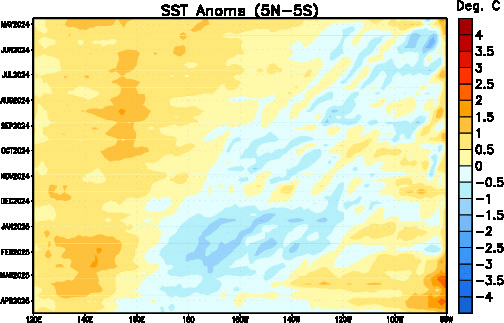
And March 2010:
http://www.osdpd.noaa.gov/data/sst/anomaly/2010/anomnight.3.11.2010.gif

seems a weaker signal than
March 1998:
http://www.osdpd.noaa.gov/data/sst/anomaly/1998/anomnight.3.10.1998.gif
Lucia – I am skeptical about the fact that January and February have been very hot world wide.
It must have been very very hot somewhere!
I would like to see some raw data charts going back many years, with seperate maximums and minimums, of individual locations in those hot areas. Degrees celsius too would be more convincing than abnomolies.
The Arctic, UAH NoPol for example, has been very warm the last couple of months. That’s different from 1998.
1997-8 2009-10
Dec -0.21 1.98
Jan 0.87 1.66
Feb -1.29 2.32
I don’t know why we ponder over tenths of a degree.
Here’s Casino Airport from `1995 to 2009 – there are two graphs because there are two Stevenson screens within 370m of each other. The blue is an automatic station, the pink is read twice a day. They vary by around 5 – 7 C which is the range we quibble about.
http://users.tpg.com.au/johnsay1/Stuff/Casino_location.jpg
http://users.tpg.com.au/johnsay1/Stuff/casino.jpg
The blue data goes back to 1908 – the pink data started in 1995.
Go figure!
lucia, you are giving nice informations with those monthly reports.
.
but the replies by your readers, demonstrate that a significant part of them are denialists.
.
I would like to see some raw data charts going back many years, with seperate maximums and minimums, of individual locations in those hot areas. Degrees celsius too would be more convincing than abnomolies.
.
degrees celsius ARE a anomaly!
Sorry but this site is getting very boring. You can keep hacking away at monthly temps forever if you want.. it means nothing especially GISS etc
Ausie Dan (Comment#37855):
While GISTEMP data is not available in absolute form, RSS MSU TLT data is at the KNMI Climate Explorer:
http://climexp.knmi.nl/selectfield_obs.cgi?someone@somewhere
You could analyze the data in any way you wanted. Examples: Here’s a graph of Global TLT (not anomalies) and the linear trend:
http://i40.tinypic.com/141qvra.png
And here’s a graph comparing Annual Minimums, Maximums, and Means for Global TLT and their trends:
http://i40.tinypic.com/260g26f.png
And there’s always Global TLT anomalies and linear trend:
http://i41.tinypic.com/2qan2wj.png
At present, the RSS TLT data at KNMI is lagging a few months. And SST data (not anomalies) is available for most datasets through KNMI.
I’m not sure what you believe you can learn from absolute data that you can’t determine from anomalies, but there is absolute data available. There’s simply no gridded absolute land surface temperature data that I’ve found.
Bob: You might find surface numbers in absolutes if you used one of the model re-analysis products. Never from observations alone.
But yes, in most cases when somebody thinks they wants absolutes, the anomalies are fine for whatever they want.
Bob
Absolutes would be useful if you were making USDA plant hardiness maps. Absolute precip would be useful if you want to really determine water availability.
That’s not what most people reading climate blogs are trying to figure out though. 🙂
Assuie Dan,
I’m not projecting the trend into the future. I’m just showing what the result is if you compute those trends.
Now: Notice the observed MEI corrected trend (solid yellow ) is less than the 0.2C shown for reference. So, ask me this:
BBCAussie Dan: Do you agree that from19951980 to the present there has been no statistically-significantglobal warmingdifference between the observed trend and the nominal projected value of 0.2C/decade.Lucia: Yes, but only just. I calculated the MEI adjusted trends for the period 1980 to the present and subtracted the nominal trend of 0.2C/decade. This difference in the trends is negative, suggesting the models may over-predict warming, but this difference is not significant at the 95% significance level. This negative difference in trend is quite close to the significance level. Achieving statistical significance in scientific terms is much more likely for longer periods, and much less likely for shorter periods.
(By the way, I could elaborate and note that we do, in fact, achieve statistical significance for longer periods.)
Now, do you dislike to trend lines so much?
My personal measure of the strength of the El Nino is the 3.4 region.
It is currently holding at slightly over +1, down from Nov – mid Jan where it was about 1.5.
It should remain at this strength for another month at least because of a few reasons.
1) The 20 deg thermocline is still below the surface off Peru and cooler waters are slow to make their way to the surface.
2) SOI is headed back down which will result in weaker trade winds for about a month, thus reducing the speed of the rising thermocline (in the East).
3) There is yet another kelvin wave making its way across the equatorial pacific at this time and looks like it has at least 3-4 weeks left on it’s course.
After about a month the El Nino should start to weaken in strength to about .5
So yes, El Nino should cause global temps to stay up a while, especially since there is usually a short lag between El Nino conditions and global temps.
BBCAussie Dand: Do you agree that from 1995 1980 to the present there has been no statistically-significant global warming difference between the observed trend and the nominal projected value of 0.2C/decade.
Mike: No, because El Chichon (1982) and Pinatubo (1991), the breakdown of the Soviet Union, and clean air legislation in the western world in the past 20 years has lead to a significant reduction in aerosols which usually have a cooling effect on global temps. The two volcanoes reduced the effects of El Ninos which would have left little or no trend.
Lucia, Might I suggest thay you use ONI instead of MEI. ONI is a 3 month avg of temp anomalies in the 3.4 (unfortunately there is no measure across the entire equatorial Pacific) whereas MEI is a measure of 6 variables, 4 not related to temperature.
MikeC–
a) Do you have the link to ONI?
b) Given 2, I would make the choice based on highest degree of correlation since 1950 and/or whether or not someone has used that correlation in a peer reviewed publication. (The reason for the latter is not that metric is necessarily superior, but that if I were to slap something together for a publication, showing someone else used it before tends to be useful in the whole process. Also, if something is widely accepted as having excellent predictive ability by those publishing, there is always the possibility that they are actually right. So that favors picking what people do accept as the ‘explanatory’ variable. )
The fact that MEI is a measure of 6 variables, 4 not related to temperature is not point against it. It is selected because it is considered a predictive indicator. If the predictive indicator was “population of iguanas in Darwin”, but “the literature” firmly believed that was an indicator, complete with explanations of why, I might take a look at that. (Ok.. I admit if it seemed utterly loony, I’d be hesitant to propagate that. But the other variables in MEI aren’t “population of iguanas”. They are climate variables and actually relate to the phenomenology of El Nino.)
Wow, I thought you’d be familliar with it, here ya go.
http://www.cpc.noaa.gov/products/analysis_monitoring/ensostuff/ensoyears.shtml
… and population of iguanas might be a better predictor of the local belt industry…
But 4 of the variables in the MEI are predictive indicators (very short term except in the case of the cloudiness)… the other two, marine air temps and SST’s are more the final product
on the other hand, if you could figure a way to average all of the nino regeons and smoothe them a little you could make Lucia’s Nino index… would probably be a better indicator of the effect ENSO on global temps too… and it wouldn’t seem loony at all
I think Dr Wolter developed MEI before they had a good handle on that whole Kelvin wave thingy down there
Mike C and Lucia: Why use MEI when discussing temperatures? The most recent MEI was “determined by assessing its ability to explain the most global precipitation variance, compared to the original MEI and other ENSO indices.”
http://ams.confex.com/ams/89annual/techprogram/paper_148776.htm
So if you’re studying precipitation, use the MEI.
And why wait for ONI? It’s a 3-month average. Why not simply use raw NINO3.4 SST anomaly data? Depending on the dataset, the start dates run as far back as the 1850s, though it gets really questionable before the opening of the Panama Canal. Geert Jan has three NINO3.4 datasets (Kaplan, HADISST & ERSST.v3b) available on his monthly indices page:
http://climexp.knmi.nl/selectindex.cgi?someone@somewhere
Or you can enter the coordinates (5S-5N, 170W-120W) in the dataset of you choice (HADSST2, HADISST, Kaplan, ERSST.v3b, ERSST.v2, and OI.v2) in the Climate Explorer Observations page:
http://climexp.knmi.nl/selectfield_obs.cgi?someone@somewhere
Of the major SST datasets, HADISST is identified most often by name in Google Scholar, but most peer-reviewed papers cite the author, not the dataset name, so it’s tough to determine which dataset is actually used most often.
OI.v2 SST data is also available on monthly and weekly bases through the NOAA NOMADS website, and their preliminary monthly data is available near the first of the month, with the final monthly data available on the 5th to 11th depending on the month:
http://nomad1.ncep.noaa.gov/cgi-bin/pdisp_sst.sh
This is the sort of stuff that begs the question: of what good are these stats?
The NH has suffered from one of the worst memories in history, and last summer’s cool effected crop yields, but our climate scientists tell us it was warmer than ever, according to their models.
If, in the midst of a tough winter, we are told to in effect ignore our lying eyes because we allegedly haven anomaly of 0.71o, are we actually being told anything of any significance at all?
One wonders how important this data actually is for anything other than sustain bandwidth use on the internet?
Bob, Like I said in an earlier post, My personal is 3.4, I suggested she use ONI because the numbers are published and they define El Nino and La Nina events. But you are basicly suggesting the same thing as I did except you already knew how to access the data… now y’all would have to call it Bob and Lucia’s Nino index.
Hunter, DeWitt Payne gave you the answer earlier. Or at least part of it. There are more than just the El Nino happening at any time but El Nino gets the most attention because it has more effect on global temps than any other weather condition.
As for weather in the US, it is actually common for the US 48 to have cool temps during El Nino, in the same way that Alaska usually has warmer temps during El Nino. But what is certain, excepting years affected by volcanoes, El Nino years are warmer globaly.
“are we actually being told anything of any significance at all”
No.
Andrew
Hunter:
There is no model involved here. This is just measurements.
If you want to see what the map looks like, you can do that.
I’m not sure how stable this URL is, but
http://data.giss.nasa.gov/cgi-bin/gistemp/do_nmap.py?year_last=2010&month_last=2&sat=4&sst=1&type=anoms&mean_gen=02&year1=2010&year2=2010&base1=1951&base2=1980&radius=1200&pol=reg
The world extends beyond your doorstep.
RE: DeWitt Payne (Comment#37858)
“The Arctic, UAH NoPol for example, has been very warm the last couple of months. That’s different from 1998.
1997-8 2009-10
Dec -0.21 1.98
Jan 0.87 1.66
Feb -1.29 2.32”
.
Theses are effects of a powerfully negative Arctic Oscillation. Also note a strong and persistent (Jan; Feb) positive temperature anomaly for Greenland and central northern/NE Canada. The negative AO is a complicating factor absent from the big El Nino of 1998, and perhaps an overlooked component of the very high global average temperatures in 2010.
Dominic (Comment#37923) March 13th, 2010 at 10:35 am
I don’t think so. It would cancel itself out in that regard. The winds shifted; extra warm in Greenland/Arctic, extra cold in parts of the US. That should be pretty much a wash in the global average.
“The world extends beyond your doorstep.”
So spaketh Carrot Eater as he(?) anonymously sits staring at his(?) computer monitor posting a seemingly endless stream internet blog comments. 😉
Andrew
Re: MikeC (Mar 13 08:43),
I’m familiar with the existence of many indices, but sometimes, finding a specific correct data page involves googling and clicking links for 15 minutes. Since you are suggesting using it, I figured I’d make you find the link for me. Thanks for the ONI. 🙂
Re: Bob Tisdale (Mar 13 10:07),
I’m trying to process what you are telling me in the context of my application. To create an ENSO adjusted trend to permit comparisons between climate model simulations and observations published monthly, I don’t need upto date ENSO metrics at all, so daily figures aren’t necessarily any more useful to me than monthly figures. In fact, for my application, I would just average those anyway!
If MEI better explains precipitation and ‘metric X’ better explains global surface temperatures, I would be happy to use ‘metric X’. What I want is a pre-exiting metric, not of my devising, that ‘explains’ the ENSO component of the global surface temperatures.
I know there are a lot of ENSO metrics.
For my purpose, the necessary features of the metric are:
1) One and only one pre-existing published not-computed by me metric. (I will not use a combination of measured variables my own devising. To create one and justify it is a research project in itself and only clouds the analysis I want to do. I want something familiar to people. I don’t want to have to write a section discussing my own, brand new metric.)
2) Metric is accepted by climatologists as being positively correlated with global surface temperature for a long period.
3) If more than 1 metric meets requirements 1&2, pick the one with the best correlation with surface temperature or the one that is most used for this specific purpose. (I don’t care what is most used for any other purpose.)
Even though MEI may be designed to predict precipitation, it still meets 1&2. So, I use that until I find something better.
Of those you list, do can you suggest whether any meet requirements 1&2?
Re: MikeC (Mar 13 10:15),
I absolutely, positively, do not wish to correct using an index I have created when testing whether the multi-model mean from simulations agrees with observations.
Thanks for the link to the ONI! I’ll look at that.
Re: Andrew_KY (Mar 13 10:49),
You are anonymous. It’s silly for you to needle others for being anonymous.
You post a lot of internet comments; it’s silly for you to needle other for posting internet comments.
Lucia,
I’m not anonymous. Andrew is my name. I doubt that Carrot Eater’s real name is Carrot Eater.
And I’m not needling CE for posting comments. I’m needling him(?) for making Profound Proclamations about the the Outside World when he(?)’s spending a lot of time propagandizing in cyberspace.
Andrew
I just went poking around the GISS station data and it seems that the arctic was, on average, cooler in 1998 than today. I would also suggest that aerosol reduction since then plays a role.
Lucia, Re your desire to use published info, then using Bobs suggestion to find the most suitable area from the SSt data should suffice.
But you really need to make an aerosol adjustment… Gavin has some numbers on that since he needs to add them to his model (which he has openly shared before)… but as usual, watch any of that data like a hawk!
… oh, and my last name really isn’t C
lucia (Comment#37928): The MEI includes a trend that does not exist in the SST (ONI) data. The easiest way to illustrate this is to subtract ONI data from MEI data.
http://i43.tinypic.com/5voj01.png
So to comply with your requirements, I’ll go along with Mike C. ONI would be best.
“The NH has suffered from one of the worst memories in history”
Truer words were never spoken. Freudian slip?
“I’m not anonymous. Andrew is my name.”
Prove it. Name, surname, maybe a couple links to your education and your job. You are not telling people who you are by throwing up a first name. Don’t be a hypocrite.
Bob, do you have a graph that includes the 4 nino areas already put together?
Robert,
“Prove it.” Is not a standard we use here in Climate Science. 😉
Anyway, I’m not asking for proof of anyone’s name. So i’m not being hypocritical.
I’m asking that the person who wants accountability from others, be willing to be accountable him(?)self. Maybe you should ask CE how he plans to reconcile his inconsistency.
Andrew
Re: carrot eater (Comment#37924)
“I don’t think so. It would cancel itself out in that regard. The winds shifted; extra warm in Greenland/Arctic, extra cold in parts of the US. That should be pretty much a wash in the global average.”
.
Fair point. Nevertheless the size of the temperature anomalies and the areas affected was/is considerable: Eastern Siberia (which I did not mention), central N and NE Canada, Greenland and to a lesser extent the Arctic itself. Sum with the negative temperature anomalies for the US, Europe and Russia and the result will be a moderate positive. So, higher global average temperatures.
“Prove it.†Is not a standard we use here in Climate Science.
BWAAAAAAAAAAAAAAHAHAHAHAHAHAHAHHA
Hide the decline, hide the hypocracy…. yep, that’s climate science!
Dominic (Comment#37941) March 13th, 2010 at 12:01 pm
I’m not so sure you can just say that, without doing some math. The cold areas were also substantial; and then one has to consider the magnitudes.
I’m just speaking from point of view of mechanism. If it’s just the winds shifting pattern, I wouldn’t expect a large change in the mean. Things get shuffled around, but the energy content doesn’t change, in the absence of secondary effects.
That said, I’m not sure how easy it would be to do the math. If the only thing that happened was an AO shift, it’d be easier. But you can’t isolate that from ENSO and whatever else very easily.
Dominic, During El Nino there is usually a warm pressure center that sets up SW of Alaska and a warm flow pushes up the Eastern Seaboard of the US which gives New England (and a bit of Canada’s east coast) moderate winters during El Nino years. So arctic areas in those vacinities will experience unusual warmth during El Nino winters. Also, these conditions cause cold arctic air to drop down farther into the US to give winters like the one we just had.
Re: Andrew_KY (Mar 13 12:00),
If you are asking CE a question, ask it directly. No of us are sufficiently psychic to figure out the question you tell us lies hidden within your obscure cracks about his use of a pseudonynm.
I don’t think CE’s requests for accountbility are inconsistent with his use of a pseudonym, but I have no interesting in posting a 4000 word essay explaining my reason.
That said, I think Anthony is accountable. Members of the public will individually assess his credibility based on his track record. Of course, since he’s never been made chair of the IPCC, if he fumbles, he can’t be ejected form that position of public trust. If CE wants that sort of accountability, he’ll need to first give Anthony the position, and then hold the investigation of any violations of public trust afterwards.
Note however that my counter argument to CE has nothing to do with his choice to use a pseudonym. Nearly anonymous blog commenters are permitted to post their concerns about accountability, and we can all discuss our views.
Further, as a matter of blog etiquette: Pseudonym are permitted here. For that reason alone, you should not be needling people for using them.
What’s more, you use a pseudonymn yourself, and your needling others for their use– whatever question you think you have hidden within your barb– is bizarre. Please stop.
Andrew_KY (Comment#37940) March 13th, 2010 at 12:00 pm
There is no inconsistency. If I say something that turns out to be clearly wrong, I will recognise that. If I accuse somebody of fraud, and it turns out to be baseless, I will retract that. If I don’t really understand some aspect of what I’m discussing, I say that up-front, or use uncertain language. I will not cherry pick instances to make a point; I will consider the breadth of both the data and the literature, so far as I’m familiar with it. I will not misrepresent the methodology that somebody uses.
Watts and d’Aleo could use the names Fred Flintstone and Barney Rubble, for all I care, but I would ask those things of them.
“I don’t think CE’s requests for accountbility are inconsistent with his use of a pseudonym, but I have no interesting in posting a 4000 word essay explaining my reason.”
Lucia,
OK, Ill stop talking about names.
You don’t have to post a 4000 word essay, though, explaining your reason. A paragraph would suffice. 😉
Andrew
Re: carrot eater (Comment#37943)
Indeed. A hard problem not suited to the back of an envelope.
As you say, much depends on the relative size of the anomalies. I should be clear: I suspect (but do not assert) that the very high latitudes where the warm anomalies are occurring gives an ‘overall warm average’ outcome the edge.
It is cold at mid-latitude, but the negative anomaly is relatively smaller than the warming further N.
Re: MikeC (Comment#37944)
Of course you are right, but my point was that the peaking El Nino NH effects were being amplified by the unusual circumstance of a strongly negative Arctic Oscillation happening at the same time.
Dominic (Comment#37950) March 13th, 2010 at 12:21 pm
I can agree with you there.
I’ll also point out that the polar regions are generally where you see the most warming over time, so you’d also have to do a comparison which removed that long term trend first, when assessing the AO itself for the last couple months.
Dominick, a point5 made by DeWitt Payne early in the thread which I later pointed to, no disagreement with ya there
Lucia, Bob Tisdale,
Tamino used MEI in his attempt to reduce the uncertainty limits. Maybe that is the reason to use MEI instead of some other metric?
.
FWIW, it looks to me like Nino 3.4 does account for more short term temperature variation than MEI.
Re:carrot eater (Comment#37951)
Yes, factoring out Arctic warming would have to be done… But it was mention of Arctic temperatures that prompted my original comment on DeWitt Payne’s post comparing some winter 1998 Arctic average temps to 2010.
The very sharp rise for winter 2010 compared to 1998 is interesting as it is considerably greater than the Arctic warming trend.
This is what makes me suspect that the collision of a negative AO with a peaking El Nino may have a net positive effect on overall global average temperature calculations.
However, I freely admit (for the second time) that this is speculation and we all agree that demonstration would be a demanding project. And it’s Friday night.
Thank you and MikeC for your comments.
Dominic
MikeC:
How is this statement:
As for weather in the US, it is actually common for the US 48 to have cool temps during El Nino
consistent with this figure published by the CPC:
http://img690.imageshack.us/img690/6158/cpcelnino.gif
?
It’s fun to compare the temperature fluctuation spectrum to the spectrum from the MEI. There seems to be no question that MEI is driving part of the observed short-term climate fluctuations, particularly the 3.5 year (0.28 1/year) and 4.9 year (0.205 1/year) spectral components of the MEI.’
Detrended GISTEMP temperature fluctuation spectrum vs MEI
I got the MEI data here.
Torn8to, go to the map you linked and draw a line between Canada and the lower 48 and that will answer your question.
Dominick:
I suspect you would need to include an interaction term between the two, the amplification of temperature fluctuations is dramatic enough, they probably can’t be treated as independent.
MikeC:
I already did that. Bismarck, ND, just to name one city is clearly in the red. Their winter was more than 4 degrees below normal. Again, how is the statement consistent with the figure?
Torn8to, You’re kidding, right? You use a city way up north and disregard the rest of the country? Is Bismark North Dakota really represebntative of the lower 48, especially in this context?
Pardon the typoes, I was laughing so hard there
Someone please help this guy out, I’m gonna go eat n dont wanna get chicken grease on my keyboard
MikeC:
The figure shows “cold” roughly from Texas east to Florida and Georgia. That’s about 6 states – hardly the “US 48”. You must be laughing at yourself.
MikeC (Comment#37939): I don’t have a comparison of the SST anomalies of the four NINO areas in one graph, at least none that I’d post. It’s hard to differentiate between NINO3, NINO3.4, and NINO4. They overlap considerably and it’s difficult to see how they compare. So you’re on your own for that one. NINO1+2 vs NINO3.4 is eye opening, though, and that I will post:
http://i39.tinypic.com/1072vrt.png
Torn8o, if you look at the RSS monthly anomaly map for the US:
Accessible here
for December, January or February, you’ll find that your suspicions are correct: It has been cool in the US 48.
If you go to 1998 and do the same thing… it was very warm there.
He who has the last laugh, laughs best?
Torn8o, The wet areas are usually a bit cooler too. So don’t forget California to Texas. Never the less, compared to the Northern area of North Dakota, I’d say the cooler anomalies in the south pretty much catch it, even if you just include the areas that are marked cold.
Bob, Just Nino 1, 2, 3 and 4… Nino 3.4 wont matter then. Any chance you can pull those areas up, combined?
MikeC wrote:
Is this based on some official list or on the 3.4 region you mentioned, ‘your personal measure of the strength of the El Niño’? How do the other years stack up?
I thought this Niño was a moderate one, especially compared to the Niño of ’98, but if it isn’t, that explains the recent high temps, despite the relatively inactive sun and negative PDO. And a bit of CO2 forcing, of course.
Bonhb, I was thinking taking three metricks… add the nino regions, and an aerosol adjustmentor maybe GISS minus the aerosol adjustment then compare it to the 4 nino regionsthen compare it to GISS…
Okay, let’s try that again with less laughter…
Bob, I was thinking taking three metricks… add the nino regions, and an aerosol adjustment and compare it to GISS… or maybe GISS minus the aerosol adjustment then compare it to the 4 nino regions
Nevin, my personal measure was in a different context…
Here is the ONI that was shared with Lucia earlier, this year comes in 4th behind 1972-73, 1982-83, and 1987-88…
http://www.cpc.noaa.gov/products/analysis_monitoring/ensostuff/ensoyears.shtml
Re: Neven (Mar 13 14:02),
I don’t know the basis for his claim of “4th strongest El Nino”. However, MikeC posted ONI numbers. The ONI hit 1.8 in december. That’s the highest since the 1998 El Nino, which hit 2.5 in 1997. ( Lots of the high months were in 1997– the earth’s temperatures tend to lag these indices.)
The 1983/82 El nino has ONIs hit 2.3. The 1972 El nino hit 2.1.
On that basis, these seems the 4th largest since 1950. A quick count shows 16 El ninos since 1950.
Of course, how long these events last also makes a difference to the effect on the annual average. But maybe we can call this one a “medium-large El Nino”?
Here are the ONI numbers.
http://www.cpc.noaa.gov/products/analysis_monitoring/ensostuff/ensoyears.shtml
So, getting back to the first comment on this thread….
“Shaping up to be the 4th most powerful El Nino in the record… and just the second to happen at a time with low aerosols in the atmosphere, so second warmest temps should be expected”
Thanks a lot for that!
Mike C: You asked, “Bob, Just Nino 1, 2, 3 and 4… Nino 3.4 wont matter then. Any chance you can pull those areas up, combined?”
When you earlier wrote about a combined graph, I obviously misinterpreted your question. What you’re asking for is a graph of a dataset that captures the equatorial Pacific (5S-5N) and extends from 160E to 90W, for the NINO3 and NINO4 regions, then shifts 5 deg to the south (10S-0) to capture the NINO1+2 longitudes of 90W-80W.

http://www.pmel.noaa.gov/tao/elnino/gif/ninomap.gif
The problem is the shift in latitude, unless I was to download the data separately and create a weighted average. You don’t want that, and I don’t want to manufacture a special dataset.
But the KNMI Climate Explorer allows users to enter the coordinates of their choice for half a dozen different SST datasets, and download the data:
http://climexp.knmi.nl/selectfield_obs.cgi?someone@somewhere
You could then tweek it any way you wanted.
MikeC (Comment#37985): Depends on how far back your data goes. If you extend it back to the 1870s, the 2009/10 El Nino has the 7th highest NINO3.4 SST anomalies:

http://i42.tinypic.com/dqrxhv.png
Regardless, it’s still a strong El Nino in terms of NINO3.4 SST anomalies.
But in terms of Sea Level Pressure (SOI) it’s commonplace:

http://i41.tinypic.com/34pj9nd.png
Also, you wrote, “…and just the second to happen at a time with low aerosols in the atmosphere…”
I assume you’re referring to volcanic aerosols, and not anthropogenic aerosols.
I assume you’re referring to volcanic aerosols, and not anthropogenic aerosols.
Bob, I was referring to both, and natural aerosols (dust, sea salt, soot from fires etc) The volcanic are going to have the most impact on the trends… since Lucia uses sat era graphs, El Chichon and Pinatubo adjustments would significantly reduce the trends since those both reduced the effects of El Nino events.
At the same time, there have been changes in anthropogenic aerosols. The breakdown of the Soviet Union and clean air legislation in much of the western world has cleaned much of the low altitude air. The AGW crowd used to make a huge error in anthro aerosols, they mistook changes in ocean circulation for them. Not sure if they have gotten squared away… last I heard was a couple years ago, we were talking to the guys running the Purdue model and they were still making that mistake.
Re MikeC (Comment#38017),
The problem with what you have postulated is that at the same time that the west cleaned up its act, the east got down and dirty. “Asian brown cloud”, anyone?
Alex, the Asian cloud would certainly be factored into the equasion. But we should really get the optical depth numbers because even the pollution created in Asia today would not match the pollution that was being created by the west and the Soviet Union.
Perhaps. I would like to see some data.
The brown cloud over Thailand is there alright. I’ve seen it. The sun looks red all day in Bangkock. The increase in rainfall in the NW of Australia has been attributed to it.
In terms of which ENSO index to use, one should use the index that provides the best match to global temperatures or to tropical temperatures and that is the Nino 3.4 index (with a 3 month lag). The Nino 3.4 index goes back to 1871 and even earlier which means you have more data to work with to assess correlations etc.
The ONI is a 3 month running mean of the Nino 3.4 index (which also means the data is always one month behind).
The MEI has six different variables in it and one has to rely on Klaus Wolter updating all the data. One has to reload the database each time if new data becomes available or is reanalyzed. The MEI doesn’t have to be lagged though. I believe it only goes back to 1950 and is really a 2 month data point rather than monthly as the other indices are.
One can also get weekly Nino 3.4 index values if you want to stay more up-to-date. For example, the ENSO peaked in the week leading up to Dec. 23, 2009 while you wouldn’t know that with the other indices.
http://www.cpc.ncep.noaa.gov/data/indices/wksst.for
Lucia,
Just out of curiosity, why have you stopped ‘falisfying’ the IPCC claim of a warming of 0.2C per decade?
MikeC
“because even the pollution created in Asia today would not match the pollution that was being created by the west and the Soviet Union.”
How do you know that? How could anyone know that? Did they have satellites back then?
http://oceancolor.gsfc.nasa.gov/SeaWiFS/TEACHERS/ATMOSPHERE/ChinaPollution.jpg
You know, I think I’ve finally understood the fundamental thing wrong with Lucia’s statistical argument (“falsification” and all that). Because, looking at the curves drawn above, that dashed black line sure looks close to the orange “prediction”. And yet the 95% C.L. bounds are pretty tight and the orange line is just on the edge of it.
So, suppose we had more statistics and temperatures really were steadily warming at the same rate decade after decade. Say we had 1000 years of actual steady warming at 0.19 C/decade, while the prediction we’re checking against was 0.2. Given the same sort of statistical behavior of temperature, instead of 95% C.L. bounds of 0.17 to 0.21, we’d have bounds something like 0.187 to 0.193. Therefore the “hypothesis” of “0.2 C/decade” is resoundingly rejected! It’s well outside the 95% CL range of 0.187 to 0.193!!!
But is that, at all, a useful way to assess the usefulness of the “prediction”? I think not…
Arthur–
Could you define what you mean by “pretty close”? And also, whatever you mean by “pretty close”, why can’t we diagnose that the predicted mean differs from the actual trajetory of the data?
Of course. And then we’d just say that. But it’s not really comparable to the actual case is it?
Since the 1950s the multi-model mean projection predicts roughly 40% more warming than observed. If you think that’s too small to bother over, say so. But I don’t see anything wrong with noting that the difference is both statistically significant and almost a factor of 2!
A bit OT, but I’m sure the commenters on this thread can answer my question and push me in the right direction… I’ve often seen the claim that 14 of the warmest 15 years have occurred since 1997… just what is that reference based on?
Si P (Comment#38102)
March 15th, 2010 at 12:09 pm
No, they didn’t have sats back then, they used land based instruments like the one on Mauna Loa.
But here is an example of satellite era measures (and no this does not mean I endorse Wikipedia)
http://en.wikipedia.org/wiki/File:Aerosol_dimming.jpg
I’m hoping to see something emprical from longer term land based measurments but I have not been able to find anything
Robert E. Phelan,
Most likely HadCRUT, though GISS or NCDC most likely give the same results. UAH or RSS would probably be more in the 12-13 of the 15 warmest, though I’d have to check.
Arthur
Robert Grumbine, Tamino and another bogger ‘Possum’
http://moregrumbinescience.blogspot.com/2009/01/results-on-deciding-trends.html
http://tamino.wordpress.com/2009/12/15/how-long
http://blogs.crikey.com.au/pollytics/2010/01/17/nerdy-sunday-when-trends-go-bad/
all give good clear descriptions on what is wrong with falsifying the 0.2/decade projection using short time spans. I am sure there are more than just those three, but they’re the three I have seen.
I think the telling thing is, Arthur, that Lucia has stopped doing those posts. She doesn’t claim the data falsify the IPCC projection anymore.
‘Since the 1950s the multi-model mean projection predicts roughly 40% more warming than observed.’
But we know that the multi-model mean isn’t a ‘target’. Hey why don’t you publish that finding? Put it out there for the science community to see, why keep it hidden on your blog?
And a warming of 0.16/decade is ‘about 0.2/decade’, so the GISS data supports the IPCC claim now, yes?
Nathan–
If by falsifying, you mean demonstrating that the multi-model mean is inconsistent with the observations, these are either a) irrelevant, b) wrong, c) misguided. Different ones make different errors, but they confuse the the difficulties with over interpreting the meaning of “fail to reject” with “reject” and/or have some odd notions about needing to get the trend to ‘converge’ to some precise value before we can reject trends that are clearly wildly different. This is nonsense.
I haven’t stopped testing models against observations. What nonsense.
What are you talking about? The IPCC uses the multi-model mean as its best estimate and describes why at length.
Longish story. Not going to explain that right now. I’m waiting to hear back from some collaborators, and afterwards, I’ll be writing up a more focused article.
GISS data is inconsistent if we use start years prior to 1980 back at least as far as 1950. If we treat noise as ARMA(1,1), it’s not inconsistent since 2001.
As it happens, I discussed the fact that if the models are wrong, we’d get some fail to rejects for shorter years, and eventually we’d get persistent reject. That discussions was posted quite a while ago.
Lucia
You used to do the whole trend since 2001 thingy, remember? You would falisfy the IPCC decadal trend since Jan 2001…. Surely you remember the many posts you did on that, then you stopped.
“multi-model mean is inconsistent with the observations”
What do you mean by inconsistent?
“I haven’t stopped testing models against observations. What nonsense. ”
I never claimed you had stopped, you seem to have trouble with your reading comprehension.
“GISS data is inconsistent if we use start years prior to 1980 back at least as far as 1950. ”
Hang on, but the 0.2/decade was for the period 2001- 2020.
You complaint seems to hinge on the fact the the models don’t precisly match the observed data in the past… Why is that actually a problem?
“Longish story. Not going to explain that right now. I’m waiting to hear back from some collaborators, and afterwards, I’ll be writing up a more focused article. ”
Well, that’s great news. We’ll all look forward to reading it.
Nathan
You used the word I “stopped” in your question in Nathan (Comment#38075) and then again describing what I did in Nathan (Comment#38129). From this I gathered you intended to convey the meaning “stopped”.
I didn’t stop. I still show since Jan 2001, but I switched to the actual multi-model mean from the model runs when they became available.
I also extended to show multiple years long ago because lots of people were hung up on the short time periods, and the longer time periods shows pretty much the say thing: The models are off.
I still think testing models against future data rather than past data is an important principle, but I have nothing against showing the models also disagree if we start from earlier data. I alternate start dates in blog posts. How is “stopping” doing what I did?
I’m in the process of writing scripts to show things better with ARMA(1,1) for a range of start years and getting some specific details organized to write up. So, you aren’t seeing those whipped out the same way, but I haven’t “stopped”.
Don’t precisely match? They are off by 40% since 1950. That’s almost a factor of 2. Do you think being off by nearly a factor of 2 is simply not a precise match? It’s quite a bit off. For shorter start times they are further off– though a sizable fraction of that can be “noise”.
Lucia
“You used the word I “stopped†in your question in Nathan (Comment#38075) and then again describing what I did in Nathan (Comment#38129). From this I gathered you intended to convey the meaning “stoppedâ€. ”
Ha ha! You truly are a strange individual.
Here is what I claimed:
“I think the telling thing is, Arthur, that Lucia has stopped doing those posts. She doesn’t claim the data falsify the IPCC projection anymore.”
I was specifically talking about your falsifying the IPCC projections by using the data since 2001.
Here is your interp.
“I haven’t stopped testing models against observations. What nonsense. â€
Then I said I never claimed you stopped – meaning that I had never claimed you stopped testing models against observations. Just the specific case of you falisfying the IPCC projection since 2001.
” I still show since Jan 2001, but I switched to the actual multi-model mean from the model runs when they became available.”
This is still not what I am talking about. You would make a post showing how the decadal trend since 2001 was too low and that the IPCC projection was falsified.
Lucia the models didn’t match the 1950s data ever, why does it matter? The modellers surely noticed this…
“They are off by 40% since 1950” – I await your publication with anticipation!
MikeC
I think I see what you mean – you mean both volcanic and anthropogenic ‘pollution’. But I am still not sure we can assume that globally we are cleaner now than we were in the past.
Nathan–
I do still show graphs since 2001; I have no idea why you think I don’t. Is your worry that I don’t use the word falsified and simply point out when the trend is inconsistent with observations at a significance level of 95%?
Why don’t you just run the numbers? It’s easy enough to compute the two trends.
Nathan–
Just for you, I promise to show the graph since 2001 when the Hadley data come out. Deal?
Nice – US looking a bit flat then
http://chiefio.wordpress.com/2010/03/16/north-america-flat-canada-not-so-much/
http://www.drroyspencer.com/2010/03/direct-evidence-that-most-u-s-warming-since-1973-could-be-spurious/
Si P–
The Spencer post is interesting.
Breaking News: 😉
“Senator James Inhofe (R-Okla.) said Monday that Nobel Laureate Al Gore, “the world’s first potential climate billionaire,” is running for cover as a result of various scandals surrounding his favorite money-making theory known as manmade global warming.”
http://newsbusters.org/blogs/noel-sheppard/2010/03/16/inhofe-al-worlds-first-potential-climate-billionaire-gore-running-cov
Andrew
Re: Arthur Smith (Mar 15 12:33),
All those years of being off by 0.1 per decade in your example would mean that the model would ultimately be off by a total of 10 degrees. Chortling about narrowing error ranges when the total error in the outcome is that great is odd behavior.
Think how many mugs lucia will sell in 1000 years if the models keep failing by more than 1 degree per century!
Unfortunately, this is bound to negate most of the trend graphs posted on this site:
http://wattsupwiththat.com/2010/03/16/spencer-direct-evidence-that-most-u-s-warming-since-1973-could-be-spurious/#more-17364
Looks like chiefo is embarrasing the h@@ out of the AGW and maybe even lukewarmers!
http://chiefio.wordpress.com/2010/03/16/north-america-flat-canada-not-so-much/
Stephan–
Spencesr stuff is intersting. Chiefios is not.
First comment. Lucia, who is VS? He left Tamino crazy.
paulo,
VS claims to be a practicing econometrician. Based on his dialogue with Tamino (and on other blogs), he seems to be expert in statistics – or at least more expert than Tamino. He clearly got the best of Tamino in the interchange so, not surprisingly, Tammy insulted him and asked him to go away. No shock there.
Re: paulo arruda (Mar 16 13:01),
I have no idea who VS is. Is he someone commenting at Tamino’s? I’ve never read theat particular handle. Based on brid’s comment, I’m going to have to dash over there and see the exciting exchange!
Where can we read the Tamino vs VS ? Sounds intriguing.
http://tamino.wordpress.com/2010/03/11/not-a-random-walk/
VS
VS played with Tamino in his area and he did not notice
Lucia,
The more detailed VS thread is here:
http://ourchangingclimate.wordpress.com/2010/03/01/global-average-temperature-increase-giss-hadcru-and-ncdc-compared/
Arthur Smith:
LOL!!!
You worked this hard, thought that long, and that’s what you came up with?
WOW!
Don’t wait! Hurry back to Tamino’s blog like a good boy and tell them how stupid Lucia is.
You guys must exhaust yourselves with the high brow level of conversation you have over there.
Carrick–
That was pretty funny. It’s especially funny that Arthur Smith thinks I responded to that post. I guess in this context “subtle” means, “If Arthur really, really, really wants to think my post is a response to Tamino’s, then he will!”
Many of my readers are aware that I update the “mug” type graphs from time to time to show where the temperature are relative to the projections. Why would he think my post overlaying observations on IPCC trends is a response to Taminos?
It is funny to read those comments. I’m the one with no physical insight? Let me see… hos did I come to be banned from Tamino’s comments. Didn’t I visit comments and ask whether the ‘sois-dissant’ physical model base Tamino concocted based on the 1st law of thermo violated the 2nd law of thermo? And didn’t he first insist he checked and found it didn’t violate the 2nd law. (Accompanied by an awful lot of harrumphing at the thought some one would ask?) And didn’t my readers ask me how you should check– so I explained. And it turned out his model did violate the 2nd law of thermo? And ultimately, then Tamino banned me pretty much because I was correct about the physics?
Of course not all tests are physically based. Even physical models are are subject to test that are purely numerical. So?
It’s also funny to read people complaining about me focusing on short term trends, when I’ve been showing both short and long term trends for over a year– and showing that the models don’t do well either way. Meanwhile, only yesterday, Nathan here in comments was grousing that I stopped showing the short term trends. Oh… well….
Re: brid (Mar 16 14:33),
There are good physical reasons to expect that global surface temperature is not a random walk. The first law of thermodynamics must apply. A warmer planet will re-radiate more heat to the universe. We might not know the price constitutive relation, but if the planet warms, it’s unlikelt to re-radiate less. (If it did, that would really be amazing!)
So,here really is a physical law that will tend to cause the earth’s surface to hover around some typical value. If the temperature fell to that of pluto, it would certainly warm up. If it rose to that of mercury, it would certainly cool down.
brid (Comment#38220) March 16th, 2010 at 1:14 pm
You must live in a parallel universe. Based on his dialogue with Tamino (and on other blogs) VS declares himself to be an expert that no one else can touch, gets called on his errors, then runs off.
Lucia, in my opinion, VS really blows it when he comments on the lack of a correlation with CO2. Any of us who have played with two-box models knows the relationship is a lot more complicated than that.
I agree with your other comments on physicality. VS has essentially failed to incorporate “prior knowledge” into his analysis.
Lucia:
There’s certainly nothing wrong with making the comparisons, especially if climate scientists themselves have already been doing it for decades now. The only real objection I’ve seen from this crowd is they don’t like the result (I am an AGW True Believer, your conclusions conflict with My Beliefs, Ergo You are Wrong. QED.)…
In the mean time, they have absolutely no clue what the real implications of your comparison is. Other than the political expediency of attacking anyone who dares to bring it up that is.
Si P (Comment#38150)
March 16th, 2010 at 1:39 am
Si P, There should be a difference between the natural and anthropogenic compnents of aerosols in the atmosphere. At the very least, since much of the arguing is over the smaller amounts of aerosols (anthropogenic, dust, ocean spreay, natural fires etc), there needs to be some adjustment for the volcanoes. Since El Chichon and Pinatubo created cooling in years where there should have been El Nino warming, and since both volcanoes occured early in the record, there would be an effect on the trend since 1980.
I’ve brought this to the attention of Roy Spencer and Lucia and neither of them are discussing any such thing (maybe they are busy).
SO… LUCIA… REPORT ON AN ADJUSTMENT AND I’LL TRANSFER, BY CERTIFIED CHECK… 9,457,092,348,709,234,570,932.47 QUATLOOS
Lucia
I saw you two trend line post (for Obs and for models).
That’s why I am excited at looking at your conclusions section for your paper.
And good to hear you haven’t given up on the ‘falsifying the IPCC projection’ – based on data since Jan 2001 series.
Anthony touched on this point a little by simply nulling those years…
http://wattsupwiththat.com/2009/01/14/how-did-the-el-chichon-and-pinatubo-volcanic-eruptions-affect-global-temperature-records-part-2/#more-5084
Re Tamino and VS and whatever else: is this still people getting excited about the Beenstock unpublished manuscript?
As a general rule, if an economist plays around with some statistics, and dismisses a physical theory without ever even considering any of the physics, this is probably not something worth a good deal of time.
I’m the guy who had to take Algebra 1 six times…. the last time to get through a graduate statistics course…. so I spent an afternoon reading the exchanges in Bart V’s blog… quite informative until Don Baccus showed up… but I was able to follow quite a bit of what VS had to say…. Tamino, on the other hand, (…uhh, can’t we use his real name? It’s not like anyone doesn’t know it..) just makes me ashamed because I’m so stupid.
lucia (Comment#38238) March 16th, 2010 at 3:28 pm
The short version, VS has no idea what he is talking about.
Zeke (Comment#38120)
March 15th, 2010 at 5:04 pm
Zeke, thanks. I was hoping to avoid having to do the research myself and that someone could point me to a graph…. and if YOU can’t point me, then the claim is a bit more nebulous than I expected. Nothing is ever easy.
By the way, if you are Zeke H., I’ve been following your reconstruction work and say keep it up!
… and some MLO data… http://www.esrl.noaa.gov/gmd/obop/mlo/programs/esrl/solar/solar.html
Barrow Alaska, Mauna Loa, Some place called SMO and South Pole… Intresting how Barrow has a large signal that looks like that Asian brown cloud
http://www.esrl.noaa.gov/gmd/publications/annrpt23/chapter3_2.htm
Lucia and Bugs,
There may well be a good physical reason why temperature is not a random walk. However, on the pure statistical discussion between Tamino and VS, Tamino (IMHO) came off a poor second. He didn’t even bother to read beyond VS’s first post so he missed a typo correction, performed the wrong calculation and came to the wrong conclusion (“I suspect he excluded a trend from his ADF test”.) And Tamino’s excuse for not reading past the first post: “I didn’t read all your comments at Bart’s blog, because frankly you don’t deserve the attention”. Ok, so VS was important enough to warrant two separate blog posting by Tamino, but not for Tamino to actually read what VS wrote. Tammy is amazing. He’ll do anything not to admit an error. The man has no integrity. Also check Alex’s response and Tammy’s poor rebuttal.
Bugs,
It is disingenuous of you to say “VS declares himself to be an expert that no one else can touch, gets called on his errors, then runs off.” Tammy tells him not to post again at Open Mind. VS also clearly stated he would continue on post on a neutral site (which he has and where has effectively rebutted most of what Tammy wrote). He invited Tammy to follow. Tammy appears to have a touch of a coward to him – he refuses to leave the comfy protection of his own blog or allied sites like Real Climate.
brid–
I have no idea who won that statistical death match!
Is that a quote? Or a paraphrase? Link?
But if your point is that it doesn’t make sense to write a whole post to rebut person X’s claims and then claim you didn’t actually read the claims because the person doesn’t deserve the attention… well… No. It doesn’t make sense. I think Joe Romm did that with Pielke recently? He writes posts about Pielke but thinks he’s too unimportant to debate or answer questions about. Something like that.
Also, if Tamino asks someone not to post in his comments, obviously, that person is going to comply. Their leaving is not evidence of turning tail and running.
Lucia,
It is a quote. Link here:
http://tamino.wordpress.com/2010/03/11/not-a-random-walk/#comment-40683
Lucia (Comment#38238),
I’ve tried to make the same point, that there are good physical reasons to expect the global avg temperature not to wander of at random, see eg http://ourchangingclimate.wordpress.com/2010/03/08/is-the-increase-in-global-average-temperature-just-a-random-walk/
where I collected my interim thoughts based on the long discussion with VS, Tamino, Heiko and others.
Basically, a random walk towards warmer air temps would cause either a negative radiative imbalance at TOA, or the energy would have to come from other segments of the earth’s system (eg ocean, cryosphere). Neither is the case. It’s actually opposite: a positive radiation imbalance and other reservoirs also gaining more energy. Which makes sense, in the face of a radiative forcing.
Whether the ‘naked values’ in the absence of any physical meaning or context could theoretically be consistent with a random walk is a purely academic mathematics question. Though it seems that VS has backpedaled from ‘random walk’ to ‘contains a unit root’, which Alex helpfully explained in a comment is not necessarily the same.
The statistics details go over my head at times, but on physical grounds it seems clear that the increase in global avg temp over the past 130 years has not been random.
“VS” repeatedly draws attention to both Tamino’s and Eli’s identities, without disclosing his own. So he’s a bad net citizen, and unless and until he apologises, I’m not going to read anything he writes. Besides, he’s obviously wrong about global temperatures, as is often the case when econometricians get involved in real science.
If someone chooses a pseudonym, it’s simply good manners to use it.
Re Bart Verheggen (Comment#38335),
I agree with you that VS appeared to backpedal slightly. However, I thought his backpedaling was along the lines of backing off from claiming that the temperature record since 1880 was a random walk, to claiming that statistically, it could not be distinguished from a random walk (as you say, on the basis that it had a unit root).
I found the discussion interesting myself. I think a bit of perspective is worthwhile – it’s not unusual in science for researchers to be certain of their theory in advance of the data being able to back them up. It is still valuable for them to be reminded now and again of what the data can and can’t prove.
Nick Barnes, dont sulk, you will miss a lot of great discussion. I agree about respecting Tamino’s anonymity even tho’ we all know who he is.
And is climate science a real science? I am not sure it is yet. The kind of scrutiny it is now getting will undoubtedly help. I think you can call it an emerging science.
I agree with Robert Phelan – I found VS easier to follow than Tamino.
Lucia
I do not understand statistics. The point is that VS wrote a lot of “nonsense” and Tamino did not notice. I do not know if it was on purpose. But Tamino spent a post to answer “who did not deserve attention.” Sorry, my English is bad. But I say “Lucia, I love you “:):):):):)
Nick Barnes,
Entirely agreed. It was both rude and a double standard to call others out on their anonymity.
But if your point is that it doesn’t make sense to write a whole post to rebut person X’s claims and then claim you didn’t actually read the claims because the person doesn’t deserve the attention… well… No. It doesn’t make sense. I think Joe Romm did that with Pielke recently? He writes posts about Pielke but thinks he’s too unimportant to debate or answer questions about. Something like that.
.
this makes a lot of sense actually. Tamino does focus on a specific claim. the “temperature increase is the result of a random walk” thesis.
.
he neither has to, nor should he actually read every piece on nonsense that VS wrote.
.
the same is true for the commenters here, who disbelieve in averages. i can discuss this point with them, and ignore all the other garbage they write.
And is climate science a real science? I am not sure it is yet. The kind of scrutiny it is now getting will undoubtedly help. I think you can call it an emerging science.
.
what nonsense! yes, the abuses will certainely help a lot. real sciences is born of of death threats!
.
I agree with Robert Phelan – I found VS easier to follow than Tamino.
.
yes. and i find sponge bob easier to follow that Kant. (add long pause, to let readers draw false conclusions…)
.
here is a VS gem, posted in his reply on Tamino s site:
.
Look at the temeprature series over the past couple of thousand of years. Where do you see a trend? There is a cyclical movement, but a deterministic trend? Nope…
.
again, you don t really read more of VS…
Lubos chimed in regarding the random walk meme:
http://motls.blogspot.com/2010/03/tamino-vs-random-walk.html
With regard to the claim that a random walk is physically unsound because the temperature change is “forced”, this is erroneous. If natural forcing from say changes in cloud cover due to changes in atmospheric circulation, which can arise out of the chaotic behavior of the atmosphere, act in such a way as to produce climate behavior like a random walk, then you’ve got something very like a random walk and no inconsistency in terms of the apparent “forced” effect. What is being assumed is that random processes arise out of nothing but random is not the same as “uncaused”.
All the statistics being tossed around there is a waste of time.
Weather is chaotic, yes. And features like ENSO are not due to external forcing, correct.
But:
Seasons are predictable. Summer will be warmer than winter.
Ice age cycles aren’t random. They occur, for physical reasons.
If the sun started giving off 50% more radiation, it would simply have to get warmer. You will argue about positive/negative feedbacks on precisely how much warmer, but warmer it would be.
A discussion about physics that’s entirely divorced from physics is pointless.
carrot eater (Comment#38347)-None of what you said proves that “random” changes in temperature don’t occur on the relevant time scales. It is basically saying “forcings have effects”. Sure. That’s not the discussion.
OT. You can’t make this stuff up!
“Ron Prinn, TEPCO Professor of Atmospheric Science, and principal research scientist Chien Wang of the Department of Earth, Atmospheric and Planetary Sciences, used a climate model to analyze the effects of millions of wind turbines that would need to be installed across vast stretches of land and ocean to generate wind power on a global scale. Such a massive deployment could indeed impact the climate, they found, though not necessarily with the desired outcome.”…
“In a paper published online Feb. 22 in Atmospheric Chemistry and Physics, Wang and Prinn suggest that using wind turbines to meet 10 percent of global energy demand in 2100 could cause temperatures to rise by one degree Celsius in the regions on land where the wind farms are installed, including a smaller increase in areas beyond those regions. Their analysis indicates the opposite result for wind turbines installed in water: a drop in temperatures by one degree Celsius over those regions. The researchers also suggest that the intermittency of wind power could require significant and costly backup options, such as natural gas-fired power plants.
Prinn cautioned against interpreting the study as an argument against wind power, urging that it be used to guide future research that explores the downsides of large-scale wind power before significant resources are invested to build vast wind farms. “We’re not pessimistic about wind,†he said. “We haven’t absolutely proven this effect, and we’d rather see that people do further research.â€
http://web.mit.edu/newsoffice/2010/climate-wind-0312.html
Sod, the ‘real science’ ref was to Nick Barnes (Comment#38336)
” …as is often the case when econometricians get involved in real science.”
Maybe climatology is a ‘real science’ (do share your definition, I am interested!) but when it is compared to economics it does not look like it is that much more ‘real’.
Sod, you did not quite read enough.
VS // March 12, 2010 at 12:09 pm | Reply
over the past couple hundred of thousand of years.. not thousand of years…
So it should be…
“Look at the temeprature series over the past couple hundred of thousand of years. Where do you see a trend? There is a cyclical movement, but a deterministic trend? Nope…”
And then you get Tamino’s FO…strange you missed that!
Andrew FL
“Random” changes still have to be consistent with observations, and the First Law. In this context, I take “random” to refer to re-distributions of heat due to ocean/atmosphere dynamics, with a slight radiation balance component coming from resulting changes in clouds. But there aren’t the observations to support the idea that this mostly explains what’s happened over the last 30 years; there are observations to support the idea that there is forced change.
carrot eater (Comment#38357)-Your definition of random is erroneous. It doesn’t have to be a redistribution of heat to be random. Random changes in cloudiness, which do occur, can impact the radiative budget and thus “force” change.
Forced and Random are not mutually exclusive.
Andrew
Sure.
But suppose we create a toy model with cloudiness varying either “on” or “off”, with more forcing when cloud are off. At time zero, assume the clouds are “off”, have been off for a long, long time, and the earth’s temperarure is at 0. Turn the clouds on. Suppose for the sake of argument that if the clouds are on for a long, long time, the earth’s temperature will asymptotically approach 10 but go no higher.
Now, start your experiment:
Earth temp =0, clouds turn on for 1 month.. Earth temperaure warms to (10-0)/2 = 5.
Flip coin: Clouds stay on for another month: Earth temp warms to 5+(10-5)/2= 7.5.
Flip coin: Cloud turn off for a month. Earth temp cools to (7.5-0)/2 = 3.25.
Keep flipping the coin and following the rule. If the coin is fair, the earths temperature will tend to return to 5.
You can come up with more complicated toy problems. But the earth does have the feature that if it’s surface temperature rises, all other things being equal it radiates more heat into space. So unless you create a system where the warming earth reduced the cloud cover, and cooling increases cloud you are going to find the earth temperature returns to some preferred level between 0 and 10. (If warming tends to reduced cloud cover and cooling increase it, given the other rules for the toy, you’ll tend to end up with an earth stuck at 0 or 10 either much of the time or possibly all of the time.)
An interesting comment by Nick Barnes:
“…“VS†repeatedly draws attention to both Tamino’s and Eli’s identities, without disclosing his own. So he’s a bad net citizen, and unless and until he apologises, I’m not going to read anything he writes…”
This seems a bit overwrought. Bad net behavior is to be the first to reveal the identity. Repeating something that is already well know seems to be well within ethical boundaries. We all (or at least many of us) knew or suspected Tamino was GF long before the CRU hack/leak released this fact to the world. So it’s not like VS was revealing anything new.
Plus Tamino has effectively “outed” himself a few times by trying to play both sides of the fence – maintaining anonymity while claiming the authority of his peer reviewed work. A case in point is his extremely rude (shock, shock!) reply to McClean ending with “Let’s “duke it out” in the peer-reviewed literature, shall we? Expect a comment on your paper to appear soon in JGR. I can hardly wait to see how you’ll respond there.” (Link here: http://tamino.wordpress.com/2009/07/24/old-news/#comment-33282 .) It takes about 30 seconds with google to find out who published a comment in JGR. So Tamino is being too clever by half and really has no moral claim to respect his anonymity.
Eli Rabbett, on the other had, is a different story. He is a grown man with a PhD who pretends to be a bunny, only refers to himself in the third person and cannot string two coherent sentences together. Creepy. Just for the sake of his wife and family we should respect his anonymity to save them any further embarrassment. That’s just common decency.
One one further point – Deltoid revealed (not repeated) the anonymous handles of certain posters (including Steve McIntyre). If memory serves, he tried to justify this on the basis that they were sock puppets. I assume Nick Barnes won’t read Deltoid until he apologizes.
Andrew_FL (Comment#38359) March 17th, 2010 at 10:28 am
My comment was not a long one. Read it again, and you shall see that I mentioned clouds and the radiation budget.
brid:
Make that “he claims to be a grown man with a Ph.D. and claims to pretend to be a bunny.”
He may or may not have a Ph.D., but I’m pretty sure he thinks he’s a bunny.
Timothy Leary effect.
Nick Barnes:
For anybody who is themselves imbued with good manners and common decency, e.g., Carrot Eater, I would agree 100% with you on.
For myself, I will not as a general course of behavior disclose the public name of people who choose to use an anonymous name, even with respect to people who I think are churlish and undeserving of respect.
But it’s a bit unreasonable to expect other people to treat poorly behaved people like as Tamino or Eli as if they were part of polite society, when they clearly are not and where the anonymity is part of their pattern of poor behavior.
Lucia:
On the other hand, it is possible that climate could have multiple locally stable states.
For example, you could have one stable state A in which a particular AO circulation pattern was present with a net albedo say of X%.
And a second stable state B with a different AO pattern with a net albedo of Y%.
It’s easy to see that if the system is in state A its equilibrium different than if it were in state B.
This is not only possible for it to happen, it’s (to me anyway) likely that it actually behaves that way.
Carrick:
Thank you for that.
Though I do reserve the right to be feisty, at times.
lucia (Comment#38362)-But how long does it take, how long can it stay away from the “equilibrium” level? I don’t think that’s so simple.
carrot eater (Comment#38370)-I read your comment fine, you mentioned clouds responding to the temperature changes, not changing for unrelated reasons.
Carrick (Comment#38377)
March 17th, 2010 at 12:13 pm
Not only does he have a Phd but he is a Chemistry Professor at a pretty Major University. But once you get to know him… things like who he gives substantial political donations to… then you begin to understand… and the iggy button becomes the most rational end.
Now… back to how those two volcanoes biased the trend and how they should be adjusted for…
Carrick–
Yes. Given constant forcing, it is conceivable that the earth has multiple locally stable states. (It’s also a bit scary; if the state are far apart, jumping from state to state would be the definition of climatologically exciting times.)
Lucia, Ausie Dan, and carrot eater: After noting my comment on this thread, the always helpful Geert Jan of KNMI emailed to advise me that the KNMI Climate Explorer did include an Absolute Land Surface Temperature dataset. I presented the dataset in this post:
http://bobtisdale.blogspot.com/2010/03/absolute-land-surface-temperature.html