
As some of you know, Dana flung the “D” word at Richard Tol. He and a sympathizer who uses the handle “@IdiotTracker” have provided interesting definitions of either “Denier” or “acting like a denier”. Above, Josh suggest another definition of the “D” word.
I thought we might get something with Madonna.
Dumb? Ok, Rich was being dumb.
Eli,
Silly wabbit…the D on the hat stands for ‘dunce’… and Dana is world class.
And here’s me checking the site thinking their might be some sort of actual content or an interesting discussion. You fooled me!
Wobert is the idiot who does the tracking. Looks like he twacks wabbettes.
Eli,
How so? Come on, Brer Rabbit; I don’t bite, talk to me. But if there’s no discussion happening on any of the blogs I read I can’t justify sitting around in front of my computer today and will be forced to do something productive. Help a fellow out, would you? 🙂
Robert! How nice of you to drop by.
I’ve been fascinated by the twitter exchange. I’ve advanced the idea that the use of the word ‘denier’ in that exchange was solely a device to discourage Tol’s vocal disapproval of the consensus paper. Specifically, that nobody (including Dana) really thought Tol was a denier, but that by calling him one he might be encouraged to back off his criticism. Alternately, by calling him a denier people following the exchange might be more inclined to dismiss his criticism. Do you agree with this, or do you stand by the idea that Tol really merited the term?
Since this website was unable to shift itself to Robert’s intellectual level, Robert will enjoy the high traffic level on his apparently self-named blog.
Carrick,
It seems Robert (@idiottracker) who made an idiotic comment at Twitter thinks that people are required to discuss his idiotic comment at Twitter at some high intellectual level. But people are permitted to merely laugh at the idiotic comment. They are also free to laugh hilariously at his whining.
:> Oh, I don’t know. I’ve already admitted to being a thick rabbit, so probably my standards are lower, but I think it’d be interesting to hear Robert expand and clarify his views here. Other possibilities include that I’m suffering with some sort of undiagnosed psychological disorder related to a fascination with scatology, I’m not sure. I don’t see all that much evidence of it elsewhere in my life though.
Tol is claiming that he had 122 papers that qualified, whatever the hell qualified means. WoS return only 10 using the search strings that Cook, et al and others have used.
Tol bitches that it would be better to look at the entire pool of papers.
Dana points out that this is nonsense because it probably would be a zillion papers and at some point there had to be sampling.
Besides which both Tol and Hansen have a lot more papers than are in the survey
Tols tantrum is basically that he is a big wheel and needs more love. He is really trying to backfill the hole he dug at this point.
and oh yea Mark, nothing discourages Rich.
Eli
He might be right.
Where does Dana point this out? Besides: Why sample they way they did pulling in all the papers on biofuels or survival rates of turtles? They could have sampled in a more appropriate way, but they chose not to do so.
Tol and Hansen have more than 12,000 papers? Collectively? Or individually? Could you clarify because I don’t know what you mean.
Huh? Where? Has the Tol/Dana argument continued on Twitter or elsewhere? Because don’t see Tol saying he is a big wheel or needs more love in the Tweets I’ve read. Nor do I see him backfilling any hole he dug. If you could point to the hole or the continue conversation, I would welcome that.
Eli,
As Lucia points out, that all appears to be speculative. That aside though, in trying to understand what you’re getting at the part I’m haziest on is the ‘more love’ thing. Are you suggesting that Tol didn’t like the study because it appeared to minimize his contribution to the literature, or am I not following you?
dana seems to be the whiny-a$$ titty-baby who needs more love, and (cue music) *da da da!* the rabbet is there to give it to him.
Tol’s comments were spot on, the whole concept is silly and poorly executed. What’s to walk away from on that?
Lucia:
And perhaps to quirk an eye at his traffic level.
Robert: “their [sic] might be some sort of actual content or an interesting discussion”
Not on his blog anyway.
Well, my point wasn’t really about whether or not it was an effective tactic, but rather more about what was intended by the use of the term.
I’ll admit when I saw this picture,

I thought of this one.

Carrick–
Yes. Richard’s hair is rather remarkable. I’ve often wondered about when that picture was taken and whether he has something against brushing, combing or cutting his hair.
Carrick,
Oh.
My.
God.
I love it! I want a wig or hat like that! I could pop that sucker on in stand up meetings and recite the caption and be utterly invincible! 🙂
Lucia, my role is not to ask why, but just to chuckle. There is so much fertile ground here.
You know, to be fair, Eli’s baseless speculations about motives aren’t any worse than mine. I mean, I have no particularly strong evidence about what anyone intends to accomplish by using the D word, just speculation.
Mark, it appears Eli was never taught that he can’t read minds. We’re taught these days to not assume motives.
That appears to be a generational thing. He reminds me of my father, who also “knows” what motivates people.
Whatever else I’ll say about Richard Tol, is I don’t see him as being particularly worried about what other people are thinking or “needing love”. 😉
Eli
Richard S.J. Tol is a “big wheel”. See:
How Should Benefits and Costs Be Discounted in an Intergenerational Context?
Kenneth J. Arrow, Maureen L. Cropper, Christian Gollier, Ben Groom, Geoffrey M. Heal, Richard G. Newell, William D. Nordhaus, Robert S. Pindyck, William A. Pizer, Paul R. Portney, Thomas Sterner, Richard S. J. Tol and Martin L. Weitzman*
Abstract
A wise person would take his comments seriously.
Carrick
I think his hairstyle proves he isn’t worried about what other people are thinking. 🙂
Off topic, it looks like it’s time for me to find ARIMA for dummies out there on the web someplace. I understand Lucia has argued that it isn’t possible that weather noise obeys this statistical model? Bleh, and I was hoping to avoid work by hanging out in the blogosphere.
Mark–
Doug Keenan argument at Bishop Hill? 🙂
I have argued that it is impossible for the global temperature data to follow a random walk that would be an ARIMA model with d=1. More strictly, ARIMA models with 0.5≤d must be excluded from consideration on the physical grounds.
Specifically: these would violate conservation of energy because they would imply that the earth would not have an equilibrium temperature even if we applied steady forcing.
The caveat is that a random walk could occur if there is something causes the natural forcings to take random walks themselves. But I can think of no reason for random forcings to take random walks. The sun’s energy shouldn’t take random walks because it would suggest the energy output is not affected by mass and chemical composition of the sun. Cosmic rays shouldn’t take random walks. and so on.
Doug is going on about the fact that a statistical model treating the of trendless data with ARIMA noise with d=1 appears to fit the data better linear trend+ ARIMA with d=0. It probably does so but that means very little becausse:
1) Physically no one expects the AGW forcings would have caused the trend to look like “straight line + noise” since 18whatever.
2) ARIMA with d=1 alone would violate the first law of thermo. (i.e. violates the 1st law of thermo. We don’t even need to get fancy and go to the 2nd.)
2)
Thanks Lucia, that’ll probably help me understand eventually. Meanwhile I’m here (http://people.duke.edu/~rnau/411arim.htm) and at similar sites for awhile. 🙂
Does Richard moonlight as an actor on Mad Men?
Mark Bofill–
That is a purely statistical discussion. I am adding a physical argument about what sorts of statistical models could be consistent with the behavior of the earth’s climate system.
Re: Mark Bofill (May 27 11:57),
The real problem with statistical modeling is accounting for deterministic trends. Obviously, no one models the raw daily or monthly absolute temperature as if it were random noise. One first converts to anomalies, i.e. removes seasonal variation. So are the anomalies just random noise? I don’t think anyone really thinks they are. Yet that’s the underlying assumption if you fit an ARIMA model to the anomaly time series. The ARIMA fits look for linear trends, but again, nobody really thinks the actual trend is linear. A non-linear trend looks very much like a random walk for relatively short series, like the instrumental record.
It’s even worse when econometricians try to fit an ARIMA model to almost completely deterministic series like atmospheric CO2 as if they were random noise. Then they have the nerve to proclaim that CO2 can’t affect temperature because the d values for the two series are different so they don’t cointegrate. Mindless.
Lucia,
Yep I understand. I still don’t understand how ARIMA works though. Might be I just don’t have the basics of statistics down strongly enough, so I’ll have to tackle it over time.
I’ve read old text books discussing approximate methods for fitting. But I don’t know the precise methods in the R packages. Manual application is tedious and I’m sure few would do complicated fits with more than a few possible terms before computers existed.
Hi Lucia,
I don’t often come here, but I just commented at WUWT that I needed to in order to find an intelligent discussion of this Keenan question. I wrote that just because one model fits better doesn’t prove that it is correct (though it does show it should be thought about).
Anyway, if you could give us a short primer on ARIMA(x,y,z) then I think a lot of us would be grateful.
Thanks,
Rich.
Hi Rich,
We’ve discussed the Keenan Q before. It looks like it will need to be discussed again. Rather than discussing ARIMA(p,d,q),
I’ll probably discuss two things:
1) what d=1 means with some physical problems. d=1 problems are brownian motion type and we can explain what’s going one a bit.
2) heat transfer and conservation of energy.
“The caveat is that a random walk could occur if there is something causes the natural forcings to take random walks themselves. But I can think of no reason for random forcings to take random walks.”
Can any of this be used to explain Richard Tol’s hair?
Given that hair, I think the use of denier might be appropriate.
Lucia,
Would it be a correct statement to say that the only significant thing about the ARIMA model with d=1 one would need to understand to understand your argument about it is that it includes a random walk as a component of the moving average?
Mark Bofill–
The important thing about d=1 is that this part represents a component that is a random walk, yes.
I should add: There are other criticism of what Keenan does, but they aren’t related to the ARIMA per se.
Thanks. 🙂 I’m going to quit banging my head against it then since the random walk part appears to be undisputed by anybody as far as I can tell. Are we specifically talking about I(1) or ARIMA(0,1,0) (whichever way one is supposed to say it)?
It looks like you’re planning a post relating, so I’ll hold further questions and comments till then.
Re: Mark Bofill (May 27 19:08),
The thing to remember about random walks is that they are unbounded. They do not regress to the mean. The expectation value is the mean, but the probability that the value of the series at any time will actually be close to the mean becomes vanishingly small at large times.
DeWitt,
Yup, I’ve got that part. They apparently generally wander quite a ways. I think I see where the thermodynamics argument is headed.
The expected value at all future times T(t+to) is the current observed value T(to).
But the reason this is the expected value is that the temperature is merely equally likely to wander or down. The initial position isn’t in any way preferred to any other position. And moreover, if you close your eyes, and look at it at some future times, once you’ve observed that new position, T(tnew), the expected values for all times after that observations is now T(tnew). It will continue to be so until you come back and observe it again.
So there is nothing “preferred” about that position. This sort of models make sense if you are watching a ‘tagged’ molecule moving around an unbounded and tracking it’s position at a function of time. The molecule doesn’t have any preferred position and is said to follow a “random walk” The d=1 portion of the ARIMA includes a random walk aspect of motions of molecules.
In contrast, for a heated system that has heat added rate Q and which radiates it away with heat loss a function of the systems Temperature T, and heat loss increases with temperature T, there will be an equilibrium temperature T. These temperature is not necessarily the current observed temperature– it is some temperature that depends on how the object loses heat the rate of heat addition Q.
If we add “noise with zero mean” to Q, then temperature T can be noisy, it will tend to have a preferred temperature. Sort of a ‘point of attraction’, and temperature will oscillate around that temperature. That temperature might be called the “pseudo-equilibirum’ temperature or something similar.
But what you see in the ‘heated’ system is that if the temperature rises above the pseudo-equilibrium temperature it will tend to drop back, if it falls below, it will tend to rise. This is not a random walk and you can’t have d=1. (Or at least you can’t unless the noise in Q has d=1. But then you have a mystery–because, why would the sun with near constant mass and distance form the earth have it’s heat take on a random walk?)
Now of course, if you vary Q, you can start create a trend in the “pseudo-euqilibirum’ temperature . But in AGW, that trend in Q is deterministic forcing due to CO2 and it would be the AGW.
In Keenan’s model he is analyzing a temperature series under the assumption that temperature of the earthcan act like a wandering molecule which can– and often will have d=1. But because the earth temperature must be constrained by the 1st and 2nd laws of thermo so it really can not have d=1. The same does not hold for the position of a molecule in an open region.
Richard got a haircut, now he has a job.
Richard Tol â€@RichardTol 26 May @AGrinsted Why sample in the first place? Just use the population. @dana1981
Dana Nuccitelli â€@dana1981 23h@EthonRaptor @AGrinsted 12,000 papers took us several months. @RichardTol now wants us to devote several years, but can’t explain why.
etc
https://twitter.com/RichardTol/status/338873985024532481
ER Besides which both Tol and Hansen have a lot more papers than are in the survey
L: Tol and Hansen have more than 12,000 papers? Collectively? Or individually? Could you clarify because I don’t know what you mean.
You really should try harder. Tol has 10 out of maybe 122 papers that he published, Hansen has about 20 out of a lot more
Eli–
If you are glued to the Twitter fight, you know perfectly well that RichardTol gave you the obvious answer to Dana’s attempt to put words in Richard’s mouth:
I mean… duh. How braindead does Dana have to be not to figure out that picking at random is the standard way to sample. Picking a biased filter is generally not.
Eli writes “RichardTol now wants us to devote several years, but can’t explain why.”
Perhaps Cook should have justified why selections based on searches of “global warming” and “global climate change” were appropriate selection criteria.
Re: lucia’s last post.
Yeah. What she said.
El
Try harder at what? You wrote a sentence that–taken literally could not be possible. I wanted to know what you meant. I’m not going to try to read your mind– and no I’m not going to try “harder” to read your mind.
If what you meant was Tol has published papers that the SkS’s team did not identify: Yes. That’s what Tol said. I have no idea why you preface your comment with “Besides” instead of “Of course Tol was perfectly correct. He wrote many relevant papers Dana’s SkS team’s filtering method missed.”
Mark Bofill (Comment #113984)
Also: We went through this at blogs before. Bach in.. oh…2010? Anyway, way back then, Arima (0,1,4) with drift beat ARIMA(3,1,0) for gistemp. Now, both of these are unphysical. But the former–which was statistically more likely, meant “AGW true”.
I don’t know how things might change with more data. But it’s a bit silly to ignore that if you expand to including unphysical models, the best one still says there is warming!
It’s amazing to me that Eli thinks that rank novices know more about population studies that people who have substantial experience. It’s also amazing to me that Eli is blind to the obvious flaws in this haphazard study.
Eli should try harder.
When Eli wrote: “Besides which both Tol and Hansen have a lot more papers than are in the survey”
I’m guessing Eli meant “Besides which both Tol and Hansen have a lot more papers that are in the survey”
Matt’s guessing Eli meant “Besides which both Tol and Hansen have a lot more papers that are in the surveyâ€
Or even “Besides which both Tol and Hansen have a lot more papers than those that were chosen to be rated in the survey”
This is utterly ridiculous, have we got to the point where our communication being hampered by how many letters fit into a damned twitter po
TimTheToolMan,
I think RichardTol is pretty clear. Dana and Eli are playing “put words in his mouth” after doing that, they debate “what I claim RichardTol said”. Both seem capable of doing that without the limitation of Twitter.
“Nobody is more qualified to judge a paper’s intent than the actual scientists who authored the paper.”
.
This is from their own consensus FAQ. Which means, the author’s take on what a paper means is the final word. Except when it isn’t.
.
And to top it, you have academics like Eli Rabbit, who should know better, defending stuff like this.
Lucia,
First, thanks for the explanation, that makes reasonably good sense to me.
You point out that assuming that the sun’s radiative output is taking a random walk isn’t the only way to introduce a random walk into Q that drives the Earth’s temperature? If noise, or something that modulates Q has d=1? Noise that doesn’t have zero mean. For example and the sake of argument, if cloud cover had noise with d=1 (and I’m not arguing that this is actually so), it seems to me that might get the job done. Or something that caused more or less heat to get absorbed into the deep ocean that had d=1 might gives us apparent random walks in atmospheric temps.
I basically buy your argument; these aren’t even pure speculation without any evidence I’m suggesting here, more like just thumbnail sketches to convey the idea. Until and unless I encounter evidence that noise with the random walk characteristic gets introduced somewhere, then yes it doesn’t make any particular sense to use a model that assumes temps are going to behave that way.
lucia writes “I think RichardTol is pretty clear. Dana and Eli are playing”
IMHO it never even occurred to Dana (or probably Eli either) that the paper really was crap and they simply weren’t ready for criticisms, particularly from people who were “on their side”.
I think they had so little understanding of the issues they wrongly read into the criticisms that they were accusations they hadn’t followed their own methodology rather than an understanding it was their methodology itself that was the problem.
All “mind reading” opinion of course.
MarkBoffil
To some extent, if it doesn’t have zero mean, it’s “signal”. This is a matter of how we partition things. For example:
If man’s industrialization is increasing CO2 steadily and CO2 does cause increases in temperature, Q will contain a trend. But that trend in Q has a deterministic component arising from the steady increase in CO2 which is caused by man. But this is deterministic, not random. From the point of view of our analysis the trend would be the “explained” part in Q. In contrast the noise is the “unexplained” part.
Because man’s behavior is not dictated by the laws of thermodynamics, the changes in CO2 caused by man could be d=1. We could, for example, increase because of the invention of the steam engine, decrease if we found a new form of energy (say Nuclear), decrease or increase due to wars and so on. All of this can ride on a trend. Some of this could be ‘noisy’ and it could have d=1.
But this wouldn’t disprove AGW. It would merely mean that AGW itself can trigger noise in Q that looks d=1. The response to this noise can be T that looks like d=1. But this isn’t an argument against AGW, so much as an argument that man’s addition of CO2 contains a d=1 element.
We can then look at these things– I’m ginning things up with possible d=1 cases and I’ll be talking about it. Right now, if we accept the possibilty of trend and d=1, “with trend” is beating “no trend” if I use annual average data ending in April. (It did for monthly back in 2010 when the whole Keenan bit started anyway. But Keenen seems to want to wave that away as if somehow merely expanding his acceptable cases to his two comparisons means we don’t get to expand even further to include d=1 and trend.)
The difficulty is: there is so much silliness there that it’s hard to focus on one bit while ignoring the other silly bits. The main silly bit is his choice at the outset to do a hypothesis test using two hypotheses neither of which anyone believes is true. Who cares which of two impossible hypotheses fit the data better?
Lucia,
Awesome. 🙂 But at the end of the day, maybe most things that aren’t quantum aren’t really random, they’re just really really complicated and we simplify life by calling them random.
This did not occur to me, good point.
Lol! Why is this by the way? Is it just a matter of us not having the mathematical tools in statistics to work with what we really believe is going on, or something else?
Anyway, I’ll hush and let you work. I probably ought to get some work done myself :0 )
Thanks Lucia!
lucia,
I meant to say the initial position. I don’t know why I said mean. The joys of getting older….
DeWitt– I knew what you meant and lots of other people did to. I wanted to clarify for MarkR though since the distinction matters for understanding what’s going on.
MarkR
Sure. But it’s an issue of “unexplained” by those things we are studying. If the whole point is to determine whether the temperature could rise as a result of the increases in CO2 associated with increased industrialization, that change in Q has to be considered “explained” form the point of view of the analysis. Otherwise…. there is no analysis!
Consider what we might call “the null” in Keenan. He claims to be testing something the Met or IPCC or someone “claims” to be true against some alternative. The “Met/IPCC” position is posited to be
Non-zero Linear trend with time + some sort of noise.
I’m not going to get into the details of the noise for now, because the problem is the “Linear trend with time”. NO ONE and I mean NO ONE who believes AGW believes the trend in CO2 over time has been linear since 1880. No one , and I mean NO ONE who believes AGW believes the temperature response to the increase in GHG’s would be linear with time since 1880.
You can get a better idea of the sort of the deterministic component of the response to C02 by looking at the multi-model mean of the ensemble of models. (Ideally, a multi-run mean based on an infinite number of runs from 1 model would represent what ‘that model’ claims is the determinstic component. That’s what the “trend” in Keenan’s model is supposed to model: the deterministic or “explained” component. No one thinks it is linear over that long a period of time. Not even approximately.
No one said their basis for diagnosing AGW is to do an analysis where the test for a linear trend since 1880 with any sort of noise. (There is something buried in supplemental materials that handwaves around it, says the model is way over simplified and so on and so on. But that is NOT their basis for diagnosing AGW!)
So, what Keenan does is test this
(1) “Non-zero Linear trend with time + some sort of noise”
where the noise is constrained to types that don’t violate physics against
(2) “no secular trend of any sort + some sort of noise”
where the noise is permitted to look like it could very well violate physics.
And then he concludes (2) fits the data better.
But so what? No one believes (1) ought to fit data because no one thinks the deterministic component is “linear” with time!
Keenan’s choice has nothing to do with not having the mathematical tools. It has to do with him putting an argument in the Met/IPCC’s mouth, testing that argument and deciding “their” argument is false.
But the Met/IPCC never made that argument.
(Note similarity to Keenan putting argument in their mouths and Dana trying to put one in Richard Tols. This is btw the correct meaning of “strawman argument”.)
lucia writes “No one , and I mean NO ONE who believes AGW believes the temperature response to the increase in GHG’s would be linear with time since 1880.”
What about accumulated energy?
Oh. Well. Alrighty then. Seriously, thanks for clarifying this.
I don’t want to get sidetracked onto the signal noise thing, but briefly, I think of ‘noise’ as ‘not-signal-I-care-about’ that’s interfering with the ‘signal-I-care-about’ in any given context. But maybe this is a subject to get back to another day.
TimTheToolMan
What about it?
Mark Bofill
I think the better definition is signal is “deterministic” and/or “explained by predictive variables” and noise is “not explained by predictive variables”.
Whether or not you care doesn’t matter so much as the fact that you can explain that change as being expected to occur as a result of some preditive variable. If you are postulting a cause/effect behavior between X/Y, the part of Y that is “caused by” X is the “signal”.
I ideally, if you know a lot, you introduce all possible X that can “explain” Y so that the unexplained part is as small as possible.
(I really don’t think being OT is important on a thread that starts with a cartoon of two guys wearing dunce caps!)
hmm. wait a second.
Is that really Keenan’s argument, that that’s their ‘basis for diagnosing AGW’? I guess it’s similar, maybe that is the same thing. But I thought I understood Keenan to be saying, ‘this statistical model is a better fit than theirs, and under this one the warming isn’t significant’.
I might be splitting hairs. If MET/IPCC aren’t basing their claims of statistical significance on the model Keenan says they are anyway, then the whole thing is indeed a strawman and it doesn’t much matter anyway. And yeah, come to think of it, I’ve participated in discussions on this very blog about the complicated computer models that the IPCC uses for this purpose.
Okay, strawman.
Mark–
I think pretty much, that’s his argument. After all: If it’s not their basis for diagnosing AGW who cares whether he shows that model fits more poorly than another model?
As for how Keenan suggests this is their model
Well…. I am quite sure the Met did not come to that conclusion in this way. It may be that in some sort of “cross-examination” ask some oddball question a mouthpiece for the met office sitting in a chair could be made to sound as if somehow that is how ‘they’ came to this conclusion. However: it is not how they came to this conclusion.
If you asked them: How did you come to this conclusion? ‘They’ would not say “We fit a straight line to data since blah, blah, used an AR(1) model to describe the data and found that the null of no warmign was rejected”.
FWIW: I have no idea what Lord D asked nor what the Met office person actually answered.
Lucia,
Yeah. I don’t keep up with UK politics, but if asking Lord Donoughue a scientific question is at all similar to asking a politician or bureaucrat in the states, that’s basically a shenanigan.
TimTheToolMan: What about accumulated energy?
You have a system with feedbacks and delays, and frequency dependent response, so it wouldn’t be linear either, or even monotonic.
Mark— it’s not a strawman, because Keenan doesn’t appear to know better, and no you definitely aren’t splitting hairs.
A thread with a dunce cap is a good place for this discussion. We’ll wait to see if Josh updates his cartoon. 😉
lucia (Comment #113961)
May 27th, 2013 at 11:49 am
“Doug is going on about the fact that a statistical model treating the of trendless data with ARIMA noise with d=1 appears to fit the data better linear trend+ ARIMA with d=0. It probably does so but that means very little because:”
Lucia, I agree with your reasoning here and I also believe that why Doug Keenan sees a better fit with d=1 than trend +Arima is because if you have a non linear deterministic trend a single linear trend line does not follow the non linear curve and leaves residual noise that will either not be modeled well by Arima + trend or will impart some of that noise to the Arima model.
First differencing can handle in some cases the non liner trends better, but with d=1 that means we are back to a random walk and an unbounded mean. Then the only part of an Arima model that would fit a temperature series is with a fractional d as part of a model with long term persistence. Unfortunately we never have sufficient data to determine whether temperature fits a LTP model. I read a blog discussion, linked here by SteveF as I recall, a while back where someone was claiming that LTP fits can be better determined on relatively shorter series using spectral analysis, but I have not had a chance to follow up.
Unfortunately LTP and some ARMA models can show rather lengthy almost linear trends that can be difficult to distinguish from a deterministic ones. Certainly though one has to assume that temperature series are going to have to have auto correlations whether the series be of observed or climate modeled origins and thus if the trends can be estimated or assumed the residuals can fit well to ARMA models. I have found that using the residuals from linear segments determined from breakpoints in the temperature series are fitted as well or better with an ARMA model than resorting to the d=1 no, no.
I think we do not stray too far from reality when we realize the limitations of any of these models.
Mark:
It’s not. Interestingly, they have much more varied backgrounds than US politicians since they didn’t get their positions based just on political acumen.
Mark Bofill,
I think Lord Doneoughue was asking the question and someone who is now more or less a bureaucrat was sitting in a chair. Mind you that someone might have a ph.d. in a scientific field ( it might have been the head of the Met office), but sitting in the chair, they would be acting in the ‘bureaucrat’ capacity, and so can’t say “The way that question is worded is just stoooopid”.
Oh. I see I got it backwards. ~blush~
Kenneth
Yes. The residuals from the linear trend will include both a deterministic component that arises from the fact that the linear trend cannot be made to match the non-linear deterministic trend and the Arima+trend will treat this deterministic component as part of the noise. The result can be finding that the ‘best fit’ happens to have d=1.
I kind of like Tol’s final word on this ” If the population is 100,000, but you have time to do only 10,000, you could take a random sample.”
It’s not important to do 10,000 samples even. Where did the magic number 10,000 even come from?
It’s just important that the sample be large enough to have the statistical power needed to test your hypotheses and that the sample of the population be taken in as random a manner as possible.
Taking a sample of 10,000 but using potentially biased criteria is much worse than taking 4,000, but selecting the samples in a non-baiased fashion.
What TimTheToolMan said is entirely on target here:
I think this is because fundamentally Dana and John view the AGW debate as a political exercise, rather than a scientific one.
People like Richard Tol are going to react negatively if they view this as a very bad paper, because they are judging it from a science perspective. They might even be more likely to respond if they think this paper undermines their own credibility.
So this paper—to the extent it deserves any critical attention—might get more attention (from the authors point of view, undue attention) than any random publication in climate science.
I do think the excessive level of self-promotion of this paper does tend to paint a bullseye on the authors’ backs too.
Carrick,
First: It’s Twitter, so you have to go backwards through the conversation. As I understand, the essential points leading up the the magic 10,000 is:
1) Richard criticized their selection method.
2) Some twitter skirmishes ensued.
3)Richard told them that they need to know the effect of their selection method. So: how does picking from Web of Science affect things? How do search terms? They should have thought of these things and check.
3) Richard also pointed out that picking from a different database would result in many, many more papers. This gets us to a round number of about 100,000 as potentially eligible papers if the SkS team had used a different search database.
4) Dana sort of whines that rating 12,000 papers was already time consuming, and claims Richard “wants” them to rate 100,000 which is impractical.
5) In response to this complaint of how long it takes, Richard says that if you have 100,000 you can chose *randomly* from that group. I’m sure he picked 10,000 because it is a round number near 12,000.
It’s all Twitter of course. But Richard’s point appear to be: The selection method can affect the results. Those doing a study ought to know the properties of their selection method relative to others. If someone asked, they ought to be able to say.
But SkS just picked a selection method more or less out of the blue. It appears there was no particular attention paid to how using “global climate change” vs “climate change” as search terms or using Web of Science vs some other more comprehensive database would affect the robustness of their conclusions.
This seems to be what Richard calls poorly implemented and it is, in fact, rather slip-shod methodology.
Did it affect the numerical results a lot? Who knows? We can all guess. Since the people writing the paper did not, the defence on twitter seems to be “You can’t prove those choices would have made a difference”. But of course, from the point of view of evaluating the quality of their study, that retort is back-asswards. A well done study would consider these issues and the authors would have answers.
Lucia that is a good summary, thanks. Regarding this “Did it affect the numerical results a lot?”
It doesn’t matter of course. If it improperly executed, it adds nothing to our knowledge base and is still bad science.
RIchard doesn’t have to prove correcting the methodology was would change the result, just that the methodology was flawed, which it is, if it isn’t controlling for obvious things like selection bias.
Dana’s argument appears to be changing over time too.
It’s my impression they looked at all 12,000 papers from their search because it was supposed to be the population. The trouble was, it wasn’t the full population, so now you have to go back and see if your selection criteria lead to a biased sample.
Seems like this study needs to be redone if it’s to have any validity.
Carrick
Of course if “the population” is by definition the one they picked, they are just fine. But that pushes back the question: Why is that “the population” that would define the consensus in “the peer reviewed literature”?
Obviously, they could have claimed to study something narrower like “the consensus in attribution studies” or “the consensus in WGI type topics”. But they seem to want some sort of breadth that pulls in papers on biofuels, mating habits of sea turtles, policy papers, cost analyses etc. while excluding… what exactly? And did their method draw randomly from the full population of what they claim to be testing? Who knows? They certainly don’t because it appears they didn’t even think about this issue.
Carrick,
“I think this is because fundamentally Dana and John view the AGW debate as a political exercise, rather than a scientific one.”
.
Yup, that strikes me as the real issue too. Dana and company are looking for political ammunition to promote the green/socialist/Malthusian public policies they desire: greatly expanded public control of most private actions, drastic reductions in fossil fuel use, reduced personal wealth, reduced material consumption, more equal national and international distribution of wealth, etc, etc. (the list is long). Their reaction to critiques has nothing to do with whether papers really support the ‘AGW consensus’. Having someone like Tol say the paper is rubbish hurts their political cause, and is why they start throwing around the D-word.
SteveF
Precisely. They have a person with peer-review publication cred from an area where surveys might be done who says it’s rubbish.
“Robert! How nice of you to drop by.
I’ve been fascinated by the twitter exchange. I’ve advanced the idea that the use of the word ‘denier’ in that exchange was solely a device to discourage Tol’s vocal disapproval of the consensus paper. Specifically, that nobody (including Dana) really thought Tol was a denier, but that by calling him one he might be encouraged to back off his criticism. Alternately, by calling him a denier people following the exchange might be more inclined to dismiss his criticism. Do you agree with this, or do you stand by the idea that Tol really merited the term?”
It certainly comes down to how you’re using the term, in a descriptive sense or in a more categorical way. What I mean by that is that some definitions kind of “create reality” in the sense that they are almost tautological: a triangle has three angles totaling 180 degrees, forever and ever, no exceptions.
The categorical definition of a denier would be something like: someone who denies that global warming is happening or that that warming is primarily caused by human actions, especially the release of greenhouse gases.
I don’t think Tol is a denier by that definition. But you can also define the term in a descriptive sense, which is a different but equally valid way to go about it. The descriptive approach says that there are climate deniers, they are in some respects a distinct social group, and you can recognize them by their characteristic attitudes and behavior. That definition is necessarily looser and more akin to this description of science denial, from “Bad Science”:
“So he has the same fun we have with the homeopaths (bemoaning that Marlene Dietrich is a fan), the vitamin pill peddlers, the antivaccination campaigners and the chiropractors, and above all captures their character, which endures: the self-imposed isolation from the corrective of academic criticism, the persecution complex, the grandiosity, the denouncement of critics as being in the pay of darker forces, and their enjoyment of jargon . . .”
This was how I understood Dani when he said Richard was “acting like a denier.” He immediately denounced the paper without reading or without understanding the methods; he failed to consider the reasons the results were different from what he expected; he opined that all sorts of things should have been different without any acknowledgement that the authors making different choices was not the same as being sloppy or obviously wrong.
That’s behavior we’ve all become very familiar with, thanks to Watts and friends et al. And Tol went further: he retweeted the loathsome Marc Morano and Watts to continue the argument. By doing that he encouraged those avowed climate deniers to make use of his ill-thought-out attack, and he made use of them. I think it’s fair to say he acted like a denier in that exchange; he behaved exactly as one would expect of a member of the denialist “tribe.”
A point I think gets obscured, though, is that obviously Dani does not think of Tol as just a denier through and through, or he would not have remarked on Tol’s behavior. Those kinds of dishonest attacks are a dime a dozen from dyed-in-the-wool deniers. It was because his behavior was SURPRISING that it was remarked upon; it was surprising because, at least at the start of the exchange, Tol obviously had some credibility for Dani as a scholar, and Dani expected better of him.
Sadly, I am less surprised. Lukewarmism is an inherently self-contradictory position, and scholars that try to cling to it are usually, I’m sorry to say, emotionally and politically aligned with denialism already. Tol has begun his descent into the Judith Curry Vortex of Irrelevance, I fear.
Sampling issues are certainly important, and yep I certainly agree that the burden of at least demonstrating that they considered such issues is on the authors. But I still think the fatal flaw is the rating based on abstracts. I don’t think you could get good results that way no matter how pure you kept everything else. If the needed information was all in the abstract, what’s the darn paper for anyway? (If this is rhetorical, let me answer that obviously the requisite information is not in the abstract, and one does in fact need to read a paper to understand what’s really being said by it.)
It really is a silly idea in my book.
Or, to quote Soon from PopTech’s site:
It is notable that after watching “The Idiot Tracker” in action for over a year, he mostly seems to track himself.
Hi Lucia,
To be fair to Doug Keenan, I don’t think that he is arguing that the ARIMA(3,1,0) model is somehow the correct model to use or indeed that it is defensible as an Earth model.
The recent outbreak was started because of a series of questions in the UK parliament. The UK Met Office stated that the global average warming from 1880 to now was “statistically significant”, but it failed at first to state the underlying model and assumptions. Under some persistent questioning the Met Office admitted that they had used a linear trend plus AR(1) to assess the significance level – despite the fact that any test shows this model to be mis-specified over this timeframe, and the residuals to be cyclically non-stationary.
Under even more intense questioning (5 times) the Met Office eventually conceded that the relative likelihood between the linear AR(1) model and a driftless ARIMA(3,1,0) model was about 0.001. The objective (I think) was to illustrate the lack of science exhibited by the Met Office – not to suggest that the ARIMA(3,1,0) model is a defensible model. Indeed, both models are indefensible, and that is relevant to the point he was making.
You can’t measure the significance of the temperature increase from 1880 unless you can specify what trajectory you expect it to follow under “normal” circumstances.
Mark–
I suspect you are correct. However, I might be convinced otherwise if the authors showed a strong positive correlation between their ratings based on abstracts and author self ratings. This could be easily computed if one had pairs of data for the (author paper rating, sks abstract rating). SkS surely has this data, but it is not discussed in the paper and as far as I am aware, it is not in the supplemental materials or at the TCP or SKS sites.
It’s surprising to me the authors wouldn’t be curious to see it. I would have been. They may, however, lack intellectual curiosity about this issue.
Robert,
I want to rush to say, thanks so much for your response! I’d love to discuss this and intend to after I think through what you’re saying.
The only answer to that, Mark, is that you should do your own study, reading all 12,000 articles yourself.
I have read thousands of journal articles, and I can count on the fingers of one hand those that didn’t have something about the methods, the sampling, or hypothesis that could have been changed in a way that would seem to make the paper more useful. The reality is that there is a limited amount of time and money to do any study, and while it’s trivially easy to imagine improvements to the methods, I suspect you’d find if you tried to repeat the study with those modifications that there is a reason they did it the way they did.
Robert (idiot tracker)
It’s rather bizarre to even begin to suggest that RichardTol is isolated form academic criticism, suffers from a persecution complex, is grandious (esp. relative to Dana or you), has suggested his critics are in the pay of darker forces or enjoys jargon. In fact: it’s hilarious!
I have no idea why you think Richard did not read the paper. When Dana accused him of this Richard said he had read the paper. Moreover, his criticism clearly demonstrate that he knows what the paper claims at the level of detail that could only be achieved by reading it.
You are a bit confused. Richard opined that the authors making sloppy choices meant they made sloppy choices.
Moreover, if the authors want to defend their choices as not sloppy, they should simply explain the basis for making those choices rather than other choices. If the basis is “we picked this because we picked this”, that proves Richard’s contention.
At least with respect to the Twitter war, it appears the authors response is inadequate. As far as one can tell, the authors didn’t make different choices because they never thought about the range of choices. Ordinarily, authors dispell the appearance of having sloppily picked after little thought by explaining the basis for their choices. They aren’t doing this. This is bad form on the part of the authors– not Richard Tol.
Robert,
There’s lots in your response I think is interesting and worth talking about. First off though, let me say that although according to your definition I’m a denier, I honestly appreciate the opportunity for discussion on this topic and hope to set tribalism aside at least for the duration of our discussion, in order to facilitate objective analysis.
I guess the most interesting point to me is the motivation behind the use of the term denier. My impression (and further, my impression that my impression is commonly accepted, if that makes sense) is that use of the term is intended to discourage or discredit the person the word is being applied to. Do you think this is correct as a general statement? Do you think this is correct in this specific instance?
A second interesting point involves tribalism. For my part, I believe that tribalism on both sides of the discussion impedes both independent and objective thought. Once it starts mattering who’s saying something instead of whether or not the statement is actually correct, the discourse deteriorates. But don’t you think the use of the word denier promotes tribalism in the first place? It’s an ‘us vrs them’ type mechanism, isn’t it?
A third point is the categorical working definition you have for denier in the first place. It’s a bit different than I thought. From SkS, I’ve come (perhaps wrongly) to equate ‘denier’ with ‘fake skeptic’, which I understand to mean, ‘someone who pretends skepticism by using arguments they don’t really believe in order to … do whatever exactly. Impede efforts to address AGW I guess. (Afterthought: I’d like to add that I do not believe I’m a denier according to this definition)
What are your thoughts?
Robert (IdiotTracker) (Comment #114032)
No. That is not the only answer. It may be the answer you wish to believe is the “only” answer. But your answer isn’t even a good answer.
One could do internal consistency tests using data SkS already did to get a pretty good answer. SkS doesn’t appear to have done any; they certainly don’t discuss those in their paper.
Only an idiot would repeat the SkS test without first trying to obtain the data required to perform the internal consistency test and spending the 15 minutes required to compute the R value and determine if it is positive and statistically significant.
Robert,
I understand BTW that you’ve said about your perception of Dana’s motivations, in essence, that Tol was acting like Watts, and that’s what prompted the use of the word. Perhaps that this was his surprised response. But this doesn’t really change my question – was Dana trying to discourage / discredit, or was it force of habit, or what that prompted the observation?
I’m sorry. 🙁 Lucia gets dibs of course, as is proper. But please get back to me if time permits!
lucia:
As absurd as it sounds, I think they really thought they had sampled the entire population. That’s why they used all 12,000 papers rather than a random subset of them.
My question of why 12,000 wasn’t addressed to Richard Tol, it was addressed to the authors.
Why do you need 12,000 for a sample of a population?
“I have no idea why you think Richard did not read the paper.”
As I said, either he didn’t read it or he didn’t understand it.
“Only an idiot would repeat the SkS test without first trying to obtain the data required to perform the internal consistency test and spending the 15 minutes required to compute the R value and determine if it is positive and statistically significant.”
And here we see “the love of jargon.” You’re carping about the methods but not raising any substantive criticisms. It’s as though you are repeating things you have heard actual scholars say. Remind me, have you published anything at all as far as science goes?
“I understand BTW that you’ve said about your perception of Dana’s motivations, in essence, that Tol was acting like Watts, and that’s what prompted the use of the word. Perhaps that this was his surprised response. But this doesn’t really change my question – was Dana trying to discourage / discredit, or was it force of habit, or what that prompted the observation?”
I’m not sure Twitter really supports this level of analysis of motives. Dana thought Tol was acting like a denier, and by saying so presumably hoped to stir some sense of shame or self-criticism from Tol, who (as Dani thinks, and I agree) has far too much going on upstairs to be retweeting Marc Morano.
I think you’re leaving out the possibility that Dana was simply describing the facts as he saw them, and not carefully calculating the rhetorical effect, except as it expressed his indignation at Tol’s vehement but ill-thought-out attack.
Robert: “…the self-imposed isolation from the corrective of academic criticism, the persecution complex, the grandiosity, the denouncement of critics as being in the pay of darker forces, and their enjoyment of jargon…”
Except for the first, this would seem to be an accurate portrayal of Michael Mann. Is this intentional?
Seriously, all you are doing is supporting my assessment that “denier” is being used willy-nilly to mean “someone who gives aid and comfort to somebody who disagrees with me.” Humpty Dumpty would be proud.
Paul_K
What do you make of the idea that this admission was obtained by ‘shenanigan’? I say that because I don’t know exactly what I mean. That it was the result of asking the wrong guy in the wrong forum, maybe. Lucia says,
and that sounds pretty reasonable to me. What do you make of it?
Robert (idiottracker)
I’ll respond to the bits of your comment that seem to be addressed to me:
I have no idea why you think it’s even possible that he didn’t read it given that he (a) said so and (b) his tweets reveal he understood it’s content perfectly well.
What’s not substantive about saying they could “perform the internal consistency test”, which I described only a few comment earlier in
lucia (Comment #114030) writing
This is a perfectly substantive suggestion of a test for internal consistency they could have done but did not do. I realize you may not be reading all the comments and so acting under the delusion that people involved in a conversation might expect others to remember something written very recently and only a few comments up stream. But that’s your delusion, not my suggestions lack of substance.
Yes.
The rest of your comments appear to be addressed to Mark Bofill.
Robert,
Interesting take. So in this context, you’re suggesting ‘Didn’t have you pegged as a denier’ is more or less the equivalent of ‘Have you thought this through, I think you’re saying something stupid’.
No, I didn’t think Dana was carefully calculating the rhetorical effect. I don’t think that’s how it works in general when people use the term denier, except possibly the first time they make a concious decision to adopt it. Still, I don’t have to carefully calculate in order to find words I believe are appropriate. Mostly afterwards I can go back and analyze in detail and see that the words I use indeed express what I mean them to.
So what about the general use of the term? Would you argue that ~that~ is just another way of saying ‘quit being an idiot, rethink what you’re saying’? I don’t think that covers the use cases, so to speak.
Also, why use the term in the first place, if all it means is ‘rethink what you’re saying?’ I think most people get by expressing that sentiment just fine without having to adopt a special word. I think there’s obviously a lot more to it than that in the generalized case.
Am I wrong in my categorical definition of denier in your view? Fake skeptic means something different?
thanks.
MarkB,
There could be shenangans going on. I went to Bishop Hill and asked if anyone has a written record of the Q/A session. Reading that might help us determine whether the Q/A session itself involved shenanigans or whether those were overlaid aftwerards by Doug Keenan or someone else’s selective interpretation of what was said or admitted.
Right now, we really don’t know. We don’t get a full transcript here:
http://bishophill.squarespace.com/blog/2013/5/27/met-office-admits-claims-of-significant-temperature-rise-unt.html
We get a snippet. Doug quotes the answer as
But then later alludes to the answer thusly
But if the answer is what was quoted above, I see no reference to any autoregressive process, nor even any mention of a linear trend.
The transcript could shed light on the series of Q/A.
On this subject of “Who is a denier?” Climate Etc published an assortment of quotes by congresspeople that a lobby group thought constituted climate denier (with Dr. Curry, naturally, disagreeing). This one caught my eye as expressing the different kinds of definitions I alluded to above:
Rep. Marsha Blackburn
“Also absent from the discussion in Copenhagen is the climate-gate scandal. Recently leaked e-mails reveal climate scientists have a long track record of manipulating data to hide scientific evidence that contradicts the global warming establishment. And why? To bully citizens and lawmakers into supporting job-killing energy tax schemes. This scandal raises serious questions about the Democrat’s climate control plans, questions that deserve a transparent investigation, not a rush to judgement by the bureaucrats in Copenhagen.â€
What the statement does not have:
* Assertion that the globe is not warming.
* Assertion that, if warming is happening, humans are not the cause.
What the statement does have:
* Conspiracist ideation (“climate scientists have a long track record of manipulating data to hide scientific evidence that contradicts the global warming establishment”)
* Anti-government paranoia (“To bully citizens and lawmakers into supporting job-killing energy tax schemes . . . the Democrat’s climate control plans”)
* Paranoid nativism (“a rush to judgement by the bureaucrats in Copenhagen”)
The attack on climate scientists as a group, belief in a conspiracy, and attribution of that conspiracy to sinister left/internationalist forces scheming to empower the government are all common, indeed ubiquitous, features of climate science denial.
There’s no absolute right or wrong answer about how to use the term — language is just not subject to that kind of rigidity, as uncomfortable as that makes some people. You can define how you are using a word, but you cannot define the one and only way people may use a word. Language is inherently slippery like that.
I view this debate as indicative of a positive shift in the discourse — most people recognize “climate denier” as a negative label, and they resist it.
One could compare that to the progression of the discussions about racism or sexism, where initially the label was met with indifference and incomprehension, and only later did people start to deny and become indignant if racism or sexism were attributed to them.
The label is debated because of the very negative connotation it has, quite rightly, acquired. If the label becomes more politically and socially damaging over time, we can expect people to be more circumspect in the expression of climate denial. I would expect, as with the discourse among racists, you will see more “code words” and other evasions that mean something to the like-minded and pass the broader public by.
People will argue about who is a climate denier, and inevitably, sometimes the charge will be unfounded. If it is thrown around causally and promiscuously, it will lose impact as it is seen not as a true description of a vile belief system, but as a form of political name-calling. I would argue we saw that kind of overreach to some extent in the feminist movement and allegations of sexism.
I see this teacup tempest as people wanting to attribute that overreach to Dana, and other people (including myself) thinking that Dana’s comment was spot on. But in the end it’s just a brief twitter exchange, and in the best case somebody got called out for douchelike behavior, and in the worst case got insulted unfairly for criticizing a paper. Comment is free and all that, but does anyone really want to die on that hill?
On the Keenan thing, I found the transcript.
http://www.thegwpf.org/lord-donoughue-climate-statistics-majestys-government/
The person who appears to be using AR1 to decree statistical significance is the Baroness Verma. I am unaware of her connection to the MET office.
So far, it seems Doug Keenan may be rebutting this Baroness.
This seems to be a follow on:
http://www.publications.parliament.uk/pa/ld201213/ldhansrd/text/130213w0001.htm#13021370000448
I think that’s probably about right, plus a side of “Do you really want to be associated with these people and their tactics? I thought better of you.”
Um, good? Nevertheless, words are tricky, and they often get away with people, especially when used in anger. Maybe Dana wishes he had said “I expect silly attacks like this from deniers, not you.” Then again, maybe Tol wishes he had said “I have a couple questions about how you chose your sample and how you categorized my papers. When I categorize my papers, I get a different answer.” Unfortunately Twitter is probably the worst possible vehicle for an exchange of views like that, since the 140 character limit enforces pithiness, at the expense of thoughtful qualification.
No, I don’t think that is all that it means or implies. When you say “acting like a denier” you are, in the literal sense, making an analogy. When you make an analogy, you connect two things together, sometimes via a thin thread, but they bring all their baggage with them. The question is, whether the thread of connection justifies the dragging in the baggage. If we were to ask Dana “In what way was Tol, in your view, acting like a denier?” then we might judge the validity of the analogy and whether it is a reasonable analogy in this context.
I can’t take it any farther today, though, b/c I have to go to work. Nice talking to you.
In my view, this line of questioning is to some degree “shenanigans”. The reason for this is that limiting answers to the questions in a more ‘legal/political’ framework means that the people answering are, to some extent, prevented from giving the full balanced answer.
For example:
My answer would be:
1) If, for reasons beyond the comprehension of engineers and scientists, we are forbidden to deem certain statistical models as impossible because they violate physics, then the ARIMA(3,1,0) model could be deemed to fit the HadCrut4 data “better”.
2) If we are permitted to excludes the ARIMA(3,1,0) based on physical arguments we deem it as unlikely because it violates our understanding of the physics.
3) If we were permitted to add our 2cents, we would point out this question is irrelevant to scientists evaluating the truth of AGW because — not withstanding the Baronesses previous answer– the scientists at the MET office and the people contributing to the IPCC do not use the linear trend +AR1 model as the main diagnostic tool for AGW over that period. In fact: it’s not clear they use it at all.
re Baroness Verma:
http://www.wlv.ac.uk/default.aspx?page=24817
On BH, I supplied a link to a whole sequence of questions on climate change from Lord Donoughue:
http://www.publications.parliament.uk/pa/ld201213/ldhansrd/ldallfiles/peers/lord_hansard_3000_wad.html
Did Robert really just say a member of the United States government showed anti-government paranoia because she said scientists have used deception to try to manipulate the government? How is it anti-government to say scientists are trying to victimize the government?
Nevermind what Robert calls paranoia is actually a perfectly reasonable perspective. And what he says is conspiratorial isn’t actually stated in a way that claims a conspiracy…
And this is the guy trying to redefine the word “denier.”
Robert,
Thanks. You are suggesting then that use of the term ‘denier’ was adopted as a response to an attack on climate science with roots in climate-gate then, if I understand you correctly.
This is fascinating. So you believe the net result that a majority of people, say ‘a culture’, will come to recognize this as a negative label and resist it.
I think clearly your answers demonstrate by implication that some other lines of question are already closed. Specifically, there is no room for doubt or discussion regarding the expected magnitude of warming or impacts, even though questions of feedback and climate sensitivity remain disputed? Also, I was prepared to argue that increasing tribalism in this manner is a negative thing, but since free discourse is clearly contraindicated in your explanation, that’d go nowhere. So thanks, you’ve answered many of my questions in this regard!
I question this. I don’t see this happening on WUWT for example. I don’t think you can expect that until / unless your position is adopted as an overwhelming majority.
Yes. Similar observations have been made here, some by me.
Last question, and I’m prompted to ask it because, after listening to you explaining all of this, I realize I don’t understand why you’d come to discuss this in the first place if you do in fact hold as a belief all that you’ve explained. I understand that apparently you believe this (use of term denier) will be effective in accomplishing an objective. Do you personally approve of this?
Once again, thanks so much for answering my questions. If you have any questions for me please don’t hesitate to ask.
Given that they are complaining about the time it took to do the analysis, I would like to see the evaluation ratings compared to the authors ratings as a function of date. Perhaps they started out rigorous, and after a while were just skimming the abstracts.
Lucia,
That’s the substantial point as far as I’m concerned. I don’t much care if the Baroness misspoke, or was mistaken, or whatever. If that’s not how the MET gets statistical significance, then the whole argument makes little sense in my book.
Robert (IdiotTracker)
I was going to ignore this, but the verbiage from IdiotTracker never ceases to amaze me.
All sorts of women will resist being called men and vice versa. This resistance is ordinarily thought to be resistance to inaccuracy not a sign that anyone considers the terms “man” or “woman” a negative labels.
MarkR–
I’m trying to figure out if she got her table from someone at the Met office. If she did, that person committed a blunder. Because that is not how the Met office or IPCC describe making conclusions in documents like the IPCC report.
The difficulty is that it can be a “quick and dirty way” and someone might have put it together that way.
I deliberately strove to avoid any remark that might be construed as an adverse judgement or attack on Robert, because I was genuinely curious about his perspective. That said, now that that conversation is complete, I have to admit that I feel the way I imagine I’d feel if I ‘d just completed an interview with an axe murderer or something.
I’ll confine my summary at the moment to stating merely that I had no idea what cynicism really was until now.
Lucia,
:> Don’t knock yourself out on my account, I’m confident that’s not the way it was done either, but it’s interesting nonetheless.
Mark–
I’m curious for my own sake. I’m interested in how this worked.
lucia
Given Verma’s background, it is very unlikely that she would have been able to construct her own reply to the question. She is a Government spokesperson for the department in question, so she would have been fed an answer by her support bureaucracy, which includes the Met Office. Quite who constructed the answer(s) is probably undetectable until official papers get released in about 30 years time. Unless someone wants to go down the FOI route.
Lucia (#114050) –
“The person who appears to be using AR1 to decree statistical significance is the Baroness Verma. I am unaware of her connection to the MET office.”
From Keenan’s BH post, “HM Government assigns the [Parliamentary] Question to a relevant ministry or department. In [this] case, the Questions have been assigned to the Department of Energy and Climate Change; the designated minister is the Parliamentary Under Secretary of State, Baroness Verma. Verma obtains answers from the Met Office.”
One should also read the response from Doug McNeall of the Met Office, here.
Paul_K
I’m not sure what Doug Keenanis arguing.
One this:
This is actually more or less Doug McNeil’s response to Keenan says here:http://dougmcneall.wordpress.com/2013/04/09/some-more-correspondence-with-doug-keenan/
And what McNeil says aligns with what the IPCC actually did in the AR4.
They estimate the variability using climate models– not ARIMA.
Odd thing to notice, but am I cracking up / loosing my marbles, or do I note that Robert repeatedly referred to ‘Dana’ as ‘Dani’?
Was that because of the name gender ambiguity cracks, do you think? Could Robert have had somewhere in the back of his mind that if he used ‘Dani’, other people might too? Nah, that’s Lew-bait type thinking. 🙂
What do I know. Maybe Dana has indicated that he’d prefer to be addressed that way.
Brandon,
I was thinking about this too. Anti-government paranoia? The old joke goes just because you’re paranoid doesn’t prove nobody’s out to get you and it’s true.
Would it have been paranoid to suspect that the IRS was targeting tea party groups for further scrutiny before the story came out? Surely it’s not paranoid after is it? Or apply to whichever current scandal you like really.
Am I indulging in conspiracy ideation now if I suggest that use of the word ‘denier’ is intended to accomplish social engineering on a large scale? It seemed to be what Robert was saying.
mmmm.
If Robert is IdiotTracker then I’d like to congratulate him for his tweet “lie down w/ the dogs, get up w/ fleas” for being a great example of a certain kind of “denier” user 😉
I think many of the users of “denier†are using in the same way bigots use epithets to define boundaries between in and out groups. Like IdiotTracker, the way Nuccitelli berated Tol appeared to me like he was saying Tol risked attaining the characteristic of “denier” by contaminating himself, touching a deniers reference. Even touching a denier can make you a denier. He was reeling him in, shaming him.
There is real ‘In the Heat of the Night’ feel to the usage I see from many quarters. Though I think the users themselves don’t realise how familiar a path they are treading as a method to wrap themselves in their perceived superiority. “Ya’ll a denier lover?†😉
Caveat: that isn’t a victim whine BTW. I am illustrating a tangible feelings of what I see reflects on the users not the targets – to me it shows both the cheap laziness and risibility of the usage. Many sceptics seem to give too much credence to the “”power” of the usage when I think they should just see it as often being weak in-group bigotry.
I get the feeling many don’t realise how fragile the attempts at haughtiness really are 😉
Tlitb1,
I don’t think all that many skeptics do, actually. Heck, I’d have a T-shirt printed to the effect of ‘Denier and darn proud of it!’ if I thought it wouldn’t be more likely to cause outside observers to take the issue more seriously. Mostly I think it’s a bad joke. 🙂
@Mark Bofill
“I don’t think all that many skeptics do, actually.”
Maybe not, I haven’t any peer reviewed work to back me up, just an impression I guess 🙂 But often I see some quite interesting debaters get derailed by the use thrown in against them. Taking great umbrage, and then allowing themselves to get side-tracked – when I think they have had everything going their way up to then – it is very depressing sometimes. That’s why this thread is interesting because we see an example of the words use within the group so to speak. We see how it used as a â€reinforcing†mechanism. I think Nuccitelli reflexively used it as an corrective tool with no thought. Quite revealing of the utilitarian shallowness of the words meaning even among “believers” I think.
Mark Bofill, I hope saying the IRS did that wouldn’t make one paranoid. I’ve discussed the IRS harassment for a couple years now. I’d hate to be paranoid just because the mainstream media took forever to pick up on a story!
By the way, a reporter in my area (Larry Conners, I think) was fired for suggesting the IRS targeted him because of an interview he did with Obama. Does saying that show conspiratorial ideation? It seems at least some would say so.
Anyway, I still want to know how a government official blaming scientists is anti-government. That seems exactly backwards.
A recent Skeptical Science post is relevant as it is titled, “The 5 characteristics of global warming consensus denial.” They list these characteristics:
As far as I can tell, Richard Tol’s comments about Cook et al display none of these. That means Tol cannot be a “global warming consensus denier.” And if he’s not that type of denier, what kind might he be? I’m sure nobody would argue he’s a “global warming denier.”
If I’m not mistaken, their definition of “misrepresentation” is “correct statements of facts with interpretations we at SkS do not like”. Their definition of “logical fallacies” is “pointing out our logical fallacies” and their definition of “impossible expectations of what research can deliver” is showing a simple 10 minute test they could have applied to their data to better understand it.
As for their engaging criticism, I’m pretty sure it’s a skilled application of “cherry picking those criticism we want to address”.
I read their article: They engaged absolutely none of the criticisms. None! Amazing.
lucia, you may be interested in a comment I posted in response. If it gets any response (other than simple deletion), it should be interesting.
http://s259.photobucket.com/user/zz1000zz/media/Question_zpsd4083e79.png.html
When one talks openly and with approval about tactics like the use of the word denier as a device to prevent discussion, I think at that point one has implicitly accepted that science isn’t the goal. Heck, how can it be about science when one uses stratagems like this to prevent inquiry that’s the root of science in the first place? It’s social and/or political change.
I think if I could stand an extended dialog with Robert or one of his fellows in this, and if they’d continue express themselves as plainly and openly as Robert apparently did, we’d agree about that. I honestly wonder why such measures seem necessary to these guys, when it’s not in any other branch of science. Where the urgency comes from when temperatures have been flat for a decade and a half. Or is it really about something else, and if so, could we reach a point where they’d admit it to me?
Robert,
If you swing back by, I’ve got another question I think.
Given what you’ve agreed is the point in using the term denier, it leads me to wonder – do you really believe that ‘someone who denies that global warming is happening or that that warming is primarily caused by human actions, especially the release of greenhouse gases.’ is indulging in a vile belief, or is the expression of this statement meant merely to reinforce the ‘denier’ label mechanism? Do you follow my point?
I mean, I’m puzzled at why anyone would think that ‘denying that global warming is happening or that that warming is primarily caused by human actions, especially the release of greenhouse gases.’ is vile. It seems like an unusual statement to make about a position on a specific question of fact, unless it’s not actually heartfelt and is again an extension of the denier taboo mechanism mentioned above.
Would Richard Tol try and use Mark Morano to beat on people? Why yes. Do the bunnies recall the shitstorm that Pielke Jr. stirred up against MT using Morano’s megaphone with Tol an interested innocent bystander?
That one was easy
Rep Marsha Blackburn OTOH is a cow fart tax opponent a a skeeter and just for the hell of it here is what is on top of her facebook page today
C’mon, that was too easy.
As I understand AGW orthodoxy, it consists of:
1. There is a high CO2 sensitivity with rapid onset
2. The effects are uniformly adverse and catastrophic
3. All qualified scientists accept 1) and 2)
4. The only solution is centralized political power sufficient to restrict fossil fuel use.
The failure to endorse and defend all four makes one a denialist by definition. For example, Bjorn Lomborg became a heretic for disagreeing with 4) and 2) but not really denying 1).
But there is also denialism by proxy. Richard Tol has been known to hang out with the likes of Roger Pielke, jr who is generally regarded as a denialist by virtue of demonstrating (with an avalanche of data) that papers purporting to show increased costs from AGW-caused storm damage were wrong– the increased losses were the result of increased shore development value being hit with storms occurring at the same historic rate and intensity.
Is disputing weak particular claims offered in support of AGW orthodoxy itself a form of denialism just because it exposes incompetence trying to claim the immunity mantle of The Consensus (all hail) or worse, because it might amuse Anthony Watts?
And that is the kind of problem we have at hand. Is one a denialist if one points out that a paper done in a pro-AGW spirit actually sucks? Could the admission that something done in support of The Consensus (blessing upon it) is wrong actually weaken the science itself or be heresy per se?
Is Tol a denialist if he points (rightly) out that a paper done to support the perception of The Consensus (hail and praise) is actually rather lame?
It appears that the only way to avoid being a denialist is to be willing to make a sacrifium intellectus and always look the other way when BS is offered in support of The Consensus (joy and funding be upon it). It’s the reality-based, pro-science way.
“IMHO it never even occurred to Dana (or probably Eli either) that the paper really was crap and they simply weren’t ready for criticisms, particularly from people who were “on their sideâ€.”
This is getting even more boring since we all agree there’s a broad consensus on AGW, but I would point out that Tol is not exactly on the same “side” as SkS. He’s basically an effects skeptic. Global warming will happen, but it’ll do a lot of good and we really shouldn’t try to stop it (much).
Oh, hi there Eli Rabett.
Say. I’m disheartened by Robert’s posts, now that I’ve had time to think them through. He’s got a definite ‘ends justify the means’ flavor underlying his premises.
You wouldn’t do that, would you Brer Rabbet? I mean, you wouldn’t be badmouthing Tol completely and utterly because he dissed the 97% consensus paper, isn’t that correct? I expect you’ve long held Tol in contempt and have often remarked on how he beats on people and such, am I right?
What happened to the world, Rabbet? Aren’t you some sort of professor? Why the total disregard for integrity and principles these days?
Mark Boffill
Multiple yellow flags for rhetorical questions!! (I need a .gif!)
Most humbly beg pardon Lucia. Really. Shall I delete that post, do you want to? I’d rewrite, only the entire post was rhetorical.
Eli
I don’t care if they were or they weren’t using subsidized phones. But why can’t they give us a straight answer?
I think the rhetorical question rule requires you to provide your answer even if you are just finding the question on someone else’s page and posting it here.
(FWIW: I can’t being to guess what point you are trying to make by quoting that rhetorical question. )
Boris:
It is interesting how the skeptics crowd came to broadly embrace the existence of GHGs, isn’t it? I think a paper that centered on this shift (which it is, and real) would have been much more influential than a ram-my-theology down-your-throat paper.
I’m not sure how many people are exactly on “SkS”‘s side. They are pretty extreme even as advocates go.
Meant to say: “It is interesting how the skeptics crowd came to broadly embrace the existence of of the GHG effect, isn’t it?”
Regarding energy accumulation.
Carrick writes “You have a system with feedbacks and delays, and frequency dependent response, so it wouldn’t be linear either, or even monotonic.”
Non-Linear I agree with, but not monotonic? If the earth can shed energy over the longer term (despite the always-present-CO2-forcing) then it has properties of a random walk and I dont buy that.
If you mean not monotonic in the sort term well…meh.
Carrick writes ““I think this is because fundamentally Dana and John view the AGW debate as a political exercise, rather than a scientific one.—
I concur. I think Dana is so set in his beliefs that in his mind science is just a formality now and that the most important thing is to get buy in from the people.
I announce myself as a visitor.
Fair warning: I’m associated with the SkS folks. However, I’m not here today to promote the paper or to defend individuals, but rather to get a better understanding of the differences in views. I’m not even here to narrow those differences, just to clarify what they are.
I hope we can have a decent discussion. Here goes:
Mark Bofill: on the term “denier”
In general, use of the term is deprecated, because it doesn’t have a good effect on discussion.
However, the attitude that has been interpreted (by our side) as going along with this term is something like this:
A.1: [ The Earth is not warming; OR
[ the warming of the Earth is not caused largely by human activity; OR
[ the warming of the Earth is not largely due to the build-up of greenhouse gases (GHGs).]
A.2: [ The scientific research that supports the (warming/human cause of warming/warming as due to GHGs) is wrong; AND
[ this scientific research has been done in bad faith; AND/OR
[ the predominance of the view that (warming/human cause of warming/warming as due to GHGs) is a manufactured dominance, created by cronyism and/or a desire to get ahead with the context of scientific careerism.]
A.3: [ Therefore, steps towards mitigating climate change are useless and economically damaging, and should be opposed.]
So let me denote that set of attitudes as “View A”, for the sake of this discussion. I believe that the folks that hang out at SkS would regard View A as pernicious, and would be very tempted to use the “d-word”.
As to why they would find proponents of View A objectionable, as distinguished from proponents of heavy metal or zombie films: Contrary to A.3, the SkS folks are largely convinced that the long-term effects of global warming will be bad: impact on biodiversity, loss of dependable water supply in China and India, coastal flooding: You know the story. I don’t want to get into the arguments; I’m just stipulating that the SkS folks regard the overall effects of continuing accumulation of GHGs in the atmosphere as bad for human beings on this planet Earth.
They therefore regard proponents of A.3 as an obstacle to getting anything done to mitigate climate change; and thus allowing the world to drift past various climatic tipping points that will severely affect the conditions of human life.
So this is why the SkS folks are worried about proponents of View A. (They also object to certain argumentation tactics that some proponents of View A adopt; but that’s another issue. Let’s put that aside for now.)
George Tobin: on “AGW orthodoxy”
You have presented your interpretation of “the AGW orthodoxy” as:
1. There is a high CO2 sensitivity with rapid onset
2. The effects are uniformly adverse and catastrophic
3. All qualified scientists accept 1) and 2)
4. The only solution is centralized political power sufficient to restrict fossil fuel use.
Most SkS folks would not accept these interpretations of their views, so described. I would modify these points, as follows, to be more compatible with my impression of SkS folks. The list below is not comprehensive of all sub-views of SkS folks, but is responsive to your list:
Z.1: [ There is a range of estimated climate sensitivities (CS); on present course, an increase of global average temperature of 2 degrees C, from the pre-industrial era, by the year 2100, is unavoidable. An increase of 3 degrees C by 2100 is possible; an increase of 4 degrees C by 2100 is not inconceivable. ]
Z.2: [ Inasmuch as such a temperature change is happening in a very short time, adaptation by evolutionary modification will not be able to accommodate, and due to the resulting denial of habitat many species will disappear without descendants. Human institutions will also come under strain: coastal flooding will cause massive emigration, and the net world effect on agriculture will probably be negative. Iceland and Russia may do OK.]
Z.3: [ The great majority of climate scientists accept Z.1. The majority of biologists accept the biological implications of Z.2. The majority of scholars that have studied human impacts in detail (e.g., the detailed impact on agriculture over the world) accept Z.2.]
Z.4: [ If there is a workable mitigation plan, it is likely to require global cooperation. The most likely direction is to move away from utilization of fossil fuels.]
Lucia: on Lukewarmers
I assume that you would describe yourself as a Lukewarmer, is that correct? I am trying to get a better understanding of that view; or if you have a different view, what that might be. From what I have gathered from the discussion upstream, it includes:
B.1: [ Anthropogenic global warming (AGW) is happening. ]
B.2: [ At least part of it is due to the accumulation of greenhouse gases (GHGs). ]
B.3: [ Climate sensitivity (CS) is not as high as some climate scientists claim; AND/OR
[ the impact on biodiversity will not be as high as some biologists claim; AND/OR
[ the impact on humanity will not be as high as some experts claim. ]
I would appreciate it if someone could correct my guesses as to Lukewarmers’ views.
As I said above, I would prefer at this moment not to get into the question of the correctness of any of these views and sub-views: I just want to get clarification on whether I have an accurate picture of what these views are. I’d also like to stay away from discussing personalities or motives, at this time.
Re: lukewarmers
“B.3: [ Climate sensitivity (CS) is not as high as some climate scientists claim;”
Too vague. I’d say Lukewarmers would say that CS is at the bottom end or below the IPCC range, — about 1 to 1.5 deg C.
Carrick:
I don’t see the shift that you do. I think the voices of more reasonable skeptics have gotten louder, but the vast majority of people who doubt AGW hold one or more obviously wrong beliefs. (Probably the same is true of global warming believers, though their wrong ideas are probably less wrong.)
And of course, greater acceptance of certain tenants of a theory is fairly predictable as older skeptical positions become less tenable. This doesn’t necessarily mean that a skeptic who “shifts” is behaving more reasonable, she would be merely setting up her defense at a different point.
Fair enough. I haven’t paid much attention to their advocacy. All I know is that SkS used to be an awesome resource and then they started arguing with people and now it is not as good and I rarely visit.
Boris: on Lukewarmers
So you think it would be more like:
B.3-boris: [ Climate sensitivity (CS) is about 1 – 1.5 deg-C per 2X of CO2.]
Any other views on set A and Z ?
/////////////////////////////////////////////////////////
Carrick: on SkS’s side
You wrote:
“I’m not sure how many people are exactly on “SkSâ€â€˜s side. They are pretty extreme even as advocates go.”
How do you understand what I’ve denoted as set Z ?
– Does it match your perception of SkS’s side?
– What about Z seems to you to be extreme?
Neal,
It’s generally good to be straightforward in my book, thanks. Funny and sad that we (and I do this too, and I do think it’s necessary given the sorry state of conversation between dissenting viewpoints in climate science) feel compelled to declare our tribal affiliations when we ride up to parley, so to speak, to demonstrate good faith. So for my part, while I have no formal / official connections whatsoever, I consider myself a moderate member of the WUWT community and more recently a fan of Lucia’s Blackboard.
(Note: Everything I say here is qualified IMO. It’s tedious to repeat and obstructs the view, so I just put in the disclaimer once)
When you say the term is deprecated, do you mean that you feel that the common view at Sks is that the term should be avoided, or that there is a specific ‘faction’.. mmm.. To explain by analogous example from my experience, the WUWT community is a highly disorganized place where you can find people with a wide variety of viewpoints on most issues. The only real common thread is a rejection of the CAGW view, other than that it’s hard to generalize about the attitudes and beliefs of the community. So if the SkS community is like that, I’d imagine that some believe the use of the term is counterproductive and some don’t.
On the other hand, WUWT does has some few ‘official’ positions, such as a rejection of the PSI / Skydragon slayer doctrine. Would you say the deprecation of the use of the term denier falls more into a category like this?
As far as the rest goes, I think I understood that, although it’s always nice to have a sanity check. There is a difference between individuals actively advocating for use of a … questionable tactic and individuals using it occasionally in exasperation or whatever, against their better judgement.
I understand what you’re saying about motivation for use of the term, although I’m not certain I fully agree. But I’m still running my thoughts on this through the tumble cycle. Maybe we can revisit this specific item later.
Neal:
On A.1, in the range of very likely as indicated in AR4-WG1 and in Knutti, R., Hegerl, G. C., Nature Geoscience that was used in the “How the Economist Got it Wrong” article by N&M, using the low end of CS, yes one can rationally assume that most of the warming is largely not due to anthropogenic causes. This is a low probability like the CS being in the range of 4.5C+ that is accepted by many proponents in the news. My question do the patrons of SkS understand the science, because if they do, this indicates that A.1 is a political statement, or that SkS is taking the Goldilocks position of probability and fail to recognize the extent of uncertainty, and that persons can rate uncertainty different from each other in good faith.
A.2 ignores the fact that persons can make different assumptions in good faith and come up with different answers as to how research has been done and how far bias and motivation have skewed the results. Where this is important is what was revealed in Climategate and in the literature. The problem is not that this is criminal, but that we MAY not be getting the best information for consideration of the effect of anthropogenic effect on climate. A person can be concerned about AGW and climate change, and still be concerned that bias, and personalities have unduly influenced critical work used in the assessment of AGW/CC. Worse, one can have concern that such activities as indicated in CG can be giving ammunition to the opposition requiring implementation of communication program like the Tylenol cyanide event.
A.3 is about policy, economic, and effectiveness. Persons can reach a valid decision to oppose mitigation on the assumption that mitigation at this time would be ineffective. This makes A.3 also about economics where diverging views appear to be the norm not the exception. In fact, Lomborg, Stern, and others point out the discount rate to justify mitigation has to be abnormal with respect to discount rates presently used. One can have economic reasons to oppose mitigation. One can oppose policy as unlikely to work and thus oppose it on the grounds of practicality since at this time except for nuclear, solar and wind are about 3X more expensive than fossil fuels in the articles I have read. This is a small listing of why persons can legitimately oppose policy.
You state: “”I don’t want to get into the arguments; I’m just stipulating that the SkS folks regard the overall effects of continuing accumulation of GHGs in the atmosphere as bad for human beings on this planet Earth…and thus allowing the world to drift past various climatic tipping points that will severely affect the conditions of human life. “” and “”As I said above, I would prefer at this moment not to get into the question of the correctness of any of these views and sub-views: I just want to get clarification on whether I have an accurate picture of what these views are. I’d also like to stay away from discussing personalities or motives, at this time””
I cannot answer for others, but I can answer with my opinion and what is indicated by responses of others I have read. In general, I would say Lukewarmers see speculation and hypothesis where you see facts and conclusions. Not to argue, but to use to highlight, biodiversity; this is one of my areas of training and expertise.
Though we cannot know the future and cannot measure the counterfactual of where would we be without ACO2, science indicates that climate has always changed. Thus, biodiversity like temperature has both natural and anthropogenic components. Many papers predicting the loss of biodiversity are speculative or extrapolate island problems to continental, or have an inherent assumption that species cannot move. It is inherent in that they are measuring present loss and not new colonization. Those papers that look at increased ranges and colonization are finding what an ecologist would predict, there will be winners and losers.
Thus this brings us to one of the main criticisms of the biodiversity argument, what species have been measured that have gone extinct due to AGW/CC? What is apparent from those measuring species loss is that man activities, and FF consumption is just one, are causing loss, not AGW/CC.
In fact whether AGW/CC will be positive or negative is considered speculative. The biosphere with its dependence on the oceans, land, and atmosphere complexities is further complicated due to natural competition and man. Our inability to do local modeling effects from AGW/CC furthers the speculative nature of the biodiversity argument and tends to increase further uncertainty.
The uncertainty arguments wrt biodiversity will be similar to arguments of other claims such ECS, local effects, flooding, economic costs. Remember, if one uses the low end low probability range of CS, especially transient, the odds are that temperature increase will be a net positive according to AR4. That it is a low probability is true, that you use tipping points, another low probability scenario, would indicate to a Lukewarmer that one can consider these equally likely, and should be discussed that way.
Neal
The traditional bit for the definition ends here.
Specifically, climate sensitivity is more likely to be on the lower end of the spread given in the AR4. If one starts saying it is zero or very very low (e.g. 0.5 C or something like that) they are leaving lukewarmer territory. If they say we are about to plugin into an iceage– they are leaving lukewarmer territory. If they claim the next 100 years are more likely to be cooler than warmer, they are leaving lukewarmer territory. (These are not unimportant observations because we’ve had people self-lable as lukewarmers and predict long term cooling on… ?? basis. I’ve said I don’t recognize that as lukewarming because then we have no distinction and the word loses all value in distinguishing those who predict warming– but less slowly than the AR4 suggests — from those who actually deny warming is much more likely that either (a) nothing happening or (b) actual cooling.)
The impacts is not an aspect of lukewarming. That’s a separate dimension. That said: If there is less warming, then all other things being equal, one would anticipate lower impacts. That is: whatever impacts you expect at +5C are likely to be larger than those you expect at +0.5C. I don’t think this is a controversial observation.
Boris
Below? No. It is more likely in the lower end of the range. Upper range is unrealistic.
Neal,
Here’s the short of my unfinished thoughts regarding motivation for using the term denier.
First off, note that on any side of a controversial, difficult, or fuzzy question, there seems to be a distribution of people holding different views. Again, on both sides, some come to the table without the facts. Some are just plain wrong. Some are fools. I’m not talking about these subsets here, I’m talking about the people who learn enough about the science and who have brains sufficient to have an intelligent opinion.
It seems to me that regardless of which side of the question one is on, there’s much for this category of people to agree about. Further, it seems to me in recent times, some of those things we could objectively agree on is that there have been some findings that suggest climate sensitivity might be lower than previously thought, that sea level rise might be less extreme than previously estimated, and that climate models are running hot.
Where does the urgency come from then for immediate political action? I don’t understand why the more objective and knowledgeable members of the SkS community wouldn’t come to the conclusion that there’s evidence that the immediacy of the problem has been overstated. From there, it’s a short step to say ‘so why use tactics like the denier thing?’
Like I mentioned, I haven’t finished thinking this through. There are other loose threads I haven’t decided about snipping or tying in yet.
I agree. Kind of like posting cartoons of climate scientists.
Boris,
You realize of course that SkS posts cartoons too?
Neal,
Since you just arrived (welcome!) you should probably be warned that Boris is not qualified to speak for lukewarmers in any way, shape, or form.
Most of us “lukewarmers” here with some technical know-how (physicists, chemists, engineers, and the like), who have ventured a guess as to the likely value of the equilibrium climate sensitivity (either through our own “amateur” efforts, or our critical reading of the literature, or both), place it in the range 1.5-3. Or, the lower end of the IPCC range, just as Lucia said. Personally I find both 1.5 and 3 about equally improbable. 2 would be really good news, but perhaps too good to be true. 2.5 would not surprise me at all.
Or throwing around words like “fake skeptics” — a practice which is pretty common at SkS.
Anyway, depracated or not, Dana still throw the D bomb at RichardTol, and Robert has provided a rather hilarious definition. I realize Boris doesn’t like cartoons, but really, is one required to write 1000 lines of prose about how ridiculous they are? I think the cartoon serves just fine.
Lucia,
In all of the conversations I’ve had, all of the posts I’ve read, people I’ve spoken to, I can honestly say I’ve yet to meet anyone I believe is a fake skeptic. I’ve talked to some people who have their facts wrong, who were probably just following their tribe blindly, people who didn’t have a clue what they were talking about, etc. all sorts. But I can’t say I’ve encountered even one fake skeptic so far to my knowledge.
Not to say they don’t exist. I guess I’d need to be a virgin maiden or something to even be able to approach one of these mysterious creatures. Caveat – in a world of billions of people, I wouldn’t be surprised to find some nutcases exist that fit the bill. In fact I might be surprised not to. That aside, in my day to day experience they are about as common as unicorns.
Mark Bofill:
– Thanks for responding. Maybe we can learn something.
– “Use of the d-word is deprecated”: There is a general consensus (there’s that word again – but it’s appropriate) that it’s not terribly useful to use that word externally, because for many people it’s like waving the red flag in front of a bull: the issue becomes the word and not the points of science or policy. For private discussions, that judgment doesn’t apply, because SkS-ers are all pretty much convinced that AGW is happening (see set Z). However, in that case, there is the recognized danger that use of that word creates bad language habits and reinforces a polarization that is not helpful. This is not to say that there is no concept of “us and them”; there is. But using the d-word reinforces it. That is not helpful from any angle.
Although I said there was a consensus on this, that term does not imply unanimity. There are a couple of folks who insist on their right to use this word, and insist that it is appropriate and valid. It’s an organization of volunteers: What ya gonna do? I would say 99% of the time, it’s not used in public; there could be a slip-up once in awhile because of insufficient review. I don’t know if there is an “official” policy against it, but if it’s noticed after the fact, it is remarked upon and (I believe) changed. People in general accept that it’s bad practice, and should be discouraged.
– What is your impression of the views A and B? Are the Lukewarmers reasonably well defined by B?
– On warmists: Does Z define what you would interpret as a warmist (or maybe cAGW) perspective? If not, what would you change? And which sub-views do you find objectionable?
\\\\\\\\\\\\\\\\\\\\\\\\\\\\\\\\\\\\\\\\\\\\\\\\\\\\\\\\\\\\\\\\\\\\\\\\\\\\\\\\\\\
John F. Pittman:
Thanks for responding; however, you seem to be addressing yourself to a combination of A.1 & Z.1, A.2 & Z.2, and A.3 & Z.3. Since the A items are generally opposed to the Z items, I’m having a hard time evaluating your answer to the questions, which were more or less:
– Do you recognize your own views in the items of A? If not, what is missing or what should be taken out?
– Do you recognize the SkS (or cAGW) views as the items of Z? What do you find objectionable about them?
So now I’ll parse your reply:
– What you appear to be saying about A.1: “There is a probability that most of the observed warming is not due to human causes.” So you seem to support one version of A.1.
– What you appear to be saying about A.2: “Bias and the interaction between personalities could have affected the assessment of AGW.” This would appear to be another variant of A.2.
– “Worse, one can have concern that such activities as indicated in CG can be giving ammunition to the opposition requiring implementation of communication program like the Tylenol cyanide event.” In all honesty, I’m not at all clear on what this means. Perhaps you can explain.
– A.3: Ok, for this one what I understand is: “It’s too expensive to mitigate now, it will be more cost-effective to wait.”
– So, John, do you regard yourself as a Lukewarmer? If so, I should evaluate your response against the items of view B: Actually, it seems to be a good fit. Do you agree?
////////////////////////////////////////////////////////
lucia:
Thanks for responding.
– As a Lukewarmer, you seem to adopt B.1, B.2, and B.3 as far as the CS issue, but excluding impacts.
– Regarding CS: Generally, on the lower end of the AR4 estimates, but above 0.5 deg-C. Boris’ interpretation was: 1 – 1.5 deg-C. What range would you specifically think likely?
– Regarding impacts: A smaller CS gives less temperature change by a given date. But if there is no change to the way human inputs affect the planet, aren’t we getting merely a postponement?
//////////////////////////////////////////////////////////
Mark Bofill:
Regarding urgency:
This is a political issue, which I don’t want to get tied into the rest of the discussion. But since you ask:
[politics]
– Without getting into the details of argument: The degree of slowdown implied by the totality of recent research can well be questioned: quite a bit of heat has gone into the deeper reaches of the oceans, so a lack of steady increase in the surface temperatures may not mean a significant delay for the “day of reckoning.”
– Even if we get a delay of 15 years or so (that’s what comes to mind, could be I’ve mis-remembered), we’ve had over 100 years to study the problem (since Fourier), it’s been 24 years since Hansen declared “AGW is real”, and we haven’t really done anything. And if/when we start doing something, it will take the switchover to renewable and non-CO2-producing power production: This is going to be a big deal, with winners and losers – and some of the losers are very powerful corporations right now. What do you think will be accomplished by waiting?
[/politics]
I am still interested in your views on warmists:
Does Z define what you would interpret as a warmist/cAGW/SkS perspective? If not, what would you change? And which sub-views do you find objectionable?
/////////////////////////////////////////////////////////
julio:
Thanks!
Yes, a review of posting history informs me that Boris is not a Lukewarmer: but I’m trying to get a feel for how the term is used.
Anyway, your estimate is: 1.5 – 3.0; 2.5 would not be surprising.
Further input from folks is welcomed.
Thanks again.
“following their tribe blindly”
That’s what people mean by “fake skeptics” in that they call themselves skeptics, but don’t actually apply any skepticism to things they agree with.
Boris
If so, the world should be applied to at least 1/2 the authors of the SKS TCP paper and most of those moderating comments at SkS!
Neal
Boris is not a lukewarmer. It’s not clear he always correctly identifies which views lukewarmers actually hold.
On your questions about clarifications on your “B”
Your B.3 is vague. “as high as some climate scientists claim” doesn’t tell us much about anyone’s position. I tried to clarify that by referring to the AR4 range. As for my 0.5C– That’s not a specific lower bound. The range is “more likely in the lower part of the AR4 than the upper. But I am throwing out a round numerical value that is a quite low number because we occasionally do get someone who insists they “are” a lukewarmer– but ever single projection is for imminent arrival of the ice ages, and then they insist because they “are” lukewarmers because they believe in a climate sensitivity that could be called +εC, which they point out is not negative. Most lukewarmers don’t have a “wall” for a lower bound. But if someone starts discussing imminent cooling– or just expecting no warming over the next 100 years, they are not a lukewarmer even if they think they are.
Sort of yes. Sort of no. But even if we go with yes, isn’t slower warming a good thing? (We are btw, violating the rhetorical question rule. My answer is: slower warming is a good thing.)
I guess I don’t understand the “lukewarmer” name, then. A CS of 2, the absolute low end of the IPCC AR4 range would still give 3+ degrees of warming in total by 2100 given an A1 (increasing) emissions scenario. That doesn’t strike me as lukewarm at all. A CS of 2.5 will give around 4 degrees of warming.
People have been talking about cycles instead of straight lines but I haven’t seen any graphs so I had a go
http://jeremyshiers.com/blog/global-temperature-rise-do-cycles-or-straight-lines-fit-best-may-2013/
Which fits the data better, trend line, flat line or the curve from 2 cosines of different periods
clearly if there actually are cycles the next step would be to identify what’s driving them
“If so, the world should be applied to at least 1/2 the authors of the SKS TCP paper and most of those moderating comments at SkS!”
I doubt it’s that high, but lots of those people undoubtedly exist.
That’s funny:
Z.1 asserts that the temperature will surely rise by 2, quite possibly by 3, and conceivably by 4, by 2100.
If Boris’ arithmetic is correct, the Lukewarmers are more pessimistic than the warmists.
TimTheToolMan:
See for example the response of climate to a volcanic eruption…
It’s a characteristic that all systems with time-delayed feedback share. More generally, any system that has a band-pass response will exhibit this behavior… it goes under the moniker of “Gibbs phenomenon”. In filter theory, it’s referred to as “ringing”.
Also see “underdamped oscillator” for another example.
You do need a source of high-frequency driving to exhibit this behavior though. When I said “not necessarily”, this is what I meant. Regarding AGW CO2 increase, it isn’t actually strictly monotonic—there’s a seasonal component to it too, but if you want to restrict yourself to “very low frequency signals” it’s unlikely, though possible, to get overshooting were the CO2 trend to suddenly and rapidly decrease (e.g. after a major asteroid strike).
Ah, Carrick:
Please refer to Comment #114114.
Carrick: on SkS’s side
You wrote:
“I’m not sure how many people are exactly on “SkSâ€â€˜s side. They are pretty extreme even as advocates go.â€
How do you understand what I’ve denoted as set Z ?
– Does it match your perception of SkS’s side?
– What about Z seems to you to be extreme?
Thanks.
Neal:
I recognize that both your A.x and my A.x can be concluded by a person studying both science and history without that person being vile. So, I gave examples. My personal belief tends to be towards 2C for ECS due to methodology of the studies. However, these studies have as many problems as the studies that have a higher range, so I am not adamant about it.
I have a firmer opinion about mitigation due to costs. But that could be dispelled with nuclear, though I question the wisdom of just how much nuclear that means. Thus, I am ambivalent about my position, and question all who tend to be adamant. Costs and potential effects from those costs I find worrisome.
The problem with having a firm opinion about biodiversity wrt AGW/CC is that man’s actions that affect this are not limited to the AGW/CC discussion; and I always like to keep in mind that the most common extant of a species is being extinct. As far as our scientific knowledge extends, there have always been extinctions, there will always be extinctions, as long as life evolves. The other dimension of this is moral. Morals differ without the persons necessarily being vile or unscientific.
Z.1 contains a belief not supported by the range indicated for TCS or ECS in the literature to support “on present course, an increase of global average temperature of 2 degrees C, from the pre-industrial era, by the year 2100, is unavoidable…” I indicated this in when I wrote “”using the low end of CS, yes one can rationally assume that most of the warming is largely not due to anthropogenic causes.”” Sorry if I was unclear. The Z.1 statement requires mid to high TCS and ECS of the range indicated in the literature, and not the complete range.
Z.2 has the intrinsic assumption that evolution is necessary rather than adaptation and range change by the species. It states that “”due to the resulting denial of habitat many species will disappear without descendants..”” This is not supported by the literature except per regional models that the literature has not found useful for predictions (projections) as I stated in my original comment. As stated, it violates the fundamentals of succession that was studied and expounded by the Odum brothers who became two of the founders of the science of Ecology. This does not mean no extinctions will occur. It is innumerate as to number and cause with “many” which I was addressing with this “”what species have been measured that have gone extinct due to AGW/CC? What is apparent from those measuring species loss is that man activities, and FF consumption is just one, are causing loss, not AGW/CC.””
Z.3 If you include the range of CS, and the adaptability of species, the cause of extinctions, I have no doubt most agree. However, you truncated ranges, and made explicit or intrinsic assumptions about extinction and adaptation that scientists disagree on in specific, but would agree in general; or the reverse.
Z.4 I don’t disagree. I pointed out that there are reasons to believe that mitigation is not necessary now or in the near future. The assumption is that a workable mitigation plan can be made. I listed reasons to disbelieve this is workable which include policy, economics, and what I read is the bottom line for many, the effectiveness.
Sorry if this was unclear.
One point I am trying to make, one can have a position different from you A to Z and not be unscientific and not be vile.
Neal,
I don’t think I qualify as a lukewarmer, and there are others here who can doubtless speak to that question better than I can, so I’ll defer.
In fact of course, I really only speak for myself.
On A.1 – The Earth is not warming – Generally, I think it’s accepted that the earth has warmed since the 1880’s. I buy this. Generally I think it’s accepted that temperatures have been flat recently. I buy this too. People take the recent flatness and run in different directions; I just take it for what it is; there hasn’t been much warming over the last 15 years.
The warming of the Earth is not caused largely by human activities / build-up of GHGs – I don’t know what we mean by ‘largely’. Mostly? For my part, CO2 is a greenhouse gas, all unknowns being equal (feedback) adding it to the atmosphere should cause some warming, so yes, some part of that is probably CO2. I haven’t seen what I consider persuasive evidence concerning the amount to attribute.
A.2 – Scientific research is wrong – I see that as too broad a statement to be correct or incorrect. Some research may be right or wrong. Some results contradict others in fact, so all of it can’t possibly be correct. I think the literature basically agrees that CO2 will cause some warming. The amount of warming is questionable, the value of CS is questionable, and the net result of feedbacks is questionable.
A.2 Scientific research is done in bad faith or is corrupt – Well, two things. First, I think that involving politics and money in scientific inquiry is a bad idea in that politics and money draw corruption the same way feces draws flies. This said, I don’t discount the bulk of the literature on this basis. I don’t have a systemic policy for dealing with things like this
from James Annan here (http://julesandjames.blogspot.com/2013/02/a-sensitive-matter.html). It happens, and it’s not all that surprising that it does, and it probably happens in more arenas than we realize. It does cause me to want to scrutinize things more closely for myself before accepting them. The other point is that I’ve heard (and haven’t been able to evaluate the claim for myself) that in order to get published in this field, one must generally genuflect towards the status quo altar. I don’t know how much of an impact that has. It’s not implausible to me that grant money goes towards studies that tend to support the IPCC position, and that probably has a certain impact. I don’t think there’s some bad guy out there masterminding this, there’s no conspiracy; it’s just the way things work when you involve a body like the IPCC and all the associated politics and money with science.
All of this said, I don’t think the literature is basically corrupt or wrong. I think there are real questions regarding climate sensitivity and feedbacks.
A.3 – Mitigation – I’ll do this in a separate response.
Boris
Oh. That’s not what I understood the term to mean. I thought it meant people who argued things they honestly didn’t believe. I can’t get to SkS for some reason right now, so I’ll table my comments on this till I can check.
Neal,
Others have pointed out that your initial comments were based on unjustified assumptions about the future, so I will not repeat.
But I would like to add a couple of quick points:
1. Lukewarmers differ in their best estimates of climate sensitivity. My estimate is about 0.5C lower than Julio’s for equilibrium sensitivity (most likely near or a little under 2.0C per doubling). But the equilibrium value is not of practical concern, since it would take hundreds of years (or longer) of constant forcing to approach that value. The more important issue is the transient sensitivity, and that is more likely under 1.5C (and this low transient value is supported by several measurement based published estimates).
.
2. The consequences of warming are wildly uncertain, but many catastrophic projections (irreversible, dire tipping points, multi-meter sea level increases over 100 years) are simply not supported by any credible data. Sea level is the easiest to examine, because there is a wealth of good data available. The current rate of sea level increase (about 2.8 mm per year actual rate of rise since the early 1990’s), is somewhat greater than the rate pre-1990’s, but there is absolutely no indication of acceleration in that rate since 1993. Catastrophic rates of rise would require rapid acceleration… and this is just not happening. Will there be a continued rise in sea level? Sure, but the data indicate a modest, not catastrophic rate. Nobody has any evidence of real, irreversible tipping points, just speculative scare-stories of catastrophes to come.
.
3. Most lukewarmers accept that future GHG warming presents potential problems, but those potential problems are not even roughly quantifiable in scope or timing. The reaction of people to uncertainty like that depends very much on how they balance risks and costs. The contentious issue of suitable discount rates for the current value of future benefits is illustrative of how much people differ in this judgement. Nobody (well, almost nobody) would make an investment with an expected payback of 4% per year for a new production plant or a new retail store, yet when you apply even this very low discount rate to benefits 100 years in the future, which means future benefits must be 55 times larger than current costs for those costs to be economically justified, you will hear howls of protest from most who are very concerned about global warming…. they insist upon a moral rather than economic analysis, where weighing future benefits against present costs is not involved. (The argument seems to be: “We have no moral right to change the Earth in ways that might hurt future generations… human or animal.”) This is a political conundrum, because different people are asking questions which are completely unrelated to each other, and giving answers that are equally unrelated. Lukewarmers almost all seem to consider GHG driven warming as just one of many problems faced by humanity, not an overwhelming existential threat; a problem that must compete for investment with all those other problems.
.
4. The primary motivation for me (and I suspect many others who call themselves lukewarmers) to pay attention to the science of global warming is to make sure costly public policies are not implemented based on wildly speculative projections by climate scientists. I honestly believe that climate scientists have allowed their field to be hijacked by the most extreme and vocal among them, and that the leaders in the field are inhibiting scientific progress because they can’t accept that taking action to avoid future warming is anything other than a moral question. They want the true climate sensitivity to be very high, so that people will agree to draconian public polities to reduce future warming. Perhaps the more realistic among them understand that absent much better evidence, extreme policies are not likely, but I have seen little evidence of this.
Carrick (Comment #114161),
.
Isn’t ringing limited to filters that have active components (eg. Sallen-Key filters)? I don’t think passive component filters (multi-stage low-pass RC filters, for example) exhibit any ringing at all.
Neal,
Thanks for your explanation. I’m sorry I didn’t notice your request
at first; I don’t mind staying out of that side of the pool right now.
Neal,
Rather than write you ‘A.3, the Novel’ maybe it would suffice to say that I don’t think ‘therefore mitigation efforts would be economically damaging and useless’, but something more like ‘additionally mitigation efforts would be economically damaging and useless.’
Hey, is this correct?
I don’t think I qualify as a lukewarmer because I don’t have a specific positive expectation that we’ll see a certain (edit: minimum) amount of warming.
Not to say I rule it out as inconceivable or even all that unlikely.
Mark Bofill–
If you think cooling and warming are equally likely over a fairly long period– say 30 years– IMHO, you are not a lukewarmer. This is not a value judgement. It is merely a recognition that if lukewarmer doesn’t have some boundaries, it means nothing at all.
It’s difficult to place a precise boundary who can be described by a particular word when people really fall in a spectrum. But my impression is that back when it was created, the word was created to describe a category of warmers. It was not defined to correspond “those who do not believe in CAGW”. That group would include “lukewarmers, statists, luke coolers, stone-cold-the-ice-age cometh coolers” and so on. (I’ve made up a bunch of those other words.)
I should note that it’s interesting to me that a person who used to visit this site insisted she was a luke wamer despite seeming to constantly predict that we are at serious risk of an ice age arriving any moment now.
Mark Bofill, the reason you can’t access Skeptical Science right now is their host servers got screwed up. They’re currently bouncing traffic back and forth between two servers due to a routing loop. It’s one of those things that shouldn’t happen on a network but sometimes does when someone screws up a configuration. What amazes me is a hosting company should know better, and failing that, they should fix it quickly.
I actually sent an e-mail to John Cook about this hours ago. He says they’re going to switch hosting. I have no idea how long that will take or if they’ll get the site back up on their current host first.
Lucia,
The distinction I was thinking of was that I don’t ‘rule out’ warming, and personally suspect at least some warming, but don’t think there’s a strong conclusive case to say that there will be a certain amount of warming.
What’dya call that? (walked into that one didn’t I. Sigh)
SteveF:
No, it just depends on the order of the filter (how sharp the transition out of the bandpass region is), not whether it’s active or passive.
A good example of a passive system that rings is an underdamped LRC circuit.
It’s easer to get a “sharp” transition region with an active recursive filter design, which is why the ringing is often more prominent there.
Carrick,
OK, I had not thought about undamped/underdamped LC filters. I don’t think a passive RC filter can show ringing… since the R in RC means lots of damping.
Re: Carrick (May 29 11:57),
Can any circuit containing only resistors and capacitors ring, assuming there isn’t any stray inductance in any of the circuit elements? In mechanical terms, an RC circuit is a damper and a spring (or maybe a damper and a mass). You need a mass, a spring and underdamping to get overshoot or ringing, L, R and C in an electrical circuit.
Mark–
What do you mean by “certain amount”. I can’t determine if you are a lukewarmer unless you clarify that.
For example, if it’s merely that you are unwilling to say “If we continue with business as usual, mars does not attack and we do not experience a world changing volcanic eruption, my best estimate is there will be at least 0.1 C warming in 50 years” then it is very, very, very, very difficult to count you as a lukewarmer. Because if you aren’t willing to think there will be some warming in a period as long as 50 years, than that would indicate you either think sensitivity is so low as to essentially not matter, or you think we haven’t put ghg’s in the atmosphere or something like that. (Or you have some notion of natural variability that is so large that once again: sensitivity to ghg’s hardly matters.) Of course– maybe I may be missing out on some possible explanations consistent with believing in non-negligible climate sensitivity and so on– but if you can explain how you are a “warmer” but anticipate it to be that low,
On the other hand, if what you mean is if someone asks you: “Given business as usual, how much warming do you think will happen in 50 years?” and presses you to give an answer like “0.x C” with a great deal of precision and assigning it a very high probability, not being willing to state a precise prediction that just means you don’t think the value can be estimated easily or precisely ” You can still be a lukewarmer as long as you think that– overall– there is a warming tendency and natural causes aren’t so humongonourmous as to mask it for 1/2 centuries at a time.
Still… people might disagree with me.
Neal King:
Ah, when I said “side” (which was echo’ing Boris’s usage), I meant side “in a debate”, not personal views.
So what I’m referring to is a tribalistic behavior externally exhibited by certain “visible faces” of the SkS community, all the while recognizing that not all members of the SkS community behave in this fashion, or necessarily endorse them. It would be impossible to go in much more detail without naming names, something that wouldn’t be generally fair to do in many case, if they aren’t involved in this thread.
In terms of views—I’d describe myself as much closer to mainstream in my views than other frequent commenters on this blog. When I get into arguments with people who have “taken sides”, it usually is over what the orthodoxy really is, rather than arguments over how plausible it is.
My baseline is to generally accept the physical science sections of the IPCC while acknowledging its many limitations, but I admit I label as of questionable validity much of what comes out of the biological, sociological and economic sides.
It is these latter fields that are most susceptible to political forces because they necessarily lack the rigor possible in the physical sciences, making subjective opinions more likely to be accepted than they would were there better objective criteria for “knowing”.
Whether SkS deprecates Denier or not, Cook and Dana use uses it on twitter:
https://twitter.com/search?q=%40skepticscience%20denier&src=typd
https://twitter.com/skepticscience/status/317235411577606144
The Lewandowsky moon landing paper that started all the climate denier conspiracy theories is now published http://bit.ly/XiuA8U
https://twitter.com/skepticscience/status/307314675203309568
Wow @WTDeniers documents climate denier conspiracy theorising on steroids! http://wp.me/pMvrx-1Gm
https://twitter.com/skepticscience/status/283837906764840960
Video of Senator Whitehouse using @skepticscience Escalator to expose climate denier misinformation http://youtu.be
This one is Dana
Dana Nuccitelli â€@dana1981 8 Dec
Nice denier letter debunking by @BadAstronomer, based on @skepticscience material http://www.slate.com/blogs/bad_astronomy/2012/12/03/climate_change_deniers_write_another_fact_free_op_ed.html?utm_source=tw&utm_medium=sm&utm_campaign=button_chunky …
John Cook â€@skepticscience 27 Nov
Striking video of climate denier’s mind changed by movie ‘Chasing Ice’ http://youtu.be/Xzw1dZNWiL8
John Cook â€@skepticscience 16 Jul
How do you tell the difference between legitimate scientific skepticism and denialism? http://bit.ly/O4Nt6U
John Cook â€@skepticscience 4 May 12
New form of climate denial: “death threat denial” (denying climate scientists receive threats) http://bit.ly/KjdNws
John Cook â€@skepticscience 24 Aug 10
The New Climate Denier Fad: Ocean Acidification Denial http://bit.ly/9l18jB
John Cook â€@skepticscience 27 Jul 10
#Morano repeats same lie about scientist “conversion” to #climate #denier http://bit.ly/aqtBTP /via @scruffydan
Heres’ denial
https://twitter.com/search?q=%40skepticscience%20denial&src=typd
Dana Nuccitelli â€@dana1981 28 May
The 5 characteristics of consensus denial http://www.skepticalscience.com/5-characteristics-consensus-denial.html#.UaTU_L5Shro.twitter …
by @skepticscience and @dana1981 about @ConsensusProj denial
Dana Nuccitelli â€@dana1981 14 Mar
Watts Interview – Denial and Reality Mix like Oil and Water http://skepticalscience.com/oilprice-watts-interview.html#.UUHeujKCQL4.twitter …
via @skepticscience
Followed by Steve Easterbrook and 2 others
Expand
John Cook John Cook â€@skepticscience 14 Feb
My new @conversationedu article with provocative title: There is no such thing as climate change denial http://bit.ly/15gCvp9
Discuss! 🙂
Followed by Ben Pile and 5 others
John Cook John Cook â€@skepticscience 30 Jan
Give us a break on the climate science denial http://www.readfearn.com/2013/01/give-us-break-climate-science-abbott-ofarrell/ …
John Cook John Cook â€@skepticscience 16 Jan
Beautiful cartoon by Jon Kudelka using bushfire to put climate denial into context http://www.kudelka.com.au/2013/01/no-cause-for-alarm/ …
John Cook John Cook â€@skepticscience 18 Nov
Clickbait climate denial from The Australian (featuring @skepticscience Escalator) http://www.readfearn.com/2012/11/clickbait-climate-denial-from-the-australian/ …
John Cook â€@skepticscience 9 Sep
More from Stephan Lewandowsky at @stworg on paper linking climate denial with conspiracy ideation http://bit.ly
======
Seems to me that’s a lot of usage from the SkS top-dogs if the term is in fact deprecated.
DeWitt,
My conjecture is you can’t get ringing with an passive zero-delay, RC system. I can’t prove this at the moment (wrong “hat” on today…) but I suspect it is provable in terms of location of poles & zeros of the filter.
However, if you put a time delay into the network, I’m almost certain you can.
This is because for an input signal $latex x(t)$ we can write:
$latex x(t-\tau) \approx x(t) – \tau x'(t)$ and $latex x'(t-\tau) \approx x'(t) – \tau x”(t)$.
For example, an RC circuit with a time-delayed resistance could probably be used to (in the appropriate frequency band of course) produce a contribution that looks inductive.
I’m thinking of a mechanical analog being the interior of a cathedral (where the propagation delay times are significant compared to one period of oscillation for human speech/singing)….seem reasonable?
By the way, for digital systems, these tiny electronic delays matter and can lead to some “interesting” (= I’m so very glad I pay somebody else to do this) effects on pulse edges.
Lucia,
:> Well, I wasn’t going to point it out quite yet if ever, but it occurred to me that Neal no more speaks for SkS than I speak for WUWT.
I certainly don’t speak for WUWT BTW! I speak for me.
But in a sense I feel guilty for this. I wanted somebody to speak for SkS, even though that’s not really a fair position to put someone in. Other than John Cook I suppose.
~shrug~
But point taken. I don’t see a whole lot of evidence confirming your speculations on the deprecated use of the denier label, Neal.
Lucia,
You’ve answered my question here:
Nope, not a lukewarmer. I’m a filthy, no-good gosh darn skeptic!
I think it’s very clear that both of the face people for the SkS organization regularly engage in the “d” word, as well as in frequent ad hominem attacks on people like John Christy with whom they primarily have political disagreements with. See “Christy’s Crocks.
I refuse to take any blog seriously that thinks engaging in this form of childishness in any way furthers the debate, or even their own position or their reputation with the larger science community.
Neal,
I don’t want you to think my lack of comments furthering discussion at this time is a lack of interest, but since you started the conversation out with an eye towards just clarifying positions, I’m holding off until you’re ready to proceed.
Re: Carrick (May 29 12:45),
Time delay. That can be a problem. When I was an undergraduate, a classmate whose father worked in the aircraft industry mentioned that he had tried a flight simulator with a thirty second delay in the control response. Difficult to not crash is probably an understatement.
Mark: “there will be at least 0.1 C warming in 50 years”
Many of the ECS estimates allow for a negative value (see this figure), so you are now part of the mainstream.
Welcome.
Mark
No. But I wanted to see if there is much evidence that the SkS crowd avoids this word. At least with respect to Dana or John, it looks like they are happy to use it.
Carrick,
Yeah, I’ve got that impulse too. But unfortunately, there they are and they aren’t going away. I’m not some crazy jihadist who thinks killing and/or terrorism is a solution, so the options left on the table are discourse in my view.
I dislike the SkS blog. I’m not about to post in a forum where my comments might get edited, or the post I’m commenting on edited, or the surrounding comments deleted to change the apparent context of what I’m saying.
Further, trying to hold a conversation there would probably be similar to trying to hold one at WUWT; it wouldn’t go anywhere. It’d be swarmed over. Lucia doesn’t seem to mind us talking here, so I figure why not. Worst thing that might happen is I might come to understand the perspectives better of people who look at essentially the same evidence I do and come to vastly different conclusions on it.
🙂 Sorry, I see I stood up a strawman next to you and proceeded to tear it up. You weren’t saying this was a bad idea, you were saying that you refuse to take SkS seriously. Still, I’m leaving this anyway since I think it’s worth saying.
Carrick,
Thanks! I’m feeling positively respectable all of a sudden.
Mark,
Of course it’s important to understand that “lukewarmer” was never meant to be a euphisms for “those who must be assumed to be correct”. It is merely a sub-range within the full range of what people might believe. When I would discuss things with ‘cooler’ who insisted it often seemed to me that her argument was that she could be called lukewarmer because prediction of cooling were correct. But of course we don’t actually know who will turn out to be correct.
You’re correct Mark. I never said not to engage.
As long as people are reasonably well behaved, I don’t mind. That said, I did ban Doug Cotton for bad behavior, and ‘willard’ is moderated for being just too… ‘willard’. (It can be indescribable.)
Neil King
I would identify myself as both a Lukewarmer and a Sceptic. As an engineer I fully accept that the earth has warmed over the past 200 to 300 years, although I have doubts about the precision with which the warming is stated and the confidence in those statements.
I also find it inconceivable that cultivation, industrialization, and urbanization would not have any effect on the climate. Furthermore I accept that increases in long wave absorbing gases contribute to those effects. However, since the increase in ghgs correlates strongly with other anthropogenic effects, and many of the signatures such as the trpospheric hot spot seem to be missing, I suspect that the ghg contribution to warming may be overstated.
I am also a sceptic because I see so much shoddy science embraced by the IPCC community, apparently for the sole reason that it is convenient.
Finally, based on everything I have studied, even if one accepts all the science as true and certain, the policy recommendations are just dumb. Furthermore, when others have pointed this out suggested more effective policies, the response is often a stream of ad hominims and invective.
Neal J. King (Comment #114114):
I dislike the term “denier”, so I am glad to hear that most of the people at SKS avoid its use.
However, if pressed, I find that only your A1 – first statement – that the earth is not warming, actually falls within my understanding of what is meant by the term denier.
Only a person who denies that the Earth is warming is denying global warming or that the climate changes (IMO).
I have a lot of trouble with your second A1 statement – “the warming of the Earth is not caused largely by human activity” – as falling into the “denier” category.
Of the .8C warming since 1880, how much is due to CO2? How much to methane? How much to black carbon? How much to land use changes (cutting down trees – paving the ground – etc.)? I am sure I could list dozens of other things which are pertinent here.
Finally, how much if the warming since 1880 (the .8C) is due to natural causes?
Without good estimates of the answers to these questions – how can anybody have an opinion on whether humans emitted CO2 is causing most (> 50 %) of the warming or not, let alone the larger part of the warming?
Even once these questions are answered – I have other questions. Of the warming caused by increased CO2 (however much the consensus states this amount is) – what negative feedbacks (if any) are created by the additional CO2? We know some plants grow faster with higher CO2 levels – does this counteract the extra CO2? Again, a lot of issues here as well. Ditto for positive feedbacks (if any).
Personally, despite all my reading on this subject, I have no clue on how much of the warming from 1880 is due to the additional CO2 put into the atmosphere by humans (and only CO2) – it could be all .8C or a much smaller amount (.1C) for all I know.
So I personally don’t find people who question how much of the .8 C warming is natural or how much of the .8C is caused by humans to be “deniers” – because it seems to me that nobody has very good estimates for these various quantities – let alone for the specific amount of the .8C in warming which is caused by the single factor CO2. There is a lot of room for healthy debate, more studies and back and forth, without considering people with varying opinions on this question to be “pernicious” (IMO).
Sure, I have read estimates – but they seem to be just estimates, and not hard numbers (like how much additional CO2 has gone into the atmosphere).
Just some food for thought from a self-identified lukewarmer.
WHAT!? Are you telling me all this time I’ve been assuming you’ve been correct without basis! /sarc
🙂 No that’s understood.
Alot of my skepticism can be summarized as simply as this:
Say you’ve got a circuit you understand pretty well, it has outputs that go into a black box that you’ve fiddled with a little and aren’t utterly clueless about but really don’t fundamentally understand, that has outputs you want to predict.
I say in that case predictions aren’t warranted. If I was forced to guess, I’d guess based on the part I understand, but I wouldn’t expect to be right. Bad analogy?
I apologize Carrick. I should’ve made it a standalone point. Can I still be part of the mainstream? (not rhetorical? I’d better go look the darn term up!)
lucia:
Re: “Slower warming is a good thing”
Yes, but the question is, Does it make a significant difference? On the question of mass extinctions (on which topic I will disagree with John F. Pittman below), my concern is with a large temperature change over a short time: 100 years. Does it make any difference if we’re talking about 200 years? I don’t really think so. If we start getting into the range of 10,000 years, my concern starts to dissipate.
//////////////////////////////////////////////////////
Boris:
My folks tell me that business-as-usual (BAU), on a continuing growth path, gives about 850 ppm in 2100. The transient temperature response should be:
dT = 1.07 * Equilibrium Climate Sensitivity (ECS)
= 1.07 deg-C for ECS = 1
= 2.14 deg-C for ECS = 2
= 2.68 deg-C for ECS = 2.5
= 3.21 deg-C for ECS = 3
So the mainstream expectation is 2 for sure, with a good chance at 3 or more; the Lukewarm expectation is between 1.1 and 3.2.
They don’t seem that far off.
/////////////////////////////////////////////////////////
John F. Pittman:
– “Vileness” is a topic I don’t wish to address today – or possibly, ever. I don’t believe it advances the discussion.
– Biodiversity & extinction: Yes, it’s true all species go extinct eventually. What I am concerned about is mass extinction: biologists have talked about loss comparable to the top 5 mass extinctions in the 4.5 billion-year history of the Earth.
– Z.1: According to the calculation summarized above, you can get 2.68 deg-C for ECS = 2.5; which ECS value julio said would not surprise him.
– Z.2: If we find it plausible that species have optimal ranges of comfort with respect to temperature, which cannot change very quickly, it follows that a change in ambient temperature is going to restrict the area in which the species is comfortable and competitive. When we additionally consider that access to new territory can be blocked by geographical or human constructions, it seems very reasonable that a species can be “evicted” from its own territory by climate change – without having a place to go to. It should not be necessary to run the experiment for the next 100 years to have some idea of how this will play out.
– Z.3: I do not understand the import of your comment on this.
– Z.4: You do not disagree with this point, but differ about the plausibility of effectiveness of mitigation. But if mitigation is not going to be possible, we (or rather our immediate descendants) may be in for a pretty rough time. It seems odd that we would be willing to contemplate that, but not trying to develop a CO2-free form of power production.
(And may I take this opportunity to differ with George Tobin, by pointing out that there is no endorsement of a centralized political power.)
/////////////////////////////////////////////////////////
Mark Bofill:
Sorry I’ve been distracted Mark: I’ve felt it impolite not to respond to some direct comments.
So if you can’t, in all fairness, call yourself a Lukewarmer, what can you call yourself? UPDATE: OK, you’re a skeptic.
– A.1-mark: [ The Earth has warmed, but may have stopped in the last 15 years. % of human cause unclear.]
– A.2-mark: [ Scientific research indicates the Earth is warmed by CO2, but the amount, the CS, and the feedback summary are unclear.]
(Regarding science careerism: One of our folks keeps pointing out that the large number of neutral/no-opinion abstracts in Cook et al.’s sample indicates that people did not feel compelled to promote AGW in every abstract, at least.)
– A.3-mark: [ Additionally, mitigation efforts would be economically damaging and useless.]
Mark, why are you sure mitigation would be useless? Even if the science is unsure, then it is unsure – not definitely unworkable.
////////////////////////////////////////////////////////
SteveF:
With regards to my unjustified assumptions about the future: nothing really comes to mind; but since you say other people have pointed it out, I assume that I’ve responded to that already.
1) TCS vs. ECS: My folks tell me the TCS is about 2/3 of the ECS. Calculations under this assumption are shown above.
2) Sea-level rise: I guess the simplistic way of thinking about this is: Where will the water go when the Greenland ice sheet melts?
3) My objection to the application of discount rates is not moral but a question of, What can you buy with the money? For a high-enough combination of discount rate and delay, you can reduce the net present value of any damage to nearly zero. What that means to me is that if you save the value you could have spent on AGW mitigation and invest it in bonds, you can be financially ahead in 100 or 200 years. But if the damage resulting from failure to mitigate makes it impossible (in an extreme case) to continue with agriculture, where do you go with your money to buy a new planet? Where do we find the “Planet Depot”?
So your view is that Lukewarmers see AGW as one among many threats, not an overwhelming threat.
4) You don’t seem to trust the climate scientists to be objective. But even your “improved” estimates (e.g., of CS) are going to have to be based on what they report. What are you going to build on? What can you trust? What do you start with?
/////////////////////////////////////////////////////////
Carrick:
Thanks for your response.
A story: A long time ago, I stopped out of my graduate program in physics to try out being a student at UC Berkeley’s Energy & Resource Group. I got bored when I realized that most of the real problems were political and institutional, not technical. The momentum of “the way things are” makes it very difficult to achieve something fundamentally different.
//////////////////////////////////////////////////////////
John Vetterling:
Skeptic/Lukewarmer:
– B.1-jv: Earth has warmed; precision unclear.
– B.2-jv: GHG contribution might be over-stated.
– B.3-jv: IPCC has embraced shoddy science.
– Policy recommendations are dumb: What policy recommendations are you thinking about?
With regard to the subject of whether “denier” is an SkS resident word. I was once accused of using “denier logic” by one of the more respected denizens of SkS, if not an official representative – Tom Curtis.
Now I guess the usage could possibly have been a relevant description of what I was doing if I was talking about anything remotely connected with the science of climate change; but I wasn’t. The subject was a more arcane discussion about the interpretation of Roger Pielke’s spat with a journal.
At that early point in the interchange he didn’t feel the need to summarise how mistaken or wrong I was, he instead threw in that strange jarring construction. This shows to me that it is a neural pathway thing, an ingrained tool or habit; “they” just can’t help it 😉
He clearly thought I was being uppity and so he reflexifly brought out the magic word he thought would put me back in my place. Pass the mint julep 😉
Neal
Define significant?
Difference to what thing? Cost? Agriculture? Effect on species?
Slower warming to a lower level would reduce impacts and costs permit adaptation and may give us time to come to develop processes like carbon capture during the time period when impacts are low.
Of course a 1 C/100 year rate rising to 2 C creates less pressure on species than a 2C/100 year rate rising to 4C which creates less than a 4C/100 year rate rising to 8C. I don’t see why you think the change needs to be cut by a factor of 100 to make a significant difference. But that may be because I don’t know what your definition of “significant” is or what ‘difference’ you are envisioning.
Of course you get to have your concerns. And we can think they are overblown!
Beyond this, we can set aside funds to develop promising technologies like CSS or switch to nuclear, we might be able to cut CO2. But how much sacrifise we should make to avoid increasing ‘x’ amount of CO2 is affected by the climate sensitivity. So, it does make a difference.
lucia:
Re: 100 years or 200 years?
Perhaps oddly (because I haven’t studied biological matters in many decades), I regard the threat to biodiversity as the biggest single problem with AGW. Quite a few very prominent biologists have described the current trends in species extinction as being comparable to the 5 major extinctions.
We won’t know what we’re missing until it’s gone. And I’m skeptical that just having the DNA on hand will be sufficiently enlightening.
Evolution doesn’t operate at human timescales. I would guess that the time frame for evolution of a new species is about a million years, from my reading. Seems like a long time, but then evolution is unguided: kind of a random walk through parameter space.
Neil
As to B.3, let me clarify that I believe most climate science is SOP, if not SOA.
As to dumb policy – biofuels which destroy ecosystems, drive up food prices while possibly increasing emissions.
Accounting tricks to claim reductions in emissions while merely transfering the source, and likely increasing the emissions.
Cap and trade systems which fail to reduce emissions beyond normal economic trends while lining the pockets of insiders.
Restrictions on energy improvements to the third world that leave billions in fuel poverty.
I could go on, but this isn’t a policy blog.
Re: Neal J. King (May 29 14:14),
Right. And Antarctica will be the only habitable continent. /sarc The PETM only caused a mass extinction for benthic foraminifera. Life on the surface barely noticed according to the fossil record. It was lot hotter to start with at the time of the PETM too.
As for the Greenland ice sheet, it would take tens of thousands to hundreds of thousands of years to melt.
OT. Did you ever get anything useful from Miskolczi?
RickA:
You self-identify as a Lukewarmer, but lucia might not agree. You might be a full-blooded skeptic.
– A.1: [Earth is not warming and/or climate is not changing.]
– A.2:
– Carbon black, increases of methane and land-use changes are all of human origin. Warming since 1880: I would look at the IPCC calculations that incorporate aerosols.
– Negative feedback from CO2: It seems to some web-searching would give you a start on that. Likewise with plant digestion of CO2.
– The GHG heating does not add up linearly: It has to do with specific frequency bands and with which gases are highest up in altitude.
/////////////////////////////////////////////////////////
John Vetterling:
– “SOP if not SOA”: conveys nothing to me.
– Policies: Yes, some of them don’t work. Some of them can work in principle (cap & trade worked for SO2) but are too complicated (hasn’t worked for CO2 in Europe).
Maybe, but are these all due to AGW as opposed to deforestation, urbanization? Overfishing? etc. Solving AGW won’t stop extinctions if much of it is due to other things.
No one said it did. Though it seems to with bacteria. But evolution isn’t the only way for some species to respond. Some can shift migratory patterns a little. Many are adapted to wide ranges. American robins go from Mexico to Canada. I don’t think your on our continent, but if I said “Canadian Goose”, those don’t live exclusively in Canada by any means!
Heck, individual plants don’t up and move. But plants seeds drift. Grasses can end up growing further north, south east or west.
Certainly AGW affects things. But suggesting that the only way for plants and animals to respond is to evolve into entire new species seems to suggest blinders to how plants and animals do respond to pressures.
DeWitt Payne:
Re: Miskolczi
We carried on an extensive correspondence, which I spent trying to understand why and how he was trying to relate his calculations to the virial theorem. It’s fair to say that it was very idiosyncratic: There was a factor of 3 that he was getting by using a definition of “vertical” kinetic energy.
At some point, I was contracted to do something remunerative, so I had to put this aside and deal with it.
However, in principle we can continue the discussion, so I don’t want to say much more than this, as it would prejudice the discussion.
Neal J. King (Comment #114221):
I agree that the factors I listed are caused by humans. However, I think you are missing my point. Let me simplify then.
How much of the warming since 1880 (the .8C) is due to natural causes versus human?
Can we answer that question – and if so to what degree of accuracy?
It seems to me that the error bars on the human versus natural factors exceed the .8C – so we cannot yet tease out the answer to my question (with any certainty).
Therefore, it is very difficult to state that humans have caused the larger part of the warming since 1880 (or even > 50%) – because we don’t even know the relative proportions of human versus natural warming since 1880 (yet).
Lets assume that the warming from 1880 to present is 50 % natural and 50% human (just for the sake of argument).
If I assume this, for purposes of argument, am I a denier – per your SKS definition?
I don’t think so – because I don’t think such an assumption is yet ruled out by the data (the error bars are to large on natural versus human, and their individual components).
I read recently that carbon black (which changes the albedo of snow and acts as an aerosol) may have caused up to 25% of the warming since 1880.
So that goes into the human category and could represent .2C of the .8C (25%).
It could be that the human causes add up to more than .8, and the natural is negative. It could be that the natural is positive and the sum of all human contribution is negative (more aerosols, more clouds maybe).
Do you see my point?
Without a breakdown on the components of the .8C warming (nature versus human), how can anyone state humans caused more than 50% of it?
@Neal J. King (Comment #114216)
“I would guess that the time frame for evolution of a new species is about a million years, from my reading.”
What are you hoping for at the end of the evolutionary production line? A new kind of climate change resistant animal?
If so then it would seem to me you think that the rate of climate change would outstrip that desired animal’s chances. Have you read something that tells you what evolution is “designed†to do? 😉
Gahhh!!! I’d just finished chapter one of ‘A3, the Novel’, clicked submit, and lost it all because I’m on my wife’s computer and didn’t fill in my name and email!
hmphf. Let me try that again.
Maybe it’s better this way. Small manageable chucks, that’s the ticket.
Neal,
1. The global political will to accomplish this does not exist. Kyoto demonstrates IMO. For all that Kyoto wouldn’t have accomplished all that much anyway, the U.S. signs but does not ratify (and adopts Byrd-Hagel), China has no binding targets, India has no binding targets. The combined efforts and pressures of the international community cannot compel Iran or North Korea to abandon nuclear ambitions, yet we hope to accomplish this? I don’t think so. In fact, the political will does not exist in the U.S.. That President Obama could not pass Cap & Trade with the friendliest Congress he’d ever see demonstrates this again IMO.
2. I don’t think the will to do what is necessary even exists among activists who think this is worth doing. I suggest that if the green movement is incapable of getting over its distaste for nuclear power, which after all is a mature, proven technology utterly free of CO2 emissions that is fully capable of supply large scale power for industrialized nations today, but instead insists on chasing immature future technologies to avoid the issue, it’s absolutely hopeless. It isn’t going to happen.
So what happens as a result? Nations maim themselves economically in futile local gestures that damage their economies without really touching the problem.
This isn’t the answer.
lucia writes “But suggesting that the only way for plants and animals to respond is to evolve into entire new species seems to suggest blinders to how plants and animals do respond to pressures.”
Most of the time evolution in the sense mutation is involved isn’t even needed. Natural selection is a much faster driver and its based on current conditions. Dogs are an extreme example of that. How long would a chiwawa last in the snow compared to a husky?
Mark:
Oh you what you said was fine!
My short response was all I had time & energy for at the time.
Neil:
And that’s a good thing. Because people who become part of “movements” often know a lot less than they think they know and giving them carte blanche with our society would be a worse disaster than CAGW ever promised to be. It’d be like a 3 year old being given the keys to the Bentley.
From my perception, the push-back you are seeing from DeWitt for example is he is arguing from the orthodoxy, rather it is your own positions that are somewhat outside of mainstream thought for science though certainty not for advocacy.
Neal,
A lot there, but I try to address each point at least briefly.
.
ECS versus TCS: Yes, ‘your folks’ are right, the transient value ought to be near 2/3 of the equilibrium value, although this ratio is lower for higher ECS and higher for lower ECS. So we agree on at least something. 🙂
.
Sea Level: Greenland would take thousands of years to melt, if that were ever to happened. Are you suggesting a much shorter period than thousands of years? Most GHG forcing will have disappeared long before that happens, if only because of ocean dissolution of CO2. No, Greenland is not going to melt any time soon. But you failed to even address the issue I raised: there has been no increase in the rate of seal level rise over the past 20 years. That is inconsistent with the catastrophic increases over the next century which have been so often and so loudly predicted.
.
Discount rate: You ask “What can you buy with the money?” There are lots of good uses for the money, including resolution of some of the pressing problems humanity faces… like lack of clean water, electricity, adequate food, and education for a billion or two souls. You implicitly assume that global warming is an existential threat. (No agriculture? Just another scare story; please spare us this nonsense.). I think you are simply mistaken about the threat involved. A 20 Km asteroid headed for Earth is an existential threat… global warming, not so much.
.
Objectivity in climate science: “You don’t seem to trust the climate scientists to be objective.” You are correct, I do not, in the same sense that I do not trust researchers working on new drugs to be objective about clinical trials. Both have strong vested interests that can lead to less than objective research. I think climate scientists are a self selected group that mostly share a set of sincerely held values/goals/priorities. Those values/goals/priorities are why most became involved in climate science, and clearly influence their work, if only in the choice of research, the interpretation of very noisy data, and the way “the science” is presented to the public. Some climate data is clear and unbiased (satellite sea level measurements, ARGO heat profiles) and some is rubbish (assumed aerosol offsets tailored to make each climate model correctly “predict” past temperatures). Like in any field, you have to be willing to critically (skeptically 😉 ) examine papers and separate the good from the bad.
How long would a chiwawa last in the snow compared to a husky?
Lets test it!
http://www.youtube.com/watch?v=wjPBkHr37Fs
my chihuahua did the same thing. awesome snow dog
sniff
http://www.youtube.com/watch?v=MuSLRPt30CA
http://www.youtube.com/watch?v=2KwEdZXwG1o
Neal:
“”- “Vileness†is a topic I don’t wish to address today – or possibly, ever. I don’t believe it advances the discussion.””
I agree. The reason I mentioned the word vile is because it is a moral objection, which concerns about biodiversity come into play.
“”- Biodiversity & extinction: Yes, it’s true all species go extinct eventually. What I am concerned about is mass extinction: biologists have talked about loss comparable to the top 5 mass extinctions in the 4.5 billion-year history of the Earth.””
Yes, and biologists have shown that we are short in CO2 concentration for best growth as well. Another interesting fact about biodiversity and extinctions is that species used by man or who adapt to man have geometric increases in numbers of individuals. Any extrapolation into the future is just speculation with assumptions. Though, that many plants are CO2 starved, and increased CO2 increases growth is not speculation. Nor are the individual counts of species that benefit from man. These are results of experiments, their continued extrapolation requires far fewer assumptions than mass extinctions. Considering that there were 13 to 17 mass extinctions in the record, according to different counts, mass extinction does no mean the end of life. Nor does it appear to be easy to do, or 17 would be much higher. Science does not “care” about mass extinctions or loss of biodiversity, people do. But this is not the argument. The deferred argument is about risk as you point out above with your Planet Depot comment. Risk aversion is not science, it is about the person’s perceptions and morals.
“”- Z.1: According to the calculation summarized above, you can get 2.68 deg-C for ECS = 2.5; which ECS value julio said would not surprise him.””
Yes but the very likely range goes as low as about 1.5 – 1.7 for ECS in most studies, which was my point. The range you offered truncates the low end. The low end is as scientific as the high end; it is part of the range.
“”- Z.2: If we find it plausible that species have optimal ranges of comfort with respect to temperature, which cannot change very quickly, it follows that a change in ambient temperature is going to restrict the area in which the species is comfortable and competitive. When we additionally consider that access to new territory can be blocked by geographical or human constructions, it seems very reasonable that a species can be “evicted†from its own territory by climate change – without having a place to go to. It should not be necessary to run the experiment for the next 100 years to have some idea of how this will play out.””
Lucia had some good comments about this. But here are some more. First, the time necessary for speciation is unknown, and in many circles is considered to be instantaneous. This has been part of evolutionary biology since the 1950’s. As you state territory can be blocked, but the evidence is the opposite. One of the great ironies in this debate is that man has been purposefully and accidentally been spreading species all over the globe. The data to present is that man greatly increases many species numbers, and spreads species world wide much to the detriment of “native” species. You are correct man has been doing this for far longer than 100 years and the results have been in for a long time: there will be winners and losers, just as there were before man came around spreading species all over the world. Of course the biggest problem is that your first sentence does not agree with what is known about species especially concerning dormant genes, and the differences of phenotypic and genotypic expression.
“”- Z.3: I do not understand the import of your comment on this.””
You stated ” [ The great majority of climate scientists accept Z.1. The majority of biologists accept the biological implications of Z.2″ For Z.1,I showed that you truncated the range which means your claim may well not be true. In the absolute sense it is not because of the truncation. For Z.2, I pointed out there is not agreement by all to all of your posit and the claim was unfounded. I expanded on that in this post.
“”- Z.4: You do not disagree with this point, but differ about the plausibility of effectiveness of mitigation. But if mitigation is not going to be possible, we (or rather our immediate descendants) may be in for a pretty rough time. It seems odd that we would be willing to contemplate that, but not trying to develop a CO2-free form of power production.””
We may be in for a tough time, we may be in for an easy time. I agree about trying to develop a CO2-free form of power production. Can you point out where I oppose this? Opposing a waste of money for failed technology is not opposing developing a CO2 free form of power. This was supported by my acceptance of the use of nuclear, but that I have doubts as to the wisdom of that many reactors, as was stated.
I grew up with chihuahuas. Pancho moved from El Salvador to Buffallo NY, then Libertyville, Illinois. They do better in the snow than you’d think! Mind you, Pancho was a long haired chihuahua. And I’m sure huskeys would do better.
Nevertheless, I don’t think all dogs or even chihuahua’s are going to go extinct. I also don’t think the fact that chihuahuas are fake- toy dogs cuts against my argument much.
I grew up with chihuahuas.
haha. me too. later labs and dals and mini pins.
and a rat terrier
Brandon, don’t forget ‘climate denier’.
Neal (sorry about the previous misspellings)
SOP = state of the practice ( or standard operating procedures in other contexts)
SOA = state of the art
Some of the re analysis work and some of the sensitivity works seems to be SOA
Some of the temperature sets are borderline SOP.
Paleo is hit and mis. Some seems cutting edge – some not so much
Much of the social science stuff, like recent work by Lew and Cook, would probably earn low grades in an undergraduate statistics course.
Carrick wrote stuff including “Also see “underdamped oscillator†for another example.”
If I understand your analogy I think you’re talking about tipping points. It seems to me we’re unlikely to tip towards a less efficient cooling regime and much more likely to tip towards a more efficient one because nature maximises entropy.
This, then, could be the basis for long term cooling.
Mosher writes “How long would a chiwawa last in the snow compared to a husky? Lets test it!”
I do feel that if chihuahuas want to make something of themselves (in an evolutionary sense) then they’re just going to have to learn to use their hind legs otherwise they’ll end up evolving another foot on their nose.
In case anyone was wondering, my last comment was so very wrong at so many levels 🙂
MikeN:
I’m not sure I’ve seen that one before. How does one deny the climate?
“How does one deny the climate?”
I think firstly you harden your heart by performing cruel acts on small fluffy animals. Then you cash in your cheque from Big Oil. After that it’s really up to you.
Neal,
I think I basically accept Z as the ‘warmist’ view, that’s about right.
If I may, I’d like to observe that your questions seem to put considerable weight on what the scientific research says. This is important of course, but there is another criteria that overrides this in my view. This overriding criteria is simple – does the results of all of this scientific research both 1) explain what we have seen and 2) provide basis for making useful predictions.
If all of the scientific research was absolutely pure as new snow, utterly free of any corruption, and every last bit of it agreed that CS was 8C for a doubling of CO2, I’d remain skeptical. This is not consistent with the evidence we’ve seen. We’ve gone from perhaps 280 ppm to 400 ppm since 1880, and seen an increase of perhaps 0.8C. If the relationship between CO2 increase and temperature increase is essentially logarithmic, then we should have seen about half of the expected warming by now. If all of it is due to increased CO2, CS looks to be about 1.6C per doubling of CO2, no matter how many scientific publications claim otherwise. If the theory doesn’t allow me to predict the future or explain the past, I’ve got no use for it.
This is only my opinion about other people of course, but I believe this is why many skeptics are skeptical of climate science where they are not skeptical about say, quantum physics. Quantum physics makes no sense (at least to me 🙂 ), I understand the high level descriptions but can only dip my toes in the shallow end of the math / physics pool, but still, it doesn’t occur to me to doubt it because the predictions are borne out in every experiment.
I’d like to add that I wouldn’t be surprised if a perception of discrepancy between what the scientific literature says and what appears to be happening doesn’t fuel much of the speculation of corruption in climate science. I believe most people are used to just taking scientists ‘at their word’ in their areas of expertise, and doubting it generally doesn’t come up because generally it becomes quickly obvious that the scientist is right, once people begin to apply the theory to practical cases.
Just speculation though.
Neal:
Yes, but I would be very surprised by 850 ppm of CO2 by the year 2100 (if I could live that long, of course). Continued exponential growth is not a realistic option over a long period of time, just by the nature of exponential growth. Look at the US: our CO2 emissions have actually gone down over the past few decades. How long before China follows suit? Its population is not growing much, and even its economic development has started to slow down.
My best guess would be an additional temperature increase of about 1.4-1.6 C for the rest of the 21st century, for a total of about 2.2-2.5 C above preindustrial values; I’m assuming we have already seen about 0.8-0.9 of that, so we’re in for about twice as much warming, this century, as the total 20th century warming.
I would call this a “lukewarming” estimate. I find it cause for some concern, but certainly not panic. After all, the net negative impact of the first 0.8 C, while hard to quantify precisely, is not clearly distinguishable from zero. Another 1.6 C may have some good effects and some bad ones, but it’s almost certainly not going to be the end of the world.
As SteveF put it above,
Regarding biodiversity: Even if anybody could come up with a reliable estimate of how many species have been lost due to AGW so far, I think the numbers would pale compared to those lost or endangered due to all other sorts of human impact–encroachment, loss of habitat, deforestation, introduction of invasive species, plain everyday pollution, illegal hunting, overfishing, and so forth. These are the things that concern me most, and these are the conservationist efforts I support. I think the “rate of return” in those investments is substantially greater than the hypothetical benefits of trying to go to zero emissions of CO2 by the year 20xx, even if such a thing were possible in the first place…
julio:
I think seeing 2100 is the part that would be more surprising. 😉
Neal,
I see that I missed the explanation about the deep oceans heating.
1. Do you believe this is a well understood phenomenon?
2. Do you believe it’s well established that this has in fact happened?
3. Do you believe it’s well established why this happened?
4. Do you believe it’s well understood that it won’t continue to happen?
I understand you asked not to discuss politics (other than the mitigation issue you raised?) so I won’t extend this at this time. From a purely scientific standpoint though, I believe that even if deep ocean heating is conclusively established to be the case, we still have a ways to go before we can conclude we face serious or catastrophic impacts from GHG’s.
SteveF:
This may be a better definition of lukewarmer than one based just on ECS or TCR.
After all CAGW isn’t interesting without the “C”, from a policy perspective…
TimTheToolMan:
I though I commented on this last night… some how it got lost in transmission. Probably my fault.
“Tipping points” are something else.
If you have a ball that you are kicking around in a hollow on a hill, you can still play football as long as you don’t kick it too hard. If you kick it too hard it ends up shooting down the hill.. that’s a tipping point. Tipping points often are associated with nonlinear “runaway” behavior, but they don’t have to be.
What I’m describing is a purely linear phenomenon exhibited by systems that respond to external stimuli over a finite frequency range.
“Overshooting” is probably the best semi-lay term I can come up with. Most systems, if you change their driving by a fixed amount, end up oscillating around the final state as they converge towards it. Basically, anytime the stimuli contains frequencies that are above the maximum response time of a system, you have the potential for “ringing” or “overshooting”.
Carrick,
“After all CAGW isn’t interesting without the “Câ€, from a policy perspective…”
.
No, it sure isn’t, and that is why I pay any attention to global warming predictions. There is far too much motivated reasoning by too many advocates, all scheming and screaming to put that capital C in front, with no regard for what predictions are plausible… or more likely, implausible.
.
Which is not to say there are not lots of other single-issue people doing the same sorts of things with other subjects (the GMO hysteria, for example). But global warming is different in that it is fundamentally correct: there will be, for certain, some surface warming from rising GHG’s, even though the extent and consequences of that warming are poorly defined, or not defined at all. So you can’t just dismiss global warming predictions out of hand like you would the predictions of most wild-eyed single-issue advocates; you have to evaluate on the technical merits of the argument.
Is Neal still around?
Quite a few comments directed at Neal since yesterday at 3:35 pm, which have gone unanswered.
I hope he sticks around and keeps engaging.
I am curious to hear his response to my question about whether we know how much of the .8C warming is natural versus human caused (and how accurately we know this).
RickA,
I hope so. Surely the guy has a life though and I’m sure he’s not about to devote all his time to this discussion.
Although the conversation has more or less already covered the scope he laid out in his introductory comments.
Re: Carrick (May 30 09:49),
Yes,
But I’m pretty sure that when climate scientists refer to tipping points it’s more like your kicking the ball out of the hollow analogy. It doesn’t come back. In chaos theory terms (I think) it would be moving the trajectory to a new attractor. The global climate, for example, could go back to hothouse conditions from its current icehouse conditions. But it can’t do it overnight, like on a century level time scale. IMO, it won’t do it at all as long as Antarctica is at the South Pole and the Arctic Ocean is nearly surrounded by land.
Of course there are the outliers who insist the Earth will turn into Venus if we don’t stop burning fossil fuels right now.
Re: julio (May 30 08:52),
Fossil fuel consumption rate will end up looking something like a logistic curve. That curve is initially exponential too. But the amount of energy economically recoverable fossil fuel, i.e. an energy return over energy invested ratio substantially greater than one, is finite and will be equal to the area under the rate curve. So the rate must peak and then decline. The same goes for atmospheric CO2, although the level after the consumption rate becomes negligible will probably be higher than the pre-industrial revolution level for tens to hundreds of thousands years. The PETM δ13C anomaly lasted for over 100,000 years.
It might be interesting to fit a simple logistic curve to the assumption that atmospheric CO2 will reach 850 ppmv by 2100 and see what the total amount of fossil fuel consumption that implies.
Boris,
This is what I thought a fake skeptic was (quote from Rob Honeycutt here : http://www.skepticalscience.com/news.php?n=2038#94913)
RickA,
Thanks for your curiosity.
I’ll be back shortly: I’m looking through some material, and also trying to get a few other things done.
Might be another day or so.
DeWitt Payne (Comment #114314),
My swag for reaching 850 PPM by 2100 is ~4-5 times as much more fossil fuel burned as has already been burned. Could happen, but I think it very, very unlikely.
.
Rising costs will push people into using non-fossil energy sources (mostly nuclear, but ‘green’ sources as well). The economic value of non-fuel products made from fossil fuels is much greater than the energy value of the fuel, and the alternatives to many of these materials are very expensive or non-existent, so the demand for fossil fuels for use in non-fuel applications will not fall much with rising price. This will, I think, help to accelerate the transition to non-fossil energy sources as soon as scarcity becomes evident.
Carrick writes “What I’m describing is a purely linear phenomenon exhibited by systems that respond to external stimuli over a finite frequency range.”
Agreed. Except the earth’s climate isn’t a highly constrained circuit so your argument is actually an analogy. I would see the ends of that ringing as being tipping points. Back and forth if you like.
And so under some configurations the earth might be highly efficient at losing energy and under other configurations it might be less efficient and so warm up.
The point being that IF the earth is subject to something like this, then when the earth is shedding energy, it can quite conceivably shed all the energy the additional CO2 added.
All conjecture of course.
Sorry, to clarify and at least partly address DeWitt’s comment when I say “back and forth” I dont necessarily mean between two configurations – rather I mean between more efficient and less efficient configurations that aren’t necessarily the same.
The thing is that they have properties of being less or more efficient at shedding energy.
I am with SteveF (Comment #114183). You can’t (to my best knowledge) get ringing with a circuit composed only of R and C components. You either need an inductor or you need an active element such that the closed loop phase shift is 360 degrees at a particular frequency. I don’t have a reference but I think any circuit composed only of R and C components can only be decomposed into a sum of various single-pole response components i.e., critically damped. BTW, there is no zero delay RC circuit (or time-delayed resistance), for after all RC is a time constant.
RB, I’m pretty sure you’re right too about a passive zero-delay RC circuit.
You misunderstand. I’m not referring to the group delay associated with the RC circuit.
I mean delay line + resistance = time delayed resistance, where e.g. the delay in inserted using a propagation delay. Such a term looks like $latex R \dot q(t-\tau)$.
Carrick (Comment #114398) May 31st, 2013 at 12:08 am
“RB, I’m pretty sure you’re right too about a passive zero-delay RC circuit.”
Yes, it’s just complex algebra. You build a circuit by connecting impedances in series or parallel. You can show that adding two complex numbers in the upper half plane gives a result there. Same with harmonic (invert,add,invert). So you can’t get out of the upper half plane. Phase shift between 0 and 180.
Oops – lower half plane. R and -i/ωC
Depends on your sign convention. 😉
But how do you use this result to prove that you can’t get ripple?
Carrick,
“But how do you use this result to prove that you can’t get ripple?”
Good question. That sounds a lot harder.
Using Elmore delays, here is a paper that shows how each node voltage in an RC network can be expressed as a sum of decaying exponentials. My matrix algebra is rusty, so I don’t quite understand the arguments.
Hi folks,
There were 11 people with about 12 overlapping issues that I would like to answer to. I can’t do this in one sitting, so I’ll deal with them issue by issue, and try to remember to deal with each person’s specific angle on it.
//////////////////////////////////////////////////////////
Mark Bofill quoted Rob Honeycutt’s moment of pique in connection with the term, “fake skeptic.†In this line of amusement, one does come across the person who does not appear to be arguing in good faith, but who is arguing just to argue, or to give the impression that there is a case that can be made. I do not think this is always a case of mutual misunderstanding: I have encountered people who will conduct two different arguments with you on different threads simultaneously, and will finally cede a particular point on one thread; only to reanimate the same dead point as an argument on the other thread. At this juncture, the d-word does come to mind, unbidden.
//////////////////////////////////////////////////////////
SteveF and DeWitt Payne have stated that it would take thousands to hundreds of thousands of years for the Greenland Ice-Sheet to melt. At the loss rate of 367 Gt/yr, measured over the period 2008 – 2012, a size of about 3,000,000 Gt implies a melting time of 8,174 yrs. However, papers by Stone et al (2012) (http://www.the-cryosphere-discuss.net/4/233/2010/tcd-4-233-2010.html ) conclude that the results of more accurate and sophisticated modeling imply that melting of the Greenland Ice-Sheet will accelerate dramatically for CO2 concentrations exceeding 400 ppm, leading to a loss of 20 – 41 % by volume over only 400 years – equivalent to 1.4 – 2.8 meters of global average sea-level rise, or 3.5 – 7 mm/yr; whereas the IPCC AR4 estimated 0.18 – 0.59 meters by 2100. (http://tamino.wordpress.com/2011/03/31/so-what/ )
//////////////////////////////////////////////////////////
Mark Bofill inquired about the Ocean Heat Content (OHC) that is building up in the depths of the ocean, in place of the surface temperatures.
1) Is this well understood?
NJK: It’s an application of heat transfer and hydrodynamics … Hydrodynamics? Oh, shhh…
2) Is the fact well established?
NJK: Yes, there are Argo measurements; see Levitus et al. (2012), http://www.agu.org/pubs/crossref/pip/2012GL051106.shtml . There is also a brief write-up at: http://www.skepticalscience.com/nuccitelli-et-al-2012.html
3) Is it well understood why it happened?
NJK: It seems to be a result of the interaction with the wind when the water is being heated and convection is under way. To paraphrase Lincoln: It seems that it is understood by people who understand this sort of thing: ocean dynamicists.
4) Is it well understood why it won’t continue to happen?
NJK: A result of the convection is mixing and temperature equalization; when temperature is equalized, the engine behind this dies. From previous history, it could go on for a decade.
5) From a purely scientific standpoint though, I believe that even if deep ocean heating is conclusively established to be the case, we still have a ways to go before we can conclude we face serious or catastrophic impacts from GHG’s.
NJK: Perhaps the main thing this shows is that conservation of energy is still valid: the power in the infrared (IR) radiation that is missing from the satellite view is indeed going somewhere: It is not disappearing, nor has the greenhouse effect gone on vacation. Because the Earth/atmosphere/ocean system is the most complicated thing in the world, there can be surprises – good as well as bad. But in general, uncertainty is not our friend.
//////////////////////////////////////////////////////////
OK, 3 down, 9 to go.
Neal J. King:
I don’t wish to add to your apparent burden of responses, but I can’t let this statement pass without criticism: “However, papers by Stone et al (2012) [link] conclude that the results of more accurate and sophisticated modeling imply that melting of the Greenland Ice-Sheet will accelerate dramatically for CO2 concentrations exceeding 400 ppm.” “More … sophisticated modeling” means nothing more than a more complicated mathematical equation. And “more accurate”? Its accuracy is entirely unproven.
.
It is a persistent epistemological error, that results from models are rather casually asserted as fact. Until a model is verified against reality, it is nothing more than speculation — perhaps well-informed speculation, perhaps a WAG. And even after *some* results have been confirmed, one must exercise caution at extrapolating beyond what has been shown. For a system as complex as terrestrial climate and glacier dynamics, we’re at the WAG end of the spectrum. Heck, there’s a fairly broad spread of estimates of current ice loss rate, which doesn’t even involve prediction. Let’s see how such a model performs over the next fifty years (say) before even considering multi-century leaps.
Re: Neal J. King (May 31 15:30),
The satellite data is nowhere near precise enough to close the energy balance at the TOA to the accuracy necessary to even say that there is power missing. The ARGO data are far more precise. However, I question their accuracy below 700m. The system hasn’t been in operation long enough to be sure that there aren’t still significant systematic errors, like possible clustering of probes near downwelling regions and away from upwelling ones. Look how long it took to quantify the orbital drift correction in the satellite temperature data. If no one in charge thinks there’s a problem because the data fits their prejudices, they won’t even look.
HaroldW:
I recall that, either just after the publication of the IPCC AR4, or just after the closing period for consideration for review within the AR4, there were various reports on the ice loss from the sheets (if memory serves). They observed some mechanisms for ice slippage that were unexpected and were accelerating the rate of ice loss. In Greenland, the loss rate for the period 2008 – 2012 was twice that of the previous study period, 1993 – 2005.
So I suspect they had some hints on why and how they should improve their models.
DeWitt Payne:
This was just a perhaps over-florid way of saying that the greenhouse effect is still in operation.
John F. Pittman wonders why, as a good warmist, I didn’t consider the low end of values of ECS: for example, 1.5. But for ECS = 1.5, at 850 ppm, dT = 1.442-C; since we’re already above the baseline by 0.5 C, this brings us to +1.942 C ; which is close enough to +2-C for government work; and Z.2 just says that +2-C is “unavoidable.â€
Julio doubts we can reach 850 ppm; DeWitt Payne thinks about calculating the amount of fossil fuel needed to reach 850 ppm, using the logistic curve; SteveF thinks it takes 4 – 5 X what we have burned so far.
But if there is 400 ppm now (as of a few Thursdays ago), since the atmosphere holds about ½ of what humanity has burned to date; then if we burn the same amount again, and again ½ remains in the atmosphere, we’ll be at 800 ppm: pretty close to 850. So in fact we only need to burn (850/400 – 1) X today’s cumulative fossil-fuel consumption, or 1.125 X.
OK, 4 down, 8 to go.
We’re at 400 ppm because we started at ~275 ppm prior to industrialization. We’ve only increased by ~125 ppm.
Ah.
So we want to add 850 – 400 = 450, and this compares with 125:
450/125 = 3.6.
So 3.6 X.
Or not…
http://article.wn.com/view/2013/01/24/Greenland_less_vulnerable_than_expected_to_a_runaway_melt/#/related_news
Using climate stats, 3.6 “is not inconsistent with” 4.
Neal,
Thanks for the response. I’ve got a bit of a hectic evening happening, but I’ll certainly get back to your answer this weekend.
Regards,
Mark
John M –
Thank you, I was about to reply in a similar fashion. I recall somewhat indistinctly a theory that meltwater would lubricate the motion of glaciers and increase their speed. This theory was accompanied by a model which quantified the expected acceleration. About a year later, a rebuttal paper was issued which contradicted that theory. My point stands: it’s all guesswork until one can verify predictions. [And even then, be cautious.]
.
Neal, I think in this case your prejudice may cause you to give more credence to such predictions than they merit. It’s an ever-present concern, in an area where little is known for certain but much is speculated.
Mark Bofill:
No rush: I need to go to sleep anyway.
John M.:
– But this takes me back to something said earlier by John F. Pittman: “In general, I would say Lukewarmers see speculation and hypothesis where you see facts and conclusions.”
– What I find interesting here is that Lukewarmers (and I assume you would count yourself among them; and if not, there have been plenty of exemplars preceding) seem to apply any uncertainty to a kind of cushioning, as if the unknown provides a barrier of safety. Whereas I tend to assume that anything that is unknown can affect me either for good OR for ill.
Either that, or else JFP has it backwards, and it is I that am seeing speculation and hypothesis where he is seeing the “settled fact” of certainty.
And you’re perfectly free to spend your days hiding under the covers.
The rest of us? We deal with uncertainties in our lives, and somehow manage to function without assuming the alarm clock is a smoke detector going off.
Neal J. King (Comment #114456)
May 31st, 2013 at 6:16 pm
“OK, 4 down, 8 to go.”
Neal, I am breathlessly anticipating your next 8 responses. You have heroically appeared out of the mist and with a very confident and quick sentence/quip seemingly destroyed some sceptical myths. I suspect when you finish your mission here you will like many heroes being riding off into the sunset.
Neal, you state what I said then avoid the conclusion. It was the low range that is important. At the low end, for us to get to that 2C requires more FF burning than we know is recoverable at this point in time. Thus you are the one see as a fact something that I see as speculation. The cushioning seems to be done on your part to get the low range up to threatening level.
The argument from the peak oil persons is that we are in decline, such that just doubling looks unlikely. Whether we have reached the decline in all FF is arguable. I take no particular stand except to note there is a large difference in proven, technically recoverable, and discovered.
But I have not seen 800 ppm considered as a possibility except those who have assumed that the sink will stop at some time in the near future, and such events as methane emissions in arctic or methane clathrates reach human emission levels. This was pointed as a possibility in some alarmist literature a number of years ago, but has not transpired.
Thus using the low range, 2C is not possible without making assumptions contrary to present knowledge. So, you still have 9 to go.
Neal King,
My SWAG for how much fossil fuel would have to be burned is more than 3.6 times what has so far been burned because upwelling ocean water (about 3.5 – 4 meters per year on average over most of the ocean surface) last was in contact with the atmosphere when the CO2 level was ~275-280 PPM. As this water warms, it releases CO2 to the air (yes, upwelling/warming ancient water at low latitudes is a large source of CO2, not a sink), but at higher atmospheric CO2 concentration, the amount of CO2 released becomes lower. At the same time, regions of cold deep convection at high latitudes will absorb proportionally more CO2 before sinking to the abyss at higher atmospheric CO2 levels. Lower CO2 release at lower latitudes and greater uptake at high latitudes… so I suspect reaching 850 PPM would take more burning of fossil fuels than the simple ratio would indicate (that is, >3.6 times what has already been burned). Will 850 PPM actually happen? I doubt it, because as fossil fuels become more scarce their reduced carbon becomes relatively more valuable for non-fuel applications (polymers, plastics, solvents, and organic chemicals of all kinds), with too many important applications, direct and indirect, to even try to count. Nuclear energy will almost certainly be substituted pretty quickly for fossil fuels when the economics for burning that carbon change somewhat.
.
You focus on worst possible outcomes, even when there is a wealth of data which says otherwise. The Greenland melt you talk about (367 Gton per year) is not supported by other studies, and a recent paper in Nature suggests that a fall in the rate of Greenland melt is far more likely over the coming decades than a rising rate of melt (see for example: http://www.livescience.com/29421-greenland-ice-melt-could-slow.html and the associated paper in Nature if you have access). So the claim of 367 Gton/year, and your calculated 8,000 year melt rate, even if accurate for the recent past, is very doubtful for the future.
.
If critically examined, you will find that most of the published work in climate science which is used to make projections of catastrophe is either highly speculative, wildly uncertain, or just plain wrong.
.
Finally, you still did not address the well known lack of acceleration in sea level rise over the past 20 years. It is simply not credible for sea levels to increase by a meter of more by 2100 unless there is rapid and continuing acceleration… and acceleration is completely absent in the data.
Kenneth Fritsch
John F. Pittman
Re: “OK, 4 down, 8 to go.â€
Relax, it’s an item list, not a scalp collection.
SteveF:
“Finally, you still did not address the well known lack of acceleration in sea level rise over the past 20 years. It is simply not credible for sea levels to increase by a meter of more by 2100 unless there is rapid and continuing acceleration… and acceleration is completely absent in the data.”
I haven’t heard anything about it. Why don’t you paint the picture a bit?
Neal King,
Haven’t heard about it? You warmist types should get out more. 😉
.
See: http://sealevel.colorado.edu/content/global-mean-sea-level-time-series-seasonal-signals-removed which shows the satellite based sea level history. You could also peek at: http://rankexploits.com/musings/2011/estimates-of-mass-and-steric-contributions-to-sea-level-rise/ and http://rankexploits.com/musings/2011/a-first-order-estimate-of-future-sea-level-rise/ and http://rankexploits.com/musings/2011/update-to-a-first-order-estimate-of-future-sea-level-rise/
.
In any case, there is no evidence of acceleration in the best data set for the last 20 years.
O/T: Neal J. King–Did you create Bitcoin?
http://www.businessinsider.com/who-created-bitcoin-2013-4
Actually, this sounds more like you.
Neal J. King â€@nealjking 18 Nov
Americans want renewable energy + stable climate, not tar sands + Keystone XL. Tell @BarackObama #NoKXL! Join us TODAY: http://350.org/KXL
https://twitter.com/nealjking
SteveF – An acceleration of the global sea level trend since 1993 would be surprising. As recent studies suggest, some 30% of ocean heat is now finding its way down below 700 metres. The thermal expansion (coefficient) of seawater decreases with falling temperature, so it could be evidence supportive of deep ocean heat sequestration, i.e. a slightly slower rate of sea level rise would be expected.
Secondly, during the early to mid 2000’s ocean heat levelled out. We saw an accompanying deceleration in global sea level rise. Given these two factors, an acceleration of recent sea level rise would seem unlikely.
Lance Wallace:
Actually, both of them are me:
– I certainly don’t support the Keystone XL; but I didn’t realize I had a Twitter account. Gonna delete that thing. And
– I am one of the folks that Penenberg suspects of being Satoshi Nakamoto (http://www.fastcompany.com/1785445/bitcoin-crypto-currency-mystery-reopened). He is wrong.
For the record: I think Bitcoin, regardless of its technical merit, is a silly idea.
SteveF:
Thanks for your references. It seems that you have made quite a hobby of the non-accelerating SLR issue.
To be honest, I don’t have much intellectual investment in that: Unless you find a conundrum in the physical model of what’s going on, it doesn’t really bother me.
However, it might be worthwhile to write it up for publication as a formal comment against the relevant articles.
LOL, Neal, I agree.
However, the range of ECS and the possibility of 850 are important to my original argument wrt what I have commented on, and how I argued it.
John F. Pittman:
– “Neal, you state what I said then avoid the conclusion.” To be honest, John, sometimes you lose me at the conclusion: You might have noticed my comments to that effect.
– Regarding how much CO2 could be put into the atmosphere: the concern I have heard is for the extensive remaining proven reserves of coal.
– On the issue of ECS: You evaluate the plausibility of reaching 850 ppm in reliance on the ECS value of 1.5; which number you justify as being within the IPCC’s range. What I see from the AR4 report:
“[W]e conclude that the global mean equilibrium warming for doubling CO2, or ‘equilibrium climate sensitivity’, is likely to lie in the range 2°C to 4.5°C, with a most likely value of about 3°C. Equilibrium climate sensitivity is very likely larger than 1.5°C.â€
What is your rationale for excluding consideration of 4.5 while relying on 1.5 ?
julio:
Re: 850 ppm of emissions
– US CO2 emissions have gone down a bit; but I don’t take much from that, as we’ve had a move of manufacturing activity out of the US; and we’ve had a bad recession (for which some would use another d-word). As economic activity picks up, so will emissions.
– It’s true that China is running into a kind of wall with their population, and their economic growth is slowing down. Very significantly, in my opinion, they have just started talking about absolute caps on CO2 emissions, for the first time. I believe the leadership realize they have skin in the game, because they only face an “election” every 10 years, which serves as the opportunity to move up the ranks; and they know that if the Himalayan glacier goes away, large areas of China will not have reliable water. These guys are very rational people, and they want to be in-charge for a long time. They will NOT want water-shortage riots all over China.
Neal King,
“To be honest, I don’t have much intellectual investment in that: Unless you find a conundrum in the physical model of what’s going on, it doesn’t really bother me.”
What? You claim rapidly rising sea level is a serious threat, and I point out that there has been no acceleration for two decades… acceleration that would be needed to reach those scary rates of sea level rise. If claiming sea level rises are a serious threat does not imply intellectual investment, then it is hard to give much weight to anything you are saying about global warming, except to note you obviously support a specific set of policy outcomes, seemingly independent of any technical analysis. Sounds a lot to me like, “I’ve made up my mind. Please don’t confuse things with the data!”
.
Come to think of it, that is something you seem to have in common with a lot of folks who visit SKS and similar blogs.
.
We are looking at the world from very different POV’s. A deus amigo….
SteveF:
Flooding is an issue, but has never been one of my hot buttons.
What specific policy outcomes do you believe I’ve promoted that relate to flooding?
And specifically, what have I said about rapidly rising sea levels, except in specific response to your asking me about it? and which answers anyone can see on this page.
Neil J King writes “To be honest, I don’t have much intellectual investment in that”
Really? The sea level (ie earth’s energy accumulation) is a cornerstone of AGW.
And thats the difference between a skeptic and an SkS believer. You simply quoted the result you’d no doubt seen on SkS or elsewhere whereas often a skeptic’s first instinct is to doubt a result. Then they intellectually invest and then they have an actual understanding of the validity and uncertainties in the claim.
Neil J King then writes (and I wish I’d read on) “Flooding is an issue”
Flooding isn’t the main issue with sea level rise. Its an indicator of AGW through energy accumulation in the ocean. No sea level rise = no AGW.
TimTheToolMan:
The build-up of heat in the ocean can be and has been directly measured, through Argo. There’s no need to rely on sea-level rise to detect that.
Neal J King writes “The build-up of heat in the ocean can be and has been directly measured, through Argo. There’s no need to rely on sea-level rise to detect that.”
Incorrect Neil. Argo cannot and does not measure the deep ocean below about 2km. Just how much actual knowledge of AGW and its issues do you think you have?
Neal and SteveF,
While the total amount of fossil carbon burned would be ~4x what’s been burned so far, you’re still neglecting the implications of the logistic curve. To get to 850 ppmv by 2100, the rate of burning would have to still be increasing exponentially in 2100. That implies a fossil carbon production rate in 2100 substantially higher than today. Even with shale gas, I don’t think that’s going to happen. Not to mention that the total area under the logistic curve would be much larger than 4x. That would also imply a peak atmospheric CO2 concentration in the thousands of ppmv.
TimTheToolMan:
From Levitus et al.:
“The world ocean accounts for approximately 90% of the warming of the earth system that has occurred since 1955. The thermosteric component of sea level trend is 0.54 mm yr-1 for the 0-2000 m layer and 0.41 mm yr-1 for the 0-700 m layer of the world ocean for 1955-2010.”
Reference links can be found at the section directed to Mark Bofill at #114442.
DeWitt Payne:
I guess the intent behind proposing the logistic curve is to take into account a certain degree of foresight into the future – whether from planning or from forward-pricing. My impression of the philosophy assumed for the business-as-usual (BAU) scenarios is that it was “Eat, drink and be merry; for tomorrow …”.
You could argue that no one would be stupid enough to run at exponential consumption until suddenly running out. You’d probably be right; but remember people said Congress wouldn’t be stupid enough to allow the budget sequestration to happen, either.
Neal,
Thanks again for your responses. I’m enjoying our discussion.
—————
Regarding the example you raised in reference to ‘fake skeptics’, while I cannot recall a specific instance where I have observed this, your example seems plausible and it would not surprise me to find evidence of this should I elect to go searching. In fact, I rather think it would surprise me not to. So I am willing to accept this is a good refutation of my ‘rare as unicorns’ statement, and I must therefore refrain from asking delicate questions about your state of purity. 😉
Still, as I said, I can’t recall an instance where I specifically encountered this, so my experience leads me to believe this is generally uncommon. Possibly it is merely uncommon in the venues I read and post in. Maybe I’ve just been lucky. Nevertheless, I believe SkS greatly exaggerates the case. Consider the SkS home page:
Some skeptics may do this. Skepticism should not be categorically dismissed in such a manner. Nor need skepticism be constrained alone to ‘scientists challenging themselves to improve their understanding’.
More to the real point than fencing over such details though, would you agree that the term ‘fake skeptic’ is almost as counter productive as the label ‘denier’? I believe there are real questions and uncertainties in climate science and the use of these terms impedes our ability to address these things.
—————
Regarding deep ocean warming, while you provided answers to my questions I suspect you missed the thrust of what I was getting at.
Respectfully Neal, this does not address my question. I didn’t ask what it was an application of. I asked if it was well understood.
There was discussion on various blogs recently that’s pertinent to this, for example: http://www.yaleclimatemediaforum.org/2013/05/wither-global-warming-has-it-slowed-down/
A couple of points that come from this:
1. I read Pielke Sr. and get the impression that we don’t understand this phenomenon thoroughly.
2. I read Trenberth’s words on this and get the impression that the IPCC didn’t really see this coming. I don’t think anyone did. I read an article that quotes a physical oceanographer (Dr. Harry Bryden) as saying ‘this warming in the deep ocean is ‘surprisingly large’; it surprised us, anyway”, who goes on to say it is too early to tell whether the ocean warming is being caused by the carbon dioxide or is a product of natural variability. Etc.
The problem I have is that such faith as I may have had in the IPCC claiming that they understand what’s going on and can see what’s coming has been somewhat abused at this point; they missed this. This damages their credibility in my eyes when associated scientists promptly pop back up and effectively say, well, we missed that, but now we’re sure we’ve got it right.
Now I’m told that deep ocean warming will cease in 10 years and it will be atmospheric warming as usual? Well, to put it baldly, I’m not willing to take anyone’s word on that at this point, I’m going to need more than that to be persuaded. If this seems stubborn, I’ll remind you that it wasn’t the skeptic side who put forward the idea that there might be a conflict between (or a need for balancing) honesty and effectiveness.
What do you make of my opening arguments regarding mitigation?
Thanks Neal.
Neil J King writes “From Levitus et al.:…”
How does your quote from Levitus detailing the 0-700m and 0-2000m depths change the fact that the ocean is nearly 4kms deep and current thinking has the deeper ocean warming to account for missing energy. A result that can only be proxied by sea level measurements because we simply dont have the direct measurements?
Reason for using ‘Denier’ – because it works. (or worked, as activists political rhetoric)
“Look at the word “scepticâ€. It’s a very carefully chosen word.
– I rather use “denier†– and I’m delighted to say it works.” – George Marshall
http://www.joabbess.com/2010/04/17/sceptic-backlash-questions-answered/
That was veteran activist George Marshall – who was behind the first Rising Tide Deniers Hall of Shame and with Mark Lynas put Lomborg, Lindzen, Soon, Stott into a who is who of Deniers in 2003 with fossil fuel implied ‘connections’
http://www.newstatesman.com/node/146820
DeWitt Payne (Comment #114494)
June 1st, 2013 at 7:45 am
“While the total amount of fossil carbon burned would be ~4x what’s been burned so far, you’re still neglecting the implications of the logistic curve. To get to 850 ppmv by 2100, the rate of burning would have to still be increasing exponentially in 2100. That implies a fossil carbon production rate in 2100 substantially higher than today. Even with shale gas, I don’t think that’s going to happen. Not to mention that the total area under the logistic curve would be much larger than 4x. That would also imply a peak atmospheric CO2 concentration in the thousands of ppmv.”
Neal, I think I see the sun setting.
Re: Neal J. King (Jun 1 08:04),
It’s not that. You simply can’t do it. There’s an optimum pumping rate for a well to maximize recovery. It’s much less than the maximum flow rate at any given time and decreases over time. There’s only so many wells it’s worth drilling.
In an oil field, there’s a logistic curve for the number of wells drilled too. The peak of that curve is something like twenty years before production peaks. There’s another logistic curve for oil field discovery that peaks even earlier. The discovery curve is, as I remember, what Hubbert used to accurately predict the peak in conventional oil production in the lower 48 states. Even with Alaskan production at its peak, that rate was never reached again. The same thing will apply to shale gas and oil. I know people talk about methane clathrates on the ocean floor, but until someone actually begins to harvest them in commercial quantities so a real price can be assigned, I don’t consider that to be a real future source of energy.
TimTheToolMan (Comment #114499)
June 1st, 2013 at 8:34 am
“How does your quote from Levitus detailing the 0-700m and 0-2000m depths change the fact that the ocean is nearly 4kms deep and current thinking has the deeper ocean warming to account for missing energy.”
Tim, I think you might be missing the inflection of Neal’s reply. It is not so much the content of his replies as is it his confident and almost condescending tone. From that alone I would say he obviously must know more about these issues than all of us put together.
Re: TimTheToolMan (Jun 1 08:34),
IMO, the warming below 700m as measured by the ARGO floats has not been proven. The Met Office, for example, only uses the 0-700m data in their publications. I’m still waiting for a realistic mechanism that can move substantial amounts of energy to below 700m globally without increasing the energy content of the 0-700m level significantly.
Kenneth Fritsch,
I don’t have a problem with Neal’s tone. So what if he thinks he knows more about these issues than all of us put together? Maybe he does for all I know. That’d be cool in my book; if I’m missing something he knows I’d certainly like to become aware of it! Conversely, if he’s doesn’t know what he’s talking about then why talk with him at all? It’s not my experience that people who don’t know what they’re talking about are easily disabused, and I don’t view it as my problem to take care of in the first place.
~shrug~
Mark
I find the analogy to the sequestration here an interesting one. We are talking about pumping fossil fuels at an exponential rate and the effects that might have on the future climate and generations and then our hero turns the tables to talk of the stupidity of attempting to reign in government spending and debt that might well have a much more devastating and predictable effect on our future generations.
Kenneth writes “From that alone I would say he obviously must know more about these issues than all of us put together.”
Ha! SkS tactics dont work at The Blackboard. Where are the censoring Mods when he needs them?
I suspect that Neil J King isn’t accustomed to actual unmoderated discussion of these issues and its not enough to post a relevant sounding quote and then have all further discussion cease.
DeWitt Payne,
Yes, I’m curious about this too. Spencer seems to think that this isn’t impossible (http://www.drroyspencer.com/2013/04/more-on-trenberths-missing-heat/) but that evidence for it is not compelling.
Why spoil a good conversation by bitching about tone? That’s all I’m getting at. I’d prefer for Neal not to take his ball and leave.
DeWitt writes “IMO, the warming below 700m as measured by the ARGO floats has not been proven.”
Crikey! I hadn’t even got to my skepticism and I couldn’t agree more. It didn’t seem necessary to challenge the idea that sea level measurements weren’t all that important to AGW 😉
Mark Bofill (Comment #114506)
June 1st, 2013 at 9:11 am
I will not disabuse your views on this matter.
Neal,
Before things get too contentious here, let me thank you for stopping by and keeping a civil discourse. You wanted to know what lukewarmers believe and why. Hopefully we have shown you that we are not a bunch of rabid flat-earthers, but also that there are significant differences between the way we assess the AGW risks and the way those we call “alarmists” do.
At this point, really, the conversation should stop, because risk assessment–in particular, very low risk assessment–is one of those areas where you can find the largest and most irreconcilable differences among honest, intelligent people.
Kenneth Fritsch,
Duh… uhhh… Thanks! I guess..
:p
Neal I don’t exclude it. What I point out is that if you read what the IPCC says and the works they quote 1.4 ECS is possible. Very likely range includes from 1.3 to 1.6 range depending on the work. It includes 4.5 to 6 depending on the study, sometimes not. Thus I took exception to your claim which does not include this low range. As you stated your argument against my points raised, it was wrong.
You asked about my A to Z and pointed out as I formulated it is correct with respect to this. You disagreed and keep on misunderstanding or not recognizing that my use was consistent. It is not the only possibility, of course, nor did I claim that.
Julio,
I hate you guys. /sarc
I hope you’re just talking about that part of the conversation Julio, or speaking for yourself.
OK, I’m speaking for myself 🙂 I’m just under the weather today…
Re: Mark Bofill (Jun 1 09:13),
I’m not so sure that Spencer’s diagram is correct about deep ocean mixing. The heat content of the surface layer is more dependent on the rate of upwelling rather than mixing. Surface winds a la Trenberth would increase mixing in the upper layer above the thermocline. Heat transfers downward mainly by eddy diffusion, which is effectively turbulence and could be increased by higher surface winds, upward by upwelling from the deep ocean. This creates a rapid change in temperature at some depth called a thermocline.
To get more heat into the deep ocean, you have to have less cooling at high latitudes and probably an increase in the overturning circulation. But this must cause a decrease in the average depth of the thermocline. If the thermocline is above 700m, this, all other things being equal, would look like a decrease in heat content above 700m. OTOH, if the layer above 700m is absorbing more energy from the sun (or radiating less net energy), then the heat content would go up. The two effects could be balanced, at least in theory. But the ARGO floats, for one, should tell us the depth of the thermocline. I haven’t seen any reports that it’s been changing. Maybe no one is looking.
If the AMO index is indeed a measure of the overturning circulation in the Atlantic Ocean and it exhibits a quasi-periodic oscillation with a period of about 60 years, it should be starting to decline any time now. Arctic sea ice coverage on the Atlantic side at least should be highly sensitive to the overturning rate. If the Atlantic overturning is a driver of the Arctic gyre, it will have an effect on the entire Arctic Ocean and possibly the Antarctic as well. At the moment, global sea ice area is well above the long term trend. Only about seven of the last 33 years were higher at this date.
As Spencer points out, once you get below the thermocline, the heat capacity is vast and the temperature change is tiny, not to mention we’re missing the large fraction of the ocean below 2000m.
The other thing is that any radiative imbalance that goes into the deep ocean isn’t going to have an effect on surface temperature for at least hundreds of years.
Following down just one line of the Neal exchanges, I summarize:
Neal very confidently said and I note the very nice reference to a few Thursdays ago:
“Julio doubts we can reach 850 ppm; DeWitt Payne thinks about calculating the amount of fossil fuel needed to reach 850 ppm, using the logistic curve; SteveF thinks it takes 4 – 5 X what we have burned so far.
But if there is 400 ppm now (as of a few Thursdays ago), since the atmosphere holds about ½ of what humanity has burned to date; then if we burn the same amount again, and again ½ remains in the atmosphere, we’ll be at 800 ppm: pretty close to 850. So in fact we only need to burn (850/400 – 1) X today’s cumulative fossil-fuel consumption, or 1.125 X.
OK, 4 down, 8 to go.”
John M reminds:
“We’re at 400 ppm because we started at ~275 ppm prior to industrialization. We’ve only increased by ~125 ppm.”
Neal then amends without noting that perhaps that is back to 3 down and 9 to go:
“Ah.
So we want to add 850 – 400 = 450, and this compares with 125:
450/125 = 3.6.
So 3.6 X.”
DeWitt adds:
“While the total amount of fossil carbon burned would be ~4x what’s been burned so far, you’re still neglecting the implications of the logistic curve.”
Neal replies:
“I guess the intent behind proposing the logistic curve is to take into account a certain degree of foresight into the future – whether from planning or from forward-pricing.”
DeWitt adds:
“It’s not that. You simply can’t do it. There’s an optimum pumping rate for a well to maximize recovery. It’s much less than the maximum flow rate at any given time and decreases over time. There’s only so many wells it’s worth drilling.”
Now I think we can all do our share of supposing and there is no harm in that and in fact it can be informative. What rankles me is the posing.
Mark Bofill:
“fake skepticsâ€
I think the emphasized section essentially defines what the writer is calling “climate change denialâ€: the word “skeptic†should be qualified to indicate someone acting that way. If you think “fake skeptic†is counter-productive, what term would you use? Such people definitely exist.
//////////////////////////////////////////////////////////
Deep ocean warming:
Since the previous note, I have consulted with some of our folks who focus on oceanic issues. A highly condensed version of what they said:
This is how things go during the La Niña phase:
– The tradewinds blowing west near the equator, and the westerlies blowing east in the mid-latitudes, drive the oceanic waters, and the Coriolis force bends them towards the centers of their respective oceans. At the center, the water is forced down to the depths, about 2 km, where it spreads out again and wells up at the edges of the oceans.
– There is also something called the thermo-haline circulation, that down-wells near sea-ice formation, and also carries heat to greater depths. This doesn’t seem to be relevant to the present issue, however.
– It would be interesting to see what Bryden actually said, in context. Did he actually mention “carbon dioxide,†or greenhouse effect?
Regarding faith in the IPCC (or, I guess, scientists): I think scientists are often surprised by unexpected phenomena. But generally, a surprised expert has some idea of how this new thing can affect his theoretical framework, and what it cannot; so he should be able to tell that a good portion of his understanding is not threatened at all. A layman is more looking from the outside, and can’t see this: so the whole enterprise can start to look questionable to him.
I don’t think there’s any solution for that beyond putting effort into studying the issues you find interesting. If you keep going back and back, you may reach a point where your reading connects with enough of your previous training that you jump the gap.
//////////////////////////////////////////////////////////
Mitigation:
I think your ideas about the value of mitigation are mostly about the difficulties and not about the merits:
– “Global will does not existâ€: Didn’t they say that about ending apartheid? And until Pearl Harbor, the idea of going into WWII was unpopular in the US.
– “Activists won’t take it as far as accepting nuclear power.†Some will, some won’t. But do we have a safe way of protecting against contamination by wastes for potentially up to 100,000 years (according to the NRC)? May I point out that we have only had the alphabet for a little over 6000 years.
– “Nations will maim themselves …â€: In Lomborg’s first book, he evaluated the cost of mitigating against the greenhouse effect at about 2% of one year’s gross world product. If you think about economic growth towards the year 2100, this would put the world back – by one year. This is not maiming.
– “…without touching the problemâ€: I think this is the only real point. If something is not effective, we shouldn’t do it anyway. But if it is, we have a trade-off to make.
In this light, consider also the sub-thread about how much in the way of fossil fuels remains to be consumed anyway. If loss of fossil fuels are going to be maiming, what are we headed for anyway?
Good luck with Neal, Mark. Pack a lunch. And you might want to take some Dramamine. Neal likes to keep goin’ round in circles.
Neal:
There are people in all walks of life who portray false motives for what they do. The fact you know they exist doesn’t somehow imbue you with the mind-reading capacity to know which is which.
I’d assume, until proven otherwise, to assume they are behaving sincerely.
This is sometimes known as viewing what others say with charity.
So I just wouldn’t use quotes at all. If somebody objects to being called something, I’d use the language they pick for themselves.
For example, John Cook (or Dana) requested that people use the moniker “SkS” for their website instead of “SS”, and most of us have complied with that.
This is an example of reasonable behavior.
TimTheToolMan:
//////////////////////////////////////////////////////////
“How does your quote from Levitus detailing the 0-700m and 0-2000m depths change the fact that the ocean is nearly 4kms deep and current thinking has the deeper ocean warming to account for missing energy. A result that can only be proxied by sea level measurements because we simply dont have the direct measurements?â€
We have measurements that go deep enough.
//////////////////////////////////////////////////////////
Meehl et al. (2011)
http://www.nature.com/nclimate/journal/v1/n7/full/nclimate1229.html
“Eight decades with a slightly negative global mean surface-temperature trend show that the ocean above 300 m takes up significantly less heat whereas the ocean below 300 m takes up significantly more, compared with non-hiatus decades.â€
⇨ The heat is below 300 meters; but the range 0 – 2000 extends well below 300 meters
//////////////////////////////////////////////////////////
Guemas et al. (2013)
http://www.nature.com/nclimate/journal/vaop/ncurrent/full/nclimate1863.html
“Most of this excess energy was absorbed in the top 700 m of the ocean at the onset of the warming pause, 65% of it in the tropical Pacific and Atlantic oceans.â€
⇨ The heat is in the top 700 meters; perfect fit for Argo.
//////////////////////////////////////////////////////////
Levitus et al.
http://www.agu.org/pubs/crossref/pip/2012GL051106.shtml
Levitus reports the following:
DEPTH ENERGY POWER dT
0 – 2000 (m) 24e22 (J) 0.39 (W/m^2) 0.09 C
0 – 700 (m) 16.6e22 (J) 0.27 (W/m^2) 0.18 C
At a CO2 concentration ratio of 400/380, the radiative forcing is 5.35 * ln(C/Co) = 0.274 W/m^2.
So the power entering the top 2000 meters of the ocean is comparable to the power of the greenhouse effect warming.
Kenneth Frisch:
If you don’t like the tone of my comments, you’re under no obligation to read them.
I, in return, will reluctantly forgo the pleasure of reading your notes.
Deal?
In the spirit of this approach, I’ll assume the deal is done when I don’t hear from you about it.
Neal
Why not just say you don’t think they believe what they say? That’s better than making up a confusing label.
julio:
Thanks for your courtesy.
I still had you down for two items:
– biodiversity
– existential threat?
If you like, I can drop you off the list.
lucia:
That’s easy enough.
Neal wouldn’t be engaging in tribalistic behavior if he didn’t put quotes around the labels he uses for people he nominally disagrees with.
lucia:
The problem is that every once in awhile you need a noun. That noun should certainly not be the unmodified “skeptic”; but in the interests of conversational flexibility, you can’t always be talking about “those folks that don’t’ believe what they’re saying”: It’s too clumsy.
DeWitt:
More like a few thousand years, if you believe the models.
More ocean heat energy uptake=smaller transient climate response.
John F. Pittman:
So do you mean to say that you accept the AR4 range for ECS?
Neal:
No, the proper phrase would be “people that, based to my jedi mind tricks, I know to not believe what they are saying, except whoops, I don’t have jedi mind tricks, so maybe I shouldn’t be using quotes.”
Maybe we can ban quoted-labels of people with whom we disagree. 😉 It’s up there with rhetorical questions in adding little of value to the conversation.
Hi Neal,
Regarding fake skeptics: Carrick might have read my mind and expressed it better than I could.
———————-
Regarding deep ocean warming:
Heh. No wonder the alleged Dr. Bryden remarks puzzled you, I went back looking and found they weren’t part of that discussion. They happened 20 years ago. :> My mistake, apologies.
So basically :
and from this I start to suspect that one of the roots of how we look at essentially the same information and come to different conclusions is this: I’ve got less confidence than you that scientists know what they’re talking about when something they didn’t expect happens. I’m less willing to believe their subsequent opinions after this happens.
OK.
Neal,
Do you find that most of the alleged skeptics you speak with indulge in this? In a sense, that’s central to my objection. If it doesn’t come up all that often, then it seems strange for SkS to focus on it so heavily.
Honestly, it sort of looks more like SkS would prefer to dismiss inconvenient skeptics by whatever device sometimes to me.
Neal J. King (Comment #114539) and
“In Lomborg’s first book, he evaluated the cost of mitigating against the greenhouse effect at about 2% of one year’s gross world product. If you think about economic growth towards the year 2100, this would put the world back – by one year. This is not maiming.”
Neal, I would not mind your tone if I thought you were truly knowledgeable in the areas of which you post so condescendingly. Lomborg, to whom I have my differences, has stated as his most recent take on this issue that to stabilize AGW at a 2.5 degree C would cost around $16 trillion and the benefits would be around $15 trillion. In 2012, the Global GWP totaled approximately $83.12 trillion in terms of PPP.
If you get your facts straight and think them through before posting here I will forgive/ignore your tone. Deal?
Careful with Neal, Kenneth. He floats like a butterfly and stings like a butterfly. He has been in training at Bart V’s blog, runnin’ round in circles.
Carrick:
Personally, I try to avoid quoted labels. But there are no jedi mind-trips needed to detect that someone is saying what he doesn’t believe, in some cases. I gave one at the beginning: Mr. X carries on two arguments on two different threads, with Mr. Y. After 2 hours of intermittent discussion, Mr. X is chiseled out of an untenable position, and cedes the point, admits that it’s wrong, and goes back to his fall-back position. OK. But two minutes later, Mr. X reanimates the same argument and position for the other thread, where it serves as the fall-back to the original position.
Because if the same argument is discussed the same way, the result will be the same. He’s just using it to tire Mr. Y. Mr. X cannot both believe and disbelieve the same argument.
No mind-readers needed.
//////////////////////////////////////////////////////////
But maybe we have mind-readers available anyway: Mark Bofill says, ” Carrick might have read my mind and…”
//////////////////////////////////////////////////////////
Mark Bofill:
Well, even scientists have jokes about people who take it too far. There’s one from the USSR: A Russian experimental physicist is staring at the graph of his latest experiment, trying to make sense of it. A brash young theoretician comes up to find what he’s looking at, and immediately says, “Oh, I can explain that, it’s very simple!” And he launches into a detailed theoretical construct.
The experimentalist is only half-listening, because something is bothering him. He suddenly realizes that he has plotted the data upside-down! Whoops. He apologizes to the theoretician – but the theorist can’t be stopped: without missing a beat, he says, “Upside down? Then it’s even simpler!” and launches into a new explanation.
//////////////////////////////////////////////////////////
Most of the time, it’s not like that.
Neal, you are changing the subject. Your statement that I pointed out does not agree with the full range of very likely in AR4 was:
Z.1: [ There is a range of estimated climate sensitivities (CS); on present course, an increase of global average temperature of 2 degrees C, from the pre-industrial era, by the year 2100, is unavoidable.
I can be scientific and not a shill, and support that the Z.1 statement is not true. WRT A.1, if CS is low enough, one cannot determine natural versus anthropogenic at present. 2 C is not unavoidable with the very likely range being used. Of course, it could be much worse than 2 C by that same token.
Note you also changed the subject with the 850 ppm argument in that such a number by 2100 is not supported. It is not supported for past 2100 either. I have repeatedly pointed out that this Z.1 statement cannot be supported from the full range.
I use AR4, since it is a good review at its time of publication but note the problems. In other words, I think it can be improved, and recently peer reviewed articles have been high lighting some of the issues. As to were it ends, I am agnostic.
I prefer the ECS and TCS based on actual observations. But with the short time line for climatic response, such estimates need a large grain of salt. But then so does the computer model with paleo support methodology that the IPCC prefers.
Kenneth Frisch:
And that’s why I specified his FIRST book. I trust Lomborg less far than I can throw him, and have no reason to believe that he would NOT gild the lily, after he found out what his real audience wanted to hear.
And if there’s a 2nd edition, then I’m specifying the 1st edition: for the same reason.
Re: Neal J. King (Jun 1 14:32),
That would be 400/280, not 380 and the forcing from CO2 is then 1.9W/m².
I dug out an old spreadsheet. If I fit a Hubbert Curve (d/dt of a logistic curve) to just the Mauna Loa data, I get a peak CO2 of 748 ppmv in 2137. If I take a modified exponential fit of CO2 data and extend it to 2100 and 822 ppmv CO2, I get a peak CO2 of 1575 ppmv in 2202. But to get to 748 ppmv, the consumption rate of fossil carbon will have to be more than four times as high in 2137 as it was in 2006. Unlikely. The probability of getting to 820, much less 850 ppmv CO2 in 2100 is, IMO, vanishingly small. IPCC A1F1 scenario has CO2 reaching 970 ppmv in 2100, but I don’t really think anyone believes that scenario is anything close to realistic in terms of fossil fuel production rates.
Neal:
Since you describe a common pattern that people have when they hold strongly held beliefs (I encounter it quite frequently in all walks of life), I find that argument wholly unsatisfactory.
Cherry-picking, neal? So Lomborg was OK as a source, until he fell in with the wrong crowd. Do you know what falsus in omnibus means, neal? If you think that Lomborg is a liar, then he is a liar. Why cite him? Try to catch up, neal. Or return to Bart’s for R&R (re-education and re-indoctrination).
Neal,
( :> loved the story about the physicist)
Regarding mitigation, you say
This is quite true. But if a course of action ultimately cannot be executed, efforts to do so in preference to some alternative course of action that might accomplish some good become counterproductive. To provide a simple analogy, it would have great merit to a man stuck in a deep pit with smooth walls if he could climb out. He cannot. In this sense, trying to climb out has no merit. Wasting effort on this rather than some other plan with a reasonable chance of success is worse than useless. From what I understand of mainstream arguments, time is precious and limited. How long will we flail about before we admit that our approach doesn’t appear to be getting us anywhere?
Do we have another course of action? Sure. Realizing that global mitigation is unlikely to succeed, we can focus on adaptation.
Come on Neal; this is much bigger than apartheid. Much more directly painful to many more nations. And so what about Pearl Harbor? By the time the ‘enemy strikes us’, if I understand the warmist arguments properly, it’ll be far too late for mitigation.
We tried Kyoto, and it failed. Until there’s something new brought to the mix, I don’t see why anyone expects duplicate attempts to yield different results.
– “Activists won’t take it as far as accepting nuclear power.â€
Are we facing a serious crisis or aren’t we? This is my point. If the crisis really is serious, then why aren’t those who believe in it acting as if it’s serious?
Again, an analogy. I wake up in the middle of the night and realize an intruder with a gun is in my house (who knows how I know the intruder has a gun, not the point). Am I going to let the fact that I’m buck naked stop me from climbing out the window and going for help? Heck no! Does it matter in this situation that I’m leaving him free to steal whatever he wants? Not to me. So so what if nuclear produces wastes we have to deal with? If we aren’t going to act unless we have a solution we think is perfect for all time to come, we don’t stand a chance of dealing with this problem. Assuming of course that we accept that there’s a problem in the first place.
Re: DeWitt Payne (Comment #114503) and shale oil:
The shale oil boom may be a temporary interlude to more supply constraints on crude oil in the future.
‘God’ has spoken, and he’s not keen on the U.S. shale boom
Probably had some phrases that offended Lucia’s religious sensibilities spam settings on the previous post, so let me try this:
Re: DeWitt Payne (Comment #114503) and shale oil:
The shale oil boom may be a temporary interlude to more supply constraints on crude oil in the future .
Neal J. King (Comment #114573)
June 1st, 2013 at 4:02 pm
“And that’s why I specified his FIRST book. I trust Lomborg less far than I can throw him, and have no reason to believe that he would NOT gild the lily, after he found out what his real audience wanted to hear.
And if there’s a 2nd edition, then I’m specifying the 1st edition: for the same reason.”
So then Neal I take it you use less than known reliable sources to quote in making your case when it is convenient.
Also when you say the following, could expand upon on
it a bit – even if you have to go back to your experts :
“At the center, the water is forced down to the depths, about 2 km, where it spreads out again and wells up at the edges of the oceans.
Interesting discussion. Just something else for people to consider, wrt OHC and Natural Variability. Recent OHC increases 0-2000m are of the order of 1 10^22 Joules/year (thats by eyeball from the NOAA site). So that is about 320 Terawatts.
Important question is then, where could this heat have come from; it can’t just appear by magic so there must be another heat source able to supply it.
It can’t have come out of the atmosphere, that has warmed as well and the difference in heat capacity between the air and the oceans means that any heat extraction from the atmosphere to warm the ocean would result in a VERY noticeable drop in air temps. Similarly it is at least in principal possible to obtain heat by freezing water but that isn’t happening; ice is melting at around 500 billion tonnes per year.
Could Geothermal heat be the source? No! Total geothermal heat is estimated at 44 TeraWatts, around 7 times too small. And that is the largest heat source on the planet.
So the unavoidable conclusion form the data is that the Earth is in energy imbalance with space. All ‘Internal Variability’ arguments are excluded by the evidence.
Increased heat flow from the Sun is ruled out. The Sun has been under near continuous observation since the 70’s. It hasn’t warmed; in fact it has cooled ever so slightly.
In fact it can’t be any process that modulates sunlight absorption such as changes in cloud cover. If the warming were due to anything sun related we would expect to see air temperatures rise more during periods when the sun is shining – daytime and Summer. In fact warming has happened as much during the night and Winter.
The cause has to be a factor that operates 24/7. Only changes to the Greenhouse Effect fits the bill.
Neal,
Don’t let the way I put my argument distract from this point; I’m not trying to persuade you regarding mitigation. I’m trying to understand our differences here. I tend to get carried away when it comes to the mitigation part and lose sight of why I’m talking blush.
So I guess I’m saying I’m not looking for a refutation. I’m looking to understand why you don’t look at it this way. So far I get that what looks to me as clearly impossible doesn’t look impossible at all to you. But why do you think this, if that’s a fair thing to ask, is what I’m trying to understand. What’s going to be different next time around? (update : of course feel free to offer your refutation if you want, I’m not trying to cheat you 🙂 just saying that’s not the point)
DeWitt Payne:
I chose a 15 years as a guess for the lag time: In other words, if you fix the CO2 concentration right now, I’m assuming that it would take 15 years for the temperature to settle out. So I use the CO2 level 15 years before as the baseline. Looking at the Mauna Loa report, I ended up having to eyeball it or add up a bunch of increases. So I settled for 20 ppm => C/Co = 400/(400 – 20).
//////////////////////////////////////////////////////////
John F. Pittman:
I am not trying to change the subject; but we are conducting a multi-threaded discussion during a multi-party discussion group, so there can be some confusion. You seem to have a good memory for specifics, but I have to go back and look things up for context, etc.
We won’t get to this right away, but as you stated you have a great deal of background on the biodiversity issue, I look forward to seeing your views. I am looking at a 32-contributor study on extinction and climate change at the moment.
BTW Neal, hats off for the multitasking. I couldn’t juggle that many discussions at the same time to save my life. 🙂 And once again, thanks for the effort, I appreciate it.
Gosh Lucia, my apologies for once again letting rhetorical questions fly unanswered. Bad habit of doing that when I get excited and I need to work on that.
(I thought we were supposed to be facing a serious crisis) and
(I have no idea, this isn’t really rhetorical even though it looks that way).
Re: RB (Jun 1 16:22),
I loved the comment about water flooding and other secondary recovery. Doesn’t work in shale. If shale were permeable enough for water flooding to work, you wouldn’t need to use hydraulic fracturing. I remember reading several years ago when the shale gas and oil boom started that the decay rate of the well production was unknown. Apparently it’s much faster than was hoped.
Drilling isn’t just capital intensive, it’s energy intensive. You end up putting a lot of steel into the ground.
Re: Neal J. King (Jun 1 16:39),
That’s a gross underestimate, IMO. That might be true if there were no oceans. Not to mention that CO2 isn’t the only forcing that’s changing, most of which we don’t understand very well.
Neal, that is why I quoted you. The context you provided was that A and Z were generally opposite. I indicated that Z.1 was not necessarily true. I also disagreed with you about we would get to 2C anyway by stating: “”At the low end, for us to get to that 2C requires more FF burning than we know is recoverable at this point in time.”
What I showed with my comment about Z.1 was that one could conclude with A.1 is that natural may well be above anthropogenic. There is the recent data that indicates it could be true. We also know on the geologic time scale that natural variation exceeds the driving force of CO2. Of course one of the problems with that geologic time scale argument is that such a consideration is that estimates from this indicate a CS about minimum of 2+. So I stay agnostic.
You asked these 2 questions:
“”- Do you recognize your own views in the items of A? If not, what is missing or what should be taken out?
– Do you recognize the SkS (or cAGW) views as the items of Z? What do you find objectionable about them?””
I think this is perhaps part of the confusion. I am typically agnostic about climate science. I am not agnostic about climategate, nor proxies, nor models, nor uncertainty. Uncertainty is too large and the others indicate problems with being certain.
You also asked about the Tylenol cyanide case.
The best article I found was this one: Leading During Bioattacks and Epidemics With the Public’s Trust and Help at http://www.medscape.com/viewarticle/472896_5 .It is how to win the publics trust back or not lose it under trying conditions.
If that study has some good stuff, I would appreciate you posting some of it under the fair use rule.
Neil J King writes in regard to measuring the Ocean Heat Content below 2000m “We have measurements that go deep enough.”
And then goes on to quote three papers in support of this claim.
.
Meehl says “The heat is below 300 meters; but the range 0 – 2000 extends well below 300 meters”
But thats not below 2000m
.
Guemas says stuff about 0-700m and you think “The heat is in the top 700 meters; perfect fit for Argo.”
But thats not below 2000m
.
And another quote from Levitus yields some more stuff and you conclude “So the power entering the top 2000 meters of the ocean is comparable to the power of the greenhouse effect warming.”
But thats not below 2000m
.
Are you aware of the issue of missing heat that Kevin Trenberth believes could be in the deep (ie below 2000m) ocean? Once again so we dont lose sight of the ball here, the sea level is the only measurement they have that can show there is even a possibility any energy is accumulating down there.
Neal J King can you quote part and parcel from Lomborg’s first book where talks about cost to mitigate AGW and to what level and what the estimated benefits are?
“And that’s why I specified his FIRST book.”
Glenn Tamblyn writes “Only changes to the Greenhouse Effect fits the bill.” but misses the obvious alternative that the earth is not in equilibrium and hasn’t been since well before the industrial revolution. If the earth is simply too cold and has been warming for hundreds of years then that fits the bill too.
I’m not saying that’s what’s happening but one can’t exclude possibilities because one’s initial assumptions limit one’s choices.
TimTheToolMan
“I’m not saying that’s what’s happening but one can’t exclude possibilities because one’s initial assumptions limit one’s choices.”
But one can exclude ‘possibilities’ when they don’t add up mathematically.
Over the last several solar cycles, Sunspot numbers vary from their peak down to around zero at the bottom of the cycle and in synch, Total Solar Irradiance varies between around 1366.5 Watts/M^2 at the peak and 1365.6 at the trough – 1366 +/- 0.5
Convert that to the equivalent Watts/M^2 at the Earths surface by dividing by 4 and removing the amount that is reflected back to space – around 30% – and that is 239 +/- 0.0875 Watts/M^2
Over the last 370 years there have been two substantial extended Solar Minima – the Maunder (1645 to 1715) where sunspots fell to virtually zero the entire time and the Dalton (1790 to 1830) where they fell substantially. Even if we assume that the Dalton was as deep a minimum as the Maunder, this still only amounts to 35% of those past 370 years having ‘minimum’ conditions. So any cooling that might have been caused during 35% of that period would certainly have been recovered during the other 65% of that time, particularly since it has been over 180 years (49%) since the end of the Dalton Minimum.
Even if there were any residual disequilibrium following those events, whatever any residual now might be would be quite a small proportion of the original disequilibrium
But a sustained disequilibrium during those times would still only have been no greater than around 0.0875 Watts/M^2 because that is the difference between the average solar output and a sustained minimum. I struggle to imagine that after 180 years any residual disequilibrium would be any more that 10% or so of the original – say 0.01 Watts/M^2
In contrast the disequilibrium represented by the warming of the oceans today is around 0.63 Watts/M^2, 60 times greater than any reasonable residual disequilibrium left over from those past Solar Minima.
So that the Earth might not be in thermal equilibrium and that that is the reason for the observed heating simply doesn’t pass a mathematical ‘smell test’.
Unless of course you can propose some other factor that could cause the Earth to be out of thermal equilibrium by such an amount, a factor that is 60 time more significant than those two past minima.
It is easy to just suggest there might be ‘other possibilities’. But any suggested possibility needs to be evaluated for plausibility. Simply using non-quantitative claims of ‘possibilities’ doesn’t cut it.
That the Earth is warming from a past cooling, ON A SCALE LARGE ENOUGH TO MATTER HERE isn’t plausible.
So my original comment stands.
Glenn writes “So that the Earth might not be in thermal equilibrium and that that is the reason for the observed heating simply doesn’t pass a mathematical ‘smell test’.”
Only if you assume the sun’s TSI (as proxied by sunspots) is the cause. Thats another one of those basic assumptions upon which the rest of your argument relies.
And goes on to write “Unless of course you can propose some other factor that could cause the Earth to be out of thermal equilibrium by such an amount, a factor that is 60 time more significant than those two past minima.”
And your second basic assumption is that specific climate changes cant cause the earth to lose energy more quickly …or less quickly. Its actually a fundamental assumption with AGW of “constancy” but there is plenty of evidence that the climate changes considerably for as yet “unknown” reasons.
Oh I should have mentioned re Glenn’s comment “That the Earth is warming from a past cooling, ON A SCALE LARGE ENOUGH TO MATTER HERE isn’t plausible.”
If science (or anyone) claims factor “X” IS the cause of something as you are doing here, then its not for me to say it could be something else and then have to find it. No, its up to science to show that factor “X” really is the cause.
So far science is having a hard time attributing CO2 as THE cause and all the time new possibilities are being proposed so we’re certainly not finished with new possibilities to describe at least some of the warming.
TimTheToolMan
“Only if you assume the sun’s TSI (as proxied by sunspots) is the cause. Thats another one of those basic assumptions upon which the rest of your argument relies.”
No Tim. the ‘assumption’ rests on the 1st Law of Thermodynamics. As I have already pointed out, terrestrial energy sources are inadequate to describe what we are observing. So there must be some factor related to energy flow to/from an extra-terrestrial energy source. The Sun is the only source available. And TSI is the measure of the energy flowing from it – other conceivable energy flows from the Sun – solar wind, magnetic fields etc are trivial compared to that.
“And your second basic assumption is that specific climate changes cant cause the earth to lose energy more quickly …or less quickly. Its actually a fundamental assumption with AGW of “constancy†but there is plenty of evidence that the climate changes considerably for as yet “unknown†reasons.”
No Tim, Constancy isn’t an assumption of AGW. But Cause and Effect is. Any climate changes that might occur don’t just ‘happen to happen’. They occur for reasons. And the range of reasons that can initiate a change of climate are much smaller than the range of factors that can respond to a climate change.
So, “but there is plenty of evidence that the climate changes considerably for as yet “unknown†reasons.”. Interesting statement, that there is evidence of unknown reasons.
Or is there much more speculation and wishful thinking on the part of those who want to think there are unknown reasons. Again, it is easy to wistfully speculate along the lines of Rummy’s Unknown Unknowns but it takes something much, much more substantial to demonstrate that the Unknowns have become Known.
So what evidence, what unknowns?
So Tim, I have a discussion with you about the plausibility of the Earth being in a recovery from some past cooling, and you respond with comments about CO2. You don’t seem to be interested in staying on one point and debating it.
I must admit, that’s a very clever tactic. If you continually evade every point you never run the risk of perhaps having to concede it. It certainly can make you feel like you are oh so clever. But actually you are just being evasive.
So, back to my point. What would you propose as a possible source of past cooling that is of sufficient magnitude to explain the current changes as being due this past cooling.
And Tim, not just words, not just mere qualitative statements. Some calculations please.
Kenneth Frisch:
Can I quote Lomborg’s first book? No, I got rid of it a few years ago. I’ve looked around on the WWW, and what I’ve seen confirms my general memory but doesn’t quote specifics.
In particular: He was not in favor of doing AGW mitigation at that time: He thought there were better return-on-investment projects.
However, despite that negative appraisal, he did not regard the cost as significant: I recall it as a one-year economic delay in the century.
That odd juxtaposition of evaluations was what made this chapter (I believe the last real chapter) particularly striking: you would normally expect someone against the project to say that it’s not worth doing AND expensive; someone for the project to say that it IS worth doing AND inexpensive; but he said it’s not worth doing BUT inexpensive.
Kenneth Frisch:
cont”d:
I guess that’s the point: One would have expected someone who basically considered AGW mitigation as a waste of time to build a better case for the “it’s too expensive” side.
It brings to mind the Sherlock Holmes story, “Silver Blaze”:
– Gregory: “Is there any other point to which you would wish to draw my attention?”
– Holmes: “To the curious incident of the dog in the night-time.”
– Gregory: “The dog did nothing in the night-time.”
– Holmes: “That was the curious incident.”
Glenn Tamblyn (#114624) –
While I think it likely that your conclusion about LIA recovery is correct, I can’t endorse your reasoning: “So there must be some factor related to energy flow to/from an extra-terrestrial energy source. The Sun is the only source available. And TSI is the measure of the energy flowing from it.”
TSI is two orders of magnitude larger than any energy imbalance observed. While *variation* in TSI is too small, it’s not impossible that modulation of insolation could account for all or part of the energy imbalance. For example, a reduction of 1 hour of sunshine per year changes the energy balance by about 1 ZJ/year, which is the order of magnitude of OHC rate. Unfortunately, I’m not aware of any global dataset which develops a time series of insolation. There is the ESRA project (e.g. this sample) but that’s regional only, and I didn’t find a simple summary of insolation energy. Perhaps some other readers here can point to a global insolation index?
Glenn writes “No Tim. the ‘assumption’ rests on the 1st Law of Thermodynamics.”
There are two ways something might warm. It can get more energy or it can lose less. AGW has it losing less. So too am I suggesting some aspect of the climate could change so that the earth loses less and it warms up. That doesn’t defy the laws of thermodynamics.
Since we dont have a particularly good handle on the past natural drivers of climate (or even the present ones for that matter) its far from inconceivable that other factors have been involved in the current warming.
Glenn says “Interesting statement, that there is evidence of unknown reasons.”
Well assuming the MWP was in fact real and global and the LIA was real and global then perhaps you can let us know the drivers for those events?
Or would you prefer to simply argue they weren’t real or weren’t global?
Glenn insists “What would you propose as a possible source of past cooling that is of sufficient magnitude to explain the current changes as being due this past cooling. And Tim, not just words, not just mere qualitative statements. Some calculations please.”
You see Glenn the thing about being a skeptic is that I dont actually have to have another explanation. I can simply look at the explanation proposed, the evidence with which its made and decide whether it looks right. If I dont think there is sufficient evidence then I can simply sit back and wait for further proof it is in fact true or another explanation which does fit the evidence better.
Right now I dont think there is sufficient evidence to say that CO2 has caused the entire temperature change we’ve seen recently, or that its a dangerous change or that we can reasonably do anything more that we’re doing to mitigate it even if it were true.
HaroldW
The problem I have with the idea of some modulating factor producing such a change is that it needs to produce that change for a sustained period. I can easily imagine that such a hypothetical process might do this for a period. But a sustained change, even of a small scale still needs an underlying causative factor.
Many systems have some underlying variability. But the average of variable systems often tends to be quite stable. Even small changes in the average of a system still need explanation and a causal mechanism.
Consider for example clouds, a primary candidate for such a mechanism. More low level clouds would have a cooling impact. However more high level clouds have a warming impact. Clouds also exist within a range of constraints:
– Water mass balance in the atmosphere requires that evaporation matches precipitation.
– To have a certain level of precipitation one needs clouds, with a sufficient percentage of those clouds able to generate raindrops large enough to reach the ground.
– In order to produce clouds, one needs sufficient parcels of air where the relative humidity is around 100% – if RH is much below 100%, condensation is impossible.
– Clouds can’t vary too much in altitude without affecting their capacity to produce rain drops that are capable of reaching the ground. At higher altitude the air is thinner, so the maximum droplet size the air can support before the droplets begin to fall is lower. As droplets fall they move into warmer air and begin to evaporate. If they aren’t large enough they evaporate before they reach the ground, and no precipitation occurs. So cloud altitude has a big impact on whether they can produce precipitation.
If we postulate changes in cloud cover it needs to satisfy these constraints, add more clouds at low level, presuming that we have more total clouds without increased precipitation, thus a higher proportion of ‘light clouds’ that are reflective but not precipitative.
And this needs to occur without a corresponding increase in high altitude clouds that have a compensating effect.
So we are talking about a change in general distribution of air properties, water vapor distribution through the atmosphere, distribution of temperatures, etc.
Notice that I am describing a change in cloud behavior based on the basic constraints imposed upon it. Not some hypothetical influence upon it; any influence has to function within these constraints.
So any mechanism that might change the ‘set point’ of this average potentially has ‘whole of atmosphere’ implications. That then need to be sustained for long periods.
It is easy to imagine factors that might influence the variability of the system. Influencing the average, the ‘set point’ of the system is a much bigger ask.
Whereas assuming that no such system wide, trend changing influence exists without any indication of a causal mechanism, and that the known physics of the GH gases combined with this fact is sufficient
At which point William of Occam steps in.
Glenn Tamblyn (#114632) –
I think you’re overthinking this. My thought is warmer -> increased (specific) humidity -> increased cloudiness. May not happen that way; that’s why I was looking for some data. Nothing to offend Occam.
Tim
“You see Glenn the thing about being a skeptic is that I dont actually have to have another explanation. I can simply look at the explanation proposed, the evidence with which its made and decide whether it looks right. If I dont think there is sufficient evidence then I can simply sit back and wait for further proof it is in fact true or another explanation which does fit the evidence better.”
Small problem with this position Tim. This isn’t some sort of dry, dusty academic debate where the resolution of the debate is only of academic interest.
The topic under consideration – AGW or the implications of our actions to address it – involves real world consequences. Maybe people will get hurt. Maybe there might be huge impacts on the environment that keeps us alive. Maybe the changes proposed will have huge economic impacts. Either way, this isn’t a game. It isn’t just a ‘debate’.
The resolution of this ‘question’ – whatever the nature of what that resolution might be – has profound, real-world, life and death implications.
As such, where there are any disputes about the positions, the appropriate course of action is to fiercely seek to resolve those disputes as rapidly as possible (I make no comment about what that resolution might be).
Because the question is so important, irresolution is dangerous. On a question as profound as this, seeking to expeditiously resolve it, no matter what ones view, is the only moral course.
So, “If I dont think there is sufficient evidence then I can simply SIT BACK and wait for further proof it is in fact true or another explanation which does fit the evidence better.”
No you can’t Tim!
If you aren’t seeking to actively pursue a resolution to this ‘question’, if you just want to ‘sit back’, then your behavior is immoral. Deeply and utterly immoral.
To quote Winston Churchill: “So they…go on in strange paradox, decided only to be undecided, resolved to be irresolute, adamant for drift, solid for fluidity, all-powerful to be impotent.”
That seems to describe you, and many like you to a Tee Tim.
If someone yells ‘Fire’ in a cinema, maybe there is a fire, maybe there isn’t. But FINDING OUT either way, rapidly, fiercely, is absolutely a moral duty.
To do otherwise, to just sit back and ‘wait to be convinced’ is deeply and utterly immoral.
This isn’t a GAME Tim. It is Life & Death serious. Not just some childish Internet ‘debate’.
Like too many so called ‘skeptics’, you reveal a nihilistic moral bankruptcy that beggars belief.
Go and play with your tools Tim. Our grandchildren will cast judgement on how careful you were with their safety.
CONVERSATION TERMINATED!
Re: Glenn Tamblyn (Jun 2 06:19),
Can you explain the mechanism of Dansgaard-Oeschger events? If not, then you shouldn’t be so certain about the idea that global temperature or even ocean heat content would be stable in the absence of anthropogenic forcing.
Glenn writes “If you aren’t seeking to actively pursue a resolution to this ‘question’, if you just want to ‘sit back’, then your behavior is immoral. Deeply and utterly immoral.”
I see. So lets pretend for a moment I put you in charge of the machine that will send many gigatons of SO2 into the atmosphere with the idea it will increase our albedo and nullify the effect of the CO2.
Do you push the button with the knowledge we have today?
After going over this thread, it becomes clear that Neal makes confident statements about very uncertain science based on what “his folks” tell him, not based on his personal knowledge of the subject (see his confused comments on ENSO and heat transport to the deep ocean, for example). So the situation is many who have looked at the technical issues and are very doubtful that climate science offers accurate explanations and predictions, are arguing over technical substance with someone who has zero personal knowledge/understanding of the subject, but who accepts the authoritative explanations of climate science 100%.
.
So we all waste our time. Neal wants us to accept the pronouncements of climate science and move on to discussions of mandated reductions in fossil fuels, while we (skeptics, lukewarmers, etc) want to talk about the technical merits… which Neal is plainly not in a position to do, and in which he seems to have little interest. Too bad climate scientists routinely rwfuse to engage skeptics on the substance. That would at least have the potential for a constructive discussion. I won’t hold my breath waiting.
Did I just read Glenn Tamblyn’s diatribe correctly.
He goes on and on about how important “the issue” is and how we must somehow come to some sort of resolution and… “OMG think of the the grandchildren!”
And his path forward is…
“CONVERSATION TERMINATED!”?
“So, “If I dont think there is sufficient evidence then I can simply SIT BACK and wait for further proof it is in fact true or another explanation which does fit the evidence better.â€
No you can’t Tim!”
Yes he can, Glenn. You are chicken little. You need to show some proof that the sky is falling. Tim ain’t scared yet. The majority of the general public ain’t scared yet. The pols who pay lip service but do nothing apparently ain’t scared yet. The burden of proof is on you. If you want to save the planet, maybe you should convince your lot to open the closed debate. Your condescending preaching won’t get it.
Glenn Tamblyn (Comment #114634)
June 2nd, 2013 at 6:54 am
“Because the question is so important, irresolution is dangerous. On a question as profound as this, seeking to expeditiously resolve it, no matter what ones view, is the only moral course.”
Questions like to mitigate or how to mitigate AGW or whether attempts at mitigation could cause more problems than AGW existing without mitigation will be open for some time. Issues like these do not suddenly get resolved. In fact a government body could make attempts to resolve AGW and fail utterly and continue down that failed path – it has happened before. A perfectly moral resolution could be to do nothing or to postpone a decision.
Glenn, you see your attempt at the moral high ground without taking a stand yourself is going to fall flat with any thinking people.
No wonder he terminated! With the following:
“”No you can’t Tim!
If you aren’t seeking to actively pursue a resolution to this ‘question’, if you just want to ‘sit back’, then your behavior is immoral. Deeply and utterly immoral.””
He sets himself up for an even more uncertain debate: whether it pays to wait and get richer before mitigation, or does it pay to start now.
Typically, the conversation devolves to that the high end is believable but the low end does not count. A scientific claim it is not.
SteveF:
There are things I know about, and things I don’t. Is it otherwise with you? Are you in full technical command of all the knowledge that touches on climate? Do you leave the room when topics come up on which you don’t feel expert?
When I deal with matters on which I don’t have enough information to wing it, I take time either to look or to consult with folks who have spent a lot of time with the topic. Sometimes that takes time; particularly when the articles of interest (for example, Trenberth’s) are behind pay-wall.
Regarding the heat transport issue: If you read what I said when first addressing the question from Mark, I think it is pretty clear that I wasn’t claiming any degree of knowledge about it. Let’s look at the record:
//////////////////////////////////////////////////////////
Mark Bofill: #114296
I see that I missed the explanation about the deep oceans heating.
1. Do you believe this is a well understood phenomenon?
2. Do you believe it’s well established that this has in fact happened?
3. Do you believe it’s well established why this happened?
4. Do you believe it’s well understood that it won’t continue to happen?
//////////////////////////////////////////////////////////
to which my response was:
//////////////////////////////////////////////////////////
Neal J. King: #114442
Mark Bofill inquired about the Ocean Heat Content (OHC) that is building up in the depths of the ocean, in place of the surface temperatures.
1) Is this well understood?
NJK: It’s an application of heat transfer and hydrodynamics … [b]Hydrodynamics? Oh, shhh…[/b]
2) Is the fact well established?
NJK: Yes, there are Argo measurements; see Levitus et al. (2012), http://www.agu.org/pubs/crossr…..1106.shtml . There is also a brief write-up at: http://www.skepticalscience.co…..-2012.html
3) Is it well understood why it happened?
NJK: It seems to be a result of the interaction with the wind when the water is being heated and convection is under way. [b]To paraphrase Lincoln: It seems that it is understood by people who understand this sort of thing: ocean dynamicists.[/b]
//////////////////////////////////////////////////////////
Does that sound like an assertion of expertise?
Or is that like another one of your myths: The one where I was beating everyone up and down about the dangers of accelerating sea-level rise, but then you saved the day by pointing out that I didn’t know anything about accelerating sea-level rise? Quite correct – except for the omission of the actuality that I had NEVER been beating up anyone about it anyway; and that I ASKED you to inform me. Whoops. Wile E. Coyote moment.
My name is not Patrick, I am not here to convert you. I am here to learn a bit more about the views here at lucia’s Blackboard, and that is sometimes facilitated by a review of current mainstream views: these are what is on the table, and you can accept them or reject them, it’s not my concern. I don’t claim to be an expert and never have. If you don’t want to talk to me, you don’t have to, just skip on by.
Get a sense of humor, SteveF. Maybe there are injections, by now.
SteveF (Comment #114637)
June 2nd, 2013 at 7:40 am
I agree with your assessment in this post and the waste of time these discussions entail. I am not an expert in these fields being discussed but I can use Google when I think I am being stroked by someone who appears to be just throwing out statements without detailed understanding of what they are discussing. I think other so-called skeptics would do better to call out posers instead of attempting to have meaningful and informative discussions where posing greatly impedes the process.
Glenn Tamblyn,
If by chance you are still reading this, mitigation isn’t going to happen any time soon if at all. Deal with it.
Your problem is not with lukewarmers or people who don’t believe in the science at all. Your side hasn’t convinced the general public that mitigation is feasible, much less practicable. The Kyoto Accords proved this point. Rather than being a good first step, they proved that mitigation, even a trivial amount, won’t actually happen in practice. And that’s not to mention that the IPCC WG2 reports on consequences and the WG3 reports on mitigation are bad jokes, full of speculation and grey literature citations. The consequences are overstated and the costs of mitigation are wildly underestimated. Those are the people you should be working on to get their act together.
John M, you read it correctly. Apparently he thinks resolving this problem is so important he’ll rant at people and demand they agree with him, but he won’t try having reasonable discussions. That’s the SkS crowd for you.
I think it unfair to suggest that Neil J. King will “waste our time”.
In reality, the ones that waste our time are people like Ferenc Miskolczi.
Neil has spent much of his own time trying to figure out what Ferenc is talking about. Take a look at this PDF doc that Neil put together in reply to “Greenhouse effect in semi-transparent planetary atmospheresâ€:
http://landshape.org/stats/wp-content/uploads/2008/08/m_questions-4.pdf
As far as I can tell, no one has been able to duplicate any of Ferenc’s arguments completely.
This is what happens when one goes off-road or off-piste. You have no idea what kinds of weird ideas that you will run into. It would have been much easier for Neil to stay on the groomed slopes, but this is the region that the climate skeptics pull us. If you want to debunk this stuff, you have to follow them into no-man’s land.
In comparison, the consensus science path (the “authoritative explanations of climate science”) is IMO more easy to follow. As an example, the Ocean Heat Content Model is straightforward to simplify
http://theoilconundrum.blogspot.com/2013/03/ocean-heat-content-model.html
This is essentially a progression built on to Hansen’s early work.
The bottomline is that you can’t simplify what you can’t fathom to understand. I agree with anybody that claims that we waste most of our time on the things we don’t understand. Yet that’s why we call it a learning curve.
DeWitt:
I think part of this is the myth of the “good first step”
In reality political capital is limited and if you choose to expend it on something that won’t show effective results, you’ve blown your capital with nothing to show for it.
In cases like this, you’ve probably even undermined your own cause, because you’ve demonstrated yourselves as people who are blind to the consequences of the actions you are proposing. (In this case, it’s a fair characterization, but that doesn’t help your movement for people to notice it.)
Re: WebHubTelescope (Jun 2 09:54),
For some reason Neal is hung up on Miskolczi’s reduction of the Virial Theorem to one dimension. That’s a red herring and has nothing to do with the fundamental flaw in Miskolczi’s derivation. That flaw is treating a variable as a constant and defining an integration constant as a variable. See my comment at Science of Doom or this comment and the articles as well for example.
DeWitt Payne:
My first goal was to see if I could follow the reasoning in Miskolczi’s paper. The energy/flux balance equations turned out to be a bit difficult to interpret.
The second goal was to try to understand the connection between what he was doing and the Virial Theorem, since he featured that prominently in the abstract. One problem was that his wording was vague enough that I couldn’t tell whether he was considering a flat-earth geometry or an atmosphere confined to a shell of a sphere; both are valid, but the VT looks very different in these two cases, because the gravitational potential looks in the one case like +z and in the other case like -1/r.
(I took some time to verify that, despite these differences, the results for the -1/r case go over to those for the +z case in the limit of large earth radius.)
As it turned out, his expressions for that section do not look like the VT for either geometry. My conclusion was that his specific equations for that part of the argument are OK; but they don’t really have any useful relationship to the VT.
At that point, we took a pause, as I had some business to do. In principle, we could continue the correspondence.
Regarding ‘wastes of time’, I don’t see why anybody who thinks a discussion is a waste of time is posting on this. If it’s a waste of your time, move on! If you’re worried about other people wasting their time, then … well, it’s most noble of you if you think to save others from wasting their time, but in my case that’s hopeless 🙂 so don’t bother.
Regarding ‘posers’, I don’t see the point of this complaint. I don’t care if they’re posers. What’s that got to do with anything? Nothing, in my view. If anybody doesn’t think Neal or Glenn are worth talking to then don’t talk to them, obviously.
I’ll admit I haven’t learned a whole heck of a lot from the discussion, but I think it’s a good exercise every once in a while to try if for no other purpose than to remind myself that people with different viewpoints aren’t evil and/or scum and/or dishonest communist agitators, or whatever. I think it’s a two way street too, I’d like to think it’s harder for SkS types to dismiss people with different viewpoints as ‘deniers’ or ‘fake skeptics’ after spending a little time talking with them. It’s worth a little wasted time in my book.
WebHubTelescope (Comment #114650)
June 2nd, 2013 at 9:54 am
I think perhaps you are not seeing my point here about wasting time with some who would comment here by merely referencing and superficially quoting from science papers. Neal B. King, who I do not know at all but well could be a very good person, gave an insight into the differences he sees between an informed layperson or a layperson attempting to become informed and the scientists working in the field in a post on this thread. He appears to me to see an almost insurmountable difference in points of view and general knowledge between the layperson and scientist that limits the layperson’s perspective (and perhaps judgment) on any one given issue. That view might well lead to the approach I have observed that he uses in this thread. I see a related and similar approach in those who come here to defend almost at ridiculous extremes those scientists work with whom they share an advocacy position. It is as if those scientists could never make an error. Interestingly these same defenders are more reflective when that scientists work is not in line with their advocacy position.
From experience in analyzing climate science papers and reviews such as those coming out of the IPCC, I have found that with some effort one can gain sufficient knowledge and background to understand the paper’s content and to judge its worth. What is rather easy to do is to separate the evidence that that paper offers and the sometimes obligatory conjecture that might be presented in order to explain that evidence. It is further a simple task to judge when that conjecture is a convenient hand wave and not substantial. Too often the take away of a paper with these weak conjectures and for discussion like we might have here, is that conjecture.
That is why I say in order to learn from the literature and discuss it in forums like this one, the layperson must be capable of discussing the subject or paper without total deference to the expert scientist in the field, i.e. you have to think and judge for yourself.
Mark Bofill (Comment #114667)
June 2nd, 2013 at 2:19 pm
“Regarding ‘wastes of time’, I don’t see why anybody who thinks a discussion is a waste of time is posting on this. If it’s a waste of your time, move on! If you’re worried about other people wasting their time, then … well, it’s most noble of you if you think to save others from wasting their time, but in my case that’s hopeless so don’t bother.”
Obviously blogs can discuss issues in almost any mode that the owner and the participants decide. My own selfish interest in these blogs is learning and in this case gaining information about climate science. What I greatly prefer and enjoy is when a single paper is analyzed and discussed in detail or a blog participant or owner writes up an analysis for discussion. I also enjoy a detailed discussion of the policy and political issues surrounding AGW.
When someone comes on here and indicates that they have answered 4 of 12 issues with a single short post and will be back for the other 8, my reaction is: “here we go again”.
Mark, I will comply with your wishes with regards to any future proclamations I might make about wasting time and will specifically exclude you with something like: “All you bloggers here quit wasting your time – except Mark Bofill.”
Kenneth Frisch:
You indicated that I “gave an insight into the differences [I] see[] between an informed layperson or a layperson attempting to become informed and the scientists working in the field in a post on this thread. [I] appears to [you] to see an almost insurmountable difference in points of view and general knowledge between the layperson and scientist that limits the layperson’s perspective (and perhaps judgment) on any one given issue.”
I do see differences between how an expert working in the field experiences surprises, as compared to how a layman responds to them. There is a big difference, because the specialist has a complete mental framework and organization for the phenomena in his subject matter, and will generally be able to compartmentalize the “damage” an unexpected event may have to his understanding. A layman does not have that framework, and so is less able to digest such a surprise without perhaps feeling a sense of intellectual betrayal. [And it could happen the other way, when the layman finds an expected event only mildly surprising, but the expert may realize that something terribly shocking has occurred.]
But this is not just true of scientists vs. laymen. A couple of weeks ago, I had a plumbing problem and had to deal with a landlord who, apparently, refused to take any responsibility for it. Fortunately, I have a friend who has been a union plumber and lives only 5,858 miles away, so I called him to better understand the situation. In a few minutes, he could explain why it was very likely that the landlord could be justified, in this case, in assuming that it was my fault/responsibility and not his; what sort of “home plumbing” approaches should be tried in this circumstance; what more complicated devices could be tried; how to approach getting a report from the plumber that could be used to bill the landlord, if necessary. The cross-relationships and implications of various possible findings were clear and obvious to him, whereas to me, they were not; or, not until they were explained. His experience and training gave him a definite intellectual framework for understanding the symptoms of the problem and the most likely causes and solutions. It was very helpful, very calming.
Nonetheless, I don’t feel inferior to a plumber.
The difference between plumbing and science in this connection is the amount of training needed to engage the material; but I think this is a quantitative difference, not a fundamental difference; and some of that training can be self-education, depending on background.
When doing self-education, I like to start with the standard conventional picture, because that is what is most likely to be what is consistent and compatible with everything else that is known in the field; and that defines the terminology that the mainstream folks will be using. Many misunderstandings are avoided by not re-inventing terminology.
This doesn’t mean that you’re confined to thinking what everyone else thinks; but it helps insure that when you’re talking with them, that you’re using the same language.
//////////////////////////////////////////////////////////
With regards to your observation: “When someone comes on here and indicates that they have answered 4 of 12 issues with a single short post and will be back for the other 8, my reaction is: “here we go againâ€.”
This is a misunderstanding. What I said at the beginning was, “There were 11 people with about 12 overlapping issues that I would like to answer to. I can’t do this in one sitting, so I’ll deal with them issue by issue, and try to remember to deal with each person’s specific angle on it.”
This did not mean that my response was intended to “settle” anything, but rather to put everything on the table and in relationship. The intent was to set down the basic point, as I understood it, of what everyone had said about a particular issue, to establish a common frame and terminology. Different people would have different perspectives and focus on aspects of the questions, and I didn’t want to miss anything interesting. I had no intent or interest in “dictating” an answer to all these people. I was expecting – and received – push-back on this summary.
Indeed, as I said a little later, “Relax, it’s an item list, not a scalp collection.”
Hi Neal,
Well, I’ve learned a couple of things I didn’t know after all. I like to point at your side as the one that wants to shut down conversation. Yet here you are of your own free will, cheerfully engaging, and somehow I spend as much time responding to lukewarmers or skeptics who want to stop the discussion as I do talking with you. I like to bitch about use of the terms ‘denier’ and ‘fake skeptic’, and yet I see you guys dismissed as ‘posers’. I don’t like the tactics SkS uses, but obviously SkS or the warmist side isn’t unique in that regard.
Mark Bofill:
From my point of view, we have barely started the discussion. For example, I have had a very brief exchange on ECS, mostly with John F. Pittman; and would like to understand better what reasons he and others may have for his greater confidence in the lower values. This is obviously a key difference in warmist vs. Lukewarmer circles.
I would like to get hold of a recent comprehensive review on the topic, as a guide to the subject.
Neal,
Looking forward to it.
DeWitt said:
The key words are “end up” and “looking something like”. I have looked at all fossil fuel carbon, which includes oil, natural gas, coal, etc, and a logistic curve fit at this point will likely vastly estimate the eventual cumulative.
The logistic is more of a heuristic and the applicability of this in describing an actually physical process is narrowly defined. If one tries to fit total carbon at this point using the ongoing exponential rise in carbon production, it starts to look like we are starting to asymptotically saturate:
http://img854.imageshack.us/img854/2394/logisticcarbon.gif
More likely, the growth in production has followed a slower power-law curve, making the production profile likely much broader, and the cumulative is much higher. That is also shown in the figure.
No question that we have passed the cumulative halfway-point in conventional crude oil production, but there is no indication that we are close to that for coal (lots of lignite), non-conventional crude such as tar sands and oil shale, and natural gas.
The wild card in this as well is that the lower grades of fossil fuel will require higher energy input to process, thus creating a multiplying effect. The potential breakthrough of being able to bootstrap the extraction of oil shale with the energy within oil shale itself has got some people spooked. A large fraction of the fuel goes into excess carbon without providing usable energy.
I have written extensively on the subject of fossil fuel depletion but this article by Pierrehumbert shows that some of the climate scientists are thinking about the systems problem as well.
[1]Raymond Pierrehumbert, “U.S. shale oil: Are we headed to a new era of oil abundance? – Slate Magazine.†[Online]. Available: http://www.slate.com/articles/health_and_science/science/2013/02/u_s_shale_oil_are_we_headed_to_a_new_era_of_oil_abundance.html. [Accessed: 17-Feb-2013].
Thanks Neil for your rationale for investigating Ferenc’s argument. Somebody has to do the dirty business of fact-checking and auditing these ideas. Yet I also think that there may be a germ of truth in even the most outlandish of ideas, and so you end up going down the rabbit hole. I have to admit that I got sucked up in to the Virial Theorem via trying to explained the observed average lapse rates for various planets, and so have also “wasted” lots of time.
The tempting thought in all this is in being able to try to eliminate one of the variables of pressure, temperature, and density by adding in the virial effect and a polytropic model with atmospheric radius (i.e. altitude) and gravity acting as extra constraints.
This may be what Ferenc was trying to do as well, but it is hard to say because he has been largely inscrutable in his explanations, and tends to get upset with any probing questions. And that is what Neil was trying to do in his letter to Ferenc, not to get him upset but to get him to elaborate on his ideas.
Neal J. King (Comment #114671)
June 2nd, 2013 at 3:49 pm
In order to put the layman and scientist view of things to a test we would need to dicscuss specific papers and topics in detail.
Are you familiar with Mann (2008)? Are you aware of the statistical problems of selecting temperature proxies for reconstructions after knowing how they perform against modern temperatures?
Re: WebHubTelescope (Jun 2 16:36),
RTP is whistling past the graveyard if he thinks that failure to build Keystone XL will have a significant effect on tar sands oil production. It will only have an effect on who gets the oil.
Cornucopian fantasies are at least as annoying as the Peak Oil catastrophists. The fantasy of the hydrogen economy was based on nuclear electricity that would be “too cheap to meter.” Only then would production of hydrogen by electrolysis make economic sense. I don’t see, for example, anyone seriously suggesting using electrolytic hydrogen as a method of storing energy from wind or solar facilities to achieve base load capability.
WebHubTelescope:
For Ferenc’s work, I believe the VT is not a fruitful direction:
– The more closely we got into it, the more he down-played it.
– When all this was fresh and exciting, Gavin at RealClimate dismissed the VT just as “being equivalent to hydrostatic equilibrium”. I thought this was an odd statement, because the flavor of the two conditions are so different. But after playing with it in three different geometries, I was never able to get a result that was different from what you would get through hydrostatic equilibrium.
– The VT calculation was always a little more interesting, because you need explicit boundary conditions: For example, when considering a flat earth, to apply the VT correctly you need to consider the vertical walls that are needed to keep the wind from blowing your gas indefinitely down the road, or else the VT doesn’t apply and you can’t close the calculation.
– When you do the VT calculation with a spherical earth, you need to remember that the gas is being supported by the spherical shell of the ground: that enters the calculation.
– But in the end, you get the same results as you would have gotten from applying the HE, for which you don’t need to think about these bounding surfaces. Gavin was right.
WebHubTelescope (Comment #114680)
June 2nd, 2013 at 5:01 pm
“I have to admit that I got sucked up in to the Virial Theorem via trying to explained the observed average lapse rates for various planets, and so have also “wasted†lots of time.”
Obviously one can learn much from attempting to understand flawed theories and methodologies and in fact my analyses of a number of climate science related papers has been just that learning experience for me. You actually get more efficient in finding the flaws by reading and analyzing more of these papers.
What you do not get much meaningful information from is having someone reference a paper as if that paper is a proxy for meaningful one on one discussion and make vague references to what the paper might conclude. We all know how to Google.
Re: WebHubTelescope (Jun 2 17:01),
The problem is that the Virial Theorem actually tells you nothing about lapse rate. Almost any lapse rate can satisfy the Virial Theorem with the correct pressure profile. However, it’s the same pressure profile that would be calculated by standard methods. As I said, it’s a red herring that actually has nothing to do with Miskolczi’s Ï„.
Assuming something close to ideality, then you only need two of your three variables. P = (n/V)RT, where n/V is the density.
Caballero’s Lecture Notes in Physics of the atmosphere are a great free resource.
Neal King,
I have no doubt that you are a swell person. But it is clear that you are not a scientist or engineer, or at the least, not one with a lot of experience. You ask if I personally understand everything about climate science; the obvious answer is that I do not. However I do have wide range of experience over 40 years in chemistry, chemical engineering, physics, electronics, light scattering, mechanical design, software development, and more. My ‘theoretical map’ of how things work is broad and internally consistent. So when I consider the content of a paper, it is judged against my mental map of how things work. In most fields, when I learn something new, it is very uncommon for me to have a “that can’t possibly be correct”. But with climate science, it happens all the time.
.
I would very much like climate scientists to be willing to address the problems I find, but they seem remarkably reluctant. And this is not something you can do in their stead.
Kenneth Frisch:
To be honest, I would prefer to start with something a little closer to the question: What are the technical issues that divide Lukewarmers from warmist? For example, lucia indicated more confidence in the lower range of values for ECS than the general range; JFP supported the lowest values. What are the technical grounds on upon which this confidence is based? Is it based on the different techniques used in the different studies? Their “philosophy”? How do the techniques work? etc.
I think this can be done by finding an up-to-date review of the ECS literature and going into that as deeply as people care to proceed.
SteveF:
“I would very much like climate scientists to be willing to address the problems I find, but they seem remarkably reluctant. And this is not something you can do in their stead.”
And this is not what I am trying to do.
As I said before, my name is not Patrick, I’m not trying to convert you. My interest is as described just above. If you’re not interested in talking to me, don’t.
Neal
Who said anything about “confidence”? Different people have different notions about the most probable range.
I’m not sure what the question “Their “philosophy”?” is supposed to mean. Moreover, I don’t think individuals who lean toward higher sensitivies can answer as broad a question as ” How do the techniques work? etc”.
The technical methods for lukewarmers are broadly similar to those of climate scientists: Scientific method, statistical inference, consistency of argument and so on.
Neal, you will find that the low numbers are supported in the IPCC, and contributing IPCC authors Hergel and Knutti. http://www.nature.com/ngeo/journal/v1/n11/abs/ngeo337.html
where they state “”Various observations favour a climate sensitivity value of about 3 °C, with a likely range of about 2–4.5 °C. However, the physics of the response and uncertainties in forcing lead to fundamental difficulties in ruling out higher values.””
The same uncertainties and physics lead to fundamental difficulties in ruling out lower values in the very likely range. This is why I pointed to the “very likely” range. It is more likely to encompass the actual ECS than the likely which is that 2-4.5C ECS. Thus I am more likely to be correct.
The technical grounds that support the lower are as good as the ones supporting the higher. Some would say better since the empirical estimates tend to be below 2 C, and the very likely range of these empirical lower than the iconic IPCC very likely.
So it is supported by the very likely of such IPCC authors as Hergel and Knutti, and empirical estimates rather than computer models. In other words as I have pointed out, the low ECS is in the range of science that is part of the concensus.
Remember though I am agnostic. I choose the very likely range to remind those, such as you appear to be, uncertainty does not just mean we could be risking tipping points, we could be risking a cornucopian earth.
lucia:
I assume your notion about the most probable range is based on some evidence.
But some evidence supports lower, some higher values.
How does it happen that the evidence you favor gives the lower range? If the descriptions of the work were complete, except that the final calculated ECS values were hidden, would you have chosen as “more likely” the same papers? Or do you have a conception about the “right” values that is independent of the published evidence?
(“Philosophy” could mean you’ve met the PI and think he’ll do a careful job; or that he’s a jerk and wants to get dramatic results; or whatever.)
Neal J. King:
I’m not sure why you refer to confidence, but the primary reasoning is quite simple. Lukewarmers accept the direct, radiative effect increasing greenhouse gases cause. That puts them at about the bottom of the IPCC sensitivity range. From there, they look at the issue of feedbacks. Not seeing strong evidence strong feedbacks exist, they decide to stay at the lower end of the sensitivity range.
There are all sorts of things one can say about various evidence and what it shows, but in the end, it comes down to a simple point. Strong conclusions require strong evidence. The existence of strong feedbacks requires strong evidence, evidence lukewarmers don’t believe we have.
(Note of caution, I’m not a declared lukewarmer.)
Here’s a simple demonstration of how to determine what sensitivity one thinks is most likely: Begin with the minimum sensitivity one accepts as a given. For those of us who don’t dispute the greenhouse effect, that’s ~1C. This is our starting value.
Starting there, look at a piece of evidence. Weight the amount that sensitivity is different from your starting value by the strength of the evidence (as you perceive it). For example, very weak evidence of a sensitivity of 6C might give you (6C – 1C) * 1% = .05C. Add that to your starting value. Repeat for each new of evidence, making sure to account for non-independence.
This process shows one doesn’t need evidence pointing to a particular value to believe a low sensitivity is most likely. We don’t have to compare studies that estimate a sensitivity of 2C to ones that estimate it at 6C. We just have to look at how strong the evidence is for a high sensitivity. If we don’t think it’s very strong, we have to think a lower sensitivity is more likely.
Or to put it simply, we should not assume the values within a range of sensitivities are equally likely. The null hypothesis/belief is that sensitivity is low.
Re: DeWitt Payne (Comment #114684)
The impediments to building Keystone XL do not even imply that the United States won’t get the oil. It will just get routed over railroad instead (with a resulting higher greenhouse gas emission). Buffett paid a premium for Burlington Northern, but it has in fact turned out to be a great acquisition since.
Neal J. King:
The models overestimate the warming, compared to observations.
The models all build in indirect positive feedback (i.e. amplification), which direct observations so far have failed to confirm.
It is the feedback amplification, over and above the physics of GHG warming which lukewarmers mistrust – because there is no direct observations to support it (just theory).
It doesn’t help when climate scientists want to change the null hypothesis to its human caused, rather than naturally occurring, even though the data are still ambiguous and do not yet statistically support this conclusion.
Because the data are still ambiguous, some climate scientists attempt to invoke the precautionary principal “we cannot wait for the data to actually show what we suspect – we must take action now, before it is to late” (I paraphrase). Lukewarmers mistrust this reflex – because the data are still ambiguous.
The first rule is do no harm.
To take action which will raise the cost of everything (food and energy for example), and cost trillions, but which may not make any discernible impact on global temperature trends, would do great harm.
Think how many times the models have been tweaked over the last 30 years, and how many new processes have been identified which needed to be factored into the models, and they are all still grossly wrong.
Most lukewarmers (speaking for myself anyway) think it is arrogant to assume we understand the complex processes which constitute the climate well enough to actually model what the climate will be like in 87 years.
The last 15 years have certainly shown that we don’t have it right yet.
And that is the evidence I rely on to lean towards the lower limits of ECS.
RickA –
Completely agree, particularly with your argument against the precautionary principle.
JFP:
Thanks for your reference; actually Knutti & Hegerl was the paper recommended to me for the ECS issue.
From what you say above, can I conclude that you basically accept as your guide the Fig. 3 from K&H, without additional reservations for higher or lower?
Regarding the risk of cornucopia: The cost of insurance against that should be pretty cheap; but not so for the opposite.
/////////////////////////////////////////////////////////
Brandon Shollenberger:
When I interpret your remarks on arriving at a range as an algorithm, what I see is that the key input is: How strong do I think is this piece of evidence? That’s basically what I was calling “confidence”. But then the next question is, How do I arrive at this confidence parameter? Maybe I am misreading you, but it sounds as though you might be saying that Lukewarmists think that higher numbers (which reflect feedback models) are considered inherently more weakly supported by evidence.
If so, is that because people judge the quality of the work supporting the higher numbers as less convincing, or the test phenomena as less sensitive at reflecting reality? I’d like not to think that it boils down to a simple prejudice against larger numbers.
Again, the key question is, how do you arrive at your degree of confidence in the evidence?
This is a well-known issue even in hardcore high-energy physics. The guys that ran the Particle Data Group, who published the updated values for the fundamental constants, elementary particle masses, etc. had to get these numbers from the experimentalists – but they also had to rationalize them with each other, so they would be self-consistent. The size of the error bars would take them part of the way, but finally they sometimes had one experiment against another, with regard to the last decimal place. At that point, they had to talk privately to the teams, and basically try to figure out which team was likely to have been more conservative about systematic errors, etc.; and that team would get extra weighting in consideration of the decision.
Glenn Tamblyn (Comment #114634)
June 2nd, 2013 at 6:54 am
Nice rant, and really quite amusing. As I noted above, many (including, apparently, you) want to frame GW as a moral question. Many disagree with that framing, and think it is primarily a technical question and a question of costs and risks. I think you will find that many who disagree with you have invested quite a lot of time evaluating the technical issues and don’t consider themselves immoral. Let me assure you of one thing: it is not going to be productive to run about telling people they are ‘profoundly immoral’. Most will take offense and/or carefully ignore both you and everything you say. Hostile rants are not prudent if you want to bring about reductions in fossil fuel use.
RickA & Mark Bofill:
I understand what you say up to a point; a couple of things make me wince.
– You don’t think the climate has lived up to the models: OK, I don’t agree, but that’s not unreasonable.
– You don’t see evidence for the positive feedback loops: I don’t agree, but not unreasonable.
– You don’t think the null hypothesis should be “human caused”: Because of the success of modern physics, this troubles me. So what do you propose as the null hypothesis?
– For the question of ECS, I agree the precautionary principle (PP) must be completely out of scope: “What is going on? and what will happen?” must be resolved before the question “What should we do?” is raised.
– But I believe the “Do no harm” injunction (DNH) must also be out of scope: It’s just the opposite answer to PP, for which the question is too soon: You shouldn’t let your hopes and fears influence what you think will actually happen: Reality doesn’t care about our hopes and dreams. Do you agree, or not?
Neal,
Let me go on to say that I consider it possible that deep ocean warming is masking our view of these things, but that I do not have confidence that this is probable. To use your excellent ack phrase, I don’t agree but not unreasonable.
I don’t understand what you mean ‘by the success of modern physics’ in this context, and I don’t want to guess. What do you mean?
Regarding the scientific question about the approximate value of CS and related, I agree that neither PP or DNH have anything to do with that, correct. Perhaps I misunderstand the PP argument, doesn’t it say that we must take mitigation action now regardless, just in case? In other words, PP does not claim to be within the scope of any discussion of ECS, it says act regardless. DNH says otherwise; must not do harm by rushing in and acting with uncertainty. Perhaps I also miss your point here, if so feel free to clarify.
Neal J. King,
Thanks for stopping by. I don’t mean to add to your list of those you must respond to, particularly since I have very little time to invest here myself (I hope you won’t consider this a drive-by if I don’t respond quickly again). Nevertheless, to the extent that I could be considered a “lukewarmer”, I would argue that at this point I simply find the evidence indicating a lower sensitivity more convincing…allow me to give a few examples.
1) Obviously I put a decent amount of weight on my own research (Observational estimate of climate sensitivity from changes in the rate of ocean heat uptake and comparison to CMIP5 models), which indicates a lower most likely sensitivity (1.98 K median), even while using the older IPCC AR4 aerosol estimates (if the impact of these is reduced, as many seem to indicate for AR5, that estimate would be reduced further). But in general, I think using observation-based estimates of ocean heat uptake and temperatures (on the 50-100 year timescale) generally suggest a lower sensitivity and that GCMs are too sensitive. For the latter, I think there has been a good amount of evidence mounting in particular:
a) As Lucia commonly points out, temperature trends in recent years have been substantially lower than that of the MMM. The most common response I hear to this is that the recent trends are lower due to low solar activity + ENSO (a la Foster and Rahmstorf), but as I went into on my blog (http://troyca.wordpress.com/2013/05/21/another-reconstruction-of-underlying-temperatures-from-1979-2012/) and KevinC recently noted on SkS, this explanation rings hollow, as that method underestimates the positive contribution to those trends while simultaneously overestimating the negative solar contribution. Adjusting for these effects is actually unlikely to alter the recent trend much.
b) The rate of ocean heat uptake in these GCMs is too high. Hansen et al (2011) even note this, but conclude then that the negative aerosol forcing must be even stronger to maintain the 3C estimate of sensitivity. This is true, although given the recent estimate for a weaker net aerosol effect, the more likely implication seems to be a lower sensitivity. The reference that Hansen et al (2011) give in support for the stronger net aerosol effect is Murphy et al (2009), which I’ll briefly mention in point #2.
c) Related to b & a, the current TOA imbalance is generally lower than in GCMs. Loeb et al (2012) show this, and while not all GCMs have a higher current TOA imbalance, the combination of that with the lower temperature trends is a stronger test. That is, supposing the recent temperature slowdown was in some part caused by more efficient ocean mixing and/or combination of La Ninas, this should reduce the rate of OLR relative to what it would be if these effects were not present (due simply to the Planck response with lower surface temperatures), which should in turn INCREASE the observed TOA imbalance relative to the models. The fact that BOTH the TOA imbalance and the temperature trends are on the lower side of GCMs is very telling.
d) As others have pointed out, many of the GCMs matched the temperature trends in the 20th-21st century using aerosol forcings that may be too large in magnitude (too negative).
2) Examples of papers that I do not find convincing, having tested the methods and finding they are a poor indicator in GCMs, are that category of regressing monthly ENSO-induced TOA fluctuations against surface temperatures. This means I don’t find those lower sensitivity estimates such as Forster and Gregory (2006) and Lindzen and Choi (2011), nor the ~3C values of Murphy et al (2009) nor Dessler (2013) convincing. Regarding the callback to Murphy et al (2009), their “aerosol estimate” quoted by Hansen et al (2011) is simply based on assuming their 3C value is correct and figuring out what aerosol effect would be needed to maintain an energy balance…of course this is exactly what Hansen does, and contains no actual aerosol modeling or satellite estimates of the aerosol effect. Again this is fine if you assume your 3C value is fixed, but should not then be used as an argument for the 3C value.
3) A recent estimate yielding a higher sensitivity and recently covered on SkS is Fasullo and Trenberth (2012). Regardless of what their resulting ECS was (even if it were low), it seems absurd to give this anywhere near the same weight of observation-based methods (let’s say Otto et al. ). Their evidence for a higher sensitivity is that there is a correlation between RH is a particular region at a particular height and the sensitivity of a GCM (due to its effect on cloud feedbacks), and that only GCMs with a higher sensitivity match those particular observations. I’ll grant that this is interesting a perhaps some circumstantial evidence for a higher sensitivity, but there are so many question marks in linking the RH in these regions to how cloud feedbacks behavior in reality vs. GCMs…while these same “higher sensitivity” GCMs fail miserably in observations of surface temperature trends and TOA imbalance that are *directly* related to sensitivity.
4) Another recent paper indicating a 3C sensitivity, and posted at SkS in response to the Lewis article, is Hansen et al (2013). For the LGM sensitivity estimate, this appears to be very weak evidence indeed – the method used is simply to take delta~T/delta~F. Apart from somewhat arbitrarily picking the likely values for these from a range of possibilities (one of the problems with the extremely large uncertainties in paleo estimates), they seem to use an estimate for delta~F that is well weaker the AR4 estimate, primarily because they appear to be ignoring the -2W/m^2 from dust + vegetation aerosols. If you take those into account, a use the typical 3.7 W/m^2 (rather than 4) for a CO2 doubling, you get (4.5 K / 8.4 W/m^2) * 3.7 W/m^2 = 1.98K
Well, that took way too long to write up…hopefully that gave some example of the thought process.
Neal J. King, what it would take to convince any given person is up to them. All I’m saying is we should assume a low sensitivity until we’re convinced otherwise. That’s true based on simple probability calculations. I’ll give an example.
Suppose we only had two papers, both of which we view as equally valid. Let’s say we weight them by 50%. One paper puts the sensitivity at 2C, the other at 6C. And as already stated, we accept 1C as a given. This is the calculation for the first paper:
(2 – 1) * 50% = .5C
That means we increase our accepted sensitivity by .5C, giving us 1.5C. Now repeat the process for the second paper:
(6 – 1.5) * 50% = 2.25
Adding that to our 1.5C, we now have an accepted sensitivity of 3.75C. That is closer to 2C than 6C. Despite having as much evidence for a sensitivity of 2C as we have for a sensitivity of 6C, probabilities lean toward 2C. And that has nothing to do with deciding the strength of any given piece of evidence.
Claiming sensitivity is 1.5C is making a weak claim, and as such, it requires only weak evidence. Claiming sensitivity is 3C is making a strong claim, and as such, it requires strong evidence. Claiming sensitivity is 6C is making an extraordinary claim, and as such, it requires extraordinary evidence.
That’s the main benefit of the lukewarmer position. They don’t need to say papers arguing for a low sensitivity are more valid or more compelling. Lukewarmers can just say people arguing for a high sensitivity haven’t made their case.
For a crude analogy, think about the burden of proof in a criminal case. There we assume a person is innocent until proven guilty. It’s the same here. We assume a low sensitivity until a high one is proven.
Neal J. King:
You ask “what do you propose as the null hypothesis?”
Here is the cite to the Trenberth article in which he argues for a change in the null hypothesis.
Trenberth, K. E. (2011), Attribution of climate variations and trends to human influences and natural variability. WIREs Clim Change, 2: 925–930. doi: 10.1002/wcc.142
Here is what Trenberth says “Past attribution studies of climate change have assumed a null hypothesis of no role of human activities.”
That is the current null hypothesis, and that has been the null hypothesis for decades (even centuries).
We do not assume the regular cycle of winter and summer are caused by human activities. We assume it is natural, caused by the change in the amount of light received (the length of the day) and the angle the light hits the Earth at – for example.
We do not assume ice ages are caused by human activities, but relate them to orbital perturbations (Milankovitch cycles).
That is the null hypothesis.
Therefore, the change in climate since 1850 (global warming) is assumed to be natural in origin. That is the null hypothesis. After all, there have been previous warm periods, and previous cool periods, all before the increase in CO2 from 280 ppm to the current 400 ppm.
What this means in practice, is that the burden of proof is on anyone coming forward and claiming that half, or three-quarters, or any particular percentage of the warming (.8 C) we have experienced since 1850 is caused by human activity.
Because the data is ambiguous, this burden has not yet been met. The Trenberth paper was an attempt to flip the burden of proof despite the lack of clarity in the data. That is not how science works, and this attempt was rejected (at least this is my take on it).
As for your comment on my “do no harm” argument – “You shouldn’t let your hopes and fears influence what you think will actually happen”.
I couldn’t agree more.
Lukewarmers might turn that statement around and point it at the climate scientists who are advocates of the precautionary principal.
The point is that the data is not in yet.
We don’t have enough data to actually conclude whether human activities are causing all of the warming, half of the warming, a quarter of the warming or none of the warming (the all natural case).
We do not have enough data yet to disprove the null hypothesis.
Therefore, the prudent thing to do is to continue to gather more data, and wait until we actually know whether (and how much) human activity is affecting the climate.
If it is cheaper to switch to non-carbon energy production, market forces will automatically cause a switch – so I am in favor of continued government funded research (and of course private research as well) to invent cheaper non-carbon energy production technology.
I am for increasing nuclear from 20% of energy production in the USA to 50% (of course this would take many years). This is certainly one non-carbon power source which is available 24 hours a day, 365 days a year. If it makes economic sense to phase nuclear in as we phase coal out – I am all for it.
I am not for taking draconian and expensive actions, before the data is in – which I think would be caused by letting fear influence what you think will happen, when the data say we still don’t know what will happen.
Troy_CA,
Very nice summary. Simple approaches, like heat balance, are less subject to influence from arbitrary parameters in climate models, like cloud feedback. There are few (if any) observationally based high ecs values I have seen.
Glenn,
I don’t think this point was fully developed and perhaps in that light your reaction was quite reasonable:
Tim said,
There are things we don’t know, that’s not a cop out. I don’t read Tim as dismissing this as some academic debate game by acknowledging that. I don’t know what anybody does for a living here, but in my industry, if you don’t know something for sure, that’s more than OK. It’s what you’d better darn well report. I don’t think Tim was talking about playing games when he said this. For people who are used to having accountability in and responsibility for the results of their work, this is definitely not some game or a silly evasive distinction to make.
In rereading this, it isn’t as clear as I wanted it to be but I don’t know how to make it any more plain. (update : maybe Tim should have said ‘I’d better’ instead of ‘I can’ when he was talking about the insufficient evidence / wait for further proof position)
RickA,
Once again you express my position with more eloquence and clarity than I could.
Mark Bofill:
– Null hypothesis: I understand this as the judgment that does not need to be defended: if nobody’s evidence changes enough minds, the judgment is that the NH wins. Some people used to argue that the amount of warming going on was so small that maybe it’s all just noise: there’s no enhanced greenhouse effect (EGHE) at all! That would be the situation if “nothing happening” is the NH: If you can’t detect the EGHE, it’s assumed it’s not there. But the problem is that the EGHE as a mechanism is such a good fit to the way modern physics works that, if it’s not happening, you need to start inventing some new quantum rules to explain that. That’s scientifically very ugly (=> almost certainly wrong).
So in summary, it’s a question of burden of proof:
– If the NH is “no EGHE”, you would need good statistical measurements to PROVE the EGHE .
– If the NH is “EGHE”, you would need good statistical measurements to PROVE the GHE .
“GHE” means: The enhanced greenhouse effect works; it does not imply the overall impact, %, importance, etc.
So what do you mean by, not human caused? Then by what?
/////////////////////////////////////////////////////////
Thanks, Troy: I will it carefully later.
/////////////////////////////////////////////////////////
Brandon Schollenberg:
The problem I see with the approach you describe here is that you’re basically assuming that low is “good”; but the universe doesn’t care about what we think is good, it is what it is. It also doesn’t care that “we have agreed that ECS is at least 1 and any increase has to be justified more for bigger increases”: We cannot bargain with reality either. Maybe there is some weird version of Bayesian statistics that you can use; but in any scientific use of statistics I have seen, if the evidence for 6 is equal to the evidence for 1, they are taken as being equally likely.
I cannot agree that what you’re describing is legitimate.
//////////////////////////////////////////////////////////
RickA & Mark Boffil
Yes, I mentioned the PP as well. It is specifically a process-violating concept, explicitly extra-logical, and should play no role in a logical decision.
But there’s a theological argument that is very similar:
Pascal’s argument for the existence of God:
– If there is no God, and you don’t believe, it’s OK.
– If there is no God, and you do believe, it’s OK.
– If there is God, and you do believe, it’s good.
– If there is God, and you don’t believe, you are so screwed.
Logically, none of these considerations have anything to do with the existence of God. But application of game theory to the situation, and it makes a thought-provoking case.
The PP is similar in concept.
Neal,
Visualize F-22’s rocketing over my car, breaking windows and rupturing my eardrums. Whatever you’re talking about here, it went over my head at an extremely high rate of speed.
The problem with Pascal’s argument (and the analogy translates perfectly) is that an arbitrarily large set of things might also be true.
Suppose Satan is on top instead of God and created everything.
– If there is no Satan, and you don’t believe (in him), it’s OK.
– If there is no Satan, and you do believe (in him), it’s OK.
– If there is Satan, and you do believe (in him), it’s good.
– If there is Satan, and you don’t believe (in him), you are so screwed.
Suppose Thor is on top instead of God and created everything.
…
Suppose Kali was the correct answer…
etc. etc.
This goes nowhere.
Actually, if you want the issue to focus on that would have the most far reaching (mitigation) impacts on virtually all of the possible threats facing mankind, I’d think you’d be arguing for and focusing your energies on the colonization of space.
Suppose CAGW is the main threat. Getting off the planet causes us to survive that.
Suppose an unidentified asteroid striking Earth is the main threat. Getting off the planet causes us to survive that.
Suppose new weapons tech is the main threat. …
Suppose the next pandemic is the main threat. …
Suppose limited resources is the main threat. …
… You get the idea.
(update: 2% of the world GDP would go a surprisingly long way in this regard)
Brandon Schollenberg:
I realized also that you never address the question of how to compare the quality of the evidence for any specific value. This makes it seem like a protocol that is never enacted, but only thought about: a Gedanken-decision that leads you to decide that lower is always more likely.
This isn’t reasonable. Among other issues, even if there are no feedback loops, etc., how do you know that the calculation of the enhanced greenhouse effect (EGHE) forcing is correct? The real power might be greater. So even if your physical concept is correct, you would be misled by a “less is more likely” algorithm.
//////////////////////////////////////////////////////////
Mark:
– If there’s no EGH at all, physics doesn’t make sense anymore.
– Counter Pascal:
Pascal was not exposed to this degree of theological diversity, so he didn’t think about Kali; Thor was dismissed as a myth.
Satan cannot be on top: He already has a role in Christian theology.
//////////////////////////////////////////////////////////
Regarding mitigation:
If we had to build a spaceship to carry everyone on Earth to the next star system, wouldn’t it be easier to just do maintenance on the planet we have?
–
Neal,
Past my bedtime, and that might be taking a toll. Might be I’m just sleepy and therefore being stupid. If so, apologies. If not:
EGHE – I don’t think it’s obvious that if there’s no enhanced greenhouse effect, physics doesn’t make sense. Lukewarmers, non PSI skeptics and warmists (BTW I keep using that term for lack of a better one, if there’s one you’d prefer I’ll use it) all seem to agree about back radiation, ERL, and the fact that CO2 is a greenhouse gas. I’m with Brandon on the 1C per doubling of CO2 ignoring feedbacks, and although I certainly haven’t done the math I accept the 3.7 W/m^2 base for a doubling of CO2. I don’t see how this speaks to the net sum of feedbacks. In order to get CS higher than 1C, one must assume that the warming from the CO2 will cause other things to happen that will result in more warming in the final analysis. It seems possible to skeptics that other things may happen that will result in less warming in the final analysis. I don’t see that on the face of it the question of feedbacks is obvious with respect to physics.
Regarding Pascal, well, I wasn’t saying he was a fool for not realizing this. I’m am saying that our cultural or intellectual limitations in realizing the full domain of possibilities is not an argument against the math. Merely because we are not exposed to a degree of theological diversity that allows us to consider the full range of possibilities does not limit the full range of possibilities in reality. In fact, this argument can be extended as a caution against our hubris when we assert ‘it MUST be CO2, because it CAN’T be anything else.’ It is just barely conceivable to me that we aren’t equipped to think of every possibility.
To change the subject, maybe we’ve gone beyond the scope of just understanding where each other are coming from, but it’s fun and interesting anyway! I’m good with it if you are.
Gotta work tomorrow, quarter to midnight here so I’m out for the night.
Regards and thanks,
Mark
“Regarding mitigation:
If we had to build a spaceship to carry everyone on Earth to the next star system, wouldn’t it be easier to just do maintenance on the planet we have?”
That’s a good place to stop. Somebody is not listening.
One derivation of the Virial Theorem applied to radial planetary atmospheres leads to a PdV differential that is 1/3 the gravitational potential energy differential. The derivation uses only hydrostatic equilibrium and mass conservation.
Astrophysicists are always playing around with this stuff, and because of the astrophysics archive of old journal articles one can find all sorts of interesting papers on the topic. That is the temptation, that one can find some universal simplifying identity. It is of course a very slim possibility to come up with something truly revealing, but it is still edifying to go through the process.
Neal J. King:
That is not even close to anything I’ve said. Since you haven’t quoted me, I have no idea what makes you think this. All I know is it is completely misguided.
Sure. When you define your answer before you start, you’ll generally find you get that answer as your result. That’s the nature of a tautology. But it only applies if what you define as your answer is actually what we’re talking about. It isn’t.
Okay. If you want to simply disagree without attempting to clarify or refute what I say, you can. It’s completely uninteresting, and it contributes nothing to any discussion, but it’s your choice.
That’s an odd realization. I may not have been clear enough for you, but I did address this question. I said it is up to the individual. People looking at the same evidence will not always find it equally compelling. I cannot give a standard which dictates subjective matters.
I think making sweeping statements dismissing people’s comments without making any effort to actually engage those comments is unreasonable. I also think rhetorical statements like this don’t contribute much to discussions. Their primary purpose is point scoring.
None of this has any relevance to what Mark Bofill said. The breadth of Pascal’s theological knowledge has no bearing on the strengths and weaknesses of his argument.
Please learn what hypotheticals are before telling people they’re wrong simply because they use one.
Oh. ~blush~
Next time be kind to the impaired (edit: means me) and put a /sarc tag in there when you go on about Satan already having a role in Christian theology.
I live in Alabama you know, it’s not a joke here! :p
Mark Bofill highlights an oddity of Neal J. King’s comments, but he apparently misses the reason it’s so odd:
There is no reason the EGHE must be true for physics to make sense. Look at what King said to me in his last comment:
If there are no feedback loops, there is no enhanced greenhouse effect. All there is is the greenhouse effect. The idea of an enhancement comes from positive feedbacks. King has apparently switched “greenhouse effect” and “enhanced greenhouse effect.” It’s especially weird because he’s said:
The enhanced greenhouse effect is the greenhouse effect, but the greenhouse effect means the “enhanced greenhouse effect works.” Try wrapping your head around that.
Or to save yourself a headache, realize every time Neal J. King refers to the enhanced greenhouse effect, the word “enhanced” is a pointless and incorrect addition.
I did miss that.
Mark Bofill:
What makes you think he was being anything but serious? That sentence was said to be written to counter an argument. It followed a completely serious sentence written to counter that argument. There was no tonal difference or subject break between the two sentences.
I get sarcasm can be hard to convey and interpret over the internet, but I can’t see anything that suggests he was using it. His comment seems completely serious to me.
Brandon,
I’m giving a serious answer in silly form, because I’m just wrong that way. No disrespect intended to anyone.
1. Excuse me for my ..stereotyping? ..profiling!?! (gods forbid I didn’t say that did I) 😉 it’s not the sort of mistake I think a warmist would make. It’s conservatives skeptics that caricatured as bible thumpers, isn’t it? /sarc off.
I’ll give Neal credit for sly teasing even if it wasn’t intended, because I’m nice that way I guess.
My real answer is, of course I have no basis for doing so. I appreciate not only the objectivity but the critical rigor that gets applied to … just about everything that comes up here at the Blackboard. (edit: and I really mean that, no humor or sarcasm. It’s a big virtue of this blog.)
Mark Bofill, ah, okay. When you said that, I figured I just missed something. I can be terrible at reading subtext.
This topic made me look for an essay I wrote in college. It’s title was, Absence of Evidence is Evidence of Absence. I’d like to quote a couple excerpts because it was surprisingly prescient:
There are a lot of details the excerpts and essay don’t cover, but this does a good job of expressing my personal view.
No worries Brandon, my wife regularly assures me that nobody sucks at that sort of thing worse than I do, and bless her heart she oughta know.
Night all.
Brandon,
What a coincidence. I wrote a paper almost exactly like that at the Army War College. They laughed and gave me a C-. How’d you do?
Just funnin’ you, Brandon. I think a little tweak now and then is good for you.
I agree with your analysis on what Tol said about Cook’s BS paper. I don’t think the Doc put a lot of unemotional thought into that effort.
HaroldW
“warmer -> increased (specific) humidity -> increased cloudiness.”
The first two steps yes, the third aspect is I think faulty. Clouds aren’t dependent on specific humidity but on relative humidity
Warmer leads to the need for a greater specific humidity to produce the same relative humidity. More water vapor in a parcel of warmer air to produce the same relative humidity.
And condensation is totally dependent on relative humidity. Essentially condensation cannot occur if RH is not essentially 100% – this isn’t just about clouds but all examples of condensation; a cooling tower, your breath on a cold morning etc.
So in order to produce sufficient clouds to balance evaporation, a sufficient proportion of the atmosphere needs to be at 100% RH.
Increase the temperature of the atmosphere and, absent some variation in the distribution of RH across the atmosphere, specific humidity needs to increase across the board to bring all the RH values for all air parcels back up to what they would have been before the increase.
This is the basis of the Water Vapor feedback. The starting point for considering this phenomenon.
So what if the distribution of RH values across the atmosphere changes, such that RH in some parcels can be restored to 100% in order to restore the hydrological balance in the atmosphere from cloud formation, while not producing the full change in SH expected from temperature changes if the distribution doesn’t change.
Could the atmospheric distribution of water vapor change to counter this. Certainly that is a possibility. What is it’s probability? What are the impacts?
If the rest of the atmosphere, the less than 100% RH parcels, sees less water vapor content increase or even a decrease in order to allow some parcels to continue generating rain, what does this mean for the atmosphere? That the distribution of specific humidity becomes more polarized as temperatures warm. Patches of higher SH in order to maintain precipitation levels mixed with other patches with lower SH to balance that out.
This would result in an atmosphere that has regions of precipitation, matching what occurs prior to any warming, and other regions where SH is much lower. In these regions localized pressure fluctuations that might previously have been able to generate some cloud cover would be less able to do so because RH is that much lower.
Some parcels have increased SH in order to maintain RH for rain generation. And others have much less SH change in order to avoid the full water vapor feedback.
The result would likely be a world with some patches of just as much rain and clouds as now, and other patches of sky with fewer clouds and thus less sunlight being reflected. So the albedo response to such a change in SH distribution would have a warming impact tending to counter the reduced warming effect of a lesser increase in SH.
I struggle to see how increased SH can be diminished without also producing a decrease in total low level cloud cover that would at least partly offset any diminution of SH increase. While I can’t rule out some change in the distribution of SH/RH in the atmosphere that might counteract this, it seems far less likely.
Also, any such putative mechanism that might produce such an effect implies that there is some special property to our current climate state that it tends to not move away from this state. But the evidence from paleoclimatology is that widely divergent climates are real.
This thus requires that there be additional mechanisms that resulted in past climate changes in addition to there being mechanisms in our current climate that predispose towards climate not changing.
‘Something might push our climate this way…’
‘No, anything that might push our climate this way today will be opposed by some other factor that prevents this move, and in past climates there was an additional third factor (or 4th, 5th or whatever) that pushed those other climates to other states independent of these current factors’.
William of Occam is still spinning in his grave.
All this tests on the fundamental fallacy in your argument. That cloudiness is tied to Specific Humidity. It isn’t, it is tied to Relative Humidity
Glenn writes ““warmer -> increased (specific) humidity -> increased cloudiness.†The first two steps yes, the third aspect is I think faulty.”
Never been to the tropics?
JohnM said
“Did I just read Glenn Tamblyn’s diatribe correctly.
He goes on and on about how important “the issue†is and how we must somehow come to some sort of resolution and… “OMG think of the the grandchildren!â€
And his path forward is…
“CONVERSATION TERMINATED!â€?”
Yes John. That is what contempt looks like. TTTM’s comment referred specifically to SITTING BACK.
There is a debate, OK, fine.
The subject matter of that debate has serious consequences. The resolution of that debate is therefore ferociously important. Possibly Life & Death important.
TTTM then suggests that the appropriate response to this serious issue is to Sit Back and wait to be convinced.
‘People might get hurt – Convince me! And I won’t lift a finger to explore this until you convince me’
You don’t find such an attitude callous and reprehensible? An indifference to the POSSIBILITY of harm that doesn’t motivate them to fiercely seek a resolution to any dispute as rapidly as possible because so much is riding on the outcome.
How many years have the ‘climate debates’ (at least in the closed bubble of the blogosphere) gone on for? How have different participants contributed to seeking resolution of the ‘debate’ – not agreement, resolution so that we can move on.
Who is seeking closure thorough agreement (including what to agree to disagree on) so that a path forward can be mapped out? As opposed to those who wish to promote endless debate, targeted carefully (seemingly intentionally) on never reaching resolution?
Inaction is usually worse than wrong action. Wrong action can be corrected. Inaction is just paralysis. Unless of course that is the goal.
TTTM “Never been to the tropics?”
Ah, a 5 word response that says everything. Erudite, in depth, considered.
Ta TTTM
Glenn writes “Ah, a 5 word response that says everything. Erudite, in depth, considered.”
Well its just that some of the highest rainfall in the world happens at the equator. So I guess that’s a measure of “cloudiness”.
Glenn writes “An indifference to the POSSIBILITY of harm that doesn’t motivate them to fiercely seek a resolution to any dispute as rapidly as possible because so much is riding on the outcome.”
You never did respond to my next question up thread. If you’re so sure about the damage the warming will have, do you push the button to instigate global cooling to compensate?
Mark Bofill, Brandon Shollenberg:
– “EGHE”:
By this, I mean that the basic mechanism of the enhanced greenhouse effect (that adding CO2 to the atmosphere raises the altitude of the individual photospheres of the infrared bands for which CO2 is the main absorber, reducing the effective radiating temperatures of these bands, and thus reducing the planet’s emissive power in these bands) is hard to avoid.
This doesn’t mean that one has to accept the quantitative significance of the mechanism, and certainly says nothing about feedbacks: those are several conceptual steps further, and rely on experimental data. But if it were not happening at all, you would have to say, “Well, then what the heck IS going on?!”
(By the way, the word “enhanced” refers to the additional CO2, not to the follow-after feedbacks. People who don’t accept the unenhanced greenhouse effect at all should be wondering why they’re not wearing snow-country attire all the time.)
On your remark that it is hubris to assert that ‘it MUST be CO2, because it CAN’T be anything else.’: Science is hubristic, and that is a component of its success. That is the whole rationale for the search for dark matter: Newton’s laws tell us there’s more matter in the galaxies than what we can see, so there has to be stuff that’s invisible; so then what could it be, and are there any tricks to expose it? A “sensible” approach would be to say, “Hey, give it a break: maybe Newton’s laws don’t work on that scale.” But the scientific attitude is: “No, it has to work – or else something even weirder is going on.” So eventually you either find what you’re looking for, or you discover something weirder. It’s not a laid-back attitude.
– Regarding Pascal’s Wager:
Yes, guys, it was a joke: It it weren’t, I’d be deliberately choosing the losing side of a gamble with God.
Mark, the objection you raised was denoted “the argument from inconsistent revelations” and used as an argument against Pascal by Diderot. But Pascal had in fact thought about that counter, and his reply was indeed (as I had guessed), “Other religions are just wrong.” Well, that settles that!
But regarding Satan: I believe in some theological circles, Satan’s role is considered an indispensable part of how the world works. An acquaintance of mine spent his formative years preparing for the priesthood in France, but tired of it, and wanted to be excused. At one celebration, the students were to propose prayers for the new year. “Let us pray for the conversion of Algerians!” “Yes, let us pray.” “Let us pray for the conversion of the Jews!” “Yes, let us pray.” My friend proposed, “Let us pray for the conversion of the Devil!” Silence. He was out within a day.
– About irony: The problem is that I’m still trying to figure out how to do italics and boldface in LBB. Until I do, you’ll have to look for context.
By the way, irony is not the same as sarcasm: Sarcasm is not part of a friendly conversation.
//////////////////////////////////////////////////////////
Brandon Shollenberg:
Let’s discuss the question of how you arrive at an evaluation of ECS values a little later. I don’t need to impose my methodology upon you, but a little bit of push-back can help clarify our differences. If you don’t mind, we can take it up later, when I have time to lay it out.
But I can tell you that I find it profoundly disturbing. No joke.
Glenn Tamblyn (#114742) –
I do wish I could be as certain about climate processes as you are. Yes, it is true that the saturation level increases with temperature, so that an increased specific humidity accompanied by increased temperature does not necessarily correspond to increased relative humidity. However, cloud formation is necessarily a local, dynamic process; global long-term averages have pretty much nothing to do with it. I can understand your *suspicion* that average cloudiness will not increase with average temperature; I can not understand the certainty with which you claim this.
.
In the end, what is needed is not hand-waving, but measurements. As I understand it, there has been a slight increase in (global average) specific humidity, and a slight decrease in relative humidity. [Although I have no citations at hand for these statements.] What I haven’t seen is an examination of average cloudiness, or cloud albedo. I take it you have none either.
Neal,
Regarding Pascal and Satan, :). I don’t dare remark further on that subject, I’ll never get back to the matter at hand. It’s fun though.
But looking back over the thread, I’m puzzled by something. Originally, the question of EGHE was supposed to relate in some way to the null hypothesis. We drilled down on what EGHE had to do with it and, if I’m not missing anything, came up with the idea that the greenhouse effect is supported by the laws of physics. OK so far, I don’t think anyone’s arguing the skydragon here. How does this relate to the null hypothesis?
I don’t want to put words in your mouth, but it seems to me that what you’re getting at is that because our understanding of physics causes us to expect (ignoring other factors) about 1C of warming for a doubling of CO2 that therefore this is the null hypothesis, by virtue of being what we’d expect?
I’m not sure if this is what you’re saying or not. If it is, I’m not sure if I agree or not. For my part, while I’m not certain I accept it as the null hypothesis, it certainly colors my expectations and weighs into my evaluation of probability of some warming.
Lower atmosphere clouds such as stratus and cumulus will simply follow the average polytropic conditions for condensation conditions (Pressure and Temperature). This will then follow the average lapse rate up and down in altitude. These have a second order effect with respect to the overall water vapor GHG effect. Unless the average polytropic parameters change, the heat of vaporization keeps the cloud formation on a predictable point of the Pressure versus Temperature phase curve.
The upper atmosphere clouds, such as cirrus, are mainly ice particles. In this case there is a differential change between the heat of vaporization and the heat of fusion. This will alter the relative altitude differences between cirrus cloud formation and lower cloud formation, which will provide a feedback to the GHE.
That’s my understanding of why climate scientists are much more concerned with the cirrus clouds, and why the CERN experiments concentrate on cirrus clouds. ( It’s also why I am interested in lapse rate and polytropic atmospheres at the moment )
Neal,
I think I see now:
No, I don’t think anyone is arguing that there’s no EGHE at all. I’m not. I’m arguing that since the actual system is much more complicated than that there’s no good reason to start with an expectation that you’ll see warming.
I said this to Lucia earlier in the thread:
I don’t see why the null hypothesis in this case should be that the black box has no impact on the outputs.
Brandon,
I like it. Seems reasonable to me.
Glenn:
Completely not true and evidence you don’t understand how politics works nor the possible impact in human lives of bad policy choices.
You have finite capital and if you spend it wrong, you don’t get to spend it again. Think Kyoto. That really dumb idea has damaged the credibility of the mitigation community, quite on it’s own.
The way I would put it is you’re willing to potentially kill millions of people by implementing policies that you don’t even understand the consequences of that may zero chance of succeeding even on paper, and you want to crow about your moral superiority. Because it’s a “start”.
/facepalm
Glenn,
Look, suppose I came to you with a plausible yet controversial theory about the stock market. My theory shows that unless you and me and everybody around invests a certain way now, we’re going to be ruined. You can disagree with my theory or decide that I haven’t made my case without having your own competing comprehensive explanation of how the stock market works. That wouldn’t make you a callous indifferent immoral fool.
If your theory is wrong then the mitigation you propose is going to harm a lot of people needlessly. To get back to the Pascal thing with respect to the precautionary principle, you can’t just point at a perceived possibility and justify taking it seriously this way, unless your solution is addressing a large category of possible calamities (I.E., space colonization).
Webby,
You should convey your understanding of the simple cloud processes to the IPCC. And you should tell Glennnnnn that his boooorish behavior is not winning your lot any hearts and minds.
Glennnn,
How about going full bore with nuclear power? Isn’t that the only way we are going to replace sufficient fossil fuels to make you happy? Or is abstinence what you are advocating? We know how that has worked as a method of birth control. If we give up our fossil feuls, will you give up that pretentious and superfluous ‘n’ in your name, Glennnn?
Don Monfort,
You know, I don’t think that’s a straw man of any kind. I know I’d personally be much more willing to support mitigation efforts that relied on mature and proven technology like nuclear. It’d cost and it’d hurt, but at least at the end of the day I’d be confident that we’d actually have the power we need.
But there’s no way I’m going to support dismantling what we’ve got in favor of some massive experimental effort. I think that’s just insane.
Glenn Tamblyn’s moral pronouncements are… strange. Skeptical Science intentionally shuts down discussions and misleads people. Both are actions which directly hamper people’s ability to become convinced global warming is a serious problem. By Glenn Tamblyn’s standards, his group is quite possibly the most evil group there is.
Of course, he has no idea what he’s talking about. Just look at his example of someone shouting fire in a theater:
What kind of nonsense is this? There is no moral duty to find out if there is a fire here. If someone shouts there is, everyone gets up and leaves. If there wasn’t a fire, the theater apologizes to the patrons, sets the movie back to where it was and offers them a free pass for the next time they come.
There is basically no reason for the patrons to try to figure out if there is a fire. They are best off simply assuming there is one. There is almost no cost to it, and there is the possibility of benefit (either by avoiding danger or receiving compensation from the theater).
There is no workable moral standard by which a blog participant is morally obligated to study global warming. Which is good for Glenn Tamblyn and associates at Skeptical Science.
Glenn,
Even if the ECS is greater than 3, we don’t, in fact, have a good idea of how much damage that would cause. We also don’t have a good idea of how much it would actually cost to mitigate. Proper application of risk management requires both. Read the IPCC WGII and WGIII reports from the point of view of a devil’s advocate instead of taking them at face value. They don’t have anywhere near the scientific credibility of the WGI report. Behaving like Chicken Little, i.e. Sir David King’s comment that Antarctica will be the only habitable continent, damages the credibility of mitigation.
As far as moral superiority, mitigation that would actually stabilize atmospheric CO2 at less than 450 ppmv, as far as I can tell, requires condemning billions of people to perpetual grinding poverty. Which, by the way, is yet another reason that a global reduction in the rate of increase, much less an actual reduction, of fossil fuel consumption isn’t going to happen any time soon. China and India won’t go along. And please don’t tell me about how China is actually leading the green revolution. They aren’t. If they were, their largest cities wouldn’t be so polluted.
Re: Neal J. King (Jun 1 13:29),
That would be a local problem, not a global problem like climate change. The high level waste would be reduced to low level in far less time than 100,000 years. If we would realize that the proliferation horse left the stable a long time ago and reprocess nuclear fuel, the actual volume of waste could be quite small. That’s the experience in France,anyway. The tanks of waste at Hanford are a special case. Production of weapons grade plutonium at the time required processing large volumes of uranium that had only been in a reactor for a short time.
“The subject matter of that debate has serious consequences. The resolution of that debate is therefore ferociously important. Possibly Life & Death important.”
That’s true but weird. when the debate is that important that folks defend certain behaviors– denying data, deleting emails, forging documents. just weird. ahhh resolving the debate in their favor is important so anything goes.. I get it.
Mark Bofill, glad you like it.
Don Monfort, I actually turned in a different paper because I was never happy with the structure of the essay. It always seemed too repetitive.
Neal J. King:
Really? I don’t get that. Why would anyone say “enhanced greenhouse effect” instead of just “greenhouse effect”? If you accept the greenhouse effect, you must accept it is “enhanced” when greenhouse gas levels go up. There is nothing added by saying “enhanced.”
Beyond that, enhance means to intensify. Saying “enhanced greenhouse effect” implies the effect is intensified, as with positive feedbacks. Using it to say greenhouse gas levels have increased is like saying “enhanced gravity effect” when someone adds weight to a scale.
Google confirms the phrase is used as you use it, so I’ll admit I was wrong. But I have to say the way I thought it was used makes a lot more sense. The “right” just seems stupid.
Be careful of Glenn Tamblyn. He might call you immoral for not devoting enough time to this 😉
I don’t know how you find it “profoundly disturbing” when you’ve shown no indication of understanding it. You’re welcome to take as long as you want to take up the issue, but if you’re that disturbed by what I’ve said, I’d suggest taking at least enough time to make sure you understand it.
It’s just a iterative probability calculation based on weighted observations. It’s really quite simple.
Brandon (#114767) –
I’m with you on “enhanced greenhouse effect.” There’s absolutely no semantic content attached to the word “enhanced” if it merely means “effects increase as greenhouse gas concentrations increase”. That’s part and parcel of the meaning of “greenhouse effect”. So I also read “enhanced” to mean “with feedbacks”. You say that it is in common usage, but I haven’t encountered it before this thread.
.
What if folks started saying “enhanced inertia” to indicate that heavier masses accelerate less than lighter ones (ceteris paribus)? Or if one used the term “diminishing greenhouse effect”, given that while the effect is linear in very small concentrations, the marginal effects become smaller as concentrations increase?
[To avoid the wrath of the rhetorical question police, I’ll answer by saying that I think those are equally valueless additions.]
I also didn’t understand “enhanced” to have the meaning Neal attached to it until this thread.
Perhaps it is similar to changing terminology from global warming to climate change (a loss of information content, since the climate is always changing).
Or perhaps like changing from the medieval warming period to (what is it? Medieval climate anomaly??)(I cannot remember).
If enhanced is commonly used as Neal indicates, what do they call feedback amplified greenhouse effect? Hey – maybe I will get to coin a new acronym (FAGE).
Google pulls up quite a few results for it, and it’s even included in Wikipedia’s page on the greenhouse effect. That suggests as stupid as the phrase is (when used that way), it is being used. It’s probably a PR thing like RickA suggests – a feelgood phrase for people who know nothing about global warming.
RickA, maybe we can take the phrase back. People could campaign on, “We accept the greenhouse effect. We don’t accept enhancements.” I bet they could even sell shirts… if they dropped the first half 😛
Neal,
For awhile there I was tempted to give you the null hypothesis thing. But I think we’re abusing the NH concept a bit.
Let’s look at how they do this in physics:
http://maximum-entropy-blog.blogspot.com/2012/07/higgs-boson-at-5-sigmas.html
Note, these guys are making a statistical point that isn’t applicable to what I’m saying. Repeat, this blog is making a statistical point that’s got nothing to do with what I’m saying. I link the article merely because of what it says about the null hypothesis.
Okay, I’m no physicist. What I gather from this is,
1) The standard model predicts the higgs.
2) The null hypothesis remains that the higgs does not exist.
(edit: 3) The experiment invalidates the null hypothesis, the higgs turns out to exist)
It doesn’t appear to be acceptable practice to say, ‘well, this is what we overwhelmingly expect, so we’ll adjust the null hypothesis to reflect our overwhelming expectation.’
In fact, I could be wrong about this but I tend to think of the null hypothesis as more or less saying ‘whatever the heck it is you’re trying to show, whatever relationship you’re trying to demonstrate; it’s wrong.’
I just wanted to elaborate a bit on the question of exponential growth and CO2 concentration projections.
First, true exponential growth is simply impossible. Mathematically, it means that not only the rate of growth is constantly increasing, but also the rate of growth of the rate of growth, and the rate of the rate of the rate… all of these, ad infinitum, are constantly increasing. This can never happen in a world with finite resources.
What happens is that exponential growth is often a good approximation for the early stages of a process, before limiting factors become apparent.
For the consumption of fossil fuels, at the present time, enough limiting factors are visible enough–even if they are hard to quantify–that one should definitely expect sub-exponential growth between now and the end of the century. (Look at the figures posted above in Comment #114678, for instance.)
So how should we define “business as usual,” then? The minimum assumption is that the concentration of CO2 will continue to do what it has been doing recently, and so grow at an approximately constant rate. That’s the linear approximation, and it gives me (at a rate of about 1.87 ppm/year) a concentration of 557 ppm by the year 2100.
Of course, someone may look at a longer time period (say 50-60 years) and notice that the rate of growth of the concentration has itself been growing, so there is a positive second derivative. Then the thing to do is to fit that longer set of data to a parabola. The following formula gives an excellent fit (within about 1%) to the CO2 concentration since about 1953:
43970.1 – 45.4245*t + 0.0118122*t^2
where t is the AD year. For the year 2100, it predicts a concentration of 670 ppm.
I’d say this is a relatively pessimistic estimate. It assumes the rate of growth continues to grow, at a constant rate (i.e., constant acceleration), whereas, more realistically, we should expect a decrease in the acceleration within the next 50 years or so (more economic crises, reduced rate of growth of world population, more difficult to extract fuels… all of these things conspire to suggest that the real growth will be not just sub-exponential, but sub-parabolic as well).
Mark Bofill, that’s exactly what the null hypothesis is. The trick is determining what you’re trying to prove. Most people would think we’re trying to prove global warming is real/strong/worrying/etc. Others don’t. Others say we’re so certain global warming is X, people who want to debate X have to prove it isn’t true. It’s just a matter of burden of proof.
Interestingly, this exact issue is seen in criminal law. A person is assumed innocent until proven guilty. That’s the normal null hypothesis. However, once a person is found guilty, that null hyothesis reverses – they’re guilty until proven innocent. At that point, evidence of their innocence is irrelevant unless it is very strong.
If global warming proponents can convince people “the verdict is in,” thus reversing the null hypothesis, they’ll be able to dismiss most of what their critics say as, “Not sufficient, even if true.” It’s an effective PR tactic.
The sad part is science does not work like the legal system. This tactic is pure PR. It has nothing to do with the science.
It would appear that this thread has produced some interesting and informative lukewarmer replies to Neal and Glenn. Unfortunately I do not judge that you will be obtaining the best the warmists have to offer in the counter replies from Neal and Glenn. Perhaps, in counter replying, if we can get Glenn to calm down and Neal to deal in more detail with these issues, we could at least get a better insight into their thought processes on these issues – for what that is worth to the bigger picture of AGW.
For myself the critical issues of AGW are the predictability of future warming and the effects of that warming on man – be they beneficial or detrimental – and the political issue which for me as a libertarian are the unintended consequences of mitigation attempts by government as governments are now configured to handle these attempts.
The warmist and lukewarmer labeling in attempts to quantify one’s judgment on past and future global temperature increases due to GHGs appears to be a starting point for many interested parties in this debate. My starting point is at the other end of the chain of events and deals first with the probability that governments can handle mitigation attempts without unintended consequences that could make the results of their action worse than doing nothing. If one were to judge, as I suspect a number warmists do, that government action will almost always produce a net beneficial effect (or at least be benign) in efforts like those that would be required for attempts at AGW mitigation -and even if the detrimental effects of AGW were overblown – it would be rather easy to see why very little certainty would be required by these people about any of the AGW related issues potentially affecting mankind. On the other hand, those like myself, who judge that the cure could be worse than disease given the current predictable way governments would handle the attempted mitigation, are going to require a great deal of certainty that the effects of AGW are going to be extremely detrimental before initiating any major mitigation effort.
I personally think that the above political differences affects informed people’s stance on the issue of AGW and the individual certainty required to support government mitigation as much or more than quantifying the probable future warming. Since little about AGW and its effects have been settled I think that those political differences definitely influence even expert climate scientist opinions when they are required to offer expert, but nonetheless subjective, quantifications of probabilities. I believe that polling surveys have borne this out when the responders give their political orientation. Obviously, simply attempting to quantify the amount of probable future warming, in and of itself, does not say anything about the beneficial or detrimental effects of that warming. Thus in a logical progression when working backwards to the next step we need to know is the probability of the effects on mankind of a given amount of future warming, including man’s ability to adapt. The dearth of historical inputs on these effects vis a vis man’s well being, given the state of climate reconstructions and the fact that modern industrialized man’s requirements differ drastically from those of earlier man, and the all important localized inputs that are currently beyond the reach of computer models makes these effects of potential future AGW more difficult to predict than the amount of future warming.
Finally we get to the basic discussion here on this thread and that is supposed to differentiate the participants into warmists, lukewarmers and those who evidently deny the physics that supports AGW. I start with accepting the physics of AGW and the warming that it predicts. Climate reconstructions have the potential for allowing us to view the natural state of the climate minus the A AGW and perhaps allowing us to better evaluate climate models capability to hindcast and to understand what is required going forward to include variability in the models. In my judgment until reconstructions use an a priori selection criteria and with sound physical bases and use all the selections in doing a reconstruction we are doomed to the continuation of the current sad state of affairs. I do think that under proper handling reconstruction results could have a positive influence on climate modeling.
Climate models in my mind have the greatest potential for predicting the amount and perhaps to a lesser extent the effects of climate change. If models were strictly constructed based on first principles we would not depend on using empirical data for evaluation, but I judge that is not something that is going to occur soon. That leaves us with testing with observed data. The frustrating part of these attempts to test the models is that what is required is out-of-sample data. Using data going forward would require freezing the model at a point in time and then using the observed climate inputs (and not a scenario) and then evaluating sometime in the future when sufficient data is available. The effort to freeze and test with an older model version goes against the inclination of modelers to test the latest version of their models as their best accumulative effort. Going back in time for testing would require using a model that was constructed to model future climate and not geared specifically to getting the past right and in addition reliable climate reconstructions that provided a long time sample of natural variations.
Unfortunately when all is said and done I think that government attempts at AGW mitigation or the lack of it will not be based on the science findings but rather political tactics of creating a perception of a crises and then a call to action or, on the other hand, the inclination of the voting public and politicians not to be concerned about issues that will have no immediate effects, like for example, the future problems related to Social Security, Medicare and government debt.
The warmist calling for government mitigation do have the precedent of the environmental movement that has been able to obtain government action by making all of nature appear benign and man’s interference as something unnatural and thus not benign.
I think arguing about the uncertainty of the intensity and effects of environmental and AGW issues with people who see government action as almost always preferable to the market place or even adaptation is going to be fruitless without first discussing the political issues.
Mark Bofill:
– Null Hypothesis: The NH is what you accept if the data don’t prove anything different. The hypothesis under test is what has to attain signal level that exceeds statistical noise.
Example: I drop an egg from a 12-story building. If nobody saved the pieces, there is no longer any direct proof that the egg smashed; but that would be the null hypothesis. If someone were to claim that it didn’t, his claim would require evidence.
wrt the Higg and the Standard Model: Just because the Standard Model is “standard”, that doesn’t mean that it has the solid support of all particle physicists: It still has “things to prove”. We run the technology of the world with quantum mechanics, our airforce operates defense equipment based on IR detection and radiative transfer theory, etc. The confidence we have in this stuff is closer to that of Newton’s law of gravity than to the Standard Model.
But if people aren’t questioning the actuality of the EGHE anyway, there’s no need to push the point.
//////////////////////////////////////////////////////////
Brandon, RickA, Mark:
– EGHE:
No, I didn’t invent the name: The first book I read on the subject was by John Houghton, a kind of grand old man of atmospheric physics (also Chair of IPCC for awhile): he used it to distinguish between the two cases.
By the way, I saw a remark posted somewhere on the site that it was only comparatively recently that the Lukewarmer “community” had accepted the EGHE or AGW? Has there been a shift in that evaluation over time?
//////////////////////////////////////////////////////////
DeWitt Payne:
– It’s true that most of the material of the high-level wastes generally burn out the fastest (or they wouldn’t be high-level), but the NRC quotes a protection time of 100,000 years for some isotopes that are mixed into the high-level wastes.
– The proliferation problem is hard to ignore. Look at how much trouble North Korea is, with what cannot be more than a few handfuls of nuclear weapons.
//////////////////////////////////////////////////////////
Brandon:
As a warm-up to the discussion on your approach to ECS, I point out that you phrase your approach in terms of arriving at a single best guess, based on two opposing papers. What seems to be more likely is that each paper promotes a range of values that are NOT excluded by their evidence. Maybe you could think about how you would modify your approach to produce a best-guess range.
–
Neal,
I still think this is abusing the term slightly, but as you say, since EGHE is undisputed perhaps this is a non issue.
Kenneth Fritsch:
“In my judgment until reconstructions use an a priori selection criteria and with sound physical bases and use all the selections in doing a reconstruction we are doomed to the continuation of the current sad state of affairs. I do think that under proper handling reconstruction results could have a positive influence on climate modeling.”
– What do you mean by “a priori selection criteria”?
“That leaves us with testing with observed data. The frustrating part of these attempts to test the models is that what is required is out-of-sample data. Using data going forward would require freezing the model at a point in time and then using the observed climate inputs (and not a scenario) and then evaluating sometime in the future when sufficient data is available.”
– What do you mean by “out-of-sample data”?
“I think arguing about the uncertainty of the intensity and effects of environmental and AGW issues with people who see government action as almost always preferable to the market place or even adaptation is going to be fruitless without first discussing the political issues.”
What do you think arguing about the political differences will be able to resolve? Do you think anyone’s mind will change in such a discussion? I’m fairly doubtful.
Neal:
It is my view that lukewarmers always accepted the 1.2C of warming we expect from the physics of putting more GHG into the atmosphere.
What lukewarmers don’t accept (without any evidence) is the indirect feedback amplification which is supposed to boost the direct 1.2C to a total of around 3C (direct plus indirect).
I think it is skydragons who don’t believe that pumping additional CO2 into the atmosphere will reflect more heat back down to the Earth’s surface.
I am speaking just for myself of course, and not for all who self-label as lukewarmer.
Neal J. King, my description actually necessitates more than two papers, but that’s not important for your comment. If we want to give ranges of likely values, it’s easy to modify my approach to accomodate. Handling the difference in shapes of PDFs is the only tricky part, and that can still be done with a single formula.
It’s pointless to discuss that though. If you don’t accept the approach, you aren’t going to accept using the approach to get detailed answers any more than you’d accept using it to get simplified answers.
Re: Neal J. King (Jun 3 14:06),
But the point is still that it would only be a problem to somebody or something that dug them up. It can’t possibly affect the entire planet or even a significant fraction of it. We’re not talking global thermonuclear war here.
Sure, but it’s unrelated to reprocessing, breeder or mixed oxide reactors. Proliferation is all about uranium enrichment because it’s relatively trivial to build a uranium bomb, Joe Biden’s comment in the Vice Presidential debate notwithstanding. We didn’t even bother to test the concept of the uranium bomb in WWII. We knew it would work. Building a plutonium bomb is orders of magnitude more difficult. And the plutonium isotope mixture you get from used nuclear fuel is even harder to convert into a bomb. But it and the plutonium cores from nuclear weapons can burn just fine in a reactor. It’s the best way of getting rid of them, if you want to do that.
As far as terrorists, it’s probably easier to steal a real nuclear weapon than it would be to build one.
Re: Neal J. King (Jun 3 14:31),
Tree cores for temperature reconstructions are selected by how well they correlate with temperature rather than selecting trees that might correlate based on a set of criteria decided in advance (a priori ) and then average them all. Lucia has written several articles on this. In other fields this would be data snooping and/or cherry picking. If core ring width or density series show long term persistence, finding a hockey stick is practically guaranteed.
DeWitt Payne:
“But the point is still that it would only be a problem to somebody or something that dug them up.”
Local contamination is still something to be concerned about: How about into the water supplies?
That”s why I refer to the 6000-year history of writing: How do we warn someone off?
Neal J. King (Comment #114783)
June 3rd, 2013 at 2:31 pm
“What do you mean by “a priori selection criteriaâ€?”
Selecting proxies a prior for a temperature reconstruction means that one develops a selection criteria for selecting proxies that will have some reasonable and physically sound basis. In other words instead of looking at how the proxies perform against the modern warming period and selecting those on that basis -which is the method most frequently used by those doing reconstructions – you make your selection before determining how the proxy performs against modern temperatures and then use all the selections.
If you select after the fact you bias the reconstruction to finish with a modern period warming. Proxies frequently have time series that meander up and down in response (not necessarily temperature) and some finish with an upward trend , some with no trend and some with a downward trend. Those proxies are probably not responding reasonably well to temperature but given the selection based on ending performance those proxies together can produce the know famous hockey stick series shape.
Using all the data is required if one assumes that the proxies responses have lots of noise and that by using a sufficiently large number of proxies the noise will better cancel out and leave a better temperature signal. That only works if the most of the noise is randomly occurring but it is the basis of most reconstructions. Yet those doing the reconstructions seemingly have no qualms about throwing out “bad” data.
“What do you mean by “out-of-sample dataâ€?”
In-sample data is where a model is constructed and tested using currently available observations. When that is done there is a tendency to fit the model to that data and also to get very positive validation results. Unfortunately many of these models will not perform well with data outside that in-sample period. That period is called out-of-sample and thus when tested for that period it is called out-of-sample testing.
Statistically this is the best method of testing a model that is not entirely based on first principles. There are methods involved with constructing the model on part of the data and reserving part of the data for testing that are better than in-sample testing but not as good as out-of-sample. There is, of course, the problem and the tendency to throw out models that perform poorly on the data reserved for testing and building another model or models until the testing in the test period gives good results. That process will reduce the validity of the tests and turns, with sufficient remodeling, into something approaching in-sample testing. Out-of-sample testing which tests on data that could not be possibly available to the modeler avoids all these problems.
“What do you think arguing about the political differences will be able to resolve? Do you think anyone’s mind will change in such a discussion? I’m fairly doubtful.”
I am also doubtful at this time. My point is that the amount of certainty required to effect government mitigation amongst informed participants in these discussions is very much influenced by their political views of government. I would say that the prevailing political views globally on government involvement in these matters generally very much favor government action on AGW. On the other hand the tendency of the voting public and politicians not do anything without an immediate crisis and/or created crisis – like government failing programs of Social Security and Medicare and debt and ignoring the problems coming in the future- has a countervailing pull on mitigation. These are not the correct or reasonable reasons but rather what I see as a realistic observer.
Kenneth Frisch:
– Proxies:
I’ve never studied this, but it has always seemed to me that pulling the past out of a diverse collection of proxies, driven by different influences, would be very tricky.
– GCMs:
Has this association ever invited a GCM modeler for discussion?
– Politics:
At least in the English-speaking world, I see a balance of countervailing forces and opinions, leading to stasis. The news of a possible CO2 cap in China might change things. Otherwise: a whole lot of nothing.
Re: Neal J. King (Jun 3 15:29),
Sure it’s a concern. But compared to the scenarios floating around about damages from high concentrations of CO2, it’s trivial. Nuclear power is the only relatively mature technology that could actually make a major dent in CO2 emissions in the next few decades. Rejecting it on the basis that somebody, assuming that there is still sentient life on the planet 50,000+ years from now, might conceivable be injured means you really aren’t serious about mitigation. That also holds true for those who think that wind, solar and biomass alone can provide sufficient energy for a global high level civilization. Small isn’t beautiful.
Regarding nuclear proliferation, I believe it’s widely held to be inevitable. The best we can do is fight a rearguard action to delay it, which is what we in fact try to do. But I don’t think anybody kids themselves it’s going to last forever. Show me a historical example of any weapons tech that didn’t eventually become common knowledge to all civilizations in contact with it. I don’t believe there are any.
This said, I was under the impression there are ways to do nuclear power that make it more difficult to obtain weapons grade material than others. ~shrug~
Again, it comes down to the question of just how urgent and important do we believe the mitigation of potential (alleged) CAGW to be.
Meh I’m wrong, anytime you’ve got a fission reactor you’ve got one of the crucial pieces you need to make nuclear weapons. You also need to reprocess the fuel though.
Re: Mark Bofill (Jun 3 17:49),
A power plant reactor has a neutron flux that’s too high to produce what’s normally considered weapons grade plutonium. You want as little 240Pu and especially 241Pu as possible. High neutron flux makes that a lot harder. It’s far easier and safer to enrich uranium. You don’t have any other high level fission products to deal with, for example. Not to mention the difficulty of creating a plutonium fission bomb. You can’t simply slap two sub-critical masses together like you can with 235U.
All that being said, I find the argument that not using breeder reactor technology and reprocessing used nuclear fuel in the US will somehow keep anyone else from producing nuclear weapons completely unconvincing. But then consider the source of the policy: Jimmy Carter.
DeWitt Payne,
Thanks 🙂
DeWitt,
Yes, it was the single dumbest public policy decision any president has made in my lifetime. Appallingly stupid and costly. Instead of encouraging the development of a very useful technology he prohibited the technology outright. He was a foolish man and terrible president.
Kenneth Fritsch
Re: #114600)
“Neal J King can you quote part and parcel from Lomborg’s first book where talks about cost to mitigate AGW and to what level and what the estimated benefits are?”
I just stumbled across this book, which was deep in a pile.
Caveat: As said before, I generally don’t trust his views, past or present; these date from 2001. But perhaps you can see why I thought some elements were striking.
Cost of mitigation:
– p.310: “Figure 163 shows the cost of the various types of intervention, with the baseline being a situation with no global warming. It shows that business-as-usual will present society with a total, one-time cost of $4,820 billion.”
Benefit of mitigation:
– p.301: “The total annual cost of all the considered global warming problems is estimated to be around 1.5-2 percent of the current global GDP, i.e. between 480 and 640 billion dollars.”
Is it affordable?
– p.323: “Now, can 2 percent of world production be described as a lot of money when it comes to combating global warming? That all depends on how we look at it. In a sense, 2 percent annually of world production is naturally a massive amount – almost the same as is spent annually on the military globally.
At the same time, the world economy is expected to grow by around 2-3 percent throughout the twenty-first century. So one could also argue that the total cost of managing global warming ad infinitum would be the same as deferring the growth curve by less than a year. In other words we would have to wait until 2051 to enjoy the prosperity we would otherwise have enjoyed in 2050. And by that time the average citizen of the world will have become twice as wealthy as she is now.” [emphasis added]
He doesn’t like the idea, but …
– p.324: “Yet, one could be tempted to suggest that we are actually so rich that we can afford both to pay a partial insurance premium against global warming (at 2-4 percent of GDP), and to help the developing world (a further 2 percent), because doing so would only offset growth by about 2-3 years. And that is true. I am still not convinced there is any point in spending 2-4 percent on a pretty insignificant insurance policy, when we and our descendants could benefit far more from the same investment placed elsewhere. But it is correct that we are actually wealthy enough to do so.
And this is one of the main points of the book.”
//////////////////////////////////////////////////////////
Ends the chapter with a zinger.
Neal,
The naivety of this sort of thinking both astonishes and terrifies me.
Let governments try collecting an extra 2-3% of their national GDP some year. I promise you, you wouldn’t be seeing that 2-3% growth the following year!
But I’ve got to say, 480 to 640 billion dollars a year sounds light to me for mitigation costs. I don’t buy that.
Neal,
Actually I spoke poorly. Collecting that extra 2-3% can take a couple of years to fully impact GDP, but my essential point remains the same.
Mark:
The phrasing is not as clear as it could be, but in context it’s clear that he’s saying:
– The annual damage that could be done by unmitigated AGW is 1.5 – 2 percent of the current global GDP, i.e. between 480 and 640 billion dollars.â€
– The cost of GW mitigation is, under a business-as-usual living standard, a total, one-time cost of $4,820 billion.â€
The problem with the analysis is it doesn’t factor in that the impact may disproportionately affect the poor.
A 2% on average effect may translate into a 20% cut for people below poverty levels. And that doesn’t translate into deferred gratifications, but an increase in number of illness, people affected by malnutrition, and even additional deaths as a result of the policy.
However, $500 billion is actually an enormous amount of money. You could build a starship with that.
Neal,
Thanks for the clarification. That makes somewhat more sense. It was the ‘managing global warming’ term that threw me for a loop.
About 5 trillion for mitigation? I can accept that as being in the rough ballpark for now.
Carrick,
Yeah, when you think of what NASA has accomplished on a 10-20 billion dollar annual budget over the decades, it makes you wonder what could get done with real money.
Maybe Glenn has a point in principle after all, and it really is immoral for me to be wasting my time on climate blogs. I should be an activist for space colonization!!
:>
Hm.. I wasn’t thinking federally funded. You have to multiply by a least a factor of three to get the equivalent starship.
If you raise the money, I volunteer to manage it, for a paltry 1% of the gross.
Carrick,
True that. At least.
:> See, you can think like a bureaucrat if you make the effort!
Re: Neal J. King (Jun 4 10:22),
Without access to Lomborg’s book, I don’t know if he’s really comparing apples to oranges, but it certainly looks like it. For example, is the BAU cost expressed as net present value or is it future value? The net present value of an income stream of 500 billion/year is a whole lot higher than 4,800 billion. And taking 2%/year from an economy that’s growing at 2%/year and putting into a non-productive investment doesn’t delay the growth curve one year. It delays the growth curve one year every year.
Imagine if your investment adviser was charging 2%/year of your total investment and it was only growing at 2%/year. The value of your investment doesn’t change over time!
Re: Mark Bofill (Jun 4 11:45),
I read that as being the cost of adaptation to business as usual. The only question is when is this cost incurred? If it’s in the future, then hamstringing present growth is almost certainly really, really stupid.
Guys,
You realize that you are helping make the case FOR mitigation, right? See #114864:
“The annual damage that could be done by unmitigated AGW is 1.5–2 percent of the current global GDP, i.e. between 480 and 640 billion dollars.”
DeWitt Payne,
(jaw drops) Holy Hezeus, how did I not notice that.
LOL
Neal,
Meh. Computing damages like that is sort of like computing that it costs eleventy billion dollars or whatever in wasted gasoline not to have your traffic lights synchronized. Maybe that’s the aggregate total, but nobody specifically has to cough up that money. Whereas with taking an action, you need a government or governments to actively collect that dough, or pass laws requiring companies to spend money a certain way, etc.
I still say if we decided to take organized action in the first place, we’d be better off with adaptation strategies.
I see that little weasel neal is keeping this thread going with his filibustering. Has he tried this one on you yet?
“This is a really silly attitude, considering that the degree of heating over the next 200 years is still uncertain. “I will risk my life for my daughter only if there is at least a 60% of saving her.†“I will spend the money for her operation only if the doctor can specify at least a 60% recovery of functionality.†Yes, a very sensible and balanced attitude.â€
The weasel loves dumb analogies and the strawman.
Neal,
Actually, I don’t really buy the numbers for damages in the first place. 500 billion a year to manage AGW? On what? When? We’ve seen .8C of warming so far, what’s that costing us?
Don,
~scowl~
Don’t be mean to my weasel.
JUST KIDDING! OMG.
No I don’t think Neal’s a weasel at all, seriously. He’s been polite, receptive to courtesy, he’s worked like a mule multi-threading conversations, and has interesting things to say.
Don,
I haven’t seen Neal argue any strawmen here I don’t think. And ~nobody~ has dumber analogies than I do. 🙂
Mark,
“I will risk my life for my daughter only if there is at least a 60% of saving her.†“I will spend the money for her operation only if the doctor can specify at least a 60% recovery of functionality.â€
The little weasel put those words in my mouth. I never said anything remotely resembling that crap. I made a career risking my life not only for my family but for the general public, including for neal the little weasel. Maybe he is on better behavior here. I don’t read his bullshit.
DeWitt Payne:
“The net present value of an income stream of 500 billion/year is a whole lot higher than 4,800 billion. And taking 2%/year from an economy that’s growing at 2%/year and putting into a non-productive investment doesn’t delay the growth curve one year.”
– His claim is that the $500 billion/year represents the costs avoided by complete mitigation of AGW.
– And his closing page or so makes it clear that he’s thinking about a 2% cost for one year only: a onetime fee. (But how exactly this squares with the other numbers is not completely clear to me: He gives a total mitigation cost of $5 trillion, and then gives other numbers that indicate global world product should be $32 trillion/year: 5 out of 32 is 15.6%, not 2%.)
Should these numbers be taken seriously? I wouldn’t. The only reason I bothered to post them was that Kenneth Fritsch wanted me to tell him, for some reason; and at that time I thought I’d thrown out the book, so I couldn’t.
Don,
Oh. I beg your pardon then, I didn’t know it.
Wow, not only are those poor analogies, they’re inflammatory ones.
Not to minimize your complaint Don, but if I don’t speak with anybody who’s ever said anything stupid and offensive I might not have much opportunity for discussion.
Neal J. King
Well… I have to tell you. Notwithstanding Dana’s claims that posting their forum comments is unethical (see
https://twitter.com/dana1981/status/341647550379597824 )
I don’t think they believe posting stolen correspondence is unethical. If they did, they wouldn’t link to them here:
http://www.skepticalscience.com/denialgate-heartland.html
There is absolutely no doubt the heartland documents were stolen. Gleick admitted getting them by deception.
That said: it may be possible that in their strange convoluted minds, the SkSers think there is some distinction that makes it ok to post the stolen Heartland documents but not ok for people to post the SkS forum documents which SkSers allege were stolen but whose theft has not been proven.
Neal
First: I favor empirical methods based on solid observations over estimates based on simulations from climate models. And I prefer Bayesian analysis use reasonable priors, not ones that make no sense. But there are also other social factors associated with increasing reliance on CFD in the past 40 or so years.
On the second: Yes.
Third: I am not weighting results based on knowledge of the authors or assessement of whether they are ‘jerks’.
Teach me to talk when people are discussing material from a book I haven’t read. LOL. I ought to know better.
Lucia,
Forget about the petty bickering here and focus on what’s important…. Roy has published the May anomaly.
+0.074
Time to see who won the Quatloos!!!
Lucia, I saw that connection too. Still, I’m sure in Dana’s own mind, he’s actually being coherent in his behavior.
It’s been my experience that people make claims like “No mind-readers needed” are full of nonsense. There’s still an assumption of motives, and you can never really eliminate irrationality as an explanation for seemingly contradictory behavior.
Mark,
I am not suggesting that you stop engaging in discussion with the loquacious weasel. I know he doesn’t care what you have to say. You are just a prop to his type. He is lecturing you. He sees you as a cardboard cutout representing the denier side. But you go on anyway.
Carrick–
I have no doubt that somehow, Dana has some explanation. Though he flings out cries of outrage and accusations of lack of ethics to those of us who have posted from the SkS forum, pointing out his SkS forum links and discusses the contents of stolen documents is responded to with . . . silence.
As it happens: I don’t think either posting is unethical. I think it’s ok to post material that has become public. I’ve always thought so. Newspapers have disclosed material in stolen documents since I was a child– I’ve rarely heard anyone complaining that is unethical.
The only cases that are even debated are
(a) those where the stolen document contain classified material. In that case, people discuss whether newspapers are required to keep that mum. But that’s not an issue of ethics related to the materials being stolen, it’s a matter of law and the contents being deemedclassifed by the federal government.
(b) those where the material really is horribly personal– like nude photos, sex acts and so on. But in this case, the ethical question doesn’t spring from the fact that the materials were stolen but rather whether anyone should be posting videos of celebrities engaging in sex at all.
Lucia, Your statement in # 114903 is close to my position. There are a couple of recent threads at Annan’s discussing CFD and climate models. I provided some references to some interesting recent work there. Just ignore the libelous activist types who I won’t name but who prove my point about climate science over and over again.
lucia:
wrt ECS values, you mention “the lower end” of the IPCC range. Can you be a little more specific? The review article by Knutti & Hegerl defines a “very likely” range of 2 – 4.5 C.
Neal,
Scrolling through the pages in Lomborg’s book I could see on line, there is no such animal as complete mitigation in practical terms. Even if we could have stabilized emissions from the developed world at 1990 levels, a la Kyoto, the reduction in the rate of increase of atmospheric CO2 was trivial. Which means that most of those damage/adaptation costs don’t go away. So the question is, how much are the damages actually reduced and at what cost? He estimated the costs of implementing Kyoto at well over $100 billion/year depending on assumptions, but it looks like the benefits were non-existent.
Neal, could you provide quotes. The “very likely” range in graphs is below 2C. It is the “likely” range that is 2-4.5C in the K&H that was linked by Dana and Dr. Mann.
Neal, Otto 2013 seems to disagree with your reference as does the majority of other recent reconstructions.
The real question why did you pick a reference with a high-ball range?
Here’s one graph:
Figure.
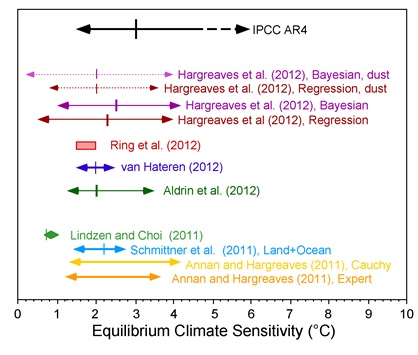
I could dig up others, but so too can Neil.
Lindzen and Choi is a joke IMO.
Neal-
No. The IPCC gives a range. I give a range. I think that’s sufficiently specific.
Neal, Another LGM estimate is Hargreaves, Annan I think from last fall. If you dig into it you will find a most likely value of 1.7c with a lot of caveats about nonlinear effects.
lucia:
You have asserted that you have a range in mind, but I don’t think I have seen you define it, except as “the lower IPCC range”. So do you mean the range from the Very Likely left (see below) to the center point, or do you have other numerical guideposts in mind?
//////////////////////////////////////////////////////////
Carrick:
Thanks for the chart. Knutti & Hegerl had been recommended as a review article; indeed JFP posted access to a copy (above). Who is the source?
//////////////////////////////////////////////////////////
John F. Pittman:
Quotes? It’s Figure 3 of Knutti & Hegerl: You posted it. But you’re right, I read the graphics wrong. But the “expert elicitation” is about: [Very Likely left, Likely left, Likely right, Very Likely right] = [1.6, 2, 4.5, 7]
//////////////////////////////////////////////////////////
DeWitt:
There is actually not much detail in the book, much of which has been constructed from divers sources not necessarily all rationalized (although a lot is based on IPCC reports). You might be looking beneath the paint into the canvas.
You know Neal, the focus on exact numbers is almost numerology given all the uncertainties. Annan has been pretty vague about it and any wise scientist would be very cautious. Does it make any difference if Lucia’s range is 2-3 or 1.5-2.5?
Neal
I’m not sure quite what you think I “asserted”.
In Neal J. King (Comment #114114) you asked me what makes a lukewarmer and in lucia (Comment #114136) I answered. I do assert that lukewamers think climate sensitivity is in the lower range. Lukewarmers represents a bunch of people, each of whom has slightly different views. A number have told you their specific views.
I don’t have any idea why you would think there can be a more precise answer to your question. There are no other numerical guideposts for the definition of “lukewarmer” any more than there are specific numerical guideposts for what “all scientists believe about X”.
David Young:
Actually, I see 2.5 (but below 4).
Thanks, but I see something different; as marked below.
J. C. Hargreaves,
J. D. Annan,
M. Yoshimori,
A. Abe-Ouchi
Can the Last Glacial Maximum constrain climate sensitivity?
http://onlinelibrary.wiley.com/doi/10.1029/2012GL053872/full
15] We have found evidence in the PMIP2 ensemble of a relationship between LGM cooling in the tropics, and equilibrium climate sensitivity. Based on this result, we estimate climate sensitivity to be around 2.5°C with a high probability of lying below 4°C…
//////////////////////////////////////////////////////////
lucia:
Now I understand what you were saying, it’s very clear. Thanks.
Yea, Neal but when asked, he said that the models disagreed on the CO2 nonlinearity, which is how they went from 1.7 to 2.5. Seems to me there is a lot is non linearity in ice sheet melting.
David Young:
I don’t see it. Maybe it’s too late at night for me.
Brandon Shollenberger:
I’ve spent a bit of time looking over your description of how you believe best-guess ECS should be evaluated, and I still don’t like it. I don’t agree with the motivating rationale (as described with reference to your philosophical essay); and I also don’t like the specifics of your algorithmic description. I will explain why in detail, in reference to the situation in which we search for the best-guess ECS value as a single number, rather than as a range.
I would be interested to hear if others approve of your approach.
To start with, let me take a moment to define what I would think is a fair approach, just so you know where my critique comes from:
– Consider a sequence of papers, numbered 0, 1, 2, …; these define the published literature on the topic of ECS, in order of publication.
– In the ideal case, to keep things simple, we assume all these papers have equal quality: When you study the methodology, talk to the people, examine the statistics, there is nothing, outside the actual ECS value promoted, to favor or disfavor one paper against the others. This evaluation is done without consideration of the value for ECS arrived at: What is relevant for the evaluation is not the value itself, but: i) Whether the theory and methodology are sound; ii) whether the interpretation of that methodology is validly captured in the final result. Briefly: i) If you think the approach behind the study is unsound, you dump the study from the list; ii) If you think the study is done well, but your “school of thought†is that certain other factors should be taken into account, you can adjust the value to what you think is the true & correct interpretation of the data. All these considerations are incorporated, before, by assumption, all these papers are given equal weight.
– The ECS values promoted by these papers are: a0, a_1, a_2, … The value a0 defines our starting point value (for whatever historical reason).
– In a simple case such as you have described, we have the value a0 established by the founding fathers of the field; and we have two new papers, 1 and 2, for consideration in this time frame. Under the conditions specified, my best-guess value for the ECS would be (a0 + a_1 + a_2)/3 : the simple average, with no extra weight given to the starting point, and no preference to either a_1 or a_2 based on their relative magnitude.
– (If a0 is really the result of multiple studies already (a “current consensus valueâ€), in my approach you have to start the best-guess calculation from the beginning of the field of study. So if N studies had been done to arrive at the position of what is now a0, you would have to do the calculation including these N papers as well. If some early papers are later deemed wrong or irrelevant, they are dropped from the list entirely.)
So much for my backdrop.
Your rationale:
As I understand it, your view (or your explanation of the Lukewarmers’ view) is that lower values of ECS should be preferred to higher values, because higher values imply more is going on than just the EGHE: in particular, positive feedback is needed. So stronger evidence is required to justify the higher values.
[from #114702:
“…Lukewarmers accept the direct, radiative effect increasing greenhouse gases cause. That puts them at about the bottom of the IPCC sensitivity range. From there, they look at the issue of feedbacks. Not seeing strong evidence strong feedbacks exist, they decide to stay at the lower end of the sensitivity range.
There are all sorts of things one can say about various evidence and what it shows, but in the end, it comes down to a simple point. Strong conclusions require strong evidence. The existence of strong feedbacks requires strong evidence, evidence lukewarmers don’t believe we have.†]
I find this very odd: If the new papers are any good, and if they propose higher values for ECS, then they must be presenting evidence for stronger feedbacks or for something else that raises ECS. When you say, “Not seeing strong evidence strong feedbacks exist, they decide to stay at the lower end of the sensitivity range.â€, and use this to justify effectively lowering the weight given to the higher-ECS value result (in your algorithm), what you are saying seems to be equivalent to “We don’t see the evidence that ECS is higher, so we lower the weight given to the evidence that ECS is higher.â€
Likewise:
[from #114703:
“This process shows one doesn’t need evidence pointing to a particular value to believe a low sensitivity is most likely. We don’t have to compare studies that estimate a sensitivity of 2C to ones that estimate it at 6C. We just have to look at how strong the evidence is for a high sensitivity. If we don’t think it’s very strong, we have to think a lower sensitivity is more likely.†]
My reaction to that is:
– The papers that are being taken into account (with values a_1, a_2) ARE the evidence for their proposed values of ECS, high or low, equally.
– If you trust that the work was done right, appropriate data analyzed, etc. as assumed at the beginning point, there is no reason to lower the weight given to the study.
– If you trust the basic work, but think certain aspects are over-/under-emphasized, you can adjust the numerical values of the ECS value to what you think is the proper interpretation of the data of the study; but then you have to treat the study equally.
– If you don’t trust the work was done right, then there’s no reason to take the paper into account at all. Just exclude it from consideration of your best guess.
So I believe that your stated approach to evaluating values of ECS boils down to simple bias towards the low end. Can you explain the difference?
Your algorithm:
[from #114715:
Suppose we only had two papers, both of which we view as equally valid. Let’s say we weight them by 50%. One paper puts the sensitivity at 2C, the other at 6C. And as already stated, we accept 1C as a given. This is the calculation for the first paper:
(2 – 1) * 50% = .5C
That means we increase our accepted sensitivity by .5C, giving us 1.5C. Now repeat the process for the second paper:
(6 – 1.5) * 50% = 2.25
Adding that to our 1.5C, we now have an accepted sensitivity of 3.75C. That is closer to 2C than 6C. Despite having as much evidence for a sensitivity of 2C as we have for a sensitivity of 6C, probabilities lean toward 2C. And that has nothing to do with deciding the strength of any given piece of evidence. ]
Summarizing this example:
a0 = 1, a_1 = 2, a_2 = 6
x_0 = a0
x_1 = x_0 + (0.5)*(a_1 – x_0) = (0.5)*(a_1 + x_0) = (0.5)*(a_1 + a0)
x_2 = x_1 + (0.5)*(a_2 – x_1) = (0.5)(a_2 + x_1) = (0.5)(a_2 + (0.5)*(a_1 + a0))
It is straightforward to derive the general term:
x_n = {a0 + (0.5)*Sum(k=1, n) [(a_k)*2^k]} /2^n
Two points to notice:
– The values of the papers, though assumed to be of equal validity, do not have equal influence on the best guess. According to the description above, this was intentional; but I am not sure the degree of inequality was considered: A paper incorporated into this best-guess algorithm at step (k) has half the influence of one incorporated at step (k+1) .
– In the order you proposed (taking the lower value of 2 first), a_1 = 2, a_2 = 6, and x_3 = 3.75. If the higher value were considered first (a_1 = 6, a_2 = 2), you would get the lower value 2.75. So actually your specific example is not “optimized†for lower values of ECS. It does however give lower values that I would have promoted: the simple average yields the value 4.5.
The best-guess value for ECS is a range, not a point:
As we discussed earlier, studies don’t really promote specific values so much as likely ranges of values. In the review of Knutti & Hegerl (2008), each proposal has a “likely†range, (a, b), and a more generous “very likely†range, (A, B), where:
A < a < b < B
I suppose if you think the study is high-quality, you respect these ranges; if you don’t, you can pad them by stretching on the boundary points.
Once you have these ranges, I would look for the intersecting range. In other words, if one study gives (a, b) and the next gives (a’, b’), where:
a < a’ < b < b’
I would guess in favor of the range (a’, b), as the region NOT ruled out by the studies.
What you have said about this problem:
[from #114687:
… If we want to give ranges of likely values, it’s easy to modify my approach to accomodate. Handling the difference in shapes of PDFs is the only tricky part, and that can still be done with a single formula.]
Accordingly, if we apply to the range-boundary points the approach you have suggested in the numerical example, we would get the new best-guess range as:
((a +a’)/2, (b + b’)/2) ; of which the sub-interval ((a +a’)/2, a’) has already been eliminated by the new study. So your best-guess range drags us into territory that has just been ruled out of consideration? This doesn’t seem appropriate to me. If you don’t trust the study, toss it out; but if you do, it says what it says.
But perhaps you had in mind a different way of extending your algorithm?
Hang on, Brandon, let me pop some popcorn before you answer.
Ok, settled in now.
Neal J. King (Comment #114897)
June 4th, 2013 at 2:06 pm
“Should these numbers be taken seriously? I wouldn’t. The only reason I bothered to post them was that Kenneth Fritsch wanted me to tell him, for some reason; and at that time I thought I’d thrown out the book, so I couldn’t”.
Neal, the reason I asked is that I find you have a habit of not giving the details when you throw out numbers and quotes. The devil is often in those details. Plus I did not believe that Lomborg was very specific in his first book about AGW since it was more about what he saw as an exaggeration of the state of the environment as reported by the media. Plus I had this later writing by Lomborg which I have linked below.
Interesting that Lomborg does not fit the general picture I have painted about one’s political preferences influencing their position on the need for mitigation for AGW. Lomborg as a left/socialist has misgivings about government spending on AGW mitigation because he sees that money better spent on his pet projects. There are others like him that might be put into the skeptical camp that have much faith in big government and spending, but simply want the moneys that might be spent on AGW spent on something else.
http://www.lomborg-errors.dk/coolitgeneral.htm
“When Lomborg writes about the costs and benefits of climate change, the arguments are centered about certain figures which are crucial for the argumentation. He writes for instance: “Stabilizing the temperature increase to 2.5° C does more good – it reduces temperature by 0.48° C – but at a rather high cost of $15.8 trillion. Actually, the models also give us a cost of the total damage from global warming (i.e. how much better off we would be if global warming wasn´t happening), which is about $14.5 trillion. Thus, from stabilizing at 2.5° C we actually end up paying more for a partial solution than the cost of the entire problem. That is a bad deal.” (British version p. 41-42, American version p. 36).”
Neal, I asked him him about it on his blog recently. If you want the exact thread I will have to look it up
David:
That might be interesting. It seems odd that it wouldn’t be in the paper (as far as I can tell).
//////////////////////////////////////////////////////////
Kenneth:
My memory works better with structures than with details.
When Lomborg’s book first came out, there was a lot of outrage among specialists who felt that their field of study had been cut to fit a procrustean bed; the biodiversity people in particular. To make a vast array of projects comparable, some simplification is needed, but I think a lot of people felt like they’d been to a surgeon who just eliminated organs he thought people wouldn’t need.
Nonetheless, the financial issues are real. It’s true that it will be harder to find a full solution to the mitigation issue than (I believe) to close the issue on what is going on. That is part of the problem: If we had a plan that we could confidently claim would do the job, I don’t think it would be so hard to convince people to take the issue seriously. The problem, from my perspective, is that it’s hard to wake people up to a danger to do – what, exactly? I am not 100% sold on any of the solutions. But what is also clear is that we cannot sustain ourselves on fossil fuels either, so there’s no choice (barring new science) to developing some way of producing power without them. If we can just accelerate that transition …
Neal,
Are we back to pretending this solution doesn’t already exist so soon? Apparently.
Mark:
Well, I guess you are sold on nuclear power. I am not; I am not solidly against it, but I have concerns about wastes, as mentioned before. Perhaps these will abate with further study.
Fukushima is interesting because it shows, once again, how a series of unlikely events and coincidences can give rise to a big problem. Now tell me about that 100,000-year leak-prevention plan…
Mark Bofill, I’m not sure how to respond to Neal J. King. What he’s said is just too priceless:
Remember, my iterative process came up with a sensitivity of 3.75. His simple average, taken of 1, 2 and 6, gives a sensitivity of… 3. His approach gives a lower sensitivity than mine. And it gets worse. He says:
His working assumption, that all three papers are equal in quality is a bad one. We know the evidence from radiative physics is of a far higher quality than estimates from things like climate models. If we accounted for this by down-weighting the weaker evidence (such as I did by assigning each paper a weight of 50%), we’d get a sensitivity of (1 + 2*.5 + 6*.5)/3 = 1.33.
Fortunately, his statement that we must use each study which led a0 addresses this issue to some extent. If we use his assumption that all studies are equally strong but say several led to a0, we’d wind up with something like (1 + 1 + 1 + 2 + 6)/5 = 2.2. Whether or not one likes my approach. it gives a higher sensitivity than Neal J. King’s alternative does.
For the record, I used iterative probability calculations simply for convenience. There are better approaches, and they give lower sensitivity values. They’d be more in line with Neal J. King’s. I never thought I’d be criticized for picking the method which favors his conclusions the most.
All I wanted to show is our knowledge of radiative physics makes us favor a lower ECS value. Fortunately, Neal J. King has shown exactly that. Though I’m not sure he realizes this as he says:
I have no idea how he figures the average of 1, 2 and 6 is 4.5. Even the average of 2 and 6 isn’t 4.5. It seems he added 1, 2 and 6 together then divided by two and called it a “simple average.”
Neal,
If you are willing to let the lack of a 100,000 year leak prevention plan prevent the realization of a realistic and effective alternative to continued use of fossil fuel, I don’t understand why on earth you expect anyone to take you seriously. Ship is sinking, bring me a plug. No, not that plug.
🙂 It won’t do.
Brandon:
1) You’re right about the arithmetic error: It should be 9/3 = 3.
2) The point is that I don’t care if the result is higher or lower: The mechanism of selecting a best-guess SHOULD be independent of the practitioner’s preferences and desires. It’s too easy to fool oneself, otherwise.
Brandon,
Ah, but if all peer reviewed papers aren’t equal, then the numerical weight of studies showing higher climate sensitivity isn’t brought to bear as effectively.
Closing one’s eyes to the differences between studies is a good way to do that too. 🙂
Honestly Brandon, I figured you’d answer
with something like ‘well, Good for you! Go right ahead and don’t like it.’ 🙂 I mean, so what?
Mark:
Actually, it’s funny you should mention it. In the 60’s and 70’s there was a big social movement against nuclear power, which had to do not only with the Cold War promotion of nuclear weaponry but also with waste-management sites that became notorious. It was pretty easy to hate nuclear-anything at the time – except nuclear medicine.
I remember at one point when the government stopped pushing to expand the number and the strategic importance of the nuclear arsenal, that there was a sense of relaxation, that nothing was pushing back. And then an article I read brought to mind the AGW issue, and there was room to consider it since the nuclear-weapons issue had receded. My thought on this, for the first time, was, “Well, maybe so. Maybe it’s the only solution.”
Brandon:
I forgot to address the quality issue:
– In your original description, you defined a case where the two studies were of equal validity, but with different ECS; in that case, you were still proposing to favor the lower-ECS value.
– To keep the focus on that point, I also define a case where the different studies are of equal validity. Of course, if they are not, they don’t get treated equally. But that’s not really the issue, is it? So let’s consider the case that all papers are on equal footing, and address the question of how personal preference should, or should not, affect a scientific best guess.
Neal,
Perhaps I should apologize. I expect that either consciously realized or not, you know perfectly well on some level that nuclear will never be adopted as the widespread solution to AGW. As you correctly say, a lot of people have considerable prejudice against it and won’t go with it as a solution. But this merely reinforces my argument that mitigation isn’t achievable. We don’t simply have to find a solution, we have to find a palatable solution to all concerned parties. Good luck with that!
Neal J. King, I think it would help if you would try asking questions about what I say rather than just arguing against it. You’ve made many mistakes about what I’m saying:
Your characterization here is horrible. You quoted me saying “strong evidence” then characterized me as saying “evidence.” In doing so, you cause your characterization to be nonsensical.
Here you completely miss the point of downweighting evidence. No matter how correctly a study on paleoclimatic records was done, its results will not be as conclusive as the radiative physics which tell us the no-feedback climate sensitivity.
Giving studies of radiative physics the same weight as studies of climate models effectively claims radiative physics is no more valid than climate models. That’s silly. Radiative physics is very strong evidence, and it should be treated as such.
This is wrong. I assigned the weight of 50% to both papers merely for demonstration purposes. Each paper could have a weight of any amount.
Indeed. That was intentional. I chose the approach which favored your position the most. That shows even when I’m being generous with what analysis is used, the results still favor the lower half of the sensitivity range.
I’m glad you mentioned this though. The main reason to use an iterative approach for sensitivity is simplicitly. It’s a lot easier to run the calculations since it can be done entirely in one’s head. My actual preference is for the good ol’ fashion:
That’s right. I prefer averaging. I don’t agree with using unweighted averages (as explained above), but otherwise, we agree on which method is preferable.
We’d even agree on the results of that method if you did the math correctly. You say “the simple average yields the value 4.5,” but that’s impossible. We had 1, 2 and 6 as our a0, a1 and a2. 1 + 2 + 6 = 9. 9/3 = 3. Your method, when calculated correctly, favors the low end of the range. The only way to get your calculated sensitivity value is to add 1 + 2 + 6 then divide by two.
There’s no justification for that. It isn’t an average. It isn’t based in math. It’s just a mistake that conveniently inflates your results.
Neal
This would be peculiar weighting in any field. Given the dynamics of publication, one would weight relatively new papers more heavily than old ones. I say relatively new rather than “published last week” as too new means people haven’t had time to identify the flaws and some papers are trash. If the study is one where progress is being made, 1 -2 year old papers that are respected should generally be given more weight than 10 year old papers. Old papers are rarely decreed “wrong”, but they are generally based on less information and, more over, the 1-2 year old papers were written with knowledge of the existence of the 10 year old paper and passed peer review by people who were familiar with the 10 year old paper.
That said: I don’t think one can just weight by counting papers or even up or down weighting based on time since publication, citations or anything else. I think one looks to other things– like how convincing the argument is, whether the paper has good empirical support, whether in instances where predictions were made, predictions panned out and so on.
Mark Bofill, I was tempted, but I’m trying to make progress. I’ve been trying to get Neal J. King to say something like:
He completely misses the significance of what he admits. I gave those numbers to demonstrate what would happen if papers estimating climate sensitivity were evenly distributed across high and low sensitivities. The 2 represented estimates of a low sensitivity. The 6 represented estimates of a high sensitivity.
When we use the approach Neal J. King himself promotes, we get 3 for our result. Three is closer to 2 than 6. That means the approach he promotes favors low climate sensitivities when papers estimating climate sensitivity are evenly distributed. So when he says:
Realize he hasn’t caught onto the fact what he thinks is irrelevant is actually the key point of this entire discussion. And when he makes an arithmetic error he thinks is unimportant, it actually demonstrates the position I’ve been advancing.
In other words, I’ve gotten him to admit my exact position. He just hasn’t realized it yet.
Neal is using you all as cardboard cutouts. He will bury you under a mountain of strawmen. He has millions of them. He will talk you to death.
Don,
Regarding the cardboard cutout thing, yeah maybe so. So long as nobody has any vast expectations it’s still interesting. Suppose all Neal’s doing is lecturing me without listening. Well, still some value in understanding the arguments from his lecture for future reference. I mean, I know nobody here is new to the debate and so it’s highly unlikely something’s going to be put forward that hasn’t already been considered by all parties.
Maybe it’s nothing more than exercise. Still, it was useful for me; I was about ready to make an error on the null hypothesis issue earlier in the thread. Talking these things out helps me keep an orderly mind.
Night all.
Neil, see the “a sensitive matter” post near the ene
Brandon:
1) The arithmetic mistake was just an arithmetic mistake. It was not “a mistake that conveniently inflates your results.” I admitted it as soon I saw your comment on the screen, as you can see by screening up a few inches; and it doesn’t make ANY difference to me whether it increased or decreased the value. My entire point is that one’s personal preferences need to be eliminated from the process of arriving at a scientific best guess.
2) [from #114703:
“This process shows one doesn’t need evidence pointing to a particular value to believe a low sensitivity is most likely. We don’t have to compare studies that estimate a sensitivity of 2C to ones that estimate it at 6C. We just have to look at how strong the evidence is for a high sensitivity. If we don’t think it’s very strong, we have to think a lower sensitivity is more likely.†]
From my point of view, this paragraph from you is self-indicting. We are talking about a scientific measurement of a parameter in the real world: the answer is whatever the answer is. You really should not demand that a higher value pass through more requirements than a lower value, because you don’t know what the value is; nor should you do the reverse.
3) So you say that palaeoclimate studies cannot be compared in rigor and accuracy to radiative physics experiments. That’s not hard to believe. But then notice that the palaeoclimate studies are measuring a different parameter (probably the ECS) than the radiative physics observations: A measurement of the feedback-free parameter does not, I believe, contradict the existence of the feedback: It simply doesn’t measure it, doesn’t address it. If you could observe that the feedback-free radiative response was already so big that it fulfills the value of the other measurements of ECS by itself, then you could say that the radiation observations provide evidence against the functioning of the feedback loops. But if the palaeoclimate’s ECS is bigger than the corresponding bare radiative response, there is no contradiction: the one is measuring the part, the other is measuring the whole, and the part is smaller than the whole. These experiments are not “competing” with each other to provide the same parameter. If you can adjust the context so that, with additional information, these two experiments can be forced to address the same parameter, then the issue of comparative quality arises. But in that case, we wouldn’t be talking about a preference for believing in low ECS values, would we? We would favor the better measurement.
4) General expression for x_n:
“This is wrong. I assigned the weight of 50% to both papers merely for demonstration purposes. Each paper could have a weight of any amount.”
No, this is not wrong: It is merely the expression for arbitrary n when the weighting is 0.5, a specific case.
The more general case when the weighting is r is:
x_n = (1-r)^n * (a0 + r * Sum(k=1, n) [(a_k)/(1-r)^k]
For the case when the studies have legitimately different validity, we did not discuss what you might have in mind. So I cannot speculate – although this is the real case more often than not.
My concern was this quote from one of your notes above:
“There are all sorts of things one can say about various evidence and what it shows, but in the end, it comes down to a simple point. Strong conclusions require strong evidence. The existence of strong feedbacks requires strong evidence, evidence lukewarmers don’t believe we have.”
This sounds like a recipe for fooling yourself on a technical matter.
5) “I never thought I’d be criticized for picking the method which favors his conclusions the most.”
Totally irrelevant and beside the point. This is not a standards meeting.
//////////////////////////////////////////////////////////
lucia:
“This would be peculiar weighting in any field…”
What you say is completely accurate. All of those factors mean that papers “age out” of relevance, or never make it in; and there are a lot of qualitative factors that incline one to have greater confidence in one scientific team. So cases of perfectly equal validity are completely unrealistic.
From my point of view, this entire discussion, equations and all, is a philosophical discussion on the principle that it is as unscientific as it is possible to be to give preference to a low value over a high value when there is no valid scientific reason to do so. Valid reasons include, among others:
– The experimental observations are more credible for the low value: the equipment is more accurate, better maintained, and the scientific staff are better (and this is the direction in which a paper can age out);
– The theoretical implications of the high value constitute a substantial challenge to the consistency and correctness of other well-established scientific work;
РThe character of some of the investigators is in doubt: for example, another Jan Hendrik Sch̦n, or just someone a little too eager for the limelight (I knew a professor at grad school who was trying to convince everyone that he had captured a magnetic monopole; he was not dishonest, just a little too wishful).
These are all valid reasons for preferring a lower value to a higher.
Non-valid reasons are:
– It’s expected to be lower;
– It matches what I wrote in my research proposal;
– It will look better for my next research proposal;
– It will affect governmental policymakers in a way I prefer.
And of course the reverse also applies: higher values should not be favored over lower without valid reason.
The purpose of the exercise was a reductio ad absurdum to show that Brandon’s suggestion of how Lukewarmists should decide on ECS values led to a situation in which two studies stipulated as being of “equal validity” had unequal influence on the final number – by a factor of 2.
Mark Bofill:
The alternative to mitigation is adaptation. There are several possibilities, but I’m not optimistic about them either. In particular, I wonder why many people think geoengineering solutions are going to be easier or cheaper than cutting back on CO2.
Given the properties of sensitivity (i.e. positive definite) one could argue that any arithmetic weighting or results should be done using logs. Then if you have sensitivies c(1:10), the best estimate will be 4.5 not 5.5. (That said: I don’t think weighting by count makes much sense because the other factors are so much more important that it just gets silly.)
Actually, it’s pretty standard to require strong evidence to overturn “nulls”. Moreover, Brandon’s statement taken literally sounds Bayesian.
If so: the idea of equal weighting by paper bad philosophy if emphasized as a start point. The other factors are so dominant that starting from a factors that has nearly no important distorts people’s views. It’s little wonder you are going to end up with tortured discussions of the “right” algebraic weighting.
But if we forced to do algebraic weighting, I would go for using logs — or at least a skewed probability distribution. My reason is different from Brandons, and has to do with math. But it will end up working out similarly.
lucia:
– How does the weighting by logs work?
– To be clear, the arithmetic weighting was proposed as a counter to Brandon’s “just always take the lower number” school; and for the specific situation (“stipulated equal validity”) that there was absolutely no way, aside from the value of the final result itself, of establishing preference between the two studies. Is that a realistic situation? No. That’s why it’s a philosophical discussion.
– The discussion on the algebraic details of Brandon’s algorithm needs to be separated from that of his allegiance to number=oriented selection generally, because it’s actually not completely clear how one influences the other.
lucia:
– Logarithms: Oh, I see. Yes, I guess it depends on the range of values being considered. If I were considering a range of values all of the same general magnitude, I would lean towards the arithmetic average; if there’s a great span, the logarithmic would make more sense. I guess it depends on how you think your ignorance should be distributed.
– Bayesian: What I’m objecting to is characterized here:
“That’s the main benefit of the lukewarmer position. They don’t need to say papers arguing for a low sensitivity are more valid or more compelling. Lukewarmers can just say people arguing for a high sensitivity haven’t made their case.
For a crude analogy, think about the burden of proof in a criminal case. There we assume a person is innocent until proven guilty. It’s the same here. We assume a low sensitivity until a high one is proven.”
I don’t believe it makes sense to say that the atmosphere must be proven “guilty” of having feedback loops: If one doesn’t know, one doesn’t know. If that’s anti-Bayesian, then I’m anti-Bayesian: Frequentist or whatever.
Kenneth Fritsch linked an article in the National Post about the negative effect of the Copenhagen Conference on public opinion about global warming in another thread. The paragraph he quoted on the poll results was interesting, but so is this one on the politics:
The interesting statistic is that 72% in Britain support a 50% reduction in CO2 emissions of 50% by 2020 even though only 43% believe that global warming is a man-made problem. The question I would have liked to have been asked of those who support the reduction in emissions is how much they personally would be willing to spend and what activities they now do that they would be willing to give up.
Roger Pielke, Jr. raised this point in The Climate Fix and apparently it’s not very much. In a 2009 poll in the US, respondents were asked about their willingness to support a climate bill in the US Congress at three annual costs per household. At $80/year a majority said they would support the bill. But at $175/year support dropped by half with a majority expressing opposition. At $770/year opposition exceeded support by a ratio of about ten to one. This is a reflection of what he calls the iron law of climate policy that when policies focused on economic growth confront policies focused on emissions reduction, it is economic growth that will win out every time.
Apparently there is a widespread belief that a large reduction in carbon emissions could be achieved very rapidly with little cost. Pielke refers to this as a belief in magical solutions. In reality, a global reduction of emissions to 50% below 1990 levels by 2050 without a massive reduction in standard of living would require the production of the equivalent of more than 12,000 nuclear power stations. That’s about one per day starting now.
As far as the PR effort of the warmers, Pielke has this to say:
Neal:
Suppose the measured sensitivities are:
> S=c(1:10);S
[1] 1 2 3 4 5 6 7 8 9 10
These are the natural logs.
> log(S)
[1] 0.0000000 0.6931472 1.0986123 1.3862944 1.6094379 1.7917595 1.9459101 2.0794415 2.1972246 2.3025851
This is the mean of the natural logs.
> mean(log(S))
[1] 1.510441
This is the mean.
> exp(mean(log(S)))
[1] 4.528729
Mean of S was
> mean(S)
[1] 5.5
But there are other ways on could weight based on other points of view about what is uncertainty. For example: One can argue that the unknown is feedback,a. So, instead of focusing on the sensitivity in the paper and averaging that, we can average feedbacks:
So, the sensitivity is realted to a base sensitivity So as:
S=So/(1-a)
where a is the feedback.
Say So=1. we could do this:
> So=1
>S
> a=1-So/S; a
[1] 0.0000000 0.5000000 0.6666667 0.7500000 0.8000000 0.8333333 0.8571429 0.8750000 0.8888889 0.9000000
> So/(1-mean(a))
[1] 3.414288
And of course, if you want to play thing game more, we can then say: “Oh. But you should have used logs of feedbacks!” (Why, I do not know. Maybe you think it’s physically impossible for feedbacks to be negative? …but let’s just play with this here.)
So
> epsilon=0.0001
> a[1]=epsilon
> log(a)
[1] -9.2103404 -0.6931472 -0.4054651 -0.2876821 -0.2231436 -0.1823216 -0.1541507 -0.1335314 -0.1177830 -0.1053605
> best_a=exp(mean(log(a)));best_a
[1] 0.3162278
> So/(1-best_a)
[1] 1.462475
You can come up with all sorts of arguments about how to weight the sensitivities, feedbacks or whatever.
Plus: in anticipation of an attempt at Occam’s razor:
* weighting by feedback and weighting by sensitivity are equally “simple”. You can’t use Occam to say one must be chosen over the other.
* a log transformation for positive definite numbers with skewed distributions is sufficiently routine that you can’t insist on not applying it based on Occam. Because not fixing obviously skewed distributions violates “all things being equal”. One does fix ‘problems’.
So even if I use your “algebra” principle, I can come up with almost whatever the heck number I want.
Neal
I don’t think your disagreement with Brandon is anti-Bayesian. I think you are arguing about the prior. Brandons prior is heavily weighted toward zero feedback. Yours is weighted towards “flat”. Real statisticians might be able to organize this toward “uninformative prior”.
Well then, you should just pick the log. The actual values are all near each other, the choice of arithmetic and log makes almost no difference. Here’s a tight distribution:
> S_tight=mean(S)+0.1*(S-mean(S))
> S_tight; mean(S_tight)
[1] 5.05 5.15 5.25 5.35 5.45 5.55 5.65 5.75 5.85 5.95
[1] 5.5
> exp(mean(log(S_tight)))
[1] 5.492487
> mean(S_tight)
[1] 5.5
This is rather well know btw. It’s why people often don’t bother to transform positive definite distributions if the mean is many standard deviations away from zero, but the transform will often fix things if the mean is close to zero.
Other transforms exist. If you have a lot of data, you can pick the one that gives the closest to normal distribution after transforming. Otherwise, you can just argue based on know properties of the thing being examined. In this case, we know sensitivity is positive definite which argues for a log transform. The argument isn’t dispositive, but it leans towards it.
Neal,
I suspect we’ll no more see a drive to massive geoengineering solutions than we’ll see a big push for nuclear. The scenarios are sort of dubious, aren’t they? How do you think the White House would respond if Beijing announced that they were rolling out a program to pour enough aerosols into the atmosphere to lower global temperatures 1C?
I’m not sure what’d happen, but I don’t think it’d fly.
Mark:
No, I don’t think it would be welcomed.
But of all the countries, I wonder if it might be most likely that PRC would engage in something like that:
– The government is firmly in charge.
– They want to keep it that way: so they don’t want problems that make people riot: food & water shortages
– They obviously not exactly purist concerning protection of Nature: as long as there aren’t smog riots, etc.
– They’re pretty pragmatic: If they think something will work, they will implement it; and they believe in technology.
Neal
Pretty soon more than 1/3rd of the citizens are going to be old. My guess is the old folks won’t riot. OTOH, the young ones might.
Can we say “cadmium”?
http://www.nytimes.com/2013/05/22/world/asia/cadmium-tainted-rice-discovered-in-southern-china.html?_r=0
Neal,
I don’t know anything about internal politics in China and there might be stumbling blocks there, but otherwise what you’re saying seems reasonable to me.
🙂 Since we’re kicking it around anyway, what could the U.S. or the international community do? As I’ve observed, it’s hard to shove even moderately powerful nations around. How do you shove China? Maybe this solution has the unique virtue that international agreement and cooperation doesn’t really matter I.E., you don’t need a (update: successful) Kyoto to make this happen.
Still, somehow I don’t think geoengineering is going to happen. I’m not sure why I think that really. It doesn’t seem to me that anybody has moved in that direction or has articulated a detailed plan to. Maybe it’s just that people are worried about the unintended consequences of such an undertaking.
Lucia,
Wow, I’d missed that interesting bit of news, thanks! Any idea if the levels are really unsafe or is it more of an ‘alar and apples’ type thing?
lucia:
My impression is that there are riots in China all the time: Lots of ethnic tensions, farmland vs. city privileges, food problems, corrupt officials, etc. But they fix some of the causes, and stomp on people for the rest. They want to stay on top of it.
So I think they will eventually do something serious about AGW as well: They won’t want to kick the can down the road forever, because in the PRC “forever” means forever, or at least multiples of 10 years; whereas in WDC “forever” means 4 years.
I saw something in the news about their considering a carbon cap; but I haven’t followed up on it yet.
Re: Neal J. King (Jun 5 05:55),
That’s a false dichotomy. It’s not either one or the other, it’s a tradeoff. The temperature will be going up more by any rational analysis so adaptation will be necessary. The question remains as to when does mitigation stop being cost effective in terms of reducing the cost of adaptation. And, as Carrick pointed out, mitigation is at the pie in the sky bye and bye stage right now, so cost/benefit analysis is a little difficult.
DeWtt:
That’s true.
DeWitt Payne (Comment #114976)
June 5th, 2013 at 6:57 am
DeWitt, your more detailed polling results give a very different perspective on how the public views mitigation than the one I threw out there. It shows that I have done a Neal-like referencing here for which I have criticized Neal.
I should have added to my link that all these polls and surveys most times need more background and detail to truly reveal how people think – even though what they think might well differ with reality. My guess as to polling question that Cook thinks shows that most of the public thinks there is not a consensus amongst scientists on man causing some warming has more to do with the perception that there are disagreements between scientist on AGW. A poll of interested and knowledgeable people on these two issues would find them agreeing at nearly 100 % that there is a nearly 100% consensus amongst scientists that man has caused some of the recent warming and further a near 100% would agree that scientists disagree on the details and specifics of AGW.
Mark Boffill,
I haven’t requested rice to run my own tests….
But my Bayesian analysis relies on the prior that says
(1) “Likelihood Chinese government would lie to cover up is near 1. ”
(2) “Likelihood food could be contaminated in China is pretty darn high.”
(3) “Likelihood fields in agricultural areas would be contaminated in China pretty darn high”.
Back in the 90s’ the PRC weather service lied about temperatures in Beijing. (Can’t find story– but it was in WSJ at the time.) Food seems to be routinely cotanimated in horrible ways in China. And I don’t mean bacteria, I mean melamine added to kids baby formula etc. Pollution is horrible in China.
So, all in all: I suspect the story is true. But I’m sure we’ll read more. Possibly independent groups will buy rice, sneak it out of China and test.
Neal–
I said pretty soon. Owing to the 1 child policy, pretty soon they are going to have mostly old people. (Well.. unless people get to start having more than 2 and start actually having them.)
Neal,
It seems to me that you’re saying leadership in China is motivated to address AGW because addressing problems is a good way to stay in power. I happen to agree that competent leadership is a good way to stay in power, but I’d suggest that history doesn’t appear to support the idea that therefore leaders do provide competent governance and pre-emptively address problems like alleged CAGW.
Simply put, if there are riots in China, so what? The riots can be suppressed much more easily there than say in the U.K. or U.S.. Regarding the recent noises about a carbon cap, well, I await further developments with much interest, but talk is about as effective as wind power in and of itself.
Mark,
“How do you think the White House would respond if Beijing announced that they were rolling out a program to pour enough aerosols into the atmosphere to lower global temperatures 1C?
I’m not sure what’d happen, but I don’t think it’d fly.”
The White House would respond by rolling over. The Red Chinese Republic of Thugocracy does as it pleases.
Here is a look into how they manage the local biosphere, for the benefit of their people:
http://www.chinahush.com/2009/10/21/amazing-pictures-pollution-in-china/
Don’t expect them to care about what the rest of the world thinks.
Don,
Yes. I said that and then thought it through some more and have come to seriously doubt my initial position. What could the U.S. do? Threaten war? Well, we could theoretically, but I don’t think it’s controversial to say that the U.S. doesn’t like to fight adversaries that can realistically threaten them back. We like wars that look like they can be won with quick, devastating use of superior technology (no matter that we inevitably get mired in nation-building afterwards, that’s a separate issue); I don’t see that being the case with China. Embargo? I think China is at least as (if not more) important to us economically as we are to them.
Maybe the White House would issue a statement of disapproval. Maybe not. 🙂 That might be the extent of it.
(update: Wow, that link was pretty ugly. Thanks.)
lucia,
China fake eggs
http://www.youtube.com/watch?v=T55tz4qwFMo
China fake meat
http://www.youtube.com/watch?v=Gnkplu1WawM
China fake rice
http://www.youtube.com/watch?v=Uw65n3ajZu4
China fake Rolls Royce (they call it Lolls Loyce)
http://www.youtube.com/watch?v=6rY3yNf-W3c
DeWitt Payne (Comment #114976)
June 5th, 2013 at 6:57 am
“As far as the PR effort of the warmers, Pielke has this to say:
Efforts to increase intensity [of public support for action], whether by hyping the science or seeking to scare people with apocalyptic visions of catastrophe, are more likely to turn people off than to motivate them to become politically active.”
DeWitt, I agree that what RPjr says could happen, but what usually happens when the politicians in Washington want to push and initiate a huge program like AGW mitigation (if it were supposed to have a large effect in attempting to reduce future warming) the first step of the campaign is produce a real or imaginary crisis. The second step is to minimize the initial and early cost of the program and then put off payments into future years. The third step is like the frog in the pot on the stove of slowly increasing the direct costs by noting that a number of jobs now depend on this program and that if problems have been found with the program the only government solution is to spend more on the program.
Initiating and enduring wars, and large domestic programs like SS, Medicare and Obamcare fit this sequence of activities well. They could be priors for a Bayesian analysis. War costs are mainly needed up front and thus for that we never expect immediate payment but rather do it through debt and inflation. Of course, if need be that strategy could be applied to a large domestic program.
Scares like we had when in the recent past we experienced many hurricanes over a period of few years appeared to perhaps be the crisis that the politicians in Washington could use to push AGW mitigation. There were some climate scientists more than willing to extrapolate that number to very high levels for future years and make the connection to global warming, including Judith Curry who appeared in many media events at the time. This one fizzled much as RPjr would have perhaps predicted. Other crises real or imaginary are out there waiting to be exploited.
Mark Bofill:
Yes, the PRC put down riots without any compunction. But remember that the PRC has been through domestic disruptions even within living memory; so they know that too many riots lead on to bigger problems – even revolutions. As a result, they do take care of their problems eventually, if grudgingly. They’re not big on civil punishments: High-level/high-visibility corruption, etc. can lead to execution.
The Chinese use guns for execution. After it’s over, they send a bill to the family for the bullet. The government is very frugal that way.
Neal,
Well, as I said, I await future developments with keen interest. Lets see how many of the 300+ coal power plants (http://pdf.wri.org/global_coal_risk_assessment.pdf) they have in the works come online I guess before we draw conclusions about how serious they are on a carbon cap.
Neal,
The document I linked actually talks about a coal cap for China:
Anyway you slice it, it’s a heck of a lot of coal.
Somehow Neal J. King has accepted my example and accepted the results of it, yet he doesn’t accept the conclusion I reach from it. His argument against my claims seems to be that I’m just biased against large numbers, yet he accepts an example which shows we should be “biased” against them. Tres bizarre.
Let’s consider how the “bias” happens. If humans knew nothing about global warming, our null hypothesis would be that climate sensitivity is 0. We would keep that hypothesis until we were given enough evidence to change our minds. We would be “biased” toward a sensitivity of 0 because it is our null hypothesis.
The same is true in our current situation. We have incredibly strong evidence from radiative physics. That gives us our null hypothesis. We are “biased” to believe it because we are “biased” not to believe new positions without sufficient evidence.
That’s all there is to it. The lukewarmer position is closer to our null hypothesis, therefore we are “biased” toward it.
Hi Neal,
Just getting back to this thread (briefly).
You asked for a reference.
I would suggest Otto 2013. Sorry to say it’s paywalled now. Was open access for a short time.
There’s a bit of a summary here from Nic Lewis, who was a coauthor.
James Annan has some comments on it too.
Brandon,
I haven’t been too vocal on this because I’m still not sure I understand the nature of Neal’s complaint in this regard. But since the question wasn’t addressed to me, I’ll remain an interested spectator.
(EDIT: looking back over this, I see
which I don’t think accurately describes your method. I suspect personal preferences and subjective weighting got scrambled up somehow. I don’t read
as really meaning personal preferences…)
Mark Bofill, it has nothing to do with personal preference. It’s simply how evidence works. Consider testing a coin for fairness. Your null hypothesis is, “The coin is fair.” You flip it twice, and both times it comes up heads.
That is evidence the coin is unfair. It is very weak evidence, but it is evidence nonetheless. If it’s the only evidence you have, would you conclude the coin is unfair? Of course not. You are “biased” toward believing the coin is fair because that’s your null hypothesis.
That’s all this is.
Mark Bofill:
– For a long time, it has appeared to me that the CO2 is waiting, among other things, for an agreement between the biggest CO2 producer and the richest economy: PRC & US. But neither would go first, so no dice. Now that China has at least stated that they’ll take a definite step – however weak – there could be a break in the ice.
Just my view of the world.
/////////////////////////////////////////////////////////
Carrick:
Thanks, I’ll look them over. Too bad about the unobtainability of Otto.
/////////////////////////////////////////////////////////
Brandon:
“Let’s consider how the “bias†happens. If humans knew nothing about global warming, our null hypothesis would be that climate sensitivity is 0. We would keep that hypothesis until we were given enough evidence to change our minds. We would be “biased†toward a sensitivity of 0 because it is our null hypothesis.”
I don’t get the zero for the null hypothesis. Wouldn’t the null hypothesis be what radiative physics would calculate? Namely 1.2C.
I think the computation for what might happen with a doubling of CO2 predates global warming. Didn’t Arrhenius have something to do with that?
Neal,
Oh I understand. That’s certainly your privilege too, no argument there. I don’t mean to be rude, it’s just that I’m not willing to pretend I see any real indicators that the ‘political will to mitigation’ winds are changing direction on a global scale.
Brandon,
No I get your position, it’s Neal’s objection that I wasn’t sure I was following properly.
Re: Neal J. King (Jun 5 15:31),
You do realize that if China does cap coal consumption, they’ll do it by increasing reliance on nuclear power. China is building new nuclear plants about as fast as they can. See here.
Note that’s 58GWe out of a projected 1600GWe capacity in 2020. They have reduced emissions some by phasing out older inefficient coal fired plants, but it’s unlikely that an expansion of that magnitude can be done without increased overall CO2 emissions unless they build nuclear power plants a lot faster than now planned. Nuclear waste doesn’t seem to be a problem for them and they’re known for taking a long view.
RickA, “global warming” covers the no-feedback sensitivity. If we know the globe will warm ~1C if CO2 levels double, we know the globe will warm; global warming.
Mark Bofill, I can’t say I understand his objection either. He promoted an approach which shows exactly what I’ve claimed. I don’t know how he can do that while disputing what I claim.
Brandon,
First of all, I have to apologize to you if I gave you the impression that I accepted your example and results. I have never accepted your example, if you mean by that the algorithm of adding a weighted delta: I have only explored it mathematically, to see how it works. I would never accept such a method or its results for any application that I can think of.
I am writing a fuller explanation in response to your last few notes, so it will take a little time.
Thanks for your patience.
Neal J. King:
As I’ve said before, It’d help if you asked questions about what I say before arguing against it. That is not what I meant at all. The example was merely the numbers: 1, 2 and 6, along with what they signified. You accepted that example and promoted an approach for handling it.
Brandon,
I’m not entire sure I understand your method either. Does the outcome depend on the order in which you process the papers? There’s an aspect where it merely appear you are weighting the sensitivity excess above a base of “1”, but there is another where it looks like the order matters. If you mean the former– I think it’s a little bit of an odd way around believing feedback is the ”proper’ unknown thing you are going to weight and average. But there is nothing “biased” in such a view. It is merely considering feedback and not sensitivity the unknown you are trying to determine from the population of papers. But if you are doing the latter– I don’t entirely understand the method.
But with respect to Neil — I think one could come up with a variety of methods all of which look equally ‘neutral’ mathematically. In principle one could apply any of these independent of the final result from a set of papers and one could claim to be utterly objective. (One might even convince themselves they were objective.)
But in practice I already know that certain ways of weighting give higher numbers and others give lower from the same batch of data. I can’t really obliterate that knowledge from my mind and still remember what a logarithm is! So I can argue why — if we are forced to weight sensitivities rather than feedbacks — I prefer log weighting (which I do), but I can’t pretend I am making this argument while blind to knowledge of how that weighting would affect the computed answer. I also know that chosing to weight feedbacks would be a perfectly valid choice, and I know how that choice will affect the computed value.
This is often a problem with processing scientific– or any– information. One can pretend the problem doesn’t exist: choice of ‘algebra’ used in weighting often matters. One can pretend that one is immune while others are not. But, in reality, this is an issue.
lucia:
The order matters for using an iterative approach. For it, if the amount of change per piece of evidence studied is small (which it is if you don’t find individual papers very convincing), the problems with the approach have little effect.
The better approach is to use averaging, but if I have 50 pieces of evidence to consider, I can’t do that in my head. That’s why I use the iterative approach as a shortcut. The difference between it and averaging was a non-issue, and it would have been better if I had only discussed averaging.
The reason I didn’t is I use iterative calculations a lot more than averaging. There are a number of games I play where I want to work out odds, and it helps to be able to do it quickly. I’ve gotten so used to using the iterative approach as a shortcut it is what comes to mind first.
Ok. I get it. It is a bit Bayesian in spirit, if not the way one would do anything formally.
Yup. There’s probably a formal way to do what I want to do, but I never had much formal training so I don’t know what it is.
As I understand your proposal:
Consider a sequence of experimental values, all of the same “validity”: a0, a1, a2, …
Let x_0 be the best-guess value, based on the history up to a0:
x_0 = a0
/////////////////////////////////////////////////////////
Then consider the new value, a1:
a) calculate the difference: a1 – x_0
b) multiply by the weight r: (a1 – x_0)*r
c) add to x_0: x_0 + (a1 – x_0)*r = a1*r + x_0*(1-r)
d) set x_1 equal to this:
x_1 = a1*r + x_0*(1-r)
…..= a1*r + a0*(1-r)
/////////////////////////////////////////////////////////
Likewise:
x_2 = a2*r + x_1*(1-r)
…..= a2*r + a1*r*(1-r) + a0*(1-r)^2
/////////////////////////////////////////////////////////
x_3 = a3*r + x_2*(1-r)
…..= a3*r + a2*r*(1-r) + a1*r*(1-r)^2 +a0*(1-r)^3
/////////////////////////////////////////////////////////
x_n = a_n*r + x_n-1 * (1-r)
…..= a0*(1-r)^n + Sum(k=1, n) [(a_k)*r*(1-r)^(n-k)]
/////////////////////////////////////////////////////////
Under your procedure, the (n+1)th best-guess is given by x_n
– Note that the effective weighting of a_k+1 compared to a_k is:
r*(1-r)^(n-k-1)/[r*(1-r)^(n-k)] = 1/(1-r)
If r = 0.5, 1/(1-r) = 2
/////////////////////////////////////////////////////////
So each measurement has twice the influence on the best-guess result as the one before. This is the same if the measurements were made over a decade, or if they were all done in a week.
Neil
I think his algorithm does that. But when examining how the method operates “in the wild”, it’s fair to recognize that the papers are unlikely to all come out in one week but rather over a course of time.
With respect to weighting of papers it is weighting new papers more than older ones. The new papers generally are written by people who have read the old ones. If results are converging to a correct answer, having new ones influence more than old ones, so the weighting might be a feature rather than a bug.
Anyway: It’s not based on the magnitude of the answer- but merely the order.
lucia:
Under the described algorithm, if you have 10 measurements, the last measurement will have a weight 1000 times greater than the first measurement.
Even if they’re done on the same day, by the same team.
lucia:
“With respect to weighting of papers it is weighting new papers more than older ones. The new papers generally are written by people who have read the old ones. If results are converging to a correct answer, having new ones influence more than old ones, so the weighting might be a feature rather than a bug.”
So if 4 groups are working on competing experiments, and publish on the 4 consecutive Mondays of May, the last guy out will have the greatest influence, and the first guy will have (1/8)th the influence. Of course if the experiment is important, maybe the first will be the guy that gets the Nobel Prize – as a consolation.
“Anyway: It’s not based on the magnitude of the answer- but merely the order.”
Yes, it’s completely crazy for a different reason.
Thanks all, I understand the difficulty now.
Neal J. King, as I’ve said several times, the weightings can vary by paper. In fact, we would expect them to. Treating r as a constant is wrong.
It’s also meaningless. I’ve said several times that particular approach is irrelevant to the point I was making. It is a shortcut I use for convenience, and a stronger approach is averaging. There’s no reason to focus solely on an approach I’ve already said can be discarded.
If you don’t like that approach, it’s fine. We can talk about the approach you promoted instead. As you know, it’s the one which reached the same conclusion once we fixed your arithmetic error.
By the way, if we are going to talk about the approach I suggested, we need to remember what I said about it:
Almost all new evidence will be non-independent. Accounting for that will result in newer evidence generally being given less weight than older evidence. The r you treat as a constant will actually tend to decrease as the number of papers increase. So when you say:
You are way off-base. An early piece of evidence could easily be given a weight of 20% while a late piece of evidence got weighted at only at 2%. It is only by ignoring a fundamental aspect of the approach that you can claim later papers receive far greater weight than earlier ones. Which is why I’ve told you, multiple times, that you cannot treat r as a single value.
In actuality, if you properly account for the non-independence of evidence, the results will tend to converge to the same answer as averaging does.
Neal J. King:
Nothing about this is inherent to the process I described. It is perfectly possible the “first guy” will have a larger influence than the last guy.
You are criticizing my approach based entirely upon a strawman of constant weighting. Behavior like that is why I’ve suggested you ask me questions before arguing against points.
Brandon:
You are adding complications to the consideration of the basic algorithm. What these complications effectively do is to confuse the reader about the basic operation. If an algorithm cannot be trusted to operate properly on the simplest case, why should it be trusted to operate properly on the more complicated cases?
Expecting the accidents of life to bale you out is NOT a reliable way to design a methodology.
Brandon:
The point is that the basic unfairness of the structure still carries when you introduce different weightings for the contributions. Going back to 4 Nobel-candidates, it is still the case that the first guy has a factor of 8 working against him: even if you double his inherent weight, his contribution to the average will be less by a factor of 4 than Johnny-come-lately’s.
Neal J. King:
You didn’t quote anything or bother to say what you were actually responding to. I’m going to assume you’re saying this in response to my comments about weighting being non-constant.
If that’s correct, your complaint is silly. Any algorithm combining evidence must account for non-independence of the evidence. Any algorithm that doesn’t will necessarily give wrong answers. Your choice of simple averaging will give answers just as wrong as my method if you don’t account for non-independence.
Which is beside the point that I’ve repeatedly said you can ignore my method all together and only look at the method you promoted.
(It also ignores the fact I’ve specifically discussed when my method works well, highlighting the weaknesses of it.)
Neal J. King:
First of all, it’s silly to give numbers to a methodology based upon an assumed value for r. Your number depends upon the weighting used.
Second, there’s no reason to think weighting would only change by 50%. It is practically impossible to have four totally independent pieces of evidence. If the first person’s evidence was remotely strong, it’s very likely the last person’s evidence would be down-weighted by more than 50%. As in an example above, we could easily see the last person’s be given a weight 10% of the first.
Third, you’re still going on and on about a methodology I said you’re free not to use. I’ve repeatedly said you’re free to use the methodology you promoted instead, pointing out it showed the same idea. If you don’t like my methodology and you want to resolve things, why don’t you start discussing the methodology we’ve both already agreed to?
Brandon:
Taking a step back:
– This algorithm is not really important to what I’m trying to find out. Let’s drop it.
– I am more interested in the general question of preference for low values of a measured quantity; in this case, ECS.
To clarify some background:
– What relevant radiation-measurements are done related to ECS, and what do they measure?
– What palaeoscience measurements are done for ECS, and what do they actually measure?
– Are there any other measurements relevant, aside from GCM simulations?
Neal J. King, I’m confused:
I’ve suggested this for a while, yet you kept harping on this issue. You forced me to write a great deal in order to correct your misconceptions about my methodology. Only after doing that did you decide we should discuss something else. That’s troubling. Why did you make me go through so much trouble just to switch topics? For that matter, why do you want to switch topics now?
Also, why haven’t you acknowledged you’ve made multiple untrue claims about the methodology? And given you haven’t acknowledged the untrue things you said about it, why should I discuss a new topic when you could just proceed to make many untrue claims that you’ll never address?
Which I’ve discussed. Many times. Even in relation to the methodology you promoted. If you’re more interested in that issue, it certainly doesn’t show. Nor does it show when you say:
And proceed to ask questions which have no bearing on the issue.
Neal
As you introduced the question of the algorithm first but are now decreeing that’s irrelevant, I suggest that with respect to your new questions, you give a detailed answer to the three questions you ask before anyone else answers. That is, by the way, the standard policy for rhetorical questions here.
While I think yours aren’t rhetorical, I still think we deserve to read your answers to your long list of questions before we give ours.
Among other things, your answering will help those who you have asked the question information they can draw on to estimate your level of proficiency and so tailor answers to your level of expertise. If we don’t know that, we’ll have to guess and possibly waste our own time typing out answer to things you already know or explaining at a level that assumes you know things that you don’t know. )
Since I’ve discussed the iterative approach quite a bit already, I should mention something. We expect evidence to converge to an answer. That means newer evidence will tend to have less variance than earlier evidence.
Because my approach weights evidence by how different it is from the previous results, the less variance in the evidence, the less effect it has on the results. This causes an effect opposite to what Neal J. King criticizes the approach for.
It also gives a handy check of results. If you use the approach and gets a series of results that vary greatly, you know the results aren’t converging to a point. How much the data varies gives you an estimate of how uncertain your results are.
Beyond that, nothing about the approach requires you input evidence in the order it was generated. You can always change that order and know it will affect your results. In fact, you can try various orders to see what effects it has on your results.
That’s mostly meaningless information, but I thought I’d share it anyway. I really do find the approach convenient at times.
For what it’s worth, I also think you should answer because you prefaced three of your questions with ‘To clarify some background:”. I don’t find those three questions remotely “clarifying”, but I might have a clue what you mean to ask if you provided your answers and then we could discuss whatever it is you think is important to determining the ECS.
Brandon Shollenberger, lucia:
I apologize, I’ve been leaning too hard on this algorithm issue.
I focused on the math because I thought it would be a quick way to understand the rationale of your approach to the selection of ECS values, favoring lower values; however, I think the opposite is the case, and it’s become a distraction. More important, I think I’ve been too harsh in my criticism; for that I’m sorry.
I think the best thing is that I take a short break for study, and then come back to follow up on your previous comments about the null hypothesis, relative accuracy of radiation vs. palaeoclimate based ECS estimates, and so on. I hope you’re still willing to discuss at that time.
If you wish to discuss the algorithm, I am willing to do so; but it is not central to my inquiry. I apologize for making a fuss about that.
Neal
First– it seems Brandon is only applying this to papers published in the peer reviewed literature. So, change “measurements” to “papers in the peer-reviewed literature.
Second: Yes. If the same team published 10 papers in the peer reviewed literature with each appearing 1 second after the other, the one appearing in second 10 would be weighted 100 times the first.The algorithm does this
Third: Are you under the impression the same team would publish 10 measurements on the same day? Or even in the same month? Or 10 different teams would do so? Or that anything remotely like this happens. Because I think it doesn’t.
Brandon’s algorithm is imperfect. I see what he’s driving at. Note that I commented on that and he wrote:
You’re the one who wanted to press for “algebraic” ways for people to do things. No one really applies these–and we’ve told you the method in generally doesn’t make much sense. But as an informal way, Brandon is trying to capture something that might include both the effect of science progress over time and weight by paper– not by his preference.
It’s not perfect.
And more over, no one sane would weight algebraically in the first place. But you wanted this game of people explaining “how” they would weight peer reviewed papers. His method has some advantages over yours given the realities that
(a) science progresses over time and
(b) 1 team isn’t going to publish 10 papers a second.
You’re welcome here. But with respect to your three series of questions, I think it would be better if you gave your answers first for the reasons above. (Among other things, I’d have a better idea what information you are trying to learn. )
lucia:
No problem.
Neal:
Don’t forget that I am one of the “nine” and have a couple of outstanding comments directed to you, which you have not answered yet. Including one about the null hypothesis which you never responded to.
By all means, study up and then return to continue the discussion.
After your study, I would be interested in your deepened understanding of the magnitude of the natural climate variability versus the magnitude of human activity on climate variability, and the error bars on each.
I think you will find that we don’t actually know these various things with enough certainty to actually disprove the null hypothesis yet (that the climate change we have experienced since 1880 is natural). Not that I don’t think humans impact the climate -I do! It is just that our impact is not large enough yet relative to natural variability to be statistically significant yet.
Rumsfeld once said:
There are things we know we know.
There are things we know we don’t know.
There are things we don’t know we don’t know.
The things we know we don’t know include how cosmic rays impact cloud formation and how clouds impact incoming and outgoing radiation (globally).
I think that the things we don’t know we don’t know are quite a bit larger than the things we know we know.
The fact that the models so grossly overestimate the warming trend is certainly evidence of that.
RickA:
I have you on my spreadsheet. But what was the issue about the NH?
Neal:
One other thing.
I won’t attempt to answer your three questions until you answer them (per Lucia).
But while you study up, you should study the fact that we don’t actually directly measure ECS. It is computed from other measured things. Also, GCM simulations cannot be considered to be “measurements” at all.
Just saying.
Neal:
Check out “RickA (Comment #114716)”.
RickA:
– Don’t worry, I have you on my spreadsheet.
– But my study-break will be short and focused on CS issues.
– wrt the unknown unknowns: Mark commented that it is hubris for scientists to assume they know everything that there is; to which my reply is still that it is the scientists’ job to be hubristic and to assume that they know everything; confident in the certainty that anything they do not know will eventually come back to bite them. This is the way it works. But an important function: Can you bound the impact of the unknown, within reasonable parameters of reality? If you cannot put some reasonable bounds on how much you could be affected by the “reasonable” unknown unknowns, then the theory is unconstrained and indistinguishable from pure speculation.
– Regarding the over-estimate of the warming trend: I do not believe there is a fundamental problem here, as it is my understanding that the oceanic heat content has been measured to be building up heat that is of the right magnitude to explain why surface temperatures haven’t been doing much. (I have an open item with TimTheToolMan on what Trenberth was saying about that. I haven’t forgotten.) It is a reasonable question to ask, “If this is so straightforward, why didn’t they mention that in the beginning?”
a) Some did. Notably, Roger Pielke Sr. has been talking about oceanic heating for years.
b) The world is a complicated thing, with lots of nonlinear interaction. You might be thinking about half-a-dozen interacting factors, and then find out that it is a 7th that becomes important and dominates that situation. The parts of the picture that are tied in with things we can trust (conservation of energy, 2nd law, etc.) are better constrained. But even in elementary particle physics – which is in some ways much simpler and more constrained than climate science – the folks searching for the Higgs had only a general idea of where to find it; if it had not been there, they would have been disappointed, but not completely out of options: There were probably folks who expected that it would show up, not in the current session, but at the next power upgrade of the Large Hadron Collider.
c) So the climate guys miss a few. Einstein once said, “The problem with chemists is that chemistry is too hard for them.” That applies in spades with climate science! But then after the surprises and hiccups, who are still the best people to ask about what’s going on and what will happen next on the climate? The climate scientists! They have more data, tools and training than anyone else on the topic.
Neal,
Good. This is highly pertinent to my skepticism. Clouds and ocean dynamics. Can their impact be bounded? If there has already been discussion of this I’ve missed it. Looking forward to this part of the discussion.
Neal, I’m not trying to personally beat you up for this (metaphorically speaking), but after all of the PR campaigns, after ‘the science is settled’, after having to listen to accusations of being a science denier, of being described as the equivalent of someone who denies smoking causes cancer or that evolution is valid, after hearing the claims that skeptics ‘manufacture doubt’ to delay action, after all of this, I find it somewhat unsatisfactory to see you effectively shrug your shoulders and say “So the climate guys miss a few”..
As is commonly said across the web, ‘Just Sayin.’
Maybe PR tactics are out of place, it’s something you might run by John Cook sometime if you have his ear.
///////////////////////////////
round and around we go
///////////////////////////////
is he gone yet?
///////////////////////////////
Re: Neal J. King (Jun 6 07:18),
I don’t believe that’s the case. If I remember correctly, the GCM’s overestimate the ocean heat content trend too. Pielke, Sr. has long been in favor of heat content as a better metric than air temperature.
And in the end, physics was too hard for Einstein. His attempts to use the geometric method that worked for General Relativity to create a Grand Unified Theory were doomed to failure.
Don,
Neal is perfectly welcome here.
You are a gracious and tolerant hostess, lucia. Otherwise, you would have sent me packing some time ago. I was just expressing my personal dislike for Neal’s practiced style of meandering filibustering. It seems dishonest to me. But that is just my very humble opinion.
DeWitt Payne:
– OHC: Yes, I also mentioned Pielke Sr. a few lines under. And there is some heat being deposited below the reach of Argos (2000 meters); perhaps 30% of it, according to Trenberth’s paper (which I haven’t had a chance to look at yet).
– Physics too hard for Einstein: In a sense, everything is too hard for everyone. I find it very hard to imagine that quantum mechanics could have been developed by a single person, however brilliant. Also, failure is relative: I read in a biography of Paul Dirac that towards the end of his life became upset while talking with some younger physicists, and stormed out of the room after shouting, “My life and work have been a total failure!”. This was Paul Adrien Maurice (PAM) Dirac: 1/3-inventor of quantum mechanics, creator of the relativistic theory of the electron (aka the Dirac equation), inventor of the concept of antiparticles,… I think most people would be quite satisfied to have failed like that.
(As was not uncommon with Dirac, nobody had the slightest idea of what he was thinking about at the time.)
I don’t think Neal is dishonest. He’s been here before.
The thing is:
(1) He got himself all jumbled up by requesting people try to come up with an algebraic way of computing the “best” ECS based on numbers of papers published, seeming to want people to not discuss features like reliability, effect of time and so on. Then, when Brandon tries to come up with a method that likely would converge on the consensus value give realistic publication practices in a field, he wants to criticize it because the weighting would be weird in a case where suddenly a zillions papers are all published by one team within a few seconds. In this limit, Brandon’s method ‘makes no sense’TM because that teams zillionth paper on day N is not really an update of their first. (It’s actually rather unlikely it’s even different from the first… so, once again, who cares how they are weighted).
But realistically, if science is progressing, papers come out over a span of time, researchers read and are aware of other papers and the later papers converge on previous papers, cite them, build on them and tweak previous methods. So, later papers should count more as, to some extent, the tend to incorporate material in earlier papers and correct. (At least this happens if science is functioning properly.)
Is Brandon’s method perfect? No. He only concocted because Neil wants someone to suggest an algebraic method and Brandon is game to go along and described something informal that might account for features.
His method is certainly better than the only method Neil suggested– which was equal weighting. So Arrhenius would be weighted the same as someone with more data computing something today. It’s true Arrhenius deserves some credit, but everyone today knows his number. If it’s right, all the current answers will have converged on his original number. If he’s wrong, they won’t. There is no particular reason to not give more weight to more recent estimates.
And with regard to the more recent question:
This seems to either be redundant to where we started: in which case, people have already answered this general question. People tend to prefer uninformative priors to the uniform ones used in some early studies. People tend to prefer empirically based estimates to values from complex AOGCM’s. Etc.
If it’s not redundant to previous questions, then the questions seems to be suggesting that we just prefer low values for the sake of prefering low values. But…well.. maybe Brandon does. But I don’t. And to the extent Brandon does– he already answered that. His prior is for “when something is not proven assume low or no effect”. This is not unusual in science. It’s certainly the default for pharmaceuticals: until a medicide is proven effective, the FDA assumes it’s not effective.
So: with regard to Sensitivity, Brandon seems to be in the camp of “I believe the base sensitivity from the CO2 only effect. But until positive (or negative) feedbacks are proven, my null hypothesis is they are zero”. This could also be expressed in a Bayesian framework– but Brandon seems to be explaining in a frequentist.
As a philosophy in science Brandon’s is not unusual.
OTOH: I would philosophically lean toward something more ‘Bayesian’ and say I’d pick out the more probable even if not proven. But I would want– where possible– a prior that doesn’t bias the results in either directions.
I think Neal thinks he wants that also. But I’m not sure he knows how difficult it is to do this– nor how posing his “algebra” affects it. For exmple: I don’t know if he was aware of the argument that one might average over logs of sensitivity nor that one could average feedbacks and that the choice of methods would affect the ‘average’ computed over a set of ‘results’ which contained a spread in reported values.
And it just so happens that of all the remotely reasonable ways I can even think of to ‘average’ over equally believable papers, his method of taking the simple average over the sensitivities gives the highest answer. All the other methods are lower.
This alone ought to reveal to him why a group of people who see the exact same set of “papers” might lean toward believing the lower range relative to people like him who just want to average using the method that results in the highest possible estimate for the “most probable” value!
On these:
I just don’t know what he’s asking. Given what ECS is the earth values isn’t really “measured” at all. We can’t do an experiment where we set things up, intentionally impose an unambiguous forcing and “measure ECS”. It is estimated from measurements or model simulations.
So, if he wants me (or I think anyone) to answer what he is asking, he is going to have to clarify. I think the best way to clarify would be for him to suggest his own answer to those. That way we’ll better know what he means to be asking– based on the type of answers he gives!
Lucia,
Don’t know about Neal, but I certainly didn’t realize this. Glad this came up. 🙂
Mark Bofill:
– There has been a PR campaign against climate scientists for quite awhile, certainly since Frank Luntz advised the “need” for one. Why would you be surprised at a back reaction?
– Climate science has lots of knowns and known unknowns. Even the knowns are not predictable to great accuracy, because of the noisiness, which is pretty much unavoidable because the density of data points is very thin, and the equations involved in GCMs are (probably) chaotic. For that reason, they seem to believe that weather forecasting will never extend much more than 15 days.
For known unknowns: you can’t predict them, but hopefully you can box them in or out.
As for OHC: I’m disappointed they missed this, because the importance of the ocean is not exactly news; but I guess what surprised them was that the heat was taken from the surface in relatively restricted areas down to the depths, eventually showing up somewhere they could find it.
A friend of mine teaches at an elite Eastern liberal arts university and does research on atomic physics. When he was showing me around, he mentioned that when he started the project, they were haunted by a magnetic field they couldn’t get rid of. My first thought was, “Well, they’ll have eliminated the Earth’s field, so what else could there be?” He went on to say that after a week, it dawned on them that they were detecting – the Earth’s magnetic field! Duh. But he does good atomic physics experiments.
Neal,
I didn’t say I was surprised. I’m saying the PR is vicious horse hockey, because when we sit down to a reasonable discussion, you admit that climate scientists are going to make mistakes. I say this to you because you’ve identified with SkS, and SkS is a major player in generating vicious horse hockey PR in my view.
Heck, I know that’s not going to change, my remark about mentioning it to Cook was silly. But you seem like a relatively decent and honest guy, maybe you should give the matter some thought.
Mark Bofill (Comment #115147)
June 6th, 2013 at 7:45 am
Mark when Neal tells you the following:
“But then after the surprises and hiccups, who are still the best people to ask about what’s going on and what will happen next on the climate? The climate scientists! They have more data, tools and training than anyone else on the topic.”
He is in effect giving you and us a great insight into how he and many of the climate science defenders who appear at these blogs think. I think in all good faith, he and those like him on this issue do not realize that climate scientists can make very basic errors in there works and interpretations of those works that laypersons with but a little effort can find.
The selection of proxies after the fact for temperature reconstructions and the problems that that process creates I know is not well understood or appreciated by most climate scientists nor those not working in the field who might come here to defend.
In fact this lack of knowledge about testing in an area where the test conditions cannot be reproduced, like climate or investing, is a bit foreign to many hard scientists as in their head one can do preliminary testing much in the manner used by those doing temperature reconstructions because they seem to think the experiment can be performed under controlled condition in later steps to truly test for validity. But you cannot and thus very different rules must be applied to the process. They might also not realize how that preliminary testing and using the results can effect the statistics required to compensate for it in the final testing. Or even understand the difference between in-sample and out-of-sample testing.
Neal:
Can you bound the impact of the unknown?
Sure – between iceball Earth and its warmest period in history define the range of natural variation (over billions of years). As you tighten the time period you tighten the temperature range which natural variation can produce.
I mean climate not weather – I realize the temperature can swing more in one day than the average temperature swing in climate over 10 years – or that winter is colder than summer, etc.
I have read papers which estimate it was 6C warmer at the poles at sometime in the past, than now (I cannot remember if it was before the last ice age or earlier).
So we could start out with a rough range of +- 6C.
I am not sure that range will do you any good – but there is definitely a range which could be computed which would encompass the unknown unknowns (reasonable ones, barring supernova, etc.). Of course, it is way wider than the signal we are looking at today, which is part of the problem.
I don’t have a problem with climate scientists doing science, offering hypothesis, gathering data and writing papers. They should keep doing that.
There has not been a measurement of oceanic heat content building up which explains why surface temperatures haven’t been doing much. Quite the opposite – the measured ocean heat content is also flatter than it should be.
It is speculated that the “missing heat” is hiding below 2000 meters, because we don’t measure ocean temperatures below 2000 meters – but we don’t know the “missing heat” is actually there.
It is just that climate scientists, who are sure their models are correct are wondering if the missing heat might be hiding below 2000 meters. Nobody actually knows yet.
Another hypothesis is that there is no missing heat. That is the null hypothesis.
Time will tell.
I don’t have a problem when climate scientists miss a few.
I just don’t want to make public policy which will harm billions, raise the prices of food, fuel and energy, trying to solve a problem which will turn out not to be solved by our actions.
It would be pretty embarrassing if a world government shut down all the power plants, turned off all the vehicles and the temperatures continued to rise to 2100 naturally (and I mean past the heating in the pipeline). Because you have to admit that those actions would cause harm.
In my opinion, we don’t have the data necessary (now) to know that if we take certain action, for a certain cost, that we will receive a certain benefit which outweighs that cost.
Perhaps in 30 or 60 more years we will be in a position to know much better. So I am a wait and see lukewarmer.
Our 30 years of global data (really starting in 1978) is quite clearly not enough to know what will happen (as of today) – but maybe by 2050 or 2075 we will be in a position to know better.
So climate scientists should keep putting out instruments and gathering data and analyzing it – I am all for that.
Just don’t expect me to believe that the ocean will rise 2 meters by 2100 or the temperature will be 3C higher than 1850 by 2100 (or 6C), without better data than what we have so far.
“I don’t think Neal is dishonest. He’s been here before.”
What you go on to describe in detail is Neal being dishonest, in my humble opinion. No matter how many requests of Neal’s that you fulfill, he will pretend that you have done squat. He will remain steadfast. The consensus dogma will remain unscathed.
lucia:
My foray into the algorithm was inspired by an interest in distinguishing between Brandon’s stated preference for low values of ECS and simple bias. It started out as a thought-experiment, and rapidly became too burdened down with idealizations to remove other factors. I realized suddenly last night that I was spending too much time killing the alligators and not enough time draining the swamp; so I decided that this was not the way to address the issue. We weren’t getting anywhere.
So my immediate questions for study include:
– the different types of ECS measurements [Mark: Yes, I agree that a GCM-based evaluation does not represent a measurement.]
– to what degree they give different results
– whether their results actually contradict each other, or if one type is measuring a quantity that is a component of what another type of measurement is getting at.
I guess in the end it probably boils down to issues of Bayesian priors and justifications thereof; but I’ve only recently been getting a little tutoring on that.
//////////////////////////////////////////////////////////
Kenneth Frisch:
In fact, I have had some disagreements with my SkS friends about the “hide the decline” issue regarding the temperature proxies. I don’t believe they were trying to pull a fast one, as the article stated what they were doing: replacing a section of the proxy temperature readings with the instrumental records, since they wanted the real temperatures, and the proxies had gone “off”. The real problem, in my view (as also in Rich Muller’s opinion) was that, if the proxies stop proxying properly for unknown reasons in the 1960s, what gives you the confidence that they were indeed proxying properly before the thermometers were installed at all? I never get a good response to that. I guess it has to be a basic issue in dealing with temperature proxies.
Lucia:
In practice it rarely functions “properly”, so a certain amount of subjectivity is required. You do need some sort of weighting for reliability.
This involves looking at the methodology employed, which includes in measurement science, the instruments used in the measurement.
In physical science, the instrument might be a microphone or pressure transducer or thermometer. Some microphones are better than others (manufacturer and microphone design are predictors of this).
For ECS measurements, the methodology used in the estimate of the ECS PDF is a big thing. I think uniform priors distort the PDF and give too long a high-ECS tail. Other people agree, but some people still publish reconstructions using uniform priors well after it’s pointed out.
For social science—well Cook 2013 is a pretty good example of “what not to do”. It certainly shouldn’t haven’t the same weight as that carefully design assay should be given.
When you are combing different studies you are technically engaged in a “meta-study” yourself, and clearly there is going to be some difference of opinion of the “best” methodology for performing your meta study.
That said, I wish people wouldn’t accuse others of dishonesty here. I don’t think it’s true and I don’t see it serving a useful function.
Neal:
I’m not sure that’s even true, if you look at the behavior of individual proxies, e.g. Mann 2008 tree ring proxies, 1958-1998 inclusive, you get this picture
Figure
Note that the US Southeast actually cooled over this same period, so that “divergence” is “real”.
See .e.g, this.
There are some regions that look “flipped” in sign (northern Canada, Sierra Nevadas in US), perhaps this is evidence that the particular species chosen weren’t good proxies, or perhaps it’s a real divergence problem (that is, it was a good proxy for an unspecified interval before 1950)?
Since you can’t eliminate that a) there may be reliability issues with regional scale temperature reconstructions using surface temperature measurements, b) the proxy response isn’t always localized and may include a response to other variables such as changes in number of hours of summertime sunlight & soil moisture level, c) the reconstruction algorithm may be failing — the SNR is very poor so it may be reconstructing noise and rejecting signal (errors in algorithms such as noncentered PCAs comee to mind here).
For any of these reasons, you should always include all of the adverse data, even if you “know” why the divergence occurred.
It’s my experience that when confronted with anomalous data, the reasons often given for why the data is anomalous are wrong, and it’s only after the origin of the anomalous data is demonstrated rigorously do we really have an understanding of the source of the anomaly.
But accusing someone of hostility is OK. And it serves a useful function.
RickA:
The kinds of unknowns that I’m thinking about that can be boxed are not on the scale you mention.
I’m thinking about clouds in modeling, for example. In fact, different types of clouds have different effects on warming/cooling, so a simple attempt to translate cloudiness into a forcing means that the conversion is uncertain even to the sign.
However, it can still be numerically bounded on both sides. So there is some way of containing it, dealing with it.
Neal:
Clouds are a known unknown. I thought you were talking about unknown unknown’s.
Whether clouds are a net negative forcing or a net positive forcing makes a huge difference, because the human signal is so small compared to the natural signal over the same period.
Again, after we accumulate more data, it will be easier and easier to tease out the natural versus human amounts – but I don’t think we are there yet.
But I get your point.
Don:
Well I wouldn’t use the word “accusing”… more like “characterizing someones behavior as”.
If you’re speaking to behavior rather than motive, it’s fine. Behavior is objective and language choice does matter in communication.
As to useful function, which would that be? I can think of several motives for saying it in addition to why I said it, but I’m no mindreader.
RickA,
I don’t want to bog down the conversation by returning to this point, yet I don’t want to continue to ignore it either. Therefore all concerned parties, only respond if you think I’m wrong here and if it’s worth it to address this:
There is no general ‘null hypothesis’ position, except that whatever one is trying to demonstrate is wrong / due to chance.
Examples:
1) Hypothesis-1 says that CO2 has absolutely no impact on global warming,
then the null hypothesis opposes this by saying that any relationship in any data I show trying to prove this is due to chance.
2) Hypothesis-2 says that CO2 controls global temperature,
then the null hypothesis opposes this by saying that any relationship in any data I show trying to prove this is is due to chance.
We are mixing up what people accept as established or not established with what people are trying to establish. The null hypothesis has nothing to do with what anybody accepts as established or not, it only has to do with what a specific hypothesis says (I.E. what someone in a specific instance is trying to establish).
Re: Don Monfort (Jun 6 12:15),
I wouldn’t say accuse. Whether one’s tone appears hostile is a matter of opinion, not fact. Your own opinion of your tone is probably irrelevant so getting defensive when someone states an opinion about your tone probably isn’t productive. Not to mention it’s boring beyond belief.
Neal, RickA –
Regarding clouds:
What is ‘it’ in this context? is it:
1) To what extent clouds at different heights affect feedbacks?
2) To what extent increased forcing will change cloudiness at different heights?
3) Something totally different?
RickA:
No, unknown unknowns are … unknowable.
Scientifically, all you can do is to assume they are not there, they don’t exist. And then, if you run into one, it’s a discovery.
Neal J. King, what you say about unknown unknowns isn’t even close to true. Many scientific discoveries wouldn’t have happened if people held to your view.
Carrick,
That’s a lot of subjective mumbo-jumbo. Why don’t you “accuse” or “characterize” as you like, and I will do the same.
Mark:
You are correct – I am being sloppy with my use of the term null hypothesis.
I believe that the null hypothesis is the opposite of whatever the hypothesis is.
So if the hypothesis is that humans have an impact on the climate since 1880 – I believe the null hypothesis is that humans have not had an impact on the climate since 1880. It is my understanding that climate scientists have not been able to refute the null hypothesis (so far) – which is why Trenberth just wants to flip it by fiat.
If the hypothesis is that there is missing heat – I believe that the null hypothesis is that there is no missing heat. it is my understanding that climate scientists have not yet been able to refute this null hypothesis so far either.
But I admit I am only an electrical engineer/patent attorney – not a statistician.
What happens when hostility meets dishonesty? Something about unknown unknowns. And here we go round in circles.
Unknown unknowns.
hmm. So, I guess known unknowns mean things we know or suspect have some impact, but we don’t know how they have an impact, or how much they have an impact?
I guess unknown unknowns are things we don’t suspect as having an impact, and naturally further we don’t know how they have an impact or how much.
Is this right?
Mark:
About the “it”. I assume Neal and I were talking about ECS. That even though modelers don’t know how to model clouds impacts on the climate (or even what sign they should use), that you could come up with some value of ECS both above and below, which bracket any conceivable impact clouds could have on ECS.
That is what I thought we were talking about – although broader than that because we were talking about unknown unknowns (I thought).
Mark:
I am the one who introduced this terminology.
If we know or suspect they have an impact (but not how much) they are known unknowns.
If tomorrow a scientist where to find out there was a process involved in the carbon cycle, which was unknown prior to that, and the models were then tweaked to incorporate that new knowledge, I would call that (today) an unknown unknown.
Science finds unknown unknowns all the time by making observations, noticing things not noticed before, making hypothesis about what they noticed and confirming them with experiment. After a while, the unknown unknown becomes known. During the transition, they are known unknowns.
RickA,
🙂 Just askin. I wasn’t trying to suggest you were wrong, I just didn’t know.
I pointed it out because it seems to me that they’re different questions that both have an impact on bounding ECS. Maybe we have some idea about cloud feedbacks, I’d think that was a known unknown. How do we have any idea about how increases in forcing affect cloud cover? I think computer models would be the wrong answer here, it’s a known known 🙂 that computer models do clouds poorly and try to avoid the problem with parametrization.
RickA,
Thanks.
Don Monfort (Comment #115167)
June 6th, 2013 at 11:21 am
“What you go on to describe in detail is Neal being dishonest, in my humble opinion. No matter how many requests of Neal’s that you fulfill, he will pretend that you have done squat. He will remain steadfast. The consensus dogma will remain unscathed.”
Don, I was the one way up thread to suggest that a one on one with Neal might be a waste of time. I have had a change of mind and not because I have changed my opinion of Neal but rather I think what he thinks or how he reacts to what transpires at this thread is relevant to the information and ideas being exchanged here on a wide ranging number of subjects related to climate and climate science.
The fact that he has remained civil and has not stamped off into the sunset as some with his POV might well of done by now has held this forum open for several hundreds of posts and with an unusually high percentage of them being informative and interesting – at least to me.
I still much prefer to see threads analyzing a single issue and/or paper, but this thread has been a pleasant surprise for me.
RickA,
That’s better than I can say. I’m a software engineer. At least you’re a real engineer. 🙂
Mark:
The original quote was from Don Rumsfeld, describing the evaluation of military situations.
A made-up example:
– Knowns: “The defending force has between 7,000 and 10,000 soldiers.”
– Known unknowns: “We don’t know how much water they have.”
– Unknown unknowns: “Could they possibly have chemical weapons? Or…?”
[Maybe you could argue that, once I’ve named them, chemical weapons should be considered as “known unknowns”. But my interpretation is that an “unknown unknown” is something you can’t even make a plan for.
//////////////////////////////////////////////////////////
In climate science, clouding is the perfect known unknown. It relates directly to the CS issue: more warmth => more clouds => WHAT? What % of clouds will be low-lying clouds that are warming, vs the % that are high-flying clouds that are cooling?
“Only the Model knows! Or maybe – It knows not!”
//////////////////////////////////////////////////////////
Brandon:
Re: Discoveries
My example of an “unknown unknown” situation in science:
Application of Newton’s laws to the rotational motion of galaxies and clusters show that these motions are too fast to be explained by the gravitational force generated by the amount of matter that can be detected by all available astronomical tools & methods. How do you make a coherent picture of the universe? There seems to be some “missing mass.”
– Solution A: Assume that maybe Newton’s Laws are slightly different at huge scales. Therefore, don’t take the “missing mass” issue seriously.
– Solution B: Assume that Newton’s Laws are fine (within appropriate limits). Start looking for that missing mass: What characteristics must it have so that we don’t see it? Assume that it fits right into whatever we think we know about high-energy physics today, and see what you can put together: Call it “dark matter”.
My interpretation is that the B folks are the ones that are “planning for no unknown unknowns”: They are not going to change their principles and rules until nature forces them to do so.
Another example of B: The high-energy physics world needs a Higgs mechanism, so they assume there’s going to be a Higgs boson, and then they go looking for it. Eventually they find it.
Neal,
I can be good with that. So long as we all agree on or at least understand what our terms mean.
Is this correct? I blush to admit that it’s possible my persistent dedication to a life of drinking Jack Daniels has taken enough of a toll to cause me to be uncertain now if you’ve said this right or if this is backwards.
…
(update: yeah, I’m pretty sure you misspoke there Neal.)
Neal J. King (Comment #115168)
June 6th, 2013 at 11:33 am
“In fact, I have had some disagreements with my SkS friends about the “hide the decline†issue regarding the temperature proxies.”
“Hide the decline” involved removing parts of a proxy series which is in violation of the requirement to have a prior selection process and not select after the fact. Cutting off a proxy at some arbitrary time in the series and not removing it in its entirety is of a more nefarious nature than selection after the fact. It is indicative of the lack of having rules or knowing that one needs rules for proxy selections.
There are many proxies which respond in a rather meandering fashion and to what we cannot be confident as the proxy might respond to temperature amongst other variables but that noisy response can scale differently with temperature at various points in time. Proxies with upward ending trends are sufficiently available to make selection of those proxies and exclusions of other possible in production of a reconstruction.
Actually with the instrumental record at the end of the proxy or reconstruction series where it is often tacked, it is difficult to see that many of these proxies do not even have much of an ending flourish and a number end before the steepest most recent warming. I will never believe that tacking the instrumental record to the end of a reconstruction is what anyone in spirit of true science would ever do. The only justification for that would be if the temperature response of the proxy were on the same level of physical understanding as the instrumental record – and we well know that that it not case – not even close. That many climate scientists and those who come to these blogs to defend those scientists see nothing wrong with this juxtaposition, weighs strongly on my judgment that an informed layperson could have much to offer these people. But you see that in view of Neal and many others like him in their faith in the superior knowledge and experience of the involved scientist would not allow that to occur.
I think I know what you are getting at, Kenneth. In my various careers I have had very productive let’s say conversations with some very dishonest people. Found out a lot of interesting stuff. Of course I did not allow them to stray far from my chosen line of questioning. Anyway, I agree that this thread has some interesting stuff in it. And I don’t think I missed anything by skipping Neal’s comments. Try reading through that way, and see if you agree 🙂
Mark:
Yep:
http://earthobservatory.nasa.gov/Features/Clouds/
//////////////////////////////////////////////////////////
Kenneth Fritsch
“But you see that in view of Neal and many others like him in their faith in the superior knowledge and experience of the involved scientist would not allow that to occur.”
Kenneth, I have not said this, or anything like this.
Scientific training is a head-start, not a coronation.
Don:
Behavior is an observable, thought processes and motives are not. You can reprimand an employee for behavior but you cannot for motive. So, actually, this is a distinction with a difference.
Carrick,
Speech is behavior. Speech is observable. It is often possible to tell if someone is dishonest by observing what they say. I am comfortable with making judgements based on what people say. I am actually quite good at it.
You and I agree that Brandon is hostile. Neither one of us knows Brandon’s thought processes or motives. How do we know that Brandon is hostile? See where this is going?
Yes Speech is both behavioral and observable, motives are not.
“Hostility” is a behavior that does not require assignment of motive, it’s a form of oppositional response. You can look at word choice and the nature of the response as a determinate. For example “what you are saying is stupid” (pretty much direct quote) is a classic example of a hostile remark.
Put another way hostility is a behavior characteristic, and there are literally dozens of different forms that people manifest, and often speak to the emotional intelligence of the speaker. You can generally train employees to use better coping skills that don’t include hostility without changing their motives for why they’re doing what they’re doing.
Dishonesty is more complicate to discuss, and because it’s more complicated to discuss, that’s a sure sign that you can’t just look at the pattern of a few back-and-forths to decide whether a person is being intentionally manipulative or deceitful.
Saying you know somebody is lying from a few idle statements is a bit like saying “I saw the look on his face and knew what he was thinking.” (No you f***king don’t know, not without a mind-reading wand. He may be wishing you’d pull that bugger off your nose. :-0 )
Carrick,
That is more mumbo-jumbo. I have sufficient reason to believe that Neal is dishonest. I inferred his motive from a discussion on Bart’s blog. Inferring the motive part is usually how we judge someone to be dishonest. Dishonest people by their nature rarely admit that they are dishonest. Go to any prison and take a poll. What are the chances that 97.2% of them was framed, or that they were inadvertently dishonest. Yeah I stabbed the dude 15 times, but it was an accident. See Strother Martin in Hannie Calder, for a very funny example. You also get to see Raquel Welch in her prime, in next to nothing.
Not really mumbo-jumbo. If you have training in the corporate world, you’d at least recognize some of the lingo, e.g. “hostile workplace.
There’s an good fiscal basis for addressing it: People who make their work-place a hostile environment negatively impact it.
I’m not going to over-dress the prohibition on impugning of motives. It’s pretty much limited to ideas a person communicates, and is based on the precept that if a thing is true, it is true regardless of who said it.
Motives may explain interest in the problem or prejudices, but they don’t affect the veracity of the ideas themselves. It helps the dispassionate examination of ideas to leave personality questions out of it.
After all, a person says enough nonsense, it will tell its own tell.
Beyond that, am I going to ignore the motives of a potential collaborator in deciding whether to work with him/her? Of course not. No more than a business person will ignore the question of how trustworthy his partners are….
I’m sure you think this is mumbo jumbo, so laterz.
I am familiar with the corporate world. I earned a Finance MBA, I am an investor in several corps. and I watch them very closely. Human resources lingo is mumbo-jumbo to me. I don’t need lingo to instruct me on how to make my employees happy and productive. I just think about how I wanted to be treated when I wasn’t a boss. I don’t see how workplace whatever has got anything to do with our disagreement on Neal’s dishonesty. We don’t need all this mumbo-jumbo analysis. I made a judgement that Neal is dishonest and you do whatever. I think you are very honest, very intelligent, and I read everything you post. But I am sure I have far more experience with human varmints than you do.
Carrick:
Re: #115172
It’s taken me a bit of time to lay out your maps and relate your comments to them.
– Basically: You’re pointing out that Mann (2008) shows proxies that are trending warmer for the period 1958 – 1998, while the GISS surface temperature analysis for the same region & period shows cooling. So this documents the famous “divergence problem”.
– Are you drawing a distinction between what should be inferred with respect to the cases of the Southeast USA and of northern Canada & the Sierra Nevada? In both cases, there is a contradiction between the measured trend and the proxy trend; but is there something different to be learned from these two cases?
– So is the import different from what I had mentioned?: That the divergence problem raises a question about the trustworthiness of the proxy method as a whole.
SteveF:
Re: Comment #114472; on sea-level rise acceleration
I have had a chance to consult with Rob Painting, who studies oceanic matters, on the references provided in your comment. He is in broad general agreement that there has been no SLR acceleration over the recent years (although there has by comparison with the early 20th century). However, he does not find this surprising, in view of: the “global dimming” period related to increased aerosols; the increased allocation of oceanic heat content (OHC) to deeper & colder waters (which have lower thermal expansion coefficient); and one or two other things.
He regards a greatly accelerated SLR as being a possible consequence of the loss of the West Antarctic Ice Sheet’s buttresses (the “anchors” near the front). However, the time at which this might occur is unclear.
So nothing makes me conclude that there is any apparent conflict between your report and current mainstream views on SLR.
(Rob posted comment #114478 earlier, above; but this was held up and may have been missed in earlier reading.)
Neal
The divergence problem does raise a very important question about the trustworthiness. That is why hiding the decline was absolutely appalling. Scientists are not supposed to hide features that demonstrates the lack of trustworthiness of their conclusions, and hiding the decline did that.
lucia:
So we are in agreement on that point; amazing.
#115168: …
“The real problem, in my view (as also in Rich Muller’s opinion) was that, if the proxies stop proxying properly for unknown reasons in the 1960s, what gives you the confidence that they were indeed proxying properly before the thermometers were installed at all? I never get a good response to that. I guess it has to be a basic issue in dealing with temperature proxies.”
If in their position, I would have reconstructed the work, omitting these questionable proxies entirely. I have been informed that that has been done, and the results are not substantially different; however, I believe they spent a lot of time defending their position first; and my informers didn’t tell me about the revised view until I demanded it.
That position is indefensible: I would have dropped those proxies like a hot potato.
Neal
Why amazing? That’s always been the point. It’s precisely what is bad about what Mann did.
That’s what should have been done.
With respect to “results the same”: Results are different unless you insert other questionable proxies. There are numerous mistakes or different types.
One problem with proxy reconstruction is that it’s simply difficult to get enough non-questionable proxies. (Either that, or for some reason, people keep pulling in really bad ones. Like Tijandar etc.)
“The real problem, in my view (as also in Rich Muller’s opinion) was that, if the proxies stop proxying properly for unknown reasons in the 1960s, what gives you the confidence that they were indeed proxying properly before the thermometers were installed at all? I never get a good response to that. I guess it has to be a basic issue in dealing with temperature proxies.â€
There are other very real problems with excluding data and that comes from the fact that these proxy series are very noisy and extracting the temperature signal (if there is a reasonable one in all that noise) depends on any random noise (assuming that most noise is random) being “averaged out”. Thus when we see an unexpected dip in the modern warming period in the proxy response what’s to say that is not part of the averaging out process.
I said:
“But you see that in view of Neal and many others like him in their faith in the superior knowledge and experience of the involved scientist would not allow that to occur.â€
And Neal replies:
“Kenneth, I have not said this, or anything like this.
Scientific training is a head-start, not a coronation.”
You are correct that I cannot know how you think, but you do appear to be frequently referring back to your band of experts.
I think many outside observers who tend to be skeptics and not defenders of climate science see that many in climate science do not respond at all or not well to advice or criticisms from outside the community. Part of that problem in my judgment is that many in that community see the recent warming and climate change as unusual over a long period of time and appear to see it as a foregone conclusion and thus see their efforts as merely confirming it. It sometimes comes across as OK perhaps our methods were not the best but we know our conclusions are and/or to the more advocating of the scientists that admitting even small mistakes will somehow greatly affect the image of a consensus on AGW and what must be done.
Lucia writes regarding dropping proxies “That’s what should have been done.”
No. Those proxies should absolutely stand for all their data including the diverging parts. You cant dump them because you dont like what they’re saying.
TimeTheToolMan–
You are half right.
Where you are wrong is this: If it’s not a proxy, it’s not a proxy. In which case it should be dumped. The difficulty is: Can you dump only the proxy that proved a problem with your proxy selection? Nope.
The difficulty is that many things called “proxies” might not even be proxies”. So, if, thought something (or things) should be a proxy (or proxies) based on some feature other than fit to current temperatures but then found that some of those things did not follow temperature, you need to throw all of them out. Because it means the feature you thought mapped into it “being a proxy” doesn’t make it a proxy. You can’t just throw the 1 bit that didn’t follow the temperature out. Otherwise, you might be just sifting noise to find the noise that matches.
The reason this happens goes like this:
1) People think that “if something has feature X, it will track temperature. If it does, we can use it as a proxy. (This is true.)
The problem is that it doesn’t work in reverse. The reverse logic is
2) If something fits the current trends, we conclude they are proxies.
But (2) doesn’t work because if you are merely sifting lots and lots and lots of noisy data, many things will match trends even if they are not proxies. If you use these — or merely include some mixed in with real proxies– then you will match the trend during the current period, but not match it in the past.
More over, if real proxies, identified based on a feature really are proxies, then you can’t pick and chose based on current trends. Either you toss everything with that feature or you keep the bad ones too.
So with respect to something diagnosed as a “non-proxy”– you do toss it. Provided you toss everythign you identfied as a proxy on the same basis you identified the thing that you later decreed a “non-proxy”.
Neal, sorry that I wasn’t clear.
In my previous comment, for 1958-1998, GISTEMP global show a net positive temperature trend in global mean temperature. See this
Secondly, “divergence problem” is that reconstructions using tree-ring proxies have a negative trend whereas the global (or northern hemisphere) temperature series have a positive trend.
The lore is this is because the proxies for this period have the wrong trend. I looked at this for reasons I can’t remember now, but using Mann 2008 data, most proxies have positive trends for this period. So the lore as I’ve been told it is wrong.
If you look at global map of proxy temperature trends (marble diagram from other comment), what you find is that sign of the trend of the individual proxies is correlated geographically.
Moreover, in the SE US (one of the most heavily sampled regions) where the proxies have negative trends, if you look at the GISTEMP trend map for the same period, you find these trends actually agree with the regional scale trend in temperature.
In this case, the divergence of the sign of the proxy trend with global mean temperature trend is “predicted” by regional scale temperature. The internet lore on these SE US proxies is that they are precipitation proxies, and their inclusion is based on the assumption warmer climate=higher precipitation rate.
The SE cooled and got wetter for this period, so clearly that lore is in error. My speculation is that with typically 4-feet of rain per year in this region, these trees get plenty of water and other variables, probably temperature, become the main determinant for growth.
There are three regions I see where the sign significantly disagrees: the Sierra Nevada’s, the Canadian High-Arctic, and the Andes.
First the Canadian High-Arctic… we don’t actually know if there’s a real disagreement in sign, because there aren’t any stations in the GISTEMP map for this area that extend over the entire interval chosen. The closest one that has a comparable latitude is in Greenland, and this station actually has a negative temperature trend too.
The positive temperature trend is the result of the extrapolation of stations in southern Canada to the north, which may be in error.
So that’s an interesting point.
The two other regions where there is substantial disagreement are likely individual species. I believe these are all considered to be tree-line growth-limited proxies.
My speculation is that these specimens showed a large growth spurt as the tree line elevation decreased with global warming during that period. After they were no-longer at the tree line, they stopped being temperature limited, at which point soil moisture (e.g precipitation) was the biggest determinant of growth. Both of these areas are historically very dry, so shifting from temperature to precipitation proxies when the elevation shifts should be expected. (And their inclusion in the study is then a mistake.)
Anyway, I believe these trees that show a large positive growth spurt during Mann’s 1900-1950 period, and his correlational methods would erroneous pick them as good temperature proxies…. that is they would be given the largest weights. So the divergence in the proxy reconstruction may be a consequence of poor proxy selection and the reconstruction algorithms used, rather than a statement about the reliability of the proxies themselves.
Anyway, I think we all agree here on this thread that you should show adverse results, even if you think you know “why” there is a discrepancy. (I should mention that Mann does show the adverse results and makes no attempt to graphically obscure them in this paper. We all learn and improve over time.)
It is also interesting to see who will defend the wide-spread practice of hiding/obscuring the divergence in dendroclimatology during the late 1990s & early 21st century. It seems the “word has gone out” that no you don’t do this, so we’re now discussing a past practice.
Kenneth Fritsch:
Re: Problems with Proxies
As you described, there are many complexities involved in using proxies to calculate temperature series. I assume it takes quite a bit of study to have a feel for these problems, and to know when they are surmountable.
//////////////////////////////////////////////////////////
Re: Experts
You seem to think it reprehensible that I sometimes rely on consultation with “experts.” I don’t understand this view, because:
– An “expert” is just a person who has spent more time studying the subject than I have. Before I put much confidence in what he’s saying, he should have spent considerably more time; but sometimes only less experienced people are available, so that’s whom I talk to; with more caution.
– There are several things that are useful about talking to an expert/consultant:
a) He may have considered this question before; in that case he has an organized overview in which to place this question.
b) If not, he may still recognize aspects of a question that I would not have noticed, because of having thought through other questions in that field. This again exposes me to the wider aspects of an issue.
In this regard, I recall a definition, by the inventor of the Old Quantum Theory, Niels Bohr, of the meaning of the term “expert”: “An expert is someone who knows the worst mistakes that can be made in a field.”
c) Even an expert’s views can only be taken as a starting point: Depending on what depends on it, and how much time one has, you should check it over and think it through. Consulting an expert is very similar to looking up a new issue in Wikipedia: You can’t trust it, as it may have errors, omit important points, or may even be imbalanced: but at least it gives you a starting point. That’s usually better than nothing. Do you think it is disgraceful to look at a Wikipedia article? Then what’s wrong with talking to a friend who knows more than you do?
d) The best use of an expert is when you have the chance to work with some ideas and push back. When I was an undergrad, there were one or two professors and several graduate students that I used to consult, when I had run into (or invented) conceptual/theoretical problems that were not in any textbook. About a third of the time, they didn’t have any idea either; but presenting the problem to different people often clarified it in my own mind. A third of the time, someone had the answer; and another third of the time, I figured it out, and I could be sure that, among that group, for this topic, I was the expert.
e) At the Blackboard, you have here a number of technically trained people; some of them have spent a significant amount of time on specific topics in climate science, at least. Not to put anyone on the spot, but I am aware that SteveF has expended some efforts studying the sea-level rise issue, and has written three reports for the Blackboard on this topic. If someone had a question concerning SRA, would you think of it as a waste of time for him to consult SteveF on the matter?
//////////////////////////////////////////////////////////
Re: Perceptions
– I think you are correct: The great majority of active climate scientists do regard recent climate change as unusual and human-caused; this has the status of a working assumption, like that of Newton’s laws (though not to the same level of prestige). We could be described in Kuhn’s terminology as living in a time of “normal scienceâ€, with AGW as part of the current paradigm.
– As such, AGW is the “null hypothesis†for climate science: Any competing framework has to prove its case against it, but not the reverse. This is how “normal science†works, according to Kuhn.
– Among themselves and in scientific conferences, climate scientists speak freely about discrepancies & inconsistencies, revised values, etc.: This is a lot of their day-to-day business, in fact. Among laymen and journalists, they have gotten gun-shy about admitting error. I think the main reason is that so often a press release that “X has been changed to X+dX†has been transformed into “The theory of climate change has been over-turned! Earth will be a ball of ice by 2100!†Now of course this happens in every science, but climate issues have become so permeated with ideological and political consideration that there have been documented cases of climate scientists being the objects of email-persecution campaigns, fraud investigations, and even death threats.
Few people are well equipped to deal with those kind of pressures. It should not be too surprising if many of them become highly defensive concerning mistakes, and somewhat secretive: Anything you give out might be used against you.
People trained in PR know that such an attitude is counterproductive, but most scientists are not trained in PR and many are constitutionally not PR-type people.
//////////////////////////////////////////////////////////
TimTheToolManand lucia:
I was going to write a reply to TTTM, but I agree completely with what lucia said; so it’s not necessary.
Carrick:
Thanks for the fuller explanation, it makes sense.
– I feel sorry for the guy that has to depict the best-guess temperature profile: How does he avoid drowning the reader in information?
– I feel even sorrier for the guy that has to decide on the best-guess temperature profile: How does he sort out the proxies?
Neal:
You (or Kuhn) said:
“As such, AGW is the “null hypothesis†for climate science: Any competing framework has to prove its case against it, but not the reverse. This is how “normal science†works, according to Kuhn.”
It is only normal for science to accept a new position when the null hypothesis has been refuted. Go back and ask Kuhn what papers or science he relies on to show that the null hypothesis has been refuted.
There have been several papers which have said that they cannot figure out any natural reason for the warming, so therefore it must be human caused. However, this ignores the unknown unknowns – and is not a proper refutation of the null hypothesis.
That is like Greeks saying I cannot figure out any other reasons for lighting, so Zeus must be doing it.
I am sure humans are impacting the climate. However, the warming we have experienced since 1880 is not outside the bounds of natural warming which have occurred in the past.
Both the MWP and Roman warming periods where on the same order of warming as we are experiencing now, and both predate higher CO2 emitted by humans.
In fact, if we could go back in time and gather temperature data like we do now, they might have even been warmer – because we are using proxies to determine temperatures during these periods, not thermometers. Your own research has shown a divergence between proxies and temperatures, so proxies are not as reliable as thermometers (which widens the error bars).
I am afraid it is not normal science to just decide by consensus (among active climate scientists) to pretend the null hypothesis has been refuted, when the data rule that out at this time. Especially when a large proportion of the active climate scientists have decided to advocate for certain policies, and therefore have lost their objectivity.
I think you should go back and ask Kuhn what made it warmer during the MWP? What made it warmer during the Roman warming period? Because it wasn’t CO2.
Neal King,
I had not noted the earlier comment by Rob; I have been traveling for most of the past week (I am sitting in an airport now). Thanks for pointing out that comment. I do not doubt that explations are available for a lack of acceleration. However, even consudering the lower rate of thermal expansion after about 2003, it is clear that the mass increase has not changed for almost two decades. I do not doubt that sea level will cintinte to rise, but I DO doubt that the oft predicted catastrophic rates of rise are cedible. The continued insistence by folks like Stefan Rahmsdorf that extreme seea level increases are likely within the century do nothing but discedit climate science.
Neal:
Well, Mann uses statistical algorithms to sort the proxy data for him. Of course, that’s been a recurring criticism of his methodology.
SteveF:
– Rob’s comment appeared hours after it was posted, so it was easy to miss.
– According to his understanding of the mechanism, the SLR proceeds slowly until the buttresses go; then things can happen fast. DeWitt called attention to the same issue in the comments to your 2nd report.
– I’m not clear on the physics (if any) behind Rahmsdorf’s prediction; or even if it’s a continuous rate or a rush. I have the paper by Vermeer & R.
Neal when you say:
“You seem to think it reprehensible that I sometimes rely on consultation with “experts.†I don’t understand this view, because:”
I am nearly certain that you do not understand my point. Your reliance on experts and the level of that reliance indicates to me that you do not understand the underlying principles involved with the topic of the discussion. That is what makes a one on one discussion with you difficult, i.e. when you feel you have to refer to experts for “backup”. That practice is really not putting that expert knowledge to good use. Get those experts to teach you those necessary principles or how to learn them for yourself. Also without some independent learning you will not know whether the experts are knowledgeable of the underlying principles. Some experts you think are experts might be doing what you are.
Obviously we all are required to use experts in our daily lives, but I am rather certain that if I needed medical advice on a pressing medical issue I would not go with my layman friend’s impression of what he heard from a medical expert – I would consult the expert directly.
Carrick (Comment #115245)
June 7th, 2013 at 9:21 am
Carrick, in Mann (08) 105 MXD proxy series were cut -off at 1960 and that part of the series were replaced with some composite data. Other TR series which finished before 1998 (and some finished many years before) were in- filled up to 1998 with composite data.
In an earlier paper by Mann an ending TR proxy which was responding such to indicate very high temperatures in the intermediate recent warming period were surgical removed going way back in time – as I recall to the early 1800s. The explanation (hand wave) was that the trees were being fertilized by CO2.
Kenneth, I’ve absolutely stayed away from the MXD proxy series, since they were heavily massaged before Mann even touched them. Your comments about the “ick” in how Mann further massaged the data are well on mark.
My take on experts:
“Experts” in a field are usually self-appointed, and tend to be the “mouths” of the field, rather than its “brains”.
I think there’s nothing wrong with starting with the orthodoxy in a field. Science does work and if you pick the orthodoxy as your starting point, you’re going to be right a vast majority of the time, especially in fields like radiative physics that are well understood.
The trouble is “expert views” are very often biased away from the true orthodoxy. The true orthodoxy is the data and what “it says” not what “experts say about it”. That means you have to spend time reading papers, looking at who cites whom and follow those papers to to develop a framework of the orthodoxy for that field.
And key point, don’t use the discussion or conclusions or introduction or abstracts (the “fluff” sections), use the result sections weighted by their description of methodologies. If you haven’t critically read many papers, you’d be shocked how often the results section vertically contradicts the claims made in the “fluff” sections.
Well after you finish with all the things that have been done wrong with proxies, perhaps we can discuss that the assumed relationship with tree rings and temperature is known to be wrong, such that if someone did fix all the mistakes, the proxy reconstruction would still be expected to be wrong until this basic mistake is addressed.
That would be nice.
Neal King,
WRT butresses failing: The purest of speculation; modeled perhaps, but certainly never observed.
WRT V&R: The model used in the paper is emperical, without a physically plausible rational (I would argue that it is utterly contrary to any plausible physical rational). The paper used Church and White historical sea level data to validate the model, which was more or less consistent with the data. When Church and White updated their earlier estimates based on better historical records and improved methodology, the V&R empirical model no longer fit the data. See the second of my posts on sea level projections to see how the updated C&W data reduced projected sea level rise. Not surprisingly, Stefan began questioning the C&W updated estimates; a nonsensical emperical model being used to question actual measurements. Motivated reasoning at its worst.
Lucia writes “Where you are wrong is this: If it’s not a proxy, it’s not a proxy. In which case it should be dumped.”
Yes, but this MUST be determined before you go anywhere near working out whether its a proxy of temperature. Dump it if its diseased or wrong coloured, or wrong anything that you determine BEFOREHAND except wrong temperature when analysed.
I know you said that in your long answer and I agree but I cant stress it enough. So…in this case for the proxies in question the proxies should stand warts and all and if that means the temperature they’re measuring diverges then that’s the result.
It was very wrong to arbitrarily cut the result off at the data from beyond the 1960s. Very non-scientific.
Lucia writes “More over, if real proxies, identified based on a feature really are proxies, then you can’t pick and chose based on current trends. Either you toss everything with that feature or you keep the bad ones too.”
And I think this is worth exploring… What do you mean by “everything”?
All tree rings in a region? All tree rings in the NH? All tree rings in 1856?
RickA:
I had a very long explanation written up for you, but I hit the wrong button and lost it. So I’ll keep it short:
– “Normal science” is a term in the sociology of science. It was invented by the philosopher/historian of science Thomas Kuhn (http://en.wikipedia.org/wiki/Thomas_Kuhn ).
– To make a very long story short: His description of the way science works: As long as there is no scientific revolution going on, there is a “picture of the world” he designated as a “paradigm”, that defines what kinds of phenomena and influences are considered real and acceptable as explanations and descriptions of work in the field. During a period of “normal science”, scientific work is aimed at filling in holes and blanks, not to challenging the framework: You can try, but unless there are enough insurmountable and pressing problems, after some effort, the scientists will just put it in a curiosity box and hope that somebody stumbles across the solution someday.
– You need something major, like the Michelson-Morley experiment or the ultraviolet catastrophe, to make people seriously consider changing the paradigm. The MWP is not serious enough: It represents a possible gap in understanding (and many people don’t even consider it as big as that: See the write-up in IPCC AR4 on MWP), but cannot be brought into a sharp contradiction to the current views of how climate operates.
– The current paradigm for climate science can probably be best understood from textbooks on physical climatology, atmospheric physics, etc. (For example, you will not find in these books the Slayers’ theories about the 2nd law of thermodynamics excluding the greenhouse effect, because their arguments contradict everyone else’s understanding of physics.)
– A discussion of of the reasons why CO2 is given the prize as the leading contributor to global warming would be very interesting but also very long and contentious: We would have to re-fight the intellectual history of climate science since Fourier – more than 180 years. My point here is at the socioiogical level: The role of CO2 has been incorporated into the current paradigm, and we know this because it is taught in the textbooks used to train climate scientists. So it IS the default.
– Hope this makes sense.
TimTheToolMan:
Re: Proposed Proxies vs. Real Temperatures
“So…in this case for the proxies in question the proxies should stand warts and all and if that means the temperature they’re measuring diverges then that’s the result.”
Remember that Mann’s interest was not in the question, “What are these tree rings doing over time”, but in “What has the actual temperature been doing over time?”
So if the temperature indications for the proposed proxies diverge from the actual temperatures, then, by definition, they are not proxying properly: their results cannot be the result that is needed, which is the actual temperature. So then the whole history of these proposed proxies should be taken out of the mix.
/////////////////////////////////////////////////////////
SteveF:
Re: Theories
I can’t say I disagree. Fair enough.
/////////////////////////////////////////////////////////
Carrick:
Re: Proxies
It begins to seem impossible to develop a set of proxies that fully fulfill all requirements.
\\\\\\\\\\\\\\\\\\\\\\\\\\\\\\\\\\\\\\\\\\\\\\\\\\\\\\\\\\\\\\\\\\\\\\\\\\\\\\\\\\\\\
Re: Experts
It’s quite true that you have to do a lot of personal study, to understand the reasoning & evidence in depth. It unfortunately takes quite a bit of time to do this.
/////////////////////////////////////////////////////////
Kenneth Fritsch:
Re: The use of experts
What you say is ideally true; but it would make for a very extended delay between exchanges if I had to develop expertise on each topic that came up in conversation.
Quite sincerely, if you don’t think continuing this conversation is a reasonable use of your time, I will not be offended if you stop. I can only develop expertise at the rate I can do it; and at the moment I’m working more in surveying mode than in drilling mode. It will take some time to develop an understanding which is both deep and well-exposed to the range of climate issues. It may take years.
Neal writes “Remember that Mann’s interest was not in the question, “What are these tree rings doing over timeâ€, but in “What has the actual temperature been doing over time?—
And if you pick and choose samples that appear to be reflecting temperatures you think are right then how do you know you’re not simply picking ones that have done that by chance Neal?
If you choose some samples and can see no reason for them to NOT be proxys of the temperature then thats what you HAVE to go with. You cant change your mind afterwards because you definitely (and demonstrably) introduce bias.
Steve McIntyre has written extensively on this including how he could reproduce hockey sticks at will by using random data (pretending to be proxy data) and selecting by matching to 20th century temperatures.
TimTheToolMan:
Re: Choosing Proxies
I would do it this way:
1) Draw up a history for every single candidate proxy’s temp-indicator
2) Compare each candidate’s temp-indicator to the measured temperature (for the period when both are available)
3) If a candidate’s history has ANY* divergence between temp-indicator and measured temperature, at any time, toss it out.
4) Keep the rest.
*) It could be discussed whether a divergence means a reversal in the sign, or if it could mean just a difference greater than X degrees C, where X is fixed.
Neal writes “I would do it this way:”
And that would be the wrong way.
Why?
Neal,
Proxies are tricky. Lucia’s talked about some of the pitfalls out there waiting to nab the unwary here (http://rankexploits.com/musings/2009/tricking-yourself-into-cherry-picking/)
Just looking at things that appear to match the temperature record might not protect the validity of the results as much as one might think.
Neal
This method doesn’t work.
Because you cant select the proxies to use to measure temperature based on how they’re measuring temperature. Lucia described it in some detail above. Read this bit carefully from Lucia
“The reason this happens goes like this:
1) People think that “if something has feature X, it will track temperature. If it does, we can use it as a proxy. (This is true.)
The problem is that it doesn’t work in reverse. The reverse logic is
2) If something fits the current trends, we conclude they are proxies.
But (2) doesn’t work because if you are merely sifting lots and lots and lots of noisy data, many things will match trends even if they are not proxies.”
You must select the proxies on some other criteria. It doesn’t matter how careful you are to make sure the “proxy” matches the recorded temperature, its not correct. And its not just theoretical, its a real problem with proxy selection.
Mark writes “Just looking at things that appear to match the temperature record might not protect the validity of the results as much as one might think.”
And in fact produces hockey sticks because if the later tree rings coincidentally matched the temperature record then the earlier rings dont and tend to average out over all the samples to a flat shape.
Mark quoted lucia’s earlier work showing that choosing proxy samples based on temperature biased towards hockey sticks and I’ll be damned if that wasn’t very probably the analysis I was remembering (from Oct 2009!)
So my credit should probably specifically go to lucia rather than Steve McIntyre afterall.
“Excel is a slug”. Ha! The good ‘ol days 🙂
That’s not a quote of me nor is it an accurate statement of my viewpoint. Mine is closer to “It’s quite true that you have to do a lot of personal study, to understand the reasoning & evidence in depth. It unfortunately takes quite a bit of time to do this.”
To expand on Lucia, your method doesn’t work, unless you have a fairly high SNR.
I’ve looked at:
http://rankexploits.com/musings/2009/tricking-yourself-into-cherry-picking/
Interesting!
/////////////////////////////////////////////////////////
I have another proposal:
1) Divide the instrumental record into two parts, A and B.
2) Consider an objective physical criterion X1, and call the collection of candidates that satisfy X1 “C(X1)”. Criterion X1 must not be explicitly or implicitly related to temperature history.
3) Check the histories of C(X1) against the instrumental record for period A.
3a) If all histories of C(X1) check out acceptably against the instrumental record for period A, then C(X1) is my draft proposal for the proxy set.
3b) If there are members of C(X1) that do not check out acceptably against the instrumental record for period A, X1 has failed. One needs a new criterion, X2; which also must not be related to temperature history. (To clarify: You might get an idea for X2 by looking at the candidates that passed or failed the history test, but the criterion itself has to be evaluated against a candidate on objective physical grounds.) Go back to step 2) with the criterion X2.
4) We now have our first shot at a proposed proxy set, C(Xn). Now, check the histories of C(Xn) against the instrumental record for period B.
4a) If all histories of C(Xn) check out acceptably against the instrumental record for period B, then C(Xn) is my proposal for the proxy set.
4b) If there are members of C(Xn) that do not check out acceptably against the instrumental record for period B, Xn has failed. Try again at step 2) with X(n+1).
/////////////////////////////////////////////////////////
If this doesn’t terminate at step 4a) eventually, I would have no proposal for a proxy set.
Carrick:
Re: abstracts vs results
One limitation is that it’s very easy to get abstracts, but often the full papers are behind pay-wall. So unless you have academic connections, it’s rarely worth the expense to get the paper itself; at least unless and when the journal decides to liberate it.
Do you have any theory for why people would misrepresent their findings in the abstract? What’s the point?
Re: Neal J. King (Jun 8 05:06),
That won’t work either because there will always be noise, if for no other reason than the soil quality will not be homogeneous. You’ll never get anywhere near 100% compliance.
What I wonder is if anyone has actually done a proper analysis of variance so that one knows both the within tree variance as well as the between tree variance. The within tree variance can be enormous as evidenced by the infamous strip-bark bristlecone pine cores that featured so strongly in MBH99.
DeWitt:
Re: Noise
– Doesn’t your concern depend upon the specification of “check[ing] out acceptably”? There has to be a defined range of what is considered an acceptable match.
– Specifically addressing the issue of soil heterogeneity: In step 3b) or 4b), I could propose a new criterion X2 = X1 AND “soil-sample characteristics fall into the range SSC-1”.
lucia has illustrated the sin of eliminating candidates based on behavior; but if we cannot constrain behavior of the set somehow, the trees are only representing themselves, not the temperatures: Not very useful.
DeWitt writes “What I wonder is if anyone has actually done a proper analysis of variance so that one knows both the within tree variance as well as the between tree variance.”
Have you ever looked at a trunk cross section? The ring width varies considerably around the tree. A single core sample is surely next to useless. And yet…
Neal writes ““soil-sample characteristics fall into the range SSC-1″”
Soil variability means at the roots and surely varies from year to year with growth. One year the roots may be in nutrient rich areas and the next year not so much.
At the end of the day there are many factors affecting tree growth and temperature is just one of them. To suggest a thousand year old tree (and there are some) has an equally strong temperature signal built into its rings throughout its life is beyond crazy.
Neal,
There is no totally clean way to do the test. Any calibration that involves using data from the instrumental record has issues.
The reason we can do things with instruments like honest to goodness thermometers is we can calibrate the thermometer using data not involved in the study itself. So, for example: We intend to deploy the thermometer to measure the temperature at LA airport. But we can calibrate it in a laboratory in Mizzoula, Montana using an ice/water batch and boiling water and so on. Plus, the properties of a mercury in glass thermometer (or thermister or so on) are more predictable that an individual tree. We’ve made these things over and over and over, replicated and tested many places and we know that unless they break they are pretty much going to work. (Breakage is usually obvious. It would be similar to “tree died”.)
But trees growth is more complicated and it ends up calibrated based on the present temperature record. These correlation is always fairly noisy (and could break down if temperature exit the ‘calibration range’). And the point of the study is to compare that to the past. So this is all very difficult.
The thing that might work *better* is if you found a ‘feature’ (e.g. ‘all sugar maples’). Studied the calibration of a bunch of ‘sugar maples’ in a variety of locations in the world (say 5). Say you find they all calibrated well with the record. After that, to do your reconstruction find a fresh set(s) of sugar maples in a different location of the world.
You could use any type of “tree” that has features you verified– but always use new trees not involved in the calibration for the reconstruction.
This is, of course, the extreme to keep things clean. If you’d studied a 100 sugar maples (from different groves all over the world) and found they always were good, you might then be able to use the sugar maples from your calibration– as long as you use all of them. You can’t sift through and use a subset that calibrated “best”. If you sift, part of your sifting will pick the sugar maples whose noise looked like the instrumental record. With the existing temperature record, you will introduce “hockey stick-like” behavior.
lucia writes “Studied the calibration of a bunch of ‘sugar maples’ in a variety of locations in the world (say 5). Say you find they all calibrated well with the record. ”
You can do this but then laughably the IPCC tells us that in the past (ie MWP) the temperature excursions were localised, mainly NH and didn’t represent the global temperature. They’ve painted themselves into a corner regarding proxy usefulness.
Neil:
Three reasons come to mind:
1) People have bias.
2) People want to sell their work.
3) People don’t always appreciate the implications of their own work due to bias or lack of knowledge.
In terms of access:
You can write the lead author directly and they’ll usually send a PDF version of their paper. Most federal agencies purchase the rights to distribute their papers freely.
At most public universities you can get access to the library’s basic resources by presenting a valid in-state drivers license and you can read and copy papers of interest that way.
So there are options.
– OK, soil-sample characteristics sounds unpromising.
– It should be pointed out they do take into account the age of tree, at least: growth factor.
– But what we seem to be asking for is super-trees, that are impervious to everything except temperature. Or, reasonably impervious: enough to stay within some limits of the instrumental record.
– How far from impossible is this?
– Bottom line: If I can’t find an appropriate X (sugar-maple productivity or whatever), I would change project.
/////////////////////////////////////////////////////////
DeWitt:
Salzer et al.,a 2009 reference, finds the difference between strip-bark and whole-bark trees to be less important than had been suspected:
http://www.pnas.org/content/early/2009/11/13/0903029106.full.pdf+html
‘Strip-Bark’’ vs. ‘‘Whole-Bark’’ Trees.
“The lack of a substantial difference in ring width between our strip-bark and whole-bark groups in the modern period appears to contradict the finding of Graybill and Idso (13) for the same species in the same mountain range. In fact, when their raw ring widths are plotted in the same manner as our Fig. 3, there is little difference between their strip-bark and whole-bark groups in the modern period (Fig. S4A). The apparent divergence of their strip- and whole-bark chronologies from the mid-19th century to the late-20th century is the result of the standardization scheme they used (Fig. S4B). When compared in an appropriate manner, without artifacts introduced by standardization, recent growth rates of strip-bark and whole-bark trees from the same environment are very similar. In light of these results, the suggestion that strip-bark pines should be avoided during analysis of the last 150 years (27) should be reevaluated.”
Just fyi.
Lucia,
Yes, using all the data cures many of the hockey-stick problems. I suspect that lots of people who try to do treenometer reconstructions understand that, but the tree data is so noisy that unselected trees probably leads to no statistically significant results… or maybe results they don’t like. A better alternative would be to find another field of study, or do paleo reconstructions using lake varves.. no wait, not lake varves… or alkenone sediments… no, not that either. Maybe ice cores, but ice cored show a really warm MWP. Yup, hard to generate the result you are looking for with paleo reconstructions. 😉
Lucia:
The thing to note here is if you align data to the instrumental record that has noise (the calibration period), this reduces the coherency of the signal in the reconstruction period.
With this method you are basically doomed to always get the “blade” of the hockey stick regardless of how bad the data are.
When the data are really poor, all you end up doing is averaging what are now a series of incoherent curves, so this basically just gives you a horizontal line (with some red-looking noise riding on it) that intersections with the instrumentation period reconstruction (± an offset error).
You can clearly see the problems with MBH 1998 and that it exactly describes the problems I described here.
While Loehle has been attacked in some quarters, his reconstruction is generally consistent with other reconstructions that have been done since. As you might recall Loehle used “data for long series that had been previously calibrated and converted to temperature by their respective authors.”
So this paper explicitly avoid the problems of him screening the data series for ones that most closely match the instrumental data.
Neal I had seen that paper, but didn’t notice the quoted material.
This sounds a lot like what I was saying above, just written in dendroclimatology lingo:
Note they also say:
This is consistent with my concerns about using tree-line growth limited specimens for temperature proxies.
Carrick, Neal,
Abstracts for very good papers (in any field) are probably a fair representation of what is really in the paper. It is the weaker papers where authors tent to hype the paper and so overstate their case. It is as easy to understand as confirmation bias… which, not coincidentally, is also often present in weak papers.
SteveF:
A souped-up abstract will get the paper looked at, but I doubt it enhances the reputation of the author. Maybe if it were the only way to get the paper published… But even then, I’d think the reviewers or editors would point this out.
Neal King,
My experience is that the content of the abstract is the most subjective/speculative part of weaker papers, and usually contains lots of qualifiers, so as a reviewer it may be too much work to fight with the author(s) about the abstract… they will say something like “But we said only said maybe all of physics will change on February 2, 2222, why are you objecting?”
Yes. If you are going to use trees as “treenometers”, you are looking for “super trees” in the sense of being a “treenometer”.
I don’t know. But I suspect natural selection doesn’t tend to make trees “want” to evolve toward “treenometer” which would require some aspect of trees growth to be montonic with temperature and not affected by very much other than temperature.
Natural selection selects things that are better able to thrive and reproduce in their current niche. Each will tend to be less adapted as you move away from the niche in which they are adapted. While one might find some sort of monotonic behavior between (growth, something) where something could be temperature, precipitation, CO2 or whatever, there is no particular reason to suspect that will be favored for most things. (CO2 might be an exception!) But generally, because growth is going to be affected by multiple things, hoping to find something whose growth is very, very strongly related to temperature, with no “noise” from any of these other things will tend to be difficult. It could happen: but it’s not likely to be easy.
Well…. yes. But look at the current ‘business’ of science. To some extent, people do this:
1) They write a proposal describing what they propose to do. (E.G. create a reconstruction based on some available data set.)
2) They do something with that data set.
3) They write up their paper.
4) The paper gets published.
5) They write new proposals, with the published paper establishing their ‘cred’ to some extent.
(Note: depending on one spot in the cycle, they might start at step 1 or 2. A grad student might be involved in (2) with the advisor having done (1) )
Now: Suppose at step (2) you figure out there is a problem. Now suppose your reaction is to decree that you can’t create a reconstruction based on this sort of thing.
You now either
(a) write a paper about how difficult it is to do reconstructions. (Which will be difficult to publish. Especially if you are junior.) or
(b) Plough ahead trying to state all your caveats or
(c) Downplay the difficulties.
BTW: The main person you might be downplaying them to is yourself. Also, entire fields can develop with a tendency to downplay difficulties– for various reasons. Sometimes this only really ‘matters’ if the results become important in a cross-disciplinary sense. So, for example: The problems with Mann’s reconstruction wouldn’t have “mattered” so much if the only people who were interested in it were those working to develop better methods to do reconstructions. In such a case, people would have just discussed the problems and their solutions internally as an “interesting” issue in reconstruction. Mann might have been just as interested in solving the “problem” as anyone. (In fact, he may be interested in solving it. But the difficulty is he has been simultaneously “defending” things like his objectiveness, the reality of climate change, the right of ‘true climate scientists’ to be immune from criticism by mere geologist, bloggers… blah.. blah…blah. )
When internal to a discipline, this is just “interesting”. The drama in climate science happens because the reconstructions become (a) icons and (b) used to make arguments about important expensive policy. There is some evidence that at least a certain group of people do want to defend the result as having “proven” more than the actually prove without conceding that the methodologies have what we might call “issues”.
Neil
I think someone would have to do a study of reviews to figure out whether reviewers typically pay much attention to the abstract. It’s actually possible they don’t attend to mis-matches all that much. (Serious mis-matches yes. But otherwise… maybe not so much.)
Also: Editors look at so many papers, and spend time finding people to review them. I think they would rarely note that the abstract doesn’t align with the results. At best, the read the abstract to see whether the paper falls in the range of things of interest to the journal. They leave any comments about an abstract/results mis-match to the reviewers.
Also: getting a paper looked at is a bigger hurdle than you think. A paper that is not looked at will not enhance the reputation of the author. If the abstract is what causes the paper to be looked at and otherwise it would not be looked at the author will have enhanced his reputation. (Well… unless people found the paper so utterly unconvincing they laughed at the author. But this will rarely be the case.)
lucia:
Re: Statistics of methodology
In my proposal of #115294, I am proposing a set of proxies C(X) that is defined by criterion X. Criterion X has been chosen because it is shown to ensure strict compliance to the instrument record (within an acceptable error) for period A. Set C(X) is then further tested on the record for period B; it only passes if all members of C(X) meet strict compliance for period B as well. So it is a test on criterion X.
It seems to me that I would be justified in using C(X) as a set of proxies for times preceding the record. According to your comment #115301, that would be OK as long as I used all of C(X) and not just a selected subset of “super-compliers”. Or better would be to use C'(X): a completely separate set of candidates that also pass criterion X. (I would certainly check C'(X) against periods A and B: if they don’t pass, no deal, X is dead.)
Can you comment on the difference between these two?
/////////////////////////////////////////////////////////
Re: Abstracts
If I read a paper in which the abstract contradicted the results, I’d remember the author, alright. I’d remember him as a guy who doesn’t understand his own papers.
Lucia
you say
“While one might find some sort of monotonic behavior between (growth, something) where something could be temperature, precipitation, CO2 or whatever, there is no particular reason to suspect that will be favored for most things. (CO2 might be an exception!) ”
Dr Bouldin on his blog says
“the relationship between climatic driver and ring response can be very strongly non-linear, to the point of unimodal (e.g. an inverted parabola or similar shape with a single local maximum), especially when that driver is growing season temperature. This is the essential problem described by Loehle (2009)…”
So, if you assume a monotonic response and the real response is unimodal, then you could find yourself underestimnating the variable you are trying to proxy. It seems like a fairly intractable problem to me.
http://ecologicallyoriented.wordpress.com/2013/06/08/briffa-et-al-2013-part-two/
Neal,
I notice your repeated use of the word ‘impossible’:
and
and I recall SkS talking about impossible expectations as being one of the characteristics of deniers and wonder if this is where you’re heading:
That selecting reliable proxies from unreliable ones may be extremely difficult does not justify dismissing objections about their use this way. Some things are extremely difficult to do correctly; life is tough for all of us in this sense. This doesn’t give anybody a pass to ignore the problems.
I’m aware you haven’t yet made any statement to this effect. If you weren’t thinking this, then my apologies for the straw man.
Mark
In SkS’s case discussing reaction to their paper, they are deeming things “impossible” that would actually be “easy to do”. For example: The could have compiled pairs of (abstract rating, author rating) for each paper and computed the correlation coefficient. They have both sets of numbers. The computation can be done on excel by putting each in a column and running the “correl(x,y)” function. But they didn’t do that.
As for the rest: Some things are impossible or nearly impossible to do. Suppose someone claimed they had obtained a close form solution to the Navier Stokes and published. Then a reader notices a flaw in the derivation. The reader does get to observe that they did not solve the Navier Stokes equations. It would be ridiculous for the authors to say “Well, your expectations are too high! We all know solving the NS is impossible– or nearly. So.. shut up about our paper and just let us go around saying we solved them”.
Of course the fact that something is impossible doesn’t give academics permission to claim the did something. Nor does it mean that others aren’t permitted to notice their paper falls short of it’s claims.
That said: I don’t think Neal is claiming that if using treenometers is impossible we should just ignore this fact and go ahead and believe reconstructions using treenometers. I think he’s saying the opposite: find something else.
Neal
I doubt abstracts ever contradict their papers. But they may over or under emphasize things and end up spinning a bit.
“Neal J. King (Comment #115304)
June 8th, 2013 at 7:18 am
…
– How far from impossible is this?
– Bottom line: If I can’t find an appropriate X (sugar-maple productivity or whatever), I would change project.”
/////////////////////////////////////////////////////////
Any questions?
Neal J. King (Comment #115316)
June 8th, 2013 at 9:01 am
I think you are learning here Neal, the process of developing a proper selection criteria might be more complex than you state here but yours does include some important principles.
Neal, do not let my comments go to your head though as I still condsider you more of a sounding board for this thread and not an “expert”. When I think your tone sounds like you are being “expertish”, I will let you know.
Actually most of this discussion on proxies here has more or less assumed we are talking about TRW and MXD proxies which have unique limitations as temperature proxies. Other proxies such as those involving measuring oxygen and hydrogen isotope ratios are in my judgment better founded in the physics as required for use as potential historical thermometers. These proxies seem to work at this point in time better when looking at larger differences in temperatures such as those related to the interglactic periods -but that makes them, I think, candidates for refinement.
Lucia,
While nobody has ever tried to argue the point with me quite the way you’ve put it, I have had a discussion where someone seriously argued that this can’t possibly be correct, because they didn’t see how anyone could ever use proxies to determine anything if this were the case. I agree with you that it’s ridiculous, but in my experience that doesn’t always much matter to people.
~shrug~ I know Neal hasn’t said anything that amounts to this. Sometimes building a straw man and setting him on fire isn’t totally useless. Sometimes it heads off pointless branches in a discussion.
Neal,
Very good then.
Mark Bofill (Comment #115327)
June 8th, 2013 at 11:28 am
I think the motivation for “doing” temperature reconstructions grew around the time of the Mann’s original hockey stick out of a desire to show that the current warming was unusual in historical terms. It did not begin by a group of climate scientist starting from scratch and determining what might be used as temperature proxy and how would one go about doing temperature proxies without introducing biases.
Many in climate science appear to think that the recent warming period is a harbinger of bad things to come for mankind and that at least part of their work is to as quickly as possible present evidence for why we should act immediately. It is that quickly part that I judge causes some in climate science to “throw” together data in the form of temperature reconstructions without bothering to do the fundamental and initial work required (it would take too long given their view of AGW and its consequences). They forget how that data might be biased to show what they want it to show. Once these edifices are built up as a foundation for climate policy their owners have a difficult time backing away from their original hasty publications for fear the entire edifice may fall.
Kenneth Fritsch:
“I think the motivation for “doing†temperature reconstructions grew around the time of the Mann’s original hockey stick out of a desire to show that the current warming was unusual in historical terms. It did not begin by a group of climate scientist starting from scratch and determining what might be used as temperature proxy and how would one go about doing temperature proxies without introducing biases.”
I don’t see that there is good reason to suspect the motives of climate scientists trying to develop proxies for temperatures. Statistics is a notoriously unintuitive arena of study. It is evident that Mann was not very familiar with statistical methods; he also misapplied the PCA method.
But I don’t see any of that as reason to accuse him of intention to mislead.
Neal:
I don’t think uncentered PCA was anything beyond not understanding an algorithm.
He did do some questionable things relating to the withholding of adverse results (we can explore this if you find it interesting).
On another note, it is a bit comical that as recent as 2007, people were still defending Mann’s original reconstruction as robust.
Since Mann 2008 EIV, there isn’t really any question in my mine that it was junk. The flat handle already suggested that, the newer reconstructions confirmed it.
lucia:
I’ve definitely seen examples of this. Experimentalists that don’t understand theory are prone to getting the conclusions backwards.
If other experimentalists review the work who are equally weak on theory, the mistakes won’t get caught until after publication.
[The same comment works in reverse, if people reviewing the paper aren’t familiar with the methods used, they may not realize that fundamental mistakes are being made.]
lucia:
I would be quite interested if you have anything to say concerning the first part of #115316:
“It seems to me that I would be justified in using C(X) as a set of proxies for times preceding the record. According to your comment #115301, that would be OK as long as I used all of C(X) and not just a selected subset of “super-compliersâ€.
Or better would be to use C’(X): a completely separate set of candidates that also pass criterion X. (I would certainly check C’(X) against periods A and B: if they don’t pass, no deal, X is dead.)
Can you comment on the difference between these two?”
In terms of the implications for the statistics.
Carrick:
My impression of Mann (view from the outside):
– very ambitious, probably proud
– quite stubborn, not amenable to suggestion
=> terrible, terrible person to deal with the public or public relations
Due to the politicization around climate science, in which it’s fair to say he’s been in the center of the storm, I think there has been a “closing of the ranks” around him by the CS community. It’s a tribal thing: They feel under attack, so there’s no cooperation. If everything you do leads to more suspicion, do the minimum. Why do more?
/////////////////////////////////////////////////////////
“as recent as 2007, people were still defending Mann’s original reconstruction as robust.”
Do you believe there is a common view by now, or two competing views?
Kenneth,
I’m not accusing anybody of anything, but yes, it’s occurred to me that this might have been the case.
The thing is, I don’t mind people going out looking for evidence to support or disprove something. It’s hard to find someone without an expectation, opinion, or pet theory that colors expectations. It’s the money and politics that spoils the pie in my view, to the extent it spoils. So long as scientists adhere to good methodology and integrity, it doesn’t much matter what their motives are, the science should be good. The flip side of course is that without good methodology and integrity, science is impossible regardless of how good one’s motives are.
But yes, I certainly think that justifying an agenda tends to be poisonous to objective research. I note with no small irony that there are warmists who argue the same thing to skeptics in a somewhat different context. 🙂
Neal,
Funny this should pop up right now, Anthony Watts just blogged this:
http://wattsupwiththat.com/2013/06/08/the-tolerant-left-these-are-not-the-questions-we-are-looking-for/#more-87827
Neal:
I think Mann would agree that Mann 2008 EIV supplants his earlier methodologies and is more reliable.
Incidentally his 2008 paper is not paywalled. You can view it here.
If you go to page 13254, there’s a discussion of the reliability of CPS vs EIV.
Neal–
You need to give an example of “a criterion” that’s less vague than “X”. Is it like “it’s a sugar maple”. Or does is it a test against the instrument record. Also what is “strict compliance”?
Do you mean:
1) You fit to the 2nd half of the thermoeter record. Keep the ones with a suitably high correlation coefficient. (Say R>0.5). Are the survivors C(x)?
2) You then take all of those survivors C(x) and test each against the first half of the thermometer record? And keep all of C(x) if .. what? Every single one has R>0.5? Or what?
I haven’t tested that specific combination. So I can’t specifically say. I know that if you just keep proxies that fit both periods individually that doesn’t work.
All of these ideas are amenable to testing with monte carlo if described and my suggestion to you is that if you have an idea, run the montecarlo on red noise with high lag-1 autocorrelation and see what happens. After you run the monte carlo, you would have your answer.
Carrick:
“He did do some questionable things relating to the withholding of adverse results (we can explore this if you find it interesting).”
People under pressure do strange things, often very unwise, so it wouldn’t really surprise me. But what does surprise me is how wrapped around the axle people seem to be about these events.
I have never had too much investment in this specific kerfluffle for two reasons:
– There are many different lines of evidence relevant to AGW; this is only one. It makes an interesting picture; but otherwise it’s not, in my opinion, make/break for the theory.
– It has always seemed complicated to me. So I just heard about the specific statistical problems involved with selecting proxies by using the target behavior as a selection mechanism: that’s news. What’s not news is that tree growth depends on lots of different factors, and there’s no particular reason to believe all of these will cancel out for our convenience to produce a thermome-tree. Our discussion has made that more explicit, but I’ve never taken the proxies too seriously anyway.
– What I do find curious is how much conflict & stress is tied up around these events. I spent an hour last December talking with Steve McIntyre at the AGU meeting in SF; quite civil. But his main topic was his struggles to get data out of Michael Mann about the hockeystick – the main events of which took place years ago. I stopped him, and asked: “Steve, I’m really not that interested in this – this was years ago. I’m more interested in knowing, What does Stephen McIntyre want his life to be about now?”
I did not get an answer to that. Steve declared that he had to catch someone at another talk, and we parted on pleasant terms.
Mark Bofill, the beauty of twitter is we get to be reminded occasionally that Michael Mann is an arrogant prig. 🙂
Beyond that I think his opinion is the “hockey stick” is a rubric for stating that modern temperatures are warmer than any time in the past 2000 years. I think this statement is based on the superposition of the instrumental temperature series and alignment with the proxy series.
In addition to questions about scaling biases (the “temperature scale” in the pre-calibration period will typically be attenuated relative to true temperature) and offset bias (there will typically be a shift in the offset between the proxy temperature in the calibration period and reconstruction period, so you can’t just align the instrumental temperature series on the proxy temperature over the reconstructed period), there is an issue with attenuation of high frequency information in the reconstruction.
I believe it’s generally agreed that these reconstructions do not faithfully preserve variations in the signal that have periods shorter than about 100-years (that number is my estimate, I don’t remember off hand what Mann and others quote).
We also get reminded that he still doesn’t understand (or care about) the implications of comparing curves that have different frequency content.
So we get to be reminded that he doesn’t understand the implications of comparing a curve that contains high frequency information (the instrumental record) with one that doesn’t and why you can’t make statements, everything else ignored, about the total variation in temperature over the instrumental record versus the proxy reconstruction.
Not until we get proxy reconstructions that are reliable and can preserve e.g. 10-year period variability anyway.
Finally, we are reminded about the duplicity and lack of general honesty on the part of the proprietors of the SKS blog. #SKSMannLoveFest would be a good hash for this. I can think of more graphic ones. 😉
Neal
What a weird question. Why do you care what Steve whats his life to be “about”? Why should anyone but his wife and kids care about that?
I did not get an answer to that. Steve declared that he had to catch someone at another talk, and we parted on pleasant terms.
It’s not too surprising. You tried to change the subject to Steve’s personal life. He’s at AGW to discuss reconstructions etc.
Neal:
It doesn’t bother me talking about it, and I don’t get particularly bent over it. I recognize he’s human, and he got caught in a big maelstrom from the publicity of his own work.
I’ve been in a similar situation before, so I can relate.
I do get a bit bent by the duplicity of some of his “supporters” who have to distort history and verbally attack his critics. I admit I do respond to that, not because I care a wit about whether it was warmer in the MWP than now in Europe (probably was for short periods… so what)
I don’t see a huge point in continuing to delve into problems with his earlier work. I do think you need to keep history honest, and from a history of science perspective it’s useful to preserve the factual record. It’s interesting on that level, but I do sense a certain degree of some bizarre sense of “pay back” in some people’s motives for continuing to dig here.
By the way, I don’t see any problem in responding to claims that Mann makes about his earlier work, e.g., with respect to his book. He makes these errors relevant by not talking honestly about them.
lucia, I do appreciate Neal’s sentiment though and didn’t read it as a question about McIntyre’s personal life but about what McIntyre’s professional interests are now. Hopefully these go beyond what appears to be some private vendetta towards Mann.
Neal,
Bravo, I share your sentiments. Some people do seem to make a great deal out of the argument that current temperature increases may be ‘unprecedented’ for whatever time interval however.
lucia:
– X might be something like: “The tree is a Japanese sugar maple that has no signs of ever having been afflicted by Dutch elm disease.”
– Compliance might be something like: “The temp-indicators stay within 2 C of the instrumental record.” But if this is statistically inappropriate, something that works better.
“Do you mean:
1) You fit to the 2nd half of the thermoeter record. Keep the ones with a suitably high correlation coefficient. (Say R>0.5). Are the survivors C(x)?”
No: All trees in the original mass are tested for X and for strict compliance for period A. If X is a perfect predictor for strict compliance ( X => compliance), then it’s a go. C(X) is the complete subset of trees that satisfy X; and by construction they also satisfy strict compliance.
“2) You then take all of those survivors C(x) and test each against the first half of the thermometer record? And keep all of C(x) if .. what? Every single one has R>0.5? Or what?
Yes, I test all of C(X) against the record for B. Every single one of them has to pass the same strict compliance test, but for B. If not, X fails as a predictor. Game Over: Look for a new X’.
/////////////////////////////////////////////////////////
So the choice is, having found a suitable X that passes both tests, I have an alternative:
a) Take the C(X) from the original trees (that have been tested and tested) and use them as proxies;
OR
b) Go find trees elsewhere that satisfy X (not among our original group): C'(X). Check their strict compliance for periods A and B. If everything is still OK, use C'(X) as the set of proxies.
Carrick,
Yes, I’ve seen discussions on this. I think Grant Foster posted on this regarding the Marcott hockey stick, although I didn’t follow the general discussions at the time all that closely.
Neal
If that’s a category, I see nothing wrong with it. That’s not to say I might not after some thought, but off hand, I don’t. So, one would just have to do some tests using montecarlo. (These can always be done provided the criteria are firmed up.)
Biologists have defined the problem of temperature sensitivity many times. Part of the problem is that Mann did not follow what dendrochronologists had worked out.
You do tests or gather data that describes the sensitivity.
You model it from know biophysical relationships.
You test the assumptions.
You select a priori the samples that meet your relationships and assumptions.
You gather lots of data.
You test to confirm. In particular, this is why the Mann and others were such complete failures. The divergence meant they failed confirmation. The lack of a priori before sampling meant that they failed confirmation with a sampling technique designed to pass (bias).
And if that is not enough, the basic assumption they made of tree rings or density is known to be not correct.
The only thing robust about these works are the arguments the authors make about how all these bad people are out to get them.
That said, Mann’s works are science. They can only be understood in the context that the hockey shaft is the greatest problem. Their methodology and poor biophysical model means that the shaft has the most error. But that is what the proxy is supposed to be used for.
It causes me to laugh whenever I read comments by those supporting the robust claim. Or even that the shaft can be used for anything other than the most general of descriptions. The shaft has been compressed by the sorting and the fundamentally wrong assumption of how trees grow.
Carrick
Agreed. But one can read the blog and see that he looks at proxy reconstructions generally. There have been discussions of Gerghis, Marcott and so on.
Having not been involved specifically in the conversation, I’m not sure precisely how things were said.
Neal,
Your discussion with Lucia right now pertains to whether or not to use the ‘calibration’ set, am I following your point correctly?
If so, I’m sort of interested in this question too.
Lucia said
I think Lucia’s argument is C'(X) is what you want. The C(X) test allowed you to use the temperature record to find a class or category of things that might be good treenometers. By not using the specific set you calibrated with, you avoid the selection problem. I think. Am I smoking crack here Lucia?
lucia, carrick:
The question was a bit off-beat, but I didn’t feel that it was really strange, and he didn’t seem to take offense. He was not talking about reconstructions at that time, he was going over his battles with Mann et al. with great intensity, as if it had happened last week. In a sense, I did not think this fixation was worthy of him: He’s a talented guy; he should have bigger fish to fry.
/////////////////////////////////////////////////////////
Why don’t the reconstructions capture higher-frequency signals?
Neal J. King (Comment #115333)
June 8th, 2013 at 12:21 pm
“But I don’t see any of that as reason to accuse him of intention to mislead.”
You are confused again Neal, what I am saying is that some climate scientists due to what they consider the urgency in getting their work done do, like many other scientists in a hurry do, and that is stop looking and testing when the results point to confirmation of held beliefs and positions on the matter at hand. What I have most often accused these scientist of is sloppy work.
I have seen this same phenomena at blogs where one might make a quick and flawed calculation that is hurriedly put on line for everyone to see before one realizes that an error in calculation was made. If the calculation had gone counter to one’s point in the making it would have been more scrutinized than one that confirms. I know because I have done it a time or two. What I have never done is walk away without admitting the error.
The errors in most temperature reconstructions are more of a very fundamental nature that in my mind puts the whole enterprise in doubt. Often those who have made public their views and criticisms of the reconstructions have pointed to specific problems in statistical methodology and without reference to the more fundamental problems. The one specific problem can sometimes be answered by those defending the reconstruction by admitting an error but then attempting to show that it did not change the conclusion. The same paper/reconstruction can have many specific errors which if answered on an individual basis can be answered” in the same manner and never face the issue of the accumulative effect of all the errors.
Carrick, what a strange comment. McIntyre “appears to [have] some private vendetta against Mann”? McIntyre generally doesn’t discuss Mann as a person, and when he does, he is rarely anywhere near as harsh as he’d be justified in being. I wouldn’t be surprised if McIntyre at his harshest was more tame than Mann ever is when discussing McIntyre.
Not only that, but the only reason McIntrye keeps focusing on Mann: Climate science has not only failed to rebuke Mann, but it promotes him and his incredibly unscientific behavior (which is shared by many others). Because McIntyre is interested in paleoclimate, he is forced to deal with Mann’s influence.
I don’t see how being forced into conflicts he doesn’t want because people behave poorly appears as a vendetta. I don’t see how tamely, and often light-heartedly, criticizing systematic bad behavior in a field appears as a vendetta against Mann. And I don’t see how spending a great deal of time studying data and analyzing papers to learn what conclusions a field can support appears as a vendetta.
Of course, I also don’t get the repeated cries of hostility. Maybe it’s just me 😉
Mark:
Yes, this is more or less what she said:
“I think Lucia’s argument is C’(X) is what you want. The C(X) test allowed you to use the temperature record to find a class or category of things that might be good treenometers. By not using the specific set you calibrated with, you avoid the selection problem“.
I’m just wondering in this particular case, since both C(X) and C'(X) comply to the same full record to the same degree, whether it makes any difference which set we calibrated with. I’m guessing that it doesn’t.
Neal,
I’m confused, although I can’t quite put my finger on what I think is wrong. If you use C(X) alone, you haven’t avoided the problem because you don’t know that C(X) wasn’t just noise that looked good…
But you’re saying ~both~ C(X) and C'(X) comply. In this case, I think we’re looking at the ‘all sugar maples are good’ case and you use them all.
I see the problem I’ve got with this now. How is this different from using the set Y = C + C’?
Hopefully, it starts to become increasingly unlikely that multiple sets of different sugar maple are all exhibiting the same coincidental noise that looks like the temperature record I guess. At some point (and no doubt it wouldn’t be hard to do the math) you can get whatever confidence you need that the relationship isn’t by chance.
Brandon:
There’s that “strange” word again. 😉
A difference of opinion here is allowed.
John F. Pittman:
We have been talking about the difficulties of finding a reliable proxy set. How do you avoid these problems in biological applications? Specifically the question of how to choose proxies over one period that have to be trusted for another period, without creating an exaggerated matching?
/////////////////////////////////////////////////////////
Mark:
There is some protection against being fooled by noise: The candidate set was selected with the goal of complying with A; but there also had to be a physical characteristic that had to match entirely. The set was then tested against B and was required to pass at 100%.
So one comes pretty close to saying: “I’ve essentially proven that there is some reason that X => compliance over A and B. What difference does it make which are the specific trees, as long as they are all X ?”
Neal:
That’s an excellent question, but not one that I really know the answer too.
Neal,
Yes. In this case, I think we’ve decided that ‘all sugar maples’ are good proxies and we use them all. Why not use X + X’ instead of just X? But I admit that once the relationship is established I don’t understand why using X alone would be a problem.
Neal J. King
As daunting as the proxy selection process can be, and as fraught with dangers of spurious correlations, that isn’t the only problem with using complex biological proxies such as tree rings. I’d advise you to read Jim Bouldin’s posts on calibration, beginning with this one.
Carrick, Neal,
My impression (and I really don’t know for sure either) is that there is no reason in principle that proxies couldn’t capture high frequency events, they merely happen not to.
Imagine some chemical compound changes in a detectable way IFF temperatures change rapidly one day. If we found this preserved in mud we could use it as a high frequency proxy.
~shrug~ I think anyway.
Carrick and Neal and Lucia,
There was a paper in Annals of Statistics on the statistical significance of paleoclimate reconstructions by McShane and Wyner I believe in the last couple of years that I believe is harshly critical of the whole matter. And then there was a Team response and a response to the response. I’d be interested in your take on this.
What I detect more than anything remaining from the Mann/McIntyre controversy is that climate scientists seem very suspicious of professional statisticians and reluctant to involve them at an early stage in their studies, something that is necessary in medicine if you want your work to be taken seriously. This does undermine my confidence in the field of paleoclimate. This is not a symmetric dispute. The climate scientists at least in principle are the professionals and should take it upon themselves in good faith to try to address the issues honestly.
Mark Boffill
The less restrictive your category, the better. For example: If you could show “all maples” were treenometers, it would be better to use “all maples” rather than “all sugar maples”.
One will have selection difficulties if they start datamining. For example: If for every available type of tree we have 50 known characteristics eg. (species: maple, sub_species: sugar, grows_where: (north facing slope, within x feet of treeline, volcanic soil, yada, yada, yada), and we *datamine* to find some subsets that match, and then pretend to apply Neals test, that’s a problem. Because in that case, we are only pretending to use Neal’s test.
(I’m sure every American who grew up watching baseball is used to certain types of “baseball statistics patter” where the announcer says somthing like: “You know, Fred who is coming to bat has the highest RBI for a red-headed left-hand short stop who played baseball on at a state university!” Yeah… well how many red-headed left-handed short stops are there?!
So: to some extent if the “characteristic” doesn’t get us a sizeable number of candidates across the globe we’ve probably data mined to make sure it passed the test before the test was applied. That said: “sugar maple in a stand with at least 10 other sugar maples in a radius of less than 1 mile and least 50 miles from a major airport” would probably be broad enough to provide plenty of groves. You could find out by seeing how many tree stands qualify!
Neal
Ambiguous example, but here is Twitter:
https://twitter.com/DrShepherd2013/status/343338700379389952
What’s Sheperd defending? Who knows? Just “The Hockey Stick” as “not discredited” (whatever that means.)
Carrick, Mark Bofill:
High Frequency limit for reconstruction information
The only relevant idea that comes to mind:
– We get one ring (one signal) every year
– The sampling rate B = 1/yr
– Nyquist’s sampling theorem says you can represent a signal form of bandwidth up to B/2 = 0.5/yr, or cycle no shorter than 2 years.
– I can’t imagine where the 10- or 100-year limit would come in.
Neal, Carrick,
Seems to me that high frequency signals are too much like noise (we expect noise to be relatively short term) to be visible. Any inversion algorithm is going to amplify short term noise, which makes matters worse.
Carrick:
Indeed. The fact I intentionally used the same phrasing as you does tend to make the same word show up. I have no idea what your point is though. Why wink at the fact we both used the same word in the same way?
Sure. So are discussions of opinions. People can disagree, talk about why they disagree and perhaps reach a resolution.
Neal:
In terms of high frequency, the question to ask is what resolution can a ring provide, and what is it resolving.
That is why I stated that the author has to state what temperature sensitivity is, how it is measured, and how it is demonstrated.
The Bouldin link above is correct in most, if not all parts. However, it may be possible to get a good estimate in a unimodal ring response, if the model and biophysics are demonstrated first, as I indicated in my post, and statement above. It will take more than just one measurement that can be demonstrated to have certain relationships to temperature and rings or density. The demonstration will not be easy.
The most important part of McIntyre, Zorita, JeffID, Lucia, Loehle, and others works is that they have shown that it is the shaft that is broken. These works indicate and demonstrate that the shaft is compressed about the mean after it has been forced to be lower than the mean of the blade.
Since it is the shaft that is the area of the claims, most of the claims are if not untrue, are unknowable. Their use in support of temperature relationships comparing the present and past have not been demonstrated, and should be assumed to be false as Bouldin indicates.
HaroldW (Comment #115371)
June 8th, 2013 at 3:08 pm
“As daunting as the proxy selection process can be, and as fraught with dangers of spurious correlations, that isn’t the only problem with using complex biological proxies such as tree rings. I’d advise you to read Jim Bouldin’s posts on calibration, beginning with this one.”
Last time I discussed the issue of TR reconstructions with Jim Bouldin he continued to see no problems with selecting TR proxies after the fact. No doubt that he has gone where not many other climate scientists have in showing problems of relating temperatures to TR responses, but I am not at all sure where this puts him with using TR proxies and the proper methods of using TR.
Actually, if you read Briffa closely and in some publications, he too has pointed to the problems in using TR as proxies. He also has no evident comprehension of selecting proxies after the fact. In a recent publication by Briffa analyzed at CA he handwaved the exclusion of a proxy because it did not meet expectations. In this paper the authors clearly stated that using TR for proxies and even interpreting the results with Regional Chronology Standardization was a work in progress and at the same time showed where a past proxy that they published on showed a higher response to modern temperatures than the “new and improved” method did.
Kenneth
You should fread Jim Bouldin’s blog posts on severe analytical problems in dendroclimatology….when he is not the professional advocate, he shows extreme doubt about the ability to capture temperature or any other climate proxy from tree rings.
Interesting that the low/high frequency discussion here was also discussed recently at CA about the withdrawn Gergis paper where the paper claimed to select the proxies after the fact by detrending and in effect selecting by high frequency responses to temperature in the instrumental period. In turns out that the selection was without detrending and ended in a withdrawal of the paper for publication. By the way, this paper was under time constraints for publication so that AR5 would have something to say about Australasia past temperatures. Hurried work can be sloppy work.
Given that selection after the fact was not used, I would personally prefer a proxy thermometer that tracked the low frequency trends in temperature – since it is those trends that we are most interested in measuring. One can also very easily prove to oneself that a very good high frequency correlation can be obtained between two time series where those series have very different trends.
From the abstract of McShane and Wyner. Sounds pretty conclusive to me. If this is correct, the whole dendro proxy business needs to be shut down pending further research.
“In this paper, we assess the reliability of such reconstructions and their statistical significance against various null models. We find that the proxies do not predict temperature significantly better than random series generated independently of temperature. Furthermore, various model specifications that perform similarly at predicting temperature produce extremely different historical backcasts. Finally, the proxies seem unable to forecast the high levels of and sharp run-up in temperature in the 1990s either in-sample or from contiguous holdout blocks, thus casting doubt on their ability to predict such phenomena if in fact they occurred several hundred years ago.”
As Neal King observed, we talked cordially at AGU.
Rather than Climate Audit being preoccupied with the Mann reconstructions, I think that it would be more accurate to say that it’s been about the other reconstructions (and more recently Climategate). Lucia mentioned Marcott and Gergis, but this only scratches the surface of the non-Mann topics covered at CA. I submit that Mann reconstructions constitute a surprisingly small proportion of Climate Audit posts.
Neal said of our AGU discussion: “But his main topic was his struggles to get data out of Michael Mann about the hockeystick – the main events of which took place years ago.”
I do not recall specifics of the conversation. However people often ask me about how the present polarization arose and it’s hard to do that without going back to the beginning. It’s entirely possible that this arose in my discussion with Neal – not because it was something that was particularly on my mind at the time, but because it was something that was relevant to the discussion with Neal.
However, it is highly implausible that the discussion focused on “struggles to get data out of Michael Mann” (as Neal claimed) as that has never been more than a minor theme in my accounts of the dispute. Even if somewhat grudgingly, Mann provided an archive for Mann et al 1998. Also as I’ve said on various occasions at CA, Mann provided a adequate archive of data for Mann et al 2008. From time to time, I point this out to people who over-accuse Mann. If this were an issue that preoccupied me, then surely it would be something that would be evident in the several thousand blog posts at Climate Audit, but I challenge Neal or anyone else to locate blog posts in which “struggles to get data” from Mann are anything other than an incidental point.
This is not to say that I haven’t posted about difficulties in getting data from Lonnie Thompson or Keith Briffa, but I challenge Neal to produce similar posts about Mann. If I haven’t made such posts about Mann, I invite readers to reflect on whether this is something that would be on my mind at AGU. The answer is that it wasn’t.
This is not to say that incidents from that period are not relevant to understanding present events. For example, though I’ve generally not commented publicly on this until relatively recently, Mann’s outright lies in late 2003 about the “Excel spreadsheet” made a great impression at the time. While the events happened some time ago and concerned an issue that turned out to have only minor importance on the Hockey Stick itself, the incident had a great impact on my view of the character of both Mann and of the various people (e.g. Tim Osborn) who were aware that Mann had lied about the matter and were content to let the lies diminish our reputation rather than correct the record.
Finally, I note that Mann’s book, published in 2012, spent a great deal of time describing events from that period. However, neither Neal nor anyone at SKS has reproached Mann’s book because it refers to events of some years ago. If Neal feels that the consideration of such events is tiresome, then it would seem less hypocritical if he had previously recorded similar displeasure with Mann’s book.
Steve McIntyre (Comment #115389)
June 8th, 2013 at 10:57 pm
“dirty-laundry”
Steve McIntyre:
Hi Steve.
You and I may well remember the conversation with different emphases; memory is subjective. What I’m talking about is the intensity of your sense of conflict with Mann, not the specific phase of it. What comes to my mind is a statement you made, to the effect that “your team, the AGW warmists, should have gotten much further by now, but reaction against Michael Mann and the folks at RealClimate has done more to hurt the cause of AGW warmists than have ClimateAudit and WUWT, put together.”
I believe this is what inspired my question, which was more or less, “Why would your goal in life be to cause less damage on the issue of climate change than RealClimate?” (We were awash with reports on climate change the entire week of AGU; at the time, we were sitting in a conference room where they had just finished reporting on faster-than-expected shrinkage of Arctic ice.)
Regarding Mann’s book: I haven’t read it – perhaps the penultimate expression of displeasure. I haven’t had occasion to speak with him; if I do, it could be that I suggest to him that his very defensive way of responding to inquiries has probably not served him well.
Cheers.
Am I the only one who suspect that Neil King has a team of ghost writers backing him up?
Hoi Polloi:
“Am I the only one who suspect that Neil King has a team of ghost writers backing him up?”
HP, you’ve made my day.
I’m just gonna let that one stand.
Neal etc.
With respect to the primes in C and C’ or X and X’, I’m not sure what this notation is supposed to denote. Do examples go like this:
C = “sugar maples I used to test my theory that sugar maples are tree-nometers” and C’ = “sugar maples I sampled after learning sugar maples are tree-nometers”.
Or is C = “sugar maples” and C’ = “a different variety of maples”, so that C+C’ is just a larger class of things (possibly all maples).
Somethings mathematical notation helps. Sometimes it’s confusing.
Neal
You say SteveMcIntyre said something like:
I’m not sure how your conversation evolved, but that strikes me as a true statement.
This sure sounds like a loaded question. The way this is worded you basically accused him of wishing to cause damage and asked him for an accusation of the motive you accused him of having. That’s pretty much “start a fight” type behavior.
It seems your recollection is SteveMc made a polite demur and went off to do something else at this point. If you did, indeed, ask a loaded question of this type, that is hardly surprising he would develop a motivation to go talk to someone who wasn’t looking to start a fight.
Neal, I’ve followed Steve McIntyre’s blog for at least seven years. I can’t recall him ever using the word “warmist”. Given the propensity some may have to take offense (Godwin’s Law anyone?), I suggest you be more careful in putting words in someone else’s mouth.
It can add to the problems associated with subjective memory.
lucia:
“I’m not sure how your conversation evolved, but that strikes me as a true statement.”
OK: That supports the thought that my memory is not inaccurate on that point. It was an interesting comment from my point of view. Particularly the beginning, which was in the flavor of “your team should really be doing much better than it is.” That raised a question for me: “Why, if Steve thinks that all this AGW activism stuff is BS, does he think that they should be doing better?” When I’m engaged in a public discussion, I generally think that the side with the BS arguments should be doing worse – both worse than the other side, and worse than their current standing. (Experience from technical standards meetings.)
/////////////////////////////////////////////////////////
“This sure sounds like a loaded question.” Of course, I cannot speak for him, but we had spent on the order of 90 minutes or more attending a couple of talks and exchanging views. This was not a shot out of the dark; and he did not seem to take offense. These were in the way of “closing thoughts”, as we were finishing up the free AGU beer; so although it would have been possible for him to answer, there was no social weight on him to do so. When we took leave, he thanked me for a “human” conversation. (Just before this, there had been a conversation between Steve and John Cook & Dana Nuccitelli, which could fairly be described as “not cordial”.)
(I even got a brief mention in his AGU report: http://climateaudit.org/2013/01/05/agu-honors-gleick/:
“I then checked the AGU program and, to my surprise, learned that Gleick was speaking at a Union session. I went to his session with Neal King of SKS, who I’d been chatting with quite cordially in the early afternoon; I encouraged him to attend. Unfortunately, we missed the start of Gleick’s speech so I can’t comment on whether he was accorded a returning hero’s welcome or not.”)
/////////////////////////////////////////////////////////
John M:
Re: Words
– My usage of “to the effect that” is meant to indicate that what follows is NOT a direct quote, but is as accurate a description of the content of what was said as I can give. There were no recordings. The paraphrase is intended to incorporate the context that would have been provided by being in the entire conversation, not to assert that Steve had used the term “warmist”.
– Anyway, I have never heard of anyone’s invocation of Godwin’s law in connection with the term “warmist”. That’s a new one on me.
Lucia,
Oh. I thought C’ was another set of sugar maples. If you haven’t done any calibration for the larger class, how do you even know they’re proxies at all? But it was Neal’s question, maybe I misunderstood him.
luci:
“I’m not sure how your conversation evolved, but that strikes me as a true statement.”
That suggests that my memory is not too wrong. The statement was surprising to me: Normally, I expect the side of a public argument that has bad arguments to be doing worse: worse than the other side and worse than their current standing. What does it imply that Steve thinks that the AGW warmist side should be doing better?
/////////////////////////////////////////////////////////
“This sure sounds like a loaded question.”
This was in the way of a closing remark / last thoughts, after about 90 minutes of attending talks and exchanging views, as we were finishing up the last of the free AGU beer. To be clear: there was no “social obligation” or pressure on him to answer, although he could have. I do not think he took any offense; as we parted, he thanked me for a “human conversation”; probably as a comparison with his previous conversation with John Cook & Dana Nuccitelli, which could fairly be described as “less than cordial”.
(I even got a cameo role in Steve’s AGU report, at:
http://climateaudit.org/2013/01/05/agu-honors-gleick/ .
“I then checked the AGU program and, to my surprise, learned that Gleick was speaking at a Union session. I went to his session with Neal King of SKS, who I’d been chatting with quite cordially in the early afternoon; I encouraged him to attend. Unfortunately, we missed the start of Gleick’s speech so I can’t comment on whether he was accorded a returning hero’s welcome or not.)
/////////////////////////////////////////////////////////
John M:
Re: Words
I used the phrase “to the effect that” to indicate that what followed was NOT a direct quote but a paraphrase, intended to convey as accurately as possible the contents of what he meant. Such a paraphrase can incorporate the context that a bare quote can fail to provide. The point was not to assert that Steve used the term “AGW warmist”, but that that was the side he was talking about.
And by the way, I have never heard anyone invoke Godwin’s law in connection with the term “warmist”. That’s a new one on me.
Lucia & Mark:
C = “sugar maples I used to test my theory that sugar maples are tree-nometers†and C’ = “sugar maples I sampled after learning sugar maples are tree-nometersâ€.
///////////////////////////////////////////////////////////
This is close. What I meant:
C(X) are the set of trees which: a) Satisfy criterion X; and b) are from my original testing universe of trees. These are the trees that convinced me that X => thermome-tree.
C'(X) are the set of trees which: a) Were NOT part of the original testing universe; but b) are found to satisfy X; and c) they also have been checked and show good compliance with the instrumental record – without exception, no failures and no exclusions. So they appear to be equally good candidates as C(X); but they were not involved in the original investigation to identify the criterion X.
Neal,
I’m hazy on this part: we checked C'(X) to see that they show good compliance. What would we have done if they did not?
I’m trying to get my head around why C’ isn’t subject to the selection problem. If we are checking C’ and rejecting C’ if there’s no match, it seems to me we’re in exactly the same boat as before; we’ve selected our proxies based solely on how well they match the temperature record.
lucia:
I have a response to Comments #115397 & #115398 that seems to be held up in moderation.
/////////////////////////////////////////////////////////
Mark:
“I’m hazy on this part: we checked C’(X) to see that they show good compliance. What would we have done if they did not?”
If any one of C'(X) failed to show good compliance, we pull the plug:
– Criterion X has failed;
– C(X) is of no interest;
– C'(X) is of no interest.
We have to go back looking for a new criterion X2. It can be a refinement of X.
lucia warned against refining X so much that you’re essentially trying to turn the criterion into a data-mined result: “Japanese sugar maples stationed at 4533 Sycamore St.” That could happen if the sets get too small. Some common sense is called for.
Neal,
Ok, I got you now. Basically, you’re saying we’re going to look for some reasonable category X that make good treenometers. If we ever see an instance of X which is not, we drop X and look for some other reasonable category. By ‘reasonable’ I mean the precautions against data mining by over refining the set.
Sounds good to me.
Except that it’s going to be dang hard in practice to find a class X with ~no~ instance that fails, but life is hard.
Mark,
Well, to be picky: We look for a criterion X that defines a set C(X) that are good treenometers.
If you have any divergences, you have a dilemma: You can
– Use proxied values that you can see are wrong; or
– Drop the bad ones, and become a victim of this spurious-signal effect; or
– Replace the divergences with thermometer values = Mann’s approach.
I guess a fair question is, Are there any well-accepted studies with proxies? What we’ve seen from the papers linked above is that tree-rings, at least, are very problematic.
Neal
I don’t know. I rarely pay attention to proxy studies. I will post blogs if people have arguments about whether something the critics are saying is remotely true. So, for example: there were people who insisted the self-selection was the “right” thing to do because
1. “If they are real proxies then they will correlate, so you shouldn’t use the ones that don’t correlate because you know those are not proxies”.
But the problem is
2. “If they are not real proxies, then you will pick those that seem to correlate, and so you’ll get a blade with a flatish shaft”.
So, I showed (2) is a problem. This problem keeps cropping up (example: Gergis.)
I know some other proxies are criticized for different reasons. For example: Use of Tijandar is criticized because, owing to construction runnoff during a portion of the ‘calibration’ period, even the person who first collected the data thought they weren’t a good proxy. And then, data was used “flipped”. That is: ‘physics’ say something like
Y = mX+b with strictly positive ‘m’.
That is: if the physical motivation for using these are sound, you should get a positive ‘m’. Otherwise….well… something else is going on.
But in the reconstruction, owing to fitting during the calibration period (which was called out by the person who collected the data as abarrant), the ‘best fit’ m was negative. Then to reconstruction history, this -m value was used. So: upside down Tijander.
You can read here:
http://rogerpielkejr.blogspot.com/2009/10/point-resolved-in-hockey-stick-wars.html
Whether there are any reconstructions that don’t have serious issues, I don’t know.
Neal:
I think it’s a lot more complicated than just sampling interval.
I could discuss mechanisms, but it’s a bit speculative.
For example, for shorter periods, trees may be better precipitation proxies than temperature proxies.
Temperature fluctuations has a 1/f spectrum, inversion is always noisy and this may limit how much high-frequency signal is resolvable. (Basically SteveF’s point.)
The amplitude and phase response of trees to temperature forcing (“transfer function”) may not be constant with frequency, and may vary from species to species. (More time may need to be spent studying each proxy species, before combining them than is done in “Mann-O-Matic” processors.)
Neal, Lucia,
yes, looking back over the thread I see I’ve been awfully sloppy with terms. I should’ve said C and C’ back in Comment #115370; apologize for any resulting confusion. Apologies.
Lucia, I agree that the Pielke’s thread is a good place to start—because it reveals just how disfunction this field and some of its participants are. Make sure to follow the link to Amac’s post.
You’ll get to see Stoat, Gavin Schmidt and Nick Stokes all shilling for Mann’s comical claims about his obviously wrong use of the Tijander proxy.
Yes. The usage was so obviously wrong. That people with some level of technical proficiency would say that it’s ok to use the proxies that way is really trust killing.
I mean… yeah if the “correct” way to find proxies is to data mine then the “math” sorts out the proxies so that whatever correlation you get during the calibration period is the correlation used. But… uhhmm…. (A) If you pick proxies by datamining instead of physics you get the wrong answer and (B) If you use ‘physics’ (or just phenomenology) your calibration had better align with the physics– not violate them!
Worse: If you know the apparent violation of “the physics” happened because of a factor like “noise due to construction causing local changes in water temperature during the calibration period” … you don’t use that flipped upside down! It was so perverse.
Neal J. King (Comment #115407)
June 9th, 2013 at 9:29 am
“If you have any divergences, you have a dilemma: You can
– Use proxied values that you can see are wrong; or
– Drop the bad ones, and become a victim of this spurious-signal effect; or
– Replace the divergences with thermometer values = Mann’s approach.
I guess a fair question is, Are there any well-accepted studies with proxies? What we’ve seen from the papers linked above is that tree-rings, at least, are very problematic.”
Careful here, Neal, what you claim about Mann in these reconstructions. He has never “replaced” the proxy values with instrumental (although he has used some instrumental data in his reconstructions). What he and many others doing reconstructions have done is tack the the instrumental record to the end of the reconstruction series making it difficult for the casual observer to know where the reconstruction series end and the instrumental begins. It also gives the impression of equivalence of the instrumental record and the proxies as thermometers.
Actually in Mann (08) he shows (it might have been in the SI) the reconstructions in all there divergent glory. He also noted in the paper that not only did dendro proxy series show divergence but also non divergence proxy series. That notation is important in that claiming divergence as unique to some tree rings proxies and related to some modern man made influences is much different than it being a general problem of proxies and more probably related to proxies in a more general sense not being reliable thermometers.
Even in these reconstruction papers the stated weaknesses can be easily separated from the claims being made by the authors.
Also a staunch defender of climate scientists, Nick Stokes, has provided animated views of reconstruction/proxy series in spaghetti graphs that are otherwise very confusing. It should be a near Epiphany to most spaghetti graph viewers where the instrumental record is tacked to the end to see these proxies/reconstructions in much less impressive configuration.
Those doing the reconstructions are most often not the people who have done the basic studies of how proxies might respond to climate and temperature specifically. The end purpose of these two groups can be very different and frequently the limitations of the proxies response to temperature are lost in the translation to those doing reconstructions. I have not seen either of these groups do a study like that that would be required to provide a physically based a priori selection criteria for proxies and the subsequent use of all selected proxies in the reconstructions.
Neal,
Relating this back to the discussion about estimating CS and the value of various pieces of evidence, evidence based on studies of proxies has minimal value in persuading me of much of anything. It’s not that I know there’s anything wrong with a specific proxy study, it’s that I think in general there’s an awful lot that can go wrong with such things.
Mark,
I agree, this entire proxy approach looks fraught with problems. The protocol I proposed seems not to have any known flaws – but in reality we would probably never find a suitable criterion X.
That’s why I’m wondering what the biologists do, who claim to get useful results from proxies. Have they twigged to the statistical problems, or have they given up hope?
Neal,
Good question, I don’t know the answer.
Neal:
Some of the problems, expressed as questions the authors need to determine in order to make claims, are:
What is the range that the species respond to, and does it match the range experienced;
Is there a trigger temperature for the start of growth;
Can the plant adapt to changing temperatures by acclimating;
Are there radically different responses to temperature with in the temperature expected to be experienced due to phenotypic or genotypic responses;
Can the species trigger temperature be effected by nutrients and is that response bimodal or unimodal;
Can leaf coverage effect growth characteristics;
For the biome and the individual specimens, are there nutrient, or other requirements that can change, or be changed in the time scale under observation;
etc.
JFP,
What are people actually able to accomplish with this proxy methodology? What results have people been able to obtain?
Neal
I don’t know. You’d have to find their papers involving proxies, see what they claim to have discovered and look at those papers. It may be that the claims are of a different nature and so on.
Depending on the species and applications, you can accomplish a good bit. I run a treatment system where understanding attributes, or similar, as I listed above are necessary to maximize treatment. I don’t use rings, but respirometry and/or pounds per day treatment.
But without a biophysical model and verification and validation, it would not be useful.
That is the real problem. The claim of robust and how the IPCC used them, means the proxy relationships, despite problems, are useful. All models are wrong, as is said. But some are useful. Temperature proxies would be useful, if the claims for them were not exaggerated.
But they are and they were.
JFP,
What you’re saying is kind of vague. Could you give me:
– What physical quantity is being proxied?
– Over what period of time do you need to use the proxy?
– How much time do you use to test the quality of proxy match?
lucia (Comment #115414) June 9th, 2013 at 10:03 am
‘Stoat, Gavin Schmidt and Nick Stokes all shilling for Mann’s comical claims about his obviously wrong use of the Tijander proxy’
Yes. The usage was so obviously wrong. That people with some level of technical proficiency would say that it’s ok to use the proxies that way is really trust killing.
A puzzle to me has been how any attempt to inject some accuracy into the heated Tiljander discussion is described as “shilling” and “trust killing”. Fans who look to that thread for my two cents will be disappointed, unless they follow a link to this thread to find me saying:
“There’s no alternative calibration available. You either use it Mann’s way, or discard it. I would discard it.”
That’s hardly saying it’s ok to use the proxies that way.
TimTheToolMan:
Re: #114599
“Are you aware of the issue of missing heat that Kevin Trenberth believes could be in the deep (ie below 2000m) ocean? Once again so we dont lose sight of the ball here, the sea level is the only measurement they have that can show there is even a possibility any energy is accumulating down there.”
Are you referring to this article:
Balmaseda, Trenberth & Källen, “Distinctive climate signals in reanalysis of global ocean heat content”
http://onlinelibrary.wiley.com/doi/10.1002/grl.50382/abstract
or a different one?
lucia and John M:
Comment #115400 has just posted as reply to #115397 & #115398.
(It was canned as spam.)
Neal:
I use temperature and nutrients to enhance nitrifiers to reduce ammonia to nitrates in a treatment system.
For example, from 5C to 15C the response is barely above zero. From 15+C to 25C the response is increasing exponentially. At 25 to 34C, the response tapers off. From 34 to about 42C it decreases rapidly. Above 42 to 45C they die as well as 0 to 5C they die.
Instead of measuring respiration rates, one can control pH by soda ash. Soda ash neutralizes the NOx produced by different species and provides CO2. They are plants. Phosphate is also added. Although we measure ammonia, and can determine how many pounds per day that is treated. A better measurement is how much soda ash is needed to keep the pH at setpoint.
In this case, we use the amount of soda ash it takes. This is quicker and with change in flows and concentrations it is more effective. Note that it is a proxy for treatment. Measuring how many pounds per day in and out determines treatment. Using pH and amount of soda ash can be determined as quickly as possible and gives a better indication of overall respiration.
Thus we use soda ash consumption as a proxy for efficiency.
Your three questions depend on the model. It has been modeled for the plants that I use. It has not been done for tree rings or density as far as I have read.
Nick
The way your quote sounds like you are open to the possibility that it might be ok to use it the way Mann uses it though possibly you wouldn’t. That is: it doesn’t read as if you are saying it’s actually not ok to do what Mann did– only that you wouldn’t. That said…. I’d have to look for context.
But I would say there was no alternative but to pitch the proxy. Using Mann’s way was not an acceptable choice.
Nick,
Whoa! Right side up for part of the proxy history, then upside down for the rest; you can’t use those lake varves at all. The only rational thing to do is discard them. That is what you should have said all along. The sad reality that Mann has been a pig headed fool on this subject doesn’t mean Nick Stokes has to imitate him.
Nick:
Accuracy is about truth, in case you missed that, not arguing that somebody who made a mistake, in some narrow legalistic sense could possible, if you squint your eyes just right, view it as, in that legalistic sense, “not obviously made a mistake.”
Had you just said Mann should have left out Sheep Mountain and Tiljander it all would have been good (at least for me).
From my perspective, there’s a very decent amount of shilling, or if you prefer, “race-horsing” going on in the thread you linked.
SteveF #115436
“The only rational thing to do is discard them. That is what you should have said all along.”
That’s what I said I would have done in the linked comment, which is the first I ever made on the topic. I don’t think I said anything later to the contrary.
Give Nick some credit. When you spend as much time as he has in defending these guys you do not just say they are wrong and in your heart of hearts thinking you have hung your clients out to dry, but rather say as Nick did that he would not do it that way. I think that would fit a lawyer client relationship and fit well a lawyer reply on the guilt of his client.
Kenneth,
I don’t think Mann is guilty. I don’t think you’re guilty either.
Nick. Ouch.”You either use it Mann’s way, or discard it.”
It doesn’t matter that you would discard it, you also said it could be used Mann’s way …except there is no justification for using it Mann’s way at all. Perhaps this is simply a case of a particularly badly worded statement and when you say “I would discard it” what you really mean is it should be discarded because there is no justification to use it Mann’s way.
It seems clear that using tree rings to proxy temperatures is very problematic. My “criterion X” proposal hasn’t been shot down; but suffers from the minor problem that it seems very unlikely that a proper criterion X can be found, in reality. In fact, given that tree rings reflect tree growth and thus the degree of thriving of the tree, it seems that a better evolutionary “strategy” for trees would be to avoid exclusive (or heavily weighted) dependence on just one environmental variable.
In other words, “thermome-trees” or “tree-ometers” seem unlikely to result from plausible evolution; a noisy temperature response should be expected.
There are other proxy methods: isotopic composition in ice-core bubbles, borehole temperatures, lake & ocean sediments; and also coral & pollen (but these likely suffer from the same sort of problems as tree rings). Does anyone have an overview of how the temperature reconstructions for these other methods fit together? Does a consistent history emerge?
JFP:
So it looks as though you use proxies for process control. But then you don’t have these time-series issues that we’ve been discussing, do you?
Nick Stokes,
““There’s no alternative calibration available. You either use it Mann’s way, or discard it. I would discard it.—
.
You carefully leave on the table the possibility that it was ok for Mann to use the crazy lake varves. It wasn’t. Those plus the very questionable strip-bark tree cores generated most of the ‘signal’ in the reconstruction. It was an obvious error, and Mann should just have acknowledged it and moved on. That he could not do so is the real problem.
Mann’s failure to correct his use of contaminated sediment proxies has led to others making the same mistake. Tingley and Huybers 2013 (Nature Geo) used the contaminated Tiljander sediments as is. The PAGES2K Arctic reconstruction also used a contaminated lake sediment series, though from a different location.
Neal’s question about how the various proxies shape up is one that ought to be covered in the literature but isnt. Unfortunately, the practice by authors relied upon by IPCC is to throw a jumble of different proxies together, then apply a multivariate method (all too often one that is idiosyncratic).
It seems pretty clear to me based on the conversation here and the Annals of Statistics papers that paleoclimatology is problematic especially when one is dealing with tree rings. The next step, it would seem to me, is to follow Steve’s suggestion and start a careful research program to try to clarify the underlying science. One obvious disappointment is that this issue was finally dealt with in a statistics journal and not in the climate literature.
Neal J. King (Comment #115280)
Speaking for myself, I don’t doubt CO2 is a greenhouse gas.
I also don’t doubt that humans are releasing a lot of CO2 into the atmosphere.
What I am not clear on is the amount of additional CO2 released by humans versus the extra CO2 released by the Earth heating up naturally (from the little ice age).
There is quite a bit of evidence that CO2 rises in a lagged fashion behind temperature increases, so some of the additional CO2 could be from the warming after the little ice age (but how much?).
I also don’t agree that just because CO2 is taught in textbooks used to train climate scientists is proof sufficient to refute the null hypothesis.
If CO2 variation were the only answer – than I wonder what those textbooks teach about what caused the rise of temperature (naturally occuring) during the MWP or Roman warming periods? CO2 was at a pretty constant 280 ppm during those periods (according to the proxy records anyway).
So your answer to my various posts doesn’t make much sense to me.
Thanks for trying.
Neal, it is true that I do not have the time issues as do tree studies. But that is because of the system I need to describe and measure has been determined.
For each part of the system that has not been measured or the relationship determined, assumptions need to be made. With tree ring and density proxies, there are instrinsic and extrinsic assumptions made. What McIntyre and others have shown is that the methodology used do not match these assumptions. A great example of this is the upside down Tiljander sediments used in conjuction with tree chronologies to express cofidence in a temperature reconstruction.
Another example of what has not been done is the first email in the ClimateGate1 release. The authors are discussing with dendrochronolgists the site where larch specimens werer take. They describe sub-fossilized trees some distance northward past the highest lattitude extent of the ones being sampled. These subfossilized specimens are estimated at 6000 years ago. They describe the macro conditions. The time is about 1999, by memory.
The intersting part of this is that the information indicates that at this location for temperature sensitive specimens is that each tree ring diameter should have the potential of two temperatures. The trees grew, then they died. It is known that these species do not grow well at lower lattitudes/altitudes. The question that needed to be resolved is what is that temperature range and what is the growth modality. Not only are there assumptions of similar growth conditions except for temperature, but one has to make other assumptions of modality and range in order to compute a temperature.
With each assumption made that has not been measured for the system, the confidence intervals need to increase, and with the potential of changing conditions other than temperature, CI’s should increase with age.
Nick Stokes (Comment #115441)
June 9th, 2013 at 11:04 pm
“Kenneth,
I don’t think Mann is guilty. I don’t think you’re guilty either”
Nick, there is no end to your lawyerliness. You reply that Mann is not guilty without reference to the specific instance. I will ask: Was Mann wrong in using the Tiljander proxy in question at this thread in his reconstruction?
My question has more to do with you than Mann (08) since in judgment there was much more wrong with Mann (08) than the improper use of the Tiljander proxy.
Neal J. King (Comment #115443)
June 10th, 2013 at 1:52 am
“There are other proxy methods: isotopic composition in ice-core bubbles, borehole temperatures, lake & ocean sediments; and also coral & pollen (but these likely suffer from the same sort of problems as tree rings). Does anyone have an overview of how the temperature reconstructions for these other methods fit together? Does a consistent history emerge?”
There are books available on dendrochronology and dendroclimatology and I have seen articles on TR use as proxies. One by Briffa comes to mind, but I do not have the link for it handy. In order to get a view of TR as proxies you would have to search a number of books and papers/articles. Jim Bouldin discusses limitations of using TR for temperature proxies at his blog. If you are truly interested you would have to do the same piecemeal searches and reading for non dendro proxies. The old guard names in dendroclimatology that come to mind are H. Fritts, E. Cook, F. Schweingruber and K. Briffa while some younger people are R. Wilson and I think B. Luckman.
I think there are huge differences in the problems/issues with dendro and non dendro proxies in obtaining a reasonable temperature signal from the proxy responses. For example, the physics of the oxygen and hydrogen isotope ratio in response to temperature is better understood than TR responses are. TR have the advantage of faithfully recording the annual times whereas with non dendros annual or even decadal and centennial resolution can be beyond the realm. In both cases the extraction and handling of the proxy material can be critical and temperature response altering. The isotope ratio proxies that depend on the differential evaporation of isotopes in the form of water and are captured where the water condenses obviously depend on where that water evaporated and on how well that source remains reasonably constant. I have seen one of a pair of conflicting isotope ratio proxies hand waved off by reason (and without any evidence provided) that the evaporation source must have changed over time.
Steve McIntyre was a participant at a conference at the University of Guelph in Canada a few days ago and presenting a talk on “Proxy Inconsistency and uncertainty of paleoclimate reconstructions”
http://econapps-in-climatology.webs.com/EAIC_Conference_Info.pdf
RickA:
– To start with, I am not here to convert you, or anyone else.
– Kuhn’s presentation is not intended to be a prescription of how science should be done; but rather a description of how he understood it is being done.
– The claim is that scientists settle into a “view of the world” – their paradigm – and pretty much live within it. They are going to be relatively impatient about approaches that do not fit well into the paradigm; and to make them seriously question it takes a BIG problem.
– This way of doing things is very efficient, because it organizes people’s curiosity along coherent lines. It is somewhat conservative regarding alternative views; even though scientists are rewarded for coming up with new ideas. The secret is to keep coming up with ideas that are new, but still compatible with the paradigm.
– The question of the “scientific truth” of the paradigm is not part of Kuhn’s discussion, because it changes when the paradigm changes. As he pointed out, due to a paradigm change, a phenomenon that had been considered mysterious before the change might be considered well-understood after; but also, a different phenomenon that had been considered well-understood before the change might be considered anomalous after!
– Regarding your specific thoughts about CO2: a lot could be explained about these points, but since these relate to the content rather than to the sociology of science, I would rather discuss it separately, and end this note here.
Neal,
I’m thinking of requesting permission from Lucia to have a sock puppet identity. I want to be able to post under the handle ‘Null Hypothesis Nazi’.
The reason I object to the abuse of this term, and to extend the objection to mixing sociological discussions such as those involving Kuhn into the mix, is that it muddies the waters. The casual observer is unlikely to understand the distinction between sociological observations on how science works as a human phenomenon and how science ought to ideally work. It doesn’t matter what historical shape scientific paradigms take or what pattern of establishment and/or overthrow generally occurs; it in no way relates to questions of actual truth or falsehood. Doesn’t matter what’s taught in textbooks. Same problem with the abuse of the term ‘null hypothesis’.
Obviously you understand this as evinced here:
So why are we talking about Kuhn in the first place?
NHN
Re: More science
What we have seen so far is that a proxy set chosen on the basis of performance over the period of the instrumentation record is a booby trap; instead, some physical characteristic needs to define the proxy set, so it can be defined without reference to the record. Nonetheless, all members of the set must comply acceptably with the record.
As mentioned above, it seems unreasonable to expect a single environmental parameter to regulate tree growth. Therefore, if we are lucky, we might be able to find that some trees satisfy a relationship like:
tree-1-ring width = tr1 = TR1(temperature, humidity, % daylight)
But in order to find the temperature record from the tr1 record, we would have to have two other relationships to get enough equations to find a solution: We can’t solve for temperature only. So we need two other measurable characteristics, tr2 and tr3: As an example:
tr2 = TR2(temperature, humidity, % daylight)
tr3 = TR3(temperature, humidity, % daylight)
where tr2 and tr3 could be tree rings for other trees, or other non-tree-ring characteristics of the same trees.
Then if we’re able to invert this set of equations, we would find:
temperature = T(tr1, tr2, tr3)
humidity = H(tr1, tr2, tr3)
% daylight = D(tr1, tr2, tr3)
So while it looks theoretically more promising to find a trustworthy proxy when you consider multivariable (e.g. 3) behavior, what that ends up meaning is that you need not one proxy – but 3 of them!
Actually, it begins to look something like an econometrics problem.
[Oops! I just realize I’ve recreated what Steve was talking about:
“Neal’s question about how the various proxies shape up is one that ought to be covered in the literature but isnt. Unfortunately, the practice by authors relied upon by IPCC is to throw a jumble of different proxies together, then apply a multivariate method (all too often one that is idiosyncratic).”
So now what do we do?]
/////////////////////////////////////////////////////////
Kenneth:
– Yes, isotopic ratios should be hugely easier to pin down than tree-ring growth.
– I have glanced at Bouldin’s first article. It sure would be nice if he were a bit briefer: 12 parts? With regard to the old guard of dendrochronology: It’s hard to believe that the later generation wouldn’t have studied them carefully. I’d imagine that the spans of time being considered are much greater now, so statistical issues are more delicate.
NHN:
“So why are we talking about Kuhn in the first place? ”
Because he gives a good description of how a lot of scientists (especially physicists) think that science is actually done;
and because it helps explain why scientists are resistant to certain ideas, when they don’t fit into the paradigm.
I’m definitely not saying that the truth-value of a theory is irrelevant and that only “paradigm fit” matters, because there is usually pretty strong evidence supporting the paradigm. Even Richard Feynman, who was a great scientific maverick, said that the mainstream folks were most likely to be right; but he went his own way because he felt he could learn something different that way. And he was always enough in touch with the paradigm that he could plug right in if he needed to.
Neal J. King (Comment #115477):
That is fine. I believe I have adequately explained what my basis is for leaning towards the lower end of the ECS range.
I was hoping you would provide your basis (or SKS’s) for leaning towards the mid to high end range.
RickA:
– My basis for ECS values: I still have a half-dozen or more papers to read & think about before I have a sense of the topic.
– Your basis for low values: I would like to discuss that with you after I get a sense of the evidence. You and Brandon seem to agree on this “low-value = Null Hypothesis” approach, and I fundamentally disagree with that. I absolutely do not agree that a high value needs more evidence than a low value.
But I don’t think we will get anywhere without some specific types of evidence on the table. The arguments we had last week on this were spectacularly unhelpful.
Neal/Rick
This is a question for Neal. Do Neal and SkS lean toward mid or high end range values?
I’d say SkS gives that impression based on the papers they chose to highlight and various of their own analyses. But do they, themselves think they lean toward the mid-high values?
lucia:
Re: Preferred range for ECS values
In the absence of special knowledge, I would accept the IPCC recommendation for likely values. As far as I know, that is still 2 – 4.5 (Knutti & Hegerl 2008, which seems to be aligned with the IPCC values). There have been recent studies with lower values, but there seems to be concern that their methodology has potentially large uncertainty.
JFP keeps reminding me that, in principle, 1.5 – 5 could be claimed to be the IPCC range: the broader IPCC range, which brackets the 2 – 4.5 range. The SkSers I’ve talked with prefer the narrower range.
If I had to give a psychological explanation, it would come in two parts:
– 1.5 is within the broader IPCC range, but SkSers are pessimistic. So if IPCC gives preference to 2 as the starting point, fine.
– If you start at 2 because that’s the low end of the narrower IPCC range, there’s no obvious reason why you shouldn’t quit at the high end of the same range: 4.5.
So, basically because Knutti & Hegerl and IPCC seem to emphasize 2 – 4.5, and I don’t have independent information, as yet. Until I develop enough understanding to generate my own views on this, I’ll accept the IPCC’s.
Neal King,
The ECS value will only be better constrained with better estimates of aerosol offsets. The AR5 SOD indicated a substantially narrowed and lower range than AR4, one more consistent with the low end of the sensitivity range. I suspect the aerosol group may come under some pressure from the modelers (and others) to raise their estimates of aerosol off-sets. It’s going to be hard for the modeling groups to continue to justify much higher aerosol offsets if the best estimates are 30 to 50% as large. It will be interesting to see how AR5 turns out. My guess? The aerosol experts will more or less cave, and substantially increase both their best estimate value and the width of the “likely range”. Science by consensus is different from the science I am familiar with.
SteveF:
– I will be in a better condition to understand the technical issues regarding ECS values in a few (or several) days. If you can give me a reference to the aerosol studies, that would be interesting.
– I am curious as to why you would believe that the modelers would “pressure” the aerosol folks for any specific numbers; unless the numbers are so different that the physics becomes unbelievable in some way, I don’t see that it’s their job to vet the input to their models. (But I haven’t spoken with any modelers.)
– I don’t agree with your interpretation of the term “consensus” for science. From my understanding, a consensus has arrived on a scientific topic when the answer is clear enough to most people that the smartest & most ambitious guys in the room just leave if the topic comes up. Max Planck once wrote, “A new scientific truth does not triumph by convincing opponents and making them see the light, but rather because its opponents eventually die, and a new generation grows up that is familiar with it.” I think that’s about right.
Neal, Quite frankly, I don’t care much about the sociology of science. It may help us understand what some of the problems in climate science are, just as those same problems have been recognized in medicine. The difference is that in medicine they were dealt with in an open and honest way by the leaders of the field. I agree with Richard Tol on the other thread when he pointed out that science progresses by challenging assumptions and theories, not by trying to get everything to “fit” in the current paradigm. I can think of a couple of good example in my field, but won’t go into details quite yet. This sociology of science, if taken seriously, is going to result in stagnation, not progress.
Neal J. King,
I don’t think “pressure” would be overt. But in science generally people are very attracted to coherent stories. So, to the extent that the aerosol forcing is unknown, but a particular range makes models hindcasts fit data better, that will tend to be seen as evidence that aerosol estimates that result in a better match are “more likely’. This could even be done formally– with Bayesian statistics.
Quite often, individuals leaning on the “bulk” of opinion don’t realize the extent to which many assumptions interlace.
David Young:
“This sociology of science, if taken seriously, is going to result in stagnation, not progress.”
This sociology of science stuff is not prescriptive but descriptive: People don’t struggle to fit things into the paradigm any more than fish struggle to swim in water. Just as we think of the earth as going around the sun: It’s not a struggle.
/////////////////////////////////////////////////////////
lucia:
It’s true that people go for coherent stories, and coherent stories are very important in science – what’s the alternative, after all? But anyone the least bit ambitious in science wants to make a mark, and you can’t do that by just supporting other people’s ideas. The driving dream is to make a change or a discovery, and create a coherent story at a higher level.
Science is ultimately a very competitive activity: That quality, like sunlight, heals a lot of problems.
RickA:
Re: CO2
1) How does the amount of CO2 added by human activity compare with the CO2 released by the warming since the Little Ice Age?
The LIA spans roughly the period 1550 – 1850 AD.
According to ice-core data, CO2 levels were around 285 ppm from 1000 AD to 272 ppm in 1600 AD, and have been rising since then.
If the land and oceans were releasing CO2 from being held in the waters and tundra during the LIA, that CO2 should have been captured from the atmosphere as it was beginning; so that it would then out-gas when the LIA ended. But the maximum of the CO2 dip was about -13 ppm, so the most you would expect the CO2 level to reach on the bounce is 272 + 13 = 285 ppm. But we’ve gone an extra 115 ppm since then.
Another angle: If temperature were a dominant influence on CO2 during the LIA, I would expect the CO2 minimum to be at the end of the LIA, in 1850 AD; but it was already back up to 285 ppm then.
So far, the human contribution of atmospheric CO2 seems to be (115/13) = 8.85 times as much as could be caused by the recovery from the LIA.
(http://blogs.edf.org/climate411/2007/06/29/human_cause-3/ )
2) How could CO2 cause the warmth of the Medieval Warm Period (WMP) [950 – 1250 AD] and the Roman period [250 BC – 400 AD]? CO2 was stable at around 280 ppm at that time.
CO2 could not cause it at that time, because it wasn’t changing. Lots of factors can influence the average global temperature: changes in solar luminosity, sunspots, cosmic rays (possibly), volcanoes, … But that doesn’t mean that CO2 is not doing it now: The fact that no one got killed by guns before 1320 AD does not mean that guns can’t kill today. The point is, we expect CO2 to have this effect, and it shows up; and no other proposed explanation really fits the bill, while remaining consistent with physics:
– Solar luminosity: It has not changed by as much as 1 part in 1000 as long as it’s been watched by satellites (about 25 years) – unlike the temperature.
– Cosmic rays: Over the last 50 years, there has been no overall trend, behavior has been more-or-less cyclic – unlike the temperature.
– Volcanoes: No overall trend in eruptions. (Also, the annual CO2 output of the volcanoes is 1/134 of the fossil fuel output.)
– Etc. …
Video on the MWP: http://www.youtube.com/watch?v=CY4Yecsx_-s . This is about 20 minutes and documents information about the MWP.
Neal,
Is sea level rise due to AGW?
Mark:
“Is sea level rise due to AGW?”
I think a substantial amount of it is, on global average. There’s also groundwater pumped out of the ground for agriculture.
lucia:
“Quite often, individuals leaning on the “bulk†of opinion don’t realize the extent to which many assumptions interlace.”
Just to be clear: I’m perfectly willing to second-guess received wisdom if & when I think I have enough information or insight to do so. But I think that’s easier in theoretical than in experimental matters.
In the meantime, if one really doesn’t have any insight into the matter, I believe it’s a mistake to have an opinion on it: It’s just a prejudgement.
In a different context, the Earl of Sandwich remarked,
“If it is not necessary to make a decision,
… it is necessary to not make a decision.”
Neal–
I’m not suggesting you make a prejudgement. I was merely posting in response to your saying this “why you would believe that the modelers would “pressure†the aerosol folks for any specific numbers”
I don’t think SteveF using the word “pressure” implies that someone is twisting anyone’s arm for a specific number. I’m just pointing out how ‘pressure’ developed in the system.
I’m not trying to suggest science doesn’t work out in the end– it does. But That’s not to say short term pressures can’t result in a certain “pressure” to lean to one side of what might otherwise be seen as the ‘neutral’ interpretation.
Maybe. Or not. It depends on what constitutes and experiment. But since we started on aerosols and modelers, do you consider climate models experiments? Do you consider everything about estimates of forcings due to aerosols experimental? Because I don’t.
Well…. an awful log of skeptics make this argument vis-a-vis action on climate change. 🙂
“This sociology of science stuff is not prescriptive but descriptive: People don’t struggle to fit things into the paradigm any more than fish struggle to swim in water. Just as we think of the earth as going around the sun: It’s not a struggle.”
I realize that’s the dogma of sociology as a hard science. I disagree and think that people and scientists have free will to choose which path they will take. It is true that honesty and courage are little encouraged character traits in a post modern world, but I still hold them up as the engine of progress. Would Teddy Roosevelt have consulted social scientists about what was right for the country and mankind. If we adopt sociological explanations for why we behave in a certain way, it provides a convenient and “scientific” excuse. I prefer Walter Kaufman, and Churchill or even Bertrand Russell to Rousseau and Dewey and Sartre. You should read Russell’s history of western philosophy if you haven’t. He pulls no punches.
When I was a graduate student, I studied mathematical logic. We learned the Platonic and the formalist approach to mathematics. Prof. Don Monk would never dare to express a personal opinion on this question, which suited his very reserved personality, but left Jim and I cold. In reality most mathematicians are Platonists. If you are a formalist, there are lot of other things to do with your time, you can become a sociologist or a psychologist. This attitude and Gordel’s theorem convinced I wanted to work in other fields.
Neal,
I mention sea level rise because the current upward trend in SLR seems to predate significant atmospheric CO2 increases by about a decade. It seems like every source I look at gives me different specific figures; I’m not sure how accurately anybody knows atmospheric CO2 in the 1800’s. Still, it looks questionable to me. I’ve never heard a particularly convincing explanation regarding this. Even if we settle on figures that show atmospheric CO2 increases and SLR went hand in hand with respect to time, an awfully small increase in PPM’s went an awfully long way with SLR back in those days.
When you say
my problem is that CO2 doesn’t seem to fit the bill all that perfectly either.
Neal and Lucia, Trust me on this as a modeler. There is pressure all the time to get the “correct” results and match data. In modern science, where soft money is always at stake, you must show your code or model is worthy of more money. The simplest way to do that is to select the data that matches your model, or to tune your constants or grid to match some data. You never in fluid dynamics see a paper with a wide selection of cases, easy and difficult, laminar, and chaotic. This is a really serious problem in the field, which is dominated by a lot of convenient myths. You almost never see a careful study of varying the parameters of a code, which are legion. The question is not whether you can get the right answer after you see the data, but whether you can predict the data before it is measured. I don’t doubt that a lot of GCM model builders are rather honest such as Lacis. What I think probably happens is that the communicators such as Hansen or Schmidt come in with a perhaps subconscious agenda that tends to result in a certain choices where there are huge error bars on the parameters and aerosols are one of those things.
And people like Paul Williams who are showing something wrong with the models have a hard time getting the modelers attention.
Neal and Mark, Lindzen makes an excellent point on SLR. In fact he says plate tectonics plays a much larger role in local sea level than any measurable effect of warming. Wunch agrees with this saying that as regrettable as this fact is, there is no definitive human induced signal in the data up to the present. I seem to recall that in fact sea level has been rising rather steadily for at least a century. What I do see is that there are a very wide range of future estimates, mostly correlating to how activist the scientist is. Hansen is an outlier on the high end, but then he has always felt that Venus might be in our future.
Neal J. King:
Could you explain why you “fundamentally disagree” our null hypothesis should be that climate sensitivity is low? As far as I can figure, setting our null hypothesis to any other belief would go against the entire point of the null hypothesis.
As for evidence, can you clarify something for me? Are you saying you would require an equal amount of evidence to believe in a 10% feedback as you would a 400% feedback?
I believe they were “spectacularly unhelpful” largely because you focused so much on specifics. The issue above appears the fundamental point of disagreement. Specific types of evidence will do nothing to help resolve it; they’ll just cloud things further.
lucia:
Pressure:
“I suspect the aerosol group may come under some pressure from the modelers (and others) to raise their estimates of aerosol off-sets…. My guess? The aerosol experts will more or less cave…”
It seems to me that SteveF is very clearly saying that he expects the modelers to push the aerosol guys for higher values, although he’s not talking about a specific number.
/////////////////////////////////////////////////////////
In theoretical situations, you don’t have to know the details of the experiment and equipment so well; you might actually have an advantage over the presenter, due to your experience and/or insight. With experimental matters, it’s pretty difficult to know the experiment better than the guy who built it.
No, climate models are calculations, very very complex calculations.
/////////////////////////////////////////////////////////
“If it’s not necessary …”
Yes, but I think a fair number of skeptics have their heads in the sand. I think there’s a very good chance that we will find out that it really was necessary, too late in the game. I hope we get around to discussing the issue of extinctions. There is a lot of information I’m still processing about that. Frankly, if you can talk me out of it, I’ll feel better. 🙂
But I doubt you will be able to.
/////////////////////////////////////////////////////////
David Young:
– Sociology: I certainly don’t think of sociology as a hard science, although Thomas Kuhn did gain his Ph.D in physics at Harvard before going into philosophy. It just struck me, and a lot of physicists, as an extremely plausible description and explanation for the human dynamics that go on in science. It’s not a question of personal freedom, it’s more like knowing how to merge into a lane when joining a freeway.
– Russell: I’ve read his biography; I don’t recall if I’ve read his history of western philosophy, probably not.
–Mathematical logic: Mathematical logic has no content. But I really disagree with you about Gödel’s theorem: His system for coding meaningful statements is mind-blowing.
– Modelering: It would be helpful to know if you do climate modeling, scientific modeling, or engineering modeling to evaluate how close your experiences should be to the situation under discussion.
– The question is not whether you can get the right answer after you see the data, but whether you can predict the data before it is measured: Well, that seems to be a fair test of how well you understand the phenomenon, isn’t it?
– Paul Williams: So who is he and what problems is he trying to reveal, and in what?
/////////////////////////////////////////////////////////
Mark Bofill:
– CO2 in the 1800s shouldn’t be a problem: ice-core bubbles. I would think you might have more trouble getting accurate SLR for that period. These days I think they use satellite measurements.
Looking at The Font of All Knowledge (wikipedia), I see quite a spread in rates of SLR:
http://en.wikipedia.org/wiki/Current_sea_level_rise#Past_changes_in_sea_level .
But in general the rates now are higher than they were pre-industrially; I have heard they haven’t moved in the last 15 or 20 years (check SteveF’s article).
But the current view is that a huge proportion of greenhouse heat is getting dumped in the oceans; and of that about 30% is being buried pretty deeply, where the water is colder, and correspondingly has lower thermal expansion coefficient. That means that you do indeed get fewer mm of SLR per Joule.
So there’s no sharp confrontation between these observations, and probably no conflict at all. The point is that if you calculate how much sunlight is arriving, subtract off the reflection (albedo factor), and subtract off the power radiated out (satellite measurements), what’s left must have been absorbed somewhere. When the surface temperatures are not rising fast enough to justify this, you can look in the oceans; and they have the Argo system that takes temperature measurements down to 2000 meters. They can measure the temperature as a function of depth and find that 70% of what was missing above is in the layers 0 to 2000 meters; and there is good reason to believe that the remaining 30% is going below 2000 meters, where you can’t see it.
So conservation of energy is saved!
And you can measure the infrared radiation looking down from the sky or looking up from the ground, and it fits very well what you would expect, in frequencies and in power, from the enhanced greenhouse effect theory. (Apparently, some of the equipment was developed for the air force to deal with missiles, so it kind of has to work.)
So I think the CO2 picture is pretty safe.
Neal J. King,
Chiming in one more time, I think it is important to note we are NOT simply able to say that “what’s left must have been absorbed somewhere” because we don’t know “what’s left”. The satellite estimates of albedo and “power radiated out” are definitely not accurate enough in absolute terms, which is the reason that the rate of ocean heat uptake is used to measure the TOA radiative imbalance, NOT satellites. In fact, in the primary satellite system, CERES EBAF, the “the global net [TOA imbalance] is constrained to the ocean heat storage term”. In other words, the absolute energy imbalance for that system is calibrated against the rate of ocean heat uptake…it is only in the interannual variations that the satellites provide a potentially higher degree of accuracy (see Loeb et al., 2012 for more discussion), but they give very little insight on the actual “power radiated out” for the purposes you mention.
Obviously, if the satellite measurements were able to diagnosis the absolute TOA imbalance and we noted that it was 30% higher than what we observed based on ocean heat uptake in the top 2000m, it would be reasonable to conclude it was absorbed somewhere below. Unfortunately, what is referred to as “missing heat” often comes from the expectation that the TOA imbalance should be higher if the earth is really as sensitive as the models suggest (and it should be), but rather than entertaining the possibility that the GCMs may generally be too sensitive, it is posited that the TOA imbalance really must be higher than observed in the top 2000m and the heat being absorbed elsewhere. Of course, that does little to change the GCMs that DO show a much larger amount of ocean heat uptake in the top 700m than observed, which leaves the speculation of “missing heat” not only shaky on observational grounds but theoretical grounds as well. It’s not impossible, but I certainly wouldn’t consider it likely.
Neal,
Russell’s autobiography is the least interesting of his works. It’s just the personal element behind the math. His descriptions of the paradoxes are interesting and how they almost destroyed him before discovering the theory of types, which is rather artificial you must admit.
Mathematical logic at least in principle is the theory behind all math and therefore all science so its very relevant. Gordel did some very important work, but the problem he uncovered is that there are some things that can NEVER be proven or disproven even with an infinite number of axioms. This means that in the final analysis, human understanding is fundamentally limited. I liken it to Lorenz’s discovery about nonlinear systems. There are a lot of things that it is impossible to predict with any certainty. Climate is certainly one of those things.
My modeling experience is in fluid dynamics, mostly engineering even though we have done some interesting work recently on the limits of the Navier-Stokes equations. There are a lot of things that we will never know with certainty even in simple situations. The real upshot of this research is that a lot of the pseudo scientific “facts” about solving fluid flow are false and in need of revision. I provided some references on one of Annan’s recent threads. We also have some interesting results coming out about this idea that “if the answer is wrong there must be something missing (usually physics like clouds) in the model.” That’s a comforting dogma, but based on a naive understanding of nonlinear systems. Often simpler models are easier to calibrate and orders of magnitude faster.
Paul Williams has a very interesting presentation on the Newton institute website about time stepping methods in climate models. Many of them use the leapfrog scheme, one of the best methods of the 1960’s. Basically, he showed that the filter used to stabilize the method is only first order accurate. By devising a second order scheme, he showed that weather model skill was increased quite a bit. He does say that he has trouble getting modelers to pay attention, much like the experience of Gerry Browning. My interpretation of Browning’s work is the same as our work on subgrid models, namely, that they overcome an instability by adding unphysical dissipation that kills some of the frequency content of the dynamics.
Bottom line, we are a lot further from a scientific and rigorous understanding of weather and climate and how to model it. This I think is shown by the recent interest in rapid climate shifts, something not captured by climate models in many instances.
Neal King,
Just to be perfectly clear, the pressure I am talking about is a normal part of science. It falls on anyone who offers theory or data which conflicts with the conventional wisdom of the day (or paradigm, since you seem to like Kuhnian thinking). After Millikan published his oil drop results, it took an eternity for people to publish the right answer for the charge on an electron; everyone was reluctant to publish a value which fell outside Millikan’s error bars. Yes, they eventually got it right, but the same thing can happen in any field, and the more important the issue, the greater the ‘pressure’.
.
After countless billions of dollars invested, multiple international conferences, hundreds (or thousands!) of newly minted PhD’s, and the adoption of global warming as an existential threat by green souls everywhere (many of them among those newly minted PhD’s), you can be certain that a message of “Gee, it looks like it may not be so bad as we thought” will be subjected to a great deal of scrutiny, and yes, the messengers (in this case, aerosol scientists) will be under some pressure to revise the message.
Neal
Maybe. I merely note that you supply this quote to justify your own withholding of decision making in those cases where you withhold it but then think others who wish to follow your advice “have their heads in the sand.”
I would also note that, in fact, you seem to make plenty of decisions. It’s not at all clear to me that you consistently follow all the rules you claim to follow even for yourself. But that’s ok. Most people are inconsistent.
Neal J. King (#115520)
“[much of the heat is] buried pretty deeply, where the water is colder, and correspondingly has lower thermal expansion coefficient.”
The other font of all knowledge (viz., Google) led me to this page, which has the following values for thermal coefficient of expansion for seawater:
…………………………………………………0 °C………………………………20 °C
Pressure = 0.1 MN m−2 …….52 × 10− 6 K− 1….. 250 × 10−6 K−1
Pressure = 100 MN m−2 …..244 × 10− 6 K− 1….. 325 × 10−6 K−1
The first pressure value corresponds to sea level. The second one, if I haven’t messed up the units, corresponds to a depth of 10 km, which is certainly far deeper than most ocean. The point is that increased pressure at depth has an opposite efffect to the lower temperature found there. Does your source have more complete figures corresponding to one or more typical profiles?
Troy_CA,
” Of course, that does little to change the GCMs that DO show a much larger amount of ocean heat uptake in the top 700m than observed, which leaves the speculation of “missing heat†not only shaky on observational grounds but theoretical grounds as well.”
.
Yes, and few who talk about missing heat in the deep-ocean to explain slower than expected warming appear willing to apply Occam’s razor: the simplest explanation, and the explanation supported by the discrepancy between the model-calculated and measured ocean heat profiles, is that the models are just much too sensitive to radiative forcing. (And as you have shown, the greatest uncertainty lies in cloud feedbacks.)
Answer to my own question in #115530 above:
See figure 13(b) in this paper.
Neal,
SLR: Meh, forget about it for now. Maybe I’ll come back to this point later and develop it properly. Basically, the idea I’m reaching for isn’t that CO2 has nothing to do with anything (it probably does have an impact), but that CO2 doesn’t explain the workings of everything as tidily as mainstream views might cause us to think. It sorta does if you squint your eyes and glance quickly at everything, but I think on careful review there are details that don’t make a whole lot of sense.
But as I said, forget about it for now.
Re: HaroldW (Jun 11 06:05),
Here’s a javascript calculator for seawater properties.
Assuming constant salinity of 35 PSU, the expansion coefficient is nearly constant at a value of ~130E-06/K below 500m using a temperature profile for the tropical ocean compared to 320E-06 at the surface. It might even go up as it gets deeper. At 4km and 0C, the expansion coefficient is 155E-06.
Neal:
Thank you for your most recent reply to me. Very substantive!
I understand your math on the 13 ppm of CO2 – but I wonder if perhaps the amount of CO2 released naturally could be higher than this 13 ppm number you calculated. For example, might the decrease in CO2 caused by cooling lead to a lower decrease of CO2 than the amount increased by warming? (in other words nonlinear)?
We know from ice cores that the CO2 lags the temperature increase by 700 years, so the total increase in CO2 from the natural portion of warming (an amount we don’t actually know), may play out over centuries. It has only been 175 or so years since the end of the LIA.
On the issue of cosmic rays, you said:
“- Cosmic rays: Over the last 50 years, there has been no overall trend, behavior has been more-or-less cyclic – unlike the temperature.”
It was my impression that over the last five or so years, that the heliosphere has dropped to a record low (at least for the last few hundred years) – which some evidence indicates could impact cloud formation on Earth. See
http://tao.cgu.org.tw/pdf/v242p000.pdf as one of may papers which discuss this issue.
Troy-CA:
Re: Ocean Heat Content (OHC), #115521
Thanks for your useful remarks on the significance of the missing heat. I wasn’t aware that the TOA was calibrated to the OHC uptake. If I understand what you are saying properly, you believe that the import of the uncertainties should be to reduce the climate sensitivity. But I do not think you view this as a challenge to the idea that the increase in atmospheric CO2 is largely responsible for generating the earth’s warming over the last 150 years – which was Mark Bofill’s concern (#115514 => #115520).
The article by Loeb et al. (2012) in Nature Geoscience ( http://www.nature.com/ngeo/journal/v5/n2/full/ngeo1375.html )
states: “Global climate change results from a small yet persistent imbalance between the amount of sunlight absorbed by Earth and the thermal radiation emitted back to space1. An apparent inconsistency has been diagnosed between interannual variations in the net radiation imbalance inferred from satellite measurements and upper-ocean heating rate from in situ measurements, and this inconsistency has been interpreted as ‘missing energy’ in the system2. Here we present a revised analysis of net radiation at the top of the atmosphere from satellite data, and we estimate ocean heat content, based on three independent sources. We find that the difference between the heat balance at the top of the atmosphere and upper-ocean heat content change is not statistically significant when accounting for observational uncertainties in ocean measurements3, given transitions in instrumentation and sampling. Furthermore, variability in Earth’s energy imbalance relating to El Niño-Southern Oscillation is found to be consistent within observational uncertainties among the satellite measurements, a reanalysis model simulation and one of the ocean heat content records. We combine satellite data with ocean measurements to depths of 1,800 m, and show that between January 2001 and December 2010, Earth has been steadily accumulating energy at a rate of 0.50±0.43 Wm−2 (uncertainties at the 90% confidence level). We conclude that energy storage is continuing to increase in the sub-surface ocean.”
/////////////////////////////////////////////////////////
By the way, I haven’t said much about your very helpful response to the ECS question some time ago, because I haven’t progressed as far into the papers as I would like. But I appreciate it very much. My friends at SkS who are more up on this topic speak of you with great respect.
/////////////////////////////////////////////////////////
David Young:
Russell:
Yes, I remember his theory of types as being kind of lame.
Mathematical logic:
– In principle, mathematical logic is quite important. In practice, it’s as boring as hell. The only thing more tedious is Foundations of Mathematical Logic.
– Gödel’s work reveals something very odd about mathematics. There has been a small industry in undecidable theorems since then; but the proof by Gödel is fascinating. To be honest, my exposure is not through the original proof itself, but via the walk-through by Nagel & Newman, which is quite readable.
Fluid Dynamics:
The subject of fluid dynamics is a famously intractable problem. From what you are saying, you’re better off looking at the phenomenon first, and then choosing the approximations that allow you to generate and refine the modeled behavior; rather than starting “at the basic level” with the Navier-Stokes equation. I find that more than plausible.
GCMS:
“Bottom line, we are a lot further from a scientific and rigorous understanding of weather and climate and how to model it.”
I agree. But I don’t think this is a good reason to believe that GCMs will be subject to target-oriented pressures; certainly not more than in any other organization.
#115517: Plate techtonics:
Sorry, I missed this before: Did it delay in posting?
– As mentioned before, I don’t have strong feelings about SLR; although I notice the statement is focused on “local sea levelâ€.
– “Earth => Venusâ€: Yes, everything else I’ve heard is that that is an extremely unlikely outcome. I have no idea where Hansen’s coming from on that one; and the same goes for James Lovelock and Stephen Hawking.
/////////////////////////////////////////////////////////
SteveF:
Pressure:
I think that if these scientific organizations were so responsible to such pressures, less climate-science research would have been done under the GW Bush administration, which was very reluctant to discuss the issue. I think you will recall that they installed someone at high level to re-write the public output of NOAA or NASA to soft-pedal the AGW. I believe that if they could resist that, they can resist what you’re describing.
My view of the Millikan issue, based on conversations with practicing physics experimentalists: When you set up an experiment, you work on the sources of noise; that’s not too hard to identify, because it shows up as non-repeatable values. When those are under control, you work on systematics: These are the errors that will give you persistently the wrong answer, and are a result of some kind of bias in your set up. The problem is that there is no all-encompassing recipe for finding these systematics: If you can re-orient the experimental setup, that can be done to see if it does anything unexpected; if it does, that can be fixed. You just keep trying different transformations of your setup, within reason, and different ways of analyzing your data for unexpected regularities, until you can’t think of any more. Then you stop and publish.
The weak point is that every time you’ve killed one bias, you have to decide whether you’re done, or whether you should start thinking about another bias shakeout. And part of what you think about is the final result: Is it reasonable? And the problem is that your only guide to whether it is reasonable or not is how it compares with the generally accepted result!
If your number is way outside the accepted uncertainty for the accepted result, you DEFINITELY go hunting for more bias, because you don’t want to look like an idiot; so you’ll look until exhaustion sets in. But if it’s within the uncertainty, you can’t help feeling a little bit relieved. You might still keep looking – but the edge is off.
So there WILL be a bias towards staying close to the accepted value. But notice what’s missing: Pressure. There’s no pressure to “toe the line”, Millikan’s buddies are not there to enforce anything. The driving incentive is to get it right.
(I notice this point has also been made by R.P. Feynman:
http://en.wikipedia.org/wiki/Oil_drop_experiment#Millikan.27s_experiment_as_an_example_of_psychological_effects_in_scientific_methodology )
/////////////////////////////////////////////////////////
lucia:
Re: Decisions
– Well, of course you first have to decide whether or not you have to make a decision. People can and will differ on that point; people can and will criticize each others’ specific decisions to decide.
– One can’t proceed without making some decisions. I worry about the ones that can lead to one’s fooling oneself.
T.S. Eliot:
“In a minute there is time
For decisions and revisions which a minute will reverse.”
/////////////////////////////////////////////////////////
HaroldW:
Re: Thermal expansion coefficient
Re-writing the information from your link with a change of units to
(e-7/K); recognizing that 1 bar corresponds to 10 meters, and 1 MN/m^2 = 10 bar
Temp\ Depth: 0 km 10 km
20 C 2500 3250
0 C 520 2440
I’ve highlighted the relevant comparison:
– surface temperature at 0 km: TEC of 2500 e-7/K
– deep temp (0 C) at 10 km: TEC of 2440 e-7/K
So even your own choice of data illustrate that the TEC is smaller for the deeper cooler ocean – though not by much!
/////////////////////////////////////////////////////////
I did a search for something more comprehensive, and found this from the Scripps Institution of Oceanography:
http://www-pord.ucsd.edu/~ltalley/sio210/:
Properties of Seawater: Table A3.1
http://www-pord.ucsd.edu/~ltalley/sio210/readings/gill_appendix3_ppsw.pdf
I quote what seems like a relevant comparison:
Temp\ Depth: 0 km 2 km (200 bar)
19 C 2489 n/a
0 C n/a 1058
Here the TEC contrast is dramatic: a factor greater than 2.
/////////////////////////////////////////////////////////
OK, and then you referenced a more recent paper, Hansen et al. (2011)
It states a TEC of 2 – 3.2 at the surface, and of 1.3 – 1.5 at 2 km (in units of e-4/K): again, TEC is greater at the surface, by a factor of 1.3 to 2.5.
And it shows a general decrease in TEC down to 4 km, and then trending upward; but never getting close to the surface values.
So I think the story is very consistent!
/////////////////////////////////////////////////////////
DeWitt:
I can’t get your calculator to work on my Mac; also, it doesn’t seem to display TEC.
I think the situation is clearly shown in HaroldW’s reference:
http://www.atmos-chem-phys.net/11/13421/2011/acp-11-13421-2011.pdf
page 13436, Figure 13 (b).
/////////////////////////////////////////////////////////
Mark Bofill:
The proposal of CO2’s role is not intended to explain everything tidily: The world is not a tidy place. There are lots of complicating factors. But any one presentation is going to be simplified, because if you try to talk about everything at once, no one is going to understand anything.
/////////////////////////////////////////////////////////
RickA:
Re: CO2
– If you want to wait 175 years for the real LIA bump, fine. But then how do you explain the rise we have NOW? Which was what we were trying to explain at the beginning.
– Plus, there is a whole independent line of evidence that I forgot about: isotope ratios of Carbon. Carbon-14 is present as a % of carbon in the atmosphere and the ocean, because it is continually being produced in interactions with cosmic rays in the upper atmosphere. Carbon from fossil fuels lacks this isotope, because its half-life is only 5730 years. So when you add a dollop of Carbon-14 free CO2 from fossil fuels to an atmosphere with a known % of Carbon-14, the % in the new mixture will be reduced. Measurements of the Carbon-14 % over time have shown a decrease that is right in line with the numbers for fossil-fuel consumption.
– I don’t see how a trend that began 5 years ago can explain the last 150 years of climate behavior.
Brandon,
It seems to me that Neal’s null is “The IPCC range is right”.
I on the other hand cleave to: Nulls are used in tests. So, we pick a null when we are trying to figure out if the data excludes that null. But we can examine the range of literature and see that with some frequency there seems to be some rather particular effort to keep high sensitivity in the accepted range despite the fact that more and more recent papers tend to be excluding it:
http://julesandjames.blogspot.com/2013/02/a-sensitive-matter.html
Moreover, some of the reasons for excluding the higher sensitivities are data independent: they have to do with Bayesian priors. This is very closely related to “null hypothesis” argument that Neal is having with Brandon. But essentially: The high sensitivies come up by saying “In our prior, lets assume there is a high probability sensitivity is high. Then, we can adjust that as we get data.” This is the same as Brandon’s method, but flipped to prefer “high” rather than low.
Presumably, if Neal doesn’t like Brandon’s out right stating he will believe in “low” unless you can shoot that down, he ought not to like the idea that prior to collecting data one will start out assuming “high” is very probable and only displace it if we accumulate a lot of “low” data. But the latter is essentially want early sensitivity studies did (possibly unwittingly). And those of us who understand that tend to think that given the fact this was done the true values are more likely to lie on the low end of estimated ranges computed that way.
Neal,
I think you underestimate the importance of social/institutional/human factors in science. Scientists surely do not want to look like fools, but they also do not want to have other scientists think poorly of them or their work… or to have what they publish reduce the chance for future funding. Publishing something that is contrary to the conventional wisdom does risk that. Please remember: it is when the old guard dies off that fundamental change takes place in much of science. The old guard (say, folks like James Hansen) is almost never convinced their views are mistaken; but the old guard remains influential until they are gone. I have predicted that after most of the (very vocal) senior climate scientists are no longer active in a decade or two, climate science will accept a substantially lower probable range for ECS. I may not live to see it, but perhaps you will. 😉
Lucia:
That would be my null too, and has the convenience of being very well defined to test against.
It seems like this null is the basis for your frequent tests too.
SteveF, as a scientist who lives on soft money, I can assure you that I spend a lot of energy figuring out which “fishing holes” are productive this year.
I’m pretty sure were I in climate science, I’d make sure my proposals fell on the correct side of “fundable”.
As I will clarify later, I would like to leave the term “Null Hypothesis” as unattached to any specific position on climate matters (or anything else).
But it is fair to say that I will assume that the IPCC range is the best guess for the ECS value – in the absence of personal information that would lead me to make an independent judgment otherwise.
Such personal information could include:
– Deeper understanding than I have now of the evidence and methods used to determine ECS; and
– Better acquaintance with the community of researchers working on ECS.
James Annan’s commentary is interesting; but I do not know him other than by name, nor how well he reflects the majority of the ECS community. The fact that he is a warmist is completely irrelevant.
If there is a reason to change the range, I am sure that IPCC will do that, in due course. Maybe it will take a few meetings. However, at this moment I do not see how asserting my opinion on this quantitative matter would add any light.
Carrick
Yes. But since a fair number of people want to ask what result the same test would give for “no warming”, I test that too. That’s a technically more difficult test– for reasons discussed in the Keenan Kerfuffle threads. To some extent, the arguments end up not being over what the the “no AGW” null is and also what the alternate hypothesis ought to be. By testing “zero trend+ noise as funky as you can image (and possibly even sharp-shooter selection” ” as null, against “alternate hypothesis no one believes to be true”, you can sometimes show that that ridiculous alternate is less probable than the “no AGW” null.
In contrast, testing models is a bit easier. We do have sets of runs. And with the forecasts as they were published the motivation for linear in the short term is that the multi-model mean is linear in the short-ish term. So that gives a motivation for “mean trend”= linear which we don’t have for anything else.
So: I don’t really get into arguments about “what the right null is“, so much as “why it makes sense to test this particular null in some context”.
But generally: I also tend to take a body of work by specialists as being more or less what one should use a starting point for what is mostly likely right. They may turn out to be wrong. And if I read what is written and it’s nuts…well… But really, that’s a better starting point than “we know nothing” or “Gravity will be assumed zero until proven otherwise!” (Mind you….. it won’t take long to prove otherwise. but one doesn’t start from zero with everything.)
Neal–
That’s fine. No one can blame you for budgeting your time, not delving further, deferring judgement. And if you want to defer to the majority (as indicated by “how well he reflects the majority of the ECS community.”) or to people you know well (as indicated by ” I do not know him other than by name”), and waiting for major bodies to change their mind (i.e. ” I am sure that IPCC will do that, in due course. “) that’s fine. Your entitled to your philosophical approach.
But you came here and asked. Lots of people gave you their technical reasons which include: preferring to look at things themselves, judging the individual papers on their merits and so on. But no one is telling you you have to do what we do.
Obviously, if your philosophies differ, there really is no way we will convince you– because ultimately, you are going to wait until the large body (i.e. IPCC) makes a new proclamation or someone you know and trust as a source says something convincing, and we are going to judge based on the papers as we read them.
So… there you go. That’s how different people end up with different views.
Okay, fine. I yield and relinquish my NHN badge and service pistol. So long as everyone is going to use the term that way anyway, it’s pointless to spam the thread with minor semantic objections.
:p
lucia:
From my point of view, it is not such a “live & let live” matter: I would like to know why people lean the way they do.
– In the case of Troy_CA, specific reasons and detailed references were provided. To engage with that decision-making process will take reading the references and evaluating their import.
– In the case of Brandon, the justification was in terms (if I can anticipate the discussion) of a general philosophy. This is easier to consider – although it can open up a broad range of issues on which to conflict.
– Finally, I am also not ruling out making an independent judgment – when I think I know enough to do so. I am quite sure that I do not know enough right now.
Neal
Knowing and changing are different things. You can know our philosophy and we can know yours and still ascribe to “live and let live”. Yours seems pretty clear as — whether you intend to or not– you periodically express it in response when people tell you theirs. I don’t think your philosophy is the ne plus ultra, but it’s ok. After all: one does have finite time. And assuming groups of experts are close to right is likely a better starting point than assuming they are wrong.
That said: the fact that your philosopy is to accept their view until you have time to learn more isn’t going to change my views in instances where I have looked into things can strongly suspect that the mainline view might be biased a bit in one direction of the other. But I’m perfectly willing for you to keep your views.
As I said: that’s fine. No one is forcing you to change your mind if you don’t think you have enough knowledge. Anyway, we couldn’t if we tried, right?
I have no ambitions about changing anyone’s opinion.
Just examining them.
Neal:
“Just examining them.”
.
Can you explain why you want to examine them?
Just to understand how other people think.
Neal:
I think you have had enough back and forth to understand how we think.
What I am curious about is whether, after the many exchanges you have had, do you think any of use are “deniers”.
We have patiently answered your questions about how we think, and why we think the way we do.
After reading our reasoning, do you think we fit the SKS definition of “denier” – that started off this whole thread?
Brandon Schollenberger et al.:
Re: Discussion on ECS: Terminology
To begin, I would like to distinguish two concepts, and then use just one of them as the focus of the question, “How do you decide which values of ECS to prefer?”
Null Hypothesis (NH):
This is a term of art in non-Bayesian* statistics. It is defined in terms of whatever statistical question you are trying to test, as the opposite. For example, if you want to test the proposition that a new drug relieves certain symptoms, you do some testing, and you evaluate the performance of the tests against the Null Hypothesis, which is that “The test results are statistical noise.” If the analysis rejects the NH, you are entitled to claim support for the your hypothesis that the new drug does indeed relieve certain symptoms. If the analysis fails to reject the NH, you cannot.
[* NOTE: My tutor in things statistical informs me that the concept of rejecting/overturning an NH in a Bayesian framework seems out of place: The natural thing to do within a Bayesian context is to assign a hypothesis with little statistical support a low probability, and to assign one with better statistical support a higher probability.
In non-Bayesian frameworks, a probability is not assigned to an hypothesis, so it has to be rejected, or not.]
An important point is that if the hypothesis is a legitimate statistical inquiry, the NH is also automatically a legitimate inquiry. If the hypothesis were to be stated as “X is true,” the corresponding NH is “evidence supporting X is statistical noise.”
Default Conclusion (DC):
Another idea is what I call a “Default Conclusion”. This is the conclusion you will assume, if not otherwise convinced. Considered informally, it sounds very much like an NH, because, if not rejected, it kills its Proposal. If the Proposal is stated formally as “X is true,†the Default Conclusion opposed to this is “X is not true.†For every Proposal there is an opposite Default Conclusion (DC). So why am I drawing a distinction between a DC and an NH? For two reasons:
– An NH is a statistical test: There is a well-defined algorithm for evaluating against it. A DC need not be a statistical test: It could be something like “Values of ECT are NOT high.â€
– An NH is always a legitimate inquiry, but a DC may not be. Two examples:
– 1) It is the year 1900. Someone claims the hypothesis X, “The Moon is made of green cheese.†Challenged for proof, he is unable to produce any. The DC is, “The Moon is NOT made of green cheese,†carries the day. Success for rationality!
– 2) It is the year 1900. Someone claims the hypothesis Y, “The Moon is NOT made of green cheese.†Challenged for proof, he is unable to produce any. The DC is, “The Moon is made of green cheese.†Should the DC carry the day?
Evidently example 2) doesn’t work out so well. The problem is that the DC, defined as the opposite of the Proposal, is not sensible. A proper DC (together with its opposite, the Proposal) must be vetted to be reasonable. By contrast, the NH, also defined as the opposite to its Hypothesis, is always reasonable, because the NH is always a statistical inquiry that can be evaluated.
Earlier in this thread, there has been some confusion (or perhaps sloppiness of language) on this point. I admit to this error, with such statements as, “AGW is the null hypothesis for climate scienceâ€; but there have also been examples such as, “the null hypothesis is that the ECS values are low.†Both statements would make a lot more sense if the term “null hypothesis†were replaced by “default conclusion,†and I will maintain that convention through this sub-thread.
I think sticking to this terminology will also shine some light on questions of justification.
Next Steps:
In the next post on this topic, I will use the terms defined here to inquire about how certain ECS values have been favored by some folks, and on what basis.
Hopefully, that will be a lot more lively.
Brandon Schollenberger:
Re: ECS
“Could you explain why you “fundamentally disagree†our null hypothesis should be that climate sensitivity is low? As far as I can figure, setting our null hypothesis to any other belief would go against the entire point of the null hypothesis.â€
Along the lines of my post just above, I would like to start by using the term “Default Conclusion†where people have been using “null hypothesisâ€. I think that will make it a little easier. Humor me.
Then we get:
Brandon-prime: “Can you explain why you ‘fundamentally disagree’ that our Default Conclusion should be that climate sensitivity is low? As far as I can figure, setting our Default Conclusion to any other belief would go against the entire point of the Default Conclusion.â€
The entire point of the Default Conclusion is to oppose the hypothesis. There is no necessary numerical value associated with it, neither 0 nor any other number. If you have physical grounds on which to estimate the ECS, then it would be reasonable to consider, “I would really be surprised if the feedback exceeds, e.g., 50%, because …â€
Consider that, in reality, I think the chance is small that the feedback is exactly zero: whether it is in the range of 0.01 or 0.1 or 0.5, it won’t be 0. So someday, what will turn out to be the right number will come in, and you’ll want to reject it because someone else brought in a number that was smaller. That doesn’t seem like a good strategy for science.
“As for evidence, can you clarify something for me? Are you saying you would require an equal amount of evidence to believe in a 10% feedback as you would a 400% feedback?â€
It would depend on whether 400% turns out, in context, to create a stability problem of some sort. If it does, then I would have valid cause to wonder if the experiment has been done right, because the planet’s atmosphere cannot be that unstable, or we wouldn’t be here. If we were still to consider it true, that would imply that there is a countervailing stabilizer of some sort; so that would push me to think, “This is a bit much.â€
But if there were no extraordinary physical implications following from that number, I wouldn’t be concerned. I have no inherent preference between these two numbers: a number is a number is a number.
Neil–
You’ve only listed negative numbers. Negative feedback is possible in physical systems. Mind you: water vapor is a greenhouse gas, and warmer air holds more water vapor. So I tend to expect positive feedback in this case. But there is nothing that says feedback must be a strictly positive number.
lucia:
That actually supports my point: Anything is possible, but for it to be exactly zero is highly unlikely, unless someone discovers a new symmetry principle that mandates it.
If we’re thinking from the point of view of the science, why would you adopt a Default Conclusion that “smaller is better”?
I don’t. But
(a) it’s not unusual to stipulate “no effect” as a null when nothing is known and
(b) Brandon’s “null” (if you want to call it that) is not “smaller is better” since negative numbers would be smaller than positive ones.
That said: I don’t consider zero feedback the most probable value because of water vapor. It’s humid out today. . . (Of course, there are also daytime clouds and there will be nightime clouds. )
Here is an excerpt of commentary that really bothers me:
/////////////////////////////////////////////////////////
Brandon Shollenberger (Comment #114715)
June 2nd, 2013 at 8:47 pm
…. All I’m saying is we should assume a low sensitivity until we’re convinced otherwise. That’s true based on simple probability calculations. …
…Adding that to our 1.5C, we now have an accepted sensitivity of 3.75C. That is closer to 2C than 6C. Despite having as much evidence for a sensitivity of 2C as we have for a sensitivity of 6C, probabilities lean toward 2C. And that has nothing to do with deciding the strength of any given piece of evidence.
Claiming sensitivity is 1.5C is making a weak claim, and as such, it requires only weak evidence. Claiming sensitivity is 3C is making a strong claim, and as such, it requires strong evidence. Claiming sensitivity is 6C is making an extraordinary claim, and as such, it requires extraordinary evidence.
That’s the main benefit of the lukewarmer position. They don’t need to say papers arguing for a low sensitivity are more valid or more compelling. Lukewarmers can just say people arguing for a high sensitivity haven’t made their case.
For a crude analogy, think about the burden of proof in a criminal case. There we assume a person is innocent until proven guilty. It’s the same here. We assume a low sensitivity until a high one is proven.
I don’t care what the null hypothesis is in this case and I’m not sure this discussion is going to be helpful. The question is how to evaluate the various lines of evidence. Everyone here agrees that greenhouse gases will result in some warming. The question is how much as it always is in science. My guess is that the whole concept of ECS is not very interesting. For example Annan says that for the LGM vs. today the “delta T / forcing/3.7W/m2” is 1.7C. But then the CO2 sensitivity could be 1.3 to 2.0 times that number because of “nonlinearities” that models disagree about. But ice sheet albedo is a nonlinear feedback. In a system as complex as the climate, the “sensitivity” will be different for different perturbations as anyone who has ever done numerical optimization realizes.
That’s why I say that observationally based estimates based on modern data are to be preferred.
David,
Looking back I see I never ack’d this, thank you. I wasn’t aware of it and I’m going to go investigate now.
ty
Neal
I know that bothers you. It’s not the way I go about weighting. But your way is also not the way I go about weighting. I’m not more bothered by Brandon than yours. If we look at it Bayesian: he just has a very strong prior for believing feedback (not sensitivity) is zero. He wants to read lots and lots and lots of very convincing before moving away from that prior.
You on the other hand have a very strong prior for sticking with whatever is endorsed by an “expert panel” or (evidently) individual experts whose name you recognize and who you happen to know and trust. I don’t think either is any less rational. You want to read lots and lots and lots of convincing papers before you move away from your prior. (And it’s not clear you have sufficient time to hunt for all the sufficient papers. So really, you are going to stick with the expert panel.)
I get that you “like” your prior: of course, it’s your prior. You don’t like Brandon’s prior. of course not: it’s not your prior. He on the other hand doesn’t like your prior– it conflicts with his.
Moreover, in this case, your priors happen to not match. But so?
I happen to have a different view from both of you. But in principle, all our views should move to the same ultimate belief as we get more data. (Well… assuming the experts you rely on the form your prior shift their view as they get more data. But I suspect the will.) I don’t see this as a huge problem.
Neal:
As an example, could you use your statement from A1 (or its opposite if you prefer):
“the warming of the Earth is not caused largely by human activity”
and run through examples of the hypothesis, null hypothesis, the proposal and the DC – so I can see how these four concepts work with a concrete example?
lucia writes “Negative feedback is possible in physical systems. Mind you: water vapor is a greenhouse gas, and warmer air holds more water vapor. So I tend to expect positive feedback in this case.”
I’m even less sure. GHGs dont warm as such, they only slow cooling so if the production of the GHGs (water vapour) cools the surface (and evaporation does) then there is less energy for them to “keep in”. Unlike others here, I dont rule out a zero or negative feedback.
lucia continues regarding Brandon’s statement “If we look at it Bayesian: he just has a very strong prior for believing feedback (not sensitivity) is zero.”
I’m with Brandon on that one because I think there is a definite possibility its true and so is justified in assessing that low estimates are more likely than high estimates until better proof (than poorly performing models) comes along.
Something elementary bothers me a little and its probably just my ignorance. I seem to recall that trees or a forest near my home is always a lot cooler than the urban area surrounding it. And trees in this part of the world transpire a lot of water vapor. The evaporation of the water causes at least some of the cooling. What am I missing here? I also believe there was a recent paper showing that irrigation actually cools the air temperature.
Neal J. King (#115552):
“TEC [Temperature expansion coefficient] of 2 – 3.2 at the surface, and of 1.3 – 1.5 at 2 km (in units of e-4/K): again, TEC is greater at the surface, by a factor of 1.3 to 2.5.”
I think you’re misreading Hansen’s figure 17(b). The tropical surface waters have a high alpha (200-320 ppm/K), but the average sea surface temperature is perhaps 14 deg C, and (without doing the proper calculation) I’d guess that the area-weighted alpha (TEC to use your nomenclature) is slightly less than 200 ppm/K. Average over the 0-700m ocean and it is lower yet. That said, the value for the 0-700 m region is, as you said, significantly higher than that of the 700-2000m layer. [Which is, at a guess, under 150 ppm/K.] I took your earlier statement about heat in the deep ocean to refer to the abyssal waters below the 0-2000m region which seems to be well-covered by Argo; and it seems that the average abyssal alpha is comparable to, and possibly higher than, that of the 700-2000m layer.
In any case, I appreciate your bringing up the subject, as it prompted a “homework problem” from which I learned something new.
lucia:
That’s called begging the question. It’s saying, “We believe this value; prove us wrong.” It’s also a bad null hypothesis because it requires unnecessarily complicated testing, and rejecting it provides an unclear answer. You’d have to test both sides of the range, and then you’d be stuck saying, “Well, the real sensitivity is either higher or lower than the IPCC suggests.”
A good null hypothesis tests a single claim, and it gives a specific answer. If you want to test two different claims, you must perform two tests. And at that point, you’ll usually be better off performing them separately. You can always combined the results of the tests afterward. You cannot always separate out the results of the two tests. This was recently shown with regard to Cook et al’s paper.
As for my null hypothesis, it’s the same as in all things, “There’s no discernible effect.” In this case, I’d say feedbacks cause no noticeable rise in sensitivity. And unless I can completely move away from that position, it’ll be part of any calculations I do.
Neal J. King:
Given the null hypothesis you listed, you are not entitled to claim anything of the sort. The fact results are not “statistical noise” in no way indicates the results support a particular conclusion. If every test subject reported their symptoms were unchanged, th data would not be statistical noise, yet it would provide strong evidence the drug doesn’t work. Rejecting your null hypothesis in no way supports your claim.
Frequentist inferernce doesn’t reject hypotheses it is testing for. It only rejects null hypotheses. This means it either confirms a hypothesis we’re interested in (at a given confidence level) or it has no result.
Beyond that, it seems meaningless to say frequentists can’t assign probabilities to hypotheses. Frequentists say a hypothesis is either true or false, and thus they don’t assign a probability to it’s validity. What they do is assign probabilities of how sure we can be the hypothesis is true or false. For most purposes, there is no difference between the two.
That is a terrible definition. There is no reason our “default conclusion” should be opposite what we’re testing. You’re suggesting we treat the lack of proof of for a claim as proof of the opposite of the claim. That’s a flagrant false dilemma. There is absolutely no reason to rule out the option of the lack of proof merely indicating a lack of evidence.
Neither of those statements were actually made on this page, but both make perfect sense as written. There is no benefit to making the changes you propose. In fact, the second statement wouldn’t even make sense with your proposed change.
(The IPCC says sensitivity is either high or low. You defined “default conclusion” as always being the opposite. That means it would be incorrect to say, “The default conclusion is that the ECS values are low.” You’d instead have to say something like, “The default conclusion is that the ECS values are either lower than 2C or greater than 4.5C”)
I can’t. You’re suggesting we change the entire structure of a discussion to be based upon logical fallacies. And you’re being inconsistent with your usage. That won’t help conversations. It will hurt them.
Brandon Shollenberger:
What I am trying first to do is to establish that there is a difference between a statistical criterion calculated against a set of test data, which I am associating with the term “Null Hypothesis”, and an intellectual fall-back position which can, in principle, be overcome by a range of arguments and presentations of evidence, of which a statistical calculation would only be a part if present at all; and I am calling this fall-back position a “Default Conclusion.”
I don’t do statistical tests, so I’m sure my terminology is shaky. However, do you see the distinction between a statistical criterion and an intellectual fall-back position?
I hqve no idea what you intend by “intellectual fall-back position.” One doesn’t fall back if one hasn’t first moved forward. Moreover, nothing about a fallback position suggests that position is further back than the starting point. One can fall back to the starting point, or one could even fall back to a point between the starting point and the point of reversal. Both are commonplace occurrences in testing.
As far as I can see, your “default conclusion” is pure contrariness. It’d have no bearing on statistics or logical arguments. It’s basically the kid’s game of playing “opposite day.”
I don’t think that’s the distinction you’re aiming for, but it’s what I see.
Brandon Shollenberger:
– intellectual fall-back position: You have a point, it has negative connotations.
– Probably something more in the direction of an “axiom” is what I mean; but an axiom is unchallengeable, so that term is too strong.
– How about “tenet”?
ten·et
noun
any opinion, principle, doctrine, dogma, etc., especially one held as true by members of a profession, group, or movement.
Keep in mind, I am still trying to define the term “Default Conclusion”: We are talking about choosing the right terms to pin it down.
David Young:
Evidence vs. priors:
Yes, ideally we would be discussing the lines of evidence rather than the priors; but I found the approach curious, and Brandon seemed to prefer not to get into the specifics of the evidence at the present.
Significance of ECS:
To be honest, I’m slightly surprised that there is that degree of linearity in the GCMs. Of course, most calculations will respond linearly to small enough deltas; but I thought the deltas they were using were kind of big.
Trees cool through evaporation:
Yes, they do. And?
/////////////////////////////////////////////////////////
Mark Bofill:
Lindzen, SLR and plate tectonics:
I haven’t found anything so far. Let us know if you find anything substantive. I’m wondering if there’s something hidden in his specifying local sea-level rise.
/////////////////////////////////////////////////////////
RickA:
Looking at #114114, I would regard all the A’s and Z’s as being Default Conclusions for the people that hold them: Ideas that you would need to be talked out of, rather than being lacking in an opinion on agreement/disagreement.
Looking back at my example in #115582, I think I overstated the point in:
“If the Proposal is stated formally as “X is true,†the Default Conclusion opposed to this is “X is not true.†For every Proposal there is an opposite Default Conclusion (DC).â€
I wrote as though the Proposal were defined first and the Default Conclusion defined second. This is wrong: You have to have a default first. What I should have said was: “If the Default Conclusion is stated formally as ‘X is true’, a Proposal challenging this would be ‘X is not quite true, because …’.â€
This changes some things in the subsequent argument, but what one is left with is:
A proper DC must be vetted to be reasonable. By contrast, the NH, defined as the statistical opposition to its Hypothesis, is always reasonable.
I wouldn’t apply the Null Hypothesis label to any of them, because they are not statistically posed questions. However, if statistical data are used to draw conclusions either in support of or against the DCs, these data are evaluated by statistical tests that have their specific NHs.
I am drawing my interpretation of what should be meant by an NH from Wikipedia: http://en.wikipedia.org/wiki/Null_hypothesis
In statistical inference of observed data of a scientific experiment, the null hypothesis refers to a general or default position: that there is no relationship between two measured phenomena, or that a potential medical treatment has no effect. Rejecting or disproving the null hypothesis – and thus concluding that there are grounds for believing that there is a relationship between two phenomena or that a potential treatment has a measurable effect – is a central task in the modern practice of science, and gives a precise sense in which a claim is capable of being proven false.
Here’s an example:
A.1: “The warming of the Earth is not caused largely by human activity.†This could be a DC. A challenging Proposal could be “The Earth is warming largely due to human activity.†The arguments that ensue would not be primarily statistical in nature.
/////////////////////////////////////////////////////////
TimTheToolMan:
You are comparing the energy required to vaporize the water with the energy from slowing down the escape of IR from the planet. That’s a valid point, but remember that the vaporization is a one-time event, whereas the reduction in IR outflow is ongoing. There is a good analogy to flipping on a light switch: It does take some energy to flip the switch, but it will be made up over time as the light continues to burn.
(And if you want to consider more cycles of evaporation, remember that heat will be given off when the vapor condenses. So if you consider a complete cycle, the heat involved in the evaporation/condensation cancels out, but during the vapor period the GHE is acting: net positive. You’re better off thinking about clouds.)
/////////////////////////////////////////////////////////
HaroldW:
I think we are talking about Figure 13 (b), not 17.
Taking the average over the box is probably not the right approach, because the additional heat doesn’t add itself to the ocean primarily through conduction but through advection: being carried through the bulk motion of the water. The description is that the water down-wells at relatively few spots on the ocean and then stops sinking and travels laterally, upwelling somewhere far away much later.
The upshot is that the main comparison should be made between the TEC at the surface, where it was expected the heat to go; and the TEC somewhere in the depths, which is where it ended up. The difference between these two TEC values is adduced to explain why SLR is not rising as fast as first expected.
Re: Brandon Shollenberger (Jun 12 02:18),
And if pigs had wings they could fly.
Drug trials don’t work that way. There will always be people who get better and those who get worse and have other symptoms after taking the drug which may or may not actually be related to the drug. Look at the possible effects list in the fine print of any prescription drug. I can pretty well guarantee that both constipation and diarrhea will be listed. Then there’s the placebo effect, which is why proper drug trials are double blind. And you need lots of people in the test because some unfortunate consequences are low probability.
Re: Neal J. King (Jun 12 05:25),
While there is indeed advection and it’s quite important for carrying energy from the tropics to higher latitudes, you seem to be completely neglecting turbulent or eddy diffusion. I’m pretty sure that is responsible for a lot of energy transfer and is the reason that the thermocline exists (See this for example). Upwelling actually occurs everywhere but only reaches the surface in a few places. Most downwelling is at high latitudes.
Neal,
Your “intellectual fallback position” seems to me to be not much more than your trust of experts. Trusting experts is probably the only practical approach in cases where you know little on nothing about the subject matter, but that trust is usually quite subjective, and so fraught with the risk of confirmation bias. Richard Lindzen and Roger Pielke Sr are by any objective measure experts in atmospheric physics (hundreds of peer reviewed papers, books, etc) yet I am quite certain you would never accept their opinions on climate sensitivity. You clearly prefer only certain ‘expert opinion’.
.
Since you say you want to understand how people think, let me offer you an explanation of how I think about ‘experts’. In subjective matters (eg. what modern era artists produce highly original work) I do defer to experts, in large part because the subject is both highly subjective and not terribly important to me. On the other hand, expert opinion on objective subjects (eg. is the cylinder in my engine missing due to a bad fuel injector or bad spark plug wire) I always examine critically (or if you prefer, skeptically) to see if it consistent with my personal technical knowledge. This is especially true when my interests and those of the expert are divergent, which is not at all uncommon. My auto mechanic pockets a lot more money for changing a fuel injector than for a new spark plug wire, so may, even unconsciously, tend to give an opinion that leads to a more favorable outcome for him. Now a divergence of interests does not have to be financial, in can be philosophical, political, or even religious. For example, I am an atheist, and I have found that the interests, goals and priorities of very religious people are very different from mine. They have goals and objectives which I believe influences their thinking on most subjects.
.
What brought my attention to climate science was the divergence I found between the stated philosophy/goals/politics of the vast majority of those involved in climate science and my own philosophy/goals/politics. I broadly disagreed with their expressed opinions, and believed that my interests and theirs were clearly divergent. So I suspected, before reading my first climate science paper, that these ‘experts’ could very well be biased.
.
After having read many papers and comparing the content to personal knowledge of relevant subjects, my honest conclusion is that the field has a very strong bias toward overstating the probability for extreme warming, and a consistent reluctance to fairly weigh any data which indicates very modest warming is more likely. In short, I treat experts in climate science like I treat any ‘expert’ who’s interests diverge from mine…. I am rationally skeptical.
Neal writes ” but remember that the vaporization is a one-time event, whereas the reduction in IR outflow is ongoing. ”
Its not a one off, evaporation is happening all the time. Increased DLR necessarily means increased evaporation with all things being equal including atmospheric temperature.
Water is evaporated, it rises a few kms into the atmosphere where it condenses and releases the latent heat of vaporisation. That energy has bypassed the “heating” of the lower atmosphere It is then further radiated up (and away) or down but not as far as the ground as its recaptured into the atmosphere well before then.
Re: TimTheToolMan (Jun 12 05:51),
The subject of the global precipitation rate as a function of temperature is controversial. While everyone admits that at constant relative humidity, higher temperature means more water vapor in the atmosphere, there is disagreement on whether more water vapor means more precipitation. Obviously precipitation must match evaporation. In fact, global precipitation is used to determine the latent heat part of convective heat transfer to the atmosphere. Quick and dirty radiative balance calculations suggest that convective energy transfer will increase at higher temperature, but it’s not guaranteed.
It’s also relatively easy to show that decreasing the lapse rate, i.e. raising the temperature at altitude relative to the surface, increases downward radiation at the surface even if the increased radiation at higher altitude doesn’t reach the surface directly. A lower lapse rate means the total atmosphere is warmer. Warmer atmosphere, more radiation both up and down.
DeWitt writes “Obviously precipitation must match evaporation.”
There doesn’t need to be increased atmospheric temperature to have increased evaporation due to increased DLR. DLR delivers its energy into the top 10um of the ocean surface and must increase evaporation directly and independently of other factors.
So with everything else being equal increased DLR speeds up the water cycle.
Of course everything is not equal and so the expected increase may be irrelevant to the climate as other factors adjust to compensate. But this is an equally valid opposing argument (in reducing feedback) to the argument that CO2 must warm the atmosphere by altering the effective radiation level, all things being equal.
SteveF:
Thanks for your detailed explanation of your rational skepticism.
As for myself, there are experts that I don’t trust, because of inconsistencies. Some have made statements in Wall Street Journal op-eds that they would never say in journals subject to comment & refutation. But in general, I will – in the absence of other knowledge, and of the time to master that knowledge – assume that people who have spent their careers studying an area probably understand it better than I do; and that the “opinion average” over a large group of them will wash out the idiosyncrasies and individual fascinations.
But you mention that you became aware of a divergence on philosophical/political grounds. What was that divergence?
And one other point: Was there a time at which you were convinced that AGW wasn’t happening at all? If so, what changed your mind?
I know I am late to this party, but it is disappointing to see Nick continue with his dissembling with regards to Tiljander. His comment that “You either use it Mann’s way, or discard it” suggests that Mann made a legitimate choice, albeit not one Nick himself would have made. The reality, as Nick well knows, is that Mann’s choice was not legitimate, it was just a mistake. Mann specifically identified the sediment series as one where the orientation was known ex-ante and therefore used a one-sided calibration test. Unfortunately, he performed the test upside down – a clear mistake. Until Nick acknowledges the obvious, he has no legitimate beef with people accusing him of “shilling” for Mann on the Tiljander controversy.
Neal
Do you mean the divergence in “philosophy/goals/politics”? It’s pretty clear that many of those in academia which has fairly heavy government support and those working civil service jobs in general like expanded government, increased regulation and so forth. Entepreneurs (like SteveF) tend to have a different philosophy about government, goals and politics.
You can look around for public statements from various people who speak out on climate change and find they tend to have views typical of those working on the goverments dime.
Neal
Opinion averages can easily be biased by world view. Among other things, while you are thinking the “wash out idiosyncrasies” (i.e. world views), SteveF’s point is that the entire group has a set of shared “idiosyncrasies” relative to the population in general. Moreover, these shared world views can bias relative to what data actually says.
In science over time one collects evidence and these biases are driven to smaller sizes over time. But that takes time. Moreover, with respect to predicting global behavior climate science is in the historically unusual situation of having to reliance on complicated models that incorporate important assumptions about physics while global data describing the evolution of the planets thermal history can only trickle in slowly. This can easily have the tendency for a “modeler Joe” to believe that “modeler Jane’s” results provide some sort of “independent confirmation” of his own when in reality, that models share a certain amount of common history. ( And of course, sharing common history is fine if we are talking both believing F=ma, but when we are talking closure models for physics that are less well understood, the confirmation is not as independent as one might like.)
In these circumstances, that fact that observational data come it at a snails pace relative to models is a rather big disadvantage. And worldviews can have a stronger and longer lasting influence that one might expect based on what happens in other fields.
Neal King,
“Was there a time at which you were convinced that AGW wasn’t happening at all? If so, what changed your mind?”
.
Never. Radiative physics is on pretty solid ground.
.
“What was that divergence?”
.
Climate scientists in their public comments usually appear to me to hold very strong “green/left” POV’s and consistently call for draconian mandated reductions in energy use, and indeed, in most economic activity. Many (for example, Michael Tobis) go so far as to call for drastic reductions in human population as the only way to “save” Earth, and talk about the “immorality” of having children. I think it is fair to say their “average view” on the proper role and extent of the public in determining how individuals conduct themselves is extremely divergent from mine. Ask your friends at SKS how many of them are actively campaigning for greater funding of breeder reactor development to take the place of most fossil based electric generation (something I think lots of ‘skeptics’ would support). I think the number will be… well, zero, or close to it. They mostly just support “renewables” in place of everything else and forcing people to reduce their energy use. The political divide is wide and deep, and seems to me mainly the result of very different moral/philosophical views.
.
One illustrative example is the (endless and tiresome) focus on the “true cost” and “external harm” of every action by every person. If I burn cadmium contaminated trash in my back yard, my neighbors have a legitimate claim of external costs/harm. But a claim of significant external costs/harm from the CO2 emitted from heating my water with natural gas or driving to the grocery store in my car depends entirely on projections of 1) extreme future warming from CO2, and 2) very harmful consequences from that extreme warming. Assigning a monetary value to future harm on the basis of hyped projections of warming and hyped projections of consequences seems to me borderline insane, and moreover, is simply wrong, in a moral sense, according to my moral compass. Substantially raising the cost of energy will for certain cause real and substantial harm to people right now, especially the poorest. And yes, I do think there is a great deal of hype by climate scientists… just read the breathless press releases that accompany most “it’s worse than we thought” papers. What I would like to see is some breathless press releases when papers show “it’s not as bad as we thought”…. but I won’t hold my own breath waiting for that.
Brandon,
Regarding default conclusions, I took this as an effort to avoid abusing the term null hypothesis. And I’m happier with that, honestly.
If I understand Neal (and it’s possible I don’t in this) he’s saying his prior assumption / default conclusion is that CO2 will cause warming, due to the physics of the situation. It’s not a null hypothesis, but it’s close in that it’s what he will accept when he runs an experiment that finds for the null. Absent specific evidence to the contrary, Neal will tell you CO2 causes warming.
I like this better because I think it’s a clearer and more accurate way of putting things. We all do this. When an experiment fails to show something conclusively, you’re left wherever you were when you started, and this is legitimately different for different people.
This said, I emphatically agree with you here:
I’m not sure if Neal meant this or not. I’m glad of the discussion because I see I was failing to accommodate this distinction before in my thinking.
Neal, when you said,
I think this is overcomplicating things.
The acceptance of the null hypothesis doesn’t actually disprove the alternate. It basically just says, the case hasn’t been made; you can’t say it’s been shown. So when someone says ‘the moon is not made of green cheese’, even if they can’t support this argument properly it doesn’t mean we must accept the opposite as true. If I say ‘CO2 causes warming’ and I can’t demonstrate it, CO2 might still cause warming. If I say ‘CO2 doesn’t cause warming’ and can’t demonstrate it, CO2 still might not cause warming.
I think the short form is, acceptance of the null never advances our state of knowledge about anything; if it seems to, we’ve made a mistake someplace.
Mark Bofill,
There are cases were absense of evidence is pretty good evidence of absence. For example: If someone claimed that additional CO2 would result in the mean temperature for 2080-2100 to be 4C greater than 1980-2000, but the actual difference turned out to be 0C, we likely could not only deem we failed to reject a 0C rise, but people who had claimed no effect could pretty firmly insist that they had been right: That data would be pretty darn consistent with “there is no effect”.
While taken as a literal fact, you couldn’t ever say “absence of evidence of any noticeable effect doesn’t eman there is no effect, but at a certain point, you can compute “type II” errors against certain alternate hypothesis. In that case, you can start making statemetns like “If the effect had been even 0.1C, the probabililty of observing a 0C rise over that period of time is only – insert some small value–. That’s less than — insert suitably small p. So we deem “no effect” to be proven (for all practical purposes.)
As a functional reality, people do do this. For example: People saying there is no effect of cosmic rays, leprechauns or what have you make this sort of argument all the time. It amounts to “We looked really, really, really hard for evidence of X, and couldn’t find it. So, it seems to use X almost certainly doesn’t exist”. Could that argument be wrong? Sure. But… well… I happen to think Leprechauns don’t exist.
SteveF:
In the case of Lindzen, we have the classic case of the field moved on and he stayed in one place. I’d apply that same standard to Hansen.
Pielke Sr at least seems to evolve in his thinking over time (but not in a manner that the activists like).
Lucia,
I’ll think about this. Off the top of my head, clearly I’ll agree that if there’s no evidence for something we’re often driven to accept this functionally as evidence that that something doesn’t exist, but I’m not sure we’re not missing something by simply stopping there. In fact, I was impressed by Brandon’s earlier essay argument about this. … … but …
I’ll get back to you on this.
Neal J. King, you say you’re still trying to pick a term and define it. That may explain why I have little idea what you’re trying to say.
Mark Bofill, what you’re referring to are just the beliefs held prior to a test. They have nothing to do with the test. We test things we believe, and we test things we don’t believe. King portrays his concept as always opposite a position we intend to test, but that isn’t true of what you describe.
On an interesting note, what you describe can involve cases where our beliefs won’t change regardless of the results of a test. That happens when the power of a test is low enough it cannot overcome the evidence for our beliefs. For example, a defense lawyer may disute that his client had a motive for the crime. Testing that view may show it right or wrong, but if thd client has an alibi proving he is innocent, the results of that test won’t change our views.
lucia, Mark Bofill, the absence of evidence can certainly be evidence of absence. This just doesn’t stem from accepting a null hypothesis. Effectively, what happens is if null hypothesis gets accepted, we may switch its place with the alternate hypothesis. This then creates a new test which may prove the original null hypothesis true.
Because the new test is so related to the original, it’s easy to take the shortcut of viewing them as one test.
Carrick,
“In the case of Lindzen, we have the classic case of the field moved on and he stayed in one place. I’d apply that same standard to Hansen.”
.
Sadly, this often happens with old scientists. In the two cases you compare, it is unclear which will turn out to have been closer to correct.
Brandon,
That might could possibly be all I was reaching for.
With Lucia’s first example,
that seems applicable. On the leprechaun thing, I don’t know if that works the same way. I personally don’t consciously / rationally accept the existence of leprechauns because of some different justifications. If you have no evidence for some specific X, then you’ve got the same evidence (none) for an arbitrarily large set of possible Y (green leprechauns. yellow leprechauns. yellow leprechauns with machine guns. yellow leprechauns that steal socks. Unicorns. Flying unicorns. …) but it in no way helps us deal with our human problems to accept an arbitrarily large set of things possible that lack all evidence. There is no reason to prefer X to members of Y lacking evidence; no selection criteria. So it’s best from the standpoint of consistency to reject all of them. This is one line of reasoning; there are others, like having an integrated sytem of beliefs that are internally consistent, etc. I don’t have time right now to figure out how these things relate back to the discussion at hand, if they do at all and they might not. (My job is drought or monsoon, and it’s mighty stormy looking today 🙂 ) hopefully I’ll puzzle it out later.
Brandon, Mark, lucia:
It does not surprise me that Mark is sympathetic to the idea of separating the two concepts that I call NH and DC: He is the only one who has been consistently keeping to this separation, up ’til now!
Correction: Must define DC first!:
The problem pointed out about the DC defined as the contrary to the Proposition, evidence of absence etc., stems from a mistake I recognized and stated in #115603/RickA: I defined the Proposition first, and the DC in reaction to it. This was because I was focusing on the idea of the analogy: DC::Proposal as NH::Hypothesis; but actually it’s ridiculous:
– You DON’T formulate your basic assumptions in reaction to random Proposals;
– But you DO formulate a new NH in reaction to whatever Hypothesis shows up.
So that was just wrong.
What I believe now: A DC does have to be sensible; and the Proposals have to address themselves to some change in reaction to the DC: Explicitly, something like this example of a DC and a set of options for Proposals against it:
– DC: “AGW is responsible for additional sea-level rise.”
– Proposal: AGW is/(is not) responsible for additional sea-level rise and SLR is/(is not) accelerating.”
If the Proposal is accepted over the DC, it can be adopted as the new DC; if it is rejected, the current DC is sustained.
Let’s go back to the 1900 example:
– To do this right, we have to recognize that the DC is “The Moon is NOT made of green cheese,” so when the new proposal is X, “The Moon is made of green cheese”, it will fail for lack of evidence and the DC will be retained.
– When the proposal is Y, “The Moon is NOT made of green cheese,” it will be pointed out that Y = DC, so this proposal is not interesting. If the Proposal is changed to Y” = “The Moon is NOT made of green cheese; but there is beer”, Y” will also fail and the DC is maintained.
– If the Proposal is Z, “The Moon is NOT made of green cheese; but there is helium”, this could be accepted; and Z would replace DC.
/////////////////////////////////////////////////////////////////
Absence of Evidence is NOT Evidence of Absence:
The statement above is true, and the counter-example sketched by lucia is not quite right: I believe the term “absence” is misinterpreted. Here it is:
“There are cases were absense of evidence is pretty good evidence of absence. For example: If someone claimed that additional CO2 would result in the mean temperature for 2080-2100 to be 4C greater than 1980-2000, but the actual difference turned out to be 0C, we likely could not only deem we failed to reject a 0C rise, but people who had claimed no effect could pretty firmly insist that they had been right: That data would be pretty darn consistent with “there is no effectâ€.” [SEE NOTE]
– In fact, the boldface phrase is the indicator of the real evidence: You can only state the value of the actual difference (whether it is 0 or anything else) if you have done a valid observation; that observation is the real evidence. So the “evidence for absence” is the valid observation that failed to find the expected result; and a failure in the prediction would be a valid conclusion.
– If by contrast, there was a power outage on the day planned for the experiment, and it couldn’t be done, then there truly would be an absence of evidence; and you wouldn’t be entitled to claim a thing.
– A better one-line summary of the above: ” “Value 0″ evidence is evidence of absence.” Not very catchy, but truer.
– I think Brandon’s essay also has the same misinterpretation: see #114736.
[NOTE: It would be remiss of me not to point out that, although the 0 C observation would constitute evidence for the claim of “no greenhouse effect”, it would not be at all conclusive, because of the ~10^22 Joule build-up of heat in the oceans. The fact that the scientists had not thought about this beforehand is embarrassing but not significant: Science is not a gotcha game.]
“although the 0 C observation would constitute evidence for the claim of “no greenhouse effect”, it would not be at all conclusive, because of the ~10^22 Joule build-up of heat in the oceans.”
Neal, I think that for most of us, if that heat hasn’t leaked back out of the oceans by 2080, we are prepared not to worry about it. As far as I’m concerned, we can go on burning fossil fuels forever, if the only effect is an incredibly tiny rise in deep ocean temperatures.
Since you’ve brought up the subject, I’d like to ask the company: What do you say about the claims that the missing heat has fled into the deep oceans? Is that based on reliable calculation/measurements/”reanalysis”? What is your take on the opinion of most in the field? Thanks.
people should not confuse statistical tests and methodology with what we are justified in believing
http://en.wikipedia.org/wiki/Theory_of_justification
Neal: I think you aren’t interpreting the saying correctly.
“Absence of Evidence” literally means you don’t have data in hand to make the test, not that the data are registering “0” on some scale.
Put in other words, the saying means “Not having data that either confirms or refutes a particular proposition can not be seen as refutation of that hypothesis.”
Here’s the Wiki’s take.
Neal
As far as I can see, you are just trying to come up with a word. Brandon was using NH (Null Hypothesis) informally– and you want to call that informal use DC (Default Conclusion). That’s fine with me. After all, the term NH is confusing as it also is used for the NH used in a formal hypothesis test. And we aren’t applying formal hypothesis tests.
Alternately someone could propose this organization:
DC: “AGW is not responsible for additional sea-level rise.
– Proposal: AGW is/(is not) responsible for additional sea-level rise and SLR is/(is not) accelerating.â€
If the Proposal is accepted over the DC, it can be adopted as the new DC; if it is rejected, the current DC is sustained.
The difference between you and Brandon is his DC contains “not” and yours contains only “is”. Switching the term from NH to DC doesn’t change your argument with Brandon. He will consider his current DC sustained until you (or someone) has sufficient evidence to make him accept the counter proposal.
Meanwhile, you will consider your current DC sustained until he or someone presents sufficient evidence the counter proposal is accepted. ( Note only that but above, you will explain that you might not have time to look at all the evidence, so you are content to wait until someone presents sufficient evidence to a panel of scientists you trust.)
As far as I can see, stated as DC’s your position and Brandons are philosophically identical. And so, both philosophies must be equally rational.
You just happen to hold different DC’s as your start point. But presumably if you present enough evidence to Brandon, and he presents enough to you (and neither of you fob off each others evidence with excuses of not having enough time to look at it), and if enough evidence exists to disprove either your DC or his DC, then you would, after some exchange of evidence likely end up accepting the same final proposal.
It seems to me you are proposing a hypothetical. Since it’s a hypothetical, I have to ask: Do we have to recognize this as ‘the’ DC? Whose DC is this? I admit that if we step out of the counterfactual, “not make of green cheese” would be my counter factual, now today. I suspect it would already have been the DC of most people back in 1900. But in your hypothetical you are — presumably– posing this as if it were a real question that two people are debating.If you have two people who firmly held opposite views, how do you decide which of the two peoples proposals is “the” (definite article) DC?
Because — assuming we are going to move from your “green cheese” hypothetical and return to the practical issue of deciding what to believe about the likely range of climate sensitivities, this focus on what you call the “DC” isn’t going to bring anyone together. No amount of wordsmithing can change the fact that no one can unilaterally decree what premise (i.e. DC) everyone else is required to believe before collecting data. You and Brandon are going to have different ones.
(You may try to explain that yours ‘DC’ of “whatever the IPCC says” is somehow more grounded than Brandon’s of “when we have insufficient data for X we presume ‘no effect’. He happens to apply that principle to his DC for estimating “feedback”, but he accepts the proposal that CO2 itself is warming. )
SteveF:
Re: Discount rate
“But a claim of significant external costs/harm from the CO2 emitted from heating my water with natural gas or driving to the grocery store in my car depends entirely on projections of 1) extreme future warming from CO2, and 2) very harmful consequences from that extreme warming. Assigning a monetary value to future harm on the basis of hyped projections of warming and hyped projections of consequences seems to me borderline insane, and moreover, is simply wrong, in a moral sense, according to my moral compass.”
You clearly object to financial obligations for CO2 production based on projections that may be exaggerated. Consider the following hypothetical case:
By the year 2030, very solid understanding of the science has been achieved, and we know exactly how much the oceans will rise, agriculture will be affected, rainfall and fire season will be affected, etc.: We know the dependence on CO2 precisely, so we actually can estimate harm/benefit per kg of CO2.
– In this case, would the application of financial incentives be appropriate to mitigate the situation? Financial incentives could include Carbon taxes, Cap & Trade; or even private lawsuits. Note that a version could include reduction of other taxes, to make the change revenue-neutral.
– If financial incentives for future harms are acceptable in any way, what discount rate should be applicable?
Neal King,
.
Were it possible to define consequences within a reasonably narrow range (2030 seem terribly optimistic, but as a hypothetical, OK), and if those consequences were in fact dire, then financial incentives would almost certainly be required to greatly reduce CO2 emissions. An appropriate discount rate for the future benefits would depend on financial conditions at the time, but historically, investments are seldom made (unless coerced) for less than ~4% per year; most businesses today would snicker at 4%.
.
I have a couple of questions for you: What would you consider a reasonable discount rate? Assuming that in 20 years it becomes obvious that the best estimates for the costs of long term consequences from warming, combined with a reasonable discount rate make significant mitigation efforts a poor investment of assets, would you then support doing very little?
Neal,
You seem to like to ask set up questions that are a bit loaded. I think it’s unintentional, but you still seem to do it. That is your questions tend to presume that your view of the science must be correct. And you are doing this in a discussion where we are aguing whether
(a) that view is correct and
(b) more specifically, whether some people desire to regulate and control the economy might be biasing their view of the most probably outcome based on the science:
Before SteveF answers your questions, how about this hypothetical which largely flips the “load” in your loaded question setup.
“By the year 2030, very solid understanding of the science has been achieved, and we know exactly how much the oceans will rise (and that amount will be 10″ by 2100), agriculture will be affected and it will be the equivalent of 1 USDA climate zone in most American climate zones, rainfall and fire season will be affected and we learn that nebraska and oklahoma now gets more rain and suffers fewer droughts, Nevada is still a desert and illinois is a bit drier and IL farmers have to irrigate , etc.: We know the dependence on CO2 precisely, so we actually can estimate harm/benefit per kg of CO2.
Now tell me your answers to:
– In this case, would the application of financial incentives be appropriate to mitigate the situation? Financial incentives could include Carbon taxes, Cap & Trade; or even private lawsuits. Note that a version could include reduction of other taxes, to make the change revenue-neutral.
for example: Should Illinois farmers be allowed to sue Chinese operating coal fired power plants? Should Nebraska’s have to pay a subsidy to fossil fuel operators for their unforseen boon?
– If financial incentives for future harms are acceptable in any way, what discount rate should be applicable?”
Should financial incentives to ensure these hypothetical future benefits be acceptable
Carrick:
Absence of Evidence is NOT Evidence of Absence
I understand the AEINEA article in Wikipedia as follows:
a) The failure to see an elephant, being a valid observation (0 on my elephantometer), constitutes evidence that the elephant is not there.
b) The failure to see a flea, being an invalid observation (0 on my fleaometer – but it doesn’t work at distances > 1 meter), means exactly nothing.
AEINEA applies to b), not to a).
Likewise, AEINEA does not apply to lucia’s example, which is just like a).
/////////////////////////////////////////////////////////
lucia:
Terminology:
Right: DC is just a term I would like to use, for what is very different from the NH in statistical usage.
The right DC:
– Actually my disagreement with Brandon is not on exactly what his DC is, but on his justification for it. I am definitely not trying to hassle him to accept the IPCC range.
– In the case that the DC chosen to be “The Moon is made of green cheese,” you are correct that, in principle, people can choose what they want. But would you want to live in a society with people who decide, in the year 1900 (the year Planck discovered the quantum) on the basis of no evidence that the Moon really is made of green cheese?
– You have supported his justification before, saying “it’s not unusual to stipulate ‘no effect’ as a null when nothing is known“. It seems to me there might be a problem with that approach, if one re-parameterizes the results: You might get two completely opposite preferences depending on the framing & parameterization employed.
But I need to think about it more.
My own answer to Neal’s hypothetical would be: It depends. If the impacts are so disastrous as to seriously threaten humanity’s future, I would push hard for world action. If they are merely costly, I would rather try to adapt to them, and help those who are harmed. I have a pretty high threshold; world action is (to my mind) usually a Really Bad Idea that generally hurts far more people than it helps.
That the smartest people think that world action is a awesome end in itself is one of the reasons that I don’t think the smartest people are very wise.
Lucia,
” I think it’s unintentional, but you still seem to do it. That is your questions tend to presume that your view of the science must be correct. And you are doing this in a discussion where we are aguing whether
(a) that view is correct and
(b) more specifically, whether some people desire to regulate and control the economy might be biasing their view of the most probably outcome based on the science:”
.
I am not so naive as to think it is unintentional (probably not), but I answer because do want to know if Neal would ever accept that a discount rate should be applied. My guess: no, he won’t, and he won’t give a number. The “presume your view of science is correct” part is for sure true, but it is a bit strange in a sense, since Neal professes (over and over) to only rely on those experts who happen to agree with him politically. So in reality, Neal’s enormous confidence is in the experts he agrees with, not any independent analysis of data or publications. (I have never met an expert I trusted that much. 😉 )
.
I don’t think this is at all unusual for those who participate in the debate because they want a certain political outcome, independent of the technical substance; this of course applies to a lot of people on both sides. Neal is more civil than most who participate primarily to advance a political agenda, but I’m pretty sure his motivation is in fact advancing his agenda.
Neal,

I am under the impression that all sorts of people are explaning that under certain circumstances, a rise of 0C does not mean there is no warming. Yet, the rise of 0C is “an observation” and it “was observed”. For example, this shows a negative trend over 13 years.
It appears you are now arguing that in my example that rise of 0C constitutes positive evidence that there is “no warming”. If you want to stick with that, I’m sure there are people who will be happy to agree with you that a 0C/decade trend since 2001 is evidence of “no warming”.
Neal
But you haven’t been able to explain why his justification is flawed. You’ve merely explained it disturbs you. But as far as I can see the only thing that disturbs you about it is that it’s not the method you would use. (Alternatively it may be it disturbs you because he starts off with a different start point from you.)
We all recognize his justification is different from yours. But both yours and his are common enough as far as generic Default Conclusions go. His is “no effect” (until that is disconfirmed). Your is “expert’s opinion ( until that is disconfirmed.)
I get that you like yours. He likes his. Their are both Default Conclusions and supposedly held until someone disconfirm with more data. So: other than his DC not being yours, or his not picking it your preferred way, precisely what is it about his you think is “worse” than yours?
That’s a rhetorical question. I have a rule about that….
But my answer are these rhetorical questions:
Do you think there is any danger that we will invent a time machine, go back in time and suddenly cause people from 1900 to assert the Default Conclusion that the moon is made of green cheese? And does the answer to the rhetorical question you asked me tell us anything about whether we should prefer Brandon’s DC to yours? (My answer to both are No and No. My answer to your question is that I am not remotely worried that people from 1900 will suddenly retroactively believe that the moon was made of green cheese. And moreover, I don’t see how my liking or disliking the hypothetical possibility about people believing in a green-cheese moon translates into believing there is anything bad about Brandon’s DC relative to yours.)
FWIW: If you want to say that you don’t think Brandon is entitled to his DC because tons and tons and tons of evidence disconfirming his DC already exists, then you have to say that and provide the evidence. But your doing that wouldn’t really provide evidence he can’t start off with his choice DC. It means you should find it trivially easy to provide him evidence and get him to move. So: instead of trying to forbid that DC, just provide evidence that his DC is proven wrong.
That’s the whole point of the DC.
On the other hand: If you are trying to insinuate that as a start point prior to collecting any evidence Brandon’s DC of “no feedback” is as ridiculous as a DC of “The moon is made of green cheese” or possibly “AGW is caused by Leprechauns”… well… that’s just dumb. If we truly had no evidence, no information from physics, and no data about anything, “no feedback” is not like “The moon is made of green cheese”.
Supported? I didn’t say I supported it. It’s not my DC. I think I said that. What I did say is that his method of coming up with a DC is common method often seen in science.
I accept that he has chosen his Default Conclusion and I recognize his method is a fairly common one in science. As long as he would change his conclusion based on evidence I see nothing wrong with it.
As for yours: Since you seem to pick and chose authorities to some extent, it seems to me that yours is potentially just as arbitrary. Moreover, for all practical purposes it seems to me your opinion amounts to little more than letting another group decide for you and trust they do so correctly. And– at least as far as I can see– if you are involved in a discussion with Brandon, you will not change your opinion based on evidence he or others bring to the table. You will defer to statements like you made with regard to Annan– which is to more or less say that you don’t really know who he is, you don’t know how well accepted he is by “the group”, you would need to spend a lot of time developing expertise to assess what he wrote and you figure if he’s right they will come around to agree with him.
That’s common enough, but in practice it amounts to “I believe what the IPCC and/or my preferred experts say and that’s pretty much it”. I don’t necessarily see it as more compelling than Brandon’s method.
For me, this whole discussion about NH is really related to who has the burden of proof.
I was under the impression that the climate scientists had the burden of proof, and they have so far failed to meet it.
I was under the impression that the null hypothesis has been “a null hypothesis of no role of human activities” (quoted from the abstract of the Trenberth paper I cite above).
I was under the impression that this has not been refuted yet (meaning the warming could be entirely natural or the data do not rule out an all natural warming yet).
I was under the impression that if the null hypothesis has not been refuted, then you cannot argue your hypothesis has any statistical validity. I thought statistics was all about refuting the null hypothesis.
So if the warming of .8C since 1850 could have been entirely natural (or the data cannot rule this out), based on previous natural variations in temperature which exceed .8C over the same time period (or whatever the case may be), the data are not inconsistent with the null hypothesis, and it has not been refuted.
It was my understanding that it was because the data do not rule out an all natural warming – that scientists wanted to just pretend that the NH had been refuted (even though it has not yet been refuted).
Am I correct?
SteveF:
“What would you consider a reasonable discount rate? Assuming that in 20 years it becomes obvious that the best estimates for the costs of long term consequences from warming, combined with a reasonable discount rate make significant mitigation efforts a poor investment of assets, would you then support doing very little?”
You will probably not find my answer very satisfying, because my thoughts are in flux about it. However, your considerations might be helpful.
(In the discussion below, please keep in mind that I am not predicting these damages, but stipulating them hypothetically for discussion of how one might deal with them, if they were to happen.)
– I think of damages as falling into two classes: reparable and non-reparable.
– Reparable damages: Damage to buildings and other structures; in-country relocation; reduction (but not incapacitation) of agricultural output; increased cost of food; any sort of flooding that does not make the area uninhabitable (anything that the Netherlanders already know how to deal with).
– Irreparable damages: Out-of-country relocation; destruction of coral reefs and schools of fish through oceanic acidification; loss of water supply; loss of biodiversity (might not be quantifiable).
With regard to the reparable damages, I can accept 4% or anything that makes sense in terms of financial fundamentals and history. And if these were the only damages, I would accept a decision on mitigation based on comparison of mitigation costs with reparation investments.
But with regard to the irreparable damages, I am not sure how investment of reparation payments is going to work. My naive ideas:
– Example: a car. If you forgo unnecessary car decoration for 10 years and invest the money, perhaps you can pay a substantial fraction of the cost of a new car. This could well be worth doing.
– Example: coral reefs. If we forgo mitigation expenses and continue business-as-usual for say 70 years, and then lose the reefs and major fish populations, then even if we evaluate the investment payments after assessing damage at, say, $50 Billion/year, where do we go with our invested savings to buy new fish populations?
So in the case of irreparable damages:
– Perhaps even a zero discount rate doesn’t solve the problem;
– But a positive discount rate makes the problem disappear “off the screen”, if the worst consequences are late enough.
Do you have any thoughts concerning what I have called irreparable damages?
/////////////////////////////////////////////////////////
lucia:
My questions are in the context of assuming that my view of science is right, because that’s the context in which the questions occur. Brandon is certainly entitled to his view; but I am not asking questions of SteveF for Brandon, I’m asking them for me.
Nonetheless:
– I am presenting it as hypothetical, not asserting it as a prediction; and
– have left the door open for consequences in the various arenas to be positive or negative: “affects” is neutral.
To answer your questions:
– Financial incentives:
I would support carbon taxes with reduction on other taxes. Carbon credits seem too tricky. The private lawsuits I tossed in because some libertarians seem to see them as replacement for all regulation: I think they are impracticable.
– Discount rate:
See my response to SteveF just above.
Lucia writes “That’s common enough, but in practice it amounts to “I believe what the IPCC and/or my preferred experts say and that’s pretty much itâ€. ”
If that’s a common view then its no surprise so many people try so hard to discredit the IPCC and the McIntyre’s of the world. How else do you change their minds?
That doesn’t answer this question:Should Nebraska’s have to pay a subsidy to fossil fuel operators for their unforseen boon?
After all in my hypothetical: Nebraska farmers benefited from the fossil fuel producers adding CO2. Should they taxed so we can subsidize fossil fuel producers to put CO2 in the air rather than switching to solar panels and so on?
Neal writes “have left the door open for consequences in the various arenas to be positive or negative: “affects†is neutral.”
You say that but your hypothetical contains only negative consequences. Reality is almost certainly going to have some positive and negative consequences and it’s much harder to understand cost of say sea level rise when say agriculture has improved.
Neal
I’m not suggesting you are asking them for Brandon. My comment had nothing to do with your disagreement with Brandon. You were asking SteveF. But obviously, if you ask: If we know for certain business as usual will cost us exactly “$X” (present value) , how much would you be willing to pay to entirely avoid that cost. The answer should be any amount less than $X (present value). The question then merely becomes: what’s the right discount rate under certainty.
With respect to the cost of these:
First I’m not convinced all “out-of-country relocation” is especially problematic. Humans have always moved. Very few 2nd generation american’s consider the fact that their grandparents relocated “damaging”. Destruction of coral reefs would be sad– but it’s possible to put a price on that. After all: Mount St. Helen’s blue it’s top off destroying all the trees. Other things have been destroyed. If the issue with the coral reefs and loss of fish is less available food: we can put a price on that and using discount rates is fine. Also: loss of water supply is something we can assign a cost to. At the outside end, we can desalinate and ship water from the ocean. It’s costly but you that simply means you can assign a cost.
Some things do tend to be unquantifiable. For example: I don’t know how one would assign a cost to the loss of passenger pigeons, dodo birds or tasmanian devils (I guess those aren’t lost.) Nor do I know how we assign a cost to the loss of ancient saber tooth tigers, mammoths or other things. It’s true I don’t want to lose biodiversity, but, on the other hand, I can’t say I wish our great, great, great grandparents had valued ‘biodiversity’ so much as to not industrialize or colonize for the sake of saving dodo birds.
Neal King,
Thank you for giving at least a qualified answer on discount rates. I was not expecting even a qualified answer.
.
Your reparable/irreparable damages argument is older than James Hansen’s first testimony before Congress. The Club of Rome was raising similar concerns in the 1960’s and 1970’s, and before that folks like Rachel Carson were sounding the alarms. I have no doubt that the ‘irreparable harm’ argument has probably been around since the days of Thomas Malthus, and probably before. I am old enough to know that the alarms have been mostly false.
.
Which of course suggests that irreparable harm is not very common. There has been human caused environmental damage like soil depletion, overfishing, habitat destruction and the like. But fish stocks can be rebuilt, and habitats restored. The question in my mind is if ANY kind of irreparable global warming damage is credible… Based on history, the likelihood that these things will happen seems to me remarkably low. There is plenty of reason to be rationally cautious, but I have seen nothing to be alarmed about. What there is not reason for is condemning a billion very poor people to remain poor by setting energy prices too high for them to begin economic development. When/if the data are clear that catastrophe looms, there will be a broad consensus for action. Till then, draconian public action is just not going to happen…. nor IMO should it.
MikeR:
I’m don’t know what your threshold is, but I agree with your general concept.
/////////////////////////////////////////////////////////
SteveF:
Discount rate:
See my reply
Experts:
– In general, I would rely on the common consensus (there’s that word again) of the people who’ve been spending their lives studying and researching these issues; and particularly on narrow issues. I would excuse those individuals that I believe I have some reason to distrust, and perhaps weight more those who have impressed me; but there aren’t many of those. If they have a common bias of any sort, you know what? I can’t do anything about that. They are still the folks that spend 12 hours day working on the experiments and calculations, and I don’t.
– Just to put some perspective on this: When I was an undergraduate, I was pretty good in physics. About once or twice a week, I would interrupt a lecture and correct the professors; this was in the junior/senior classes. About 8 out of 10 times I was correct. So I’m not shy when I believe I understand something well. Well, I’m here to tell you that I don’t understand what is going on in climate science well. I’m not saying that you don’t; I’m just saying that I don’t. And it will take considerable effort for me to develop a real hands-on confidence about the topics, because they are complex, often oriented around experimental setups that I have no exposure to, and I can’t drop by and talk with experts (even grad students) conveniently. Without that kind of access,it is very difficult for me to really get at what’s going on in these papers.
Your mileage may vary. I only know mine.
Advancing my agenda:
When you’ve figured out what my agenda is, please let me know. I’m sure I could be more effective if I knew what it is supposed to be.
Irreparable harms: If you can move everything into the reparable column, I’ll accept a 4% discount rate for it. Obviously, I’m a lot less optimistic than you about a number of aspects: in particular the fish. We are modifying the chemistry of their environment, and I have no idea of how fast they can adapt. As I eat a lot of fish, it’s more than an academic issue for me.
/////////////////////////////////////////////////////////
lucia:
It depends on what you mean by “warming”. I like to distinguish between “warming” and “heating”.
Warming: Increase in global average surface temperatures.
Heating: Increase in the earth’s thermal energy: mostly in the oceans, also in the atmosphere.
So, in my terms, warming has slowed down or stalled, but heating hasn’t particularly.
Some people would take the position that the lack of temperature change does not represent a change in the trend, because in the very noisy temperature signal, a trend of 0.1/decade could have a very hard time showing clearly in a period of 20 years. Indeed, I recall seeing a note by Carrick among your threads, in which he showed that the right amount of time over which a temperature trend should be established was at least 30 years.
/////////////////////////////////////////////////////////
Rhetorical questions: What is your rule?
Green-cheese Moon: This is a whimsical device intended to help make vivid the concept of a Default Conclusion; it wasn’t intended as a snide accusation against Brandon or his preferences. The rhetorical question only came up because you pointed out that some people might want to assume that the Moon was indeed made of green cheese – which hadn’t occurred to me.
Justification:
You quoted me saying [emphasis added]:
NJK:
“You have supported his justification before, saying “it’s not unusual to stipulate ‘no effect’ as a null when nothing is known“. It seems to me there might be a problem with that approach, if one re-parameterizes the results: You might get two completely opposite preferences depending on the framing & parameterization employed.”
Then you said [emphasis added]:
lucia:
“Supported? I didn’t say I supported it. It’s not my DC. I think I said that. What I did say is that his method of coming up with a DC is common method often seen in science.”
There is a misunderstanding:
– What I was saying you supported was Brandon’s justification (for his DC).
– What you thought I was saying you supported was Brandon’s DC; but I wasn’t.
– Your next sentence said “his method of coming up with a DC”, which is his justification, “is common method often seen in science”. So you seem to support his justification for his DC; which is what I said originally. That’s all.
Nebraska: As you hypothesize, there could be winners and losers among the states, due to CO2 emissions and climate change. I think the tax issues should be decided on the national level: If the net result is harmful, the tax should be maintained and set at a national level; if the net result is beneficial, it should be dropped; in that case, subsidies should only be considered if the fossil fuel industries seem to be in danger of going broke. The picture gets more complicated if AGW is good for the nation (e.g. Iceland) and generally bad for the rest of the world. An interesting geopolitical problem.
My questions: I’m not clear on what your point is. The discount rate issue was already discussed.
Irreparable damages: Anything you can successfully move into the reparable list I’ll accept a reasonable discount rate for. But for specifics: Out-of-country re-location means not individual emigration but mass migration; regarding water, I will be very interested in how China and India anticipate dealing with their water supply issues. Something difficult to quantify is the loss of biodiversity, which I’ve seen estimated as upwards of 20%; my personal opinion is that we will miss them more as our own biological & bioengineering knowledge & skills grow.
/////////////////////////////////////////////////////////
RickA:
The question of who’s got the burden of proof is within the judgment of the individual. Regarding your questions, you can guess which way I’ll go. But ask some of your more typical friends here. You might be surprised. Check out #115620.
Neal King,
“I would excuse those individuals that I believe I have some reason to distrust, and perhaps weight more those who have impressed me; but there aren’t many of those. If they have a common bias of any sort, you know what? I can’t do anything about that. ”
.
I think that comment cuts right to the heart of the issue. Can’t do anything about bias? Sure you can! Consider the very real possibility that they are biased, during all of those 10 or 12 hours per day, and evaluate what you hear from them accordingly.
.
WRT agenda, I can’t read your mind, but I can read your words. Your agenda seems pretty clear: bring about large mandated reductions in fossil fuel use ASAP to reduce catastrophic risk of global warming. I think you should expect to continue to get a considerable amount of push-back on that.
SteveF:
– Assume they are biased:
I don’t know any conversion factor that turns biased estimates into unbiased estimates.
– Push-back:
This really doesn’t bother me, since I get no commission on sales anyway.
Neal
At this point, all I can say is “whatever”. You made some pretty black and white statements before and seemed to be putting mine in the “black” end. I’m not surprised that you now think that 0C change doesn’t have the black and white meaning you seemed to be suggesting before as I did not think that’s the way you would interpret that if placed in context of current data. Seems to me you are now explaining my example wasn’t “didn’t see an elephant when trying to detect an elephant”.
When you ask them you must provide your own answer in the comment where you asked the rhetorical question. Otherwise, you are either
a) assigning homework (as if you are “the prof” and others are “your students”.
b) being lazy and not providing your own arguments
c) aiming for plausible deniablility in making “points” that you can pretend you did not intend to make and often at the same time
d) achieving utter lack of clarity.
There may be other alternatives. But if you pose rhetorical questions without providing your own answers immediately, you are rarely doing anything remotely useful in terms of fair even handed communication.
It’s just as good as your justification for your DC.
I think his justification is no better and no worse than yours. So either you should think I support both or I support neither. Mostly: I think people will have their own justifications. Some might be insane, or uncommon. But as far as I can see, you and Brandon use fairly common philosophies used by many in science. Neither view is insane. His is no better or worse than yours. Yours is no better or worse than his. If you want to call that my supporting his.. wll.. ok. But in which case I equally “support” yours– which is a totally different method. I use neither method. Presumably the fact that I use neither might be seen as lack of support. But.. well.. whatever.
Carrick, This may be on the wrong thread, but you were dissussing Lindzen and Peilke and I wanted to come to Lindzen’s defense. I think his role is critical to science. His role is a deep contrarian to the conventional wisdom. He is sometimes wrong, but I think plays a vital role in the debate and the science. Sorry, Lucia, about being OT.
Neal
I took it as a whimsical devise until the point where you asked me the rhetorical question about whether I would want people in 1900 to have taken that as their DC. I mean… if it’s only a whimsical devise, I can’t even begin to imagine the point of that question! (This is one of the reasons I don’t like rhetorical questions. If I’d answered no, what would that have meant? Of I’d answered yes, what would that have meant? I have absolutely no idea in either case!)
So? I’m not seeing your point. I don’t see why those in the 2nd generation after a mass emigration would see their grandparents emigrating as “damage”. I don’t see how “mass” vs. “individual” even begins to matter.
Ok. So you’d be interested. But how does your expressing “interest” make any damage “irreparable”?
Ok. So … you personal opinion is we will miss them? Simply “missing” something doesn’t translate into huge cost. I miss my grandpa harry. I miss my first cat Whiskers. If what you mean is that having a larger gene pool might have economic value because genetic engineers would have a larger pool to play with– then that value might be estimated with the same level of uncertainty as everything else. But if you are going to consider that, you need to consider the economic cost of not funding research in genetic engineering because we are all doing laundry by hand to avoid burning fossil fuel required to run our washing machines (or all spending extra time vaccumming carpets of chopping wood or what have you.)
SteveF writes “Consider the very real possibility that they are biased, during all of those 10 or 12 hours per day, and evaluate what you hear from them accordingly.”
The whole reason the IPCC exists is to help those in power to mitigate their climate related risks. If the conclusion of the IPCC at any point was that AGW was going to be on the whole beneficial, what do you think would happen the the IPCC?
Put another way are you likely to turn up at work tomorrow and say to your boss …look I’m making more than enough money to feed and cloth myself and my family. I’ll take a paycut for the good of the company.
lucia:
Warming vs. Heating:
“You made some pretty black and white statements before and seemed to be putting mine in the “black†end. I’m not surprised that you now think that 0C change doesn’t have the black and white meaning you seemed to be suggesting before as I did not think that’s the way you would interpret that if placed in context of current data. Seems to me you are now explaining my example wasn’t “didn’t see an elephant when trying to detect an elephantâ€.
You might look at my statements in full:
#115642:
“There are cases were absense of evidence is pretty good evidence of absence. For example: If someone claimed that additional CO2 would result in the mean temperature for 2080-2100 to be 4C greater than 1980-2000, but the actual difference turned out to be 0C, we likely could not only deem we failed to reject a 0C rise, but people who had claimed no effect could pretty firmly insist that they had been right: That data would be pretty darn consistent with “there is no effectâ€.†[SEE NOTE]
…
[NOTE: It would be remiss of me not to point out that, although the 0 C observation would constitute evidence for the claim of “no greenhouse effect”, it would not be at all conclusive, because of the ~10^22 Joule build-up of heat in the oceans. The fact that the scientists had not thought about this beforehand is embarrassing but not significant: Science is not a gotcha game.]”
As I pointed out in my first mention of the issue, the 0 C observation is evidence; but not conclusive evidence.
Rhetorical questions:
I have used them on occasion, for rhetorical flourish. But if you think they lend themselves to abuse, who am I to disagree? No one.
Whimsical device: A land where people have decided the Moon is made of green cheese:
I asked about whether you would want to live in such a country, after and only because you surprised me by suggesting that there could be such a country.
Mass migration:
When people migrate a few at a time into a country where they “look different”, it’s not a problem. When a lot of such people move all at the same time (and especially in circumstances in which they need help), the story is different: Resentment and hostility is not uncommon among the settled populace of the host country. In the US, the experiences of the Irish, the Chinese and, more recently, the Haitians come to mind.
Water: The areas of India and China that are threatened by loss of controllable water flow are pretty big. I do not know how practical it will be to desalinate and move all that water.
Missing biodiversity:
The full quote of what I said was [emphasis added], “… my personal opinion is that we will miss them more as our own biological & bioengineering knowledge & skills grow.”
What I’m thinking about is reconstruction of critters from their DNA. I suspect that there will be a gap between what we can understand and predict from the DNA and what the living critter looks like, as there is between a blueprint and a building. Of course, in principle, the information should all be in the DNA; but I suspect that it will take a while to learn all the tricks. The more living implementations there are of the different DNA sets, the more we can learn, potentially; plus, I would guess that some of the more educational examples would be the odd ones that might be wiped out.
Neal writes “When a lot of such people move all at the same time (and especially in circumstances in which they need help), the story is different”
As I understand it, over the last couple of hundred or so years we’ve had something like 30cm of sea level rise. Thats a fairly likely “order of magnitude” figure for the next hundred years or so.
Where are the hordes of climate refugees from that previous increase?
IMO people who argue for greater impact from sea level rise have no proper concept of time and somehow confuse what happens over a number of generations with something that has immediate impact on people.
Neal King,
“I don’t know any conversion factor that turns biased estimates into unbiased estimates.”
.
The most effective conversion factor is the grey stuff sitting between ones ears.
TimTheToolMan:
Flooding is not the only incentive for mass migration.
Some of the near-equatorial regions are expected to have serious agricultural problems related to climate change.
Some people have even blamed problems with the wheat harvest, related to climate change, for some of the urgency behind the Arab spring. I can’t be sure if it’s true without looking into what Arab rioters were complaining about on the streets; but it could be expected that people living less high on the hog than advanced western countries will feel the impact of a price rise in wheat much more keenly than we do.
Neal writes “Flooding is not the only incentive for mass migration.”
Sometimes people leave en masse because of disasters…but then again disasters aren’t caused by climate change, they’re caused by weather. There has always been tornadoes, storm surges, and so on and there always will be.
SteveF:
At this point, when I read the papers, I encounter a lot of non sequitors, because I’m missing the background behind the arguments.
I don’t know why different aspects are emphasized in different contexts.
I don’t have a reliable instinct for the relative magnitude and significance of different factors.
When someone proposes an approach, I don’t know whether it’s a standard war-horse of a technique, a brilliant new idea, or or subtly flawed idea.
So, no I wouldn’t take seriously my independent opinion any more than I would volunteer to fly an airline jet across the Atlantic.
/////////////////////////////////////////////////////////
TimTheToolMan:
Some detailed studies of the AGW impact on agriculture predict big problems in the near-equatorial region. My interpretation: If it hangs around, better get used to it.
Neal writes “Some detailed studies of the AGW impact on agriculture predict big problems in the near-equatorial region.”
Those predictions aren’t based on model predictions of precipitation are they?
Out of interest how many climate related migrations would you think will happen when compared to “regular” migrations?
Neal,
Rhetorical questions:
I have used them on occasion, for rhetorical flourish. But if you think they lend themselves to abuse, who am I to disagree? No one.
You are allowed to use them for rhetorical flourish. But using them for rhetorical flourish requires you to provide your own answer. See the rules. If you are not providing your own answer but believe you are using the for “rhetorical flourish”, you are usually deluding yourself. And– in fact– as a person reading your rhetorical questions– it seems to me you at least sometimes use them as “arguing by rhetorical question”.
huh? In what way did I suggest there could be such a country? Just before you asked me about whether I wanted to live in such I country
I engaged your green cheese metapohor are refer to your metaphor as “hypothetical” and specifically call out the green cheese issue a “your “green cheese†hypothetical “( E.g. “assuming we are going to move from your “green cheese†hypothetical and return to the practical issue of deciding what to believe about the likely range of climate sensitivities “ see lucia (Comment #115651))
I would have thought I was pretty clearly marking that I recognized your “green cheese” idea as a hypothetical (i.e. fictional device or what have you.)
Ok.. no we are going on your guesses about what might be educational in the unknown future when some as yet undeveloped technology is invented and you are guessing what it can do and it’s limitations. I could just guess you were wrong about which species we could learn most from. I’ll just say I guess that we can learn more from the species that survive. Then we can have a guess-off on this one.
I have no idea and neither do you. I think you are now going off on something like similar to your “green cheese” binge.
Neal:
You said:
“RickA:
The question of who’s got the burden of proof is within the judgment of the individual. Regarding your questions, you can guess which way I’ll go. But ask some of your more typical friends here. You might be surprised. Check out #115620.”
My question was to everybody reading the thread – so I welcome other comments.
I don’t understand your citation to SteveF’s response (which I totally agree with, by the way).
Do you think I doubt radiative physics?
I don’t.
But radiative physics merely computes 1.2C (or so) warming from the additional CO2 (above 280 ppm) – it says nothing about the additional warming from indirect effects (the feedback or amplification warming). At least this is my understanding from what I have read.
My personal belief is that we can expect warming of 1.2C from the additional CO2 above 280 ppm. I just don’t know how much of that warming is natural versus human caused, just as I don’t know how much of the CO2 emitted above 280 ppm is human emitted, versus naturally emitted by some amount of natural warming (rebounding from the LIA).
I just have a hard time seeing any amplification effect in the actual observations. To the extent you are correct, and the burden of proof is really just in the eye of the beholder (I didn’t think it worked like that – but if you say so), then I think the burden of proof is on those arguing for an amplification effect, over and above what radiative physics would predict (about 1.2C for the extra 120 ppm, of which we have already seen about .8C).
Fortunately, this is the kind of scientific question which 30 or 60 more years of data will make easier and easier to answer.
So I do believe we will ultimately be able to estimate what ECS is, just from long enough observations, and reducing the error bars with those additional actual observations.
Neal and Lucia, There are always irreparable losses due to climate. The starvation in Europe during the Little Ice Age was real and irreparable in that the contributions of those people to civilization are lost forever. Neanderthals died out partially due to human competition but also due to the end of the ice age. That’s a “loss.”
There has been a lot of work on this “mass extinction” that is supposedly going on. It is not nearly as bad as alarmists like to claim. This has really more to do with how humans interact with the environment than with climate. 24000 years ago there was a host of giant mammals in North America including sabre tooth tigers, dire wolfs, and a host of others. They are all gone. I think there is a lot of looking for the worst and finding the worst. The best thing that ever happened to biodiversity in North America is the industrial revolution because it made America so prosperous that we started to care about it and took steps to preserve our biodiversity.
24000 years ago where I am sitting was buried under 5000 feet of ice and there was no biosphere to speak of. Now there is one of the most productive ecosystems on earth. Life adjusted and evolved and the result was the flowering of agriculture and human civilization.
Rome fell and that was a temporary “loss”, but the result was the destruction of paganism and the birth of the modern world. Kaufmann writes very eloquently about the hell that was the classical world for most people. Constant insecurity, constant warfare, tyranny, no sense of ethics, the strong can and do take whatever they want.
The best way to preserve biodiversity is prosperity and that ain’t going to happen if we artificially raise the cost of energy.
I agree with Lomborg that what we really need is research breakthroughs in energy technology. Right now, we are spending a lot more on green solutions that don’t work than on that.
I seem to recall Malthus and his later day dishonest shadow Erhlich predicting disasters that didn’t happen. Personally, I think we have plenty of time to use our technology to resolve problems that arise. That’s not to say we shouldn’t realize that carbon has a price. But, what has happened in Europe on energy policy is manifestly not working.
Disaster mongering is very counterproductive. People eventually begin to doubt all of it. We need to be smart enough to ask what mankind can be and what it ought to be and try to shape our lives and the future to make that happen.
lucia:
You know, Lucia, I would really like to avoid problems. But I have spent some time trying to track down the green-cheese issue, and I can no longer understand what the issue is.
Please tell me what the problem is, and I will try to fix it.
Mark Bofill:
That does work as an approach, but it’s pretty ad hoc. I prefer an approach that is consistent across all situations. In this case, what I described would play out like this:
1) We set our null hypothesis to, “Leprechauns do not exist” and test it. Test indicates we cannot reject the null.
2) We set our null hypothesis to, “Leprechauns exist” and test it. Test indicates we cannot reject the null.
3) Having failed to reject any null hypotheses, conclude we have no basis for forming a view on the existence of leprechauns.
Neal J. King:
That’s an interesting restriction as many beliefs people hold aren’t sensible.
The essay I quoted in that comment had over a thousand words written to explain structures in logical reasoning. Given our exchanges thus far, I’d love to see you try to critique it.
To be clear, you’ve just said you would alter your views of evidenciary matters based on your personal views of various people. That is pretty much the definition of an arbitrary standard.
Could you explain how you could accurately gauge the supposed “consensus” within a group? Scientists don’t usually take tallies of who supports what views. And any information you glean from PR is practically worthless as PR actions have little to do with scientific content, and they inevitably under-sample the views of a group.
Amusingly, the problem with this approach ties directly into the the recent PR campaign being waged by “the SkS folks,” people you say you are associated with. If you believe basically anything your associates are saying about their recent paper, you’ll necessarily be misinformed about what consensus there is on global warming.
It’s kind of funny. You either dismiss the claims of your own associates, or you show your approach to judging science is highly influenced by things which have no relation to actual science.
lucia:
I’m afraid I can’t agree. I don’t think faith in “experts” is a good basis for belief. I certainly don’t think it is if one is allowed to pick and choose which “experts” to trust based on subjective standards. That borders on, “I believe this because people I like tell me it’s true.”
I suppose it’s a philosophy, but I don’t think it’s a good one. And it certainly doesn’t work when people start asking questions like:
Neal J. King’s approach provides no technical ground for anything. If he uses it, that suggests he’s holding people he disagree with to a different standard than himself. Imagine if I had responded to him by saying, “Oh, we don’t have technical grounds for our beliefs. We just go with what some people say.” Do you think there’s the slightest chance he’d say that’s reasonable? I don’t.
Interestingly, I sometimes use King’s approach. The difference between him and me is I don’t use it to determine what I believe. I use it to decide how to act. The reason for that is we don’t have to believe something is true to act as though it is.
Of course, I couldn’t use his approach for climate science. After all, it’s apparently very difficult to figure out what the consensus in it is 😛
Neal,
As far as I can tell, the ‘green cheese’ hypothetical. I thought you were using it in a discussion to discuss philosophies of picking DCs. (You don’t like the way Brandon picks his– and your green cheese metaphor was being used in the discussion.) The metaphor seemed to work fine until, for some mysterious reason, you asked “But would you want to live in a society with people who decide, in the year 1900 (the year Planck discovered the quantum) on the basis of no evidence that the Moon really is made of green cheese?”
Not that (a) this seems to be a rhetorical question (b) you didn’t answer it. I have no idea whether you were trying to make a point, what point and so on. I answered your rhetorical question in lucia (Comment #115665)
I still want to know whether you think the answer to your question about green cheese tells us anything about what DC choices are “right”. (If it doesn’t, I’m wondering what the entire point of the whimsical device was. Whimsy is fine– but here, we are supposedly discussing how one picks DC’s.)
Brandon
I believe Columbus sailed to the US in the Nina, Pinta and Santa Maria principally because of what history “experts” say and not from my own research into primary sources. But I agree that if one starts to pick and chose experts this method becomes fraught. But even that is sometimes done in some areas.
On your opinion of Neal’s philosophy: You don’t like his. He doesn’t like your. I think both fall in the range of “not insane”, and are fine provided one permits the DC to move when new data are presented. (There is evidence in the thread that suggest Neals method does not update with new evidence. His reaction in cases is to deem certain “experts” may not fall in his circle of “experts”. He even says he does that: See his reaction to James Annan.)
On Neals issue with DC’s needed to be sensible: It makes a bit more sense to say there needs to some way for observations (or lack of them) to cause a person to switch. For example: If you DC is “leprechauns exist”. How long must people fail to find leprechauns before you decide your DC should switch to DC’s don’t exist? If the answer is you will continue to believe they exist despite zero recorded sightings, then it’s sort of a bad DC. ( A more common belief seems to be the Loch Ness Monster or Sasquatch. For the most part I don’t care if they exist. But I tend to think they don’t.)
I think someone else may have already observed this in the thread, but what we’re really talking about here is what we believe in the absence of conclusive evidence / test results.
Regarding observations, as Neal pointed out correctly (I think) in comment #115642, we should distinguish between absence of evidence due to lack of (or inadequacy of) observations. I don’t have comprehensive observations regarding Sasquatch in the wild (as opposed to the comprehensive exhaustive ones I can trivially make that demonstrate there are no Sasquatch in my office). I think it’s a matter of realizing that statistical tests are one tool for justifying(?) beliefs (validating beliefs?), an important one, but not the only one. With Sasquatch in the wild, not only have none been observed (specific testable 1), but no Sasquatch bones have been found (specific testable 2), no Sasquatch ‘dens’ have been identified (testable 3), etc. etc. When we attempt to integrate all of our knowledge in a consistent, non contradictory way, we can look at the vanishingly small probability that Sasquatch exists and yet we are false rejecting on all of these tests. At this point we apply Occam’s Razor and conclude Sasquatch simply doesn’t exist.
—————————–
But on a different note, a couple of things:
1) Reliance on experts isn’t really avoidable in my view. I’ve read that there was a time that ‘Renaissance Men’ could know everything about broad fields of knowledge, but that time has past. Even so, even back then I don’t think everybody could be expert in everything, there isn’t enough time in a human lifespan. If someone’s got a better solution, I’d love to hear it, because I don’t like relying on experts. I just don’t see the alternative.
2) Regarding this and other issues, like the sensibility of DC’s and the issue of burden of proof RickA mentions in comment 115670, I’ll observe that it depends on what we most care about:
a) If we care about the scientific truth and not being wrong, we care about how sensible our DC’s are, sure, and we play funny games with this at our peril.
b) If we care about power and motivating people to political action, perhaps DC’s are a useful device to mess with. I don’t really care to examine the workings of this hypothetical sewer too closely, but I imagine it might be effective in ‘moving the crap’ so to speak.
Apologies in advance; I’m buried and will have limited opportunities to respond in the near future.
lucia:
Green Cheese:
The purpose of the green cheese was just to illustrate the role of a DC. In particular, the first time I used it, I chose it under the mistaken view that the DC was created mechanically and in opposition to the Proposal (as the NH is created mechanically and in opposition to the Hypothesis), leading up to the paradox that you might have the Moon declared green cheese because of insufficient proof otherwise.
Later, I realized that I was wrong: the DC is formulated first, and all Proposals against it have to address it in some way: modify, extend, or contradict. That’s where the strange statement, “A DC must be sensible” comes from: It’s what’s left of the description I had before before, changed to put the DC before the Proposals. If I had re-written the discussion from scratch, it wouldn’t be there.
Later, the green-cheese example was useful for illustrating how a Proposal can challenge a DC. If the DC is the sensible “The Moon is NOT made of green cheese”, a challenging Proposal could be:
a) “The Moon IS made of green cheese”;
b) “The Moon is NOT made of green cheese; but there is beer”;
c) “The Moon is NOT made of green cheese; but there is helium”.
The point is that this now behaves properly if the DC is sensible: a) and b) will die for lack of evidence, and we will default to the DC: no cheese.
Evidence for c) would however be obtainable at least for the helium, so c), an extension of the DC, could then replace it as the new DC.
So the whole point of the green cheese is to provide a vivid example of the DC/Proposal structure. It was not intended as commentary on the content of anyone’s specific DC, or to illustrate how to choose DCs
This is all I was trying to do with the green cheese: everything since then that is green-cheese related has been like trying to escape quick sand.
I hope this puts the green cheese behind us, now.
Neal,
I don’t know how you define “sensible”. I would suggest that in any scientific or evidence based argument any DC is acceptable provided it has at least one of following property:
(a) we have some pre-existing evidence for its truth.
(b) there is some evidence the person holding the DC would accept to overturn it.
In this regard, the DC “The moon is made of Green Cheese” is fine provided the person who stated that was their DC would accept evidence to overturn it. So for example: If they would accept inspection of moon rocks brought back by astronauts, it’s fine. Also, if they would accept spectroscopy. Or there is some visual inspection people could use to test whether the moon is (a) Green or (b) resembles cheese rather than something else. And so on.
Now you might argue that I end up with a dillema because this would mean way back in time a Neanderthal could have “The moon is made of Green Cheese” their DC because some day, hypothetically, someone might bring a bit of moon rock back. Or, looked at another way, one might argue the neanderthal can’t use that as their DC — it’s only permitted once we have some ability to test what the moon is made off. And I would suggest that we are merely getting to the limits of evidence based argument. When something literally cannot be tested at all, the concept of DC become silly. Because one can’t test any DC. At all. (Sort of like possible examples: ‘God exists’. ‘God does not exist’. Which is the ‘right’ DC? I would say that it’s either (a) neither or (b) a personal choice.)
I hope this puts the green cheese behind us, now.
It may. But now we are confronted with the argument I think you were trying to make. I think you were trying to suggest that Brandon’s DC doesn’t meet your criteria of “sensible”.
But I would suggest that– if anything– using my definition of “sensible”: that is we can change it based on evidence, Brandon’s is more sensible than yours. Yours is a pretty strong appeal to an authority– but worse, you get to decide who you think are authorities. And, to some extent, you may be deciding who merits the “authority” based on whether they agree with your DC! Mind you: you seem to be willing to change if the “official” authoritative body “speaks” (possibly by publishing the AR5), but in that case, the main weight for changing your DC is that the “authorities” changed their mind.
If a high school student asked me how to answer questions on a standardized admission test I would tell them that method was the “right” one. It’s the method that will get them a good grade and permit them to move forward. But as a method to detect truth, it has serious flaws.
With regard to green cheese– using whimsical metaphors is sometimes fraught. Especially when the result would change if we change metaphors. For example: replace “moon not made green cheese” with “god does not exist” and could really end up with some very fierce arguments about the ‘right’ DC and what is “sensible”.
lucia, Mark Bofill, SteveF, Brandon Shollenberger, RickA, Carrick
On Experts and Trust in Expertise:
We Need Experts!:
As Mark Bofill said, we cannot avoid relying on experts. This is not the Renaissance: There is much too much to know. If we are reading scientific and technical papers, we are relying on the expertise of the authors, and there is no way around that.
Can we correct for the Experts’ bias?:
SteveF seems to believe that by applying sufficient intelligence he can undo the distortion imposed on the evidence by the bias of the experts. With all due respect, I am a bit doubtful of this:
– Assuming a bias exists, how can you find out the right amount of anti-distortant to apply? What is the indication of perfect balance?
– In particular, how do you evaluate a qualitative degree of perceived politico-economic bias to a quantitative degree of correction to scientific numbers like the ECS?
– Finally, the idea that you can correct the information in a paper implicitly assumes that all the information relevant to the paper is actually available, hopefully in the paper. I would argue that most scientific papers are written for an audience that has extensive training and experience, so that a great deal is not said; and this limits one’s ability to discern what is biased about a paper. Some examples will be given in a subsequent note.
How should we rely on Experts?:
Focusing on the question of ECS values for the sake of specificity, I have proposed that, in the absence of other information, a reasonable choice for the range of values would be the range proposed by the IPCC, as reflecting the consensus of the experts.
There have been a couple of objections to this:
– That it is blind faith, uninformed by considerations of technical investigation.
– That it cannot be updated to reflect new information.
– That the experts may share a common bias that will distort the picture.
These criticisms would be true, except for one thing: The critics have skipped over the phrase that I have always included: “in the absence of other information“. Once you have some other information, it certainly makes sense to take it into account. As a personal matter, I admire the approach illustrated by Troy_CA in #114714: studying the individual approaches carefully and critically from a technical perspective, and even contributing some original research on the topic. The contribution of research helps in at least two ways:
– It allows you to develop a hands-on feel for the real issues; and
– It puts you in touch with the experts on the topic, so that you become aware of the unpublished information about the field.
In short, by contributing research, you become, to one degree or another, one of the experts.
Summary:
So I still say that, in the absence of other information, the IPCC range is a very reasonable guess for the ECS value. As you gain more information and insight, you adapt that as seems most reasonable. There are no formulas for this.
Brandon Shollenberger et al.:
Absence of Evidence is NOT Evidence of Absence:
My perspective on this is well represented by the Wikipedia article, http://en.wikipedia.org/wiki/Evidence_of_absence#Absence_of_evidence
Maybe I’m being thrown off the scent by your title, “Absence of Evidence is Evidence of Absence,†(#114736);
plus the statement:
“lucia, Mark Bofill, the absence of evidence can certainly be evidence of absence. This just doesn’t stem from accepting a null hypothesis. Effectively, what happens is if null hypothesis gets accepted, we may switch its place with the alternate hypothesis. This then creates a new test which may prove the original null hypothesis true. Because the new test is so related to the original, it’s easy to take the shortcut of viewing them as one test.†(#115638)
Although, to be honest, I couldn’t get what you were saying after the sentence in boldface.
/////////////////////////////////////////////////////////
Who do you trust as experts?:
NJK: I would excuse those individuals that I believe I have some reason to distrust, and perhaps weight more those who have impressed me; but there aren’t many of those.
Shollenberger: To be clear, you’ve just said you would alter your views of evidenciary matters based on your personal views of various people. That is pretty much the definition of an arbitrary standard.
I would call it using experience and inside information:
– If someone says things that are exaggerated, and which I have reason to believe he knows are exaggerated, I take that into account for his future statements.
– If someone I know to be intelligent, competent and well-informed has an opinion about an issue in his area of expertise, I listen more carefully.
– Example: In 1989, Pons & Fleischmann announced discovery of “cold fusionâ€. It was very controversial, because on the theoretical side, nobody could figure out how it could work. As a check, the university arranged for the lab to be turned over for a week to an experimental physicist, Michael Salamon, to operate the experiment without Pons and Fleischmann around. As it turns out, Michael is an old friend of mine, so when I met him a few weeks later, he told me what he had seen: nothing, no signal, dead quiet. I knew him to be a bright, competent, careful and hardworking guy, so this convinced me that the Pons & Fleischmann incident was over, and “cold fusion†was dead.
– Example: In the 1960s, Weber built gravitational wave detectors, and claimed to have picked up a signal. It was very controversial, because the signal was too strong. Tony Tyson (Bell Labs) visited his lab, and then gave a talk at a departmental colloquium I attended. Tyson was young but well thought of. He explained that nobody except Weber had access to the raw data; the algorithm for data processing had not been released; and the numbers were not believable: the universe should have converted its total energy into gravitational waves within 50 Million years, if they were true. This looked very bad for Weber. A year later, Richard Feynman was giving a talk to freshman at CalTech, and he mentioned Weber. His interpretation: Weber had made an honest mistake, made a big announcement, and felt unable to back down from it; he had “cracked.†Richard Feynman being Richard Feynman, I gave his opinion a lot of weight.
– /////////////////////////////////////////////////////////
NJK: In general, I would rely on the common consensus (there’s that word again) of the people who’ve been spending their lives studying and researching these issues; and particularly on narrow issues.
…
Without that kind of access, it is very difficult for me to really get at what’s going on in these papers.
Shollenberger: Could you explain how you could accurately gauge the supposed “consensus†within a group? Scientists don’t usually take tallies of who supports what views. And any information you glean from PR is practically worthless as PR actions have little to do with scientific content, and they inevitably under-sample the views of a group.
– In general, PR announcements can be counter-indicative of a consensus, because a consensus is what is “not worth talking about†anymore.
– For climate science, I think the best single indicator of the consensus is what is in textbooks and what the IPCC says.
– For physics, sometimes Physics Today is useful. I consult my own small network of people who are much better plugged-in than me; but it’s not as easy as it used to be, when I was at university.
– Example: In 1975, a professor at Berkeley claimed to have discovered a magnetic monopole, and gave a big announcement. After his presentation, Nobel Laureate Luis Alvarez tore his analysis apart. After the talk, I happened to be walking away in the same direction as Pf. Gene Commins, an experimentalist of atomic physics (one of his thesis students at that time was Steven Chu, later a Nobel Laureate & Secretary of Energy). Commins asked me what I thought, and my reply was cautious: “It seems a little sloppy.†Commins snapped back, “It was EXTREMELY sloppy!†Commins was extremely well respected and talked to a lot of people; although there was still discussion, it was clear to me then that the claimed monopole was going to get an extremely skeptical reception. Several months later the claim was retracted.
– My point here is that it IS possible to get a feel for the consensus, or what the consensus will be, by attending talks, or talking with people who are very “plugged-inâ€. You need to get to know the people. These are informal means, and the “straight dope†may never be written down.
Neal,
Yup. But this clarifies why I get so upset about climate scientists running around saying things like this:
The trouble with activist scientists is that it’s extremely difficult to trust them. It amazes me that they can’t see this for themselves.
lucia:
But now we are confronted with the argument I think you were trying to make. I think you were trying to suggest that Brandon’s DC doesn’t meet your criteria of “sensibleâ€.
Please note in the posting directly above yours:
So the whole point of the green cheese is to provide a vivid example of the DC/Proposal structure. It was not intended as commentary on the content of anyone’s specific DC, or to illustrate how to choose DCs.
This is all I was trying to do with the green cheese: everything since then that is green-cheese related has been like trying to escape quick sand.
/////////////////////////////////////////////////////////
Regarding Neanderthals, etc.: The time of 1900 AD was chosen specifically:
– late enough that people should know better
– early enough that they wouldn’t be able to physically visit the Moon
– also late enough that they could do spectroscopy on helium
/////////////////////////////////////////////////////////
NOW can we move on?
Mark Bofill:
The whole quote, before it was edited by The Detroit News, was:
On the one hand, as scientists we are ethically bound to the scientific method, in effect promising to tell the truth, the whole truth, and nothing but – which means that we must include all doubts, the caveats, the ifs, ands and buts. On the other hand, we are not just scientists but human beings as well. And like most people we’d like to see the world a better place, which in this context translates into our working to reduce the risk of potentially disastrous climate change. To do that we need to get some broad based support, to capture the public’s imagination. That, of course, means getting loads of media coverage. So we have to offer up scary scenarios, make simplified, dramatic statements, and make little mention of any doubts we might have. This “double ethical bind†we frequently find ourselves in cannot be solved by any formula. Each of us has to decide what the right balance is between being effective and being honest. I hope that means being both.
http://climatesight.org/2009/04/12/the-schneider-quote/
Neal,
I know it. I’ve had this argument with Jan Perlwitz over at WUWT some time back and I’ve got no intention of repeating it with you. If this doesn’t cause you the slightest bit of alarm, doesn’t make you even the tiniest bit suspicious of what climate scientists are telling you, then you deserve what you get in my book.
Neal King,
“SteveF seems to believe that by applying sufficient intelligence he can undo the distortion imposed on the evidence by the bias of the experts.”
.
Nah, nothing so precise as that. And you are correct that it is very difficult (or impossible) to gather every scrap of data you might need to identify precisely what level of bias is present in a specific paper. Heck, some people have tried to get all the data and they often have been stonewalled.
.
But I think you are largely missing my point. Technically trained and experienced people are quite capable of asking if the methods and conclusions of a specific paper are reasonable/plausible (see my post on Foster and Rahmstorf, 2011, for one very unreasonable/implausible example). The goal is not to determine the hour of the day a fish was caught, it is to determine if the fish passes the smell test and makes it to the kitchen. I have found all too many climate science fish that don’t make it to the kitchen. As I mentioned long ago on this same thread (I think it was this thread, seems like years ago now :-o), I rarely have a “That can’t possibly be right” reaction to journal articles…. other than those from climate science.
.
Less technical people will of course be less able to critically evaluate individual papers, but they can sure read things like the UEA email exchanges showing behind-the-scenes shenanigans, or about Jame’s Hansen’s multiple arrests, or the late Stephen Schneider’s comments about “being effective” versus being honest, and reach a perfectly rational conclusion that climate science is not being practiced by coolly rational individuals. It is pretty obvious to a disinterested observer that climate scientists (at least the ones who attempt to communicate with the public) consider themselves “on a mission” which has specific policy goals. I am quite sure you understand what those goals are, and you probably agree with most of them. Being on a mission does make people think (quite rationally!) climate scientists may be biased in their work.
.
Will science finally get it right (will data trump bias)? For sure, but that may take considerable time. Climate science seems to me nowhere near that point. Far too much desire for certain kinds of political action, not enough understanding of the key processes involved in control of Earth’s surface temperature.
Mark:
If you know the correct full quote, but use the edited-down version to make your point, how can you accuse Schneider of dishonesty with a straight face?
relying on expert opinion is quite acceptable in forming justified beliefs.
the argument goes back to at least the 5 century ( sextus empiricus)
hmm here is a good resource
http://books.google.com/books?id=6UxyS_4GXAkC&printsec=frontcover&dq=amazon+appeal+to+expert+opinion&hl=en&sa=X&ei=4Qi6UZfXK9HF4APUrIHwCA&ved=0CDkQ6AEwAA#v=onepage&q&f=false
I’ll repeat. accepting the ‘null hypothesis’ approach to ‘coming to justified beliefs” is a gross distortion of how we actually reason.
We simply don’t do this except in highly specialized circumstances.
generalizing from this highly specialized approach to making decisions to all decision making is problematic.
The first problem is that there is no justifiable rule for rejecting null hypotheses. The 95% “rule’ is a tradition, a convention.
lets take brandon example
“1) We set our null hypothesis to, “Leprechauns do not exist†and test it. Test indicates we cannot reject the null.
2) We set our null hypothesis to, “Leprechauns exist†and test it. Test indicates we cannot reject the null.
3) Having failed to reject any null hypotheses, conclude we have no basis for forming a view on the existence of leprechauns.”
Test’s do not indicate that we cannot reject the null. Tests do no such thing. IF you decide that 95% is some how a magical number because some expert told you that 95% was required, then you decide to reject based on
A) the test results
B) your decision to use 95% at a cut off
The bottom line is that any time you do a test and reverse the test
one alternative will come out as more probable.
So, one can say that I will always believe in the more probable conclusion. I dont need 95% confidence to assert or believe.
Put another way the TOOL of statistical hypothesis testing is just that: a tool. it is not the only way we come to believe and as a way of coming to belief it is filled with pragmatic justifications that few people will admit.
personally I like 94% percent certainity cause its an even number. No wait, I like 95.1% certainty
Neal,
Because:
1) the edited down version is the one my search hit first.
2) the version used doesn’t make the slightest bit of difference to the point I’m making. Saying ‘I hope that means both’ doesn’t make this OK.
Neal,
Back up, where did I accuse anybody of dishonesty? I think Schneider was being very honest there, actually.
About the need to balance scientific integrity and honesty with effectiveness and dishonesty, no less.
Go figure.
Neal King,
“This “double ethical bind†we frequently find ourselves in cannot be solved by any formula. Each of us has to decide what the right balance is between being effective and being honest. I hope that means being both.”
.
Yes, everyone wants to go to heaven, but nobody wants to die. 😉
As a scientist I was (and remain!) appalled by Schneider’s statement; that many people in climate science continue to defend that statement AT ALL is symptomatic of the continuing problem of bias in the field.
.
Schneider should just have said “As scientists we are ethically bound to the scientific method, in effect promising to tell the truth, the whole truth, and nothing but – which means that we must include all doubts, the caveats, the ifs, ands and buts.” If he had left it at that, he would have been applauded everywhere. Shame on him for implicitly endorsing dishonesty among climate scientists, and shame on everyone who was present who did not stand up to shout him down.
SteveF:
I understand that this may make you concerned that, for example, the ECS values might be too high. But would you try to guess a “corrected” range, or what?
///////////////////////////////////////////////////////////
wrt Schneider’s quote: Please look at #115776, and compare with #115774.
///////////////////////////////////////////////////////////
But isn’t it possible that some of them are on a mission because of what they see and know?
I think it’s important to focus on the question “what is an expert”?
My interpretation is “a person who self-nominates himself as a person with comprehensive and authoritative knowledge in a particular area”. (Borrowed from Merriam Webster.)
Secondly a person becomes an “un-expert” if what he says is not consistent with the remainder of the group of self-nominated specialists, and secondly if one or more of them “un-elect” him by declaring him not an expert.
So what are the problems with this?
First there is a personal benefit to overstate your level of expertise (conflict of interest).
Secondly, people who can’t think talk, so you get people who aren’t aware that they don’t know what they represent themselves to know.
Third, there is an incentive to “conform” to the expectations of the remainder of the group.
So IMO,basing your opinions on a matter on what “experts” say is true is an absolutely terrible standard for assigning belief.
If you want to use a more neutral standard, I would say start with the people who are most cited in a field and appoint them as your “voices of authority”. See if you can find workshop papers or conference talks by these individuals (not peer-reviewed).
These are more informal and tend to be more “honest” assessments, since they don’t have to get through the politically-correct filter applied by the peer review process.
Neal King,
“But isn’t it possible that some of them are on a mission because of what they see and know?”
.
They may think so, and you may think so, but that does not encourage people trust they are playing everything straight. Isn’t it possible they are in climate science because they have always been on a mission? (not a rhetorical question)
.
Schneider’s statement without any edits, and taken in context, is utterly odious. I do hope that he thought better of it later, but I never saw anything he said or did later to indicate he did not believe exactly what he said. If you can’t appreciate just how damning and terrible it was for a scientist to make that statement, then we have much less in common than I thought.
.
And with that, I end my comments on this thread.
Neal,
Look, it’s not like that quote is uniquely important. If you don’t like that example, I could give you a different one. But I don’t think we even need a statement from a climate scientist about this in the first place. If somebody opens a brothel and people are seen entering and exiting, you don’t need a sworn statement to know people are getting laid in there. Similarly, when you involve money and politics with science, you don’t need an admission from somebody to know that there’s a degree of corruption. The only question that remains at that point is, how much corruption?
Carrick:
The concerns you raise seem to relate to your specific interpretation of the word “expert” as a self-promoter. I don’t interpret the word that way. For me, an expert in a field is someone:
– Whose work in the field is well appreciated by his peers;
– Has intellectual depth and breadth in the field;
– In technical areas that we can both discuss, makes sense to me.
/////////////////////////////////////////////////////////
Do you have any problem with the hard-science folks at the IPCC, as representing valid expertise?
Neal,
Sure! I’m sure some of them are. But that doesn’t improve the situation. I don’t care if they are corrupt (money) or idealists (politics). The end result is the same, I get something other than the truth, the whole truth, and nothing but the truth. And that wipes out their value as scientists in my book.
Why do you assume there is corruption because people get paid salaries?
I am sure you get paid a salary: Is there corruption?
Neal,
Are you deliberately misunderstanding me?
I never, never said people getting paid a salary leads to corruption. That’s not what I mean when I say ‘involving money and politics with science’. I’d have thought what I meant was obvious, if it’s not I apologize.
It’s not just money, not just a salary. It’s big money and big politics and power; billions of dollars and the shape of the entire world to come. You pointed out earlier in the thread that there would be winners and losers in any effort to find a viable alternative to fossil fuels. This isn’t just a paycheck we’re talking about here.
Neal,
I get paid my salary to deliver a result. It happens that because I work for a private company rather than the government, my company does not prosper unless the software I deliver actually works. The market keeps them honest; it’s the only way they can survive. This is the result my company pays me to deliver, and I do it. I assure you, if they paid me to deliver faulty systems, I’d deliver faulty systems (well, most likely I’d look for a less distasteful line of work, but).
But the IPCC doesn’t survive if it turns out CO2 has a minimal impact on climate. I don’t think that’s a controversial thing to say. From Wikipedia:
This is what it’s for. If there are no risks of climate change caused by human activity, why does it exist? Why does it influence policy? Why should anybody spend a dime on them?
This is one of the fundamental differences between private and public sector projects of course, and one of the reason private projects tend to be better run; they generally have to deliver a real value to somebody in order to get paid.
I never deliberately misunderstand. But my assumptions may be very different than yours.
You don’t think that the fossil fuel companies are spending billions to ensure that things go their way?
from RealClimate:
The IPCC is not, as many people seem to think, a large organization. In fact, it has only 10 full-time staff in its secretariat at the World Meteorological Organization in Geneva, plus a few staff in four technical support units that help the chairs of the three IPCC working groups and the national greenhouse gas inventories group.
The actual work of the IPCC is done by unpaid volunteers – thousands of scientists at universities and research institutes around the world who contribute as authors or reviewers to the completion of the IPCC reports. A large fraction of the relevant scientific community is thus involved in the effort.
Neal,
Okay, let me back up and apologize for suggesting that. Let me also say that I’d have approached this subject differently if I’d realized it was going to be controversial. I didn’t.
Yes. I don’t just think fossil fuel companies spend big bucks to make things go their way, I know it. One easily verifiable example is this: They, like many other industries with vested interests, specifically pay people called lobbyists to look out for their political and economic interests. They make no bones about this.
Don’t misunderstand me. I in no way was attempting to imply that climate scientists in and of themselves are categorically corrupt, or idealistic, or doing bad science. They are scientists just like any other I’m sure.
I am saying that large scale money and politics corrupts. And this is true of anybody, be they coal companies or government organizations like the IPCC. I don’t know why this would be controversial to you, am I wrong in thinking it is?
What makes you think IPCC has access to large scale funds? They’re a UN agency. I’ve been involved in a bigger UN agency, the International Telecommunication Union: 40-ish people. I don’t see anyone swimming in dough.
Neal.
Look, I don’t think you’re thinking through what I’m saying. I don’t understand what difference you think it makes that the IPCC only has 10 full time staff. If you are suggesting that because a bunch of unpaid volunteers are involved that there’s no real money involved, you need to reread what I’ve said and think about it. I’m going to take a break for a few hours anyway and get some work done.
I certainly didn’t mean to derail the conversation and I apologize if I’ve offended you with what you might consider presumptions. I honestly didn’t realize (at first) I was addressing an area where we’d fundamentally disagree.
Neal:
That’s a good starting place (it’s where I started), but there are still issues there IMO, because the IPCC is highly political and it’s not just the best researchers that end up on top.
IPCC annual budget looks to be around
$9,000,000.
I haven’t heard of a preponderance of climate scientists investing in renewables; or anything else.
Where is the large-scale money?
Carrick:
Well, their job is to collate a report. As long as the chairs are dealing out responsibilities to scientifically AND administratively competent people, they don’t really need to be the best researchers. Might be wrong personality type, in fact.
Neal said: “The actual work of the IPCC is done by unpaid volunteers”.
This is obviously untrue.
While IPCC contributors are not directly paid by IPCC, the vast majority receive salaries from public institutions, salaries that would appear comfortable to most working people. I am confident that nearly all such contributors include work on IPCC matters as work-related activity in annual reviews and that their institutions or funding agencies pay their expenses for travel to IPCC meetings. David Holland established this for UK Met Office employees a few years ago through FOI.
It is an abuse of the term “volunteer” to compare such work to work by actual volunteers for charities. It is functionally much more comparable to participation in industry associations by employees of member corporations e.g. participation in the Copper Development Association by employees of copper mining companies.
A few comments on the discussion on the discount rate as I think some postings to date have been a little confused. The concept of irreparable versus reparable does not per se have any implications for the discount rate. I know of no support in the finance or economic literature for applying differing discount rates to different types of losses absent differences in respective uncertainty. These issues are normally dealt with in the numerator (estimates of damages and losses), not in the discount rate. Having said that, there is an argument to be made that a real risk of a truly catastrophic event can reduce the discount rate. The standard Ramsey formula includes a term for rate of growth of consumption and climate change could produce a shock to this term. However, the impact of including a precautionary term would be to reduce the discount rate for all damages, not just irreparable harm. (If Richard Tol is still reading, it would be interesting to hear him weigh in as he is one of the leading experts on social discounting).
Neal,
Perhaps you should read Pielke, Jr.’s The Honest Broker. It might throw more light on the whole expert thing. There’s nothing wrong with being an advocate as long as you are open about it. The main problem is the type the author calls a stealth advocate. That is a person claiming to be an honest broker but who is actually an advocate and slants his statements accordingly. Now given human nature, it’s very possible that someone could think he was giving unbiased advice while actually being an advocate.
IMO, the authors and editors of the IPCC working group reports are all stealth advocates, particularly for WGII and WGIII.
Steve McIntyre:
But from the description, these participants would have their same jobs anyway, with or without the IPCC. They just wouldn’t be going to the occasional meeting.
I used to go to ITU (International Telecommunication Union) meetings for technical standards for telecom. Most companies would have gladly had their staff back working full-time on design/marketing/system-architecture rather than traveling to standards meetings; but they needed to participate to avoid getting shafted.
So it’s still not a whole lot of extra jobs to cover.
Brid,
I’m just not sure how discounting fits into this. Just to review:
– Reparable damages: Things that can be replaced or compensated for financially.
– Irreparable damages: Things that cannot be replaced, like (potentially) coral reefs, fish populations, biodiversity.
Now if nothing that I call irreparable happens, then there’s no problem. But for whatever discount rate you adopt, if a harm is truly irreparable, it can’t be replaced; compensation is just a concept. So for me it’s a conundrum. Have you seen anything addressing these sort of concerns?
DeWitt Payne:
Thanks for the suggestion.
Neal,
This may seem harsh to you, but we can put on a value on everything no matter how seemingly priceless. Courts do this every day, for example when assessing the value of loss of a loved one. I understand your view that compensation is just a concept, but it is somewhat nihilistic as accepting your position means that we can’t do any cost- benefit analysis.
agreews with Brid…especially if most of the people involved drew salaries…
brid,
OK, now I understand what you were saying before about the numerator.
What’s the general concept behind the Ramsey formula?
Neal,
Alright. We’ve gotten somewhat far afield from the original point. We started by talking about trusting experts. I quoted Schneider, and you didn’t appear to accept this as an honest problem. I said forget Schneider, we don’t need his statement to know that there is corruption, and somehow we land here arguing about what sort of money flows through the IPCC.
It would be fun to figure out how the IPCC guys could be profiting on the side, and to look for evidence that they are doing so, because between you and me I’m pretty sure they are, but I don’t see that it goes anyplace. The IPCC per se isn’t doing research in the first place. We were talking about trusting climate scientists.
Tell you what. I’ll withdraw my argument about money being involved for now, since I don’t think it’s necessary to make my point. Let’s go back to direct statements from people who have visited the proverbial brothel I referred to for political reasons. Way back in comment #114166, I quoted James Annan:
OK. We’ve dispensed with the Schneider controversy. We’ve dispensed with the money. Here we have James Annan directly reporting on a fellow scientist involved in elicitation exercises who openly states that he lies about his expert scientific opinion in order to motivate political action.
I believe this is reasonable evidence demonstrating the existence of corruption. As I stated before, the only question is, how widespread is it?
What do you make of this Neal.
It’s not a good idea.
On the SkS side, there are people of different levels of optimism or pessimism. But nobody wants to get stuck exaggerating a problem; even thinking very narrowly, the PR is bad.
Neal,
The basic formula is Ït = δ + η·gt
Where:
Ït = the discount rate applied to costs / benefits at time t,
δ = the utility rate of discount,
η = the elasticity of marginal utility of consumption,
gt = the rate of growth in consumption
The formula is based on the principle that the marginal utility of consumption declines as consumption increases. It can be modified to include a precautionary term where the rate of growth of consumption is uncertain.
The problem with irreparable harm is that it is speculation. Worse it is a deferred counterfactual argument. What Neil has proposed is that you accept the irreparable and then have your self put to defending your position with a speculative counter factual.
Neal first show that the harm is irreparable, next show that the harm has infinite cost. Otherwise you are engaging in a dishonest argument.
The point is that we could do irreparable harm to a species by making it extinct, and it is not needed by any biosphere, and has no worth, but we are to gut the world’s economy shows the lack of viability of Neal’s argument. When reality is that it should cost us nothing because it was not worth anything.
This argument is a deferred argument of morality and a speculative counterfactual disguised in precautionary principle. If someone says it is irreparable show it. If the species is worth money, show it. If not then admit that it does not belong in a discussion about money, and yes we can discount the cost of repairs or compare the costs to letting humans starve today for a precautionary, and probably useless, principle.
Why probably useless? Because it was useful, you would probably be able to show it.
Neal,
Alright then. Consider all of my remarks since Comment #115774 withdrawn, and amend 115774 to use Annan’s quote as support. All I was trying to get at is that scientists indulging in activism makes it difficult for me to know who to trust. This incidentally is the whole reason I’m interested in climate science in the first place; it’s certainly not my field. Given the problems, it seems to behoove me to learn as much as I reasonable can about it so I can form my own rational opinion.
JFP:
Probably the biggest concern would be if you knock out a keystone species and cause unexpectedly dramatic changes on the local environment. I wonder how successful they have been in identifying such species before knocking them out?
Examples (see http://en.wikipedia.org/wiki/Keystone_species ) include:
– herbivourous weevil Euhrychiopsis lecontei and its suggested keystone effects on aquatic plant species diversity by foraging on nuisance Eurasian Watermilfoil
– sea stars (e.g., Pisaster ochraceus) may prey on sea urchins, mussels, and other shellfish that have no other natural predators. If the sea star is removed from the ecosystem, the mussel population explodes uncontrollably, driving out most other species, while the urchin population annihilates coral reefs.
– sea otters protect kelp forests from damage by sea urchins. Kelp “roots”, called holdfasts, are merely anchors, and do not perform similar roles to the roots of terrestrial plants, which form large networks that acquire nutrients from the soil. In the absence of sea otters, sea urchins are released from predation pressure, increasing in abundance. Sea urchins rapidly consume nearshore kelp, severing the structures at the base.
Mark Bofill:
There’s an interesting mirror-inversion here:
– If one thinks (as most folks at this site do) that the true risk of severe damages due to AGW is small, then involvement by climate scientists in activism is seen as suspicious, possibly corrupt, and confusing.
– If one thinks (as most folks at SkS do) that the true risk of severe damages due to AGW is great, then lack of involvement by climate scientists in activism is seen as cowardly and frustrating.
– If we take a hint from DeWitt’s book reference, maybe it would work out best if we were to encourage the climate scientists to be activists or anti-activists as they feel – but not stealth-brokers.
Because these guys are still the guys in the best position to know what is actually going on: They have the time, they have the training, they have the equipment, it’s their job. Does it make sense to forbid or discourage the people with best access to information to express their views on the consequences of climate policy (or lack of climate policy) – whatever those views might be?
Neal, Your argument about activist scientists is pretty naive. Your justification of it is indeed odd. In medicine the problems are just as bad. Money is often the motive, but you also have activists like Pauling, and of course the whole “naturopathic” movement, and the GMO’s are deadly greens. In medicine, there is a recognition that there is a problem and that the science should be separate from the activism and yes there is justified suspicion of people who do science who are also activists. You know your argument strikes me as something a robber barron might use if his paid “expert” on say the effects of bone meal in meat for example was challenged as having a conflict of interest. I thought Teddy Roosevelt purged this idea from the public sphere. Scientists can choose their level of activism, but need to realize that this decision will impact how seriously they are taken as scientists by most people.
Neal,
I just want scientists to give me the truth. Why wouldn’t the truth be compelling? (rhetorical, I think it would be compelling if it’s solid) I don’t mind anybody expressing their views. I do mind being manipulated by people who think they know better than me, or people who think I can’t grasp the truth because it’s too complicated, or whatever. I’m not a scientist, true. I’m not even an engineer in a physical science field. Still, with enough time and effort I actually can understand and apply scientific results. I think most people with any brains and reasonable motivation can too.
It really is ironic, if the current mainstream beliefs are completely valid, that attempts to sell them backfire so badly with people like me. I’d have found them much more palatable, much more credible, without the PR.
Neal,
BTW I didn’t know that about the alternate perspective on climate scientists and activism. Thanks, it’s interesting.
David Young:
I have been thinking of another analogy: Consider earthquake planning. I don’t think people will doubt that considerations about earthquakes should affect land-use planning and permitting; this will affect property values, city planning, and corporate business plans. So earthquake planning is important long-range input to economic planning; undue influence could give unfair advantages to some parties, or endanger the integrity of the planning.
As a group of scientists, geologists probably know more about earthquakes than anyone else. Because of the tie-in between earthquake planning and the above-mentioned city planning, should we be suspicious about geologists who seem to be earthquake-activists?
Mark:
“I just want scientists to give me the truth. Why wouldn’t the truth be compelling?”
The issue that Schneider cites as the focus of his statement is the news services practice of delivering news as sound-bites. That approach is fine for anything dramatic, but doesn’t work well for a story that takes some logic to build up.
Neal
Sure. But I note that I still think your DC is less “sensible” than Brandon’s.
Yellow flag for rhetorical question. Worse, a badly worded one because who the neck knows what “things go their way” is supposed to mean. If you asked whether I think FF companies are paying billions to fund skepticism, my answer is “No. So no I am laughing my ass off”.
What’s your answer to your question? (And could you clarify what “things go their way” means? )
Much of the work is done by “unpaid volunteers” who happen to be paid by agencies like NOAA, the Met offices, funded on grants from their universities. Those who go to meetings don’t spend their own money out of their own income. That is to say: They aren’t paid by the IPCC. That’s not to say their employers don’t pay them nor is it to say their employers don’t let them charge part of their daily efforts to the “support the IPCC effort” account.
Neal
To answer your rhetorical question: yes. Abso-frickin-lutely. If we witness geologists engaged in earthquake activism, we sould be somewhat suspicious.
Can you name any geologists who seem to be earthquake activists? Because I’m unaware of any “earthquake activists movements” of any sort. But if you can point out any such beings, I will happily be somewhat suspicious of spin.
Neal,
Yes. I was about to post that I even understand (I think) what might drive a scientist to conclude that something else is needed. I think most Americans at least really are fat, dumb, and happy to be that way. Most don’t seem to know who the Speaker of the House is for example, or the Secretary of Defense; these things aren’t rocket science. But if they can’t be bothered to even learn about or pay attention to simple politics that has an immediate / direct impact on day to day life, how can anybody hope they’re going to do real work and follow science? People don’t care about much of anything except their entertainments.
I understand, but I don’t subscribe to this thinking at the end of the day. Ultimately this is reasoning that’s dominated by or rooted in despair, and these ideas lead to ruin. Insanely frustrating as it may be, it doesn’t justify replacing science for sound bytes.
Listen to me rattle on, I must be constipated or something.
🙂
Night all.
Neal, My answer is yes, we should be suspicious. Politicians and ordinary people should judge the relative importance of addressing various dangers, of which there are an infinite number. If you went to a doctor who told you that your lower back pain would be cured by vertebraeplasty and that he would do it for you for a high cost, would you be suspicious? If you were not suspicious, you are a fool, because the science says the procedure has no statistically significant benefit. But yet, this procedure continues to be sold by doctors with a conflict of interest to patients. Or lets say Linus Pauling told you that vitamin C would cure your cancer. Pauling had no financial interest in Vitamin C. Would you be suspicious? You should, because Pauling had a track record of activism on the subject. You are always better off with scientists who have no personal or financial interest in the matter and who are willing to give you both sides of the story. Do really believe WWF “scientific” reports? The IPCC was badly burned by this. Activists usually are less objective.
lucia:
I protest the yellow flags: These were not rhetorical questions.
– I expected and received an answer from Mark. This was Mark’s:
“Yes. I don’t just think fossil fuel companies spend big bucks to make things go their way, I know it. One easily verifiable example is this: They, like many other industries with vested interests, specifically pay people called lobbyists to look out for their political and economic interests. They make no bones about this.”
– I’m expecting an answer from David.
IPCC: The wording is taken directly from RealClimate’s description of IPCC; I probably otherwise would have used different wording.
However, as I replied to Steve McIntyre:
“But from the description, these participants would have their same jobs anyway, with or without the IPCC. They just wouldn’t be going to the occasional meeting.
I used to go to ITU (International Telecommunication Union) meetings for technical standards for telecom. Most companies would have gladly had their staff back working full-time on design/marketing/system-architecture rather than traveling to standards meetings; but they needed to participate to avoid getting shafted.
So it’s still not a whole lot of extra jobs to cover.”
Mark:
#115852
And your conclusion would be?
David Young:
“Or lets say Linus Pauling told you that vitamin C would cure your cancer. Pauling had no financial interest in Vitamin C. Would you be suspicious? You should, because Pauling had a track record of activism on the subject.”
I don’t agree that Pauling’s activism in Vitamin C deserves skepticism; I think the fact that he didn’t have good-quality evidence does.
I don’t believe it would be unfair to say that Jonas Salk and Ignaz Semmelweis were activists for their passions: polio and antiseptics respectively. But they were found to be right.
Neil J. King–
No one said activists are never right. Merely that one is justified in being suspicious.
Neal, I’m a little bit surprised at your attitude on conflicts of interest. It was one of the great triumphs of Progressivism that it created a higher standard in this regard. You seem to be resisting the idea that we should continue the drive for “cleaner” science, medicine, not to speak of government and business. We can only benefit by raising standards and that cannot happen if we just accept conflicts of interest of all kinds as normal among a special class of people who are supposed to be “better” or “more ethical” than everyone else. It is a historical irony that Progressives are now content to accept conflicts of interest amoung their new preisthood, namely scientists. Corruption is the norm in human societies and it is all too easy to slip back into that pattern. If the culture goes too far down this path, it becomes too late. I think that may have happened in Russian culture where democracy has if anything intensified it.
In Pauling’s case, it was precisely his activism that probably led him to be blind to the lack of real scientific support for his activism. You know that Pauling had all kinds of “grey” science that supported his position. WWF reports being used as a source for the IPCC sound a little like that?
lucia:
This is weird. You somehow picked the example which triggered my decision to never believe anything simply because people say it is true. I was about 18, having taken every advanced history class available to me, when I found out the Columbus story I had been taught was complete bunk.
I had been told by dozens of educators Columbus was a hero who set out to prove the world was wrong. Everyone I knew agreed about that same story. Naturally, I believed it too. Then one day I happened to stumble across something discussing ancient cartography, and I read people alive a thousand years before Columbus knew the world was round. It turns out the story was a lie caused by some guy writing a story hundreds of years after the fact.
I suppose you can say teachers and such aren’t “experts,” but…
Neal J. King:
To be clear, you are bothered by claims while not understanding the justifications offered for them. You are also making absolutely no effort to seek clarification of said justifications.
I understand the former. The latter, not so much.
The IPCC does not represent a consensus amongst scientists. Most of what the IPCC says isn’t reviewed by many scientists. Most of what is included in the IPCC documents can be attributed to fewer than a dozen people. Plenty could be attributed to fewer.
Heck, I can point to examples where changes were made for no apparent reason, with no evidenciary basis, and with no reviewer calling for them. I’ve discussed this before. It seems people made changes without even realizing what the changes actually were.
You’re saying one’s beliefs should be shaped by processes that allow unintentional, unchecked statements. And self-promotion. And a myriad of other unscientific behavior.
All without considering the fact your own “side” says political pressure has been used to weaken the IPCC statements!
Wow. I knew your approach rejected some people’s views as being outside the consensus, but this is a bit much. You’re saying you’d classify a person as “not an expert” simply because other “experts” disapprove of his work.
lucia, David Young:
I see a slight difference between the positions of lucia and David, which I’ll re-state as I understand them:
– lucia_1: The objectivity/credibility of a specialist in subject X who engages in activism related to X should be subject to suspicion.
– david_1: Working specialists in subject X should not engage in activism on X.
Please correct me if you think this misrepresents your position.
==================================================
From lucia_1, I can derive a sequence of conclusions:
– conclusion_1(lucia_1): In order to remain above suspicion, a specialist in X should not engage in activism on X.
– conclusion_2(lucia_1): In order to remain above suspicion, an activist in X must not be a specialist in subject X.
conclusion_3(lucia_1): Trustworthy activists in X must not be specialists in subject X.
conclusion_4(lucia_1): There are no trustworthy specialists in subject X among the activists in X.
=> Activists in X cannot be trusted on subject X.
OK, that’s not a terribly surprising conclusion.
==================================================
and from david_1:
– conclusion_1(david_1): An activist in X must not work in X as a specialist.
– conclusion_2(david_1): There must be no specialist workers in X among the activists in X.
=> Activists in X cannot have current working-level specialist knowledge on subject X.
==================================================
So the result of all this is that under lucia’s principles, activists cannot be trusted for expertise in their area of activism; under David’s principles, activists cannot have current working-level specialist knowledge of their area of activism.
Now, the term “activism” does not mean only pushing for change. Consulting Wikipedia: “Activism consists of efforts to promote, impede, or direct social, political, economic, or environmental change, or stasis.” (In fact, everyone here and at SkS is an activist, of some flavor and to some degree.) So that means not only no Hansen, Trenberth or Schmidt; but also no Spencer, Christy or Lindzen.
==================================================
I guess I find lucia’s position acceptable: Any one pushing any angle deserves some scrutiny. But I think David’s complete severance of professionally knowledgeable experts from activism means that all activism (in all directions) will be conducted by people who have no current working-level knowledge of their area of activism. David, is this what you want?
[NRQ: Not a rhetorical question.]
Which particular geologists would these be? Plate tectonics is well understood. Plate boundaries have been indentified, and plate motions measured. Strain has been calculated. Civil engineers have real acceleration data to incorporate into their designs. Earthquake resistance is built in, at a cost. This is all precisely as it should be with events that can be predicted (in magnitude, not time). After the Great Hanshin Earthquake there was a post mortem, failures were identified, and building standards revised. This is how science progresses.
Activist-geologists exist. Expanding earth and abiotic oil are two areas. They are given (mostly) a polite hearing but they don’t work in geophysics, structural geology or the mining and oil industries. They don’t inform public or industry policy.
When is there going to be a post mortem into the multiple failures of climate science?
Brandon Shollenberger:
“Teachers aren’t experts”: No, they’re not. No specialist knowledge needed until at least college level.
“To be clear, you are bothered by claims while not understanding the justifications offered for them.”: That is part of why I am bothered by the claims.
“You are also making absolutely no effort to seek clarification of said justifications.”: This conversation, such as it is, is part of an effort to establish enough common ground and terminology that clarification can be understood. I would say it’s not going too well: For example, I have been trying to establish a terminological convention that distinguishes between a concept used in statistical testing (the Null Hypothesis) and the more general concept for which I’m proposing the term, “Default Conclusion”. I even changed the definition in response to some valid criticism from yourself and others. In general, the feedback has been quite positive, as several people have agreed the distinction makes sense: But you still refuse to adopt it. Why do you criticize me for not seeking clarification when you refuse to accept the simplest changes that would help make that clarification possible?
[NRQ: Not a rhetorical question.]
“The IPCC does not represent a consensus amongst scientists.”: I think the IPCC report is the best indicator, aside from current textbooks. I believe that the individual sections of the report are reviewed by the experts who care about what goes into them. Regarding the “unscientific behavior” that influences the report: Science is a human, not a Vulcan, endeavor; the competition to be right, and first, cures many ills, in the long run.
Wow. I knew your approach rejected some people’s views as being outside the consensus, but this is a bit much. You’re saying you’d classify a person as “not an expert†simply because other “experts†disapprove of his work.: Yep.
Exceptionally, I would be interested in hearing his views if I had enough extra information on him to know that he really could be a step ahead of the pack. But when presented with one of those Slayers with a Ph.D (I think there must be at least one of them), I’ll pass on him.
Hector Pascal:
Which particular geologists would these be?:
You have a good point: Geologists are not really the specialists of interest in this case, but probably Civil Engineers.
So the example in #115846 should be re-worked as follows:
According to my restatement of the positions in #115875:
lucia_1 implies: Activists in earthquake planning cannot be trusted on earthquake-related civil engineering issues.
david_1 implies: Activists in earthquake planning cannot have current working-level specialist knowledge on earthquake-related civil engineering issues.
The relevant activists are then the people who participate in the planning boards for land-use, zoning, construction limits, etc.
Neal writes “=> Activists in X cannot have current working-level specialist knowledge on subject X.”
I think you misunderstood. Its not that the Activists cant have working-level specialist knowledge, that would actually be expected of them. Rather its that they cant work IN subject X.
So for example James Hansen is an activist so his work in climate science must be viewed with great scepticism because its expected he’ll have bias.
A more concrete example of this might be activist Eric Steig’s analysis of Antarctic warming resulted in widespread warming (just as he would have liked) but only because he used a suboptimal methodology. O’Donnell more fully explored the warming and found more robust results of regional warming and cooling using more optimal methodologies.
Furthermore he could actually demonstrate his results were more robust…so the question is why didn’t Eric get closer to O’Donnell’s results?
By the way, that’s one of those rhetorical questions that doesn’t actually need an answer 😉
TTTM:
– If someone is not working in X, his working-level knowledge is not current. That is what I specified above – as you can see from your own quotation of it.
– As mentioned before: That also rules out Lindzen, Spencer, and Christy, as they are activists advocating against mitigation.
Brandon
I wasn’t taught Columbus set out to prove the world was wrong. I learned he sailed in the Nina, Pinta and Santa Maria in 1492. I think he got funding from Fernando and Isabella, and hoped to make it to China which all thought possible because they knew the world was round. That’s the version I learned.
Neal. You are avoiding my point. Earthquake accelerations are known. Geoscience has given the numbers to engineering and we have a result. We have solutions too.
Wittering on about “activist” civil engineers dosen’t help.
Then you’ve gone for pea and thimble:
Precisely. You admit it’s politics, not science or technology.
Neal
Well, I would say you are jumping to conclusions. 🙂 But beyond that, you are writing very broad statements like “Trustworthy activists” and using words like “must”. I don’t make blanket judgments about who is “trustworthy” nor what people “must” or “may” do.
I think that people are justified in being suspicious that a person who becomes an activist on subject “X”
(a) loses some objectivity when weighing evidence about “X” and
(b) will tend to spin evidence in order to achieve “X”.
Maintaining objectivity is a difficult task and trying to be an activist about “X” and simultaneously remaining objective about “X” only makes it more difficult. If a scientists wants to try to do both, that’s fine. But for me, it sets a flag, and I think it ought to for anyone rational. Certainly if someone’s main method of deciding how to form an opinion is consulting “experts” (as yours seems to be), rather than reading and assessing arguments on their own, then if that person ought to consider activism a big red flag. If you don’t… ok, but I would suggest the practice of ignoring activism would put you at serious risk of falling for bad advice.
Hector Pascal:
My basic point has been this:
The conclusions that can be drawn from the positions of lucia and David, respectively, are:
=> Activists in X cannot be trusted on subject X.
=> Activists in X cannot have current working-level specialist knowledge on subject X.
So I want to display the example in which X = earthquake planning; which is a topic for planning commissions that have not inconsiderable financial influence, in the long term.
The people of interest are the ones with current working-level specialist knowledge (preferably technical knowledge) on this topic of earthquake planning. So, can you identify for me the group of people thus specified? [NRQ]
lucia:
Certainly if someone’s main method of deciding how to form an opinion is consulting “experts†(as yours seems to be), rather than reading and assessing arguments on their own, …
Perhaps you missed my statement in #115771:
“How should we rely on Experts?:
Focusing on the question of ECS values for the sake of specificity, I have proposed that, in the absence of other information, a reasonable choice for the range of values would be the range proposed by the IPCC, as reflecting the consensus of the experts.
There have been a couple of objections to this:
– That it is blind faith, uninformed by considerations of technical investigation.
– That it cannot be updated to reflect new information.
– That the experts may share a common bias that will distort the picture.
These criticisms would be true, except for one thing: The critics have skipped over the phrase that I have always included: “in the absence of other information“. Once you have some other information, it certainly makes sense to take it into account. As a personal matter, I admire the approach illustrated by Troy_CA in #114714: studying the individual approaches carefully and critically from a technical perspective, and even contributing some original research on the topic…
Summary:
So I still say that, in the absence of other information, the IPCC range is a very reasonable guess for the ECS value. As you gain more information and insight, you adapt that as seems most reasonable. There are no formulas for this.”
==================================================
So I think it should be clear that my reliance on the consensus of the IPCC is to set a starting point for an iterative process of self-education. I think that’s pretty reasonable.
==================================================
If you look at #115875:
“I guess I find lucia’s position acceptable: Anyone pushing any angle deserves some scrutiny.”
Neal,
Oh. It sort of goes beyond the scope of our discussion I think, it’d be heading deep into … political theory, maybe?
I don’t want to go there at this time. Briefly, I’ll just say that dumb and lazy as people might seem, if the cure is to manipulate them by doing PR and lying or exaggerating science then I’m pretty confident the cure is worse than the disease.
Neal writes “If someone is not working in X, his working-level knowledge is not current. ”
Why? Its possible to have an excellent knowledge in X without publishing on X.
Brandon, Lucia,
In elementary school I was taught several things about U.S. history that turned out to be flat out false when I reached college. I presume they were flat out false; it’s also possible I’ve been misinformed in college. Most likely I imagine I got a somewhat more accurate view in college along with some new mistakes and/or distortions. It certainly served as a wake up call about casually taking an authority’s word for anything.
Mark:
I’m certainly not recommending lying or spinning. But if you have a point of view, it’s hard to avoid letting that tinge your presentation.
Tangential:
An interesting book is 1491: New Revelations of the Americas Before Columbus by Charles C. Mann. Based on the current state of anthropological research, he states that, at the time that Columbus arrived in Hispaniola, the population of the Americas was as large as that of the Europe of that time. By the time the next ship came, the native Americans were on their knees from the communicated diseases.
Neal,
No, I know that. I was just explaining what I thought was wrong with the position of the scientist lying in elicitation, I wasn’t suggesting that this was applicable to you or your position.
I’m not all hardcore Nazi on no tinge or taint of one’s point of view coming through. I think that’s running with this a ways farther than I meant.
Everybody’s got opinions. Everybody’s free to share them. All that is fine just fine. Just keep it clean and clear, where the science ends and the opinions start. Keep it honest. I mean, I do this all the time. My boss wants to know about a probable defect in a product. I give him the objective analysis, what the tests show and what that means, and what I can prove from observations, and then I give him my opinions about what’s probably going on. I don’t see anything wrong with this.
Of course, my situation and probably most situations are different from climate science in that there are no political implications in my opinions, but … if there were, I’d think it’d still be OK so long as I was up front about it.
It keeps ultimately coming back to the fact that motivating political action and discovering and disseminating the objective scientific truth are not necessarily compatible goals I think.
Neal,
Regarding indigenous population, no kidding! That’s really interesting.
Never underestimate the power of biological warfare I guess!
Lucia, Neal,
Oh. To clarify, I don’t think fossil fuel companies are funding skepticism either. If anyone has any evidence to the contrary, please share details with me as I’d be delighted to collect a pay check for talking on blogs about things I talk about anyway for free. 🙂
You know, I’m not entirely sure if I’m being sarcastic or not…
Neal, I don’t think I said scientists can’t be activists, but maybe I implied it. They can do whatever they want. I’m actually closer to what you state as Lucia’s position. I also believe that conflicts of interest in important public decision making should be ruled out as much as possible. So Hansen can do what he wants, but he should be excluded from policy making bodies, etc. Activists should know something about the subject of their activism but their statements on that subject should be viewed with skepticism. It’s really pretty simple. You do this all the time yourself, I’m sure, with regard to lobbyists, politicians, and a host of other “activists.” The Himylayan glacier issue with the IPCC was a scandal precisely because the WWF has a conflict of interest and their “scientific” reports should not be used to make policy.
TTTM:
The issue I raise is not publication but working: Someone working in an area uses the tools all the time and is familiar with what is going on. For example: If I were having an operation, I would rather have an anesthesiologist who was doing operations every day, not once per month; and I’d stay far far away from someone who had merely mastered the intellectual content and passed exams.
Even if we are only talking about theory and not practice, someone who is working in an area talks with colleagues about the theories and their application all the time; he will certainly be able to develop a deeper understanding of these theories and their limitations.
I know some people might feel I’m being insulting by saying that a professional has a head-start over a non-professional. But look at it this way: If you were to spend 9 hours/day devoted to climate studies, with appropriate software/hardware/library access/contact to the active researchers, access to presentations and colloquia at universities, wouldn’t you know more than you do now? I know I would.
So, what I am pointing out is that a logical result of David’s original recommendation to get working experts out of activism is that the activists will never have current working knowledge. This is just set theory.
Neal
There are people who deliver stuff: energy, steel, copper wires, electricity, concrete, water, internet, sewage, food, cars petrol etc.
Then there are some fo whom these are abstractions.
Let me explain what happens when everything goes titsup.
First, the internet goes off, then the lights. That’s Ok, but then the water goes off. After the water’s gone, the sewage goes. So now you can’t drink, and when you shit your turd is floating about in the bog, not going down the magic tube.
Go to the shops. Electricity is off. No-one knows the cost of anything, so it takes two chicks to calculate your bill: one to run about the shelves to check the prices and another to work it out with a pencil.
There’s no power on, the shops have sold out of everything, and no fuel to bring anything in. No water and nowhere to shit. The road tankers which were lined up at the harbour on a Friday night have been washed away along with the fuel.
The absolute No1 priority is to parachute in a committee of climate scientists Ahem.
Sorry, I misstated it again a little. Activists should not be on scientific advisory boards that give advice to governments. They should not be playing leading roles in the IPCC reports, etc. They can try to influence policy all they want. It’s a free country.
David Young:
“I don’t think I said scientists can’t be activists, but maybe I implied it. They can do whatever they want. I’m actually closer to what you state as Lucia’s position. I also believe that conflicts of interest in important public decision making should be ruled out as much as possible. So Hansen can do what he wants, but he should be excluded from policy making bodies, etc.”
Either Hansen is, or he is not, excluded from policy-making bodies. Which do you mean? [NRQ}
Overall, I think I’m with Lucia on the question of activists.
I don’t dismiss out of hand what a ‘scientist/activist’ has to say, but yeah, I do view it with greater suspicion, or as requiring closer scrutiny. And yes, this certainly does apply to skeptics in my book too.
Neal writes “The issue I raise is not publication but working: Someone working in an area uses the tools all the time and is familiar with what is going on.”
Scientists actively working in an area are publishing aren’t they? That’s what they do. If not, what do you think they’re doing? By “using the tools” in this context means reading and citing papers in their own work.
Giving an example of an anesthesiologist is just wierd. Sure some anesthesiologists may write papers but thats not usually an important role for them.
Neal goes on to say “If you were to spend 9 hours/day devoted to climate studies…”
Believe it or not some people do spend a large amount of time studying AGW for their own pleasure. You dont need to look very far on this forum to find them.
David Young:
“Activists should not be on scientific advisory boards that give advice to governments. They should not be playing leading roles in the IPCC reports, etc. They can try to influence policy all they want. It’s a free country.”
So now you’re saying implies that all IPCC leaders have to be governmental employees; and there should be no industrial input to the governmental scientific advisory boards.
So, if someone has just retired as the head of NOAA, he shouldn’t do anything major at the IPCC; or if he’s the head of Bell Laboratories, he shouldn’t give advice to the government.
Is this really what you intend? [NRQ]
Neal,
Since we’re talking about climate experts, what are your thoughts on this? Climate science is a multidisciplinary field, we’ve got radiative physics, ocean dynamics, geology, paleogeology, computer modeling, statistics, biology, etc. I don’t tend to think about scientists being ‘climate experts’ per se, but more as being experts in particular related fields. Would you agree with this distinction?
TTTM:
Publication is working, but working is not always publishing. So I’m allowing a broader range of work activity.
“Believe it or not some people do spend a large amount of time studying AGW for their own pleasure.”
Oh, I believe it. But do they have:
a) 9 hours/day, 5 days/week, 49 weeks/year, N years
to do this? If you’re a professional, you do: It’s your job.
b) All software to do all relevant calculations, access to all governmental climate databases, access to all journals. If you’re a professional …
c) Funds to do climate-related observation projects (if that’s the sort of thing that you do): Satellites, Argo
d) Attendance at conferences to discuss matters with the entire climate-science community, plus a rolodex for the same.
If you have all that, you ARE a climate-science professional.
And if you don’t think that having that would be a big boost, I think you’re fooling yourself.
Mark:
“Climate science is a multidisciplinary field,… I don’t tend to think about scientists being ‘climate experts’ per se, but more as being experts in particular related fields.”
Absolutely. That’s a very important aspect that I think makes the area difficult: It’s not unified the way physics is; and the world is, well, the most complicated thing in the world. That’s another reason I think conferences are so important in this field, because several aspects may need to be considered before all the circumstances and implications of something can be understood. I suspect it’s difficult for an individual to get an overall systems view of anything.
Neal, of course activists should have INPUT to the science advisory bodies, but should not be voting members. Industry should not get to vote on how regulations are written, input yes, but someone without that conflict should decide.
David Young:
“Neal, of course activists should have INPUT to the science advisory bodies, but should not be voting members. Industry should not get to vote on how regulations are written, input yes, but someone without that conflict should decide.”
I think what you’re thinking about is very far removed from how it’s done today. For example, I believe it’s generally conceded that the telecommunications industry employees and consultants essentially wrote large sections of the Telecommunications Act of 1996, so voting rights for them would have been almost superfluous.
Neal’s the expert. Geo-crisis. No water, no power, no food no shitting. lead on……………
David Young:
But according to you, then, what is an employed Jim Hansen allowed to do? vs. a retired Jim Hansen?
Because you said that he shouldn’t be an activist.
Neal
No. I’ve read your posts in the aggregate and your main method is to rely on experts. You have a theoretical notion of how you would revise but as a practical matter, you would not revise your view unless your band of experts all changed theirs. As for your “absence of information” caveat: it seems that for all practical purposes this is an empty caveat because if presented with more information you decree that you don’t have time to look into it.
Hector Pascal:
You seem to be going a little nonlinear.
BTW: I posted a comment on Trenberth’s post
http://rankexploits.com/musings/2013/trenberths-missing-trends/
It is that sort of article by a published scientist that tends to suggest that scientists are willing to spin data to discount evidence of lower warming and inflate evidence of faster warming. Otherwise: Why make his case by just omitting the recent low trends?
We’ve seen this in other scientists. That climate scientists can be publishing stuff this obviously spun at the met office’s site will make 3rd parties suspicious. This isn’t even sophisticated spinning. It’s just “leave out data I don’t want to talk about”.
lucia:
I don’t recognize what you’re reading as anything like what I’m writing. I think I made it very clear that the IPCC view would be the starting point; and that I would change the range as appropriate depending on new information. New input from the IPCC would certainly be new information; but so would:
– greater insight about how the measurements were done; or if they were even relevant
– knowledge about the alcohol level of the staff the day the measurements were taken
– discovery of error in the data analysis approach
– etc.
– What I will not do is to change it on the vague grounds that “some of us think it’s too high.” Even if you think it’s too high, does that mean 50%, 90%, 10%? The answer is that until you have a framework for understanding these numbers, you don’t know.
– I don’t know how many Blackboarders have been through a “Troy-CA”-like process for evaluating the ECS numbers: I know that I haven’t. When I have (and no, it didn’t happen last week), I may have an idea for a range different than IPCC’s; it’s more likely that I will have a whole set of questions about how to understand papers.I won’t know until I’ve had a little peace & quiet to look into it.
==================================================
on Trenberth’s article:
– It looks to me like the reference to a rise after 2001 – 2012 is just a mistake. The article doesn’t look tightly edited.
– I don’t know why anyone cares about 10-year “trends” for global average temperature, positive or negative. Carrick showed a nice calculation on some thread here that it takes 30 years to define a meaningful trend, for the expected rate of 0.1 C/decade. Assuming he’s right, a trend based on anything shorter doesn’t mean a thing.
Re: Neal J. King (Jun 14 12:02),
Did you mean the [consensus] expected rate of 0.2C/decade or an expected rate of 0.1C/decade? It depends on the magnitude of the the trend and the magnitude of the noise. It also depends on what you mean by define. If you mean it as distinguishing from no trend, then the greater the magnitude of the trend, the less time it should take. If defining means determining the magnitude of the trend to ±10%, then the trend magnitude makes less difference, I think. IOW, defining is not the right word to use here. In the analytical chemistry world, determine means to obtain a quantitative value with a known uncertainty. If it’s below the detection limit, you have only determined an upper limit for the value.
Not nonlear? really?
Neal, I grew up in an irish/Catholic family in the Uk. I’m left handed. I know all about having the crap beaten out of me for being evil. I know everthing there is to know about shit.I recognise shit when I see it. I know shit when it’s stuffed down my face.
Neal: your’e full of shit.
DeWitt Payne:
Statistics is definitely not my strong suit, but this is what I mean:
From my naive point of view, what would interest me is:
– a best fit to a straight line for a good long period: the 1970 – 2013 looks fine. Find the slope, m.
– RMS of the difference between the measurements and the line fit: call it RMS.
– Define duration d = RMS/m. To my way of thinking, this is the shortest period over which the expected signal could even rise to the general noise level; to see it well enough to measure a local slope, m_l, I would say the period should be 2 to 3 x d; and a careful analysis might lead to something more like 4d.
– So my question would be, as a starting point, What is 3*RMS/m ? Any local slope defined by values over a shorter interval doesn’t interest me: it’s just noise.
Hector,
Does this serve some productive purpose, or are you just trying to get Neal to shut up? Cause while I disagree with Neal I’m enjoying talking with him. Not to mention that your remark is rude as heck. I’m sure if Neal wanted abuse he could get it at WUWT, just like I could get similar treatment at a wide variety of warmist blogs.
Do you mind?
Just by eyeball:
m ~ 0.5/30 = 1/60
RMS ~ 0.2
d = 0.2/(1/60) = 60/5 = 12
3d = 36
So something like 35 years.
Neal
His article is specifically about ‘rebutting’ people arguments that recent trends are slower than past ones. In that regard, omitting the recent trends ought to count as something a bit worse that “just a mistake”. The mistake particularly egregious because if we define “recent” trends as those in the 21st century, he left out 2 of 3 possible 10 year trends from his graph, he left off the two that specifically rebut his argument based on comparing recent 10 year trends to past ones, and he left them off both his text and his figure:

That he also left of the recent 12 year trend is just icing on the cake.
I agree his blog post was likely not tightly edited. But these problems go beyond typos, style, format and so on. Cherry picking data to make your point (or omitting the inconvenient data) is a substantive issue and that’s what he did.
Neal
BTW: I am sure that you are misinterpreting Carrick. That it might take 30 years to define a “meaninful” trend for an expected rate of 0.1C/decade doesn’t mean that shorter trends don’t mean a thing. That idea is just wrong.
I am equally sure that if we see a -0.5C/dec trend over the next decade with no major volcano eruption and no attacks by Martian’s Carrick will tell you that one could say the ‘long term secular trend’ is not +0.2C/decade. The question of “how long it takes to define a ‘meaningful’ trend” is a very loose one and if Carrick answered it, I’m sure he turned that utterly vague question into a meaningful question before providing any estimate. To interpret his answer you need to go hunt down the exact question.
DeWitt:
My term for this case is “bounded” rather than “measured”.
lucia:
Trenberth:
“But while the overall warming is about 0.16°C per decade, there are 3 10-year periods where there was a hiatus in warming. From 1977 to 1986, from 1987 to 1996, and from 2001-2012. But at each end of these periods there were big jumps. We find exactly the same sort of flat periods in climate model projections, lasting easily up to 15years in length. Focusing on the wiggles and ignoring the bigger picture of unabated warming is foolhardy…”
All I see he’s using the flat periods for is to point out that they get the same sort of thing in the GCMs (which obviously can’t have unexpected lack of heating). He doesn’t seem to be assigning much significance to the exact value of the slope, except that it’s not going up. The description of the ends of these periods is sloppy: he says they all have big jumps, but one of the jumps was big, the other was medium, and the last is still TBD: I think the behavior is not important to him: What I think he means is “the temperature was flat for awhile, then jumped and got going; and it did this three times.” Because he’s already confident that it will get going again, he’s already counted the recent flat period as over and done.
I think you are seeking too much significance in what looks to me like a quickly tossed-off text.
Carrick:
I saw this within the last week or so. All I remember was that someone was addressing the 10-year trends, and Carrick was saying the 10-year trends were meaningless, you need to have at least 30 years. He showed a nice graph of some kind of uncertainty creeping downwards as the period increased, and then taking a dive at 30.
In #115976 and #115981 I did a back-of-the-envelope to estimate what I think would be a sort of reasonable minimum duration to define a slope that would bear any relationship to a long-term trend: My quick & dirty gives about 36 years; not too far off from Carrick’s 30.
So, unless you’re trying to account for some definite physical event, I don’t take any interest in any duration shorter than about 36 years: positive, negative, zero, or loop-the-loop. In my skeptical view, it’s noise; and noise doesn’t mean anything.
Neal,
Sure, I agree, 10 years is noise.
Still, what do you make of Trenberth leaving off the last couple of points that make the slope negative on the last plateau?
Neal
You see wrong. The flat periods on his graph and in his discussion are in the observations not GCMs.
But beyond that: it’s silly to say we expect negative periods simply because we’ve seen flat ones.
I’m going to discuss the GCM issue separately. (He’s pretty wet on that too.)
Oh? I should think this behavior is precisely his point. He is trying to tell people that we should expect a jump after a stall.
Well…. yes. He’s counted the 3rd as having happened when it hasn’t. The first two stalls happen to be coincident with volcanic erupts. The second is Pinatobu. So, yes, the temperature “jumped” after Pinatobu– if you define “jumping” as “recovering from the dive it took due to the aerosols.”
The man bothered to take time out of his schedule to “toss-off” this text. It’s supposed to be his area of expertise. I think you are demonstrating your bias for wanting to believe people you consider “authorities”. But you are entitled to think otherwise of yourself.
Mark:
I don’t make anything of it, because I don’t see that it matters.
There is an old quote: “Something worth doing is worth doing well.” Everyone has heard this a million times.
But let’s subject this to a little logical analysis:
WD = “X is worth doing”
WDW = “X is worth doing well”
So we start with the axiom: “X is worth doing” implies “X is worth doing well”:
WD => WDW
But a representation of the implication function ( => ) in terms of ANDs, ORs and NOTs (~) turns this into:
(WDW) or (~WD)
which is:
(~WD) or WDW
which is:
(~WD) or ~(~WDW)
which is the representation of:
(~WD) => (~WDW)
which means: “X is not worth doing” implies “X is not worth doing well”.
In other words: “Something not worth doing is not worth doing well.” I don’t know whether you’ve ever heard that before, because it’s not the kind of message parents want to inculcate into their offspring. But I claim it’s logically equivalent; and a great tool for procrastinators.
In this application:
X = calculating a 10-year trend = the something.
So the application turns into:
Calculating a 10-year trend is not worth doing, so it is not worth doing well.
So I have a profound lack of interest in the question of those points: It’s noise any way you look at it. I just can’t manage to get excited about it.
Neal: “I think what you’re thinking about is very far removed from how it’s done today. For example, I believe it’s generally conceded that the telecommunications industry employees and consultants essentially wrote large sections of the Telecommunications Act of 1996, so voting rights for them would have been almost superfluous.”
This is part of the problem in my opinion and a lot of good government types. Congress should find independent experts to write these laws. Kind of like the insurance companies writing large parts of Obamacare, its an invitation to corruption.
Neal,
Your boolean algebra is simultaneously charming and dubious. X -> Y doesn’t transform into !X -> !Y, but I don’t need a truthtable to justify my procrastinations. 🙂
Come on, you can guess what I was really asking. Why would Trenberth do such a thing? I’m inclined to view this as evidence that he’s the sort of guy I should be leery of trusting, am I making a mistake in your view?
Neal:
10 year trends are not as good as 30 year trends.
30 year trends are not as good as 100 year trends.
Our global data collection efforts really only started in 1978 – so 2008 was 30 years of real global temperature data.
Yet they published the FAR in 1990, only 12 years after satellite data was starting to be collected.
What were they thinking?
The entire report was just based on noise!
Well Neal:
Trenberth himself chose to do an analysis on 10 year trends. I guess you don’t care that he did it badly, but it seems to me that if you think it’s not worth doing, you should disapprove of his doing it at all.
As it happens: I think 10 year trends contain information and only people who understand nothing about statistics can be made to believe that 10 year trends do not contain information. And given your statistical earlier in the thread, I’d say we have evidence you know nothing at all about statistics and that evidence is confirmed by your view that there is no information in 10 year trends. Meanwhile, have fun with the weird boolean algebra.
Neal J. King:
You pick and choose who are “experts” in your view so it’s hardly surprising you would say certain people are “not experts.” It’s also irrelevant. I didn’t say teachers are experts in history (though two of mine were). I didn’t claim my example proved we can’t trust experts. I said it’s what triggered my decision not to blindly trust what is said by anyone.
If I had wanted to use history as an example of why we shouldn’t trust experts like you suggest, I’d have picked a different subject. Like the effective cover-up of Martin Luther King Jr.’s rampant plagiarism. Or the dumbfounding hero-worship of JFK. Or any of a number other examples of bias overwhelming reason. Anyone who’s studied modern history with an open mind could probably list a dozen.
Predicating accusatory interrogatories upon fabrications is unwise. The only thing I refused was to use your phrase when you defined it in a way that was nonsensical. In response to me pressing this point, you decided to change your definition. I then told you I had little idea what you were trying to say.
None of that is as you now portray. Nowhere did I “refuse to accept the simplest changes.” I never refused to accept any changes. You’re asking me an accusatory question based upon something that is completely untrue.
Tell me Neal J. King, why do you keep beating your wife?
I’m not sure I could think of a more damning criticism of your approach.
As I said before, wow.
Mark Bofill:
His “boolean algebra” is not dubious; it’s wrong. Oddly, that doesn’t change his conclusion any. WDW is a subset of WD. That means !WD necessarily indicates !WDW.
I’m not sure what to make of the fact he abused logic in his “logical analysis” to make a point he could have made just by pointing out the definitions of the terms.
Mark:
“Your boolean algebra is simultaneously charming and dubious.
X -> Y doesn’t transform into !X -> !Y, …”
Dammit, you’re right: “X => Y” => “!Y => !X”, so we really should get:
“If something is not worth doing well, it is not worth doing.”
Nonetheless, I think my improperly derived result is also true:
“If something is not worth doing, it is not worth doing well.”
But it cannot be derived from what our parents told us. Too bad, I’ll just have to rename it the Procrastinator’s Axiom.
To return to Trenberth:
– If I understand the article properly, the business with the flats is all contained in about 3 lines, it’s almost a throwaway. He’s mentioning it because, as he says, he gets 15-year flats in his GCM runs all the time. I don’t see that he’s placing any more significance than that.
– The way I see it, it’s a bit sloppy: it’s not carefully written, the description only matches the graph in a general sense (with regard to the jumps). At the same time, I don’t think he was trying to fool anyone, because to my understanding, there is nothing to fool anyone about: It’s noise. As Gertrude Stein should have said: “Noise is noise is noise.”
– If I were ever having a beer with him and ran out of other things to ask about, I could conceivably ask, “What was that statement about 10-year flat periods about? Isn’t that just a waste of time? And why didn’t you describe the end-of-period right?” And I could imagine getting an answer like, “There are always people who ask if the temperature trend has stalled, so I wanted to assure them that it hadn’t. I drafted something really quick, and I meant to go back and clean it up, but I ran out of time. So that’s what we sent in.” “And the last two points?” “They weren’t in the file that I had conveniently to hand, and I was gonna fix it up later.” or some other such dumb circumstance. That’s how I imagine it would go, because the whole piece strikes me as a rush-job/toss-away.
How should it affect your view of Trenberth?:
Well, for sure it doesn’t exactly cover him with glory. To me, it would depend on what I thought of him before, and based on what work. If he had some “momentum” built up in my estimation, I would basically write it off as a rush job on a bad day. But if you don’t know that much about him (as I don’t), you might think, “Come on, why are you writing this nonsense? Who cares about 10-year “trends”? Why don’t you describe the jumps properly? Why didn’t you get the right range of data? If it’s not worth doing well, why are you bothering?”
On balance: Because I think it was a rush job, I wouldn’t weight it too much; but it would be kind of a bad sign. Before coming to any definite conclusion, I would have to look at something more substantive of his, to see what I thought of that. But: Not a great introduction.
Actually Brandon had a point; I wasn’t thinking about it as a subset problem.
So, an honest mistake in a hurry? Well, I’ll kick it around. I made an honest mistake in thinking the version of the Schneider quote I used wouldn’t matter to you that could be misconstrued as dishonest, so it happens. I guess. But this is the guy’s line of work isn’t it? mmm.
I’ll kick it around.
Thanks.
Brandon,
Neal has a distorted sense of humor I think. I recognize it because I personally live with a similar deformity. 😉
Neal
First: You are confused, Trenbreth shows zero GCM data. The three flats are data.
But beyond that: Do you not “get” that to make this argument he deleted data? The recent trends aren’t “flats”. The two most recent trends are –0.05C/decade, while the “flats” are all positive (and less than 0.025C/decade).
The way he handled not discussing the “negatives” is to not include those two negative trends on the graph. If you include the negatives his argument is pointless.
You can call this a throw-away, but it’s the scientific equivalent of a lie.
Second: Seeing “flats” defined as “as large as +0.025C/dec” in GCM data is irrelevant if you are trying to explain away negative observed trends. Which is what he is trying to do. Giving the impression that the observed trends are merely flat when they are negative is deceptive.
Well, if he said that I would know it was a big fat lie because the two points he didn’t use to compute trends appear on the graph . And you could see them there if you used your eyes.
I have to say: Given your discussions earlier in the thread, I’m not surprised that you are finding an excuse for Trenberth, but have reservations about Annan. Looks to me like you pick your “experts” based on whether they are alarmist enough for your taste. 🙂
Neal J. King (#115981)
By Excel (using NCDC 1970-2012 from the other post):
m=0.0158 K/yr
rms=0.084 K
d=5.3 yr
3d=16 yr
.
Trend over the last 16 years (1997-2012) = 0.0044 K/yr = 0.044 K/decade
AR4 multi-model mean trend = 0.22 K/decade
observed/predicted = 20%
P.S Your reliance on eyeball rather than spending a minute in Excel makes me suspect you’re really Phil Jones. 😉
Re: HaroldW (Jun 14 18:49),
Not to mention that three times the RMS is extremely conservative. That’s something like only 3 chances in 1000 that you’re wrong. But maybe that makes up somewhat for serial autocorrelation.
RickA:
I would agree that 12 years is too short if the basic motivation behind crediting global warming is just the temperature record. But I think that the discussion on the THEORY of the impact of additional CO2 since the time of Fourier has led to the expectation of global warming, and the temperature rise up to that point was not incompatible with that, given the additional CO2. As far as I remember, as late as the 1950’s there was quite a bit of skepticism about the proposed mechanism for the enhanced greenhouse effect (EGHE), questions about whether CO2 absorption of IR would saturate, etc. These were eventually resolved, and the expectation of global warming was accepted. At that point the burden of proof changes: The question changes from “Can you prove that EGHE is happening?” to “Can you prove EGHE is NOT happening?”, because the expectation is that it is indeed happening.
(An analogy: If you drop rocks from a tall building, the rocks may or may not break. If you claim they have broken, you might reasonably be asked to provide evidence to that effect.
But if you drop eggs from this building, you have every reason to expect they will break. If someone else claims they didn’t, you could reasonably ask them to prove it: the burden of proof is on them.)
==========================================================
lucia:
Trenberth himself chose to do an analysis on 10 year trends. I guess you don’t care that he did it badly, but it seems to me that if you think it’s not worth doing, you should disapprove of his doing it at all.
I do; as stated in #116020.
I think 10 year trends contain information and only people who understand nothing about statistics can be made to believe that 10 year trends do not contain information.
I just don’t see how a tiny signal can poke its head out through the cloud of noise in under 36 years. If you can use the 10-year period to calculate a trend, why not the 1-year period?
Trenbreth shows zero GCM data:
What he says is: “We find exactly the same sort of flat periods in climate model projections, lasting easily up to 15years in length.” That seems to be his sole interest in flats.
Excuses for Trenberth, reservations about Annan:
Your memory is somewhat selective: You remember I said this: ““ ‘They weren’t in the file that I had conveniently to hand, and I was gonna fix it up later.‘ †but forget I said this: “or some other such dumb circumstance.” The fact is that I haven’t had that beer with Trenberth yet, so I don’t know what he would say.
At any rate, I haven’t heard that Trenberth is advocating any changes to the ECS range, so comparing my degree of trust in him compared with my trust in Annan is moot. In fact, I don’t know enough about either of them to justify a special status. My preliminary judgment on Trenberth: “On balance: Because I think it was a rush job, I wouldn’t weight it too much; but it would be kind of a bad sign. Before coming to any definite conclusion, I would have to look at something more substantive of his, to see what I thought of that. But: Not a great introduction.” (#116020)
Deleted data:
I have a hard time regarding failure to state uncalculated slopes for unincluded data points as being discard of data. One can’t be convicted of mistreating children who have never been conceived.
==========================================================
Brandon Shollenberger:
Experts and trust:
“I said it’s what triggered my decision not to blindly trust what is said by anyone.: I’m only surprised that it took you til age 18. I figured that out in 7th grade.
Predicating accusatory interrogatories upon fabrications:
Let’s cut to the chase:
– Can we agree to use separate terms for the “Null Hypothesis” of statistics and the more general concept of “What you end up believing in the absence of sufficient evidence otherwise”?
– Can we agree to use the term “Default Conclusion” for the second concept?
Yes or No?
IPCC:
In the absence of further information, prior to detailed investigation, I do not believe I have a better view into either the phenomena of the ECS or into the consensus among working climate scientists on this matter than expressed in the IPCC reports and textbooks.
I do not happen to believe that you do either. However, that is your concern, and not mine.
Who is an expert: Peer opinion:
Yes, I think an expert that I put any degree of weight on should have the respect of his peers; at least until & unless I know more. If he doesn’t, I’d have to question why. Scientists are not that hard to impress.
Boolean algebra wrong:
Yes, Mark pointed that out, and I agreed in #116020.
It’s a pity, because it makes a nice story the other way. Stories are useful for communication, when dealing with people in possession of a sense of humor.
Neal, I appreciate your persistence here. It has been interesting.
I want to give you another example of how “trusting” experts is not a good idea. My brother was director of medicine at a HMO for a decade and he had lots of docs doing lots of things some of which were justified and some of which were not. He hired independent experts to evaluate the literature on these procedures to determine if they really had scientific support. Statisticians are good at this kind of thing. A lot of what was being done was costing a lot of money and was not supported by rigorous double blind studies.
I continue to be amazed that climate scientists seem so hostile to professional statisticians. They are setting themselves up to be harshly judged by history.
Neal:
The Enhanced Greenhouse Effect (EGHE) is the warming from the extra co2 caused by human activities? So that is the extra 120 ppm above 280?
That warming is computed to be 1.2C – but climate scientists say it should be 3C due to indirect feedbacks which will amplify the expected warming.
The data do not show this, so I don’t think the expectation of feedback amplified warming (the warming above 1.2C) is now the default.
An example.
You drop a rock off a building.
You expect it to drop at a feedback amplified rate of 10 m/s squared.
100 years of data show it actually drops at 9.81 meters per second squared.
Guess what – the feedback amplified rate has not been seen as expected according to theory.
Your theory has not been observed to be correct.
That is science.
Time will tell if the indirect feedback amplified warming of an additional 1.8 C over and above 1.2C will be found to be correct.
So far the data does not look good for this theory, and does not confirm it at all.
David Young:
Nobody should be trusted absolutely.
But even the folks that say they don’t trust the climate scientists, because of differences in political/economic philosophy, have to rely upon what these self-same scientists’ produce for results. What is unclear to me is how you convert a qualitative sense that “these people want a big government solution” into a quantitative reduction from 2.5 to 1.5, or maybe to 1.8. Where does the magic conversion factor come from?
Maybe there is a perfectly good rationale for deciding what “the conservative choice” for ECS should be. But it would be silly for me to embrace it without understanding the rationale. To embrace that value, I have to assume: 1) The researchers have done their job properly but with a bias; and 2) that someone else has been able to assess that bias properly and compensate for it.
As I have said a few times, for me the IPCC value seems to be the most appropriate as a starting point. As I learn more, I might change my mind. But to go in with a change that I don’t see any motivation for does not appeal to my sense of being conservative about scientific truth.
==========================================================
RickA:
I agree with you about the feedback: One principal problem with the water vapor feedback term is that it involves clouds, and clouds come in all altitudes and do different things to the radiative forcing budget accordingly. So the water-vapor feedback is a known unknown.
What is very clear is the primary radiative forcing from the CO2. If that isn’t happening, then there is a whole lot that we suddenly don’t understand about nature.
Wowzers. Neal dons the neon sign of bias by stating “I have a hard time regarding failure to state uncalculated slopes for unincluded data points as being discard of data. One can’t be convicted of mistreating children who have never been conceived.”
Neal J. King
WDW is a subset of WD. That means any traits inherent to WD must exist in WDW as well. There’s no need for logical operands or new axioms. What you’re trying to prove is true as a matter of definition.
The difference is his seems to be unintentional 😛
HaroldW & DeWitt Payne:
Good catch!
But I’m going to disappoint you: As advertised, statistics is not my long suit. The “eyeball” (peak-to-peak)/2 was what I was actually thinking of, because:
– I am imagining the growth of the actual signal at rate m over time d until it reaches the “height” of the noise;
– if the noise were a pure sine wave, the (peak-to-peak)/2 would be
A = sqrt(2) * RMS = sqrt(2)*0.084 = 0.1188.
– But when I “eyeball” it, the peak looks closer to 0.13 [which is shaved back from 0.2],
– so d = .13/.0158 = 8.23, and 3d = 24.7 years.
So this is shaved back from 36, but much bigger than 10 or 15, the numbers being quoted for the flats. Carrick got 30, but it’s unclear to me right now what he was calculating, although it was related. I have heard of a number in the 20’s for AGW trend determination, but no longer remember its provenance.
Neal, Sure, starting with the IPCC range is fine. But I’ve been very suspicious of it based on its reliance on GCM’s which I have rigorous evidence and published papers that call it into question. We will see how this turns out, but my money is on the lower ECS estimates based on observational constraints. You know of course about the retreat of Myles Allen from reporting very high values to 2C.
There are numerous reasons i don’t fully trust climate scientists. Some have been discussed on this thread. The one that is most disturbing to me is the punative reactions to Michaels paper where they were openly conspiring to get the editor fired simply because he accepted the paper. Now it looks like Michaels’ estimate is looking very plausible.
The final straw for me was the reaction to climategate and the stubborn refusal to admit that there might be a problem. I’ve seen this in no other field, not even in politics. When a scandal arises, usually there is a willingness to admit we need to do things differently. And this is when I began thinking the field was hopelessly politicized. Medicine acknowledges that there are problems with the literature and the field and its openly discussed. In climate science, this topic is rigorously censored at Real Climate for example.
Just for the record, Neal, there are climate scientists who I respect including James Annan and Ed Hawkins and even Myles Allan is showing hopeful signs of honesty. My bad actors list includes Real Climate and most of the communicators most especially including Mann who I think is a classical case of tin foil hat conspiracy theory with his vast fossil fuel conspiracy to “get” him. If he just showed a little humility and acknowledged some of the most obvious errors, he would be treated with a lot more respect.
Neal J. King:
Your comments here seem to indicate you not only haven’t learned that lesson, but that you believe it’s a bad lesson to learn.
Before I answer, I want to point something out. I made something like three comments discussing how you define that phrase. At one point you added the restriction that the default conclusion must be “sensible.” I pointed out that was an odd restriction that would make your definition not work in many cases. You never responded to my comment.
If you want me to accept a new definition, I think you’re obliged to acknowledge you’ve changed your definition since the last time you told me it. That’s especially true given your accusations about me refusing to accept your changes. It’s absurd to make changes without bothering to tell me then portray me as behaving unreasonably because I don’t accept them.
That said, I will agree to your phrase and definition on two conditions. 1) You stick with this one definition. 2) You acknowledge your insultory portrayal of me in this comment was not only false, but baseless.
That’s an interesting change of subject. Limiting the discussion solely to the issue of ECS is a nice way of avoiding most criticism of the IPCC. It allows you to dismiss many problems with the IPCC reports as not having to do with ECS estimates. It’s a total strawman, but it’s a nice tactic if it works.
As it happens, I may not have a “better view” on one particular issue than expressed by the IPCC, but I certainly have a “better view” on a number of issues. On some, the IPCC definitely doesn’t represent the consensus view. On others, it may represent the consensus, but it is still unquestionably wrong.
This is a very strange comment. You say an expert you’d trust (to some extent) should have the respect of his peers. Earlier you said if someone didn’t have that respect, you wouldn’t consider them an expert. How can you not consider someone an expert yet call them an expert?
The issue is simple. Can a person be an expert yet not have the respect of his peers? By any sensible definition, the answer is yes. By your current comment, the answer is yes. By your earlier definition, the answer is no. You’re contradicting yourself.
I’m at a loss as to why you haven’t commented on the fact your point was true despite your “logical analysis” being wrong. All you have to do is point to the definitions, and it is obvious your point is correct.
Re: Neal J. King (Jun 14 22:07),
For a large number of samples from normally distributed data, the relationship of the range (or peak to peak) to the standard deviation is a factor of 4 or sd = range*0.25. I think you’re still overestimating the variance by your technique which means you’re overestimating how long it would take to reach significance.
Brandon Shollenberger:
#116044
“WDW is a subset of WD. That means any traits inherent to WD must exist in WDW as well. There’s no need for logical operands or new axioms. What you’re trying to prove is true as a matter of definition.”
You are correct.
“Mark: Neal has a distorted sense of humor I think. I recognize it because I personally live with a similar deformity. 😉
Brandon: The difference is his seems to be unintentional 😛 ”
I wonder how you would be able to tell.
Neal J. King:
By judging the style of the supposed humor. There are characteristics more expected from accidental humor than intentional humor. For example, one wouldn’t normally make a lengthy offering that’s completely misguided just to setup a humorous situation with straight face. There would normally be nods to the humorous nature, or at least a punchline (even if only an implied one).
Without those sort of things, the situation is funny, but the offering itself is not. That suggests the humor was unintentional. Alternatively, we could interpret it as the person doing a terrible job at being funny.
Also, I need to offer a small clarification. What I said about subsets technically isn’t true. What I said is true for traits of elements of a set, not for traits of a set itself. A set can have dramatically different characteristics than subsets of itself.
David Young:
IPCC range:
I agree that the GCM estimates are calculations, not observations. I won’t form any opinion until I’ve had some time to read.
Public relations: The various scandals have not been handled very well. Unfortunately, dealing with such situations requires the hands-on effort of people used to handling hot situations. That’s not a good fit for most scientists.
I suspect that the main difference between climate science and any other science in this regard is that people’s lives will be affected by how the results turn out – one way or the other. So a lot of pressures come to bear that are unusual in science. For example, it doesn’t really affect most people’s lives whether the Higgs boson shows up as expected or not. But it DOES matter whether ECS turns out to be 1.5 or 5.5; and how people react to it matters as well. So there’s a whole political mechanism that kicks in; which scientists are not necessarily prepared for.
DeWitt Payne:
Not sure I’m getting your point:
You have said: For normally distributed data,
(Peak-to-peak) = 4 * SD
So:
(Peak-to-peak)/2 = 2 * SD
According to HaroldW’s excel calculations, SD = 0.084
So:
(Peak-to-peak)/2 = 2 * 0.084 = 0.168
As mentioned in #116045, this is the quantity that I have intended to use as the “height”‘ of the noise: replacing the term “RMS” by “h” in my original formula in #115976:
d = h/m
HaroldW’s value for m = 0.0158
So using the height calculated from HaroldW’s SD:
d_h = 0.168/.0158 = 10.63
=> 3*d_h = 31.9 years
Using my “eyeball-estimated” height:
d_e = 0.13/.0158 = 8.23
=> 3*d_e = 24.7 years
So under the normal distribution assumption you are proposing, the minimum time is 32 years.
Using my eyeball-estimate, 25 years.
===================================================
Granted: This is an extremely naive calculation.
Brandon,
I was making a polite, somewhat self depreciating joke in order to excuse or dismiss what I considered to be a mildly bad joke on Neal’s part. Like most self depreciating jokes I make, there’s an certain element of truth to it (which is what makes it amusing to me anyway), but the point was mostly to dismiss the matter. Like when I say I must be constipated or something, … oh nevermind. 🙂
Usually when someone says something that implies a mistake that I don’t think it’s plausible for them to be making, particularly if it’s on some tangential frivolous topic, I assume they’re trying to be humorous. This is just my perspective. But naturally stuff like this depends heavily on tone and facial expression and such that are absent or at best poorly represented in blog text, so it’s slippery and hard to support arguments one way or the other on it, IMO.
Neal J. King (#116045 et seq.)
Your original calculation estimated the time for a trend to reach 3-sigma significance (under certain assumptions), which seemed to me to be a decent first-order guess. Your revised formula estimates when the trend exceeds three times the maximum “noise” value, which is extremely conservative. Frankly, it seems to me that you are just making up a formula to generate a pre-conceived result.
.
If one is trying to estimate the slope to within (say) +/-10%, then I agree than 10-15 years won’t do the trick. But to show that the global temperature is not continuing its previous trajectory, well, I think what we have is sufficient. Perhaps more importantly, to show that the IPCC multi-model mean is too high, which is a more significant point in the current context, current data is sufficient. See e.g. this recent post by Lucia, or one of several similar earlier ones, for a more statistically-literate view. [Why is this more important? Because all (or nearly all) predictions of alarming climatic effects are predicated upon GCM projections. To the extent which GCMs over-estimate global warming effects (at least!), the danger is over-estimated.]
.
P.S. DeWitt’s rule of thumb is quite accurate in this instance (at least): over the 43 years (1970-2012) of the NCDC global temperature record, the maximum detrended value is 0.185, minimum is -0.173, fairly close to +/-2*sigma = +/-0.168 respectively.
Neal,
A couple of things:
1) The burden of proof is a convention, and in a way it’s a silly one. The weight of the burden is heaviest on those who care most deeply about finding the truth. It doesn’t comfort me in the slightest to say, ‘oh, I don’t have the burden of proof in this question’ and to ultimately end up being wrong because of my lackadaisical rationalizations. If something is demonstrably true, it ought to be able to stand without the necessity of default assumption. I tend to agree with people who speculate that this is more a PR device than an argument based on a rigorous dedication to science.
2) Even if we accept this notion, the analogy you provide is wanting. We’ve covered this ground, and everybody here agrees with the physics behind the EGHE. The trouble is that the problem it’s applied to isn’t that simple. I’m pretty sure I’ve said it before, but I’ll go ahead and say it again; in a complicated system like this there are feedbacks we don’t understand that could reduce the effects implied by the certain EGHE. To apply this to your analogy, if you drop eggs from a building but have no idea if you’re dropping eggs into tens of meters of soft cushioning or rocks, you have no good basis for assuming the eggs are going to break.
——————-
On another subject, could we talk more about what we mean by sensible in DC’s? I’m not sure we mean the same thing.
Neal,
Oh. Sorry, I missed this response to RickA you made:
Okay, no slayers here, primary radiative forcing from CO2 undisputed. I don’t see why we keep harping on this point that we all agree about.
What puzzles me is this, knowing that we don’t understand feedbacks, how does anyone positively conclude significant AGW, much less CAGW?
HaroldW:
Frankly, it seems to me that you are just making up a formula to generate a pre-conceived result.
Harold, I am a little surprised to get this from you: Your postings have up ’til now been well above the level of accusations of bad faith. Such accusations don’t accomplish anything useful, in my opinion. I hope we can continue our discussions without this extraneous element.
Returning to the point: Expressed in terms of SD, you are correct: I switched the formula. The reason was that I always intended for the h measure to be the (peak-to-peak)/2; for a sine wave, this would be the amplitude of the wave. I originally wrote down RMS because I knew the RMS is related to the magnitude of the noise; what I didn’t think about is that if the signal “pulses” are spaced out instead of being regular, even though the “amplitude” is unchanged, the RMS is reduced; so RMS is just not what I wanted at all. What I really wanted was the “eyeball impression” of the noise.
The very naive idea that motivates this calculation:
– the signal is growing at rate m, so at time d it has magnitude = d*m;
– the noise is like a fence with irregular height from place to place;
– to be seen, I want the signal to be over the fence, way over the fence. Beating the RMS doesn’t do me any good in this picture, because that will be much lower than the fence at high sections: I have to beat the “amplitude”. So I set h = “amplitude” = (peak-to-peak)/2;
– I chose a factor of 3 as something that gets me “way over” the fence.
So:
3*h = d*m
=> d = 3*h/m
//////////////////////////////////////////////////////////
– Possible objection: “The whole concept of using a peak-to-peak instead of RMS is crazy and doesn’t fit into the way statistics is done“. You’re probably right; but this is how I’ve conceived of this criterion. Maybe it’s possible to re-cast the idea in terms of more normal statistical argument; or maybe the whole approach is flaky. It’s not a normal statistical criterion, it’s based on a picture.
– However, it seems to me that the question of how many data points you need to determine a signal of a given slope with data possessing specific noise parameter values should be a standard issue in the statistics of experimental physics. I’m trying to locate someone who can clue me in on this.
– In the meantime, I have seen a calculation (http://bartonpaullevenson.com/30Years.html) that shows that if you calculate the RMS for global average temperature over time ranges from 5 years upwards, the RMS value keeps increasing until about 45 years: So the implication is that the calculation gains “time-frame independence” for time-frames above 45. I have seen other approaches as well, and they all give between 17 and 45; but I haven’t studied them.
Screwed up the meaning of d above from the convention used before: But the point is still that the time needed is:
3*h/m
Neal,
So if a race car driver bets you that he can beat the world record on track xy you don’t care what the time for the first 12 rounds are.
And you’re a gearhead. You just need time to read something about cars.
Got that.
Brandon Shollberger:
On blind belief:
“Your comments here seem to indicate you not only haven’t learned that lesson, but that you believe it’s a bad lesson to learn.
I’ve extensively refuted that mis-characterization a few times. I’m not going to spend any more time on it.
Definitions:
– Null Hypothesis: In statistical inference of observed data of a scientific experiment, the null hypothesis refers to a general or default position: that there is no relationship between two measured phenomena, or that a potential medical treatment has no effect. (Wikipedia: http://en.wikipedia.org/wiki/Null_hypothesis )
– Default Conclusion: In decision-making or in a scientific judgment, the conclusion that does NOT bear the burden of proof’ when evidence is presented.
Conditions of acceptance:
– Stick with definition: The above is the proposed definition.
– “You acknowledge your insultory portrayal of me in this comment was not only false, but baseless.”
Brandon, this is silly: The comment is quite long, to make a meaningful statement I would have to rehash the history of discussion to figure out what exactly is bothering you and why – which is likely to re-open old wounds. Whatever I have said in that note, I know for a fact that many harsher things, and much more personal, have been written to you on this website, within the last week or so. If you want to get into setting conditions on having discussion, I suggest that you look at how successful that approach has been in resolving the Palestinian question. I suggest that you work on growing a thicker skin instead.
Experts:
NJK: “Yes, I think an expert that I put any degree of weight on should have the respect of his peers; at least until & unless I know more. If he doesn’t, I’d have to question why. Scientists are not that hard to impress.”
Brandon: “This is a very strange comment. You say an expert you’d trust (to some extent) should have the respect of his peers. Earlier you said if someone didn’t have that respect, you wouldn’t consider them an expert. How can you not consider someone an expert yet call them an expert?
The issue is simple. Can a person be an expert yet not have the respect of his peers? By any sensible definition, the answer is yes. By your current comment, the answer is yes. By your earlier definition, the answer is no. You’re contradicting yourself.”
Brandon, if you will just put aside the word-play, and think, the issues are not very confusing:
– There is a community of researchers: all of them have some degree of training.
– Some of them are very smart and capable; some are mediocre; and some are just not very good.
– If and when I find someone whom I think is very good, I pay special attention and value that contact as a source. One criterion is definitely that he have the respect of his peers, regarding the quality of his work, knowledge, insights, and good ideas.
– Someone who does not have the respect of his peers is probably not very good. If I heard about a plumber or a dentist that he is not respected by his peers, I would stay away. I think it’s not too hard to see that the same should apply to scientists.
– It’s really that simple.
Remaining commentary:
The rest of your commentary does not clarify anything, propose anything, or further anything. I’m not going to waste my time on it.
Mark Bofill:
What puzzles me is this, knowing that we don’t understand feedbacks, how does anyone positively conclude significant AGW, much less CAGW?
– Feedbacks: You can bound the effects of clouds. They’re a known unknown.
– Climate Sensitivity: There are palaeological studies of climate sensitivity to CO2. But I need to read up on this myself.
Re: Neal J. King (Jun 15 15:48),
The RMS of a sine wave is very different from the RMS of gaussian or white noise. Noise is concentrated close to the mean as in the bell curve. A sine wave spends very little time close to the mean.
By using range/2 instead of range/4 and then multiplying by 3 instead of two, you’ll not only have the trend line above the noise of a line with zero slope, you’ll have close to 100% of the noise of the line with a trend above the the noise of the line with no trend. In statistical terms you’re claiming that you need six sigma instead of two or three to define significance. This is so far beyond conservative as to be ridiculous. Four sigma is 3 parts in 100,000.
The normal rule is that to be significant, the confidence interval must not include zero. Since this is a one-tailed test, that is you only care about the low side of the distribution, a factor of two represents a confidence of ~98% that the slope of the line isn’t zero. A factor of three is 99.9%. A factor of 4 is 99.997%. The quickie online normal distribution calculator doesn’t go up to six. The way you do it is actually just for the last point on the line. The confidence interval of the calculated slope stops including zero a lot earlier than that because you’re dealing with multiple points all above zero, assuming we normalize to a mean of zero.
The Western Electric rules for a control chart declare a process out of control at the three sigma level when you get 8 consecutive points above or below the mean, four out of five beyond one sigma, two out of 3 beyond two sigma and 1 beyond three sigma. But that’s for independent, identically distributed noise. Serial autocorrelation means runs are much more likely. Still….
DeWitt:
As I said, the whole approach may be flaky. I’ve stayed pretty far away from experimental physics, but I’m sure there’s a “standard approach” to this.
I may be able to get hold of somebody over the week.
Neal at 116109:
– Feedbacks: You can bound the effects of clouds. They’re a known unknown.
– Climate Sensitivity: There are palaeological studies of climate sensitivity to CO2. But I need to read up on this myself.
//
– Please can you provide a reference for your claim about clouds effects.
– I watched Murry Salby’s lecture on the relationship between temp and CO2. It will be interesting to see if publications come from it – I have the impression that he has been working it up to publication standard for a while. From his cv he looks to be a very competent guy with a relevant background. Apologies if this has already been covered – it was your comment about cloud effects that caught my eye.
Re: curious (Jun 15 18:29),
Salby is mistaken. He’s confusing annual fluxes back and forth from the atmosphere to the ocean and biosphere with emissions. They’re not. They do not increase the total amount of carbon in the atmosphere, biosphere and hydrosphere. Burning fossil fuel does. They also don’t explain the measured changes in the ratios of carbon isotopes to each other. Burning fossil fuel does. The problem with any argument that human emissions are insignificant is that total annual human emissions by themselves account for much more than the annual increase in atmospheric CO2. Any increase in atmospheric CO2 from an increase in temperature would come on top of human emissions. Ferdinand Englebeen has posted a lot of information on CO2 that you should probably read.
Neal J. King (#116104)
“…accusations of bad faith…” Your words, not mine. You went from a plausible 3-sigma criterion to what is effectively a six-sigma criterion. Heck, even for the Higgs boson they were only looking for five-sigma. Remember Feynman’s dictum about the easiest person to fool. You wrote, “I want the signal to be over the fence, way over the fence.” Why? It’s not as though as our knowledge of climate processes establishes temperature response so firmly as to require such exceptional proof.
.
However, perhaps it would be more fruitful to ask you what you infer from the recent hiatus in global temperature. What do you think it shows? What proposition(s) do you have less firm belief in?
Neal,
If you run across a persuasive paleo reference, do share it with me. I’ve never heard the proper argument (assuming there is one) I think. The paleo arguments I’ve heard to date seem to me to amount to a lot of handwaving.
Also, if you have a good reference on bounding cloud feedbacks I’d love to look at that as well.
Neal J. King:
I don’t agree you’ve refuted it at all. In fact, I think the approach you describe for determining your beliefs is a good example of it. However, it’s not an important issue, and I’m happy not pursue it.
This is a bad definition. Interestingly, the first source given in the Wikipedia article contradicts it by giving a good definition. I guess that shows you can’t trust Wikipedia to do anything right.
No you wouldn’t. I detailed the exact issue in the paragraphs prior to what you quoted. I specifically referred to an accusation you made and showed it to be false. Then, in the next paragraph, I called for you to acknowledge the portrayal you made based upon that accusation was false and baseless.
My skin is perfectly fine. I’m not bothered by anything you’ve said about me. I’m just not inclined to allow you to set the definitions we’ll use if you will flagrantly make things up in order to make false allegations. The way I see it, if you have too little interest in accuracy to describe other people reasonably, I can’t trust you to describe concepts reasonably. A point aptly demonstrated:
Again, you resort to unfair, insulting language: You portray me as not thinking and solely engaging in “word-play.” Despite doing so, you completely fail to address the issue I raised. Namely, you’ve used the word “expert” in contradictory ways. You can claim:
But it won’t change the fact you’ve defined expert one way then used it another. Asking you to use words the way you define them is not engaging in word-play. It is not showing a lack of thought. That you portray it as such is inexcusable. If you don’t want people to be confused by how you use a word, use it the way you define it.
Given you’ve made a fuss about me not accepting definitions when you change them, it’s remarkable you’d use a word in contradictory ways and refuse to deal with it. How can I possibly accept the definitions you use if you don’t accept them?
That’s a handy way of dodging points you don’t want to discuss. Just declare everything you don’t like irrelevant and ignore it while implying other people are at fault. You can even use it when you bring up the issues you now portray as irrelevant. It requires a complete disdain for other people and a lack of interest in honest communication, but it’s still very convenient.
DeWitt – thanks for the response re Salby’s work. I recall similar views being expressed last time his work was getting attention. I was following climate issues more closely then and I read Ferdinand’s work and thought it surprising but possible that someone with Salby’s skills had got a fundamental wrong. I watched his recent lecture from Hamburg and he was going to great lengths to build his case step by step. I would continue to be surprised if, after being exposed to public criticism, he had allowed fundamental errors in his thesis to persist. His Hamburg presentation was delivered with a very high level of “confidence” – have you watched it?
Brandon Shollenberger:
The problem I have in discussing things with you is that you do not seem to be discussing to resolve issues, but to throw up roadblocks, to play “gotcha”. Gotcha games don’t shed any light. Specifically:
– This is a bad definition… I can’t trust you to describe concepts reasonably… How can I possibly accept the definitions you use if you don’t accept them?
Then why don’t you propose an improved definition? That would be a constructive response. And that’s an invitation.
– Namely, you’ve used the word “expert†in contradictory ways.
The purpose of discussion is to communicate views, common and otherwise, not to nitpick words unhelpfully. Do you really fail to understand what I have been describing?
[NRQ: not a rhetorical question]
– That’s a handy way of dodging points you don’t want to discuss …
Yes, and I don’t want to discuss them because they don’t go anywhere: they do not clarify anything, propose anything, or further anything. They are just expressions of pure negativity on your part. Really a waste of time.
And re-hashing the history of your hurt feelings? Come on: You can’t drive a car staring only into the rear-view mirror.
HaroldW:
– As I’ve indicated several times, the specific criterion I proposed as a naïve attempt (as stated at the beginning) to understand how one could arrive at a measure of the minimum time needed to establish a meaningful trend, given the noisiness of the signal. I used the “eyeball estimate” because that was what I meant; although I mis-named it “rms”. The concept is motivated by the image I described, not from proper statistics. From my point of view, the whole approach to this criterion is as a question in applied mathematics; and it may be entirely flaky, as stated already. I need to get a proper understanding of the way this is properly done to answer the question to my satisfaction.
– The physical reasons that bother me about a 10-year trend have to do with climate cycles that introduce noise into what is being sought: the global-warming trend. For example, the Atlantic Multidecadal Oscillation (AMO) has a rough cycle time of about 5 years. Now, if the AMO were a perfectly periodic function of time, or even a perfectly periodic function of time added to a trend, we could average it over one cycle and eliminate its influence over the global average temperature. But it’s not, and I don’t see that adding it up over two rough cycles sufficiently suppresses the amount of noise it provides.
– [What do] you infer from the recent hiatus in global temperature. What do you think it shows? What proposition(s) do you have less firm belief in?
As far as I can tell, the main issue that emerges is that the ocean has been taking up heat rather faster than had been expected. This does reveal a need for better understanding of the mechanisms of oceanic heat uptake; and maybe also indicates that the overall systems view needs to be more responsive to incorporate that kind of possibility.
But it doesn’t change my basic understanding of the radiative forcing mechanism, or rule out any of the feedback concepts. The total impact of these feedback mechanisms is insufficiently determined to provide a clear confrontation with the temperature history, as far as I know.
So, what I expect would be some changes to the GCMs to update the oceanic heat uptake. Could there be more surprises? Certainly. Does that mean that the GCMs are useless? The GCMs are no more than the calculations that apply the physics, etc. that we know to the climate information that we have, put into a box. If we say that the GCMs are useless, we are saying that that calculation is useless or that science is useless. [So, no.]
Neal, I agree that GCM’s aren’t “useless” but I suspect they are not as useful as climate science seems to think for long term predictions or even short term for that matter. I again urge you to see the discussions for example on Annan’s blog “A senstiive matter” or “Anthrpogenic Data Point” threads. There is also an excellent recent post on Curry’s site (Week in Review: rgbatduke section on an anology to atomic modeling”) discussing this idea that “if the models are wrong we need to add more physics.” In any nonlinear system, this is probably wrong. What you need to do is find a level of modeling with few enough parameters that you can calibrate them based on data.
I’ve done Navier-Stokes simulations of some sort or another for over 30 years, and one of my graduate school professors was involved in the climate/weather modeling world. Trust me on this, the models are in urgent need of scientific validation and upgrading their methods. It could very well be that GCM’s are not much good for long term climate and what we need are simpler but better constrained models.
Neal,
I’ve heard this before, but not recently. Let’s not equate the validity of GCM’s with the validity of science, because:
1) Nobody even pretends the models exactly model what’s really going on. For example, clouds are parametrized, which is a fun and fancy term for ‘fudged’. Ocean dynamics are handled poorly at best. Since there are processes involved in climate that remain poorly understood, it is unsurprising to me that attempts to model climate accurately remain generally unsuccessful.
2) Every bit of physics involved in the models might be completely correct, and still the models may not be useful in modeling things. People like to glibly say that while weather is chaotic, climate is not, but nobody really ever seems to offer any solid evidence to support this, just weak analogies that may or may not apply. If climate turns out to be largely chaotic, it doesn’t matter how precisely we get the calculations, the models are never going to predict what happens.
3) And also, a monkey. :p (I started out with another point but forgot what in heck it was.)
NEal,
Oh! I remember what the monkey is. Right:
3) There are bunches of models. They give wildly different results. Some omit things. I don’t think it’s reasonable to categorically say ‘if GCM’s are useless’; some might be more useless than others. Again, certainly I wouldn’t equate the validity of a class of things instances of which give vastly different results to the validity of calculation or science in general.
Neal J. King:
A problem I have in discussing things with you is you make (somewhat) insulting remarks with false justifications, and when confronted, run away from what you said. To demonstrate, you say:
But you quote from a paragraph in which I say:
I pointed you to a good definition directly linked to by the source you gave for your definition. Despite giving you a good definition, you ask me, why I don’t give you “an improved definition.” You ignored this fact, quoting only the portion I made bold. In other words, you misquoted me in order to ask me a hostile question in the form of, “Why do you beat your wife?”
You felt it was worth the trouble of defining the word expert. Why are you calling it nitpicking for me to expect you to use the definition you offer or say it was a wrong definition? How do you expect me to understand what you’re saying if you change the meaning of words at random, without explanation? And if you’re going to randomly change the definitions you use without saying so, how can you possibly expect me to use any definitions you offer?
In other words, you bring up points, but when I try to discuss them, you drop them. How am I supposed to have a discussion with you when you randomly pick which topics you bring up will actually get discussed? Am I supposed to just waste my time responding to things you say and hope you’ll deem them worth discussing?
Serious question: Why do you keep making things up? I have done nothing to indicate my feelings are hurt. They aren’t. I just set a reasonable standard of requiring you admit you made things up prior to me accepting your choice of phrasing and definitions.
It’s amazing, but in response to me asking you to admit you made things up to insult me, you made things up to insult me.
David Young at 116179 – “Neal, I agree that GCM’s aren’t “useless†but I suspect they are not as useful as climate science seems to think for long term predictions or even short term for that matter.”
******
David – please can you say what you think the GCMs are useful for? With your experience I’m guessing you will know of V and V processes and methodolgies of ASTM and ASME. To what extent do you think these have been applied to GCMs?
Mark:
“…attempts to model climate accurately remain generally unsuccessful.”:
My point is that some of the more strident contrarians are willing to declare the GCMs as having no value at all; and I disagree with this completely. But one cannot expect a precise prediction from them. I think they can give some insight into overall dependence on parameters of interest, like CO2 concentration.
“…weather is chaotic, climate is not.”:
The “chaoticity” of the weather is actually an issue of the partial differential equations used to model it; the point being that two initial conditions only slightly different can be shown to start diverging exponentially from each other. So technically, it’s not the weather that is chaotic, but the calculations of the weather.
The climate results are obtained by running their equations in an ensemble created by varying their initial conditions through a range; and then averaging the results. So climate calculations are innoculated against chaos; like scrambled eggs are protected from having broken yolks.
“There are bunches of models.”:
Yes, I agree with what you say there.
==========================================================
David Young:
“What you need to do is find a level of modeling with few enough parameters that you can calibrate them based on data.”:
But that implicitly assumes that the models have “enough physics” already. The new idea that there is a way that the ocean has been injecting heat into much lower levels than expected (which has been validated by oceanic temperature measurements) shows that all the physics (in this case, the ocean dynamics) has NOT been incorporated. In the analogy to modeling the Carbon atom, the physics involved is the same from model to model; what differs is the complexity of the calculational method employed. The difference is that the GCMs still need to be open to new physics. If you’re going to present a parameter-constrained model as a GCM, what parameter do you change to introduce a previously unknown oceanic dynamic? I don’t think you can predict the effect of all possible unknowns.
This brings me to the other point you raise about validating the GCMs scientifically. Comparison between the GCM projections and current observations is done all the time; and also progressions between earlier time periods. But when you talk about “scientific validation and upgrading”, I get the impression that you are coming from the perspective of engineering software and modeling. I think there is a very important difference between scientific and engineering software projects: In developing engineering software, you know what you’re trying to end up with; but in developing scientific software, you don’t – you are in more exploratory mode. This is why, a few years ago, I was arguing here that Lucia’s idea that GCMs should be created the way commercial software is produced (with requirements, performance criteria, etc.) is not going to work until you’ve developed a GCM that does a good enough job that you just want to replicate its capabilities exactly.
Otherwise, imagine trying to get a new mechanism incorporated into the GCM:
– Researcher: “We need to incorporate this new dynamic.”
– Change Control Management: “Change Request action: REFUSED; Reason: GROSS VIOLATION OF SOFTWARE ARCHITECTURE; Status: CLOSED.”
Neal at 116109:
– Feedbacks: You can bound the effects of clouds. They’re a known unknown.
– Climate Sensitivity: There are palaeological studies of climate sensitivity to CO2. But I need to read up on this myself.
//
– Please can you provide a reference for your claim about clouds effects. Neal – please can I bump you for this? Thanks
Neal at 116193
“This brings me to the other point you raise about validating the GCMs scientifically.” etc
***********
Neal, given the view that you expressed there, what role do you think GCMs should have in policy formulation?
Neal,
Beg your pardon then, I missed your larger point. No, I’m with you there, the models are not without value.
You say
and I have to disagree with you here. I hope I’m not repeating my mistake and missing some larger point. Scientists need models which accurately reproduce the system being modeled (or more properly some attributes of interest at least) just like engineers do. You can ‘go exploring’ in a modeled simulation, but if you don’t know the relationship between your model and reality I don’t see what sort of science will get accomplished.
Further – I’ve begun to suspect that this is another one of those multidisciplinary areas where the scientific community could greatly benefit from the experience of professional quality specialists in the software engineering community. In my world, I hear that even relatively simple models can be dang hard to get right; it’s a difficult undertaking that absolutely requires stringent validation and quality assurance measures.
Brandon Shollberger:
Actually what you have written is very revealing.
“Despite giving you a good definition, you ask me, why I don’t give you ‘an improved definition’.”:
– For someone not inclined to seek hostility, that would be understood to be what it was stated to be: an invitation to participate in a definition with which you could agree.
– The fact that you pointed at another one doesn’t imply that I was rejecting that one: It was a simple invitation for you to make a definite proposal. If you had simply cut & pasted that one, that would have been a very reasonable starting point. I might have accepted it; or I might have suggested an improvement to it. But I wouldn’t have dumped on it.
– Instead, you interpret it as a “hostile question.” I agree there’s hostility – but I think you should be looking in the mirror to find it. You manage to convert my simple invitation for you to propose something you find acceptable into yet another roadblock to discussion.
“You felt it was worth the trouble of defining the word expert. Why are you calling it nitpicking for me to expect you to use the definition you offer or say it was a wrong definition?…”:
My point: Did you or did you not understand the description I was giving on how I would consult experts? If you did not, you could have asked a simple question, like: “What would you think of someone like this: … or what about this …” But if you did, then everything you wrote is just another attempt to play gotcha on word games, to throw up another roadblock. So which is it? [NRQ]
“How am I supposed to have a discussion with you when you randomly pick which topics you bring up will actually get discussed?”: Try reading your questions and seeing what directions they lead in. If they don’t clarify, propose or further anything with respect to the topic of discussion, they are irrelevant; if in addition they are dipped in innuendo and drip with hostility (it’s pretty easy to tell if you read them aloud), they serve only to derail the discussion, and are roadblocks.
“I just set a reasonable standard of requiring you admit you made things up prior to me accepting your choice of phrasing and definitions.”:
Yes, more roadblocks.
“It’s amazing, but in response to me asking you to admit you made things up to insult me, you made things up to insult me.”:
You know, I do not have the imagination required to make up all the roadblocks that you have thrown up just in the note to which this is a response.
It seems pretty clear that you don’t want to have a conversation, so I don’t know why my calling you on throwing up roadblocks would strike you as an insult.
Neal,
It doesn’t work this way. I mean, sure this might happen, but if you’ve got a decent architecture then there’s a right way to do whatever it is you need to do. Otherwise your architecture sucks in the first place.
Mark Bofill:
I’m not sure why Neal J. King draws the distinction he draws between “engineering models” and “scientific models.” Both types can be equally exploratory.
Oh god yes. One thing I decided years back is if people are so worried about global warming, and they think GCMs are a valuable tool, they ought to push to have GCMs coded openly and properly. I would happily support funding for such. If nothing else, it’d mean interested parties could look at the work without spending six months trying to figure out all the details of a poorly coded program (assuming the code was even available to them).
Brandon,
Yeah, I’m not sure if it’s that Neal has a strange idea of what engineers need models for or if I have a strange idea of what scientists need models for. As an engineer, what’s a model for if not to play with various parameters to see how things will be affected? Do scientists do something different?
Amen on that last part. There was a time that process in software engineering was a joke, but in my experience that time has passed.
Brandon,
The more I think about it, the more I think you’re talking about Open Source efforts. I was thinking more along the lines of just having proper internal rigor in development and validation. But Open Source would certainly help a lot; that method seems to have given good results with Linux for example. To address Neal’s configuration concern, if there was some feature desired that the main gatekeepers of the project didn’t like, one could always branch one’s own version.
But in general, I think allowing everbody access to the code means everybody scrutinizes it, and I think this certainly tends to cause defects to get noticed and eliminated that otherwise might go unnoticed. There are other benefits.
Mark Bofill:
Scientists need models which accurately reproduce the system being modeled (or more properly some attributes of interest at least) just like engineers do. You can ‘go exploring’ in a modeled simulation, but if you don’t know the relationship between your model and reality I don’t see what sort of science will get accomplished.:
But the difference is that scientists are often modeling situations in which they don’t know what the reality is. For example: the first model of stellar evolution. They had a general understanding of what the physics probably was, but there was a lot of cut & try before the program reliably gave a stellar lifecycle that didn’t have major stability issues. Then the question: “How do you know the answer is right?” You don’t have supplies of stars that you can examine just as you like. Probably the best they could do is to project the numbers of stars at various stages in a galaxy, to see if the populations matched the behavior of the model (you have to assume a distribution of stellar masses, since main parameter in determining the stellar lifecycle is the mass). But that’s very far from being able to verify the predicted point-by-point behavior of the stellar model.
(Also, not typical of an engineering project: The program was written by one guy. When he finished his Ph.D and got a postdoc, there was nobody around who really understood the program anymore.
I’ve begun to suspect that this is another one of those multidisciplinary areas where the scientific community could greatly benefit from the experience of professional quality specialists in the software engineering community.:
Perhaps so; but they’ll have to understand that there can be mid-stream changes in architecture from time to time.
It doesn’t work this way. I mean, sure this might happen:
Well, that’s the point: If it happens in an engineering context, you know the system architect screwed up. But if it happens in a scientific context, it might just reflect someone’s conclusions about an unexpected set of measurements.
…or if I have a strange idea of what scientists need models for…”:
I have seen models for dust accretion disks surrounding black holes, where the interest was in the last millimeter in the ring before the dust overcomes the angular-momentum barrier and gets sucked straight into the black hole: They wanted to explore the possibility that the temperature of the dust (which had been heating as it compressed while moving in towards the center) would cool in the last millimeter (having its translational kinetic energy “suppressed” by the gravitational force overcoming the angular-momentum barrier), resulting in a population inversion in certain atoms that would support lasing. There is no way you could check the specifics of motions, etc., against anything that you could examine physically. The whole model was based on what was called “The Bizarre Object SS433”: which consisted of an observation for an object that displayed an atomic-transition spectral line with two values of Doppler shift (that were changing in opposite directions). The expected physical behavior is so extreme that you have no real idea of whether what is being shown is the real behavior, a module failure, or a numerical instability.
Open source software:
Probably the GCM community (the professors & principal investigators) would like the idea; but students trying to finish their PhD’s by programming a GCM module wouldn’t like it. You could end up with an open-source project where none of the subject-matter experts want to participate.
==========================================================
curious:
Cloud effects references:
When I have some time, I will start off with the IPCC AR4 report, to see what they say. They will give their references.
I will also look at the climate-sensitivity references, since obviously the cloud effects are major contributors to the uncertainty in CS.
Not having a particular interest in the physics problems related to clouds, I haven’t studied the matter up til now; but I have seen ranges given for clouds as feedback. I assume these ranges are based on calculations somewhere; so it’s only a question of where.
“what role do you think GCMs should have in policy formulation?”:
They are the best guess we have about how the climate will respond to various influences, including CO2. If anyone knows a better idea, he should push to include it. I think we have to use them to guide policy formation, with an understanding that the situations could be less dramatic – or more dramatic.
Mark Bofill:
Scientists need models which accurately reproduce the system being modeled (or more properly some attributes of interest at least) just like engineers do. You can ‘go exploring’ in a modeled simulation, but if you don’t know the relationship between your model and reality I don’t see what sort of science will get accomplished.:
But the difference is that scientists are often modeling situations in which they don’t know what the reality is. For example: the first model of stellar evolution. They had a general understanding of what the physics probably was, but there was a lot of cut & try before the program reliably gave a stellar lifecycle that didn’t have major stability issues. Then the question: “How do you know the answer is right?” You don’t have supplies of stars that you can examine just as you like. Probably the best they could do is to project the numbers of stars at various stages in a galaxy, to see if the populations matched the behavior of the model (you have to assume a distribution of stellar masses, since main parameter in determining the stellar lifecycle is the mass). But that’s very far from being able to verify the predicted point-by-point behavior of the stellar model.
(Also, not typical of an engineering project: The program was written by one guy. When he finished his Ph.D and got a postdoc, there was nobody around who really understood the program anymore.
I’ve begun to suspect that this is another one of those multidisciplinary areas where the scientific community could greatly benefit from the experience of professional quality specialists in the software engineering community.:
Perhaps so; but they’ll have to understand that there can be mid-stream changes in architecture from time to time.
It doesn’t work this way. I mean, sure this might happen:
Well, that’s the point: If it happens in an engineering context, you know the system architect screwed up. But if it happens in a scientific context, it might just reflect someone’s conclusions about an unexpected set of measurements.
…or if I have a strange idea of what scientists need models for…”:
I have seen models for dust accretion disks surrounding black holes, where the interest was in the last millimeter in the ring before the dust overcomes the angular-momentum barrier and gets sucked straight into the black hole: They wanted to explore the possibility that the temperature of the dust (which had been heating as it compressed while moving in towards the center) would cool in the last millimeter (having its translational kinetic energy “suppressed” by the gravitational force overcoming the angular-momentum barrier), resulting in a population inversion in certain atoms that would support lasing. There is no way you could check the specifics of motions, etc., against anything that you could examine physically. The whole model was based on what was called “The Bizarre Object SS433”: which consisted of an observation for an object that displayed an atomic-transition spectral line with two values of Doppler shift (that were changing in opposite directions). The expected physical behavior is so extreme that you have no real idea of whether what is being shown is the real behavior, a module failure, or a numerical instability.
Open source software:
Probably the GCM community (the professors & principal investigators) would like the idea; but students trying to finish their PhD’s by programming a GCM module wouldn’t like it. You could end up with an open-source project where none of the subject-matter experts want to participate.
==================================================
curious:
Cloud effects references:
When I have some time, I will start off with the IPCC AR4 report, to see what they say. They will give their references.
I will also look at the climate-sensitivity references, since obviously the cloud effects are major contributors to the uncertainty in CS.
Not having a particular interest in the physics problems related to clouds, I haven’t studied the matter up til now; but I have seen ranges given for clouds as feedback. I assume these ranges are based on calculations somewhere; so it’s only a question of where.
“what role do you think GCMs should have in policy formulation?”:
They are the best guess we have about how the climate will respond to various influences, including CO2. If anyone knows a better idea, he should push to include it. I think we have to use them to guide policy formation, with an understanding that the reality could be less dramatic – or more dramatic.
Neal,
We don’t need to pursue this, but a good architecture allows you to deal with unforeseeable unplanned future requirements; it’s part of what makes a good architecture good. If you imagine engineering software shops don’t deal with major midstream changes on a fairly regular basis, … you need to walk a mile or two in my shoes my friend. 🙂 These issues are actually among the reasons a professional approach to software is important. Process and quality isn’t the enemy of progress you may think it is, it’s actually the best road by which to get there.
But I’ll refrain from hectoring you further about software development.
GCM’s and policy – a much more interesting topic. GCM’s aren’t without value, but they don’t appear to be good predictive tools as of yet. Why are we using best guesses when we can see perfectly well that they’re guesses and that, like most guesses, they’re probably going to be wrong? I don’t see the sense in that. Pretending knowledge is not preferable to admitting ignorance in my book. (update: the higher the costs and stakes, the more important I think this is, in fact)
Neal – thanks for the response re: clouds. What struck me was the confidence of your comment. My understanding is that there is still a lot of research in hand on this key “unknown” – for example:
******
Cloud feedbacks in Earth System Models (ESMs) remain the largest source of uncertainty in projections of future climate. They are also a major contributor to uncertainty in other feedbacks (e.g., surface albedo, carbon cycle) in the Earth System. Through interactions with the large-scale circulation, cloud processes also contribute to synoptic circulations and regional climate. They are therefore critical to the prediction of future changes in precipitation patterns, climate variability and extreme events.
********
http://www.euclipse.eu/projectinfo.html
//
Re: policy use – FWIW I think they have been applied way beyond their capability.
(last caveat on the subject of software architecture, process, quality, and configuration management – I’ve worked in a good number of shops, having spent over a decade of my life as a contractor / hired mercenary. As one would expect, some shops do these things well, some screw them up all to heck, some few understand how to do quality and process well (without strangling development), many more don’t. Actual mileage varies depending on specifics. Still – ideally, these things can be and in fact are done well in at least a few places.)
Neal J. King (Comment #116193)
June 16th, 2013 at 2:34 pm
Said;
The climate results are obtained by running their equations in an ensemble created by varying their initial conditions through a range; and then averaging the results. So climate calculations are innoculated against chaos; . . .
Nope. Averages of chaotic behavior are also chaotic. Indisputably.
Mark Bofill, curious:
Why are we using best guesses when we can see perfectly well that they’re guesses and that, like most guesses, they’re probably going to be wrong? I don’t see the sense in that. Pretending knowledge is not preferable to admitting ignorance in my book. (update: the higher the costs and stakes, the more important I think this is, in fact):
Because we don’t have anything better; and we’re never going to get anything better, because as soon as we get more understanding, it will be incorporated into the GCMs.
From dealing with doctors, I know that there are a lot of things they treat, for which the medicines they prescribe have only statistical (and I mean low statistical) support. And if you study the background behind some rather serious illnesses, the medical understanding of causes and the course of development is sometimes very limited. But what are you going to do? Just turn your back, and take up yoga? I think the case for the GCMs is much stronger than for doctors on a number of neurological issues. With regard to action: Deciding not to act, is also an action.
curious:
What struck me was the confidence of your comment.:
What I can be confident about is that if the IPCC has quoted a range, then somebody has made an attempt to calculate that range. How good a job did they do? That remains to be seen.
Neal,
Look, whether or not to act is one question. Whether or not to pay attention to GCM’s that are probably wrong is a different question. I’m not going to be stampeded into pretending I think it’s sensible to act as if GCM’s that don’t make accurate projections are worth paying attention to because you tell me ‘what are you going to do?’. If you believe the evidence is good enough to warrant action in spite of the GCM’s, that’s perfectly fine in my book. (UPDATE: should have said, ‘in spite of the apparent poor performance of the GCMs’) However, it makes no sense to me to pretend we think GCM’s are telling us what’s in store when we’re pretty sure at this time that they’re not.
(uhm, my use of bold type isn’t meant in this case to convey emotional intensity, just to draw attention to an important point 🙂 )
Mark Bofill:
I don’t think GCMs should necessarily be open source in the development sense: that anyone can contribute code. Maybe that’d be good, maybe not. What would undoubtedly be good is if all the code was made publicly available and every change was publicly documented. That would allow people to know how the program works and understand why it goes through the changes it goes through. Not only is that good in and of itself, it would also help increase the rigor in development and validation.
If GCMS are a vital tool in understanding one of the largest problems humans will ever face (a portrayal I’ve seen many times), we should take steps to make it easier to understand/trust them. The best way to do that is to make them well-structured, properly coded and open for examination.
I’m currently involved in a project that takes large chunks of work from three previously abandoned projects. None of those projects were ever intended to have any connection to the others, but because a well-designed architecture was used in each, combining (large parts of) them has been easy.
That sort of thing is the entire point behind OOP.
Neal J. King:
Nonsense. I said one definition was bad. I then said what a good definition would be. You responded by saying:
I did “propose an improved definition.” That was the entire point of telling you what a good definition was. As for your follow-up remark, the obvious reason to say something would be a constructive response is to strongly imply my response wasn’t constructive.
Here you set up a straw man. I never claimed you rejected any definition. What I said is you ignored the fact I offered you a good definition.
A simple invitation is not prefaced with snide remarks. A simple invitation is not made with the implication of wrongdoing. A simple invitation is not made by creating false impressions. A simple invitation would have been something like:
“How would you define it?”
I can’t understand what you’re saying about how you would consult experts when I don’t even know what you consider experts to be. That’s why I pointed out you contradicted yourself about what experts are: So you could clarify. It’s also why I’ve repeatedly told you I can’t understand you when you contradict yourself.
If this were an attempt to “throw up another roadblock,” it would be the worst attempt imaginable. All it would have ever taken for you to resolve this issue is a single sentence stating which definition of “expert” that you’ve used in this topic is the one you actually use. There is no way I would have anticipated you’d cause so much trouble rather than give such a simple answer.
And again, I’ll note you’re lacing your remarks with implications of wrongdoing. While suggesting I may be playing “gotcha on word games,” you say I’d be trying “to throw up another roadblock.” Not a roadblock, but another roadblock. In other words, you backhandedly say I’ve engaged in this supposed behavior before.
I don’t see how you can use backhanded insults while repeatedly refusing to give a simple, single sentence answer, yet say I am engaging in word play to throw up roadblocks. At least, not while keeping a straight face.
Not only do I disagree with your portrayal of my comments, I’d argue your comments demonstrate the exact behavior you accuse me of. The difference is rather than focus on that impression of your behavior, I’m attempting to have a discussion despite it.
I’ve repeatedly attempted to engage you. I’ve gone to great lengths to answer every question you’ve asked of me. I’ve attempted to respond to every point you’ve made to me. You refuse to give a single sentence answer to a simple question.
Does anyone other than you think it is pretty clear I’m the one who doesn’t want to have a conversation?
Brandon,
I couldn’t agree with you more.
(Update: err, referring to (Comment #116253)).
Regarding the conversation with Neal
, I’ll post a separate remark.
Re: curious (Jun 16 03:51),
The creation scientists like Behe and Demski deliver their message with a high level of confidence too. I don’t pay any attention to them either. Even if the equilibrium sensitivity of CO2 to temperature was high, the ocean itself takes about 2,000 years to equilibrate. A temperature change imposed for a relatively few years isn’t going to make the kind of difference Salby needs for his hypothesis to be correct. And then you still have to account for the fossil fuel combustion which is added directly to the atmosphere and equilibrates over time with the rest of the surface systems.
Brandon, Neal,
I’m not sure about this (obviously), but my impression is just an ongoing communications problem. I suspect (I’m not about to go back searching) that there are places where Neal thinks Brandon is picking irrelevant nits but Brandon has a point or issue he considers important, and in trying to discuss these things further misunderstandings seem to be (may be? again, I’m not going back searching) cropping up. It’s like old acoustic coupled modems talking over a bad phone line or something; trying to correct the bad blocks is just generating more bad blocks.
I don’t have a solution to propose, unfortunately. And as always (and more so than usual in this case), it’s not unlikely that I’m full of it. 🙂
HaroldW, DeWitt Payne:
I got hold of one of my experimental-physicist friends. Perhaps surprisingly, what he said was not too different from what I had been thinking:
“height” of noise = (Peak-to-Peak)/2
slope = m
“comfort factor” = n
minimum measurement period = d
d = n*h/m = n * 0.13/0.0158 = n * 8.228
n > 1, but otherwise the choice of n is somewhat subjective:
– For n = 1, d= 8.228 years; this corresponds to 0.13/0.084 = 1.548 sigma => confidence level = 88%
– If I choose n = 1.5, d = 12.34 years; this corresponds to 2.32 sigma => confidence level = 98%.
– If I choose n = 2, d = 16.45 years; this corresponds to 0.26/0.084 = 3.095 sigma; => confidence level = 99.8%
– If I choose n = 3, d = 24.68 years; this corresponds to 4.64 sigma;
=> confidence level 99.9997%.
– If I assume normally distributed data, with (Peak-to-Peak)/2 = 2 sigma, d = n * (2 * 0.084)/0.0158 = n * 10.63; so with n = 2, d = 21.27 years, corresponding to 4 sigma => 99.994% confidence level;
and for n = 1.5, d = 15.95 years => 3 sigma => 99.7%
==========================================================
CONCLUSION:
– Scraping the barrel at my comfort level (n = 1.5) and using my eyeball estimate on (Peak-to-peak)/2: 12 years at 98%.
– Assuming normal distribution instead, at n = 1.5: 16 years at 99.7%
– More comfortably at n = 2, eyeball estimate: 16.5 years at 99.8%;
or for normally distributed data: 21.3 years at 99.994%.
The smallest duration is 12 years.
Neal, I think you are misunderstanding my position a little.
What I mean by scientific validation is not software verification. It’s careful comparison against data and sensitivity studies with respect to parameters of the numerous models.
I believe most models already have ocean coupling and a reasonable ocean model. The physics they are “missing” has to do with dynamics and that’s chaotic so having it will not improve things because of the butterfly effect.
We actually have a paper accepted on this subject of “missing” physics in AIAA Journal. Should appear before the end of the year. Bottom line is that as you include more physics, you increase the complexity of the models and the number of parameters and it becomes virtually to constrain all of them with data.
GCM’s actually rely not on “physics” but on the dogma of the attractor. Bear in mind that climate models are run on course grids so the details are completely lost anyway. You are relying on the hope, and its no more than that, that “you will get sucked into the attractor” and get the right statistics. This is not a scientific assertion and its impossible to verify. We also have some papers on this topic of numerics and dissipation and how poor ones distort results. They are mentioned on the Annan thread on “A sensitive subject.” By the way, on that thread, you will see proof of how mean and nasty this subject has become. Just try to count the ad hominums and libels coming from a commenter called “Carl C.” A fine piece of work who epitomizes the smears and dirty tactics the hangers on of the Team use all the time.
David, Neal,
Judith Curry just put up a blog article pertinent to this discussion, brief but interesting:
http://judithcurry.com/2013/06/16/what-are-climate-models-missing/#more-11895
Neal, New post by Judith Curry giving it straight from the horses mouth.
Rather than reducing biases stemming from an inadequate representation of basic processes, additional complexity has multiplied the ways in which these biases introduce uncertainties in climate simulations. – Bjorn Stevens and Sandrine Bony
Mark Bofill:
I don’t think so. Communication problems can explain some things, but I don’t see how they explain Neal J. King’s behavior. For example, he’s started lacing every comment with insulting language. And he’s repeatedly dismissed things I’ve said as dishonest attempts at trolling (or at least strongly suggested they are). That’s not just some communication problem.
My solution is simple, but it requires a bit of discussion. Feel free to skip it as this is a stupid topic to have to discuss in the first place.
In a comment a while back, Neal J. King offered his definition for what an expert is. I expressed my surprise at his definition. He reiterated it. I again expressed my surprise. That would have been that, except King then discussed what he considers an expert again. I was confused by what he said as it contradicted the earlier exchange. I said so, asking how he could resolve the contradictory views. Up to that point, we were having reasonable discussions on the issue despite our disagreement. However, King’s next response was anything but reasonable. Rather than address my simple point, he wrote a non-responsive response that began with:
I made a simple point. I’d have been happy with a response like, “I misspoke. I meant X.” I’d have been okay if he didn’t even say he misspoke. He could have just said, “Earlier comments aside, I define ‘expert’ as X.” That would have resolved everything.
Instead, look at how he responded. And consider the fact we’ve now had a number of comments that should never have needed to be made. And consider that each of his comments since then has portrayed my attempts to resolve this issue in negative lights, often as attempts to sabotage discussions.
With that background in hand, let me offer my solution: Neal J. King should chillax. Ideally, he would also answer simple concerns with straightforward responses and stop attacking people’s character.
And then we could all stop wasting our time with stupid subjects like this.
David Young, Mark Bofill & Dan Hughes:
– So it sounds like Stevens & Bony would like to build a “Waterworld” model. Maybe they can get a project started.
– Regarding your point on chaotic behavior: If the behavior is chaotic, even if my trajectory doesn’t run into the attractor, if I look at enough different runs, I should get a sense for what the range of possible behavior is, shouldn’t I? And if I can see a feature/behavior/characteristic that shows up in all runs, isn’t it reasonable to expect it to be show up in reality?
– Regarding reduced numbers of variables: My understanding is that many models (I don’t know if they’re called GCMs) are quite simplified by variable count reduction (and even dimensional reduction). Have you been in contact with the results from these simpler models?
Brandon Shollenberger:
I invite anyone to go over the history of this discussion.
I think they will find that I have been quite polite to you until recently; I generally am, since I see no mileage in not doing so.
However, every attempt to engage you has been frustrated by an unconstructive response, decorated by a sequence of snide and snarky remarks.
I do not really care, since my self-image does not depend on what you think or say. However, it’s necessary at some point to push back, rather than become a doormat. So recently I’ve been biting back – and you’ve provided a target-rich environment. But what your friends at the Blackboard have already been telling you is rather worse than anything I have said, so I’m sure it’s water off a duck’s back.
So whether we have this discussion or not has descended to a matter of utmost indifference to me; but if we do, it must be free of the heavy “tone” that emanate from your typical notes.
If not – later, ‘gator.
Mark Bofill:
Well, the problem is that the GCMs are the only things that incorporate the physics that we know. So, if you simply say, “The GCMs are wrong!”, then all you can say is that whatever the answer that the GCM gives, the real answer is different*. That leaves a lot of parameter space for decision making. And whatever you choose will be different from the best guess from the physics. So it’s basically arbitrary.
But I’m not convinced that the GCM projections have been that bad. Elaborate?
=========================================
*: Technically, even if the GCMs were wrong, they could have a true answer occasionally. Stopped clock right twice a day, etc. So you could still agree with a GCM value by accident.
Neal, in a chaotic system if you look at enough initial conditions you will get a very broad set of solutions. This is nicely illustrated by a recent paper by Slingo and Palmer in the Transactions of the Royal Society using the Lorentz attractor. There are some points where the trajectories of an ensemble are more or less bounded and others where they diverge making any prediction impossible.
David Young:
When you say they diverge, does this mean that their motion thereafter is unbounded; or that the Lyapunov exponent is positive?
If the solutions are bounded, you could learn something from the ensemble average, I would think.
Neal J. King:
Say what? It’s true I’ve made mildly snide or snarky comments at times, but they’ve been rare. Most of the dozens of responses I’ve made to you haven’t had any snideness or snark to them.
As for unconstructive responses, I’ve made comment after comment delving into details of issues solely to address concerns you’ve raised. We’ve had lengthy exchanges where you sometimes adopted things I said. Many of comments couldn’t possibly have been unconstructive.
Even if I’m guilty to some extent of the things you claim, there’s a lesson to be learned about motes, beams and eyes.
I have no idea what you’re talking about when you say my “friends at the Blackboard.” The fact we all post here doesn’t mean we’re friends. In fact, I’d say the people done anything like you are people whose history with me shows we’re not friends.
You’ve done just about everything you could to sabotage our discussion. If you want to blame it on me, and leave, you can. You’ll just be wrong. In the meantime, here’s a simple question asked without any snark or snideness:
Neal, They are bounded at least in the short term but the exponent is positive. As a practical matter, that means you learn very little. You should read the National Weather Service forcast discussion sometime. A typical one says roughly: For the first 48 hours the models are in reasonable agreement but the timing differs. After that, the models diverge from each other and I’m trending the forcast to climatology. Bear in mind that a GCM is just a weather model run on a very coarse spatial grid so that there is a lot of nonphysical numerical dissipation.
Mark Bofill:
I have another thought to bounce off you:
– Bohr’s model of the hydrogen atom was a brilliant success: It explained the spectrum of hydrogen magnificently; when someone pointed out a mistake in Bohr’s analysis, he corrected it – and thus improved the precision of the model; it worked for all single-electron atoms (multiply ionized).
– The extension of the model to two-electron atoms did not work out so well: They tried to keep both electrons orbiting in the same plane (on opposite sides of the atom); they tried to have them in two planes tilted 45 degrees with respect to each other; none of it gave fitting results, and there wasn’t any hope of mechanical stability. They also tried ways to calculate the magnetic moment: dividing the electrons into core and outer-shell electrons, and playing games about how they might align; half-integral quantum numbers. Two leaders in this were Landé and Heisenberg (who was basically taking freshman physics at the time he started this work). In the meantime, Pauli was failing to understand the anomalous Zeeman effect. Nobody pays any attention to this stuff anymore, in the end, it was total nonsense.
– But when quantum-mechanical dawn broke, it was Heisenberg, who was so immersed in this crap, for whom it broke first: He conceived the ideas that left these silly concrete pictures for sets of infinite abstract matrices, with an algebra that didn’t commute; and later with the uncertainty principle. The picture now is much simpler than when he started out, but much harder to understand.
– In the end, it is not surprising that it took an active participant in the Old Quantum Theory to invent the new Quantum Mechanics, even though the flavor of the theories could hardly be farther apart. Heisenberg was immersed in the phenomena, trying different things out every day. From Munich, he kept up a quantum-oriented correspondence by letter with Pauli in Zurich, sometimes twice per day.
– So I predict that even though you may not think of the current GCMs as being reliable, I would say that they probably do a job at least as good as the Old Quantum Theory; and if there ever is a model that works significantly better, it will be invented and developed by the people now working on the GCMs, or their successors.
William Blake: “The fool who persists in his folly will become wise.”
David Young:
What I am thinking of: Two trajectories that each start out close together, in a neighborhood of positive Lyapunov exponent, diverge exponentially; but if the trajectories are bounded, they might do a thorough sampling of some portion of phase space. If that’s true, I would think that an ensemble average would be informative.
Does this work, or not?
=====================================
By the way, your story about the National Weather Service forecast reminds me of Einstein’s question about weather prediction. He wondered one day how it was that the prediction for rain was always a multiple of 10%. So he contacted the radio station to find out. This was the answer: “We call 10 meteorologists to ask if it will rain. If 7 say ‘yes’, that’s 70% chance of rain.”
DeWitt – thanks for the additional comment. I’m still unclear if you watched Salby’s Hamburg lecture or not?
Brandon Shollenberger:
OK, let’s try this:
I’m going to draw a line, and after the line:
– No recriminations about anything above the line;
– No snide remarks, snark or sarcasm;
– No unpleasant irrelevancies, no gratuitous insults;
– No impugning of motives;
– Keep things constructive: clarifying, correcting, proposing.
– Both of us.
Deal?
===================================================
===================================================
Ok, that was the line.
Now to your query:
“How do you define “expertâ€? How does this compare to your previous usages of the term?”
Instead of going over the history of how I have or have not used the term “expert”, I think it would be more useful to describe, here at one time, how I would use it in all the different contexts that are appropriate to our general discussion. Then all usages will be from one mental framework, and synchronized.
a) Expert: Someone who is professionally employed as a researcher; or someone who has received the education & training &/or experience to function as such, and is generally accepted among the professionals as a peer in expertise; or a professional who has retired.
b) Expert that I would trust: An expert, as defined in a), who additionally meets the following criteria:
– Is generally honest;
– Has intellectual breadth & depth in the field;
– Whose field-related work is generally appreciated among the class of experts defined in a); and
– Makes sense to me, in technical areas that we can both discuss.
c) Consultant: Someone I consult on a topic, who is not necessarily an expert as in a), but who knows more than I do about it; and who I believe will not deliberately deceive me.
NOTE:
– The reason an expert I trust has to “make sense to me, in technical areas we can both discuss”: If I trust someone’s opinion enough to give it more weight than normal, I am assuming that, were I given exposure to the same data, training & experience, that I would arrive at essentially the same technical conclusions as he, on questions in the field. The only check for that is to compare views on technical areas on which I trust myself: Certainly if we disagree, without a clear technical reason, then we’re not on the same page, and there’s no point in my trusting him, even if he has rock-star status among the experts defined in a).
Neal,
Sure. When I talk about the inadequacy of the models:
1) They are empirically bad, the models run hot compared to observations, here: http://rankexploits.com/musings/2013/ar4-models-since-2001-multi-model-mean-trend-rejected-by-23-obs/
2) The are theoretically bad, the models do not handle clouds properly, and clouds are important.
Now I think it’s great that scientists are making a ‘best guess’ with models about what’s going to happen. But to give you a much less risky and costly example of what I’m saying – you wouldn’t fly in an airplane that was the result of a modeling process where empirical observations didn’t match the model and where you knew the model didn’t model important parts of the system. You wouldn’t use this ‘best guess science has’ argument, you’d just refuse to board the airplane. Well, great, but you shouldn’t argue for other people to have to get on the darn thing, which is what you’re doing by pushing for a policy in the face of substantial uncertainties.
BTW, if you want to understand the moral difference between acting and not acting, it’s simple. If you act, you have moral responsibility for the outcome of your act. If you do not act, you may not, depending on the circumstances. We should not act without certainty, because saying ‘I meant well’ after the fact doesn’t undo damages. Do no harm.
Neal,
Yes, good. Eventually they may get there, certainly I’m not suggesting we scrap them. But they aren’t there yet, and you want to use them to justify policy.
Neal, if I had a suspicious and distrustful streak, I might imagine that you have an ulterior motive for wanting to go with the GCM’s. If you disagree with me about them being inadequate, I guess that’s one thing. But if you agree that they aren’t projecting / predicting accurately, your position doesn’t make any sense to me at all.
Mark Bofill:
– “If you act, you have moral responsibility for the outcome of your act. If you do not act, you may not, depending on the circumstances.”:
The circumstances in this case: There is a possibility of actual harm to humanity; the probability may be close to 1 or close to 0, depending on the climate sensitivity (CS). We do not know the CS; the IPCC estimates it at likely between 2 and 4.5; for CS = 2, the probability is not that close to 0 for the time frame of 2100, and higher for time frames longer than that (assuming no fossil-fuel policies are adopted). If the CS is 4 or 4.5, the probability is close to 1.
I don’t think anything I’ve said in the paragraph above is in dispute; you can correct me if I’m wrong about that.
Given your knowledge of the situation, a decision to act or a decision to not act (which really boils down in this case to a decision to oppose action) are both decisions. If we knew CS and probability(CS), the choices would be clear: But we don’t, so we have to operate in uncertainty.
I think we have to be clear that opposing action is not passive. Example: There is a fire. People have sent a fire-truck to a house. You oppose the action, saying: “No, this is the wrong house! The fire is over there.” That opposition is an action. It might be a positive action (if the house was indeed the wrong house); or it might be a negative action (if the house really was the right house). But either way, it is an action. Policy-setting is the same way.
Another example: The question of a gigantic asteroid headed in the direction of the Earth. The essential questions are, How likely is it to hit the Earth? and What should we do about it? The probability is unknown. This example is very similar to the climate issue, except that there is greater urgency associated with it. I think it’s clear in this case that there will be anxious discussion, so a stand either way is clearly a decision and an action.
To go back to your GCM/airplane analogy: The reason I think we’re still stuck with the GCMs is that:
– Everybody has to “take the trip” anyway: remaining in the year 2013 only works until January 1, 2014. So we have all got to go.
– The GCM “airplane” is the only “mode of transport” that we have any definite information about. The rest have no historical performance record at all.
– On GCM performance: It would be useful to see something longer term than 12.3 years. Surely you must have a longer-standing rationale for distrusting GCMs. My little calculation gives me the feeling that that is rather a marginal duration to draw any conclusion; and the published estimates are nearer 30 years.
– My perspective is as stated. I don’t own any stock in GCMs or get any financial remuneration from anything that has anything to do with them.
Neal,
The IPCC estimates a likely lower bound of around CS=2, that’s true. That the IPCC estimates this does not necessarily make it so.
Your analogy is a poor one, because in your analogy there is a fire. This has not been demonstrated. A better analogy might be, we have a new automated fire response system (the GCM’s) that appear to be false accepting noise as fire distress calls. Our engineers say that this is the best they can do with the system for now. Should we continue waste valuble resources paying attention to the darn thing.
There may be a gigantic asteroid on it’s way right now. There may be a pandemic brewing that will wipe out 99% of humanity. There may be an arbitrarily large number of possible threats. This is the precautionary principle in different clothing. The precautionary principle doesn’t justify action as we’ve already discussed with Pascal’s wager.
No, the question isn’t about stopping time. The question is whether or not to pretend we believe models that do not match observations and that we know are theoretically flawed or incomplete.
*******
1) There are confidence intervals for the models, and we are approaching rejection.
2) Don’t forget, the modelers will plainly admit that clouds are not handled properly. This is not disputed.
Science isn’t some sort of religion to be obeyed because it’s sacred and holy. We pay attention to science because it allows us to make useful predictions. If our science does not allow us to make useful predictions, then we are in an area where science doesn’t help us make decisions.
Take meteorology. We understand the limits there. We can’t predict things more than a week out. It would be very useful if we could see dangerous storms coming from further out. Maybe we could generate some best guesses about this that are unlikely to be correct and act on those. Sure we could, but it’s ridiculous. We know our best guesses are probably wrong. Why can’t we admit the same thing here?
We can go round and round on this Neal, but you’re never going to get me to accept that I should trust a model that I can see isn’t modeling well. That’s just dumb in my book.
Neal,
Incidentally, you are making a serious ideological error when you equate inactivity with action in the policy sphere. You can say ‘not acting is an action’. What that really means with respect to politics is that leaving people free do to as they see fit is the same (this inaction is an action) as passing laws telling them what to do. You’d deny people cheap power, damage economies, etc. and claim that it’s morally equivalent to leaving them alone. This is incorrect.
Neal,
Models don’t, and likely never will, justify drastic action in and of themselves. Risk analysis requires that you have a reasonable idea of the possible damages and a reasonable idea of the costs of mitigating those damages. Then, since we don’t have infinite resources and there are other immediate problems facing us, you still have to prioritize.
The IPCC really falls flat on its face when they go past the physics. While Working Group I does a pretty good job with their report, if you ignore the summary for executives which glosses over most of the uncertainty. Working Groups II and III are hopelessly bad on estimating damages and mitigation costs. They exaggerate the former and minimize the latter and are wildly optimistic on how much mitigation can actually be done. But even so, global warming is nowhere near most people’s first priority on expending limited resources. In fact, it’s pretty far down the list.
Polls consistently show that even in the US, a majority of people think that human are altering the climate. But they don’t see effective solutions being offered as there were with CFC’s and sulfur in flue gas. They see pie in the sky, i.e. wind, solar and biomass, while a real technological solution, nuclear, is rejected. You obviously haven’t even thought about a real cost benefit analysis of the risks of nuclear waste storage, which are trivial compared to the your assumed large risks of global warming. You just don’t like the idea that someone 50,000 years down the road might suffer some damage from those wastes. Oh, puhleeze!
Mark Bofill:
In general, I think I have tried to write the preceding note without making an assumption as to which side will be shown to be right. You seem to read everything with the interpretation that I am presuming the answer. I think this is filtering your interpretation of what I’m trying to get across.
The IPCC estimates a likely lower bound of around CS=2, that’s true. That the IPCC estimates this does not necessarily make it so.:
Yes – nor did I say otherwise.
A better analogy might be, we have a new automated fire response system (the GCM’s) that appear to be false accepting noise as fire distress calls. Our engineers say that this is the best they can do with the system for now. :
Here you seem to be making the assumption that you know the answer: that the GCM is definitely wrong on the CS value. Well, everyone can hope so, but knowing so is a different story. Also: I would still like to some longer-term evidence that the GCMs have done so badly.
Giant asteroid:
Maybe this wasn’t clear, but in the case I’m thinking of, I’m not talking about the situation we have today, where there is always a remote possibility of an asteroid; I’m imagining, for sake of comparison with the climate issue, that there is a definite asteroid that we can see and that is headed for a very close call: close enough that it might be a real hit. This case is analogous to the climate case as follows: a) In both cases, there is an actual threat; b) in both cases, the likelihood of that threat being realized is unknown; c) for both cases, it is not reasonable to adopt the position that objecting to action is not itself action: a decision to do nothing is still a decision. I am not saying it is the wrong decision: that depends on how things turn out. All I am saying is that if things do turn out badly, it is not reasonable for you to say, “Well, we didn’t really have any effect on what happened.” It’s just the same way in the other direction: If all efforts are expended but the problem turns out to be a flat balloon, they the proponents have to admit they played a role. I am not promoting the precautionary principle; I am promoting symmetry.
you’re never going to get me to accept that I should trust a model that I can see isn’t modeling well:
I think this brings back the issue we discussed concerning building a GCM according to industrial principles and practices: I believe an issue is that the GCMs have to be updated to take into account new discoveries, such as the heat transfer to the deep ocean: they have to reflect the latest understanding. The models are not “fixed” in one form; so the GCM runs for the year 2005 (say) look different today than they looked in 2000, because the models have been changed. You could say that this is cheating, because a performance test for year-2000 software failed to predict the year 2005; and that a revision in 2013 cannot wipe out the failure. Or you could say that the 2013 GCM has been improved to correct for missing elements in year-2000 software to improve the prediction for 2005. I think this illustrates the differences I was pointing to concerning engineering software and scientific research software: in an engineering project, you expect performance; in a research project, you expect to fiddle with it until it comes out right.
What that really means with respect to politics is that leaving people free do to as they see fit is the same (this inaction is an action) as passing laws telling them what to do.:
I am not talking about passing laws, I am talking about owning your own decisions. If you are the CEO of a corporation, and some issue comes up, you have to decide what to do about it. Creating a policy is one solution; so is deciding that nothing needs to be done. But either option is the result of a decision. If it turns out well, the CEO can take credit; if it turns out ill, he’s going to be blamed. What he cannot do is to do nothing and later claim that “nothing” was “merely” the default decision. (Try that out in a case of sexual harassment. It won’t fly.) If such a matter comes to his attention, he has to make a decision; and he will be held responsible for his decision.
What does this have to do with us non-CEOs? Figuratively, we are each the “CEO” of our own little world. We are each responsible for what we decide to promote, whether it is some action on an issue, or whether it is to wait on that action. Once the issue comes up, we have to make a decision, and we do: because doing nothing IS a decision. It may even be the right decision, I can’t prove otherwise in the current state of knowledge.
DeWitt Payne:
…They see pie in the sky, i.e. wind, solar and biomass, while a real technological solution, nuclear, is rejected. You obviously haven’t even thought about a real cost benefit analysis of the risks of nuclear waste storage, which are trivial compared to the your assumed large risks of global warming. You just don’t like the idea that someone 50,000 years down the road might suffer some damage from those wastes.:
I think long-lasting radwastes is an issue. However, I actually haven’t made a clear decision on which way to go on nuclear.
Neal,
I see. Alright, I do start from the premise that the GCM’s are off and that they are running too hot. It’s not impossible that it’s weather noise, but it is approaching the boundaries of what we consider statistical grounds to reject. It’s not impossible that they just need to be modified for more deep ocean warming.
So there are several cases that seem reasonable to me:
1) If the idea is to wait and see if the models are ~really~ running hot, but not make any policy decisions based on them, I’m ok with that.
2) If the idea is to improve the models so they more accurately reflect deep ocean warming and then wait for some reasonable interval to pass to see if we’ve got it right before making any policy decisions based on them, I’m ok with that too.
3) If the idea is to make policy decisions in any event right now based on models that appear to be running too hot, I can’t support that.
I think that we’re going to have to agree to disagree about this:
It’s not symmetrical. If I want to interfere with what other people are doing, imposing carbon taxes or whatever – in essence I have decided to rule others. I’d better have a darn good justification for doing so. I read what you typed about it not being a matter of laws, but frankly I don’t understand how it’s not a matter of laws when we are talking about climate policy.
Neal,
You are merely abstracting the problem away. If as CEO of my own little world, I promote policies that are adopted into laws, it’s the same thing. Me and my democratic block of little CEO’s have taken it upon ourselves to do something to decrease freedom and increase government control. We’d better have a darn good reason for it, because inaction or not passing laws or policies that govern people is always by default better than action or passing laws or policies to govern people, unless there’s a darn good justification for the action.
Mark Bofill:
I read what you typed about it not being a matter of laws, but frankly I don’t understand how it’s not a matter of laws when we are talking about climate policy.
From my point of view, you are jumping to the end of the issue. The sub-issues, as I process them:
1) What is actually happening? (In other words, what is the value of CS?)
2) How much harm/good will be done by 2100? by 2200?
3) Is this a big enough deal we should do something about it?
4) If so, what? (Technological issue)
5) How? (Policy)
The SkS folks would generally agree through 3) that something should be done; split on 4); and don’t really worry much about 5). A discussion on 5) might get as far as “tax CO2 and cut other taxes,” or something like that. Policy and political implications are not a big part of the discussion.
Neal,
OK. Well, we can drop back to 1-3.
Neal:
Thank you for agreeing with me about feedbacks. It is my stance on feedbacks which makes me a lukewarmer. Because we all agree about the direct radiative effects of CO2 here.
Maybe after you study up some more, you will become a lukewarmer also.
I have been reading your exchanges with Mark and find myself agreeing with Mark. The models just are not ready yet to make policy with.
Yes – improve them – yes keep doing science.
However, we cannot rely on their output to judge what may happen in the future (yet).
In addition, I find myself agreeing with DeWitt about cost/benefit.
Lets say we decide we are willing to cut down carbon emissions.
How much will it cost and what will the benefits be?
The costs are huge. Just for the USA, we are talking 300 nuclear power plants to replace all of our coal, oil and natural gas power sources. We are only building two right now. Solar and wind just won’t fix more than a small portion of our power needs, and we have to build baseload capacity in case it is not windy and dark.
So I think the costs are huge.
Now lets talk benefits. What is the benefit if just the USA eliminates its carbon output? Very little – I read .1 C somewhere (by 2100).
How are we going to get the rest of the word to comply anyway?
One world government?
That would be pretty expensive also.
I really do not see China and India stopping emissions, let alone the developed world.
We would condemn billions to more expensive food and energy – no electricity, and poverty – for a very small decrease in the rate of increase of temperature trends.
Europe is already pulling back from its costly emissions strategy – to expensive and no benefit.
In my opinion, we need to invent new energy technology which is zero emission and cheaper than coal, oil and natural gas. We have not done that yet – but that is what we should be working on.
If it is cheaper, market forces become our friend and we will switch to the cheaper energy source over time – worldwide – automatically.
Fusion. Space based solar. Those would be baseload, zero carbon emission energy sources. But right now, we have not invented them.
Neal – we cross posted. But let me take a crack at answering your questions:
1) What is actually happening? (In other words, what is the value of CS?) We don’t actually know. My best guess, something between 1.3 and 2.0 C. But even after CO2 rises to 560 ppm, people will still be arguing about whether the lack of warming is due to aerosols (or greater warming is due to carbon black or land-use changes). We cannot stop every variable but Carbon from changing – so fights are inevitable.
2) How much harm/good will be done by 2100? by 2200? Not much. How much harm has the .8C in warming from 1850 caused? Not much. The additional .4C to 1.2C which we will probably see will not be a huge strain (in my opinion). We will probably also see some negative feedbacks which will lower the effects. Hey – maybe that is what is causing the pause? I personally see adapting as the best cost/benefit solution. Everything else will adapt – as everything did numerous times in the past, when it was up to 6C warmer than the present.
3) Is this a big enough deal we should do something about it? Not based on the data so far. Plus – we have no idea what to actually do. Plus the decrease in trend will probably be very small and cost so much it will result in actual harm to billions.
4) If so, what? (Technological issue) We actually have no solution other than nuclear – which will actually work – but which greens have rejected. But the costs are huge and the benefits small. Invention is the key to solving this problem – but the inventions lie in the future. No acceptable solution exists today.
5) How? (Policy) Another real problem. We (USA) can not control Russia, China and India – let alone the rest of the world. Going it alone is what Europe tried – and it failed – and they are pulling back. Yes China is interested in green energy – but meanwhile they are opening one coal power plant per week. The emissions from China and India will dwarf ours in 20 years (they are already marginally larger) – and it is not in their economic self-interest to stop rising emissions. They are trying to catch their populations up to developed standards – and who am I to say that is not their populations right?
My thoughts anyway.
RickA:
Of course, the trajectory of questions depends on the answers: If you decide the answer to 1) is that CS is very small, then the answers to the follow-up questions become unimportant.
But I remind you additionally of two points:
– A large CO2 concentration in the atmosphere remains for a long time. It does decay, although not exponentially; the general figure is about 1000 years. So unless we develop CO2-removal systems that are cost-effective, it is not unreasonable to also think about the harms through 3000 AD.
– China has started making some noise about a CO2 cap – a high one, but a cap. If they do follow through, it could make a no-go situation actually move. I have had the feeling that the US would not move unless China did; and vice versa. So the news is that China has broken this stalemate – or anyway announced.
Neal J. King (Comment #116326)Â
June 17th, 2013 at 12:07 pm
Said:
I think this illustrates the differences I was pointing to concerning engineering software and scientific research software: in an engineering project, you expect performance; in a research project, you expect to fiddle with it until it comes out right.
Nope. For all software the results from which are used to guide public policy, the universal requirement is validated software.
It is only the climate science community that continues to insist for special exemptions for its software.
Dan Hughes:
I don’t think there is anything particularly unreliable about GCMs in the context of scientific modeling: A lot of scientific models are developed by “cut & try”, which is not good procedure in reliable software development. But the results of a stellar life-cycle program don’t have implications for the rest of society, whereas the projections of a GCM do. So that does introduce special demands.
RickA (Comment #116336)
June 17th, 2013 at 1:41 pm
Neal:
Thank you for agreeing with me about feedbacks. It is my stance on feedbacks which makes me a lukewarmer. Because we all agree about the direct radiative effects of CO2 here.
Maybe after you study up some more, you will become a lukewarmer also.
I have been reading your exchanges with Mark and find myself agreeing with Mark. The models just are not ready yet to make policy with.
##############
I see this repeated over and over again.
Lets start with the basics. If policy makers are the users of these models, that is, is policy makers have decided to use models to inform their decision making process, then policy makers determine whether the models are ready. Not scientists. not engineers. not blog commenters.
What has been missing from the entire development process is input from the users on how well the models must perform.
For example. If policy makers decide that the models shall
get the “sign” of sea level increase correct, and should hindcast within 10 cm, and forecast within 10cm over a 10 year period, then the model is validatined against the USER requirements. Not against your requirements. Not against “reality”. We are in the sad position of having models developed with no criteria for success. I look at the models and think they have done a damn good job. Damn good job compared to anything else I’ve seen. Other folks look at the models and say “they suck!” look they got the number of snowflakes wrong. This fight over whether models are good enough for policy is happening at the wrong end of the process. Moreover, if you want a model for policy I’ll give you this: 5.35ln(Co2/Co2b). Increasing C02 warms the planet. duh. That’s all I need to know to understand that a policy of
“burn it all” is probably not wise. Put another way, the simplest of models is enough to INFORM policy. But the most complex accurate GCM could never decide policy, because policy demands the application of normative reasoning.
If we burn it all its gunna get hotter and the sea will rise. You dont need a cray to figure that out. 1C, 2C, 3C more? not sure?. Its simple. start walking down the path taking the steps we can all agree to take: ie no regrets policy
Steven Mosher:
The 5.35*ln(CO2/CO2b) gives you the direct forcing, but unfortunately the “deadline” for any specific problem also depends on the sensitivity <= the feed-backs <= the modeling.
Of course, you could get a very relaxed view of the timeline with that guideline.
Steven,
Are you suggesting that the peasants are getting a little uppity? (rhetorical, it seems that way to me) Funny. I was under the impression the policy makers answer to their constituents in the States.
What steps can we all agree to?
Steve Mosher,
Interesting comment, and I completely agree with the ‘no regrets’ conclusion. But I think your view of politicians is a bit optimistic. Most politicians will reverse field if they perceive that will add to their chance of re-election… or even improve the position of their party in the next election. Or as I noted in a private conversation with a editor of my local newspaper: I avoid comparing politicians to hookers… Too much chance of offending the hookers.
.
I think that if the models’ predictions are not good enough to convince people (like you and me) of the need for specific (costly) action then it is unlikely politicians are going to make that determination on thier own. (I doubt many politicians know enough science to evaluate the models in any case.). Getting people to believe substantial current sacrifice is needed to avoid problems in 100 years is going take a lot more than ‘maybe it will happen’.
Steven,
Sorry to have been argumentative. My stomach is upset, my butt itches and I’m in an irritable mood.
I agree with your point about user requirements, actually.
Neal J. King:
That’s not the way I’d prefer to resolve things, but sure.
There’s six conjunctions, two semicolons and an extraneous comma in that sentence. To make sure I’m interpreting them all correctly, am I correct in saying you define an expert as a person who meets at least one of these three criteria?
1) Someone who is professionally employed as a researcher.
2) Someone who has received the education and training/experience to function as such and is generally accepted among the professionals as a peer in expertise.
3) A professional who has retired.
If so, I don’t think this is a good approach. The first and third categories label people as experts by virtue of them being paid for research. That would include every hack job paid by lobbyists and the like. That means by relying upon consensus amongst experts to determine your beliefs, you could wind up believing conclusions simply because more money is spent by groups which desire those conclusions be believed.
The second category suffers from a similar problem. It says the people getting paid determine who is and is not an expert by whether or not they believe a person is qualified enough. That means your standards require experts either get paid for their work or be accepted as peers by those who do get paid.
I don’t think money should determine who is and is not an expert. Especially not if you’re going to base your views on the views of experts. It’d effectively be saying your beliefs are determined by where money is spent.
Brandon Schollenberger:
“a) Expert: Someone who is professionally employed as a researcher; or someone who has received the education & training &/or experience to function as such, and is generally accepted among the professionals as a peer in expertise; or a professional who has retired.”
//////////////////////////////////////////////////////////////////////////////////////
– “is professionally employed as a researcher;”
=> “has received advanced academic training in the field, and is professionally employed as a scientific researcher in the field, in an academic, governmental or industrial laboratory;”
– “or a professional who has retired”
=> “or such a professional who has retired”
\\\\\\\\\\\\\\\\\\\\\\\\\\\\\\\\\\\\\\\\\\\\\\\\\\\\\\\\\\\\\\\\\\\\\\\\\\\\\\\\\\\\\
REVISED VERSION:
a) Expert: Someone who has received advanced academic training in the field, and is professionally employed as a scientific researcher in the field, in an academic, governmental or industrial laboratory; or someone who has received the education & training &/or experience to function as such, and is generally accepted among the professionals as a peer in expertise; or such a professional who has retired.
Neal,
Your objection to nuclear power based on the radioactive waste issue is a classic example of the perfect being the enemy of the good. There will always be something wrong with any alternative to fossil fuels. Them’s the rules. Wind turbines kill birds, especially the large raptors. Large scale, land based solar power plants will certainly cause some damage to the local environment. Generating more than a few percent of total electric power from home rooftop solar panels would make controlling the power grid a nightmare.
The question is, do you want to maintain a high level technological civilization and expand its benefits to those who don’t have it now while reducing reliance on fossil fuel as the primary source of energy? If so, then nuclear must be a substantial part of the mix. Wind and solar can’t provide base load power. The probability of developing economic energy storage are, IMO, vanishingly small. Etc.
DeWitt:
I would call my level of concern a “reservation” rather than an “objection”. There may not be a practical alternative.
There are two ways of looking at that 50 kyrs:
– It’s a long, long time from now; things will work out.
– It’s a long, long time from now: What if we get a new period like the Dark Ages?
In addition, there are the more normal considerations we have discussed before, that I should like to check out further.
“Generating more than a few percent of total electric power from home rooftop solar panels would make controlling the power grid a nightmare.”
Why?
Neal J. King, that’s a good deal better. I still don’t think expertise should be determined by peer approval, but if you’re going to go that route, your current definition should work well enough. There’s one change I’d recommend though. The third criterion refers to “such professionals,” but the criterion immediately before it discusses non-professional experts. That comes across as disjointed.
A simple solution would be to roll the third criterion into the first. Not only would it be clearer, it’d also be simpler as you’d only have two criterion. My version of your idea would be:
Most of the changes are just in form, not function. The only exception is I removed “in an academic, governmental or industrial laboratory” as I don’t think it adds anything useful. You’re free to put it back in if you’d like. Either way, I think it conveys what you are trying to say. There are still some nits I’d pick with it (like why only researchers, and why only scientists), but it’s clear enough.
Brandon Shollenberger:
I think what you’ve proposed has improvements; but I would re-insert the bit about the labs: It’s a bit more definite.
– “and has been professionally” => “and is or has been professionally”
– “in the field.” => “in the field, in an academic, governmental or industrial laboratory.”
So:
Expert: Someone who has received advanced academic training and is or has been professionally employed as a scientific researcher in the field, in an academic, governmental or industrial laboratory. Alternatively, someone who has received the training/experience to function as such and is generally accepted amongst other experts as a peer.
//////////////////////////////////////////////////////////
Regarding why I specify scientists and researchers: I define the “core” group to set a fairly high standard for being deemed an expert in the field, and then broaden the group to include people who have earned the general respect of the “core” group, for their knowledge of the field, through publications or projects. It’s important to have some flexibility, not only because individuals can acquire significant knowledge through non-traditional means, but also because even academics come into climate science through a great range of formal disciplines.
Neal J. King, I wasn’t expecting to discuss this further as I figured you wouldn’t want to. I was content to have clarified things enough that I understood what you were trying to say. But since you’re responding:
If a person is currently employed, they must have been employed in the past as well. That means your change here doesn’t add any information.
I don’t know what makes you like this change. There are plenty of experts who don’t work in any sort of laboratory, and there are plenty of non-experts who do. Who are you hoping to exclude/cover with this change?
The problem with this is there are plenty of fields where most current experts are not researchers. In fact, there are many fields where most current experts aren’t even scientists. The older and more developed a field is, the less research scientists represent the expert population.
Brandon Shollberger:
Re: More definitions
Maybe it would be easier to keep this a line of discussion separate from that on experts.
My proposal for DC:
Default Conclusion: “In decision-making or in a scientific judgment, the conclusion that does NOT bear the burden of proof when evidence is presented.”
Any issues with this?
Null Hypothesis:
My proposal was: “In statistical inference of observed data of a scientific experiment, the null hypothesis refers to a general or default position: that there is no relationship between two measured phenomena, or that a potential medical treatment has no effect.” (Wikipedia: http://en.wikipedia.org/wiki/Null_hypothesis )
You seem to prefer: “A proposition that undergoes verification to determine if it should be accepted or rejected in favor of an alternative proposition. Often the null hypothesis is expressed as ‘There is no relationship between two quantities’.”
[For example, in market research, the null hypothesis would be “A ten-percent increase in price will not adversely affect the sale of this product.” Based on survey results, this hypothesis will be either accepted as correct or rejected as incorrect.]
(http://www.businessdictionary.com/definition/null-hypothesis.html )
– What I find lacking in the BusinessDictionary definition is the explicit statement that the NH is judged by tests based on statistical methodologies; this may be hinted at or implicit, but since the point of defining the DC is to distinguish it from the NH, I would like to use a definition that makes that explicit. This could be addressed by something like:
“verification” => “statistical verification”
– Another interesting difference between these two definitions: In the Wikipedia definition, it seems clear that the NH has the “favored” position; whereas in the BusinessDictionary definition it seems to be on an equal footing with an “alternative hypothesis”. To an extent, the favoring is implicitly asserted in the example format, ‘There is no relationship between two quantities”; but that seems overly subtle; and anyway, it is only an example.
Do you think this is a valid point? If so, can you suggest something?
Brandon Shollenberger:
“and is or has been professionallyâ€:
The addition is not important. It might be due to over-exposure to legal language.
“Who are you hoping to exclude/cover with this change?”:
I’m trying to include people with a Ph.D-level of understanding. I’m trying to exclude people whose principle experience is in think-tanks. Cross-over cases can be covered by the peer-acceptance clause.
“The problem with this is there are plenty of fields where most current experts are not researchers. In fact, there are many fields where most current experts aren’t even scientists. The older and more developed a field is, the less research scientists represent the expert population.”:
Well, I’ve been developing this definition primarily for application to scientific fields, and specifically for climate science; I don’t think anyone will claim that field is overly developed.
To broaden the scope of the term “field” beyond scientific areas would probably open the framework too wide to be useful. Perhaps the term “expert” should be qualified as “scientific expert”.
Re: Neal J. King (Jun 17 20:56),
See this report for an explanation of the issues involved. I’m surprised that you would even ask that question. It’s considered common knowledge for anyone seriously interested in renewable energy.
There’s an op-ed in today’s (6/18) Wall Street Journal that takes a dim view of the future of wind energy.
Consider also that even if a system could be designed that didn’t require massive capital investment in distributed energy storage systems (something else the greenies don’t consider when they enthuse over wind and solar), it would be a cyber warrior’s wet dream.
Neal,
Then there’s the issue of the current practice of robbing the poor by forcing power companies to purchase solar power at retail prices from individuals who are rich enough to afford the tax payer subsidized (again wealth transfer from other taxpayers) capital investment of a roof top solar array. This doesn’t seem to bother greenies, though, who are normally in favor of wealth transfer the other way.
Neal J. King:
What you’re referring to is just a prior belief. I mentioned this concept before. There’s nothing new or questionable about it. I don’t care for your choice of words in the phrase/definition, but that’s hardly important.
The reason it doesn’t explicitly state that is a null hypothesis does not need to be judged by statistical tests. Null hypotheses are used outside of statistics. This is actually good for your goal because your “default conclusion” is used outside of statistics as well.
If your goal is to distinguish between the two, perhap it’ll help if we lay out what the two are:
– A default conclusion is a belief. Like all beliefs, it’s usually based upon prior analysis of data. It can be viewed as the output of previous tests.
– A null hypothesis is a tool used to figure out what data shows. It’s part of the testing process.
The two serve totally different functions. One is a tool used in tests. The other is the output of (earlier) tests. Statistics has nothing to do with how they’re different.
The BusinessDictionary definition is actually a bit bad because it includes the phrase “accepted or.” A null hypothesis is not tested to see if it should be accepted. It is only tested to see if it should be rejected. With that in mind, realize there are three possibilities when it comes to data: 1) It shows a conclusion is true. 2) It shows a conclusion is false. 3) It shows nothing about the conclusion.
The purpose of a null hypothesis is to cover 2 and 3. The alternative hypothesis only covers 1. Because uncertainty always favors the null hypothesis, the null hypothesis is always favored. As long as you are clear a null hypothesis is only tested to see if it should be rejected, the favored nature of it is evident.
I should stress something: The fact a null hypothesis is favored says nothing about the hypothesis itself. You can always switch the null and alternate hypothesis. Doing so will switch which hypothesis is “favored.” That’s because the null hypothesis says nothing about what we should believe. It’s just a tool used to run a test.
Neal J. King:
I don’t think re-adding what I removed will help with this goal. Those restrictions won’t exclude many people you want to exclude, and they will exclude people you don’t want to exclude.
If your goal is to include people based on their level of understanding, why even bother with things like jobs? Those are a poor measure of one’s level of understanding.
I can’t think of a reason to use one process for determining your beliefs in some fields yet a different process in others. I’d think you would want to use the same process for all things. Consistency issues aside, creating different standards for different situations is engaging in ad hockery. That devalues any approach you might choose to use.
I think you should know how you’ll decide what to believe before examining things. How else can you ensure your methodology is chosen for its qualities rather than the answers it produces?
DeWitt Payne:
There’s little reason it’d be more at risk than the current system is. There’s nothing about green energy solutions that should increase either the vulnerabilities or desirableness of cyber targets.
Re: Brandon Shollenberger (Jun 18 07:31),
There is human involvement in the current system. A grid with substantial distributed power generation requires fully automated control. Did you bother to look at the report I linked?
DeWitt Payne:
You say the new system would require “fully automated control,” contrasting it to the current system that has “human involvement.” In other words, you say humans would be removed from the process. This is quite different from your quote which says humans would be less “central to the process [than] is the case today.”
As for your source, quoting it as a source on cyber-security is a silly. Here is what it says on the topic:
I have no idea why you think looking at your source would have been worthwhile for the issue I discussed. The entirety of its discussion of cyber security is mindlessly repeating what is practically a catchphrase.
Looking at your source would be a complete waste of time for the issue I raised, and you misrepresented it – while quoting what you misrepresented. I think it’s fair for me to ask you:
Steven Mosher,
Ok. Now that my butt no longer itches I’m ready to respond in a more reasonable manner.
Sure. We’re busybodies on blogs and we talk about all sorts o stuff that’s not really our direct business. This said, I’m also a voter, and if I get wind of Mo’ Brooks or Jeff Sessions making decisions based on GCM’s (unlikely), I’ll send them a stern email which their staffers will cheerfully ignore.
I agree strongly with this. My only problem is that I don’t believe my policy makers are competent to do this, but that’s a separate issue which we can file under Why I think many elected officials or bureaucrats hired or appointed by elected officials are incompetent; it doesn’t invalidate your point. But yes, theoretically at least the users requirements are what need to be addressed.
Okay, I’ll agree that there’s nothing better.
Come on Steven. I don’t give a crap about snowflakes. I do care about clouds and that the models parametrize them. I only care about this because I think it’s important to the results, I don’t see why that makes me some unreasonable jerk or whatever. I’m also not delighted to see that the mean trend of the models doesn’t appear to match what’s happening, although I understand that variability can mask stuff for long periods of time.
Yes. I said this earlier, that if the position is that the evidence is good enough to justify a policy regardless of what the GCM’s say, I’m fine with that.
Re: Brandon Shollenberger (Jun 18 08:16),
If there is no increased risk from a more automated distributed control grid, then why does a search on ‘cyber attack vulnerability power grid distributed generation’ get so many hits like this? (Not rhetorical. )
Please cite some references as to why you believe:
Steven Mosher (Comment #116359):
First, there is nothing wrong with my expressing an opinion that climate models are not ready for policy decisions yet. I am entitled to an opinion, if for no other reason than I am a voter.
Of course, I do not have fiat over whether government officials should actually use climate models to make policy decisions (other than by expressing my opinion).
In fact, your opinion is no better than mine – as you are blogging also.
With that said, it must be that in the USA, the policy makers have decided climate models are not ready yet, based on failed climate change legislation.
In Europe, they have decide they are ready – although they are apparently rethinking this (based on their changing policy).
I do agree that the users “the politicians” have not provide us with their requirements. So it is a little silly to criticize me for expressing my opinion that the models are not ready when the “users” have not even begun to lay out their requirements. Perhaps, after they lay out their criteria – the climate models will be found to fail them? Perhaps not.
I don’t agree that the models are doing a good job – they are not doing any better than your simple equation. In fact, a linear trend of .17 degrees per decade may do better than any model. We will have to see.
Based on the current state of the models, we have very little idea what the climate will be like in 2100. That makes it hard to formulate policy.
I am glad you think the models are doing a damn good job compared to anything else you have seen. I personally think they did a crappy job in 1988 and they are still doing a crappy job in 2013.
I personally don’t want our government making trillion dollar policy decisions based on their output (in their current state). That is my opinion – and I am entitled to it, just like you are entitled to your opinion.
I agree increasing CO2 warms the planet – in fact you quoted me saying that.
I also didn’t advocate a “burn it all” policy.
I assume this portion of your comment had nothing to do with what I said.
What is your idea of a “no regrets policy”?
Because to me, that would depend on the costs and the benefits of a “no regrets policy”.
If by no regrets you wanted to switch over to burning no fossil fuels tomorrow (like James Hansen), I would be against that. That is not even realistic.
If by no regrets you wanted to build 2000 nuclear power plants in the next 10 years (worldwide), I might look at the cost versus the benefits. I think that would be very expensive. Although I do think more nuclear power is a good idea. I have previously stated that I would be in favor of increasing nuclear power from 20% of USA power to 50% over time.
If by no regrets, you mean funding zero carbon power systems which are cheaper than oil, coal and natural gas – then I am all for it. I have said that before also. Unfortunately, these inventions lie in the future – they do not exist yet.
Re: The threats of SmartGrid
I think it’s true that the inherent variability of renewables presents a challenge to managing the power grid.
However, I would take the cyberwar connection with a grain of salt: Having some business exposure to people promoting SmartGrid issues, I know that for some people it is The Next Big Thing (TNBT(tm)), so writing it up and making it visible is part of the business.
Likewise, there are all sorts of developments in security & cryptography going on, so why not bring them into the mix?
Is it illegitimate? No.
Is it legitimate? Well, maybe knock it back 10 dB.
Brandon Shollenberger:
“I don’t think re-adding what I removed will help with this goal. Those restrictions won’t exclude many people you want to exclude, and they will exclude people you don’t want to exclude.”
I think most pure political hacks could not qualify: not for the core group and not under peer acceptance.
I think anyone that I would think about wanting to include that didn’t satisfy the first criterion would get in under the peer-acceptance clause. I don’t think there are a high percentage of such people.
“If your goal is to include people based on their level of understanding, why even bother with things like jobs? Those are a poor measure of one’s level of understanding.:
I think if we’re even going to talk about defining a group, there should be objective criteria for sorting that out. Having, or having had, or even being within striking distance of having a reasonably meaningful scientific job is a reasonably objective criterion. But if we were to ask, “Who has a good grasp of climate science?”, the answer could range from millions of people to zero, depending on what is meant by “a good level of understanding”.
“I can’t think of a reason to use one process for determining your beliefs in some fields yet a different process in others. I’d think you would want to use the same process for all things. Consistency issues aside, creating different standards for different situations is engaging in ad hockery. That devalues any approach you might choose to use.”
It really depends on how similar the fields are. It might be possible to retreat to a level of such abstraction that the same approach would work for defining expert communities in mathematics, musical conducting, art history, advertising and plumbing; but I’m not convinced such a framework would tell us anything useful.
“I think you should know how you’ll decide what to believe before examining things. How else can you ensure your methodology is chosen for its qualities rather than the answers it produces?”:
There are two alternative approaches, at least, that I’m aware of for preventing fixation on a pre-conceived answer:
– Create frameworks and procedures to prevent your own initial ideas from dominating the decision making.
– Stay aware that you are susceptible to being sucked into what you know already; and keep some awareness of the disadvantages of doing so.
DeWitt Payne, why do you bring up new points without addressing what has previously been said? You accusingly suggested I didn’t read a source. That source was completely useless for the issue at hand, and you even misrepresented it (while quoting what you misrepresented).
We can move on from that, but if you don’t acknowledge what happened, I can’t expect anything better from you in the future. And if all I expect from you is that sort of thing, I have little reason to want to hold a discussion. We won’t be able to resolve anything if you just jump to new points every time I discuss something you say.
Nothing in that result says moving to a smart grid would make things less secure. All it says is moving to a smart grid would introduce new security issues. That’s true of all changes. It’s also meaningless for what we’re discussing. Along with introducing new security issues, changes resolve other security issues. You cannot ignore security improvements when looking at whether a change would make for a more or less secure system.
I can’t say I know of any references that discuss this issue off the top of my head. Anyone who works in information security knows moving away from “proprietary, closed networks” to consistently designed structured systems improves security. There’s nothing about the electrical grid that would overturn that basic truth of network security.
Neal J. King:
Pure political hacks wouldn’t qualify under that standard, but they wouldn’t qualify under most standards. The problem is there are plenty of people improperly influenced by things like politics/money who would meet your standard.
The biggest example is the “me too” people – People who write papers endorsing a position while offering little real content. It’s seen all the time as a tactic for CV padding.
Objectivity is good, but it doesn’t imply accuracy. One can have an objective standard that is faulty, inaccurate or even wrong. You’re trying to avoid subjectivity by using a proxy whose relation with the object of interest isn’t qualified, much less quantified.
I suppose that may be better than a direct examination that’s subject to subjectivity. I just don’t see either as being close to good.
Neither of those approaches work. Even when people are aware of their biases, people still fail to properly account for their them. This is a well-studied phenomenon. It happens because people attempts to address bias require conscious effort while bias itself is subconscious. That means anytime conscious thought isn’t being put into a matter, bias can creep in even if one knows of that bias.
If you picked one standard and went with that, you could avoid bias as you could make sure to consider it while forming that single standard. You won’t be able to do that if you create a new standard for each field you look at. That’s especially true if you don’t formalize your standard for each field.
Anyway, all of these problems are inherent properties of the general approach you’re using. They’re tied directly to the use of expert opinions’ to form one’s beliefs. If you’re okay with using your approach despite these problems, that’s your choice.
But hopefully you can see why I can’t imagine using your approach. It’s unresolvable problems make it completely unsuitable for me.
Brandon Shollenberger:
One distinct difference in our perspectives that I see: I think of science as definitely a group activity. Unlike pure mathematics, the validity of which can be established logically within the scope of one mind, science relies on verification against empirical examination, and thus on a community of scientific workers. This community will, amongst themselves, propose ideas, criticize ideas, check consequences against experiments, bring back the results or discoveries from experiments, and so on. Membership in this community means that anything one submits is given at least some degree of attention by the community; how much depends on one’s standing and the degree of interest in the topic. If one doesn’t have membership, it may be quite hard to get the community’s attention on anything one wants to submit for consideration.
In the early days, shortly after science was invented as a concept by Roger Bacon, I would say that the term “membership” could be taken quite literally: One could say that a scientist was a member of the Royal Society of London for Improving Natural Knowledge. Nowadays we could not be so specific: There are many societies, many fields of scientific study, and there are mavericks who cross disciplines, and stray cats who wander in.
Nonetheless, I think that for any field, there is a body of people who feel themselves responsible for that field and who pay attention to it; and communications from within that body will be attended to, whereas messages from outside will wait – perhaps a long time. I think this is just the way things are.
In this context, I proposed my definition of “expert” to identify the characteristics of people who are members of the community of climate science as it is today, not to identify people who might in an ideal world be considered experts.
When defining the term “expert in climate science”, the question really is, “Whose opinions affect climate science as an ongoing field of scientific effort?” The answer is not, “Everyone who understands or thinks he understands climate science issues.” If I guess “All the people that have earned Ph.Ds in natural science with climate-related thesis topics”, I’m getting much closer, although the characteristics need further refinement; and if I toss in “the people the first group also respect on the topic,” I think I’ve got the people I’m looking for: These are the people whose opinions and theories define the status of climate science today. Among that group, if a new idea occurs, it can affect climate science; but if it occurs outside that group, and no one communicates it in, it’s like a tree falling in the forest, with no one to hear.
Neal, Brandon,
I must say, I appreciate the conversation about criteria for experts. I never gave the matter much thought, but after reading the exchanges I’m thinking I ought to. 🙂
Neal J. King:
I have never said anything to indicate I don’t think science is a group activity. I have no idea what you think my perspective is if you think this is a “distinct difference in our perspectives.”
Could you quote what I’ve said and explain why you think this?
It’s not important, but science as a concept was not invented by Roger Bacon. The most you can say is he popularized/refined what had already existed for centuries.
There are fields where “messages” from outsiders are addressed promptly. Take computer science as an example. If somebody says an encryption protocol is flawed, they don’t get ignored. People who are involved in the field will look at what he said and try to help him understand what’s going on. And if anything he says has merit, it won’t get ignored – people will talk about it and examine it.
The difference is computer science is a field where people are encouraged to learn as much as they want to learn. They’re even encouraged to participate with whatever level of knowledge they have (there’s room for everyone in Open Source projects).
You don’t see that with climate science. Despite global warming being commonly portrayed as a major threat, almost no effort is made at educating people about it. The only effort made is to inform people. Anyone who actually attempts to think or analyze aspects of global warming is likely to meet with resistance, if not hostility. The motto might as well be, “Don’t think; know.”
Interestingly, the approach used in computer science makes experts relatively easy to identify. The openness of the field makes it readily apparent which participants are knowledgeable and skilled. Compare that to climate science where Michael Mann is considered an expert on multiproxy studies, a rating your system would endorse.
Those two are radically different things. Many great experts had little to no influence on their fields while doing great things. On the other hand, complete buffoons like Michael Mann had dramatic effects on their field with work that rather than display expertise, displays incompetence and dishonesty. Given that, when you say:
I don’t think there is any justification for calling this group of people “experts.” You can follow this group’s views a la argument ad populum or the like, but even if I’m generous, it’s a monumental stretch to say they’re “the experts.”
Mark Bofill:
I’ve always defined “expert” as “one who displays expertise.” Neal J. King’s latest comment seems to define “expert” as “one who has influence on a field.” QUite frankly, I don’t see what King’s “expert” has to do with the word expert.
Think about the emperor’s new clothes. Everybody said he had amazing clothes. If that kid hadn’t spoken up, how long would the “experts” would have kept promoting their completely idiotic belief? In that hypothetical world, possibly forever.
Who is the expert there? I say it’s the kid who made an observation and drew a conclusion from it. Neal J. King would apparently say it’s the crowd who, for whatever reasons, ignored the observations they made and blindly followed the popular view without any cause.
Brandon Shollenberger:
One distinct difference in our perspectives that I see: I think of science as definitely a group activity.:
Further to that, I think there is a specific group that constitutes the defining community.
Whereas you point to: “Neal J. King would apparently say it’s the crowd who, for whatever reasons, ignored the observations they made and blindly followed the popular view without any cause.”
My perspective on that: If that’s what happened, then that’s what happened: Scientific progress was stalled during that period. But if that’s what happened, then there’s no use pretending that there was some magical place where real scientific progress on the topic was being made: It wasn’t. It is a fact of scientific history that this occasionally happens. It doesn’t mean that the people doing science are drum-rolled out of the field. When they finally catch on, people realize the new insights, incorporate them, and move on; or some of them hang on to the old ideas, but their students stop quoting them about it. Either way, the community doesn’t undergo a dramatic population change.
I don’t regard computer science as a very good test case for examining the question of expertise in science. It is too much like mathematics: The ideas themselves are enough to determine validity; but that is not at all the case with natural science, where there can be loads of ideas that are reasonable and attractive – but they don’t happen to be reflected in reality. In natural sciences, there is a tremendous amount of empirical information available to be incorporated into the scientific frameworks, and it all has to fit in somehow. If you are developing theories, either revisions or new, you have to pay attention to this stuff, or your theorizing is very likely going to bear no fruit. I know this is not true of mathematics and I’m quite sure it’s not true of computer science either.
This base of empirical knowledge and basic theoretical knowledge is why it takes so long to finish the training to be part of the accepted community of a natural science field. This community, to be blunt, are really not interested in hearing from people who haven’t been through the thorough exposure to this information. That’s why they don’t want to hear from the “Slayers”, who have obviously never been through the standard discussions about the 2nd law of thermodynamics.
Going back to the kid and the new clothes: If I make an analogy to the natural sciences again, I would say that that would be analogous to having a flash of insight. That would be great; but that’s not enough to consider someone a really great scientist. There are “one hit” wonders in science: I’m thinking of Bose, who invented the idea of bosons (more or less), and de Broglie, who introduced the idea of a wave associated with a particle. Neither of them ever came back with another useful idea. By contrast, you have people like ‘tHooft, who discovered a renormalization procedure for electroweak interaction when he was fairly young; and then he went on to do very solid work in related areas of elementary particle physics, although not with the splash of his earliest work; I would say that ‘tHooft has become quite an authoritative figure in physics; de Broglie and Bose, not so.
I have spent a lot of time explaining how I would go about getting an idea of what certain empirical numbers should be; and I guess you are beginning to see how this approach fits into my view of science. I will now turn the tables on you, and ask you to address the questions, How do you develop familiarity with and expectations for a science in which you haven’t received formal and complete training? How do you know when you’ve understood a particular scientific question? [NRQ] You can use climate science as an example, or physics or any natural science. But I’m not interested in mathematics or computer science, for this query; for the reasons mentioned above.
Neal J. King, I explicitly told you I have never said anything to justify saying:
I then asked you to point to what I’ve said that indicates I believe what you portray me as believing. Why would you respond to this by not only repeating the disputed claim, but building upon it? If I don’t believe what you claim I believe, you shouldn’t keep saying I believe it. You certainly shouldn’t bring up new points of supposed disagreement based upon the belief I don’t actually hold.
To be clear, I do not believe what you claim I believe. I have never said anything which indicates I do believe it. There is no reason to continue saying I believe it.
There was a place progress was being made. It was with the child. In the real world, that’d be the people who made progress but weren’t listened to by the vast majority. There is nothing that says if the majority of scientists don’t make progress, no progress can be made by anyone. And there is certainly nothing that says people require magic to make progress when most scientists aren’t making any.
If you have an argument to make, you can make it without rhetorical flourishes like “magical place” that serve no purpose other than to belittle what I say. Given that, and the fact they contradict your own mandate that snark be avoided, you shouldn’t use them.
I can’t think of a more damning thing to say about scientists. I’m happy to say it isn’t true of most scientists I’ve known.
Nobody has talked about great scientists. All I said is a person who can correctly do analyses of something is an expert at it, and a person who can’t do such analyses is not. That has nothing to do with greatness. Why did you talk about greatness?
I’ve understood how it fits your view for quite a while. The fact I criticize aspects of your approach and view does not indicate ignorance of your approach and view.
I explicitly asked you one question in my comment. I’ll answer your questions, but in exchange, I’m expecting you to answer mine. Especially since mine isn’t a diversion from the subject being discussed.
I don’t “develop… expectations for a science.” I have the same expectations for all science, and I’ve had them for as long as I can remember. As for familiarity, if I want to become familiar with something, I study it.
Scientific questions are just questions. They take almost no knowledge to understand. If you understand how questions are asked, and you know what the subjects in the question refer to, you should understand the question.
That said, if I’m not sure I understand a question, I break it into its components. I then examine each component and how it is combined with the others. If I want a further check, I’ll map out the possible responses to the question.
Mark Bofill:
Re: Scientific expertise
An interesting difference between my perspective and Brandon’s emerged in the last exchange: It looks like Brandon’s disciplinary “home” is computer science, whereas mine is physics.
My view of science is based on my view of physics, and is based on people: Science is what the scientists are doing; scientists are the people who have been trained to be scientists. (This is not a circular definition, because people indeed take university curricula to be trained as scientists.) They usually work in university, governmental or industrial “laboratories”. This is tied into national and international institutions. This is mostly it; but there are a few people you can toss in who have earned the respect of the “professional” scientists above and are accepted as peers; however, they are somewhat uncommon.
My impression is that Brandon has a somewhat more idealistic concept of what should be meant by an “expert”, whereas I’ll admit to that status anyone who would be accepted into the community of scientists for that field. That doesn’t mean I would necessarily trust him: That requires more qualifications.
Where the rubber hits the road is when you come into a field in which you haven’t received the full training: How do you orient yourself? If people in the field have different views, how do you figure out who is probably right? If you read a paper, how do you know when you’ve really understood it? For that matter, how do you know if you are reading the right papers?
Based on my framework, I have a feel for how to handle such issues. I will be interested to hear Brandon’s approach: The last note has kicked off in that direction.
Neal J. King:
I don’t think I have a disciplinary “home,” but if I do, it is not computer science. If I have such a “home,” it’s philosophy. Philosophy and an interest in security are the primary drivers of my interest in computer science. It’s also the driver for my interest in mathematics.
That is a terrible definition which isn’t consistent from one day to the next, much less over the course of time. Given pseudoscientific fads happen on a semi-regular basis, your definition would require us say pseudoscience is science because scientists do it at times.
(And that’s ignoring the fact the definition is hopelessly vague. Scientists engage in self-promotion, political activism and hundreds of other activities. They can’t all be science.)
You’ve just said scientists are only scientists if they meet a criteria that is basically the same as the one you offered for “expert.” Does this mean you’re saying the two are synonyms?
I believe definitions should be consistent – a definition should not cover one thing one day then not cover it the next. I believe a person should not be able to switch between “expert” and “non-expert” (or scientists and non-scientist) without having undergone any change.
I don’t see that as particularly idealistic.
If you were wanting some step-by-step guide of how I’d go about studying a new field or topic, I’m going to require we resolve the outstanding points of discussion first. Discussing a guide like that would take far too much time and effort to do so while trying to discuss other things.
Brandon Shollenberger:
Different perspectives:
“I have never said anything to indicate I don’t think science is a group activity. I have no idea what you think my perspective is if you think this is a ‘distinct difference in our perspectives’.â€
The contrast I’m drawing is not between your views, as I perceive them, and that one sentence. The contrast is to the entire paragraph starting with “I think of science as definitely a group activity. Unlike pure mathematics,” and ends with “If one doesn’t have membership, it may be quite hard to get the community’s attention on anything one wants to submit for consideration.”
I don’t think you would sign up for all that; but I think it’s pretty realistic.
“I then asked you to point to what I’ve said that indicates I believe what you portray me as believing. Why would you respond to this by not only repeating the disputed claim, but building upon it? If I don’t believe what you claim I believe, you shouldn’t keep saying I believe it. You certainly shouldn’t bring up new points of supposed disagreement based upon the belief I don’t actually hold.
To be clear, I do not believe what you claim I believe. I have never said anything which indicates I do believe it. There is no reason to continue saying I believe it.”:
I’m quite puzzled at this statement, because I don’t see anywhere that I’ve said anything definite about what you believe; the most I’ve gone to is to point out some of my own views and to suggest you probably wouldn’t agree with them.
The most definite thing I have found is: “My impression is that Brandon has a somewhat more idealistic concept of what should be meant by an expert, whereas I’ll admit to that status anyone who would be accepted into the community of scientists for that field.” This is just an impression. Is it incorrect?
If you don’t think the above answer adequate, then please point out specifically what you believe that I believe that you believe.
Going forward, I am not going to quote everything, because I have some physical difficulty typing, and it is very tedious; I will only quote if it’s necessary to make the point clear. Also, I will not address points that don’t seem to need answers.
“magical place”: That was not snark, that’s just the way I talk and write. It wasn’t in any way “aimed” at you.
“I’ll answer your questions, but in exchange, I’m expecting you to answer mine. Especially since mine isn’t a diversion from the subject being discussed.“: Now, that/i sounds like snark. Is it, or not? [NRQ]
Scientific questions: Probably I wasn’t very clear. Yes, you break it into components and study it. The real question is, How do you know when you’ve understood it correctly? As an analogy from physics: the “twin paradox” of special relativity. I don’t know if you’re familiar with the problem; very briefly, two twins separate, one going off to a neighboring star and back, the other remaining on earth. By one analysis, the traveling twin will be less old upon return than the stay-at-home; by another analysis, they will be equally aged. The question is, How do you go about deciding which analysis is right? Sensible people have had opposite opinions. I am asking you this as a methodology question, not as a physics question. How do you go about deciding between them?
Neal and Brandon:
This whole discussion about experts is interesting. However, my recollection is this started because Neal likes to consult with experts, and relies on their answers and trusts them, because they are experts.
This smells to me like argument by appeal to authority. And it would appear that Neal agrees with this argument – but I am not sure Brandon would.
In other words – my perception is that if Neal knows nothing about a subject – and an expert tells him something – he will accept it – period. Just because they are an expert.
However, I am not sure Brandon would necessarily accept it. I think he would run it through his own bullsh*t detector.
I have to admit to running stuff through my own bullsh*t detector – even in subjects I am not an expert in.
My own view is you do not need to be an expert in a subject to study it and have an opinion about whether something is bullsh*t or not.
I am not an expert in math. I don’t have a degree in math. However, I did take two years of calculus in the course of getting my electrical engineering degree. But I am NOT an expert in math.
Still – I think I would be competent to teach 4th grade math. Not that teaching doesn’t have its own skill set and you have to be patient (which I am not). But I think I could teach 4th grade math – and probably muddle through – even though I am not an expert in math.
So maybe this whole expert discussion is a giant red herring?
RickA:
If I don’t know anything else, I’ll accept the consensus opinion of the experts.
As I learn more, I’ll develop my own independent view.
However, even in learning more, there is some dependence on experts. I think that is unavoidable.
What do you regard as the red herring?
Also: The danger of using your own b*s detector is that in strange situations (“paradoxes”), you can easily draw a “false positive”. In relativity, there are several cases where what turns out to be the only logical answer seems to be total nonsense at first.
Neal J. King:
It’d be unreasonable to interpret your comment as saying I do think science is a group activity, but that’s irrelevant. What I said applies to the entire paragraph just as it does the one sentence. At no point have I disagreed with anything you said in that paragraph. In fact, I believe I’d agree with everything in it.
You said you perceive a “distinct difference in our perspectives” while detailing what your perspective was. That’s saying what you detailed is contradicted by my perspective. If my perspective is perfectly in line with what you said (and as far as I can tell, it is), you mischaracterized it.
You do not need to say what something is to mischaractirize what it is. If I point to a dog and say it isn’t a dog, I’ve mischaracterized it. If you point to my view and say it isn’t what it actually is, you mischaracterize it.
That’s a false dichotomy. Something can be “just the way [you] talk and write” and be snark. In this case, it was. There is no purpose for using a phrase like that the way you did other than to indirectly mock something. Belittling a person’s claim by saying it can only be true in a “magical place” is being snide.
Why would you say this? I never claimed anything was aimed at me. This is a total straw man.
If you think me labeling a question a diversion is mocking or being derogatory then my comment was snark. Personally, I don’t think so. I don’t think there’s anything wrong with diversions. As such, I don’t think it is mocking or being derogatory to call a question a diversion.
You asked how I understand a question. You’re now discussing how one picks between two different conclusions. I’m going to assume you just misspoke in the earlier comment and you’re not interested in questions, but answers.
The difference in amount of time passing between the two reference frames in the twin paradox is a necessary property of special relativity. As such, there is no sensible way to say the two twins would age the same amount. If “sensible people” come to that conclusion, it’s only because they don’t bother to understand the basics of special relativity.
If I hadn’t known which answer was right the moment I heard the “paradox” for the first time, I’d have grabbed a book or other resource that discusses introductory aspects of special relativity. If what I read fit the evidence that is available (given my knowledge of GPS systems, I’d know it does), I’d be comfortable deriving my answer from the definitions given in special relativity.
Starting from scratch, my process would be:
1) Determine which system covers the question at hand (special relativity).
2) Examine the evidence for that system (it overwhelming supports special relativity).
3) If satisfied, use what that system says to derive an answer.
RickA:
I would never believe something just because someone (or many someones) told me it was true. Neal J. King says he wouldn’t. In fact, he insists he wouldn’t. He also says he would:
I can’t say I understand it.
The exact details of what Neal J. King considers to be an “expert” aren’t really important. I’ve mostly been examining them to highlight general problems with his approach. Plus, it got us this hilarious line:
Replace science with anything else, like crime, and you’ll see why it’s so silly.
RickA,
I’m actually with Neal on this in general, just not about climate science, because of reasons already mentioned. But in general yeah. I studied computer science in college, took the general science math and physics, but I’m no expert in math or physics. Still, I’m well enough educated that I can follow along if I make an effort. But this leaves a lot of fields I’m not expert in, and I don’t really care to try to become particularly knowledgeable in. I’m perfectly happy to take a quantum physics expert at his word regarding quantum physics (somehow that doesn’t much come up 🙂 ), or a neurologist, or an architect, or an biologist, or whatever.
I don’t really think Neal was heading in the direction of appeals to authority. I’m willing to believe he was just being honest. Honestly, I suspect authorities do affect our judgement even in climate science. For example, if Pielke Sr. says something for example, at minimum I’m going to look at it very very carefully before I disagree. I respect the guy and my heuristics tell me it’s unlikely he’s talking out of his butt. So on.
An appeal to expert opinion is a defacto concession that a person doesn’t have a scientific understanding of whatever the issue is, or the appeal would not be made to begin with. In talking science, it’s important that a person have a scientific understanding of the relevant issue(s) or they aren’t going to *know* what’s correct and what isn’t. To this day I have not seen any evidence that anyone has demonstrated a scientific understanding of how the climate works that they can give meaningful info about what the future holds (other than generalizations like it’s going to be colder in the winter).
Andrew
Brandon Shollenberger:
I’m actually a bit surprised that you say you would agree with everything in the paragraph; specifically:
Membership in this community means that anything one submits is given at least some degree of attention by the community; how much depends on one’s standing and the degree of interest in the topic. If one doesn’t have membership, it may be quite hard to get the community’s attention on anything one wants to submit for consideration.
My perspective is not only that this is the way that it is, but that I don’t see any practical alternative to it. Do you still agree?
Something that strikes me as odd: As I’m trying to find out your views, I will note what I think of as differences. You seem to take offense, as if I were insulting you to say that there was a difference in views. Let me just say that I don’t see it that way. That two views differ does not mean for me that one is better and the other worse.
“There is no purpose for using a phrase like that the way you did other than to indirectly mock something. Belittling a person’s claim by saying it can only be true in a “magical place†is being snide.”
I’m sorry you feel this way, but I assure you that it is not: no mocking or belittling intent was present. I will avoid that usage going forward; but I’m going to ask you not to go hunting for insults: It is too tiresome to keep fending off accusations of bad faith.
“If you think me labeling a question a diversion is mocking or being derogatory then my comment was snark. Personally, I don’t think so. I don’t think there’s anything wrong with diversions. As such, I don’t think it is mocking or being derogatory to call a question a diversion.”
To me, the term “diversion” has the connotation of trying to avoid dealing with an issue by changing the subject, or by distracting; there is also a military connotation. I prefer it not be associated with me.
Twin paradox:
The twin paradox is a straightforward application of special relativity, but some people have found the result so repugnant that they have rejected special relativity. Some people have insisted on casting the problem in terms of general relativity and claim to get a different result; the consensus is that they have misapplied general relativity.
This particular problem is mathematically not challenging; but a related issue still draws controversial stands: Take a metal disk. Rotate it extremely fast about its center (like a record on a turntable): What happens to the radius R (which is perpendicular to the line of motion? What about the circumference C (which lies in the line of motion? What about the ratio C/R ?
There is a recent book of articles on this question, Physics in Rotating Frames: conclusions are all over the map.
At any rate, when approaching a paradox, in addition to the reading you describe, I would also be consulting with several experts, as many trusted ones as possible. Partly to get a poll of answers, but mostly to run through the arguments and calculations.
Generally, the top two arguments would be presented by about 75% of my consultants, but the remaining 25% would have a variety of arguments – some, upon consideration, wrong.
This was very useful to me in two ways:
– I developed a good sense for when I definitely didn’t understand something conceptually.
– I found out that many people do not have that sense.
Brandon Shollenberger:
“…when approaching a paradox, in addition to the reading you describe, I would also be consulting with several experts, as many trusted ones as possible. Partly to get a poll of answers, but mostly to run through the arguments and calculations.”:
.
A few points that I should probably clarify:
– “Paradox” should be “Conceptual Problems”: The twin paradox is just a very notorious example of how a theory can throw up a result that goes against naive impression. When I first started thinking about physics, I found lots of less famous conceptual questions: on the concept of coherence length; Bertrand’s theorem on the central-force attraction laws that give rise to closed orbits; on the angular momentum in a static electromagnetic field; the relativistic turning couple (Trouton-Noble) problem; etc. The vast majority of these I have forgotten, because once you clear up a conceptual problem, it goes away; it’s a kind of kink in your thinking.
– “Reading”: In full problem-solving mode, I would go to the physics library and collect all the books I thought might resolve the question and search through them. A typical number might be about a dozen.
– “Partly to get a poll of answers, but mostly to run through the arguments and calculations.”: This gives the wrong impression. What I would typically do is find a graduate student who was not so busy that he would wave me away, and bring up the problem. Probably as beneficial as anything else was having to explain in what light the issue appeared problematic. I would go over what parts I had figured out by that time, and what parts remained mysterious.
The response was mostly just discussion; sometimes a new angle would emerge. The whole interaction would probably take about an hour, spread over a couple of days.
I didn’t really poll, in the sense of taking a vote; I just noted the relative popularity of different approaches. What I finally decided on was determined by what made most sense to me, not by the %s.
There were a couple of professors in my circuit, but I would be pretty careful about approaching them: only if I wasn’t getting anywhere at all. Often they didn’t have answers either; but they had better suggestions about references.
.
So the consultations were not so much focused on “what is the right answer” as much as “what is the right way to think about this problem”.
===================================================
Correction: The previously mentioned book is titled, Relativity in Rotating Frames, by Rizzi & Ruggiero.
Neal J. King:
I don’t find the idea of us disagreeing offensive. I wasn’t offended by anything. I was irritated. I was irritated because I had to tell you were mischaracterizing my views three times.
Snark doesn’t show bad faith so I wasn’t accusing you of bad faith. If you think it is tiresome to fend off accusations of bad faith, I’m sure you’ll understand why I find it tiresome to fend off false accusations.
I know quite a few people who have specialized in one form of physics or another. I suspect all of them would be surprised if I came to them with a question showing total ignorance of a fundamental aspect of special relativity. At least some would ask, “Why didn’t you just look this up?”
I find it strange you say one in four experts you’d consult would give you different answers. This sort of question is incredibly basic. There’s no reason for any expert to give a different answer. I know not a single person I would poll would give me one.
I’m guessing you meant that in a general sense, not in reference for this particular question. Is that right?
I forgot to respond to something:
There is no doubt that membership in a community means the community will pay some measure of attention to what one has to say. There is no doubt people outside a community may find it hard to get the community to liste to them. There is also no doubt that for science to be workable in any meaningful sense, there needs to be an exchange of ideas, requiring more than one person.
Brandon Shollberger:
.
“Snark doesn’t show bad faith so I wasn’t accusing you of bad faith. If you think it is tiresome to fend off accusations of bad faith, I’m sure you’ll understand why I find it tiresome to fend off false accusations.”:
Snark in no way contributes to communication: It poisons the well. I suggest we both: a) avoid engaging in it; and b) be careful about declaring it.
Also: I read third-party communications on this thread, as I assume you do. When writing to third parties, I assume you will read what I write about you and my perceptions of your opinions – and I write accordingly. I hope you will do the same. In other words: Nothing on a thread is really third-party.
.
Moving on …
Twin paradox:
Yes, the twin paradox itself is probably the least typical example, because it’s actually covered in the lectures; so there wouldn’t be a need to chase people down to talk about it. Actually, as I mentioned in #116576, the better tag would be Conceptual problems.
.
“There is no doubt people outside a community may find it hard to get the community to liste to them.”:
Elitist though this may sound, I think there is a certain need to avoid getting too much noise injected into the community by people who simply don’t have the technical background to contribute. I have had many cups of coffee with would-be Einsteins who wanted to disprove relativity. If you worked out the math of their ideas, they mostly boiled down to an arithmetic mistake. A few years ago, I got a paper from an electrical engineer who is (apparently) well-known and well-respected in Germany, trying to model a relativistic point mass as a nonlinear Kirchhoff circuit, and coincidentally claiming that the accepted form of the kinetic energy of a relativistic particle was off by a factor of 2. I still have no idea of why or how one would use a nonlinear Kirchhoff circuit model; but it was very easy to show that his claim of a factor of 2 was incompatible with his other claims (e.g., that the particle would still obey the same equations of motion). I read and critiqued this paper for fun, because it came up in discussion with a friend; but a working scientist would have read the abstract and tossed the paper into the recycling bin, because it was obvious from the beginning that he wasn’t talking about the same reality that physicists are dealing with. Frankly, that would have been the more productive approach.
.
I suppose the reason I’ve described my process of consulting experts (who were then graduate students, and are now professors) is to show that it’s not a passive process of asking for & receiving answers, but rather a way of getting an insider’s view of the ongoing questions and the caveats related to any answers. It works best when you’ve put in the effort to understand the options and their implications. It’s a very active approach.
Neal J. King:
This isn’t true at all. Snark is just an implementation of sarcasm. It can contribute a great deal to communication. For example, sarcasm (or snark) is often used to convey emotions far more effectively than any neutrally worded sentence would. It can also be a way of making a point efficiently by reducing entire sentences into a few words.
Nonsense. Sarcasm (or snark) can be used positively. It happens all the time in comedy. It’s also used for other things like cheering people up. A common tactic for responding to someone feeling down is to agree with them while exaggerating everything they say to the point of ridiculousness. They know what you’re saying is wrong, and because it’s similar to what they’re thinking, they realize the problems of their current mindset.
It’s fine if you want to avoid snark because it contributes to misunderstandings (or other such reasons). It isn’t fine to portray snark as some awful thing that should never be used because it contributes nothing.
Incidentally, what you say about snark seems to suggest the use of snark indicates bad faith. Under that view, when you (falsely) claimed I accused you of bad faith, you accused me of bad faith. Combined with the fact you used the exact behavior you accused me of using, I think that calls for a sarcastic comment. How else could one effectively convey the humor of the situation?
.
Sure. Which is why I'm confused by your decision to completely ignore an apparent contradiction in your remarks I've highlighted multiple times, most recently here. By your own statement, you’ve read it. You’re aware of it. You choose not to discuss it. I have no explanation for that.
This argument is an example of a classic abuse of logic (the fallacy of the unrepresentative sample): You take a mild version of a position, promote its merits then act as though they’re shared by more draconian versions of the position.
For example, you say, “We should be allowed to ignore crazy things people say” and point to a mentally unstable person standing on the street corner preaching about the oncoming Armageddon. People agree with you. You then take the fact they agreed and say, “People agree we should be allowed to ignore those crazy people who disagree with the theory we know to be true.”
The fact some amount of filtering is appropriate tells us nothing about whether or not the amount of filtering used in whatever community is appropriate. It tells us nothing about whether or not your decision to promote (and reject) blindly trusting experts is appropriate. In fact, it tells us basically nothing.
Actually, it’s worse than that. Too much noise can be introduced by any group of people. Your statement would be true if we applied it to “scientists” instead of people lacking the “technical background to contribute.” I could use the exact same argument to support censoring anybody.
Which is in direct contradiction to what you’ve said throughout this thread. There is no way for me to reconcile what you’re saying now with what you’ve said before. That’s why I’ve tried to get you to address the apparent contradiction. I don’t know why you’ve refused to. I certainly don’t know why you refused to address it yet devoted half of your latest comment to discussing what is either a logical fallacy or an irrelevancy.
Brandon Shollenberger:
.
Utility of Sarcasm:
I don’t agree with you that sarcasm is useful. Sarcasm is inherently mean-spirited: The wikipedia article on “irony and sarcasm: ( http://en.wikipedia.org/wiki/Irony#Verbal_irony_and_sarcasm ) quotes Webster’s Dictionary:
Sarcasm: 1 : a sharp and often satirical or ironic utterance designed to cut or give pain. 2 a : a mode of satirical wit depending for its effect on bitter, caustic, and often ironic language that is usually directed against an individual.
I don’t see how the use of such expressive content can contribute to effective communication – unless that communication is intended to attack. I think we’ve had quite enough of that, or more than enough: It’s not conducive to discussion.
.
Correction vs. Explicit Acknowledgement:
You seem to require explicit acknowledgement of every instance that offends you; I find that incredibly tedious, because it requires delving back through multiple pages of correspondence, and burdens the discussion with the inertia of past discussions. I think the point of indicating a problem in communication is to correct the problem by effecting a change in behavior, not to wring out an apology for the problem: Demanding an explicit acknowledgement weighs down substantive discussion, and makes the discussion focus on the breakdown in communication rather than on the subject matter of discourse.
Like what’s happening right now.
.
Distinction between Discussion and Commentary:
– When I address Mark or RickA concerning a discussion I’m having with you, I am providing commentary on an ongoing discussion. The purpose is to provide background or explanation to someone not directly involved; it’s not for back-door communication. Therefore, I don’t write anything in commentary to which I expect or want your reply: When I address something to you, I want to make sure that I present it exactly the way that I think conveys what I’m communicating.
At the same time, I am aware that you may well read what I have written; and therefore, I do not write dismissively or cuttingly about you or your opinions, even though I disagree with them. As stated above, I believe making snarky remarks harms the channels of communication, and it does so whether the remarks are made in direct discussion or in public commentary. (Private commentary is a different matter: If I make snarky remarks in confidential commentary, by definition, you will never read them; so it doesn’t affect the direct discussion.)
– Accordingly, I don’t regard response to commentary as necessary; or even appropriate, if the commentary is being used as a replacement for direct discourse. A commentary has its own framework and context, outside that of the discussion; for the discussion to address the commentary, it has to break its own framework, which confuses the discussion.
– In short: If I want to tell you something, I’ll tell you directly. I expect the same.
.
Filtering:
The filtering that the community of scientists use is not censorship. It is simple lack of interest. But it is not that hard to get around it, at least to get entry: Publish a paper in the normal communications channels of the community, by meeting the minimal requirements for publication. It’s not that hard. People manage to get odd things published, as for example, the Mansuripur paradox:
http://www.sciencemag.org/content/336/6080/404.summary
http://arxiv.org/abs/1205.0096
and they can eventually be addressed:
http://news.sciencemag.org/sciencenow/2013/01/purported-relativity-paradox-res.html
.
The original idea got published in 2012 in PhysRevLetters, which is pretty darn mainstream. It started to go down in flames right away. I got hold of a pre-publication version from the author, and I could see some fatal problems pretty quickly. I checked the web, and there were already 4 professors debunking it, essentially for the same reasons I was seeing. I enjoyed studying it, I learned more about the so-called “hidden momentum” in electromagnetic theory than I had before; but the basic idea was wrong.
.
Active vs. Passive approach:
You claim to see a contradiction between my statement,
“It’s a very active approach.”,
and “… what [I]’ve said throughout this thread.”
Well, that’s because I haven’t been saying what you claim I’ve been saying at all.
What I’ve been saying, again and again, is:
– In the absence of further information, I would accept the consensus of the experts; and
– With further information, I would adapt my views according to what makes sense.
.
What you and lucia have been focusing on is only the phrase,
“I would accept the consensus of the experts;”
despite the fact that I keep calling attention to the rest of my statement. Indeed, go back to where you last quoted me from:
Follow up your own links in #116551, where you say:
“I would never believe something just because someone (or many someones) told me it was true. Neal J. King says he wouldn’t. In fact, he insists he wouldn’t. He also says he would:”
and read the whole text: It’s all there, and it fits in perfectly with what I’ve described as an active approach to consulting experts.
You’ve just been refusing to see it.
Correction to #116698:
“Therefore, I don’t write anything in commentary to which I expect or want your reply: When I address something to you, I want to make sure that I present it exactly the way that I think conveys what I’m communicating.”
=>
“Therefore, I don’t write anything in commentary to which I expect or want your reply: When I address something to you, I want to make sure that I present it exactly the way that I think conveys what I mean to say.”
RickA, Mark Bofill:
I trust that #116698 above sufficiently addresses the issue of my perspective on scientific authority.
.
If not, let me know.
Neal J. King, define irony:
You just accused me and lucia of bad faith after complaining about being accused of bad faith, despite the fact nobody had actually accused you of such. Not only that, but you complain that people have “refused” to focus on a complete diversion from what was being discussed.
Nobody has refused to see anything. This entire discussion has been about how one’s prior beliefs shape the conclusions we draw. That something could eventually overcome the effects of one’s prior beliefs has no bearing on what effect those prior beliefs have. You’re accusing us of bad faith because we discuss the topic being discussed, not some diversion you randomly throw out.
Interestingly, you show the exact opposite of your claims about actively pursuing alternative answers:
I gave specific examples for what I claimed. Despite disagreeing with me, you say nothing about them. You flat-out ignore evidence that contradicts your view in order to maintain your view.
I could go on, but it’s indisputable you flat-out ignore things that are inconvenient for you. It’s indisputable you attack people, often with no basis for your attacks. And it’s indisputable you shamelessly hold the people you disagree with to different standards than yourself.
I’m tired of trying to hold a discussion with someone who does practically everything he can do to sabotage it. I’m going to bow out. Feel free to take the last word.
Neal J. King
Wow. The amazing undying thread. Looks like my last comment was a week ago.
Of course, I’m hunting for references to me. This is odd:
My idea? Huh? I’ve never advocated this idea.
Yea, Lucia, my criticism has never been about how the software is created, its about the underlying methods. Just scanned the documentation for the latest NCAR community climate model and my suspicions were confirmed. They still use the leapfrog scheme with a filter that was shown by Paul Williams to be too dissipative. There is the horizontal dissipation, Browing’s unphysical dissipation and they use a spectral method that is well known to result in unphysical “wiggles” if sharp fronts are present.
lucia & David Young:
GCMs as software:
We discussed this a few years ago, during one of my earlier (perhaps earliest) sojourns to this site. As I recall, you were proposing that industrial-strength software-development practices be applied to GCM development; and I was arguing that scientific programming is exploratory in nature and not compatible with such (admittedly admirable) practices.
In this context, I recounted the sad story of my supernova simulation. Perhaps if you search on “supernova” or “super-nova”, you might locate the thread: That term cannot have been too common here.
.
//////////////////////////////////////////////////////////
.
David Young:
Paul Williams’ insights:
.
I’ve taken a look at Williams & the Newton Institute references on the web, and it looks perfectly respectable as far as I can tell.
However, I am puzzled by one comment he makes:
“Within 10 years, I think we’ll see a model that predicts the weather and climate change exactly – it’s the only way to resolve the debate.” ( http://www.newton.ac.uk/programmes/CLP/seminars/2010120815301.pdf )
That statement seems more than a bit optimistic! Maybe if he were to qualify the word “exactly” and give a time frame for the period of accuracy, it wouldn’t appear so odd.
.
But, to the substantial point that Williams’ insights have been neglected in the continuing development of GCMs: Have you contacted Williams directly, to get an impression of how he believes his work is being received by the GCM developers? I’m sure he has some idea.
I’ve done that at least 5 times: only once was the inquiry not answered. In one case (Miskolczi), we had an extended exchange; in another (Parker), I negotiated a 2-stage Q&A from the WUWT folks to him, regarding his work on the urban heat island effect. Scientists are generally quite happy to hear that someone takes an interest in their work.
.
\\\\\\\\\\\\\\\\\\\\\\\\\\\\\\\\\\\\\\\\\\\\\\\\\\\\\\\\\\\\\\\\\\\\\\\\\\\\\\\\\\\\\
.
Brandon Shollenberger:
I cannot say I’ll miss this conversation, which has taken on way too much overhead: In my last note, 43 lines were dedicated to trying to encourage civility in discourse, and 37 lines (allocated generously) to content. Your last note dedicates 22 lines to encouraging incivility, and 5 lines (allocated generously) to content.
.
Adiós, and may the wind be at your back (for more than one reason). (My moment of snark.)
.
//////////////////////////////////////////////////////////
.
Mark Bofill, RickA, Andrew_KY:
On consulting experts:
.
In the preceding notes, I defined what I meant by a scientific community of experts: the formally qualified plus those accepted by them as scientific peers; my subset of “trusted expertsâ€; and I gave a discussion on what I meant by consulting them: a very active process in which you bring together whatever you understand and whatever questions you have and see what your consultant has to say about it. It can involve a lot of give & take, depending on how much time is available and on how well you know your consultant.
.
The specific case I discussed was the general field of physics, which was for me an ideal case:
– I was enrolled in the training curriculum, so I was introduced to everything from the beginning;
– There were lots of experts (or “relative expertsâ€) to talk to, and I had the right to ask any of them; and some of them turned out to be very good, by any standard;
– There was a library in which I could find almost any book published in English on the subject matter;
– I had what now seems like an infinite amount of time.
.
These days, I have a more than passing interest in a particular neurological disorder, and I’m trying to learn more about its etiology and development. After reading the very general information available on websites, I turn to the specialist reviews, such as The Scientific Basis for the Treatment of …, and try to understand it. I run into some problems:
– I’m not near an English-language university, so I can’t necessarily get the most recent version of the book. This copy was printed in the early 1990s. The 2nd edition was printed about 2005; but would set me back at least $100. Is it worth it?
– I don’t have any medical training, nor any knowledge of neurophysiology. So if a term comes up, I have to look it up and guess the implications. They are not as simple as “the head bone is connected to the neck bone,†unfortunately.
– I sometimes do not follow how they draw inferences; sometimes the statistical support seems very slender to me; but I don’t know what is considered strong.
– My experience with doctors is that they are more concerned with not worrying the patients than with getting to the bottom of an evidentiary question. So they don’t make very good consultants, in my sense of the word. And I don’t have any contacts with relevant researchers.
.
There are websites discussing alternative therapies: However, many of these websites are clearly promoting solutions they are selling, so there is a conflict of interest. In addition, some of the discussions on these alternative sites strike me as a little flaky; somehow, the idea of taking therapeutic advice from someone who thinks he will be able to live forever, by having his brain cryogenically frozen, just doesn’t appeal.
.
So the neurological disorder represents, for me, a kind of worst-case with respect to “breaking into†the field from the outside. What about climate science?
– I have training in an area that informs a great deal of climate science: physics. But I don’t have thorough grounding, from the bottom up, in the general overview. I have some books (Hartmann’s Global Physical Climatology, Washington & Parkinson’sAn Introduction to Three-Dimensional Climate Modeling, Houghton’s The Physics of Atmospheres, and Goody & Yung’s Atmospheric Radiation: Theoretical Basis), but I haven’t read all of all of them; and it’s not definite when or if I will. And the books are expensive; as mentioned before, I don’t have access to an English-language university.
– Unlike physics, climate science is a relatively young field, so plausible big ideas are proposed more often by articles in the field. I am aware of not following all the discussion in the article, and of the possibility that I might be over-valuing what I do understand; and of the possibility that there could be aspects I’m missing entirely (the “unknown unknownsâ€).
– Also, when I’m trying to back-fill my technical background to understand an article better, I’m often not sure how far back I have to go. In a physics article, even a strange one, I can get a pretty quick sense of what I’m probably missing and where I have to start to get up to speed. For me, it’s much trickier with a climate article.
– Many of these issues could be solved by reliable access to experts that I could query for clarification; but I don’t have this. For specific topics there are people I can ask, but their degree of professional standing is quite diverse.
.
So it’s quite a bit harder for me to get a definite sense for where the evidence is pointing in climate science than in physics.
Neal,
You recall incorrectly. I’ve never proposed that. There was a visitor or possibly a number who often proposed that; I think one of them might have been named “Dan Hughes”, but I’d have to search to be sure and I don’t think it’s worth my time to do so.
It is difficult to have discussions with you when you attribute positions I never held to me. I don’t want to waste my time writing comment saying “I never said that, I never implied that, I never thought that” and then having numerous exchanges about your misrepresentation. Since I don’t want to do that, I’m not going to. However, in future, if you want to represent a position as being mine, please try to do a search of comments. Otherwise, given your poor memory about these things, maybe you should just attribute the argument to being between you and “someone” whose name you do not remember.
Neal
BTW: should you wish to find all mentions of ‘supernova’, you can do a custome search:
http://www.google.com/cse?cx=016992808805070465142%3Am99na644i9a&ie=UTF-8&q=supernova&sa=Search#gsc.tab=0&gsc.q=supernova
If you want to find the ones that contain supernova and your last name:
http://www.google.com/cse?cx=016992808805070465142%3Am99na644i9a&ie=UTF-8&q=supernova&sa=Search#gsc.tab=0&gsc.q=supernova%20King
Neal J. King
Curious, I went further and performed a search you cannot do yourself. I searched the actual database for comments by people whose “name” included “Neal” and whose comment included the snippet ‘nova’. (I has tried ‘supernova’ and thought possibly you wrote ‘super nova’ misspelled, etc.) There is exactly one comment matching that combination. It is “Neal J. King (Comment #116817) June 22nd, 2013 at 7:44 am” just above.
This confirms the custom google search. Whatever conversation you had, your recollection is flawed.
BTW: If you think someone could find evidence to support your claim by doing a google search, you should try to do it yourself instead of assigning it to others.
lucia:
I have tried searchs including combinations of:
neal, king, supernova, super-nova, simulation, graduate student, program, …
Unfortunately, I either get very little or too much: Sometimes, what comes up is just the leader page for some topic (ca 2008) that quotes a more recent entry; but not necessarily the last 10 entries, what’s quoted could be from several days ago. I was thinking that you might have access to a database that would not be confused by the excerpting function.
Neal, I may have said something like “they need to start over from scratch and build a new code and do rigorous scientific or industrial strength validation.” But I’m no big fan of the latest computer programming “disciplines.”
I have contacted Paul Williams who said something like “I’ve been trying to get the modelers to pay attention.” This is the same problem Gerry Browning had. We had the same problem with fluid dynamics Navier-Stokes modelers. Generally, modelers are not too keen to have mathematicians poking around in their methods and codes. We now have some rather convincing evidence however that people will find hard to ignore. The problem here is that the codes become so complex that its hard to inject better methods.
The problem here is that there is keen competition for money and scientific reputation among the various groups, who therefore have an incentive to make their codes look good and no incentive to recognize or dwell on the problems. This leads to a strong positive results bias in the literature. It is a very perverse system that results in the literature being rather useless and deceptive in CFD anyway.
If you want to see our recent work, I referenced a couple of papers at Annan’s. Generally, GCM’s use the best method from the 1960’s. Numerical methods have come a long way since then so there are I suspect large gains to be made from rewriting the dynamical core of the models.
David Young:
“The problem here is that the codes become so complex that its hard to inject better methods.”
Yes, I could imagine that would be a problem. If the fundamental calculational methodology is changed, I could imagine that could necessitate a big architectural change. From a project management perspective, that’s a bug (or a bear), not a feature!
.
I could see someone taking the position that it would have to be proven to be broken (not just potentially a problem) before he would approve re-doing the whole thing.
.
“If you want to see our recent work, I referenced a couple of papers at Annan’s.” Could you be a bit more specific?
We could create a dump file of every comment Neal J. King has ever posted on this site. That’d make it easy to see what he has and has not discussed on this site.
Neal
I do have accessed to the database. I searched and until your most recent comment you never, ever, ever discussed “supernova” in comments at The Blackboard . It might occur to you that if you can’t find conversations you ‘recall’ taking place the problem might be with your memory.
Given your fuzzy recollection, and the frequency with which my views are misrepresented at SkS, I might suggest that you ask John Cook to search his data base to discover whether you ever had a conversation at SkS where someone attributed that opinion to me and you ‘rebutted “what lucia is claimed to have said” ‘ by posting something about supernova’s over there.
As for me: I think I have done enough work trying to find your discussion about “supernova” here.
I just reviewed every comment written by Neal J. King on this site written prior to a couple months ago, and I couldn’t find anything that matches what King claims was discussed.
Not content with that, I tried a few different things and found a discussion I believe he was referring to. Nobody could find it on this site because it wasn’t on this site. It was on another blog.
I’ll leave it to others to determine if lucia actually said what King claims she said.
Neal, The thread is “More on that recent sensitivity paper.’ Towards the end as my patience with Carl C wears thin, I cite a couple recent reference.
As I’m delving into the documentation more, it appears that Gerry Browning is right about such things as nonphysical dissipation.
Bradon,
No where on the thread do I say anything that could remotely justify this statement by Neal
lucia, I agree. I just don’t feel like making the same point for the umpteenth time. I’ve accused Neal J. King of arguing against points nobody made multiple times. I’ve also accused him of refusing to correct errors multiple times. It’d basically just be me repeating myself.
Better someone else take up the issue. For neutrality, and for the sake of time I’ve already wasted on him.
Brandon
I saw that. I almost jumped in to agree with you but decided it’s just not worth it. I don’t think Neal can be made to understand that his habit of mistating people’s position is a bad one and prevents constructive discussions. Note that I mostly dropped off this thread a week ago.
I should have stopped it long ago, but I’m bad at walking away. It’s a character flaw I’m sure you’ve noticed.
Anyway, as bad as him misstating views is, the bigger problem is he refuses to admit anything. Acknowledging mistakes is a common step taken for reconciling differences. Even if one doesn’t admit to having been wrong, it’s important to clarify what each person is saying. Neal J. King refuses to take this step and instead portrays it as petty point scoring. That prevents any sort of reconciliation
Brandon Shollenberger:
Thanks for finding the thread; it’s very unlikely that I would have found it otherwise.
http://climateaudit.org/2008/01/02/james-annan-on-25-deg-c/
.
//////////////////////////////////////////////////////////
.
lucia:
Having reviewed the discussion from January of 2008, I would summarize it as:
– You thought it was necessary to have good-quality documentation on GCMs;
– I thought it was a nice idea, but unlikely to happen as long as GCMs are being developed in an exploratory fashion.
– I’m sorry I misremembered your exact position from a discussion 5-1/2 years ago; no harm intended.
.
As to misstating people’s positions: My general approach to understanding how other people think often includes restating my understanding of their positions, as a reflection: to see if people recognize themselves in that reflection. It’s not intended to insult them or to caricature them: it’s to see if I got it right, if I’m able to express their views in my own language well enough that they recognize themselves. If not, usually it’s not a problem to get a correction, so that I can try again. In a situation in which people are discussing towards clarification – arguing towards a conclusion or a resolution – it doesn’t produce an unfriendly atmosphere.
.
However, in a situation in which people seem to want to score points off each other, it doesn’t work; but it’s not clear to me that anything else works either. If the response to a misunderstanding is “That’s wrong, take it back!” instead of “No, what I meant was …”, then even an apology is going to give rise to more errors requiring more apologies; and so on. The whole communications channel will collapse under the weight of growing overhead.
.
So I don’t have any other strategy than trying to talk people out of the point-scoring attitude. If you have a better suggestion, feel free to let me know.
Neil,
I remember that discussion. it didnt happen here. It happened at climate audit and yes lucia was a part of the discussion. I dont recall what she said exactly. yu may be attributing my position to her.
Here is your comment
http://climateaudit.org/2008/01/02/james-annan-on-25-deg-c/#comment-129822
Ah I see brandon found it as well. sorry
Thanks anyway, Steven. You have an excellent memory!
David Young:
If you would like me to look at your papers, it would be more effective if you could simply provide a link to them. Searching through blogs to arrive at:
“AIAA paper 2013-66”
has not done the job.
Thanks.
Neal
I might accept your apology if you apologized for the right thing. I and no one would fault you for having a poor memory. But you didn’t merely “misremember[.] [my] exact position”, you misrepresented my position utterly and completely.
Now beyond that:
(1) Among my points was that GCM’s are no longer being used in an exploratory fashion.
(2) That your all or nothing characterization of something is rather odd. Documentating something so that policy makers or third parties can understand what was done is not the same as going full “V&V” and so on.
I can’t being to guess why you think mistating my position helps you understand how I think. Above I see you mistating Brandon’s, and when he complains that you have mistated, you suggest he is actually upset at your difference of opinion.
Moreover, with respect to your restatement of my position: It seems rather unlikely that you had a sudden need to restate my position based on your recollection of a zillions year old thread at climate audit.
You really ought to take more care. Possibly if you really what to know what people think and you aren’t sure you correctly understood, you should ask a question rather than mistating their position and waiting for them to correct you. This is especially true when you are mistating their position in a discussion with 3rd parties. For instance: I had not been on the thread for over a week and there you are mistating my view.
This is precisely why you should not go around mistating people’s views. And no– apologizing for misunderstanding is not going to help because the thing you should be apologizing for is mistating their views.
If you think people telling you that you have mistated their views when you have attributed things they neither believe or said to them is “point-scoring” you are seriously mistaken. Moreover, that you would claim their saying so might be point scoring is the worst sort of attempt at point scoring on your part.
So, in addition to apologizing for the the actual wrong you committed (i.e. mistating my view), it would be nice if you didn’t follow the any apology with an lecture on how you think the worse behavior is to correct you for having mistated my views! Seriously. Talk about a not-pology.
Lucia,
Like you, I have stayed away from this thread, save for one reply to a comment by Mosh. A (very) non-rhetorical question: Do you think that engaging Neal on this mother-of-all-threads has been at all productive? I can’t see that it has, but perhaps my view is incorrect.
Neal, I don’t have links for these things because we are not in the business of “getting people to read our papers” even though I think we are approaching a tipping point where people will have to pay attention. We are in another business. For me climate is an avocation which helps me learn things that help me in my day job. You can go to aiaa.org and find the AIAA paper. The other journal is also readily available. Our main audience is the computational fluid dynamics community even though the results could be helpful in climate as well.
I really quite frankly don’t fully understand why climate and weather models use such out of date and inferior methods. The same thing is true of NASA codes in CFD, they are typically about 20-30 years old and haven’t changed much. My experience is that the only way to use modern methods is to start over from scratch. It has worked for us at least twice.
Neal, On second thought, if you are really interested and you can get your email to me, I can send you copies. Normally, I do that for scientists who are interested enough to ask. But, they are quite technical.
Neal J. King (Comment #116853)
June 22nd, 2013 at 3:13 pm
Thanks anyway, Steven. You have an excellent memory!
#############
ya. sometimes it’s a burden, especially when Im a jerk and I have to remember that.
I was pretty hard on you in that thread. I hope you didnt take offense. Sometimes the keyboard has a mind of its own.
SteveF, as the one who has engaged with him the most, I’d say it has had productive aspects, but they’ve been far too rare to justify the trouble. Other than serving as a demonstration, it’s been a waste of time.
I believe in giving everyone a chance. Sometimes it just gets you burned.
SteveF (Comment #116860)
June 22nd, 2013 at 4:53 pm
“Do you think that engaging Neal on this mother-of-all-threads has been at all productive? I can’t see that it has, but perhaps my view is incorrect.”
Steve, you did not ask me but I’ll give you my take on it anyway.
Based on past experiences with those with Neal’s POV appearing and disappearing from threads and never really getting into a serious discussion, I was initially very pessimistic about any relevant discussion coming out of Neal’s appearance.
Neal being used as a sounding board and his willingness to stick around has resulted in some regular posters here summarizing in some instances some important information that can inform. Of course, even that interesting stuff can run its course in a very long thread.
lucia:
I don’t go deliberately misstating other people’s views; but I do get them wrong from time to time. After a distance of 5-1/2 years, I could easily misremember your’s – and I did. And, yes, it was based on a tangential thought that reminded me of a zillion-year-old thread that turns out to have been at ClimateAudit.
.
I am not sure if this situation is reparable or not.
.
This is your website. If you want to ban me from the site, you can do that.
David Young:
.
Yes, I would appreciate the papers:
nealjking [at] gmail.com
Kenneth Fristch, he definitely does provide some interesting things. My personal favorite is his defining science as “what scientists do.” I had never considered that construction before. The next time there’s some scandal in climate science, we can say:
Steven Mosher:
.
It was a little tough; but no, I didn’t really mind.
.
I’m actually a believer in Bertrand Russell’s quote: “Find more pleasure in intelligent dissent than in passive agreement, for, if you value intelligence as you should, the former implies a deeper agreement than the latter.”
Kenneth Fritsch:
.
Actually we have never got into the discussion of the climate sensitivity numbers: the evidence.
Neal
When they tell you you mistated them, it would be wise if you acknowledged you mistated them. Giving them a little lecture advising that they should not tell you you mistated is foolish.
My complaint isn’t that you misremembers. Is that you stated your recollection as a factual representation of my position, which it was not. But worse: When I told you it was a misrepresentation, you suggested that I do research to find the conversation you recollected.
It’s reparable if you recognize and acknowledge where you went wrong rather than accusing those who corrected your mistatements of attempting to “score points”.
Your not banned. Rest assured you are not in the category of “Doug Cotton” or “TCO”. But really… even if you think “restating” positions, is somehow useful, it’s not. If your “restatement” is totally off base, people are going to tell you it is. If you don’t understand someone’s position, it is much better to ask a question than to “restate” in what turns out to be — quite often– a rather absurd way that can be shown to be absurd merely by posting the original statement and your statement side by side. Moreover, the people whose positions you mangle in this way are quite likely to decide your “method” of “gaining understanding” assume that they should devote nearly infinite amounts of time while you spend practically none trying to parse what they actually said. (Because really, quite often, your restatements are simply absurd and it is difficult to see how you come up with them.)
lucia:
.
In general, I’m quite willing to be corrected on misapprehending someone; however, when I review the record, I can see that that might not always be obvious.
As a formal device that could set a clearer tone, I could try the phrase: “Would it be fair to say that you think that …?”
Neal
Of course not. Because you supposedly wanted to discuss the process(es) people use to develop their views. A few people did provide evidence further up the thread, but that seemed to be irrelevant to your quest. If you want to discuss the process(es), philosophy or epistomology, fine. If you want to discuss evidence, fine. But it’s silly to later complain that when you asked questions about epistomology you got answers relevant to epistomolgy. Oddly if you asked questions about ‘X enough some people ‘ will answer the questions about ‘X’ rather than changing the subject to ‘Y’. Your later complaining that the conversation ended up being about ‘X’… well sure. People indulged you, answered your questions and stuck to the issue you introduced.
If you want to talk about “Y”, I would recommend you start off talking about “Y” rather than complaining we didn’t get around to that 200-300 comments and weeks after you started asking questions on topic “X”.
lucia:
.
I wasn’t complaining. I was responding to Kenneth’s thought that: “Of course, even that interesting stuff can run its course in a very long thread.”
Neal
That would certainly be better though if I write
“The cloudless sky is blue” and you ask me “would it be fair to say you think the sky is red”, that would till be a waste of my time. Because either (a) you have a screw loose or (b) your reading skills are really, really poor or (c) you are not arguing in good faith.
But at least me as asking me “is it fair to say you think the sky is red” after I said its blue is better than if, after I’ve said the sky is blue you addressed someone else and said,
“My position is the sky is blue, but Lucia seems to disagree with me”.
Obviously if you write the latter, I’m going to jump in and say that
(a) I never claimed the sky is not blue
(b) in fact, I’ve always maintained the sky is blue
and that I think it’s amazing you have misrepresented my position. (Needless to say, I’m likely to wonder why in the heck you would “restate” my position as saying the sky is not blue when I said the sky was blue!!)
Moreover, if, after you claim I said the sky wasn’t blue, and I tell you I never said the sky was l blue you “assign” me the task of doing a search to find the discussion that lead you to form to odd opinion I said the sky was not blue… well.. criminy! (And of course, if someone finds the conversation and it’s clear I said the sky was blue… well then!!)
If you think your ‘form’ of argument is just some sort of habit of ‘restating’ people positions as you understand them. Sheesh. It would be one thing if you seemed to be actually trying to understand them. But its an other thing if — given the totality of what you write– you seem to be trying to rebut them using the method of “distorting them”.
Lucia,
.
The examples you’re using are so remote from actual discussions that I can’t quite make use of your point.
– I never deliberately distort what I understand of someone’s position. I might stress-test it by applying it in an extreme case – but even then, it would be my attention to aim for the 50/50 point, where the answer could go either way.
– In commenting on someone’s views to a 3rd party, I might abbreviate to provide a snapshot of “where things are at”. However I regard these views, I try to be careful to be respectful of the individual and his/her views to the 3rd party. I regard 3rd-party communications as commentary, not really intended for the 2nd party, so not needing a response. I try not to make disparaging remarks in commentary.
Neil, I think it would improve the discussion if, when you think you are summarizing other people’s views, you linked to the views you think you are summarizing.
In addition to mis-representing Lucia’s views on a five-year old thread, you also managed to completely mis-represent mine recently wrt climate proxies (that’s not a complaint, just an observation, which does suggest this is a pattern on your part).
Leaving it out is always good advise if the thing you are trying to comment on is unsubstantiable by you. It certainly is not reasonable to expect others to be forced to rebuttable your five year old memory on a give topic.
Carrick:
– Linking to views: It is possible when that view is stated in one place; it gets harder if I’m trying to synthesize an understanding from several different statements.
.
Misrepresenting your view: I believe you are referring to:
#115282: Carrick:
Re: Proxies
It begins to seem impossible to develop a set of proxies that fully fulfill all requirements.
.
to which your reply was:
“That’s not a quote of me nor is it an accurate statement of my viewpoint. Mine is closer to ‘It’s quite true that you have to do a lot of personal study, to understand the reasoning & evidence in depth. It unfortunately takes quite a bit of time to do this’.â€
.
With all due respect, the original comment was not intended to represent your view, it was a conclusion I was beginning to draw myself. At this point I still think that any claimed proxy relationships has to have a pretty clear-cut rationale; and that that is pretty unlikely for a tree.
Neal
Bull. They aren’t remote from the actual discussion. You quite recently with respect to my statements, utterly and complete misrepresented my views. On this thread, you misrepresented Brandon’s. If you don’t get the point, that’s your deficiency, not my metaphor of saying someone says “The sky is blue” and you asked “If I understand you, you are saying the “sky is red”? There are some possible ‘question’ you could ask that are so far off the mark that people are just going to get impatient with you no matter what ‘form’ you think you present you questions in. If you don’t get this, you are beyond hope.
Well, whatever you might mean by “stress-test” it appears to mean “distort” the statement in some way that some where in your mind you think is not” delibarate. If other people get annoyed by your “stress-tests” and think your “stress-testing” by you intentionally stating their view in a way that even you think they might not mean it, you should hardly be surprised if they suspect what you did was a deliberate distortion. Because guess what? Even if you call it a “stress test” it is a deliberate distortion.
Bunk.
It is not “respectful” to utterly, totally and completely misrepresent Joe’s views when having a conversation with Jane. And if Joe notices that you misrepresented his views during a conversations with Jane, you are not being respectful when you tell Joe you ‘remember’ some 5 year old conversation that gave you the impression Joe thought what you claimed and to further suggest that Joe do “research” to confirm your version of what you think Joe believed.
And, more over, when someone (aka. Brandon or Steve Mosher) finds the 5 year old conversations and it proves that Joe never said what you claimed it is not respectful to tell “Joe” that you did not really intend “Joe” to read your misrepresentations of Joes claims– you merely intended those misrepresentations to be read by the 2nd party (i.e. Jane) — and so Joe doesn’t have any ‘need’ to correct your misrepresenations and didn’t expect Joe to jump and and correct the rocrod. (I mean.. as if Joe doesn’t have an interest in correcting your misrepresentations of Joe’s views if done in the presence of Joe? What the heck are you smoking?! And worse: you are misrepresting Joe at Joe’s own blog? That’s some mighty strong weed you are smoking!! )
So what? If you say “Joe claimed ‘A'” when Joe did not claim “A”, that is insulting to joe. It is a misrepresentation. That your defense might be “I didn’t add ‘and believing A is idiotic” ” is pretty lame. Joe has a right to point out that:
a) you claimed Joe claimed or believes “A”.
b) Joe does not claim or believe A.
c) Joe has a right go further and prove he never claimed “A” and state that he never believes it.
Your defences of “I never said believing ‘A’ is a bad thing’ is so utterly stupid and irrelevant to Joe’s grievance that I almost can begin to understand why you would advance that as any sort of defense to Joe’s complaint.
Seriously: You need to stop misrepresenting people’s positions. If you aren’t going to stop doing it, you need to at least learn to stop doing it in the sight/earshot or internet equivalent of either. And if you do make the mistake of misrepresenting them and the demostrate that you did misrepresent them you need to admit you misrepresented them and… moreover… vow to try to stop doing that in the future. And now.. none of this trying to characterize your misrepresentations as “stress tests”. Seriously. That is totally and utterly lame.
Lucia:
I don’t deliberately misrepresent views: There’s no point in it.
– I misremembered your arguments: So what I said about them was not correct. But I did not deliberately misrepresent them: There’s no point in it. After 5-1/2 years, I just got it wrong.
– I found (and find) Brandon’s ideas genuinely strange to me. So it’s quite likely that I genuinely don’t understand them. I find a lot of the distinctions he draws strange; I find a lot of his conclusions strange. So if I say anything about them, yes, it’s likely to be wrong, because I don’t understand him. It doesn’t mean I’m deliberately trying to distort his views. Again, what would be the point?
– Stress-testing a view is only done person-to-person and consists of presenting an extreme situation and asking, “Do you mean this or do you mean that? Would you do A or would you do B?” I have not advanced it as an explanation for getting views wrong, I have stated it as a way of trying to pin views down. Of course, if I have the views wrong, the questions may appear odd. But I cannot think of a single case in which I have stress-tested your views; maybe a good example with Brandon would be the mathematical argument, where I was trying to pin down what he would do in different circumstances. There were probably a few instances with Brandon. But I don’t do it to make fun of his views, I do it to see if I understand them.
– You seem to be applying what I was saying about the interaction with Brandon to the interaction with yourself, and taking exception to it. Well, most of what you’ve brought up doesn’t apply to your case: I just didn’t name Brandon by name.
” I found (and find) Brandon’s ideas genuinely strange to me. So it’s quite likely that I genuinely don’t understand them. I find a lot of the distinctions he draws strange; I find a lot of his conclusions strange. So if I say anything about them, yes, it’s likely to be wrong, because I don’t understand him. ”
you are not alone.
Neal
You keep repeating that you did not deliberately misrepresent. But no one has suggetested you deliberately misrepresent. But if what you do is:
1) a misrepresent other people’s views (e.g. mine. Brandon’s) .
2) misrepresent based on dim recollections of 5 year old conversations which you mis-remembered and didn’t bother to check (mine.)
3) when the person misrepresented tells you you misrepresented, you suggest they should do research to disprove you mistaken memory and/or suggested that you aren’t ‘denigrating’ them and/or that they shouldn’t be angry that you ‘disagree’ (which is hardly the point.)
If you keep trying to excuse all of 1-3 based on the fact that you did not deliberately misrepresent, you just don’t get the points I am trying to get you to see.
Moreover, if you keep re-itterating this really , truly stoooopid defense for misrepresenting people it’s likely you will continue to misrepresent them but “not deliberately”.
It would be wise if you reflect and review how it is you come to “not deliberately” misrepresent and how it is you come to respond by assigning those you represent with the “homework” of proving you did misrepresent and worse– why it is you (as above) suggest their pointing out you misrepresent them is point scoring. Because all of these behaviors are obnoxious, unfair and worthy of criticism. And repeating that you didn’t “intentionally” misrepresent merely makes me wonder if you have any brains beyond a mere brain stem. Because your lack of mens reas doen’t change the fact that you did misrepresent (and then tried to shift the blame for any subsequent derailing of discussing onto those you misrepresented by trying to claim their pointing out your inaccuracy is some sort of attempt to “score points”.)
First: if you know you don’t understand what Brandon says, then you should not try to restate his views in some way you call “stress-testing” and which amount to little more than intentionally mis-stating them.
Honestly, I have no idea what the point is. But you have admitted to “stress testing” views. And as far as I can see there is absolutely no differenceme. Which. You. Did. . . In. Spades. That’s what you do is pointless… ? Also not an excuse for your doing it.
But this isn’t the sort of behavior that resulted in complaints. With respect to my past statements you wrote:
This isn’t asking me what I think. This isn’t asking me what I mean. This is no where near the equivalent of asking me ““Do you mean this or do you mean that? Would you do A or would you do B?— . Rather, it is a bald mis-represention of my views coming out of the blue. (And I would suggest that your misrepresentation of Brandon also isn’t you asking questions like “Do you mean this or do you mean that? Would you do A or would you do B?â€. You made positive statements about what his belief and your statements were inaccurate. )
So it may be that you sometimes ask things like “Do you mean this or do you mean that? Would you do A or would you do B?â€. But no one has complained about your doing that. They’ve complained about flat out misrepresentations.
Huh? I’ve complained about your mis-representing me and also noticed you mis-represented Brandon. I’m allowed to notice both things. I’m allowed to take exception to both. And taking exception to your mis-representing Brandon is not confusing that with the entirely separate instance of you misrepresenting me.
Well. Stop ‘stress-testing’ . What you call stress-testing is what other people call “misrepresenting someones view”. It’s a very, very bad, annoying and insulting habit. It’s disrespectful to others. Plus, it doesn’t seem to result in conversations that can help you understand others– so if you have more than 2 brain cells in your head and you really do want to understand others, stop that.
Moreover, since I haven’t suggested you made fun of his views, stop defending the misrepresentation by telling me you didn’t make fun of his views. Misrepresenting Brandon’s views is bad whether or not you made fun of his views. In fact, in my opinion, misrepresenting someone’s views is much, much worse than making fun of them. So, telling me you didn’t make fun of them… well so? You did something worse than making fun of their views.
lucia:
“I’ve complained about your mis-representing me and also noticed you mis-represented Brandon. I’m allowed to notice both things. I’m allowed to take exception to both. And taking exception to your mis-representing Brandon is not confusing that with the entirely separate instance of you misrepresenting me.”
.
OK, I’m getting tired of this. Allow me to ask you a non-rhetorical question: What is the difference between a misrepresentation and a mistake?
Neal, it would be nice if we had good discussion on anthropogenic impact on evolutionary vectors.
I don’t think it necessary to understand or agree with someone in order to have a good conversation. In fact, I tend to believe the opposite; otherwise it’s just practicing with the choir. Thus, I can find thoughtful and thought changing remarks from Mosher or Brandon, even if I think they are wrong. And it cost nothing more than reflecting and trying to understand or even trying to understand why I disagree. Pretty cheap for a good thought.
Neal,
What an odd question. But anyway:
A misrepresentation is representing something as true which is not.
An mistake is an error with (often) ill consequences.
That you might be incorrectly represented (i.e. misrepresent) my views. That was a mistake. You tell us that was because you made a mistake of deficient knowledge. (I would suggest given that you didn’t check to refresh your memory, it was also ‘defective judgement and carelessness. But whatever.) So: you both mis-represented and made a mistake.
If you keep trying to claim your misrepresentations aren’t misrepresentations because they were “mistakes” or “stress-testing” or just “restatements” that help you learn how people think, or complaining the problem isn’t your misrepresenting but people pointing out that they never said what you said they said, or claiming all you did was ask certaint types of probing questions (which is not what you did) the conversations is going to continue.
lucia, to be thorough, a misrepresentation doesn’t have to be a mistake. It can also be intentional.
Which makes Neal J. King’s question even odder. What does he think asking the difference between two words that are only loosely related will accomplish? And what does it have to do with him being tired of whatever? If anything, asking a silly and irrelevant question will nust drag things out.
Those aren’t rhetorical. I’d really like to know how his question could possibly advance anything.
Brandon–
I agree a misrepresentation doesn’t have to be a mistake though it may be a mistake. It’s sort of like “what’s the difference between ‘red’ and ‘apple’.” The two words mean different things. An apple may be red (or yellow or green.) A red thing may be an apple, or a tomato or a car. Asking the difference between “red” and “apple” would be odd and I think asking the difference between ‘misrepresent’ and ‘mistake’ is equally odd.
lucia:
“You keep repeating that you did not deliberately misrepresent. But no one has suggetested you deliberately misrepresent.”
.
In that case, I believe you should stop using the word “misrepresent” against me. The information gathered below shows that the word “misrepresent” implies not only the element of error but also the element of intention and deception.
.
.
.
.
.
.
Your own sources actually indicate the same:
.
.
Since even you do not assert an intent, to use that term would be – misrepresentation.
Lucia
“Asking the difference between “red†and “apple†would be odd and I think asking the difference between ‘misrepresent’ and ‘mistake’ is equally odd.”
Huh. red is an adjective. Apple is a noun. Asking the difference between then would be odd unles you were refering to the word itself.
But asking the difference in your mind between a mistake and a misrepresentation isnt odd at all. Its perfectly normal.
Mistakes, in ordinary usage, don’t convey the sense of there being a deliberate intention. Misrepresentations, can involve a deliberate intention. So, when I say you have mistaken my position, I don’t open the door to motives. When I say you misrepresented what I said, I don’t explicitly accuse you of having done so deliberately, but I don’t close that possibility off either.
Easy way to see the difference is
A) you have deliberately mistaken my position
B) you have deliberately misrepresented by position
C) you have inadvertantly misrepresented my position.
The argument would be that “deliberate mistake” is rather odd, whereas one can have both inadvertant and deliberate misrepresentations. So, the difference between mistake and misrepresentation is that the former rarely implies a motive and the later more often than not implies a motive. If you assume no motive then to be clear you would say “mistake”. But one can always play the game of ambiguity and say “misrepresent” and when challenged, retreat, ala one true scotsman style, and say
” I never said deliberate misrepresentation”
So the question ” what is the difference between mistake and mispresntation” is not odd. It’s normal. The fact that we can discuss it shows that is not odd in the way that “whats the difference between red and apple ” is odd.
accidental mistake
deliberate mistake
accidental misrepresentation
deliberate misrepresentation
note deliberate mistake is considered to be an oxymoron
and accident and mistake are taken as synonyms.
discussing the difference between mistake and misrepresentation is not as equally odd as discussing the difference between apple and red. not by a long shot.
Neal,
Good gracious: http://www.answers.com/topic/misrepresent
Neal gave a “an incorrect or misleading representation of.” my views. The fact that this is the first meaning indicated in the American Heritage dictionary is sufficient to make the use of “misrepresent” just fine when describing his giving “an incorrect or misleading representation of.” my views.
I use the word according to it’s dictionary definition. FWIW: I think if Neal wants to avoid doing this sort of thing he should try to check sources to refresh his memory of events from 5 years ago before posting “incorrect or misleading representation of.” my views: that is before misrepresenting them.
As for your referring to contract: Legal dictionaries use legal terms of art. Normal people communicating outside of courts of law are not required to adopt the usage from legal dictionaries.
As for your quoting my source
This is precisely what you did. You represented something as my view that representation was incorrect. So, it qualifies as “incorrect or misleading” because– the way “or” works only one of those needs to be true. So what you did fits “misrepresent” by my dictionary defintion and your bolding “misleading” doesn’t make the “incorrect” magically go away.
With respect to your free dictionary
Your description of my view was false and so a falsehood. By telling people it was my view your saying it was my view was misleading. So: applying the definition from the source you provided, you misrepresented my views.
Here are things in the list it matches
“falsehood, untruth, falsity – a false statement” (Because you said something was my view. It was not my view. and so it was a falsity a false statement)
I am using “misrepresetation” according to dictionary definition 1 from the definition you chose. The fact that it may also be used according to dictionary definition (2) does not make definition 1 null and void. It’s permitted. And that’s how I’m using it.
JFP:
.
It’s not usually a concern of mine whether I agree with someone before a discussion. Much more significant is whether we make progress towards coming to terms and perhaps sharing some idea of what the issues actually are.
.
With regard to the immediate impacts of AGW on biodiversity loss, my guide would be two-fold:
Thomas et al. (2004), “Extinction risk from climate change”, Nature 427, pp. 145-148
http://www.nature.com/nature/journal/v427/n6970/full/nature02121.html
.
Hannah et al., (2012) Saving a million species: Extinction risk from climate change
.
These are the most quantitative studies on the topic that I have seen. The methodology of the Nature article was to do detailed estimates of geographical area loss to different biomes due to climate change, and then to apply species-area relationships to estimate the resulting loss of species. 19 ecology/conservation/geography specialists were involved in this study.
The result of the study was, under some assumptions, a loss of about 1 million species. This was the motivation for the title of the follow-up study published 2012, which is a 20-chapter 407-page book. The general methodology seems about the same, but sections are given over to insects, coral reefs, oceans, freshwater environments, higher latitudes, tropical forests, palaeological studies, and conservation strategies.
.
The article seems like a reasonable starting point; with the book available for clarification and expansion. The methodology has been challenged, and the article has three commenting articles attached; but there are factors that would indicate both greater and smaller numbers. The book is rather expensive for its size; but perhaps you can get it from a library if you feel the need.
.
But probably the material in the article will be enough, since it’s likely that our points of discussion might not not be that sensitive to the precise numbers. The basic driving numbers in my mind are: If local temperatures increase at 0.1-C/decade, then on a smooth Earth the isotherms would be moving poleward at about 15 km/decade (in the temperate zone); or vertically upward at 10 m/decade. Even assuming that the local geography cooperates, how does a tree keep up with the pace at which its biome is running away?
.
Does this sound like a reasonable plan? Or did you have some other issues to bring in? I’m not sure if there is another meaning behind the term “evolutionary vectors”.
Mosher
I am neither accusing him of motive nor clearing him of motive. I am agnostic on that point. He says he has none: Fair enough. But the word misrepresent can be used even if his misrepresentation was unintentional. I am not required to use a word that communicates clearing him of a motive. I am permitted to use a word that is agnostic on that point. Using that word does not represent an accusation. If it did, we would then have no way to communicate agnosticism. We would either be forced to communicate that we believe he is innocent of intent or be forced to accuse. But “misrepresentation” permits us to communicate agnosticisms and that’s what I am doing.
If Neal doens’t like that: ok. But my choosing a word that takes no side on the issue of motive is permitted. I prefer that word and I stick with it.
“I am neither accusing him of motive nor clearing him of motive. I am agnostic on that point. He says he has none: Fair enough. But the word misrepresent can be used even if his misrepresentation was unintentional. I am not required to use a word that communicates clearing him of a motive. I am permitted to use a word that is agnostic on that point.
###############
Of course you are permitted to use the word. No one said you were not permitted to use it. That fact that you used it, in and of itself shows you don’t need permission. what a strange argument. He asked for a clarification of what you thought the difference was between a mistake and a mispresentation. it appears you both realize the difference and then call his question odd.
################
Using that word does not represent an accusation. If it did, we would then have no way to communicate agnosticism.
it can be interpreted as a accusation whereas “mistake” cannot, which is why it makes sense to talk about the difference between the two and which is why your statement that this is comparable to apples and red is just wrong.
Further, if even mispresentation did “mean” an accusation we would still have ways of clearly indicating agnosticism. some rather simple ways.
#######################
We would either be forced to communicate that we believe he is innocent of intent or be forced to accuse.
No. you could clearly say “whether he mispresented my views or merely made a mistake” the language rarely “forces” you to do things.
#####################
But “misrepresentation†permits us to communicate agnosticisms and that’s what I am doing.
Of course misrepresentation permits you to communicate agnosticism, but it also allows you to imply intent. “whether he was mistaken about my meaning or misrepresented it” is a clear statement that you are agnostic about intent. Saying merely “mispresent” ALLOWS you to be agnostic when challenged, but it does not mean that you were agnostic when you used it. in other words we can be agnostic about your claim to agnosticism.
########
If Neal doens’t like that: ok. But my choosing a word that takes no side on the issue of motive is permitted. I prefer that word and I stick with it.
Of course you can use that word and of course neil can object to it. and when he asks for a clarification, that question is not odd. its clearly not as odd as asking about the difference between red and apple, which you have in fact demonstrated by discussing that misrepresention is “agnostic” about motive whereas “mistake” implies no motive.
Mosher
I do consider the question odd. Of course we can look up definitions. They are different words. Their definitions are different but the it’s possible for both to apply to what Neal did. In context, I think it odd he should ask the question.
Misrepresent is agnostic and mistake is not. If someone interprets “failure to claim innocence” as “admitting guilt”, then of course, one could interpret “misrepresent” as an accusation. But that doesn’t mean that failing to claim innocence is an admission of guilt and misrepresent is does not accuse.
Sure. But that fact that there are other ways to clearly indicate agnosticism doesn’t mean we can’t do it this way.
Of course you are allowed to be agnostic about what I meant to communicate. Nevertheless, the word “misrepresent” is agnostic on the point of intent.
Fair enough. But I think in context it was odd. And if one only wishes to know if I believe I am accusing by using “misrepresent”, which is agnostic and has that sense in the dictionary, they could read what I’d already written. I had not accused Neal of intent. I understand his preference for ‘mistaken’ but I am not required to use it simply because I don’t accuse. I can chose a word that is agnostic. Then I am still not accusing.
FWIW: I think Neal was trying to claim that using ‘misrepresent’ was an accusation. I think this because he said that if I did not claim intent, I could not use misrepresent if I wasn’t claiming intent. Or at least that’s how I interpret
Neil, having clearly misrepresented Lucia’s views, are you now claiming victimhood for her noticing?
Carrick:
– I didn’t misrepresent her views, I very clearly mistook them: There is no conceivable advantage I could gain by deliberately misconstruing them – not so much as a book of matches.
.
I don’t regard the word “misrepresent” as neutral or agnostic at all:
It comes laden with a very heavy load of suspicion, as Mosher explicated quite clearly: One can crawl around that in the denotation, but the connotations are shown very clearly in the thesaurus summaries of synonyms and antonyms.
Neil
I don’t take what Mosher wrote as “explicating quite clearly” that it carries a ‘very heavy load of suspicion’. Among other things he write “Of course misrepresentation permits you to communicate agnosticism, but it also allows you to imply intent.”
If the word permits one to communicate agnosticism it doesn’t carry a “very heavy load of suspicion”. Moreover, if he did say it carries a very heavy load of suspicion, he is simply wrong. The #1 definition in dictionaries indicates a zero load of suspicion and a zero load is not “very heavy”.
Neal, Just emailed you a couple of papers. Not sure if they will be too technical or not. The implications are not spelled out in very clear terms, unfortunately.
“The #1 definition in dictionaries indicates a zero load of suspicion and a zero load is not “very heavyâ€.”
.
A definition is just the denotation; it does not reveal all the associated meanings, the connotations. For those, you have to look at the thesaurus, to see the synonyms and antonyms.
.
http://en.wikipedia.org/wiki/Denotation
http://en.wikipedia.org/wiki/Connotation
.
There are many many words that have been misused in translations because the translator paid attention only to the dictionary definition, and didn’t listen for the connotations. One I remember from a Tibetan example: The translator translated a phrase that meant “to cross over several spiritual levels at one time” using the word “transgress”, because it has the dictionary meaning of crossing boundaries: “1. To go beyond or over (a limit or boundary); exceed or overstep”. What she didn’t catch onto was that it means to cross these boundaries illegally. I convinced her that a better choice would be “traverse”, which has the dictionary meaning: “1. To travel or pass across, over, or through.” It doesn’t look that different, but in use, it is about movement, not about trespassing.
.
David Young:
Thanks very much.
.
I just took a quick glance at -663’s conclusions: Does multiple solutions imply that some of them are wrong, or that there are multiple modes of behavior possible?
.
Neal,
I speak English. I’m not translating from Chinese. You are exaggerating the extent to which misrepresentation connotes intent. My use here is precisely correct. You misrepresented.
lucia:
.
I don’t agree.
Neal:
You are being difficult.
Lucia says she is using the meaning which does not imply intent.
This is one of the valid definitions.
You choose to interpret her usage as being one of the other valid definitions.
However, Lucia stated she did not use it the way you interpret it, but the other valid way it can be used.
She is correct – using her definition.
You are wrong – using her definition.
She doesn’t have to use your definition – because she is the one who said it.
Get over it.
Neal:
We have now agreed about feedbacks and the radiative effect of CO2.
Given that, I would like to know if your interaction on this thread has changed your view (as an SKS representative) on any part of view A being pernicious and potentially triggering the “D” word by a SKS person.
I ask this because now that we agree about feedbacks, I want to know if you understand why some skeptics are not positive that humans are largely responsible for the warming since 1880.
This is also a restatement of Mark’s point above “What puzzles me is this, knowing that we don’t understand feedbacks, how does anyone positively conclude significant AGW, much less CAGW?”
It is not that this outcome is not possible (it is) – but that the data is still equivocal – allowing for the possibility that the warming is largely due to natural variation (I mean any non-human caused climate change by this term)(Lucia and I had an exchange about this term on a different thread).
Even though you think it possible to bound the effects of clouds (which is part of the feedback puzzle – but not all of it) – can you see how reasonable minds can differ about how certain a person can be about whether humans have largely caused the warming since 1880?
I am just curious what your thoughts are overall as a visitor who wanted to understand how we think and what we base our thoughts on – and whether your many interactions have made any impact on your initial views as of when you begin engaging in this thread?
I am just curious.
Neal, We aren’t sure yet. The most disturbing thing is the “pseudo-solutions” where you get an almost converged solution that seems to be stable and then you wander to a REAL solution that is different, sometimes a lot different. The problem is that all the legacy codes (based on the best methods of the 1980’s) are totally incapable of telling the difference!! Talk about confusing results. This may explain a lot of the results in the literature especially the unexpectedly poor results for the NASA drag prediction workshop, where the spread of results was much larger than expected.
You see, the situation in 2000 was like it is in climate now. The literature had a strong positive results bias. Noone really tried to root out problems with their codes other than superficial ones. They always hunted the usual witches, such as “it must be a bad grid.” Never did they question whether the problem might be ill-posed. There was also an idolatry of turbulence model developers.
One of the problems in climate I think is that there is not proper skepticism of models. I would be very surprised if the same kind of positive results bias was not present in the modeling literature for climate.
It’s worse than that RickA. He quotes a definition of misrepresent as such:
He bolded the word misleading to indicate it shows misrepresent indicates intent. However, the word misleading does not indicate intent. It merely means to lead or guide wrongly. It often happens by mistake. That means Neal J. King is misrepresenting the definitions of other words in order to support his identical misrepresentation of the definition of misrepresent.
To really muddle matters, we could start discussing the fact an action can be a mistake in retrospect if we dislike its results. That means one can intentionally misrepresent another person’s comments as a mistake!
Neal:
Misrepresent just means you improperly represented something. As Lucia says, it does not imply anything about motive. It’s neutral on the issue of motive. If you prefer misconstrue–fine with me, nuance is slightly different but not enough to matter.
You have nothing to gain perhaps from deliberately misconstruing something, but it does appear you are trying to make hay out of claiming victomhood over her perfectly reasonable word choice, after you negligently misconstrued her viewpoint.
The victimizer becomes the victim—this is not exactly a heroic posture to assume.
My suggestion again is to avoid misconstruations by carefully linking to the persons arguments you are trying to summarize rather than just stating them in your own words without reference.
As to the proxy thing—sorry but you are making a distinction that carries no real difference in meaning. You did misstate my views and you didn’t delineate that you were extrapolating from what I said.
RickA, it does appear that Neal is misconstruing what the word misrepresent means. 😯
Carrick:
Misconstrue refers to how one interprets; misrepresent refers to how one portrays. It’s similar to the difference between imply and infer. You can’t switch one word for the other without changing the meaning of the sentence.
Personally, I think the difference matters.
misrepresentation:
– Despite comments to the contrary, examination of the list of synonyms of the word “misrepresentation” shows they are overwhelmingly negative and associated with intent to deceive. It is a word with unpleasant connotations, and it acquires meaning from them. A test of that would be have someone apply it to you yourself: I think you would find it distasteful.
– Now, as RickA and others have remarked, lucia has the right to chose her own words. But it is disappointing to me that she doesn’t admit something that seems so evident to me: that the word bears a load of negativity.
– A very fair question is, Why does this matter? Does it matter to me whether lucia expresses “agnosticism” (#116940) about whether I intentionally gave an inaccurate representation of her views? Fundamentally, no, it doesn’t matter: my life does not revolve around what people at blogs think of me.
.
The reason the issue comes up for me is that if someone cannot agree to what seems to me so evident (the connotational meanings of the word), then there is very little hope that the subsequent discussion (on whatever topic) is going to be interesting; because for me an interesting discussion is one in which the participants are more focused on where the ideas and evidence are going, and not on “winning”. If we cannot agree on what is in front of us, it’s going to be really difficult to come to terms on matters which require even more acceptance of the basic validity of each other’s reasoning.
.
A case in point is the discussion I had with Brandon. (I will try to write this as neutrally as I can.) I think there was some potential for an exchange of ideas, and the ideas were very different; however, the discussion became so bogged down in communication problems that the actual exchange dried to a trickle. It became a waste of time on both sides.
.
By contrast, there have been topics discussed here in which the discussion was much more content-driven. What comes to mind:
– The implications of defining a collection of proxies based only on performance over a sub-interval of the total range: this causes me to doubt a bit further the whole approach to tree-ring proxies.
– Significant technological improvements in nuclear-power generation: this suggests to me that things may not be as grim as I had thought.
– The lack of precision in the top-of-atmosphere imbalance as calculated from satellite measurements: I hadn’t realized that.
.
In these sub-threads and in some others, which were not dominated by communications problems, I learned something new and shifted my views on things – a bit, anyway.
But I think it’s hard to have these exchanges if one feels one has to be psychologically on-guard against “knife attack”.
RickA:
“Even though you think it possible to bound the effects of clouds (which is part of the feedback puzzle – but not all of it) – can you see how reasonable minds can differ about how certain a person can be about whether humans have largely caused the warming since 1880?”
Honestly, not really. Two lines of evidence come to mind:
– If you model (calculate) your expected global average temperature anomalies over the last couple hundred years, taking into account the impact of land-use changes, solar variation, sulfates and sulfur dioxide from coal combustion, and volcanoes, you cannot match the record unless you include the calculated impact of CO2 and other GHGs. But when you do include that, it fits pretty well.
– Alternative explanations have not panned out: they have the wrong time behavior (e.g. cyclical instead of generally increasing), or the correlation with temperature stopped long ago.
.
In short, we have an explanation in terms of a GHG signal that shows up as expected, and to the extent expected, from the physics; and alternatives so far proposed don’t seem to do the job.
.
Regarding Mark’s question about “CAGW” (a term not used at SkS): the issue rides on climate sensitivity and time frame. Even if the CS = 1, this doesn’t mean that the issue of AGW goes away, it means that we have more time to think about it. (Although if we consider the increased CO2 content in the oceans, that is not a CS issue; so whatever impacts the lowering pH has will proceed anyway.)
.
“I am just curious what your thoughts are overall as a visitor who wanted to understand how we think and what we base our thoughts on – and whether your many interactions have made any impact on your initial views as of when you begin engaging in this thread?”
The fourth paragraph of #116976 highlights some changes in my views; but I’m sure there have been others as well.
.
==========================================================
.
David Young:
.
We’ll have to see what happens to the GCMs over time. Certainly they’re very complex.
Concerning turbulence calculations: This has always been a notoriously intransigent problem.
.
By the way, are you familiar with the story about how Schrödinger achieved an understanding of turbulence? (It’s a joke.)
.
==========================================================.
Carrick:
.
“As to the proxy thing—sorry but you are making a distinction that carries no real difference in meaning. You did misstate my views and you didn’t delineate that you were extrapolating from what I said.”:
I thought that issue was addressed in #116879 (q.v.).
.
The comment to which you seem to object is #115282, part 3 out of 4:
.
\\\\\\\\\\\\\\\\\\\\\\\\\\\\\\\\\\\\\\\\\\\\\\\\\\\\\\\\\\\\\\\\\
Carrick:
Re: Proxies
It begins to seem impossible to develop a set of proxies that fully fulfill all requirements.
\\\\\\\\\\\\\\\\\\\\\\\\\\\\\\\\\\\\\\\\\\\\\\\\\\\\\\\\\\\\\\\\\
Re: Experts
It’s quite true that you have to do a lot of personal study, to understand the reasoning & evidence in depth. It unfortunately takes quite a bit of time to do this.
Your response was in #115293:
“That’s not a quote of me nor is it an accurate statement of my viewpoint. Mine is closer to ‘It’s quite true that you have to do a lot of personal study, to understand the reasoning & evidence in depth. It unfortunately takes quite a bit of time to do this’.â€
I guess I didn’t respond to that particular point (although I did respond, in #115295, to some other points that you had made). The reason was that, as stated in #116879, I never intended #115282 as a restatement of anything: If you look at all 4 parts, there is nothing that indicates my imputing a view to you or anyone else among the 4; there are just 4 responses to 4 people.
I didn’t think #115293 needed a response, because I didn’t take it as an objection to a perceived imputation, but rather as an assertion of your own view.
Analogy: If I were to say, “I’m a Dodgers fan.” and you responded “I’ve never been a Dodgers fan, I think the Yankees are much better.”, I would accept that without response. I wouldn’t respond further unless I had originally said, “Carrick is a Dodgers fan,” because your objection would then be new information.
So what I took from #115293 was: “Carrick doesn’t agree with my tentative conclusion about proxies. OK, no problem; and anyway we have other topics to follow up on.” Hence #115295.
.
So if this doesn’t satisfy you, please show me the words in which I have attributed a view on proxies to you, that does not match you.
Let me see if I have this straight: Neal J. King says he doesn’t care about the exact meaning of “misrepresent,” but he feels it is important to discuss the meaning because if he doesn’t, the conversation will get bogged down in communication issues. Further, if we don’t engage in this discussion he finds meaningless, we’ll devolve into point-scoring. Is that accurate?
Weird stuff. I suppose it is like how he cites communication problems between he and I when those problems stemmed universally from his refusal to do simple, reasonable things like state what he was trying to say. Or admit when he made mistakes. Or respond to evidence.
Speaking of, I find it fascinating King says it is so obvious what the evidence says, yet he fails to address the things people say about that evidence. I suppose it is easy for things to be “clear” when you pick and choose what to look at.
Oh well. This is the same guy who says Skeptical Science doesn’t use the term “CAGW.” SkS recently had a post which said global warming could send the world to hell. Apparently he thinks it matters they don’t say “catastrophic,” but not that they use religious terminology of fire and brimstone.
(Nevermind the obviously wrong argument about the influence of anthropogenic influences which he bases entirely upon conflating two distinct arguments.)
Carrick:
.
It occurs to me that in #115282, you may have misunderstood my formatting convention: In part 3, the initial
.
//////////////////////////////////////////////////////////
Carrick:
.
does not indicate an index for a kind of collection of “views”. It indicates that this text is intended for you to read.
.
If you look above and below, you can see that TimTheToolMan, SteveF, and Kenneth Fritsch get the same format:
.
//////////////////////////////////////////////////////////
Name:
.
If you look at the contents of these texts, for those other parts there can be no possibility of interpreting it as anything other than a note from me.
.
Also: Note throughout that I use the format:
.
Re: Subject
.
consistently, including in part 3.
This is my convention for a letter topic, to indicate to the intended reader what the next bit is about.
If it were supposed to be the index for a “view” entry, I wouldn’t have been using the “Re:”s. See:
.
http://en.wiktionary.org/wiki/re#English
.
re
About, regarding, with reference to; especially in letters and documents.
\\\\\\\\\\\\\\\\\\\\\\\\\\\\\\\\\\\\\\\\\\\\\\\\\\\\\\\\\\\\\\\\\\\\\\\\\\\\\\\\\\\\\
.
I hope this puts the nail in the coffin concerning attribution to you of views on proxies.
Neal:
One of your lines of evidence is models. However the models have feedbacks built into them. You agreed with me about feedbacks. So this line of evidence is only able to “fit pretty well” using these feedbacks, whose magnitude have not been observationally confirmed yet.
Your other line of evidence “absence of an alternative explanation” is not correct.
The temperature excursions in the past several thousand years exceed our current temperature excursion. Therefore, the warming we have experienced since 1880 is potentially mostly natural variation in the climate system – and not caused largely by humans.
So a viable alternative explanation does exist – the warming is natural and coincident with the CO2 emitted by humans. Correlation is not causation.
Perhaps in 30 or 60 years we will have enough global data to actually show observationally that humans have largely caused the warming – but we are not there yet.
Re: Neal J. King (Jun 24 06:39),
But are they playing fair when they do this? It’s really easy to model using all factors and then pull out CO2 and say: See, it doesn’t fit any more. Especially since it’s fairly clear that the aerosol forcing is somewhat adjustable (to put it charitably) from model to model. I’m not saying they do that, but I wouldn’t be surprised. Cloud cover in models is something of a joke too. AFAIK, it’s significantly different in both magnitude and location than observations.
Neal,
Apologies for the late response. I haven’t actually dropped thread, just been buried alive at work for awhile, and having successfully dug myself out I took a vacation. I see you’d addressed some questions to me (Neal J. King (Comment #116817) ), I’ll get a response to you today.
Neal that will be fine. I will have a detailed response tonight when I have a chnace to look at the article and some of my reference books.
I agree that a pricey book is not what I had in mind, though, in book form the assumptions and reason to consider them is explicit rather than the typical implicit found in an article. So, I may have to look at the book anyway. Unless you have it, and we can discuss it as I discuss the paper.
Later.
Neal
Maybe you should look in the mirror. You are the one clearly misconstruing the meaning of “misrepresent”.
As for your “synonym” test, it is the oddest method for proving nuance I have ever seen. If you want to show synonyms for misrepresent why not show synonyms for misrepresent? Instead, you look up its synonyms, pick the subset that convey intent, then show their synomyms, and then show that misrepresent is on that list.
Now if we just look up synonyms for “misrepresent”, we find http://www.merriam-webster.com/thesaurus/misrepresent
Note that distort, misinterpret, misrelate, misrepresent, misstate, slant, twist, warp don’t imply an intent. They merely convey the outcome.
That fact that some of the words on the list do convey intent doesn’t tell you that misrepresent conveys intent. The purpose of collecting synonyms together is precisely to let people pick the one that is most suitable. Some words are are more suitable because they have different nuances; in this case one can find words that convey greater or less degrees of intent. Misrepresent may convey intent in the sense that it does not exclude intent. But it does not accuse about intent.
If I use your method of looking up the synonyms to the synonyms, I can “proving” the misrepresent does not convey intent by looking up the synomym to “misinterpret” and finding
http://thesaurus.com/browse/misinterpret?s=t
Look! Now “misrepresent” is on the same list as mistake and misunderstand both of which are what you claim to have done and neither of which conveys intent. While this is a stupid proof of the definition of “misrepresent”, it is exactly equivalent to your proof of looking up “distortion” and then showing that “misinterpret” is on that list while “mistake” is on the list with “misrepresent”.
Likewise, if we look up “garble”, http://thesaurus.com/browse/garble both “mistate” and “misrepresent” appear in the list of synonyms. Do you take the appearance of “misrepresent” on a list of words with “mistate” which does not convey intent a proof that misrepresent does not? If so, then you have conceded it does not convey intent. If you don’t take that at proof, you must now conceed your “proof by looking up synonyms for the subset of synomyms to misrepresent that do convey intent and finding a bunch of words that have similar meaning to ‘misrepresent’ but most of which do convey intent” does not constitute any sort of proof that misrepresent conveys intent.
Moreover, in “Neal J. King (Comment #116931)
” you cited a “Premium Essay” from “StudyMode: Inspiring better grades” a resource to help highschool students ‘write’ better essays. )” suggesting this as a resource to what misrepresent means “at law” . (If you want to read the entire premium essay, you can spend subscribe. After which I suppose you can submit that essay to your highschool teacher, whose plagiarizing checker may or may not detect the plagiarism.)
Oddly, the online portion of that ‘essay’ available from the plagiarism-subscription service didn’t actually give a definition of misrepresent at law or otherwise.
The fact is, even though I don’t like using law terms of art to prove what a word means in normal languge, you can see even at law, misrepresentation is not assumed to be intentional. See:
http://legal-dictionary.thefreedictionary.com/misrepresentation
“A misrepresentation need not be intentionally false to create liability. A statement made with conscious ignorance or a reckless disregard for the truth can create liability. “
Clearly, if the law recognizes that misrepresentation might not be intentionally false and still hold someone libel for the misrepresentation, then the law does not assume “misrepresentation” is an intentional act.
You can see that the adjective “intentional” is tacked onto the “misrepresent” all sorts of places in google searches of intentional misrepresentation. The reason the adjective is used is precisely because ‘misrepresent’ applies to the fact that facts are presented incorrectly. This outcome might have been intentional or it might have been unintentional.
(And note: the google links to misrepresentation are to sources like “The Minnesota Bar Association” — the professional organization in charge of licensing attorney’s in Minnesota– and rather unlike your link to “StudyMode: Inspiring better grades” a resource to help highschool students ‘write’ better essays. )
And if that’s not enough for you, please see wikipedia: https://en.wikipedia.org/wiki/Misrepresentation Which describes:
Fraudulent misrepresentation
Negligent misrepresentation and
Innocent misrepresentation
You seem to want to insist that “misrepresentation” always implies “fraudulent”, but it doesn’t. If no adjective implied, it is silent on whether the misrepresentation was fraudulent, negligent or innocent. (I think your recent misrepresentation of my views was negligent and I have said so.)
And for icing on the cake, go to Cornell law schools convenient search page
http://www.law.cornell.edu/search/top/misrepresentation
Where you will find all sorts of papers distinguishing types of torts which can involve “willful misrepresentation”, “fraudulent misrepresentation” or just “misreprestation”. But if you don’t like Cornell Law School here is Black’s
http://thelawdictionary.org/misrepresentation-2/
So an innocent mistatement is an example of a “misrepresentation”.
I don’t know why you keep torturing language to insist that misrepresentation must convey intent. Or worse that it conveys heavy intent. The fact is: unless you add an adjective, at law, misrepresent conveys no intent at all. Zero. Zip. None. Mis-represent doesn’t according to first entries in most dictionaries. It doesn’t even do so by your argument of comparison to listed synonyms include other words that do not convey intent (and anyway, the looking up synonyms of synomyms is a stupid method especially if you cherry pick and don’t look up all of them which would reveal that by your method “misrepresent” is on a list with “mistake”. And your entire point seems to be trying to disprove that ‘misrepresentation’ can happen by ‘mistake’.)
Given that misrepresent doesn’t convey intent at law. That dictionaries list it’s first definition as not conveying intent. That by your method of synonyms of synonims we find it on a list of words that include ‘mistake’, I say I am using it correctly: as not conveying intent.
You are distorting the meaning and concocting really odd methods of proving your claim. (Cherry picking synonyms of synonyms? Finding vague discussions online for-fee plagiarism services? Wow. Just wow.)
Neal
I suggest blockquotes
RickA, try not to get diverted from your question. You asked about people being sure humans have largely caused the warming since 1880. Neal J. King’s argument claims human emissions have had some influence, at some point. It’s a total non-sequitur.
GHGs must have had some impact to explain some of the warming we’ve seen. That tells us nothing about how much warming GHGs were responsible for, much less in what time periods.
Neil:
Yes… it is a formatting issue. <blockquote> … <blockquote> fixes that. Of course it doesn’t work on all blogs.
I was definitely having a wtf moment when I saw what you wrote originally.
Suggestion: Regardless of the word choice you use, it is appropriate to link to the person’s views that you are trying to summarize. If you don’t have time to link, or at least be able to provide the link, you shouldn’t try to summarize them. (Substantiation of ones claims.)
My personal “neutral panel”/”fair jury” for words is Merriam-Webster.
The rule I use is for you to “win” the word has to unambiguously carry the connotative meaning you believe it confers. If it unambiguously carries connotative meaning that is orthogonal to your claim… you lose. This is for any “you”.
And by the way, for clarity, I mean “connotation” in the sense used in linguistics and summarized on wikipedia
Here is the full definition
There is no way to interpret this definition and its synonym so that the only connotative association is with words that imply intent. Since it also includes connotative association with words that don’t imply intent—looks to me like you have a learning opportunity here and should move on.
In any case, 1) Lucia has explained in any case what meaning she intended to convey, 2) the word can mean what she says it means based on a “fair jury” outcome, 3) the author owns the particular nuance of the meaning of their words, not you.
It’s my experience that when people complain overmuch about particular word choice, they are trying to deflect from something else, like a mistake of their own. I suspect this is most other people’s experience too. Suggestion is, you’ve overcooked your complaint about the word choice, and undercooked your apology for your own error.
These things are easy to take care of—say how you will address this in the future so the error is less likely to reoccur, agree with her that her choice of words was appropriate but not one you would use and why, then move on. Nobody is scoring debate points here so no harm done.
Brandon:
Thank you. I will try not to get diverted.
I have returned to this question several times in this thread.
It is my view, based on everything I have read, that the null hypothesis that the warming is natural has not been refuted.
it is my view that the argument that we cannot model the past climate unless we assume humans have had a large impact (i.e. > 50%) is just arm waving and not a proper refutation of the null hypothesis (with Trenberth being the leading cheerleader and arm waver – by trying to switch the null hypothesis without refuting it first).
Given that the null hypothesis has not been refuted – the data then say nothing about the hypothesis that humans have caused more than 50 % of the warming (warming largely caused by humans) – this hypothesis is still just a hypothesis. I thought this was statistics 101.
Perhaps in time, with more data, this hypothesis will actually be shown to be correct – but that time is not now upon us.
So we should not make trillion dollar decisions which will hurt billions of people by making food and energy more expensive, and prevent people in poverty from getting electricity and clean water – until we actually know spending that money will actually help and not hurt.
We should not spend trillions until we know humans have caused more than 50% of the warming and it is not just a natural response to the LIA. And that is the key fact which we do not know yet (according to the observations).
I had hoped that by engaging Neal on this issue, we (the skeptics) could actually get an SKS representative to agree that it is not so clear that humans have created more than 50% of the warming since 1880 – that reasonable minds could differ on this issue.
But that has not happened yet. I will keep trying.
What I really want is for Neal to go back to SKS and tell them how counter-productive it is to use the “D” word – especially when people can still differ over the issue of whether the warming is largely caused by humans or not. That Neal’s view A is not actually “the truth” and it is not “pernicious” to disagree with the opinion that humans have caused more than 50 % of the warming since 1880 – based on the data to date.
I had really hoped that Neal would admit that the skeptics he has engaged with on this thread are not “deniers” as SKS uses that term.
RickA, personally, I think it is a waste of time to debate the quantification of the human component since 1880. Data quality is significantly degraded the further one goes back in time. Even if one pretends the quality of temperature records are constant, the quality issues in forcing histories are too great. Anything prior to ~1950 is so uncertain we can fit it with almost any combination of records.
That’s why the IPCC has said an anthropogenic component is only necessary after 1950. It’s likely human influences caused changes in temperature prior to that, but we can’t extract them. Even after 1950, we can’t extract “the anthropogenic signal.” We can tell there is such a signal, but we can’t tell what it actually is. Still, the fact we can draw some conclusions makes the post-1950 a better period to study than the post-1880 period.
The real trick is the question being asked (how much warming have humans caused?) is zero-dimensional while the actual point of interest is one-dimensional. Humans having caused .4C warming since 1880 is very different than if it were since 1970 – the time distribution of any anthropogenic influence is very important to understanding how future activities will influence our planet.
That said, I don’t agree that we need to know humans have caused more than half of the warming we’ve seen to justify costly action. If the response function to anthropogenic influences has a long enough window, a small amount of warming now could indicate very large problems. Besides which, there is no special dileanation between 45% and 55%.
I do agree on the terminology issue though. It’d be nice if Neal J. King would speak against the unquestionably bad rhetorical styles used by SkS. Even if it was only on the single issue of “denier.”
RickA and DeWitt Payne:
Models:
DeWitt: “But are they playing fair when they do this? It’s really easy to model using all factors and then pull out CO2 and say: See, it doesn’t fit any more.”
RickA: “However the models have feedbacks built into them. You agreed with me about feedbacks. So this line of evidence is only able to “fit pretty well†using these feedbacks, whose magnitude have not been observationally confirmed yet.”
I don’t know details about cloud modeling, but I am aware there have been numerous attempts to try to fit the GAT observations without using CO2. The most recent attempt of which I have heard is Q.-B. Lu’s, “COSMIC-RAY-DRIVEN REACTION AND GREENHOUSE EFFECT OF HALOGENATED MOLECULES: CULPRITS FOR ATMOSPHERIC OZONE DEPLETION AND GLOBAL CLIMATE CHANGE”, the abstract of which concludes: “These results provide solid evidence that recent global warming was indeed caused by the greenhouse effect of anthropogenic halogenated gases.” So he wants to blame CFCs instead of CO2. Some folks I know have found fatal errors in his paper, so I’m pretty sure that this attempt has failed as well.
There may be more looseness than anyone would like in the models, but we have an expression in the world of technical standards: “When it comes to proposals, ya can’t beat SOMETHIN’ with NOTHIN’.”
.
“The temperature excursions in the past several thousand years exceed our current temperature excursion. Therefore, the warming we have experienced since 1880 is potentially mostly natural variation in the climate system – and not caused largely by humans.
So a viable alternative explanation does exist – the warming is natural and coincident with the CO2 emitted by humans.”
RickA, unless you have a definite proposal for the nature of this “natural variation”, the assertion that this causes the measured warming is just equivalent to the statement, “Either the temperature of the Earth changes for no reason at all; or else it changes for physical reasons that we don’t know – but we’re sure they’re unrelated to CO2.” The first branch makes any scientific question impossible to address, so it’s unacceptable as an answer to a scientific question; the second branch is a simple assertion without evidence that the cause cannot be CO2: It could be any physical reason at all except CO2. Which would be OK if you had an actual candidate for that “any physical reason except CO2.”
.
Now actually in the last few years, we have learned that the great majority of the global heating has been going into the oceans; and that, depending on the phase of Pacific Decadal Oscillation (PDO), more or less heating gets absorbed into the oceans, and so produces the “natural variability” that people have used to cover what they don’t understand. So this has “hidden” the heating for a few years; could it also be responsible for the increased heating for the last 133 years?
.
But there is a problem with that: We haven’t been watching the connection between ocean heat content (OHC) and PDO for very long; but we do have observations of the PDO going back to 1900, and tree-ring reconstructions going back to 993. There is a rough cycle-time for the PDO, which is 20 – 30 years. So if the PDO were responsible for 133 years of warming, we’d have to explain why only the warming showed up, and not the cooling.
.
Plus I forgot: If the PDO is doing the warming, the oceans should be getting cooler as the surface air temperatures get warmer. But they’re not.
.
So if you want to suggest that “something – just not CO2” is responsible for all the warming, you can do that. But what is this “something” like? We need a proposal: ya can’t beat somethin’ with nothin’.
.
===================================================
.
Mark Bofill:
No problem, take your time.
.
===================================================
.
John F. Pittman:
As it happens, I do have a copy of the book: I managed to find it somewhere for an unusually low price (so it was a bit pricey but not outrageous).
I guess that a further question, that I’m not sure is covered in the book, looks at the problem from the other end: How long does it take for a new species to evolve? The number I have seen (from, for example, E. O. Wilson) is “about a million years”. But it has to depend on what you mean by “species” and what you mean by “new”.
For example, although polar bears are the epitome of the “large charismatic mammal”, study of the genetics suggests that branching off from the Irish brown bear may be as recent as 150 k-years.
If you have or can find any insight into these speciation issues, I would appreciate hearing about it.
Neal:
You said “RickA, unless you have a definite proposal for the nature of this “natural variationâ€, the assertion that this causes the measured warming is just equivalent to the statement, “Either the temperature of the Earth changes for no reason at all; or else it changes for physical reasons that we don’t know – but we’re sure they’re unrelated to CO2.â€
What I am saying is that the temperature has changed quite a bit in the past – and these temperature changes were not caused by CO2. Take the cooling of the LIA – this was not caused by a change in CO2 (as far as we know) because CO2 has been pretty steady at 280 for quite a while.
The MWP was not caused by CO2 (as far as we know).
The Roman warming period was not caused by CO2 (as far as we know).
All of these temperature excursions were of the same order as our current warming (.8C since 1880) – but they were caused by other physical things (some known, some unknown) – but not CO2.
So it is possible that the current warming is merely coincident with higher CO2 emissions, and the bulk of the warming could be natural, and less than 1/2 could be due to the radiative physics of CO2. I am not saying this is so – I am merely saying it is possible – that it is not ruled out by the data.
I don’t have my own theory about what is causing the current warming. I am merely saying that it could be caused by something other than CO2 – that the data do not rule this out. Whereas the climate scientists say our models allow for no other alternative other than CO2 (including more than just the radiative physics number of 1.2C – but also including the feedback additional warming of 1.8C which is not robust IMO).
But I don’t have to have my own theory to point out that the null hypothesis of natural warming has not been refuted.
I believe the burden of proof is on the climate scientists – and they have not yet met that burden of proof.
By the way – I thought the PDO was a 60 year cycle – changing phase every 30 years?
Re: Neal J. King (Jun 24 12:30),
But we’re not talking technical standards here, we’re talking about consequences, i.e. spending real money that could have been spent on something else. In that case, saying any model is better than no model is, charitably, insufficient. Not to mention that it’s only one part of the equation and the rest of the equation, damages and mitigation effectiveness and costs, are on far shakier grounds. Shooting ourselves in the foot while China and India continue increasing emissions faster than we can reduce them doesn’t seem logical. And please don’t tell me that China is going green any day now. I don’t believe it. I believe what is actually being done in China, which is plans for rapidly increasing fossil fuel consumption for decades at least.
Carrick:
.
Dude,
While telling me this,
“There is no way to interpret this definition and its synonym so that the only connotative association is with words that imply intent. Since it also includes connotative association with words that don’t imply intent—looks to me like you have a learning opportunity here and should move on.” (#116994)
.
you point me to the Merriam-Webster definition at:
http://www.merriam-webster.com/dictionary/misrepresent
.
Carrick, did you read that definition?
.
You’ve just proven my point, better than I did: the connotations of the word “misrepresentation” are negative.
.
Further:
– In #116878 you asserted that I had misrepresented your views; despite the fact that I explained that I hadn’t (#116879), you continued to assert in #116966 that I had.
– In #116981, I suggested a plausible explanation for our very different understandings of what had happened: Your misinterpretation of the formatting of my note to you.
– In #116994, you accepted this explanation; which in my eyes completely clears you of anything worse than careless reading.
.
However, I would like to ask you two simple questions:
.
1) According to your discussion in #116966, “Misrepresent just means you improperly represented something. As Lucia says, it does not imply anything about motive. It’s neutral on the issue of motive.”
My question is, “Based on your perspective, would I be justified in saying that you had misrepresented me in #116878 and #116966?”
Yes or No?
.
2) We have gone over definitions, synonyms and antonyms. We could argue over how many positive/negative/neutral there are on one word vs. another. But I’m going to boil it down to another very simple question: If, for some reason, I were obligated to describe this situation to a group of your family, friends, and peers, – and I have absolutely no intention of doing that – and I had to choose between saying:
a) “Carrick misrepresented me as…”; or
b) “Carrick mistook me as…” ?
Which would you prefer, a) or b)? and are they equally fair?
Neal,
Okay. I’m sorry, I’m not sure why your comment on experts was addressed to me. You asked some questions in the neurological disorder part, but I don’t think my opinions on those would be of any value. I therefore have no particular response to your comment. Is this satisfactory to you, or did you have some question or issue you’d specifically like for me to address from 116817?
I’m suffering mental page faults or something every time I try to fathom why the misrepresentation discussion is still going on. I don’t want to join that discussion.
I’d actually prefer to return to this point of discussion, between you and RickA:
This is interesting to me. Is it your position that it is unreasonable to question how much of the warming has been anthropogenic since 1880? How much of the warming has been anthropogenic in your view?
Neal,
I actually disagree with this, although my impression is that I hold a minority view in this regard. An incorrect explanation is not preferable to admitting ignorance.
In some matters, it is possible that we wrestle with problems that contain inherent complexity beyond our ability to deal with at this time. Primitive men might have used this argument, that ‘ya can’t beat SOMETHIN’ with NOTHIN’.’, while propounding theories that Zeus was angry with them or that Posiedon required sacrifice to explain lightning or flooding. They’d have been wrong, and the fact that there was a real solution they simply couldn’t deal with would have been the truth in that case. It might be the truth in this case as well. The point is, ‘something is not automatically preferable to nothing’.
RickA:
.
What I am saying is that the temperature has changed quite a bit in the past – and these temperature changes were not caused by CO2.:
.
First: We can’t observe directly what happened in the past, the best we can do is to use proxies of some type. So conjecture about the past is, to some degree, speculation.
.
Second: Whatever happened in the past, from a scientific perspective, we have to assume that it was going on in accordance with physical law; by which I mean: energy was conserved somehow, etc. But that means also that whatever is going on in the present is also in accord with physical law. But now we are here to watch it, so we should be able to see anything physical that’s happening. There are Milankovich orbital cycles, and continental drift, etc.; but the number of things making big changes in 133 years is rather more limited. The most obvious candidates are what we mentioned before: the human activities involving fossil fuels and land-use. Nothing else has really checked out.
.
Third: Actually, for some of those changes, there have been recent suggestions that CO2 was involved, as follows:
– In 1492, Columbus landed on Hispaniola. Some pigs were escaped, and spread contagious diseases against which the natives had no immunity. Eventually, the native population would decline by a factor of 10; however, even the immediate impact was probably a factor of 2.
– The population of the New World had been, prior to Columbus, quite comparable to that of contemporaneous Europe; and they were engaged in a lot of tree harvesting. When the population was depleted, the tree harvesting stopped, and the CO2 levels started to drop around 1550; recovering around 1800.
– So this is a scenario in which CO2 plays a role explaining part of the Little Ice Age. I do not know how well accepted it is right now. But it shows that there are ways in which CO2 could have been involved in the past.
.
What I find a bit unreasonable about the “anything but CO2” explanation is that there’s no way to disprove it. Whereas the GHE is producing real and tangible warming that keeps us from freezing, and the calculations for additional CO2 are, in the worst case, better than ball-park reasonable fit. From a scientific point of view, I would have to ask, “What have you got against CO2?”
.
P.S.: Yes: PDO full cycle 50 – 60. I misread the article.
.
==========================================================
.
DeWitt Payne:
.
Well, are we talking what reality is, or are we talking what we should/should not do about it? If we are making decisions in the awareness of ignorance, we also need to keep in mind that we could be guessing small instead of guessing large.
Neal,
I’m pleased that you asked. Of course you didn’t ask me, but I’ll give you my answer anyway :).
I only became interested in and began to question climate science when the predictions of doom from the 90’s seemed not to materialize. It eventually occurred to me to wonder why.
I look at IPCC AR4 projections and note that the ‘Year 2000 constant concentrations’ scenario most closely matches what has transpired over the last 13 years while atmospheric CO2 has been increased substantially over that time period. Now, I’ve become slightly better educated on the matter over time and I understand that natural variability might be masking effects. I understand that Dr. Trenberth might be correct and the heat might be going into the deep oceans. But then again, he might be wrong.
Bottom line, I don’t see that the conventional mainstream thinking regarding climate and CO2 has had all that great a track record. I look at it and see that events haven’t conclusively disproven it yet, but that certainly at best some unanticipated things have been going on with our climate. I don’t think we really understand what the heck is really going on yet.
Neil “usually” isn’t “always” and the rule I suggested was:
It does not unambiguously carry this connotation, so, sorry, no dice.
As to #116878 etc, the problem there was one of written communication rather than misremembering something written five years ago. I thought you said something different than what you meant to say, due to an ambiguity in the manner in which you formatted your material. Did I misrepresent what you meant to say? I naturally take you at your word that I did. Did I correctly represent what I interpreted your writing to mean—certainly.
As to the other, to me, mistook and misrepresent mean about the same thing.
I think it comes down to this—
People in science & engineering without question speak to each other much more brusquely than people in many other areas of society. Lucia’s comment was a “kids glove” version of what she might have said in another forum. Being used to the full-on “vaporize bulldozer” mode researchers converse in, I’m afraid I probably wouldn’t blink an eye with either word choice.
“Mistook” is more certainly a more charitable than “misrepresent” because is suggests I don’t suppose you did it on purpose. That however does make an assumption of motive on my part (however a charitable assumption). I might however interpret Lucia’s word choice as conveying a certain amount of irritation over their viewpoints being erroneously represented, but I might expect a certain amount of irritation over that in any case. (However, I suspect it was meant in the sense of agnosticism that Lucia said it was meant rather than as a statement of irritation. )
Mark Bofill:
.
“I’m suffering mental page faults or something every time I try to fathom why the misrepresentation discussion is still going on. I don’t want to join that discussion.”
Smart. Very smart.
.
Experts:
I first described a near-ideal situation (for me, in physics) for educating myself. Then I described a far-from-ideal situation (for me, in climate science). The tough question is, How do you know when you’re knowledgeable enough to trust your own opinion over the experts’? In physics, I have a sense for it; in climate science, not so much.
.
“Is it your position that it is unreasonable to question how much of the warming has been anthropogenic since 1880? How much of the warming has been anthropogenic in your view?”
Not really, although the answers may be a bit complicated. I have heard arguments that the human contribution is ~130% of the total, because the negative “heating” from aerosols, etc. brings the total down; but that’s kind of a confusing way of putting it. I don’t know that the 50% mark is a magic line. My perspective is that we know enough that we know we should think really hard about whether we need to do something or not.
.
Something vs. Nothing:
Yes, but we’re not talking about myths, we’re talking about the best science that’s available to us to deploy. Even if we don’t know all the details, the only way to learn the interrelationships of different factors is to simulate them and see what happens. Thinking about battle plans, here are two quotes:.
– “Plans are of little importance, but planning is essential.”
Winston Churchill
.
– “Plans are nothing; planning is everything.”
Dwight D. Eisenhower
.
What we can get out of our climate science today is projections that are based on the physical science we know. These are going to be approximately right: How close depends on how much that we know is true. But in planning for the future, isn’t it better to have a plan that is approximately right than one that is exactly wrong?
Carrick:
.
“As to #116878 etc, the problem there was one of written communication rather than misremembering something written five years ago. I thought you said something different than what you meant to say, due to an ambiguity in the manner in which you formatted your material. Did I misrepresent what you meant to say? I naturally take you at your word that I did. Did I correctly represent what I interpreted your writing to mean—certainly.”
.
Carrick, you had a text plus an explanation from me before your second assertion.
I had a memory from 5-1/2 years ago, and no idea of where to find the record.
Which of us is more deserving of charity?
.
“’Mistook’ is more certainly a more charitable than ‘misrepresent’ because is suggests I don’t suppose you did it on purpose.”
.
And that was my entire point.
Re: coal in China:
http://cornerstonemag.net/the-development-strategy-for-coal-fired-power-generation-in-china/
Neal – you said:
I have the same problem with the line of argument that nothing else (except CO2) explains the warming – so it must be CO2.
I have nothing against CO2. In fact every time I breathe I exhale some.
My problem is that we do not know how much of the warming since 1880 to attribute to the net 120 ppm emitted by humans.
We don’t know how much is due to land use.
We don’t know how much is due to methane emissions (or other GHC’s).
We don’t know how much is due to carbon black.
We don’t know how much is due to natural variation.
We don’t even know whether natural variation caused the larger part of the warming or the smaller part of the warming.
Therefore, we cannot do a proper cost benefit analysis (yet).
Neal:
They state:””Future distributions are estimated by assuming that current envelopes are retained and can be projected for future climate scenarios7–12″ for an envelope “For each species we use the modelled association between current climates (such as temperature, precipitation and seasonality) and present-day distributions to estimate current distributional areas7–12. This ‘climate envelope’ represents the conditions under
which populations of a species currently persist in the face of
competitors and natural enemies.””
This precludes adapting by acclimation. Adapting on short term such as temperature, or precipitation has been done repeatedly and found to exist for most species. In fact, at one time the term “over-specialized” was used to describe these rarer species that fit their model. So if they did not normalize, as the paper indicates, for the fact that species do adapt and acclimate, the paper will be biased for high species loss.
No wonder an objection pointed out “Although we acknowledge the efforts that they make to measure the uncertainties associated with different climate scenarios, species’ dispersal abilities and z values (predictions ranged from 5.6% to 78.6% extinctions),…”
The next assumption “”We assume that a species either has no limits to dispersal such that its future distribution becomes the entire area projected by the climate envelope model or that it is incapable of dispersal, in which case the new distribution is the overlap between current and future potential distributions (for
example, species with little dispersal or that inhabit fragmented
landscapes)11. Reality for most species is likely to fall between these extremes.”” This underscores the why the normalization would be needed. Without a limitation, one would expect a species to adapt to the area under the envelope such that dispersal would be 100%. Ask yourself what would stop a species from dispersing since species are designed to disperse.
Look at what they have in the Methods on the envelope “The approach has been validated by successfully predicting distributions of invading species when they arrive in new continents and by predicting distributional changes in response to glacial climate changes”” If it is continental extant of an invading species, then they fit within the areas of the continent they are suited for… 100% dispersion of applicable biomes. Though if one were to look, for alpine envelope, such may stop at the east or west, or similar due to geophysical barriers, until transported across them by humans.
Neil can you spot the contradiction in this paragraph about biodiversity? “”The ability of species to reach new climatically suitable areas will be hampered by habitat loss and fragmentation, and their ability to persist in appropriate climates is likely to be affected by new invasive species.””
On the selection of climate model used “”There is also uncertainty over which species will inhabit parts of the world projected to have climates for which no current analogue exists6.”” 6 is the TAR. I will have to research this one, but I do not remember in any but the highest ECS that this could be remotely more than an extremely small area of the world if it occurs at all. But the statement no current analogue exists underscores how their assumption on adaptation and acclimation are unrealistic, resulting in counted extinctions whose occurrence should strongly be doubted.
The next part of the same paragraph underscores another problem with the paper…””Equally importantly, all parts of the world will have historically unprecedented CO2 levels6, which will affect plant species and ecosystems21,22 and herbivores23, resulting in novel species assemblages and interactions.”” It is known that CO2 will encourage growth and resistance to drought which should enhance specie biodiversity by making the biome both more resistant and more adaptable, yet is unremarked or is actually counted opposite of what should be expected.
“”Climate projections for 2050 were divided into three categories: minimum expected change resulting in a mean increase in global temperature of 0.8–1.7 8C and in CO2 of 500 p.p.m. by volume (p.p.m.v.); mid-range scenarios with temperature increases of 1.8–2.0 8C and CO2 increases of 500–550 p.p.m.v.; and maximum expected scenarios with temperature increases of .2.0 8C and CO2 increases .550 p.p.m.v. (ref. 30). Projections for the year 2100 were allocated to 2050 scenarios according to their end temperatures and CO2 levels (Supplementary Information).”” The projections are alarmist to put it mildly. The current rate is about .6 to .7C by 2050.
From their model notes “”Species for which Anew > Aoriginal were analysed as though Anew = Aoriginal; that is, zero extinction would be returned by each equation if every species was projected to expand (Supplementary Information). It is important to recognize that further work is required to establish empirically how the absolute and proportional area losses of individual species (in other words, the type of data from climate envelope projections) are related to extinction risk. As yet, no agreed standard method exists for such calculations: assumptions and uncertainties inherent in the three methods will be considered in detail elsewhere.”” In other words no winners and no way to justify the assumptions made. Not only that but this means it is biased to overestimate the number of extinctions. They have a model where the usable biomes are modeled as shrinking, and their basic equation is that shrinkage equals extinction.
Taking the alarmist temperatures, and the bias inherent to their methods, I would say this letter is a good example of why persons should be doubtful of biodiversity claims.
Neal,
There’s never a guarantee of being correct. When experts exist that disagree, ultimately one does end up trusting one’s opinion over that of one (or both) of the disagreeing experts. Being able to predict things accurately is a big plus though. This is part of (most of, in fact) the basis of my skepticism.
Well, I’m not going to disagree that we should be thinking really hard about whether we need to do something or not. We should be thinking really hard about what we’re doing in any case. As I’ve mentioned before though, I come from a political perspective that requires a strong burden of evidence be met before we enact measures via government intervention to do anything at all; this is merely my perspective and is by no means universal. Even if it were, it would still be open to debate, but obviously I find it compelling. Further, as I’ve already mentioned, if we were to do something, I’d hope we’d do something effective and not merely go through the extremely painful motions of mitigation for a noble cause, hoping against hope and against the confidence history should give us that everybody else is going to voluntarily do the same painful self sacrificing thing. They won’t. But this merely rehashes ground we’ve already covered.
How ‘approximately right’ we are is the key. Having the 2000 constant concentrations level projection turn out to most accurately represent the temperature anomaly we’ve been seeing isn’t approximately right in my view. Also, planning based on realizing you don’t know something is better than planning based on false assumptions. When you know you don’t know something there are ways to deal with it. When you accept something that’s false as solidly true, it generally comes back to bite you, in my experience.
Thanks for your answer though. I was wondering about the original line of reasoning that RickA picked up on. Let me go ahead and cut to the chase. Do you believe skepticism regarding significant (say, significant meaning CS=2C or more) AGW is unreasonable given what we currently know?
Mark Bofill:
not merely go through the extremely painful motions of mitigation for a noble cause, hoping against hope and against the confidence history should give us that everybody else is going to voluntarily do the same painful self sacrificing thing. They won’t:
I’m a fairly cynical guy; but I can see that an aspect of cynicism is that it can lead to a self-fulfilling hopelessness. “There’s no point in doing anything, because not enough people will join in.” So nobody starts anything, and nothing happens: successful prediction (sort of). I’m not a Pollyanna, and I don’t believe that you can accomplish whatever you imagine; but I do believe that you can never accomplish what you cannot imagine.
.
When you accept something that’s false as solidly true, it generally comes back to bite you, in my experience.:
Who will know what the weak points of the GCMs are, better than the people who use them?
.
Do you believe skepticism regarding significant (say, significant meaning CS=2C or more) AGW is unreasonable given what we currently know?:
I don’t know enough to give any answer to that. Maybe in a week or two. But the last time I heard expert advice, the consensus was closer to 3.
Neal,
If this were the case, I’d agree more with this reasoning. However we have adaptation options that can succeed regardless of what China and India do.
I’m an empirical sort of person at the end of the day, that’s all. If projections start demonstrating some accuracy, … that’s all I really ask for, actually. If the science is right, show me your power. But I’m horrified to contemplate that if by some miracle, the entire world had taken the IPCC AR4 projections to heart and found a way to halt emissions, we’d have been convinced that the current flat temperatures were a direct result of that. We’d have been wrong! There’s something very disturbing about this to me.
Thank you. I’ll add (although it shouldn’t be necessary) that I’m not going to take offense at your answer whatever it is, since I specifically asked.
Mark,
.
Another point is that almost anything we do will take time to implement. So the likelihood that we go too far is not large, I think.
Neal,
I’m sorry, I don’t understand what you mean.
Mark:
.
Suppose there were a societal decision to incorporate solar power into the grid from as many points as possible. You might have to rewrite building codes, re-design the connections to the power grid, etc. It could take a long time to get everything up and going. Barring a wartime condition, it’s not going to be fast.
JFP:
– What could be interesting would be a sensitivity analysis on their assumptions.
– But it will take me a little more time to study.
Neal,
I’m not sure how this helps. Are you suggesting that we could try to get started with mitigation and still have time to change our minds if nobody else in the world was following along?
Neal, I’m sorry to be such a downer, but I don’t think that helps because I don’t think it’s remotely possible that China AND India AND the U.S. are going to take significant steps to cut emissions. But that’s OK – we can disagree about that. I don’t have a problem with your position, lots of people think the same way you do. I just don’t agree at all.
Mark Bofill, curious:
Re: China, India and the US
.
China will be an interesting country to watch, perhaps the keystone. On the one hand, they are chugging away with coal; on the other hand, I believe they know they face a water-security issue.
Of course, in other countries, the governments are also aware of potential problems. The difference with China is that the leadership have an excellent expectation of remaining in power for the rest of their lives, not just a few years; and the willingness to “break eggs” to achieve their policy goals. (I’m not condoning that, just pointing it out.) So if they come to a conclusion about the water/energy trade-off, it has a much higher likelihood of going into effect than in the US, in my opinion.
cont’d:
.
My impression is that if China starts doing something serious on the mitigation end, it will get much harder for US not to engage in some mitigation.
.
Unless terrible and clearly climate-related things happen in India, I suspect India will wait for China to act first.
Neal, if you go to do the sensitivity remember they used the TAR. One complaint, of their work to note that they could not be responsible for that severely effects their work, is that climate for regions even today are known to be incorrect, and that the numbers of extinctions given the methodology depend on the regional work to be correct.
Neal you stated:
Who will know what the weak points of the GCMs are, better than the people who use them?
I agree. That is why the climategate files are worse in context. They reveal that many of the criticisms that skeptics had for IPCC work were good criticisms that the scientists themselves recognized and discussed. This revealed that the “tarring and feathering” of those scientists who took either more nuanced or lower ECS positions were knowingly, and purposefully ridiculed for having an acceptable scientific position and were portrayed as cranks.
Considering your recent bout with just intent, I have to ask where do you stand on purposed, malignant attack on scientists whose fault is that they take a different scientific position that is consistent within the framework of the science? How do you view those who have made contributions to the literature that show the proxies have many known problems? How do you view those who attack these scientists whose work showed these problems being described as cranks or worse?
I know it is an invitation to a food fight, but I am still curious because of your adamant position about intent. I understood that Lucia used the word in a neutral context. I also understand that many use neutral words for the assumed, often incorrectly, intent. It is called spin in politics, in literature it is the richness of language. I almost typed richmess of language. Perhaps I should have left it that way. But still, I am curious.
JFP:
.
Accuracy in climate:
The book was released in 2012 and cites the IPCC AR4.
.
Climategate:
I haven’t spent any time reading up on that, although there has been discussion earlier in this thread around the “hide the decline” issue: As you can see, my initial opinion of the proxy approach was that it was dubious; and the discussion of the proxy-selection statistics strengthened that doubt.
I have heard, however, that another notorious topic in Climategate was de Freitas, who was the Climate Research editor who published the Soon & Baliunas paper that misrepresented so many of its references; they suspected he had taken extraordinary steps to by-pass peer review, and they wanted to get rid of him. In fact, according to the Wikipedia account ( http://en.wikipedia.org/wiki/Soon_and_Baliunas_controversy#Response_of_journal_editors ), de Freitas did get the paper reviewed. It’s unclear to me what went wrong: perhaps the selection of reviewers was poor. There was a statement by one researcher who had served as a reviewer for CR: He said that a few times, a paper being handled by de Freitas had been published after he had issued a strong negative review – without informing him. At any rate, by the end of the affair, half the editorial board no longer wished to be associated with CR and resigned. The discussion in Climategate on this issue focused on trying to get de Freitas out of the editorship. They did not succeed in this.
.
In this case, we are not talking about a scientist proposing odd views, but about an editor at a serious journal, who seemed to have a practice of subverting the review procedure to get papers that he liked published; and in this case, a paper that seems to have been universally denounced after publication. To put it bluntly, they felt he was ruining one of their field’s journals. In their position, what do you think would be the responsible position to take?
.
So, no, I’m not in favor of demonizing people with odd opinions. It’s far better to explain the problems with them. I’ve spent a small amount of time with the recent “Mansuripur paradox”, as described above in #116698.
.
neutral:
In my opinion, a truly neutral phrasing does not hint at things that have no justification. For a fuller explanation, you can review:
#117007
#117012
#117016
Neal,
Let me make a small amendment to my earlier statement regarding China. I think China will do what China wants to do. I don’t believe for a second that China will take drastic steps to reduce its use of coal anytime in the next two or three decades because of AGW concerns. That said, I don’t believe fossil fuels will remain the dominant source of power for the rest of eternity; sooner or later (but probably later) most of the world will indeed switch to the next thing, and that will include China.
Might that happen as early as 2080? 2060? I don’t know. I see China building or planning hundreds of coal fired plants today and conclude those plants are going to be running over at least the next couple of decades, but I don’t push my predictions out much farther than that, except to note that new tech takes a good long while to get into widespread large scale use.
Neal J. King harps on the supposed problems of the S&B paper, using the fact it was demonized to suggest an editor was wrong to publish it. In reality, the criticisms of the paper are overwrought and often hypocritical.
For one example, S&B used temperature and precipitation proxies together. Many people criticized them for this, saying the two are different and cannot be combined. The same people haven’t said a word about Michael Mann using precipitation proxies as temperature proxies. Nor did they speak up when the same was done in reconstruction after reconstruction following this.
S&B used precipitation and temperature records together to try to form a generalized climate record. They were clear in not conflating the two. The dozen or more people who used precipitation records as temperature data in mainstream reconstructions generally didn’t even bother to say what they were doing.
But you won’t see Neal J. King condemning mainstream reconstructions as dishonest. How could he? He’d have to accuse SkS, and in turn himself, of the same dishonesty. No way that would happen. Much easier to insult sources he doesn’t like and find a way to convince himself he isn’t a hypocrite.
Gosh guys, a climate gate food fight? What’s the point?
That Wikipedia article references a paper written in “rebuttal” to S&B. Consider:
The use of precipitation proxies as temperature proxies is routine in multiproxy temperature reconstructions, and their sensitivity to temperature is never assessed. S&B directly stated what they were doing, and they never said the data was anything other than it was. That is far better than secretly using precipitation data as temperature data.
Every hockey stick ever published got its shape via giving a small amount of data undue weight. The original hockey stick stems entirely from data in one region of the US. Mann’s 2008 hockey stick stems from data in that region and the (grossly misused) Tiljander data from one other region.
Again, the only unique aspect of S&B is what they did better: They examined much data and treated it equally.
This is the exact response given to the Marcott et al media blitz. It’s true of every millenial reconstruction ever made. All hockey sticks have been based on low frequency series being compared to the high frequency modern temperature record. The primary difference is S&B didn’t assign numbers which would inevitably be misleading.
Put simply, S&B was not criticized for its methodology. The methodological issues raised with it have been ignored in every other case. The only reason they were raised with S&B is people didn’t like S&B’s conclusions.
It is nothing more than rampant bias and hypocrisy. Anyone who condemns S&B without condemning temperature reconstructions as a whole is either deceived or dishonest.
Mark Bofill, I don’t care about the Climategate aspect, but the S&B situation is one of the most offensive things in global warming arguments. Defenders of the consensus raise important issues that need to be dealt with in their field, but they only raise the issues with people arguing against them. They never look at their own work in light of those issues.
You can do the exact same thing they do, and if they don’t like your results, your work will be called dishonest, you’ll be insulted and people’s jobs may be put at risk. And if anyone criticizes them on the very same issues, they’ll act like the issues don’t need to be dealt with.
It’s one of the most disgraceful things I’ve seen in science.
Mark Bofill:
.
“I think China will do what China wants to do.”
Absolutely.
.
“I don’t believe for a second that China will take drastic steps to reduce its use of coal anytime in the next two or three decades because of AGW concerns.”
It depends, I believe, on how quickly problems emerge. The PRC hate having to keep squashing protests: It starts to make things look unstable, and they know that leads to trouble for their regime.
But you might be right: I don’t know offhand what the “time table” is for disappearance. On the other hand, it shouldn’t be necessary for the ice to be gone for the regime to get worried: There’s that long-term planning practice that will kick in at some point.
Brandon,
I agree with your assessment fully. (Edit, let me add that I share in a certain amount of outrage over Soon & Baulinas). I just don’t see the point in this:
That’s pretty harsh. I understand your point, but I don’t necessarily think Neal is dishonest or hypocritical for not seeing this. He might simply be misinformed or uninformed, or believe things about this that are false.
~shrug~ Obviously not for me to tell you where to go or not to go in discussions. I just don’t understand where you see this line of argument ending up.
Mark:
FYI: A couple of notes to Carrick.
.
#115251:
.
#115282:
Mark Bofill, I’ve raised the issues where I know Neal J. King would see them. He may not have been aware of the issues before, but he is now. So now he’ll be a hypocrite if he lets things stand as they are. In other words, I’m discussing the future (though I was unclear about this).
As for dishonesty, I’d argue SkS’s position on S&B indicates dishonesty.* I’d also argue we know SkS will never admit what I’ve said about S&B. Based on that, I’d say unless King decides to publicly distance himself from SkS, he’ll be stuck with the tar of their dishonesty.
King could surprise me by giving this issue a fair examination. Doing so would prove my expectations of both dishonesty and hypocrisy wrong. If that happens, I’ll admit I was wrong. I’m just cynical enough that I’m not going to wait until I know for sure to state my beliefs.
*SkS isn’t just offering a claim SkS purports to examine issues to find the truth. That obligates them to actually examine issues. If they don’t, they give a dishonest portrayal.
Re: Neal J. King (Jun 25 07:49),
It’s my impression that the protests are about pollution, specifically particulates, sulfur and smog, not CO2 and AGW.
No regrets actions are, obviously, appropriate. I do not consider robbing Peter to pay Paul to install solar panels on Paul’s roof and then buying excess power from Paul at retail price, thus raising the average price of electricity for everyone else, to be a no regrets action.
By the way, I’d have been more tame save for one thing: Neal J. King said S&B misrepresented sources. Given how much effort he’s put into saying “misrepresent” implies dishonesty, that was a clear accuaation of dishonesty on the authors’ part.
What I’ve said about S&B is very basic, and it’s the sort of thing anyone who has researched the issue should know. If Neal J. King accused the authors of dishonesty without doing basic research on what he was discussing, I see no reason to treat him more kindly.
Since the subject has come up, let me go ahead and mention the curious case of Dr. Spencer’s paper ‘On the Misdiagnosis of Surface Temperature Feedbacks from Variations in Earth’s Radiant Energy Balance’, the journal Remote Sensing, and Wolfgang Wagner. The guy resigns but the paper isn’t retracted? Wolfgang personally apologizes to Dr. Trenberth?
Bizarre.
Pielke calls this (http://wwwp.dailyclimate.org/tdc-newsroom/2011/09/spencer-faulty-science) a hatchet job, and it sure looks that way to me too:
http://pielkeclimatesci.wordpress.com/2011/09/04/hatchet-job-on-john-christy-and-roy-spencer-by-kevin-trenberth-john-abraham-and-peter-gleick/
I consider this reasonable evidence that something is indeed rotten in the mainstream climate science publication process. It might be enough to make one rethink one’s stand on S&B, would you agree Neal?
Neil:
You did something I don’t approve of, which is summarize somebody’s views from 5+ years ago without vetting it first and without knowing beforehand that you can substantiate your remarks. Further when you were asked to substantiate what you said, you basically said “proof lead to reader”. Do you really think you deserve a tremendous amount of charity in this case?
As to the other, I didn’t interpret what you wrote correctly, the second paragraph did not confer the meaning to the first for me in the sense you meant it to. So the issue here was failure of communication.
Is it the readers fault when the author doesn’t communicate what he is trying to say effectively, or the reader? Clearly your formatting of the original material lead to a failure in communication with a reader. So now you want to scape-goat the reader? Not a good way to get people interested in your ideas, IMO.
Brandon,
Point taken.
If we’re going to quote mine, Neal also used misrepresent in a way that doesn’t imply motive here.
Misrepresent seemed to be a relatively frequently used term on this thread, and until Lucia used it to describe Neal’s erroneous characterization of her views, nobody seemed to complain about it.
Carrick:
– And you did something I don’t approve us, which was to condemn me for what I wrote because you didn’t look at the context – even when it was pointed out to you. All you had to do, in response to my explanation that what you were objecting to was not intended to be taken to be your views, was to look a few lines up and see that these were a series of messages directed to specific people, not a database of entries related to those people.
– The reason I didn’t point out the formatting issue the first time? Because, as I explained earlier, I didn’t imagine anyone would make that mistake. Nobody else seems to have made it.
– So now when some 20-30 people have managed to understand a format for the last few weeks without a problem; and then one reader cannot understand it, and prefers to assume the worst (even after explanation), you believe it’s appropriate to scape-goat the writer.
.
Honestly, Carrick, I thought better of you. I really did.
Neal you ask:””In this case, we are not talking about a scientist proposing odd views, but about an editor at a serious journal, who seemed to have a practice of subverting the review procedure to get papers that he liked published; and in this case, a paper that seems to have been universally denounced after publication. To put it bluntly, they felt he was ruining one of their field’s journals. In their position, what do you think would be the responsible position to take?””
Not only is Brandon’s assessment true in general, your response before the question is missing some inportant factors. One is that the editor pointed out that he had two of the reveiwers on opposite sides of publishing and that, in and of itself, was reason to publish for the field to detemine the paper’s worth not the editor. The editor also was pointing out the effort others were taking to subvert his position of being editor. I am familar with the denouncement, and as Brandon pointed out it was much ado about nothing. But consider that the flaws that got spotted when S&B used them, are ignored when others use them. In fact considering flaws as a prerequisite to stop publication might very well condemn proxy science before birth. A much too harsh condemnation, IMO.
So, my answer is, if it was as you outlined, I would understand the activities. As it occurred, I preferr not to choose betweeen the three parties: The editor who liked to publish controversial hoping it was cutting edge, the reveiwer who used his position in the community to try to keep a paper unpublished, or a bunch of staff who felt that the paper was ruining their journal while the editor in question was able to defend his judgement/procedure.
The biggest problem I see is that I can’t see alot of difference between Mann and S&B except as noted that S&B appear to be more expilcit in what they claim matching what they write. Brandon has pointed out some of Mann’s failing in this area, and with your mention of hid the decline, Briffa and others are noted as having problems that if the criteria of those who complained of S&B were correct should have “trashed” a whole bunch of others work. But that was their own work in some cases. So, I ask you, do you think it wise to support the pot calling the kettle black, and what basis would you use? I don’t think I would, and cannot think of a good basis, but you may have a different opinion.
Neil, my misinterpreting your composition, due at least in part to an formatting issue that you yourself admitted was present, is in no way equivalent to incorrectly and carelessly describing another’s viewpoint, then belly aching because of the word choice used.
Were I in your position of having a reader honestly misunderstand a comment I made, I would try and figure out how to not have the failure in communication the next time. The onus is on the author to correctly convey his true meaning, and you admitted yourself you could see how it could have been misinterpreted.
Where I in the position of misremembering somebody quotes and having failed to properly verify their views on a particular topic before misstating their views, I would apologize for it and move on. If their comment “pinched” a bit, I’d probably assume I deserved it but still move on.
Rather than admit error and move on, you instead choose to attack people for their word choice in pointing out your errors to you, which includes both mischaracterization of Lucia’s views and mischaracterization of the meaning of the word “misrepresent”.
And you are now getting hostile with me over something that is not related to your own failure wrt misstating Lucia’s views, and really is in no way comparable to it.
To what purpose does that serve? Are you wanting an apology from me for misreading your mis-formatted text?
Neal
I think you need to be careful assuming that you know how people have been interpreting your formatting. I have found your idiosyncratic formatting confusing in the extreme. Moreover, I would have read that comment as likely referring to Carrick since you named no one else after writing “Carrick” but before writing that text.
It’s generally very dangerous to write someone’s name, write a few things and then switch to addressing noone in particular. The use of ‘/////’ is not conventional and I suspect few people has any idea what it meant. I know I didn’t.
It’s much wiser to learn to use blockquotes to indicate you’ve quoted. If you do that, absence of blockquotes will clarify that you are not quoting.
Carrick,
Neal says: “Honestly, Carrick, I thought better of you. I really did.”
.
Don’t worry, I still think better of you. 😉
Thanks SteveF, I admit being devastated by my inability to decrypt arcane keyboard symbols ,
I now feel much better. /wink = /nod -> /shrug blind man
Lucia
the //// thing is a sign of wikipedia editing….
Diogenese,
Really? I’ve never edited wikipedia. I’ve just found it sort of confusing. It is inconvenient that you have to use [] type brackets at forums and <> at blogs. But, well, if you post at both you have to just suck it up. If someone edits wikipedia, they still shouldn’t use wikipedia code at blog where it’s just confusing.
I’ve seen people use
////////////////////////////////////////////////////////
comments in C/C++ coding blocks.
// is the C++ “comment to end of line” token, so for block quoting you might see
/////////////////////////////////////////////////////////
//
// Author: B.L. User
// Date: October 21st, 2015
//
/////////////////////////////////////////////////////////
(This is much less dangerous than the “old-fashioned” /* … */ style )
Lucia
my mistake…I last edited a wikipedia article a few months ago and the convention is to sign your edits with ~~~~. My memory was at fault and //// is not a wiki convention. Apologies for any misconceptions. /// now just seems like a clumsy style of punctuation.
DeWitt Payne,
.
“It’s my impression that the protests are about pollution, specifically particulates, sulfur and smog, not CO2 and AGW.”
.
In the PRC, there have been protests about land being sold under peoples homes to big companies, grossly contaminated food, HIV-inducing blood-donation programs, ethnic tensions, and, behind it all, government corruption. Also, I think there were some riots when the Three Gorges Dam was completed, because they moved 1 million people.
.
The people there are not going to protest AGW; but if the impacts on the Himalayan glaciers reduce their ability to smooth out the water supply, there will be lots to protest; and then what are they going to do about it? My impression is that the regime does not take a “kick the can down the road” attitude about ANYTHING: That’s not how you stay in charge of an authoritarian state.
.
==================================================
.
Mark Bofill,
.
Serial mistakes:
Pielke defends Spencer’s performance against Trenberth’s complaint:
“My direct experience with the UAH-MSU data analysis has been over more than a decade. I will share two examples here of the rigor with which they assess and correct, when needed, their analyses.”
He explains how Spencer promptly fixed two relatively minor problems. Heartwarming. These stories go back to about 2006, the date of publication of the report being prepared at the meeting; and Pielke’s direct experience with the data-analysis should go back to about 2011 – 10 = 2001, maybe a little earlier.
.
What Pielke does not tell you is that what people are pissed off about happened before 1998. Between 1992 and 1998 there were 5 significant adjustments made to the UAH-MSU data-analysis procedures; and until 1998, these measurements were interpreted as showing the Earth’s global average temperature as cooling, in disagreement with surface-temperature trends and the measurements of the RSS-analyzed satellites. It probably drove everyone in the field nuts for 6 years, trying to figure out who had the problem.
Finally: “The largest of these errors was demonstrated in a 1998 paper by Frank Wentz and Matthias Schabel of RSS. In that paper they showed that the data needed to be corrected for orbital decay of the MSU satellites. As the satellites’ orbits gradually decayed towards the earth the area from which they received radiances was reduced, introducing a false cooling trend.”
It is kind of hugely embarrassing to have to have your scientific competitors figure out where the big systematic errors are in your experiment. It makes them pretty grumpy, too, because they would rather be working on their own project. Did you notice who Pielke described as gunning for them? It was the leaders of the RSS group. Probably still pissed off.
Between 2003 and 2010 there were another 5 adjustments to UAH-MSU data analysis.
Does “serial mistakes” still sound unreasonable?
http://en.wikipedia.org/wiki/UAH_satellite_temperature_dataset#Corrections_made
.
==================================================
.
JFP,
.
Soon & Baliunas and Climategate:
Your most recent note has several points and ends up being rather involved. I’ll try to parse it out.
.
Editor’s justifications:
According to the referenced article, the editor’s actions were formally correct. While not contradicting this, what I was pointing out was that the concern of the email participants was that the editor’s work product was bad science and was ruining the usefulness of a major journal in their field. Then, the question is, What do you do? If you feel a certain loyalty and responsibility for the field and the journal, I think it’s appropriate to bring it up as a management issue for the journal. According to the article I read ( http://newzealandclimatechange.wordpress.com/2011/11/27/climategate-2-and-corruption-of-peer-review/ ), which is very negative on the participants, they went further to try to pressure his home institution. I would not have gone that far.
.
Equivalence of methodological errors?:
You have suggested that the errors made in Soon & Baliunas are equivalent to errors made by others in the field, so that S&B were just being picked on because of their results and not really because of their methodology. I believe you get this impression from reading the Wiki article on the S&B controversy:
“The Eos paper made three key points: the SB03 and Soon et al. papers had misused precipitation and drought proxies without assessing their sensitivity to temperature, they had taken regional temperature changes as global changes without any attempt to show that they had occurred at the same time across the world, and they had taken as their base period for comparison mean temperatures over the whole of the 20th century, reconstructing past temperatures from proxy evidence not capable of resolving decadal trends, thus failing to show whether or not late 20th century warming was anomalous.”
However, if you actually look at the Eos article itself, which was the complaint by 13 authors (many who had been cited in S & B), you find a different story:
http://www.meteo.psu.edu/holocene/public_html/shared/articles/eos03.pdf
.
Let’s look at the first issue:
“[S&B] had misused precipitation and drought proxies without assessing their sensitivity to temperature…”:
What the Eos article actually says is, ” the [S&B] approach that defines a global “warm anomaly†as a period during which various regions appear to indicate climate anomalies that can be classified as being “warm,â€â€œwet,†or “dry†relative to “20th century†conditions. Such a criterion, ad absurdum, could be used to define any period of climate as “warm†or “cold,†and thus makes no meaningful contribution to discussions of past climate change.”
I don’t think Mann can be accused of that.
.
How about the next?
“they had taken regional temperature changes as global changes without any attempt to show that they had occurred at the same time across the world”:
Again, the Eos article is more explicit:
“…the specification of a warm period requires that warm anomalies in different regions should be synchronous, and not merely required to occur during any 50-year period within a very broad interval in time, such as AD 800–1300, as in [S&B].”
Likewise, I do not think Mann and friends can be accused of that.
.
On the third item:
“… they had taken as their base period for comparison mean temperatures over the whole of the 20th century, reconstructing past temperatures from proxy evidence not capable of resolving decadal trends, thus failing to show whether or not late 20th century warming was anomalous.”
The Eos article says:
“It is essential, in forming a climate reconstruction, to define carefully a base period for modern conditions against which past conditions may be quantitatively compared. It is, furthermore, important to identify and, where possible, quantify uncertainties; and demonstrate, using independent data, the reliability of any reconstructions [Mann et al., 1999; Jones et al., 2001]. The conclusions of the most recent IPCC report [Folland et al., 2001] that late-20th century mean warmth likely exceeds that of any time during the past millennium for the northern hemisphere is based on a careful comparison of temperatures during the most recent decades with reconstructions of past temperatures, taking into account the uncertainties in those reconstructions. As it is only the past few decades during which northern hemisphere temperatures have exceeded the bounds of natural variability, any analysis (SB03) that considers simply “20th century†mean conditions, or interprets past temperatures using the evidence from proxy indicators not capable of resolving decadal-timescale trends, can provide only very limited insight into whether or not recent warming is anomalous in a long-term and large-scale context.”
.
I am not quite clear on the full implications of what is intended; so I cannot say with any certainty whether Mann’s methodology is entangled in this or not. I note that they cite his work on this point, so he must have said something relevant to it earlier.
.
So, on two points out of three, I would say that S&B were indeed doing something extraordinary, methodologically. On the third point, I pass, because I don’t quite see what they’re getting at.
Carrick,
.
I do not think your arguments (#117113) are very strong, and it would not be hard to explain why. However, let me point out that all this started with a tangential remark, with no specific intentions behind it, but which led to 2 days of unpleasant conflict involving 3 or 4 people. We have at present a relative calm, that has lasted about 2 days. If I explain in detail what I believe is wrong with your case, I will have to open up old wounds and pour salt in them, discussing the specifics of who said what: I can just about guarantee that we will go back to war again, and again with 3 or 4 people, and it will last another 2 days and possibly more.
.
I think both of us have better things to do than that. Actually, I think all of us have better things to do than that.
.
So I propose that it would be better if I don’t give you a real answer to your claims of #117113. If you insist, I will: but on your head be it.
lucia, Diogenes,
.
The reason I have used the:
/////////////////////////////////////////////////////////
is to create section separation.
.
There are two uses I’ve had for sections:
1) within a single comment, to separate notes to different individuals;
2) within a note to an individual, to separate topics for clarity. (Since someone pointed out that a period can be used to create a line of space, as so,
.
I no longer implement this second use.)
.
My reason for not simply addressing each individual in a separate comment is that, particularly at the beginning, I would have been commenting to half-a-dozen individuals at one time. I have seen somewhere a statement that your system will block or moderate a run of more than 4 comments from the same poster. So to minimize that risk, I have taken the approach of consolidating the notes into as few comments as practical.
Hence my need for a format convention, at least within each comment. I have used:
.
but more recently I have been using:
Neal
The fact that you have an internal motive doesn’t make the novel punctuation communicate what you mean to communicate clear.
It used to do so because of troll eruptions caused by the formerly constant visitor “TCO”. That was an early version of “Troll Controll”
I think “Troll Controll” was tweaked to only affect select individuals and does a few other things. The list is now (a) willard, (b) Doug Cotton and possibly a few people I forgot to take out but who rarely stop by. That plugin does force pause between two comments. Yours are long enough they would almost never get stopped. (That pause is for bots which will try to post 100’s of comments a minute. )
Neal,
Regarding serial mistakes, did you not read this? I’ll quote Pielke Sr. here, since apparently you didn’t:
I suggest that, even knowing as you must that propaganda and PR is used in this arena, you have fallen victim to it nevertheless. What purpose does this (http://wwwp.dailyclimate.org/tdc-newsroom/2011/09/spencer-faulty-science) disgraceful piece serve other than to attempt to discredit a dissenting point of view? Surely you are not so naive as to think the timing coincidental.
But all of this is a digression, my point is in fact that something is rotten with the process by which papers are published in the field of climate science.
Spencer’s paper was not retracted. Instead Wagner resigns and apologizes to Dr. Trenberth. Does none of this strike you as odd?
Neal,
The ARGO data initially showed falling OHC because they weren’t paying attention to a data flag or something like that. Stuff happens.
Exactly how to compensate for orbital drift of non-stationkeeping satellites is still a major bone of contention between RSS and UAH.
It doesn’t matter who finds a problem, it’s how it’s dealt with when found. See for example the Tiljander lake varve proxy kerfuffle. In that case, the researchers who used the data incorrectly and some of their apologists still refuse to admit error.
Neal,
Actually, the hatchet job was a clever ploy. It is outrageous enough that people like myself feel compelled to address it. But the clever part is that drawing argument about whether or not it’s valid distracts from the obvious point that it was a hatchet job in the first place. It was a PR smear piece intended to discredit a dissenting viewpoint. This is the real point – Dr. Trenberth resorted to this tactic. Couple this with the fact that the paper was not retracted, but that the editor resigned with a personal apology to Dr. Trenberth, of all things, and it should be obvious that something very unusual is going on there.
Neal
Carrick,
.
I do not think your arguments (#117113) are very strong, and it would not be hard to explain why.
I think his argument is pretty strong. And yes, it’s likely that if you engage it and keep providing the ridiculously weak arguments you have been providing, blame shifting to others and so on, conversation will continue.
If you don’t want to drop it, drop it. But attempting to do so by first indicating that you think if you bothered to address Carricks points, you would “win” and then explaining that you won’t and then decreeing that if any discussion ensues that’s his fault is just weasely.
Either drop it, or don’t. The way to drop something is to just drop it. That means being willing to not have the last word.
But don’t try to insinuate you are the ‘victor’ going home with all the ‘points’ and then tell others that if they don’t drop it the ensuing discussion (mostly criticizing your silly ‘points’) is “their fault”. That sort of thing is playing ‘point scoring’ in the worst kind of way.
DeWitt Payne, Mark Bofill.
.
Article by Pielke:
Yes, I read Pielke’s article: that’s how I noticed that he claims familiarity with the UAH-MSU data-analysis only since around 2001. If the history I quoted is fabricated, Spencer should go to the wikipedia article I linked and update it: It’s not locked down. But I have heard this story before from folks at RealClimate: It is not the first thing they say about Spencer, nor in the top 5; but definitely in the top 10.
.
Does it matter who fixed it?:
Technically, no; but in fact, it matters how the situation was handled. Reading between the lines in the Realclimate complaints, I get the impression that the UAH-MSU dismissed the idea that they might have problems for a long time, and may not have made much effort to search. In the end, it was an outside team from their competitors at RSS that resolved the big issue.
.
If this is true, then what Pielke reports (for an event around 2006) suggests that the UAH-MSU team might have learned a lesson from that. But that doesn’t mean that the RSS folks have completely forgiven them: Having your time wasted can be taken personally.
.
(A far-worse example of this occurred in mathematics a few decades ago: Bell Labs mathematician Karmakar invented a new twist on a linear programming technique that got much faster results. He published the theorem & proof, while Bell Labs pursued the patent application. Several of his peer mathematicians tried to verify the proof, but kept running into trouble: something was missing. Karmarkar dismissed their questions, basically implying they were incompetent. After another year or two, the patent was granted, and then Karmarkar revealed a few sections of his proof that he had held back from publication. Many of his colleagues were pissed. Quoting the wikipedia article on the algorithm: “Opponents of software patents have further alleged that the patents ruined the positive interaction cycles that previously characterized the relationship between researchers in linear programming and industry, and specifically it isolated Karmarkar himself from the network of mathematical researchers in his field.” I would say that if his colleagues felt he had callously wasted their time, that would cause more alienation than the simple fact of patenting.)
.
Now, I have never heard anyone assert anything as blatant as deliberately wasting his colleagues’ time against Spencer. My point is that scientists can take it rather personally if they feel someone has contributed to wasting their time, by not “pulling his own weight”. 6 years is a long time to clear up the fact that your data analysis says the Earth is getting cooler when all the other evidence is that it’s getting warmer.
.
Dissenting point of view? Not quite:
The complaint Trenberth has against the paper is not that it comes up with the wrong answer but that the paper was of poor enough quality that it should not have passed peer review. If we look at the abstract of the paper, one key sentence says, “Here we present further evidence that this uncertainty from an observational perspective is largely due to the masking of the radiative feedback signal by internal radiative forcing, probably due to natural cloud variations.” If true, this would be a very important point and of great interest. But the final statement of the editor was, “In other words, the problem I see with the paper… is not that it declared a minority view (which was later unfortunately much exaggerated by the public media) but that it essentially ignored the scientific arguments of its opponents.” So then the paper is just a waste of time, because it’s built (at least partially) on the basis of claims or arguments that have already been disproven.
.
In recent times, since climate issues are so generally controversial, any suggestion that climate science is less well-attested becomes a political talking point, not just a scientific claim. Since Trenberth does have an activist leaning, he is going to worry about any paper that makes the state of knowledge look worse than it really is.
.
Paper retraction vs. Editor’s resignation?:
Retraction of a paper is very rare. Most papers have something wrong in them somewhere, but they’re not withdrawn for that reason; the author would have to request it. The usual treatment for papers so wrong as to be un-useful is to ignore them.
.
Why did the Editor resign? Trenberth’s complaint was that the peer-review was essentially incompetent. Perhaps he felt either too embarrassed to continue, or that it would take too much more time to be more careful in the future. (He has a professorship in Vienna.)
.
Hatchet job?:
It’s true that Trenberth probably is irritated that he’s going to have to deal with people claiming that the Spencer paper proves that climate science is more backward than it actually is. It also could be, as I speculated above, that he’s pissed off with Spencer from years back.
I’m not sure if there’s more you can deduce than that.
Neal J. King offers an… interesting argument. Before I get to it though, I’d like to point out it is cheeky for King to address his arguments to John F. Pittman regarding things I said. No matter how he feels about me, it’s inappropriate to require someone else justify the arguments I make.
In any event, King basically says the Wikipedia article doesn’t reflect the EOS paper, thus the fact what Wikipedia says is hypocritical is irrelevant. His argument is based entirely upon the idea the EOS paper doesn’t say what I responded to. To consider this, let’s remember the first point was:
And look at what the EOS paper said was a key point challenging S&B’s conclusion:
This is the exact point raised in the Wikipedia article. It is the exact point I discussed. How could Neal J. King suggest this isn’t what the EOS paper said? He clearly read it. After all, he quotes from the very same paragraph when he claims “the EOS paper actually says”:
The EOS paper made a specific claim about what should be done, labeling it a key point. It then said S&B failed to do it and discussed specific details of S&B. Neal J. King quotes the specific details, saying he doesn’t think Mann can be accused of them, all the while pretending the paper’s key point doesn’t exist at all.
I could quote a dozen sources criticizing S&B on this key point. I could quote Skeptical Science doing so. I could quote Michael Mann doing so. I could probably quote every critic of S&B ever, but there’s no point. The simple reality is Neal J. King cherry picked a quote to misrepresent criticisms of S&B in order to pretend they were not hypocritical. I believe that adequately proves what I said about him.
It also demonstrates the problem I discussed. The rampant hypocrisy with how S&B was handled is not only tolerated by defenders of mainstream climate science, but it is defended – no matter how ridiculous the defense must be. No amount of dishonesty, distortion or delusion is too great.
Neal I will respond on S&B when I get home.
The book may use AR4, but the article used the TAR. As indicated the article is questionable to say the least. The book you will need to post some quotes and info.
Neal,
Let me make one more effort to be as clear as possible before I start speculating that you are indulging in wilful blindness.
This (http://wwwp.dailyclimate.org/tdc-newsroom/2011/09/spencer-faulty-science) is a smear job. It is an obvious attempt to discredit Dr. Spencer’s current and future work based on accusations of past errors.
This is not a legitimate argument against Spencer’s paper. It is a fallacy. Even if the accusation of past errors is correct, it has no bearing on the validity of Spencer’s paper.
This is not an appropriate activity for objective scientists of differing viewpoints to indulge in. If Spencer is incorrect, refute him. To point at ‘past errors’ in an attempt to discredit him is a tactic that demonstrates the use of fallacious means to attempt to persuade. It is, all by itself, an indictment of the process surrounding the publication of papers in climate science.
JFP,
.
S&B: Take your time.
.
The book: This may also take some time, since there is roughly 60X information.
Brandon, he addressed it to me because I used your comments as the start of an argument of mine. I was going to point out what you state in 117176, and some other points.
I do not assume he addressed them to avoid you, but to address my comment. In fact with reference to the S&B as written in the EOS letter, the real problem is that this following quote actually applies to essentially all proxies that depend on living organisms “”
the [S&B] approach that defines a global “warm anomaly†as a period during which various regions appear to indicate climate anomalies that can be classified as being “warm,â€â€œwet,†or “dry†relative to “20th century†conditions. Such a criterion, ad absurdum, could be used to define any period of climate as “warm†or “cold,†and thus makes no meaningful contribution to discussions of past climate change.
“”
This is where the real problem lies; and as you have pointed out, what is allowed for one is not for another. I do not think Neal understands the problems with the unproven assumption of teleconnections actually working as one progresses into the past. Or how a relationship works one way now, and then the author flips the relation in the past by making different assumptions about precipitation based on the results not the methodology or any evidence. Or what the weights given in certain proxy reconstructions mean, nor even that the “assessment” of Mann for using rainfall proxies as temperature proxies consisted of cherry picking those that had a correlation… i.e. correlation equals causation in terms of support in extrapolating their use temporaly and spatially in the past for teleconnections.
However, I would apprecaite it if you would address the parts of EOS article you think warrant it.
In particular, it should be noted in the EOS article Figure 1 that if one excludes the blade period that is known to be possibly caused by the selection methodology and looks at the mean of the handle, the different works do not agree as to the temperature. They only agree if the blade and the relative temperatue of the blade and handle is correct. But such cannot be correct with compression that is known to happen when using certain selection criteria. Loehle has a paper about this.
As indicated by several works, some in the last 3 years, of the known compression that occurs, one should assume that not only is the hockey stick likely an artifact, but that even if one does not, these different works do not agree. IIRC there was a statistical analysis on the works of this graph that reached the same conclusion. Their temperature profiles only agree in that they have been forced to agree mathematically at best.
So much for the “”assess(ing) proxy data for actual sensitivity to past temperature variability.”” The EOS shows within itself the other works do not agree wrt temperature. Considering in this Figure 1, IIRC, we have reconstructions that hid the decline by replacing proxy data with temperature data, or even just removed the data itself, they do not necessarily agree at the blade either. IIRC, there are ones that use proxies where it was concluded by expert reveiwers these proxies should not be used.
It is the pot calling the kettle black.
Mark Bofill,
.
Maybe you are succeeding in clarifying the issues that bothers you. But it seems to me that you have mixed them together in a way that puzzled me, and to some extent still does.
.
First, the hit-piece by Trenberth et al. (TAG) is not a published paper (peer-reviewed, etc.): It is a blog article. So when you kept indicting the publication process because of TAG, you kind of threw me off the track.
.
Second, you are correct in that the hit-piece is very nearly fact-free regarding the paper: All it really has is that Spencer’s article should not have passed peer-review, it doesn’t even say why. It’s basically a nasty-gram.
.
“This is not an appropriate activity for objective scientists of differing viewpoints to indulge in. If Spencer is incorrect, refute him.”:
Perhaps not; but this is what blogs do. Pielke’s blog article is half references, but the other half is criticizing the behavior of the TAG; he doesn’t seem to be pulling any punches, either. Is that legitimate? It’s what blogs do. If he had wanted just to refute TAG, he would have had a very short statement: “TAG doesn’t tell me what was wrong with Spencer’s article, it just says that it shouldn’t have passed peer review.” That would make an exciting read, wouldn’t it. Or are you saying scientists shouldn’t be allowed to blog? That might be an interesting concept, but would be difficult to enforce; seems questionable on free-speech grounds as well.
.
“To point at ‘past errors’ in an attempt to discredit him is a tactic that demonstrates the use of fallacious means to attempt to persuade. It is, all by itself, an indictment of the process surrounding the publication of papers in climate science.”:
The second sentence is where you lose me. I don’t see what an after-the-fact hit-piece written after the publication of the article in question has to do with the integrity of the publication process. If that is an important point for you, please expand on it.
John F. Pittman:
I know. The problem is he effectively made my arguments yours. Not only does that put the burden on you to support my claims, it effectively cuts me out of the exchange. That means I’m not presented the opportunity to defend what I said despite my arguments being criticized. Even if he didn’t intend anything by it, it was very poor form.
The three points mentioned in the Wikipedia article are the key points of the paper, and I’ve discussed those. I say all of them are true points, and they need to be applied uniformly. Doing so would greatly improve the scientific quality of temperature reconstructions. It would also show the conclusions of every major temperature reconstruction are unsupportable.
In addition to what you said about the first figure of the paper, I should point out the reconstructions in that figure are all susceptible to the criticisms raised against the S&B paper. The EOS paper actually promotes work that is guilty of the things it condemns.
Speaking of which, Figure 2 has a proxy labeled China, said to be from Yang 2002. That proxy is actually a reconstruction made from a number of proxy series. Ironically, the series used to make it include precipitation proxies.
The EOS paper doesn’t just fail to criticize work with the same problems as S&B. It promotes that work. The authors of the EOS paper are largely responsible for that work. It is about as hypocritical as anything can get.
JPF,
.
As a general practice, I do not reply to 3rd-party comments (comments not directed towards me), unless I take a particular interest. I find that this reduces confusion.
.
Just FYI.
Neal,
I give. If you want to ignore the fact that Trenberth pens a hit piece while considering whether or not his views are objective on the legitimacy of the peer review process involving the same paper he wrote the hit piece about, and just blithely assume that Trenberth’s view is objective and correct because he says so, there’s nothing I can do for you. I could make further arguments but they involve more work (for me) than I feel the issue is worth, so I’ve got nothing further on this subject I think, I’m ready to move on whenever you are.
Mark Bofill,
.
The full statement I quoted above (#117170) was from the editor:
“In other words, the problem I see with the paper… is not that it declared a minority view (which was later unfortunately much exaggerated by the public media) but that it essentially ignored the scientific arguments of its opponents.â€
.
Unless you are assuming the editor is lying, I think that is a valid reason to say that the paper should not have passed peer review. It doesn’t matter to me if he realized this only after Trenberth and other folks in the field told him: It was not Trenberth’s decision as to his final judgment. And it didn’t even affect the publication status of the article: It remains unretracted.
,
Maybe you think I am being blind to something; complementarily, maybe I think you are seeing things that are not there.
Neal,
Does it not occur to you that Wolfgang might have been afraid of repercussions against his career for allowing this paper to be published? (it occurs to me) I mean, it’s not as if Trenberth, Gleick and crew are above a hatchet job, is it? (it doesn’t appear that they are above doing this to me) Heck, it’s not like Gleick isn’t above wire fraud for goodness sakes for the Cause.
This doesn’t cross your mind as possible? (honest question)
Neal,
Now you attempt to equate Pielke’s blog post complaining about dishonest smear tactics with dishonest smear tactics. Apparently all the same in your view.
Well, this certainly explains why we disagree regarding this matter.
Neal you asked: Equivalence of methodological errors?: In the post above, I listed several of the methodological errors that are equal or worse. The main point is that Using Figure 1 of the EOS article it can be seen that many do not agree on the centennial much less the decadal scale.
The article states “”In a similar vein, the specification of a warm period requires that warm anomalies in different regions should be synchronous, and not merely required to occur during any 50 year period within a very broad interval in time, such as AD 800–1300, as in SB03.”” Yet Figure 1 clearly shows reconstructions where papers show periods of 50 to 100 years on opposite sides of the shaft’s mean.
In other words the complaint of S&B of “†the [S&B] approach that defines a global “warm anomaly†as a period during which various regions appear to indicate climate anomalies that can be classified as being “warm,â€â€œwet,†or “dry†relative to “20th century†conditions. Such a criterion, ad absurdum, could be used to define any period of climate as “warm†or “cold,†and thus makes no meaningful contribution to discussions of past climate change.— their Figure 1 exhibits what they complain of S&B. Proof of what Brandon and I have pointed out. You do not even have to be familiar with the “tricks” (their wording) to recognize this.
The statement ”How about the next? “they had taken regional temperature changes as global changes without any attempt to show that they had occurred at the same time across the worldâ€:
Again, the Eos article is more explicit:“…the specification of a warm period requires that warm anomalies in different regions should be synchronous, and not merely required to occur during any 50-year period within a very broad interval in time, such as AD 800–1300, as in [S&B].†Look at figure 1. there are reconstructions that show in one reconstruction versus another where they agree with the synchronous and then, the same two do not agree on centennial scale. So, though you do not think Mann and friends can be accused of that the graph shows differently.
In your third part “” It is, furthermore, important to identify and, where possible, quantify uncertainties; and demonstrate, using independent data, the reliability of any reconstructions [Mann et al., 1999; Jones et al., 2001]. The conclusions of the most recent IPCC report [Folland et al., 2001] that late-20th century mean warmth likely exceeds that of any time during the past millennium for the northern hemisphere is based on a careful comparison of temperatures during the most recent decades with reconstructions of past temperatures, taking into account the uncertainties in those reconstructions.”” This is the part where they hid the decline two ways. One person(s) is Briffa where data was excluded. Another was Mann and or Jones who replaced proxy data with temperature data in the calibration/validation regime. Another is Mann and or Jones, Crowley, etc who used tree chronologies with specimens that have been determined should not be used; had replaced large chronologies with small chronologies. All these mean the claim of a careful comparison of temperatures during the most recent decades with reconstructions of past temperature is more than a little problematic. This is easily seen in Figure 1 comparing such as the Crowley and Esper reconstructions. Worse, many of these use the same proxies and there is such disagreement.
One thing is true, others do use precipitation proxies. It is also obvious that when the anthropogenic enhanced period is excluded and the proxies rescaled, they do not agree with each other on the decadal. So, either the temperatures are wrong which invalidates the article or they do not match synchronously which invalidates the article. Or it is as I and Brandon claim, they pound S&B for their own errors, or they excuse themselves errors that are worse than S&B’s.
Neal you stated: “”So, on two points out of three, I would say that S&B were indeed doing something extraordinary, methodologically. On the third point, I pass, because I don’t quite see what they’re getting at.”” My point is this is why I agree with the editor that it should be published. Whether or not you agree with S&B, the consensus, or something else, this is what the literature is supposed to do.
The part that is most interesting to me is that the paper against S&B actually underscores why S&B needed not only to be published, but that the poor job done in the EOS article underscores the weakness of proxies. The problem is that this means the whole IPCC stance as indicated in the EOS article is also weak. From the article “”More specifically, a number of reconstructions of large-scale temperature changes over the
past millennium support the conclusion that late-20th century warmth was unprecedented over at least the past millennium. Modeling and statistical studies indicate that such anomalous warmth cannot be fully explained by natural factors, but instead, require a significant anthropogenic forcing of climate that emerged during the 19th and 20th centuries.””
And they advertised this weakness. Brings a smile to my face.
Mark,
.
We live in a world where Monckton goes about, in person and on the web, claiming that climate scientists should be locked up.
.
Scientists are also part of this very uncivil world.
Mark,
.
Repercussions? I don’t think so:
The editor has a post in Vienna. I don’t think they would take much interest in some American coming to tell them what they should do about faculty: They have their own games for that, going back to the days of the Austro-Hungarian Empire.
Neal,
Right, because obviously my argument has been that the problem is that scientists aren’t civil to each other. /sarc
Look, I said I give. I’m not going to waste any more my time walking you through what should be obvious – climate science publication is a corrupt situation and these guys (Trenberth and Gleick) are crooked. I don’t have audiotape of them trying to intimidate Wagner. I seriously doubt they had to resort to anything so direct or crude; Wagner probably isn’t an idiot. These guys had means, motive, and method (pardon, opportunity) to obtain this or a similar outcome and their behaviour (in writing hatchet job pieces or in Gleick’s case doing wire fraud to try to smear opponents) is consistent. Yet you persist in believing that when people go into brothels, they’re probably just playing cards with the prostitutes and not getting laid. Okay! I give. You go think that.
I’m done with this topic, feel free to continue to discuss it but I’m out. Let me know when you’re ready to move on to something else.
JFP,
.
On the first item, I’m looking at Fig.1 and looking at what seems to be the key point you raise, “Yet Figure 1 clearly shows reconstructions where papers show periods of 50 to 100 years on opposite sides of the shaft’s mean.” I admit I’m not getting it. Could you speak to identified or numbered parts of Fig. 1 and talk through the specifics?
.
Likewise with respect to “Look at figure 1. there are reconstructions that show in one reconstruction versus another where they agree with the synchronous and then, the same two do not agree on centennial scale.” Can you walk through a comparison and point out what you’re seeing?
.
“This is easily seen in Figure 1 comparing such as the Crowley and Esper reconstructions.” What is it that is easily seen?
Mark,
.
We’ve been discussing l’affaire Wagner because you’ve been pushing the topic. I have nothing to sell.
Neil get back to you tomorrow night. I had a day that looked like a foot. If I rubbed two nickels together, not sure I would get a dime.
JFP,
“I had a day that looked like a foot.”:
Well, you’ve definitely lost me on that one! I have no idea how to interpret that!
.
“If I rubbed two nickels together, not sure I would get a dime.:
That one’s not any clearer: I always have to do an exchange to get a dime; rubbing doesn’t do the trick.
.
Anyway, no rush:
– I still owe you a response on #117019; and
– I’m reading relevant parts of the updated book to reflect the most recent material. It’s going a little faster than I had thought.
Figure 1, the mean is about -.2C in the area of concern. The modern period where the math will drive the different proxies to agree will be ignored in this part of the discussion. So let’s do what they claimed to do, and examine the graph. I choose the period before temperature measurements as the baseline since this is the area that is actually unknown. It is this area where we want to examine claims of cold or hot, etc. that the authors complained of S&B.
“”The simulations, furthermore, show that it is not possible to explain the anomalous late-20th century warmth without the contribution from anthropogenic forcing factors [e.g., Crowley, 2000], and that the role of anthropogenic forcing can clearly be detected in the proxy-based temperature reconstructions [Hegerl et al., 2003].”” This is an essential claim on their part that supports and is the basis for their complaint of S&B.
Which is why they started off with this statement “”henceforth both referred to as “SB03â€â€”challenge this view, and have been used to support the claim that recent hemispheric-scale warmth is not unprecedented in the context of the past millennium””
So lets examine the four simulations wrt the reconstructions at the period they claim S&B do NOT know what they are talking about since it would “”Such a criterion is implicit, for example, in the SB03 approach that defines a global “warm anomaly†as a period during which various regions appear to indicate climate anomalies that can be classified as being “warm,†“wet,†or “dry†relative to “20th century†conditions. Such a criterion, ad absurdum, could be used to define any period of climate as “warm†or “cold,†and thus makes no meaningful contribution to discussions of past climate change. “”
The first thing to note is that when Esper et al scaled 1856-1980 is at its coldest from about 1050 to 1450 AD, Bauer et al EBM is at its warmest from about 1100 to 1400 AD. Note that Crowley and Lowery are basically in agreement with Bauer. Another area of opposites is the period around 950 to 1050 AD between Esper et and Mann&Jones. Remember Mann uses Irish rain proxies in his temperature reconstructions. So we have here three basic confirmation that what they accuse S&B, the authors do themselves.
1.) Their work does NOT agree with the simulations;
2.) the reconstructions and simulations show at the same time period hot is cold or cold is hot, depending on belief not the shown temperature anomaly; and
3.) authors included in the Figure 1 use rain precipitation records, replace data with temperature in a temperature (!!!) reconstruction, truncate data, and other “tricks.”
An example of the truncated data is the following for Briffa et al 2001 from Climate Audit: http://climateaudit.files.wordpress.com/2007/05/ipccfi24.gif where Steve was examining different aspects of reconstructions. So, if we now consider the calibration/training period, there are sections of the decadal response where depending on belief, not measurement, hot is cold or cold is hot wrt what the computations of the proxy reconstructions actually are.
It should be obvious why truncated the data and making the claims as in the EOS article is not supportable as an unbiased assessment. That does not mean S&B cannot be criticized. But the same holds for other reconstructions. If you digitize it, you will find they cut off the Briffa from about 1940 in that graph, and rescaled. In other words they deleted the whole section where the anthropogenic effect starts; and that calls into question that the proxies even can do the modern period when you are forcing agreement with the selection, weighting, and correlation routines.
I do not know of an acceptable criteria for resolving these issues by stating that the other persons work is so flawed. The graph actually shows the opposite; it shows S&B is like the others work. Especially if you magnify the graph so you can see some of the tricks used by deleting and rescaling.
JFP:
.
I am still working on the previous issue.
.
btw, I am still intrigued by your previous remarks:
– “I had a day that looked like a foot.â€
.
“If I rubbed two nickels together, not sure I would get a dime.
.
What do these actually mean?