 (Click for larger.)
GISS published their January 2009 anomaly: 0.52C, up from 0.46C in December 2008. (December 2008 is up from the previous entry of 0.45C. I circled both in red to highlight this change.)
So, the satellites and surface measurements are in general agreement so far: The temperature rose.
I sometimes try to write a narrative describing all other changes in monthly values revealed by comparing the cached record to the current record. This month, words cannot describe …. I just tried to circle all the past temperature anomalies that changed this month. Feel free to find any mistakes in the figure above.
I will note that the Jan-Dec annual average temperature anomalies for 2006 and 2007 fell.
Why so many changes? Who knows. I dreamed up three theories and created a poll.
The Poll
What’s this do to the trend?
I’m getting -0.1 C/century since 2001. So, it’s still just a hair below zero. I’m curious, so tomorrow, I’ll compare the Jan 2001-Dec 2008 trend using the cached and new values. (It probably won’t make much of a difference. Still.. curious.)
Update
Feb. 13, 2009.
Someone set up this cool change log detection script for GISSTemp: change log for NASA GISSTemp. This will let us watch the leprechauns at work systematically evaluate changes in historic values in GISSTemp’s archive each month. (Yes. I voted for the Leprechaun theory. )
I believe in little green people. Or, at least, little people who wear green.
There’s “something about August 2001”. Color me red?
Definitely not as vigorous of a jump as the satellites figures. But given the anecdotal evidence regarding a cool winter and the La Nina, I am not surprised. It’ll be interesting to see what Hadley comes out with.
PS. I think you’ve got the Oct. 08 circle the wrong colour.
Good catch Bill. Yes, I colored that blue when it should be red.
Fred– No it’s not as large a jump. Still, a jump. Yep, I colored Oct. 2008 red and it should be blue.
In 1958 my student advisor was also a first rate mathematician and aerodynamicist. He taught me that ANYTHING is possible (even gremlins and leprechauns), although very often the probability might be vanishingly small.
Hence my vote.
Temps in January were affected by the record Sudden Stratospheric Warming event that occurred. Temperatures at the top of the Stratosphere jumped by up to 55C above normal (that is not a typo.)
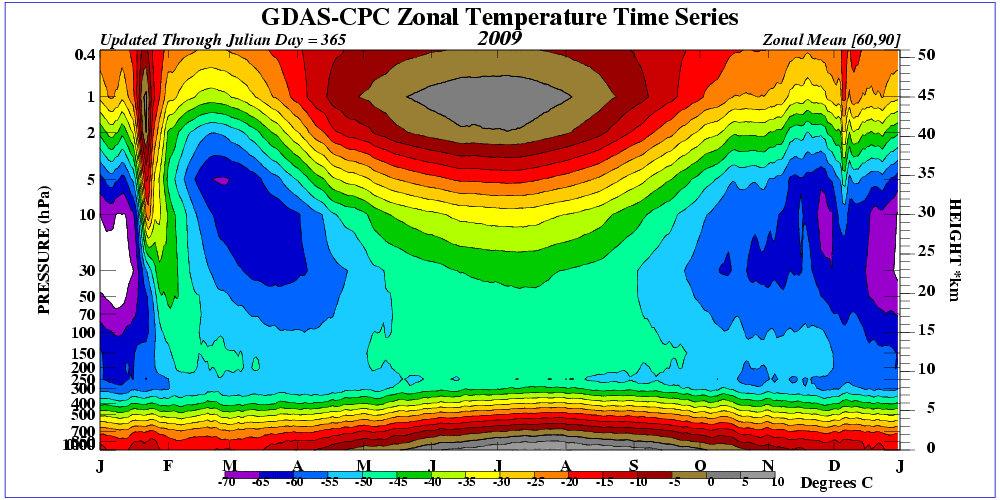
http://www.cpc.ncep.noaa.gov/products/stratosphere/strat-trop/gif_files/time_pres_TEMP_MEAN_ALL_NH_2009.gif
This event will produce cooling in February and into March.
The satellite troposphere measures seem to have been more affected than the surface going by the AMSU graphs from UAH.
http://discover.itsc.uah.edu/amsutemps/
There is an animation of it here.
http://earthobservatory.nasa.gov/IOTD/view.php?id=36972
These events are common in the winter in the northern hemipshere as there was 4 of the events in 2008 but the 2009 event was significantly more intense than any recorded so far.
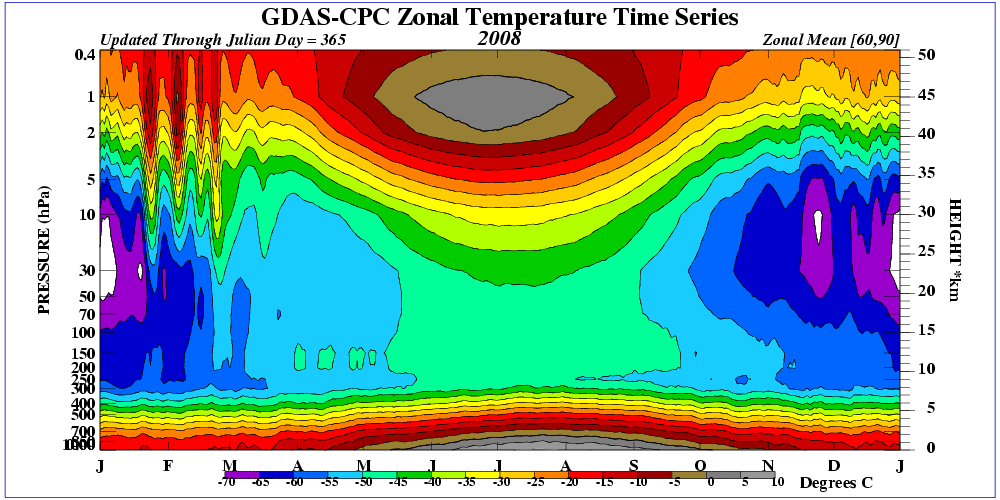
http://www.cpc.ncep.noaa.gov/products/stratosphere/strat-trop/gif_files/time_pres_TEMP_MEAN_ALL_NH_2008.gif
The effect they have is more in the high Arctic and the impact on the surface is usually not very high. There is some warming at the surface during the event and some cooling about 2 weeks to 8 weeks after (northern hemisphere higher latitudes only.)
Sorry, I meant to put this chart in as well which probably shows it better than any other. 10 hpa is 30 kms up.
It’s just a pre-9/11 mentality.
At least one Sudden Stratospheric Heating event is associated with cosmic rays. The 2008 graph looks as if Earth passed through a pulsing beam. Hmm.. Groundhog Day, 2008 at midnight… The constellation The Lynx is antisunward? Between Cancer and Leo. Any suspected cosmic ray sources in that direction? Let’s see; not Orion, nor Cygnus. There’s a suspected cosmic ray source 3,000 light years away but no known direction. Lynx is where SN 2006jc is, but that’s too recent to have been a source before 2006. Same for sn2000C.
How long ago have SSH been noticed, and at what time of year? Or might SSH be masked during Northern Hemisphere summer? That might be checked in a Southern Hemisphere graph, unless the source is high over the north.
See here change detection log for a history of changes to GISS. The data for the 19th century change every time. Can leprechauns travel back in time?
A question:
Is there a physical (oceanographic or biogeochemical reason) why the mean anomalies are slightly greater during Northern Hemisphere winter than summer (based on plotting the anomaly values in Excel and onto a variety of charts to see if any interesting patterns emerged)?
OK, so 8 years isn’t much data, but plotting up the average monthly anomalies show a crudely sine-wave type trend (except for March which is a high outlier, about 0.1 deg C above the line) with a peak in November (0.58 deg C) and minimum in June (0.45 deg C), with a difference of 0.13 deg C peak to trough.
Alternatively I can think of 2 reasons why this pattern is in the data:
1) The anecdotal suggestion that during the Soviet era (i.e. when the baseline for the anomalies was determined), Siberian locations tended to report colder winter temperatures than were really the case – maybe this also explains why March is so far above the trend, with the cold reported to hold on for a few days longer each year than was really the case as winter turns to spring.
2) That the corrections applied by GISS for the drop-out from 1990 onwards of high lattitude weather stations is not correct and so skews the results slightly, biasing warmer in winter.
Looks like we need a change log for the GISSTEMP algorerithm. If only it were public…
Rich (Comment#10305)
Faith and Begorrah, but of course!
Lucky
I would like to see a statistical treatment of the GISS (and others) ‘updates’ so as to test for possible bias. One way to do this is simply to compare increases vs. decreases. But this would not test against the effect of updates on trends; e.g., a decrease in the more distant past would tend to bolster a warming trend. More to the point, a test of each update as to whether it increases or decreases the underlying trend would discover an inherent leaning in the updates. Presuming the updates are random, one would expect a distribution centered aroud zero.
Gavin assures us that providing a change log for climate data is beyond the current scope of human science. Mighty Nasa has failed in challenger like fashion. Even Google has failed. Therefore, I conclude that BOTH the changes in temp AND the MYSTERIOUS code that detects and tracks changes MUST BE from some super intellect. Leprechauns Rule.
steven mosher– Truly the impossible has been accomplished! This is proof of the existence of Leprechauns, an unseen form of intelligence familiar only to those who believe Irish myths. That they can be so productive is evidence the current populations are large. So: The results are consistent with the Leprechaun theory of global warming.