I mentioned we had a coolish April around here; the Scandinavians reported it’s warm over there. Interestingly, Chad had just finished downloading model data from HadCM3 and compared the local anomalies in HadCrut and HadCM3. The differences in anomalies for HadCRUT and HadCM3 relative to the period 1980-1999 are shown below:
You can see the “Chicago” grid cell is blue, indicating that we are chilly relative to predictions in HadCM3 (which predict warming.) In contrast, Sweden looks a bit yellow, indicating they are running a bit warm relative to predictions in HadCM3. Mind you, this doesn’t tell us how much it really warmed… it’s all relative to predictions in a particular model.
Nevertheless: it appears Chicago has warmed less than the Chicago grid in HadCM3, and Sweden has warmed more than the Sweden grids in HadCM3.
You can read more at Chad’s blog.
Is there any explanation why european russia has low and high extremes side by side?
Hans–
No explanations. Chad just computed computed the predicted and observed values in the grid boxes and compared. The values are very noisy. If I were forced to make a SWAG, my guess on red boxes next to blue boxes would include:
1) Some box has a big urban heat island effect.
2) Some box has more than the usual measurement noise, with a big bias somewhere for some reason.
3) Dramatic changes in terrain make the two regions have drastically different micro-climates which responded differently.
Chad also checked which grid boxes has trends that were statistically different form 0 using AR(1) as the noise model.
From where I am standing, Sweden looks pale green. Maybe I need to see my optometrist? I am overdue.
Hey, Florida is a nice cyan color! Cool! (no pun intended).
Andrew_FL– I guess I think it looks lime green– so yellow tinged. Norway looks blue green. We could ask Chad to be sure.
THe world should cheer up; it’s looking a little blue!
Lucia,
Maybe HADCM3 latched on to the unusual highs around the end of the month [Valborgsmassafton and May1] and took them to be the norm… Or maybe HADCM3 has the same credibility as Aftonbladet [S], the Swedish tabloid rag that thinks it’s a newspaper and which proclaimed Sweden to have one of the warmest springs on record. As of this morning it was 13C and cloudy in Stockholm.
Tetris–Up to now, Sweden probably did have one of the warmest springs on record. There are about 5 weeks of spring yet. Let’s see if Chicago and Sweden swap. I’d like it to warm up so my tomatoes will get going.
Forget Sweden.
It looks like the South Pole is broiling!
http://www.cdc.noaa.gov/map/images/rnl/sfctmpmer_07a.rnl.html
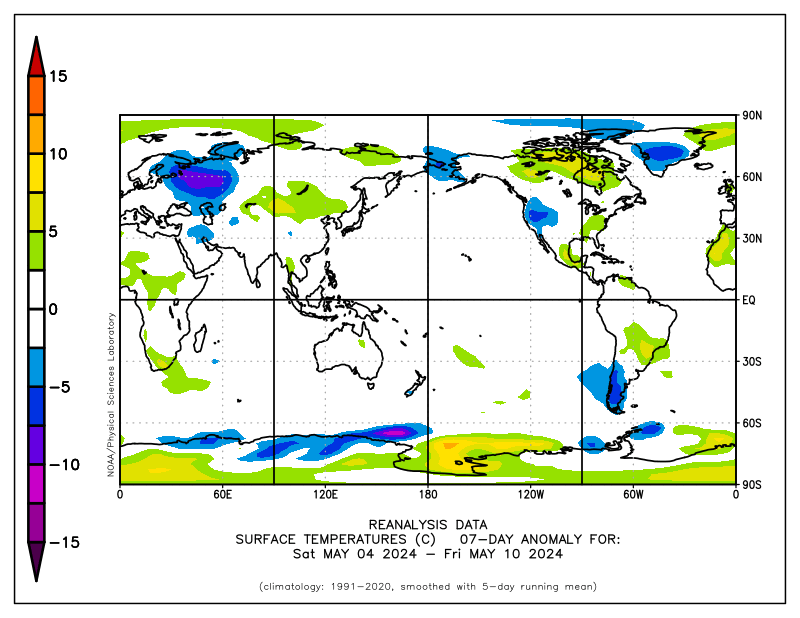
Don’t you just love those Mercator Projections?
Lucia [13419]
I speak the language and have weekly contact. Nobody tells me they’re any warmer than when I lived in the south 30 years ago.
You think you have a gardening problem? Remember, I was annoyed because I had to have my wood stove on mid April on the West Coast islands? Well, it’s on again, May 6th! The high today was 10C, the low 6C and the garden is running 3-4 weeks late.
Even the uber politically correct CBC has started acknowledging that things are truly not normal.
Alas, despite the most Swedish sounding name possible, I speak no Swedish. I guess I could ask my father-in-law’s cousins.
Lucia
This is great material by Chad here.
I often wonder what is happening behind closed doors right now.
The modelers (gavin et al.) are talking to their bosses (Hansen, Jones et al) and they have to be brain-storming on how they can make all the “forcings” match up to what is really going on with the actual temperature trends now.
They can all produce a chart or two showing how accurate their models are for the glorifying-masses at RealClimate etc., …
… see here (and lucia, you should have a look at this if you haven’t seen this one yet since your blog is cited on this one).
http://www.realclimate.org/index.php/archives/2009/05/moncktons-deliberate-manipulation/
But just knowing how the “external forcings” work in these models, they have to be really confused right now because they have already bumped up well beyond all reasonable expectations the only negative forcing capable of over-riding the GHG impact over ten years – Aerosols – (and all the latest data is starting to show the net impact of Aerosols’ forcing including Black Carbon in the atmosphere is actually a positive impact on temperature, not a negative one), and with all the new results coming in on Ocean Heat Content falling or at least stable (probably declining averaging out all the numbers from the newest studies) …
… they have to actually be examining whether the GHG impact and the GHG formulae has to be lowered now. It is the only conclusion one can come to.
Bill Illis–
Yes. I saw the incoming link. WordPress shows those in the dashboard. Oddly, I left a comment, but it got moderated. I was surprised because I didn’t think it was the sort of comment that would get moderated!
Bill Illis-“only negative forcing capable of over-riding the GHG impact over ten years”
Maybe, but not necessarily. Nir Shaviv has argued convincingly that at the very least the solar forcing over the eleven year cycle has been greatly underestimated:
http://www.sciencebits.com/files/articles/CalorimeterFinal.pdf
Long term variations are more speculative, so I’m not so sure about solar effects actually influencing warming itself but, well…
And then there is the possibility of natural cloud variations which Roy Spencer has been working on.
Now only ~anthropogenic~ forcing, that might be a more accurate statement.
Bill,
You mention that ” Aerosols – (and all the latest data is starting to show the net impact of Aerosols’ forcing including Black Carbon in the atmosphere is actually a positive impact on temperature, not a negative one)”. I’m curious what studies you are referring to here, because the only new aerosol research I’m aware of (e.g. work by Shindell and Ramanathan) only suggests that black carbon outweighs aerosol forcings in arctic and some antarctic areas, certainly not for global forcings.
Zeke{13427] Bill Illis [13424]
Before we all get caught up in our various shoe laces in terms of explaining things this, that or the other way, please have another look at what Jim Hansen said about aerosols at the Copenhagen Climate Change Conference past March. [synopsis: we don’t have an everloving clue].
Hansen dixit: “the IPCC numbers on aerosols are pretty much pulled out of a hat”. If that comes across to anyone as bizarre in any which way, pls ref pp 6-8 and for that matter the rest of Hansen’s Copenhagen PP presentation [which includes involving his grandchildren as props], available at the GISS website.
Credibility is a very precious thing to waste…..
Zeke, there are lots of studies talking about the role of black carbon in the atmosphere separate from the black carbon on snow Arctic and Antarctic impacts.
Here’s one
http://www.nature.com/ngeo/journal/v1/n1/full/ngeo.2007.62.html
The only way the math will work if they build in a more-realistic black carbon in the atmosphere impact in, is if they triple the sulfate negative Aerosols forcing or they cut the GHG forcing in half.
http://img509.imageshack.us/img509/8388/modeletempimpactst.png
Bill,
The paper you link to is reviewing studies of net impact specifically in ‘aerosol hot spots’. Your ‘math’ then extrapolates that as if it were a global finding.
Some areas with verly close both negative and positive anomalis might seem implausible, but are not neccessarily physically impossible.
Marine systems have areas with narrow boundaries between cold and warm currents and/or advections and convection systems.
If or when the boundaries for such phenomena is dislocated, fairly dramatic (at least in color-coded graphs) can be observed.
Typical areas would be W of Spitzbergen in the NE Atlantic, and around New Foundland (typically S of NF)
Cassanders
In Cod we trust
I just checked the Swedish Inst. for Meteorology and Hydrography
http://www.smhi.se/cmp/jsp/polopoly.jsp?d=5648&a=41303&l=sv and they remarked an unusual warm April in both Germany, Sweden, Denmark and Southern Norway. (The anglophone web-page has a number of other headlines)
A “higher than normal” number of high pressures giving more irradiance from the sun hitting the ground is suggested as a major explanation.
The lower than usual temperature at Spitzbergen (Norw) is also noted (Spitzberge has typically had warmer than normal Aprils the later decade(s).
Cassanders
In Cod we trust
I’m thinking about sending something in to EPA concerning this CO2 as pollutant thing. I’ve been wondering if it would be feasible to calculate a 500 year frost the way engineers calculate a 500 year flood. It’s something to think about. If we had an abnormally late spring frost in the same year as an abnormally early fall frost in, say, the northern cornbelt, it could have global consequences. I suppose you would look at the bell curve of frost dates and project out the appropriate number of standard deviations? – something like that?
First time poster (and reader) at this place. Came by via climateaudit. Just to confirm Cassanders comments, in Denmark we have had a record high April with 9,4 C compared to the 1961-90 ‘normal’ of 5,7 C.
Some call it a nice spring – some call it somehing else 😉