I just read RayPierre’s article on whether or not early action on methane “buys time” before the earth hits 2C. (Keith Kloor has also been discussing this a lot.)
I’ll admit I only skimmed. (I was also watching my t-test runs from R.) But even skimming, I was struck by what seems to me a somewhat misleading comparison. I went back, reread, and the comparison still seems misleading.
If I am not mistaken, the argument that acting on methane now buys time before we hit 2C goes like this:
Let’s assume we recognize that it will be impossible to get an agreement on action on CO2 in Cancun, this year. Period. As a practical matter it ain’t going to happen. But let’s also assume that if politicians discuss methane, we can get an agreement to reduce methane. So, the possibile outcomes are:
- No agreement on CO2 and no agreement on methane or
- No agreement on CO2 and an agreement to reduce methane.
Whatever happens, politicians will be back at the table in the future– possibly next year. At that point, if they got outcome (1) , they can decide on their negotiating based on the likelihood of success. They may still be faced with options (1) & (2). If they got option 2, they will then focus on CO2.
My impression is the buy time argument is that if politicians hammer out option 2 rather than 1, the world will warm somewhat less rapidly in the short term. Temperature will be lower than if we reduce no ghg at all.
To assess this argument, we need a graph that compare:
- Temperatures if we reduce methane shortly after 2010 and delay action on CO2 until that’s politically feasible. .
- Temperatures if we never reduce methane and still delay action on CO2.
But, it seems to me, that’s not what RayPierre compared. I think he compared
- Temperatures if we reduce methane shortly after 2010 and delay action on CO2 until that’s politically feasible. .
- Temperatures if defer action methane and but manage to act on CO2 shortly after 2010.
At least it seems to me that’s the comparison we are given in this graph:
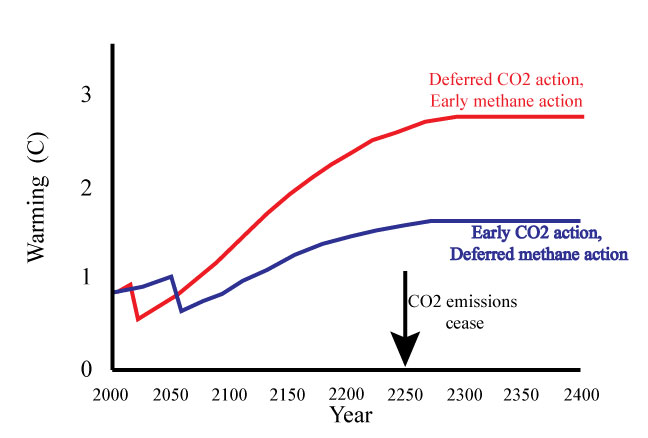
Sorry, but that graph doesn’t provide information we need to assess whether reducing methane now “buys time”.
The reason is that the argument about buying time contains both a political element and a scientific element. The political question is: Is there a chance in hell that we can get an agreement on CO2 in Cancun? If the answer is “No. There is zero chance.”, then then the “buy time” argument kicks in.
My cartoon rendition of what happens if we perpetually ignore Methane because it’s less important than CO2 is shown by the black trace I added to RayPierre’s graph, which I think qualitatively describes what happens if we do “no action on methane, deferred action on CO2” .

Notice at all times, the black line results in more warming than the red line.
So, in this sense, reducing methane “buys time” before we hit a rise of 2C.
Of course, maybe I am wrong in my guess about the shape of the black trace (which is qualitative in any event). But even if my guess is incorrect, it seems to me the analysis RayPierre provides us no insight into the answer to the question about “buying time”. This is because his “scientific” discussion fails to address political reality, and also fails to address the actual claim encapsulated in the “buying time” argument. If he wants to bring his scientific expertise to bear on this question, he needs to address the honest to goodness “buying time” argument and not merely the (ahem, straw-man) argument about whether, as the rather academic issue of whether we get lower temperatures by acting on CO2 first, and Methane later, or vice-versa.
I am under the impression that, apart from leaking russian pipelines, methane sources are largely natural, and the feared ones are a consequence of global warming – melting clathrates in permafrost on land and under the arctic ocean come to mind. How, absent finding a way to prevent future warming, can there be action on methane sufficient to make any difference?
JT–
My impression is that there are sources of human released methane. But I am wrong about this, it appears RayPierre must also be wrong about this because those sudden dips in his Temperature vs Time graphs come from his estimate of what happens if we reign in the human released methane.
Here’s what the EPA says (http://www.epa.gov/methane/sources.html)
BTW: My brother-in-law persuaded the county to use waste methane from the sewage treatment plant to drive power generation. This resulted in cost savings to the county. From the POV of human induced ghg, it’s a double benefit. The county emits less methane and gets some power without having to burn purchased natural gas, coal etc.
OK, so we burn methane thereby reducing the amount which nature releases into the atmosphere. The by-product is CO2 which warms the atmosphere and prevents the next glaciation from depositing a mile thick layer of ice on a number of major cities from Cleveland to Pittsburgh to Detroit… even Chicago gets squished… of course, to protect hundreds of millions of people from certain death or destruction (not to mention the immigration problem created when all those Canadians who have to go somewhere with their extra beer refrigerators)… but there is the added problem of when you reduce naturally released methane in the atmosphere, which is a more powerful greenhouse gas than CO2, you will artificially cool the climate… which means we’ll have to burn coal and oil to add extra CO2 to counter the cooling.
Blocking CO2 emissions is perhaps a more important goal than stopping global warming, for certain people who consider environmentalism a religion.
Similar to opposition to nuclear power, or geoengineering.
MikeC
If you don’t burn the methane and release it into the atmosphere, it also decomposes to CO2. But it’s radiative properties are then reduced relative to being methane.
Well… I guess if you manage to reduce all natural sources of methane, that would occur. But is there any risk of that happening? And if it did, couldn’t you just throttle back on capturing the cow farts and gas emitted from termite mounds? That would hardly be difficult.
Lucia, We’ve already tapped much of the near surface methane and now are drilling for sources deep in the crust, kinda like oil… so we’ve already slowed down the warming process according to the neighborhood alarmists…
MikeC–
Did the near surface ones previously leak?
Of course, methane builds up pressure where it forms in the crust… methane which develops near the surface leaks into the atmosphere…some leaks are small and some are large… if you surf the net you’ll find some pictures of some massive releases which are now being captured… one that I saw in the past looked like it could equal the farts of millions of cows.
Not that I believe what I see on television, but I recall seeing a documentary (History Channel, maybe) attempting to show how large methane releases in the open ocean can sink ships or even bring down airplanes. Think “Bermuda Triangle” here. 🙂
I’ve always had issues with the whole cow fart scenario… So cows farting releases CH4, hasnt the C come from photosynthesis? With the atmospheric life o CH4 being around 8 years, wouldnt the level o carbon emitted vrs absorbed(photosynthesis) reach an equilibrium over this period, and a rise in ch4 due to bovine out gassing require a rise in the total bovine bio mass?
I just fail to see the difference between us breathing out co2 being a co2 source, and bovine fartery causes rises in ch4.
For the black line, I would consider deferred methane action, and deferred co2 action. This curve will meet the red line in the long term.
Early methane action could cause extra warming in the long term, to whatever extent (if any) that it gives us an excuse to cut back on CO2 action.
Why? Methane warns, right?
If early action is alternative to no action, shouldn’t it cause less warming in the long run? Otherwise, if it’s an alternative to later action, both those scenearios have the same outcome in the truly long run, with early action always being cooler than later action. Right? Or am I missing something?
Lucia – I agree and thought the same thing when I read Raypierre’s article — to be a truly fair comparison, there needed to be a third realistic option which included not doing anything about CO2 for 10, 15, or even 30 years. While Raypierre only looked quantitatively at methane, I think the point included black soot, and other easier to control/regulate emissions. My own feelings are it would be better to start attacking the low-hanging fruit (e.g., black carbon and methane) now since there are other benefits (for example, improved respiratory health and possibly the ability to better hone in on CO2’s actual climate sensitivity) rather than to continue down a path of trying to get CO2 emissions regulated/reduced in the short term when there isn’t a snowballs chance in hell that there is the political will in any of the major countries to do so. I do agree with Raypierre and others, however, that focusing on things like black carbon now will not necessarily buy political capitol for regulating CO2 in the future.
“Temperature will be lower than if we reduce no ghg at all.”
For a little while. I believe that that is Ray’s point, and it’s a good one. Less methane is good, he’s not arguing that, but it doesn’t buy time, given the lifespan of the two gases in the atmosphere. So it gives the impression of improving things, like leasing a bunch of expensive stuff with a credit card. But it doesn’t affect where we are in the long run, because you can tackle methane anytime and get a rapid response. Functionally, then, methane controls do not so much offset CO2 emissions as temporarily mask their effects.
Mind, I’m not sure I agree, but I think he makes an important point that deserves to be understood. One thing the argument doesn’t take into account is human psychology — a successful international agreement that slows warming and cuts an important greenhouse gas would seem to make for a better climate to tackle CO2. Then again, the Montreal agreement didn’t seem to make things easier, did it?
BobN
I also don’t know if it will or it won’t buy capital.
Robert
Not a little while. If methane is low and stays low, it keeps the temperature lower forever relative to methane being uncontrolled. Forever ≠“a little while”.
The lifespan is irrelevant. If methane is reduced and kept low, it keeps temperatures lower than the alternative of uncontrolled methane and the effect lasts forever.
I realize that RayPierre’s post is written in a way that obscures this point, but that’s a misleading feature of RayPierre’s post.
I think the fact that what he writes is misleading needs to be misunderstood. Had he put a third trace on the graph, you would be able to see that the effect of cutting methane and keeping cuts in place forever relative to never cutting it would have reduce the asymptotic temperature for a given amount of CO2 forever.
He could, of course create a large number of “what if” graphs. Given political realities, and what buying time means, he left off the important trace, which is: What happens to temperatures if we do nothing now relative to cutting methane now.
Re: lucia (Dec 8 17:03),
Controlling methane emissions is even more fatuous than controlling CO2 emissions. Is he suggesting banning agriculture? Rice cultivation alone is responsible for something like 20% of all anthropogenic methane. Hydroelectric and other dams are also significant methane sources. Low hanging fruit indeed!
Lucia,
I think you should keep your powder dry for something more relevant. Methane has been trotted out before to cover for CO2’s inability to account by itself for the AGW/ACC hypothesis.
In fact, just last week the same crowd pulled out the next rabbit-out-of-the-hat supposed to solve the “man-made” warming equation: gases used to put you down or out for dentistry or surgery. And might I mention cow farts.. Whatever.
DeWitt–
I’m willing to give up rice…..
(My sister is gluten intolerant, so she may not be willing to give up rice.)
Let’s start with some economic and industrial realities.
In any part of the world where steam coal costs anymore then $100/ton ‘new nuclear capacity’ is cheaper then ‘new coal capacity’.
The only place in the world where steam coal is for sale for less then $100/ton is the United States. The price ranges from $20/ton delivered in Wyoming to more then $80/ton delivered in New Jersey.
Japan is increasing it’s nuclear generating capacity to 40% of its total, South Korea is increasing its nuclear generating capacity to 40% of it total. Rumor has it that the Chinese has $500 Billion in there nuclear budget.
South Africa,Kuwait,Saudi Arabia,UAE,Turkey,Great Britain, Eqypt,Finland,India,Vietnam have all announced substantial nuclear build programs.
These countries are not currently bound by any treaty to take the actions they are taking, they are taking them because it is in their ‘economic interest’ to do so.
The only advantage coal currently enjoys over nuclear power in the global market is the ‘industrial capacity’ to build coal fired plants is underutilized, so it you want one tomorrow morning at 9, the building crew will show up tomorrow morning at 9.
At the moment the industrial capacity to build nuclear power plants is over subscribed. If you haven’t already put down a deposit the construction crew won’t show up for 5-10 years.
Lack of a ‘treaty to limit CO2 emissions’ doesn’t change the economics of coal. The global price has quadrupled in the last 10 years and continues to climb at double digit rates.
So the basic ‘Without a global treaty nothing will happen’ is false on its face.
DeWitt – I had not thought of it before, but am intereste in how dams account for methane generation. Is it that the previously flowing but now stagnant waters breed algal blooms and the like which when they decay lead to methane generation? How confident are we in the magnitude of this effect?
If what you say is true, it further supports Pielke Sr.’s position that there a multitude of human-caused first order forcings that the IPCC and current modelling efforts don’t adequately address.
DeWitt is quite right. Human methane production is not going to reduce significantly whatever Cancun decides because it is a byproduct of food and energy the world needs. The proposition is fatuous.
Wait a minute this graph seems to be inverted. Isn’t methane a much stronger ghg than co2? How is the red line, signifying early methane action, resulting in a higher temperature increase?
There is a combinatorial set of 9 possible options involving 3 CO2 options: reduce now, reduce later, reduce never
and 3 CH4 options: reduce now, reduce later, reduce never.
“buying time”, in your own words, is “What happens to temperatures if we do nothing now relative to cutting methane now.” I don’t read that sentence (or the phrase “buying time”) the same way you apparently mean it to be read. I read both the phrase and that sentence to read “what happens to temperature depending on what we do in the next ten years: and we assume that we get our act together and do the right thing, reducing both, ten years from now” (or 20, or 30, or whatever).
But another approach would be to rank the 9 options from “best for climate” to “worst for climate”: my ranking would start clearly with:
methane now, CO2 now
methane later, CO2 now
then all approximately tied, with the “CO2 now” scenario being either better than or worse than the other two depending on how much of each gas is being reduced in various time periods:
methane never, CO2 now
methane now, CO2 later
methane later, CO2 later
then,
methane never, CO2 later
and finally, the three CO2 nevers.
So, CO2 now beats CO2 later beats CO2 never, with not much sensitivity to methane choices – with the possible exception of methane never, CO2 now… but we aren’t making once and for all decisions today. We are making decisions about the next few years. Given that, reducing methane today does NOT buy time. Reducing methane 50 years from now (and 100, and 150) might buy some time, but that’s not the control knob we can push. We can only push “now” or “not now” (which encompasses both later and never), and given that, while reducing methane is better than nothing, it doesn’t “buy time” for CO2 reductions.
Or so I think.
-M
In the meantime:
Overnight lows of -15C in Scotland and -13C in England
Experts say cold snap is ‘once in a lifetime’
Slight thaw this weekend but a return to snow predicted for next week
The Army was called in today to help clear away ice and snow as Britain headed towards its coldest December for 100 years.
Hmm hmm hmm.
Liza, That’s all climate change created by your desire to eat a steak
We should consider the best possible outcome from all of this:
Not only a failure of Cancun but no more CO2 obsessed cliamte conferences in the future.
M
Two questions: Which are you saying. It does NOT (all caps), or “it might buy some time”? Because these contradict each other. (The latter is closer to correct.)
In reality, holding any other act constant (i.e. cutting or not cutting CO2), relative to options of not reducing methane now, cutting methane now reduces the rate of increase of temperature now. Assuming methane is a GHG, and we keep the methane in check after the first reduction, the temperature trajectory is always lower than not reducing methane. Always. This is a physical fact.
If “buy time” means “time until we hit 2C”, reducing methane now absolutely does “buy time” relative to not controlling methane now while holding other choices constant. (Those choices could be control CO2 now or not control CO2 now). It buys time irrespective of your other observations with which I agree. (For example: We aren’t making once and for all decisions. We never decisions for all time. If an agreement to reduce CO2 was possible, that would keep temperature lower still. )
So, the correct interpretation: If we assume we can’t get agreement to cut CO2 now getting agreement to cut Methane does buy time before we hit 2C.
Second question: Why do you think reducing methane 50 years from now is not a control knob we can push? It seems to me that RayPierre hypothetically pushed the knob on future action in his discussion, so I don’t see why our hypotheticals aren’t allowed to discuss those.
Of course. CO2 now with Methane now beats CO2 now with Methane later beats CO2 now with Methan never.
And so on. And the political issue is: If we assume we can’t get agreement on CO2 now, which choice is better:
Methane now? Or refuse to spend time negotiating methane until after CO2?
The science would say “methane now”. And if by “time” we mean “time until we hit 2C warming”, methane now “buys time” relative to stubbornly refusing to have negotiators devote sufficient time to ironing out a deal on methane and insist they focus on arguing over the deal on CO2 which, for political reasons, we think can’t be achieved.
BTW:
Even using your definition, reducing methane now and CO2 later still keeps the temperature lower than not reducing methane now and reducing CO2 later. The early methane reduction will always follow a lower temperature trajectory, with the two solutions approaching each other asymptoticaly after multiples of the time constant for Methane in the atmosphere or the time constant for the earth’s climate system (which ever time constant is larger.)
So, under your interpretation of buying time, reducing methane now absolutely buys time until we hit 2C!
The only way to make reducing methane not buy time is to assume the alternative is to reduce CO2 now. But the “buy time” argument assumes that is politically impossible.
So, “rebutting” the concept by assuming we can reduce CO2 now is silly. If you think we shouldn’t do it because you believe we actually could get an agreement for CO2 reductions now (or at least very soon) that’s different. But this has nothing to do with physics. It has to do with your guess about political reality.
One question that comes up is how close the black line would be to the red line. A point implicit in the RC post (maybe explicit too, I didn’t go back to check) is that the black line would be so close to the red line that it wouldn’t make much difference.
Of course, as prior comments in this thread show, one determinant of where one draws the black line is, which sources of methane constitute “low-hanging fruit”? Diffusing out of landfills, yes. Coming from exposed coal seams, maybe. Lakes behind hydropower dams, thawing permafrost, not so much.
It seems to me that there’s also an element of “the worse the better.”
(1) If people aren’t going to take effective action (=CO2), then they shouldn’t get to “feel better” about their ineffective acts (=CH4).
(2) If our society/the world isn’t going to take effective action (=C02), then we might as well see the effects of the resultant inevitable temperature rise sooner rather than a little bit later, since that might lead to the “uh-oh” moment that belatedly gets “denialists” to shaddup, and more-reasonable “inactivists” to agree with the sorts of programs that Michael Tobis proposes.
From the C-a-s post “Our Miserable Future,” here is a link to comment #16, which seems to go beyond the-worse-the-better to schadenfreude about the punishment that Gaia is about to start inflicting on Western societies.
The commenter might be writing black comedy. Sometimes it’s hard to tell. But whether serious or parodic, he does seem to lay out a view that isn’t beyond the Pale.
MikeC, No it’s not. Remember the La Brea Tar Pits? 😉
(not much steak eating here at our house lately but we do; and we will continue to enjoy life with rice in it. I have a Korean-American teenager growing up in my house. Life without rice is no life at all. 😉 )
Mac
If the implicit point is accurate, RayPierre should show this instead of skipping this. But in fact, it cannot be so. Methane warms, and the difference in the assymptotic values for “never control” vs “control now” should be close in magnitude to the size of the “dips” RayPierre shows when his scenario engages hypothetical methane control. I tried go capture this in my sketch.
This exact same issue affects the size of RayPierre’s “dips” when methane is controlled in his two scenarios. Clearly, if there is no “low hanging fruit”, then his original graph should have no “dips” when methane is controled (because almost none gets controlled). Likewise, my black line would lie right over his red line.
It strikes me that put into the “buy time” methaphor, this translates into: “Assuming that we get CO2 control in year “N”, and that decisionis unaffected by our choice in Methane, reducing methane now does buy time. But we shouldn’t do it, because we think a slower rise in temperature now would reduce political will to cut CO2. So, if reducing methane means we reduce CO2 later than we otherwise would, we shouldn’t do it.”
This is a political judgment about how current choices will affect future choices. But it shouldn’t be confused with the misleading sort of “science” RayPierre has presented us.
Liza, Rice fried in animal fat…. HA, GOTCHA!
MikeC (Comment#63582)
Nah uh! Rice cooker. (but that uses electricity-so does being on the internet and using a computer! 😉 )
Methane warms or methane worms?
http://images.spaceref.com/news/2001/05.04.01.ice.worm.bw.lrg.jpg
(um ewwww)
“”It’s very cool that while we’re busy speculating about life on other planets we continue to discover new forms of life in the most unlikely habitats on Earth,” commented Erin McMullin, a Penn State graduate student and a member of the research expedition that discovered the methane-ice worms. Methane ice, a gas hydrate, forms naturally at the high pressure and low temperature of the deep sea, but is usually buried deep in marine sediment. The Gulf of Mexico is one of the few places where hydrate can be found exposed on the ocean bottom. Occasionally this seeping, solid methane bursts through in mounds, often six to eight feet across.”
http://www.spaceref.com/news/viewpr.html?pid=4742
lucia (Comment#63554)-If the US is burning all our corn and we don’t let rice be grown, huge segments of the world are going to starve to death. The entire nation of Japan comes to mind. I have incidentally just said something similarly misleading to RayPierre. I did not consider the case where we stop burning our corn as ethanol, then let the Japanese learn to love paying extra money for corn instead of rice, which has to be imported. However, if we are shipping corn to Japan, that releases CO2 emissions, reducing the effect of lessened rice paddy agriculture considerably.
And of course, there again I need to consider the possibility of flattening the Japanese landscape with giant steamrollers to make it suitable for growing other grains.
Liza, You just walked yourself into it… your rice creates more methane than my prime rib roast…
http://zebu.uoregon.edu/1999/es202/methane_sources.gif
… therefore I am a finer (and better fed) example of humanity…
reminds me of Riverwind Casino in Norman Oklahoma… prime rib roast (the best I’ve ever had) nightly in the buffet… and some slots that pay off!
Andrew… rice in Japan is a spiritual thing… If you look around I bet you’ll find it’s import very limited
Speaking about rice fields and methane – I just wonder how much methane produce all these wetlands artificially reinstated throughout Europe, where our allegedly foolish ancestors have drained them for farming. Now it is very fashionable to reinstate them with all the nice skeeters they breed…and supposedly also methane?
Oh horror, one ecological disaster is remedied by another! 😉
EW, Call the IPCC! Man creates wetlands to be good environmentalists which produces methane (and thus AGW) and breeds mosquitos which potentially spread malaria…OMG… Al Gore was right!
AMac (Comment#63579) December 9th, 2010 at 10:39 am
“(1) If people aren’t going to take effective action (=CO2), then they shouldn’t get to “feel better†about their ineffective acts (=CH4). ”
If we took action on soot, SO2 and NOx 15% of the coal fired plants in the US would close.
http://www.reuters.com/article/idUSTRE6B82UI20101209
It’s not a question as to what people should feel good about. It’s a question about making one form of energy less economic then another.
One of the problems the ‘developed’ world has in cutting emissions is that we have a lot of existing capacity producing very cheap electricity because the capital investment has long ago been amortized.
So if you want to cut CO2 emissions you can either legislate away the existing capacity or make the economics less then favorable.
A way to make the economics of a coal plant unfavorable is to require installation of various pollution controls. Plenty of plants would close rather then install the emissions controls, the economics of ‘new’ coal fired construction would become less favorable.
The price of a new coal fired plant with all the emissions controls except CO2 is not substantially different then the price of a nuclear power plant.
China and India are never going to agree hard CO2 caps because they both depend on the longtime allies of the US , Canada and Australia for Uranium. Since India’s Uranium supply has already been cut once and was only reinstated in July of this year, they are not going to bargain away the fallback position of burning coal if the US,Canada and Australia get themselves in another tizzy over a little nuclear bomb test.
Re: harrywr2 (Dec 9 13:17),
Interesting article.
So would stricter controls of SO2 etc. be pursued for traditional pollution/health reasons, or in order to indirectly but effectively cut CO2 emissions? Both, I guess.
Somewhat off topic, I am beginning to suspect that the politics (not the science) of the AGW story is going to become progressively overshadowed by the Peak Oil issue. Here, for instance, is a slide show by Robert Hirsch. As that overview suggests, in some cases concerns over Peak Oil and AGW will lead to the same policy recommendations (conservation). In others, they will be opposed (coal-to-liquids).
If/when Peak Oil comes, its economic effects will bite Western (and other) economies, fast and hard. Pocketbook effects will lead to unwelcome lifestyle changes. It seems unlikely to me that voters will weigh concerns about future decades’ climate as heavily as they do today (whether such a changed emphasis is justified or not).
Ramanathan claimed that the other than CO2 “low hanging fruit”(LHF=soot, CH4, etc.) results in a forcing of 80% of CO2. Assuming no feedback doubling of 1.1’C and we are at x1.393 now, so the deltaT for CO2 would be 0.43’C. Add in the LHF, the no feedback deltaT should be 0.78’C. IPCC says 0.74 warming during 20th century.
Does this imply low sensitivity to anthropogenic forcings?
Even if you accept Ramanathan’s estimates, the non-CO2 “low hanging fruit” would still have to be called anthropogenic.
oliver (Comment#63595):
yes, that’s my point.
CO2+LHF=AGW forcings=0.78’C increase to from 1910 to 2010
Actual IPCC 20th century increase =0.74’C
** there is no 21st Century increase yet 😉 **
Where are the positive feedbacks ??
AMac (Comment#63593) December 9th, 2010 at 1:47 pm
“So would stricter controls of SO2 etc. be pursued for traditional pollution/health reasons, or in order to indirectly but effectively cut CO2 emissions? Both, I guess.”
What is the easier sell politically? Does it really matter?
On the OT as far as transportation fuels, if I’m reading the tea leaves correctly I think CNG/LNG is probably going to be the medium term bet. Maybe coal to liquids with Carbon Capture would be the only way to even dream of selling it to environmentalists.
Lucia, I think you make a good point that the missing black line would make easier the interpretation of what the authors says about the future problems resulting from buying time in the near term. The author’s point though does not change and is probably reasonable within the consensus thinking and some rather straight forward physics of GHGs.
What I do find of interest is that the short term fix to the detriment of the long term is so much in line with choices that governments throughout the world have made. Unfunded liabilities for SS and government health care come immediately to mind. In Illinois we have the example/problem of state funded pensions.
Being a libertarian I have little faith in a major government and international effort to do anything about AGW that would not have unintended consequences worse than any of the (unproven) problems arising from AGW. Having said that I also know that the only way to move the populaces will be to create a crisis, real or imagined, (like governments do when they need a big change in the way things are being done) and therefore one would want it to get hot sooner rather than later.
Kenneth
Which point doesn’t change if we add the black line? If we add the black line, it’s clear that controlling methane now does buy time, which seems to me to contradict RayPierre’s “point” that it does not. He insists it does not buy time when responding to Keith’s arguments in comments, and it’s clear that his “reason” is he refuses to judge the “buy time” argument including it’s assumption that it’s politically impossible to get action on CO2.
So, basically, the way I see it RayPierre’s analysis is irrelevant to the “buy time” argument. That would be unimportant except that he framed his post as having something to do with the “buy time” argument and makes a conclusion about that argument.
If all RayPierre wants to say is that, based on physics, we will achieve lower temperatures if we control CO2 first– sure. But the “buy time” argument isn’t saying otherwise.
Well… sometimes, this seems to be Tobis’s argument. 🙂
I read RayPierre’s article once and it has no “practical” value for me so I’ll not read it again.
What I read the first time through and perhaps misunderstood is that the methane reduction first will buy you warming time to the “dreaded” 2 degree C increase in global temperature. With your black line I can estimate how much time I buy. RayPierre’s point is that in buying time and doing nothing to reduce the much longer lived CO2 levels, the eventual warming from the additional CO2 that accumulates during the buying time period will be not only be greater eventually but that increase will endure for a long time even when the emissions go to zero. (That of course, would be true for any level at the end of the CO2 emission period.)
I was thinking that perhaps a poll might be in order to determine what your blog participants judge is the ideal global temperature (as a difference in degrees C from the current level). I suspect that some time in the future that man will have the capabilities to control global temperatures up and down within some tolerance level. If man was capable, it would also be interesting to consider how the global populace would decide what temperatures were appropriate. Certainly there would be people who would feel they were losers in whatever decision was made.
I think most people tie into the idea that the “natural” temperature is better i.e. what it would be with no influence from man and/or whatever temperature is the current one because they have gotten accustomed to it. For those not selecting the status quo I think most would chose a warmer climate – or maybe I think that because I am older and could forgo a relocation to warmer climes.
Kenneth Fritsch (Comment#63599) December 10th, 2010 at 9:25 am
“Having said that I also know that the only way to move the populaces will be to create a crisis, real or imagined, (like governments do when they need a big change in the way things are being done) and therefore one would want it to get hot sooner rather than later.”
http://www.bloomberg.com/news/2010-12-10/deutsche-bank-raises-thermal-coal-price-forecasts-for-2011-2012.html
“Export power-coal prices at Richards Bay, South Africa, a market benchmark, will average $118 a metric ton next year and $140 in 2012, Daniel Brebner, a London-based Deutsche Bank analyst, said in a report dated today.”
$140/tonne works out to a fuel cost of 7 cents/KW.
Hydro/Wind(location dependent)/Nuclear/Natural Gas all end up being cheaper options. I never heard of anyone who was against ‘save my wallet’.
The situation in the US Midwest and Rocky Mountain States is somewhat different as Powder River Basin coal goes for $15/ton.
But the US Midwest and Rocky Mountain States represent a tiny fraction of global energy consumption.
Kenneth
Yes. But the problem with this “point” is how it relates to the “buying time” argument which is about what we should do if we assume that we can’t get an agreement to reduce CO2.
So, yes, if we can get an agreement to reduce CO2, but decide to reduce methane first instead, that doesn’t “buy time”. In that case, RayPierre’s lines describe why, if we actually have a choice between the two scenearios he bothered to consider, we should pick “reduce CO2 now”.
The only thing is: That has nothing to do with the “buying time” suggestion.
I think the “ideal” temperature is a fairly stable or at least slowly varying one. That permits people to plan. Populations can stay pretty much were they are ans so on. Other than that, I think there is no “ideal”.
I have no particular preference to whether the “ideal” is achieved artificially or naturally. I prefer day time temperatures to be between 75F-80F and night time temps between 70-75F. If it’s hotter than 80F outside, I would still consider 80F ideal, and kinda’ like walking into air conditioned builidings (provided it’s not set too cool– which it often is) If it’s colder than 70, I put on warm clothes and also like to sit and especially sleep in heated buildings.
I have no love of the “natural” 18F temperatures we’ve had during days this week!
Back to RayPierre’s graph– If we had “knobs”, I would rather reduce Methane at a rate that took out the “methane dips” in his graph and just resulted in a slower trend. That is: it’s large values of dT/dtime that bother me more than the absolute temperature.
MikeC (Comment#63588)-Hm, checked, you kind of have a point. Although it is true that there is a great shortage of arable land, and much of that land is suitable chiefly for rice paddy agriculture, they can and do grow other crops. More importantly, they have an enormous surplus stock of rice, which they can’t seem to figure out what to do with. So they may be okay with less rice.
http://en.wikipedia.org/wiki/Japanese_agriculture
Still, rice is one of the world’s major staple grains, and we can’t really expect to just replace it with corn and/or wheat.