GISSTemp posted a January Temperature anomaly of 0.71C. This ties with 2002 for the 2nd highest January anomaly in the record, exceeded only by January 2007. The anomalies are plotted below:

We’re still waiting for Hadley!
GISSTemp posted a January Temperature anomaly of 0.71C. This ties with 2002 for the 2nd highest January anomaly in the record, exceeded only by January 2007. The anomalies are plotted below:
We’re still waiting for Hadley!
Comments are closed.
I think the distribution of anomalies is interesting. A belt of quite cool anomalies through USA across the Atlantic and then through northern Europe and Asia. Nearly circling the NH except NW Pacific.
What I hadn’t notice before is a roughly equivelant belt in the SH. It runs through the southern ocean and doesn’t cross land anywhere. Although much weaker than the NH cool belt on land, it is roughly as cool as the parts over the Atlantic and Pacific.
Isn’t GISS more a measure of land surface temps?
I know sea surfaces were warm, but I really have to wonder about land surface temps.
“GLOBAL Land-Ocean Temperature Index ”
why not just click the link???
I think, until we get to the bottom of the problems at GISS, their data should be, at the least, tagged with question marks.
hunter–
GISS doesn’t seem any better or any worse than any other observational set.
oh giss is a joke. look in the 1200km map how kazakhstan swamps mongolia to make it look like its warmed in mongolia. hehe. i wonder if it is warming in kazakhstan? maybe we should ask borat if it has been 12 degrees above normal for the month.or is that uzbekistan that was baking? of course we can understand canada due to the one thermometer being a bit warm..
it seems china was really warm after all and the chinese were just bitching about the extra snow for no reason. of course there are probably half a billion or so chinese that think giss and co are mad, but thats neither here nor there because they cant speak our language, so who cares about them or the africans or poor little borat, and for that matter those other poorish people living in south america.
i tell you now, the anomaly map looks more like the wealth map of the world than anything to do with the temperatures.
Michael Hauber (Comment#33873),
“A belt of quite cool anomalies through USA across the Atlantic and then through northern Europe and Asia.”
An interesting observation for sure. It appears this is linked to El Nino conditions. The last time we had winter temperatures in South Florida approaching the very low 2009-2010 temperatures was during the 1998 el Nino (this is pretty well known, see http://www.floridadisaster.org/bpr/EMTOOLS/elnino/elnino.htm). It is also interesting that much further north (northern Canada, Greenland) it is warmer than typical for this time of year, suggesting an increase in wintertime heat exchange between mid and high latitudes during El Nino.
.
The RSS multi-color map of TLT (http://www.remss.com/data/msu/graphics/plots/MSU_AMSU_Channel_TMT_Time_Lat_v03_2.png) shows a very clear pattern of temperature vs latitude over the ENSO, with higher tropical temperatures at the peak of each El Nino, followed by higher mid-latitude temperatures as El Nino declines and La Nina conditions begin to take over. So I predict much nicer winter weather here in Florida next year! (But more chance of hurricanes in late 2010 and summer 2011… ug!)
Surprising that GISS is the outlier (assuming HADCRUT comes in lower). It’s usually NOAA that is the outlier.
Lucia,
You may want to have a look at the WUWT thread today on Chris Horner and the GISS emails released under FOI. They paint a pretty troubling picture of GISS’ “management” of the temp data. Directly relevant to this thread.
“Isn’t GISS more a measure of land surface temps?
I know sea surfaces were warm, but I really have to wonder about land surface temps.”
GISS uses satellite data for its ocean component, which makes their southern hemisphere data interesting. Since 1998 they have the SH making a series of higher highs (1998, 2002, 2009). NCDC and the satellite providers have a series of lower highs for those years. Since GISS uses satellite ocean data, their land data for the relatively small amount of SH land must be quite an outlier.
tetris,
Really? Pray tell, what is there?
Apparently Chris Horner discovered the “Y2K” problem. Bully for him.
I’d suggest making any judgments based on the actual contents of the emails in question: http://www.nasa.gov/centers/goddard/business/foia/GISS.html
Zeke February 18th, 2010 at 11:27 am
“Really? Pray tell, what is there?”
Just a little adjustment that caused .15 degree warming in the US data set. Insignificant really on a trend line showing 2 degrees warming per century that starts in 1980.
Lucia,
Until the temp manipulation issue is sorted out, I think anything to do with GISS, and GISS-esque temp management, should be seen as dubious at best.
We know Hansen left the reservation a long long time ago.
How many went with him?
Inquiring minds want to know. Tax payers have a right to know.
“GISS doesn’t seem any better or any worse than any other observational set.”
In other words, Lucia has no idea wether it’s good or bad, right or wrong, or whatever. 😉
Andrew
This is silly. If you don’t like GISS, ignore it. Those of us who think there aren’t any obvious problems with it will continue to use it.
Its somewhat ironic that the most “open” of the global temperature methods (in terms of code released, independent replication, and whatnot) is also the one most reviled because folks dislike Jim :-p
“This is silly. If you don’t like GISS, ignore it.”
We can’t, Zeke. Totalitarians are using it to advance a Global Warming Hoax. 😉
Andrew
harrywr2,
We talked about that issue a lot back in 2007. Now, I could write a breathless piece about how a huge error was discovered in UAH in 2005, but it wouldn’t be particularly relevant to the current temp record either, now would it :-p
Zeke Hausfather (Comment#33960) February 18th, 2010 at 1:21 pm
QFT. Also the irony that there are not teams of amateur scientists pouring over the code right now.
“Totalitarians are using it to advance a Global Warming Hoax”
Godwin’s law already approaching …
Ahab,
Prove me wrong. 😉
Andrew
Zeke,
There must come a point when intelligent people like you have to start acknowledging that you can’t continue to defend what is clearly not worth defending.
CRU data is useless because it is corrupted and the originals necessary to verify the “adjusted” version have been “lost”. GISS data has -on good grounds- been under scrutiny for quite some time, and the more we learn about GISS sources and their data “management”, the worse it gets. Have a second look at the FOI emails: the original data series are corrupted at various points and the final data is a suspiciously “adjusted” product. NOAA purports to provide credible temperature data on the Canadian North, extrapolated from one [1] actual station the other side of 60N. On the second largest landmass in the world after Russia? Credibility issue, perhaps? Only in “climate science” is this type of institutionalized garbage still deemed to be acceptable and reliable information.
If what has come to light over the past months does not do it for you, try the analogy of a large pharma company trying to convince the regulatory authorities [and by extension very soon the courts] that the original data from three different Phase III clinical trials [think VIOXX for easy reference] had either been lost, had become somehow corrupted without a way back to the originals or was “adjusted” to the point of being FUBAR. Anyone involved in perpetrating something like that would quickly and for a long time be acquiring an intimate understanding of what bars look like, seen from the inside out.
Reality is, based on the CRU debacle, the growing understanding of what is amiss with GISS and the demonstrated corruption of the NOAA data, there are good grounds to argue that we no longer have much of any verifiable, benchmarked, understanding by how much global temperatures actually fluctuated over the past 100 years or so [please note my use of the term fluctuated and not warming or cooling]. If the data necessary to assess that particular question is not/no longer available, how the hell can anyone tell us anything about the purported anthropogenic component of the fluctuations?
One of the core problems with the AGW/ACC meme is that its orthodoxy for political/policy reasons tried to do away with the core of all scientific endeavours: uncertainty. Admitting that we don’t know, and by extension discussing what we know we don’t know, and having a stab at what we think we don’t know, has been taboo for over 20 years.
When I argue, as I have done here and elsewhere that Humpty Dumpty is truly broken and even the “king’s men” can not put him back together again, it is the meme I’m referring to.
The GISS emails only serve to compound the breach of trust that started with the CRU climategate last November. And quite frankly, as much as I like the Blackboard and our host’s postings, I don’t understand why GISS data is any longer used as a reference for anything.
tetris, spot on, well expressed, a penetrating and correct diagnosis. You will not convince Zeke however.
Re: bugs (Feb 18 14:02),
What are you talking about. There’s the clearclimatecode project. http://clearclimatecode.org/gistemp-tab/
tetris,
You are somewhat mistaken on a number of points.
First, GISS doesn’t manage any data. GISS is a set of procedures that takes temp data from three sources (GHCN, USHCN, and Antarctic stations) and uses that data to process a grid-weighted global temperature record, using methods that check and correct for discontinuities in station records and UHI.
You can poke around in the actual nuts and bolts of either for original FORTRAN code or the (much more managable) CCC Python replication.
Now, as for the validity of surface records in general, thats a question that’s not specific to GISS. There certainly are gaps for some places, and countries aren’t always very timely about submitting CLIMAT reports for stations to the WMO so they can be updated in GHCN. However, there is strong evidence that the globe is oversampled based on the estimated number of stations needed to measure global temperature (climate being strongly spatially correlated within regions). In the Canada example, while it is true that most of the Canadian stations north of 60 have not reported data in the past decade (save Eureka), you should direct complaints to the Canadian government. You could also compare the Eureka-specific temp to the rest of N. Canada via MSU data to double check that it is not particularly anomalous. Finally, you could test the sensitivity of the global mean temp trend to the temp readings of the Eureka station over the past few years. If you do any of those things, you will realize that you are making mountains out of proverbial molehills in this case. Yes countries need to be better about submitting CLIMAT reports to the WMO (and most of the data WILL eventually be submitted; GHCN is often updated with a few years of data from a station long after the fact when they finally send it in). But that doesn’t mean that the stations we have reporting don’t do a reasonably good job of representing the global surface temperature.
Re: lucia (Feb 18 14:52),
Ravenbrook are hardly amateurs. For that, you’d have to go to ChiefIO. But Bugs is right – after all the clamour to release the code, the clamourers lost interest pretty quickly.
Re: Zeke Hausfather (Feb 18 15:17),
“while it is true that most of the Canadian stations north of 60 have not reported data in the past decade (save Eureka)”
No it’s not really true. A whole bunch last reported in November 2008 (just after a Federal election). But you’re right that it’s probably beyond GHCN’s control.
“Prove me wrong.”
Yeah, Ahab, prove Andrew’s wacky conspiracy theory wrong. If you don’t, it’s obviously true.
“Yeah, Ahab, prove Andrew’s wacky conspiracy theory wrong. If you don’t, it’s obviously true.”
Yeah, Boris, prove that wacky AGW Theory wrong. If you don’t it’s obviously true. 😉
Andrew
Nick–
I think you are mistaking “amateur” for “untalented hack”. One can perfectly well be a talented amateur.
Almost everyone is a professional something. Ravenbrook are also not climatologist– and I was assuming bugs’ complaint is that people who are not professional climatologists aren’t jumping onto looking at that code. Ravenbrook is untangling the code but does not seem to be concerned with how one would best create a reconstruction. (This is fine with me.)
GISS is the most open global temperature product. Scrutiny by skeptics has uncovered errors such as the y2k error, and when spotted the error was fixed. Most of the criticism of GISS is picking on individual stations and claiming the data does not make sense. However no one has come up with an alternate to GISS with any of the supposed errors in GISS corrected that has a different temperature history.
Efforts along this line have been started, such as the effort to take the surface station data from Watt’s project and calculate an average based on only the good stations. Early efforts found great agreement between GISS and trends based on good stations only. Since then efforts along this line appear to be stalled and criticisms of John V’s early efforts, and the independant Mene analysis made that the data is incomplete.
If GISS really was flawed an alternate analysis of global temperature that corrects these flaws should be well within reach of those who call themselves skeptics, but we are still waiting to see one…..
OT, but has anyone noticed that all WordPress-based blogs are currently down? WUWT, Air Vent, Pielke Sr, etc.
And as for freeing the data.
http://scienceblogs.com/deltoid/2009/12/willis_eschenbach_caught_lying.php
Re: Contrarian (Feb 18 16:31), They released some GISS/NASA emails that are supposed to be similar to CRU. WUWT has a link to the searchable emails, perhaps others as well. I know I want to look at some myself.
Contrarian-
Yes. Blogs running on WordPress.org are down.
Michael Hauber,
.
The GISS algorithms have been analyzed on CA and it does appear that the UHI adjustments simply smear the warming around instead of actually removing it.
.
ChiefIO is actually analyzing the code trying to see what it really does instead of relying on what the documentation says it does. He has found many places where there are differences. He seems to be convinced that the station dropouts do introduce bais and he is aware that the GISS algorithm, in theory, should not do that. He has not published any details on that point yet.
.
All Ravensbrook did is port the code. Junk algorithms re-written in a new language are still junk algorithms.
.
The biggest problem is it all comes down to judgement calls and blind faith because the magnitude of the ad hoc adjustments/extrapolations exceed the magnitude of the trend being measured.
Raven–
Both porting the code to make it easier for people to understand what it does and examining what it actually does to data are useful exercises. The first task is a bit more straightforward.
I agree there is a lot of structural uncertainty in data products like GISSTemp, HadCRUT and NOAA Land/Ocean. I don’t really think this can be fixed. To some extent, I think there is less structural uncertainty in the more recent data– so I think comparisons between simulations and more recent observations are very useful. (Yes. Of course we need to look for statistical significance which is more difficult to get with less data. But I structural uncertainties are more difficult to deal with.)
I agree on the port but it is generally a waste of time for skeptics to port code because any subsequent adverse results will be dismissed as mistakes in the porting.
.
The problem is people keep reporting these temperature reconstructions without the structural uncertainties which gives a false impression of their reliability.
Why does GISS only use Eureka for northern Canada? There are 22 other stations north of 65 degrees that have current hourly temperatures and historical data available on the web.
Swift,
GISS uses GHCN. GHCN uses data from all stations that report to the WMO GSN network via CLIMAT reports. National governments have the responsibility to file CLIMAT reports.
As Nick mentioned, most of those stations have started reporting data again, but its pretty spotty over the past decade. What to know why? Ask Canada.
Raven (Comment#33990) February 18th, 2010 at 5:07 pm
[quote]
All Ravensbrook did is port the code. Junk algorithms re-written in a new language are still junk algorithms.
[/quote]
Which parts are junk? Chiefio does not seem to understand what he is dealing with.
Nicky,
“Re: lucia (Feb 18 14:52),
Ravenbrook are hardly amateurs. For that, you’d have to go to ChiefIO. But Bugs is right – after all the clamour to release the code, the clamourers lost interest pretty quickly.”
Funny how there are such misapprehensions being promoted here.
Chiefio has already shown how GISS code has warped the temp records for a large part of the world. Individuals have shown how ridiculous adjustments have CREATED the trend on a number of individual stations and regions.
I used to think the satellite record was useful. Now that we have been shown how poor the surface record is, it becomes obvious that satellite records that closely track surface records must also be questioned.
Sorry Nicky and Bugs et. al., your time is running out quickly!!
kuhnkat,
.
The problem with the satellites are the splices required to merge data from different satellites. UAH and RSS use different methods to splice and that is why their 30 year trends are different.
.
I suspect that the RSS splicing algorithms were choosen because they provided a good match to the surface record. UAH has a lower 30 year trend and does not really match the land record.
harrywr2 (Comment#33957) February 18th, 2010 at 12:45 pm
.15 degree warming for something like 5% of the worlds surface. The global average was barely dented.
“Which parts are junk? Chiefio does not seem to understand what he is dealing with.”
You could just over to his site and ask him. That way you could know for sure and not have to project.
I have looked there, and gave up. He misunderstands so much it is a waste of time.
Michael Hauber [33980]
It is AGW/ACC proponents who have over the past 20 years held up the various data sources [CRU, GISS, NOAA] as being beyond questioning and criticism. The entire AGW/ACC meme is built on the IPCC treating these data sources as coming from the heavens.
We now know beyond much discusion that this definitely not so, not just in one but in all three cases.
You intimate that it is now somehow up to the skeptics to come up with a better and more reliable source. However, in doing so you conveniently side step a fundamental principle of the scientific method: the falsification of a hypothesis does require one to provide proof of anything else, only that the hypothesis in question is false. By analogy, as a skeptic I am under no obligation to come with a more reliable data source/data series than CRU, GISS or NOAA. The only thing I can do is to acknowledge that we no longer have the foggiest in terms of the reliability of long term temperature data.
To draw any meaningful conclusions about climate change [let alone the anthropogenic components of it] on that basis is akin to astrology and fish gut reading. To formulate any multi billion dollar policy on that basis is criminal. [Pls ref. my analogy about clinical data above].
bugs (Comment#34030)
‘I have looked there, and gave up. He misunderstands so much it is a waste of time’.
What would you say are the two or three most important or fundamental things that he misunderstands?
tetris is right.
Defending the indefensible in terms of the surface station record is going noplace. It just convinces the undecided that they are dealing with a cult not a scientific hypothesis. Well, the whole thing, from the defence of concealing the data, the dodgy stats in the hockey stick, which then had to be defended, now all the errors in the IPCC. When you have a bunch of people whose point of view is that anyone on our side is perfect, and no mistakes have ever occurred, you can rapidly see that there’s no credibility there.
Thats the corner Zeke and Hauber are painting themselves into. Folks, it is not warming, or if it is, you are not proving it. Reset. You are sounding more and more like Pravda every day. Its not getting anywhere.
The criticisms to the temperature records, although understandable, still relies on “it appears”, “questionable interpolation”, “unjustified (by whom?) adjustments in THAT station” and the like. Indeed, there’s more than one temperature record exactly because different groups make different choices on several issues.
These are all good questions that need to be adressed in details. But untill a thorough and serious analysis of the problem and of the consequences is not given they are at best just hypothesis, at worst chattering. And no one really needs such a large amount of noisy chattering.
Tony Hansen (Comment#34040) February 19th, 2010 at 3:33 am
Temperature anomalies for a start.
Watts dishes up his usual daily laugh.
That’s just too much, make a claim, then ask the reader for proof.
“Temperature anomalies for a start.”
Really Bugs? You honestly think E.M. Smith does not understand anomalies? Please, get real.
ChangeDetection has a page devoted to this GISTemp global temp URL. The page contents changed by 45% on 17/Feb.
GISTemp – Change Detection
The years prior to 1940 seem particularly busy.
“You honestly think E.M. Smith does not understand anomalies? Please, get real.”
Chiefio thinks GISS doesn’t use anomalies and he’s flat out wrong. Whether that is because he doesn’t understand anomalies or he’s confused about the code or he doesn’t get the process GISS used, I can’t say.
“the process GISS used” =
Whatever process produces Global Warming, I imagine.
Andrew
“Whatever process produces Global Warming, I imagine.”
Yea, same for Smith. A lot of imagining is going on.
“Yea, same for Smith. A lot of imagining is going on.”
Indeed, Boris. Maybe you could show the process to me so I don’t have to imagine it anymore?
Andrew
It’s described in the papers and the code is available, Andrew. No more hiding behind the “free the code” mantra. Time to get crackin’.
This is what Smith says about anomalies. I don’t see the misunderstanding. Can you help me out here Bugs?
“As one of it’s major end products, GIStemp produces an “anomaly mapâ€. This purports to show if the planet is getting warmer, or cooler, where, and by how much. It does this by comparing the present computed temperature averages to the past computed temperature averages. If the present averages are higher, the assumption is that the planet is getting warmer. “
“It’s described in the papers and the code is available, Andrew. No more hiding behind the “free the code†mantra. Time to get crackin’.”
I asked you to show it to me Boris, so I know that you understand it, and aren’t just pretending that you do.
Andrew
wow .. the Court is out. Guess the birth name of the Judge.
oh dear Lord …
You guys don’t get it. You are selling. The product you are selling has a price tag of trillions. We don’t have to design other products, do your marketing for you or any of that stuff. We don’t have to make up alternative scenarios. We just have to decide, are we buying or not.
The problem is yours, you are the ones who are saying there is a trillion dollar problem and asking us to pay money to fixing it. We don’t have to prove there is not. That’s the default scenario. What you are hearing now is, we ain’t buying. Try harder. And try listening and stop shouting. No-one ever made a sale by shouting.
bugs (Comment#34028) February 18th, 2010 at 10:24 pm
“.15 degree warming for something like 5% of the worlds surface. The global average was barely dented.”
You miss the broader point. If we can’t get within a 1/10th of a degree accuracy on the US temperature record, then the global temperature record can be no better.
The fundamental question for policy makers is timeframe.
British Coal runs out in 9 years, Central Appalachian coal has 35 years, German coal has 35 years, Chinese Coal has 40 years, Spain has 30 years, Turkey has 20 years left.
The British are in negotiations with the French for some nuclear plants, the Turkish are in negotiations with the South Koreans for some nuclear plants, the Chinese are building nuclear plants like they are going out of style.
France didn’t go all nuclear because they were worried about CO2, they went all nuclear because the cost on importing coal from the US was prohibitive.
How many times do you hear it?
It goes on all day long
Everyone knows everything
And no one’s ever wrong
Until later…
Who can you believe?
It’s hard to play it safe
But apart from a few good friends
We don’t take anything on faith
Until later…
Show…don’t tell…
-Rush
Boris,
.
The alarmist critics are wrong. GISS DOES average absolute temperatures together BEFORE calculating anomolies. This behavoir is documented in the code. E.M. understands what is going on fine.
.
Now there is one subtle point that is missed: GISS does shift the data before averaging which, in theory, does the same think as converting to anomolies.
.
However, that is what the docs say. When E.M. runs the code he finds that the results change depending on whether a cold station or a warm station is dropped. He has not sorted out why this is occuring but the change is sufficient to show that whatever the docs might say the actual code is doing something different.
“The Lord helps he who helps himself.â€
Benjamin Franklin
Raven:
and
Now hold on, didn’t you just contradict yourself?
Though actually it doesn’t matter which order you do the subtraction versus global average, as long as the adjustments are done properly. (Conceptually it is easier to do the subtraction first, but mathematically they are formally identical, )
Why is that a problem? Wouldn’t you the results to change depending on what adjustments are being made at a given station?
“The Lord helps he who helps himself.â€
Yes! And in looking at the claims of you warmers myself, I have discovered that you don’t know what you are talking about.
Andrew
Carrick,
.
No contradiction. The procedures are different even if mathematically equivalent and it is incorrect to say that averages are calculated from anomalies. People who use that argument are demonstrating that they do not understand what GISS is doing.
.
E.M. has not really explained why he sees a problem. The only thing that can be said is he is perfectly aware of the subtleties of the GISS algorithms and accusations that he ‘just does not understand was GISS does’ are unwarranted.
.
Personally, I am not convinced that E.M. will be able to come up with any ‘smoking gun’ that irrefutably shows GISS is biased high. I suspect the real problem is in the raw data which is hopelessly contaminated with UHI and other structural defects.
Raven:
Could you give us definitions of what you mean by “temperature anomaly” versus “subtracted temperature”?
I’m not sure I follow, because as I understand the usage of the word “anomaly” in climate science, it’s the same.
Leave off the abuse of the word “anomaly”… where’s Steven Mosher when we need somebody to rail against language abuse.
Steven Mosher, Steven Mosher, Steven Mosher.
Let’s see if that worked.
Raven,
Reviewing Chad’s discussion of grid temp generation would be useful.
http://treesfortheforest.wordpress.com/2010/02/10/methods-to-combine-station-data/
http://treesfortheforest.wordpress.com/2010/02/13/combining-inhomogeneous-station-data/
http://treesfortheforest.wordpress.com/2010/02/16/combining-inhomogeneous-station-data-%e2%80%93-part-ii/
Tamino also has a few good posts looking at EM Smith’s assertions:
http://tamino.wordpress.com/2010/02/08/combining-stations/
http://tamino.wordpress.com/2010/02/15/dropouts/
And I have my old article looking at Smith’s dubious claims of NCDC/GISS “dropping” stations and showing that a) the trend in discontinuous stations is the same as that in continuous stations and b) high latitude stations in both the continuous and discontinuous groups show much greater warming trends than low latitude stations (e.g. dropping “colder” stations would tend to introduce a cooling bias in the temp record):
http://www.yaleclimatemediaforum.org/2010/01/kusi-noaa-nasa/
This is for my own understanding. I am not being snarky or playing gotcha. My basic feeling is that the more people that look at GSItemp the better the product will be. Don’t “throw it out” or “not use it”, instead improve it and let it evolve.
E.M. Smith said the following and I believe him:
“GIStemp takes in monthly averages of daily averages of the daily MIN and MAX. When you are averaging temperatures, you are averaging exactly 2 of them. The daily MIN and MAX for one place for one day.”
So is this correct?
1. Daily MIN/MAX temp is averaged for the day.
2. Each day’s average is averaged for the month.
3. This month average is input to GSITEMP.
4. GSItemp averages the month average into a year average.
5. GSItemp calculates the “anomaly” by subtracting a “base line” from the year average.
Number 1 above is the only average that uses temperature.
The “base line” in number 5 is an average of yearly averages from number 4 above for a certain set of years.
So is the following conclusion valid?
GSItemp inputs an average, not actual temperatures.
GSItemp outputs an anomaly.
There is no “temperature subtraction”.
Zeke,
Thanks, for the links to Chad’s work.
But did you read it?
In Part 2 he shows that the GISS (RSM) method introduces a warming bais if there is UHI in the data.
In any case, the issue with the northern stations is not the same. In those cases if a station is on the coast it is subject to step changes depending on what happens to the ice. i.e. if the ice melts sooner one year then there will will a huge jump in the anomoly. If this station is the only station in a grid then this jump will be extrapolated across a large region.
Add that to the fact that many places that had ice in the 70s are now ice free year round you could find that artic warming is an artifact of sea ice changes and not really a measure of long term temperature rises.
Zeke – in your analysis are you using USCHN2 or USHCN1?
Do you get different results between the 2 versions?
Zeke:
As I’ve pointed out in the past the large tail (leptokurtic) in this probability distribution is extremely problematic.
I suspect the interpretation is a time-dependent trend adjustment whereby early years were adjusted to have a steeper slope than later years. Leptokurtic distributions are almost always diagnostic of some underlying issue with the data or data analysis method.
“Yes! And in looking at the claims of you warmers myself, I have discovered that you don’t know what you are talking about. ”
That’s you self-consolation and indeed you keep missing climate science, but that’s no news.
“That’s you self-consolation and indeed you keep missing climate science, but that’s no news.”
It not consoling at all, Ahab. It’s quite disturbing that some people would purposefully try to deceive the public with an AGW hoax. Why would these people do that?
Andrew
Raven, if you use the grid-based averaging method, there is no net shift in mean latitude of station location post 1950:
Figure.
The shift to lower latitudes prior to 1950 would be reflected in an additional warming for that period. [However, since that period is thought to be natural, if anything, this ends up overstating the importance of natural climatic variation compared to man-made.]
It not consoling at all, Andew. It’s quite disturbing that some people would purposefully try to deceive the public with an anti-AGW hoax. Why would these people do that?
Andrrew,
this attitude will bring us nowhere. Worse, will bring the world nowhere.
Ahab,
So you believe in an anti-AGW hoax? That comes to one hoax for you and one for me. Looks like were in the same place. 😉
Andrew
Ahab,
I agree. But I’m not interested in “bringing the world somewhere.” I’m interested in discovering what the truth is. If you can agree with me that the truth should be our common starting ground, then *you and I* can definately get somewhere.
Andrew
clivere,
I used raw station data from World Monthly Surface Station Climatology at NCAR: http://dss.ucar.edu/datasets/ds570.0/
You could do the same analysis using GHCN data if you wanted. I dunno if they use USHCN1 or USHCN2, though I’d suspect it wouldn’t matter that much.
Carrick,
Fair enough. I did caveat that graph by mentioning that the mean adjustments across all stations would be highly sensitive to the time period selected, and only apply as shown the the -entire- record.
Its somewhat tangential to the discussion of Smith’s work here, however.
Raven,
Chad’s work is quite interesting, but its a very different caliber of approach than that of Smith. I suspect when we are done either Tamino or Chad will do the work to compare gridded GHCN results for the globe with different stations combination techniques. However, since Chad lurks here, he can probably speak to his work better than I can.
He also concludes that Smith royally bungled his analysis. :-p
Zeke – ok – it appears that version of “raw” data is at least partly sourced via Ashville so is likely to be in line with USHCN2.
One of the issues bubbling under is what versions of “raw” data are actually out there and is one version more “raw” than other versions!
http://www.rockyhigh66.org/stuff/USHCN_revisions_wisconsin.htm
Zeke Hausfather,
‘…He also concludes that Smith royally bungled his analysis’.
Have you a link for that?
Zeke:
That’s fair enough, and in any case, the effect of the temporal distortion in the temperature trend is to increase the prominence of the natural variability, so that doesn’t work in the direction of human bias to maximize the AGW story.
[That gets maximized by a true hockey stick… negligible temperature trend until 1980, then zoom-zoom.]
As an aside, leptokurtosis can be used as an automated method of detecting the presence of human influence (tampering or unintentional both) on the data. When you have a lot of wild outliers it is often, but not always, due to somebody pounding on the outlier with a hammer to try and get it to conform with the mean data.
That’s why having both the raw and adjusted data available to compare against is so important, because it allows for a objective testing of unintentionally or purposeful manipulation of data. This applies as much to one’s own data (grad students don’t always conform to one’s own standards for data handling example) as it does to other people’s data.
anomaly. Arrg I hate that word.
Anyways, my take on the loss of stations.
If one takes the anomaly of a station with respect to its own mean during a reference period and then average the anomalies to form a grid average, then moving stations and dropping them should have no effect on the mean anomaly. your spatial error grows.
If on the other hand one averages temperatures for stations in a grid and then you take the anomaly, err.. you might have a problem. This point got debated ( if you can call it that ) over at CheifIO. I think Nick was there and carrick.. anyways.
Personally, if we went from 600 stations in canada to 35 ( for example) I’d say a quick and dirty test is to test the whole series with only 35 and then test the whole series with as many as you got.
Then I note the irony. back in 2007 when I suggested that people drop the stations in USHCN that anthony was complaining about, gavins side went Ape shit on me.
Start with the best stations. let it fall out how it does.
any way. looking forward to more work from chad, jeffC, nicL
Nick Stokes (Comment#33974) February 18th, 2010 at 3:40 pm
Re: lucia (Feb 18 14:52),
Ravenbrook are hardly amateurs. For that, you’d have to go to ChiefIO. But Bugs is right – after all the clamour to release the code, the clamourers lost interest pretty quickly.
Actually not.
We spent a good deal of time going through the code. People went in different directions.
I started slogging through the code helping guys debug what turned out to be complier bugs.
http://climateaudit.org/2007/09/10/hansen-code/
From my perspective I wanted to get it running in its native enviroment:
http://climateaudit.org/2007/09/08/hansen-frees-the-code/#comment-104471
Other guys just focused on key bits they were interested in:
http://climateaudit.org/2007/09/10/the-bias-methods-perfect-siberian-storm/
One guy did a mac port.
other folks started on various little pet projcets
http://climateaudit.org/2007/09/18/hansen-step-1/
mcintyre also did a blog on a key aspect. you go find that.
OH, we didn’t do what you wanted or expected? Sorry.
That should make you feel kinda stupid for fighting the request.
If the code came out turnkey ( like JohnVs) then people would use it. I know I did, when he shipped me working code I dropped my GISSwork. Figured someday when anthony finished his work it would be a good time to get back to it. Volunteer work, sorry its like that. Then I got word that someguy who lives in the area was making headway on fixing all the little shit we were looking at in the debug thread. Cool.
Bascially when you release code you get a free for all. neat. Lets see what comes out.
michel (Comment#34070) hits nail on head: AGW propmoters are the ones selling expensive meds. Let them do the work of whoing why it important to buy it.
harrywr2 (Comment#34071)
we have many many more years of coal reserves than you claim:
http://tonto.eia.doe.gov/energyexplained/index.cfm?page=coal_reserves
The AGW community, as part of the doom and gloom they use to sell fear, are always going to understate real energy sources, and hype silly ones like windmills.
Re: Andy Krause (Feb 19 13:33)
So is this correct?
1. Daily MIN/MAX temp is averaged for the day.
2. Each day’s average is averaged for the month.
3. This month average is input to GSITEMP.
4. GSItemp averages the month average into a year average.
5. GSItemp calculates the “anomaly†by subtracting a “base line†from the year average.
As I understand, 1-2 are right, but not part of GIStemp. 3 is right (if you mean averages for each station). 4 is partly true – an annual anomaly is formed in step 2 (toANNanom.f), but I’m not sure what it’s used for. Later calcs are still done monthly.
5 is the key one. But no, what they do is calculate an anomaly for each month for each grid point (in toSBBXgrid.f). This involves combining data for each point (by weighted averaged relative to distance from the grid point) for the 1951-80 period to get the base, and subtracting that from the average monthly temps (also weighted) to form the grid point anomaly.
That’s the point of anomalies – you have to subtract some local mean to improve regional correlation and enable aggregation. There’s no use subtracting a global mean. But if you localise to the level of a station, you often have trouble with missing data in the base period. Grid-point averaging is a compromise, where you lose a little of the correlation improvement, but gain in an improved base calculation (since the aggregate of stations is likely to have good 1951-80 data).
Clivere,
I’m not sure GHCN is subject to the same adjustments as USHCN. GHCN data is taken directly from CLIMAT reports filed by countries, with some very basic quality control checks. You could email someone at NCDC to check, however, since they manage both GHCN and USHCN.
I wonder if anyone has compared geographically-weighed U.S. temps in USHCN v1 and v2. It would quickly clear up if changes in procedures had any net effects.
Tony,
See http://tamino.wordpress.com/2010/02/15/dropouts/#comment-39223
michel (Comment#34070) February 19th, 2010 at 9:49 am
You guys don’t get it. You are selling.
The reason they dont get this is most of them never had to sell. Oh sure, sell their director on their thesis. sell their committee. sell their students. sell their collegues. They know how to sell those customers. They dont know how to sell the man on the street. they dont know how to sell the educated man on the street. They dont know how to sell wall street.
And they got help from the wrong people. First misatke they made was a picking product sponsers. Gore is to climate science what OJ was to hertz. and hansen is not much better.
The selection of product sponsers or spokespeople is a tricky business, especially in science. They continue to blow this job.
Andrew,
we are indeed in the same place (like it or not).
The world will go somewhere anyways (like it or not).
Even just writing here is “trying to bring the world somewhere” (like it or not).
Definitely we all are interested in discovering the truth but not always (almost never indeed) the way we try to do it coincide. Just to remind you where we started:
“Totalitarians are using it to advance a Global Warming Hoax”
I refuse this method. You and I can’t get anywhere this way.
Zeke – I believe there is a issue with the derivation of datasets via NOAA and that there is a possibility that you are getting different results to E M Smith because you are using a heavily processed dataset.
I have also seen a significant difference between the John V open temp output and the Menne paper which again suggests a possibility that USHCN2 is heavily processed. John V had a significant difference in trend between good stations and poorly sited stations which disappeared in the Menne paper.
If USHCN2 is heavily processed by NOAA and the processing raises the values of any of the stations where lights = 0 then there is a mechanism for creating a warm bias when the data is fed into GISS. It uses lights = 0 processing to adjust the “urban” stations.
Re: michel (Feb 19 09:49),
You guys don’t get it. You are selling.
Actually, we aren’t, any more than Newton was selling gravity. Gravity is there (and costs us trillions – just think of the costs of keeping planes in the air). Newton just explained it (and didn’t show his code). And if Newton got affected by mercury, gravity is still there.
CO2 blocks IR. It will get warmer. You can believe it or not as you will, but it’s what the science says. Whether trillions should be spent or not is a decision for governments. And if governments need more than the info provided by the few folks at CRU (as well they might), then they should fund a regatta of CRU’s.
Ahab,
“Even just writing here is “trying to bring the world somewhere†(like it or not).”
Saying that writing comments on The Blackboard is “trying to bring the world somewhere” perhaps is a personal belief of yours. It’s not a personal belief of mine. You may be on a world-wide mission, but I am not. Your assertion is just poetry.
Just to remind you where we started:
“Totalitarians are using it to advance a Global Warming Hoaxâ€
I refuse this method. You and I can’t get anywhere this way.
It isn’t a method. This is a conclusion. If you have some evidence that it isn’t true, you are free to share it with me.
Andrew
[quote harrywr2 (Comment#34071) February 19th, 2010 at 9:49 am]
France didn’t go all nuclear because they were worried about CO2, they went all nuclear because the cost on importing coal from the US was prohibitive.[/quote]
.
Actually, France went nuclear so they could build atomic weapons. In the process of doing this the basically flat out lied to their citizens about the costs of the program and the problems with waste disposal.
.
P.S. Just for the record, I think GISS is a PoS and it’s not worth spending time on trying to fix it.
Nick,
Newton just explained it (and didn’t show his code).
He didn’t have any code, dude. He had something everyone could observe.
Unlike AGW, which has Secret Code and nothing to observe.
Andrew
hoax (hks) KEY
NOUN:
1. An act intended to deceive or trick.
2. Something that has been established or accepted by fraudulent means.
“The good news is we know what to do. The good news is, we have everything we need now to respond to the challenge of global warming. We have all the technologies we need, more are being developed, and as they become available and become more affordable when produced in scale, they will make it easier to respond. But we should not wait, we cannot wait, we must not wait.”
AL GORE, speech at National Sierra Club Convention, Sept. 9, 2005
http://www.notable-quotes.com/g/global_warming_quotes.html
Well, that was 2005. We’re still waiting, as far as I can tell.
Andrew
Andrew,
you are good just at making insunuations while paying no attetion at all at what people say:
“You may be on a world-wide mission”
maybe you can understand why one may think your credentials are below zero. How come you deliberately choose to just make insunations? Is it you mission here? Or is it just noisy chattering?
Nick says,
.
“Actually, we aren’t, any more than Newton was selling gravity”
.
That is a falsehood. What you are selling is a long list of unverifiable claims about the _consequences_ of warming. There is huge difference between saying the planet will warm and saying the planet will warm and it will be a catastrophe.
.
Verifiability is the bedrock of science and all good scientists understand this. It is the only climate scientists that think there are exempt from those rules and expect to believed even though it is impossible to verify their science.
Ahab,
That’s just it. I have no credentials. I’m just a dude from “Kentucky”. 😉
You are free to disagree with my opinions. That’s my mission- to voice my opinion. Like every American citizen should.
Since you think credentials are important, care to share yours?
Andrew
“CO2 blocks IR. It will get warmer. You can believe it or not as you will, but it’s what the science says.”
No, its not what the science says. What the science says is that IR absorption by CO2 will produce a forcing equivalent to 1C for every doubling of CO2ppm. This is analogous to physics and the law of gravity.
What it does not say is that the climate works in such a way, with positive feedbacks, that this will result in any particular amount of warming, let alone 4-6C.
“Science” does not say what the feeback is, or even if it is positive at all. It is quite possible that CO2 doubling may produce a negligible warming. And if it did, this would not require us to revise any laws of physics.
Re: Raven (Feb 19 18:05),
“That is a falsehood. What you are selling is a long list of unverifiable claims about the _consequences_ of warming.”
Actually, I’m not. I rarely talk about that – I’m not sure how harmful the consequences, on balance, will be, although there’s plenty to worry about. And I doubt if PJ, Mann etc are selling this either, although they may believe it. It’s for governments and the populace to decide how bad they think it is, and how much they are prepared to spend to avoid it. All I’m saying is that the science says that it’s happening.
The Consequences Of Warming
“I rarely talk about that…although there’s plenty to worry about.”
I guess this is one of the rare occasions when you talk about it.
I’m commenting way too much, I know. 😉
Andrew
Nick Stokes says,
.
“Actually, I’m not. I rarely talk about that”
.
You do. You can’t avoid it. If you didn’t you would have nothing to talk about. i.e. CO2 makes the planet warmer. Big deal. Nothing in that fact to justifies massive efforts to regulate CO2.
.
Each time people like Mann or Hansen expresses the opinion that something that should be done about CO2 they are implicitly expecting others to accept their beliefs on what the consequences of CO2 induced warming will be.
.
IOW, they are trying to sell their unverifiable predictions as fact. That means the onus is on them to demonstrate that their predictions are more than stuff they made up because it suits their political predispositions.
.
Your last comment about it being up to the “governments and the populace to decide” is quite hysterial. You don’t want the people to decide. You want them to be bullied into accepting a position that you agree with based on the premise that the unverifiable predictions of bad consequences are a “scientific truth”.
Re: Raven (Feb 19 19:15),
“You don’t want the people to decide. You want them to be bullied into accepting a position that you agree with”
Evidence?
Actually, I do want the governments and the people to decide, but anyway, they will regardless of what I want. My concern i sthat they be aware of the science.
Nick,
.
“My concern i sthat they be aware of the science”
.
You are a using “science” as a replacement for “my opinion”. You deliberately use that word because you expect people who are not educated in science to accept your opinion without questioning it because ‘it’s science’. That is a form of bullying.
.
If you really wanted people to make an informed choice you would accept that they have a right to question your opinion on what the consequences will be and and accept that the onus is on you to show that the consequences are likely.
.
i.e. you have to sell your opinion on what the consequences will be. it is not enough to wave your hands, declare its science and expect the unwashed to bow down in submission.
Re: steven mosher (Feb 19 16:24),
Well, Steven, I see your links go from 8 Sept 2007 to 18 Sept. Ten days that shook the world?
Going back to Lucia’s graph, I see Joeseph D’Aleo is saying we’re having some remarkable stats:
AO down to 5 SD’s negative
SOI all of 8 SD’s negative
This is not model output this is the real deal. Makes UAH anomaly of about +2.5 SD look pedestrian.
Weird weather.
Joe’s post dated 19 Feb is at: http://icecap.us/index.php
“All I’m saying is that the science says that it’s happening.”
This argument is as valid as one which says, looking at a machine, that if we open the valve, the speed will rise. Its just physics, Nick says. The energy in the increased steam will push the pistons faster. If you doubt that, you are doubting basic laws of physics.
No, it is having questions about how this machine works. Its wondering, in particular, if this machine has a safety limiter of any sort. Will it perhaps turn at the same speed and vent steam? Will it slip the transmission?
Being fully convinced of all the laws of physics, but being skeptical that a given system works in the way someone says it does, is not being skeptical about science. It is being skeptical about their account of the system. We were not doubting the science of heredity when we doubted that twin studies proved that blacks, women and the working classes were less intelligent than middle class white males. We are not doubting the science of biology when we are unconvinced of the saturated fat – cholesterol – heart disease hypothesis.
Nick is persuaded that when CO2 doubles, the atmosphere absorbs more heat. He is correct, this is indubitable, its a consequence of basic laws of physics. We know how much heat is absorbed. We know what effect this would have if nothing else happened. But we also know that this is an input of heat to a very complex system.
He is also convinced that the planetary climate works in such a way that any input of heat to it is multiplied by a factor of 4-6. This means that the effect of a CO2 doubling would allegedly not be 1C but 4 – 6C.
I am saying, there is no evidence for this. The reaction of the planet could be, long term, no warming at all, as when I drink my cup of coffee in the AM and my body temperature does not rise. To observe this is not to doubt basic physics on the heat content of the coffee. Or it could be to raise temperatures by some factor, but what we do not know. There is no reason to think the climate reacts in a linear fashion. It is possible that as temperatures rise, the feedback becomes more strongly negative, and that as temperatures fall, it becomes more strongly positive.
To be doubtful about Nick’s account of feedback and climate sensitivity is not to doubt ‘the science’, its to doubt his account of the climate. They are different.
The AGW movement, in a rhetorical device worthy of Pravda, always wants to portray those who are doubtful about the effects and magnitude of CO2 doubling as being skeptical about basic physics. We are not. We are like customers standing with Nick in front of a certain model of car. Nick is saying, you see, the tank holds x gallons, which contain y energy. You see, its just physics, it will do 300 miles on a tankful. It is indubitable. If you doubt it, you are in denial.
Wait a second, we say. You have not told us what the wind resistance of this car is. Or what kind of an engine it has. Or how much heat loss there will be. Or whether it has AC.
We do not doubt the physics. What we doubt is your account of how this car works. It may seem like a great way to sell a car, but it sure as hell is not science.
Richard Lindzen hits the Warmers for Six. Uses RealPlayer. I would advise downloading Real Alternative, which is free and doesn’t muck up your system.
http://vmsstreamer1.fnal.gov/VMS_Site_03/Lectures/Colloquium/100210Lindzen/f.htm
Nick Stokes (Comment#34142) February 19th, 2010 at 8:38 pm
It turned out just as I told gavin it would. I told him he should release the code because no big error would be found. I suppose in the end they realized this. It makes the arguement against releasing code even WEAKER. Don’t see why you guys don’t get this.
Once I had a chat with McIntyre. The whole Mann affair would have vanished years ago by some simple painless concessions.
So keep fighting it. Look what Boris did. he raised the UAH idea.
Good idea, folks are now going after that. In the end this issue will be taken off the table. If you trust the code and data join us and push for 100% release. heck take over the charge. you lead the demand for it. please.
[quote steven mosher (Comment#34150) February 20th, 2010 at 2:07 am]
Look what Boris did. he raised the UAH idea.
Good idea, folks are now going after that.
[/quote]
.
I don’t think Boris, or anyone else, deserves credit for the work I’m doing. I don’t even know who Boris is.
.
The only reason I’m doing UAH and the Aqua satellite is because I didn’t think anyone else would. UAH is basically given a free pass by skeptics and believers alike.
.
No one should get a free pass.
Andrew,
well, you know, as for credentials we’re playing on the same ground. After all, we would have been discussing the science instead of having this pointless discussion. So i have no problem to share my credentials: nihil.
But the main difference stands still, just a subtlety in the style, i do not use propaganda-like proclaimations about totalitarism, hoax, fraud and the like. Does it tell us something? Who knows …
I know there are some big hockey stick people here, and so I want to urge all of you to practice restaint when argumenting climate science. There’s a German blog, that is overall quite good, that is getting tired of hearing about it.
http://klimazwiebel.blogspot.com/2010/02/poem-for-unknown-blogger.html
Let’s burn the hater hockey stick books!
Happy hunting magicjava. The science will be better no matter the outcome. We need more of this on both sides.
Steven, you are 100% wrong on this.
It turned out just as I told gavin it would. I told him he should release the code because no big error would be found. I suppose in the end they realized this. It makes the arguement against releasing code even WEAKER. Don’t see why you guys don’t get this.
.
a lot of wind has been generated, about errors in the code. real errors found so far? basically ZERO.
.
i could have told you, that you wouldn t find anything of substance, in 10 years of e-mails. an awful lot of wind has been generated over those e-mails. points of substance found? basically ZERO.
.
the same story, with Raw data. with descriptions of methods used. with the completely insane requests of “the original data used for this set”.
always the same story. massive claims. no results.
.
Once I had a chat with McIntyre. The whole Mann affair would have vanished years ago by some simple painless concessions.
.
funny, that Gosselin decided to post a poem on that subject. the idea that an admission would have led to less uproar among sceptics and denialists is simply false.
“But the main difference stands still, just a subtlety in the style, i do not use propaganda-like proclaimations about totalitarism, hoax, fraud and the like. Does it tell us something? Who knows …”
Ahab,
I told you my position as best I can. I pasted the definition of hoax and an example of it.
That’s the honest way to do it. If you prefer that I use a dishonest method, that’s your problem.
Andrew
re: michel (Comment#34148) February 20th, 2010 at 1:17 am
A very good description, michel. And I’ll go a step or two farther.
They say our car gets 300 mpg (kpl) because our mathematical models are based on the fundamental physical laws of conservation of mass and energy and balance of momentum. Not aware, apparently, that we car buyers know for a fact that this statement is not correct. While some physical phenomena and processes in their models might be described at a somewhat fundamental level, we know that the most critically important ones, are not. The physical phenomena and processes that dominate radiative-energy exchange between the Earth’s systems and source at the Sun and sink in deep space are among those that very likely will seldom, if ever, be described at the fundamental level.
Models of some of these phenomena and processes will seldom be based on experimental data measured in the Earth’s atmosphere and instead will be used as ad hoc knobs to tune the model’s calculations of states of the systems in the past. Whenever past states of the system are used as tuning knobs, the possibility that these states might not be obtained in the future seems to get swept under the rug. The fundamental physical laws do not address past states of the materials to which they apply. Solely the properties of the materials are incorporated into the laws via constitutive ( essential properties of materials ) equations. The states attained by the materials are determined by conditions imposed on them.
While the energy emitted by the source at the Sun is highly likely to be accurately well established, the fractions reflected, absorbed, transmitted, and emitted by the complex, and heterogeneous, mixture of gases, vapors, liquids, and solids in the Earth’s atmosphere makes for an extremely difficult problem for analysis from fundamental first principles. Additionally, while the energy source is assumed to be a known quantity that enters the Earth’s systems as a specified energy forcing, the distribution of that energy among the materials that make up the Earth’s systems, and the processes that utilize the energy within the materials, are determined by driving potentials ( gradients in temperature, concentration, pressure, velocity, and others ), and for some processes, the level of a state variable ( phase change at a specific, and constant, temperature). The distribution of the energy among the materials and processes cannot be set by simply taking fractions of the incoming energy.
Accurate temporal and spatial resolution of the distribution of the incoming energy among the materials and processes would require that all the critically-important gradients be resolved; an insurmountable calculational problem at the present time. Instead, at the present time, the temporal and spatial distributions of the incoming energy among the materials and processes are determined in the models by use of the all-encompassing and critically important parameterizations and coefficients in algebraic correlations of empirical data.
And don’t get me started on the so-called numerical solutions that are used to demonstrate that they have a 300 mpg car.
Here in the USA, there’s this old conspiracy theory that Big Auto was easily capable of producing a 100 mpg car based on a secret carburetor that had been developed, but was in the pay of Big Oil to not produce the car, for obvious reasons. It seems that Climate Science would have us believe that it has that secret carburetor ( fuel-injection systems, these days ).
sod:
You’re wrong as usual (always?). I suppose this is a consequence of drunk blogging.
Errors have been found, reported then corrected. In both GISTemp and in CRUTemp.
You’re wrong as usual (always?). I suppose this is a consequence of drunk blogging.
sorry, but i can t drink enough, to forget the huge “errors in the code” hype after the e-mails were stolen.
.
3 months have passed, ZERO real errors have been discovered.
.
Errors have been found, reported then corrected. In both GISTemp and in CRUTemp.
.
errors that really changed the outcome? why not post a link to those errors?
Nick Stokes (Comment#34115)
Thank you Nick. I appreciate the explanation.
Sod,
You are confusing two issues.
in 2007 I lobbied gavin to release GISSTEMP. All sorts of spurious arguments were raised as to why it could not be done. I explained to him that my expectation was that nothing very substantial would be found wrong with the code and this would be a good result for his side of the debate. In the end they agreed and released the code. walking through it by hand made pretty clear there was nothing hugely wrong. The point is the release has now allowed various people to do the things THEY are interested in doing. Clearclimatecode did what they wanted. ChiefIO does what he wants. Others, like Mcintyre, have looked at emulating sections of the code to perform isolated “unit tests”
All to the good. Which was the point. Holding back the code brought more pain.
WRT CRU. You dont read much. Both McIntyre and I expect to find no major errors. That’s not what interests people like him or me. You’ll have to read what has been written about this to figure it out. You need some practice in reading comprehension.
In the end, CRU will release all their CRUTEM code. Nothing of great importance will be found. A few minor errors perhaps.
But the code will allow people to do things that interest them.
me? I will use the release to promote MORE RELEASE. that is what interests me. I will use the release to show other scientists that they dont need to worry about releasing code. That is what I will use it for. You will use the release to bolster your belief that the climate science is solid. Others may use the release to look for minor imperfections. there are such people, thank god. Others will use the release to do their own analysis. what if?
Now, the longer you fight, the longer I have a message to convey. Thank you.
Andrew,
“If you prefer that I use a dishonest method, that’s your problem.”
come on, can’t you see that the association of propaganda to dishonesty is yours?
magicjava.
Boris comments here. During the stink about CRU code, Boris complained that people like me and lucia dont call for the release of UAH code. Points for that, he was right. I took it that you got the idea to go after the code from Lucia. I took it that Lucia got it from the exchange that Boris and I had.
Since Boris was the first person to suggest this, ( to my knowledge)
I was giving him a hat tip. If the idea to go after the code ( which you are doing) was an independent notion then I stand corrected.
magic,
Kudos on going after UAH. No free passes.
michel
Well put.
Zeke Hausfather (#34116)
Thanks Zeke. Are you sure that is the link you meant?
Re: steven mosher (Feb 20 14:42),
I don’t think magicjava got the idea from me. He/she (?) was working out it, and I suggested going straight to Christy and Spencer. They were evidently helpful– although not to the extent where magic has code in hand yet. So, we’ll see.
But yes, Boris did suggest the idea– with the notion that the time and energy be spent by someone other than Boris. 🙂
Ok.. that sounds a bit snarky. But climate-blog wars always seem to have party “A” suggest that something is “interesting” — with the notion that party “B” should do this. Quite often, party “B” is doing something party “A” has decreed “not interesting”– which phrase seems to translate into “something party A would prefer no one does.” So, I often see these suggestions as attempts to distract by telling us how red herring is much more delicious than other herring.
“come on, can’t you see that the association of propaganda to dishonesty is yours?”
I already explained my position. If you have a problem with the definition of hoax or the example I used, please indicate precisely what part you think I am wrong about. Thanks.
Andrew
Re: michel (Feb 20 01:17),
We are like customers standing with Nick in front of a certain model of car.
Again, no. We are fellow dwellers on the planet. There is much scientific knowledge about its state and where it is going. You should be as interested in finding out the truth as I am. It actually isn’t my job to convince you.
Much of your argument here is like that which Andrew_KY proffers from time to time – all is unknowable. No science is possible. But you have to do your best to figure it out. The IPCC has made a huge effort to document the state of knowledge. There’s plenty to read up on the state of that car’s fuel consumption.
The argument that we can’t know because we never know the air resistance etc is just a way of saying we don’t want to know. In fact people make quite satisfactory use of incomplete knowledge about fuel consumption. They know a gas guzzler when they see one, even without knowing the air resistance.
“Much of your argument here is like that which Andrew_KY proffers from time to time – all is unknowable. No science is possible.”
This not my argument at all. My argument is there isn’t any conclusive evidence for AGW. You are misrepresenting (again).
Andrew
Re: Andrew_KY (Feb 20 17:21),
“from time to time” – I was thinking of stuff like this.
Nick,
My argument is the same now as it was then. FYI.
Andrew
steven mosher (Comment#34171) February 20th, 2010 at 2:38 pm
You need some practice in it, you mean. There is not an error, or supposed error, that is not trumpted as being the ‘final nail in the coffin of AGW’ around the blogosphere. Following the methods of creationists, all you have to do is create doubt. McIntyre takes a publicly very vindictive, personal and aggessive attitude with his blog. He uses the typical schoolyard bully tactic, stir up trouble, when they hit back, make loud noises of self righteous indignation.
http://climateaudit.org/2010/02/19/world-dendro-2010-withdraws-invitation/
That piece of self righteous indignation buried amongst an endless catalogue of attacks on numerous individuals. It’s about time he asked himself if maybe he is the problem.
bugs,
Thanks for not mentioning the number of times and the vitriolity of the attacks from team members and AGW types, in the media and out, against Steve Mc.
Too bad that you are so into that same mindset that you can’t even recognise the dates that show Steve swallowing it for years before starting to dish it out.
Yet, what else would I expect from a good little Apologist like yourself??
HAHAHAHAHAHAHAHAHAHA
in 2007 I lobbied gavin to release GISSTEMP. All sorts of spurious arguments were raised as to why it could not be done. I explained to him that my expectation was that nothing very substantial would be found wrong with the code and this would be a good result for his side of the debate. In the end they agreed and released the code. walking through it by hand made pretty clear there was nothing hugely wrong. The point is the release has now allowed various people to do the things THEY are interested in doing. Clearclimatecode did what they wanted. ChiefIO does what he wants. Others, like Mcintyre, have looked at emulating sections of the code to perform isolated “unit testsâ€
All to the good. Which was the point. Holding back the code brought more pain.
.
the idea that what Chifio does is “good” is pretty crazy. he is spreading some very serious confusion.
and what you did, was cherry picking the more reasonable approaches to the data. you forgot to mention all the completely insane stuff. and blog comments.
.
99% of what is produced with the code, and 99% of what is written and claimed about it, is WRONG. there were completely insane claims, about the CRU code. then nothing.
.
WRT CRU. You dont read much. Both McIntyre and I expect to find no major errors. That’s not what interests people like him or me. You’ll have to read what has been written about this to figure it out. You need some practice in reading comprehension.
.
my reading comprehension is fine. i do actually notice, all the false hype over errors, not yet discovered. the overblown reactions to tiny errors found. and the wild claims over stuff with no actual meaning. (like a reference being wrong in the IPCC reports).
.
most people actually think that major errors have been found. the truth is, nothing that was found did really change the temperature record.
sod:
That’s not how one measures scientific progress, neophyte.
WTF? It’s the resident creationist again.
McIntyre and others created the pigpen. Jones should have known better how to deal with the problem, but he’s a scientist used to more formal means of dealing with disagreements over the conclusions of research.
michel says
“He is also convinced that the planetary climate works in such a way that any input of heat to it is multiplied by a factor of 4-6. This means that the effect of a CO2 doubling would allegedly not be 1C but 4 – 6C.
I am saying, there is no evidence for this. The reaction of the planet could be, long term, no warming at all, as when I drink my cup of coffee in the AM and my body temperature does not rise. To observe this is not to doubt basic physics on the heat content of the coffee. Or it could be to raise temperatures by some factor, but what we do not know. There is no reason to think the climate reacts in a linear fashion. It is possible that as temperatures rise, the feedback becomes more strongly negative, and that as temperatures fall, it becomes more strongly positive.”
First off, it’s 2 to 4.5 C, not 4-6.
Second, to claim there is no evidence is wrong. There is plenty of evidence that climate sensitivity is between 2 and 4.5, and plenty of evidence for positive feedback in the climate system (WV feedback, ice albedo as two examples)
The most important contradiction to your claim is the ice ages. You just can’t get out of an ice age unless CO2 has about a 3C sensitivity. A negative feedback for CO2 and the earth would never get out of an ice age.
So you might want to look a little bit harder to find that evidence you say doesn’t exist.
I’ll say it again-if you strongly constrain temperature variability in the tropics, but alter the latitudinal distribution of solar radiation, as happens with Milankovitch, large mean temperature changes can occur even though the negative feedback in the tropics would lead to a low sensitivity.
bugs [34203]
Here’s a slightly different take on your frothy-at-the-mouth inuendo about your favourite “resident creationist”.
“If we are to have a good environmental policy in the future, we will have to have a disaster”. The individual who made that statement, in the same interview claimed that global warming might well be one of those disasters sent by God to warn man to better his ways. [The Telegraph {UK} September, 1995].
None other that Sir John Houghton [self avknowledged fervent evangelical christian], one of the IPCC’s founders and long time Chairman of WG I, the main source of the IPCC’s increasingly alarmist prognostications.
Where do you think religious fervour, conviction and dogma had a better chance of pervading people’s views and affect attittudes?
How about a vote for the IPCC core group, perhaps?
When con artists get busted, they often blame those that catch them.
The tactic of AGW promoters in blaming McIntyre and the other skeptics who outed them is not any different from this at all.
It is also the sign of a really great con that the victims defend the con artist. Exactly as do our very own AGW defenders here and elsewhere.
The skeptics are not the victims of the AGW scam. The true believers, blithering on endlessly as apologists of AGW, are the real victims.
Boris [34211]
So you’re right. OK, you’re right. And that means we’re all in for a long hot summer that never ends, so best we make our peace with that idea.
That’s because whether you, Hansen, North, Mann, Jones, Trenberth, Houghton, the IPCC and all the other “non-deniers” are right or wrong, doesn’t matter anymore. As far as the great unwashed can see, “Climate science” has become suspect. And where it really counts – at the political level – AGW/ACC as an issue is as dead as a doornail. Just ask Ivo de Boer, the UN chief climate negotiator, who just handed in his resignation.
At Copenhagen, the Chinese tumbed their noses at the entire OECD – and litterally wagged their finger at Obama- as they continue to open coal fired power plants at the rate of one a week.. India has terminally disavowed the IPCC. Besides some bleating and residual window dresssing, in Europe there’s the hissing sound of leaking balloon. Brazil will do as they please, and in Australia Labor’s cap and trade proposal has become a ball-and-chain.
Canada [the Western Hemisphere’s quiet energy super power] has stated it will only work in concert with US policies. Meanwhile in the US cap and trade legislation is stone dead and the EPA is being sued left, right and center on its CO2 endangerment findings and the “irreffutable, peer reviewed” science those were based on.
Wherever you look, it’s no longer about environmentalism’s gospel of doom and the Book of Job. Getting re-elected or staying in power instead means: jobs, jobs and jobs.
So if you’re right, its going to be a long, hot, slog indeed.
tetris,
The irony of it is even the alarmist succeeded in convincing the rich countries to commit economic suicide in the name of reducing CO2 it would not have succeeded because the technology does not exist nor is it likely to appear (economic renewable energy has been the holy grain of energy production for 100+ years and it is unlikely that a few more years of R&D will change that).
Re: Boris (Feb 21 09:07),
That’s only true if you assume that the change in ice/albedo forcing from glacial to interglacial is ridiculously small, about the same magnitude as the total forcing from CO2. A larger change in ice/albedo means a smaller overall climate sensitivity and lower contribution from CO2.
“The skeptics are not the victims of the AGW scam. The true believers, blithering on endlessly as apologists of AGW, are the real victims.”
I agree, hunter. The AGW Believers are like the sad girl who gets used by her boyfriend. She knows he is a creep, but doesn’t have the courage to just end it.
O if we could find just one AGW Believer who has a truly scientific mind, who can actually correct their error, that would be something, wouldn’t it? 😉
Andrew
Re: DeWitt Payne (Feb 21 11:16),
Conversely, if the climate sensitivity is too high, you either end up with a runaway or you can’t get into an ice age and stay there without postulating a carbon reservoir that is both non-linear with temperature and has high hysteresis. Saying the ice/albedo forcing is higher than the IPCC claims it is is a lot simpler solution.
If the polar sea ice coverage and the resulting ice/albedo feedback is both significant and very sensitive to global temperature now, then it must have been sensitive to temperature during glacial/interglacial transitions too. You can’t have it both ways.
Re: bugs (Comment#34188) February 20th, 2010 at 8:08 pm —
You wrote,
This would be an example of Charge #1 of your bill of particulars against McIntyre, as cataloged in my Comment#34210 on the ‘Steve Mosher on PJTV!’ thread.
Please quote those words by McIntyre at that link which most forcefully illustrate your accusations against him. For reference, here’s your list of descriptions.
publicly very vindictive, personal and aggressive attitude
typical schoolyard bully tactic
stir up trouble
when they hit back, make loud noises of self righteous indignation
self righteous indignation
endless catalogue of attacks on numerous individuals
No summaries, no paraphrases. Cut-and-paste of McIntyre’s words, with whatever you need to add for proper context.
Time to put your cards on the table.
Re: AMac (Feb 21 15:10)
I’ve pretty much given up on reading CA now. It at least used to occasionally talk about the science. Now it seems consumed with a campaign to preemptively denigrate the Muir Russell inquiry before it has said anything. Looking at the front page, I see:
Hometown Coverage personalities, though just an intro to a news article
“UK Govt’s Chief Adviser on Climate Change†Boulton, currently the villain du jour, apparently because he’s on the Russell panel.
World Dendro 2010 Withdraws Invitation General kvetching
Muir Russell At least the hominem’s are given names for clarity
Boulton Information Likewise
The Boulton Bio Watch “He then condescendingly told the reporters..” etc
Boulton’s Changing Story
the hapless Muir Russell Inquiry “the hapless Muir Russell Inquiry…”
“None have links to …IPCC†“Boulton partially fessed up”
Cicerone at the AAAS North ‘hadn’t read the Climategate emails out of “professional respect‒
Partial Transcript of Inquiry Press Conference “including the Boulton bits”
OK, very calm, no hysteria. Just a strategic campaign to discredit people on the Russell Inquiry in advance, especially anyone on it who might not have correct thoughts.
Boris,
“The most important contradiction to your claim is the ice ages. You just can’t get out of an ice age unless CO2 has about a 3C sensitivity. ”
That’s interesting. can you point me at the source of that. I’m not playing gotcha, just interested.
Nick, do you actually think it makes sense for North to comment on the emails when he has no clue what is in them? Do you not think maybe, just maybe, this was a rather poorly constructed-forget deliberately biased as that’s unprovable-inquiry? The people doing it have not even familiarized themselves with the issues at hand! That means all they are going to offer is their preconceived opinions. What those will be is obvious: this whole thing is basically irrelevant, and let’s put it behind us so we can get back to business.
Re: steven mosher (Feb 21 16:23),
I’d also like to know if the source tells us what range of sensitivities let us get back into a glacial period.
Nick Stokes [34225]
It’s obvious you don’t much care for CA and Steve’s postings. Unfortunately, he has with good reason hammered the nail[s] half an inch into the wood.
To most observers, it is clear that the Muir inquiry has turned into a travesty before it even got off the runway. If based on what we know about those who remain on that “independent board” [ as in “who have not yet looked at themselves in a mirror and resigned” ] we are supposed to expect to receive an unbiased review and assesment of the CRU train wreck, I would rather put the foxes in charge of my chicken coop. It would be much, much fairer to the chickens.
sod.
“the idea that what Chifio does is “good†is pretty crazy. he is spreading some very serious confusion.
and what you did, was cherry picking the more reasonable approaches to the data. you forgot to mention all the completely insane stuff. and blog comments.”
I think bad analysis is GOOD. Look when CheifIO and others spread confusion with the whole “rounding” stuff, what HAPPENS?
well, yes some people pick it up and it spreads. But then you get people who have credibility with skeptics ( like Lucia) do a post.
You get Nick doing his study of latitudes. Good work DRIVES OUT bad work. When you make stupid insane comments that gives others an opportunity to look sane.
Part of the problem in 2003 was mann and friends sat around trying to manage the message. ignore the skeptics or challenge them and give them credibility. that was how they FRAMED it.
It’s an interesting framing because its not one you would expect from a scientist. Its the framing of a PR person or product marketing person. I’m just describing it. When I have a competing product I have to choose “ignore it” or position directly against it.
third choice is “ghosting” For example, when gavin talks about “skeptical arguments” ( this always bugs lucia who wants to know WHO ) he is “ghosting”
here isyour choice sod.
Fight against code release. basically, when it comes to the people who are undecided, I will win that argument. Doesn’t
matter what you say. I’ll win that argument.
Push for code release: you might hit a few bumps in the road.
a few minor errors here and there. people will blow them out
of scale. That’s good for you. But you have to put the case together. here is what you need for a killer case.
A. Somebody claiming that they want to and expect to find a big error.
B. Somebody releasing that code to them and no error found.
But you wont get that. The reason you wont get that is the people asking for code dont ask for it ON THIS BASIS. those
of us ( Mcintyre, and others) who ask for CODE don’t ask on this basis. We learned long ago ask for the code and say ‘we dont expect to find errors’ . We want to prove there are no errors. You trust there are no errors. Conspiracy people, expect you are hiding something. Doubters like me just want to prove your case more fully. people like me believe in code release on principle.
sod:
“most people actually think that major errors have been found. the truth is, nothing that was found did really change the temperature record.”
SteveMc debunked the Hockey Stick (over a long period of time, by its’ manifold authorship) which was the justification for saying there was no MWP, and therefore that current Temps were “unprecedented”. Thus the whole foundation of ADW theory was removed. (The Hockey Stick lie was essential to the Warmers, that’s why Mann won’t die, even though he has a stake through his heart (metaphorically))
Secondly, through his Where’s Wally Series, he showed that most of the world Surface Temp Record was unreliable.
Thirdly, his analysis of SST Records showed that they also were unreliably.
Fouthly, through his FOI requests he drove Jones and his colleagues to make serious admissions in emails which have now become public.
Fifthly, he has done important work in other areas, such as Hurricanes, and Sedimentation.
In summary SteveMc has shown that the historical Proxy record and the recent Temp record put forward by the Warmers to be fraudulent. Others notably Watts are working to show the real recent temperature record. Till then, the studying of comparison of models to the current debased Temp record is an exercise in naval gazing. Still at least it’s highlighting the fact that Temps are not going up.
steven mosher (Comment#34226)-This appears to date back to at least this paper:
http://www.nature.com/nature/journal/v360/n6404/abs/360573a0.html
But has been reiterated since by Hansen, and several others.
The problem is that they simply treat the changes in climate as described entirely by the global mean and do the same for changes in forcing. However, this is missing a very important aspect of the way Milakovitch has to work. Remember that the dominant signal in the ice cores is eccentricity, which results in the approximately 100,000 year periodicity. Why this should be the dominant temperature signal is truly odd, since eccentricity is, in terms of global mean forcing, very weak compared to the other orbital parameters. Clearly the Ice Ages, which must be triggered by Milankovitch as CO2 rises later as a slow feedback, are determined by some more subtle feature. The most obvious possibility is alteration of equator to pole heat fluxes combined with negative feedback in the tropics.
Stokes. SteveMc is being very sensible and restrained. Previous committees in the Scientific area have been whitewashes, loaded with adjudicators who have heavy investment in AGW theory.
This time, he is trying to get an unbiased hearing. Obviously you wouldn’t want that.
Sod,
You need to go find the CRU error yourself. It will do you good. And yes the error “didnt matter” radiative physics is still true.
Let me make it clear to you. NOTHING in any mail, Nothing in any code that I have asked for or mcintyre, Nothing in ANY code of climate science will change radiative PHYSICS. Nothing.
Re: Nick Stokes (Feb 21 16:15),
Your comment is actually very helpful (assuming bugs and sod are thinking similarly). It illuminates what you think of as “publicly very vindictive, personal and aggressive attitude, typical schoolyard bully tactic, self righteous indignation” etc.
Are the contents of those posts true? Are they relevant to matters of public interest, e.g. whether or not there are appearances of conflicts of interest on the part of any members of the Muir Russell Inquiry? Are the items arguably or plausibly true? Relevant?
Conversely, are McIntyre’s words defamatory? Is he lying? Making stuff up? Bringing in issues that are irrelevant to the climate-related topic that is purportedly under discussion?
Those posts generally seems like pretty weak tea to me, in those regards. YMMV. The direct quotes are particularly milquetoast (“He then condescendingly told the reporters,” “the hapless Muir Russell Inquiry,” “Boulton partially fessed up”). Your paraphrases, which aren’t responsive to the matter at hand, are somewhat more exciting.
Since we’re talking about the morality of tactics, here’s the natural question. If the conduct of one of your allies was analogous to the conduct of this enemy, would you call him or her on it? Or would you shrug your shoulders and mutter, “serves ’em right”?
Assertion #2 (McIntyre’s done nothing scientifically worthwhile) and Assertion #3 (UEA denied McIntyre’s FOI requests because they know he’s anti-science) are still hanging.
Re: AMac (Feb 21 17:07),
Your comment is actually very helpful (assuming bugs and sod are thinking similarly). It illuminates what you think of as “publicly very vindictive, personal and aggressive attitude, typical schoolyard bully tactic, self righteous indignationâ€
No it doesn’t, and I didn’t say it was any of those things. It’s just my complaint about the current state of CA, which is devoted to strategically playing the man, at the expense of science, which has barely made an appearance in the last three months.
Re: Nick Stokes (Feb 21 17:25),
Sorry about misinterpreting your remarks, and thanks for the clarification.
Nick,
My sense is that steve is probably working on a submission to the inquiry.ramping up to do this is a daunting task. It’s volunteer work. So why do it? And why do it when the panel doesnt look independent?
Re: MarkR (Feb 21 16:46)
“Thus the whole foundation of ADW theory was removed.”
Frequently said, and totally wrong. The MWP has nothing to do with any foundation of AGW, and notions that legions of scientists are conspiring to “contain” it are just absurd. The foundation of AGW is the IR absorption of CO2, being produced in great quantity, and the subsequent warming effect. That long predates hockey sticks, as does Kyoto, the IPCC and AR1, AR2.
“Where’s Wally?” OK, I missed that. I searched CA for Wally without success.
“through his FOI requests he drove Jones and his colleagues…”
Possibly true, but hardly a great contribution to science (or FOI).
“Others notably Watts are working to show the real recent temperature record.”
Are they? How? I’ve seen lots about BBQ’s etc, but no analysis of their effects, and no suggestion of what is the “real record”.
steven mosher (Comment#34231) February 21st, 2010 at 4:46 pm
You are living in some sort of fantasy land. Bad money drives out good, bad science drives out good. CheifIO is more popular because creates more of the **** that people want to hear. Just look at Anthony’s blog. And McIntyre can’t pay him enough compliments.
steven mosher (Comment#34240) February 21st, 2010 at 6:10 pm
Why do it when, once you take out the cheer squad and hyperbole, there’s really nothing left. He might even have to answer a few questions himself, which could be unsettling.
How many times is the term “Mannian” used?
http://www.google.com.au/search?q=climateaudit+mannian
bugs,
Mannian is only an attack if you agree that Mann’s methods are junk science. If you think that Mann’s methods are good then it is a compliment.
Nick Stokes (Comment#34241) It was the Waldo (not Wally) series follow the listings:
http://climateaudit.org/page/2/?s=waldo
There is no experimental evidence at all that CO2 has any effect as a GreenHouse Gas.
Raven (Comment#34248) February 21st, 2010 at 7:27 pm
It’s all about Mann, an individual. The intent is derogatory. The science is not about Mann.
“Steig and the International Man of Mystery”
It’s all about Steig.
http://climateaudit.org/2009/08/14/steigs-mystery-man/
McIntyre, self appointed judge and jury. Guilty until proven innocent.
Mannian is just a short way of saying that the methodology being referred to is similar to methods used by Mann in the past. These have often been…unique, to say the least.
bugs,
Scientists that come up with new methods often have the new methods named after them. It is only derogatory if you believe that Mann’s methods are junk (as sceptics believe).
If you believe it is derogatory then you must agree that Mann’s methods are junk.
Raven (Comment#34257) February 21st, 2010 at 9:13 pm
No, I am presenting McIntyre’s use of the term.
Bugs,
Comment#34247 and Comment#34255 are helpful in terms of understanding what you see as McIntyre’s Bad Behavior on Assertion #1. See my Comment#34224 (Feb 21 15:10), supra.
It illuminates what you think of as “publicly very vindictive, personal and aggressive attitude, typical schoolyard bully tactic, self righteous indignation†etc.
I’d describe McIntyre’s writing as “not respectful, politely sarcastic, humorously dismissive.”
Thus, I’d say we agree on Kind, although not on Degree. Your standards of decorum in blog forums are obviously higher than mine.
If the tactics of McIntyre that you chronicle were used by an ally of yours against a common enemy, would they be repugnant?
Anything on Assertion #2 (no scientific contributions) or Assertion #3 (FOIA denials)?
Re: Andrew_FL (Feb 21 16:48),
If anyone has access, I’d be very curious to see what they use for the ice/albedo forcing in the linked paper, just not curious enough to pay for it.
I don’t think anyone really likes Milankovitch cycles as the driver for the glacial/interglacial cycle. It’s used because it’s the only game in town that comes even close to having the correct periodicity. AFAIK, no one has explained the shift from cycles of ~40,000 years during the first part of the current cold spell to the current~100,000 year period. You also have the problem of ice/albedo forcing being strongest at high latitudes and practically non-existent in the tropics, while CO2 forcing is strongest in the tropics and weakest at high latitudes.
Then there’s the problem of the shape of the temperature curve. Why is there a rapid rise and a slow decay? The Milankovitch forcing just isn’t big enough on its own to drive that sort of impulse response.
On GISS accuracy:
‘When you have a bunch of people whose point of view is that anyone on our side is perfect, and no mistakes have ever occurred, you can rapidly see that there’s no credibility there.
‘
‘It is AGW/ACC proponents who have over the past 20 years held up the various data sources [CRU, GISS, NOAA] as being beyond questioning and criticism. The entire AGW/ACC meme is built on the IPCC treating these data sources as coming from the heavens.’
GISS is not perfect. No one ever said it was. When faults such as the y2k error, and when September data was repeated in October were found the errors were admitted and corrected.
The denialist position is to dishonestly mis-represent the AGW position as one of perfection, pointing to an uncertainty that every AGW scientists already knows about and pretend they have added something useful to the debate.
If there were serious problems with GISS then someone should be able to correct them. An alternate ‘corrected’ GISS would be a far more convincing argument that there is a problem with GISS than any argument I’ve seen to date.
The fact that no such corrected GISS has appeared speaks volumes.
Re: Michael Hauber (Feb 21 21:41),
This is one of the sillier arguments out there.
If someone finds and error and can explain an error, that would be convincing, period. Fixing the error to create a better product would be a benefit but that’s a separate thing.
As an analogies: I can figure out my battery is dead without fixing it. I can figure out my mom’s meatloaf is horrible without teaching her to make better meatloaf. (My mother is meatloaf impaired. We have a family story about this.)
I suspect GISS is more-or-less ok. That is: it’s as ok as you can expect given the fact that the surface temperature product has to be computed based on data that was collected long ago for other purposes. But the lack or presence of any corrected GISS is pretty irrelevant to my placing some confidence in GISS or to my thinking GISS might be wrong. I think it ought to be for nearly anyone.
Nick,
“The MWP has nothing to do with any foundation of AGW, and notions that legions of scientists are conspiring to “contain†it are just absurd.”
Frequently said and absolutely wrong.
With the MWP and Roman Optimum we see that CO2 was not required for temps to be higher than now with alledged much lower CO2 levels. With the current high CO2 levels, we are seeing NOTHING to indicate CO2 is causing a temp rise faster or higher than previous natural excursions.
CO2/Temp correlation is a bust.
This has nothing to do with tortured radiative atmospheric physics although you and many others still cry that PHYSICS REQUIRES IT!!!
How many times in history have laboratory results NOT BEEN USEFUL in the wild???
DeWitt Payne (Comment#34260)-It is important to remember that the small effect of Milankovitch cycles on the radiation budget as a whole is only part of the story. The latitudinal distribution and seasonal variations also are changed. So the regional forcing in some places can in fact be rather large.
AMac (Comment#34259) February 21st, 2010 at 9:28 pm
I’m not worried about blog forum standards, but the fact that scientific standards are being dragged down to that level.
Re: kuhnkat (Feb 21 22:40),
No, this is illogical. Even if it were the case that a natural excursion took MWP temperatures as high as current, that doesn’t mean that burning increasing amounts of C over the next century won’t make a much greater future increase, as the physics says it will.
It’s as if you had rain pouring down, with no end in sight, and the river was near the top of the levee, and you say – no need to worry, it’s been that high before.
kuhnkat,
That would only be a core issue if those on my side of the fence were arguing that CO2 is the only driver of temperature change on the earth.
From my perspective, I simply accept the borehole study that showed that temperatures during the MWP were between .1 and .5 degrees warmer than the global temperature in 1990. I think it was by Huang. It does not alter my views regarding AGW or current temperature increases. The fact that it may well have been warmer *then* is not evidence that CO2 is not driving current warming.
Stokes: If the MWP didn’t matter to AGW theory, the Hockey Team wouldn’t cling to it. They cling to it so as to pretend that recent warming is unprecedented. If MWP was real they have to find some other mechanism for it in their models. This undermines the models, cos they depend on the theory that all forcings are known and have been accounted for, and what is left, the “balancing figure” must therefore be AGW. Complete nonsense.
There is no EXPERIMENTAL evidence that CO2 causes any Warming.
NOWHERE in the IPCC reports is the actual mechanism set out for challenge. It’s an ILLUSION.
MarkR,
I think that the greenhouse effect is pretty well-established in atmospheric physics. Surely the only debate is on sensitivity.
(apart from all the other debates, of course …) 😉
David Gould [34276]
As you say, apart from all the other debates..
The greenhouse effect may indeed be established in atmospheric physics in principle. But how it has been manipulated is another matter altogether. What about H2O in various forms – the most important of all GHCs- including its effects in terms of sensitivity, which is something the IPCC and its supporters have studiously and actively avoided?
From a scientific point of view, the greenhouse effect per se tells us nothing about the anthropogenic component of anything.
That’s only what we have been told to take for granted by the “climate science” establishment for the past 20 years.
tetris,
The effect of H2O is most definitely included in the modelling and has been discussed at length. This is one of the feedbacks, after all, and is a major factor in working out the sensitivity of the climate to CO2.
As to anthropogenic components, we have pretty clear evidence that the increase in CO2 over the last little while comes from human activity.
If you are talking about what component of the warming, then that simply returns to a sensitivity debate.
So those two points seem to come down to, again, sensitivity.
Nick, you say “Much of your argument here is like that which Andrew_KY proffers from time to time – all is unknowable. No science is possible. But you have to do your best to figure it out. The IPCC has made a huge effort to document the state of knowledge. There’s plenty to read up on the state of that car’s fuel consumption. ”
No, its not that argument at all. The argument is that science is perfectly possible, and is being done all the time, and that there are fundamental laws of physics which we know for certain.
The argument is that there is a difference between these laws of physics, and claims about how the climate works in accordance with them.
There are multiple ways for the climate to respond to heating forcings, and all of them are compatible with the basic laws of physics. The argument is that you guys have put forward one particular account of how it works, but have then claimed that this is the only one compatible with basic science. And it is not.
Boris claims that if there were negative response to CO2 we would never get out of ice ages. This is once again misrepresenting the arguments – both the AGW argument and this counter argument. There is no sensitivity to CO2. There is some sensitivity of some sort to inputs, whether warming or cooling. There is no a priori reason to expect these to be linear.
AGW gives one particular account of feedback, in which its asserted that any warming impulse at present temps is multiplied by 4 -6. What happens to any cooling impulse is not clear. I see no proof that this number is right, nor do I see any discussion of the linearity issue. But it could well be that a warming forcing at one average global temperature leads to quite different feedbacks from that at a different average temperature.
Science is perfectly possible. Part of science consists in describing exactly how complex systems work. This is the part that is missing here. And the dishonest and propagandist element is implying that if you do not think the work of description has been adequately done, you are doubting science. You are not. You think science is perfectly possible, very important, and you just cannot wait for scientists to start doing it again, instead of rushing into non-science based policy advocacy.
deWitt :
.
Conversely, if the climate sensitivity is too high, you either end up with a runaway or you can’t get into an ice age and stay there without postulating a carbon reservoir that is both non-linear with temperature and has high hysteresis. Saying the ice/albedo forcing is higher than the IPCC claims it is is a lot simpler solution.
If the polar sea ice coverage and the resulting ice/albedo feedback is both significant and very sensitive to global temperature now, then it must have been sensitive to temperature during glacial/interglacial transitions too.
.
Actually it is irrelevant and Dan Hughes nicely explained why .
The whole notion of a simple linear differential equation connecting temperature and CO2 concentration is hopelessly naive .
Even worse , when one substitutes to the local temperature some global average temperature , it leaves the naive to go in the ridiculous .
Many people on blogs pretend to be interested in science but they won’t even bother to try to understand that , as D.Hughes is saying , what matters are not averages of dynamical states but gradients that drive one state into another .
We are still given the tired 19th century picture of equilibrium system even if everybody should know that this is wrong – neither weather nor climate is in equilibrium and its evolution is NOT driven by some spring like forces getting it to some other hypothetical equilibriums .
On the contrary a chaotic systelm evolves perpetually being out of equilibrium and there is no privileged direction in the phase space for its evolution .
.
So the answer on glacials and interglacials is in the way how energy is distributed . And here to trigger a change in the energy distribution within a chaotic system you don’t need any “significant” change in the governing parameters . A very small one is enough provided it is the right one .
And btw , there is no periodicity . Quasiperiodic regimes may set up for a certain time and then unpredictably abandonned again .
.
As long as there is no serious dynamical interpretation of the system’s states taking in account the drivers of energy distribution , the AGW theory will stay just a rather primitive and not proven assumption about average states .
This state won’t change in any near future . And no it doesn’t depend on the computing power .
.
I have even read on this thread at least 5 times that the CO2 heats the Earth because it absorbs heat !
I thought that this had been already debunked 100 times .
The CO2 absorbs “heat” but it also emits “heat” . And as everybody should agree that energy conservation is a reasonable assumption , under LTE the CO2 will emit what it absorbs . So there is NO net heat absorption by CO2 .
TomVonk (Comment#34281) February 22nd, 2010 at 4:04 am
I always love it when someone comes along who knows no more about the topic than I do, and proceeds to act as if they know it all.
Science generally reaches a level of complexity where an ‘exact’ description is not possible, nor is it considered possible for the forseeable future. There is supporting evidence for the theory, or not.
MarkR (Comment#34274) February 22nd, 2010 at 1:16 am
Spencer himself will tell you it does and it is, that it’s no illusion. He just disputes the magnitude of the change due to it’s increase.
http://www.drroyspencer.com/2009/04/in-defense-of-the-greenhouse-effect/
bugs, you need to speak more precisely. Raising CO2 levels is a forcing. That is indubitable. It does not, or does not necessarily, produce warming. It remains to be established how forcings relate to later temperatures. They may warm a lot, a little, or none. And an account also has to be given on the downside. If you cannot explain the Little Ice Age, you have an even greater problem than being unable to explain the grounds for positive feedbacks of 4 – 6. Was it a decline in CO2 that cause the LIA? Or the cooling after the RWP and MWP? Or the cooling of the mid 20C? If not, what was it exactly?
Your problem is not simply that you have no explanation of the climate’s response to forcings in terms of the alleged magnitude of that response. You also have no explanation of why the climate has moved previously without your own favorite candidate for forcing being involved one way or the other. You are reduced to claiming that this particular recent one is different from all the others in terms of the cause, and that this particular one will be amplified dramatically, unlike all the others. You might yet be able to prove it. But you have not even come close so far.
It is also not true that drinking hot coffee produces warming. It does not. It is indeed a forcing, but the end result is the same temperature, plus flushing and sweating.
Anyone who goes around saying its just physics, heat is going into this system and so its temperature has to rise, is completely misrepresenting the situation. In the same way, heat going into a pot of water will raise the temperature of the water up to a certain point, 100C, and no further. You cannot reason that because heat goes into something, its temperature will always rise linearly as a function of that input. That is what you are doing.
David Gould [34278]
Quite right. It all boils down to the sensitivty issue. A fundamental question remains whether the models have got the H2O “sign” right or wrong. Is it a + as orthodoxy claims or a – as several qualified “non-orthodox” observers have suggested?
michel,
As far as I know, there are some reasonable theories for the multiple causes of the LIA. Changes in solar forcing is a main one.
Further, inability to explain the LIA does not rule out an ability to explain current warming. Murders happen all the time. Some of them we solve, some of them we do not. We know that bullets kill, even if we cannot link bullets to every murder. We know that CO2 warms. And we know that it has the ability to warm the earth above current temperature levels, because it has in the past.
David Gould :
“And we know that it has the ability to warm the earth above current temperature levels, because it has in the past.”
Oh really, when? And, who is “we”?
The Paleocene–Eocene thermal maximum is one. Six degrees of warming, caused by high levels of CO2.
As wo ‘we’, me and James. And now you. 🙂
http://www.physorg.com/news122309112.html
To be more precise: high levels of greenhouse gases, which included CO2.
David Gould,
The PETM yes of course. One time in millions of years maybe C02 drove temperature. That is the time ” you guys ” always give. 😉 Let’s have another. BTW That period of time on Earth is not well understood at all ( I know this because my husband is a published earth scientist with a Masters in Environmental Geology which I’ve said many times) “we” don’t know at all for sure if the C02 concentrations caused the temperatures at that time to be warm so your statement is just making stuff up. Plus, the concentrations were thousands of ppms higher then now.
Here’s a graph of Holocene Temperature variations
http://en.wikipedia.org/wiki/File:Holocene_Temperature_Variations.png Thousands of years before present (C02 concentrations in the atmosphere are relatively stable.)
Are you saying you don’t find ice core data reliable?
Re: David Gould (Feb 22 01:57),
David Gould, it seems clear that some commenters on this thread dispute that. However, as a new-to-Lukewarmer with a broad scientific background but no climate expertise, I agree entirely with what you assert here.
1. The effects of water vapor are widely discussed in the literature and (even!) on blogs.
2. Undergrad-level physics (black-body radiation, etc.) predicts warming of the Earth’s surface from rising CO2 levels, with great confidence.
Any of the more knowledgable skeptics to weigh in on a point of possible agreement?
bugs, Gould,Stokes. The CO2 forcing mechanism is nowhere described in the IPCC Literature. They always refer to “somewhere else”. Some say it has been defined elsewhere, but never say where. Vague references to “black body” radiation are insufficient. To me it is illuminating that no IPCC Physics Scientists have been able to set out and put their name to their CO2 forcing theory.
Why is it not defined in the IPCC literature? Whenever the IPCC handwave, they are hiding something dangerous to them.
Spencer says: “The greenhouse effect is supported by laboratory measurements of the radiative absorption properties of different gases, which when put into a radiative transfer model that conserves energy, and combined with convective overturning of the atmosphere in response to solar heating, results in a vertical temperature profile that looks very much like the one we observe in nature.
So, until someone comes along with another quantitative model that uses different physics to get as good a simulation of the vertical temperature profile of the atmosphere, I consider objections to the existence of the ‘greenhouse effect’ to be little more than hand waving.”
Hardly a ringing endorsement. He says the models look like reality, so that must be how it works. Not very scientific, and given the track record of “tuning” models, and the failure of the models to forecast accurately, I would say that using a model as “proof” is a flawed approach.
Example? Financial models worked fine till something unexpected happened. Then they didn’t work at all.
“That’s interesting. can you point me at the source of that. I’m not playing gotcha, just interested.”
Hansen has a paper from the early 90s. I’ll see if I can find it. My “about 3C” is a bit confusing as the range in some estimates is quite a bit larger, but net negative feedbacks are not in any ranges I have seen.
https://e-reports-ext.llnl.gov/pdf/240137.pdf
Estimates CS is between 3.C and 3.7C.
Annan has a paper that gives an estimate of 4.5C, but there’s a discussion about how the estimate is biased high.
There was also a response to Chylek that corrected his upper bound. But even Chylek found net positive feedback. (He got 1.3C to 2.3 C)
I think bad analysis is GOOD. Look when CheifIO and others spread confusion with the whole “rounding†stuff, what HAPPENS?
well, yes some people pick it up and it spreads. But then you get people who have credibility with skeptics ( like Lucia) do a post.
You get Nick doing his study of latitudes. Good work DRIVES OUT bad work. When you make stupid insane comments that gives others an opportunity to look sane.
.
in a further effort, to show how he and McIntyre are only trying to advance science, Steven Mosher is going to write a second book.
.
the follow up work to the CRU “Climategate” work, he will investigate the hatemail that climate scientists receive these days. (via Deltoid)
.
http://www.abc.net.au/unleashed/stories/s2826189.htm
.
he will take a close look, at how the sceptic and denialist blogosphere produced and influenced this hatred.
.
and he will detail an approach, to change this course. look forward to this book published soon!
Over 60 glacial advances and retreats have occurred on our planet in the last 2 million years.
These two million years are at the 0 point on this graph which is of C02 concentrations in the atmosphere over geologic time:

http://i48.tinypic.com/300toqr.jpg
( the Late Ordovician Period was also an Ice Age while at the same time CO2 concentrations then were nearly 12 times higher than today– 4400 ppm. )
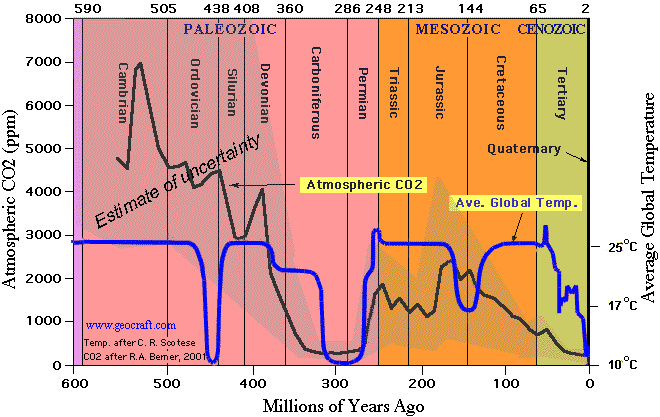
http://www.geocraft.com/WVFossils/PageMill_Images/image277.gif
MarkR (Comment#34295): yep, my husband says when “they invoke “feedbacks” it is because they have no clue.
Re: Boris (Feb 22 07:09),
The Hansen paper doesn’t support what you actually claimed, which was
There is a difference between saying you can’t get out of an ice age unless CO2 has a bout a 3C sensitivity” and “Hansen’s estimate based on temperature and CO2 changes from from glacial to interglacial periods is 3C, but others estimate as low as 1.3C or as high as 4.5C.”
None of those estimate tell us anything about why, hypothetically, the planet could not emerge from the glacial period and enter an interglacial if sensitivity to CO2 was less than… well…. less than anything!
liza. Hi. Long time no post!
Hi back MarkR! 🙂
Funny how some graphs make folks get all quiet! 😀
Re: AMac (Comment#34224) Feb 21, 2010 at 3:10 pm —
Theories of McIntyre’s Villany are regularly advanced as powerful explanations for what’s wrong with the Climate Science Debate. I broke it into three parts.
#1. McIntyre engages in direct, sustained and personal attacks on climate scientists.
#2. McIntyre doesn’t engage in scientifically valuable work, only in attacks.
#3. McIntyre’s FOI requests were justifiably denied by UEA because McIntyre is anti-science.
bugs has addressed #1; see Comment#34259. Where bugs sees McI as being publicly very vindictive, having a personal and aggressive attitude, using typical schoolyard bully tactics, and expressing self righteous indignation, I describe the excerpted comments on Mann, Jones, and other figures as not respectful, politely sarcastic, and humorously dismissive.
No links or quotes in support of #2. No links or quotes in support of #3.
I conclude that Theories of McIntyre’s Villany have little (#1) to no (#2, #3) explanatory power as regards Climate Science or its current challenges. Posters who advance talking points based on these theories are not contributing Signal to the discussion.
Liza,
“Funny how some graphs make folks get all quiet!”
.
OK I’ll comment on the graphs. What is clear is that the long-term temperature trends are driven by a number of important factors in addition to CO2, including, but not limited to, continental drift and the albedo feed-back of ice/snow versus land/vegetation/ocean. Continental drift between the end of the cretaceous and now ( http://www.cyburbia.org/gallery/data/6457/pangea-continental-drift.gif ) caused the gradual thermal isolation of Antarctica by the southern ocean circulation, which almost certainly lead to permanent glaciation, falling worldwide sea levels, and a substantial increase in Earth’s total albedo, with consequent drops in global average temperatures. More recent (~3 million years) rapid glaciation cycles are the principal drivers of the wildly varying temperatures over that period, via changes in albedo. CO2 radiative changes are too small to contribute more than a small fraction of the temperature variation, even if you assume >4C per doubling for CO2 sensitivity. Temperatures prior to the past 2.5-3 million years ( http://www.globalwarmingart.com/images/d/d3/Five_Myr_Climate_Change_Rev.png ), with the absence of much norther hemisphere glaciation, appears remarkably stable and only a little warmer than the current interglacial.
.
All very interesting, but the key question remains unanswered: What is the current climate sensitivity to CO2 with today’s continental arrangement and today’s level of glaciation? I don’t believe this can be accurately answered by looking at the long term temperature history… too many confounding factors, none of which can be accurately quantified. Using the geologic record to calculate sensitivity to GHG forcing is fraught with problems and uncertainty, and pronouncements by James Hansen and others about very accurate estimates based on recent ice ages are simply humorous.
.
The immediate influence of GHG forcings (short term climate sensitivity) should become much better defined within the next 10-20 years due to continued increases in atmospheric CO2, improvements in ocean heat data, and much better atmospheric aerosol data. My personal guess is that the immediate sensitivity to GHG’s will turn out to be near the lower end of the IPCC range, or even a little lower. The possible longer term (centuries to millenia) effects, like reduced albedo and substantial sea level increases, due to loss of snow/ice in the norther hemisphere (especially Greenland) will remain very poorly defined until the short term sensitivity to GHG forcing is better defined.
Bugs
.
ignorant rant
I always love it when someone comes along who knows no more about the topic than I do, and proceeds to act as if they know it all.
What is that supposed to mean ? I have never used the words “ignorant rant” so why do you write it like if it was a quote of me ?
And what has your post to do with anything anyway ?
In the case you ignore or don’t understand what my post is about , it is not a problem for me . de Witt and Dan Hughes do and that’s more interesting to me .
SteveF (Comment#34308) “What is clear is that the long-term temperature trends..” have NEVER been driven by….. CO2. There, fixed it.
MarkR (Comment#34310),
Well, most everybody (including well known scientists who doubt high climate sensitivity, like Spencer, Christy, and Lindzen) seems to agree that GHG forcing has to cause some level of warming, and I do not understand what your objection to this conclusion is. Over geologic time, other factors appear to have have dominated the influence from CO2, but this does not mean that CO2 has NO influence on surface temperature. The real issue is the sensitivity to radiative forcing, which is (I think) subject to considerable debate. But I just can’t see why you would (apparently) claim that increased forcing would not lead to some temperature rise.
“None of those estimate tell us anything about why, hypothetically, the planet could not emerge from the glacial period and enter an interglacial if sensitivity to CO2 was less than… well…. less than anything!”
I disagree. Obviously the papers are looking at CS, but the implication of the lower bound is the that you could not get out of an ice age with an effect of CO2 that is lower. (Or probably into an ice age either). The ice age itself is a constraint on sensitivity.
Now, there could be things that we don’t know about ice ages that would alter this view, but that’s a different argument.
SteveF [34308]
Some graphs do indeed cause some people to go quiet.
As Liza’s graph illustrates, the last time the earth had CO2 concentrations as low as 350 ppmv was during the end of the Carboniferous [350-290 MM year ago]. During that period CO2 concentrations fell from 2500 ppmv to 350 ppmv and at 380 ppmv today we are still at some of the very lowest CO2 concentrations in the geological record.
There certainly is a whole lot we don’t understand about GHG forcings. That said, the absurdity of arguing that there is a direct link between current increases in CO2 concentrations [regardless of their origins] as the sole causal agent in the minor warming observed over the past 100 years, is staring us in the face from the geological record, something most geologists worth their salt will point out.
How about a challenge: using the textbook graph above, if anyone on this thread can demonstrate a positive correlation or better even a verifiable causal relationship between CO2 concentrations and temperatures over the 250 MM years since the Carboneferous, I am sure all of us would like to learn about it.
But, yeah, I shouldn’t have said “about 3C” because the lower bound is sometimes quite a bit lower in some estimates. I think even one of Hansen’s has a lower bound close to 2C.
What I want to know why you guys accept that graph without a proper audit. Hmmmmmmm….
Tetris: Richard Alley does a reasonably good job on that subject.
See http://www.agu.org/meetings/fm09/lectures/lecture_videos/A23A.shtml
Boris (Comment#34312),
“The ice age itself is a constraint on sensitivity.”
.
I don’t think so. Compare the Holocene temperature history from Ice core oxygen isotope data (as well as from multiple other proxies) to the the Holocene CO2 history from Ice core data. The temperature trend from 8,000 to 500 years ago shows a gradual decline of about 0.3C, while over the same period, atmospheric CO2 increased from ~260 PPM to ~283 PPM. Based on a sensitivity of 3C per doubling, that rise in CO2 should have driven a temperature increase of ~0.37C, while the temperature was in fact i>falling by ~0.3C during that period. Now you might argue that this discrepancy was caused by other factors, but then you need to identify what those other factors are and show that they in fact do account for the discrepancy in order for the 3C per doubling to remain believable.
Zeke Hausfather (Comment#34316) February 22nd, 2010 at 10:21 am
“Richard Alley does a reasonably good job on that subject.”
I agree that it is an effective presentation, but I think it begs a lot of important issues, like the influence of continental drift and ice age albedo feed-backs. I am sure that Richard Alley believes what he says, but I think there remains enormous uncertainty in any estimate of sensitivity that comes from this type of analysis.
Steve,
I disagree that such a discrepancy needs explaining or else 3C is excluded.
But first, I’m wondering where you get the decrease in CO2. Ice cores are not very good at picking out individual starting points (since they are–what? 1,000 year averages or so?) so I don’t know if the downward trend you claim is outside of uncertainties given the short time frame.
In any case, it doesn’t matter because we can look at large changes like ice ages where noise is not as big an issue. The changes you note in CO2, if accurate, are quite small indeed. It’s just easier to infer sensitivity from large changes rather than small ones.
SteveF,
Sure, Alley gives a somewhat simplified version, but its only one time-limited lecture. If you look into his papers (or are around in his neck of the woods and want to sit in on a class), its a bit more comprehensive. There are lots of fun puzzles left in the earth’s climatic history (e.g. snowball earth, faint sun paradox issues, etc).
However, there is strong evidence that CO2 is a major player in changes in surface temp over the paleoclimate. And it meets Tetris’ request to “demonstrate a positive correlation or better even a verifiable causal relationship between CO2 concentrations and temperatures over the 250 MM years since the Carboneferous”.
“I don’t know if the downward trend you claim is outside of uncertainties given the short time frame.”
But 130 yrs ( since 1880) (with only 30 or so yrs of satellite technology) and in fractions of one degree (and the margin for error could be greater than or equal those fractions of one degree (from “all those thermometers”) is a ” real trend”. Heh.
Boris,
See A. Indermuhle et al, NATURE, VOL 398, 11 MARCH 1999, where they do a high resolution analysis of Holocene CO2 from Taylor Dome; their data looks quite solid. (This article is available as a PDF for free if you search a bit.) The authors fret a bit about what caused the rising CO2, and note that temperature driven ocean absorption/desorption is inconsistent with the CO2 trend. Based on C13 shifts in the ice core CO2, they speculate that a lot of land biomass was converted to CO2.
.
I raised this point only to show that drivers of temperature are not well defined, even during a relatively stable period like the Holocene; it is a huge stretch to suggest that ice ages, with large temperature shifts, accurately constrain sensitivity to CO2; IMHO they really don’t. We need good present day data to accurately determine present day sensitivity to GHG’s.
SteveF thanks for all your comments. Don’t have time to see the whole video Zeke presented; have to go now; but I’ve yet to see anybody explain how that C02 goes up and DOWN all by itself if it is the thing driving.
Liza,
CO2 is a feedback, not a forcing, in the paleoclimate. Well, there is long-term CO2 forcing through changes in volcanism, but lets not complicate things too much :-p
I wrote a piece on it awhile back that might be helpful: http://www.yaleclimatemediaforum.org/2007/10/common-climate-misconceptions-co2-as-a-feedback-and-forcing-in-the-climate-system/
There are valid debates on the magnitude of CO2 forcing in the paleoclimate, though most of the evidence suggests that its pretty substantial. Thats not to say that we may not discover some heretofore unknown agent in the future, but science is always drawing the best hypothesis possible from the data available. Alley’s video really is worth watching through, just because he gives a good overview of the state of the literature and touches on some of the remaining questions.
Boris (Comment#34315)-If you doubt them, maybe you should look into auditing them.
The CO2 comes from:
http://www.geology.yale.edu/~ajs/2001/Feb/qn020100182.pdf
While the temps are from:
http://www.scotese.com/climate.htm
With regard to a “constraint”-how do the glaciations and deglaciations get started in the first place? Until the problems with just the tiny radiation changes from Milankovitch are resolved, then it hardly makes sense to say that the temperatures were determined by global mean forcing and thus a constraint on sensitivity.
“it is a huge stretch to suggest that ice ages, with large temperature shifts, accurately constrain sensitivity.”
Thanks for the paper.
I’m not sure why you think it is a huge stretch to use ice ages to constrain sensitivity. You were using the small Holocene change in temp to constrain it. I think you can use the Holocene as well, but I’d be surprised if there was much constraint on CS in either direction given the small signal and uncertainties.
Boris,
One final comment, then I have to go. You said “The changes you note in CO2, if accurate, are quite small indeed. It’s just easier to infer sensitivity from large changes rather than small ones.”
.
The Holocene change in CO2 was ~23 PPM with a forcing (based on sensitivity of 3C per doubling) of about 0.65 watt per sq meter. The CO2 change form the depth of the last ice age to the early part of the Holocene was about 69 PPM, with a forcing (based on 3C per doubling) of about 2.38 watts per sq meter. So we are talking about only a factor of four difference between the changes in forcing. But the change in temperature between the last ice age and the Holocene is 15 to 20 times greater than the temperature change during the Holocene, and the temperature change during the Holocene goes in the opposite direction from what you would expect from CO2 forcing.
.
What’s more, the rise in CO2 from glacial to interglacial is at least in part (and maybe mostly) driven by increasing ocean temperature. It’s not simple to tease out cause and effect.
.
The point remains that temperature changes during the Holocene appear inconsistent with forcing from changes in CO2, and it one or more other (stronger than CO2) influences are required to explain the Holocene record.
“The point remains that temperature changes during the Holocene appear inconsistent with forcing from changes in CO2.”
You’d need a lot more information to come to this conclusion. IIRC, the Holocene optimum was marked by very little ice at the north pole, as well as relatively high methane and NO2 levels. Like I said, I have no problem with an approach looking at the Holocene, but you have to look at all factors. I’m pretty confident that if such a study were conducted, the sensitivity for CO2 would be wider than for ice ages and would not rule out very high or very low sensitivities.
‘The Paleocene–Eocene thermal maximum is one. Six degrees of warming, caused by high levels of CO2’
We get a 1C forcing for every doubling of CO2. We start out with 300ppm.
600 gets us +1.
1.200 gets us +2.
2.400 gets us +3
4.800 gets us +4
8.800 gets us + 55
17,600 gets us + 6.
Is this really what is being asserted? 17,600ppm?
Well, concede the point. Suppose that at some point millions of years ago we had 17,600ppm, and it caused a 6 degree rise in temperature. Now, lets return to the argument today. Is this supposed to show that we urgently have to drop ppm under 600 because of runaway warming due to a 1C forcing?
Its the logic. It simply makes no sense. In no other area, business, medicine, engineering, would we accept such completely incoherent reasoning. Next someone will invoke the precautionary principle in order to justify doing something, when it could as well justify doing the exact opposite.
My own personal belief about this, for which I have no evidence whatever, is that the large scale consumption of phycho active drugs, in particular SSRIs, has destroyed the capacity of large sections of the American Establishment to engage in systematic protracted logical thought. And that this explains the AGW phenonmenon, along with a whole bunch of other irrationalities.
Re: TomVonk (Feb 22 04:04),
Agree. In fact, the ice core derived temperature record has a high Hurst coefficient, strongly suggesting chaotic behavior, if that’s the correct terminology. However, I think it’s useful to look at the system according to “the consensus” and see if it’s self-consistent. Showing that it isn’t is one more nail in the coffin.
I was looking through Climate Audit trying to find the quote from Gerald North or whoever that said they couldn’t model glacial to interglacial temperature change without a climate sensitivity of 3 C (couldn’t find it, although I distinctly remember the post and it wasn’t all that long ago) and came across a thread on a paper by Archer, et.al. (David Archer and Arne Winguth1, David Lea and Natalie Mahowald, 2000, WHAT CAUSED THE GLACIAL/INTERGLACIAL ATMOSPHERIC pCO2 CYCLES? Reviews of Geophysics, 38, 159–189.) that said they couldn’t even model the change in atmospheric CO2 from glacial to interglacial and back again. The paper was published in 2000, so maybe it’s been fixed since then.
The Hansen paper uses sea level change to calculate ice sheet area and hence albedo forcing, but what about sea ice area? Changes in sea ice extent and area are not going to change the sea level. So if only land based ice is counted, then it seems likely to me that albedo forcing is going to be underestimated, possibly by a lot. Unless, of course, sea ice extent isn’t sensitive to temperature. In which case, why are some people so worried about the polar bears?
Zeke,
Can we just cut through the fog?
I asked a very simple and straightforward question:
Would someone on this thread please provide us with a repeatable demonstration of a direct causal relationship between marginally [in the geological context] rising CO2 ppmv levels and a [verifiably, quantifiable] increase in global temperatures?
It is not that much to ask, and is not more compliated than that.
Because absent that, anyone with a training in science and willing to be honest with him/herself, knows that anything else put forward is at best conjecture and at worse [ideological/political] hand waving.
So, “non-deniers”, pls step forward.
re: DeWitt Payne (Comment#34348) February 22nd, 2010 at 1:37 pm
“Agree. In fact, the ice core derived temperature record has a high Hurst coefficient, strongly suggesting chaotic behavior, if that’s the correct terminology.”
DeWitt, do you have a cite for that report / paper? I have the Hurst procedure coded and would like to give a shot at that data. I’ve looked at a few long temperature records, and some others, but haven’t yet seen anything that makes sense. There’s some info here: http://models-methods-software.com/2008/11/25/hurst-coefficients-a-rough-draft/ And with Tom’s assistance we looked at a few variations on the theme.
Thanks
Boris,
Oh, Boris.
That graph, Liza’s, the one you are trying to put down, is found in all university/college Geology 101 text books.
It’s the earth’s geological record, which academically we have chewed on for quite some time now, dug into, spat out, queried and verified, etc.. Not necessarilly absolutely perfect in terms of all our understanding, but by and large reasonably solid ground by all accounts.
Not a load of unverifiable “adjusted” CRU/GISS/NOAA data.
So pls try again, or learn to recognize the perils [in the Swedish vernacular] of pulling your cow ever further out onto thin ice.
Boris,
“the Holocene optimum was marked by very little ice at the north pole, as well as relatively high methane and NO2 levels”
.
This is just not accurate for methane and N2O. Though the data are sparser, the methane level during the Holocene peaked near 667 PPB about 10,000 years ago, dropped to a minimum of about 570 PPB about 6600 years ago, and rose to about match the earlier peak of 667 about 2400 years ago. The forcing from this level of methane change is very small compared to the forcing from changes in CO2 during the Holocene. Ditto for the N2O levels, but even smaller: from about 260 PPB to 265 PPB, minimum to maximum; once again a tiny effect next to the change in CO2. I do not have any information about evolution of sea ice in the arctic, so I can’t comment on its potential contribution to the Holocene climate. But keep in mind that we need a negative forcing in the range of 1 watt per square meter (assuming the real sensitivity to CO2 is 3C per doubling) if we are going to account for the apparent drop of ~0.3C at the same time the CO2 was rising (and so should have caused an increase in temperature).
.
I don’t want to belabor this issue too much Boris, but it is important to note that there are lots of uncertainties in connecting past temperatures to past forcings. IMHO, claims of closely constrained climate sensitivity based on ice age studies (or worse, geologic studies!) are extremely doubtful, and I am trying to be generous with that evaluation. If your objective is to actually determine climate sensitivity, nothing is going to substitute for good aerosol data and good ocean heat content data over some reasonable period.
“Is this really what is being asserted? 17,600ppm?”
No. Try again with a CS of 3 and you’ll find 1,200.
Steve,
I don’t really disagree. I do think you overstate the implications of cooling Holocene wrt CO2, but I’ll read and think more about it.
“That graph, Liza’s, the one you are trying to put down, is found in all university/college Geology 101 text books.”
The pretty color one? I really don’t think so (I think Annan referred to it as the “Scotese scribbles.”)
Dan Hughes (Comment#34352)-Figure 5 here:
http://www.itia.ntua.gr/getfile/907/1/documents/hysj_54_2_394.pdf
Boris (Comment#34360),
” I’ll read and think more about it.”
.
So will I.
Re: Andrew_FL (Feb 22 14:46),
That’s it. Koutsoyiannis, et.al., 2009. The links to the data are in the paper as well. It’s GISP2 data from Greenland.
Thanks, Andrew_FL and DeWitt. That information has become available after I landed some paid-for consulting work. I haven’t had time to keep up for about a year now. Don’t know if or when I’ll get back to it, either. But I’ll keep it on my to-do list.
Thanks, Andrew_FL and DeWitt. That information has become available after I landed some paid-for consulting work. I haven’t had time to keep up for about a year now. Don’t know if or when I’ll get back to it, either. But I’ll keep it on my to-do list.
Lucia said:
As an analogies: I can figure out my battery is dead without fixing it. I can figure out my mom’s meatloaf is horrible without teaching her to make better meatloaf. (My mother is meatloaf impaired. We have a family story about this.)
response:
How do you know a battery is dead without seeing a working battery? How do you know a meatloaf is horrible without seeing a better meatloaf?
If you argued that a particular meatloaf was bad, but no one could produce a better meatloaf I’d refuse to believe you.
And why should I believe GISS is bad when no one can point to or create a better temperature series?
lisa,
re the Ordovician:
http://researchnews.osu.edu/archive/earlyice.htm
It seems that researchers have found evidence that CO2 drove the increase in temperature at that time.
Oh, and then there is this (part of the same work)
http://www.sciencedaily.com/releases/2006/10/061025185539.htm
A decline in CO2 drove the cooling.
So there are more than one. Indeed, from what I can tell, pretty much all of the major increases and decreases in temperature that we know about are linked with increases and decreases in CO2.
Re: Michael Hauber (Feb 22 16:48),
Having worked in R&D, I know that own can write a “functional design criteria” for any design, including as yet uninvented designs. I can test any devise against those criteria.
If I had never seen a battery but has a functional design criteria for the devise, I could test a any battery. If I found it had no charge, I could determine that battery is a bad, deficient, or dead, battery. You don’t need to have ever seen a good example of anything to determine that something is bad.
I know what food is. I know what horrible glop is. The question is not “How good is mom’s meatloaf relative to other meatloaves.” The question is: How good is the meatloaf as food.
My mother’s meat loaf is horrible, horrible, horrible. She does not make it. She cooks other things well, but we have a family story about the psychologically traumatizing incident that lead to the neurosis that prevents her from being able to follow a recipe for something that calls itself “meatloaf”.
“It seems that researchers have found evidence that CO2 drove the increase in temperature at that time.”
David Gould,
From the article:
“The fact that the deposits were found in three different sites suggests that sea levels may have been low all over the world at that time”
“440 million years ago” and three sites? -suggests this only evidence in someone’s imagination.
Andrew
David Gould (Comment#34384)-what you may be forgetting here is accounting for why it rose and fell in the first place. Correlations would not be surprising even if the CO2 weren’t the reason for the changes. Just as in the glaciation cycles it could itself be a response and feedback, rather than the forcing. Which means the temperature change it was responsible for is confounded by the variable that started the process.
However I’m not convinced that the Ordovician problem is “solved” by two references.
Tetris,
You asked for “a repeatable demonstration of a direct causal relationship between marginally [in the geological context] rising CO2 ppmv levels and a [verifiably, quantifiable] increase in global temperatures”. I’m not sure what would satisfy this condition, given that we can’t repeat geologic history in historical time, unless you are asking for a simple experiment to show that CO2 is a greenhouse gas? The reason I linked Alley’s talk is because it gave a reasonably good overview of the the state of the scientific literature on the various ways in which CO2 affects the climate over different time-frames (long-term silicate weathering, biogeochemical feedbacks in glacial cycles, etc.). My apologies if it somehow served to thicken the proverbial fog.
Andrew_Fl,
They discuss that in the articles. It rose due to volcanic activity. The decline is talked about here:
“The timing of the strontium ratio decline matches the rise of the Appalachian Mountains . The crustal plate underneath what is now the Atlantic Ocean pushed against the eastern side of North America, lifting ancient volcanic rock up from the seafloor and onto the continent.
This kind of silicate rock weathers quickly, Young explained. It reacts with CO2 and water, and the rock disintegrates. Carbon from the CO2 is trapped in the resulting sediment.”
The mechanisms seem to be pretty well-understood.
As to solving it, I agree: a few pieces of evidence are not usually enough to ‘solve’ things like this. But it is evidence that undercuts the notion that CO2 levels in the Ordovician are a problem for the notion that CO2 is one of the drivers of temperature.
David Gould (Comment#34392)-“But it is evidence that undercuts the notion that CO2 levels in the Ordovician are a problem for the notion that CO2 is one of the drivers of temperature.”
Except that noone argues that it isn’t “one of the drivers”-it is argued whether the variations are sufficiently pinned down to that such that sensitivity can be estimated. When other causes are co-linear not being aware of them will cause false attribution of the vast majority of the change to one cause.
Wow. First, it’s a forcing then a feedback! We are the world! I am truly amazed.
Andrew:
“440 million years ago†and three sites? -suggests this only evidence in someone’s imagination”
Not only that; the resolution of data that old could be off by plus or minus 10s of millions of years or more. (((Which a geologist and/or reasonable person/scientist would point out before proclaiming what they think they know)))) That means comparing 4 “sites” like that together representing millions of yrs of time for the whole darn planet; could be millions of years off – comparing data not of the same time frame at all, millions of years apart; that has no “teleconnection” at all.
Andrew_Fl,
It seems that lisa is indeed arguing that it is not one of the drivers – or that it is a very minor one, given the temperatures in the Ordovician. That is the whole point of this discussion, unless I am confused, which is of course very possible. 🙂
liza (sorry – I mispelled it previously),
Things can be both forcing and feedback – I am not sure what the issue is there.
As to your criticism of the article and lack of error bars, those kinds of things are rarely mentioned in news stories. I am sure that the original paper examines those – however, I think it is behind a paywall (they usually have five-year limits these days).
Further, if it is so difficult to get good resolution that far back in time, how can the Ordovician be claimed with any certainty to be inconsistent with CO2 as a driver of temperature?
http://geology.gsapubs.org/content/33/2/109.abstract
Here is the abstract, but it is indeed behind a paywall.
Oh my gosh David!
“Things can be both forcing and feedback – I am not sure what the issue is there.”
“Further, if it is so difficult to get good resolution that far back in time, how can the Ordovician be claimed with any certainty to be inconsistent with CO2 as a driver of temperature?”
Because for instance; look at the graph right after the Ordovician! There’s MILLIONS of YEARS of “global average temp” not moving at all while for MILLIONS of YEARS C02 drops 100’s of ppms.
Hello! I say again. In the last two million years there’s been over 60 ice ages and retreats of ice with c02 in “stable” amounts.
The driver of the Ordovician/Silurian ice age was the fact that Gondwana moved across the south pole due to continental drift.
The heart of Africa was right over the south pole 443 million years ago, the date of the ice age and the Ordovician extinction event.
The d018 isotope data indicates the ice age lasted from 460 Mya to 420 Mya and centered on the 443 Mya timeline, there was a significant cooling event which may have been -7.0C globally.
Here is an illustration of Gondwana’s continental drift between 450 Mya to 250 Mya, which when combined with the fact that parts of it were below sea level for long periods and couldn’t accumulate glacial ice sheets, this drift explains the Ordovician/Silurian ice age and the Carboniferous ice age as well.
http://www.ncdc.noaa.gov/paleo/ctl/images/figure05_10.jpg
The Ordovician/Silurian ice age and the Carboniferous ice age can be explained by continental drift. Supercontinent Gondwana moved across the south pole between 450 Mya to 250 Mya.
There were long periods when portions of Gondwana were below sea level and, consequently, large glacial ice-sheets could not build up, but this chart should explain both events to anyone who understands how much sunlight is reflected off of glacial ice sheets, especially when they extend for 1000s of kms away from the pole.
http://www.ncdc.noaa.gov/paleo/ctl/images/figure05_10.jpg
Bill Illis (Comment#34403) February 22nd, 2010 at 6:18 pm;
Thank you. And if they care to imagine; how all that could have changed the tilt and wobble of the planet as it orbited around the sun too.
Liza, I don’t think it makes any difference. The Earth is a big mass and a few kilometres of ice and continental landmass don’t impact rotation rates etc. to make enough of a difference. It might be a few milliseconds change in the length of day or a few kilometres in the actual tilt.
The moon and the other planets change our rotation rates and tilt angles by a 1000 times more but this still takes 1000s and billions of years to manifest itself.
Bill Illis (Comment#34405) February 22nd, 2010 at 6:49 pm
My husband thinks it could be so. ( He’s a wobble guy-likes to study it ) Big earthquakes (well what we call big now) affect the wobble; and even subtle changes in orbit matter at some point. (like the Sahara desertification was initiated by subtle changes in the Earth’s orbit; say some German scientists).
He said imagine what earthquakes were like when that land mass was breaking up.
Wikipedia says about our modern Indonesian earthquake (9.3):
“The earthquake generated a seismic oscillation of the Earth’s surface of up to 20–30 cm (8–12 in), equivalent to the effect of the tidal forces caused by the Sun and Moon. The shock waves of the earthquake were felt across the planet; as far away as the U.S. state of Oklahoma, where vertical movements of 3 mm (0.12 in) were recorded. By February 2005, the earthquake’s effects were still detectable as a 0.02 mm complex harmonic oscillation of the Earth’s surface, which gradually diminished and merged with the incessant free oscillation of the Earth more than 4 months after the earthquake.[26]” also says the energy released by that quake to the earth’s surface was ” 550 million times that of Hiroshima” bomb.
1960 Chilian Earthquake was 9.5
See what I meant? Everything was moving (still is).
liza,
If I am in error regarding things being able to be both forcings and feedbacks, I would like to know the details.
This is how I think it works: methane is put into the atmosphere, and increases the forcing. Temperatures rise. More methane enters the atmosphere as a feedback. This may well be using the terminology wrong.
Regarding your ice ages over the last two million years, can we first go back to the Ordovician. You brought it up as an example of a problem. However, when I presented a small amount of evidence that it might not be a problem, you talked about not being able to get sufficient resolution to tell. I then suggested that this meant that the Ordovician could not be pointed to as a problem. Do you accept that point, or do you wish to still discuss the Ordovician?
Re: Zeke Hausfather (Comment#34329)
Zeke,
Should I understand you as saying that some other natural mechanism such methane release could have created a rapid warming during the PETM that dumped a lot of carbon into the atmosphere which now becomes the background CO2 and therefore, the CO2 concentrations in the atmosphere are in response to natural mechanisms? Therefore, saying that increasing current concentrations by 20 times will lead to only 5C or so warming is not the correct way to analyze it because sensitivity is only defined with respect to some background level of CO2 and is not related to the absolute number …. I’m kinda losing the train here. OK, I’ll watch Alley’s talk again, but if you could kickstart me here, that would be nice.
liza,
Re the last two million years, the Vostock ice cores seem to show that CO2 and temperature moved together over the past 400,000 years. Are you excluding that period from the last two million years?
David Gould (Comment#34418)-Well in those cases we know it isn’t volcanoes but the temperature rise itself which causes the CO2 to rise. Which means something else started the warming. Which, logically, means that some amount of the warming from glacial to interglacial is due to a factor other than CO2. If you don’t know how much, then the glaciation cycles don’t tell you how much warming you get from CO2.
liza (Comment#34401) February 22nd, 2010 at 6:06 pm
CO2 is not the only forcing, nor even the most powerful, depending on the circumstances. That is why there has been research into finding out just what is the state of play at this point in time, and the answer is, at the moment, CO2. No doubt, this will change over time. It is this point in time (in geological terms) that is our concern.
Andrew_FL,
As far as I know, we have worked out the rough theory, Milankovitch cycles, to explain what kicks off warming. CO2 then follows and amplifies. We are able to work out reasonably well changes in the amount of the sun’s energy due to orbital changes. So we can get approximations for the amount of warming that the increases in greenhouse gases caused. I would imagine that the error bars are quite large – probably accouting for the 1.5 to 4.5 degrees that we have as the 95 per cent confidence interval for climate sensitivity.
AMac,
Nice to see some agreement between one on the side of the light and one on the side of the dark. 😉
David Gould (Comment#34422)-“we have worked out the rough theory, Milankovitch cycles, to explain what kicks off warming.”
Standard Milankovitch theory has enormous problems. For one, the changes in radiation are very small. Another is that the biggest cycle corresponds roughly to eccentricity, but this produces less forcing than precession and obliquity. Under the paradigm that climate is determined by the global mean forcing-this is the same which argues for CO2 warming now-this is totally inexplicable. And one million years ago the periodicity just shifts from 41k to 100k.
IMAO this only makes sense if you consider that the changes are not explained by the global mean forcing but rather changes in radiation distribution-which it just so happens would mean that you couldn’t simply attribute them to the small changes +CO2.
Andrew_FL,
Distribution may indeed have an effect, especially if the axial tilt brought one of the polls directly in the line of fire, so to speak. However, simply saying that distribution changes explain this is not really an alternative theory. Has someone done the calculations? (I think you posted something earlier, but I cannot find it.)
According to wikipedia, tilting does not seem to be associated with changes in global temperature. (But this may not be what you are referring to.)
Boris, you say “No. Try again with a CS of 3 and you’ll find 1,200”
No serious scientist thinks that the effect of doubling CO2 is to apply a forcing of 3C without feedbacks amplfying it. To assert that is to deny 100 year old physics. To assert that would require us to revise our whole understanding of how gases work and how IR is absorbed. It is just not true.
When you assert that climate sensitivity is 3C for every doubling of CO2ppm, what you must be asserting is that every 1C forcing is tripled by other factors. But this is exactly what is in dispute.
It is not true that doubling CO2ppm in itself will raise the temperature of the planet by 3C. It cannot ever have done that. What may have happened, but there isn’t to me evidence that it did, is that a 1C rise in temperature was multiplied by 3 by other factors. This ought to have happened every time there was a 1C rise in temps, regardless of whether they were due to CO2 or some other cause.
This equivocation about what is really being asserted with regard to CO2 is one of the most disturbing thigs about the AGW Party Line. There is always an effort to attribute all the feedbacks and the direct forcings to CO2, when what is really happening is a small forcing from CO2, amplified (allegedly) by other factors, which would have amplified forcings from any source, not limited to CO2.
We are thus being asked to accept two propositions, one about CO2, which is indubitable, and the other about the way the climate works in response to forcings, which is both independent of the CO2 proposition, and dubitable. But the marketing materials suggest there is only one.
If CO2 were the only forcing, then the table would be about right. If CO2 is the only forcing and is not amplified, we would have:
600 ppm 1C
1200 ppm 2C
That’s just physics.
“No serious scientist thinks that the effect of doubling CO2 is to apply a forcing of 3C without feedbacks amplfying it.”
Your post was very confused then. You seemed incredulous that CO2 could cause 6C of warming and thought that it would take 17,600 ppm. I never made any claim about the first order CO2 forcing.
“This equivocation about what is really being asserted with regard to CO2 is one of the most disturbing thigs about the AGW Party Line.”
There is no equivocation, you just aren’t paying close enough attention.
“David Gould (Comment#34418) February 22nd, 2010 at 9:33 pm
liza,
Re the last two million years, the Vostock ice cores seem to show that CO2 and temperature moved together over the past 400,000 years. Are you excluding that period from the last two million years?”
What do you mean by “moved together” ? Have you actually looked at the data?
A friend of my husband, (California licensed Professional Geologist Registered Environmental Assessor (1987). He was also appointed the first Certified Environmental Auditor in Victoria, Australia in 1991) with quite a wit wrote the following and I found his series of pdf’s posted online here:http://icecap.us/index.php/go/joes-blog/the_sky_is_falling_or_revising_the_nine_times_rule/:
He says:
I downloaded all the Vostok ice core data http://www.ncdc.noaa.gov/paleo/icecore/antarctica/vostok/vostok.html and loaded it into Excel. Here I did some careful analysis and was able to verify things I had found on the internet.
On average, temperature rises and CO2 follows in about 400-3,000 years. Meaning, of course, that CO2 is a spectator during these climate change events.
But that 400-3,000 year timing was intriguing. It takes about that long for the deep oceans to turn over and come into thermal equilibrium with the atmosphere. Could it be that CO2 changes were reflecting temperature driven equilibrium concentrations between ocean and atmosphere?
So I concocted a little test. I took two of my favorite carbonated beverages, beer, and placed one in the refrigerator, and the other on the kitchen counter last summer. I turned the fridge down very low, like deep-sea bottom of 100k year deep freeze grade cold, and let the brew and fridge cool down for a few days. I then opened the warm brew and put it back on the kitchen counter, and opened the nicely near frozen one and put it back. I waited two days. I then took both
outside and shook them up with my thumb over the opening. Upon releasing my thumb, what do you think I found? The one in the freezer had far more CO2 left than the warm beer did.
Although the nicely cold one went down well, this brought the old hairy eyeball out of storage and focused it on CO2. An easy going person by nature, I will have no mercy if you intentionally pull the wool over my eyes.””
I can’t believe you guys are questioning “the the most regularly occurring thing known of in all geology-the rickety orbit of Spaceship Earth”.
Cant wait for the sunspot cycle and of course clouds to be discussed! 😉
This paper seems to suggest that CO2 sensitivity was likely greater not lower than 3C per doubling in the past.
http://droyer.web.wesleyan.edu/climate_sensitivity_PNAS_commentary.pdf
I guess we need to take into account that the sun was cooler then etc.. high PPM alone is not enough of an argument when all others are not the same.
David Gould (Comment#34415) February 22nd, 2010 at 9:20 pm
“Regarding your ice ages over the last two million years, can we first go back to the Ordovician. You brought it up as an example of a problem. However, when I presented a small amount of evidence that it might not be a problem, you talked about not being able to get sufficient resolution to tell. I then suggested that this meant that the Ordovician could not be pointed to as a problem. Do you accept that point, or do you wish to still discuss the Ordovician?”
NO. We can know from the data that generally there was an ice age then for 10’s of millions of years. We can know from the data that generally the C02 concentrations in the atmosphere were in high (the 4000’s ppm) for 10s of millions of yrs.
We can’t know for sure all the things your paper/article claims because the data is off plus or minus 100’s; 1000’s,100,000s, 10’s of millions of years -and that’s your problem, not mine.
BTW it could take only a few thousand years to come out of that ice age.
Climate sensitivity most likely 2.8C per doubling over 420 million years.
http://droyer.web.wesleyan.edu/climate_sensitivity.pdf
Addresses Bill Illis’ comment below
“RB (Comment#34458)
February 23rd, 2010 at 7:59 am
This paper seems to suggest that CO2 sensitivity was likely greater not lower than 3C per doubling in the past.
http://droyer.web.wesleyan.edu…..entary.pdf”
Nice data selection and confusing graphs in this paper which is the signature of all of Royer’s papers.
The paper is mainly based on a new method of deriving CO2 from fossil soils/Paleosols/Pedogenic Carbonates whatever they are calling them now.
Previously, there was no correlation between temperatures and the CO2 estimates derived from fossil soils. In fact, it often produces estimates of Zero ppm. With this new method, there will now be 12 individual CO2 estimates below 100 ppm in the paleorecord which, as we know, is impossible since most of the vegetation will die.
Here is the entire record (not just a little snipit of 80 million years) of fossil soils CO2 estimates as published in the IPCC AR4 (which was collated by Royer).
http://img708.imageshack.us/img708/4313/co2fossilsoilsar4.png
“RB (Comment#34464)
February 23rd, 2010 at 8:30 am
Climate sensitivity most likely 2.8C per doubling over 420 million years.
http://droyer.web.wesleyan.edu…..tivity.pdf”
Here is the actual data used in this paper (versus the confusing chart Royer presents as I noted before).
http://img22.imageshack.us/img22/7097/royerbernertempvsco2.png
http://img213.imageshack.us/img213/579/royerbernertempvsallco2.png
I think your plots are saying that 3C per doubling is an overestimate and Royer says that less than 1.5C per doubling is very unlikely.
Bill,
You should submit a letter to Nature refuting Royer if her graphs are so incorrect.
“Zeke Hausfather (Comment#34475)
February 23rd, 2010 at 9:04 am
Bill,
You should submit a letter to Nature refuting Royer if her graphs are so incorrect.”
I’m not sure that would be an effective use of time and effort as so many others have discovered.
RB,
.
The only natural mechanism that releases significant amounts of CO2 unforced by other factors is volcanism. All other CO2 changes in the paleorecord are necessarily responses to exogenous temperature changes (e.g. forced by continental drift, Milankovich cycles, variations in solar output, etc.). The “background” CO2 over geologic time can be thought of as an equilibrium of sorts defined by the arrangement of the continents, the brightness of the sun, the rate of silicate weathering, and other factors.
.
The marginal forcing of additional CO2 is certainly a function of the “background” level due to the spectral properties of the gas; increasing a 150 ppm atmospheric concentration by 1 ppm has a much greater effect than increasing a 300 ppm atmospheric concentration by 1 ppm, for example. That said, the sensitivity is defined respective to a doubling of CO2, so it is roughly true to say that increasing atmospheric CO2 concentrations from 75 to 150 ppm has the same forcing as increasing from 150 to 300 ppm or 300 to 600 ppm.
.
Now, a lot of the CO2 feedbacks happen rather slowly. There was a fascinating paper discussed over at RC awhile back trying to constrain short-term carbon cycle feedbacks based on temps over the past millennium that might be of interest to you.
.
Does that help?
Bill,
Ah, yes, the grand conspiracy among all the world’s top scientific journals to keep out blog science. A shame, that.
David Gould (Comment#34426)-It’s not the fact that one of the poles is “in the line of fire” it’s the alteration of the equator to pole heat fluxes.
As for calculations IMHO there is no easy way to quantify this effect as it depends on some unknowns like the feedbacks in the tropics.
Zeke Hausfather (Comment#34483)-Evidently you are ignorant of Science and Nature’s editorial policies against accepting any papers contradicting the “consensus”.
Zeke, My husband has tried to publish in Nature a few years back when his thesis was done; and the editors told him and his co-writers the subject matter was of no interest and didn’t pertain to anything up and coming in fast and fancy science world. (Also; one of his co-writers didn’t have a good relationship with one of those editors and that mattered too)
Ha ha. The paper was about the subduction zone in No. Calif. and a mega tsunami that devastated the coast of California 6 million years ago that he discovered. Lo and behold travel a few years later into the future and we get the Indonesia tsunami (same kind of subduction zone) and hundreds of thousands of people perish. So Nature was so wrong. (Unless hundreds of thousands of people perishing is a big yawn)
‘The “background†CO2 over geologic time can be thought of as an equilibrium of sorts defined by the arrangement of the continents, the brightness of the sun, the rate of silicate weathering, and other factors.’
This is the key – that helps (I think!).
Carbon dioxide forcing alone insufficient to explain Palaeocene–Eocene Thermal Maximum warming
“We conclude that in addition to direct CO2 forcing, other processes and/or feedbacks that are hitherto unknown must have caused a substantial portion of the warming during the Palaeocene–Eocene Thermal Maximum. Once these processes have been identified, their potential effect on future climate change needs to be taken into account.” Nature.com 13 July 2009 http://www.nature.com/ngeo/journal/v2/n8/abs/ngeo578.html#top
Oh Dear. So what exactly is the theory again? How can we rely on models whos idea is that we know all the natural forcings and feedbacks, so any unknown is caused by Man. Wrong!
and other factors…
From the same set of articles I posted above:
The earth’s orbit is not a circle around the sun. And we are not the only thing orbiting the sun. In fact, some of the other planets have worlds orbiting them that are even bigger than the earth, all possess gravity, just like we do. And they exert that gravity not only on their satellites, but every one of the sun’s satellites, including us. And they all orbit the sun at speeds commensurate with their distance from the sun. We presently orbit the sun at 93 million miles, we call that distance one parsec. But we are not always 93 million miles from the sun. Those pesky neighbors of ours push us around to the tune of 2%, making our orbit not a circle but an ellipse. That 2% difference is called eccentricity, and it occurs to us on three cycles, 91k years, 125k years, and 400k years. All of Sol’s children push each other around, all have slightly elliptical orbits, and all have different length years. Even a cave man would get this.
Forty seven degrees of axial shift and a few thousand miles of earth diameter shift making the difference between summer and winter, each and every year. Simple enough. What would happen if we make that a few million miles instead of a few thousand miles without changing the axial tilt at all? You get an ice age. Oh, and by the way, the axial tilt also changes, just to complicate the picture a little.
http://en.wikipedia.org/wiki/File:Eccentricity_half.svg
http://en.wikipedia.org/wiki/File:Eccentricity_zero.svg
MarkR,
That means we have to look at other things besides CO2 – like methane etc. – without necessarily throwing out the GHG theory.
http://www.realclimate.org/index.php/archives/2009/08/petm-weirdness/
I think you are arguing for more funding for climate science.
“I think you are arguing for more funding for climate science.”
RB,
Why would anyone argue for flushing more money down the toilet?
Andrew
liza:
Thanks for the link to Mr. McClenney’s article. It was a fascinating and entertaining read. Puts the whole AGW argument in rather a different light.
Zeke Hausfather —
The italicized assertion is not obviously true, to me. For a given surface temperature, doubling CO2 at a given concentration has the effect of decreasing the net loss of energy at IR wavelengths (per unit area per unit time) by a certain amount. As CO2 levels become “very high,” does this insulating effect of CO2 approach some value asymptotically? If so, is that “very high” level of CO2 in the range of the higher estimates of CO2 during geological time?
Could you point me to a review article, textbook chapter, or blog post that goes into this in a little more detail, at a fairly basic level?
Michael Smith (Comment#34515)
You are welcome. I was surprised and glad to find it stored online (I googled for his bio and found that link). Bill sent all five pdf’s by email -and he spammed everyone he knew with them; after each section was completed. lol It was fun waiting for the next installment. I wish more people would read it.
AMac:
This link asserts the same relationship for CO2 as stated by Zeke:
http://geoflop.uchicago.edu/forecast/docs/archer.ch4.greenhouse_gases.pdf
Response for comment #4 here gets into how Venus could be considered saturated in the sense imagined by Angstrom for Earth:
http://www.realclimate.org/index.php/archives/2007/06/a-saturated-gassy-argument/
Frankly though, I don’t know how to interpret “10 bars of surface pressure” in terms of CO2 ppm concentrations.
RB,
Thanks for both of those links; they clear up my misconception. The RealClimate explanation has the bonus of some interesting science history.
AMac (Comment#34518),
The calculation of “radiative forcing” is complicated, since it involves both infrared absorption spectra and stratospheric temperatures. I have never seen any good summary; IPCC WG2 Chapter 2 makes a feeble stab at it, but the explanation is superficial and (IMO) not at all clear.
.
As defined by the IPCC, RF it is the net downward increase in radiation at the tropopause, after allowing stratospheric temperatures to adjust (cool due to the presence of GHG’s), but without allowing any change in temperature profile through the troposphere or temperature change at the surface.
.
As I understand it, defining RF in this way makes it possible to compare forcing from different sources (solar cycles versus GHG’s, for example) on an equal footing. When the rest of the system responds (via changing temperatures, convective transport, etc.) to the RF, the outgoing and incoming radiation are back in balance. Since the tropospheric temperatures and water vapor/latent heat vary greatly over the globe, there is no single response of the surface temperature or tropospheric temperature profile to a change in RF. For example, the models suggest greater surface temperature increases at high latitudes than at low, which does appear to be at least partly correct, especially in the northern hemisphere.
.
The specific calculated (by climate models) response of the troposphere profiles and surface temperatures to RF is why there has been so much focus/controversy about the “tropospheric hot spot” in the tropics that is expected due to amplification by increasing atmospheric water content. The apparent discrepancies between the modeled tropospheric temperature profiles and the measured profiles (weather balloons and satellites) in the tropics (but elsewhere as well), have suggested to some that the climate models do not have heat transport in the troposphere right, and so are overestimating the surface response to RF. Dueling papers (Douglas et al, Santer et al, and more recently Klotzbach et al) all address this issue. Chad’s great work shown at his blog (Lucia has a link) to extend the Santer et al, which did not use all available data, through 2009 says that the model ensemble average is inconsistent (>95% confidence) with the measured temperatures, as are many of the individual models. Based on only earlier data, Santer concluded that the models could not be rejected at 95% confidence due to too much uncertainty in temperature measurements and model variability. Chad now says the models really can be rejected. Klotzback saya that the models do not properly treat the near-surface boundary layer, which made Gavin go positively apoplectic (why? because Klotzback suggests the models have tropospheric transport wrong).
.
Let me know if you find a good summary of how RF for GHG’s is calculated.
Zeke, all good and well.
Still no verifiable proof [as opposed to conjecture, suppositions or an unscientific-because-unverifiable hypothesis] of anything. Most certainly not that man’a activities are the main driver in whatever appears to be going on.
I am currently in France and had an instructive conversation with a group of people today over coffee, all of whom have the appropriate credentials, and all agreed that the skepticism about AGW/ACC put forward by Claude Allegre [interantional heavy-weight French geophysicist and former socialist minster under Mitterand] is entirely justified. Noted in passing, Allegre was one the first to support the AGW/ACC hypothesis, but as a scientist, a decade ago, reached the conclusion that it doesn’t stand on its own merit [for those versed in French: “ca ne tient pas debout”].
Skeptics, damned skeptics everywhere….
Zeke,
I forgot to add: “vive la science” 🙂
tetris,
“vive la scienceâ€
On that, at least, we agree 😛
I was simply pointing out the current state of the paleoclimate literature. Might it change in the future? Sure! Hell, I wouldn’t be planning to do a PhD in climatology if there weren’t plenty of fascinating questions left to answer.
That said, I argue that the weight of evidence suggests that actions to mitigate CO2 emissions are justified. Lucia agrees, though probably to a lesser extent than I. You likely disagree. Whose view prevails in the political arena is more about politics than science 😉
“Chad now says the models really can be rejected. ”
I took a quick look and Chad seems to be comparing only the multi-model mean not the models themselves. Annan/Hargreaves have recently written an article saying that the truth-centered paradigm has no theoretical basis. Therefore, you cannot say that deviations from the mean disprove the validity of the models.
SteveF,
I’d avoid putting words in Chad’s mouth, since he is here to comment himself 😛
RB (Comment#34523)-Well that’s 1000 kilopascals or ~ten atmospheres of pressure. But I also have no idea how to get ppm out of that.
However, the composition of Venus’s atmosphere is:
~96.5% Carbon dioxide, ~3.5% Nitrogen, 0.015% Sulfur dioxide, 0.007% Argon, 0.002% Water vapor, 0.001 7% Carbon monoxide, 0.0012% Helium, 0.0007% Neon, and trace amounts of Carbonyl sulfide, Hydrogen chloride, and Hydrogen fluoride.
The atmospheric pressure as a whole is 93 bars.
RB (Comment#34534)-So what you are saying is, sure the mean is wrong, but the range is still okay? That’s more serious than I think you are admitting. The “ensemble” is supposedly the “best estimate”-that’s part of IPCC “consensus”.
Andrew,
Yes, the range is still OK and models used by IPCC are reliable for sensitivity estimation per Annan/Hargreaves. More here, I posted this link here before:
http://julesandjames.blogspot.com/2010/01/reliability-of-ipcc-ar4-cmip3-ensemble.html
CO2 @ 96.5% corresponds to 93 atm. I’ll take a totally wild guess and say that CO2 at greater than 10% corresponds to 10 atm i.e. greater than 100,000 ppm?
Zeke Hausfather (Comment#34539),
I certainly did not ever intend to put words in Chad’s mouth. I was just trying to summarize what I understood from reading his posts on the extension of Santer et al. If Chad believes that I have misrepresented his efforts or his conclusions, then I welcome any correction he wants to make.
Even wilder guesses:
Assuming (surface pressure) = 0.98*(112)^k
where k is the concentration yields k of 0.49 or 490,000 ppm for a surface pressure of 10 bars.
RB (Comment#34534),
My recollection is that the multi-model mean rejected at 95%, as did a fair number of the individual models. Of course, Chad can correct this if I am wrong.
Steve, As I understand it, you have to take the entire statistical ensemble into consideration and average or any single model do not have to match observations.
The range is the most ridiculously weak statistical test imaginable. In the real world, sensitivity is one value, not a range.
Look, either the ensemble is consistent with the observations or it isn’t. If it isn’t, we can begin to ask questions about whether some of the models are more realistic than others. If we conclude that, say, the model that warms most is way too high, then removing that model would change the range and the mean, and probably models could become consistent with the observations. But suddenly we would have a narrower range and a smaller mean value. That seems like the best way to pin down the real value of future change (instead of preserving a range which has a little physical basis as the mean BTW). That would normally just mean scientific progress. The appeal to “range” on the other hand is just a way of avoiding this issue.
Presumably as parameter uncertainties become tighter, sensitivity estimates also become tighter, but still ensemble mean does not have to correspond to the observed values as long as model inputs have uncertainties.
Anything but trying to actually eliminate erroneous models. Okay then.
liza,
Yes, I have looked at the data. I believe that there is a consensus 😉 that changes in C02 follows rather than leads temperatures by an average of around 800 years or so. However, *you* made the claim that changes in CO2 do not track changes in temperature over the past two million years. The Vostock cores show that it has over the last 400,000 years.
So, I need to get you to clarify: are you saying that an average 800-year lag means that it *does not* track – in other words, disagreeing on a definitional point – or are you saying that you disagree with what the Vostock cores show or are you now retracting the claim that CO2 and temperatures have not tracked over at least the last 400,000 years out of the last 2 million years?
I just like to be clear what it is that I am disagreeing with. 😉
David Gould (Comment#34568)
February 23rd, 2010 at 8:45 pm
liza,
Yes, I have looked at the data. I believe that there is a consensus that changes in C02 follows rather than leads temperatures by an average of around 800 years or so. However, *you* made the claim that changes in CO2 do not track changes in temperature over the past two million years. The Vostock cores show that it has over the last 400,000 years.”
David, there is a lot of confusion sowed about CO2 and temperature changes in the ice ages. Yes, there is a lag which is more often about 2000 years rather than 800 years and CO2 changes do track the temperature changes closely other than the lag issue, but it is the absolute magnitude of the changes that are rarely talked about – and Al Gore certainly did not tell you this.
The CO2 changes, at 3.0C per doubling, can only explain about 20% of the temperature changes that occur. CO2, for example, only explains -1.8C of the -5.0C in change that occured in the last ice age.
Here are the CO2 and temperature changes taking into account the relative magnitudes over the last three cycles.
http://img7.imageshack.us/img7/2127/last3iceages.png
And there is some talk above about how the Milankovitch Cycles are responsible for the ice age cycles. Well, they don’t match good enough to say that. The Milankovitch Cycles cannot explain the depth or the timelines associated with the ice ages. There is some correlation, but at some point, all that ice that builds up, overwhelms the Milankovitch Cycles and it is just serendipity or blind luck when some ice ages end and others don’t. It is really the Ice-Albedo feedback that determines the ice age cycles. They are not regular 100,000 year cycles and the elliptic orbit signature also misses the timelines – the maximum global solar irradiance was reached just as the last ice age was really kicking into gear. What we can say is that CO2 is certainly not the driver.
http://img510.imageshack.us/img510/9195/milkanvsiceages.png
Bill Illis,
The sources that I read seemed to suggest that about 30 per cent of the temperature changes could be explained by CO2, but they certainly agree with you that C02 could not explain the bulk of it.
And, yes, I am aware that there are many problems with the Milankovitch theory. However, it does seem to explain some of the changes.
Positive Feedbacks.
CO2 can lead or lag, depending on if it is acting as a feedback or a forcing. It is a GHG, and it is doubling in concentration.
Jeff Severinghaus had a good guest post at RC back in the day on this. He remarked that:
[quote] The contribution of CO2 to the glacial-interglacial coolings and warmings amounts to about one-third of the full amplitude, about one-half if you include methane and nitrous oxide.
So one should not claim that greenhouse gases are the major cause of the ice ages. No credible scientist has argued that position (even though Al Gore implied as much in his movie). The fundamental driver has long been thought, and continues to be thought, to be the distribution of sunshine over the Earth’s surface as it is modified by orbital variations. This hypothesis was proposed by James Croll in the 19th century, mathematically refined by Milankovitch in the 1940s, and continues to pass numerous critical tests even today.
The greenhouse gases are best regarded as a biogeochemical feedback, initiated by the orbital variations, but then feeding back to amplify the warming once it is already underway. By the way, the lag of CO2 of about 1000 years corresponds rather closely to the expected time it takes to flush excess respiration-derived CO2 out of the deep ocean via natural ocean currents. So the lag is quite close to what would be expected, if CO2 were acting as a feedback.
The response time of methane and nitrous oxide to climate variations is measured in decades. So these feedbacks operate much faster. [/quote]
Raven,
Yes, if a spurious warming trend is present in any of the stations, it will show up in the final product. The order of combination does make a difference. I had initially done the combination without weighting by distance. I think if an urban station is combined early in the process and more rural stations are combined towards the end, and assuming the rural stations overlap the period of urban warming, it could be the case that the urban warming might greatly diminish since the overall weight of previously combined stations diminishes as new ones are added. This argument (which I haven’t studied in great detail but at least give it a few grains of salt), might still hold if the order of combination has stations decreasing in distance (which have greater weight) as the combination proceeds to the end. Hope that makes some sense. The other methods as well contained the spurious warming trends but they weren’t as bad as the reference station method.
Zeke,
Thank you Zeke. My intention is to at some point create a full gridded product using multiple methods (I see a lot of do loops in my future). I haven’t experimented with Tamino’s method (primarily because I don’t know how to implement it in R or Fortran) but it would be nice to add into the mix. When you refer to Smith are you referencing my post on false precision? That was one of my better posts (anything that gets a mention by Lucia must be a good post right?)
RB,
I’ve looked at both ensemble means and multi-model ensemble means. I read that paper by Annan and really wasn’t sure what to think of it (primarily because it went over my head.)
SteveF,
Depends on what variable you’re looking at and which observational data set you compare it to as well as the region of comparison. Comparing models to GISS in the tropics, the level of agreement is much better than globally.
Zeke[ 34578]
There is no such thing as a “good post” at a site that uniderectionally censors contents. That observation applies both in scientific and political terms.
Thanks Chad. Comment often!
BTW, your site is the only technical one I’ve seen that attracts important, constructive, civil comments from smart people on both sides of the Great Divide. You may be doing something right.
Zeke Hausfather (Comment#34578)
“..the lag of CO2 of about 1000 years corresponds rather closely to the expected time it takes to flush excess respiration-derived CO2 out of the deep ocean via natural ocean currents. So the lag is quite close to what would be expected, if CO2 were acting as a feedback.”
I don’t think this is accurate. Direct comparison of ice core CO2 with ice core oxygen isotope derived temperature estimates shows that there is virtually no lag at all as the temperature rises, but a substantial lag as the temperature falls. If you use the temperature estimates to “calculate” what the CO2 would be based only on temperature, you get a best fit equation of something like: CO2 = 260 + 8.5*(temp deviation), where ‘temperature deviation’ is the estimated temperature less today’s temperature. The fit is remarkably good during glacial periods and periods of rising temperatures, but there is an obvious lag (~4-8 ka) during any period of rapidly falling temperature, as evident at the transition from interglacial to glacial. Perhaps the lag is related to very gradual conversion of accumulated biomass from the warm interglacial into CO2. The period from 130 ka to 110 ka shows this lag clearly, with falling temperatures (about -2.5C) while CO2 concentration remained almost constant at 270 PPM. Something was forcing the temperature down, and it sure wasn’t falling CO2.
Bill Illis (Comment#34569) February 23rd, 2010 at 9:24 pm
Thank you.
tetris (Comment#34583) February 24th, 2010 at 2:18 am
Amen to that! Yeah you can search RC for their explanation of “the CO2 lag” in the archive there; that “guest post” a few years back. My husband laughed when he read it and he showed it to his peers and they did too. The gate keepers over there closed the comments very fast after it got too complicated to defend and I know they were not letting comments in. (they’ll tell you the comments were closed because “there was no interest”) Hee hee Zeke; we’ve been involved in this for awhile 😉
Here’s the link:
http://www.realclimate.org/index.php/archives/2004/12/co2-in-ice-cores/
Check it out!
Hey! Here’s a thought: maybe just maybe; We are living in “the lag” right now! LOL
Warm = Life.
“Warm = Life”
liza,
Now that is an elegant equation. 😉
Andrew
Andrew_KY (Comment#34607) February 24th, 2010 at 8:45 am
I think so. I wish they would stop scaring my kids! 😉
SteveF (Comment#34604) February 24th, 2010 at 8:13 am
Thanks for that comment too!
liza,
Just tell your kids they don’t have to be afraid of Global Warming Bullies. Global Warming is just a bedtime story that is confusing some adults who are behaving like children.
Andrew
liza,
It was one of the first posts ever on RC. Methinks the lack of comments is more due to the lack of readers back then. Steve M’s posts at the time have a similar dearth.
Its hard to believe that climate blogging was a backwater 6 years ago given how crazy things are these days.
SteveF,
I was under the impression that there was strong evidence of an ~800 year lag during rising temps at the end of a glacial period. I’m not asofyet as familiar with the literature there as I’d like to be, however.
Zeke Hausfather (Comment#34615)
Nope! Nice try though; taken one for the Team! 😉
Ferdinand Engelbeen ( love his name!) is a friend from the early CA crew. I know he tried to get more comments through; and I know we were all interested in the topic. Like I said; my husband and his co-workers were too. You can not know how many comments were just not allowed through and besides; show me where comment sections turned off on any blog just because traffic is slow or the topic is in the archive. “Bump!” 😉
Liza,
Here is an example of where comment sections are turned off because the topic is in the archive:
http://rankexploits.com/musings/2007/about-rank-exploits/
😉
Liza/Zeke–
I use a an “auto-close” plugin to close comments on all posts after 30 days. It’s available here:
http://ajaydsouza.com/wordpress/plugins/autoclose/
My reasons are: a) minimize spam from ‘bots, b) encourage people to talk on more recent threads, c) budget my time moderating really old threads.
Most people don’t notice the automatic thread closing because 30 days is usually more than long enough for traffic to slow down on it’s own. That said, if and Zeke ever decide to stick to 1 post for 30 days, you will suddenly notice comments closing.
Some other blogs have the same policy, likely for similar reasons. I first encountered it the policy at The Volokh Conspiracy. I think their comments are open for a much shorter time than mine. My impression is they remain open for about a week. Often, after a week, you only have 1 or 2 people returning and arguing with each other.
The auto-close plugin lets me reopen threads, and I have sometimes done so when people email me requesting it be re-opened.
Thanks Lucia and Zeke 🙂 , but I (we) were/was there at the time when that thread was created and they closed the comments on that topic letting only 4 through. I also know for a fact Ferdinand tried to reply again. You can take my word for it or not. I think they learned fast over there how to control and moderate that way. They haven’t changed.
Liza–
Closing comments because you don’t like the ones you are getting differs from my routine closure after 30 days. Yes.
Re: Zeke Hausfather (Feb 24 00:25),
So if the forcing from CO2 is x watts/m2 than the combined forcing from N2O and CH4 must be x/2 watts/m2. There’s a problem with this. Archer’s MODTRAN interface won’t let me change N2O, but I can play with CH4. Valley to peak for CH4 before anthropogenic influence is 0.7 to 0.35 ppmv. That calculates to a forcing of 0.35 W/m2 compared to 280 to 180 ppmv CO2 of 1.79 W/m2 (1976 std atmosphere 100 km looking down all others default). That would require a forcing from a much smaller proportional change in N2O of 0.54 W/m2. Not going to happen. In fact, I doubt you can get from 30% to 40% by adding CH4 and N2O.
Re: Bill Illis (Feb 23 21:24),
While I agree that ice/albedo is the major driving force for glacial/interglacial transitions, your graphs are somewhat apples to oranges comparisons. I’m assuming the temperature data is from an Antarctic ice core, Vostok or Dome C. But the temperature change calculation from ghg’s is for global mean temperature. The ice core record will be for high latitude temperature change, which should be much larger than the global mean change. I would also expect the NH temperature change to be larger than the SH change similar to the annual seasonal change in NH temperature being larger than the SH, thought to be due to the higher proportion of land in the NH. Since that’s an Antarctic record, shouldn’t the insolation be calculated at 75S, not 75N? Or is there any significant difference?
As far as CO2 lagging temperature during the increasing temperature phase, the best argument that it exists, IMO, is the much smoother change in CO2 than temperature. The Antarctic Cold Reversal (not to mention Younger Dryas in the NH) shows a fairly long and fairly large decrease in temperature while the CO2 concentration change is much smaller relative and over a shorter time period (see graph, the yellow line is calculated CO2 concentration as a function of temperature assuming a time constant of ~2500 years).
Dewitt, the Antarctic ice core (composite from the NCDC archives) temperature data has been converted into a Global temperature estimate (in practise, this is just dividing the change by 2 – Antarctica changes by -10.0C in the ice ages and the global estimate is -5.0C; there is also a formula to convert the dO18 isotope data from Antartica into a global estimate and it is close enough to half to just use the number).
The dO18 isotope data in the Greenland ice cores changes by the same amount as the Antarctic ice cores so the temperature change in the NH should not be much different (Richard Alley produced some numbers for Greenland that were +/-20C but they were not calibrated for the latitude properly, basically he was trying to make the Younger Dryas event look bigger than it really was).
Antarctica’s temperatures do not follow the SH solar insolation cycles at all, they only partially follow the NH solar insolation cycles. ie. the ice ages come from the NH solar insolation not the SH.
I used 75N because the Albedo feedback should show up here first before any other latitude. The sea ice becoming permanent has to be the first step in an ice age. Technically, the change in summer solar insolation is so small (the change is only equivalent to a few hundred kilometres farther north – Chicago versus Milwaukee; London versus Manchester) that there should always been enough summer sunshine to melt all the snow and ice in continental NA and Europe. The ice ages start with Albedo feedback from the Arctic sea ice and the glaciers on Ellesmere Island and Greenland. In practise, 75N has almost exactly the same pattern as 65N which is commonly used and thought to be the most sensitive so the chart would not look any different.
DeWitt Payne (Comment#34680)-“since that’s an Antarctic record, shouldn’t the insolation be calculated at 75S, not 75N? Or is there any significant difference?”
My understand is that many of the changes are 180 degrees out of phase between the hemispheres (this is actually really awkward for Milankovitch as a theory, and the synchronization between hemispheres is for that reason popularly attributed to the CO2 feedback. That really doesn’t explain it IMAO.
Maybe Dewitt might be able to answer this. I’ve never used MODTRAN before, but I tried const. relative humidity, 100km looking down, 1976 standard atmosphere, 0ppm CH4, all others at defaults to see if temperature change ever saturates due to CO2 ppm.
From 375 ppm to 750 ppm = 1.2C change
From 200,000 ppm to 400,000 ppm = 5C change
In other words, as CO2 ppm increases, temperature sensitivity actually increases. Somehow from Ray’s comments in the realclimate link, I thought there would be some tailing off of the CO2 response at very high concentrations. Any explanation for this behavior?
RB (Comment#34702)-Why would you put methane at 0 ppm?
Andrew, I didn’t want to see any warming from CH4 ..
It’s just that the real atmosphere has CH4…
Andrew, I just want to see what happens to the log-relationship for CO2-temp at very high ppm values.
MODTRAN is designed to model atmospheric propagation of electromagnetic radiation for the 100-50,000 cm-1 (0.2 to 100 um) spectral range built by the US Military primarily for tracking Air Force targets. It has assumptions built in which may be right or wrong for its purpose, but I think it’s fair to say that it was never intended to be an accurate dynamic world atmospheric model. In fact such a model is impossible, as Gerry Browning and others have demonstarted.
Re: RB (Feb 24 17:21),
20 to 40 % CO2 (200,000 to 400,000 ppm) is way beyond the design parameters of the program. I would need to go into more detail in the tables, but I suspect that there would be major inconsistencies between the number average concentrations of the various atmospheric components and the atmospheric pressure. The surface pressure is fixed, so if you make CO2 20% of the atmosphere, you have to get rid of quite a bit of oxygen and nitrogen. I haven’t looked to see if that actually happens, but I suspect it doesn’t. The structure of the stratosphere would have to change drastically because the huge radiative cooling from that much CO2 would overwhelm the warming from UV absorption. I wouldn’t believe anything over 1% or 10,000 ppm. It’s probably best to stay below 2,000 ppm.
That being said, I do think the trend is approximately correct. That is, at higher levels of CO2, the forcing from doubling will be higher than at lower levels.
Dr.RayP himself kindly replied and said that 100,000 ppm is equivalent to 0.1 bar. To get to the Angstrom-saturation, you’d need to get rid of the ocean and have a runaway greenhouse effect upon which you’d get Angstrom-like saturation but the warming never stops. The sensitivity increase at higher CO2 is because of additional absorption from weak bands that don’t play a role at low concentrations.