Roy posted the UAH global-average lower tropospheric temperature for march, 2010. This is month, Neven pegged it! I followed my rule of just betting on the average value based on the daily values of the Channel 5 AMSU when posted at the web and was off by quite a bit. Here is a chart showing the AMSU readings, your winnings are posed below. Neven, spend those wisely!

[sockulator(../musings/wp-content/uploads/2009/09/UAHBets2.php?Observed=0.653?Display=1?Metric=UAH TTL?Units=C?cutOffMonth=4?cutOffDay=2?cutOffYear=2010?DateMetric=March, 2010? )sockulator]
31 thoughts on “March UAH Temperature Anomaly: 0.653C”
Comments are closed.
Spencer is busy making all sorts of adjustments to the UAH, making comparisons using the historical monthly data sort of useless. He “moved” a lot of temperature rise out of Jan,Feb,and Mar back to last fall and apparently spread it out over this year as well.
According to his adjusted numbers, September 2009 at 0.504 was the hottest September, November at 0.479 was the hottest November, January 2010 at 0.649 was the hottest January, and March 2010 at 0.653 is the hottest March in the UAH data. July 2009 is the second hottest July, and October 2009 is the third hottest October.
Looking forward to April, the April 1998 anomaly was very high at 0.76, but the runner-up month of April 2005 at 0.41 is quite a way back… Looks like April 2010 will end up the 2nd hottest April.
May and June of this year will be interesting, because some of the adjustment from JFM will increase reported anomalies in May and June.
To me, the important and interesting calculation, is the 13-month moving average… If April, May, June, and July average 0.62, the UAH 13-month average will set a new record high when the July report is issued. This may seem difficult, but remember the adjustments in Spencer’s new system are likely to add over 0.10 to each of those month’s anomalies.
Not a slam dunk, but the UAH data are likely to show 2010 as the hottest “year” ever recorded.
http://wattsupwiththat.com/2010/03/05/february-uah-global-temperature-anomaly-little-change/#more-17030
Back on March 5, with the “revised” system Feb was .613. Now the new “revised” system (should well call it 5.4?) Feb is .603. How many more times is this thing going to get adjusted. Seems like a large artificial correction is being applied.
I just knew I would nail this one!
.
” Neven, spend those wisely!”
.
I’m donating my quatloos to CARCS (Center for Auto-Raped Climate Scientists). 😉
.
“September 2009 at 0.504 was the hottest September, November at 0.479 was the hottest November, January 2010 at 0.649 was the hottest January, and March 2010 at 0.653 is the hottest March in the UAH data.”
.
Like I said a few months back: a lot of broken monthly records. This with a medium-sized El Niño, a few sunspots and a negative PDO (correct me if I’m wrong). I can’t wait to see a big El Niño with lots of sunspots and a positive PDO! Should be fun!
Paul K2
I noticed past months changed also. V5.3 isn’t entirely stable yet.
Note that I didn’t. I think the new system makes the betting more fun! 🙂
As his post says, they added the NOAA 18 data this month.
cce–
Yes. That’s the reason for the change. But I don’t think the full history for the UAH 5.3 is posted, so I didn’t want to write any elaborate comparison of 1 month to other months. I figure at some point things will stabilize.
As Dr. Spencer has said, the changes with 5.3 does not change the trend at all.
Lucia,
Have you switched to a win/place/show system?
Peter–
No. How many people win money is an odd function of how many quatloos the winners and losers actually bet. For the most part, if the #1 placer only bet 1 quatloo while lots of non-winners bet 5, the #1 winner gets very little out of the pot and more remains for those who were just close. This month, Neven, who won, wagered 5 quatloos, so he took lots of the money.
Interesting. And during this very warm global period Arctic sea ice increased a great deal:
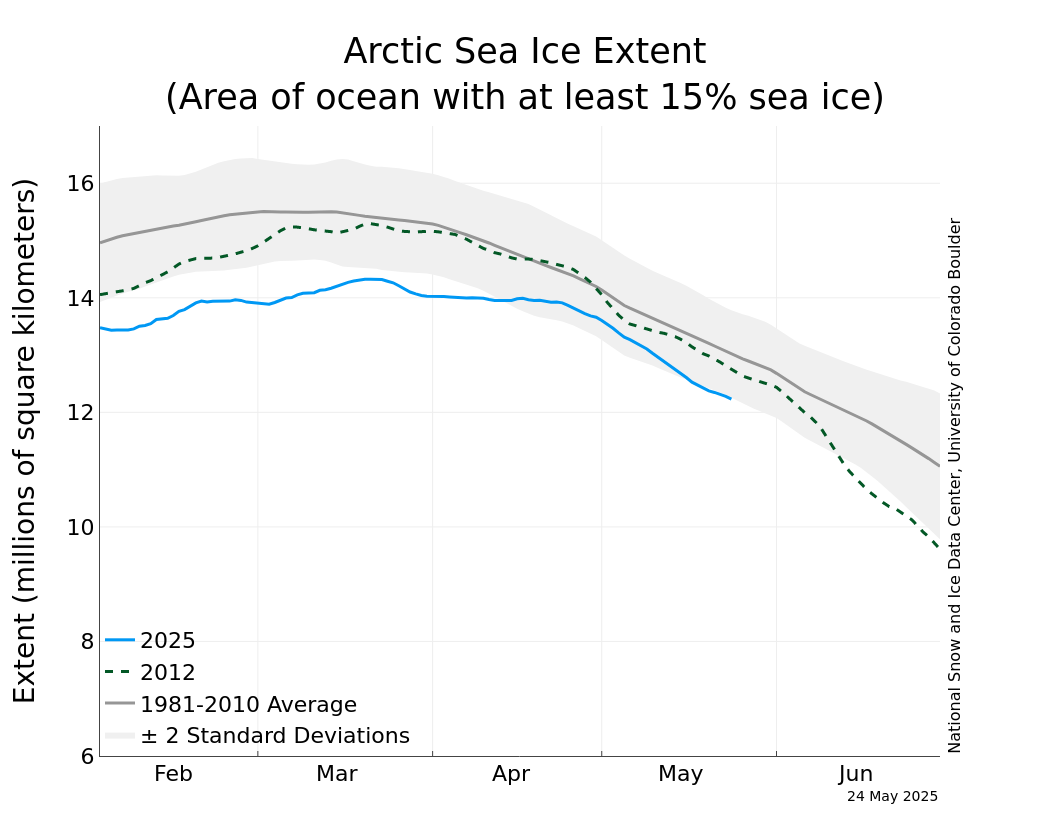
http://nsidc.org/data/seaice_index/images/daily_images/N_stddev_timeseries.png
The more I learn about climate change the less I truely understand it’s inner workings.
Fred Nieuwenhuis:
Spencer actually said that the long term trend isn’t changed at all. This appears to be because the annual UAH anomalies shouldn’t be impacted, once the year is complete. However, the monthly anomalies will be changed, and so at this time, the trend over 2009 and 2010 can’t be compared easily with previous years. And I think his comment applied to the corrections being made to reduce the annual cycle in UAH that isn’t showing up in other temperature records. But Spencer is changing and adding and switching other satellite data at the same time.
The net effect seems to be obscuring the record run-up in temperatures in the last nine months… But by this summer the record heating of the planet’s atmosphere won’t be hidden anymore.
Neven (Comment#39982)-You stand corrected, in February PDO was positive, .82, and January 0.83. Almost certainly it was positive in March as well.
http://jisao.washington.edu/pdo/PDO.latest
As a rule of thumb, as ENSO goes, so goes PDO, at least in the short term.
Thanks, Andrew. I thought the PDO switched on a decadal scale, but that’s probably the AMO or whatever.
PDO is in negative phase. Neven was right.
http://en.wikipedia.org/wiki/Pacific_decadal_oscillation
.
Amazing, isn’t it? Could this negative AO be influenced by the El Niño? Perhaps when ENSO switches to neutral or La Niña we get opposite conditions in the Arctic. The NSIDC has issued its monthly report yesterday:
.
“Early in March, Arctic sea ice appeared to reach a maximum extent. However, after a short decline, the ice continued to grow. By the end of March, total extent approached 1979 to 2000 average levels for this time of year. The late-season growth was driven mainly by cold weather and winds from the north over the Bering and Barents Seas. Meanwhile, temperatures over the central Arctic Ocean remained above normal and the winter ice cover remained young and thin compared to earlier years.”
.
So if ice cover really is ‘young and thin’ and we get a switch in conditions during the melt season, we might be in for a record difference between extent maximum and minimum (which if I’m correct stands at 9,801,406 square km), based on IJIS.
.
Does anyone know if there is any interesting thread for the 2010 Arctic sea ice melt somewhere? There was one on CA last year.
sod, Andrew FL and Neven,
Neven and Andrew FL are both partly right. The PDO is in the early stages of a cool phase. However, this does not preclude positive values of the PDO index, for which, as Andrew FL pointed out, the most recent value is positive. Phases usually last 20-30 years. This graphic http://en.wikipedia.org/wiki/File:Pdoindex_1900_present.png illustrates the point. The PDO was in a warm phase between around 1976 and 2007, but this did not prevent occasional negative index values. Similarly, the previous cool phase had occasional positive values.

Thanks, Alex Heyworth. Another thing learned.
Clearly, we will need to bet on the ice minimum. Have the ice monitoring officials decreed the maximum to be past us?
I need to plug some numbers into MODTRAN, but I betting that air temperature really doesn’t have all that much to do with ice formation when the sun is below the horizon. The real question is cloud cover. If the higher temperature was caused by higher cloud cover, then the dominant heat transfer process in the Arctic winter, direct radiation to space, would be reduced and the ice would not be as thick. As far as melting, though, that will be dominated by the AMO. If it is below zero for the melt season, you won’t see a record low minimum extent or area.
OTOH, I just checked and the AMO index is out for March. It’s 0.335. I was really expecting a much lower number given the extent and area behavior on the Atlantic side during March.
Dewitt –
The AMO is possibly being affected by the Nino, which is possibly producing the warm anomalies off the coast of Africa via changes in trade winds, etc. So the artic areas may not be as warm as the AMO suggests, if the majority of the positive signal is coming from the lower portion of the North Atlantic.
Bob will obviously be a better source than I, but that is my understanding.
Interesting… Christy is taking his climate views to a new level. Joe Romm claims Christy told him that the March 2010 UAH anomaly did NOT set a new record for March!
Their database shows March ‘98 at 0.53 and Mar ‘04 at 0.45.
They just reported UAH for March 2010 at 0.65. According to their own numbers, March not only is the hottest month in the dataset, it is by far the hottest March…
And of course RSS shows March 2010 handily beating March 1998.
What are Christy and Spencer trying to cover up here? Does anybody know? It seems funny that they are trying to hide the record high temperature. Do they have a reason to hide the data?
Re: Paul K2 (Apr 7 19:40),
No, it’s not the hottest month in the 5.3 data set. Both Feb and April 1998 are higher in the 5.3 data set (http://vortex.nsstc.uah.edu/public/msu/t2lt/tltglhmam_5.3):
It might be the hottest March. I’ll double check tomorrow.
Christy and Spencer began work to create 5.3 a while ago, in response to criticisms which appears valid. So, I don’t think that change can be thought motivated by any wish to hide anything.
El Nino isn’t dead yet. We may still see UAH higher than 0.770 C. But, the fact is, it’s not the highest month ever using 5.3.
sod (Comment#40092)-Funny, I thought that by linking to the actual index values, I could show exactly what “phase” the PDO was in during a month! It turns out that by pointing to a wiki page which has a graphic (hey, from the same website!) that ends in September of 2009, my statement is shown to be wrong when the last value on that graphic is also positive.
Sod, you’ve reach a new low.
Paul K2 (Comment#40167)-Wow, you weren’t joking around you really think they are hiding something! Yep, and the government was behind 9/11, Obama is Seikh Hermaphrodite from Mars, and the moon land was really filmed in Wisconsin on a giant piece of cheese.
Lucia, I am talking about a record March anomaly, on top of the record January, November, and September monthly UAH anomalies.
Andrew FL
Joe Romm contacted Christy, who gave him a different number for the March anomaly than is posted on Spencer’s website. Christy claims it is only the second highest March.
We are trying to sort this out on Climate Progress here starting at my post at comment 21. I have provided a link to my saved copy of the UAH database before they started adjusting it.
I thought the posters at this site were into accurately reporting data on temperatures and open access to temperature records. Why are you guys giving Christy and Spencer a free pass?
Spencer and Christy certainly resemble Anthony Watts’s depiction of the foolish climate scientists in this infamous post of his. AW and his band were out to punish the GISS miscreants for showing a June 2009 anomaly much higher than the June UAH anomaly. Of course, AW and his gang didn’t know anything at all about the seasonal cyclical trend in the UAH data. So I decided to post some comments that they were on the wrong track in their hunt for the foolish scientists.
My comments on that thread start on July 15th at 9 o’clock… for my pains in showing Watts the cyclical variation in UAH (referencing DeepClimate, who in turn came on and posted the links to papers and analysis showing the big seasonal problems with UAH), all of my comments on WUWT are now censored. Read that thread, and realize that Watts has doctored out some comments to make it not look as bad as it was.
Anyway my comments prompted Watts to ask Christy about it, and watt do u know, in February, they rolled out these big adjustments. Watts loved to make fun of GISS adjustments, but these UAH adjustments swamp any of the GISS adjustments. Clearly the UAH record was broken pretty badly, and now Christy and Spencer resemble Laurel and Hardy, as Anthony Watts so presciently depicted his foolish scientists.
Paul–
What’s with the accusation? You wrote this:
The part that says “March not only is the hottest month in the dataset,” is clearly wrong. Maybe you didn’t mean to write that. Maybe what you really meant was November was a record for November. — but I responded to what you wrote here, not what you wrote at Climate Progress.
The new data set is here: http://vortex.nsstc.uah.edu/public/msu/t2lt/tltglhmam_5.3
The value for march is:
2010 3 0.653 0.853 0.454 0.726 31. 0.380 0.420 0.340 0.426 365.
That’s the value Spencer posted. It hadn’t been updated when I wrote the current post, so I obviously didn’t tabulate which months were hottest and I didn’t check to see if it’s the hottest March, Jan etc.
The old data set is here:
http://vortex.nsstc.uah.edu/public/msu/t2lt/tltglhmam_5.2 .
It contains plenty of value that exceed 0.653C. It does no contain a march value because they are no longer using v. 5.2; so we can’t say whether this march would have been the warmest march using V5.2. (Though, I suspect it might have been a record computed under the old record.)
They discussed why they were changing methods last summer.
As for your discussion at ClimateProgress: I rarely read climate progress. The long screeds, and worthless comment section are unattractive to me. I don’t know whether Christy misrepresented something to Joe, made a mistake, or whether Joe just misunderstood something. But I don’t see why I should be accused of giving Christy a free pass because Joe posted a second hand report of something he thinks Christy particularly since I do not even read Joe’s blog.
No one is getting a free pass.
Lucia, you already told me that March wasn’t as hot as some months in 1998; you are repeating yourself. I already clarified what I was talking about, and I apologize profusely for not being clearer that I am trying to track anomaly records for each month in the year. I am not so interested in comparing June to January; or even March to February; I am interested in comparing March to previous Marches.
Why am I interested in looking at records for each month? Because it is clear that the prior reported temperatures in the UAH data had a strong seasonal cycle, not consistent with the other temperature records. We can’t assume that a March anomaly can be compared with anomalies from other months. We don’t even know, if the 1998 month by month anomalies shouldn’t be adjusted, using some of the adjustment procedures that Christy and Spencer are currently applying to 2009 and 2010.
So I have focused on looking at each month’s anomaly in relation to previous anomalies reported for that month. And in the last nine months, the data show the hottest September, November, January, and March in the records; the second hottest July and February, and the third hottest October. There clearly are some high temperature records being set in the UAH database, in spite of a weaker El Nino and weaker solar forcing compared to 1997-1998. It appears that April will likely come in as the second hottest April. For May and June we don’t know, because we don’t know how long and how big the El Nino impact will be, and because there will be a significant upward adjustment due to the new UAH procedures.
We do know that there were some big errors in the month to month anomalies, as evidenced by the big adjustments that are currently being applied. These errors are much larger than any adjustments we have seen in the other temperature record sets. This is at least the second time the UAH data has had to be substantially revised because of errors in the data processing.
We also know that US taxpayer money is paying for this work (of questionable quality?). I would think there would be a lot of comments here, but everybody seems all excited about the big Heartland party instead. I am not so interested in pursuing this surprising poor data analysis, as I am in getting accurate temperature data from the satellites.
Anyway, clearly March 2010 was the hottest March in the data at the site you linked to. And I don’t understand why Christy told Romm why it wasn’t the hottest March in the data. Is there some kind of disagreement between Spencer and Christy about the reported anomalies in the new system?
PaulK2
Ok. It appears you think it’s important to make comparisons. So, do I.
But if that’s your focus, what’s with closing your post to me with stuff like this:
You come here, mistate what you meant. I answer what you said. Then suddenly your clarification of what you mean involves some discussion you are having at Romms, and translates into I’m not tough enough on John Christy? Or what?
Is what you meant to say was you’d like to see comparisons of UAH relative to previous months, I totally understand that.
Did you want to ask why I hand’t shown them? That’s easy enough to answer. The reason no comparisons appear in the blog post is that http://vortex.nsstc.uah.edu/public/msu/t2lt/tltglhmam_5.3 was not yet updated at the time I posted. I alluded to this (possibly in a way that wasn’t clear) here:
It happens to be the case that Roy Spencer posts his monthly values, and http://vortex.nsstc.uah.edu/public/msu/t2lt/tltglhmam_5.3 is updated a few days later. Normally, I can compare the value Roy posts, because the previous monthly values don’t change. But this month, previous values for 5.3 changed– the reason for this was mentioned by Roy at his blog, and in the read me file here: http://vortex.nsstc.uah.edu/data/msu/t2lt/readme.07Apr2010. (You’ll find discussions of other issues there.)
As far as I can tell, I have access to data in a reasonable timely manner.
I don’t know either. I also don’t know precisely how Joe phrased the question he asked Christy, or what Christy thought he was telling Joe. If you wanted to know the answer to this, why not email John Christy, Joe Romm or Roy Spencer instead of dropping an obscure accusation in my comments? I’ve emailed John. Other than that, I’m content to wait a day or two, even if you are discontented.
Thanks for the links Lucia… I used them in this post at Climate Progress (since you don’t read the posts there):
Paul K2 says:
April 8, 2010 at 11:48 am
Here is the revised UAH database (version 5.3).
Here is the previous UAH database (version 5.2).
I posted some comments on the Blackboard, and Lucia provided the links.
I find it strange that Spencer is working on some kind of urban heat analysis on the landstation data, while the UAH product is basically offline. This would never fly in the private sector… They received good funding to generate the UAH records, and now with significant errors in the previous product exposed, they aren’t working to fix the product, but instead are working on something else? This is the second time there have been big mistakes in the UAH product.
Maybe its time to move the UAH product to a different team who are interested in putting out a good product.
“No one is getting a free pass.”
.
Except Anthony Watts. 😀
Paul-
I wrote John Christy and asked. He responded:
Given the terseness of Joe’s interjection in your comment, I think this clarifies what John Christy meant. John is writing Joe to clarify this for Joe.