Those of you who bet on the UAH anomalies are pretty familiar with the Channel 5 AMSU, whose data are provided in near real time by UAH. Recently, LuboÅ¡ Motl, commented on the very warm January readings, Joe Romm commented on LuboÅ¡’s post, and the crew on Michael Tobis’s google group are all discussing the graph itself.
When visiting my post announcing the opportunity to bet on UAH’s January anomaly, Michael Tobis asked me to explain my graph which reorganizes the information from UAH to create a “daily anomaly”. Scant explanations are posted on the betting blog post because I figure most of those betting are familiar with the recurring graphic and the main point of those posts is to alert people they can bet. Regular bettors have their own methods of guessing the upcoming anomalies. However, due to current interest in the channel 5 temperatures, I’ll explain my anomaly graph.
To begin, let me show UAH’s graph of channel 5 temperatures, below we can see a graph I created by selecting “channel 5” at UAH’s satellite page:

The graph shows measured temperature reported by the Channel 5 AMSU reported in C.
The smooth yellow curve indicates the average temperature computed during first twenty years of operations which is used as a baseline. The fuschia curve and light blue curves respectively indicate the highest temperatures and lowest recorded temperatures recorded during the 20 year baseline. Other traces correspond to individual years after the baseline. It’s easy to see excursions above the 20 year record high occurring during years after the 20 year baseline. You have to squint to find the few excursions below the 20 year record low during years after the 20 year baseline.
(It’s worth nothing that the baseline does not start in January. It ends in 1998, so you happen to look at temperatures for 1998, that temperature trace will will begin mid-year. )
The graph above is fine as far as it goes. But Michael Tobis asked a question about my betting graph, which reorganizes the information. For the purpose of betting on future reported UAH temperatures, to quickly see whether today has a warm anomaly relative to some warm historic anomaly that might have happened in a different month of the calender year, most of us want to know anomalies: that is temperature relative to the baseline.
That is to say, people might want to know the difference between the current temperature and the smooth yellow line in the graph above.
To help curious quickly gauge whether the current temperature is high relative to the baseline, I created new annual series by subtracting the daily value from the annual average temperature (i.e. data from smooth yellow line) from the corresponding daily temperature for an individual year. This is a “daily anomaly” for the temperature.
In addition, to give bettors a feeling for the overall increase in the daily values since the end of the 20 year baseline period, I computed the average temperature over years after the end of the 20 year baseline. I did this both including and excluding 1998, the partial year. I also computed a standard deviation.
The various traces are illustrated below:

There are many features worth nothing:
- the average temperature during the post-baseline period is consistently higher than during the baseline period.
- the current January daily anomalies are records for January for channel 5 AMSU.
- the current January daily anomalies have not yet reached the all time high for the channel 5 AMSU daily anomaly (but they are close.)
- I added a black bar to show the average computed over January days already reported. That anomaly is 0.740C, which is very high.
Based on the last point, it’s advisable that people who want to win quatloos when betting on UAH should bet the January UAH value will be high. Bet high even if January is cold in Chicago (and it is. Brrr! Aussies, reporting they are frying down under, I’d be thrilled to exchange a few degrees with you! )
Returning to betting on the UAH anomaly that will be reported for January: it’s worth keeping this in mind: UAH does not use the channel 5 AMSU to compute their anomaly. They use the more accurate Aqua satellite which carries extra fuel to avoid drifting. Because the AMSU satellite drifts, we can’t be sure the rise in temperature is due to fluctuations on earth, or position dependent biases in daily reported temperatures that arise because the satellite drifts.
This means the instantaneous temperature reported by the AMSU satellite my overestimate or underestimate the temperature in the troposphere. All the web accessible page can show us is the reading. This information is a useful guide for betting, but caution is advised before decreeing that we have seen the warmest January day ever or some such thing. We can say we have seen the warmest January channel 5 reading– that’s thought strongly related to the warmest January day, but it’s not the most accurate satellite available. It’s just the one whose readings are quickly available. If you bet using the AMSU readings only, you will often lose. (That’s my strategy and I have never yet won the quatloos!)
P.S. If you want to bet, go here: bet entry form for UAH’s January anomaly.
it is snowing here. folks just bet a -1°C anomaly.
you can t go wrong with the wattsup weather service….
Sod–
We got a little fresh snow yesterday. Snow is normal in January… but it really has been a bear of a January. BRRR!
Dear Lucia, a good post. But let me admit that I kind of missed the Channel 5 fad. Why is exactly this channel so interesting?
I agree that anomalies are the most important things for predictions and comparisons – and with them, we’re just approaching the record readings. By the way, 0.74 °C is my current central estimate for the final January 2010 UAH global surface anomaly. That would not be quite a record. But chances are significant that the record readings at 0.76 °C will also be beaten.
I just submitted a posting in which I argue that the special high January anomalies could actually be due to the excess snow “anomaly” relatively to recent years and months (besides El Nino in recent years),
http://motls.blogspot.com/2010/01/warming-induced-by-latent-heat-of-snow.html
because the creation of the snow released the latent heat of the liquid water to the atmosphere. An estimate shows that such extra snow may temporarily warm up the average atmosphere by as much as 0.2 deg Celsius or so – before the snow melts again, and cools the atmosphere back along the way.
So I do expect that the high January anomaly will be shared by the surface weather station teams, too – although not as dramatically as UAH will show. And I do expect that all these anomalies will significantly decrease again by April or May – despite the strong El Nino that is underway.
Lubos
Of the various channels from the AMSU, it correspondes most closely to the temperature of the lower troposphere. Oddly, I think your post started the recent ‘fad’ of looking at it for the purpose of noticing how warm January is. (Though, of course, my readers have been looking at it for the purpose of betting.)
So, you think when the polar air traveled south and froze out all the water, it released sufficient heat to notice? Could be. I’ve never tried to do any sort of bounding calculation on that. We’ll see what happens next.
I encourage you to bet on the UAH temperatures when the time comes. Maybe I need to set up something long term. But 1 year bets at the blog are no fun. Maybe I need a three month. Everyone can bet on April temperatures now? Something like that.
Dear Lucia, that’s an interesting feeling to start the Channel 5 fad without ever having looked at the Channel 5 in any detail. 😉
My successful bets on UAH – usually with accuracy 0.01 deg C – are only bets on the month that is already underway, usually around 1/2 or 2/3 of it. The anomaly during the whole month is not so different from the anomaly in the first 2/3 of it which can be read from the daily applet. It’s easy to convince oneself that if you have data up to 20th of the month, the error (as standard deviation) for the whole month is usually less than 0.02 deg C.
I usually assume that the now-minus-last-year temperature differences will stay constant for the rest of the month (as in the last measured day) – this was my most successful assumption so far.
Can you actually win some money from these “bets”? That could be an interesting possibility.
Lubos–
You can only win Quatloos, which can be spent on the planet Triskelion. I haven’t verified the legitimacy of our Quatloo bills with the governing authorities of Triskelion though. So, there a risk they might decree you a criminal and punish you by turning you into a thrall.
Not a thrall! Anything but a thrall!
Thanks, Lucia, it’s very attractive but Triskelion was just accepted to the European Union which means that I would have to pay the value-added-tax out of it, according to the newest 2010 EU laws designed to complicate the lives of everyone who accepts any quatloo or euro from another EU member state.
Moreover, I would probably need to learn the channel-5 numbers. Sorry for that but I have only mastered the channel-4 (surface) numbers and I have no idea whether the qualitative behavior is really the same. This is pure convention, a sociological problem of myself, and it’s plausible that channel-5 is better for all these purposes and a source of cleaner information than channel-4. But I’m just used to channel-4.
sorry, but i fear i have to disturb the cozy and funny Quattloos discussion.
after weeks of bombardment with snow reports on wattsup, Lubos takes a look at the UAH numbers and arrives (reposted on wattsup) at the completely unreal conclusion, that:
So while it may be fun to watch the global temperature – a meaningless game that many people began to play in recent years because of the AGW fad (…) – it is very important to realize that the changes of the global mean temperature are irrelevant for every single place on the globe.
while the denialist blogosphere was celebrating every single snowflake as a sign of the “PDO-shift” and a coming iceage, accurate (and actually climate related) meassurement of the global temperature is telling us the real story:
the globe continues to warm.
————-
sorry Lubos, but if the average cyanide concentration in the five glasses in front of you, doesn t tell you anything about how many drinks to take, then i can t help you.
Is there a diagram of the orbital path of the sat available?
Dear sod,
I am not disputing that these wiggles in the global mean temperature are real. Quite on the contrary, I have studied them, written about them, and understood them 100 more comprehensively than you and your politicized colleagues combined.
I am just saying that they’re completely irrelevant for the life of the mankind, key civilized cities, everything else. Every sensible person knows that. If we have half a meter of snow in Czechia, Britain, or New England, you won’t convince us that something is getting terribly warm about winters. Everyone knows that these real data – snow cover in Eastern U.S., Britain, Czechia, etc., is what really matters to us in 2010. The global mean temperature is an abstract irrelevant figure.
Moreover, I have calculated that something like 0.2 deg Celsius part of the month-on-month warming can be due to the rapidly increased snow cover anomaly in the most recent month.
http://motls.blogspot.com/2010/01/warming-induced-by-latent-heat-of-snow.html
So this warming will disappear again as the snow melts. Alternatively, you could add a negative “discount” to the global mean temperature for the latent heat that was added by the created snow. The globe has warmed in the last 20 years but this warming is completely irrelevant for any real purposes. It is a purely academic game to guess whether the global mean temperature in 2100 will be 1 deg Celsius or 1.5 deg Celsius higher than the temperature in 1998. Or whether it will be cooler, which may still happen with the probability comparable to 25%.
No person in 2100 without an access to the global and full daily or monthly data will be able to tell the difference just by looking at his or her environment because the “noise” – fluctuations as a function of time as well as location – exceed the hypothetical accumulated warming. And yes, by UAH, it’s still just 1.3 deg Celsius per century, and even less in the middle troposphere. 1.3 deg Celsius is 1.3 deg Kelvin which is just 0.45% of the absolute temperature we have (288 Kelvin or so). A negligible change.
I haven’t been celebrating snow too much. It’s just a fact – that allowed us to ski around Pilsen etc. – but in general, it sucks. Personally, I am pretty much annoyed by this winter already (coughing since I debated the Greenpeace nuts in a freezing Berlin, on December 4th), and if you ask me about the optimal temperature of the globe, it should be about 13 deg Celsius higher than the temperature today.
It’s very easy to see why. I live in the Czech Republic where the annual mean temperature averaged over the country is 7 deg Celsius. Clearly, the right optimal average temperature for us is around 20 deg Celsius, like the room temperature (we prefer tourist destinations where the temperature is even much higher than that), so we need 13 deg Celsius of warming to get a more decent environment as far as the temperature goes. I am afraid you won’t be able to provide us with this service, will you?
The discussions about plus or minus 0.2 or 0.4 deg Celsius per month – that mostly cancel – are completely academic and everyone who claims that politicians should be interested in these specialists’ climatological issues is crazy (or a liar).
Best wishes
Lubos
“Climate doesn’t kill people. Weather kills people”. Seen on Dr Clam’s accidental blog.
Is it known whether the global average temperature meanders around? ……. through a season or over a year? I would have to think that the global average temp would be different when the sun is largely over the Pacific instead of Asia. I could be wrong though because I think the earth radiates whether the sun is shining or not.
Hank
It does. Look at the top graph. That yellow sinusoidal curve shows the temperature over the course of the year. It’s warmest roughly during northern hemisphere summer.
Since we bet on anomalies, I subtract that out from the daily temperatures to create my graph.
Kusigroz:
And mostly cold weather at that. Figure.
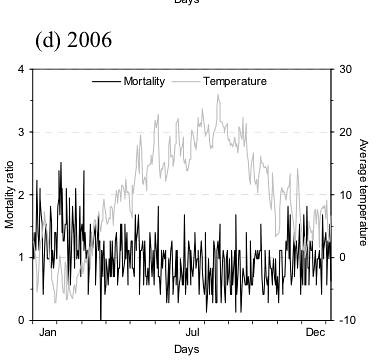
Vastly more people each year from cold than warm (due to weather, cold exposure and cold-weather illnesses such as influenza).
I meant to say “due to weather related accidents, cold exposure and cold-weather illnesses such as influenza.”
Sorry about that.
Lucia, of course, thanks. Some of us are better at dreaming up questions than figuring out how to answer them. I suppose that is the perennial complaint of those in the know about skeptics.
It seems like that the low of the average comes very close to the Jan 1. That’s seems like an odd coincidence since the conventions of calendar are such ancient things.
Lubos says:
“…1.3 deg Kelvin which is just 0.45% of the absolute temperature we have (288 Kelvin or so). A negligible change.”
Since water transforms from solid to liquid at about 273º K, and from liquid to gas at about 373º K, at 1 bar pressure, with large changes in heat capacity, it’s this smaller interval that’s important for estimating ‘non-negligible changes’.
The “13 Celsius” increase that he ‘desires’ would certainly destroy life as we know it.
Come off it Lubos!
Re: lucia (Jan 18 13:25),
Because the NH and SH are 180 degrees out of phase, the global average temperature is much less informative than the separate NH and SH temperatures, IMO. For example, the Muana Loa annual fluctuation in CO2 concentration is strongly correlated with the SH temperature, not the global or NH temperature. Barrow, OTOH, seems to correlate to insolation at high latitude, rather than temperature.
Len–
You are obviously right. It doesn’t make sense to consider temperature changes as a fraction of the absolute temperature of the planet in Kelvin. Even 100C may not be the proper reference base. After all, I can’t personally survive either 0C or 100 C for long without protective clothing. (Heck, I’m not sure I can survive 100 C for long without a protective enclosure which no one would describe as clothing.)
DeWitt–
Less informative relative to what question? It does appear both the northern and southern hemisphere have warmed during the last century. If one is looking for verification that the surface of the planet as a whole is warming, it seem to me the NH+SH average is more informative than either together.
That doesn’t mean we can’t learn a lot by looking at each individually as well. But I don’t see how the average is less informative for any and all questions.
Dear Len, I agree that a more biology-oriented estimate of the “order one” change of the temperature is not by 273 degrees Kelvin but rather 100 degrees of Kelvin. Well, that’s a factor of 2.7 only – not too much change. It’s still true – by far – that the predicted warming is negligible relatively to the changes that qualitatively matter.
But let me also remind you that the global mean temperature may sit at 15 deg Celsius. So while one of the important phase transitions, the freezing point of water, is pretty close (and a relatively small cooling may change a lot – ice ages sucked), the other qualitative transition – the boiling point of water – is 85 degrees Celsius away.
It’s completely preposterous to imagine that 13 degrees Celsius of warming would destroy life on Earth. Prague’s climate would look just like Melbourne’s climate looks today. It’s completely fine. My uncle has moved from Pilsen to Melbourne and he’s been doing fine. People would be doing fine.
Just to be sure, we wouldn’t be affected by a sea level rise, either. We’re hundreds of meters above the sea level while the melting of all Antarctica and Greenland ice would only add 24 meters to the sea level.
However, this would not really happen because most of the Antarctica’s ice (and probably most of Greenland’s ice) would actually survive if the warming were just 13 degrees Celsius. See the map of the annual mean temperatures:
http://www.globalwarmingart.com/images/a/aa/Annual_Average_Temperature_Map.jpg
Antarctica is mostly below -40 degrees (Celsius or Fahrenheit, it’s the same thing for this particular number), so 13 deg Celsius of warming wouldn’t qualitatively change anything about Antarctica. It would still be uninhabitably cold. And even Greenland is mostly below -20 degrees Celsius, so it would remain below the freezing point for most of the year.
Sahara and maybe even Brazil could become annoyingly warm – although the tropical forests can do miracles with the energy. Meanwhile, the U.S. would simply resemble Mexico or Brazil today while Canada would resemble the U.S. today.
The world would almost certainly be richer if the temperature increased by 13 deg Celsius. It would be a different world but the idea that the present life forms would disappear is entirely absurd. To threaten life on Earth as we know it, so that a simple migration wouldn’t help, you would need to warm the Earth at least by 50 degrees Celsius.
Re: lucia (Jan 18 15:53),
I should have been more specific. It’s less informative for seasonal variation of something that responds to the temperature, not the anomaly. Once you construct anomalies or annual averages, the seasonal information is gone anyway.
Re: Luboš Motl (Jan 18 15:55),
I don’t think you can assume that if the average temperature goes up 13 C, that the average temperature at the poles will only go up 13 C. The global average temperature at the peak of the Cretaceous is thought to have been 25 C. Dinosaur fossils from the time have been found at what would then have been 75 S latitude. The arrangement of the continents and global oceanic circulation was completely different than now so comparison is difficult, but I’m pretty sure the concept of polar amplification is valid for any change in temperature.
Luboš-
I think you underestimate the effect on the icecaps. Down in the ice temperature gets higher, see, for example:
http://www.pnas.org/content/99/12/7844.full
The melting temperature depends only weakly on pressure in the relevant range, so once the T increase on the surface propagated down (which could take quite some time), the rate of flow of the ice could change dramatically.
Dear DeWitt,
Len was talking about “destroying life as we know it”. Florida is not a part of “life as I know it” – in fact, I have never been there (unlike many other states of the union). So for life as I know it, it’s perfectly OK to melt the polar ice sheets and Greenland’s glaciers. The sea level would rise by 24 meters, fine, and what?
If the global temperature jumped by 13 deg Celsius, Antarctica could warm up by 40 deg Celsius, if the amplification is three-fold (so far, it hasn’t warmed up in the “global warming era” at all – instead it cooled down a little bit, so this is a big speculation and probably an overestimate).
An Antarctica that is warmed up by 40 degrees Celsius is still too cold for me because the annual mean temperature is below the freezing point (today, it’s -45 deg Celsius in the bulk). It’s certainly extremely far from a point when the whole globe would be too warm for life. Eastern Siberia may sit around -15 deg Celsius of the annual mean temperature today. It could be around zero after my warming – and it would still be too cold.
The best zones for life would be in Central Europe (by construction) – and the moderate zone would be in Western Siberia, Canada etc. Moreover, it’s important to realize that what we find annoying in the very warm climates is often not the high temperature itself but the aggressive solar radiation. That wouldn’t change at all if the Earth warmed up because of some internal changes.
We could still find our life near the equator, where the annual mean temperature could approach 50 deg Celsius, unpleasant. But you would be damn surprised how life in general would thrive over there. There are clearly many species that would love it – even life forms that love temperatures approaching the boiling point – and they would create ecosystems for many others. After all, jungles are doing similar service even today.
I insist that a threat for “life as we know it” cannot start before the increase of the global mean temperature approaches 30-50 degrees Celsius relatively to today’s temperatures.
Consider that the dew point is a temperature that is thermodynamically impossible to cool below using shade, sweat, convection or wind. Current dew points in the tropics and subtropics regularly rise into the low to mid 20s (celcius). I believe the highest dew points are recorded in the middle east at around 30. A 13 degree increase would push dew points into the mid 30s, making it close to impossible for humans to lose heat into the surroundings, unless aided by airconditioning.
Of course rise in dew points would probably be tied to the surrounding sea temperature and ocean temperatures in tropics and subtropics would probably rise less than average.
LuboÅ¡ Motl–
I’d miss Florida. I like Sarasota and the keys. I have fond memories of El Salvadoran beaches– this will be underwater if the oceans rise 24m. (Of course, there will be new coastal areas, but the ones I remember will be underwater.)
Besides all this, if temperatures jumped 13C quickly– like say in 100 years, that’s going to cause strains.
Luboš Motl:
Remember that the warming is greater over land than sea, so a 13°C increase globally would be more than that over land masses. Secondly, effect is larger at temperate and polar regions, so to get 13°C globally, you’d get a lot more than 13°C at the poles. Maybe something closer like the 40°C increase (and of course a lot less than 13°C to compensate at the equator).
Dewitt-
According to what I’m reading, in the Northern Hemisphere there is a 7 week “thermal lag” between the astronomical height of the summer (at the solstice – June 20) and the meteorological height of the summer (late July or early August) . On the other hand in the more oceanic Southern Hemisphere the lag is reduced several weeks so that the seasons as experienced more closely match the seasons based on the sun’s position in sky. I also read that it varies by location and that San Francisco has a seasonal lag of almost 3 months for the summer – (but not winter). I guess this is all evidence that it does take time for things relating to climate to achieve an equilibrium. Wiki is also telling me there is a thirty year seasonal lag on Neptune, but I must be missing something in that statement. Of course my big question is whether these kinds of lags manifest themselves in any models or are things so averaged out that things like seasons don’t pertain.
I seem to remembering hearing on a PBS special from the 80’s (or so) that the problem modelers of that era had was keeping their models from snow blitzing. This was a thing where enough snow was in the model to make the whole earth model “freeze over” (figuratively speaking) due to the whiteness (and hence reflectivity) of snow. To me that is somewhat of a confirmation of climate models since I am now reading that geologists think that kind of thing may have happened in Precambrian times and possible at the Permian Triassic unconformity. It would be interesting if difficulties climate modelers were having in the 60’s or 70’s presaged a later geological discovery.
I think that ‘life as I know it’ would change dramatically if average temperatures in Canberra increased by anything close to 13 degrees celsisus … Days that are 8 to 10 degrees above average in summer are pretty nasty. Electricity usage rises dramatically, as does water usage. Given that we are already in drought, this would be a disaster. We would run out of water. It is likely that we would have to be abandon the city after a couple of years at this kind of temperature level.
Lubos …
(Comment#30637) January 18th, 2010 at 10:33 am
Dear sod, ….” if you ask me about the optimal temperature of the globe, it should be about 13 deg Celsius higher than the temperature today.”
I disagree completely – optimally the temperature would be about 9c warmer here today – Although I may agree with you tomorrow.
Of course the gobal temperature record is excellent and all the recodring stations perfectly calibrated:
http://failblog.org/2010/01/15/temperature-fail/
Andrew Kennett, it’s pretty decent since we got the global satellite coverage, especially since NASA’s AQUA satellite came on line.
Lubos:
The Hadley Cell deserts (Sahara, Outback, Kalahari, Thar, etc.) would extend from the equator to about 35º N & S. Virtually all tropical land species would be destroyed.
Although you might feel comfortable, some of the time, in central Europe, a major part of the surviving human population would be decimated .
As a smart physicist, please take the time to learn a bit more about biology and the environment, before you make such dumb pronouncements.
Len Ornstein,
“The Hadley Cell deserts (Sahara, Outback, Kalahari, Thar, etc.) would extend from the equator to about 35º N & S. Virtually all tropical land species would be destroyed. ”
Except that CO2 fertilisation would offset this.
Figure out how much more CO2 would be outgassed by the oceans if the global temp was +13c. There should also be a substantial increase in water vapor in the atmosphere.
Len:
Not according to the models, they wouldn’t. They’d shift to the north, and the cell strength would weaken.
kuhnkat and Carrick:
CO2 fertilization can’t help where there’s virtually no rainfall (as in the present Sahara).
With a 13º C GMST increase, the Hadley Cells expand both north and south, rather than move away from the equator, and they dry their deserts further, even with the higher global atmospheric humidity.
If its from UHA/AMSU/RSS I believe it, but current monthly doesn’t mean anything in the context of climate as does the snow/extreme etc in the NH this winter. I certainly do not believe any temp data from Hadley, NDCD, NOAA or IPCC any longer as its all rigged anyway or taken from hearsay in popular junk magazines such as New Scientist.
Len:
You have a reference?
What I have found (admittedly not 13°C) says otherwise.
How reliable can the models, which don’t do a very good job even with current forcings levels, be in any case for such an extreme temperature shift?
What does the paleoclimate evidence say?
Len, re CO2 fertilization — while 13degC would be a huge increase (I’m sorry I don’t have time to find the refs so ignore me if you like) the relationship between nutrient density (and CO2 is a plant nutrient) and water availablility is complex. On good soils plants can usually cope much better with drought, we see it all the time with wheat. In the last (7+) drought years in eastern Aust farmers can cover to some extent for reduced water allocation with fertilizer addition. But the major limit for world cereal crops is cold — +13 deg would open up huge areas of Canada, China and Russia to cropping. I would also expect massive expansion of the monsoon belt. But I expect Lobus Motl was joking with 13deg — maybe he suffers from SAD 😉
Andrew Kennett, I think your scenario is more plausible personally. Add the greater available crop land to a decreasing world population, and there isn’t much of a crisis for humanity.
(I’m still waiting for somebody to convince me we aren’t facing a major history-of-the Earth magnitude extinction event in the next 100 years though.)
Carrick (Comment#30726)
I think you should recheck your reference. It says that, yes, the HC’s would weaken, but they would expand, and, as Len says:
“Associated with this widening is a poleward expansion of the subtropical dry zone “
It’s completely preposterous to imagine that 13 degrees Celsius of warming would destroy life on Earth.
Lubos is demonstrating a serious lack of understanding. the Prague reference in the original article was already quite stupid.
but this is simply getting beyond hope.
to get a 13°C change in Prague, we would need a 5° to 20° change of the global average.
on the other hand, a global average change of 13°C would cause more massive changes at other places.
Prague simply cannot see a big change of its average temperature, without the globe having a big change of average temperature. a connection that Lubos denied in the original article.
life on earth would change for humans, because of population displacements.
life would change for plants and animals, because of other effects caused by humans.
the idea that “CO2 fertilisation” would offset any of these massive changes is bizarre.
I have read the replies of yours above and I think that you haven’t presented any arguments – except for manifestly wrong ones and emotions – that an average 13 deg Celsius of warming in the global mean temperature would represent any threat for the life of humans and the life of life forms that we know today.
For example, some of you claim that people can’t live around 30 degrees Celsius. Is that meant seriously? Denver has the average high in July at 31 degrees Celsius and they’re just fine. The record highs are at 41 degrees Celsius and they haven’t ever started to mass-die.
It’s equally untrue that the deserts would spread. The deserts such as Sahara exist because the geographic location combined with the local winds and the humidity at relevant places around it brings a small amount of precipitation over there. This has almost nothing to do with the temperature, at least not in a simple way, as everyone in the equally warm tropical forests in Brazil knows very well.
I feel like a heretic among some crazy medieval believers who have been brainwashed by their priests and who feel that their God is being humiliated by the modern science. A rational person could simply not be brainwashed in this breathtaking way. It’s completely manifest that 13 degrees Celsius of warming globally – which could be 25 degrees Celsius of warming at previously frozen places – would represent no existential problems for life whatsoever. And in fact, there would still be many places that would remain annoyingly cold.
Also, 100 years is not a “short interval” so that the changes in 100 years are “fast”. While it would be true that the Earth has rarely seen 13 degrees Celsius change in 100 years, there would be nothing wrong with it. One needs to move somewhere by 2000 km to completely compensate for the effect. That’s 20 km per year. Too much?
The systematic changes of the climate in 100 years or so have never been dominantly important for the survival of species on Earth. When it came to temperatures, animals were always killed by the weather change, not climate change. A 20 degrees Celsius change in temperature within a month can kill animals – because they may be unable to escape in one month. But they’re always able to move in 100 years. You have all these things upside down.
Where are the animals in Australia going to move to? The Southern Ocean?
You also forget that animals don’t have aircon.
Dear bugs, I was talking about the “life on Earth”, not about particular animals. Most of Australia is inhospitable even today, and it would surely become even more so. In other words, Australia is pretty much irrelevant for the existence and survival of life on Earth.
Australian fauna would mostly disappear – but that’s a completely different proposition from the statement that the life on Earth would be threatened. Life doesn’t have to live on every place on the Earth, and even today, it surely doesn’t.
You’re wrong that “animals don’t have aircon”: yours is an mis-informed biology. Cold-blooded and warm-blooded animals have different mechanisms to adjust their body temperature, but both of these groups are capable to push the temperature in both directions.
Concerning the cooling, panting, flushing, and flapping elephant’s ears are among the tools to increase cooling if the temperature around is still cooler than the body temperature (typically 40 deg Celsius), at least a little bit. But even beyond this point, one can cool himself down. Sweating cools you down because the evaporation consumes the latent heat that is taken from the animal/human. It has good reasons to sweat when it’s hot, and it works. See
http://en.wikipedia.org/wiki/Warm-blooded#Avoiding_over-heating
To summarize, it is equally difficult or equally easy for animals to live under warmer-than-optimal and cooler-than-optimal conditions. Your bias that a warmer weather is worse than a cooler weather is scientificially incorrect.
And the average global temperature is still surely below the optimal one for the average existing life forms, so warming is surely beneficial.
i noticed that australia is supposed to be baking, well it is and it isnt. this chart is for the max anomaly for the week up to 12th, it has cooled considerably down south in the last week, so you can make an estimate from this-
[IMG]http://i931.photobucket.com/albums/ad158/mobihci/weekanom-1.gif[/IMG]
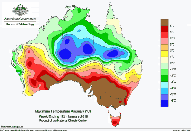
take note that the anomaly is departure from the 1961-1990 reference period, and that we had warming from 1880 through till the 30s in some cases the 40s and cooling from the mid 50s to the late 70s, then warming again, so the base period is within a cold zone. in general temps now are not much different than they were 100 years ago. in fact all ground stations that go that far back show overall little warming at all.
Luboš Motl (Comment#30746) January 19th, 2010 at 4:10 am
You have a way with words, Lubos. Life will continue, as will the rocks. But much of life is optimized to it’s environment, and environments are often quite complex biological interconnections, dependent to a large extent on climate. Mess with that, and the weeds and pests are the most likely to exploit the huge changes. “Average” temperature can be misleading, even one day of 47C can be exceedingly descructive, increase the frequency of them, add in days over 50, you have major problems.
Dear bugs,
there are some (or many) interconnections between ecosystems and their parts, and if the external conditions change, some of them are replaced by other interconnections. The idea that any change must be bad is just a delusion of a Gaia-style New Age quasi-religion. It’s complete nonsense. Animals, plants, humans, and their interconnections adapt to whatever external environment as long as it is compatible with life, and less than 30 °C global mean temperature surely is compatible with life.
The best places in the world to live would probably not be places that would be above 50 degrees Celsius warm, and I have surely never claimed that. The best places to live would be places such as the (current territories of) U.S., Canada, Europe, Russia. That’s how I designed the optimal world.
I don’t know why you’re so obsessed with some overheated deserts. They’re irrelevant for the bulk of life today, and they will probably be irrelevant in the future, too, whatever changes of temperature we will see. The important places for life are those that are hospitable and where life can thrive – and there would be more of them in my world than in the current world.
Still, your comments about “super destructive” one day with 47 °C are bogus. The highest temperature ever recorded in a city was 58 degrees centigrade (136 degrees F) at Al’Aziziyah in Libya, on September 13, 1922.
http://www.triviafactoids.com/2009/11/most-watched-program-on-tv.html
It’s more than ten degrees Celsius above what you claim to be extraordinarily destructive. The city lived just fine through those 57 degrees Celsius. Its population is 300,000 today. So your opinions about major problems are bunk even in cherry-picked places that are unimportant today and that would be even more unimportant in the warmer world.
Best wishes
Lubos
Silly! All the animals on Earth wouldn’t be so diverse and wonderful if climate didn’t change . (Lubos, you rock as always)
Be calmed though. News is the Yeti is safe for now from extinction! The IPCC royally messed up on their “Himalayan glaciers are melting!” projections. Turns out it was all just a wish and a dream (and not based on any peer reviewed research)! Wonderful! Let’s here the cheers of joy from all concerned! 😉
Mohibici
[i noticed that australia is supposed to be baking, well it is and it isnt. this chart is for the max anomaly for the week up to 12th, it has cooled considerably down south in the last week, so you can make an estimate from this-]
Still damn hot here,
In Perth the last three days were max’s of 43, 43, 41 (that’s C). Last night we had a minimum of 27 – second hottest night on record. And right now it is 30C at 9pm. HOT. This is our hottest start to Summer (Dec – mid Jan) on record. Most of the Southeast set record highs during Oct and November, and was hot again at the start of Jan.
There is a chance the East will get cooler, El Nino tends to cool things down over there. But here in the West it’ll stay hot.
Bugs, early this month there was a strong of extremely hot days in Ravensthorpe (south coast of Western Australia) – staying around 47C. There were large numbers of bird deaths, Australian animals are adapted to heat – which is unsupportive of Lubos’ strange claim [Most of Australia is inhospitable even today] (tell that to the kangaroos and camels) – but they can’t cope with the extreme heat days that are becoming more common. Adelaide, Melbourne and most of the towns between and north into New South Wales all set record high temps around 47 last year
Lubos
“It’s more than ten degrees Celsius above what you claim to be extraordinarily destructive. The city lived just fine through those 57 degrees Celsius. ”
That’s just a dumb claim. Have you ever experienced that sort of heat – or anything close to it? IT IS AWFUL. It’s not ‘just fine’. People die at those temps, see what happened in Melbourne and Adelaide recently when they experienced strong heat waves.
“So your opinions about major problems are bunk even in cherry-picked places that are unimportant today and that would be even more unimportant in the warmer world.”
Yes, we get all sorts of problems with power supply, elderly people die, we are running short of water… Oh yes, all just fine.
Oh yeah, and I forgot Australia is apparently unimportant. Great.
Lubos, pray tell. Where IS important?
Dear liza,
thanks for your soulmateness 🙂 – and amusing comments about Yeti. It’s funny. Well, Yeti may be gone but Czech carmaker Å koda – a part of VW – began to produce Yeti SUV, so from the viewpoint of eternity, Yetis are conserved. 🙂
http://www.skodayeti.net/
http://new.skoda-auto.com/COM/model/yeti/
I hope that the environmentalists agree that SUVs are equally beloved species as some hairy scary non-existent manbearpigs in the mountains. 🙂
The Himalayan 2035-2350-nothing scandal is nice and catchy because it’s so easy to describe why the IPCC screwed everything. In other cases, their distortions etc. are unfortunately more complex so it’s harder to explain to most people why the IPCC shouldn’t be taken seriously.
Back to the diversity. Environmentalists sometimes loved to emphasize that the tropical forests are the true paradises of biodiversity (for example, when the main target were corporations with activities in Brazil etc.). Over 90% of the species or how much live in the tropical forests. But when it turns out – shockingly – that the tropical forests are pretty warm, this fact becomes inconvenient. Life is surely impossible over there, isn’t it?
The tropical forests are very wet and the humidity (and screening of sunlight by the trees) is contributing to the ability of this ecosystem to keep good conditions for life – usually between 20 and 35 °C.
Cheers
LM
Enjoy the ‘just fine’ heat Lubos
http://www.abc.net.au/pm/content/2009/s2746685.htm
Oh look how good the ‘just fine’ heat is…
http://www.watoday.com.au/breaking-news-national/melbourne-endures-sizzling-night-20100112-m33y.html
Look, birds love really hot temps
http://www.abc.net.au/news/stories/2010/01/08/2788535.htm?site=news
Dear Nathan, yes, I have experienced temperatures above 45 degrees Celsius (deliberately traveling to countries that are often that hot), and they are exactly as pleasant or as unpleasant as temperatures around the freezing point.
It’s interesting that you must go back with the stories about the Australian heat. Yesterday, Australia experienced the first summer snow in modern history.
http://www.kbsradio.ca/news/56/1052815
At any rate, Australia in average is clearly hotter and especially drier – even today – than the optimum world for life. That would become even more so in a warmer world. I like kangaroos and koala bears, believe me. My uncle has lived in Melbourne for 40 years so I have some special “unclish” attachment to these mute faces.
However, that doesn’t prevent me from seeing that except for the moderate Southeast, Australia is essentially a desert. In a significantly warmer world, only the cities in the South – with a lot of air-conditioning for people and their pets – would be recommended places to stay. But there’s no condition that life on Earth requires a convenient life in the center of Australia. Quite on the contrary – we know that the latter is not true.
Best wishes
Lubos
Lubos
‘Dear Nathan, yes, I have experienced temperatures above 45 degrees Celsius (deliberately traveling to countries that are often that hot), and they are exactly as pleasant or as unpleasant as temperatures around the freezing point.’
So they’re not ‘just fine’ are they? they’re not actually very pleasant at all. People die – over 300 people died in Melbourne’s heat wave last year. Then another 200 died in the fires that raged during the heatwave.
“At any rate, Australia in average is clearly hotter and especially drier – even today – than the optimum world for life. ”
This is a completely nonsensical statement. Life adapts to the conditions (heard of evolution?). There are no optimum conditions for life. Merely conditions at which particular forms of life can exist. The problem happens when you change those conditions faster than life can adapt. It is meaningless to say 20 – 35 degrees is optimum. What does ‘optimum’ even mean?
‘It’s interesting that you must go back with the stories about the Australian heat. Yesterday, Australia experienced the first summer snow in modern history.’
So what? This is another meaningless statement. Been hot everywhere else.
‘However, that doesn’t prevent me from seeing that except for the moderate Southeast, Australia is essentially a desert.’
Well, you can relax in you ignorance then. I would recommend reading the wikipedia entry.
Remember most of the heat deaths happened in the moderate southeast… in Melbourne.
Other interesting Australia facts: the Badgingarra region of Western Australia – part of the terrible desert according to you – has the highest plant diversity in the world.
Lubos and Liza, your comments are just plain out stupid.
Lubos, your claim about average global temperature being irrelvant was obviously false. the 13°C increase in Pargue demonstrates this perfectly. such a rise can not happen, when global temperatures don t change.
your claims about life are wrong as well. you maneuvered yourself in a stupid position, and now are trying to wiggle out.
the original claim above was about life as we know it.
The “13 Celsius†increase that he ‘desires’ would certainly destroy life as we know it
nobody (apart from you) is talking about the end of all life. some plants and animals can get frozen. others survive decades in permanent forms. some live at the bottom of the oceans and wont notice.
but a 13°C change of global average temperature (over 100 years) would certainly remove the vast majority of all big (non-domestic) animals.
there is a pretty significant chance, that man wouldn t survive the conflicts following such a change either.
Lubos
” But there’s no condition that life on Earth requires a convenient life in the center of Australia. Quite on the contrary – we know that the latter is not true.”
That’s just a mindnumbing thing to say.
Are you just making up pretend arguments that no one makes?
Nathan, quite on the contrary, temperatures around 45 °C are just fine, especially if one has a fine hotel to sleep at. Otherwise we wouldn’t ever be traveling to countries where 45 °C is somewhat common.
My statement that the Australian desert is not optimized for life is meant relatively to the life forms we know today, and the proof that it is correct is simply that a very small number of species and individuals live in the Australian desert.
You may deny this fact, hide your head into the sand, and convince equally intellectually deficient people as you to do the same thing, but that’s everything you can do against this indisputable fact. I have to have some standards and benchmarks what temperatures and humidity levels are good for life or bad for life if this is exactly the topic we’re talking about, and this particular statement – that Australia is too dry and also too warm for life – is an empirical fact that everyone who has at least traces of a brain in the skull must be able to see.
Most of the deaths appear in the Southeast (or densely populated areas, in general) because almost no one lives in the desert (or other barely populated regions) to start with. What a shock. This is called tautology, idiot.
Best wishes
Lubos
Natahn– 53C. Wow!
People die in Chicago during heat waves too. But it’s certainly never hit 53C (127F!). The reasons for human deaths in Chicago are complicated. The difficulty is that many older people won’t open windows at night, don’t have air conditioning, don’t think to sit in a cool tub of water, and generally don’t or won’t take adaptive measures.
My understanding is that, in the upper midwest, it’s not just the absolute level of heat. Unexpected heat waves in June kill more people than similar long periods of high temperature later in August. But then, we’re talking about heat waves where it’s hovering near 100F (40C).
Oh, we have plenty of water in Chicago. Unless people forget how to build pumps and water distributions networks, drinking water shortages aren’t going to be an issue in the Chicago area. And even if they forgot how to do that, large cisterns would collect quite a bit of water for most people year around. My mother-in-law grew up in a house in Joliet had a cistern.
Changes in precipitation patterns could challenge farmers though. We don’t irrigate, and we get plenty of rain overall. I think we are still supposed to get plenty of rainfall year around when it warms. But there are more and less convenient times for the rain to fall. Farmers really like those occasional big thunderstorms in July and August!
an 4, 2010 … At least 33 people have died after a biting cold snap sweeping across northern India, a report says.
Jan 18, 2010 … Snow, cold kill at least 4 in western China ..
Jul 13, 2004
Cold weather kills eight in Argentina and Chile, thousands of animals. …
3 days ago
Twenty-six patients at a Havana psychiatric hospital have died as a result of cold weather in the past week…
Jan 12,2010…Pelicans killed by extreme cold; some may have huddled together to stay warm..
Extreme cold kills 1000 Tibetan gazelles
Mar 7, 2008 … More than 1000 Tibetan gazelles died in the extreme cold during the mid-January to early March period, an official in China’s southwestern …
(2008 -yep don’t get started on last year and those years before. Could add up. Haven’t even talked about the crops lost…)
This Earth has never been an Eden. It has always been a dangerous place.
Lubos
“My statement that the Australian desert is not optimized for life is meant relatively to the life forms we know today, and the proof that it is correct is simply that a very small number of species and individuals live in the Australian desert. ”
Again, this is a nonsensical thing to say. The conditions are ideal for those creatures adapted to it. The reason you are making qualitative statements about what is and what isn’t ‘optimum for life’ is that you have made up a criteria. You have decided that optimum for life means high number of species and individuals. This is just an invention of your own. There are plenty of places world wide that lie in different climates to rain forests and have higher diversity, Southwest Western Australia is one of them… But apparently it doesn’t matter right?
” that Australia is too dry and also too warm for life
What an unbelievably stupid thing to say. There is almost no part of Australia that doesn’t have life.
“Most of the deaths appear in the Southeast (or densely populated areas, in general) because almost no one lives in the desert ”
HA HA! Awesome in your dumbness. Brisbane, lies well to the north, in Queensland with a population of almost 2 million… Do we see many heat deaths there? No. It almost never goes about 40 there. Sure, most people live in the Southeast. But there are plenty who live in the north, they don;t die of heatstoke because it doesn’t get the extreme heat conditions they get in the south.
This whole argument is because you have a fundamental misunderstanding of the climate and ecology of Australia. You are simply making stuff up as you go along.
Yes Lucia,
It’s been hot in Australia lately…
Lubos
Your ‘optimum for life’ criteria actually goes by another name:
Biodiversity.
You will note that this present period in time (the Holocene) would seem to have the highest biodiversity in the Earth’s history. This period is also one of the coldest in the Earth’s history.
I gotta go.
Lubos Learn more about Australia and Australian deserts chum. They are not like the Sahara.
Nathan–
Yes. I’ve heard it’s hot. Plus, most of Australia is closer in climate to our southwest than Chicago. So, when it’s hot there, it’s really hot.
I did once experience a heat wave visiting a family who owed a farm the coast of El Salvador. I don’t know how hot it was, but I’m sure the temperature exceeded “Chicago heat wave”. It probably was not 53C. I was 14 years old and someone saying a temperature above 110F would definitely have stuck in my memory.
We were kids and sat in a water filled tub and played all day. I felt very sorry for the people who did not get to sit in a water filled tub all day. The adults we were with stayed in the shade wearing linen. But I could see employees still suffering going back and forth in the heat. Hot or cold, cows still need to be milked!
That was near the coast, so if the earth’s temperatures do rise 13C, they will be under water.
Nathan, your emotional responses are understandable, but I can’t help but remember that sending folks to Australia was a form of punishment in the beginning… as far as the human population now living there thing goes! 🙂 j/k
Nathan (Comment#30770)-It should be a codified law, but, as a rule biodiversity is like Entropy-It increases.
Naturally then the most recent period is the most biodiverse.
Liza–
But sending people to Georgia was a British penal colony too.
I invariably enjoy LuboÅ¡ Motl’s contrarian impulses. However, what is the point of discussing a 13 degree rise when anything over 2 is a major disaster with no positive benefits and pretty much the end of life as we know it.
Better to instantly destroy the global economy and dispense with democracy, economic freedom and national autonomy forever than allow a 3 degree rise.
I have already personally warned Luboš that temperature rises in excess of 4 degrees C will cause almost daily storms a dozen time bigger than Katrina to send tidal waves littered with the corpses of dead polar bears right to Pilsen and Prague. But does he listen?
George–
There is a lot of hyperbole out there. Luboš is still wrong about the idea that a 13 C (23F) rise in temperature would not change life as we know it. If this happened fast, there would be turmoil.
Yes. In principle, we could just start planting orange groves in Georgia instead of Florida. But in practice, it’s really difficult for agri-business to make efficient investments if the USDA climate zone is shifting 4 zones a century. Shifting precipitation patterns isn’t helpful either!
Dear Lucia, I didn’t say that such a 13 °C warming wouldn’t “change” our life. I said that it wouldn’t “end” the life as we know it.
George Tobin (nice bridge, by the way): as Richard Lindzen or any other competent atmospheric physicist will explain you, storms are driven by the temperature gradients and pressure gradients. Because a hypothetical warming affects primarily the (polar) regions that are currently cold (because of the positive, ice-albedo etc. feedbacks), the temperature differences would decrease. So would the gradients.
So it’s likely that in a cooler world, there would be less storminess and weaker hurricanes.
Concerning dead polar bears, yes, I listen. You amused me. 😉 If my sounds sounded disrespectful, I surely hope so because it was a snort of derision.
There are 25,000 polar bears. That’s one polar bear per 272,000 people because there are 6.8 billion humans. Because Pilsen only has 160,000 people, it would have to be lucky to get its dead polar bear, especially because most corpses would surely end up away from any city. 🙂
I guess that you are joking with all this stuff about hurricanes and polar bears – these must be just some references to a degenerated mass culture of the early 21st century. But it’s hard to recognize what is joke and what is serious.
Just to be sure, all my projections concerning a 13 °C temperature rise are completely serious. It has actually been a nonzero work to summarize these effects etc. and I think that because these scenarios are used to justify brutal interventions to the very way how our civilization works, it has become a very important issue to consider seriously and scientifically, instead of by weird emotions and mass brainwashing.
See also my special article about it:
http://motls.blogspot.com/2010/01/13-c-of-warming-would-be-fine-for-life.html
Lubos-
Yes. We are arguing about the definition of “as we know it”. I think the changes would end life “as we know it”; it would not end life entirely. A 13C change is not going to disinfect the earth or boil away the oceans. That likely could end life– though I might have to consult a biologist to learn whether there are any life forms that can survive boiling. But, life as I know does not mean no Florida peninsula, the coast of tiny El Salvador under water or dahlia tubers surviving Chicago winters. Granted, the last one would be a nice change, but it’s still not “life as I know it”.
Would I personally mind trading Chicago winters for Memphis winters? No. But rapidly evolving temperature changes would be disruptive. A 13C change in a century would dramatically change “life as we know it”, both directly and indirectly.
You can think it doesn’t matter much to you if temperature ore precipitation changes make Turkey too hot or dry for agriculture. But if the weather gets hot enough in Turkey, Prague will likely discover a need to maintain borders to keep a large number of hungry Turks migrating north from overwhelming you in some way or another.
Physics isn’t the only problem. People’s reactions to changes in climate need to be considered. And their reaction to a 13C change will be disruptive to life as we know it.
Dear Lucia, well, if we argue about the meaning of “as we know it”, it means that we must know different worlds.
The whole discussion was about ending life and the major animal species, plant species, human activities, industries (if we make the thought experiment in the context of a civilization), and basic principles that govern the co-existence of organisms in ecosystems, the system how the societies work, and the economies.
I wrote, and I insist, that a 13 °C increase of the global mean temperature wouldn’t end these things.
Would the price of land in Florida or another place change? Would the population or GDP of country XY would change relatively to country VW? You bet. But changing prices and changing GDPs and moving people are *parts* of the world as I know it. Maybe you don’t know that prices of the land are changing (so they’re not parts of the life as you know it), but I do.
The point is that a warming by 13 °C wouldn’t be something “lethal” that we would have to avoided at any costs. It would only have finite costs (and finite benefits) – and there are surely many much more important things than to keep the global mean temperature with a 13 °C accuracy. For example, the basic freedom of the people.
I was just reading my Aircav desert survival manual (chapter 13). It says desert sand and rock can be 30 to 40 degrees F higher than desert air temperature. I am also reading in my moon survival manual that surface temps on the moon reach 260 F. So how does the greenhouse effect cool the earth’s surface by about 100 degrees F? Or is it a difference in day length? Earth’s temperatures make for a very complicated picture – methinks we may be oversimplifying.
Nathan, record temps according to whom? bom? you do know that bom deliberately ignore anything pre 1910 during instrument changes even though these sites can be calibrated against current instumentation. most sites open pre 1930s show warmer temps in the period between 1890 and 1930 than the 2000s, though they are not part of the ‘record’
no doubt with such short records, there will be numerous records broken during this recent hot spell, does it make it worse than 1900s, no. in fact if you remove the urban records, the temps have barely changed AT ALL from 100 years ago.
i am not just talking about darwin or alice springs. do the test yourself. those sites you believe broke records, go to the bom website and grab the data from the stations with the longest records (closed or not) around the area you are checking making sure it is not a built up area. you will find next to no warming or indeed still cooler temps than the early 1900s.
like the recent issue of dalby, QLD claiming that due to global warming they are running out of water and may need to truck in water. the reality is-
dalby had a period, like most other areas in australia as a whole, where it was warmier than today and the rainfall was less than today between 80 and 100 years ago. go to bom and grab the figures if you dont believe it, its all there. dalby has cooled, the rainfall is as it was when the temp previously rose 1900 to 1930.
the reality of the issue is that an ethanol plant-
http://www.dbrl.com.au/
had signed a deal with the council to use the bore drinking water. a total of 1/8th of the whole town water usage. the easy path out is global warming.
you want to see the reality of the situation, you check for yourself and dont rely on one person perspective ie it is hot in perth so australia is hot or it is snowing in the victorian alps so it is cool.
the reality of january temps and all last year is that the only thing setting records was the medias speed to print anything alarmist.
Lucia, Lubos-it seems you two are arguing different things-Lubos is saying that such a temperature rise would not end life as we know it. You are arguing in response that it would change life as we know it. These are two different things.
However, as much as I think Lubos likes to muse on theoretical things, and I do as well, I fail to see the point of speculating about a temperature change that couldn’t occur even in a thousand years.
Otherwise, I disagree with the adjective “rapid” for changes by 13 degrees Celsius per century. It would be faster than all other centuries in the last X million years, but from the human viewpoint, it wouldn’t be “rapid”. It would still be just 0.13 °C per year – a small change per year. It’s comparable change to the natural month-on-month or year-on-year variations except that the variations would mostly go up.
100 years is a very long timescale relatively to the human lives – it is actually longer than the average human life. In normal countries, it is 4-5 generations. Virtually no one in the world today remembers what the temperature was 100 years ago. Children are born into a new world and only physics matters to them. Whether grandfathers saw a cooler world is just an irrelevant story. In fact, most people don’t even remember what it was 50 years ago. The idea that everything must be continuous or constant is just silly.
There would be no major individual human reactions to the “rapid” change because this hypothetical change is not rapid, relatively to the human scales, at all. That’s why only physics arguments are legitimate. Using non-physics arguments is equivalent to making this whole discussion irrational. Of course that people may react irrationally to any change – or no change or just a fairy-tale about a change – but that doesn’t justify a silly reaction.
Turkey would actually still be OK when it comes to temperature, even after the 13 °C of warming. It is not a terribly hot country today. Look at the map above. At any rate, temperature is not the primary reason why people emigrate, it’s the economy, stupid, and it would likely not become one even in a warmer world.
A warmer world in 100 years would simply mean that during those 100 years, the population of the excessively hot countries may start to drop – by lowered expectancy rate, increased outflow of people, and so on. So in 100 years, all the numbers and populations and their ratios would surely change.
But there’s nothing “catastrophic” about it. An average person does move several times in his life. That means over 15 billion of business-as-usual relocations per century. If you want to add an excess of 3 billion transfers in 100 years, and you distribute this moving over the century, it will only add 20% to the moving rate or so. It would not become a dominant part of the relocation and emigration.
Cheers
LM
Dear Andrew_FL, yes, of course, I like to think about theoretical things. 😉
Except that this weird speculation is no longer just a theoretical exercise without practical implications. It has become a very practical issue because people use their own theories what would happen in a hypothetical warmer world to move, steal, or liquidate trillions of dollars.
So I think that it’s important that these academic issues must be discussed seriously, using empirically and rationally rooted arguments, otherwise this part of the “thought experiments” is left to the people who are either incapable or unwilling (because of financial interests and personal prestige) to think rationally and impartially.
I chose 13 °C because it’s kind of the temperature change where I can imagine that the business-as-usual thinking would be stretched to its limits. I find it completely uninteresting to discuss changes by 2-3 degrees Celsius – or, which is more realistic, 1 degree Celsius – per century because such a small change wouldn’t be seen in the business-as-usual at all. There are hundreds of changes per century that make a much bigger impact on the life of the society (and Nature) than the change of the global mean temperature by 1 or 2 degrees.
Within the complicated noise of life of Nature and the society, one or two or three degrees per century are de facto undetectable. Of course, the places where people like to go skiing could rebalance a little bit, but once again, there are hundreds of more important things that will happen in one century.
Best wishes
Lubos
Lubos–
Of course prices fluctuate now. But price fluctuations are qualitatively different from economic collapses like depressions. When the banks collapsed in the 30s, life as people knew it changed. Florida being underwater would change life as many Americans know it.
If you are only trying to suggest that someone, somewhere has presented a wild exaggeration to the amount of change– well, sure. Given the level of exaggeration all around, I don’t doubt some people have. I think Michael Tobis said something about people burning. Clearly, a 13C change in the average temperature is literally cause people to burst into flames. (There could be indirect effects of more fires, but people not doing stupid things or moving can prevent that.)
But really, you are indulging in hyperbole on the other side. Losing basic freedoms? Which basic freedoms are you worrying about? Free speech? The right to marry people of other races? Equal protection under the law?
Now, if your only argument is that a 13C rise is not sufficient that we should be “avoiding at all costs”– I agree with you. Insisting we turn around and reach 0 carbon emissions tomorrow would certainly create horrible disruptions and also “change life as I know it”. So, there are certainly costs to heavy to bear. Heck, I can imagine any number of horrible unspeakable things we should not do to prevent a rise of 13C.
But for the most part, people aren’t suggestion the amazingly horrible unspeakable things– and I’d prefer to discuss whether or not we should adopt practices that are being proposed. For example: Should we encourage alternative energies? Sure. (We should for non-climate reasons also. But I’d encourage it due to climate risk alone.)
I’d also prefer to discuss more realistic possible temperature rises.
For example: What would I be willing to bear to reduce the probability that temperature this century will rise more than 4C to below 50%? 10%? Now ask the same thing with 2C., 1C etc.
I can answer quite frankly: I’m not willing to do anything to prevent a rise 0.5C this century. Nothing. Zip. Zero.
I can also say that I am entirely willing to do something to reduce the probability of a 1 C increase this century below 50%. I’m willing to do something to reduce the probability of 2C below 10%. A modest carbon tax applied in a rational manner might do.
But the something I am willing to do does not amount to enslaving people. (Is that what you mean by losing basic freedoms?)
I also want fair assessments of the probabilities (and I don’t think we are getting those.)
Also: I care about the rate of change in temperature just as much as the ultimate high we hit and much more than the persistence in temperatures. From my point of view, if the temperature rose 0.2C a century for the next 65 centuries, and then stayed rock steady 13C above where we are now– not problem. Sure, Australia would probably be a crummy place to live, but who knows what’s in store for the year 8510 anyway? If temperature rose slowly, by then we’d have orange groves in Tennessee and mature grape vines in Canada. Santa Clause could shed some of his furs. If temperature changes were slow enough, we could adapt.
George Tobin: “Better to instantly destroy the global economy and dispense with democracy, economic freedom and national autonomy forever than allow a 3 degree rise.”
What an idiot. Is this before or after Al Gore builds a ninth bathroom? (Not to mention, men and women all over the world put their lives on the line everyday for one or more of those things!)
Lucia, I didn’t know that about Georgia. Australia was the second option after the revolution?
Lubos, my great grandmother was 95 when I was born. She was born in 1865. And her mom might have prayed for this warm now for me. 😉 Great grandma saw the men walk on the moon before she died. Imagine the changes she witnessed! I don’t think she griped about it.
PS. I keep telling people my plumeria tree froze but no body cares. Wah! lol
Andrew_FL–
Changing life “as we know it” is ending life as we know it. Otherwise, what does the modifier “as we know it” even mean? Plus, isn’t “life as we know it” an idiom that conveys an idea where the word “life” isnt’ as in “biological life” but more like in “daily life”.
After aspects of our daily life change, we need to learn the new way life is. Life as we knew it ended, and now we have a new sort of life.
Now, turning to a more substantive discussion of what a 13C change means to biological life: A 13C will not result in the destruction of all biological life leaving the earth a sterile life free planet. It’s not going to cause animals to stop evolving or prevent plants and animals from filling in ecological niches that no longer support the previous species. Lubos and I both seem to agree on that.
But it would change the daily lives of many many people– and so end life as they currently know it, and they would have to move, learn new ways, and take on new types of lives.
Human’s adapt. Soon enough, maybe only a couple centuries, nerdy boys and girls will be creating new species for their science fair projects with kitchen sink genetic engineering kits, and tycoons will be bidding up prices at art markets of the latest creation of the freshest but profoundest bio-artist on the scene. My great worry is that self cloning will get out of hand. We may need to regulate that. We don’t want everyone in the world to be Bill Gates look a-likes just because he can afford to clone the most copies of himself.
Exhibit A: http://www.all-science-fair-projects.com/project956_103.html
Lubos
The economies will collapse in places that are strongly negatively impacted by climate changes. Those people will emigrate. Agricultural failures in a region will result in large out migrations from many places.
Turkey is relatively dry. If rain systematically fails, they are going to be in trouble. If they get more rain, their farmers will like that. But large rapid changes are going to affect people alot.
And Lubos, steady change of 0.13C a year would be a large change in terms of planning agri-business. It just is.
Liza– Sorry to hear your plumeria tree froze! Ohh.. climate zones 7-11. I’m in climate zone 5. It’s going to take quite a bit of warming before I can plant one of those.
I don’t know if Australia was a second choice for penal colonies, or just the one left after
threw off the oppressive yoke of British domination and kept it off by winning a second warthe American Revolution. I know Georgia was a penal colony; there may have been some on other states. I’m not sure.I don’t know if other European countries set up penal colonies in the Americas.
liza & Luboš:
I apologize for not more clearly signaling satirical intentions. I had hoped the polar bears in the tidal wave thing would have given it away but I guess that is not far enough removed from normal alarmist imagery to be clearly satirical, what with polar bears falling on Manhattan in prime time ads.
lucia:
A big part of the problem in these kinds of discussions is that we are ideologically discouraged from considering mitigation what-ifs and cost-benefit analysis because CAGW orthodoxy requires a preference for presumptions of unmitigated (unmitigatable?) disaster that can only be prevented by highly centralized political solutions.
For example, the AR4 impacts chapter presents a kind of silly straight-line more-warming-is-always-bad-in-every-category (see this graph:). It is not possible that a little warming might improve some or all of those things but a lot of warming would be bad? Not a straight line but a rise and fall curve?
If a little warming is positive (or at least more positive than is being presented) and if small-warming is also a much more likely outcome that lots of warming, doesn’t cost-benefit analysis favor continued lukewarmism as a preferred outcome? Suggested new slogan: “Only Double CO2 Once!”
I don’t know how this would impact Australia but I would like to go on record as saying that my confidence in the adaptability of Aussies is boundless.
Lucia-LOL (your strike through text)
All the nurseries sell plumeria here (zone 10). Mine was doing great for several years. It was about 5 ft tall at that point with many branches. School girls walking to school would pick the flowers and put them in their hair. It was the year of “snow in Malibu” past that froze it (2 yrs ago?). Many of my other plants died too. We are having similar colder weather right now. It’s in the 40’s F, cold wind and rain; and snow level is at 5,000 today. (why I can bug people online all morning too!)
I did get a new tree; it’s in the house right now. 🙂
I am all for alternative energy. I don’t like the plastic floating in the ocean either. I don’t think oil companies, miners or etc are “evil”. As for AGW- The “science” is not settled and there is a heck of a lot of WRONG with it, and besides- all the political crap associated with it, scaring my kids about the future, people like AlGore saying to them “don’t listen to your parents”…blah blah and the behaviors of the Team, obstruction, tribalism …exaggerated “burning and boiling and dying”…on infinity is very telling of its real validity. IMHO.
Liza,
You discussing the frangipanni makes me want to go buy a jazmine plant for my windowbox. I love plants that smell good.
Dr. Motl has simply made the standard deviation of life as we know it very large. In this way, almost no amount of warming would change life as we know it. The skeptics of his argument have made the standard deviation of life as we know it very small. In this way, almost no warming destroys life as we know it.
It’s easy to argue with Motl’s model and assumptions, but it is useful to objectively contemplate such a scenario to get to the nub of the issue. Cooling is absolutely devastating and warming potentially beneficial due to our proximity to ice and the distance to vapor. To argue about the specific effects of his warming model is at a near equal level of hysterical fantasy as the predicted dire consequences of the IPCC consensus heating.
Besides, who wants life as we know it. That is a rather stodgy nostalgic backward view of things.
LuboÅ¡ Motl (#30760) “Yesterday, Australia experienced the first summer snow in modern history.”
No, it’s not the first! Even near here in Melbourne. And probably Canberra’s white Christmas of 1967 still counts as modern history.
“I don’t know how this would impact Australia but I would like to go on record as saying that my confidence in the adaptability of Aussies is boundless.”
Yeah, we can’t adapt to a low carbon economy, but we can adapt to high temperature one.
Nick Stokes,
“And probably Canberra’s white Christmas of 1967 still counts as modern history.”
Nope, that’s before the satellite record!!
Len Ornstein,
“CO2 fertilization can’t help where there’s virtually no rainfall (as in the present Sahara).”
Sorry, you are just plain WRONG!! CO2 fertilisations’ primary feature, in my opinion, is allowing plants to survive on less water and nutrients and at higher temps. One of the current dirty little secrets of AGW science is that the Sahara is NOT increasing in size and there is evidence that vegetation is encroaching on the sand!!!
Re: HankHenry (Jan 19 11:06),
It’s heat capacity, not the greenhouse effect or day length. The heat capacity of the lunar surface is low so as soon as the sun goes below the horizon, the surface cools rapidly to very low temperatures. The heat capacity isn’t zero and the radiative flux is a function of T^4 so the minimum temperature is on the order of 125 K, not the cosmic background temperature of 2.7 K. At local noon, insolation is so intense that he surface achieves very close to the gray body temperature expected for the solar flux density. Here’s a graph of a crude model that illustrates the effect. It’s crude because it assumes the surface is a single, well-mixed box which only conducts heat vertically. It isn’t and heat actually diffuses in and out so the real moon warms and cools faster than my model when the sun is near the horizon. If the heat capacity of the lunar surface were infinite or the surface were superconductive, the temperature would be constant at all times at about 286 K assuming a lunar albedo of 0.1.
kuhnkat:
“vegetation is encroaching on the sand” at the boundary between the Sahel and Sahara, where the West African Monsoon barely encroaches – not in the middle of the Sahara.
With +13ºC, the entire Sahel would be in the center of the extended Sahara.
Plants simply can’t use CO2 without water!
I’ve been following the El Nino, as well as two huge hot areas in the southern Pacific and the southern Atlantic.
http://www.osdpd.noaa.gov/data/sst/anomaly/2010/anomnight.1.4.2010.gif

In combination, it seemed like these things would have to show up on the temperature records eventually. The good news is that the El Nino may have topped out and started on it’s down trend. The same looks to be true for the southern Pacific and Atlantic hot spots. There is a three to four month lag in the El Nino effect, however, and I would expect a lag for the hot areas as well. So we could have some warm months for Feb and March.
In an impressive study recently published in The Review of Economics and Statistics, Deschenes and Moretti (2009) analyze the relationship between weather and mortality, based on “data that include the universe of deaths in the United States over the period 1972-1988,â€
they discovered that “hot temperature shocks are indeed associated with a large and immediate spike in mortality in the days of the heat wave,†but that “almost all of this excess mortality is explained by near-term displacement,â€
In the case of cold temperature days, they also found “an immediate spike in mortality in the days of the cold wave,†but they report that “there is no offsetting decline in the weeks that follow,†so that “the cumulative effect of one day of extreme cold temperature during a thirty-day window is an increase in daily mortality by as much as 10% [italics added].â€
If of interest, read the rest at sppiblog.org 18/01/10
Dewitt, Thank you for taking trouble to answer. I didn’t formulate my question very well. This isn’t the answer I was expecting but on reflection I think I can see what you say makes sense. I think what your saying is also probably the reason that dry deserts tend to get much hotter (especially at the surface) than parts of the tropics that are moist? I am trying to work through in my mind how this great greenhouse metaphor works. What parts of it are apt and where does it fail. An answer that I thought pertained was that the greenhouse effect must be a two way street. That while the atmosphere does indeed contain or slow the escape of radiation coming from the earth in certain infrared wavelengths it also must slow (and possibly even reflect) some of the infrared incoming from the sun’s spectrum. If this were true it would mean I could say that while the greenhouse effect does indeed warm the atmosphere it also has a cooling or shielding effect because on earth we don’t see the kinds of extremes in surface temperature that our comparable, atmosphere free neighbor, the moon, experiences. In short that the greenhouse effect of the earth’s atmosphere tempers extremes of temperature – (as well as warming it above what it’s theoretical average should be). I think what I need to think more about is whether the atmosphere itself doesn’t have a certain heat capacity which is at play when working in tandem with convection. Both of which when working together would probably tend to lessen the extreme that the earth’s surface temperature could achieve.
Ironic, but have a look at
http://ocean.dmi.dk/arctic/meant80n.uk.php
Is that a 13degree dive in less than a month?
anna v
That just has to be instrument error.
Instrument error ? look at other years that have similar drops. I think it is a wind change that keeps the cold in the arctic instead of spreading it around to us :).
1961 or 1982,84, 86 ?
look at the year 2000, almost a 30 deg K drop.
Annam, mibihci,
Lets see if it holds!
Hey, all that heat to make snow has gotta come from somewhere. The 2010 plot looks to be in the normal fluctuation range. No evidence that it is instrument artifact. The winter months are noisy in general and some years have bigger swings than others. The warm months always show very little departure from the mean.
I wonder if this is related to Herr Professor Doktor 😉 Motl’s recent theory of increased heat conduction in ice versus liquid water phases.
at the frequencies AMSU use, snow would be a real problem to weed out. photons start to behave more like particles than waves, the snow becomes reflective as a steel sheet is to lower frequencies. they call it the emissivity due to the fact that absorption is lower. snow can be as low as 40%, water 50% land up 90%. what it means in the end is that a correction needs to be made for the total amount of snow cover seen v how much is expected in whatever algorithm they are using to determine the daily temperature anomaly. i may be wrong, but i dont think this correction is made until the end of the month.
lucia (Comment#30976)
January 21st, 2010 at 8:15 am
That just has to be instrument error.
Why would you say that? I watch this graph regularly and it spikes up and down all the time.