DeWitt has been predicting this all summer: The CT area record was broken. Today’s reported value of 2.9175 million square kilometers is a hair below the previous record of 2.9194 million square kilometers.

DeWitt has been predicting this all summer: The CT area record was broken. Today’s reported value of 2.9175 million square kilometers is a hair below the previous record of 2.9194 million square kilometers.
Comments are closed.
Er, think you got the numbers mixed up!
Thanks. Fixed!
The 365 day moving average of global ice area is also very close to setting a new record low. Antarctic area was at near record highs in 2007 while it’s slightly below average now.
The correspondence between the 2007 and 2011 ice area curves is amazingly close. The geographic distribution of ice was quite different in 2007.
DeWitt-
The little uptick around day 240 was an interesting coincidence.
I don’t see how this is a record, it’s happened before, making it…not a record.
Dr. Jay–
The CT has never recorded a lower value. So, no, “it” hasn’t happened before and this is the lowest value in the CT record. That makes it “a record”.
Dr. Jay, please don’t tread on the delicate sensitivities here. The Squiggly Line is “our friend.” 😉
Andrew
What time of day is JAXA updated?
According to my calculations, the minimum extent, predicted by me to be 4.55 thingies, occurred around 1/2 way through today, so tomorrow ice should be growing again.
Steveta_UK– The graph above is area from the Cryosphere. Their updates are…. irregular!
JAXA is a bit odd. They generally report an initial extent value around 10 pm Chicago time. This is revised — often by the time I wake up in the morning. I don’t think JAXA area numbers are available on line.
Looks like another last nail in some coffin or other…
Julio–
The important question is ‘Has anyone checked whether the body is in the coffin?”
Very good one, Lucia! 😀
lucia,
‘Has anyone checked whether the body is in the coffin?’
If it is, then it is almost surely lukewarm.
@Lucia
Okay, so the CT is Cryosphere Today.
“The CT has never recorded a lower value. Okay, so I’m guessing this is one of those 1979-present deals…
So I suppose I can make a website tomorrow called “water forever” pour a glass of water, and claim a record because WF never recorded a glass of water. This is very poor logic and frankly is an example of revisionist history.
“it” hasn’t happened before. So you’re saying ice has always been there. No it hasn’t.
I think there’s a strawman in that coffin
Re: steveta_uk (Sep 8 11:37),
JAXA initial posting is at shortly after 11 PM EDT. The final result is posted at shortly after 10 AM EDT the next day. The correction has been fairly small lately. Cryosphere Today usually posts by 10 AM EDT, but you can’t bet on it, especially on a holiday weekend.
Dr. Jay–
Yes. You can create an airport and report records for the airport (as our local weather guys do for O’Hare.) You can settle a town and start recording temperatures and report a record for that town– as people do.
And yes, if you want to create a “water today” record, we can report records for that group. They are all records.
There is nothing illogical about this. And no, saying there is a record at O’Hare is not claiming that the temperature on that spot of the earth has never been higher or lower. It means that no one has recorded a higher or lower temperature.
Jay,
Arctic ice extent could be considered a leading indicator for global sea levels.
You are right, the arctic has been ice free before, and the greenland ice sheet has mostly disappeared before.
Is there a connection?
wget -q http://www.ijis.iarc.uaf.edu/seaice/extent/plot.csv -O – | grep ,2011 | grep -v 9999
Dr. Jay,
Ah, you may be right about the past records but this record was caused by man.
the ice crust sickens
dies now before its masters.
powerless to hold
Is there any literature which discusses a possible link between sea ice melt and volcanic ash? Has there been an increase in volcanic ash deposition in the atmosphere in recent years?
When all the extent is receding
Levels and temperatures rising
It all melts the same
It all melts the same way – “Ice Melting” by Andrew
I heard the record melting was caused by the radiated thermal energy of millions of “skeptics” grasping at straws.
show off geek
Is Jeff ID really Kim
I think we have proof
In his/her own words
CT = warmist site, credibility = 0, look up some scandinavian sites 100%% trustworthy like DMI.
Andrew– I only see extent at their main page:
http://ocean.dmi.dk/arctic/icecover.uk.php
Do they have area somewhere? Also, I don’t see numerical data– just graphs like Uni Bremen. Do they make numerical data avaialble? (I like the numerical data so I can quickly find features.)
Andrew (Comment #81251)
September 9th, 2011 at 6:10 pm
————————–
CT =site that gives Andrew information he does not like.
Andrew’s credibility = 0.
I’ve just posted at Bishop Hill’s blog suggesting that if Richard Betts on the Paul Nurse thread wants to talk about testing model projections he should visit you.
Hope you don’t mind.
JF
Julian–
I don’t mind– but I’ve been distracted from model testing. 🙂
Andrew (Comment #81251)
September 9th, 2011 at 6:10 pm
CT = warmist site, credibility = 0, look up some scandinavian sites 100%% trustworthy like DMI.
————
I’m not sure if you’re being sarcastic or not; DMI measures extent as 30% ice cover, JAXA uses 15%. Even with that, they’re in pretty close agreement with each other. This thread is about neither, it’s about area.
lucia
quote
I’ve been distracted from model testing. 🙂
unquote
Yes, we’d noticed….
JF
BTW, I said that the new minumum would lend succour to the ‘end of the worldists’. I’ve already seen the beginnings of a new ‘death spiral’ meme.
In case you missed it, Bremen has announced a new record low in arctic sea ice extent (http://www.iup.uni-bremen.de:8084/amsr/minimum2011-en.pdf)
Owen–
Sure. I don’t post Bremen because they don’t post data, just graphs. There are plenty of people running Bremen’s PR piece.
Julian
Sure. There are people who are using the “death spiral” meme. Whatever that means. The world is getting warmer. So it’s expected that ice will melt and we should break records over time.
Lucia, you said 3 days ago that you could start thinking about other topics “very soon”. Looking forward to discussing a wider range of climate-related topics.
Andrew
Re: lucia (Sep 10 07:49),
True, however, the data are at the Uni-Hamburg site. Unfortunately, it’s only updated monthly. Heygster, Spreen and Kaleschke devised the ARTIST algorithm for using the new microwave channels at 89GHz on the AMSR-E detector on the AQUA satellite for determining sea ice concentration. Heygster is at Uni-Bremen, Spreen and Kaleschke are at Uni-Hamburg.
Andrew_KY– When I’m not distracted.:)
DeWitt–
Yes. Monthly is unfortunately not speedy enough to attract me to checking their site as the melt progresses. That’s why I discuss JAXA instead of Bremen. I’ve noticed some people who would prefer to focus on the instrument reading the lowest (i.e. Eli) have grumbled that people focus on JAXA– but the reason is that JAXA posts numbers, and does so promptly.
It is a record, but a record in an arbitrarily limited data set. The data set is only somewhat informational because it is limited, and the data points tell us only what the value is, not what the value should be. Nobody knows what the value should be, in fact, meaning any value is as interesting as the next. Of all the data gathered regarding climate this is the most pointless for making any case regarding climate, but will ultimately become useful, possible 100 years down the road.
Re: lucia (Sep 10 08:28),
That’s remarkably silly. The relative uncertainty of the measurement is highest at the minimum. The nominal values may be one way or the other between 2007 and 2011, but in reality, they’re probably all the same within the true error bounds of the various methods. According to Spreen, et.al. linked above, they also probably overestimate the true extent when compared to in situ measurement.
Expected but concerning. “Estimating the global radiative impact of the sea ice–albedo feedback in the Arctic” from last month’s Journal of Geophysical Research put the near-term warming feedback at an addition 0.2 W m-2, and the long-term impact if/when we lose all the ice at 0.6 W m-2.
We’ll know more about the likely impact of ice loss on the carbon cycle and mass loss from Greenland when we see the AR5 models.
There is still a few days to two weeks of melt to go yet.
Having said that, 2011 is 272,000 km2 higher than the 2007 minimum according to Jaxa’s numbers.
The 2007 minimum happened on September 24th and 145,000 km2 was lost between Sept 9, 2007 to Sept 24, 2007. The melt would have to be twice as high as 2007 which was extremely exceptional compared to every other year in the record.
So, it is highly unlikely the 2007 Sea Ice Extent record will be broken. But 2011 is already the second lowest.
Robert—
a) Does the JGR paper use the term “death spiral”?
b) When we see the AR5 models,we’ll know what the models predict. I suspect the AR5 will suggest the models tell us something about the “likely impact”. I’m not sure that means we’ll actaully know all that much about the “likely impact” of anything much.
All the instruments have error. Some people want to focus on the instrument that gives results they “like better”.
At the blog, during the melt, I mention data from instruments that is “convenient” because…. well… this is a blog.
This is true with JAXA. But Bremen shows an extent record already.
Tunnels restore this.
PATENT PENDING
http://i149.photobucket.com/albums/s54/hurricanedude/001.jpg
http://arctic.atmos.uiuc.edu/cryosphere/IMAGES/seaice.area.arctic.png
BTW: NSIDC also has graphs:
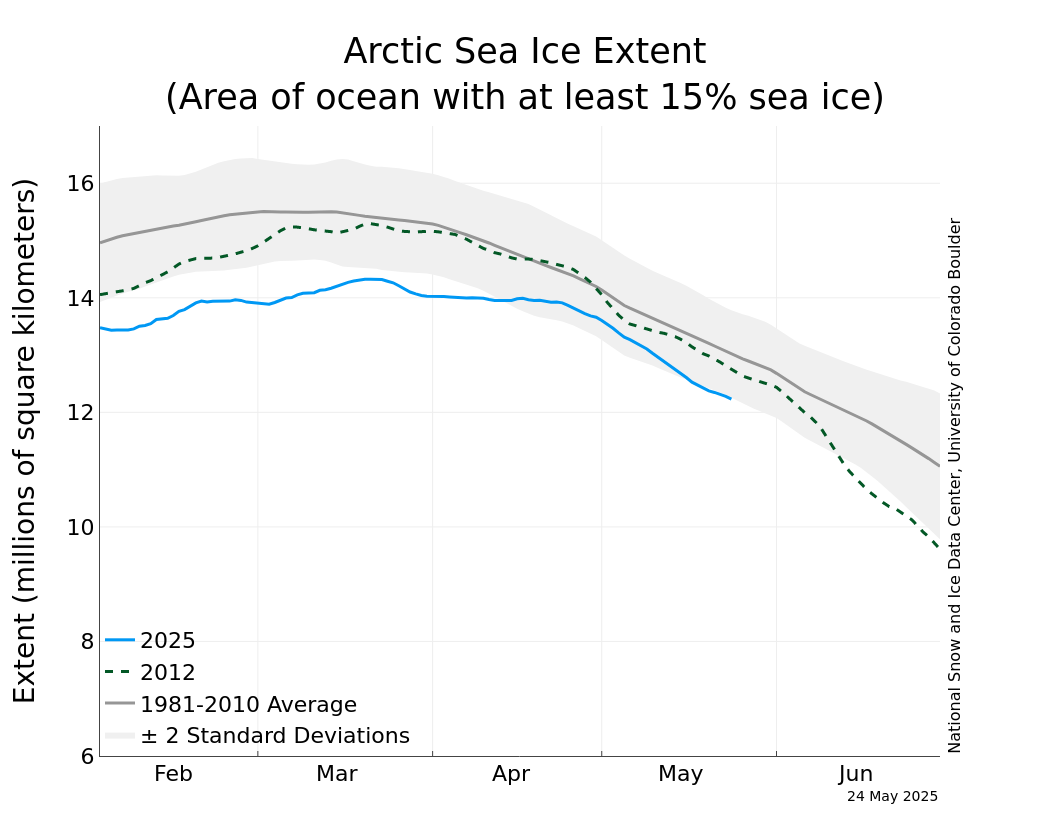
Like Jaxa it doesn’t show a record.
I’ll go grab the Bremen one for Owen.
The sea ice areas for 2007 and 2011 are and have been right on top of each other according to JAXA and CT, and both have pretty much leveled off at their broad minima at this date. Compaction looks to be the major factor on the extent.
Don’t forget about the mass either! My Tunnels also build mass!
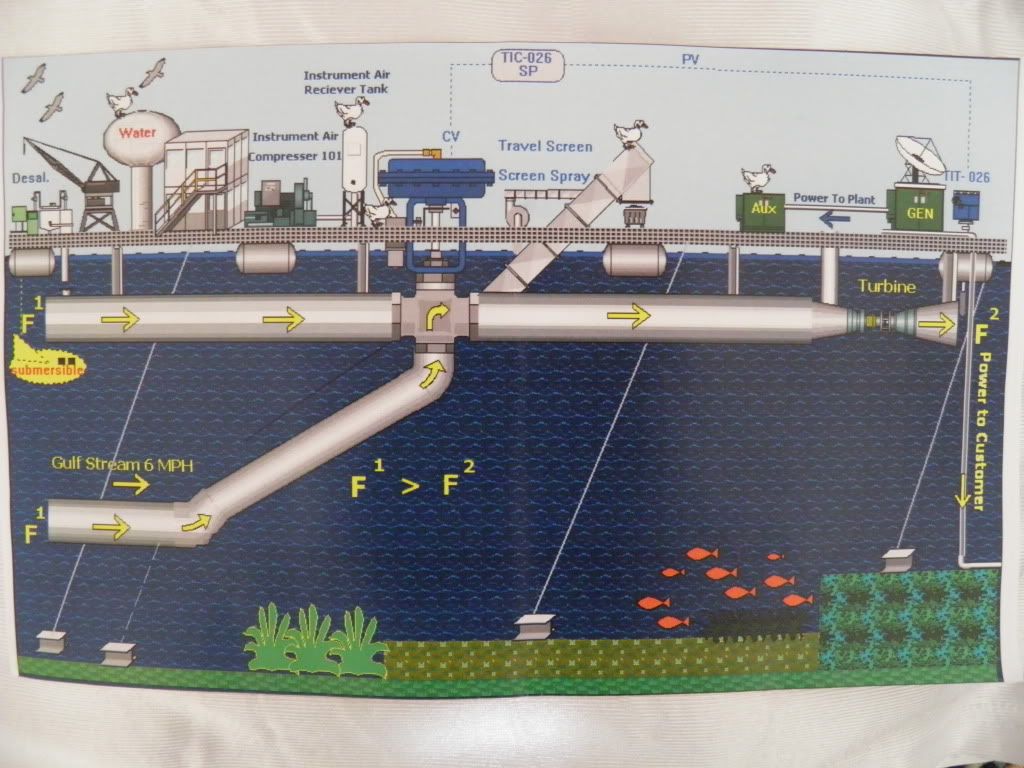
PATENT PENDING
http://i149.photobucket.com/albums/s54/hurricanedude/001.jpg
http://psc.apl.washington.edu/wordpress/wp-content/uploads/schweiger/ice_volume/BPIOMASIceVolumeAnomalyCurrentV2.png?%3C?php%20echo%20time()%20?
http://psc.apl.washington.edu/wordpress/wp-content/uploads/schweiger/ice_volume/BPIOMASIceVolumeAnomalyCurrentV2_CY.png?%3C?php%20echo%20time()?
Owen–
Officially, CT area has a new minimum low. That’s the topic of this post. I showed this min. because CT posts numbers so I could zoom in and we can see the min. I’m not entirely sure CT area has leveled off but it did oscillating up and down over the past few days. We’ll see.
JAXA posts both graphs and numbers for extent, but graphs only for area. That’s why I don’t post JAXA area much. (If I recall correctly, JAXA also says they believe their extent measurements are more accurate than their area measurements.)
I anticipate continued extent losses but I also think JAXA won’t beat it’s 2007 record. Of course, I could be wrong on the latter.
cyclone– Are the ducks important?
duckless
http://www.nola.com/news/index.ssf/2009/07/bill_gates_of_microsoft_envisi.html
Way better. Fewer moving parts and no broken physics
@ Lucia (Comment 81274
(If I recall correctly, JAXA also says they believe their extent measurements are more accurate than their area measurements.)
You’re right Lucia, here’s what they say:
.
[“The area of sea-ice cover is often defined in two ways, i.e., sea-ice “extent†and sea-ice “area.†These multiple definitions of sea-ice cover may sometimes confuse data users. The former is defined as the areal sum of sea ice covering the ocean (sea ice + open ocean), whereas the latter “area†definition counts only sea ice covering a fraction of the ocean (sea ice only). Thus, the sea-ice extent is always larger than the sea-ice area. Because of the possible errors in SIC mentioned above, satellite-derived sea-ice concentration can be underestimated, particularly in summer. In such a case, the sea-ice area is more susceptible to errors than the sea-ice extent. Thus, we adopt the definition of sea-ice extent to monitor the variation of the Arctic sea ice on this site.”]
.
http://www.ijis.iarc.uaf.edu/en/home/seaice_extent.htm
http://www.nola.com/news/index…..nvisi.html
“Way better. Fewer moving parts and no broken physics”
LOL. no broken physics except for the fact that the warm water isn’t going to “fall” down the pipe against gravity. Colder water is heavier (that’s why its at the bottom 😉 ). You would need to pump the hot water down the pipe. So any idea of using it to generate power is … a pipe dream. aka naive, broken physics.
Judging by the reliability of windows PCs I don’t think we need this guy messing with the climate.
Preliminary data from Jaxa today has an increase of 938 km2 (30 kms by 30 kms – 10 times the size of Manhattan).
Bill–
Where are you getting that? The last two lines on extent are
09,09,2011,4526875
09,10,2011,4520781
here
http://www.ijis.iarc.uaf.edu/seaice/extent/plot.csv
That’s a loss.
Soon Vanilla Ice will just be another white puddle.
lucia (Comment #81280)
September 11th, 2011 at 8:14 am
————
It must have been updated since you looked – at 4,527,813 now.
Bill-
09,09,2011,4526875
09,10,2011,4527813
You’re right. I had to clear the cache.
I usually try to remember to never run my scripts to announce whose in the lead until after 10 am when I can be sure JAXA has updated!
a) Not that I saw. Why do you ask? The Arctic sea ice is rapidly declining, and consequences of that are serious. Whether or not you call that a “death spiral” is up to you, and whether or not that is a correct use of the term depends on what you think a “death spiral” implies. If you are implying that the term “death spiral” is false or misleading, I would say you haven’t shown that to be true.
b1) I never claimed to know what the models predict. What I said was that we would know more about the likely impact.
b2) You may doubt the AR5 models will be helpful in predicting the expected changes in the Arctic, but given that you are not a climate scientist and haven’t seen the models, I think that your prejudgement of them tells us more about the bias you bring to the table than it does about their worth.
Because in your comment Robert (Comment #81266) , you quoted my sentence “There are people who are using the “death spiral†meme. Whatever that means.” and then proceeded to say something about this paper. The continguity made me wonder if you thought the paper mentioned “death spiral”. So I asked.
I didn’t claim you know what the models will predict. And I suggest that contrary to what you do say, we will not necessarily know any more about the likely impact. When the AR5 models are available, what will know is what the models predict. It’s not clear how confident “we” will be that the models are much better at predicting the future than data extrapolation. So, the revelation of what they predict does not necessarily tell us much more about the future than what we already know. But it will tell us what models predict– that’s for sure. 🙂
What prejudgement? No one, not even a climate scientists will know whether the AR5 models can predict the future until after the future occurs. What we can “know” about them is releated to how well climate modelers have been able to predict the future with their previous models. It’s not clear they have been able to do any better than extrapolation. Or if they can, they’ve been hiding their “real” predictions in the closet because the projections they collectively picked out and put in the AR4 were right to the extent they a) predict it will warm, things will melt etc but b) seem to do so no better than extrapolation.
If you can show the projections in the AR4 do better than extrapolation — as opposed to doing well relative to “no change”, have at it.
Here’s where I see my comment fitting in with those ideas: death spiral implies a dangerous, progressive process. You alluded somewhat mockingly to a “death spiral,” and then said the fall was “expected.” My point was that while the fall is expected, it is also dangerous.
Seemed to me like you did, but perhaps I misunderstood you.
Yes, I’ve seen you make this argument, but I’m not persuaded by it. The valid comparison is not to extrapolation of current warming, but of what we would expect if AGW is false — not constant warming, but regression towards the mean.
In any case, what I am talking about is the effects of Arctic warming on the carbon cycle. The AR4 did not incorporate these at all. The AR5 will. Common sense would suggest that models examining these effects will advance our knowledge relative to those which ignore them. The success of the AR4 in predicting current warming is notable, but not necessary to predict that including the carbon cycle in the model will improve our understand of the likely future of the carbon cycle.
I consider “death spiral” to be an ambiguous metaphor that implies something more than merely “ice levels are declining”, but I’m not sure what it implies. Maybe you think otherwise. I don’t see a fall being expected necessarily meaning it is dangerous. Anyway, merely saying it is dangerous is itself ambiguous. What is the danger? That it will fall? If so, then the fall would be ‘dangerous’ in a circular sort of way. People would then want to know if there is any other danger.
This doesn’t seem at all relevant to my observation.
I think you mean the lack of success– that is, unless you can show some success beyond extrapolation.
Of course the fact that they can’t do any better than extrapolation at predicting temperature changes doesn’t mean they either can or cannot do better than extrapolation on the carbon cycle. But it still follows that since we can’t know whether they have developed the ability to predict “X” until after their predictive ability is confirmed, we will not really ‘know’ the likelihood of ‘X’ based on publication of AR5 models. What we will know is what the AR5 models predict.
I’m sure the text of the AR5 will itself conflate the range of model predictions with what actually is likely — as you do. And maybe it will even turn out that the range of AR5 projections will correspond to what is most likely. But we won’t be able to “know” this until after the unproven AR5 models are shown to have been useful.
So, this all means we won’t actually gain much knowledge of what is likely when the AR5 models are published. Extrapolation may continue to be the best way to foresee the future. More importantly, we will not have any knowledge to test whether the AR5 models can predict anything we previously couldn’t predict until after the future the predict materializes and either confirms or refutes them.
Robert-
I disagree. In fact, I think this is non-sense. AOGCMS are huge complicated models. Valid comparisons ought not to be to something we know is not true and can show with simple energy balance models available since… since… the 60s or even earlier. It ought not to be to extrapolation based on simple energy balances and recent data. No one in any other field would set such a ridiculous standard for testing models that are hugely computationally intensive, contain numerous sub-parameterizaitons etc.
In anycase: We already know certainty things using simple models and energy balances. The fact that someone will publish results from a set of hugely complicated models that have not been shown superior to the simple models and energy balances will not magically make use know “more” than what we already know based on the simple models and energy balances.
This is true no matter what you consider the correct way to assess the usefulness of the computationally intensive AR5 models. It’s somewhat telling that you think they should be tested against “know nothing”. But your pushing the standard for evaluating them down to “do better than nothing” doesn’t change this simple fact: If they haven’t been shown to create better forecasts than the simpler “know something” methods we are already aware of, can use and have been working, then we won’t be learning much more about when the behemoth models are published. We’ll basically know as much as we knew based on the simpler “know something” models available prior to publication of the AR5 models.
I’m not sure either. I looked at it a little bit, and found a few possible origins of the metaphor (http://en.wikipedia.org/wiki/Death_spiral):
* It’s probably not the figure-skating move.
* In flying, it refers to a “spiral dive,” which wikipedia describes as:
The term “death spiral” is also used in insurance and in fiance, but given there is no literal “spiral” movement, I doubt either is the origin of the metaphor. In both cases, a “death spiral” refers to a situation where deteriorating conditions lead to worsening conditions through a process of positive feedback.
Whether this applies to the sea ice depends how it’s intended. In flying, a death spiral is gradually developing dangerous situation characterized by slowly building momentum towards a bad outcome. That seems to describe the conditions in the Arctic very well.
In finance and insurance, it describes a situation in which positive feedbacks make a bad situation worse. That sort-of applies, and sort-of doesn’t. It doesn’t apply in the sense that, according to our current understanding, ice loss will not cause more ice loss if conditions do not get warmer. It does apply in the sense that ice loss causes more warming, which causes more ice loss.
My take. Your Google-Fu may vary. It seems the inherent ambiguity of the term makes it a poor rhetorical football — hard to say, regardless of what happens, whether the Arctic sea ice is objectively in a “death spiral.”
Robert–
Except if I understand the models where they remove all the ice and see what happens, the ice loss does not cause sufficiently more warming to cause more ice loss. If so, the loss we are seeing is due to warming in general. Temporary ice loss to a level lower than would be “natural” at the current planet temperature does not seem to cause lots more warming leading to more ice loss. So, in this case, the finance death spiral associated specifically with ice loss would not seem to fit so well.
Hey. We actually agree on something!
This is why I say I don’t know what it’s supposed to mean exactly. The ambiguity doesn’t necessarily matter. After all, I described the recent record minimum as “a hair” below the last one (and gave numbers and figures.) People could ask me what “a hair” meant, and then I’d just say it’s an ambiguous figure of speech and if you want to know numbers, look at the graph and figures.
But from time to time, people seem to suggest “death spiral” is an honest to goodness prediction or concrete description of what is going on or will happen. But if the word means something concrete, I don’t know what it means exactly. (By seem previously, I mean “seem”, I don’t mean to imply the honestly, truly believe they aren’t using a metaphor. I’d also note that people confusing metaphors with concrete statements happens outside climate blogs too. And of course, blog discussions are blog discussion so lots of people use metaphors.)
There was considerable warming in the arctic from 1920 to 1940.
http://www.arctic-warming.com/poze/pozaH1.jpg
http://www.arctic-warming.com/how-was-the-warming-discussed-in-the-1930s.php#_ftn2
I suspect if satellites existed then they would have considered a death spiral likely too.
”steven mosher (Comment #81276)
September 11th, 2011 at 12:00 am
duckless
http://www.nola.com/news/index…..nvisi.html
Way better. Fewer moving parts and no broken physics”
Negative. No power is generated and they can not regulate the temperature.
Bruce.
Warmer air temps does not entail less ice.
The links were interesting Mosher.
“The retreat of sea ice in the Spitsbergen region due to ‘recent climatic improvement’ forced him to note that: “This part of the Arctic may, without exaggeration, be said to have experienced a climatic revolutionâ€.”
“The Spitsbergen branch of the North Atlantic Current has greatly increased in strength and the surface layer of cold water in the Arctic Ocean has decreased from 200 to 100 metres in thickness.”
“Johannsson’s main conclusion is that the increased air circulation (15 % higher) between 1896 and 1915 had gradually changed the current and ice conditions, thereby altering the borders between the Arctic gulf current climate and the true Arctic climate further north.”
“There were increased Gulf Current temperatures, particularly significant in the Barents- and East Greenland Sea.”
“The Spitsbergen winter 1936/37 was warmer than all previous winters, whereby the next winter 1937/38 broke again all records and was by mean 16ºC warmer than winter 1916/17.”
Mosher: “Warmer air temps does not entail less ice.”
16C warmer might have some effect.
Re: steven mosher (Sep 11 21:31),
The AMO index was in its upward phase during that period, from an annual average low of -0.384 in 1913 to a high of 0.357 in 1944. a sine wave fit to the data has a minimum in 1911 and a maximum in 1944. The water was warming the air, not the other way around.
That sine wave also peaks in 2011.
DeWitt #81319,
Yes, but that sine wave sits on an overall positive secular trend. Are you suggesting that the 2007/2011 ice minimums will be reversed over the next couple of decades? That is, do you think cooling from the declining phase of the AMO be greater than warming from radiative forcing, and so reverse Arctic ice loss?
Dewitt/Steve
I’m grabbing AMO smooth, and I’m going to see if that changes any projections. For wed, we’ll see if it shows up in the short term loss projections. Later, we can see longer term.
It’s easy enough to stuff anything and everything into the script now. 🙂
Re: SteveF (Sep 12 08:03),
I’m (still) relatively confident that the rate of ice loss in the Arctic will slow during the downward phase of the AMO, whenever that actually occurs. In fact it did seem to be slowing until the recent El Nino made the AMO index jump back up to peak levels and Arctic temperatures soared. Whether it reverses is something I’m far less confident about than I used to be. What I expect is that the global loss rate (Arctic plus Antarctic) will continue to increase but the loss will shift towards the Antarctic from the Arctic.
Dewitt/Steve
Unsurprisingly, inserting the most recent AMO smooth value into the predictometer shows it has little predictive power for the soon-to-be arriving minimum. I’ll be wanting to add to pure temporal predictions to announce long term betting to be made in March or so.
Dewitt– do you have a sense which monthly value of AMO I should hunt around for when predicting in January? I can just stuff the lagging 12 month average in– or use the most recent smooth or whatever and see what happens. (That is– basiclly hunt around. The weighted method at least protects some against overfitting since I ‘keep’ the predictions of all plausible models weighted according to their AICc.)
But do you have some sense for which value might be best correlated if I were to make predictions well away fro the ocurance of the minimum?
Re: lucia (Sep 13 07:56),
Not really. All I’ve done is no lag correlation, which is fair. The problem is that there’s so much noise in the index that I doubt it will help much for short term prediction. Then if you use the extent anomaly, there’s the problem that the seasonal behavior changed in 2007. I haven’t looked at correlation just from 2007 on using a modified anomaly calculation.
Dewitt–
I absolutely didn’t expect AMO to help on the very short term prediction. Also, even if it has a real effect, it may not show up well in predicting the 2012 minimum now. Suppose the following for example:
Suppose AMO is, in a large sense, “causal”. It affects the general long term situation n the arctic. That is, assume we know this, and it’s simply true.
Suppose also the AMO has a long time constant–which is true.
Then, the area now has somehow been affected by general conditions over a fairly long time– at least in part, the low area is an effect of AMO. But low area might also be affected by other things, and it might matter in and of itself.
But now, suppose I try to predict the 2012 area (or extent) based on (year, AMO and area). It may well be that 2011 minimum area will be better predictor or 2012 minimum area than AMO and hunt as I may, I might find that after accounting for year and area, the current AMO had no statistically significant effect that could be used to predict the 2012 area.
This would be true even if area was in a large sense a function of AMO. The reason is that from the POV of predicting 2012, the current area already reflects the effect of the AMO. So, in terms of prediction the fact that AMO partly ’caused’ the low area wouldn’t help me predict next years extent beyond what I already know based on current area (or extent).
But…. I am going to hunt around for fits with only time and AMO — a little later on. I know AMO doesn’t cause ‘year’ and year doesn’t cause ‘AMO’. So.. I’m interested to see if there is some correlation that pops out if I don’t include potentially interfering things like current ice volume or area as predictors. I know AMO is noisy. For any longer term prediction– like the one involving guessing whether Connolley or Dekker will win their bet– I’ll probably try 12 month average AMO with various lags to see if it makes a difference to the estimate of who wins that. There is big money in that bet, and both already put there money down. so it would be interesting to tell Rob whether accounting for AMO seems to change his odds.
Steven Mosher:
Could you expand on this? I’m not even sure what you mean by “entail”.
If what you are trying to say is mechanical effects associated with wind & weather explains more of the sea ice variability, then I agree with this, but it’s an awfully ambiguous comment in that case.
If what you’re trying to claim is that warmer average arctic temperatures doesn’t imply less average ice extent or area, then I’d have to say this statement is clearly wrong.
It is fun to read through this post and the comments about 10 days later, now that there has been a very significant uptick in NH ice area and extent, and this significant uptick is obvious whether you are looking at JAXA, NANSEN, DMI, or any other graphs I have seen.
Also, what the claim of “record” is missing (as usual) is the uncertainty bars. 2.9175 vs 2.9194… ok 2.9175 certainly is a lower number. However, if the uncertainty is in the 2nd digit after the decimal point, the numbers beyond that are meaningless.
I had a co-worker who used to read standard (non-digital) thermometers and claim that the temperature was 25.76 degrees C. Since the divisions on the thermometer were 0.2 degrees, and the distance between each division was tiny, there is obviously no way she could have eye-balled the temperature to that many significant digits.
So, my question is, is anything beyond the 2.91 MEANINGFUL in any way?? I tend to doubt it, unless our measurement methods are a hell of a lot more precise than what they are purported to be.
PeterB–
The weatherman doesn’t indicate uncertainty bars when announcing records for temperatures measured at O’Hare airport. The ‘record’ is just the highest recorded value in the list of recorded values.
Depends on what you consider meaningful. But we can observe that the lowest value in the list of values recorded by CT today is lower than previously. That is: it’s the new record low.
If we don’t describe records this way, we’ll likely never set “records” because the new low (or high) will very frequently be just a little different from the old one. In which case, people would want to find a new word that meant: We have achieved a new extreme in the recorded values. We would need the new word because people like to communicate this information. Currently, that word is “record”.
Re: PeterB in Indianapolis (Sep 20 12:00),
I disagree. Unless the spacing is truly microscopic, one should be able to split the spacing into a minimum of 5 parts. For a spacing of 0.2 degrees, that means a resolution of at least 0.04 degrees. With a clip-on magnifying glass, one can do even better with less possibility of parallax error. It’s a mistake to start rounding too soon.
The AMO increased quite a bit in the last few weeks if that is relevant. Up to +0.45C at the time the mimimum occurred.
It is hard to predict the AMO going out (I and Dewitt know that) but it is correlated to both the ENSO and Arctic sea ice extent.
http://img840.imageshack.us/img840/9660/weeklyensoamosep142011.png
entail: follow of necessity.
Bruce posted a link to air temps in the 1940s and assumes that there may have been less ice then than now. I point out that there is nothing in warmer air temps that entails ( leads to with necessity) less ice then.
For example, If there were cooler ocean temps then than now that would mitigate ice loss. If there was more MYI then than now, that would mitigate ice loss. In short.. warmer air temps are only part of a chain of evidence. Part. that part does not entail the answer he wants.
You will also note that Bruce builds his beliefs on very shaky foundations. If he were as skeptical of his own arguments and his own ‘evidence’ as he is of the evidence of climate science I would have no issue.