The new post will be an open thread… but I’m contemplating a stupid analysis to see what we would “get” if we kinda sort of looked at the “cause effect” relationship in figures like those at Causality and Climate (the post at Judy Curry’s blog), if
* We KNOW there should be a trend in CO2 because of fossil fuels. (Like… uhmmm… we know the water level in a huge pool will rise if we turn on a small hose that adds water. This happens even if the pool is “big” and yada, yada, yada…)
* We posit that Temperature is a function of CO2 and some deterministic oscillation (e.g. el nino).
* We posit instantaneous CO2 is a function of the known trend plus temperature.
Then we make graphs like K’s and eyeball them. (That’s what he suggests we do in his blog post.) I want to see if this method obviously fails to get for certain sizes of the oscillation, trend in CO2 and interaction coefficients. It might be the method will pass… or not. I just have to see this.
This is a test that should have been done. If someone knows it was let me know… But I’m just going to gin it up because it might be easier to just run it than to plow through the other paper.
For now, this post is just for discussion and is open for all topics. The old one will close soon.
Edit: Full paper On Hens, Eggs, Temperatures and CO2: Causal Links in Earth’s Atmosphere
edit: Keeping track of my comments at Judys.
1) About cross-correlation in the residuals
2) Q: About subtracting the means.
Comments here are closed. Go here for more here.
On a discouraging note: A couple days ago Judith posted a crazy paper on her blog claiming temperature increase causes the rise in CO2, not the other way around. It is the dumbest, most profoundly wrong paper I have seen in a very long time. The 500 odd comments following the post re-hash all the silly arguments about temperature/CO2 causality… the same silly arguments that have been shown to be non-sense dozens of times before. I fear Judith has taken leave of her senses.
.
That the same ridiculous (non-physical!) mechanisms are proposed over and over gives me pause. It seems like an awful lot of people with formal training in science have no clear picture of how things actually work. It is discouraging and a little frightening.
SteveF,
I thought the general thinking was both could happen. Temperature increasing CO2 does not contradict CO2 increasing temperature. (And I mean…. burning carbon based fuels has certainly increased CO2– whether or not some is also coming out of solution from the oceans.)
SteveF, I’m going to quibble a little with you. What they prove and what I think the journal editors found interesting is that the variation of CO2 after detrending is very correlated with temperature and that temperature changes causes the CO2 variations. I didn’t really find much evidence of a positive assertion that all the temperature rise of the modern era was not caused by CO2. They may have implied it but I didn’t read carefully. But maybe I missed it.
What I find more interesting is the consensus enforcers response to it having been published in a reputable journal. A lot of the usual whining. It was admittedly worse after Lindzen’s iris theory paper which seemed to strike a nerve I think because of Lindzen’s amazing career and reputation. Just as Ioannidis was singled out by the covid lynch mob because he is a really top flight scientist.
You really do know who to listen to based on who the witch hunters are after at the moment.
Lucia,
There is a short term temperature effect visible in the data, superimposed on the long term trend, as I recognized >10 years ago when I first looked at the data and wrote a short guest post about it at Anthony’s. But the increases due to temperature are small, and mostly balanced by decreases. The authors of the paper de-trend the CO2 data, and then can see only the minor temperature effect, not the many times (~15x?) larger long term trend due to emitted CO2….. and based on that de-trended data proceed to claim CO2 emissions can’t possibly cause an increase in CO2 concentration in the atmosphere. It is an argument disconnected from reality…. and weirdly, has been advanced by lots of people who should know better, including Roy Spencer.
.
David Young,
If you don’t instantly see that paper is utter crap, then I doubt any argument will convince you. It is obviously and completely mistaken in both method of analysis and conclusion.
SteveF,
Well…. that’s ridiculous.
I haven’t read the paper Judy recently discussed. I just knew as a general principle… yeah… increase in Temperature can increase CO2. But no, I don’t think for a second it’s what’s causing the current increase in CO2.
SteveF, lucia,
Is “the paper” you are referring to this one?
https://judithcurry.com/2023/09/26/causality-and-climate/#more-30527
SteveF, I was deeply sadden about Judy Curry allowing the post of the paper on chicken and egg vis a vis CO2 and temperature increases on her Climate Etc without at least making some critical comments of her own. There were some good critical explanatory posts on that thread that give credit to some of those holding a minority veiw of climate change being able to critically assess papers regardless of where there conclusions fall.
Unfortunately this one instance will probably be used by the consensus crowd to discredit alternative views on climate change.
SteveF, Judith errs on the side of encouraging diversity of viewpoints.
David Young,
“I actually rather admire Judith’s patience and tolerance. I would not be so tolerant.”
.
OK, but really, to allow a garbage posts on your blog is not a good look. And that was indeed an irrational, garbage post. Allowing garbage comments is a different thing. Most everybody except the most unhinged climate warriors is lenient about comments.
I also think Steve, its very easy to overestimate how much damage these people do to the climate realist cause. The drive toward a climate catastrophe religion began a very long time ago. Now that the media and school teachers all believe in this religion, how Judith moderates her blog is irrelevant.
I used to think the same way. Whenever there was something a Conservative did or said something I didn’t like, I would try to blame these things for the success of the left’s long march through the institutions. In retrospect, I realize it made no difference at all. This is the Pence theory of politics and you can see how well its working for him. Pence is a man I respect but its a fools errand to try to purge your faction of unsavory characters.
Well Steve, the paper in my opinion did have some interesting science in it. The editors of the journal (which is well respected) and the reviewer agreed. Can you cite where they state directly that all the CO2 increase over the last 75 years is due to temperature increases? I didn’t see it.
David Young,
“Judith errs on the side of encouraging diversity of viewpoints.”
.
Even, it seems, when those diverse viewpoints are utterly disconnected from reality. I have no problem with diversity of viewpoints. I have a problem with absolutely crazy ideas which are obviously and utterly non-physical. Let those folks work on propaganda initiatives with Robert Kennedy’s son; Judith would do better to not encourage them.
David Young,
Did you read the author’s nutty comments?
Yes, they are screaming the rise in CO2 is not due to emissions.
IMHO they know absolutely nothing. I hope you do.
I believe that the poster Ferdinand Engelbeen at Climate Etc makes the useful and extremely patient counter arguments to the recent CO2 post. If anybody wants to cut to the chase and avoid all the clutter that usually ensues over there I would read his posts first.
SteveF (Comment #224815)
A couple days ago Judith posted a crazy paper on her blog claiming temperature increase causes the rise in CO2, not the other way around. It is the dumbest, most profoundly wrong paper I have seen in a very long time. The 500 odd comments following the post re-hash all the silly arguments about temperature/CO2 causality… the same silly arguments that have been shown to be non-sense dozens of times before. I fear Judith has taken leave of her senses.
SteveF (Comment #224838)
“Lucia,There is a short term temperature effect visible in the data, superimposed on the long term trend, as I recognized >10 years ago when I first looked at the data and wrote a short guest post about it at Anthony’s. But the increases due to temperature are small, and mostly balanced by decreases. *** It is an argument disconnected from reality…. and weirdly, has been advanced by lots of people who should know better, including Roy Spencer.”
–
Well, I guess Roy Spencer has a halfway decent chance at being right
And I admire Judith Curry.
And as people know I leave longer, less relevant bits out of quotes eg **- Sorry SteveF if you want the full text I will add it in.
The sensible thing would be to go over to Climate etc and test out a few arguments but since Joshua is here and loves poking holes in weak arguments I will put forward a few salient(to me) and let people shoot them down.
–
Very simply. Reality connect.
1. CO2 is multi factorial with an enormously large turnover yearly.
2. CO2 in the atmosphere is in balance with its sources and sinks.
3. CO2 production by humans in a number of ways is only a very small amount of that large turnover between sources and sinks.
4. CO2 levels are intensely temperature dependent, I am glad that SteveF, having written an article on it, has rightly corrected his iniyisl comment after prompting by Ken and Lucia.
angech: “3. CO2 production by humans in a number of ways is only a very small amount of that large turnover between sources and sinks.”
Human CO2 production is about 2x larger than the *increase* in atmospheric CO2.
So I don’t see why it matters that human CO2 production is less than the (natural) annual turnover. It is the cause of the increase in pCO2.
HaroldW (Comment #224925)
angech: “3. CO2 production by humans in a number of ways is only a very small amount of that large turnover between sources and sinks.”
“Human CO2 production is about 2x larger than the *increase* in atmospheric CO2. So I don’t see why it matters that human CO2 production is less than the (natural) annual turnover. It is the cause of the increase in pCO2.”
–
Thank you for at least thinking about the issues.
Definitions matter and if we have a serious discussion on your assertion and statements.
–
Take your comment “Human CO2 production is about 2x larger than the *increase* in atmospheric CO2”
It immediately deviated from my comment about how much CO2 humans produce annually compared to the other causes of CO2 entering the atmosphere so does in no way answer the question.
It makes a bland assertion about two different values and fails to explain why you plucked a figure of two times out of the air.
And why only half of it counted.
It gives no time frame for this assertion.
Do you mean annually or since the start of the Industrial Revolution [1750]?
At least it is a starting point.
HaroldW (Comment #224925) a little cherry picked research.
–
You appear to be out by a factor of 8 the wrong way.
Average annual atmospheric levels of carbon dioxide (CO?) reached a record high of 418.56 parts per million (ppm) in 2022, a year-on-year increase of 0.5 percent. Or 2 ppm.
Humans generate CO2 when burning fossil fuels such as gas, petrol, oil, and coal. This is claimed to add an additional 9.1 billion tonnes of CO? to the atmosphere each year
It is claimed 4.1 billion tonnes of CO2 stays in the air, increasing the atmospheric concentration of carbon dioxide annually
Each part per million of CO2 in the atmosphere represents approximately 7.82 gigatonnes of CO2.
So humans might actually only contribute 25% of the annual atmospheric increase in volume rather than 200% [x2 figure you quoted.]
if one accepts that causation in the first place and ignores all the other qualifying factors such as the actual amount of natural CO2 variation possible in a year.
–
Feedback, please.
Facts not fiction.
angech,
Your numbers are completely wrong. Estimated fossil fuel, industrial, and land use change emissions are shown here:
https://ourworldindata.org/co2-emissions#global-co2-emissions-from-fossil-fuels-and-land-use-change
about 40 billion tons per year (4×10^10 tons), keeping in mind that there is some uncertainty in the land use change, but land use only represents 10% of the total. The total mass of CO2 in the atmosphere is approximately 3.36×10^12 tons, (total mass of the atmosphere * (volume fraction CO2) * (44/29)) so our current annual emissions represent (4×10^10)/(3.36×10^12) or 1.19% of the total in the atmosphere each year. The actual atmospheric increase is currently 2.21 PPM per year (average of last 5 years, Mauna Loa), or 2.21/422 = 0.52% per year increase. So we know for certain that approximately (1.19%-0.52%)/1.19% = 0.563 (56.3%) of what we emit is being taken up by plants and dissolved in the ocean, and about 43.7% remains in the atmosphere. You are mistaken if you think human emissions represent only 25% of the increase in measured CO2. In fact, human emissions represent 1.19/0.56 = 212% of the measured increase in atmospheric CO2.
.
Which is why claims warming is driving CO2 are completely mistaken. A simple material balance proves Earth is acting as a large net sink of our emitted CO2, not a net source of CO2. I am an engineer; facts not fiction.
angech,
BTW, I don’t have any idea what you mean by saying I “corrected” an earlier comment. I have been consistent: What was posted at Climate Etc is pure garbage, and all the arguments in the comment thread which followed (supporting the idea that temperature rise is responsible for the measured increase in CO2) means a lot of people can’t do or can’t understand a simple material balance and its implications.
.
I am pretty sure Roy Spencer now agrees that emissions cause the rise in CO2. But you can ask him if you want.
angech,
I switched two numbers. The our annual emissions are 1.19% of the mass of CO2 in the atmosphere, and the measured increase 0.52%, so our emissions represent 1.19/0.52 = 229% of the measured rise, not the 212% stated in my comment above.
Comment fell into moderation (misspelled my own name, how bad is that?).
I’ll post again hoping it won’t lead to a duplicate.
Angech –
I’m not able to evaluate the technical arguments, Nonetheless, parsing all the technical and complicated back and forth at Climate Etc, there does seem to me to be a rather critical component, and I would imagine that of all the points of contention, rather straight forward to assess.
Demetris says:
> One might think that the potential causality direction we determined is counterintuitive in the light of the well-known greenhouse effect, and that the effect of temperature on CO? concentration would be subtle. But no, it is quite pronounced.In fact, human emissions are only 4% of the total, natural emissions dominate, and the increase of the latter because of temperature rise is more than three times the human emissions.
SteveF says:.
> You are mistaken if you think human emissions represent only 25% of the increase in measured CO2.
If I were able to assess the technical arguments, that’s where I’d start.
The issues for me at my level are: the first being that Demetris defends the plausibility of his overturning a consensus with weak logic, imo. The second is that he ducks the obvious problem, that if he’s going to say that anthropogenic CO2 doesn’t cause the recent decades of warming but the other way around, he should commit to describing a viable causal mechanism in detail, which would mean committing to a cause in the warming. How can you describe such a complex process and then just beg off explaining any potential interaction effects of some theoretical cause of warming? Us it plausible that there would be some unknown warming mechanism with NO interaction effects? Doesn’t seem plausible to me. So then among with his theory he has to commit to a cause for the warning to be viable , imo. Just hand waving at “natural variations” doesn’t work for me.
But I don’t have the brains or knowledge to assess the technical arguments so I can only apply indirect heuristics to assess the issues. Of course, the likelihood of Denetris and co-author being a new Galileo has an inherent plausibility problem, imo.
—-
With reposting I now see that Steve was referring to a different measure (i.e., the increase) than Demetris. Even still, that does seem a critical issue to me.
I think angech might be confusing tons of carbon emitted with tons of CO2 emitted. Each ton of carbon corresponds to 3.67 tons of CO2. Some sources are vague or careless about the difference.
.
It seems that we have dueling simplistic arguments. Human CO2 emissions are tiny compared to the amount in the atmosphere/ocean system. Annual emissions are small compared to natural annual fluxes. But emissions are double the long term change in atmospheric CO2. And on longer time scales, there have been large changes in atmospheric CO2 without any human influence. By picking which numbers to compare, one can arrive at a variety of conclusions. Which is correct requires a detailed understanding of the system.
.
SteveF (Comment #224928) appears to have correct numbers (I have not checked them) and the correct conclusion, but the wrong reason for that conclusion. When he says ” A simple material balance proves …” his argument is first cousin to the silly argument in the article at Judith Curry’s site.
Joshua (Comment #224932): “if he’s going to say that anthropogenic CO2 doesn’t cause the recent decades of warming but the other way around, he should commit to describing a viable causal mechanism in detail”.
.
Science does not work that way. Science progresses in no small part by proving things wrong. If you put forward a theory and I find evidence to disprove it, I publish my evidence. I am under no obligation to propose an alternative theory.
.
It is a fact that climate changes without human intervention. There is nothing remarkable about arguing that the recent small change might be natural, not anthropogenic.
The absence of C14 in CO2 from fossil fuels allows estimates of man made CO2 in the atmosphere. Ferdinand Engelbeen tackles the methodology of the paper in question at Climate Etc, but I did not see any references to the C14 indicator on skimming the discussion.
https://gml.noaa.gov/outreach/isotopes/c14tracer.html
I haven’t been paying very close attention because the reality is the actual science of climate moves pretty slowly. Case in point is dragging out that same old CO2 precedes temperature argument.
.
I will say it doesn’t bother me in the slightest “fringe” arguments are presented because it is pretty hard discriminating between real science and narrative enforcing science. Both sides obsessed with narrative reinforcement is what got climate science to where it is.
.
90% of what I see in the media is extreme weather attributions which is really sketchy. I read about 5% of those articles (especially the hurricane ones) and they are mostly people making bold assertions, not showing the data, disregarding actual previous consensus on the subject, never quoting the IPCC, and pretending they have found a new way to count things which is simply p-hacking.
.
The attribution hack is basically taking a * model * known to predict more extreme weather, running it against current conditions around a recent extreme weather event, and declaring the model predicting the climate was factor. It’s completely circular.
angech: “Humans generate CO2 when burning fossil fuels such as gas, petrol, oil, and coal. This is claimed to add an additional 9.1 billion tonnes of CO? to the atmosphere each year
It is claimed 4.1 billion tonnes of CO2 stays in the air, increasing the atmospheric concentration of carbon dioxide annually”
If you compare your figures of 9.1 Gt emission to 4.1 Gt remaining in the air, the ratio is about 2:1 for emissions compared to atmospheric increase. (9.1/4.1 ~= 2.2)
Your figures, however, must be referring to GtC, that is, the mass of *carbon* in the CO2, not of the CO2 itself.
[Edit: Mike M. said this first.] [Scientific literature often reports emissions in this form.] Annual emissions (recently) are approx. 37 Gt CO2.[1] As carbon amounts to (approx.) 12/44 of the mass of each CO2 molecule, the carbon content of those 37 Gt is about 10 Gt. Please re-check your sources; there’s no way that 9.1 Gt represents the mass of emitted *CO2*.
As to why anthropogenic emissions should be compared to the increase in pCO2, rather than the much larger natural flows in CO2, let me use an analogy. Consider an ocean: at its shore there might be a daily tide of perhaps 10 feet variation. Let’s assume that there is no evaporation, no rain, no rivers running into this ocean. The tides remain at the same height every day* — forever, given the (rather unphysical) assumptions. Now add a river bringing a small amount of water each day. The tidal levels will rise according to the amount of water delivered. Slowly — perhaps a millimeter a year, certainly much less that the feet of daily variation. But it’s the river which causes the increase, even though it’s much smaller in volume than the tidal sloshing.
[1] IEA estimates the 2022 global emissions as 36.8 Gt CO2, Statista has it at 37.5 Gt CO2. Other estimates are also in the 35-40 GtCO2/year range.
*I should have said the tides are the same each month. To keep the tides precisely at the same height every day, you’d also have to have a fixed sun-moon alignment. Or just consider a hypothetical solar system with a sun and one moonless planet.
Mike M,
Do you understand material balances? Real question, because it sounds like you don’t. If a material balance shows the Earth sequesters most of our CO2 emissions, and it clearly does, then Earth can’t simultaneously be emitting more than it sequesters. All the rest is pretty much irrelevant. Human emissions cause virtually all the rise in measured CO2 concentration. Full stop.
Mike –
Thanks for the explanation for how “science works.”
Here’s how I look at it. “Science says” that CO2 in the atmosphere causes warming and that increases in concentration will result in increases in temps. There has been a increase in surface temps concurrent with an increase in anthropogenic CO2 emissions. For decades, scientists have confirmed that the increase in surface temps is attributable to that increase in concentration and increase in emissions (although there’s uncertainty in the magnitude of the effect).
If you’re going to tell me that no, the increase in surface temps causes the increase in the CO2 concentration despite the increase in emissions, then come to the table with a cause for the warming and explain why there are no interaction effects with that cause for the warming.
I’ll let other people be concerned with how “science works.”
angech,
I haven’t written an article on the effect of temperature on CO2.
.
On the other points: I wouldn’t say it’s intensely temperature dependent. It is true that the oceans act as something of either a source or sink to atmospheric CO2 and that solubility of CO in water depends on Temperature. So as a general statement: CO2 levels in the atmosphere could be be affected by temperature.
.
My general thought is that it is highly improbable that the current rise in CO2 is due to CO2 coming out of solution in the ocean. The reason is that we know burning industrial fossil fuel injects CO2, and the amount tallies up to close to the correct amount for the increase we see. This is “back of the envelope” and not fancy, but it is a pretty robust way to get a first cut at “why”.
.
I may have to break down and read that blog post. But I need to sew a costume!!!! So I really shouldn’t….. (I need to start my costume for a show case– dancing…. )
angech/SteveF
I answered you without reading the rest. This is what mean by “My general thought is that it is highly improbable that the current rise in CO2 is due to CO2 coming out of solution in the ocean…..”.
.
SteveF and I are telling you the same thing.
Mike –
I’ll add a bit more. Lots o’ people these days come to the table with associated phenomena and claim causality. It’s a by product if increased availability to information, and I think to a large extent basic human cognitive traits of pattern finding, and increases in polarization/decreases in shared identity.
So in light I’d that trend, when someone comes to the table with a rather extraordinary claim that a particular association is causal, I look to see whether they can offer a plausible casual mechanism.
Or course, a lack of a description of a plausible causal mechanism isn’t dispositive. Their claim can be true despite any plausible mechanism being offered. But for me, a lack of plausible mechanism being offered is a way for assessing probabilities.
Extraordinary claim of causality with no plausible mechanism being offered gets no cookie from me.
Joshua
Yep. You’ve got a key thing here.
.
And the idea there should be a identifiable causal mechanism for a claimed effect is a very strong rule in engineering and (at least physical) sciences. “Natural variations” can exist, but they still have causes. For example: the people who say “it’s the sun” at least have a claimed cause– the sun’s out put varies, our distance for the sun varies etc. Then those evaluating the “natural variation” argument can look to see if the sun’s variation have the right order of magnitude or are in the right direction.
Just saying “for some reason” and “very, very fancy math” isn’t very convincing.
.
Now, the “math” could be convincing if the data were very very strong or we had many many samples. (So strong you don’t really even need statistics, and the number we can get when we repeat things in labs.) But in that case, you then search for a cause or explanation.
.
Still haven’t read the paper– but quick look– this is very fancy “try to teach out very weak signal from noise” type method. If it is no result can be strong evidence if you can’t give a causal mechanism.
MikeM
Oh yes the argument Joshua advances is involved in “how science works”.
.
And engineering and application of science sure as heck does involve trying to identify physical mechanisms for what you see in the data.
.
And the basic mechanism of scientific advance isn’t trying to “prove thing wrong.” It’s closer to when you see something you can’t explain with current physical mechanism you try to identify a new physical mechanism and refine understanding. But first you make sure you really, really see it. This usually involves doing another experiment that might get you clean data.
.
Really seeing it rarely involves teasing out a very small signal from noise. Not saying it never does– but it usually involves getting more better data.
There are natural variations and they are very difficult to isolate. The argument works both directions. The climate moved around quite a bit without human CO2. The other end is that all recent changes (or more) are human caused which is also not compelling. AFAICT there really hasn’t been much progress in the last decade unwinding these forcings. The biggest news has been the climate doomsters grudgingly admitting the RCP 8.5 scenario is unlikely.
Either Earth is a sink for emitted CO2 or a source for rising CO2. It can’t be both at the same time. Since we know for certain that Earth is a large net sink for emitted CO2, it can’t also at the same time be a source for rising CO2. Some people might jump up and down and shout “But CO2 would have risen less from our emissions of CO2 if the Earth hadn’t warmed!” Sure, but that just means Earth would have been an even bigger sink for CO2 had there not been some warming. Our CO2 emissions are more than double the CO2 needed to explain the rise in CO2.
Your model cannot be proven, therefore mine is right. This logic might be flawed.
Ok…https://judithcurry.com/2023/09/26/causality-and-climate/
.
Starts out describing Michelson and Morley experiment. One of the features of MM experiment is it was very very very clean and precise. They did not use “fancy math”. They weren’t overturning previously accepted concepts based on claiming to have teased out a tiny signal out of noise.
.
Yes. Because this was an actual experiment, not “data processing”. It was clean. And it could be repeated by others to see over and over again.
.
(And if they’d had no idea, the experiment would have been repeated and also tweaked to other configurations and repeated…. to see if they screwed up. Sort of like high temperature super conductivity announcements.)
.
Ok.. haven’t read any further… Just want to comment on this feature of “how science is done”.
Tom Scharf,
” The climate moved around quite a bit without human CO2.”
.
Sure, but that is unrelated to the question of what is causing atmospheric CO2 to rise…. we are. There for sure needs to be better definition for how much rising CO2 will warm Earths surface and oceans, not to mention other effects (greening, ocean level rise, rainfall patterns, and many more).
.
But people need to get past the nonsensical horse-shit stuff like: ‘Emitting CO2 doesn’t raise the atmospheric concentration’, ‘Rising CO2 can’t possibly cause warming because radiative physics is wrong’, ‘Sea level rise is unrelated to warming of the ocean’, etc. That people STILL engage endlessly in those kinds of nonsensical arguments after 30 years of global warming alarm only distracts from the important questions that need to be discussed…. like whether there is any real cause for alarm, and what policies make economic and social sense. Failing to actually address the important questions leads to absolutely crazy public policies driven by fear and alarm.
This is going to be stream of consciousness– not math. Mostly “plausibility” and “how this argument is made”.
The title of the next bit is
“How a clear case of causality can become a noisy mess”.
He’s actually going to claim clear causality became a “noisy mess”. Sorry, but clear causality is clear because it doesn’t need statistics. Suppose I observe this: I play T-ball, but a ball on the T and then hit the ball with a bat, the ball flies off the T. If I repeat it 100 times and the same things happen I witness all 100 times. I also watch the entire time and notice the ball doesn’t ever fly off on it’s own. The whack by the bat making the ball fly off is clear causality. Because I can get clear data about clear observations. And I’m not clearing it with “math”.
.
As for “teasing”, I note the blog posts first example of the ship/wave has the ship effect be really, really, really dominant. You would not need fancy math.
Tom Scharf,
“Your model cannot be proven, therefore mine is right. This logic might be flawed.”
.
What? No idea what you are trying to say.
Figure don’t have numbers… but under “Atmospheric temperature and CO? concentration”….. he’s subtracted the annual average!!!! He’s subtracted the annual average!!!!. OMG!
I mean… WTF!!!
(Now I have to look at numbers… dang. I need to sew!!!)
I’m loving the “hint”…. “Use without math analyses”. So is he telling me not to notice he took out the dang trend!!!!!.
I mean… look at the dang trend compared to the fluctuations
The paper
No!!!!! No!!!!!
.
One might think that
We’ve got our causal mechanism.
Arghhh!!!
yeah… but the human emmissions are all in the same direction. The natural ones go up and down. A “Mathy” person should get this!!!
Tom –
> Your model cannot be proven, therefore mine is right. This logic might be flawed.
Not sure whose logic you think that is. I’m guessing you think that’s my logic.
It isn’t.
Ok… first impression: The paper is crap. Because it’s detrended.
Does anyone know if someone ran montecarlo to mimic a “causal” system where
(1) the temperature rises because of one effect. (e.g. CO2 injected.)
(2) the CO2 also rises because of temperature (e.g. reduced solubility).
And then show relative magnitudes? Then see what these “new method” concludes?
I mean… yeah, temperature does affect solubility– this is known. But CO2 also affects temperature (this is known.) So the issue is
(a) which is dominant– for the effect we give a shit about (which is the trend.)
(b) which is dominant– for the effect we really don’t give a shit about (which is the oscillations about the trend.)
Lucia,
” So is he telling me not to notice he took out the dang trend!!!!!.”
.
That they detrended the data was in my first comment. They detrend the data and hunt for temperature-CO2 causality in small variations around the trend. Unbelievably and profoundly stupid, and not just because short term temperature variations are well known to cause short term variation in CO2 (they are adding zero new knowledge), but because they then jump to absurd conclusions about CO2 and temperature causality, when it is obvious by inspection of the emissions data that CO2 emissions have caused the rise in atmospheric CO2 since the industrial age began.
> ”So is he telling me not to notice he took out the dang trend!!!!!.”
.
It’s interesting to observe that on top of the more philosophical responses related to Demetris’ arguments about causality, with all the possible responses to the “mathiness” in the paper, that is the primary response from across the climate divide. That’s not a terribly easy feat to achieve.
Joshua,
Most people, but certainly not all, can recognize stupidity. I see stupidity on both sides of “the climate divide”. Do you?
Does latex still work here? (This is a test.)
\(C = AT + at+ mu_c \)
\(T = BC+ mt+ mu_T \)
— failed… Gotta turn it on, or figure out how to get it to work here. I haven’t used it in so long.
What I am saying is both sides claim the other side has failed to conclusively prove their case, which is true. The failed logic is that this somehow makes their case more compelling. The weight of the evidence matters, but overstating the case is a constant never ending problem in climate science.
.
Things like temperatures are rising and CO2 is part of the cause are fine. Claims that natural forcings are zero or are known conclusively is not.
.
We can retread old ground all day, it’s not very interesting. There has been warming for a long time and part of that was apparently natural until around 1950 when human emissions took off. What I see is other people previously trying to claim natural variation almost completely shutoff at 1950 and all warming since then is human caused. They do this because they want to maximize future warming estimates for their activism. They use models with hindcasting and guessed previous forcings to “prove” that.
.
This is the part of overstating of knowledge with unjustified certainty that has become endemic in this subject. All these models are bad, with different levels of badness and too much evangelism. The only fair way to sort it out is to see who can estimate future warming most accurately. We have had some of that over the past 20 years and the hot models have been diminished.
Steve –
> . I see stupidity on both sides of “the climate divide”. Do you?
.
I’m not smart enough to easily decide what is smart or stupid in many situations – but especially in technical matters where I lack the knowledge and brains to make a reasonable evaluation.
.
I’m reasonably sure that it doesn’t make sense to describe Demetris and his co-authors as stupid people. The same would go for the reviewers of their published paper. So I find it hard to think that what’s argued in the paper is stupid, when produced by (most likely) non-stupid people and accepted for publication by (most likely) non-stupid people.
.
So as to not ellide your question. There are many people on both sides of the climate divide who, in my observation, are extremely confident in their beliefs about things where I don’t think the available information supports their level of confidence.
.
I think I have seen good evidence to explain the casual mechanism behind that process. And I think for the most part the question of whether those people are stupid, or even whether what they believe is stupid, is mostly orthogonal to their process of belief formation, and in my view kind a distraction.
.
.
Tom –
> The failed logic is that this somehow makes their case more compelling.
.
I’m not clear who you see applying that logic.
.
Although I could see how someone might think that’s my logic, it isn’t. I also tend to doubt that’s the logic being applied by anyone else here. So maybe you should quote who and where you see that logic being applied?
Joshua, I will use your name if I am addressing you.
Joshua,
“I’m reasonably sure that it doesn’t make sense to describe Demetris and his co-authors as stupid people.”
.
The paper is profoundly stupid, and as Forrest Gump’s mom said: “Stupid is as stupid does.”
.
We can agree to disagree, as usual.
SteveF (Comment #224939): “If a material balance shows the Earth sequesters most of our CO2 emissions, and it clearly does, then Earth can’t simultaneously be emitting more than it sequesters.”
.
Your conclusion is correct. Your reason is wrong.
.
Not so. Our emissions have increased the amount of CO2 in the atmosphere plus oceans by a tiny amount. But the partitioning between atmosphere an ocean has changed. A simple material balance argument does not identify the cause of the change in partitioning. It is a fact that the atmosphere ocean partitioning can change on relatively short times scales as a result of natural processes. It is not a priori obvious that the current change has a different cause than the earlier changes.
.
There is a host of detailed evidence that shows that the cause of the change is different this time. C14, as someone pointed out above. Also, measurements of the kinetics of the exchange rates between different reservoirs show that the change in partitioning is due to the finite rate at which CO2 is transferred from the atmosphere into the deep ocean. There is no question that the change in atmospheric CO2 is dominated by anthropogenic emissions.
.
A simplistic argument in contradiction to a simplistic argument is not really argument. It’s just contradiction.
Tom Scharf,
The question of how much of the observed warming has been driven by higher CO2 concentration is quite independent of the question of what has caused the rise in CO2; the answer to that question is clear: human emissions. Same thing with rising NO2, methane, and synthetic refrigerants: obviously due, mostly or entirely, to human emissions.
.
I am not making any comment about how much observed warming has been due to rising CO2 (or NO2, methane, refrigerants, etc).
Joshua (Comment #224941): "There has been a increase in surface temps concurrent with an increase in anthropogenic CO2 emissions."
.
True in general, but not true in detail. There was an increase in global T in the first part of the 20th century that was similar to the increase in the latter part of that century. That is in spite of little CO2 increase during the former period. In between, temperature decreased slightly, in spite of increasing CO2. And for the last quarter century, T increase has slowed in spite of CO2 continuing to increase. There is obviously something going on other than anthropogenic CO2.
.
We know that there are natural changes to climate. we don't know what those changes would be absent anthropogenic CO2. So we can not say for sure that the overall upward trend is due to anthropogenic CO2.
.
FWIW, I think the most plausible assumption is a natural cycle imposed on a anthropogenic upward trend. But we can not simply dismiss the possibility that the whole thing is natural. Especially since the mainstream climate scientists can not explain the natural changes in climate.
Mike M,
Wow, you really don't make any sense; what you are saying is illogical.
.
If most of the CO2 humans emit goes in to the ocean and into more rapid plant growth, it means those are net sinks not net emitters. The rise in the atmosphere can't be due to a shift in "partition" between the ocean and the atmosphere, because we know that the net movement of CO2 is in one direction only: human production –> atmosphere –> Earth's sinks. The direction is obviously not from the sinks to the atmosphere.
.
If you really believe otherwise, then there is not much more anybody could say to convince you. Cio.
lucia,
Please also move my Comment #224978 above, cross posted with your announcement.
MikeM
SteveF (Comment #224939): “If a material balance shows the Earth sequesters most of our CO2 emissions, and it clearly does, then Earth can’t simultaneously be emitting more than it sequesters.”
In the material balance, the earth has to sequester an "additional" amount equal to all of our CO2 emissions for the amount in the atmosphere to remain stable. Sequestering most is not enough.
.
If, prior to our emissions, the amount sequestered was equal to the amount emmitted by natural sources, and then you start adding more from some other source, the CO2 in the atmosphere will increase.
.
To make an analogy:
If I own a pool that is filled to 6" below the top, and owing to rain adding water and leakage draining water, this pool remains filled to 6" below the top with some slight oscillations around that, then it is "in balance". It's not a perfect balance, but it's pretty balanced. That is: the natural drainage amount equal the average addition from the rains.
.
But if I then find a small hose and start dribbling in some water the water level will start to rise and if I do this long enough I'll be able to distinguish this from the oscillations. This rise is caused by addition of water from the hose.
.
That the rise is caused by the addition of water from the hose is true even if the amount of water added by the hose is a small fraction of the amount that drains each day. The rise will be caused by the water from the hose even if "most" of individual water molecules of water water from the hose while other water molecules already in the pool that would have drained fail to drain.
.
This is how mass balances work. I'd say it's not rocket science, but rocket scientists use mass balance. So it kinda is. But the concept is the "bean counting" of science and engineering, so lots of people should be able to grasp this without having actually applied the bean counting to more complicated problems.
Mike M,
I repeat this comment because it was left on the other thread and addresses your comment 224976:
Wow, you really don't make any sense; what you are saying is illogical.
.
If most of the CO2 humans emit goes in to the ocean and into more rapid plant growth, it means those are net sinks not net emitters. The rise in the atmosphere can't be due to a shift in "partition" between the ocean and the atmosphere, because we know that the net movement of CO2 is in one direction only: human production –> atmosphere –> Earth's sinks. The direction is obviously not from the sinks to the atmosphere.
.
If you really believe otherwise, then there is not much more anybody could say to convince you. Cio.
Tom –
.
OK, thanks.
steveF, MikeM,
I think I've moved the comments that were posted while I was moving comments. Let me know if there are others I missed.
SteveF (Comment #224965)
October 3rd, 2023 at 9:46 am
Steve as you know Demetrius Koutsoyiannis is professor of Hydrology and Analysis of Hydrosystems at the National Technical University of Athens and writes a lot about long-term persistence and Hurst-Kolmogorov (HK) dynamics. I would not label him stupid in his field, but climate science is not his field. When specialists, and this includes those in climate science, get astray from their specialist field, they can make obvious errors, or more often omissions, that would appear stupid to someone with a wider range of interests. There are some specialists who have a wider range of interests and knowledge.
The fact that the discussion at Climate Etc does not mention (as far as I can tell) the C14 method of estimating CO2 in the atmosphere from fossil fuel and cement manufacturing makes me wonder what really are the points of contention in the discussions over there. The paper could have gotten by the reviewers by their looking at the method to determine cause and effect without consideration of increasing length of time that leads on the longer term to negating the CO2 in the atmosphere from fossil fuel. I should take a hard look at the paper and reviews to determine exactly what are the claims. At this point that seems to be a waste of time and effort.
On the "stupidity" issue, I'm not so concerned about whether Koutsoyiannis is stupid or smart. What I'm interested in is whether this paper leans toward "right" or "wrong". Or possibly more important: is it "right" in a meaningful way vis-a-vis climate change.
IF the goal is to determine the cause of the rise in temperature, taking out the annual mean value of CO2 and just annalizing the oscillations strikes me as perverse. Because what we want to underestsand is why things like the annual average Temperature are rising with oscillations around that.
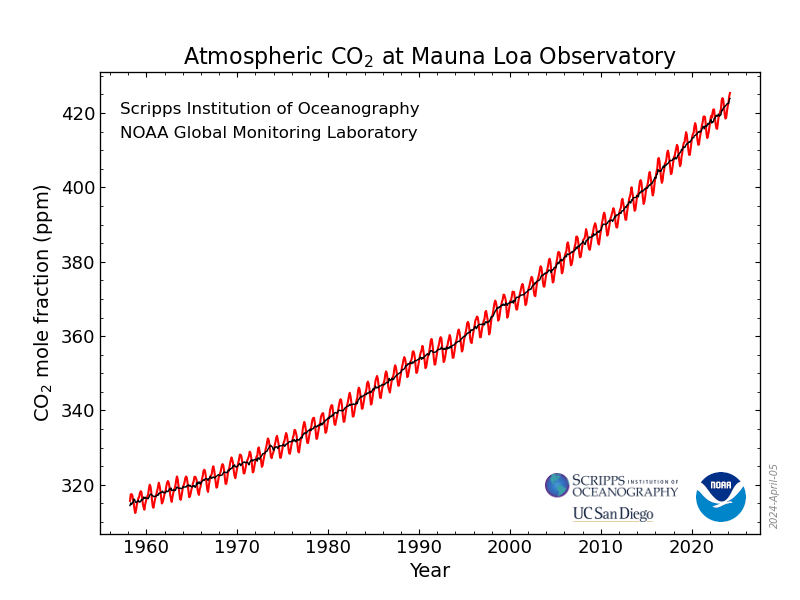
If, we are interested in seeing if there is some effect of Temperature on CO2… well, everyone always thought there was. That's why no one thought it was some sort of "mystery" that there is a strong annual oscillation in CO2 data in the Mauno Loa records. They are below.
.
https://gml.noaa.gov/webdata/ccgg/trends/co2_data_mlo.png

.
We have all seen this graph and honestly, scientists were not scratching their head about "what causes that annual oscillation"? The conventional explanation is "Temperature variations". So, to some extent, that temperature is involved in the oscillations is not new. It's in fact obvious, well known and no one disputes it.
.
That there might also be further "noisy" effects due to El Nino– that would hardly be a surprise.
.
But…. I mean… detrending? And then after detrending concluding the rise in the trend is due to Temperature rising? That strikes me as odd. Maybe there is something in the paper that explains why this makes sense, but well, mass balance already explains the rise in CO2.
Lucia, when I click on post at the right side it does not come up like posts below it, but I see it when I click a post below it. It did allow a late edit where I needed a double negative to be clear.
SteveF,
I evacuate a 30 L flask then introduce one kg of water. I let it come to equilibrium and measure the pressure of H2O(g) in the flask. It corresponds to 1.00 gram of H2O in the gas phase. I now add an additional 0.10 gram of water to the flask. I let it come to equilibrium, then measure the pressure of H2O(g). I find that there is now 1.10 gram of H2O in the gas phase.
.
Have I proven that the amount of H2O in the gas phase is determined by the total amount of H2O in the flask? Of course not. More likely is that my temperature control was very poor.
Here’s a conventional explanation of the oscillations (So conventional it’s from a “flasch card”
You know what’s correlated with photosynthesis? Temperature. There is no mystery that to some extent short term, trendless CO2 oscillations are a function of Temperture. This not new. It also has nothing to do with the trend.
"That is not to say that there are specialists who have a wider range of interests and knowledge."
Should have been "There are some specialists who have a wider range of interests and knowledge."
Ken, I think I fixed that for you.
lucia (Comment #224989)
Agreed, but I think a point being made was the lag between CO2 change and temperature change which got further refutation at Climate Etc.
Lucia you fixed it, but my late edit did not stick, hence my post above.
All is good.
Ken. The “move” plugin seems to interfere with editing (including mine.) is it ok now?
If no, tell me what to fix. If yes, I’ll delete conversation about it.
Mike –
> True in general, but not true in detail.
.
From what I understand, there’s disagreement as to whether that’s a detail or noise. Of course, then there’s the follow-on question of whether one can make that distinction objectively or whether it’s a subjective assessment.
.
Either way, it seems to me to be problematic to use “but” and “not true” there as you have done. Even if it’s a detail, but even more so if it’s noise, there’s no reason that “but” and “not true” (for the general) should be assumed, imo. Looks like a false cm dichotomy to me.
.
I hope that’s at least somewhat coherent.
Mike M,
“I evacuate a 30 L flask then introduce one kg of water.”
.
Um, that is nothing like CO2 in the atmosphere. CO2 is a trace non-condensable gas, with partial water solubility, water vapor absent air is condensable with a vapor pressure that depends only on temperature.
.
The situation is more like: add 10 liters of water to a 32.4 liter flask filled with air. Seal the flask and add 4.4 grams of CO2 gas (~2.24 liters at ambient temperature and pressure) wait a while, and measure the composition of the gas in the headspace. If the CO2 just goes into the headspace, then 2.24 liters added should give volume fraction of ~10% CO2, but we sample the flask headspace and discover the volume fraction is much lower than 10%; some of the CO2 dissolved in the water. Now we add 0.224 liter of CO2 gas, and again measure the CO2 in the headspace….. we find CO2 volume fraction is in fact increased, but not as much as we expected (0.224 liter is ~1% by volume CO2 added). Now the question: Did the second addition increase the CO2 concentration in the headspace because we shifted the CO2 equilibrium from the water to the air, or simply because we added more CO2?
Steve –
.
> We can agree to disagree, as usual.
.
I don’t think we’ll disagree as to whether I’m in a position to judge whether their technical arguments are “stupid.”
.
I’m simply not.
.
Again, I’m just trying to assess probabilities. That those individuals would write a “stupid” paper and get a “stupid” paper past those reviewers seems relatively improbable to me but not impossible.
.
I tend to think other explanations are more probable – say that that Demetris et al., are publishing in an area where they lack domain relevant expertise, or that they are so focused on an arcane statistical argument that they miss other important considerations, etc. I know that some smart people with relevant knowledge are arguing that they made “obvious” errors but others with similar attributes day they aren’t. Who am I to judge that? I can’t see any obvious errors in their technical arguments because I can’t assess that but I definitely see some of what I think are problems with what Demetris has argued (in non-technical discussion) at Judith’s.
.
As to whether people on both sides of the climate divide believe “stupid” things, if you held a gun to my head I would agree that they do, but again, I think that’s mostly a distraction.
SteveF (Comment #225003): “Um, that is nothing like CO2 in the atmosphere.”
.
But it is, I think, a lot like the way that the uninformed (like the paper being discussed) think about it. The mass balance argument does not prove them wrong.
.
Your example is nothing like COs in the atmosphere either.
.
The dominant cause of increased atmospheric CO2 is anthropogenic. But your argument does not prove that and there is no reason to think it should convince skeptics.
Joshua (Comment #225001): “From what I understand, there’s disagreement as to whether that’s a detail or noise.”
.
No, it is definitely not noise. Unless you classify all natural variation as noise, in which case your argument is circular.
.
The decadal trends in temperature are much larger than measurement error and too large to be attributed to year-to-year fluctuations.
The link below is a comprehensive explanation of the CO2 and temperature relationships. Although not originally intended, I think, it is a convincing refutation of the Cause and Effect paper discussed at Climate Etc. It includes some of what we have discussed at the Blackboard.
Sorting through the clutter at Climate Etc can result in finding some jewels.
Please note the part about derivatives of temperature and CO2 changes.
http://www.ferdinand-engelbeen.be/klimaat/co2_origin.html
Mike –
.
> No, it is definitely not noise. Unless you classify all natural variation as noise, in which case your argument is circular.
.
Given that what you say there shows you either ignored what else I wrote, or didn’t comprehend it, or read it and comprehended if and just decided anyway to argue as if I hadn’t said what I said, it’s clear there’s no point in continuing the discussion.
Ken– If you see my “arghh” and “he’s subtracted the annual average!!!! He’s subtracted the annual average!!!!. OMG!”.
In this math, taking the correlation after differencing essentially takes out the trend. (In a big of a weird way.)
Thanks for that link. (I’m trying to gin up a toy model but reading that may be useful.)
Kenneth–
Oh. That’s not specifically on what Koutsat……. did, right?
Kout took the first difference of the log CO2 and temperature but not on annual basis as I recall.
Joshua (Comment #225010): “there’s no point in continuing the discussion.”
.
I win!
The NewYorker recently wrote a bazillion word article on the Data Colada affair. Harvard is working on revoking her tenure, almost unheard of.
https://www.newyorker.com/magazine/2023/10/09/they-studied-dishonesty-was-their-work-a-lie
“This spring, Harvard finalized a twelve-hundred-page report that found Gino culpable. As part of its investigation, Harvard obtained the original data file for one of Gino’s studies from a former research assistant. An outside firm compared that to the published data and concluded that it had been altered not only in the ways Data Colada had predicted but in other ways as well. Gino’s defense, in that case, seems to be that the published data are in fact the real data, and that the “original” data are somehow not. Data Colada titled a blog post about her alleged misdeeds “Clusterfake.””
.
Ummmm … if that is the only defense you have then things are looking bad. If you examine Data Colada’s accusations of the Excel manipulation then you know this is just not true. The post-sorting changes look very damning.
.
The worst section of this article is how the field responded:
“Kahneman graciously conceded that he had been wrong to endorse some of this research, and told me, of Data Colada, “They’re heroes of mine.”But not everyone was supportive. Data Colada’s harshest critics saw the young men as jealous upstarts who didn’t understand the soft artistry of the social sciences. Norbert Schwarz, an éminence grise of psychology, interrupted a presentation about questionable research practices at a conference, and later called the burgeoning reform movement a “witch hunt.” A former president of the Association for Psychological Science, in a leaked editorial, referred to such efforts as “methodological terrorism.” When Data Colada posted about Amy Cuddy, it was taken as evidence of borderline misogyny. The Harvard psychologist Daniel Gilbert referred to the “replication police” as “shameless little bullies”; others compared Data Colada to the Stasi. Simonsohn found this analogy hurtful and offensive. “We’re like data journalists,” he said. “All we can do is inform people with power. The only power you have is being right.””
.
Soft artistry … ha ha.
Mike –
.
Congrats. I’m happy for your victory.
Mike M,
“The dominant cause of increased atmospheric CO2 is anthropogenic. But your argument does not prove that and there is no reason to think it should convince skeptics.”
.
Yes, the cause is human emission of CO2, but a simple material balance pretty clearly shows that is the case. Not much point in arguing with you.
Tom,
I like ““Clusterfake.””!
A recent WST story mentioned her work &etc.
Ken Fritsch,
Ferdinand Engelbeen has presented convincing arguments for more than a decade, constantly and patiently engaging the crazies whenever someone posts a lunatic’s irrational “explanation” for rising CO2. He is obviously made of stronger stuff than I am.
.
His opening argument in your link (mass balance) is, by itself, clear enough proof, but he goes on to present multiple independent arguments, all saying the same thing. Experience shows his multiple technical explanations will not make any difference, because technical incompetence is what leads to the lunatics’ crazy explanations in the first place. Or as an old Chinese friend of mine liked to say: “Ferdinand is playing the piano for cattle.”
Here in my Engelbeen link above is where he explains the claim made in Cause and Effect paper at Climate Etc. The graphs of the paper at Climate Etc and Engelbeen’s link are not CO2 concentration changes versus temperature changes but rates of change of both. That over short periods of time rates of change of temperature precedes rates of change of CO2 says nothing about longer terms and particularly about CO2 concentration changes versus temperature changes.
Elsewhere Engelbeen points to seasonal changes of CO2 and temperature where increased temperatures coincide with lower CO2 because of photosynthesis which is an entirely different process than that controlling long term changes.
Unfortunately Engelbeen does not get the attention and understanding he deserves at Climate Etc. I blame the ever present noise level over.but there.
First up a big thanks to Lucia for putting up a science discussion post on its own and on a very contentious subject.
Second thanks to SteveF who should be able to reiterate the scientific reasons for and against a mainly temperature driven CO2 rise as he has written on it in the past.
Thanks to Joshua for commentating, old adversary,very good at tracking down other peoples mistakes.
and Harold W.
Busy reading all the comments at the moment.
I’ve got to look at the latex plugin…
I’ve now read the underlying paper On Hens, Eggs, Temperatures and CO2: . As far as “math” vs. “physics” go.
First: the major math is not the stuff at Judy’s. It involves an equation (1) and finding the “best fit” values for “g” (the impulse response function or IRF). The “x” and “y”s would be either T or ln(Co2) in his paper. Ordinarily, equations kinda, sorta like that one are justified based on mass or energy balances. Here’ they are just thrown out there as representative equations. Because.
But since this is physics, I think physics matter. You can’t just turn this onto a mathematical optimization problem unconnected to physics
I’m listing worries as 1T and 2T– relate to temperature version of their choice of equation and CO version.
Worries when y represents T.
1T)BIG worry important: Why, oh, why did the reviewers allow then to represent the time series for T with something like equation (1). (This would THE most important equation. ) T would be either Y or X (I’ll Y.) Equation (1) is fundamentally unphysical for T. The reason is: You need a second integral that convolutes another “impluse respose function) (IRF) with Temperature. That second integral represents… get this… the heat capacity of the earth’s atmosphere.. It appears in copius papers. This is an important term. And he’s already got “T” as a factor. Not keeping it in (1) is both bizarre and unphysical.
.
2T) Not worried too much. When doing whether CO2 drives T, I’m not too worried “x” would be ln(CO2). Physically, that’s just saying the forcing from CO2 is proportional to the log of CO2. This is just here because I’m going to have a 2C)
.
3T)Small worry: Why or why did the reviewers allow him to seek the solution for g(h) that minimizes the “v”? Of at least, why didn’t they require the authors to include a bit more explanation why. I know it seems “traditional” to do so. But it is also “traditional” to normalize things so that you don’t expect “v” to be something that has a large variance. If T is total temperature (not an anomaly), why would “v(t)” in (1) be something that corresponds to a solution with the minimum variance. We know that “v(t)” is the sum of contributions not captured by T or ln(c) (i.e. “x” or “y” in his nomenclature.) Physically that includes the solar contribution.
.
4T) Place holder because I’m going to have a 4C02.
.
When finding “g(h)”, he later uses (1) to look at monthly data— and not anomalies — we know that v(t) must, must, must contain a pretty large annual cycle in solar heating. So it’s not a small term. But maybe this is ok since the the variance of the sum of a deterministic function plus noise is always greater than the variance of the deterministic function it seem mathematically risky to expect the method of picking the solution with the lowest. (Maybe this was somehow tested in the authors references to their previous papers? Dunno. Haven’t looked.)
I’ll post the worries about the version of (1) when CO2 is y next.
Shoot… I lost a whole comment…. I’ll be writing about my cncerns about the equations for CO2 later on. (I need to leave the house.)
But basically, I find important disconnects with physics in equation (1) and so don’t think massaging numbers to find the best “g(h)” is going to tell us much of anything at all.
Dang you guys for bringing up this paper… no I have to go dig up “Papoulis, A. 1991 Probability, Random Variables and Stochastic Processes, 3rd ed.; New York, NY, USA:
McGraw-Hill (1st edition 1965).” I’ve got edition 2 somewhere in the basement….. Oh, the pain!!
SteveF (Comment #224928)
‘angech,Your numbers are completely wrong.”
–
Thank you for providing some information to start working from.
Could I please state that unlike a lot of the other commentators who cherry pick statistics to please themselves or misinform others I try extremely hard not to do so.
I hate being wrong.
Nonetheless when and if I am wrong I will be happy to acknowledge and thank you for any such corrections.
–
Note I wrote this and a great deal more only to find that at the end of it you were right due to an important aspect
That hurts.
I was arguing on a wrong assumption on the amount of human emissions
–
Your comment below
” Estimated fossil fuel, industrial, and land use change emissions are shown here about 40 billion tons per year (4×10^10 tons)”.
Is an acceptable figure.
angech,
Very gracious. I hope you now see that human emissions to the atmosphere are well over double the measured rise of CO2 in the atmosphere: therefore, the rise in measured CO2 can’t possibly be due to CO2 being released from the Earth to the atmosphere. Earth is sinking some of our CO2 on net, not releasing CO2.
Lucia,
The rise in the mean of CO2 is not at all stochastic.
Yes. I know! “The plan”….. look at the theoretical foundations. (I have a lot of “huh? That doesnt’ make sense? Well…. lets see if digging back though the citation list clarifies.” Maybe it will… (I’m guessing… nah. But we’ll see.)
Saturday I’ll be looking at “Papoulis”. I told jim I was “arguing with strangers and need to find Papoulis”. He said “You better hurry. I’m planning on clearing out the basement….”
SteveF (Comment #225097)
angech, Very gracious.
–
Thanks.
I still do not agree with you on your comments that Temperature rise cannot be the cause of CO2 increase and will still argue that the human input is inconsequential.
–
You have already dismissed this at least 5 times above by the argument of but science ….”
–
Fair enough, the book is closed for you at the moment.
–
I have Lucia’s problem of time constraints, an explanation not an excuse. I see she is working on aspects of the maths side, thanks.
Joshua, I would appreciate your constant underrating of yourself after all the years of work you have put in to stop.
If you have no concept of maths etc stop commentating.
Since you obviously do now keep commentating but do not undersell yourself.
Simply,
Does Temperature rise increase CO2 levels?
–
Yes.
–
Authority? SteveF agrees it does.
–
Yet he insists that the physics denies the ability of temperature to control the amount of CO2 in the atmosphere.
A combination of Henry’s law, the ideal gas laws, and assumptions of the sources of CO2 , and the sinks available strongly suggest that he is right
–
The assumptions have been around for a long time.
Are he and many others right?
–
The argument from basic physics goes like this.
The amount of CO2 in the air is predetermined by the pressure of the air, the temperature of the air and the interchange of available CO2 between its three phases in the air, liquid and solid components of the earths atmosphere, oceans and crust.
***We will leave out temporarily those other ice and deep volcanic sources.
***We will leave out temporarily those pesky humans, plants and animals and fossil fuels.
Does anyone have the temerity or good sense to disagree with this proposition or starting place?
Consequently the amount of CO2 in the atmosphere is purely dependent on the amount of CO2 available from the substrates in liquids which include the oceans, but also all the moisture in the atmosphere [small but significant] all the rivers lakes and all the subsurface terrestrial water which is in contact with the solids but also linked to the surface water or air [not sequestrated off].
–
This model allows a direct physical calculation of the amount of CO2 substrate available at the present time in the oceans and earth by comparing the current PPM of CO2, and the current temperature of the earth’s atmosphere at ground level.
–
The sheer amount of substrate available means that small amounts of temperature change from very small changes in either the sun’s output, controversial but possible or in the amount of sun energy able to reach the earth through the variable amount of cloud cover the earth produces could explain the CO2 rise.
–
Note, Roy Spencer’s take on this SteveF despite you dissing this is that the cloud cover variability might explain the temperature rises and falls.
I think you could at least try to understand why a top climate scientist with knowledge in this area has come to this view and reignite some of your skepticism
Lucia,
the trend upwards in CO2 levels with its seesaw effects for possibly 70 years[?] is frighteningly regular scientifically and does not follow the know decadal changes in temperature or CO2 production from humans.
The seasonal variation is seemingly linked to increasing and decreasing sun input due to the orbital distance of the earth from the sun.
The fact that it is so regular but increasing over such a long time suggests strongly that it is either manufactured [I doubt it], or due to processes that are outside the control of [much larger] than surface vegetational, forest fire, fossil fuel use, economic, volcanoes or cloud cover changes.
– The best answer to this conundrum is simply that the earth is getting hotter due to recent small sustained increases in the level of input from our main energy source, the sun which in turn is putting up the CO2 as outlined above.
–
The fact that you can detrend it and come to a conclusion that it is regularly rising says very strongly that none of the insignificant changes humans have made or are making, as well as nature herself biologically, are plausible causes.
angech –
I don’t think I undersell myself. I read technical discussions on these sites and see the breadth of technical knowledge and skills of the participants, and I know that it’s a different universe than my own.
That’s just a reality.
That doesn’t immunize them from cognitive biases. And it doesn’t (always) take those kinds of technical skills to see biases or logical flaws when they manifest (although often those skills are a prerequisite to see the biases when they’re embedded in the technical context). I’m not immune either, of course. But I am very interested in the quality of the arguments that people make.
angech (Comment #225105): ”
The amount of CO2 in the air is predetermined by the pressure of the air, the temperature of the air and the interchange of available CO2 between its three phases in the air, liquid and solid components of the earths atmosphere, oceans and crust.
…
Does anyone have the temerity or good sense to disagree with this proposition or starting place?”
.
Yes.
Where in that is the overturning circulation of the global ocean? The biological pump in the ocean? The huge disequilibrium between the deep ocean and the atmosphere/surface ocean? Does that model permit an explanation of large variations of atmospheric CO2 on multimillenial time scales?
angech (Comment #225106): “the cloud cover variability might explain the temperature rises and falls.”
.
Cloud variability is the only thing known that can produce major climates change.
.
Temperature controlling CO2 is a red herring.
angech (Comment #225107): “the trend upwards in CO2 levels with its seesaw effects for possibly 70 years[?] is frighteningly regular scientifically and does not follow the know decadal changes in temperature or CO2 production from humans.”
.
Not true. The long term trend in CO2 correlates beautifully with emissions. There is a much stronger statistical link than for temperature and CO2.
—
angech: “The seasonal variation is seemingly linked to increasing and decreasing sun input due to the orbital distance of the earth from the sun.”
.
The seasonal variation is due to life; specifically, photosynthesis and respiration. Those are linked strongly to the northern hemisphere seasons.
Joshua (Comment #225108)’ I don’t think I undersell myself. I read technical discussions on these sites and see the breadth of technical knowledge and skills of the participants ***
That doesn’t immunize them from cognitive biases.”‘ true
Yet “it doesn’t (always) take those kinds of technical skills to see biases or logical flaws when they manifest”
That’s the undersell, you do have technical skills
Mike M. (Comment #224933)
“I think angech might be confusing tons of carbon emitted with tons of CO2 emitted. Each ton of carbon corresponds to 3.67 tons of CO2. Some sources are vague or careless about the difference.”.
–
Thanks for trying to help but I was up to speed on this trap, it was the actual amounts of CO2 humans emitted v that that remained was my problem.
–
Mike M. (Comment #225110) “Cloud variability is the only thing known that can produce major climate change”
–
A big statement, Roy Spencer says that it is a potential cause of global temperature variation due to the increase in albedo.
Lots of other things are capable of causing major climate change but the issue here is can temperature changes be enough to explain CO2 changes
–
Mike M. (Comment #225111)
re (Comment #225107): “the trend upwards in CO2 levels with its seesaw effects for possibly 70 years[?] is frighteningly regular scientifically and does not follow the know decadal changes in temperature or CO2 production from humans.”
You said
“Not true. The long term trend in CO2 correlates beautifully with emissions. There is a much stronger statistical link than for temperature and CO2.”
Trends and statistical links are amazing in that everyone can find in them what they want to see by selecting part of such studies.
You can see a trend in an unspecified long term trend. Others apparently don’t presumably on the same data.
Apparently you like to look at a longer part of the whole data rather than the way it correlates on shorter terms.
I would point out that this makes either the Monckton pauses highly significant, no rise over 18 years or highly insignificant if you look at a longer Skeptikal science escalator or in between if you consider that similar pauses did and will occur in any temperature chart of long enough duration with or without CO2 risEs.
angech: “The seasonal variation is seemingly linked to increasing and decreasing sun input due to the orbital distance of the earth from the sun.”.
You said
“The seasonal variation is due to life; specifically, photosynthesis and respiration. Those are linked strongly to the northern hemisphere seasons”
Are you sure about [Princess Bride quote]
This is a very tricky part of the whole discussion and not exactly relevant. Lucia said something along your lines earlier. There are a lot of issues in plant CO2 production, on land , in the sea or under the land surface, In North v South Hemisphere temperature distribution patterns due to land mass and oceans, and on what time of the year we have the most insolation.
“During the period when the Earth is furthest from the sun (aphelion), the average temperature of the entire planet is about 4°F (2.3°C) higher than when it is closest to the sun (perihelion). On average, the intensity of sunlight falling on Earth during aphelion is about 7% less than during perihelion. Despite this, the Earth ends up being warmer during the period in which it is furthest away from the sun.”
So can I ask you where the CO2 sawtooth goes up and is due to plant growth North or South and is the plant growth because of the time of year or when it is hottest?
I repeat are you sure about this?
Is the CO2 rise commensurate with a temperature increase of 2.3C or the plant growth that might accompany this and which link , in your terms, is the stronger?
Why is one more relevant than the other?
[help Joshua!]
Best of luck and yes one day I will do my own research
angech,
At the present moment, I’m only focused on understanding Koutspyainnis Chicken Egg paper.
I’ve gotten a better handle of what he actually did. This is a pure “signal processing” paper. There really is no physics in the analysis.
Lucia, looking forward to your analysis on that paper
Mike M. (Comment #225109) re
“The amount of CO2 in the air is predetermined by the pressure of the air, the temperature of the air and the interchange of available CO2 between its three phases in the air, liquid and solid components of the earths atmosphere, oceans and crust. Does anyone have the temerity or good sense to disagree”
–
“Yes. Where in that is the overturning circulation of the global ocean? The biological pump in the ocean? The huge disequilibrium between the deep ocean and the atmosphere/surface ocean? Does that model permit an explanation of large variations of atmospheric CO2 on multimillenial time scales?”
–
Mike M CO2 Gas exchange from the atmosphere into the ocean is an event that occurs at all surface water /air interfaces.
The concerns you mention in the oceans themselves are not relevant to that surface interaction.
The model proposed describes the reason why CO2 is in the air at an around the 420 ppm level currently at the current world surface temperature.
W
How can anyone quibble with physics stating how and why the CO2 is there?
The CO2 will be there whether fossil fuels are burnt or not.
It is also the reason why temperature changes will usually precede CO2 changes apart from massive ancient volcanic events.
angech,
I am puzzled you don’t seem to understand the physical impossibility of Earth both sequestering more than half our CO2 emissions and being a net emitter to the atmosphere over any period longer than the annual cycle visible in the Mauna Loa data. This logical requirement has nothing to do with Henry’s law, ocean water temperature, clouds, or the rest. The Earth is a net absorber of our emitted CO2, not a net emitter; our emissions are far more than enough to raise atmospheric CO2 by the measured amount. IMHO, you have a blind spot.
.
As for Roy Spencer: His analysis of clouds and their effect on surface temperatures is unrelated to the question of what causes CO2 to rise. I am nearly certain Roy now accepts that atmospheric CO2 increases because of emissions.
.
You seem to want to drag the unrelated question of the effect of rising CO2 (and other infrared absorbing gases) on surface temperature into the discussion. That is a much more complicated question, and one that of course ‘matters’ for developing sensible policies. For what it is worth, I think most public policies to reduce global warming are far more costly and socially destructive than any possible future benefit, and are driven by fear and an irrational religious dedication to “Gaia”. But as far as what causes the rise in CO2, that is a settled purely technical question: we do.
Lucia,
A signal processing paper where nearly all the relevant signal is removed before starting the processing? It is a crazy paper.
As for the exercise of signal processing, Demetris’ argument about C02 may not stand up without placing it in full context.
> We illustrate the definition by real-world data, which also exemplify the large climatic variability. Given this variability, the term “climate change” turns out to be scientifically unjustified. Specifically, it is a pleonasm as climate, like weather, has been ever-changing. Indeed, a historical investigation reveals that the aim in using that term is not scientific but political. Within the political aims, water issues have been greatly promoted by projecting future catastrophes while reversing true roles and causality directions. For this reason, we provide arguments that water is the main element that drives climate, and not the opposite.
https://www.mdpi.com/2073-4441/13/6/849
Joshua,
“…we provide arguments that water is the main element that drives climate, and not the opposite.”
.
What else could we expect from a hydrologist? 😉
.
The guy is nutty.
Steve –
.
I may indeed be coming around to your view.
.
Although I still have a hard time with “nutty.” It’s such a subjective call. For now I’m inclined to go with “overly-committed.”
.
What else could we expect from a hydrologist? ????
.
Also, I’m reluctant to go with the “what to expect from a hydrologist” logic, as that brand of backwards engineering can be applied almost uniformly and it’s kind of unfalsifiable. That said, I does often apply as well. And certainly that element in his article is striking. It’s not just that quote, but it runs throughout.
.
I left some comments at Judith’s discussing his rhetoric. I’m guessing he’ll ignore me, but I will be interested to see what he says if he responds.
.
.
On a side note – I attempted to put in an emoji (on my phone) and just got a bunch of question marks. How do you put in an emoji in this interface?
Ok – now this is interesting.
.
When I tried to put an emoji into the textbox, when the comment appeared online I got question marks.
.
Just now, I copied what Steve wrote, including an emoji. And I pasted it into the textbox.
.
When it appeared online, the emoji was replaced by question marks.
.
That’s a bit confusing.
Joshua,
The hydrologist comment was a joke.
My Iphone allows me to place emojis, but a smiley face is just a ; – ) without any spaces between the characters.
.
WRT ‘nutty’, what I mean is disconnected from rational thinking. You can see plenty of examples in San Francisco if you walk around a bit…. but watch your step on the sidewalks. Hell, I see plenty of examples most every day. Most people are reasonably rational, but I have found a significant fraction are motivated by things other than rational thought (eg ‘too invested’ in a certain idea or POV) and that I think is indeed ‘nutty’.
SteveF (Comment #225118)
” angech,I am puzzled you don’t seem to understand the physical impossibility of Earth both sequestering more than half our CO2 emissions and being a net emitter to the atmosphere over any period longer than the annual cycle visible in the Mauna Loa data.”
–
Steve F
I have provided a description of why and how CO2 is in the atmosphere at its particular PPM at the current earth surface temperature and air pressure.
–
The difference between an accurate model for the CO2 in the atmosphere and the model you insist on is a widely held belief belief that emissions not made naturally must behave differently to natural emissions.
In other words you believe that if mankind adds a few [40GT] of CO2 to the atmosphere each year that this must magically behave differently to all the natural CO2 sources that have existed for eons. That this small amount of CO2 is unnatural, bad and immune to the laws of physics and will stay around in the atmosphere for thousands of years.
That never in the last million years has nature ever bothered to put anything approaching 40 GT extra into the air for a few hundred years.
If on the other hand you admit that yearly variation of CO2 can vary by at least 100 GGT of CO2 depending on factors like forest fires and extra good plant growth seasons you would have to question the mechanics of sequestration the earth uses.
Angech,
I’m pretty sure it’s going to take the form of creating two signals and then showing correlations. (I also need to get the Latex plugin working again. Or remember the formatting it required here. It may need some escape characters or something.)
I’m taking in the references to the Hen or Egg paper to better understand the method, but I don’t think I need to actually apply it. But…. dunno. It might be necessary to do it. If so, the “toy” will take a long time because I first need to concoct the two time series, and then apply the method.
.
Who knows? Maybe all I’ll do is I can’t find a set of time series that breaks it. (Well… I know I can because I’m pretty sure I can say photosynthesis clears CO2 when the sun is shining, temperature goes up when the sun is shining… put that in with different lags and get any answer I like. Those are all true statements.)
.
angech,
“The difference between an accurate model for the CO2 in the atmosphere and the model you insist on is a widely held belief belief that emissions not made naturally must behave differently to natural emissions.”
.
No, no no!! I did not say that, and if you think I did you need to work on your reading comprehension.
.
Look at the Mauna Loa data, there is very little variation in the annual cycle (certainly nothing equal to 100 GT of CO2), and what variation there is can be mostly explained by ENSO (not forest fires or extra good growing seasons).
.
I think it pointless to further discuss this with you. You have not the slightest clue what you are talking about, and do not appear understand the basic technical issue. To wit: Earth is not a net emitter of CO2; Earth has been absorbing most of our CO2 emissions, for at least as long as there have been accurate atmospheric measurements (since 1957).
.
Cio.
SteveF,
It also looks for “impulse response functions” that must be inside a ±20 months and does not permit them to be negative at any time scale. I think the former is a problem because the ocean turnover is slow– not inside 20 months. That affects the time scale for “release and absorption”. I think the latter is a problem because photo-synthesis is fast and could, hypothetically, result in CO2 decreasing when temperatures rise– but that would be a short term effect– definitely less than a few months.
.
The method is likely also going to break if there if the CO2’s annual cycle is affected by something correlated to T but different from it– that would be solar insolation. I think this could be true of photosynthesis.
.
These are not to say these things did exist and are the reason the thing “broke”. It’s just that this is a “novel statistical method”. Statistical methods that sound like they would work are proposed all the time. There will be math……
.
Then they break under certain circumstances. Often “when things break” is not know widely until they break. ( I mean, remember sifting red noise? Why you first hear it, it sounds like “oh. I’m just calibrating.” But as applied to a batch of treenometers, not so much.)
The concept is this.
The earth is not a beaker in a laboratory with a fixed amount of CO2 able to go in and out of solution with changes in pressure and temperature.
Where adding in a soupcon of CO2 means there is extra working CO2 for ever.
–
The earth is best envisaged as a cup with sides lined by the earth’s surface with a thin layer of water over the inner sides and full of the atmosphere which cannot escape from the top of the cup because of gravity.
Or you can use a three layer flat model if you wish.
The earth has been covered by water for billions of years but some parts at the top of the cup are only in contact with the atmosphere.
The earth contains masses of CO2 in mineral and organic forms.
Only the parts touched by water or air can absorb or release this CO2 by chemical processes. This is the original and ever renewable source that can produce CO2 forever.
The earth surface is at a pH equivalent to that of the oceans in general.The reason should be obvious to anyone who thinks about it, about 8.1
[***Could people not nitpick , this is an overall estimate].
The CO2 from chemical processes in the earth to air is gaseous.
There earth acts as a substrate and a sink for all CO2.
The CO2 from chemical process in water is quite different as various forms of Carbonic acid (H2C03) exist . The hypothetical acid of carbon dioxide and water. It exists only in the form of its salts (carbonates), acid salts (hydrogen carbonates), amines (carbamic acid), and acid chlorides (carbonyl chloride).
These release CO2 to the atmosphere and take it back in in a process driven by temperature in much greater amounts than earth to air.
The amount of CO2 in the air is fixed in a range determined by the temperature of the atmosphere in contact with water and earth surfaces.
I cannot find a formula for it but it could be worked out backwards since we can estimate all parts of the equations apart from the actual amount of substrate going from water to air and back.
-In answer to questions about why the equations as Mr Engelbeen finds them yield seemingly low amounts of CO2 increase compared to large temperature changes [1C]. the answer is simple.
The amount of CO2 being held in water is vastly underestimated as it is not only the oceans and lakes but at least another third as much again in the land which has moisture in the to 20 cms with vast surface areas reaching the atmosphere.
The moisture in the air in the form of water vapor also contains large amounts of CO2 in acidic form, much more than the air itself holds.
This is the actual basis of the sinks and sources that maintain that total mass of CO2 in the atmosphere.
It is approximately 3.36×10^12 tons, according to Steve F and no 40 GT does not figure at all compared to that large amount held in place by physics.
That’s enough
This is self-brainstorming:
1) What happens to model if CO2 depends BOTH on temperature and solar intensity while temperature depends on solar intensity. And these two have different lead lags. Solar intensity is then an exogenous variable.
2) What does detrending and having a time window on “h” do in the extreme case where the the IRF (h) for a one variable is long compared to the window and the trend is caused by the an exogenous rise in the other variable.
3) What does forcing the “gis” to be positive do if they actually are negative in certain places.
angech (Comment #225114): “So can I ask you where the CO2 sawtooth goes up and is due to plant growth North or South and is the plant growth because of the time of year or when it is hottest?
I repeat are you sure about this?”
.
The seasonal cycle is due to photosynthesis/respiration. It is dominated by the hemisphere with the large majority of land at latitudes with significant seasonal variation.
.
I am certain of that. Every CO2 molecule consumed by photosynthesis releases an O2 molecule. Every CO2 molecule released by respiration consumes an O2 molecule. The seasonal cycle for O2 agrees with that for CO2 once one accounts for their differing uptake in the surface ocean. The kinetic and thermodynamic parameters relevant to that uptake have been measured.
Mike M
Can you point me to that? (I might want it and am too lazy to hunt. If it’s hard to find, don’t worry. It’s not urgent and… might not be necessary. But… well… I can’t do much today because I’m visiting my 94 year old mother.)
lucia,
The big name in O2 measurement and sea-air exchange of O2 and CO2 is Ralph Keeling. He is the son of Charles Keeling, who started the Mauna Loa measurements. Don’t have a reference since I am going by memory of events. But there seems to be a decent summary with references here:
https://en.wikipedia.org/wiki/Ralph_Keeling#Research
Haven’t read the paper yet, but if this press release is correct, it kind of shows how little we know about the carbon cycle, a point made by Freeman Dyson at least a decade ago.
It is almost certainly true that fossil fuels are the main driver of increasing CO2. It is also obvious that increasing ocean temperatures make a contribution, probably a lot smaller in magnitude.
You may recall when climate orthodoxy was that the ocean would become saturated with CO2 and the sequestration of half our emissions would stop. Further evidence that climate science doesn’t have a quantifiable handle on the carbon cycle. The rapid greening of the planet is perhaps something they neglected to consider.
In the Northwest there is a massive carbon sink in our forests. With fire suppression, that sink has increased over the last century. Also the logging industry here is in decline.
In the physics building at CU Boulder there are some photos from the mid to late 1800’s of the campus. The flatirons are visible in the background and there are almost no trees. Today this region is heavily forested.
https://www.eurekalert.org/news-releases/1003520?mc_cid=c6e35a3b91&mc_eid=8249944246
Angech, I think you best should study the link I posted above from Ferdinand Engelbeen and come back here with your understanding of what he was saying.
Steve’s point on the earth’s sink for CO2 is that the human addition to CO2 to the atmosphere is not distinguish from any other sources other than different isotope ratios of carbon, but there is a limit to rate the sink can take up CO2. If not the atmosphere would be sucked dry of CO2. The extra human addition therefore must lead to an increase of CO2 in the atmosphere. If there was not a sink but instead a source the atmospheric CO2 levels would be much higher.
David Young (Comment #225145): “Haven’t read the paper yet, but if this press release is correct, it kind of shows how little we know about the carbon cycle”.
.
I am pretty sure than volcanoes and weathering are insignificant parts of the carbon cycle on less than geological time scales.
—
David Young: “You may recall when climate orthodoxy was that the ocean would become saturated with CO2 and the sequestration of half our emissions would stop.”
.
The orthodoxy has been and still is that the fraction of emissions partitioned into the ocean depends on the rate of growth of emissions. So if we freeze emissions at the current level, uptake into the ocean will gradually slow.
.
I think the big issue with predicting future ocean uptake is the mistaken assumption of constant Redfield Ratios. But I have not kept up with that.
Mike M,
So if we freeze emissions at the current level, uptake into the ocean will gradually slow. Seems obvious. There is a question of how gradually the uptake will slow. My guess is that there are multiple time constants, but it would take centuries for uptake to approach zero (since ocean overturning is on the order of 1000 years).
Ken Fritsch (Comment #225153)
"Angech, I think you best should study the link I posted above from Ferdinand Engelbeen and come back here with your understanding of what he was saying."
-Thanks Ken,
Appreciated.
I did note that you have posted the same link at Judith's towards the end of the comments there.
–
"Steve’s point on the earth’s sink for CO2 is that the human addition to CO2 to the atmosphere is not distinguished from any other sources other than different isotope ratios of carbon, but there is a limit to rate the sink can take up CO2."
–
Ken,
What is a sink?
Why is a sink a sink?
Serious questions for you and Steve F and Mr Engelbeen to consider.
CO2 goes into and out of the ocean and all other liquid sources at a rate dependent on the temperature of the water and adjacent atmosphere.
Also their concentration in the water in their various forms.
So by the way do all the other atmospheric gases.
No prizes for not knowing that each and every gas has a concentration in the atmosphere depending on available substrate.
Hence in that sense only there is no sink, only a transfer between the interfaces.
When one describes sinks or sources that are extraneous to this concept, biomass, fossil fuel burning respiration etc you have to realize that if they did not exist there would still be an overwhelming mass of CO2 in the atmosphere at close to the same ppm.
[ This is one of those hypotheticals where everything else is in current proportions]
–
" If not the atmosphere would be sucked dry of CO2."
–
See, you just said it something totally unscientific because CO2 ….
Think about an earth where we turn off all non natural CO2 production.
The earth has massive amounts of CO2 in the ocean and more in the land underneath. Nothing would change.
The atmosphere would not be sucked dry of CO2 in a billion years.
If we stopped the earth would have to put in an extra 40 GGT to keep the amount of CO2 in the air for its current P/V/Substrate/Temp scientific causation.
"The extra human addition therefore must lead to an increase of CO2 in the atmosphere. If there was not a sink but instead a source the atmospheric CO2 levels would be much higher."
–
No.
I have explained why above.
Additions and depletions on a minuscule scale, ie non natural or manmade have no bearing on the vast amounts of material in balance.
I'm moving comments that have nothing to do with climate chagne to
http://rankexploits.com/musings/2023/open-thread-for-current-events-discussion/
Angech, I should have referred to net sink not sink, but SteveF has used net sink so that I assumed it would understood that the sink is a net sink. The sink currently takes up nearly a half of the human sourced CO2 emmisions. The direction is currently into the sink and not out of it. Ocean temperature and other oceanic effects can change the amount of CO2 net going into the ocean, but that does not lead to the conclusion of long term temperature leading CO2 concentrations in the atmosphere.
The Engelbeen link shows several independent evidences that refute the conclusions being made at Climate Etc about the Chicken and Hen paper. The data results of the paper are not in dispute but rather the effort to take a high frequency event and extrapolating it to the long term event (trend). The mechanisms (causes) are different. The problem of interpretation is zeroing in on a single aspect of an observation without knowledge or recognition of the bigger picture.
SteveF (Comment #225161)
October 5th, 2023 at 4:45 pm
SteveF, I have seen three major processes for CO2 update with three very different time constants with ocean, CaCO3 and igneous rock.
It rather surprises me that the range of the overall half life of CO2 in the atmosphere remains wide and changing overtime.
Ken
But there must be another one. That’s plants breathing and and out– sequestering potentially permanently but also short term. e.g. Like tree leaves hold some carbon, fall off and rot. similar ground plants have tops that form during spring, grown, hold carbon then die off. Lots of flowering plants in many gardners perenial and annual plots do that.
People discussing climate change generally don’t discuss that– and I think the climate models don’t contain that physics because… well… it’s a very short term cycle and hard to model. For the intended purpose, those aren’t thought to be hugely important. So better to neglect than to try to explain some totally cheesy model.
Ken–
Photosynethesis is often given as the reason for the big annual cycle in CO2. That’s superimposed on the longer term (non-linear trend.)
.
It’s worth nothing that generally speaking more CO2 will be *removed* when plants are growing and returned whey the are not. So during at a scale less than annual, ?CO2 could plausibly decrease when ?? increases. ( Kotsouyanni’s paper mathematically restricts this so it cannot occur in his “math” when it’s doing the optimization. And his application uses month data– and only 20 months on either size of 0. )
Ken Fritsch,
The geological processes (especially volcanic emissions) are on the order of 100 million years.
.
I was thinking more about the range of less-than million year time constants: eg surface ocean (fast), thermocline (much slower) and thermohaline overturning (on the order of 1000 years). We can add to that plant sequestration which likely also has fast to much slower time constants.
.
“It rather surprises me that the range of the overall half life of CO2 in the atmosphere remains wide and changing overtime.”
.
Not sure I understand that comment.
SteveF
Yes. This has to have a huge range of time scales. Some quite fast– photo synthesis in extreme latitudes can only be one when the sun shines. And it’s efficiency is evidently a function of intensity! Plants go dormant when it’s cold. And the efficiency photo-synthetic process is also nonlinear the temperature– peaking at “medium high” temperatures, and off at very low and very high “weather” type temperatures. But it happens, and it’s got to have a short tiem constant relative to resposne to changes in insolation.
.
Then there are tiem constants that have to do with how different plants will shirt ranges because Temperature increases. But whatever is heat loving isn’t going to shift instantly when temperature rises.
.
Then plant roots sequester into the ground. Co2 can come out of the ground (or it can form fossile fuels. :))
.
The range of time constants has to be enormous. (From the POV of Kotsoyannis’s paper, I suspect the short ones may matter– for a reason I alluded to above.)
Lucia,
We cross posted about plants.
.
The seasonal cycle does seem to be mainly plant growth driven, although there are no doubt other factors like variation in ocean absorption, especially in the Southern Ocean. (There are multiple papers that say the gradually increasing magnitude of the annual carbon cycle is due to both.)
Lucia,
“Then plant roots sequester into the ground. Co2 can come out of the ground (or it can form fossil fuels.”
.
We should live so long. ;-o
.
One interesting subject which seems to have been mostly forgotten is the purposeful sequestration of carbon as charred (charcoal-like) plant matter. (https://pubs.acs.org/doi/10.1021/acs.est.3c02620)
There are areas of Brazil known as black-earth regions where forest fires (likely set by native Americans) left large quantities of char in the soil.
.
The potential for sequestration as char is on the order of 1 to 2 gigatons carbon, or 3.6 to 7.2 gigatons of CO2.
I have found this substack that I read that is pretty good on debunking climate catastrophism. Some are paywalled but some are free.
https://irrationalfear.substack.com/p/september-recap?utm_campaign=email-half-post&r=6jqh1&utm_source=substack&utm_medium=email
We live next to a State wildland park which covers perhaps 5 square miles. I regularly hike the trails. Every year there are hundreds of trees that blow down on the trails. If we extrapolate this to the entire area, probably there are tens of thousands. It takes 15 to 50 years for these to decay depending on species. This area was last logged in perhaps the 1920’s. The average trees are 2-4 feet in diameter and 150-200 feet tall. It’s a massive carbon sink. This area was glaciated in the last ice age. Since then, a layer of soil about 2-3 feet thick has developed.
Does anyone know of studies or papers that attempt to quantify this effect in the US?
David Young,
Where I grew up in Massachusetts virtually all old growth forest (mostly white pines) had been cut down in the 1700’s and 1800’s and converted to farmland. But by the early 20th century, farming had shifted almost completely to the mid-west and the former farmland long abandoned to forest growth. Most of that growth in the 1950’s and 1960’s was deciduous, with a smattering of white pine, with all in the ~35 to ~60 year old range (we cut some down and counted rings). But there were a handful of old-growth pine trees (150-200 YO?) still around in places that were never attractive for farming. I remember that two 14 year old’s could not wrap their arms around these trees.. making them probably 3.5 to 4 ft in diameter.. or more. I guessed they were 150+ ft tall. These few giants were later felled for lumber. They were the biggest trees I ever saw until I visited western forests decades later.
.
In the western forests, decay of large trees is said to take many decades.
The seasonal photosynthesis is cyclical and as such is probably not a major factor in determining longer term half-lives for CO2 in the atmosphere.
I have seen CO2 half lives in the atmosphere modeled to yield 50 to 200 years.
Ken Fritsch (Comment #225172)
“Angech, I should have referred to net sink not sink. The sink currently takes up nearly a half of the human sourced CO2 emissions. The direction is currently into the sink and not out of it.”
–
“Ocean temperature and other oceanic effects can change the amount of CO2 net going into the ocean, but that does not lead to the conclusion of long term temperature leading CO2 concentrations in the atmosphere.”
The sink.
Or the net sink.
At least Lucia is asking questions about what we mean by the sink.
–
A sink is where something goes to disappear.
A source is where something new is produced.
–
CO2 in the atmosphere comes mainly from every drop of water with a surface connecting to the atmosphere.
This is in turn in balance with the CO2 substrate of the earth in contact with the water.
CO2 starts with mineral or organic sources in the earth which leach out into the water with very fast moderate and very slow chemical processes.
As Lucia said there are responses in the moderate to quick range which are never taken into consideration.
e.g. “The global carbon cycle
Carbon may be transferred from one reservoir to another in seconds (e.g., the fixation of atmospheric CO2 into sugar through photosynthesis) or over millennia (e.g., the accumulation of fossil carbon (coal, oil, gas) through deposition and diagenesis of organic matter).”
The Earth’s active carbon reservoirs contain approximately 43×1018 g of carbon, which is partitioned between the atmosphere (750×1015 g C), the terrestrial biosphere (2190×1015 g C), and the ocean (39 973×1015 g C;
Carbon reservoirs that remove and sequester CO2 from the atmosphere are referred to as carbon ‘sinks’. The partitioning of anthropogenic carbon between oceanic and terrestrial sinks is not well known.
In fact, the natural decay of organic carbon contributes more than 90 percent of the yearly carbon dioxide released into Earth’s atmosphere and oceans”.
–
Sorry about all those little information snippets.
The point is that CO2 is always there Ken.
It comes from the earth.
Ken Fritsch (Comment #225243)
From the other thread.
Throughout human history, at least since the dawn of agriculture, the general rule has been that a warmer climate is a better climate.
.
I think it is also true that on geological time scales the amount of living biomass is higher the warmer the climate.
.
As you say, adaption is an issue. Our infrastructure is optimized for the recent climate. At an optimum, slopes are zero, so small changes don’t much matter. But larger changes become important. Studies that I have seen (by economists) indicate that the adaption problem gets serious with warming somewhere between 1 and 2 C above where we are now.
.
But rate of change is important. Infrastructure is not forever. How much of what you see around you was there a century ago? In some places, a lot. In most places, not much. And adaption is easier if we can see the change coming.
Mike, I agree that a warmer climate is generally better for life on earth. Higher levels of CO2 up to maybe 1000 ppm are also better for ecosystems.
The constant propaganda on this subject is amazing.
The tropics will warm a lot less than the global average and I doubt any areas will become “uninhabitable”. Maybe you could make the case that the Middle East will require some adaptation. The Northern Arctic will warm a lot more opening up vast areas to agriculture. Ecosystem productivity is rising rapidly meaning more sources of food for humans and other species too.
The one area where there will be a problem is sea level rise. We can start now by rescinding the silly Federal flood insurance program and states can stop issuing building permits in low lying beach areas. My sister lives in coastal South Carolina on the ocean effectively. Their house stays dry even at extreme high tides but their neighbor’s house is a couple of feet lower and gets some flooding almost every year. What they have done is move out of their 1st floor. They are considering stripping it to the studs.
You could also note that the alarm over worsening weather seems to be misplaced. There is no signal in most of these events even according to the IPCC.
SteveF,
a bit OT, but….
.
Dad and a friend of his decided that we children should have a swing in the back yard. We lived south of Minneapolis on a lot which included a couple of the oak trees which had lined the road to what had been the farmer’s home.
.
These trees were big and by 1948 had been there 50 years. The lowest branch was probably over 20 feet from the ground. Somehow they got the two ropes tied to the branch and we were turned loose on the swing.
.
It didn’t work.
.
Dad and freind both being engineers set about to discover what the problem was. If they ever did, I wa too young to understand it.
.
More likely they didn’t, although I now suspect problem was geometry of leaning forward and back producing insufficient moment and stiffness of rope, or ??
Questions in case someone can help me find something convenient. (I’m trying to minimize calculations and google likes visualization pages that link to really, really detailed info I don’t want to process.)
(1) Does anyone know where I can find Monthly averaged net insulation that arrives at the surface of the planet. WHOLE PLANET. Not say “Chicago” like I can find at Ashrea and NREL.
(2) Already processed monthly averaged ACTUAL temperatures (not anomalies.) Global.
I want to try something over simiplified but not to ridonculous. So it would be nice to have these and not calculate. But goggling is going to all the beautiful visualization pages and to anomalies.
john ferguson,
https://www.science.org/content/article/physicists-unlock-secret-childs-swing
.
There doesn’t seem to be any length limit in theory, but my guess is in practice, the ability of the child to shift their center of mass (“by pumping”) to remain sufficiently behind the supporting ropes on both downswings (back to center, front to center) may limit the practical length. I mean, if a child’s weight shift is very small compared to the length of the ropes, then energy losses may overwhelm the child’s efforts.
.
Now, if the child were in a vacuum and the ropes free of any frictional losses….
.
😉
Lucia,
Top of atmosphere is readily available (https://data.giss.nasa.gov/modelE/ar5plots/srmonlat.html)
but I am guessing you want at surface insolation. That may not be so easy to find.
Lucia, You might try DuckDuckGo or Bing or Google Scholar. There might be some papers on this issue. I would be surprised if total insolation is measured at many weather stations. I do know that percent of possible sunshine is reported for many stations on a daily basis, but obviously time of day of the sunshine will determine total daily insolation.
This describes how the measuring devices work and contains a warning about overestimation of insolution for most of the record.
https://www.metoffice.gov.uk/weather/guides/observations/how-we-measure-sunshine
lucia: “(2) Already processed monthly averaged ACTUAL temperatures (not anomalies.) Global. ”
It’s been a while since I played with these, and they’re now up to version 5, but I would use the anomalies in https://crudata.uea.ac.uk/cru/data/temperature/HadCRUT5.0Analysis_gl.txt
added to the (absolute) baseline [1961-90] in https://crudata.uea.ac.uk/cru/data/temperature/abs_glnhsh.txt
As for your (1) “Monthly averaged net ins[o]lation”, by “net” are you intending to include cloud cover — that is, the shortwave radiation which penetrates clouds to reach the surface?
Lucia,
One maybe useful number to keep in mind is Earth’s overall albedo of ~0.31. Any detailed mapping of insolation at the surface by latitude has to be consistent with 31% of all sunlight being reflected back into space.
.
NASA’s MISR (multi-angle imaging spectro-radiometer) appears to collect exactly the data you are looking for…. but good luck figuring out how to download and use it; ‘obscure’ isn’t the half of it.
Not much readily available figures on such important issues raises a lot of questions.
Part of the reason this whole subject is so difficult to get a handle on.
As a further quandary I could raise the issue of why the surface temperature is apparently higher when the sun is further away and the solar insolation is lowest.
This using the combined earth and sea surface measurements gives greater weighting to areas covered by land and obfuscates the true nature of how much energy is actually absorbed by the oceans which are the biggest emitters of CO2 when temperatures go up.
–
angech,
The southern hemisphere, south of 23 degrees south, is mostly ocean or glacier. Ocean which warms much more slowly than land, and glacier has a very high albedo. The northern hemisphere, north of 23 degrees north, has relatively more land, which warms faster than ocean, and relatively less glacier.
.
So even though the sun is strongest in January and weakest in July, the highest global average surface temperature comes in the northern summer.
Harold
I would want monthy averages of that — if available.
Thanks for the baseline monthly. It’s what I would need if I do a “temperature” type based things. (Not anomalies.)
.
I may be doing a synthetic set that is NOT climate. (The thing is explore how a METHOD goes wrong. It might be best to avoid climate. But I had been thinking of Temp and Insolation– and still might use it.)
angech
They are available. I’m just parallel processing and I know other people may know where some of these things are. Google happens to be coming up all the “cool” visuals. So I figured better to just ask.
SteveF
That’s along the lines of one of the things I’m thinking.
I’m trying to put together the “idea” for the toy model. I AM going to have to gin up some series, and then apply “the method”. It’s going to take a while– especially since I MUST sew today.
Last night I was reading the supplement to Koutsoyanni’s paper 2.
angech (Comment #225318): “Not much readily available figures on such important issues raises a lot of questions.”
.
It is easy to find detailed maps of insolation. Also, global annual totals. But not so easy to find specific intermediate levels of aggregation, already done for the user.
lucia,
Does this help? http://www.physicalgeography.net/fundamentals/images/insolation_latitude.gif
It is only for certain latitudes and it looks like TOA. I found it here:
http://www.physicalgeography.net/fundamentals/6i.html
I have by the way found “why” Koutsayannis detrends. In the Supplementary Information to “Revisiting causality using stochastics: 2. Applications” he discusses this feature:
.
IF a time series, y, is a Hurst process (noise of a certain type)
AND one decides to apply Kout… HOE process to explain the system.
AND one picks decides to pick the possible causal-anti-causal process ‘x’ to be time.
.
Then HOE (hen or egg) causal analysis will result saying it could be a “Hen or Egg process” — that is both y might cause x (y->x) and x might casuse (x->y).
.
Systems that can go both ways DO exist. However in THIS case, we know “time” isn’t caused by the HURST process. And, in fact, in this case “time” doesn’t cause the HURST process. Something else might– but “time” doesn’t cause it. So we both of these are “spurious” positives.
.
That is the math says each “might cause” the other, but in fact we know they don’t.
.
Now, you could leave it at that and just recognise that spurious positives ARE a feature of this system.
.
But since he KNOWS it’s spurious, he then decides the problem is the “excess correlation” between x and y during the period in question. He gets rid of that by *detrending* and his method of choice is to take the derivative.
.
After that, he finds !(dx->dy) and !(dy->dx). Ok… fine, that’s correct.
.
But so far, I haven’t seen what happens if he started with two processes that are highly correlated, have a trend, one IS the cause of the other and he then does the HOE analysis on the derivatives.
It’s hard to imagine he hasn’t considered this– since it’s clearly important to the issue at hand.
.
After all… ahem… what’ he’s trying to prove is he’s trying to convince people who believe the trend in CO2 is DOES cause the trend in T. Moreover, there are physical reasons to believe it does so.
.
So I’m hunting to see if I can find it… somewhere…
.
(And note to Joshua, if I can’t find it, I’m going to say “Is is THAT stupid to either have NOT asked this question, done the analysis and highlighted it? OR. I’ve noticed that you noticed “everyone (who know smath) said ‘Why did he take the derivative!’ That takes out the trend!” (And it is one of my first exclamations on reading the paper.”
.
This is an important paper, and the discussion in the supplementary material skirts the real question.
.
FWIW: spurious positives is a “feature” of this system. When you get a positive like x->y, you can only conclude x “may” have caused y. What the method is “supposed” to be good at is EXCLUDING causes. So if it shows !(y->x) THAT’s supposed to mean y could not have caused x.
.
MikeM
Precisely!
.
Thanks. All of this is good. Which I will use remains to be seen. I’m still reading to see which of my questions are already answered. (No point in doing the ‘toy’ analysis on a bit that’s actually discussed in the papers but which I just overlooked.)
.
Right now there are three issues that are bugging me and the insolation/temperature data are just to make ‘more real looking’ toys — should that one be a feature.
SteveF (Comment #225319) “ angech,The southern hemisphere, south of 23 degrees south, is mostly ocean or glacier. Ocean which warms much more slowly than land, and glacier has a very high albedo. The northern hemisphere, north of 23 degrees north, has relatively more land, which warms faster than ocean, and relatively less glacier.
.So even though the sun is strongest in January and weakest in July, the highest global average surface temperature comes in the northern summer.”
–
Thanks for this excellent summary and great to know that you and Lucia and Mike M are all up to speed and all over this weird aspect of world temperatures
–
A problem for this is that the world temperature is then of itself not a good comparison to CO2 as emission is likely higher from southern seas due to the high insolation when the world temp appears to be lower.
Obviously overcome on a yearly scale when the total temp matches, less clouds, the insolation effect.
Hence findings of CO2 lagging temp (therefore caused by temp for Lucia’s direction analysis) is possible.
As I believe is shown on most of the studies long term investigations from decades to millenia.
–
On the monthly scale adjustments have to be made to to compare temp increase to areas where CO2 goes into the atmosphere from the seas.
This may well be a factor in proving or disproving the vegetation hypothesis.
Since growth occurs because temperature goes up and decreases CO2 the NH growth at first sight seems to confirm temperature to CO2 with the drop in the spike.
Yet with overall temp going down at near the same time this seems to go against my idea of temp causing CO2.
If the figures of sea insolation v land insolation are available it may yet show that the sun effect is real and accounts for the CO2 rise coming out of the true temp/ pressure/ substrate.
Not the vegetation growth which is a result of not a cause of CO2 in the atmosphere changes.
Best of luck, Lucia.
My link warns that earlier methods for measuring insolation are inaccurate. There might be a jump when more modern instruments were introduced. Many stations may still be using the old method.
It also is good to ask how accurate is this data. Maybe its out there, but I’m unaware of any analysis of this. The temperature data on the other hand has undergone a massive microscopic exam.
angech,
The flux of CO2 into and out of the world’s oceans is pretty well defined (and based mostly on measurements). Takahashi et al have a series of papers with improved definition of the fluxes. You can find color coded global maps from Takahashi et al very easily. Quick summary: most net absorption takes place in the mid-latitude northern to arctic latitudes in both Atlantic and Pacific oceans. Dominant emissions of CO2 from the ocean take place in the tropical Pacific west of South America, a much smaller amount in the tropical Atlantic west of Africa, and very much smaller amounts elsewhere (like the Southern Ocean).
.
The pattern of a sorption and emission goes hand in hand with the thermohaline circulation, with cold, CO2 rich water sinking in the areas of strong CO2 absorption, balanced by strong upwelling of cold CO2 rich water off the west coasts of Africa and (especially) South America. As the upwelling water warms, it emits CO2, of course. The turnover time for the thermohaline circulation is on the order of 500+ years, so the upwelling cold water contains CO2 at a concentration mainly (but not completely) determined by what the atmospheric CO2 level was 500+years ago. The sinking CO2 rich water has a CO2 concentration set mainly by today’s atmospheric level of CO2. The thermohaline circulation (and long turnover time) partly explain why the ocean absorbs as much CO2 as it does.
.
Where the absorption is strong, it is highly seasonal, because surface warming in the summer months produces a temporary, hydrodynamically stable, warm surface layer which does not strongly absorb CO2; this surface layer cools, and deep convection (with CO2 absorption) starts in the colder northern months.
.
The seasonal pattern of variation in CO2 concentration is strongest in the northern hemisphere, where seasonality of terrestrial plant growth is dominant. The seasonal signal in CO2 is much, much, smaller in the southern hemisphere.
.
I have often suspected that part of the reason for the very small seasonality of CO2 in the southern hemisphere is that the seasonality of terrestrial plant growth is much less than in the north, but what there is should be 180 degrees out of phase with the pattern from the north. Southern terrestrial seasonality partially offsets the stronger season signal that comes from the north (via limited atmospheric mixing across the tropics) leaving southern hemisphere seasonality that looks like the Mauna Loa record with regard to timing, but much smaller in size. Were land masses and terrestrial plants distributed similarly in both hemispheres, the seasonalities would strongly offset each other.
SteveF a few comments on your first comments. sorry.
–
Looking at fluxes from a temperature linked viewpoint one would say that Takahashi is just demonstrating that hot water emits CO2 and cold water takes it in.
At an even more primitive level hot equatorial waters absorb large amounts of CO2 as the water cools overnight and the northern and southern cold oceans emit CO2 over the day whilst absorbing larger amounts at night. The Ph is presumably a little lower towards the polar regions and higher at oceanic equatorial water surfaces.
Hence to describe these areas in terms of extra CO2 emission and absorption is ignoring the point.
All this shows is that temperature rise and fall produces or reduces CO2 in the atmosphere independent of vegetative or human causes.
No cars, concrete or massive vegetation or compost in the middle of the oceans.
– Further the talking point of CO2 rich cold water and thermohaline circulation of 500 years is practically meaningless.
Apart from denying the actuality that molecules are in constant motion and that CO2 does not exist as an actual entity in water ( one should talk perhaps of the various ionic components of CH2O3).
One would not expect a teaspoonful of salt in cold water to be still there as the same tablespoonful of salt 500 years later so why demand it of the CO2 (or H2CO3).
Rigorous science would say that that H2CO3 would be diffusing as rapidly as it is allowed under the pressure temperature and substrate mix it is in allows it to change.
For all practical purposes the CO2 that emerges into the atmosphere from the surface of the sea has no memory of where it was 500 years before.
It goes out as soon as the temperature of the sea surface it is in starts to rise.
(Well in fact there is always some transfer both ways at all temperatures just the direction of the flux is out as the temperature rises.
–
“Where the absorption is strong, it is highly seasonal, because surface warming in the summer months produces a temporary, hydrodynamically stable, warm surface layer which does not strongly absorb CO2”
Sorry in warm months CO2 is being transmitted both ways at a much higher rate than in cold months and is absorbing CO2 much faster as well as emitting it.
There is no hydrodynamically (***???) strong preventative barrier of CO2 transport at all .
–
Thinking outside the box.
If one accepts that vegetation growth and decay is only incidental to temperature rise and CO2 output.
Ie it is a natural siphon, not a sink or source.
It grows and falls side by side with the atmospheric CO2.
Then the amount of CO2 in plants is not actually removed from the atmosphere, that CO2 is replaced by more CO2 from the ocean.
When CO2 goes back into the ocean then the CO2 from the plant decay that occurs during colder temperatures and no sun also goes back into the ocean , less has to go back from the atmosphere.
In this model the CO2 is basically constant depending only on the temperature.
The bulk of the CO2 in the atmosphere remains there not because of any changes in emissions but because that is what CO2 from the oceans and earth do
–
If this is the case we would have to explain a spike each year not in terms of vegetation but in terms of the temperature rise and falls of the earths surface and when they occur.
Certainly not due to the sun giving a yearly blip?
–
Or one would have to combine the vegetation growth theory with some sort of lag in absorption due to CO2 increase which I do not want to do as it would go against the physics espoused though lags do occur with seasonal physical occurrences such as PIOMAS ice volume
angech,
I believe you are mistaken about so many physical and biological processes in the ocean and on land that I can’t see a path to how you can get straightened out, especially in light of your constant focus on rising temperature causing the rise in atmospheric CO2. I give up. See ya.
SteveF sorry to be so dense.
Thanks for your efforts.
You have put a lot of things very clearly.
I am trying in my own way to put together an argument as to how temperature rise could significantly cause a CO2 rise.
If it doesn’t work it does not work.
More to the point is are these other people right in pointing it out without having what I feel are adequate explanations.
They have enough gravitas for you to at least look at what they are saying before blanket denying the possibility.
I look forward to Lucia’s summary if she can get enough data
angech,
It will be a while. While I could focus on doing an analysis first, I’m actually trying to look at the conversations her, Curry’s and Ander’s, and also looking at papers.
For those in the who want data for the “is this just stupid” camp, I think the “Revisiting causality using stochastics: 2. Applications
Supplementary Information” contains the absolutely stupidest “analysis” I have ever seen– under “SI2.2 On high autocorrelations and spurious IRF estimates
As stated in the main papers (Koutsoyiannis et al., 2022a,b), high autocorrel”
Mind. Numbingly. Stooooopid.
SteveF (Comment #225377): “The turnover time for the thermohaline circulation is on the order of 500+ years, so the upwelling cold water contains CO2 at a concentration mainly (but not completely) determined by what the atmospheric CO2 level was 500+years ago.”
.
The concentration of CO2 in upwelling deep water is something like 4 or 5 times what would be in equilibrium with the atmosphere. The base of the oceanic food chain is photosynthesis in the trophic level. Most organisms live, die, and are consumed there but about 10% of dead biomass sinks into deeper levels of the ocean. That forms the basis of the deep ocean food chain. The organic carbon is then converted to CO2 and, since the overturning circulation is so slow, that CO2 builds up to very high levels.
.
The same process, called the biological pump, transfers micronutrients, like iron and phosphorus, to to the deep ocean. As a result, most of the surface ocean is starved of those nutrients, thus severely limiting primary productivity. The exception is in areas of upwelling where the nutrients get returned to the surface. That is why the world’s great fisheries are in areas of upwelling.
.
During glacial periods, the overturning circulation slows, causing greater sequestration of carbon into the deep ocean and much less CO2 in the atmosphere.
.
Quibble #1: I think that “thermohaline circulation” is pretty much obsolete since it is based on the incorrect idea that overturning is driven by density effects. The overturning circulation is driven by wind and steered by a number of factors.
.
Quibble #2: “Deep ocean” has different meanings in different contexts. If memory serves (it seems to get less and less reliable) a few centuries is the appropriate time scale for intermediate waters, a millennium or two for deep water, and multiple millennia for bottom water.
One again: this is keeping track– notes to myself. (That doesn’t mean you can’t ask… why? Right now, I may ask DK something over at Judy’s. The motivation is to know what the synthetic tests were and to not waste my own time with my toys– which will be synthetic tests. My goal is to see if his tests have the features I suspect are “problems” for his method.)
.
Revisiting causality using stochastics: 2. Applications
has synthetic examples:
(Gives equation 5 for “x”… blah… blah….He says the “w”s are “standard gaussian” which would mean they ave mean zero, it is trendless.)
TO DO: I need to verify whether this does or does not have a mean of zero.
.
Equation (6) follows.
I think he also means all synthetic examples are constructed with equation 5.
Note: When y is based on (6) and the a’s are not zero, it is caused by “x”. However. The I haven’t read if the noise
.
Note to self:
TO DO: verify does DK he means ALL Y;s are calculated this way. (Or keep reading to see if answer seems obvious.
TO DO: us does ut have a mean of zero? (He sais “Gaussian”, not “standard gaussian”, and gives standard deviation.)
Mike M,
I understand that the “thermohaline circulation” is driven partly by wind, but also by density differences; the sinking of water in the North Atlantic to great depths is for sure due to that water being more dense than the water immediately below it. (eg https://en.wikipedia.org/wiki/Thermohaline_circulation describes the formation of “North Atlantic Deep Water” and how that NADW spreads in the deep over most of the Earth’s oceans)
.
There is for certain a combination of effects that increases CO2 in the deep ocean (the ‘rain’ of organic matter being a part of that of course), but we have to keep in mind that oxidation of organic matter is mostly in the top 2,000 meters, and not much below that, so the addition of CO2 from oxidation of organic matter mainly takes place well above the deep ocean, and indeed, the free oxygen level has a minimum (in some places) near 2,000 meters. (https://en.wikipedia.org/wiki/Oxygen_minimum_zone)
.
Finally, the solubility of oxygen at 1 atmosphere and near 0 C in seawater is about 0.0003 mole per liter and in the deep ocean the concentration is about half that, and so the mass of added CO2 from the organic rain can’t be much more than ~0.00015 * 44 = 6.6 milligrams per liter, almost all in the form the form of bicarbonate, not free CO2, since the pH of deep ocean water is about 7.8-7.9, vs 8.1 typically at the surface. Upwelling water west of South America is about 7.9 pH. As that upwelling water warms, excess CO2 is released to the air and the pH returns to near 8.1 (https://image.slideserve.com/537151/slide7-l.jpg)
SteveF (Comment #225410): “the sinking of water in the North Atlantic to great depths is for sure due to that water being more dense than the water immediately below it.”.
.
That is oversimplified. It would imply that dense deep water can not rise into the less dense water above it. Certainly there can be no significant net work from deep water formation and upwelling. So some energy source (the wind) is needed to drive the circulation.
.
Denser fluid above less dense fluid does not cause flow in a specific direction. It causes vertical turbulent mixing that eliminates the gradient. What happens in regions of deep water formation is that the vertical mixing creates a column of water at an average density greater than that at lower latitudes. That creates a higher pressure at depth at high latitude which drives a deep water flow away from the region of higher pressure. That causes a downward flow in the column, lowering local sea level and causing surface water to flow in.
Mike M,
Um…. I think we are mostly in agreement about the circulation. I only note that while it is true prevailing off-shore winds near western tropical South America and western tropical Africa make upwelling happen in those places more than elsewhere, there would always have to be slow upwelling somewhere (most everywhere?) to balance the volume of downwelling of NADW (and downwelling in a few other places).
There are lots of places with upwelling, though few can match the eastern tropical Pacific. There is a lot of upwelling off the coast of Antarctica and lots of deep vertical mixing associated with the Antarctic circumpolar current. There is also downwelling in places other than the North Atlantic. I think there is some slow downwelling in the center of each oceanic gyre sine there is a constant radial flow toward those areas. The regions of deep convective mixing in the Southern Ocean should have net downwelling. And of course the bottom water formation in the Weddell Sea. A very complex system.
.
But my main point was that there is an enormous concentration and amount of CO2 in the deep ocean. Bringing the entire ocean into equilibrium with the atmosphere would increase atmospheric CO2 several times over with almost no change in the amount of CO2 in the ocean.
Mike M,
“enormous concentration and amount of CO2 in the deep ocean”
.
Well, there has always been much more CO2 (in various inorganic forms) in the ocean than the atmosphere, that has not changed. What has changed is that the ocean is net absorbing quite a lot of CO2 from the atmosphere year-on-year because the atmospheric concentration of CO2 is higher from human emissions, with absorption of that CO2 mostly via conversion of carbonate to bicarbonate.
.
This whole conversation started because angech suggests the ocean is not a net absorber of CO2 due to higher atmospheric CO2 levels.
Lucia.
The idea of getting some input into the available data as well as your concern about the structure of the tests used may well best come from the authors of that paper if they wish to be constructive.
I think we should ask on both accounts.
Angech….
There are questions I will be asking the authors.
.
But it will not be “available data” for insolation (as they used none) nor the structure of tests. The reason is I intend to do tests the did not do. They did test– but i have my concerns about features they should have tested. They don’t give a hoot about those features. 🙂
.
It is not always best to ask authors how I could test their model to show its shortcomings.
SteveF, I do not understand all the individuals in the Hen and Egg paper discussion theorizing on how temperature causes and proceeds CO2 accumulation in the atmosphere in recent times in light of the several independent sources of evidence to the contrary. Do they think that evidence is wrong or do they just ignore it so that they can continue with their counter theorizing?
I have not read the paper in question but it is my view that the authors hit upon a high frequency event where indeed it is known that for short periods of time increases in temperature precede increases in CO2 concentrations. That process is different than the controlling one for the current long term relationship of temperature and CO2 in the atmosphere. You cannot extrapolate a high frequency process finding to explain a different process causing a longer term relationship.
To me the paper and the authors discussions of it are nothing burgers and not worthy of much analysis.
Yes Ken, its not that important a paper to me. For me it highlights how little we know about the carbon cycle. You saw my link to a new paper showing that rock weathering is actually a source of CO2 rather than a sink.
I should again link and credit Ferdinand Engelbeen for his depiction and explanation of higher frequency lag of the derivatives of changes in CO2 and temperature that I believe the HOE paper sees and from which wrongly draws conclusions and very different than those of Engelbeen.
https://www.ferdinand-engelbeen.be/klimaat/co2_origin.html
Some of the ideas here are oversimplified.
Molecules in liquid are in constant motion admittedly slower at great depth and pressure but the idea that currents are needed to cause molecular and heat transfer is just plain wrong.
Metal atoms do not circulate but the heat still goes through the saucepan without meal currents circulating.
David,
I’m currently leaning more towards the HOA paper highlights how easily people can be bamboozled by math. But we’ll see….
angech (Comment #225445): “Molecules in liquid are in constant motion admittedly slower at great depth and pressure but the idea that currents are needed to cause molecular and heat transfer is just plain wrong.”
.
Molecular diffusion is negligible in the oceans. It is orders of magnitude faster in the gas phase than in liquids, but is negligible in the atmosphere below something like 100-120 km. Turbulent mixing is much more important, but still quite slow below the well mixed upper layer of the ocean, which is 50-100 m thick except at some locations at high latitudes. The deep oceans are cold. That proves that the overturning circulation dominates transport.
angech
I doubt you understand what people are actually saying.
.
Currents are needed to cause significant amounts of heat transfer relative to molecular diffusion in still water. Have you ever blown on a spoonful of hot soup to cool it? You know that cools the soup after. Have you ever stirred a pot of spagetti sauce? You know that equalizes the temperature between the bottom and the top much more effectively than molecular diffusion does.
.
Lucia,
I do understand what people are saying.
When they express a concept it has to be correct.
The concept being expressed was that the currents are needed to enable and explain heat transfer at depth.
But like the chicken and the egg what causes the currents in the first place?
–
There are open and closed systems.
There are analogies like the soup and the spaghetti sauce which can be used to explain the concept, thanks, but miss the point.
–
In those examples an external agency that does not exist in nature allows an event in an open system to create currents of air in one and water in the other that show the fact that moving hot air away from a hot liquid will help cool it or that mixing hotter and colder liquid mixes will lead to an average temperature.
Fine.
But consider when one does not have a person to blow on the spoon.
How does the heat in the spoon dissipate because it does get cooler through conduction to the spoon and conduction and evaporation to the surrounding air which in turn naturally creates currents in the air that will then naturally take the air away more quickly.
–
In the closed system under discussion which consists of the icy polar air and water, all the atmosphere of the earth, all the oceans and the ubiquitous coriolis forces a funny thin happens.
Every force or current or heat transfer one way demands a balance somewhere else in the sea and atmosphere. For every down dwelling current seemingly created by the icy waters and salt changes there is an equal and opposite up dwelling current carrying warmer less salty water up and ditto with the currents claimed to carry warm air upwards to godsend the heat to space forgetting that other currents are going back to earth.
See SteveF describe this correctly second sentence of
SteveF (Comment #225422) .” I only note that while it is true prevailing off-shore winds near western tropical South America and western tropical Africa make upwelling happen in those places more than elsewhere, there would always have to be slow upwelling somewhere (most everywhere?) to balance the volume of downwelling of NADW (and downwelling in a few other places).”
–
I would prefer to use the analogy of a can of coke cola opened to describe the true nature of CO2 in our atmosphere.
There simply is PVT and substrate.
Take our world less people and plants.
A vast sea full of H2CO3 in salty water at pH 8.1 is slowly heating up from 13C to 15C due to a minute increase in the suns temperature.
It’s atmosphere is O2, N and CO.
The Three gases increase in amount as the air gets warmer over a hundred years as more of them come out of solution.
The amount dissolved in the oceans also increase because a larger amount is needed in the oceans to be in balance with the increased amounts in the air (?).
These extra amounts come from the earth land substrate dissolving more CO2 at higher temperatures.
Hence there is both more CO2 in the air and more CO2 in the water as it gets hotter.
–
This is physics 101.
What is the CO2 level in ppm?
SteveF and Mike M and Ken Fritz can say this is rubbish as much as they like, and will but the answer is obvious to all. It is not due to temporary incidentals like volcanoes.
At the lower Temp the Ppm will be less than 300 and at the higher temp it will be greater than 400.
–
How can anyone argue about this fact?
angech,
Yes it is all rubbish. It is not physics 101, more like the thinking of someone who got zeros on the finals of physics 101, introduction to physical chemistry, thermodynamics, and basic logic.
.
The ocean is currently net removing CO2 year-on-year from the atmosphere, not net emitting to the atmosphere. It can’t do both at the same time. The ~1 C rise in the ocean surface temperature over the last 100 years could not have caused the measured increase in atmospheric CO2 had people not been emitting CO2, not in 1,000 years, and not even in 10,000 years. The equilibrium is not that sensitive to temperature.
.
The isotopic composition of the carbon in CO2 in the atmosphere has shifted toward the isotopic composition of carbon in fossil fuels, not the isotopic composition found in CO2 in the ocean (mostly in the forms of bicarbonate and carbonate). The ocean could never cause the measured shift in isotopic composition due to outgassing CO2.
By the way, your suggestion that pressure increases viscosity of water in the deep ocean is mistaken: at 60 megapascals (6 Km depth) the viscosity of water is very slightly lower than at atmospheric pressure. The effect of temperature (higher viscosity at lower temperature) is much, much more important than any pressure effect. The viscosity of water reaches a local minimum at about 100 megapascals, then begins to very slowly rise. There is no place in the Earth’s oceans were pressure causes a significant increase in viscosity. Of course, in spite of me telling you this, and in spite of you being able to do a quick internet search to confirm it, I expect you will continue to have bizarre ideas of viscous water in the deep due to high pressure.
.
If I sound frustrated, it is because I am.
angech,
Is this a real question. There is a process called “natural convection”. It’s discussed in heat transfer books. It’s important in engineering. It’s not a big mystery.
angech (Comment #225453): “Hence there is both more CO2 in the air and more CO2 in the water as it gets hotter.”
.
You have a small increase in T creating CO2 out of nothing. That violates the basic laws of chemistry and physics. A change in T in the surface ocean will change the distribution of CO2 between that reservoir and other reservoirs. But that is a very tiny amount compared to even the smallest reservoir (the atmosphere).
SteveF (Comment #225456): “60 megapascals (6 Km depth) the viscosity of water is very slightly lower than at atmospheric pressure.”
.
Is that true for seawater or fresh water? For instance, fresh water has a density maximum, seawater does not.
Angech did you read the link I gave to the Engelbeen article? Are willing to discuss what it means or would you rather continue your twaddle here?
Mike M,
Yes, the viscosity of seawater also generally falls with rising pressure. At low temperatures (0C to 4C) the local minimum viscosity corresponds to the pressure at ~6-7 Km depth. The depth for minimum viscosity changes a bit with water temperature; the minimum viscosity at 20C is about 4.5 Km depth. The size of the viscosity reduction is less at higher temperatures as well.
.
At 0.84C and 11 Km depth (deepest ocean), the viscosity is about 2.5% lower than at atmospheric pressure. Please note all the viscosity changes due to pressure are very modest…. a few % change from atmospheric to 15 Km equivalent depth.
.
https://doi.org/10.1029/JZ071i022p05275 (research published in 1966)
SteveF (Comment #225474): “Yes, the viscosity of seawater also generally falls with rising pressure.”
.
Cool.
Angech,
YOu’ll be glad to know I’ve started asking questions. I asked this:
It doesn’t seem to be showing though?
Are comments at Judy’s moderated for a time?
Lucia,
If your comment was in moderation it’s been released now.
https://judithcurry.com/2023/09/26/causality-and-climate/#comment-994353
Cool. Thanks.
I ask because I have a long list of questions.
ONE of my questions to myself was:
What if the “v’s” in (1) are autocorrelated to each other? I see no synthetic test that address that issue.
Then in comments DK mentioned this paper
On Spurious Causality, CO2, and Global Temperature
Philippe Goulet Coulombe1 Maximilian Göbel
University of Pennsylvania ISEG – Universidade de Lisboa
Wich asks a si milar problem. More later.
Well… I think he didn’t answer my question. I asked
“Are the cross-correlations between the residuals to the fit….”
And he pointed me to the cross correlations between x and y. Not the same thing.
I’m “clarified”. (Honestly, or just pointed out that Figure 4 “are not the droids I’m looking for. ” 🙂 )
Comment to appear
https://judithcurry.com/2023/09/26/causality-and-climate/#comment-994353
Haha!!! I had a typo… clarified.
Lucia, great.
The right way to go. If they are genuine scientists trying to prove a point they should be more than happy to cooperate.
If not, we’ll….
I doubt Judy would ever want to moderate you.
–
In a similar vein it is good to see responses from at least three musketeers who have taken the time to read my comments but none of whom are prepared to go one step towards the first part of my questions.
It is a series of simple steps.
A to B to…Z
Prove any wrong and I am wrong.
Step one does everyone agree that the level of CO2 in the air over the ocean surfaces is in balance with the CO2?
–
Undestanding the implication that a mountain of dissolved CO2 in the oceans is far more important than a trace in the air.
–
No sidetracks, no viscosity sidetracks (though in time I will ask SteveF about the special density changes in water at 0- minus 4c which just happen to be the temp range in the deep ocean he chose to use.
–
Ken,I take you and SteveF as the litmus paper of sensibility. I will find the time to do as you say and get back in touch re the points on which Engelbeen is right and wrong.
Angech, if you would take just some of the time that you spend posting here and at Climate Etc, to read the independent sources of evidence that are given in the Engelbeen article that contradicts what you are attempting to theorize it would keep you from wasting time and breath. What you are doing is emblematic of what I see way too often at Climate Etc.
As opposed to lots of what I see at Climate Etc, I have hope for you. You have a much better disposition than most doing wasted posting over there.
Angech
I didn’t think she would. I didn’t want to spam comments by reposting and just wanted to know how comments operate.
Lucia –
.
The moderation at Judith’s is extremely wonky. Comments can go into some kind of moderation for what seems like completely random reasons.
.
Sometimes they disappear for a few minutes and then show up (first showing up in “recent comments” and after a bit longer showing up in the moderation thread). But in those cases they aren’t being released from moderation, there’s just some kind of a weird delay.
.
Sometimes the delay is longer, and it looks like an actual “moderation” in a sense. I know this because if I repost in a kind of bubble sort to find out where the problem is, I can find the offending word that triggered the moderation.
.
Sometimes it goes into actual moderation and Judith releases it, usually after a significant delay. Sometimes it apparently just goes into the ethernet for not discernable reason.
.
Bottom line – always save a copy of your comment so you can try to repost.
.
It seems that people are also emailing the comments that disappear to Demetris, and then he posts them although even that is no guarantee as it seems his comments can go into moderation as well.
225546 SteveF I cannot see where I made that suggestion or what it has to do with CO2 coming out of solution at a surface.
–
“By the way, your suggestion that pressure increases viscosity of water in the deep ocean is mistaken”
–
There are two types of viscosity, dynamic and kinetic, a bit like European and African swallows.
Which one are you using?
The Kinetic version varies with fluid density and while water is fairly incompressible at earth type pressure ranges it would still be slightly denser at depth .
Between 0 and 4C water becomes significantly less dense ( bursts pipes at atmospheric pressure.).
Most of the base of the deep ocean is in this range.
Since temperature decreases viscosity and it is much warmer at the surface it would stand to reason that deep ocean water is more viscous.
Finally in a pipe under lamella flow conditions the water flows slower the closer it gets to the non moving pipe.
This would also suggest viscosity is greater at depth near to the wall of the ocean floor.
Joshua
Thanks.
I’m not going to be emailing him personally. :).
I’m waiting to see if the answer to my question ends up being a clear “yes” or clear “no”. It should be simple: either he looked at the cross-correlation on residuals or he did not. (And honestly, he knows what a “residual” is! I’m a bit… well…let’s pick the word “puzzled” that he didn’t read the words and latched onto a typo of E(x|y) where I should have written E(y|x). I don’t think Judy’s blog has latext– and I have to check into the format here with the plug in I have. But… well…. Still, it’s approaching 7 am in athens now. So I certainly assume the man sleeps. So I’m hoping to hear “yes” or “no” in 24 hours.)
.
FWIW: In case you are wondering: Why this question? There are several question I consider “crucial”. The matter to whether this “method” is robust as a “signal processing method”. (Notice, I am not talking about “the physics”– just the processing.
.
I will be writing something up on the issue of “spurious correlation due to confounding variable” and explaining it in what I hope will be accessible language. (Even to you!!! And I say that not as a slam but because you have acknowledge you don’t plow through tons of math. The issue of “confounding variables” that can be understood– I think– without a lot of math. So… “Even to Joshua!” Honestly hope that doesn’t sound like a slam. But I want it to be accessible w/o “math”.)
.
I want to talk a little bit more about that issue, because I it matters at least in general– and in theory– and may matter in practice. (The question I asked is related to “in practice’. It definitely matters “in theory”, though to explain clearly may require me to do some “stuff”.)
Lucia –
.
I mentioned to my brother about your comment about it being a signal processing question.
.
Reason being, he’s an EE professor, specialization is signal processing.
.
I didn’t give a very detailed description but his response was “Sounds like it.”
Lucia –
.
I mentioned to my brother about your comment about it being a signal processing question.
.
Reason being, he’s an EE professor, specialization is signal processing.
.
I didn’t give a very detailed description but his response was “Sounds like it.”
FWIW –
.
I’ve noticed what seems to me a propensity to sidestep direct questions. Will be interesting to see what happens.
Oh, and no problem on the “even to Joshua” point.
.
I don’t that personally. It is what it is.
.
My interest is much more on questions of confounding variables and spurious correlations (and mediating and moderating variables, and interaction effects) than math.
.
But I warn you, trying to get it down to a level that I can understand may be quite a challenge.
.
Ken Fritsch (Comment #225493
“Angech, if you would take just some of the time that you spend posting here and at Climate Etc, to read the independent sources of evidence that are given in the Engelbeen article Evidence of human influence on the increase of CO2 in the atmosphere.”
–
Ken ,I have a small problem.
–
This CSIRO article
“What are the sources of carbon dioxide in the atmosphere?
In total, Earth’s oceans, land and plants absorb 190.2 billion tonnes of CO? per year from the atmosphere.
Natural processes such as respiration and decay, forest fires and volcanic eruptions add an additional 190.2 billion tonnes of CO? to the atmosphere per year.
Excess carbon dioxide emitted by human activity is impacting the natural carbon cycle in the environment that has occurred for millions of years.
Humans generate CO2 when burning fossil fuels such as gas, petrol, oil, and coal. This adds an additional 9.1 billion tonnes of CO? to the atmosphere each year.
Plants and soils take up 2.8 billion tonnes of this extra carbon, while the oceans take up 2.2 billion tonnes.
The remaining 4.1 billion tonnes of CO2 stays in the air, increasing the atmospheric concentration of carbon dioxide.
–
Mr Engelbeen
1.1. The mass balance
The amount of CO2 emitted by humans nowadays is about 9 PgC/yr (CO2 counted as carbon). The increase in the atmosphere is about 5 PgC/yr.”
–
Can you explain to me where he gets his figures from and how to convert them to
SteveF (Comment #224928)
“Your numbers are completely wrong. Estimated fossil fuel, industrial, and land use change emissions are shown here:
https://ourworldindata.org/co2-emissions#global-co2-emissions-from-fossil-fuels-and-land-use-change
about 40 billion tons per year (4×10^10 tons),”
–
I had made a simple error of assuming the CSIRO when talking about CI2 added to the atmosphere actually meant the amount of CO2 produced yearly by human activity,
SteveF corrected me.
What to do with Mr Engelbeen figures?
Is he talking ppm of C or CO2?
Is he talking Gt of C or CO2?
His ppmv/year C seem to relate directly to the GT of CO2 instead used by the CSIRO.
I will not comment on the rest o& his paper until someone sorts out my confusion here on units and what is meant by added to atmosphere opposed to produced by human activity as it is a dilemma!
Joshua,
Just the guy to get it then!
.
Tell him one of the main underlying references is “Pappoulis”. He’ll probably recognize that. It’s very popular in EE! Heaven knows why, but my husband and I took the EE grad course that uses that book. (Well.. the reason why is we wanted a better handle on signal processing for stochastic processes for a different application– experiments in turbulent flows!)
Lucia, I have not read the HOE paper in detail, but I believe you are attempting to determine or obtain from an author the adjusted residuals from cross-correlation in order to obtain an adjusted standard error and t value.
I may be wrong on what you are doing, but if not the link below presents a discussion of the process.
https://online.stat.psu.edu/stat510/lesson/8/8.2
Joshua
.
Let me give this a try. To make things clear, it sometimes helps to give stupid (possibly obvious) examples.
.
Consider the following three “random” variables.
1) Whether someone died the past calendar year (say 2022): Call that “D”. So that could be D=0, or D=1.
.
2) Whether someone was taking a particular medication for disease “M” in the previous calendar year (2021). So M=0 or M=1.
.
3) Whether someone ever had disease X (diagnosed or not.): X=0, X=1.
.
For some mysterious reason, you are given data on D and M, but not X. So you know whether they died or not. You don’t know if they were sick or not.
.
You have lots and lots and lots of data pairs. (D,M)
1: (1,1); (This one died and was medicated.
2: (0,1); (This one lived and was medicated.)
…
So no you say: I wonder if being medicated is correlated with dying? You do the correlation, and lo and behold, it’s positive. And you conclude people are more likely to die the year after they take medicine M.
.
Now: in this case, the obvious is likely to occur to you. That is, “I only have data on D and M. But it seems likely that the group who took M which is for disease X. They didn’t just randomly take medicine D.
.
Maybe they died because they had disease X.
.
I could gin up a synthetic toy problem, to show that the problem is the correlation of “D”, with “M” would be positive if both were “caused by” X. And that positive correlation could persist even if in the subpopulation who has X, fewer die or M. (And for those who do not have ill, M does nothing. )
.
Anyway, this issue actually arises in lots of data. It arises when the existence of the confounding variable isn’t positive (and sometimes when someone really, truly wants to believe Medicine M causes Death, D.
.
The issue doesn’t suddenly “go away” when you are trying to apply a fancy-schmancy signal processing problem where “D” becomes “CO2” and “M” becomes T or what have you.
.
At the conceptual level it’s very, very simple. (In the econometrics paper, it talks about a variable B being “diagonal”– which as you can see– makes the idea opaque to those who don’t “know math”.)
angech,
I believe the reference on the viscosity of seawater used the relative dynamic viscosity (ratio of the viscosity at high pressure to the viscosity at atmospheric pressure). But since the density of seawater varies only by a fraction of a percent over a thousand bars, it makes little difference which viscosity they used.
.
Of course, the viscosity of cold water (or cold seawater) is greater than warmer water, just as I noted in my earlier comment; viscosity differences due to different temperatures are much larger than any pressure effect. The viscosity near 0C (deep ocean) is almost twice that at 30C (tropical surface). But high pressure in the deep ocean does not increase the viscosity compared to atmospheric pressure, it reduces the viscosity slightly. Water near 0C, sinking from the surface of the north Atlantic, does not become more viscous as it sinks.
.
I have no idea why you bring up turbulent vs laminar flow in pipes.
.
WRT Engelbeen’s numbers, he appears to be converting CO2 emissions to the equivalent mass of carbon (9 GT * (44/12) as CO2), which looks a little low; he may be using emissions figures from some years ago, and may not have included estimates from land use changes (which are less certain).
Angech, the information from CSIRO, Engelbeen and SteveF are consistent. Engelbeen uses units of carbon. SteveF and CSIRO use units of CO2.
Angech this is no time to go wobbly.
The point is that some of the human emitted CO2 is being net absorbed and some net, not absorbed, going into the atmosphere thus a net sink for CO2.
Lucia,
Did you mean to write “orthogonal” rather than diagonal?
Joshua
Well…. sidestepping won’t help him for long. After all, the general issue that counfounding variables would affect his method if the confounder exists can almost certainly be shown to be true. Someone can do the math– might take some finding. But LOTS of people can run “toy models”. All they need to do is run a “toy” that contains the confounding variable and show the method doesn’t work.
.
The thing is: showing it does or must exist with his data could be more difficult. And publishers find papers discussing problems with statistical methods if you can show the problem mattered to that specific application. That might be more difficult to show– but having correlation in the residuals would suggest it does. )
.
Thing is: I don’t know if there are correlations in his residuals. (I know his residuals are big— they are about 70% of the variance. The fit only explains about 30%.)
.
(By the way, everyone’s criticism of “the trend” issue beign removed by the derivative: That’s probably also valid. There are a few other things. But notice: I’m describing things as signal processing problems. Your brother would probably get this more than the “physical mechanisms” people. I am actualy more a “physical mechanism” person– but I was an experimentalists. So.. had to process signals.)
SteveF
Nope. I meant diagonal. It’s a matrix.
1 0
0 1
is diagonal.
0 1
1 0
Is anti diagonal.
.
Now I know I have to write this up. 🙂
Ken
Not “adjusted residuals”, just “residuals” . Right now I’m merely trying to learn if (a) HE calculated them and (b) if HE shows them. If he did, I want to see the figure.
.
(I will know how to calculate them when I run toys. I’m asking because I’m trying to avoid running toys where I already know an issue was tested and it has been shown it doesn’t matter. This is “think and ask before wasting time doing something pointless.”)
.
If he did not calculate them, the reason would likely be that he didn’t consider the potential issue. That’s what happens in statistics. (He runs about 18 “toy” tests to show his model works. But as far as I can see, none test if it works if a confounding variable exists. )
SteveF:
I should add: if the “B” matrix– which is the matrix for the “noise” — or thing “not accounted for” in the econometrics paper by Coulomb are diagonal, they are also orthogonal. But I am using “Matrix” language.
.
One of the tricks is going to be switching back and forth between being “mathy” and using language of “cause and effect” in the physics sense etc.
lucia (Comment #225520)
October 11th, 2023 at 7:12 am Edit
If the residuals are significantly autocorrelated that could change the significance of the model.
In order to determine a measure of a confounding variable won’t you have to identify that variable?
By the way, this is his answer to the cross-correlation issue
So he claims they are low. (FWIW: 0.10 is the borderline of what Colombe used as the cut off for saying it’s been shown there is a problem. So 0.1 isn’t necessarily “low enough” to not have a problem.)
.
Colombe was evidently a reviewer and was not able to convince the editors that the paper was wrong. That doesn’t mean the paper is not wrong.
.
I should also add:
I am very aware that discussion of this issue would require a 6th appendix! 🙂
He also notes this is an issue for further study. 🙂
Ken
To truly full do so, yes. But with many statistical tests, you can look at the “left over” (residuals) to see if they suggest there must have been a problem.
.
For example: if you fit a time series to an AR model (because back in the day computers were expensive so a fancier model was too much work and/or that’s what you wanted to do) , you can look at the residuals and see if they are now “white”.
If they
* are not white, the AR model was not enough.
* are white, your AR model may be suitable.
.
You can’t look at the residuals to prove your model is suitable.
.
So I wanted to know if he looked. It does sound like he looked at them and satisfied himself they are low enough. (Whether they are or not… dunno. It is something I could look at.)
.
For me: one issue is to see what I think should be looked at first with respect to the question the climate curious want to know. I’m pretty sure that if I asked him DK would agree that if there was a confounder, of the sort Columbe (one of the reviewers) discussed, it would result in a problem for his method.
.
(After all: he did answer that he would make this a sixth appendix had I been a reviewer who asked that.)
Lucia,
It’s fine that you’re throwing out the English version paper copy of Papoulis and the holy bible. But the French copy? That’s one sacrilegious bridge too far! ( joking )
I was going to ask why he thought you had something against Papoulis. I re-read the thread but didn’t put it together. Now I see, sure, cleaning the basement. Crap. Got it.
[Edit: Oh. It was a French version of a bible. Still sacrilegious. (still joking)]
lucia –
Can you relate your question about cross-correlation of residuals to your toy model of {D,M,X} above?
[While I recall Papoulis from one course (possibly more), I don’t have it among the very few textbooks that I’ve retained. Perhaps I should describe them as residual textbooks.]
[Edit: P.S. Thanks for mentioning that there’s a .pdf version of Papoulis available. I downloaded it.]
“residual textbooks”
.
Love it! 😉
mark,
I did a word search after and I don’t seem to have used the word “crap” for the stuff in the basement. But I said Jim is emptying it.
.
Harold
Not yet, because I haven’t constructed the toy model yet.
.
I’m at the point of trying to prioritize questions. DK’s answer on residuals for his problem is responsive to the question with respect to whether we could show his application must be affected by that problem.
.
If you look at lucia (Comment #225526) — my answer to Ken about post-hoc tests
The issue is this:
If the residuals
* were authocorrelated, then we would know the model couldn’t work.
* they were not auto-correlated then the model might be suitable.
.
There is no way to ever prove a statistical model is suitable based on data. All you can show is that it is not unsuitable.
.
Mind you: Coulomb (a reviewer of DK) had already looked at a different fit and found that the residuals for the CO2->T fit are not large. (All others… were.) He has a physical explanation for that which he discussed in 4.1. What’s Up with CO2?
I can’t find it now, but I think he thinks the isue could be aerosols
So basically: When ?CO2 is high, Aerosols are high. They will be positively correlated because the both are driven by “more industrial production”. If so, that can result in the appearance that ?? is “caused by” ?CO2.
.
But until numbers are run, it’s speculation. 🙂
.
The thing is: you have to have an idea what you are trying to figure out before you can run numbers. That’s why this can’t be done instantly.
Lucia, thanks for the reply. I wanted to become uninvolved with the HOE discussion, but unfortunately your analysis has piqued my interest.
Ken,
I wish I could be uninvolved….. I need to SEW!! And practice my routines!!!
Lucia –
.
I don’t have much time right now but I’ll give it a go.
.
.
.
————–
> Consider the following three “random” variables.
1) Whether someone died the past calendar year (say 2022): Call that “D”. So that could be D=0, or D=1.
.
2) Whether someone was taking a particular medication for disease “M” in the previous calendar year (2021). So M=0 or M=1.
.
3) Whether someone ever had disease X (diagnosed or not.): X=0, X=1.
.
For some mysterious reason, you are given data on D and M, but not X. So you know whether they died or not. You don’t know if they were sick or not.
.
You have lots and lots and lots of data pairs. (D,M)
1: (1,1); (This one died and was medicated.
2: (0,1); (This one lived and was medicated.)
…
So no you say: I wonder if being medicated is correlated with dying? You do the correlation, and lo and behold, it’s positive. And you conclude people are more likely to die the year after they take medicine M.
.
Now: in this case, the obvious is likely to occur to you. That is, “I only have data on D and M. But it seems likely that the group who took M which is for disease X. They didn’t just randomly take medicine D.
.
Maybe they died because they had disease X.
——-
.
.
Well, yes, that was my first thought.
.
.
———-
.
> I could gin up a synthetic toy problem, to show that the problem is the correlation of “D”, with “M” would be positive if both were “caused by” X. And that positive correlation could persist even if in the subpopulation who has X, fewer die or M. (And for those who do not have ill, M does nothing. )
.
Anyway, this issue actually arises in lots of data. It arises when the existence of the confounding variable isn’t positive (and sometimes when someone really, truly wants to believe Medicine M causes Death, D.
————
.
So here’s where I am to this point. This looks to me like a fairly standard situation of a spurious variable where you see what looks like a correlation (implying causation) but all you’ve really found is a spurious correlation because you missed what was actually the causal variable (or a modifying/mediating variable, and any of a variety of interaction effects).
.
Am I wrong?
.
.
————
>The issue doesn’t suddenly “go away” when you are trying to apply a fancy-schmancy signal processing problem where “D” becomes “CO2” and “M” becomes T or what have you.
.
————
.
Again, if I’ve followed you correctly, then that makes sense to me. Fancy statistics can’t help you out if you’re looking at a spurious correlation. But we all agree on there being a correlation. So are you saying there’s a spurious correlation here?
.
This seems to be a question of direction of causality. So then I’m confused about how this relates to the question at hand. I don’t think anyone is suggesting that there’s some other variable that’s explaining the correlation between CO2 and temperature rise, thus creating the appearance of a correlation that’s actually spurious.
.
Sorry – I told you it wasn’t going to be easy.
.
joshua,
Yes, it seems to me to be a direction of causality issue. But strangely enough, everyone already knows that there is some ‘causality’ of temperature changing atmospheric CO2. It is the detrending of the data that I think can’t be justified, because it masks the true source of causality (emissions) and exaggerates the importance of T–>CO2, with the (incorrect) implication that T is causal for the observed rise in atmospheric CO2.
I can not easily tell what the claim of the hen/egg paper is or why they think they can make that claim. Experience has thought me to be very suspicious of such papers. Maybe somebody who has looked at it more carefully can answer some basic questions.
(1) After detrending they have two periodic processes, A and B. Are they claiming that they can distinguish between (i) A causes B, (ii) B causes A, and (iii) A and B have a common cause?
(2) If the answer to (1) is ‘yes’, then my response is that I simply do not believe it. Why do they claim they can do that?
(3) In response to (2) “because math” is not a reason. Math is not physically meaningful except as a description of a physical process. What is the claimed physical basis for distinguishing cause and effect?
(4) Are they claiming that cause and effect in the long term trend is the same as in the seasonal cycle? If so, there is no reason to believe that is true and the most one could show is consistency.
As I think about it more, I’m realizing I need to clarify a bit what I was thinking. It’s as if I was operating from the concept that a correlation that’s spurious (because of a missing, mutually causal variable) isn’t actually a correlation. But now I’m thinking that’s what was confused. The correlation is there, but it’s the causation that’s missing (and lies with the missing variable). Maybe I should just think of it as a “spurious causation” rather than a spurious correlation (or relationship).
.
Not that my clarification is really directly related to the question at hand.
SteveF (Comment #225544)
October 11th, 2023 at 10:58 am
I agree with the differencing being the issue in the HOE paper and with which the authors are actually, and evidently unknowingly, dealing as a special case.
From the beginning I have speculated that the HOE paper was successly published by presenting a novel method of determining/estimating causality by applying it to high frequency response (already known) where the rate of change in temperature proceeds the rate of change in CO2 concentration in the atmosphere. Going no further than this and the paper stands as non controversial -providing Lucia’s analysis does not come up with problems that these authors with their backgrounds should have discovered on their own.
Now I am reading paper and the background papers and falling way behind on my schedule. I blame Lucia.
Using the original and undifferenced series in HOE I judge was done in attempts to remove the effects of autocorrelation that the authors indicated lead to spurious results. First differencing could lead to some rather hefty negative autocorrelations.
They used first differences, as is often used in economic analyses, and did not simply subtract an estimated trend as is more often done in climate science analysis. I remember something about 1st differencing assuming something contradictory about a natural process series – I think.
Nope. You are right.
I think what you mean is ” I don’t think anyone at the blogs I’m reading is suggesting that there’s some other variable that’s explaining the correlation between CO2 and temperature rise,”
I think that’s true. But that doesn’t mean there isn’t potentially one. And the potential one that may be relevant to the DK’s HOA analysis is SO2 Mind you: Potential.
Usually, denizens of climate blogs just say “aerosols”, “everyone” knows aerosols affect the amount of solar radiation that gets to the surface of the earth. That means they affect temperature.
.
But this is the argument:
Remember that DK uses change in ?CO2 and ??. (For “reasons”.) He doesn’t use CO2 and T directly. Now, ?? is affected by the level of SO2. What Coulomb suggests (but I haven’t checked) is high levels of SO2 (which would cause cooling) could be correlated with ?CO2 (change in CO2). The reason for this would be that we humans spew out aerosols when we spew out CO2. That would make SO2 a potentially confounding variable.
.
The key thing– in terms of publication — is that you can’t just say “it might be”. Someone has to create the computer “meat grinder”, put the ingredietnts in and say what type of sausage comes out. So I would not expect an editor at a journal to say “you can’t publish because someone speculates it could be confounder”. They need more — because otherwise, no statistical paper involving correlation would ever be published.
.
(I think you can see why I’m doing so much yacking in comments and not just going to R to create my version of the meat grinder and trhow it in. I need to know enough about what was done and have some concrete issues.)
.
BTW- until I do some stuff with the meat grinder, I’m going to be quite convinced that detrending is a problem. But that also needs me to put some stuff in the meat grinder of “the math”.
Kenneth
I’ve fallen behind on sewing and naps. I blame Judy Curry.
WordPress appears to be protecting me from greek letters. the ?? in the above were \delta T and \delta CO2. (Maybe these will work?)
Joshua,
This more is in Coulombe and touches on the confounder:
.
So “Forster” et all predicted there would be a rise in temperature after industry popped back after the covid epidemic. Have you noticed there was a rise? (Of course you have. You read Anders’s blog post “staggering”.)
.
Aerosols have a big effect. The thing is they don’t accumulate.
.
One of my “to dos” is to snag the data on SO2 and NOx references Foster et al discuss.
Test (pasting Greek letters from Word): ????????
Edit: pasting from Word doesn’t get around the problem.
Ken,
At least for now, the way I see their idea is this:
.
They think the trend in Temperature is a “Hurst” process, and T is really random with mean zero. It just looks trendy.
.
Now with any random process of that sort T will eventually revert to 0– but the time period is too short. However, they don’t say it this way. If I were saying it I would say something like “several integral time scales for these processes are required to do the analysis.” But if I said that, I would then just have to stop and wait for several integral time scales– which I think he thinks is too long.
.
Their claim is that if T and CO2 are correlated, then dT/dt and dCo2 /dT are correlated. So they can pick up the relationship by studying that instead. I’m rather unpersuaded by this. And I think it’s especially problematic if the trend is reall. But this is yet another thing for the “meat grinder of montecarlo” once I get to monte-carloing stuff.
.
“I’ve fallen behind on sewing and naps. I blame Judy Curry.”
.
I blame a very stupid paper, no matter its ‘math intensity’. The paper is quite irrelevant, but has been (surprise!!) appropriated by people who know very little to deny reality about addition of CO2 to the atmosphere.
.
That said, Judith could have done everyone a big favor by not allowing the nutty post on the paper.
SteveF,
If Judy hadn’t allowed DK a guest post, I would probably have just let Anders and others criticize it.
.
I do think the paper is “interesting” in the sense that it does present a puzzle. But I also think the analysis and application have “issues”. The “issues” are why the paper ends up with an answer that I think is wrong– and wrong in a way that is…well crap.
.
But the thing is to show it in an interesting way. Unfortunately while there is enough there to be able to say that I don’t think anyone needs to believe he has shown T->CO2, I think it’s going o be necessary to show just why it seems to show that– and what feature (or features) of the analysis caused that. Without such a showing there will certainly be people who will insist that he has shown T->CO2 even though…. well…
.
Sadly this will require the meat grinder of monte carlo– on some toys at least and with some real data.
Lucia, I recall a discussion here sometime ago discussing first differencing a series and implications of using it on a random walk series where first differencing can make a non stationary random walk series stationary. I believe we all agreed that temperature series like GMST were not random walks. The HOE paper could have detrended by using regression residuals. I am guessing that they did not because the residuals would still have a goodly amount of auto correlation. But their end results could have had adjusted confidence intervals accounting for autocorrelation. I am sure they attempted several approaches before landing on differencing.
First differencing the temperature and CO2 series because the authors see this done in economic related papers does not seem right to me.
SteveF, would you consider that the HOE paper appeared to present a novel approach to showing causality – ignoring the interpretation of the results and perhaps the application in the case of CO2 and temperature.
Ken,
I think about the world in terms of physical processes. As in: “You can’t stuff 10 pounds of shit into a 5 pound bag”. The HOE paper is like stuffing 50 lbs in a 5 pound bag. The paper is intellectually offensive to me because it is utterly (and appears willfully) disconnected from physical reality. The paper “explores” a relatively simple, well understood process in non-obvious ways, creating confusion where none should exist, and creating doubt where there really is none.
.
I think the authors have done a disservice, and should be ashamed of themselves.
Ken
Yes. But it’s also true that differencing (Trend+random walk) results in a stationary series because that becomes ( ‘the slope’ + white noise). Neither the trend nor the random walk were stationary. But the random walks is the integral of white noise. White noise is Hurst with H=1/2.
.
The HOA paper could have detrended by taking out the mean trend. But he didn’t. 🙂
.
Yah think? 🙂 Of course, that’s officially cheating. Like P-hacking.
I’m not sure why he picked what he picks, nor do I know what he gets if he just subtracts the trend– that’s a question for the meat grinder.
Ken
I think it’s a novel approach and would think it’s interesting if applied to things where the question is
Either
* X is a very large cause of Y and you are fairly certain there is no other variable Z that is important OR
* Y is a very large cause of X and there is no other variable X that is important.
And other things that affect X and Y really are “noise”, and are stationary.
.
That is not the situation with Climate. There are lots of “Zs” potentially affecting X or Y– solar forcing, aerosols. I’m also a bit uncertain about why X doesn’t cause X itself (that’s done in a lot of papers — using the same equation Pappoulis gives.) I need to go back to one of DKs more foundational papers to know why that “disappears”.
Just off the jet plane Darwin to Melbourne, 2 hour drive home.
4 problems.
Mr Bierce’s dictionary would describe a spurious cause thus;
“A spurious cause is a real cause that does not fit in with groupthink.”
–
I will consider SteveF, Ken and Mike M to have agreed that CO2 in the atmosphere is in balance with the CO2 in the oceans as they have not replied to the contrary.
–
Mike M. (Comment #225545)
“I can not easily tell what the claim of the hen/egg paper is or why they think they can make that claim. Maybe somebody who has looked at it more carefully can answer some basic questions.
(1) After detrending they have two periodic processes, A and B. Are they claiming that they can distinguish between (i) A causes B, (ii) B causes A, and (iii) A and B have a common cause?
(2) If the answer to (1) is ‘yes’, then my response is that I simply do not believe it.”
Shame to have a closed mind.
The answer is simple and due to timing with periodic processes.
If in the majority of cases A (temperature) rise or fall precedes B CO2 rise or fall then it is generally agreed thatA is a cause of B because it happens first.
Not that this matters when people refuse to accept that the case is trivially true and may yet be structurally true
angech (Comment #225576): “If in the majority of cases A (temperature) rise or fall precedes B CO2 rise or fall then it is generally agreed thatA is a cause of B because it happens first.”
.
That is a ridiculous claim. There are two periodically varying variables. A *always* precedes B. And B *always* precedes A. You can’t say anything about cause and effect.
.
I have an open mind. Just not so open as to permit my brains to fall out.
SteveF (Comment #225571): “The paper is intellectually offensive to me because it is utterly (and appears willfully) disconnected from physical reality.”
.
Exactly right. The paper uses math to obfuscate, not illuminate.
The temperature times series is auto-correlated on several time scales. If they are assuming it is not, then the paper is bunk. OK, that is another reason why the paper is bunk.
MikeM,
I’m not sure if they are or are not assuming it is not. I know that equation (1) (the sort of foundational equation) only has
“x(t)” =Integral(g(h) y(t-h) dy + v(t)
functionality as written x can be the CO2 type variable and y the T variable. (I can’t write deltas and don’t want to type lnCO2 constantly. And they swap. In the analysis the integral become a sum to discretize things.
In Pappoulis v(t) would just be “everything that is not y”. The integral is supposed to represent E[x(t)|y]. So it’s just the best estimate of X if all you know is Y.
But when x is the CO2 variable.
“T(t) is “current change in T.” Notice at least as written, there is is no “T” on the right hand side. So I need to flip back to see if I can find something that explains why that would be ok for the application at hand. (And also– this is one more thing for the “meat grinder”.
.
As you can see, I have a number of self assignments.
.
Also: DK is right that this will be a lot of work. 🙂
angech,
Nobody has claimed the CO2 in the atmosphere is in equilibrium with the ocean, just the opposite has been stated many times: the concentration in the atmosphere is higher than the concentration which would be in equilibrium with the ocean. Which is why there is net flux from the atmosphere into the ocean. Please point out where anybody but you suggested there is equilibrium.
.
It is very frustrating that you think people believe the exact opposite of what they have many times said.
Lucia, with regards to the foundation equation of HOE you have written as:
“x(t)” =Integral(g(h) y(t-h) dy + v(t)
and paraphrasing the HOE paper on the foundation equation:
For any two processes this equation has infinitely many solutions in terms of the function g(h). The sought solution is the one that corresponds to the minimum variance of v(t), called the least-squares solution.
Which to me means that application of the foundation equation is to find the lag, h, which minimizes v(t) that is treated like white noise. I assume that the four conditions required for linear regression of linearity, nearly normal residuals, constant variability and independent observations should apply.
I wonder what the additional selection of lag would have on the estimation of confidence intervals.
lucia,
Any math equation is derived from assumptions; e.g. “If A, B, and C are true then it is also true that …”. To apply an equation to a physical process, one must show that those assumptions are met, or at least likely met. If they skip that, then I fear you are wasting your time.
.
The above is true even for generic equations, like linear regression. That assumes that the underlying relation is linear with minimal errors in the independent variable and errors in the dependent variable that are normally distributed and uncorrelated. If you apply the equation when those conditions are not met, the results might be very wrong. The fact that many people don’t bother to check the assumptions, or maybe don’t even know them, does not mean they don’t matter.
The link below advises that first differencing be used for detrending an I(1) series, i.e. random walk and nonstationary, and regression residuals for detrending an I(0) series, i.e. non random walk stationary series.
Does DK assume that the temperature and CO2 series are random walks? I recall very vaguely from past articles by DK talking about random walks for some of these series.
https://faculty.washington.edu/ezivot/econ584/notes/unitroot.pdf
Angech, count me out on further discussion on the HOE topic with you.
Instead of concentrating on the counter arguments you are trotting posts from here over to Climate Etc and attempting to put words in people’s mouths.
MikeM
Well, normally I would agree with you. But exploratory or confirmatofy statistics are useful. And this paper is published. And I think it’s probably nice method if applied “right” to problems that suit it’s strengths.
.
I think I’ve “got” something. (In terms of ideas.) And it is related to the confounders. And if it’s right, it will elaborate on your “physics” issue. I’ve scrawled notes (including flesh out the math), and I need to see if I still agree with myself on Sunday. (I”m going to visit mom now, Jim is competing tonight, I have a jillion lessons on Friday, I watch a friend compete tomorrow….. So…. Sunday.)
.
The math is all “air math” right now– that sometimes doesn’t work out once it’s onpaper. 🙂 But I think I do have something in my mind. (Not something I can explain at all yet.)
Lucia –
.
.
>>And the potential one that may be relevant to the DK’s HOA analysis is SO2 Mind you: Potential.
Usually, denizens of climate blogs just say “aerosols”, “everyone” knows aerosols affect the amount of solar radiation that gets to the surface of the earth. That means they affect temperature.
.
But this is the argument:
Remember that DK uses change in ?CO2 and ??. (For “reasons”.) He doesn’t use CO2 and T directly. Now, ?? is affected by the level of SO2. What Coulomb suggests (but I haven’t checked) is high levels of SO2 (which would cause cooling) could be correlated with ?CO2 (change in CO2). The reason for this would be that we humans spew out aerosols when we spew out CO2. That would make SO2 a potentially confounding variable.
.
.
————
.
.
I saw where you raised SO2 earlier, from one of the reviews.
.
So I’m scratching my head here a bit because SO2 wouldn’t explain the spurious correlation, or perhaps I should say the spurious belief of a causation in that correlation, because more SO2 wouldn’t lead to both more atmospheric CO2 and higher temps (the correlation being examined for causlity), in fact it would result in *lower* temps.
.
But then maybe this is where my old favorite, “interaction effects” comes into play?
.
And then also I read on and you say this:
.
.
>> Aerosols have a big effect. The thing is they don’t accumulate.
.
.
And I begin to think that must be critical to my confusion about the logic, although I’m not entirely sure why it would be. Maybe you can explain, maybe I’ll understand it more if I think about it.
.
.
As for this:
..
>> So “Forster” et all predicted there would be a rise in temperature after industry popped back after the covid epidemic. Have you noticed there was a rise? (Of course you have.
.
.
This touches on an issue that I tried to raise with DK, but imo he side-stepped – which relates to other critical non-mathy ways that people can examine the question of causality and direction of causality. I tried pointing him to Bradford Hill’s criteria for causality and he just responded that they don’t relate, because they’re focused on epidemiology. But I don’t see them that way. Although I’ve thought about them a lot in a context of epidemiology, I think they have a more universal application.
.
.
.
I addition to that, I raised with him the most critical aspect, perhaps, of what I think he fails to address (given that I’m not looking at it through a technical lens). The simple fact of a prediction made a long, long time ago, that with an increase in anthropogenic CO2 emissions, there would be a resulting rise in certain other atmospheric phenomena, the effect of which can be measured as a rise in surface (and I would guess OHC) temperatures. Also, along with that, as per Hill’s criteria, there would be a dose-dependent relationship, over an extended time period. That kind of prediction before the fact is, IMO, a very important evidence related to a theory of causality.
.
DK just essentially hand-waves that away, by saying essentially that “people have been wrong in the past.” He backs that up by saying that people were wrong in the past about things for many, many years before they were proven wrong. In doing so he ignores that modern scientific methodology is much more sophisticated than it was for those many years, and that the basic direction of causality beliefs re CO2 and temperature has withstood interrogation with the most sophisticated methodologies science has to offer.
.
Certainly that’s a condition that wouldn’t have applied for the examples of people being wrong that he offers, had those same methodologies existed back in the day when people thought that the Earth was the center of the Solar System. And then, of course, there’s also the selectivity of picking out the examples where a consensus was overturned without placing them into the full context of the (perhaps many, many, many more) examples of where a consensus has been *confirmed.*
.
.
>> The key thing– in terms of publication — is that you can’t just say “it might be”. Someone has to create the computer “meat grinder”, put the ingredietnts in and say what type of sausage comes out. So I would not expect an editor at a journal to say “you can’t publish because someone speculates it could be confounder”. They need more — because otherwise, no statistical paper involving correlation would ever be published.
.
.
Sure. But I can’t get over how DK is basing a theory here on a fundamental premise that something is causing the warming that causes the temperature rise, without identifying that something that is causing the warming, or even offering up (as near as I can tell) a plausible theory of causal mechanism that can then be subject for falsifiability.
.
That his theory is unfalsifiable in that sense doesn’t mean it’s wrong. But I don’t like that he just armwaves away the importance of that element re establishing causality/direction of causality.
.
.
It will be interesting to see what happens with your meat-grinder, and depending on what you find, what he has to say.
I should add something for those in the rooting for “T causes the increase in CO2”,
(1) The HOA analysis never finds anything does cause anything else. (DK says this himself.) It can find it might.
(2) Even by DK’s result, only about 1/3rd of dCO2 “causes ” dT”. (That the correlation coeficient”.
(3) That would still leave a lot of increase in CO2 caused by emissions.
,
So the result cannot be interpreted as saying the increase in CO2 is not causes by emissions. The analysis doesn’t address what “causes” the additional 2/3rds of the increase.
.
And… by the way, alarmists are the ones who suggest increases in T also cause CO2 to increase. So saying T “causes” some of the increase in CO2 is not a victory for those who are not worried about CO2.
.
The “controversy” in the paper is that he thinks he’s shown increases CO2 does not cause increases in T and that likewise, CO2 does not cause T. (The “I think I’ve got it is related to this issue. But if we get rid of that result everyone rooting for Temperature cases CO2 to increase is going to have to change their mind about that and say “only might” or”something else might be going on. Because you ain’t going to be happy at what the the “hell fire and brimstone” type alarmists are going to say.
lucia (Comment #225597): “But exploratory or confirmatofy statistics are useful. And this paper is published.”
.
Yes, exploratory tests are useful. But an interesting exploratory result implies the need for more careful examination, not strong and controversial conclusions as drawn by the HOE authors. Published does not mean a lot. Reviewers are often lazy, or biased, or friends of the authors. And some journals will publish almost anything.
.
When I was publishing and reviewing papers (and reading lots of bad papers in the literature), I came to the conclusion that obscurity can be an aid in getting stuff by reviewers. They don’t want to work hard enough to decipher the paper, especially if it involves obscure math published elsewhere. And they don’t want to admit they don’t understand the paper. And they can’t recommend rejection if they can’t explain why. So it gets through.
Joshua,
Well, that’s not a good “because”! Math is math. Causality is causality. I don’t know what that condition even is, but “focused on epidemiology” isn’t very useful. Papoulis’s book is “used by a lot of people who are focused on electrical engineering”. But Math is math.
.
I think so to. Prediction before facts is a very important criteria. It’s stronger evidence than “fancy math”.
.
Not surprised he said that. But that’s not a strong argument for why his analysis must be right.
.
But my reasoning is different from yours: “People have been wrong in the past” can equally well be used to not trust his fancy math!
Lots of scientists will be wrong from time to time. Science hasn’t changed in a way that changes that. One of the scientists who may turn out to be wrong is Koutsayannis. 🙂
.
Also, the way in which scientists are wrong evolves. Einstein didn’t prove Newton wrong. Results like F=ma still work at. And relative velocity doesn’t need any adjustment for the speed of light at speeds Einstein was observing. So Newton remains right for things he could observe. This sort of thing hasn’t changed recently.
.
It may or may not be unfalsifiable. 🙂
It could be some dCO2 is caused by dT and some is caused by T — in terms of a true physical causal system. (Possibley no need for aerosols) The latter will make Mike M, SteveF, and a bunch of us happy because “that’s physics”. The former being “some” might turn out to make some “there is absolutely no warming” skeptics unhappy– but it depends on whether a directionality changes.)
.
We’ll see.
Off to Moms/
Joshua, All,
By the way, you will notice I thanked DK for a useful answer. “Useful” means it helps me with my thinking and finding things. It does not mean it’s “right”. I may not yet know if it’s right. But I’m glad I asked, and it’s guided some of my thinking.
Lucia –
What does this mean?
.
> (2) Even by DK’s result, only about 1/3rd of dCO2 “causes ” dT”..
.
The syntax is a little unclear to me. Are you saying his argument is that 2/3 of the dCO2 doesn’t cause dT? Just has no impact at all on T? Or are you saying his argument is that dCO2 only causes 1/3 of the dT?
.
So you later say.
.
> The analysis doesn’t address what “causes” the additional 2/3rds of the increase.
.
Which suggests the latter interpretation?
.
.
If so are you really saying that his argument is that warming (of unknown etiology) is causing 1/3 of the temp increase and that the other 2/3rds of the temp increase is due to other (unspecified) causes?
.
.
If so, that certainly isn’t the impression I’ve gotten (which could be entirely my fault).
.
>But if we get rid of that result everyone rooting for Temperature cases CO2 to increase is going to have to change their mind about that and say “only might” or”something else might be going on..
.
.
Experience tells me that isn’t going to happen very uniformly, if much at all. Specificity and that kind of conditionality is mostly lacking in these discussions, IMO. It’s like the constant mantra that there was a “pause in global warming” based only on a temporary decrease in a longer term trend of increase in surface temps only (ignoring the bulk of the energy balance that manifests in OHC)
Demetris Koutsoyiannis (DK), has in the past considered the term climate change, for example, temperature changes as a misnomer given that he considers the changes as long term persistence with Hurst constant,H, approaching 1. He sees this, not as a random walk with H=0.5, but nevertheless not something forced. From this it is not difficult to see his predilection for seeing temperature increases causing increasing the CO2 concentration in the atmosphere.
I believe, and have stated it before, that HEO sees an already known high frequency response of temperature preceeding CO2 concentration in the atmosphere that would not account for much of the temperature changes we see from human emitted CO2. It is DK who does not see this as full stop and end of story, but rather consistent with his prior soundings on temperature series as long term persistence caused. It his extrapolation of the HOE findings to his predilection that are wrong.
Ken Fritsch (Comment #225596)
“Angech, count me out on further discussion on the HOE topic with you. Instead of concentrating on the counter arguments you are trotting posts from here over to Climate Etc and attempting to put words in people’s mouths.”
–
I apologise on all accounts, Ken.
No intention to upset you on my part.
I work on ideas that if I do not write them down immediately tend to evaporate with time.
I am extremely happy that this discussion is going on at multiple sites but have been commenting and thinking on the ideas here.
I thought that pasting verbatim such thoughts relevant to discussion topics elsewhere would be time saving and interesting to others.
This is going to be skanky because I don’t have latex.
Paper 1 is :Revisiting causality using stochastics: 1. Theory
.
In paper 1 he defines “e = 1-var(v)/var(y)”. equation (9)
.
But bear in mind, equation (7) is
y(t) = integral ( g(h) x(t-h) + v(t).
.
That is “the fraction of y explained by x”. v is the part “not explained by x”.
.
So “e” is the fraction of variance in “y” not that IS explained by x. If e was 1, you can use x to estimate or predict y perfectly. If it’s zero…. forget abou it You’ve probably heard this as the “R squared”. You want an R squared near 1..
.
Now go to paper 2:
Look at table 1 on page five. Find the columns for “e”.
Totally ignore synthetic cases. That is to see if his models works on toy data.
.
Now find the row for
“Modern Tempearture vs CO2 data. go across to column e. For one way of fitting he gets e=0.31. For another 0.23. I called that “about 1/3rd explained”. 0.33 would have been 1/3rd explained. This is LESS explained than that.
Then look at the Paleoclimate data. Even worse.
Mike M. (Comment #225579)
angech (Comment #225576): “If in the majority of cases A (temperature) rise or fall precedes B CO2 rise or fall then it is generally agreed that A is a cause of B because it happens first.”
–
“That is a ridiculous claim. There are two periodically varying variables. A *always* precedes B. And B *always* precedes A. You can’t say anything about cause and effect.
I have an open mind. Just not so open as to permit my brains to fall out.”
–
Sorry.
Tamino has the patent on an open mind.
And look what happened to his brains.
Much prefer your views, nature and comments!
So how do you want to describe temperature and CO2 now I understand your argument better.
–
The question was does an event, temperature rise, precede another event, CO2 rise and therefore act as a causation.
A to B.
–
Causation is the key word here.
Another would be attribution.
Your logic seems to be that if you get to state the parameters you can ignore the question.
–
All very good on the surface but ignoring the fact that other peopl do not believe your statement as evinced by the very fact that this argument is currently being discussed here by a lot of other people and would not be if your description of the argument was correct.
–
Causation involves one event occurring , a second occurring afterwards and an arrow of entropy, one precedes the other and in the absence of other proof is assumed to cause it.
–
You say
“There are two periodically varying variables. A *always* precedes B. And B *always* precedes A. You can’t say anything about cause and effect.”
–
Good for a sine wave, up always before down and vice versa.
But we are not discussing sine waves which are always fixed in that sense.
Temperature has its own variable, non periodic causes.
The whole climate change schemozelle.
If the sun increases in temperature it is not due to a CO2 increase on earth but the CO2 will go up caused by the temperature rise.
–
SteveF (Comment #225586)
October 12th, 2023 at 5:10 am
angech,
“Nobody has claimed the CO2 in the atmosphere is in equilibrium with the ocean”
–
Really?
So very disappointed.
angech,
Last I will no longer interact with you. goodby.
My formal judgement: angech is irrational
and disconnected from reality. No other plausible explanation I can see.
Joshua
No. Something else causes the 2/3s of the varriance in dT. What causes it is unidentified. Solar? Cosmic rays? Leprechauns. The analysis doesn’t give us a clue.
.
(People are asking him what does cause things. My impression is he is unconcerned about this. But his analysis doesn’t point any finger.)
.
I have an idea, but I can’t say yet, because I need to make sure I haven’t made a math error. So, I can’t make a clear suggestion. (But at least I’m admitting I’m not clear here.)
Demetris Koutsoyiannis view of climate change and long term persistence that might well explain his extrapolation of HOE in the extreme is available in the link below.
https://www.preprints.org/manuscript/202102.0180/v1
Lucia, I was reminded of the paper by Cohn and Lins arguing for long term persistence in explaining the historical global mean surface temperature that was discussed here. One of the authors, I believe it was Cohn, posted at the Blackboard about the paper and took a major put down by you. I believe it had to do with the confidence intervals – but it was a while back in time.
Ken,
I know DK is one of the “Long Term Persistence” guys. And I figure that’s what contributes to his decision to take derivatives and to the analysis on that. One of the things “on my list” is to look to see “what you lose” when you take a derivative. Maybe nothing. Maybe something. But to check that, you have to run toy similations with a trend.
I guess by “long term persistence” you guys mean the claim that the climate displays pink noise rather than white noise at long time scales of more than a few centuries? If so, long term persistence would seem to be well supported by proxy temperature data on such time scales. That is different from the implicit assumption of conventional climate scientists and the behavior of climate models; i.e., white noise on scales of more than a few decades.
Mike M,https://en.wikipedia.org/wiki/Hurst_exponent
No that’s not what we mean. It’s usually “Hurst Process” with 1/2
Red noise is stationary and mean reverting.
lucia (Comment #225705),
For a noise power spectrum of 1/(f^n).
n = 0 is white noise
n = 1 is pink noise
n = 2 is red noise (sometimes called Brownian noise)
I think “pink noise” is often used for anything sort of in the middle between n=0 and n=2, which is how I used it above.
—-
“Red noise is stationary and mean reverting.”
.
That is white noise, I think.
—–
This seems to say that H=1/2 is white noise:
https://en.wikipedia.org/wiki/Hurst_exponent#
But then it says that is red noise (which it calls brown noise) and 1D white noise, with H=0 for pink noise:
https://en.wikipedia.org/wiki/Hurst_exponent#Definition
Maybe that is supposed to be -1/2 for 1D white noise.
.
This also seems to say H=1/2 for white noise:
https://en.wikipedia.org/wiki/Long-range_dependence#Short-range_dependence_versus_long-range_dependence
In order to empirically determine long term persistence a very long time period is required and longer than the observed global mean surface temperature time period.
Some temperature proxies go back sufficiently in time to estimate long term persistence parameters, but those proxies can be affected by climate variables other than temperature and are no where near as reliable as the observed temperatures.
One could conjecture that the global temperatures tended towards long term persistence without the effects of modern human beings.
There is a critical difference between white noise and a random walk.
https://towardsdatascience.com/time-series-from-scratch-white-noise-and-random-walk-5c96270514d3
Ken Fritsch (Comment #225713): ” What makes it different from white noise is the fact that the values aren’t a list of random numbers.”
.
Yes. The positions in a random walk are an integral (or sum) of a series of random numbers.
.
In Brownian motion, there is a relaxation time for the velocity. On time scales short compared to the relaxation time, the velocity does a random walk and the power spectrum is red noise (1/f^2). On long time scales, the velocity fluctuates about a mean value and the power spectrum is white noise (no frequency dependence). The standard deviation is then independent of time.
.
The position is the integral of the velocity. So on long time scales, the particle does a random walk and the power spectrum is red noise. The standard deviation of the position increases with the square root of the time period over which it is determined. If I remember correctly, on short time scales, the power spectrum of the position exhibits 1/(f^4) noise.
.
Ice cores give us pretty decent proxy T data on time scales of 1-100 millennia. The power spectrum is something like 1/(f^1.3) or 1/(f^1.5).
.
Intermediate time scale T proxies, like tree rings, tend to show white noise but with a standard deviation an order of magnitude larger than in the instrumental record. That is noise due to measurement error and tells us nothing about noise in the climate system.
MikeM,
You’re right. Pink noise is long term persistance.
WRT the DK paper issue with the “long term persistance” paper is that he does a step that sort of *a priori* assumes the trend IS “long term persistance” and is not “a trend”. It’s partly his excuse for taking a derivative and doing the analysis on derivatives.
.
Figuring out “what happens” if it is a trend and you do that is on my list of “things”. For that matter, I have a similar issue (but with different reasons) if it’s long term persistant with too short a record to cover an integral time scale.
.
I’m not really arguing that the trend must be “real” vs not– just that I think I need some tests with synthetic models that the method works when you take the derivative and that it still works if the trend is real. It’s just a “to do”.
The empirical results from the 2013 paper linked below using measurements similar to those from the HOE paper are very much the same. The link summarizes an abbreviated version of the paywalled paper. As I have noted previously there is nothing new about finding that in high frequency results the rate of temperature changes can precede the rate of changes in CO2 concentrations in the atmosphere. The HOE paper bibliography did not include this paper.
https://www.sciencedirect.com/science/article/abs/pii/S0921818112001658
Global and Planetary Change Volume 100, January 2013, Pages 51-69
Ole Humlum Kjell Stordahl, Jan-Erik Solheim
The links below are to Ferdinand Engelbeen’s detailed explanations of the high frequency events where the rate of change in temperature precedes the rate of change in the CO2 concentration in the atmosphere. The graphed series lags appear very much like those from HOE. The second listed link is the most detailed on the high frequency subject. It shows by isotopic ratio differences in the carbon in CO2 in the atmosphere that the high frequency events with T leading CO2 are related to vegetation photosynthesis and the longer term trend of temperature to CO2 to human emissions.
https://www.ferdinand-engelbeen.be/klimaat/co2_origin.html
https://www.ferdinand-engelbeen.be/klimaat/co2_variability.html
Finally, the link below is from a reference from the second link above that uses a toy model by Paul K. to show the locked phase of dT versus dCO2 in the high frequency response.
http://bishophill.squarespace.com/blog/2013/10/21/diary-date-murry-salby.html?currentPage=2#comments
lucia (Comment #225716),
I see nothing wrong with claiming that long term persistence is a factor in climate change. I think that much more likely than the standard assumptions of the modellers.
.
But if the HOE paper starts by implicitely assuming that the recent secular trends in CO2 and T are the result of natural changes and persistence, then it is hardly surprising that they get that result. And totally unconvincing.
Mike M,
I’m more focused on “what results might you get if the trend does exist and you use this method?”
If the GMST were from long term persistence (LTP) there would not be the trend over time that most considered primarily caused by GHGs, but rather it would be a trend-like occurrence that can appear in LTP series. The shortness of the observed GMST series is problematic for determining LTP.
Ken Fritsch (Comment #225758): “If the GMST were from long term persistence (LTP) there would not be the trend over time that most considered primarily caused by GHG”.
.
I don’t see why not. Natural climate change produces trends on time scales from decades to tens of millennia, if not longer. So the variations we have seen could be natural.
.
Not that think that is the case. The most probable interpretation of the instrumental record is a multidecadal cycle combined with a CO2 driven rise since the middle of last century. But we can not prove that the recent rise is not mostly natural.
Ken
Of course, their argument is that it is long enough to tell that it is LTP, or at least not exclude that.
.
Although, of course, there being LTP doesn’t exclude there also being a force trend.
That the observable GMST series can be explained by LTP variability and does not include a forced trend is very much part of the implications of Demetris Koutsoyiannis.
I agree that LTP could explain variations in the GMST over long periods of time and that the recent forced trend is mainly additive to LTP, but that LTP is an explanation for GMST sans the forced trend is not currently definitive.
The observable GMST can be modeled as ARMA and/or AR with a trend and quasi periodic variations.
How much more data do you think it would take to make a reliable estimate? 10 years, 20 years, 50 years? My general observation has been that since we can’t get better historical data and that new and better data is being added at a relatively painfully slow rate that there is nothing to do but wait in order to get more reliable conclusions. I find it unlikely that anyone is going to find a math-a-magic way to get there using the current dataset.
Tom,
I think the LPT people think something like a thousand years…. It’s long. I’d have to go look.
I think that there is no way to definitively attribute the multidecade trend without knowing climate sensitivity. And there may be no way to determine climate sensitivity without being able to attribute the multidecade trend.
.
I might be possible to use natural variations in forcing (volcanoes for the instrumental record, greenhouse gases for the ice core record) to put an upper bound on climate sensitivity.
MikeM
I think the former is not true. It does depend on the type of “noise” weather causes in the temperature even when it’s trendless. That’s why there are all the arguments about LTP.
There is no single time scale for long term persistence.
lucia (Comment #225779): “It does depend on the type of “noise” weather causes in the temperature even when it’s trendless. That’s why there are all the arguments about LTP”.
.
I don’t think I follow. If you assume no memory in the system beyond a few years, so that there is only white noise on multidecadal time scales, then you show that the trend is not random. But that would only because you have assumed away the possibility of long term persistence.
.
So we can not definitively rule out the possibility that the trend is natural.
As I see it, the objective is to use the data we have to construct estimates with ranges and CIs in a process of risk analysis. IOW, to look at the probabilities related to low probability high damage risk over the longer time horizon.
One problem is that some people are trying to squeeze more than that out of the current data. Another is that kind of risk analysis doesn’t come naturally to people and runs into cognitive bias headwinds.
Joshua (Comment #225782): “One problem is that some people are trying to squeeze more than that out of the current data.”
.
I don’t know who you mean by “some people” or what you think they are trying to squeeze out of the data.
.
I’d say that the biggest problem is that the climate alarmists want to ignore the data and instead rely on unvalidated computer models that do not agree with observations.
Mike –
.
I think that tenancy exists on all sides of a variety of issues.
.
It is rooted imo, in human tendencies related to cognitive biases, human cognition, and human psychology.
.
In my view, the tendency to see a disproportionality in the signal of that phenomenon in “them” less so than “us,” is a recursive signal of the underlying problem.
Joshua (Comment #225784).
Vague and indecipherable.
Mike –
.
Can’t say I’m shocked.
joshua,
“IOW, to look at the probabilities related to low probability high damage risk over the longer time horizon.”
.
Absolutely standard reasoning used to dismiss the use of actual data to evaluate risk. It’s an argument closely related to the “precautionary principle”. It is, I think, why so very many terrible (costly, damaging) public policies were adopted during the covid pandemic, and why so many costly and damaging “solutions” to global warming are proposed, and unfortunately (IMO), are starting to be imposed on the public.
.
Most people accept small risks for clear, certain benefits (ride in cars, fly in planes, get medical x-rays, etc). Some people refuse to accept small risks. The refusers are mostly in control of “climate” policy today. I doubt they will be for much longer, if only because the personal costs for that policy will become ever more apparent to voters, and the discrepancy between projections and measured reality will continue to grow; people are going to just say “no”.
Tom Scharf (Comment #225776)
October 17th, 2023 at 8:34 am
The problem is that the uncertainty increases rapidly as the length of the series to which it is being applied decreases. I would think 1000 years would provide reasonable uncertainties.
Using an AR or ARMA model on the observed GMST after removing a trend and any cyclical variations can produce the white noise that a good model would require . Of course, positive autocorrelation can add significantly to the uncertainty of the trend value.
What is in more dispute currently in consideration of the GMST than LTP is whether or how much natural cyclical variation is contained in the observable GMST. Even there a 60 year cycle is difficult to see _ even though they definitely appear using series decomposition methods like CEEMDAN.
My research on the subject of HOE paper does not show much detailed analyses by climate scientists but rather more by laypersons like Ferdinand Engelbeen and PaulK.
SteveF –
.
Trying to assess the probabilities overlaps with the process of deciding what you want to do once you’ve made that assessment, but they aren’t congruent sets.
.
It’s a fairly normal process in non-polalrized context where people aren’t triggered by identity-based biases, although in any context there are cogintive busses that come into play, like an availability bias.
Joshua,
“Trying to assess the probabilities overlaps with the process of deciding what you want to do once you’ve made that assessment, but they aren’t congruent sets.”
.
Well, seems to me in climate science they pretty much are congruent sets: “we must stop using fossil fuels” is both the start and the end of the analysis. And no, nuclear can’t be used in place of fossil fuels either. Solar and wind, or nothing. It is not going to work.
SteveF:
Science with some data and accompanying theory with a wide uncertainty says we have a potential problem. Politicians want to call it an emergency and convince a majority of the voting public that it is an emergency. Politicians deem that only government intervention can solve the problem and are backed-up by current intelligentsia thinking. Media that favors bigger government extracts from science findings that that can be used by politicians in maintaining the emergency mode. The problem is then presented as so large that no expense is too large and government bounds need be relaxed.
This sequence is not new to climate change but rather historically and not infrequently has been the call for government intervention on large scales. Wars quickly come to mind but only appear among a myriad of emergency triggers.
Should have added that science in my previous post is not limited to physical sciences but includes all endeavors that might be called science.
Ken,
“Science with some data and accompanying theory with a wide uncertainty says we have a potential problem.”
.
Of course. But that is not how climate scientists present “the science”. More along the line of hype and fear, followed (always) by an urgent call for drastic action like immediate elimination of fossil fuels (no matter the price in wealth and liberty).
.
What I think the situation actually calls for is narrowing uncertainty… and a high level of certainty there is reasonable congruence between data and projections. “First do no harm” applies to climate science even more than it does to medicine.
Kwn,
“….includes all endeavors that might be called science”
.
And lots of those endeavors might be called science by some, but most definitely are not.
Ken Fritsch,
Kwn is “ken” in Swahili. 😉
Ken Fritsch,
As I think more about it, instead of “First do no harm”, it seems climate science adopts the ethos of: “First, do the most possible harm.”
.
China and India (not to mention South America and Africa) are not going to restrict their CO2 emissions. So, everything “climate science” does is a) peripheral, and b) irrelevant, save for a reduction in current wealth “climate science” policies inevitably lead to in developed countries. ‘Evil and stupid’ is the only reasonable description I can come up with for climate science.
The earth we live on .
The atmosphere in gas phase, the oceans etc in liquid phase and the crust in solid mineral phase or as ice and snow.
It has an inbuilt source of heat which is important.
The vast majority of the heat present at the surface comes externally from the sun.
The minerals making up the earth are the original source of the atmosphere and the oceans.*
The earth is basically a hot meteorite slightly cooling down.
If we could imagine it a lot further away from the sun in orbit we would find it to have very little atmosphere as most of the oxygen and nitrogen would be frozen as a layer on the surface with the oceans as solid ice.*
The earth, and meteorites, have a pH depending on their mineral composition which for the earth is around pH 8.1.
When the temperature increases ( planet closer to the sun in our case) water becomes liquid on top of the solid mineral surface and engages in chemical reactions which lead to it equilibrating with the pH of the surface of the earth in general.*
When water is present a third gaseous layer develops from the large amount of gases given off by the warming water.
This is far greater than any trace gases such as on the surface of the moon.
The gases in the atmosphere are present as per Boyle’s law each by how much is dissolved in the water at that temperature and pressure from the solids presented by the earth.* Oxygen.
CO2 in the air is present in minuscule amounts compared to CO2/H2CO3 various forms and CaCO3 in water.
In turn the earth has massive amounts of CaCO3 and other Carbonates.
The earth pH 8.1 is in equilibrium with the water pH 8.1 overall.*
The CO2 in the atmosphere has been there for over the last two billion years. It has always come from the water dissolving carbonates when it is warm enough to do so.
The water keeps an average 400 ppm in the atmosphere with an average surface temperature of 14.9 C at 1 atmosphere of pressure.
–
“Ken Fritsch,
Kwn is “ken” in Swahili.”
Yes, Steve, I should know since I changed my name from Kwn some time ago. Just kidding. Actually “Ken” in Swahili is “Ken”.
Since the sea surface acts as a buffer any minor addition to the atmosphere by fossil fuels immediately reabsorbed with a minute, virtually indistinguishable change in PH. Possibly 0.00001.
Sinks in that sense are nonsensical.
–
The proof that temperature drives CO2 is actually very simple to demonstrate and before everyone’s eyes at sea level but not at the height of Mauna Loa for obvious reasons (too high).
–
All the CO2 readings are done on 24 hour and annual bases.
Over land and sea at hourly intervals through a day and night cycle an amazing thing happens. The level of CO2, particularly over the sea fluctuates in harmony with the actual sea temperature. it falls significantly during the cold of night and rises significantly with warming of the water by the sun every day.
–
We can nit pick about winds and currents, equilibrium meanings and pressure changes.
If anyone can prove that this description of CO2 changes at surface level is wrong I will shut up for a week
Angech
You know…. T driving some CO2 and Human Emissions also driving it are not either/or propositions. In fact, that’s the “hell fire and brimstone” position. 🙂
angech (Comment #225856),
You sound like you have gone bonkers. Yes, temperature affects CO2 solubility. Nobody questions that. The issue is whether that is globally significant. It isn’t.
.
There is very little diurnal variation in sea surface T, except in very shallow areas. Water has a high heat capacity and the upper layer of the ocean is vertically well mixed almost everywhere.
Well… moving onto “meat grinder” phase. I’ve installed CVXR
“install.packages(“CVXR”)”
https://cvxr.rbind.io/cvxr_examples/cvxr_intro/
Naturally, my first try at running the example crashed…. mysteriously. As all things must. Then I thought…. “hmmm…. the Mac Operating system recently updated?” Why not check if there is an update to R? And Rstudio. There was and now the command called
Step 2:
objective <- Minimize(sum((Y - X %*% betaHat)^2)) Does not crash. These weeked I will be onto the most trivial tests to make sure I turn can use the meat grinder, make constraints and throw in simple cases for "Y" and "X". (And I mean really simple. I'm even going to make X be a time series and Y be dX/dt to see what it does. Might add noise. Might detrend. . Some of these trivial things might be blogged just to create a post to keep comments from closing. They will NOT be exciting (I don't think.)
Hi Lucia and Mike,
“T driving some CO2 and Human Emissions also driving it are not either/or propositions. In fact, that’s the “hell fire and brimstone” position. ????”
–
Good of you to say so.
However some people here are of the persuasion that only CO2 can be a significant driver.
The blog post started because of comments about the possibility of temperature being a significant player.
We have a CO2 measuring device at U3A since Covid.
In a small closed room with 15-20 people Human Emissions of CO2 quickly raise the local CO2 level hundreds of ppm in a short time frame.
I emphasis the local.
CO2 levels vary vastly over jungles like the Amazon and with closeness to the poles at sea level.
If (big if) CO2 buffering does occur quickly by simply absorbing the extra into the sea surface at a then lower pH then CO2 would be a neither not an either.
We have an atmosphere whose minute concentration of CO2 is driven by the elephant of sea CO2 and the Goliath of earth crustal CO2.
–
As a devil’s advocate I have given sound reasons for temperature possibly being a driver of CO2.
I argue it strongly because of the intransigence of people to even consider it as a possibility.
I mentioned why I might be completely wrong, that is lack of a method to show that the CO2 is in sync with the changing energy input of the earth ( clouds and albedo, hemisphere differences) but the main flaw is exposing that small seasonal sawtooth.
Working on that.
I actually have confidence that your methods will confirm a priori (?) the conjecture that temperature drives CO2 and await the massed wailing.
Hi Lucia and Mike,
Human Emissions, eg breathing from 20 people will certainly increase the CO2 in the air at our U3A building measured by our Covid era CO2 monitor it gives up several 100 ppm in 15 minutes.
Conditions closed room, reasonable CO2 sources, room temperature.
–
In real life we have a large source, the earth putting a small amount into water which puts an even smaller amount into the air.
The sheer size of the CO2 sources makes the amount in the air almost irrelevant as any small amount introduced by fossil fuels goes straight back into the ocean as only the equilibrium amount can stay in the air.
400 ppm at 14.9C for a pH of 8.1.
–
I fully expect your Monte Carlo(?) tests to show that temperature precedes CO2, full confidence.
Mike M. (Comment #225859) re angech (Comment #225856),
“You sound like you have gone bonkers.”
Common comment when people are in disagreement but of course could also be true.
–
“Yes, temperature affects CO2 solubility. Nobody questions that.”
This post was written because several good scientists / commentators here including yourself rubbished the idea that temperature increase could be the cause for CO2 rise.
The issue is does temp increase cause CO2 increase.
The two are linked in that increasing temp causes a solubility decrease which leads to extra outgassing of CO2 and a minute pH rise.
While all acknowledge a very small temp rise might occur you say
“The issue is whether that is globally significant. It isn’t.”
A lot of people disagree with you on this hence that paper.
.
“There is very little diurnal variation in sea surface T, except in very shallow areas.”
This is much better in the way of argument. It acknowledges the exchange occurs at water surfaces but it falls down in adding that rider.
We both know deep sea water should normally have very little diurnal variation.Sunlight does not go very deep.
Yet surface water is immensely impacted by the presence of the sun particularly in the tropics even when not shallow.
When the sun goes down for 12 hours the surface temperature drops.
It also drops at 1 and 5 meters of depth but that is not relevant.
It drops even more so in very shallow waters as any one who has gone skinny dipping at night knows.
Please let me know if you have any easily available source for that.
I will try to cross check myself.
As said if you can prove this and that the CO2 does not drop at night as well my argument would be shot
–
“ Water has a high heat capacity and the upper layer of the ocean is vertically well mixed almost everywhere.”
–
Good point but the surface temperature is different to the layer temperature and when the sun goes down the heat and temp dissipate from the surface layers surely?
MikeM
“There is very little diurnal variation in sea surface T, except in very shallow areas.”
From wiki
“Sea surface temperature and flows
Local variations[edit]
The SST has a diurnal range, just like the Earth’s atmosphere above, though to a lesser degree due to its greater thermal inertia.[7] On calm days, the temperature can vary by 6 °C (10 °F).”
–
One can but wonder how much more CO2 the ocean would put out if it sustained a 6C rise.
I think you would agree that 6C change over 24 hours on a calm day is a lot, not a little, diurnal variation every day
angech
I don’t think you understand what Monte Carlo is! There will definitely be cases where temperature CO2 -> T and cases where CO2 ->T in the monte carlo.
.
The point is to see if there are situations where the ‘method’ breaks! I can make whatever “toy” models I want. They are toys, I build in the physics!
Angech,
Actually, with luck, there will be cases where CO2 <-> T– causality goes both ways!
.
I should explain a little to you:
In Monte Carlo I create a set of equations that create “toy physics”. So, if I *chose* to do
.
dT/dt = – A1T + B1C + other1
dC/dt = A2T – B2 C + other2
.
“Other” is some process that is neither T or C. (It could be simple white noise, it could be a ‘forcing’ term with a trend– like human emissions, it could be “the sun” etc. It can be the sum of these)
.
I get to pick the A’s, B’s and “others” create a set of series T and C. Then I can “test” those.
.
One of the cases will have strictly positive A’s and B’s plus white noise. If DK’s method ‘works’ the above *should* show that T causes C AND C causes B. (This is because off diagonal terms B1 and A2 exist.)
.
Another case will be similar but with B1 “off” while A2 is still on. Another will be similar but with A2 off and B2 on.
.
And another will be with both off diagonal terms (B1, A2) off.
I need to do all those first to be sure the “meat grinder” works– it’s partly debugging. DK has some “constraints” in his method– and I’ve never used those. And I have questions. So I want to do some simple problems where it should work first.
.
Note: the earliest tests will just be on *simple systems*. The purpose in doing them is ensuring myself the “meat grinder” doesn’t contain a bug. And the purpose in showing them would be to show people that the “meat grider” did spit out the known right answer in test cases.
.
After that: I’ll be playing with the “other” terms so I can comment on whether it still works when certain features exist in the data. The features will be things *I* code in for “other”.
.
DK also did some test cases and discussed these in
“Revisiting causality using stochastics: 2. Applications” You can see the specific ones under Case Studies which begins
Of these 18 are “toy models”–and he monte carlos away on them.
.
He discusses these more under 2.1 Synthetic examples
.
The paper describes how he creates his “X’s” (which in the above might be the “T”, and his Y’s (which in the above might be the Y’s.
.
His xs are going to be “MA”, stationary with mean zero.
.
Later he descries his “ys”– which also appear to be stationary with mean zero. (I base the mean zero on this– but I’ve inferred something.)
.
I assume he means Gaussian with mean zero and standard deviation 0.5.
.
I will be kinda sort of repeating those– but with simpler interaction coefficients and simpler noise. (Because that shouldn’t matter to “the meat grinder”. It should still work with AR noise instead of Hurst noise, and it should work with simpler interaction coefficients.)
.
But… then I’m doing some other ‘toys’.
angech (Comment #225864),
I suppose your source is this:
https://en.wikipedia.org/wiki/Sea_surface_temperature
A crummy article since it is totally vague as to depth of measurement an frequency of events. But you might take a look at the T profile under “Measurement” and note the extreme log scale used.
.
This gives a better idea of reality:
https://agupubs.onlinelibrary.wiley.com/doi/full/10.1029/2018JC014289
In other words, changes of 1 C or more are localized events that occur with some frequency in specific locations. And if you dig deeper, that is only very near the surface. In particular, look at Figure 2. The diurnal variations are essentially confined to the top 1.5 m and are typically just a couple tenths of a degree, but occasionally much larger. And that is in a sea chosen for the study because it has large variations.
Henry’s law and observations estimate a 16 ppm increase in atmospheric CO2 from the oceans with a 1 degree K temperature increase.
angech,
One last point on the low diurnal variability of sea surface temperatures: Hurricanes do not go to sleep at night.
Ken Fritsch (Comment #225874),
CO2 does not obey Henry’s Law since it reacts with water. Your statement is too terse to otherwise admit of comment.
Lucia, I assume to test your modeling that you will be using a Gaussian distribution for other1 and other2 even though what you propose may be included in others would not necessarily present one. The included items I assume would enter others as a distribution of variations of those items.
Also would lag terms enter your model?
https://www.ferdinand-engelbeen.be/klimaat/co2_origin.html#The_oceans_pH_and_pCO2
Ken Fritsch (Comment #225878) quoting Engelbeen:
I am very skeptical. I am pretty sure that the accepted interpretation of low ice age CO2 is greater partitioning into the deep ocean. Engelbeen gives no detail for his “Henry’s Law” calculation. I did the equilibrium calculations once myself and found that T driven partitioning into the surface ocean was tiny compared to the ice core data. I guess I will have to go check that.
Link below explains using Henry’s law in the presence of CO2 reactions with water where equilibrium constants for CO2 dissolving in water and the fast CO2 chemical reaction in water are combined to give a total equilibrium constant.
http://butane.chem.uiuc.edu/pshapley/GenChem1/L23/web-L23.pdf
Engelbeen’s detailed explanation of CO2 changes with temperature changes between atmosphere and sea water is provided in the link below.
https://www.ferdinand-engelbeen.be/klimaat/co2_variability.html
Mike M,
“the diurnal variations are essentially confined to the top 1.5 m and are typically just a couple tenths of a degree, but occasionally much larger. And that is in a sea chosen for the study because it has large variations.”
.
Casting pearls before swine.
.
Of course, the diurnal variation is (on average over Earth’s oceans) very small. And shockingly enough, mostly balances between day and night. Whatever CO2 is desorbed during daily warming is (surprise!) adsorbed during nightly cooling. The whole conversation is nutty.
Engelbeen does not gives details, refers to Henry’s Law, which is not really applicable, and treats the dependence as linear rather than logarithmic. All of that gives me pause.
.
On the other hand, the T dependence is stronger than I remembered.
.
Checking various sources, I get the following for the temperature variation of CO2 vapor pressure over solution:
2.7%/K for Henry’s Law (physical solubility alone)
3.7%/K using reaction enthaplies from tables (zero ionic strength)
About 3%/K from a graph of CO2 solubility in seawater
.
If I use the largest of those slopes and current mixing ratio of 420 ppmv, I get close to Engelbeen’s 16 ppm/K.
.
If I use the largest slope, preindustrial CO2 of 270 ppm, and 5 K cooler at glacial max, I get 224 ppm at glacial max, compared to 180 ppm from ice cores. So that suggests that half the drop would be T driven.
.
But the actual value would be quite a bit less. For one thing, the T dependence in seawater seems to be smaller than at zero ionic strength (I will have to check that). Also, 5 K is probably too high a T change; ocean T changes quite a bit less than land, it might be as low as 3 K in the tropics. Finally, amounts of inorganic carbon in the atmosphere and surface ocean are comparable, so one must account for increased inorganic carbon in seawater which would increase P_CO2.
.
So increased surface ocean solubility can account for some of the ice age drop in atmospheric CO2, but most of the drop must be something else.
.
I think maybe this has drifted off topic. 🙂
Mike M,
” Also, 5 K is probably to high a T change; ocean T changes quite a bit less than land, it might be as low as 3 K in the tropics”
.
Yes, in part because when you have sea level that is 140 meters lower than today, which means (at standard lapse rate) the ocean surface is always going to be about 1C warmer, all else equal. Depositing a huge amount of ice on continents, and lowering sea levels, has the inevitable consequence of putting the sea further from the top of the troposphere… making the sea surface warmer.
.
Not off topic at all.
Ken
The noise. But bear in mind, under the construct, “other” is not necessarily noise. It can be something that creates a trend. Like emissions. So other will be explored much more fully than DK did. 🙂
In seawater, the relevant reaction for dissolving CO2 is
CO2(g) + H2O(l) + CO3=(aq) = 2HCO3-(aq)
The equilibrium constant is H*Ka1/Ka2 where
H = Henry’s constant, T dependence of 2.7%/K
Ka1 = first acid dissociation constant
Ka2 = second acid dissociation constant
From a table of Ka1 and Ka2 values, I get T dependencies of
0.2%/K in seawater
0.6%/K in dilute solution
Combined, that gives 3.3%/K for the T dependence of the above reaction in dilute solution; less than the 3.7%/K I got from enthalpy data and that Engelbeen seems to have used. I can not account for the difference. The seawater value is just 2.9%/K. With a 3K sea surface temperature change, that would reduce an equilibrium pressure from 270 ppm to 248 ppm. Nothing like the ice age decrease in CO2 to 180 ppm.
I found slightly different numbers for carbonate and bicarbonate in a different table. They give a T dependence of 3.4%/K for the dilute solution equilibrium constant. That is close enough to the 3.3%/K I got from using the tabulated equilibrium constants (Comment #225890). The difference corresponds to let than 1 kJ/mol in the enthalpy of reaction.
——–
SteveF: Am I far enough off topic yet? 🙂
lucia (Comment #225867) “angech I fully expect your Monte Carlo(?) tests to show that temperature precedes CO2, full confidence.
I don’t think you understand what Monte Carlo is!
There will definitely be cases where temperature CO2 -> T and cases were CO2 ->T in the monte carlo.”
–
I know where it is.
In regard to the maths you are right, I do not have a full understanding but I do get the gist.
When you and Ken are talking the details go over my head and I have to concentrate more on the outcomes you get and making sure they fit the size of the problem.
Order of magnitude.
I’m a bit like that maths student you mentioned in a previous post but I do love maths.
One of the ways I used to pass multi question exams successfully!
angech,
Not where, what. 🙂
The correct answer to the multiple choice is not “a city in Monaco”!
Oh man, oh man, oh man…..
Go read my question:
https://judithcurry.com/2023/09/26/causality-and-climate/#comment-994602
Mostly, I just want to be sure I understand. Not making a mistake.
But guys, think of this math point of view.
YOu have a time series for CO2. The time series for C02 *has a secular trend* (because of emissions.) That is: the trend IS real. IT’s deterministic. (It’s what you actually want to explain.)
YOu also have a time series for T. It also has a trend IS real.
.
You decide that instead of working on CO2 and T, you will process the data to create change in CO2. (Basically take the derivative) and same for T? YOu know have dCO2, and dT. What happens to the trend? (Yes… you know the answer….)
.
THEN in you next step you find the *avearage* of all the dCO2s. And subtract that from the dCO2s.
.
THEN in you next step you do the same for the dTs.
.
And AFTER THAT, you throw it all in the signal processor for the “cause” of…. what? Not the secular trend. You threw that away.
.
Gotta make some synthetic data….
I think I may have a heck of a lot of fun once the meat grinder is going.
Not where, what. ????.
MikeM thank you for the work you are putting in looking up facts.
An aside for everyone.
If temperature increase ( sun, distance from sun, NH/SH, albedo change due to clouds and the fact that energy in does not conveniently equate with temperature of the earth as it is hottest when the sun is further away from the earth) does not match the CO2 level accurately then the idea is disprovable.
Further these variables would have to match a spike in true (CO2 outgassing increase) for the idea to work.
The third variable not considered by Engelbeen et al is the true amount of water/air interface available because clouds, raindrops at pH 5 have a lot of CO2 in them 60 lot/lots more that cannot be counted as CO2 in the atmosphere and there is a vast amount of water in the earth with similar access to air which is never counted.
Anyway though temp and CO2 are going up and I would expect match the parameters for outgassing the two do not show the synchronicity needed on pure temp CO2 graphs.
The CO2 spike drops in May? Whereas the orbital distances (energy in) are not helpful unless they provide more cloud cover.Very difficult.
Mike M. (Comment #225873)
“This gives a better idea of reality:
https://agupubs.onlinelibrary.wiley.com/doi/full/10.1029/2018JC014289
The Mediterranean Sea is chosen as the study region because diurnal warming events exceeding 1 °C are a frequent occurrence, with incidence between 20 and 120 days a year depending on location
In other words, changes of 1 C or more are localized events that occur with some frequency in specific locations. And if you dig deeper, that is only very near the surface.”
–
“The Mediterranean is a shallow sea not directly comparable to the oceans and only used for he study because the parameters can be more clearly defined.”
Nowhere do they give a list of the at surface temp diurnal variations that I could see.
“ And that is in a sea chosen for the study because it has large variations.”
Not the reason I read.
Surely there is more scientific stuff out there on ocean equatorial diurnal at surface where it all happens temperature range.
Mike M. (Comment #225890): “With a 3K sea surface temperature change, that would reduce an equilibrium pressure from 270 ppm to 248 ppm.”
.
Actually, the reduction in P_CO2 will be more like 4 or 5 ppm rather than 22 ppm. The reason is in the overall reaction:
CO2(g) + H2O(l) + CO3=(aq) = 2HCO3-(aq)
The dissolved C is mostly bicarbonate, HCO3-. Because each CO2 that dissolves converts a CO3= to HCO3-, a 1% increase in dissolved carbon is a roughly 2% increase in HCO3-. Since that is squared, P_CO2 will change by 4%. So with roughly equal amounts of C in the atmosphere and ocean mixed layer, the buildup of HCO3- will suppress the uptake of CO2 by a factor of 4-5.
.
So my initial comment that ice age T change accounts for very little atmospheric CO2 change was right, but that was only partly because of the T dependence of the equilibrium constants.
——-
p.s. – I am going on memory as to roughly equal amounts of C in the atmosphere and ocean mixed layer and my memory has been known to be faulty.
.
p.p.s. – Quoting myself. Sad.
I’ve posted a new thread. This one is too long…. I’ll close comments here and move a bunch of the recent ones.
For more, go here:
http://rankexploits.com/musings/2023/testing-latex-in-anticipation-of-toys/