GISTemp has reported their December anomaly: It’s 0.40C down from 0.76C reported in November. We’ve all been watching to see if any of the agencies would set new records in the calendar year average. GISTemp did; the 12 month lagged average temperature are show below, with calendar year values circled in orange:

(Note: This is rebaselined.)
As many of us anticipated:
- The global surface temperature finally dropped from 0.76C in November to 0.40C in January. So, the influence of La Nina is finally showing.
- Despite the drop, the Jan-Dec. annual average of 0.63C sets calendar year record for GISTemp. exceeding the 2005 Jan-Dec global temperature of 0.62C.
So those describing the outcome without respect to any sort of projections will note that this is an record in global surface temperatures as observed using this particular metric.
Meanwhile those interested in comparing to projections will note:
- The annual average global surface temperature remains below the annual average of the multi-model mean computed based on models driven using the A1B SRES. However, the difference is currently slight.
- The trend in GISTemp fit to data since 1980 is roughly 20% lower than the trend fit to the multi-model mean of projections based on the A1B SRES; the observed is also lower than the nominal value of 0.2C/decade highlighted in phrases like “about 0.2C/decade”.
Some people like to pay special attention to 10 year trends, and I happen to like to consider trends starting in Jan 2001, the first year after the SRES used to create projections were finalized. This month, both trends happen to coincide. These are shown below:

The trend since Jan 2001 is currently 0.07 C/decade (see blacked dashed line). This is positive but lower than 0.2C/decade whose slope is illustrated in orange. The December monthly temperature is in the low range for this decade; this can be attributed to La Nina. (Recall, the clear upward trend can be seen above in a graph starting in 1980.)
We’re still waiting for Hadley and NOAA. Hadley probably won’t set a record. I’ve been saying NOAA is a crapshoot. The low GISS temperature might incline me to expect NOAA won’t break the record, but the correlation in timing of drops in monthly temperature is not sufficiently strong to make any firm prediction.
Hey, you can adjust anything. Thinking back to our summer, our AC bill was much smaller than normal. Is the unadjusted data available?
tarpon– The unadjusted data for your AC bill? Ask your electricity provider if they archive customer data or look at any bills you stored.
Tarpon,
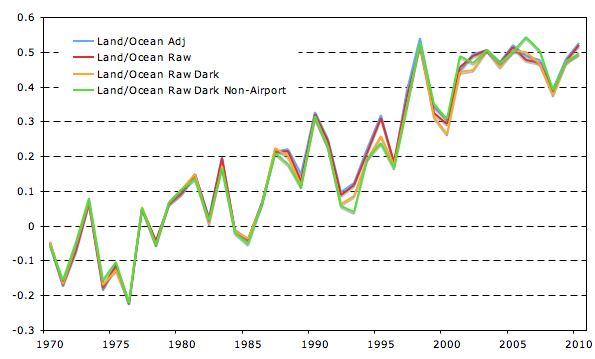
Crying adjustments won’t really help much. Take raw GHCN and any SST series you like and you will still get 2010 tied for hottest within sampling error. You can even eliminate all urban stations or airport stations and you get effectively the same results:
http://i81.photobucket.com/albums/j237/hausfath/Screenshot2011-01-12at42745PM.png
Zeke,
I am a little uncertain about what is and is not “adjusted” in the GHCN and SST data. Are you certain the GHCN data has not been adjusted in any way (like for station moves or equipment changes). Please correct me if I am mistaken, but my impression is that there is no truly “raw” data available from GHCN.
SteveF,
For land temps, post-1950s data is all raw (e.g. input and copied directly from the instrument) with some very minimal upstream processing to detect typographic errors. Pre-1950s land temps are a bit trickier because they are from so many different sources, some of which may have made adjustments. However, when the raw data exists it is included in the GHCN land record, so its as “raw” data as is possible to obtain.
SST data is a bit trickier, and is by definition not raw as it includes indirect measurements from satellites among other things. I’ve actually not followed SST series quite as closely as land records, so I’m not sure how much adjustments affect ERSST, HadISST/Raynolds, or HadSST2 series.
I should be clearer is distinguishing between Land and SST data when I refer to it as “raw. For reference, GHCNv3 raw and adjusted data can be found here:
Unadjusted – ftp://ftp.ncdc.noaa.gov/pub/data/ghcn/v3/ghcnm.latest.qcu.tar.gz
Adjusted – ftp://ftp.ncdc.noaa.gov/pub/data/ghcn/v3/ghcnm.latest.qca.tar.gz
Zeke,
OK, thanks.
It still comes down to GISS and the polar interpolation scheme
Mikec,
Yep, thats the main difference between GISTemp and Hadley/NCDC. Its also somewhat notable how much higher Hadley was during the 1998 ENSO event than GISTemp:
http://i81.photobucket.com/albums/j237/hausfath/Screenshot2011-01-12at51522PM.png
Zeke… and since the Arctic is where warming trends will be the greatest, be it caused by AGW or natural variation, then that’s the place to focus observation and study what is causing the warming… or lack thereof
Zeke,
GISS shows a slightly higher overall trend than the other indexes, but arrives at that trend with lower variability over the past 32 years, and is the only index that shows repeated records… 2005, 2007 and 2010.
http://www.woodfortrees.org/plot/uah/mean:12/plot/rss/mean:12/plot/hadcrut3vgl/from:1978/offset:-.15/mean:12/plot/gistemp/from:1978/offset:-.23/mean:12/plot/uah/trend/plot/rss/trend/plot/hadcrut3vgl/from:1978/offset:-.15/trend/plot/gistemp/from:1978/offset:-.23/trend
The Daily UAH temps provide the best description of what happened in 2010.
http://img831.imageshack.us/img831/4550/dailyuahtemps2010.png

Its pretty clear that NOAA and GISS have been working hard all year to make sure there was a record. Just noting that ChangeDetection recorded 2005 GISTemp was adjusted down to 0.62 from 0.63 today (making 2010 the highest number). 1998 was adjusted down long ago.
Bill Illis,
A conspiracy? Sigh.
SteveF,
Why did you use an offset of 0.23 for GISS, rather than 0.24?
David Gould (Comment#65615)
January 12th, 2011 at 9:17 pm
Its not a conspiracy.
They are just cooperating with each other to decide on what stations they will include and what adjustments will be done to those stations so that temperatures seem to going up forever when they are really just increasing at a minor amount.
I see no reason to adjust 1880 temperatures down as was done today.
I see NOAA has reported the annual average here , but I don’t see the monthly average for december yet. I usually get the monthly values here: ftp://ftp.ncdc.noaa.gov/pub/data/anomalies/monthly.land_ocean.90S.90N.df_1901-2000mean.dat
Does anyone know if the monthly values are released more promptly somewhere else?
Bill Illis (Comment#65611)
January 12th, 2011 at 8:58 pm
The Daily UAH temps provide the best description of what happened in 2010.
What was your UAH graph supposed to tell us? I don’t see any link to your conclusion that GISS and NOAA were up to monkey business.
Bill Illis,
As I said previously:
A conspiracy? Sigh.
By the way, in October 2010 the 2005 temperature was .62. Did they adjust it up so that they could then adjust it down again? Those Machiavellian masterminds!
Owen (Comment#65619)
January 12th, 2011 at 9:28 pm
“What was you UAH graph supposed to tell us? I don’t see any link to your conclusion that GISS and NOAA were up to monkey business.”
Do they have to be linked. The Daily UAH chart is just supposed to provide everyone with a better understanding of the trends throughout the year. GISS and NOAA have the opposite view.
Bill Illis,
Ah. I see the logic now.
1. Bill Illis sees no reason for something.
2. Therefore, there is no reason for something (other than a conspiracy).
Bill Illis,
They have the opposite view? Does that mean that at the beginning of the year they were showing anomalies in the region of -.4 to – .6? Perhaps you had better define what you mean by ‘opposite’. Dr Spencer, after all, said that this year was statistically tied with 1998 for warmest year. Is that the opposite of what GISS said?
In light of the civility thread, I should perhaps mention here that what I perceive to be irrational conspiracy theories push my buttons.
I’m as cynical as anyone. But, if there were no warming, wouldn’t there be some sort of limit to how much and how long they can continue to adjust stations to make it “seem” there is warming when there is none? One of the reasons I like to look at shorter term trends is that it seems to me that once AGW became politically visible, it becomes difficult to sort of fiddle any data. I get how someone might suspect a group or agency could fiddle with records from 1890 to make it seem cooler. I wasn’t alive then. I’m not going to do a bunch of research to figure out of Siberia really was cold in 1890. But how exactly is anyone supposed to majorly fiddle with 2001 data to ‘force’ it to be cooler than 2011? Or even 1980? And not get caught?
No matter how cynical, or suspicious you are, it seems rather difficult to believe even the most clever and devious people would have a very difficult time fiddling to ‘force’ a trend onto data since 1980. Even if everyone cooperated, i don’t believe they could do it.
The NOAA and GISTemp ‘working hard’ to create records theory doesn’t make much sense to me.
Bill-
GISS and NOAA don’t have the ‘opposite’ view relative to NOAA. The year started warm by all three groups. It ended cooler than it started. When averaged over the full year, UAH happens to not break a record– but it’s the second highest year recorded. When averaged over the year, GISS comes out highst. NOAA evidently showed a tie between 2010 and 2005. So, it was so close that some agencies show a new record; others don’t show a record.
There is no “opposite” here.
Bill Illis (Comment#65621)
“GISS and NOAA have the opposite view.”
Bill, not sure what you mean. Here is the 2010 from Wood for Trees: http://www.woodfortrees.org/plot/gistemp/from:2010/offset:-.24/plot/uah/from:2010/plot/rss/from:2010
I’m not sure where you are going with this? The satellite temps are higher for El Nino and lower for La Nina, and we had both in 2010.
lucia (Comment#65618)
They always change. I stopped using NOAA global temps because they start every year with these preliminary numbers which come down later in the year. Also, I got tired of constantly updating spreadsheets going back years. Third, Tom Peterson is in charge of much of the data they use and he is a hardcore partisan.
David–
I think conspiracy theories about global surface temperature records (and most other things) make no sense.
SteveF
I think the lower variability and the sustained records are related.
Think of this: Suppose the trend really was monotonically increasing an linear. If there is no noise, every single year will show a record.
Now add noise– possibly due to measurement. Possibly due to instruments– just for whatever reason you like. Now, some years will not show records because years with “negative” noise might be lower than the previous year with positive noise.
The more noise you add to a trend, the larger the time interval between records.
Owen (Comment#65616) January 12th, 2011 at 9:19 pm
“Why did you use an offset of 0.23 for GISS, rather than 0.24?”
I was just eye-balling the correct off-set to make them close to each other on average. Maybe 0.23 would be better for GISS.
.
The main point was that the GISS trend is less variable and shows a more continuous upward trend (three annual records since 1998) compared to the other indexes. Clearly what they are measuring is a little different.
Bill Illis (Comment#65617)
I’m not so sure how much they adjusted past temps today, but adjusting past temps in general is fair game. In the begining of the temperature record, many of the stations were located in cities but were relocated to better sites about mid century. So if they are making urbanization adjustments using the records of surrounding rural stations as is customary, then you should expect records to be adjusted downwards earlier in the century. I would be suspicious, however, if rural stations had significant downward adjustments early in their records.
The other thing you might want to consider is changes in the adjustment process. If they moved to a new version of their homonization process this year then you might see changes in the .05 or .1 range.
By UAH, RSS, GISS, and NOAA, 2010 was a very warm year, as was 2009. What do we make of the fact that such warm years are occurring in the midst of a prolonged 100-year solar minimum?
see: http://science.nasa.gov/science-news/science-at-nasa/2009/03sep_sunspots/
Lucia,
“I think the lower variability and the sustained records are related.”
For sure; what I was trying to say but didn’t manage to. 🙂
MikeC– The NOAA monthly numbers don’t seem to shift much after they are published.
All surface groups shift a little. They admit to publishing monthly numbers when some fraction of data are in. Sometimes, the monthly value move a little when more comes in– but it usually stable by month 2. GISTemp is a bit different because their anomaly method is a bit… well confusing to people who haven’t thought about it very long. And it causes new data to propagate back a long way. Still, they published their method, so it makes sense. (Even though it comes off a bit huh(?) in implementation.)
SteveF,
Wood for Trees uses -0.24
Lucia, when you spend several years updating spreadsheets with their numbers every few months… then have to redo the entire spreadsheet every time because numbers kieep changing going back over a hundred years… you’ll get what I’m saying. And yes… NOAA has a habbit of making preliminary numbers which come down later in the year… their old page even had a disclaimer which stated that they were preliminary numbers and that the graphs will not change.
Owen (Comment#65636) January 12th, 2011 at 9:57 pm
“Wood for Trees uses -0.24”.
I didn’t know that; I was just estimating by the look of the graph.
lucia (Comment#65626)
January 12th, 2011 at 9:42 pm
——
For the October 2010 GIStemp temperature record, approximately one-third of the individual monthly records back to 1880 were changed. That makes 500 monthly record changes. It was an unusual month – normally there is much less than that.
But here is how the math works. Let’s say every monthly update since the 1990, one adjusts 2 out of 12 months down by 0.01C in 1880 (a typical change actually). Every 6 months, you can drop the 1880 temperature by 0.01C.
So every 6 months since 1990, 40 times, you can drop the 1880 temperature by 0.01C. 40 X 0.01 = 0.4C
Now one can also look at the emails released through FOI requests by judicialwatch.
http://www.judicialwatch.org/files/documents/2010/783_NASA_docs-2.pdf
1934 in the US was adjusted down by -0.2C by GISS in just 8 years of adjustments. 1998 was adjusted up by +0.3C. A 0.5C change in the differential in just 8 years. Now take that out to 20 years and make it global rather than just the US.
SteveF (Comment#65638)
January 12th, 2011 at 10:06 pm
Owen (Comment#65636) January 12th, 2011 at 9:57 pm
“Wood for Trees uses -0.24″.
I didn’t know that; I was just estimating by the look of the graph.
You have a good eye. And the slope was not affected.
Luica,
.
The difference in the appearance of the GISS trend compared to the others is what I find interesting… and perhaps informative. Certainly GISS treats sparse high latitude data differently, and they show 1998 as relatively lower than than the other indexes.
.
It might be interesting to examine the high latitude data from UAH or RSS, and compare with GISS, but I don’t known if the separated by-latitude data is available.
Bill Illis,
Yes, temperatures have been adjusted downwards. And, as you see no reason for it, it must be a conspiracy. Impeccable logic.
(And, in case you did not get it, by ‘impeccable’ I mean ‘very, very bad’).
Bill– Year end does seem to be an unusual time for the surface temperature groups. My theory is that all the local stations try especially hard to send in their reports to make the computation of the annual average as complete as possible. They hustle in a way they might not if a problem arose in, say, july. So, you’ll see more monthly averages updated as outer-slobovia has their staff double check data for the year or hustles to make sure that they don’t get the Dec. data in so late it’s not included in the computation of surface temperatures until February. That’s a guess. But agencies across the world tend to be cash strapped, and it seem to me that’s the way things might very well be.
On the emails from judicial watch: What precisely am I supposed to see? Why would what I see translate into a conspiracy?
Doing a comparrison of sat vs surface temps is a good example of go home and do it again. You’re measuring two different things here… 1-2 meters vs 0-5 miles. But if you look at the WFT graph you’ll notice that the two sat sets are very simillar and the two surface sets are very simillar. GISS has a higher trend because they include the Arctic interpolations and probably have lower variability because of a different homoginization process.
lucia,
The evidence for a conspiracy is so clear that if you cannot see it you must be part of the conspiracy. However, it also might be part of the conspiracy to make it appear as if you are part of the conspiracy. Either way, it is likely that you have been ‘adjusted’.
Reading that email, it appears as though they conspired to make 1998 the warmest year and then conspired to make it not the warmest year. They conspired to do that to make people think that there was a conspiracy. And they have succeeded. So all people who think there is a conspiracy have become unwitting dupes of the conspiracy. (While I, on the other hand, am a witting dupe …)
David, there is no doubt that the numbers are played with. But since Climategate, they’re no longer believable anyway
Is that the email discussing the last year of MBH98? Where the temperature record was kind of cherry picked to use the super El Nino year?… then forgot to mention it in their study?
MikeC,
As I have said previously to Bill Illis, a conspiracy? Sigh.
Hadley shows a higher trend from 1978 to 2005 compared to GISS, but when you add the 2005 to 2010 periods to both, the GISS trend becomes higher overall.
http://www.woodfortrees.org/plot/hadcrut3vgl/from:1978/to:2005/offset:-.15/mean:12/plot/gistemp/from:1978/to:2005/offset:-.24/mean:12/plot/hadcrut3vgl/from:1978/to:2005/offset:-.15/trend/plot/gistemp/from:1978/to:2005/offset:-.24/trend
There is a considerable divergence between GISS and Hadley since 2005. Whatever the differences between the methodology, that difference has made 2005 to 2010 warm considerably faster than the other indexes. (I am NOT suggesting a conspiracy David, just a significant change since 2005!)
David, eh… more like let’s pick the people and stations which will show us the best agreement with our models since our models MUST be right… in the mean time, when one guy copies the trick that another guy used to hide the decline, I’m not so sure if that constitutes a certified grassy knoll conspiracy.
David Gould (Comment#65651)
January 12th, 2011 at 10:25 pm
MikeC,
As I have said previously to Bill Illis, a conspiracy? Sigh.
—————
That is not an actual argument. It is just a plea to those that understand that most conspiracy arguments are bogus.
Have the temperatures been adjusted by 0.5C or more is the question. But then you don’t know because you have never checked.
In fact, no one really knows how much the global temperature record has been adjusted. We do know that the US trend has been adjusted up by +0.425C but that is it. There is no accounting for how global temperatures have been changed.
SteveF’s “considerable” divergence is within the margin of error
Bill, He’s trying to make you out to be something you’re not…
but anyway… the more likely scenario for the U.S. is error in the homonization process… it looks to be about .4
Bill Illis,
No, that is not the question. The question is: was it done for good reasons?
To jump from, ‘There have been adjustments’ and ‘I can’t see a good reason for them’ to ‘conspiracy’ is irrational, and can be placed in the ‘bogus’ bag of conspiracy theories.
MikeC,
So “cooperating with each other to decide on what stations they will include and what adjustments will be done to those stations so that temperatures seem to going up forever when they are really just increasing at a minor amount” is not a conspiracy? We must have different definitions.
David, If Tom Peterson provides the stations which are used by NOAA and GISS, then it’s not a conspiracy… it’s Tom Peterson… and if NOAA and GISS turn their heads then it’s not really a certifiable grassy knoll conspiracy.
… but cooperation perhaps?
“No matter how cynical, or suspicious you are, it seems rather difficult to believe even the most clever and devious people would have a very difficult time fiddling to ‘force’ a trend onto data since 1980. Even if everyone cooperated, i don’t believe they could do it.
The NOAA and GISTemp ‘working hard’ to create records theory doesn’t make much sense to me.”
Nope, you are exactly right. The data is the data and that is what we have to deal with. The record is still within the deliberately unrecognized UHI effects though but whether this year is a record or a recent one makes little difference.
Bill,
If only GISTemp would release the code they use, and NOAA would release the raw data, than we could get to the bottom of their nefarious schemes. We might even spend a year meticulously developing our own reconstructions and testing possibilities of different sets of stations to use (like GSOD!) and parse them in different ways to test for UHI and other biases.
Seriously though, what stations are “dropped”? If you can provide an example where data was submitted to GHCN via CLIMAT reports, passed QC, and was excluded I might admit you have some case. Apart from that, if you take the raw station data from GHCN, grid it, and calculate anomalies you get something pretty damn close to GISS and effectively identical to the NCDC record. Slightly higher, in fact, if you use Jeff Id’s LSM combination method intead of CAM. The only real critiquable step in temperature reconstructions are UHI corrections (GISS does them, NCDC does not) and how to deal with the areas of the arctic lacking station coverage (infilling like GISS or giving it the global mean like NCDC).
I took a stab at replicating GISTemp (sans interpolation) awhile back, and got pretty damn close with no fiddling of past temperatures or adjustments: http://rankexploits.com/musings/2010/replication/
Jeff, do you even kinow what these records include or how they come to those conclusions? UHI isn’t adjusted in GISS??? Come on dude!
Zeke, But NOAA and GISS use the same data provided by GHCN, except in the U.S. where GISS uses USHCN. So if GHCN has urbanization problems, doesn’t it make sense that they would show similar trends to GISS which uses the Arctic (which naturally has higher trends)?
And should I trust GHCN which said data is provided by Peterson who photoshops pictures of his competing scientists such as this?:
.
http://wattsupwiththat.files.wordpress.com/2010/07/cru_climategate_email_marooned.jpg
MikeC,
If you don’t trust NCDC, you can turn to the CLIMAT data upstream via the GSN: http://gosic.org/gcos/GSN-data-access.htm
Alternatively, you can compare it to independent products like ISH or GSOD. In both cases I haven’t found any basis for concern, apart from some countries neglecting to submit CLIMAT reports in the most timely manner.
Urbanization problems are a tougher nut to crack, and are the focus of my current project. I’ll have more on that down the road when its closer to completion.
Zeke, I went through the GSN station list and I’m just… astonished… it’s a mecca of urbanization. I hope they have some homoginization / urbanization… I’ll go back and look for it. Do you have links to the ISH or GSOD station lists?
While we’re at it, GSN is held at NCDC…the same place where Peterson works the GHCN… are the other data sets any more independent?
Technically I think NCDC plays a role in managing ISH and GSOD too. They are the government agency set up to manage climate data after all. For records nominally independent (though substantially overlapping in station inventory) try the WMSSC: http://dss.ucar.edu/datasets/ds570.0/
Lucia, as far as I understand the Jan-Dec avarage for 2010 according to GISS is 0.63 degree Celsius above their baseline, not 0.65 as you write in your summary:
http://data.giss.nasa.gov/gistemp/tabledata/GLB.Ts+dSST.txt
Not a big deal perhaps, but there is no need to exaggerate the numbers supplied by GISS that according to some are already higher than strictly needed ….
Zeke (Comment#65606) “Its also somewhat notable how much higher Hadley was during the 1998 ENSO event than GISTemp”
The Hadley Centre spliced two source SST datasets (ICOADS & NCEP-GTS) together in 1998 for its HADSST2 data. The source of the two datasets, ICOADS, advises that the two datasets are not fully compatible.
Here’s the difference between HADSST2 and ERSST.v2:
http://i49.tinypic.com/j090g1.png
And here’s the difference between HADSST2 and ERSST.v3b:
http://i49.tinypic.com/20qgmk5.png
HADSST2 exaggerates the 1997/98 El Nino and there’s a shift in the data afterwards that doesn’t appear in the other buoy- and ship-based (no satellite) SST datasets
I discussed and illustrated this in a post about a year ago:
http://bobtisdale.blogspot.com/2009/12/met-office-prediction-climate-could.html
It’ll be interesting to see how the Hadley Centre addresses this in their updated HADSST3 and HADISST2 datasets due out this year.
Regards
Zeke, GISS used to have it’s own until they started using USHCN and GHCN a while back. CRU has their own although the station inventories are similar to GHCN… which is the problem when comparing data sets. I’m not surprised that your comparisons of the data tend to show a lot of similarities
Seems to me that since 1978 the global average temperature record is solid, given the strong agreement between direct surface measurements of temperature and the indirect measurement of temperature based on microwave emission spectra of atmospheric O2. The trends are almost identical, but the microwave temperatures are more exaggerated by ENSO events. We can talk all day about this weather station or that and UHI effects, but the surface methods seem trustworthy to me. Zeke’s graph (#65597) gives me even more confidence in the measurement process.
In the interest of being honest, I can only point out to David Gould and Lucia and Zeke that the history of science includes lots of evidence of dishonesty. So misleading manipulation of data is not out of the question.
The question for me is, how would David or lucia or Zeke know whether or not all the data is what it’s supposed to be?
They don’t. And they don’t care about finding out.
Andrew
Is the rational for adjustments agreed before the overall resulting change on the global record for GIStemp is known? if researchers proposing a change to the methodology have already compared different codes for the raw data and are just selecting the one they feel suits their ‘metric’ this is surely bias??
Implications of conspiracies without evidence are a waste of time. Temperature trends without a reasonable attempt at also showing 95% CIs are a waste of time.
I guess a record broken by 3/100ths of a degree makes headlines somewhere.
harrywr2–
Of course. Records of all sorts are often reported and make headlines in appropriate venues. If an Olympic swimmer breaks a record by 0.001s (or whatever is the smallest recordable increment) that gets reported. The announcers don’t say, “but it’s only 0.001s, so it doesn’t count.”
Andrew(KY),
I wouldn’t say that we have no interest in finding out. Otherwise why would we be interested in examining alternative dataset (e.g. GSOD, which is mainly non-overlapping, and WMSSC, which is largely overlapping): http://wattsupwiththat.files.wordpress.com/2010/07/figure-2.png
Bob,
Interesting work as always. I suspected that the 1998 ENSO response in HadCRUT was a result of the SST series chosen, since I recall comparing the land records back in the day and finding them effectively identical to those produced by GHCN stations only.
Lucia,
To be fair, swimming records don’t have measurement error in a meaningful sense. Claiming a record is meaningful when it beats the prior one by 0.03 C when the measurement error is around 0.07 C is somewhat silly, and GISS/NCDC at least have been reasonably responsible in pointing this out (some media coverage markedly less so…).
PKthinks,
GISTemp doesn’t update their code very often, and the changes are all well-documented (and replicated by the CCC folks). The last major revision was the switch to using nightlights for UHI correction last January: http://data.giss.nasa.gov/gistemp/updates/
Zeke–
Fair enough. But the fact is while the earth warms, the records are often going to be broken by small amounts. These accumulate over time. If we don’t call the GISTemp record a record relative to 2005, what do we do we say if the 2011 record is broken by only 0.03C in 2014? And then by another 0.03C in 2018? Can one never say any record was broken? That’s not quite right.
I say a record is broken if the number recorded is higher than all others recorded. Otherwise, it’s not. I’m not necessarily saying breaking a record is “meaningful”. But it’s a record based on a previously published algorithm run using available data. We all do watch GISTemp– even the GISS/Hansen critics watch it.
As it happens, I think trends are more meaningful than records. But I was curious to see if the numerical value published this year would be higher than those for other years: It is.
Zeke,
The GSOD I just looked up is produced by NASA, so I’m not sure how independent it is.
“Abstract: Global Surface Summary of the Day is a product archived at the National Climatic Data Center (NCDC).”
“The USHCN has been developed over the years at the National Oceanic and Atmospheric Administration’s (NOAA) National Climatic Data Center (NCDC)”
“GISS: Current Analysis Method
The current analysis uses surface air temperatures measurements from the following data sets: the unadjusted data of the Global Historical Climatology Network (Peterson and Vose, 1997 and 1998), United States Historical Climatology Network (USHCN)”
Somebody correct me if I’m wrong.
Andrew
You’re wrong.
GSOD is not produced by NASA.
Ron,
Who is it produced by?
http://gcmd.nasa.gov/records/GCMD_gov.noaa.ncdc.C00516.html
Andrew
Now that in several replies (65717, 65720) the anomaly of +0.65 is apparently accepted, I repeat what I said in post 65674: the correct number published by GISS is 0.63 !
Andrew_KY, the answer is prominently displayed in the link that you posted:
Ron,
Yeah but it looks like a nasa.gov link and the NASA logo is displayed prominently at the top of the page.
What is the connection between NASA and GSOD? Did NASA approve it or something?
Andrew
http://gcmd.nasa.gov/Aboutus/index.html
While the GCMD’s primary responsibility is to maintain a catalog of NASA’s Earth data sets and services, it is also catalogs data from a variety of sources … such as NOAA.
Thanks Ron.
So NASA GCMD is like a mini-IPCC, assisting policy-makers.
Andrew
I think that the evidence is pretty split over whether policy-makers reference collections or collectors of information such as the GCMD, or the IPCC, or the local library – or if they just take whatever policy is provided by their largest donors.
Owen,
So you say the global average temperature record since 1978 is solid.
32 years and this is enough to base all kinds of policies upon?
Given that lots of things such as PDO, which we didn’t even know about back in 1978, seem to operate on a 30 yearish cycle how can you put such faith in the temp record?
Andrew_KY,
“There have been conspiracies; therefore this is a conspiracy.”
Sorry. For me to consider the notion of fraud, there has to be evidence presented that this is a serious possibility. Wild speculation, such as the ‘logic’ used by Bill Illis – “There have been adjustments; I can’t see why they were made; therefore, conspiracy” – does not count as evidence.
I tend to trust organisations, methods and processes that have served us well in the past – especially when they are working in areas that I have no expertise in. When people propose ‘conspiracy’ as the answer to a question raised, they can pretty much be dismissed unless they present significant evidence for their claim.
As to investigating the data, I have read lots of information about it. I have talked to the people who present the data; I have read about the things that others are complaining about. I have not always understood everything about those issues or the answers to them, but I have seen nothing that has caused me to have any significant doubts about the global temperature datasets that we have.
If you have such information, I would be happy to read it.
“There have been conspiracies; therefore this is a conspiracy.â€
David,
This is not my position. My position is that dishonesty has occured in the past in science, and since no Magic Spell of Purity has been cast on science that any of us know of, dishonesty is still possible in science.
“areas that I have no expertise in”
This is close to my point. If you wanted to confirm step by step all the assertions of Global Warming scientifically, you couldn’t, even if you wanted to. Yet… you behave as if you have experienced some sort of confirmation of your beliefs. I suspect you haven’t …other than other people regurgitating the same unconfirmed beliefs.
Andrew
Andrew_KY,
In areas in which we have no expertise, we all trust the experts. That is the only rational option. However, this trust is weak: if a significant number of aircraft crashed, the engineers who built them would not occur.
If you wanted to confirm step by step all the assertions of astrophysicists, you couldn’t, even if you wanted to.
I would also point out that you have the ‘confirmation of my beliefs’ things the wrong way round. My beliefs came about *because* of what I read about climate change. I did not have beliefs going in and then looked for confirmation – indeed, a few years ago I was only vaguely aware of the issue of global warming, and it was not an area of interest for me at all. My focus was on religion and philosophy.
I agree that dishonesty is possible. However, there is no evidence that dishonesty has occurred on a large enough scale to distort the record significantly enough to alter the conclusions. If you have such evidence, present it. If you are saying that we should not believe anything until it is proven not to be the result of dishonesty then you operate under a different notion of knowledge than I do.
David,
“In areas in which we have no expertise, we all trust the experts.”
No we don’t. See, you trust the label ‘expert’ for some reason. I don’t. Trust is not part of the scientific method. Do you think it is?
People fly in planes for the first time because they see planes full of people fly around and not die, not strictly because some expert told them it was OK. People they know fly. They observe flight.
Global Warming? A person only experiences weather.
(Unless you are Lucia who experiences Global Warming by gazing intently at Squiggly Lines 😉 )
“If you wanted to confirm step by step all the assertions of astrophysicists, you couldn’t, even if you wanted to.”
So it would be reasonable not to let astrophysicists tell you how how to run your business or your life, based on astrophysics alone.
“My beliefs came about *because* of what I read about climate change.”
Right, they are beliefs now, and will never be anything but.
“However, there is no evidence that dishonesty has occurred on a large enough scale to distort the record significantly enough to alter the conclusions.”
Yes there is. Scientists making unverifiable assertions and calling them ‘science’ is evidence. It’s all over the place.
Andrew
AndrewKY,
Do you know that the mechanic who checked something on the specific plane that you are going to fly today did not have a bad day? If you do not have that knowledge, then you are flying on trust. You cannot possibly check every little detail. Thus, you must trust. (Or not fly.)
Regarding the scientific method, the reason that I trust science is because of the scientific method. The science around global warming has been around for decades. It has been tested, checked, examined by many, many people. It holds up. As I said, I trust organisations, methods and processes that have served us well. Science is such a method. The conclusions of global warming arise from that.
Ah. “It’s all over the place.” Then show me the evidence that dishonesty has occurred on a large enough scale to distort the record significantly enough to alter the conclusions.
If you define ‘knowledge’ as 100 per cent certainty, no-one knows anything outside of formally defined systems such as mathematics. All other things are beliefs.
Can you define for me what you consider knowledge to be? From memory, I suspect that we operate under different definitions and assumptions in this regard.
“Do you know that the mechanic who checked something on the specific plane that you are going to fly today did not have a bad day? If you do not have that knowledge, then you are flying on trust. You cannot possibly check every little detail. Thus, you must trust. (Or not fly.)”
David, if I knew there was a problem with the mechanic who had worked on my plane, you better believe I wouldn’t get on it. No trust. And I don’t ‘have’ to trust flying at all (there are those who don’t). I can drive, walk, boat, train or something else. Anybody who trusts that everything will go right on every flight is suffering from misplaced belief.
“Regarding the scientific method, the reason that I trust science is because of the scientific method.”
How do you know in which cases the scientific method is being adhered to and which it is not? You have no expertise.
“Then show me the evidence that dishonesty has occurred on a large enough scale to distort the record significantly enough to alter the conclusions.”
The conclusions are unconfirmed assertions.
Here’s one:
http://wattsupwiththat.com/2011/01/13/another-overhyped-global-warming-claim-bites-the-dust/
Andrew
Re Knowledge:
Familiarity, awareness, or understanding gained through experience or study.
http://www.answers.com/topic/knowledge
Andrew
Andrew_KY,
Then I have knowledge of climate change, as I have studied it (unless you mean formal study at a university).
Andrew_KY,
My point is that you *do not know that there was not a problem*. And yet you get on the plane. You must be trusting that he did not have a bad day.
While a trivially true statement, if that airline had a history of “controversy” and just had a bunch of e-mails leaked that indicated that many of its employees recognized serious flaws in how the airplanes were maintained (“It’s a travesty we can’t account for that missing hydraulic fluid”), I suspect the airline would have a problem.
And I doubt anyone would be apologizing for the airline because the e-mails may not have been obtained by legal means.
Re penguins, one study finds one thing; one study finds another. A single study, one way or the other, is not sufficient for me to accept a scientific claim – indeed, while I like reading about new scientific findings, I take them with a grain of salt as the vast majority of new findings are overturned in a few years. Further, a study being overturned is not evidence of dishonesty. You made the claim that there is evidence of sufficient dishonesty on a large enough scale to alter the conclusions. Indeed, you said it was “all over the place”. Yet the first thing you link to has nothing to do with dishonesty. I am losing trust in you. 😉
John M,
Let us just say that you and I have different interpretations of those emails – and the ‘history of controversy’ – and leave it at that.
David,
It’s my choice as to whether I get on the plane or not. If I have a good reason not to trust then I don’t trust. If I have reasons enough to trust, I can choose to trust.
If I don’t get on the plane, will I be labeled as a political opponent?
I don’t just trust without analyzing the situation. That would be unreasonable. If my best friend starting acting oddly, I wouldn’t give him the keys to my house. You dig?
Andrew
“Then I have knowledge of climate change, as I have studied it (unless you mean formal study at a university).”
But you haven’t studied it yourself. You are believing someone else’s opinions. I bet you haven’t collected one piece of data you could submit as evidence in the case of Global Warming.
Andrew
Andrew_KY,
I agree that it is your choice. I am not sure that I ever said it was not. And I do not trust without analysing the situation, either. The degree of analysis varies with the significance to me of the topic. This is why I have spent a lot of time on the climate change issue over the last few years (I cannot remember precisely, but I think I started looking at it in 2006). I know that I cannot check everything; I know that I cannot understand everything. But that is the case for most things.
As to ‘being labelled a political opponent’, if I, based on my beliefs on climate change, campaign for X and you, based on your beliefs on climate change, campaign for Y, then you are a political opponent, whether I give you that label or not. There is nothing bad about being a political opponent – my friend here at work is a ‘climate change realist’ (his term) and has run for political office, making him certainly a political opponent.
If you object to being labelled a political opponent of mine, what term would you like?
I suspect that in my analogy, the CEO of the airline would probably try to argue the same.
Andrew_KY,
So your definition of ‘study’ is to independently collect the data. Under that definition, not many people would have knowledge of anything, as reading books would not count as study.
I have used data (other people’s data) to make a prediction regarding the local effects of climate change. (That prediction has been falsified.) Would that count as study?
“You made the claim that there is evidence of sufficient dishonesty on a large enough scale to alter the conclusions. Indeed, you said it was “all over the placeâ€. Yet the first thing you link to has nothing to do with dishonesty.”
Yes it does.
Biologist Erli Costa said: “This is all due to global warming.â€
Obviously this is a misleading statement.
Andrew
Andrew_KY (Comment#65808) January 13th, 2011 at 6:11 pm
Hi!!! Funny..I have to tell you. That very thing happened and it is why and how my father in law came to live and retire in a house on the beach on Oahu. Trusting has nothing to do with it. At least I don’t think so. It is about having standards. Father in law is a pilot and was a Cessna owner. Routine work on his plane…one little part not screwed in tightly…down went the plane with his brother and nephew shortly after take off in an urban neighborhood of Los Angeles in the 1980’s. Ruled the mechanic’s error after investigation of the crash. He almost died…everyone was hurt really bad. He almost lost his eye, and I mean lost as in..came out of the socket (sorry if that is TMI!) and that was just one injury! At least mechanics are held accountable for their bad practices “Having a bad day” or fudging data..not adhering to FOI requests…what ever … doesn’t matter. STANDARDS are set in place beforehand!
David,
If you read extensively about guitars but have never seen or touched, heard, tuned, or tried to play one, you don’t have knowledge of guitars. The books you have been reading may be inaccurate. If you never confirm what you have read, you are a reader of guitar books. I’m afraid to have knowledge, you have to do it yourself.
I know that ruins the whole Global Warming Thing for you, but that’s life, kid.
Andrew
Andrew_KY,
I think you will find that Erli Costa said this:
“I don’t think the levels of pollution are high enough to affect the birds so quickly. I think instead we’re seeing more young and sick penguins because of global warming, which affects ocean currents and creates more cyclones, making the seas rougher,” Costa said.
He may have been wrong, but how is that dishonesty? Do you have evidence that he is lying about what he thinks? Does one of the climategate emails, for instance, say, “And I told the press that I think that penguins are dying because of global warming, when I know that it is really sharks with friggin laser beams attached to their heads!’?
link:
http://www.msnbc.msn.com/id/25740110/ns/world_news-world_environment/
Re: Political Opponent
This is a scientific discussion. To politically label someone based on an unanswered scientific question changes the nature of the proceedings. We’ve shifted from science to politics.
Andrew
Andrew_KY,
I am afraid that that is not life. 🙂 We simply have different definition of knowledge. There is plenty of knowledge to be gained in books, and I am sad that you do not accept this. I would suggest that even if you picked up a guitar and tested the claims in the book, you still would not have knowledge of guitars under your definition. All you would have, in fact, would be knowledge of that particular guitar – other guitars might be different.
Inductive reasoning is very important in the building of knowledge; indeed, it is one of the most important parts of science.
“He may have been wrong, but how is that dishonesty? Do you have evidence that he is lying about what he thinks?”
David,
Attributing with the word “is” when all the evidence and speculation says “might be”, is dishonest.
Andrew
Andrew_KY,
That is why I specifically raised the notion of politics: if you are a political opponent, then you are a political opponent. If all you do is disagree with me on the science, but vote the same way, then you are not a political opponent, merely a scientific one. (In other words, if you *only* disagree with me on the science, then you are not a political opponent. You are only a political opponent if, well, you are a political opponent.
Or maybe I completely misunderstand what you are getting at.
Andrew_KY,
He said, ‘I think.’ He did not say, ‘I know,’ or ‘It is an undisputed fact that …’.
Seriously, if you think that *giving an opinion* is dishonesty then I am not sure how I can communicate with you.
By the way, in case you misunderstood, he never said, ‘This is all due to global warming.’ That is an uncharitable – dishonest? – paraphrase. Look at what he actually said.
“I would suggest that even if you picked up a guitar and tested the claims in the book, you still would not have knowledge of guitars under your definition. All you would have, in fact, would be knowledge of that particular guitar – other guitars might be different.”
You are quite correct. I would have to have experience with more than one guitar to have knowledge of ‘guitars’.
You have nicely filled in how inexact I was.
Now apply your evaluation skills to Climate Science… 😉
Andrew
Andrew_KY,
I am still unclear what your objection might be to being my – or anyone else’s – political opponent.
Political beliefs are informed by various other things – religion, science, economic circumstances, life experiences, parental factors, education. So, if you and I interpret a particular area differently we may well have different political beliefs – and thus be political opponents. For example, I am an atheist. If you are a Christian, you may hold different views than I do on various issues because of that difference in religious belief. And if we disagree on an area of science, then, to the extent that that area of science informs our political belief on a particular topic, we may well be political opponents in that area.
Why is that a problem for you?
David,
According to the Sunday Mirror:
Dozens of migrant penguins are being treated at Rio de Janeiro’s Niterio Zoo. Biologist Erli Costa said: “This is all due to global warming.”
http://www.mirror.co.uk/sunday-mirror/2008/07/20/plight-of-the-p-p-p-penguins-98487-20655117/
So the paper is being dishonest? Is that what you are suggesting?
Andrew
Andrew_KY,
I understand that under your definition of knowledge I have no knowledge of climate science. And neither do you. Given that neither of us have any knowledge – under your definition – of climate science, how would you suggest that you and I proceed from here? The only options that I see are: trust those who do have knowledge or do not trust those who do have knowledge. Perhaps you can suggest some alternatives.
David,
My objection is not about having political opponents. My objection is making a political opponent out of someone due to mistaken or unconfirmed beliefs.
Andrew
Andrew_KY,
Yes, the paper is being dishonest. Look at the tone of it. It is clearly an anti-global warming piece. Apply your critical thinking skills and your non-trust philosophy here.
Andrew_KY,
If you believe X and I believe not-X about an issue, one or both of us must be wrong. If everyone had correct (or at least the same) beliefs, I cannot see how there could be ‘political opponents’.
Imagine that I believed that all the banks should be nationalised, and you believed that all the banks should be in private hands. We both hold these beliefs because, under some criteria, we believe that that would be ‘the best’ result. Clearly, one of us is wrong. We are just as clearly political opponents. What is wrong with that?
Again, I am obviously missing something.
Andrew_KY,
As I am having difficulty seeing how the penguin piece demonstrates dishonesty and as you said that examples of dishonesty are ‘all over the place’ my advice would be to find another one.
“The only options that I see are: trust those who do have knowledge or do not trust those who do have knowledge. Perhaps you can suggest some alternatives.”
David,
If you want more than an unscientific/blind faith in Global Warming, I’m afraid you are going to have to start evaluating the evidence yourself.
Maybe you could ask an ‘expert’ what evidence they have evaluated and perhaps they can share it with you.
We can do this together. What ‘expert’ can we approach who will share his evidence, methods, and all the relevant info we will need to increase our knowledge?
Andrew
“Yes, the paper is being dishonest.”
You are claiming the paper is being dishonest. You are admitting there is dishonesty at play here. We are making progress. Baby steps, but progress. 😉
Andrew
Andrew_KY,
But you said that we cannot get knowledge without collecting the data ourselves. So asking someone for their evidence, methods and other relevant info will not suffice. We would instead need to learn how to build thermometers – and we would not be able to get this knowledge from books, unfortunately, as you have already ruled that out. Then we would have to go out and put them in place. Then we would have to daily go to each and every one of them (if they came to us via computer, we would have no means of checking to see that they were not being tampered with). To make this daily trip to thousands of locations around the globe, we would also have to likely invent teleportation. Again, we would not be allowed to use books to help us do this, though.
Under your definition of knowledge, I cannot see how we can move forward here.
Andrew_KY at 65844 😉
However, if you wish to talk to a scientist about the data, methods and information, I recommend Dr Hansen. He has helped me in the past. What questions do you want to ask him?
“Imagine that I believed that all the banks should be nationalised, and you believed that all the banks should be in private hands. We both hold these beliefs because, under some criteria, we believe that that would be ‘the best’ result. Clearly, one of us is wrong.”
Science is the thing that removes belief and establishes fact.
Nationalization vs. Privatization is a philosophical question and quite removed from being the same kind of question that ‘is Global Warming True’? is.
You can either establish Global Warming is true or false with the scientific method or you can’t.
Apples and oranges.
Andrew
Just to be clear: I think that your definition of knowledge is silly. 😉
“Again, we would not be allowed to use books to help us do this, though.”
I never said we couldn’t use books. I said we won’t get the knowledge by only reading books. We can confirm what’s in the books.
And yes, if we wanted total knowledge of Global Warming we would have to do all the steps ourselves.
You aren’t willing to do that, are you?
Do you see how much of Global Warming is belief? It’s literally a world of belief.
I would ask Dr. Hansen if he knows how to build a thermometer. 😉
Andrew
Andrew_KY,
You cannot establish global warming to be true using the scientific method. Truth is not determined using science. We can “provisionally accept something as sufficiently accurate for now” using the scientific method. However, assuming that that is what you meant, I think that the scientific method has established global warming as true; you don’t. In the same way, I think that the scientific method has established that black holes exist.
Given that we disagree on what the scientific method has shown, and given that upon that disagreement rests a political difference, that makes us political opponents. And what is the problem with that? I still do not understand your objection.
However, given that you do object to being my political opponent, what is the solution?
“Just to be clear: I think that your definition of knowledge is silly.”
It’s the dictionary definition, dude.
Andrew
Andrew_KY,
I do not think that it is possible for me – or any individual – to know everything about global warming. Or, indeed, under your definition *anything* about global warming. Under your definition, *all human knowledge vanishes*. Which makes it, obviously, a completely useless definition.
I will email Dr Hansen and ask him that question.
Andrew_KY,
No, it is not the dictionary definition. You specifically define ‘study’ as excluding book learning – you say that you cannot study anything by simply reading books, a claim that is patently false. If we go by the dictionary definition of study:
stud·y   /ˈstʌdi/ Show Spelled
[stuhd-ee] Show IPA
noun, plural stud·ies, verb, stud·ied, stud·y·ing.
–noun
1. application of the mind to the acquisition of knowledge, as by reading, investigation, or reflection: long hours of study.
Note that the dictionary *specifically includes reading* and *specifically states ‘acquisition of knowledge’.
http://dictionary.reference.com/browse/study
Your definition is silly.
“I think that the scientific method has established global warming as true;”
OK, care to tell us how that happened? Did you write a paper on it?
But wait, you have no expertise. Hmmmm…
You’re losin’ me, David.
Andrew
“I do not think that it is possible for me – or any individual – to know everything about global warming.”
So no person can verify that Global Warming is true.
We are making more progress.
Andrew
Andrew_KY,
It happened by individuals making progress using the knowledge gained by others over a long period of time. They did not waste time by applying your silly definition of knowledge and reinventing the wheel every day. The IPCC reports are a good starting point for seeing the knowledge that we as a species have developed on this topic.
As to me having no expertise, yes. And I have no expertise in astronomy. But I think that the existence of black holes has been confirmed by the scientific method.
Can you tell me whether there is anything that you believe has been confirmed by the scientific method? If there has been, can you let me know what data gathering you carried out and where you got your expertise from?
As your definition of knowledge has been demonstrated to be one invented by you and not one shared by the vast majority of individuals on this planet, why should I – or anyone else – accept it?
Andrew_KY,
According to the dictionary definition of knowledge, I have lots of knowledge of global warming. 🙂
“you say that you cannot study anything by simply reading books”
If you study books then books are what you have studied.
If you study guitars, then guitars are what you have studied.
If you study books about guitars, then you have studied books about guitars.
A book about guitars may help you play better. But you have to PLAY.
Andrew
“The IPCC reports are a good starting point for seeing the knowledge that we as a species have developed on this topic.”
Ugh, you are wandering again… and we were doing so well.
You BELIEVE the IPCC reports are a good starting point. Again, you have no expertise in this area because you have no actual experience with the subject, so you don’t know.
Andrew
Andrew_KY,
Previously, you said, “I’m afraid to have knowledge, you have to do it yourself.”
Not according to the dictionary definition.
After I pointed that out, you now are altering your definition. That is progress. Some day, you will no longer have a silly definition of knowledge. 🙂
I will post again if/when I get a reply from Dr Hansen.
“Not according to the dictionary definition.”
Right.
Yes that’s why you do math problems yourself in school, have labs where you can do experiments yourself, write your own papers, play an instrument yourself in the band, actually play football or volleyball yourself, go on dates yourself, travel yourself, garden yourself, do your job yourself, and love your new little niece with your own heart.
🙂
Andrew
“After I pointed that out, you now are altering your definition.”
Nope. Same as it ever was.
Re Knowledge:
Familiarity, awareness, or understanding gained through experience or study.
Andrew
Lucia, they do change recent temperatures as well. 1998 was originally reported even warmer. I posted about it here before: Go through the annual summaries for GISS. Some of them you can see the chart on the side, and can tell that the numbers have changed.
So this is .0083C per 5 years. I can live with that amount of global warming.
Here some more misleading/dishonest material for David Gould to contemplate:
“Raging Waters In Australia and Brazil Product of Global Warming.
Scientists: Climate Change No Longer a Theory, It’s Happening”
http://wattsupwiththat.com/2011/01/15/is-the-is-the-brazilian-flooding-catastrophe-evidence-of-another-global-warming-era-extreme/#more-31785
Andrew
This post is already incorrect. GISTEMP now reports .74C as the November anomaly.
The annuals last decade are 47 56 55 48 62 55 58 44 58 63 and 1998 is 56.
We’ll see what these values change to when the next record is set.
Andrew_KY (Comment#65862) January 13th, 2011 at 7:48 pm
They are a good place to start because they are the collation of the case for AGW, including references to all the research papers that are the basis for their claims. You can disagree with what they say, but if you want to start the debate somewhere, it is the logical place to start. I don’t know what would be a better place to start.
“but if you want to start the debate somewhere, it is the logical place to start. I don’t know what would be a better place to start.”
bugs,
I agree with you here, sir, that this is a good a place to START a debate. It is not the place, though, to declare the science is settled and then label and marginalize the people you would be debating, as some have done.
Andrew
So what you have bugs, are the people who have turned their judgement about Global Warming over to agencies (people like you) vs people who have retained their own judgement about Global Warming (people like me).
Andrew