In comments, we’ve been discussing who has predicted various levels of ice loss in the Arctic. It’s seems to me many of the predictions reported by the media are couched in language that is suitably vague. This may be because the people predicting weren’t really intending to predict anything, but the reporter wanted a prediction for the story.No matter what the cause,the prediction can be read as very alarming (or not), but if ice doesn’t (or does) melt, the language seems to give plausible deniability.
That said: bets generally force a degree of clarity. Someone needs to propose precise terms to decide who wins and who loses. Even if the prize is “quatloos”, we still have a number, a date etc. We know who wins.
So, I was interested to read Joe Romm’s posted challenge in the form of a bet. Though terms of bets are subject to negotiation prior to agreement, if the bet is serious, the proposal ought to be sufficiently clear to permit those betting to have some idea what the bet might entail. Otherwise, initiating negotiations about details is pointless.
So, I was wondering if anyone can clarify Romm’s bet proposal for me. I have this snippet:
The Arctic is all but certain to be virtually ice free within two decades (barring extreme volcanic activity). I’m happy to make bets with any bloggers, like Andy Revkin, who apparently believe otherwise.
This is followed by the wall of words typical of a Romm post. Despite all the alarming verbiage. I don’t think it’s appropriate to try to hunt down the terms of the bets by reading other long wall-of-word Romm posts and trying to tease out what he might wish to bet on. Plus, I know some of you might know and save me time. 🙂
My specific questions:
- What Romm’s criterion for “virtually ice free”? Is it absolutely zero ice area reported by some well respected agency? Is it a low extent by some other agency? Volume? That is: what particular area, volume or extent qualifies as “virtually ice free”?
- When Romm writes “The Arctic is all but certain to be virtually ice free” does he mean it will be “virtually ice free” all year including the time when we currently expect to see the maximum amount of ice or does he only mean it would being “virtually ice free” for 1 day a year in September?
- When he writes “within two decades”, does he mean that at the end of 2031, he thinks that, the entire artic will have achieved the criterion of “virtually ice free” all day, every day, for some sustained period (e.g. 5 years), or is he only saying that by Sept, 2031, we will have seen at least 1 day on which his as-yet-to be defined criterion of “virtually ice free” was observed”?
Of course, it would also be nice to know Romm’s criterion for “extreme volcanic activity”. Given the rate of large volcanic eruptions over the previous 120 years, that’s a pretty big “out” clause over 2 decades. Still, I think that’s the least unclear things about Romm’s proposed bet.
For now: I know Romm seems to be using the rhetorical method of “projecting by offering a bet”, but I don’t have any idea what would have to happen for him to win or lose the bet. The range of what he might be ‘predicting by offering a bet’ is so huge I think that when 2031 arrives, it’s highly likely no one will be able to figure out if he won. That is: No one will be able to figure it out unless NH ice extent has been reported as 0 km^2 from Jan 2026-Jan 2031. If that happens, he would have won the bet had anyone taken it. Otherwise — who knows?
Biggest bet I know $10,000 Stoat (William Connolley) v Rob Dekker
http://scienceblogs.com/stoat/2011/06/betting_on_sea_ice_10000.php
Romm vs Annan, Connoley, Brian Schmidt
http://scienceblogs.com/stoat/2007/12/betting_on_sea_ice_following_t.php
Romm $6000 vs $9000 bet
http://backseatdriving.blogspot.com/2007/04/new-global-warming-bet-for-7-10.html
Then of course there is all the intrade betting
If that doesn’t work don’t blame me but in case I’ll add the two links:
https://data.intrade.com/graphing/closingChart.png?contractId=744206&chartSize=S&tradeURL=https://www.intrade.com” height=”225″ width=”460″
http://www.intrade.com/aav2/trading/tradingHTML.jsp?selConID=744206
Virtual adj. – Existing or resulting in essence or effect though not in actual fact, form or name. (American Heritage Dictionary)
If the ice were really gone, Romm would lose, because it wouldn’t be “virtually” gone.
Also, in the virtual world of climate models, Romm is sure to be right, if he chooses the right model.
You are correct that it is a meaningless bet!
Here are my intrade trades which have yielded a profit of $75.68 (and I have closed out my positions).
Back to your positions
Show Profit, Loss and Fees for this contract
OrderID Time Buy Sell Price Posn Avg
Minimum Arctic ice extent for 2011 to be greater than 2007 > MIN.ARCTIC.ICE:2011>2007
21 February 2011
618849796 22:48 5 48.0 -5 48.000
27 February 2011
619333811 11:53 5 38.0 -10 43.000
619334537 23:40 4 41.5 -14 42.571
25 March 2011
622617375 15:00 14 41.0 0 –
18 April 2011
624327660 20:40 1 74.0 -1 74.000
24 April 2011
625471206 23:27 1 62.0 -2 68.000
09 June 2011
630761086 13:27 2 48.0 0 –
630762893 13:36 2 48.0 2 48.000
10 June 2011
630900026 09:14 2 60.0 0 –
19 June 2011
631747457 15:22 10 48.0 -10 48.000
05 July 2011
633130994 22:02 10 63.0 -20 55.500
633238537 22:14 5 61.0 -25 56.600
09 July 2011
633775078 14:20 5 56.5 -30 56.583
10 July 2011
633775869 12:41 5 45.5 -25 56.583
11 July 2011
633776320 11:52 4 43.5 -21 56.583
12 July 2011
633959956 12:59 4 46.0 -17 56.583
633960096 14:05 17 45.0 0 –
13 July 2011
634022107 04:28 2 40.5 2 40.500
15 July 2011
634554824 16:07 2 50.0 0 –
17 July 2011
634631551 14:38 5 53.0 -5 53.000
18 July 2011
634633086 12:12 5 60.0 -10 56.500
19 July 2011
634672672 08:32 5 52.2 -5 56.500
23 July 2011
635279811 06:33 8 61.7 -13 59.700
635279842 06:33 1 61.8 -14 59.850
27 July 2011
635558342 17:19 6 61.9 -20 60.465
28 July 2011
635898018 16:34 16 62.0 -4 60.465
30 July 2011
636058259 10:10 2 68.0 -2 60.465
02 August 2011
636169637 03:04 5 93.0 -7 83.704
636310914 18:28 8 87.0 -15 85.462
03 August 2011
636351993 03:17 8 85.0 -23 85.301
04 August 2011
636526356 11:01 8 86.0 -31 85.482
636621565 14:10 6 88.0 -37 85.890
636690342 19:14 3 86.0 -40 85.898
05 August 2011
636727792 08:55 20 80.5 -60 84.099
636727813 08:56 20 80.0 -80 83.074
636727934 21:22 1 84.0 -81 83.086
07 August 2011
636727934 18:02 19 84.0 -100 83.259
12 August 2011
637794494 22:15 4 76.0 -96 83.259
15 August 2011
637825191 01:31 10 71.2 -86 83.259
637850607 15:36 30 79.5 -56 83.259
637850675 15:36 21 82.0 -35 83.259
16 August 2011
637981084 15:59 20 84.5 -15 83.259
637932932 17:59 10 76.0 -5 83.259
17 August 2011
638066377 07:51 5 86.0 0 –
173 -173 0 –
BTW, I haven’t attempted to answer specific questions as I don’t yet know which bet(s) you want to look at.
I think it’s safe to assume that Romm has something very similar to his bet with Annan, Connolley and Schmidt in mind. Presumably given the longer time period he’s now proposing, he’d be willing to accept more than two volcanic eruptions comparable to or greater than Pinatubo to occur before the bet is voided.
Crandles– Betting real money? You’re braver than I am.
Having read negotiations of bets and betting proposals and watching how certain people bet their quatloos for UAH I think a number of people will actually put money on what they are rooting for rather than what makes much sense.
Jon
Which would be…. what?
Also, whatever you think Annan, Connelley and Schmidt have in mind is safe to assume what Romm would bet on matches what William would bet on? William seems to describe himself taking the “skeptic” (more ice) side of a proposed bet here.
He’s also taken the high side of bets from crandles
The bet Connolley took the high side of went as
.
Given Romm’s alarming drum thumping, are you sure his position isn’t closer to this “RD” fellows notion? (BTW: RD’s bet is well outside my current 95% uncertainty intervals for prediction. Connolley is well inside the uncertainty intervals. So, Connolley is much more likely to win RD’s money than otherwise. However, no money exchanged is a strong contender. I’d have to do calculations to figure out whether “draw” is more likely to happen than “Connolley wins”.)
I think the volcanic eruption ‘out’ is the least unclear aspect of Romm’s bet.
Crandles–
Romm posted a bet in the article I linked in my post:
http://thinkprogress.org/romm/2011/08/09/291788/arctic-death-spiral-sea-ice-tipping-point/#more-291788
The full text of the bet seems to be this:
The post is long– but I don’t find any more specifics on the bet in that post.
Revkin responded with this post A Bad Bet on Arctic Sea Ice. Andy has a longer quote:
I guess I forgot about Andy’s post– which has more details. But this doesn’t help much. The additional details are contained in the same post as the first one I quoted– but the two bets don’t seem to match. “Within two decades” would seem to end in 2031, while 2020 is only 1 decade away. Also, if we assume they are two different proposals, the second one is also unclear.
Does Romm’s half refer to the area, extent, volume? Measured in September, March or some other time? Will the reference to “this Science paper” clarify what he means?
I don’t know.
If I actually were a better, I might engage Romm in negotiations. I’d start by firming up details by creating a more specific counter proposals saying the bet will apply to the ice maximum and figuring out which of area, volume or extent is least likely to be 1/2 the current level in 2020! Based on the response, we might eventually see what Romm actually means.
But… I don’t bet real money. Only quatloos.
“Which would be…. what?”
The bet crandles linked to in Comment #80494, calling it “Romm vs Annan, Connoley, Brian Schmidt”.
“Also, whatever you think Annan, Connelley and Schmidt have in mind is safe to assume what Romm would bet on matches what William would bet on?”
The bet exists and has been described in writing, no doubt more completely elsewhere than in the description at Stoat crandles linked to but that seemed, based on my recollection of longer past descriptions by Romm, adequate to give a good idea of it. All I’m suggesting is that Romm likely has something very similar in mind with his recent challenges. I fail to see what relevance the current parameters of bets William Connelley might be willing to accept has to the question of what Joe Romm has in mind.
Jon–
Thanks for clarifying.
Edit– I misinterpreted:
This clearly has a different set of times– 2020 instead of 2 decades etc.
If Andy Revkin is not taking up the bet, Romm may well have tried a few different formats which could well explain discrepancy between 2020 and 2031. No bet situations are generally uninteresting and usually there wouldn’t seem much point in clarifying what exactly was proposed especially when you get a “It’s a bet about as ill advised (to propose or accept)” sort of response.
However, it would be interesting to know if there is significant change in Romm’s term from his bet with Annan, Connolley & Schmidt so see if he is backtracking or enhancing his beliefs.
Jon–
Ok. If I understand WC’s 2007 post correctly, at that time, Romm bet
By 2020, the minimum total Arctic Sea ice extent would be less than than 10% of the 1979-2000 average minimum annual Arctic Sea ice extent, at least once. (Measured by someone suitable.)
Connolley bet against this. So, in Romm’s proposed bet to Revkin, is he extending the time before he’s willing to bet that will happen two decades– which would be 2031? Or is he sticking to his earlier date of 2020 as suggested by the different wording later in the post? What’s your guess?
Agreed. But if it’s sufficiently unclear at the outset, you’re also likely to have a no-bet situation. I’m just wondering what Romm was actually proposing– because I couldn’t tell.
If Jon is correct, we can discover it by finding a 2007 WC blog post discussing a bet. I would never have found that without asking. So, I’m glad I asked– as this is helping fulfill my curiosity. (What’s blogging for, after all?)
Jon
Sure, but I didn’t immediately realize you were referring to informaition in the link in Crandles post. I saw Connelley in your comment and went there to see what Connolley was betting. Sorry for the confusion. Now I know what you meant.
HO HO HO HO! I’d love to take that bet but we know Romm is a cheat. In the next 20 years, a volcano is bound to erupt and he’ll simply cite that as the reason he was wrong. Interestingly though, Romm has essentially admitted that natural forces are more powerful than man made co2 emissions, able to block human caused warming.
My guess is as Jon suggested, ie similar terms. I think 2 proposals: half extent gone by 2020 or virtually all gone (whatever that means) at minimum in any year prior to 2031.
This is not as strong a position as Rom took against Annan, Connolley & Schmidt in 2007 but this could be leaving room to negotiate rather than backtracking. It would also be unfair for me to accuse Romm of backtracking when I am only guessing at the details.
This is just a guess, I agree it is unclear.
Poor ol joe gonna be broke! BTW what were the average bets for August UHA temps?
$999 is not going to break Joe and if people keep refusing to bet how is he going to go broke. You seem sure of the outcome though so perhaps you are heading over there to make an enormous size bet with him?
Has there been this many shipping paths open since 1979? OUCH!
http://i149.photobucket.com/albums/s54/hurricanedude/Manyshippingpaths.png

Lucia,
http://thinkprogress.org/romm/2007/12/04/202152/global-warming-bet-arctic-ice-melting/ seems to be where Romm announced the bet – you can just read the first screenful to get the bet since the rest is Joe explaining why he thinks he’ll win.
Going by that, the genesis of the whole thing was Joe originally saying “It is very safe to say the Arctic Sea will be essentially ice free by 2030, and I’d personally bet on 2020 — any takers?”, so I wouldn’t say he’s really changed his thinking on the timing of the ice mostly disappearing. Rather, he’s adjusting the time frame of bets to reflect whether he’s making them against people who claim that the ice will disappear but slower than he thinks it will versus betting against people, like Revkin, who believe that the ice will likely dwindle but not to a truly alarming extent over the next several decades.
I have to admit, it’s unclear to me from the text of the bet whether the bet is based on NSIDC monthly averages, provided those continue to be produced, or the absolute minimum extent value NSIDC says was reached each year, once again assuming NSIDC continues to produce that value through the end of 2020.
Jon,
Thanks for the link. Now that I know about the 2007 posts & bets, I think that’s probably more or less what Joe reads. I only started following climate blogs in late 2007, so I’m afraid I wasn’t familiar with this previous bet. I’m glad I asked because I would never have found that.
I suspect that’s negotiable. I don’t think the bet is materially affected by choice of NSICD vs. CT today or any other agency that has data back to 1979. I assume that betters would negotiate about the agency if one of them shut down.
crandles–
Romm doesn’t bet against anonymous commenters. “andrea” is that particular commenter’s current “name”; s/he is equally sure of their positions under a variety of different pseudonymns.
Has there been this many shipping paths open since 1979? OUCH!
I like the way the purple stuff has been changing.
kinda cool
cyclonebuster, off-topic link trolling again?
steven mosher, of course parts of the Northern Sea Route (aka the Northeast Passage) have been open since the 1600s. No satellites back then to give pretty pictures, darn those savages.
It isn’t terribly hard to reach me by email if one goes to my website. One can also use Google.
Still why not speculate what I think rather than reading what I’ve written?
1) I offer different bets to different folks, like most people do in real life. Bastardi (who thinks ice will recover to 1970s levels) ain’t Revkin, whose expectations/projections are more opaque.
2) We get pretty specific pretty fast in the rare case when people are serious. The purpose of bets is clarity, yes, but for me it’s to see whether people actually believe the stuff that they say. I don’t think anybody has any doubts as to what I believe on most issues related to climate.
3) Had you read to the end of my “wall,” you’d have seen the line “I’m happy to make bets with any bloggers, like Andy Revkin, that the Arctic will have under half the ice it has today by 2020, thus equaling or surpassing the lowest level identified in this Science paper. ” The fact that he wouldn’t take the bet was clarifying, at least to me.
4) My views haven’t changed much, except last year I talked to Maslowski who inspired them in the first place and he thought I should have bet 80% drop by 2020 rather than 90% because of the likelihood of lingering ice.
5) The bet is on the minimum in any year before the end date. NSIDC is OK by me.
Not sure why you didn’t just ask, but I welcome the chance to come out from behind the wall.
Joe–
Thanks for stopping by.
Of course it’s not hard to reach your web site. I found it very easy to find, visited and even linked above. 🙂
Emailing you might help me learn what bet you actually oferred, but it would not answer an equally important question: Can anyone figure out what you bet based on your post? That is, when offering it, did you go to the trouble to describe it sufficiently that anyone could tell what you are actually proposing. I happen to want to know that also.
Moreover, it is my preference for these sorts of conversations to be public rather than private. So, it is my preference to write the post rather than send a private email.
I reserve the right to do things the way I prefer. I assume you follow your preferences from time to time as well.
I read what you wrote in the post where you offered the bet. But reading didn’t really reveal the precise terms of the bet. 🙂
Yes. There is nothing wrong with offering different bets, and my assumption is that you would do that. Whether Revkin’s views are opaque or not, based on the content of your post, I could not tell what you were offering Revkin. The fact that you have every right to offer different bets makes it more difficult to guess what bet you might be offering Revkin.
Sure. Like you, one of my reasons for reading the bets you actually offer is to see if a particular persons– (i.e. Joe Romm) really believes what he says.
You are, by the way wrong, to believe that nobody wonders what you really believe. I, for one, have my doubts about precisely what you really believe. The bets you offer lead me to believe that you paint a more alarming picture than you really believe is true.
Had you read “lucia (Comment #80505)” above, you would likely realize that I not only read the bit you seem to think I did not read, but quoted it and commented on it. 🙂
I noted that the text you think I did not read only makes the bet less clear. But you can scroll up and read more details.
Thanks. We were wondering about this.
Am I understanding you correctly: Are you claiming you believe the ice extent will drop to 10%? But your offer to Andy Revkin is for 50%?
I think I will repeat this “The bets you offer lead me to believe that you paint a more alarming picture than you really believe is true. ” Of course you can claim otherwise. But that’s the impression I have developed.
Thank you. That clarifies. Now we know it’s not the maximum, average for the year etc.
My grandpa Harry suggested that I should generally assume personal preferences are the answer to mysterious questions like “I don’t understand why X does Y”.
I think I explained above, but simplest reason is I do what I prefer to do. So, grandpa Harry’s advice holds true, and you might consider learning this bit of wisdom.
I can reveal that I could also say “I don’t understand why Joe writes blog posts proposing mysterious cryptic bets requiring readers to guess what is being proposed” But, applying Grandpa Harry’s principle, I don’t waste time saying silly things like that. The answer is almost certainly: Joe does this odd thing because Joe does what he prefers. This might not be what I prefer, but to each his own.
Joe–
A followon–
What do you think has been clarified?
What are Romm’s criterion for “virtually ice free�
It IS, I’m sure, to be an absolutely zero ice area reported by some well respected agency. Regarding area, volume, and/or extent, it IS, I’m sure, to be “virtually ice freeâ€. Regarding ‘where’, it IS, I’m sure, that portion of all sea surfaces North of 65*N Lat. He also means it will be “virtually ice free†all year including the time when we currently expect to see the maximum amount of ice, I’m sure. When he writes “within two decadesâ€, he means that at the end of 2031, he thinks that the entire artic will have achieved the criterion of “virtually ice free†all day, every day, for a sustained period (e.g. 5 years), I’m sure. Joe is a straight shooter. And, I just know he plans to be around in Sept. 2031, to see it all come ture and collect on any friendly side bets (or pay off if the need arises), and in “quatloos†adjusted for inflation, I’m sure. Regarding “extreme volcanic activity” this refers to any greater than the 1991 eruption of Mount Pinatubo in the Philippines, I’m sure. (SarcOff)
Ah, we have different blogging styles. If I wrote something in a comment that answered or updated anything I wrote in the text, I’d stick it in the text, since the vast majority of people don’t read the comments.
Your inline replies are exactly why I don’t generally write comments.
You provide no basis for this claim: “The bets you offer lead me to believe that you paint a more alarming picture than you really believe is true. â€
I have stated here and on my blog (last year):
My views haven’t changed much, except last year I talked to Maslowski who inspired them in the first place and he thought I should have bet on an 80% drop (in lowest September minimum in any year) by (end of) 2020 (vs. 1979-2000 average) rather than 90% because of the likelihood of lingering ice.
This is what I believe. Hasn’t changed much. I use the term “virtually ice free” to cover that, since if we hit that level, it will be rather obvious to everybody that there isn’t gonna be a recovery — and that those of us who have been talking about volume for 5 years were right.
BUT I make different bets to different folks. Doesn’t change what I believe.
Linking is easy. If you had read the original post you linked to, you’d know why I offered the bet on a 50% drop from current levels. It is impractical for me to try to explain that in a comment, which is why they are unproductive and why I write the “wall” that you denigrate.
My offer to Revkin was not “mysterious cryptic” — a 50% drop in extent from current levels (i.e. last year’s minimum) is pretty straightforward (any regular reader would know the likely details — everyone I know bets on the September minimum, so that is a red herring — if they matter, which they really don’t if the other party says no). In any case, I felt no need to waste time spelling it out in detail since I doubted he would be interested.
This is your blog and you get to make all sorts of claims here, which is fine. I don’t think my readers were mystified and they know my view on the sea ice death spiral — which has been repeated multiple times and has remained roughly the same for many years.
But I’ll repeat them again.
My views haven’t changed much, except last year I talked to Maslowski who inspired them in the first place and he thought I should have bet on an 80% drop (in lowest September minimum in any year) by (end of) 2020 (vs. 1979-2000 average) rather than 90% because of the likelihood of lingering ice.
This is totally nontransparent to me:
Does Joe mean the lowest measured ice for the year, if so how measured (extent, area, or volume, which data source???), or the average measured ice, or even the maximum area extent/area/volume. Also does he mean specifically the year 2020 or by any date prior to the year 2020?
In my case, it would indicate that I find gambling (for real dollars) to be immoral. That tells you something, but what real conclusions can you draw?
Joe:
Um yeah, that’s totally obvious. Joe appears to have trouble saying anything clearly, and when people point it out, he gets cranky.
Joe
Huh? I didn’t not stick to the text of the post. I’m just pointing out that your accusation that I had not read something you wrote in your post was false. I had read it. Moreover, the part of your text you point to only makes the bet you offer even more opaque. The substance of my post is in large extent that reading your blog, I can’t figure out what bet you are offering, and I stick with that. I can’t!
First– I shouldn’t think I would need to provide a basis for a claim when telling you what something leads me to believe. I am simply reporting a fact: The bets you offer lead me to believe that you paint a more alarming picture than you believe is true.
But if you want some history as to why I (note not you) have formed my (note not your) belief I will refer you to:
http://rankexploits.com/musings/2009/joe-romm-defines-anyone/ In this proposed bet
a) you created a list of criteria that excluced nearly everyone on the planet.
b) you proposed a bet that — it is my impression– falls in the low end of what you believe will occur. That is: people who believe there is no warming would if correct, have a 50%-50% chance of winning, while if you are correct, you would have a better than 50%-50% chance of winning. I (note not you) believe if you believe warming was as fast as hte AR4, or even as fast as has happened in the past 20 years, you would propose a bet sort of like this: The trend from 2010-2020 will exceed that from 2000-2010.
Of course, you are allowed to draw other conclusions about your inner thoughts based on your bets, but I draw the conclusions I draw based on the evidence I see. And what I see is a man who proposes bets that do not conform to what he seems to communicate at his blog.
I’m going to not waste my time and to skip responding to stuff that I consider to be unproductive winging on your part and go here:
Here you seem to be communicating that you believe the ice extent will drop from
3.527.04 millioin sq km to0.3520.7 million sq km.Having read most recent comment it is my impression that you were offering to bet Revkin that levels would decline by 50%. That is, you wrote
The ice extent in 2010 was 4.9 millions sq. km. So, though you tell us you believe that the ice will decline to 0.70 you are offering a bet where it wins if it only declines to 2.45?
Let me repeat: “I, for one, have my doubts about precisely what you really believe. The bets you offer lead me to believe that you paint a more alarming picture than you really believe is true. ”
You, of course, are free to believe the bets you offer communicate a different message from the one I infer. But I suspect you are not confident in the level of alarm you convey.
Carrick,
I must admit I am surprised by this statement. Immoral even if the winnings go to a worthy charity?
.
Do you draw a distinction between a bet between individuals about a future outcome and the purchase of speculative investments? (eg. options, futures, short sales, etc.) I am having a hard time seeing a meaningful moral distinction. Heck, even the purchase of common shares would appear to be a ‘bet’ on the future performance of a company.
SteveF–
I’m an atheist, but it seems to me that various religions have seen distinctions between:
1) interesting bearing loans.
2) owning income generating property and
3) betting.
There was a time when the Catholic church permitted (2) but not (1) and all sorts of weird convolutions were involved in turning what otherwise might be a loan into something that looked like income generating property.
Lucia #80535,
Yes, I am aware that (various) religions at different times have drawn distinctions between different financial transactions, which usually seem to me (a religious outsider like you) to have no meaningful moral difference. I was just wondering what/how Carrick draws that kind of distinction. Just honest surprise on my part.
Amazing. Well, we both have learned something. I have learned you don’t actually read my comments or my blog posts.
You agreed with my statement “I offer different bets to different folks, like most people do in real life.” You said “Yes. There is nothing wrong with offering different bets, and my assumption is that you would do that.”
But then you ignore my repeated statement of what I believe and assert that the bet I offered Revkin is what I in fact believe!
This is so astonishing to me that I can’t see why I would comment here any more.
For the record, why should I offer my old bet to Revkin when the one I offered was germane to the issue — the study we were talking about? Why shouldn’t I try to get the best terms possible?
I hadn’t seen that link before. I merely adopted Nate Silver’s standard. Didn’t realize that was indicative of anything other than my respect for his greater understanding of statistics (and perhaps betting) than me.
Your math doesn’t scan for me, so please don’t attribute it to me, but this is your blog. Enjoy!
“…I can’t see why I would comment here any more.”
Well, since unlike your home field, you don’t have censorship privileges on comments here, I can see how that would be your “road” strategy.
lucia,
If Joe is betting that 2020 extent will be 10 per cent of the 1979 to 2000 average minimum September extent, I do not think that that equates to .352 million square kilometres. The 1979 to 2000 average is surely higher than 3.52 millon square kilometres? [I know this does not make much of a difference, given that it would still be 0. something or other, but I was wondering where you got that figure from.]
Joe
Huh?
I didn’t say that I think what you offer Revkin is precisely what you believe. However, I do doubt you believe that the ice will fall to 10% of the 1979-2000 level, and I do doubt this based on that bet. Subtlety may not be your strong suit, but the latter does not does not require the former.
That’s ok. Ordinarily, I try to avoid trying to score rhetorical points by childishly saying that I don’t think it’s worth commenting at a blog that I am visiting. But, fwiw: I don’t see any reason to comment at your blog; that’s why I don’t do so.
Huh? I think you can do whatever you wish.Those — like Revkin–who have turned down your bets can also do whatever they wish.
By the same token: You may think that Andy’s decision to decline your bet offer clarifies… something in your mind. (I still don’t know what, but you tell us that it has clarifed something for you. Equally, I may decide that your pro-active decision to concoct bet offers clarifies something in my mind. I’m telling you that your choice of bets– totally devised by you– encourages certain beliefs on my part.
I’m curious: if you don’t see the link between the bet someone offers or takes, then could you explain what you meant by:
Huh? Are you saying you don’t know the numerical values of the mean sea ice extent minimum for 1979-2000, the 10% value, the value for 2010 or 50% of that value? If yes, wow!
Lucia,
On topic: Joe does seem to request terms for bets which seem less that 100% supportive of his often stated levels of certainty about future warming and it’s consequences. But Joe mostly writes a political blog, not a technical blog, so I guess we could cut him some slack when he is a lot less than precise; precision is not his bailiwick after all; advancing an agenda is. He is an advocate.
Romm writes : “Amazing. Well, we both have learned something. I have learned you don’t actually read my comments or my blog posts.”
And TimTheToolMan wonders whether one has to be a little divorced from reality to maintain such a deep interest in what ought to be the reality of the earth’s climate.
If Romm is saying ice free… even for a day, TAKE THE BET!!!
David Gould #80539,
I think it should be about 0.67 million square Km at 10% of the 1979-2000 average.
SteveF,
That sounds right.
As to betting and belief, I have a [small] bet that the Arctic will fall below 1 million square kilometres at some point before the end of 2014 (using JAXA). That is probably at the edge of my alarmism (in other words, that is the worst I can imagine it realistically being – I think and hope that it will take a lot longer than that to reach that dubious milestone and I think and hope that the models that I am using are wrong). So knowing how someone bets does not necessarily give you an insight into their true beliefs – some bet higher, some bet lower than their true beliefs.
David–
Joe isn’t merely betting something. He is presenting bets as challenges and communicating that at his blog. The presentation of the bet itself appears to be a rhetorical device.
I think different motivations and beliefs are communicated by the different acts. Extending a bet offer, accepting a bet offerred by someone else, devising the bet, making a blog offer about a bet are all different actions. You have not done the same thing as Romm does. 🙂
Lucia,
Personally, I prefer people who are alarmed about warming to be more up-front/direct like Micheal Tobis. Makes them a lot easier to communicate with, and a lot more entertaining. 😉
Joe’s lawyer-like use of wording to make it impossible for him to ever have to admit he was mistaken, no matter what happened, grows tiresome after a while; which is why I rarely bother to read what he writes. I am reminded by Joe of an old scratched vinyl record which keeps playing the same 2 seconds of a song over and over.
Yes. I caught this and corrected before I read your comment. You’ll see the strikeouts.
I suspect my error stemmed from multiplying by 0.5 again. Or maybe pulling in areas. (My husband had just come home and I was trying to finish up while he talked to me. Plus… dinner. )
You are correct that the correction doesn’t change my point: Joe proposes a bet that doesn’t match what he claims he believes. He does so in a very public, loud manner.
I could go on a bit. I’ll note that Joe’s bet proposal appears to serve the rhetorical function of being some sort of attempt to rebut or counter something Revkin said in this blog post. whose main message appears to be that Revkin thinks arctic ice extent levels are difficult to predict.
Romm tells us Revkin’s not taking a bet clarifies… something. Here in comments, Joe doesn’t tells us what that is (though perhaps he has or will eventually tell us at his blog. Or not. I’ll probably look at it the next few days to see.)
FWIW: I do think Revkin’s turning down the bet tells us something. As far as I can tell, what Revkin’s declining the bet offer clarifies for me is that Revkin appears to actually believe that three are large natural variations in arctic sea ice extent– that seems to be what his blog post said. If one believes this, they are likely to believe that arctic ice extent levels are difficult to predict.
Moreover, if one believes much of the recent decline in sea ice is due to natural variation– and the natural portion can be recovered from– they are likely not to interpret the current “down” as a death spiral– since the arctic may well have had previous lows and recovered.
So, it makes complete sense for Revkin to not take the silly bet. It would make sense for him to responde to Joe Romm with “huh? You propose what? Weird!”
Yet, evidently, for some reason, Romm concocted this bet and he thinks it clarifies, something.
David–
You might win your bet. Or not. I’d have to do a calculation to figure out what odds I’d give you. That said: my estimate might be useless, but if I was motivated, I’d do it. 🙂
Oh goody another absurd infatuation of the Arctic ice cap melt season.Worried that the loss of ice (which happened before right in this interglacial period) will help cause a big warming trend.
Maybe this will make some people feel better:
Estimating the global radiative impact of the sea ice–albedo feedback in the Arctic
http://www.agu.org/pubs/crossref/2011/2011JD015804.shtml
No climate models needed for this science paper.
SteveF:
Definitely moral then. It’s just a “general principle” thing for me (I’ve seen too many poor people get poorer from gambling
swindlescas*nos).David Gould:
I’m afraid you’re going to lose. Oh well. Sucker!
sunsettommy,
I am not particularly concerned that the loss of the ice will help cause a big warming trend – not at present, at any rate. I thikn that the loss of the ice *would be as a result of a big warming trend* and this loss of ice will be one of the first of many quite drastic changes in our environment.
I would also point out that the earth is currently projected to be out of balance by somewhere between 0.5 and 1 watt per square metre. So a further .2 would actually be relatively significant.
Carrick,
If I lose, I win; if I win, I lose. That’s how I’m looking at it at any rate. 😉
[and, yes, I strongly suspect that I am going to lose the bet]
SteveF:
Definitely moral then. It’s just a “general principle†thing for me (I’ve seen too many poor people get poorer from gambling
swindlescas*nos).David:
If you win, who really loses and how?
Complex issue, I wouldn’t want to be first author on any paper arguing either position on this one. Though I understand what you’re saying.
Since global warming is not happening as fast as predicted, the skeptics should have won every bet ever made about it.
The Arctic sea ice might be the exception since it is really the only change in the physical conditions of the Earth that we can point to (a few mountain glaciers have retreated, an Antarctic ice field fed by a tiny mountain chain collapsed as well but we should expect a few unusual changes around the world among the many millions of possibilities).
But the Arctic sea ice ain’t goin’ to less than 1 million km2 anytime soon. I’ll take the 2014 bet for certain but betting on the weather doesn’t seem logical in my opinion. Skeptics tend to be more logical so betting $10,000 on the weather is not something we would normally do.
Bill Illis,
I did not bet $10,000 or anywhere near it. I only ever bet what I can afford to lose.
Lucia,
I would guess that my chances of winning are well below one per cent at this point. But perhaps your method might be able to narrow that down some more. 😉
Different, but similar, Tom Fuller has a bet with Joe on temperatures, that I am part of. If you want the details, I can look them up. IIRC, its for warming of 0.1 (or 0.15?) deg C, by 2020, with a 2 volcano clause.
Of course, Joe did refuse a “bet” of kinds with Roger Pielke Jr, where I would put up 10k to go the winner’s charity, during a debate.
Re: “Joe proposes a bet that doesn’t match what he claims he believes. He does so in a very public, loud manner.
…
Romm tells us Revkin’s not taking a bet clarifies… something.”
I think Joe deserves a lot more credit than that. Joe is prepared to put his money where his mouth is and opponents seem not to be willing to match that.
“Doesn’t match” is unreasonable. We should expect Joe to try to get the best terms he can and it is only fair to try to set the bet terms to half way between the beliefs of the two parties. Thus we should not expect the bet terms to match Romm’s beliefs.
“clarifies… something”
I think it is obvious that it clarifies that Joe is willing to put his money where his mouth is. To say Revkin is not and therefore doesn’t believe what he says is unfair as there are a few get-outs. e.g. he doesn’t bet or his position is that extent is difficult to predict rather than extent will remain at current levels or higher for a long time.
For one person, taking a get out is fine. If Joe Romm has tried lots of people and they all take a get out then a pattern would begin to emerge from which it might reasonably be concluded that contrarians don’t believe what they say. Unfortunately I don’t know how many people Joe Romm has tried.
That ‘doesn’t match’ seems bad enough to be sure that you have driven Joe Romm away from here.
crandles
I think he is not willing to put money where his mouth is. To show he is willing to put money where his mouth is his proactive offers should match where his mouth is. Joe’s proactive offer to Revkin is nowhere near Joe’s rhetoric.
I would agree with you if Joe was counter offering. But he’s not. He’s just throwing bets out there at people who never suggested betting in the first place.
Also note:
Evidently, his purpose is to determine whether people believe what they say. But of course, if the people Joe is “diagnosing” by throwing out offers are to be judged by not turning down Joe’s offers, I think I can use the exact same standard as Joe. I read what he offers to bet and diagnose him on the basis of the offer. FWIW: I take the fact that Joe is the instigator, creates the bet, and blogs about whether people accept or turn down as further evidence of his motives and beliefs.
In this case taking everything together: I don’t believe Joe really thinks that 90% of the 1979-2000 ice extent will have vanished by 2020. Not only does he have no confidence in that, I don’t think he even believes that 1 year will have ice correseponding to 90% of the ice being gone.
Other people are — of course– permitted to think Joe believes what he claims he believes. Even Joe can believe he believes what he claims. But I think he has serious doubts about it.
Get outs? Revkin’s not betting on ice at all aligns perfectly with his first post. He wrote that the ice extent appears to be naturally highly variable. That would make it a coin flip. Revkin doesn’t need the publicity Romm seems to crave. Why would Revkin bet Romm on a stupid coin flip?
Unfortunately I don’t know how many people Joe Romm has tried.
Well… the first bet I was familiar with was the one where he challenged “anyone”.At least two non-anonymous bettor came forward. At that point, Joe created a list of qualifications for who could bet– you had to be a climate blogger with a low Alexa rank. The list of qualifications was based on traffic turned out to exclude nearly the entire planet. Here’s is the list of climate blogs that did not qualify at the time:
So, basically, “anyone” is “almost no one”. So, as far as I can tell, Joe is trying to do something with these bet challenges– but actually putting his money where his mouth is is not one of them.
First: If what Joe proposes to bet doesn’t reveal what he thinks, why would anyone think the bets a contrarian turns down is any sort of evidence? Tell me, because I don’t get this. My position is that what “X” proposes in the first place tells us more than what “Y” accepts or even which bets “Y” is willing to engage. And in this case “X” proposes bets that suggest he won’t put money where his mouth actually is.
That said: If based on what Joe claims Joe believs and what the contrarian says he believes the risk of winning and loosing was balanced, I might diagnose a pattern. But when Joe proposes bets he would win even if Joe is wrong, while the contrarian has no better than a 50/50% chance if the contrarian is right don’t see any reason why the contrarian should waste his time negotiating with Romm. I also think it suggests Joe doesn’t really believe what he says.
I think if Joe believed what he said, he would craft bet proposals that split the difference between what he claims to believe and what the contrarian he is challenging claims to think. Others can judge the evidence differently, but that’s what I think.
P. Gosselin had a climate bet for charity, in which bettors could bet on whether the 2011-2020 decade would be warmer/cooler than 2001-2010. Losers pay a charity. I don’t know if the opportunity to bet is still open, but even Romm might believe the terms of the bet are acceptable.
http://notrickszone.com/join-the-climate-bet-for-charity/
Gosselin’s betting opportunity is open until October 1, 2011.
sunsettommy (Comment #80552)
August 17th, 2011 at 8:02 pm
————————————————————
Thanks for the reference to the Hudson paper showing a globally-averaged forcing of 0.1 W/m2 due to summer ice loss since 1979 in the arctic. Certainly that value would be far greater regionally, in the arctic ocean area, and I would think it would be expected to further accelerate ice loss (even though the impact on the ave global surface temp would be far less).
@Cyclone Hustler
Sadly for you, cyclone hustler, several of us have an elementary level understanding of history and we are aware that there usually aren’t ice caps at the poles so your point is that your an idiot who tried a crappy gimmick.
crandles:
Putting your money where your mouth is, means really very little. It could just mean he’s an idiot for thinking that we have enough knowledge to be able to estimate the risk associated with the bet.
A lot of the warmers have a lot more certitude about exactly how climate over short periods (e.g., 10 years) will behave than I think is warranted from the historical data.
Lucia
How do we know that Joe is betting with his own money?
Gras Albert–
I don’t. And yes, the possibilities that Joe either
a) is not betting his own money or
b) thinks betting is a useful business expense even if he loses
have occurred to me and influence what believe are his likely beliefs and motivations.
If I were planning to bet, I’d try to use other people’s money. 🙂
@Lucia
http://icecap.us/images/uploads/JB_followup.pdf
Have a look at page 4. I don’t know off hand if that graph showing sea temperatures covers the entire northern icecap but if it does, you cannot attribute the melting ice to global warming whatsoever. The temperature is the same as it was since 1979, Lucia. Sigh and double sigh.
Didn’t Tom Fuller make a bet with Joe Romm?
I remember thinking that I would bet Romm’s side over Fuller’s.
“if two or more volcanic eruptions with the energy level equal to or greater than the 1991 Mount Pinatubo shall occur between now and the end of 2019, then the bet is voided
From the bet with Tom Fuller.
It occurs to me that Tom Fuller is at a further disadvantage in his bet because GISS changes the numbers, making the past cooler.
This showed up last year when we were seeing if 2011 would set a record temperature, and I noticed that my post on the subject had been outdated in a matter of months.
The current GISS values for 2000-2009 are 33, 47,56, 55,48,63,55,58,44,57, and 63 for 2010.
and requires a decade average of, yup .666
target 48 62 71 70 63 78 70 73 59 72
actual 63
I’m wondering if the targets have already moved, because at the end of that post, I said the bet requires growth of .14 from 2009 to 2019. The target of .666 is only .096 above the 2009 value, and steady growth requires .17 increase(10*.096*10/55).
MikeN
“It occurs to me that Tom Fuller is at a further disadvantage in his bet because GISS changes the numbers, making the past cooler.”
GISS does not make the past cooler. It changes the estimate of the past as SOURCE DATA changes and as the algorithm changes. That can result in cooler or warmer revisions.
The revisions can occur for three reasons. 1 a change in algorithms
2. a change in source data. 3 corrections to metadata
1. pre 2009 the UHI adjustment only used nightlights for the US
post 2010, he uses nightlights for the entire world.
2. The metadata for stations has been corrected in a number of cases ( tiny tiny effects)
3. Source data changes.
The source data changes are twofold. First are changes from source countries that flow into GHCN. This includes the US and changes to USHCN. The second results from the alogorithm which is performing exactly as it should. As years go by the overlaps in stations change and the reference station estimate changes.
This is one reason why something like nick stokes or romans method is superior. The CRU method is stuck with the 1961-90
baseline. If you change that, the past will change.
Giss is stuck with the reference method. Again as stations get more time in the overlap periods they come into the picture and estimates of the past change. They have to, you have more information contributing to the final average.
Its one thing to describe the algorithm fairly and criticize it on technical grounds. It’s another thing to misrepresent that.
Dr. Jay Cadbury, phd. (Comment #80579)-“I don’t know off hand if that graph showing sea temperatures covers the entire northern icecap”
It doesn’t, not even close. Sadly the chart doesn’t mention the latitudinal bounds. I visited the Climate 4 you website the chart comes from, for context of what the chart is showing. It turns out it’s temperature anomaly for the upper equatorial Pacific Ocean.
Here is the source page:
http://climate4you.com/SeaTemperatures.htm#Average%20sea%20temperatures%20in%20the%20upper%20300%20m%20at%20Equator
Here you can see the region covered by those temperatures:
http://climate4you.com/images/PacificSSTareas.jpg
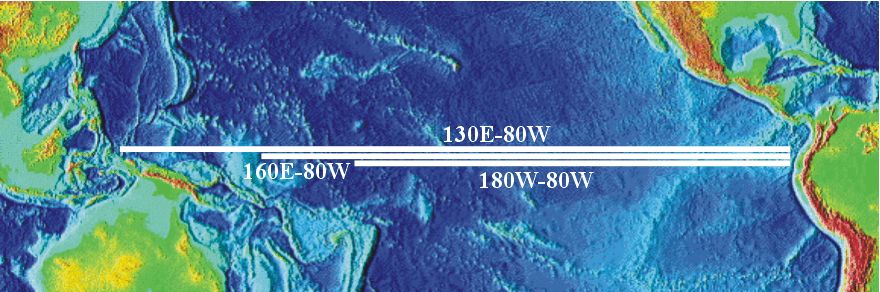
What the temperature variations are there unsurprisingly are unrelated to the Arctic.
andrew you want to look at the heat flux under the ice
http://www.oc.nps.edu/~stanton/fluxbuoy/deploy/buoy21_deltaT.html
http://www.oc.nps.edu/~stanton/fluxbuoy/deploy/deploy.html
steven mosher (Comment #80589)
steven mosher (Comment #80590)
While I appreciate the information, my point was merely to explain to commenter that his plot of “sea temperatures” that he was unsure if the covered the entire icecap, not only doesn’t cover the entire icecap, it doesn’t even cover anything within sixty degrees latitude of the icecap. In other words, the commenter was saying that there was no warming to explain the ice loss…based on temperature data from a completely different region of the Earth. I just think people should know what the data they plot actually is, and when people cite plots, the should understand them. Clearly the commenter didn’t understand the plot he was looking at. Not really his fault, Bastardi doesn’t really explain clearly what his charts are supposed to be of. Climate 4 You does explain, but you need to visit their site to see the explanation, which isn’t on the chart itself. I really can’t complain, considering how little labeling I usually put on my Charts, but still…
sorry I forgot the question mark after my sentence
Lucia: off topic, but on the topic of arctic ice, Jason Box has disappeared his blog post where we were discussing his highly selective criticism on the selective use of data.
.
He did a good job too, even the wayback machine can’t find it.
@Andrew FL
Yeah it looks like those boundaries used in the presentation I was looking at are useless. I don’t know why he even bothered to use them.
That’s interesting!
I don’t think you can disappear things form the wayback machine. BUT, you can forbid the wayback machine from crawling. Then it never gets in.
I find this discussion thought provoking in that if one were to model a system like Arctic ice melting in the summer months to a minimum for the year and it provided the developer some confidence in the prediction and the developer of the model could take various sides of a bet and at various odds which side would the developer take. For example, if the model indicated a 10 % chance that a record minimum would be reached this season would the modeler more likely bet a quantity 1 against a quantity 20 that a record would be set or a bet that a record would not be set by betting a quantity of 5 versus a quantity of 1. I know that the actual amounts bet would could come into play when making a bet. Does decision theory have anything to say about the side of the bet most likely taken.
Some people no doubt offer bets as a means, and I think often as a bluff, to show up others with countervailing views on an issue. If the countervailing views are based on uncertainties about future events then a non acceptance of a bet offer might be misconstrued.
I think I’ve had climate on the brain too much of late; last night I dreamed that I had thousands of dollars invested in a sea ice futures market, and was worried that I hadn’t checked the updated charts in a week!
Zeke–
Because I’ve been trying to improve my short term forecasting methods (to send to SEARCH for their final close out prediction for the summer), I have to work hard to avoid posting every day.
But, I run the script. Last night, the chances of going below the minimum and exceeding last year were equal. If I recall correctly, both were 14%.
Kenneth
I think the ‘cost’ and ‘benefit’ analysis of many public blog bets needs to consider factors other than cash. For some bettors, the cash factor likely dominates. For others, non-cash factors dominate.
Consider for example:
Blogger A proposes an even money bet to person B. They have widely divergent views. Person B has just described his views.
The publicity or spin surrounding the bets, negotiations, who wins who loses can, itself be something the person proposing the bet would pay money to obtain.
In this context if big-megaphone blogger A is frequently proposing bets where if blogger A is correct, he has a 99% chance of winning while if person B is correct, looking at the terms of the bet, person B has a less than 50% chance of winning because “noise” could carry things in either direction, one has to start wondering about the purpose of Blogger A’s bets.
It’s all well and good for Blogger A to claim that the terms are set because he wants to win money— but there is more than that. If A wanted to do was win money and there is a large spread in beliefs about the future, he could easily propose bets where person B would– if correct– have a better than 50% chance of winning. Moreover, if you were really trying to make money, that’s what you’d do. Winning 2 out of 3 even money bets can make you a lot of money. Proposing tons of bets that you think would put you on the winning side in 99 out of 100 cases because you think you are more prescient than others would make you more: if you could entire the other guy to bet.
But if you formulate the bets so the other guy thinks his chances are less than 50/50 even if he’s right about the future, he’s probably not going to bite. He shouldn’t bite. The outcome is no bet and you make $0.
And with blog bets we see a lot of bets where person B is right, Blogger A proposes a bet where B has a less than 50% chance of winning.
Zeke I cant stop watching the ice. I expect to wake up one day and see that its all gone. flash, slush puppy vanishes.
If steveF is around he might like this paper
http://wattsupwiththat.com/2011/08/19/anoter-sea-level-rise-fallacy-falls-short/
There’s a show on television (or cable, dunno) called The Marriage Ref. In the show three couples take their marital issues to the host and a panel of judges to determine who is “right”. The spouse that is the “most right” wins a billboard in their home town proclaiming their rightness to the world.
If I had a smidgen of spare cash and an urge to prove to the world how right my opinions are, I’d consider a bet where my rightness or wrongness would be posted on the billboard for the world (or home town) to see. Caveat: I have no clue what the costs are for billboard space.
Mosh,
Thats certainly some interesting spin on it from Anthony. Not that anyone really expected paleo SLR to be dominated by thermal expansion…
One commenter on Watts’ thread is talking about the thermal properties of water… hinting that the colder parts of the ocean (<4degc) would actually decrease in volume with increasing temperature.
.
Is this expected to be a significant effect?
@Zeke
Zeke I note you take the “history started when I was born” position that Lucia and Mosher also assume. It is hysterical to me that whenever it is pointed out that something “new”, “unprecedented” or “record breaking” is shown to be a hoax because it’s already happened before, you get extremely defensive and claim spin.
@Mosher
I thought I would pre-empt my assault by notifying you that I plan on slathering some thick, heavy barbecue sauce on you when the ice all comes back. For somebody so smart, you’re being a fool for not looking at the temperatures. The temperatures deliberately are not reported because they aren’t changing. Furthermore, I can simply point to a random point in history when there was less ice and thus prove you cannot attribute melting ice to global warming.
Zeke.
I stopped reading the thread. There is just so much I can take.
Mosher, many of the GISS adjustments seem to go past colder, making warming higher. Perhaps these are just neutral adjustments or the reverse are not mentioned or noticed. What was the reported record 1998 temperature?
In line with this thread, are you willing to bet that the 2000-2009 GISS average in 2019 is lower than the current number, .516?
Not sure how to adjust for a changing baseline.
Mosher, many of the GISS adjustments seem to go past colder, making warming higher. Perhaps these are just neutral adjustments or the reverse are not mentioned or noticed. What was the reported record 1998 temperature?
#######
They are not adjustments.
You will have to quantify the word “many”
You will also have to understand the reference method. That means read the code. In a warming world, when you add new data in the past ( which is WHERE it shows up) do you think
that the new data is likely to be warmer or colder?
Record temps are meaningless with a statistical context. I dont bother to look at them and think its a mistake to focus on them. It’s beside the point I am trying to make. A point you have not addressed. So, no changing the conversation.
“In line with this thread, are you willing to bet that the 2000-2009 GISS average in 2019 is lower than the current number, .516?”
In 2019 Giss will probably have moved on to F16 nightlights ( they should have in 2010) or by that time maybe F17. In 2012 they will move to GHCNv4, so who knows which way it will turn out. The bottom line is the data is all available. If you dont like the way the RSM works, write your own code. Higher or lower? coin flip. I dont bet on coin flips.
steven mosher (Comment #80608)
August 19th, 2011 at 9:48 pm
But WUWT is the worlds most popular science blog.
Yea, I should have qualified my bet. You figure higher or lower is a coin flip. So I’m guessing with 2-1 odds for higher temps, you would consider that a bet worth taking, with say bet cancelled at equal temps? Not sure what you mean by different methods, but I am talking about what would be reported at
http://data.giss.nasa.gov/gistemp/tabledata/GLB.Ts+dSST.txt
>You will have to quantify the word “manyâ€
I don’t really have an idea, just an overall impression that other blogs have mentioned as well. If you look at the historical annual reports at GISS, this seems to show some adjustments more in line with what I said. I think I’ll start pulling the GISTEMP numbers to quantify this.
>You will also have to understand the reference method. That means read the code.
I didn’t read the code, but I think I see your point. I get that it could be colder or warmer changes.
>In a warming world, when you add new data in the past ( which is WHERE it shows up) do you think
that the new data is likely to be warmer or colder?
I don’t see your point here. I don’t see why it would be one or the other, but you seem to be suggesting something else. What am I missing? I realize that I am now arguing against myself.
>Record temps are meaningless with a statistical context. I dont bother to look at them and think its a mistake to focus on them.
But the bets are being made based on such things. 2000-2009 was a record, and that 2010-2019 would beat this record and convincingly.
>It’s beside the point I am trying to make. A point you have not addressed.
Which is?
Yea, I should have qualified my bet. You figure higher or lower is a coin flip. So I’m guessing with 2-1 odds for higher temps, you would consider that a bet worth taking, with say bet cancelled at equal temps? Not sure what you mean by different methods, but I am talking about what would be reported at
http://data.giss.nasa.gov/gist…..s+dSST.txt
#########
By different methods I mean that by 2019 GISS will have switched methods and datasets.
>You will have to quantify the word “manyâ€
“I don’t really have an idea, just an overall impression that other blogs have mentioned as well. If you look at the historical annual reports at GISS, this seems to show some adjustments more in line with what I said. I think I’ll start pulling the GISTEMP numbers to quantify this.”
####
Good pull the numbers. While you are at it, you should run
GISSTEMP every month. That way you could see which numbers change ( In the station data that they ingest ) That would go a long way toward clarifying your confusion.
>You will also have to understand the reference method. That means read the code.
I didn’t read the code, but I think I see your point. I get that it could be colder or warmer changes.
######
No you don’t get the point. Explain the reference method.
>In a warming world, when you add new data in the past ( which is WHERE it shows up) do you think
that the new data is likely to be warmer or colder?
I don’t see your point here. I don’t see why it would be one or the other, but you seem to be suggesting something else. What am I missing? I realize that I am now arguing against myself.
######
You need to understand the reference method.
>Record temps are meaningless with a statistical context. I dont bother to look at them and think its a mistake to focus on them.
But the bets are being made based on such things. 2000-2009 was a record, and that 2010-2019 would beat this record and convincingly.
######
if jimmy jumps of the empire state building does that mean I have to? I’ll prefer to talk about trends, 10 years? way too many caveats to make it interesting.
.15C per decade, but I would not be shocked by anything .15C higher or lower. That’s well within the spread of a GCM.
>It’s beside the point I am trying to make. A point you have not addressed.
Which is?
######
1. That GISS does not “adjust” the data to cool the past.
2. You can see that by
a. archiving the data by month
b. running the code each month.
what you’ll find is that
A. the source data supplied by OTHERS changes
B. The algorithm stays the same and spits out different
numbers.
B happens because:
1. the input data changes (see A)
2. the algorithm is sensitive to the overlap in station reports.
To understand 2 you have to:
A. read the code
B. run the code
C. understand the algorithm.
When you do understand the code you’ll say.
GISS’s Reference Station method has an odd property. I suggest we use a better method.
The way you put it imputes motives where you have no evidence of motive. And If you looked at it you would understand that it’s just the result of a algorithm.
Done. I’m gunna write code now. later
Mosher [re: 80614]
Maybe you should make a proper effort to get off your verbose hobby horse. And your very arrogant habit of putdowns [“Only so much I can take”. ” Paintings are not calibrated”. And several others along the same lines]. It’s getting tiresome, and detracts from this blog. Yeah, you may have been in the thick of Climategate, but what have you done for me this week? [Just the ol’ CEO in me coming out…]
So [OT] why don’t you give all of us here -based on your unbridled self confidence and superior insights into stats and all other analytical methods you purport to master- a bet on 1] the likelihood of a recession in the US and the EU within the next two quarters. 2] A bet on the likelihood of the Euro imploding over the same time period. And 3] a bet on the likelihood of China imploding as a result of losing 35% of its foreign currency reserves in the event the Euro goes sideways.
FWIW my bet: [1] 60/40. [2] Is at best a 50/50 and more likely 65/35 at this stage of the game. And [3] most of us would not want to start thinking about that in terms of what that might do all of us in the OECD economies -and that includes your business ventures. My bet: should the Euro implode, China’s development -and its current socio economic structure- will be rattled to the core and the chances of the [CC]Party managing the outcomes are slim, indeed.
So if you are so cocksure about your analytical abilities, give the above bets a crack. Their outcome is way, way more important than the 2011 Arctic sea ice minimum or AGW/ACC for that matter. The subject of your pontifications and putdowns.
BTW I live by my “bets”, which are implemented in the way I have restructured my investment portfolio to guard against them. So my money -and the bread I make- and my mouth are in sync. I sleep well that way.
PS: Lucia
I am sorry that there are no mathematical models or trend analyses to substantiate my “bets”/”expected outcomes” above.
Only 35 years in various shark pools around the world. 🙂
FWIW: as far as the Arctic is concerned: 2011 lows may continue to “tickle” 2007 September numbers, but I don’t expect them to go below.
tetris. I dont need to bet
I poo gold
http://www.youtube.com/watch?v=DUFQ-Wn8J9Y
Mosher, there is no-one quite so annoying as a capable smart-ass.
steven mosher (Comment #80603),
I had read the abstract to that paper. That thermal expansion is small compared to glacial contribution seems pretty obvious just looking at the Levitus data (and others, but those don’t seem nearly so solid). Thermal expansion in the last century probably accounts for ~20% of the total sea level rise. Were there to be much more rapid temperature increases in the coming decades (compared to the last 5), thermal expansion would be greater, of course, but almost certainly would continue to be dominated by glacial melt at all time scales.
Hmm, I’m a bit confused by your response.
>GISS’s Reference Station method has an odd property. I suggest we use a better method.
The way you put it imputes motives where you have no evidence of motive. And If you looked at it you would understand that it’s just the result of a algorithm.
I have no evidence of motive, fair enough. But are you saying the reference method and GISS’s algorithm does cause things to go cooler in the past inadvertently, when they do their updates?
Or do you think it is 50-50?
MikeN
“I have no evidence of motive, fair enough. But are you saying the reference method and GISS’s algorithm does cause things to go cooler in the past inadvertently, when they do their updates?
Or do you think it is 50-50?”
I would start here
http://climateaudit.org/2008/06/28/hansens-reference-method-in-a-statistical-context/
The method works by starting with the longest series and then adding other series based on their length, calculating an offset.
The problem is twofold
1. The answer is not consistent with MLE. This is why I prefer
Tamino’s method for reference stations ( its in my package)
OR Roman’s method, or Nicks method.
2. As time goes by “the longest record” can CHANGE. That is,
suppose you have two records. one is 25 years and the other is
23. Then suppose the 25 year record stops updating. In 3 years
the 23 year record will be the longest.
It’s unclear to me whether this will result in a 50/50 split or if
in a warming trend it will cause the estimate of the past to be cooler. That is probably something that could be simulated. Or as I suggested if you want to understand the in’s and outs of the algorithm start studying it. Or just run GISS yourself and look at the data that gets output after the RSM step is done. It’s not a question you have to wait until 2019 to answer. You could establish that the algorithm has this property. And no I wont do your work for you. You could establish yourself as a nice little analyst and get a pat on the head from tetris.
I will tell you this. When GISS cools the past and you see the trend increase they are getting CLOSER to the best estimate. that estimate is provided by RomanMs approach. Yes you read that right. The best estimate is warmer than CRU and warmer than GISS, so to the extent that the RSM is changing over time to warmer trends.. they are improving.
Then again, it might not be the result of the RSM at all. It might be source data changing. You would have to do that investigation.
>The best estimate is warmer than CRU and warmer than GISS,
Here’s the thing. If the correct numbers are to cool the past, then doesn’t this suggests that the GISS estimates for CURRENT temperatures are too high?
>It’s unclear to me whether this will result in a 50/50 split or if
in a warming trend it will cause the estimate of the past to be cooler.
So you think it is either neutral, or perhaps leans in the direction I suggested. I guess I will have to go see the code. I don’t see why the warming world would make it lean one way or the other, as the comparison is in the same time frame. You would have to pull new data from colder areas to get a cold bias, wouldn’t you?
I think we have come back to that Tom Fuller is at a disadvantage due to GISS adjustments. You are somewhere between it is a 50-50 split and maybe GISS adjusts the past downwards, not deliberately.
>It’s not a question you have to wait until 2019 to answer.
How would I know what source data they have in 2019? You think the primary changes happen because some stations stop reporting data?
By the way, I do have evidence of motive, that should be clear to everyone. What I do not have is evidence that this motive is what causes the effect, or even evidence that this effect exists.
>The best estimate is warmer than CRU and warmer than GISS,
Here’s the thing. If the correct numbers are to cool the past, then doesn’t this suggests that the GISS estimates for CURRENT temperatures are too high?
################################
you misunderstand. The number that matters is the trend. Not an individual month or year. We know that GISS’s method is sub optimal. We know that CRUs method is sub optimal. We know this because of the work of skeptics. We know that when optimal methods are used the trends increase. Those increases are a combination of a cooler past and warmer present. For current temperatures CRU is too cool, GISS is a bit closer. But we ware talking within the error bounds. In short, that dog dont hunt. It doesnt even bark except in the fevered brains of a few
>It’s unclear to me whether this will result in a 50/50 split or if
in a warming trend it will cause the estimate of the past to be cooler.
So you think it is either neutral, or perhaps leans in the direction I suggested. I guess I will have to go see the code. I don’t see why the warming world would make it lean one way or the other, as the comparison is in the same time frame. You would have to pull new data from colder areas to get a cold bias, wouldn’t you?
###########################
I think nothing except you should go do the work and put numbers on your claims. This is one of those things that fascinated me 4 years ago when I first saw it. It still fascinates some who refuse to look at the code we fought to free. It’s a non issue technically.
“I think we have come back to that Tom Fuller is at a disadvantage due to GISS adjustments. You are somewhere between it is a 50-50 split and maybe GISS adjusts the past downwards, not deliberately.”
the reference method has no motive. When input data changes the answer changes. AS IT SHOULD.
“>It’s not a question you have to wait until 2019 to answer.
How would I know what source data they have in 2019? You think the primary changes happen because some stations stop reporting data?”
I think nothing. I’ve laid out for you the possible mechanisms by which output numbers can change. I don’t see what your problem is. get the code. get the old data. keep new data as it comes along. Watch what happens. Diagnose what happens and why.
FWIW, the reason I took Romm’s bet was that he was shutting other bettors out because their websites didn’t get enough traffic.
Plus I thought I might catch a lucky break–it is a sawtooth waveform superimposed on a rising trend and it just felt we were due for a dip.
And then there is the fact that Romm really acts like a jerk and he’d never shut up about nobody betting him, after disqualifying everybody who wanted to bet him.
Kind of like some who were saying Skeptics couldn’t have a point because they didn’t publish while working behind the scenes to keep them out of the journals.
MikeN:
With these algorithms (that anomalize relative to a preset baseline), it depends a bit on whether the new data falls in your baseline period or not.
Also, high latitude stations have a larger trend, so increasing the density of high latitude stations, especially in the pre-1950 data which had many missing cells, should increase the trend for that period.
Since you are baselining the anomaly period to say 1951-1980, increasing the temperature trend of the data of some data range prior to 1950 will cause the temperature to drop relative to the baseline period (remember it is pegged to go through zero in the baseline period). But this is due to the high northern latitudes having a larger trend, not because they are “colder” sites. (Colder versus warmer first order effects are removed by anomalizing.)
Actually it turns out that higher latitudes are over-represented in the pre-1950 data, so it’s likely that adding new data will have the opposite effect (we’d expect an apparent warming of the data, and the pre 1950 temperature trend would get reduced).
Maybe. But the list of blogs cut out by traffic meant Real Climate bloggers couldn’t bet had they wished to do so.
Anyway, his defining “anyone” to a very restricted list after people said they’d take him up on the bet suggests to me that his bet offers are somewhat disingenuous.
Concur.
>I think nothing
Easy to get misquoted there.
>except you should go do the work and put numbers on your claims.
I did put a number on it. Past gets cooler means something more than 0, at least .01, putting Tom Fuller at a disadvantage. You went from arguing against to ‘thinking nothing,’ wanting me to do research and eventually end up perhaps back where I started?
It occurs to me that Tom Fuller is at a further disadvantage in his bet because GISS changes the numbers, making the past cooler.
########
Write this sentence using only things that you know or can verify.
“Write this sentence using only things that you know or can verify.”
Steven Mosher, if you actually held this standard there would be nothing about climate science for you to read. -Andrew
Well I thought I had some more information on this when you said you thought it was 50-50. I wasn’t interested in betting, but if I were, I would have thought 2-1 odds was favorable for me, and 50-50 very favorable. Your saying you consider it to be 50-50 changes my information and makes me very unlikely to bet. Then you backed off of that and said you were unsure, it might be 50-50 and it might be worse than that.
Andrew_KY (Comment #80702)
August 23rd, 2011 at 9:40 am
“Write this sentence using only things that you know or can verify.â€
Steven Mosher, if you actually held this standard there would be nothing about climate science for you to read. -Andrew
#####
interesting. Looking at your sentence you say there is nothing in climate science that can be verified. Can you verify that?
I suppose this means you are giving up your belief in the LIA or MWP? giving up your belief that water is made of H2O? that there are ocean currents? that the sun shines? that there are clouds? that thermometers should be well sited?
I’ll suggest you not make frivolous sweeping generalizations
It’s easy Mike. Knowing nothing I’d guess it was 50/50. Looking a bit harder at the algorithm.. It might have a bias, but that bias would depend upon certain things. nevertheless, when you say things like “giss does this” you sound like goddard. That is not a good thing.
“giving up your belief that water is made of H2O? that there are ocean currents? that the sun shines? that there are clouds? that thermometers should be well sited?” None of these things are “climate science”, Mr. Mosher. Climate science is the production of squiggly lines. -Andrew
I am glad Romm posted here. I still don’t know if his writing style makes it entirely unintentional that he writes one thing that most people will interpret one way, but he actaully means something else. This is not something you will pick up on at his blog.
“I’m happy to make bets with any bloggers, like Andy Revkin…”
Does not simply refer to Revkin as a “any” blogger, but to qualify “any” to mean someone who has a blog with a large number of readers.
There are plenty more examples that I don’t want to spend the effort to quote… as well as multiple examples of him assuming someone means something they do not.
“The fact that he wouldn’t take the bet was clarifying, at least to me.”
We know from the post that Revkin thinks the Artic is on a downward trend but thinks the exact speed is unknown and that what is known is that there is not a death spiral.
Even after Revkin clarified in another post that he thinks the odds of winning the bet are 50/50, Romm still thinks this is telling that Revkin does not believe in what he is writing about. What?
The distinction in ideas is in the death spiral, which Romm seems to admit (right after the part about the bet in his update he says “The death spiral continues”), not the range of extent that Revkin already believes is possible. How does not taking a bet regarding the mid range of extent equate to Revkin’s belief in the death spiral?
I have to agree with Lucia about the terms of Romm’s bet as well as his reaction to it is far more revealing than Revkin not accepting the bet.
Lucia, regarding the Connolley-Dekker (yep, that’s me) bet, you write :
RD’s bet is well outside my current 95% uncertainty intervals for prediction. Connolley is well inside the uncertainty intervals.
I’m curious, did you already present the model that you used that defined these statements, and if not, can you please present it ?
Rob–
My current method is discussed here:
http://rankexploits.com/musings/2011/weighted-prediction-of-ice-melt/
It’s a weighted method. So, combine individual models. One of the individual models checked is described here:
http://rankexploits.com/musings/2011/nh-ice-update-vulnerable-ice-method/
If I understand correctly,you win if the ice is below 3.8. By Aug 12, my model says that position was out– you can read the text in the lower left hand corner.

Rob–
Oh. Sorry– reading this morning, thought it was a 2011 bet.
I’m not sure what I thought back when I posted that comment. I’m sure I haven’t posted anything about longer term projections– but I’ve done odd computing at home. Let me look to see what I’m getting on that. It may or may not be out. I can post on that later. I was planning to. We’ll see if your position is out.