Time for the Wednesday update when you can learn who is on track to win the quatloos. But first, let’s look at this weeks events in the Arctic.
Extent Loss
This week was the second week of rapid extent loss in the arctic. Similar to last week, the 7 day average extent loss rate fell inside the bounds previously observed at this time of year, but it was high. The 7 day average extent loss rate is shown below left with this is shown in black, with this years rate in black. The final “dot” indicating the rate if the most recent daily extent loss is maintained 7 days. Below right is the daily extent loss rate showing only years when JAXA was fully operational. Some daily records were set for JAXA, but this is expected to occur rather frequently as there are 365 days in a year, and many fewer years of JAXA operation:
 |
 |
| Click graphs to enlarge. |
Nevertheless, as I mentioned last week: We don’t need to see extra ordinarily daily or even weekly extent losses to beat the 2007 minimum. All we’ll need to see is sustained losses at the high end seen previously or a melt season on the long end of what has been seen. Both remain possible.
Current Extent
Despite higher than averages losses for this time of year, the current extent remains above the minimum for this day set in 2007:

Current Area
The qualtoo bet is on extent, but discussion often turns to area. The 7 day smooth area is at a record low for this day of year, but we have not yet reached the absolute minimum. The 7 day smooth areas for various years are shown below left.
 |
 |
The unsmoothed area is shown above right. I focused on 100 days around the current day to let you see how close to setting an all time daily record low we came this week. I thought we’d reach it when the black trace indicating 2011 reached a relative minimum and then rose back up. Coincidentally, this happened at nearly the same time of year in 2007.
Current Prediction
As a result of the rapid loss, I tweaked my prediction method again! Previously, the regressors included ( 7-day smooth extent, 7-day smooth areas, PIOMAS July 31 volume, blah, blah, blah…). I’d liked using smoothed extents because it prevented my forecasts from oscillating too much from day to day.
However, it seemed to me that as we near the final minimum with so little time available for changes it might be useful to include the most recent extent without smoothing. This seemed particularly important as the extent loss is on the high range or anticipated values– using the smoothed extent meant that the recent losses only fully register 4 days after they are first reported.
So, I added the unsmoothed extent to the regressors; it turned out this gave a superior corrected Akaike coefficient (AICc) for predicting the minimum 7-day smooth extent. (Note: When I add a regressor to the mix, I don’t remove any. The “method” automatically selects the best for the current date using the AICc values. The weighted method lets me do include many regressors with little risk of over fitting.)
Owing to the fairly rapid recent extent losses, and my decision to switch to a method that fully incorporates the recent extent loss now rather than four days from now, best estimate for the minimum 7 day extent declined to 4.4 millions square kilometers. This is above the minimum 7 day extent recorded in 2007. Assuming the errors in my methods are normally distributed the chance of breaking the 2007 extent is estimated at 21%. This estimate says the record is well within the possibility of happening. On the other hand, according to the model, the chance of this years melt exceeding last years is 0.1%. That’s pretty small!

(For those wondering: Oddly, when I apply the exact same method for the NSDIC September mean, the AICc criterion indicates that the smoothed extent gives a better prediction of the NSDIC extents. So, there isn’t a big change in forecast for that. Go figure.)
Histogram
Now to see who is leading the pack– according to the forecast. If you click to read the text, you’ll see the front runner is BobZ!

(Note: Current value is smoothed extent.)
Other things to notice:
- My bet (in yellow) looks like it’s going to be high. I used my incipient statistical method based on extent only, and that was a high value. Oh. Well. My estimates did drop after CRandals suggested I look at area, and I started hunting down more data to add. But it looks like I was a day short, and I’ll be five quatloos shy!
- The Blackboard mean (purple) is not only high, but outside the ±95% confidence bounds (blue). I haven’t recomputed taking out the math-enabled ‘bot or suzanne, but they bet, so they count in the mean.
On the other thread, (I think) Nick Stokes tells me JAXA’s values for today are in. They must have come in while I was writing– and I’m not going to rewrite. Bad timing on my part. If you like, maybe tomorrow I’ll rerun and show a new histogram in comments. Meanwhile those of you who know you are out of the running: you’re in good company. Each week a different person has been the closest contender. No one knows who will win!
Lucia, I’ll be on vacation from 13th to the 27th September, with little access to the internet, so can you make sure the minimum is reached before then, please? Otherwise the tension of not knowing if I won or not will ruin the vacation.
Thanks in advance
Steve T
steveta_uk–
I’ll test out my new supernatural powers and see what I can do!
lucia (Comment #81040),
Might those powers also be used to influence the outcome of elections? Just askin’.
SteveF–
I need to train and develop them more. With some luck, I can develop the powers to the point where I can dictate all decisions in Congress and by the President by telepathic control.
Hi Lucia
Would you hate me forever if I correct your grammar?
“your” is a possessive pronoun.
e.g. “that is your estimate”.
“you’re” is a contraction of “you are”.
e.g. “you’re in good company”.
That particular substitution is a pet peeve of mine.
Please forgive my bad manners.
Michael J
Michael J
No. I won’t hate you. But grammar lessons won’t improve my typing or proof reading.
You’ll also see I occasionally will type “it’s” for the possessive and spell all sorts of things incorrectly especially if I post between 10 pm and 11 pm. 🙂
Patent Pending to solve ice problem.
http://i149.photobucket.com/albums/s54/hurricanedude/001.jpg
BTW isn’t it rude to correct your grammar or grandpa?
Lots of people standing around waiting for ice to melt…. sounds like something an alcoholic 8th grade science teacher would assign as a lab activity on a hangover day…
I am fully expecting low winds, lots of cloudiness and light precipitation to steady the melt rate and keep it above new-record levels. The precipitous rush to lower bets is misguided.
cyclone– I don’t know what your grandpa does. When people point out errors, I fix them.
Micheal.
your fergiven
Michael, it’s Lucias beauty spot.
Notice I used “it’s” correctly 🙂
Moshers typing OTOH strikes me as far uglier than Lucias but he’s a man so he’s fergiven too.
First time I read Lucia and saw all the typing problems I thought she was a dude. For me I’m so left brained that my right hand is the only one that can actually type. oh except my middle left finger. It’s pretty good.. crossed trained it.
Such is the nature of humans. We tend to be exceptional at crunching numbers or as a wordsmith but rarely both. In my case I am not exceptional at either but tend towards the written word and language. More of a Jack of all trades and master of none I suppose. Put a $ sign in front of those numbers though and everything changes.
Lucia has demonstrated excellence at crunching numbers for a long time so I simply overlook her sometimes quirky word usages. We all have “stuff” but her stuff never interferes with my understanding her meaning. I see no need for the grammar police here.
Type on Lucia!
I took the JAXA extent data from 1/1/2007-8/30/2011, resampled to 365 days/year and ran it through the R decompose function. Decompose breaks the time series down into seasonal variation, low frequency trend (365 day moving average filter after removing seasonal variation) and residual after subtracting trend and seasonal. It’s still time domain analysis, but I think it’s interesting.
Residual (random) plot.
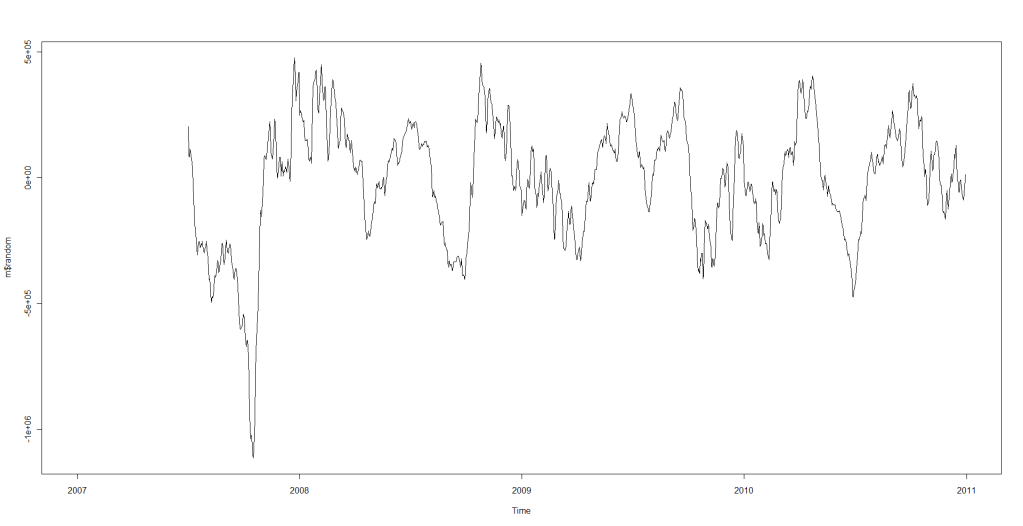
It does look like there is a new, relatively stable seasonal pattern. Note the big spike down in 2007. I’m guessing that represents the export of multiyear ice through the Fram Strait. That’s also, IMO, the reason the seasonal pattern changed. Now that there is less multiyear ice, the rate of melting is faster in July and August than before 2007. I guess that means I should be using the 2008-2010 daily average to estimate minimum extent.
Trend plot.
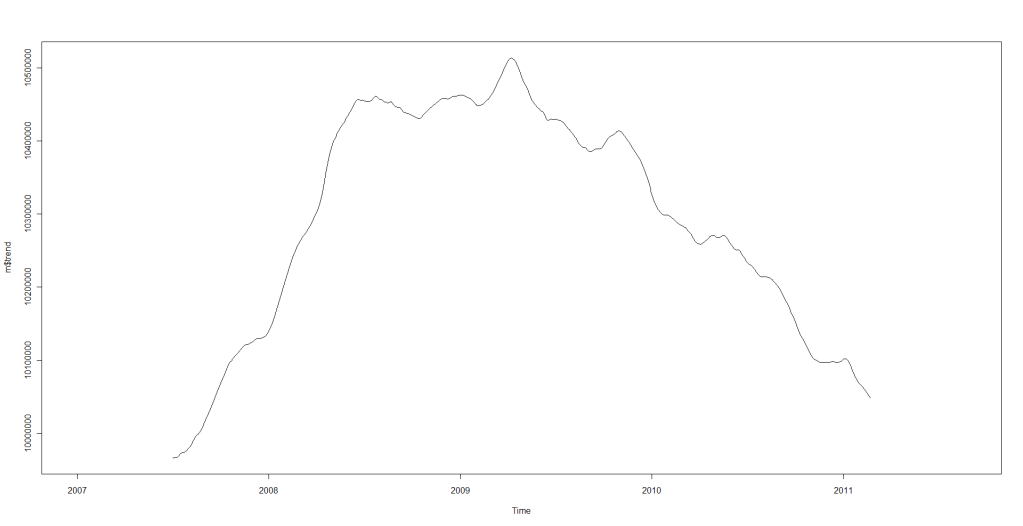
Until 2009, there was some hope that the Arctic ice was actually recovering somewhat. El Nino put an end to that.
With 2011 looking like a damned near run thing with 2007, I have to wonder if any the really vocal prominant ‘sketpics’ every have a flicker of doubt and think about what if they are wrong. Perhaps this whole sea ice retreat is a long term trend and we will have a much warmer summer Arctic in the coming decade or two.
I strongly doubt any of them do. But it cant be a pretty thing to reflect on, being seen as a dishonest crank by every future writer of the history of climate science.
dorlomin
I have no idea. As the wonder is in your mind, I need to ask you who you consider to be ‘sketpics’ (mispelled and in scare quotes). Until I know, I can’t begin to speculate what their positions are, whether the current events would result in flickers of doubt about their position or whether the current events should result in any flickers of doubt about their views.
Who or what is seen as a dishonest crank? The ice melt (i.e. what?) Whoever it is you describe as a “sketpics”? (i.e. who?) Something or someone else?
Why is it that when I put on to many blankets at bed time I sweat a lot but when I take them off I stop sweating?
dorlomin (spelling double-checked before posting),
The history will be written in two possibilities:
“Even though James Hansen’s climate propositions were off by more than half in the early empirical evidence of the response rate of global climate, he was eventually proven right by 2100 as global warming approached 2.0C and the discrepancy was accounted for.”
or,
“Even though James Hansen’s climate propositions were off by more than half in the empirical evidence, the climate science establishment continued to push the proposition and society very nearly de-industrialized by 2020. It was only in 2025 that modern society was saved and a major error was discovered and proven in the assumptions regarding the theory. This error matched the more than 50% error rate in the empirical data and the new more accurate theory of climate has proven to be reliable ever since.”
Off by more than half is the word to take note of.
Lucia,
This pose you occasionally adopt of pretending you don’t understand what people are saying really gets old after a while. It’s perfectly clear that the people dorlomin thinks ought perhaps to be worried about being universally considered dishonest cranks in the future are the same ones he refers to as “the really vocal prominant ‘sketpics’ ” and you clearly are sufficiently aware of the rest of the climate blogosphere to know who several of those people would likely be (on Arctic sea ice in particular, Watts, Goddard and Bastardi come easily to mind).
Jon
I don’t know why you think it’s clear Dorlomin means Watts, Goddard or Bastardi. I’ve been called a skeptic as have many of my readers. I don’t know how I am supposed to know he doesn’t mean me, Steven Mosher, Steve McIntyre, Jeff Id, SteveF, Carrick etc all of whom post regularly (i.e. are vocal) etc. Dorlomin is leaving the comment here– not at WUWT. I have no idea how I would know with any certainty he means Watts, Goddard or Bastardi. If dorlomin means Watts, Goddard and Bastardi he could just day “Watts, Goddard and Bastardi”.
Lucia,
A couple of years ago, Paul Graham wrote the essay Keep Your Identity Small. An excerpt:
To keep this comment on topic, I would have had to have substituted “climate” — or perhaps “climate science” — for each mention of “politics”. But you and this blog’s audience already figured that.
My advanced prediction method is telling me to stay with my original bet.
DeWitt:
That was my belief too. This is as close to metaphysics as I will get to:
The ice loss in 2007 was a “body slam” to the arctic ice climate system, and it’s pretty common in complex systems that when you hit it hard enough, you move it to a new (perhaps lower) minimum energy state.
These type of systems can be “sticky”, so they oscillate around one minimum until a large enough perturbation occurs to shifts them to fluctuate around (what is now) a lower minimum energy state.
Another good example of this is e.g. what Pinatubo did to stratospheric temperatures.
If there hadn’t been a Pinatubo, I believe TLS eventually would have flipped to this new lower minimum temperature, it just would have taken longer. (This particular figure is also a really good example of the abuse of linear trend estimation, IMO.)
@Lucia, a number of people have made very pugnacious predictions over past 4 years about the future direction of Arctic sea ice extent, the likes of Bastardi, Goddard and Watts. I was just wondering aloud (perhaps mischievously) whether such people are given to doubts when the data seems to run against them.
Last year around the time of the US elections I had said (here on The Blackboard) that for the most part the climate debate was over, everyone was dug into entrenched positions. It was now a long slow haul as data overtook opinions rather than an exchange of ideas. This is one of the first of those moments where the most enthusiastic opinions appear to be falling to a bit of data.
If the opinion is that ice was in the process of recovering from 2007 — and quickly, I think that one is going to have to go away. But it may just be replaced with it could potentially recover but slowly. It’s hard to speculate what others will think is happening without asking them. But if you mean Bastardi, Goddard and Watts, I’m sure we’ll learn what they think within a few months.
I’ve pretty much always figured that the long term trend is for ice to decrease. So, this year pretty much falls in line with what I expect.
dolormin #81063,
Sure, the politically motivated on both sides of these issues are always dug into their positions. But I think that is not a fair representation of many people who have commented on this blog (and lots of others).
.
The decline in Arctic sea ice cover is consistent with the overall warming trend seen in the high latitude north. What is not clear is how much (if any) of that decline in ice cover is the result of long term variation (eg, 60+ year pseudo-cyclical) and how much due to GHG driven warming. We just don’t have a long enough record to know that. We do know that there has not been a comparable change in the Antarctic, which ought to plant a small seed of doubt in thoughtful minds.
.
But speaking of “those moments where the most enthusiastic opinions appear to be falling to a bit of data”, certainly the low rate of ocean heat accumulation over the last 8 years, lower rate of warming than the IPCC’s ~0.2C per decade projection, and the multi-year decline the the rate of sea level increase all fall in the same category as the faster than expected decline in Arctic sea ice. I keep expecting that at least some of those who loudly proclaim their certainty of future worldwide doom from GHG forcing to acknowledge that maybe (just maybe) it isn’t “as bad as we thought”. Please tell us when you start to hear that kind of comment among the faithful.
Re: Carrick (Sep 2 04:11),
I wish I had the geographic breakdown data for ice extent or area for 2007, particularly the Greenland Sea. What I have from NSIDC stops in 2006. CT has it because they publish anomaly plots. I’ll ask William Chapman if there’s a link to that somewhere.
The stratosphere is interesting because it’s not just CO2 causing cooling. There was loss of ozone too. But fluorine concentration has peaked and is starting to drop. That could mean we’ll see an increase in temperature, or at least a continuation of no change.
DeWitt–
Heck, I’d like the NSDIC daily extents from 1979-now. But…. alas….
I know the data exist, but they don’t seem to be online. (I don’t necessarily blame them for not putting it online. There are people who are very demanding about the quality of anything online. For my purpose of SWAGGING the upcoming minimum, noisy, imperfect data is generally better than no data. If the data is really skanky and noisy, that will generally just make the fit to that data set worse than one might expected based on whatever underlying ‘physics’ connect a regressor and regressand, that predictor will be a low weight and — if the predictive ability is too small, will get kicked from the list of candidate models.)
I’d also like the Bremen stuff online. L. Hamilton is posting graphs of UBremen stuff:

As you can see it’s reading low relative to JAXA. If the U Bremen dailies (or even monthlies) were online, I’d add that to my weighted model to see how that changes my predictions for the upcoming minimum. As they are reading low relative to JAXA,that would likely make the best estimate for the ultimate minimum JAXA lower– but I can’t be sure since I would need access to the data L. Hamilton used to make the plot estimate how much lower. Alas, it is not yet online. 🙂
At Arctic sea ice minimum discussions, RealClimate has auto-updating graphs of JAXA Sea Ice Extent and JAXA Sea Ice Area. There’s also the current Cryosphere Today image, and a static graph of Estimated Sea Ice Volume from UW PIOMAS.
The comments are less RC-ish than usual. L. Hamilton provides some additional links at #14.
DeWItt:
If you find it & he gives permission, please feel free to post!
GSFC had it broken down by region, but their data sets both stop before things got really interesting.
Lucia, thoughts on the editor of Remote Sensing resigning?
Lucia,
“If dorlomin means Watts, Goddard and Bastardi he could just day “Watts, Goddard and Bastardiâ€.”
Why should dorlomin have given specific names? He wasn’t asking anyone to read someone’s mind for him. He wasn’t administering a test so I can’t see why you feel he was under some obligation to supply all the data required to answer it as though it were a scholastic exam. If I write something here along the lines of “I sometimes wonder whether any conservative Republican elected officials skeptical of anthropogenic climate change ever think about how they’ll be regarded in future if it turns out to be a serious problem.” are you going to attack me for not supplying a full, completely up-to-date list of current Republican elected officials who meet my personal definition of conservative?
That said, I take it you’re conceding that you knew dorlomin wasn’t suggesting the ice melt might in future be regarded as a dishonest crank. What was the point of playing so dumb as to pretend otherwise? Are we supposed to write our comments here on the assumption that you aren’t aware of such basic things as “ice melt’ not being an entity capable of expressing itself either honestly or dishonestly?
The reason I can think of is if he wanted us to know what he’s talking about.
As it stood, I didn’t have any idea whether I would either a) share his doubts expressed in the first sentences.
The 2nd sentences I just flat out didn’t understand.
Dorlomin contributed to a conversation. I don’t think asking him who the “sketpics” were so that I could continue the conversation without strong risk of miscommunication is an “attack”. If you wrote that vague statement and I wanted to discuss it further, I would point out that I didn’t know which republicans you meant and so I couldn’t begin to speculate what they might think of do in the future. I would not consider this an “attack”.
Conceding? I just flat out didn’t understand the second sentence
in
I guess he meant “Being seen as a dishonest crank by every future writer of the history of climate science can’t be a pretty thing to reflect on”, but when I read the whole comment, I didn’t know what the “it” referred to as the notion about being seen as a crank isn’t introduced until after the word “it” is used. I was scanning to figure out what dorlomin meant and kept trying to refer “it” to some body, thing or concept said prior to the use of the word “it”. I was puzzled what he meant, so I asked. This seems to bother you. Oh. Well.
Dr. Jay, I speculate that Lucia only posts Squiggly Line Stuff anymore because the rest of Climate Science has become pretty inexplicable and would only be a chore for her to have to respond to coherently.
Andrew
Andrew_KY, Dr. Jay,
I suspect (Lucia can correct me if I am wrong) such issues are of little technical import.
.
The editor in question appears to me to be having a nervous breakdown. Lemmesee…… he sets up an editorial system, and selects reviewers to screen papers, then he vomits when they don’t do as he thinks they should? Sad case… very sad case. He should clearly have never been an editor.
SteveF (Comment #81077)
September 2nd, 2011 at 6:16 pm
Andrew_KY, Dr. Jay,
—————————-
My take is that the editor made a big mistake in letting the paper go forward in that particular journal and feels that the mistake is sufficient to warrant his resignation. According to what I have read, the journal, Remote Sensing, does not deal with climate models or climate change and its reviewers are not expert in those areas. It probably should have been sent on to another journal at the submission stage.
SteveF–
I don’t know if you are wrong or right. I haven’t read enough about it. But it does seem odd to me that he would not only resign but make such a huge public declaration. What does it mean about climate change? Probably nothing.
I doubt any mistake in letting the paper go forward would be sufficient to make a rational journal resign. It seems to me there must me more to it. For example: may be that he can’t convince anyone else on the editorial board that this was a big mistake. If he could convince people it was a big mistake, they might just collectively write something saying the publication was a blunder. Then, he would, presumably stay on. But if he can’t convince people the publication was a blunder, he feels he has to resign and do so with a big PR flourish.
I’m just speculating– but this seems more plausible to me than the idea that merely publishig a paper he considers flawed or merely having the process be imperfect would result in his resigning.
Owen (Comment #81078),
Perhaps I am jaded from a combination of age and experience, but I would bet that the editor wanted to make sure he didn’t risk future Federal funding. The wagons circle… the ranks close, the infidels are put to death by sword. Such is climate science.
I think the editor was caught flatfooted. The paper was submitted to a journal as an “off-topic” paper and I don’t know if the reviewers or the editor understood what they were getting into. The editor resigned after an outcry from mainstream climate scientists. It appears to have been a cagey move by Spencer.
SteveF (Comment #81081)
September 2nd, 2011 at 6:55 pm
Perhaps I am jaded from a combination of age and experience, but I would bet that the editor wanted to make sure he didn’t risk future Federal funding. The wagons circle… the ranks close, the infidels are put to death by sword. Such is climate science.
——————————
IMO, you are definitely jaded, but I won’t speculate on the cause.
Lucia,
What I think it means is that the supporters of CAGW have sufficient political influence to terrorize most anyone who depends on government funding for their research.
.
There is a political solution to this problem, of course. It happens next November.
SteveF (Comment #81084)
September 2nd, 2011 at 7:03 pm
“There is a political solution to this problem, of course. It happens next November.”
——————————————————
I hope you don’t mean an Inhofe/Perry-led defunding of climate research and alternative enery research in the USA.
Owen,
You seem shocked (shocked!) that politics enter into these kinds of bizarre behaviors. Not sure what to make of that.
Owen,
No. What I mean is that the capacity of main-stream climate science to influence what is published and what is not must come to an end. If that means partial defunding of climate science, that is OK with me. I believe a 25 -30% reduction in funding (especially with some associated lay-offs) would do wonders to focus peoples minds on what their priorities should be. These folks serve at the public’s leisure, and in theory, in the public’s interest. They should be aware of that.
SteveF (Comment #81086)
September 2nd, 2011 at 7:09 pm
Owen,
You seem shocked (shocked!) that politics enter into these kinds of bizarre behaviors. Not sure what to make of that.
——————————————————
Roy Spencer, author of the paper in question is on the board of directors of the George C Marshall Institute, a right-wing thinktank critical of mainstream climate science, and an advisor to the Cornwall Alliance for the Stewardship of Creation, an evangelical Christian organisation that claims policies to curb climate change “would destroy jobs and impose trillions of dollars in costs” and “could be implemented only by enormous and dangerous expansion of government control over private life.
Yes. I understand that politics is involved.
The editor you think was worried about federal funding is an Austrian remote sensing scientist, probably not all that affected by climate model orthodoxy.
OPwen,
Just to clarify: I do not believe that any non-elected Federal employee should should be allowed use their position of employment as a means to advance a political agenda. It is contrary to the public’s best interest. Climate science researchers (closely followed by EPA officials) are most guilty of this. Yes, they should be fired over this.
Steve,
“I believe a 25 -30% reduction in funding (especially with some associated lay-offs) would do wonders to focus peoples minds on what their priorities should be. These folks serve at the public’s leisure, and in theory, in the public’s interest. They should be aware of that.”
————————————————-
I fear that a Perry presidency with a Republican congress will not stop at 25-30% – their goal will be to gut climate research as entirely as possible.
(Then what would we talk about on climate blogs?)
I agree that climate scientists most definitely need to serve the public’s interest, and I think a majority do serve well and with competence.
Owen,
Perhaps, but I would need to be convinced. Certainly people like Hansen are way beyond the pale.
I am not (repeat not) in favor of eliminating climate science funding. It is an important field that needs to be funded. But I am reminded of Ronald Reagan meeting with Paul Volker (after Volker had snubbed the president twice). Said Reagan, “Some people tell me that we don’t really need a Federal Reserve Bank system at all”. Volker got the message, and became a lot more cooperative with president Reagan. The same needs to be applied to climate scientists. They need some perspective about their relationship to their employers (the public). The real possibility of substantial defunding of their employment gives exactly the perspective needed.
Steve,
Yours is a reasonable approach, one that I can accept (it applies actually to many situations). Your rhetoric at times sounds more strident. Glad you explained your position.
Owen,
Forgive me that I become frustrated; politics so corrupts climate science that it quite drives me crazy.
.
Climate science is a legitimate and important field that needs public funding; humanity really does need to know with some measure of certainty what will happen as GHG levels rise over the next 50-100 years. Climate science should not be (indeed, must not be) used by advocates to advance a political agenda.
Steve,
We are nearly of the same mind on these issues and share the same frustrations. However, I see the corruption by politics from one vantage point, and you from another. You see political agendas advanced by climate scientists and I by deniers. The emphasis on the underlying science is often lost in this right/left continuing war.
SteveF and Owen
Hang on! You two just had a reasonable discussion and came to an agreement. Surely that isn’t permitted. 🙂
Owen (Comment #81088)
Exactly what is the point of bringing up Spencer’s supposed views on those issues? I’m surprised you didn’t also say he is pro-life and a homophobe as well, as if any of that would have any bearing whatsoever on his abilities as a climate scientist.
Would it be okay for someone with a “skeptical” viewpoint towards climate science to remark on the viewpoints of an “alarmist” scientist towards politics, religion or other personal matters?
Is Spencer is “political” because of his views and someone with opposing views apolitical? Or did I miss your point?
You could argue Hansen hasn’t been alarmist enough, because we have done sod all about reducing CO2 production so far, and those who want to do nothing are on the increase.
Scientists have to be detached, objective, rational, calm, serious, everything people just switch off on. Up against them, people can be as alarmist as they want, and as ignorant as they want. They have to prove nothing. WUWT is proud to tell us it is voted the worlds most popular science blog, which I find depressing.
Daryl M (Comment #81096)
September 3rd, 2011 at 1:23 am
“I’m surprised you didn’t also say he is pro-life and a homophobe as well, as if any of that would have any bearing whatsoever on his abilities as a climate scientist.”
———————–
And I specifically did not say those things. I said that he publishes work in climate science while holding memberships in organizations that are politically (and ideologically) opposed to the results of current mainstream climate science and to any attempts to ameliorate current warming.
Re: Spencer’s paper and the Wagner resignation, physicist Jonathan Jones’ comment at “Bishop Hill” is worth reading in full. Sep 2, 2011 at 9:51 PM (scrolling required)
.
Re: Owen (Comment #81082),
> The [Spencer & Braswell] paper was submitted to a journal as an “off-topic†paper and I don’t know if the reviewers or the editor understood what they were getting into.
This is a reasonable conjecture, so I looked at the Remote Sensing website. Here is the listing of articles for the September 2011 issue. My conclusion is that S&B is typical fare — not an outlier. This journal’s focus is on applications of remote sensing to a wide range of disciplines, and their implications. Articles in the current issue consider pesticide use, urban mapping, 3-D modeling of buildings, deforestation, and peat swamp biomass calculation.
There are also more-focused “methods” articles, e.g. on evaluating the accuracy of wind speed detection, collecting data for RTE calculations, height detection by laser scanning, and using LIDAR to map coastal sea-surface topography.
Off topic — Razib Khan discusses the new history “1493: Uncovering the New World Columbus Created” with its author, Charles Mann. One of Mann’s general observations is germane to many of the debates that swirl around climate science — and even to some threads at “The Blackboard.”
Now back to sea ice, S&B, et alia.
With regard to whether S&B was “off-topic” for Remote Sensing — they have an upcoming Special Issue “Human-Induced Global Change”.
Last year they published Christy et al., “What Do Observational Datasets Say about Modeled Tropospheric Temperature Trends since 1979?”
So S&B is on-topic for the journal.
Owen (Comment #81101)
I know you didn’t say those things about Spencer, but you made my point nonetheless. This is why many skeptics such as myself believe that for alarmists such as yourself, AGW is an ideology and a religion rather than just science.
Re: lucia (Sep 2 18:50),
I think you’re on the right track there. But the reason for resignation seems clear to me. Wagner says that the referees were chosen by the Managing Editor. That’s Mr Elvis Wang, a DPMI employee. I can’t find any record of him being a scientist. If the Editor in Chief is being told by management who he has as referees, and then all this blows up, I think resignation is understandable.
Nick–
The job is elective. He gets to resign for his own reasons, and he did. But I should think that an Editor in Chief who finds management dictating referees should resign before a paper or papers he doesn’t like gets published. Management should not be dictating referees at scholarly journals and this is true even it turns out that papers the Managing Editor “likes” get published or even if those bad papers that get published don’t result in any public kerfuffle.
bugs:
Or you can blame people like Hansen who think the answer to gaining public trust is to lie to them about what we know, and make it sound like things that are uncertain are very likely. Oh yeah, and to propose solutions that won’t fix any problems, but will generally make things worse in the mean time.
“I suspect (Lucia can correct me if I am wrong) such issues are of little technical import.”
Yeah, a dysfunctional review system has no effect on the science.
Andrew
Daryl M (Comment #81107)
September 3rd, 2011 at 7:41 am
“This is why many skeptics such as myself believe that for alarmists such as yourself, AGW is an ideology and a religion rather than just science.”
——————————
Excuse me. What makes you think I am an alarmist?
Carrick (Comment #81113)
September 3rd, 2011 at 9:49 am
I don’t think Hansen is lying, he seems to be completely sincere in what he says. You may think he is wrong, but that doesn’t make him a liar.
AMac (Comment #81102)
September 3rd, 2011 at 5:12 am
We would need to look at his reasons for resigning. He didn’t resign because someone published something wrong, he resigned because some published something that was already known to be wrong even before it was published, because prior research demonstrated it was. All new papers are ‘wrong’ in a sense, otherwise we would reach a point where we didn’t need to publish anything new. This was the opposite, it was a case of going backwards from where we already were.
Re: bugs (Comment #81117),
Speaking of going backwards, how do you think the peer review of S&B11 compared to that of Mann08 (PNAS)?
IIRC, nobody felt they had to fall on their sword over that one. I wonder what the difference is.
.
Here are William Briggs’ comments on the kerfluffle.
Why would I care what WIlliam Briggs thinks.
bugs:
He may not make up facts whole cloth, but he does exaggerate the certainty of what he knows (cf., 1988 hearings), and omits information that is detrimental to his argument. These distortions of truth are know colloquially as “lies”.
And you can do all of these things in the utmost of sincerity, all it takes is certitude in the rightness of your cause. Something Hansen has in abundance.
Sincerity and honesty don’t go together hand in hand.
Re: bugs (Sep 3 22:07),
> Why would I care what WIlliam Briggs thinks.
Briggs makes informed critiques from the perspective of a statistician, which some people might find interesting and relevant. Many climate scientists and advocates — not so much.
.
SteveF and other reg’lars have adopted the use of a dot-only line (e.g. the one immediately above) to signal “On a different topic…” By using that convention, I was conserving precious electrons by condensing two posts into one. I guess that wasn’t clear.
AMac (Comment #81125)
September 4th, 2011 at 6:55 am
He is so sell informed he thinks the ten worst books on climate are the ten best. One of his heroes is Plimer, who is so bad on climate it is hard to find anything he gets right. Briggs brings nothing to the debate except ignorance.
bugs, #81129,
I have read what Briggs writes.
I have read what bugs writes.
You do not know what you are writing about. Briggs knows a LOT more than you do Bugs, as far as I can tell, about most everything. If you have hidden specialty we do no know about, please tells us now.
Re: bugs (Sep 4 15:24),
> Briggs brings nothing to the debate except ignorance.
ad hom, yawn.
Briggs has repeatedly cautioned about the hazards of smoothing time series, then checking for statistical significance against some other trend.
This is very sensible. It is (it should be) surprising that mainstream academics in climate science are so taken with this way of massaging data. I’ve seen no argument to counter Briggs’, but also no sign of his wisdom being incorporated into the mainstream’s practices.
That, alone, makes it worth listening to what he has to say.
/OT
AMac (Comment #81125)
September 4th, 2011 at 6:55 am
‘I was conserving precious electrons by condensing two posts into one.’
Fortunately, a solution is at hand. By using only AC power instead of DC, you use only re-cycled electrons, and can avoid the problem in the first place.
🙂
Briggs was invited to speak to GISS.
WTF do they know that you don’t, bugs. U tool.
http://wmbriggs.com/blog/?p=103
Maybe he could tell them that most of the rise in CO2 comes from volcanoes.
It was in the past bugs and he was telling them about the work he did analysing hurricane intensity. The presentation is available from the link Mosher gives above.
Maybe bugs could dig up a link where he disagrees with Briggs and thinks Briggs is demonstrably wrong. Or he can continue to make childish insults, and look foolish.
Re: Carrick (Sep 5 06:17),
> Maybe bugs could dig up a link where he disagrees with Briggs and thinks Briggs is demonstrably wrong.
Carrick, that’s like shooting fish in a barrel. I will help bugs respond to your challenge.
As I mentioned upthread, Briggs has criticized smoothing time series, and then calculating correlations. Briggs is wrong, wrong, wrong. Award-winning climate scientists use smoothing routinely, without any second thoughts, and without regrets. Why, Mann et al (2008) makes extensive use of running means. The losers who criticize such settled science can only be described as dishonest mud-slingers engaging in their usual deception.
Examples of Briggs’ misguided pseudo-statistical critiques of smoothing are here and here. Those are from 2008; he has more recent posts on the same flawed theme.
Briggs’ doubleplusungood ideas have been thoroughly refuted at the premier science blog RealClimate.org. Search Google with { site:realclimate.org “William M. Briggs” smoothing } for the impressive list of posts on the subject.
Briggs’ errors on time-series smoothing have also been thoroughly discussed at other mainstream climate-science blogs and in the peer-reviewed literature.
bugs can supply those links.