Guest Post by Tom Fuller.
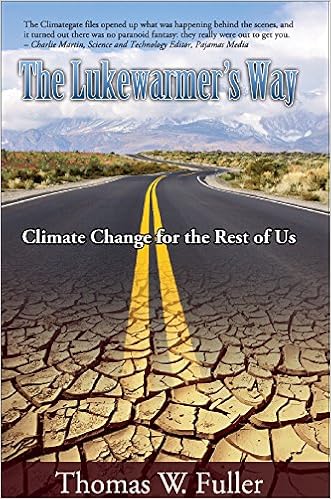
Lucia was kind enough to invite me to submit a guest post promoting my new book, ‘The Lukewarmer’s Way–Climate Change For the Rest of Us.”
Now that I’m here I feel a little awkward. Many of the regulars here know more about climate science than I do–many of you contributed in a major way to my education on the subject. And, one, of, you, knows, more, about, the, proper, use, of commas, as, well.
My book isn’t about climate science per se. Nor is it about grammar. It is about explaining a third position in the climate debate, one that is neither alarmist nor skeptical. As Lukewarmers are getting a bit more press than previously and as a lot of the press is as wrong about us as it is about everything climate, I am hoping my book will serve as a flagpost that both identifies us and locates us accurately on the spectrum of climate opinions.
Of course, the simplest definition is Mosher’s: “The simplest definition was given by Steve Mosher, who frequently comments on your blog. ‘Given and over/under on sensitivity of 3C, lukewarmers will take the under.”
Over at the blog Making Science Public, Brigitte Nerlich spent some time trying to figure out who Lukewarmers are, what we actually think and how we’re different from skeptics and warmists. After a lot of discussion it turns out that we agree with the science, that there is an A in AGW, but that we also think sensitivity is lower than warmists. Not much of a revelation there.
One of the commenters on the thread is one of my favorite humans, Lucia Liljegren of The Blackboard. She pursues the topic in greater depth here, referring to Tamsin Edward’s post in The Guardian and was kind enough to mention me.
Matt Ridley has adopted the mantle of Lukewarmer and seemed to expect that we would all fall in line behind him. In comments at my blog he seemed to be a bit miffed that that didn’t happen. Similarly, Pat Michaels has taken on the label and is reportedly coming out with a book called ‘The Lukewarmer’s Manifesto,’ which we manifestly don’t have and probably don’t need.
So what is a Lukewarmer? Let’s start with how the opposition describes us. This is what ATTP writes: “The fundamental problem I have with the Lukewarmer position is that it appears to be based on the idea that everything could be fine, therefore let’s proceed as if it will be fine. That’s why Eli Rabett calls them Luckwarmers – we’ll be lucky if they’re correct.”
On the other side of the spectrum, Shub Niggurath chimes in: “The term ‘lukewarmer’ has some of its roots in some skeptics trying to distance themselves from the extreme portrayal that was directed at skeptics. These skeptics tried to hijack and smuggle away whatever acceptable facets there were, so they could be spared the smearing and tarring. Skeptics would then be left holding only greenhouse gas skepticism, contrails, US govt agency meddling etc. In reality lukewarmers are just skeptics, they are a timid bunch that’s all.”
Let’s contrast that with what Lucia says and what I say.
What I say in the Forward to my book is, “Briefly, what I came to think was that climate change is real. It is probable that humans contributed to the dramatic warming of the last quarter of the 20th century. One of those contributions consists of greenhouse gases from the burning of fossil fuels. Burning of fossil fuels will accelerate rapidly in the 21st Century. This is likely to pose a problem for continued human development, and it would be wise to take steps to reduce the emissions and prepare for the impact of future warming. However, climate change is not solely caused by human actions. Fossil fuel emissions of CO2 are not the only human contribution to climate change and may not even constitute more than half (deforestation, conventional pollution, black soot and preparation of cement may combine to have a larger effect). Alarmist scenarios of very large temperature rises and sea level increase are not supported by mainstream science. Climate change should be considered a serious issue deserving of our attention, but it is not a ‘planet-buster’.”
This is the short version of what our hostess (who I consider the first and foremost of Lukewarmers) has to say: ”
Do you believe in AGW with the emphasis on the “A†or what?
Yes. Lukewarmers believe in “GW†and a noticeable proportion is due to “Aâ€. (Some might be natural variations — it’s not somethign like 99.99999999% natural. The cut-off isn’t entirely clear since this is a label. )”
I somehow don’t think that is going to settle the issue definitively, but let’s move on from labels.
Because Lukewarmers don’t have a manifesto (at least until Pat Michaels tells us what we’re supposed to believe), the Lukewarmers I have read all have different ideas on what it means.
Here’s what I wrote in my book:
“What we seem (so far) to have in common is an understanding that the basic underpinnings of climate science are understandable, well-grounded and not controversial, plus the growing realization that one of the key components of an extended theory of climate change has been pushed too far.
That component is the sensitivity of our atmosphere to a doubling of the concentrations of CO2. The activists who have tried to dominate the discussion of climate change for more than twenty years have insisted that this sensitivity is high, and will amplify the warming caused by CO2 by 3, 4 or even 10 times the 1C of warming provided by a doubling of CO2 alone. The Skeptics who oppose them dispute the models that have shaped Alarmist views of sensitivity and argue instead that sensitivity is only about 1C or even less.
There is a middle ground. It is my hope that this book and the efforts of other Lukewarmers will take the conversation far ahead of the extremists on both sides of this important issue and leave them to their increasingly irrelevant and increasingly arcane tossing of insults and ignoring reality.”
As I have done more than my share of tossing insults, it should be clear that that last paragraph is more aspirational than descriptive.
Here is why I’m not an alarmist:
“Climate models have projected more warming than has occurred through 2014. Although they do a good job at charting the broad sweep of climate over the years, they do not get the fine level of detail needed to inform planning.
- A pause (or slowdown) in temperature rises has occurred just at the time that human emissions of CO2 have exploded. Almost one third of all human emissions have taken place since 1998, but warming has slowed dramatically during that same time frame. This is an argument against a high sensitivity of the atmosphere.
- Recent calculations of atmospheric sensitivity to increased concentrations of CO2 in the atmosphere are based on observations and provide values for sensitivity that are much lower than previous versions that were based on models.
- Sea level rise has increased from 2mm a year to 3mm a year in the past two decades. However, sea level rise shows no sign of accelerating beyond that and some indications are that it is returning to the 2mm annual increase of prior years.
- The physics-based approach to calculating climate change leaves calculations vulnerable to large biological or chemical responses to warming. Vegetative cover on earth has increased by 7% recently—how much additional CO2 will this draw out of the atmosphere? Physicist Freeman Dyson is frankly dismissive of models’ ability to capture the interaction between the various inputs into models.
- Temperatures estimated from before the modern record do not seem reliable, although part of the problem may be due to inappropriate statistical treatment of the data.
- Advocacy of an active policy response does not seem to rely on a confident view of science. Rather it suggests that Alarmists rely more on dismissing the opposition as ‘deniers’ and exaggerating the modest findings of climate science, precisely because the results of science to date are not alarming.”
“Here are reasons why I am not skeptical of human-caused climate change:
- The physics underlying the basics of climate science are utterly uncontroversial, over a century old and broadly agree with observations. CO2 is a greenhouse gas, it does interact with infrared radiation at certain wavelengths and prevents heat from escaping the atmosphere.
- Temperatures clearly have risen since 1880 by as much as 0.8C.
- One of the key predictions of climate science, that the Arctic would warm much faster than the rest of the planet, has come true. Arctic temperatures have climbed by 2C.
- Sea level rise, almost all ‘steric’ (expansion of the water caused by heat) has increased from 2mm to 3mm per year.
- Human emissions have grown from 236 million metric tonnes of carbon in 1880 to 1,160 in 1945 to 9,167 in 2010.
- Concentrations of CO2 in the atmosphere have grown from 280 ppm in 1880 to 400 ppm in 2014.
- The rate of increase in CO2 concentrations is increasing. The volume of CO2 in the atmosphere grew by 0.75 ppm annually in the 1950s. In the last decade it has increased by 2.1 ppm per year.
- Growth in energy consumption is skyrocketing with the development of Asia and Africa. My projections show that we may use six times as much energy in 2075 as we did in 2010.
- Other impacts of human civilization, such as deforestation and other changes to land use, pollution and black soot landing on Arctic snows also contribute to warming.
- Published plans for construction of renewable energy infrastructure and nuclear power plants fall far short of what is needed to appreciably reduce emissions.
- The two principal drivers of emissions are population and GDP growth. Both are projected to rise considerably over the course of this century.”
As I said up top, many of the readers here are well-versed in one or more aspects of the many disciplines that combine to cover climate change. My book will not further your education, if that describes you. What I’m looking for is to describe the Lukewarmer position, tell why it is based on mainstream science and to discuss possible policy options based on the Lukewarmer stance on climate change.
I hope you’ll buy it.
Note Guest Post by Tom Fuller. Posted by Lucia while he is in Taiwan.
In case it’s not immediately obvious (it wasn’t to me):
the image of the book is clickable and takes you to Amazon where the book is on sale in Kindle format.
Thanks Paul.
I’ve added a 2nd image at the top and included the words “click to buy” on the lower one.
I’m about to go camping!
Hi Tom,
I will probably buy your book in the next few weeks. In the meantime, I have one comment on the above post: While there is a lot of uncertainty in the fraction of current sea level rise due to melting of land supported ice and due to thermal expansion, I think there is a consensus that the melting contribution is a quite significant (30%-45% of the total?). “almost all ‘steric’” doesn’t reflect the best information available.
Just my opinion, but Lukewarmerism is a very apt name for a very wishy-washy position. You can explain what it’s supposed to be with verbose postings but after all the pomp and circumstance, it’s really just non-scientific positioning in the face of crappy science, political pressures, and just wanting to appear smart.
Andrew
Andrew,
“and just wanting to appear smart”
.
You can be confident few will suggest you ever appear smart, whether you want to or not.
Andrew_KY, as opposed to all the other positions on climate change, I presume.
Here’s a question I have. Whenever I see lukewarmers describe themselves, it seems they believe climate sensitivity will be on the lower side of the range of estimates and damages won’t be anywhere near as bad as often portrayed. That makes sense to me, as the two would generally tend to go hand in hand, but are both actually necessary to be considered a lukewarmer?
I assume a person who believes climate sensitivity will be high, but that won’t be a serious problem is not a lukewarmer. After all, there is nothing “luke” about their views on warming. But what about a person who thinks climate sensitivity will be low, but that will still be very dangerous?
I can’t think of anyone I know who fits that description, but I can imagine why a person might. After all, tons of people say two degrees of warming is a limit we can’t go beyond. We could easily reach that amount even with a lower climate sensitivity. We could easily go well beyond that if we ramp up greenhouse gas emission enough. If you believed climate sensitivity is 2.5C, which fits Steven Mosher’s description, I think you could wind up believing global warming would wind up causing extreme problems.
Would that still make you a lukewarmer? Is being a lukewarmer just about the “warmer” part, or is the policy part an inherent part of it too? Because if the policy part isn’t inherent to being a lukewarmer, I could imagine lukewarmers accepting the whole spectrum of policy options, from “do nothing” to “take drastic action.”
Tom,
Respectfully, I question whether there are very many skeptics who would disagree with the items on your ‘why I am not a skeptic’ list. It might just be that I’ve been hanging around here too long though. 🙂
I guess some skeptics dispute the Arctic warming, maybe even many of them. Also, I agree with SteveF above, I’d thought the position I’d always heard was that sea level rise was due to a combination of steric and melting of land ice. I don’t actually know a darn thing about this though.
I think it’s neat you’ve written a book on this, good!
The IPCC AR4 indicated that the best estimate for a ‘High’ scenario was 4C per century.
.
The IPCC AR4 indicated that the best estimate for a ‘Low’ scenario was 1.8C per century.
.
The highest observed trend through the last complete year(2014) is 1.69C per century.
.
Whether or not one is a lukewarmer, the atmosphere is luke-warming.
Brandon, you might check out the thread referenced in the post by Brigitte. Lucia talked through the various permutations of warming/sensitivity/impacts and has created ‘buckets’ for different positions.
My position is that even with low sensitivity, the amount of emissions I expect is so high that impacts will be notable. Much of the last third of my book is devoted to showing that energy consumption in 2075 will be six times that of 2010 and that published plans for the buildout of renewable energy sources will not put much of a dent in fossil fuel consumption.
So I think we have real problems. Sadly we are not helped by the hyperbole put out by the alarmist crew.
Comments
the front cover of the book looks a little bit alarmist but it was either that or a pretty girl to attract attention I guess.
I’m just jealous you are clever enough to write and publish this book.Well done.
It is rather hard to imagine anyone criticizing it and you as vehemently as Andrew KY when it is taking a very scientific approach to the middle ground
“A pause (or slowdown) in temperature rises has occurred just at the time that human emissions of CO2 have exploded. Almost one third of all human emissions have taken place since 1998.”
Sounds horrible and alarmist except that the actual amount of CO2 produced by humans is still very small compared to the annual earth produced volume.
“Growth in energy consumption is skyrocketing with the development of Asia and Africa. My projections show that we may use six times as much energy in 2075 as we did in 2010″.
Brandon would eat you for breakfast here. How many variables did you have to freeze to make this assumption.
Social change dictated by massive population increase and stress for decreasing resources means we will have wars and famine decimating populations and preventing such optimal development ever occurring. Your projection based on business as usual ignores so many white swans that no black swans are needed to say it will not happen.
“Briefly, what I came to think was that climate change is real.”
Yes
“It is probable that humans contributed to the dramatic warming of the last quarter of the 20th century.”
No
Wishy washy of the first order, a real get out of jail free card.
Give a range ie 1%,10%, 50% of contribution -something!
Give a time range that is real and encompassing ie from 1975 to 2015.Did humans contribute to warming for a picky 25 years and then contribute nothing from 2000-2015??
This is a real IPCC argument on warming Humans could 1% contribute to dramatic warming 99% non human and your comment with the alarmist “dramatic” sounds terrible but means nothing.
Humans can cause Climate change and have done so by diverting rivers and stream. Look at the South Aral Sea drying up. Look at agricultural practices in Southern Australia and Egypt, forests in England and Europe. The fact remains that we have limited ability to affect Global Climate through CO2 production as we are so insignificantly small and all the energy the human race can produce would not and never will equal half an hour of sunshine.
Mitigate what we can, Pollution is a worry, but do not allow AGW problems to be fabricated on dodgy, junk science.
Mr. Fuller, even the GISS graph of Global temperature indicates that there has been no global warming since 2002 although atmospheric CO2 has increased from approximately 360 to 400 ppm during that period. Inasmuch as this increase in CO2 was not accompanied by increasing temperatures, as a Lukewarmer, what would you expect a reduction in CO2 to do to temperature?
When the world warms the Arctic and Antarctic both would warm proportionately faster.
This is NOT a prediction, it is a scientific necessity.
It gets proportionately colder when the world gets colder as well.
So Tom, what has gone wrong in the Antarctic with your theory?
Or do you just use the part of the theory that agrees with you and Mann the part that disagrees?
angech:
Hey now, I have no problem believing we may use six times as much energy in 2075 as we did in 2010. I also have no problem believing we may see a global nuclear war which devastates the world’s population to such an extent 2075’s energy consumption is half that of 2010’s. So when you say:
Realize that unless you’ve read more than I have about the basis for Fuller’s projections, which I doubt, you probably have no idea how he came up with them. I personally doubt they represent “business as usual.” Then again, I’m not entirely certain what that even means since the phrase “business as usual” doesn’t have an inherent meaning like its wording might make a person think. You have to make decisions when defining it, and those decisions are largely arbitrary. I have no complaints about that, mind you. I just have never been clear on what the exact definition is.
But if you’ll ignore the long-winded excursion there, the basic point is criticizing a model without knowing anything about it is mostly pointless. I don’t know of any reason to think Fuller’s projections have any merit, and I doubt I’d find them convincing, but… so what? Unless or until someone quotes the book to show the basis for them, we don’t really have anything to discuss.
Unless we want to create our own models. That could be fun. Personally, I don’t think there’d be any point in trying to use any sort of complex model for projections 50+ years out, so if I had to approach the problem, I’d probably just go with a simple model using population and average per capita consumption. Project how you think those two would change, multiply the result, and you’d have your projected energy consumption rate out to 2075 like Fuller does. I bet you could get about as close as to the true answer as he could too.
“Andrew_KY, as opposed to all the other positions on climate change, I presume.”
Well then there’s the scientific position: “We don’t know what is happening.”
Andrew
Andrew,
You start by saying,
then you give us this:
Decisive statement there. Nothing wishy-washy about that…
I thought the scale went like this:
CAGW = warmists
AGW = lukewarmers
GW = skeptics
no GW = nutters/sky dragons.
Regarding future energy consumption, I go into detail in my book, but for the more frugal among you I also explain it in two year’s worth of posts over at 3000quads.com.
See here: http://3000quads.com/2012/01/24/research-tables-and-report/
Of course I might be wrong. I hope I am. But I used the same projection framework I do for my energy clients and they’re pretty happy with the results to date.
It’s pretty basic. When developing countries get as rich as countries that have developed, they’re going to want to use the same amount of energy per capita. As they have more capitas, energy consumption is quite likely to increase dramatically.
We have real world examples of this happening in the recent past.
Like I said, I do hope I’m mistaken about this. But the numbers don’t look good.
Morley, we do indeed have a pause–long may it reign!
However, we had two similar pauses during the 20th Century, after which warming resumed. I rather expect the same to happen this time.
Steve Ta,
ref: (Comment #139056)
That scale is so yesterday:
“Climate Change”, the undefinable self-referential name chosen to replace the failed “Global Warming” family of marketing products.
The scale is more like:
Agree with “Climate change” = double plus good
Question “Climate Change” = double plus ungood
Tom,
“When developing countries get as rich as countries that have developed, they’re going to want to use the same amount of energy per capita. As they have more capitas, energy consumption is quite likely to increase dramatically.”
.
Likely to increase dramatically is an understatement…. it will increase dramatically. However, there is a considerable range of energy increase for the same level of development. Part of this is due to the environment (Calgary uses more energy for winter heat than does Corsica), and part is due to politics (Europe taxes the cr@pp out of energy consumption to increase government take of GDP and reduce energy consumption). But there is another factor: evolution of energy efficiency. For example, in Florida, where I spend most of my time, most of the existing housing stock is not very well insulated. This reflects relatively low electric costs (for A/C) and an unwillingness of individuals to invest in energy efficiency which has a long term pay-back. If the time horizon you care about is 10 years, then not investing in better insulation may be a perfectly rational choice. Retrofitting existing houses to be more energy efficient is enormously more expensive than adding better insulation during construction, and is not often done. So there are a lot of things working against improving energy efficiency in Florida, not the least of which is the inertia that a large existing stock of inefficient housing represents.
In developing countries (mostly in the tropics), the investment in existing infrastructure and buildings is much less, and there is at least some reason to believe that development could be much more efficient than the efficiency typical of south Florida. If one believes that global warming due to greenhouse gases is a real problem which needs to be addressed, then providing financial incentives to developing countries to adopt more energy-efficient infrastructure and housing may be a prudent choice. Society has a much longer time horizon than individuals, and investments in efficiency that an individual would not otherwise make could be incentivized in the interest of society in general.
So while energy use in developing countries necessarily will grow, the extent of that growth may not be accurately predicted by the energy consumption in existing developed countries. We could ignore how countries choose to develop, but that would likely lead to less energy efficiency in those economies and more fossil fuel use, at least in the coming decades.
.
What population assumptions are you making?
.
In the economically developed world, two things are happening.
.
1. Per capita CO2 emissions are falling, and
.
2. Fertility rates are falling below replacement rates.
.
Clearly, a lot depends on economic development, particularly in Africa, but GLOBAL fertility is on track to fall below replacement by 2030, with population to follow within a generation. This a pretty big deal, and falling population is better than changing fuel sources because it solve a lot of other ‘problems’ than CO2. Also, the ten year trailing CO2 forcing rate ( to smooth out y-to-y variation ) peaked in 2007!
And total GHG forcing peaked around 1979. Clearly forcing is DEcelerating, not ACCelertating.
And in addition, there’s the pumping of water from slow filling aquifers. ARGO has plots of the estimated thermosteric contribution to sea level rise. According to Levitus, et.al., 2012
Which would imply that most of the rise in sea level was not thermosteric. We also have ocean mass measurements from the GRACE experiment that indicate a significant mass increase of the world ocean and a corresponding decrease in land based ice mass. Cazenave, et.al.,(2009) estimates from GRACE measurements that ocean mass increase accounted for 1.9±0.1mm/year of the estimated total rise of 2.5±0.4mm/yr.
Assumptions about future population growth are important. Stern, for example, used the IPCC scenario A2 to estimate the future cost of global warming. In that scenario, the global population in 2100 is 15E9 and rising. So it’s no surprise that his conclusion was mitigate now rather than adapt later.
“Nothing wishy-washy about that…”
Mark,
The truth isn’t wishy-washy. It is what it is. If you don’t know something, don’t pretend you do. And don’t pretend at the expense of others, especially. This is basic decency. Lukewarmers as well as Alarmists, don’t have this for some reason.
Andrew
Thomas:
“However, we had two similar pauses during the 20th Century, after which warming resumed. I rather expect the same to happen this time.”
Together with the current plateau in warming, does this not imply that CO2 concentrations are not tightly coupled to global temperature so that reducing CO2 might not reduce temperature?
It would be like trying to control the speed of a car only with brakes and no gas pedal.
Here is another take an what a lukewarmer is.
It is a person who believes in the physics of the direct warming effects of co2, but doesn’t necessary believe in the indirect effects.
That is me.
Yeah – I accept the 1.2C of direct warming we should see from a doubling of CO2 from 280 ppm to 560 ppm.
But I don’t see any evidence for the tripling of that number – the actual observational evidence seems to be tracking just the direct effects, or maybe just a tad bit more.
I think lukewarmers can meet that label for lots of different reasons, and just wanted to throw one other reason out there for discussion.
As a lukewarmer, I have my own opinions as to where Global Mean Temperature (GMT) will go between now and the end of the 21st Century, based on my Parallel Offset Universe climate model, which is documented here in this graph:
The graph represents my opinion that whatever the causes for the long-term rise in GMT are, they will continue into the future for at least another hundred years, if not longer.
My entire analysis is self-contained in the graphic. There is nothing more to it than what is presented in the lines and the words contained in the illustration.
Three alternative scenarios are presented; and all three scenarios assume some level of man-made warming resulting from GHG emissions, with Scenario 1 assuming the most influence from GHG’s and Scenario 3 assuming the least. Of the three scenarios presented, the +1 C rise in GMT between 2015 and 2100 is the one I suspect is most likely to occur.
In other words, when in doubt, assume that current trends will continue.
As for the interactions which occur between climate science matters and public policy matters, a robust public debate concerning the validity of mainstream climate science will not occur until and unless governments move beyond what is now mostly talk and begin to take strong action against GHG emissions in ways that directly and powerfully affect the life styles of middle class voters.
Here in America, we are not there yet, not even close. Whether or not we will ever go there is something which is yet to be determined.
Where we do go in America depends entirely upon who controls the White House and how far the sitting President wants to go in using the EPA to its maximum possible effectiveness in legally and constitutionally enforcing strong anti-GHG measures.
As for what is now being done by the EPA, the Clean Power Plan merely scratches the surface of what could be done legally and constitutionally by the Executive Branch in the absence of buy-in from the US Congress.
If President Obama wants to reduce America’s own GHG emissions as far and as fast as he says we need to reduce them, he already has all the authority needed to accomplish that goal without asking for another word of new legislation from the Congress.
1) “dramatic warming of the last quarter of the 20th century.” — as opposed to the identical warming in the early 20th century.
2) Arctic temperature rise as predicted — seriously disputed.
3) sea level rise.
When the only actual evidence for believing are the supposed “dramatic warming”, arctic ‘warming’ and sea level rise, it is apparent at how little scientific evidence is really there.
Hi Tom,
I second Brandon’s question: ” Is being a lukewarmer just about the “warmer†part, or is the policy part an inherent part of it too?”
I consider myself Lomborgian. Even stipulating for the sake of discussion that historical temperature was as stable as Michael Mann says (which stipulation I revoke the moment this discussion is over) and the warming of the 1850s to 2000 was as remarkable as James Hanson sez, etc etc …
War, particularly the nuclear variety, seems to me to be a bigger problem than climate change. Does that make me a “lukewarmer”? Given two dollars to spend, I would spend $1.99 on diplomacy and defense rather than over a penney on windmills and solar panels. In any case, I would stridently oppose handing the problem to the IPCC and United Nations (After all, the UN has been attempting, with dismal results, to solve the problem of war refugees and displaced migratory populations since 1948. How’s THAT working out? Why would anything suppose weather management is an easier problem for transnational policy wonks to address than refugees?)
Policy matters, doesn’t it?
Hi all,
As commenting is a bit complex from Taiwan it may take me a bit to respond to all of your comments. Starting from the bottom and working up,
Pouncer, nobody is handing out requirements lists for calling yourself Lukewarmer. Some Lukewarmers have firm policy ideas, many don’t. I think Mosher says he will live with whatever policy plans someone comes up with, for example.
I like Lomborg too. I also think multinational war is more of a policy concern than warming. Like you, I think policy matters. Unlike you, I think warming needs to be addressed by multiple nations, if not multinational organizations. I think the UN, IPCC, ad absurdium are well placed to lead policy. I am not sure they are competent to do so.
Stan, warming was dramatic in two periods of the 20th century. I don’t know what that means to the debate, really.
RickA, from what I can see, no two people who call themselves Lukewarmer have the same figure for atmospheric sensitivity to a doubling of concentrations of CO2. My strike price is 2.1.
Morley, to an extent, yes. However, given my conviction that emissions will rise to a very high level, I think eventually emissions will win out over a recalcitrant atmospheric/hydrological system.
Dewitt, yes, assumptions about population are very important. I criticize Stern at length in my book about that and other issues. Both the UN and the US DOE project population growth and I use both their figures.
Turbulent Eddie, as opposed to looking at per capita emissions I chose to look at per capita energy consumption. I did that specifically because we are in a period where major choices about our portfolio of fuels are being made. If we all go green green green I guess the subject will be moot. As I don’t think we can do that globally and I don’t think anyone is making serious plans to do so, I think consumption regardless of fuel type is the better metric.
Fertility rates are falling in many countries, but certainly not in all. And even where they are falling they are still well above total fertility of 2.1.
SteveF, there is considerably variability both within and between nations regarding both energy consumption and fuel portfolio. In the U.S., states like Wyoming and Alaska have insanely high per capita energy consumption, while New York’s is below Germany’s.
It is my belief that developing countries will go for lower cost, less efficient methods of generation and cheaper, less efficient appliances and will approach America’s average of 310 mbtu per person rather than sober and sane Denmark’s 161 mbtu.
Again, hope I’m wrong.
.
Chad is the only country I could find that did not have a falling fertility rate. see the side by side comparison of countries from 1970 and 2014.
.
And about half the countries of the world have a TFR of less than 2.1(replacement).
.
And the trend is toward rapidly falling TFR, such that global TFR will fall below replacement around 2028.
.
There is a lag, but population will begin falling about a generation after TFR reaches replacement – around 2050.
.
On one hand, this is good – more sustainable for sure.
On the other hand, this is bad – economic growth also derives from increasing population.
.
How this resolves politically and economically will be interesting, to the fullest extent of the Chinese curse.
.
But with a falling population, CO2 emissions will be declining.
And even before population has begun to fall, the rate of annualized lagging ten year ghg radiative forcing increase has fallen from it’s peak around 1979, and the forcing from CO2 alone has not eclipsed the rate set in 2007.
.
This would seem to indicate decreasing rates of warming for the foreseeable future.
Hi Turbulent Eddie,
Counting countries can make you feel optimistic about TFR. Counting populations, not so much. Countries like Pakistan, Nigeria, etc. are still growing strongly. Countries like India, even with a falling TFR, are still increasing because it hasn’t fallen below 2.1.
Lots of European countries with falling populations. And Japan. But Brazil has more people than the lot of them put together and it’s still growing.
As for forcing, it comes and goes, doesn’t it? Yet CO2 concentrations, which used to increase by about 0.75 ppm back in the fifties, are presently increasing by about 2.1 ppm per year now.
Thomas Fuller says:
Which is… sort of fine, I guess? I don’t know why developing countries would “want to use the same amount of energy per capita.” It doesn’t seem like something they’d care about. What I’d imagine they’d actually want is to have the same, or possibly even better, standards of living and things like that. That could involve them using “the same amount of energy per capita,” but there’s no inherent reason it must.
FOr instance, a developed country would have spent quite a bit of time both developing and improving their energy efficiency. A developing country could bypass some of the earlier stages of this process, jumping straight to higher efficiency options. From a modeling perspective, this could result in developed countries having equitable standards of living with developed countries despite having lower energy consumption per capita.
And that’s just an example of a problem inherent to idea. An additional problem is equal per capita consumption can result in different standards of living based on things like the size or climate of a country. A country whose population is spread out across wide distances, such as the United States, will not be comparable to a densely populated country such as Japan. Equitable per capita consumption would not automatically translate into equitable standards of living between the two countries. There are at least several dozen different factors which go into it, and that’s under the assumption foreign relations aren’t a factor.
But let’s suppose we ignore all that for the moment. Supposing we did boil it all down to every country wanting some particular amount of per capita consumption, and perhaps even achieving it, all Fuller says of that amount is:
What numbers? I tried looking at the site he linked to. The PDF on the page he linked to was only for years up to 2030. Am I supposed to just start looking around that site at random to try to find posts which contain the numbers? I know Fuller says:
This isn’t a matter of being frugal. He himself has said his book likely won’t have much in the way of new material for me. I’m not its intended audience. It would seem pretty silly to buy a book that’s not meant for me just on the hope it provides some sort of actual sources or descriptions. I mean, if there’s “two year’s worth of posts over at” that blog, couldn’t he give a link to one that actually talks about the subject at hand?
And no, that’s not rhetorical. The tagline for that site is, “Humans will use 3,000 Quads by 2075. If they all come from coal we’re ruined,” yet when I went one of the more recent posts titled, “Our Global Energy Future,” it didn’t say a word about projections out to 2075. It was a summary post, referring to five previous posts. None of those posts said a word about projections out to 2075. The farthest they went was 2040.
I’m at a loss as to where the information for these projections for 2075 is located at. Fuller made it sound like it should be easy to find tons of information on them all over that site, but I’m not seeing any.
Lucia
“think Tom Fuller, who like me, is a long time self-identified Lukewarmer, concurs with my view that “do nothing†is not “the†lukewarmer position.
there are some self-identifying lukewarmers who believe we should do absolutely nothing — not even encourage use of insulation. But my impression is those number are few.
But all Lukewarmers do believe some warming is caused by GHG’s. Consequently some risks are present.”
Wishy washy.
Thank you Andrew K. That was your comment.
By definition a lukewarmer has to believe some warming [1%, 50% 99%] is caused by GHG’s.[why not just say the dirty word CO2?]
As do all CAGWarmists. [97%-110%]
and most skeptics. [1%, 50%]
It is not a point of differentiation.
“Some risks are present”
How much? cue in [1%, 50% 99%]
How alarmist? [1%, 50% 99%]
Why not say “Some benefits are likely” [1%, 50% 99%] first or both together?
Why does it have to be risk, risk, risk unless one is an alarmist.
A true Lukewarmer would no more favor one than the other.
That is the definition of Lukewarm.
Goldilocks.
The porridge is just right.
Yes, if you do not blow on it first, it might [Risk, risk] burn your mouth.
But it will taste a lot better than the cold one you spent a lot of money on and have to throw out.
And the hot one?
It will cool down in time.
It seems to me a lot of Lukewarmers are CAGW wolves in sheep’s clothing.
.
Counting population is the rear view mirror, TFR is what’s ahead in the windshield.
.
TFR is the most important predictor of futurepopulation. Global TFR is 2.425 and falling steadily by about 0.025 per year. That’s a trend that puts global TFR at less than replacement very soon. As I wrote, population will continue to rise for a generation, but consider this: global population since WWII has increased by about 5 billion. Unless there’s some dramatic change in TFR, population may peak some 1.5billion beyond today’s ~7billion and then fall to perhaps net zero change by 2100. That’s about what the UN low ‘variant’ indicates and the rate of TFR decrease is consistent with the low ‘variant’.
.
.
The economically developedportions of India have TFR well below replacement. This argues for economic development, not just in India, but globally.
.
.
I’m guessing you mean India, not Brazil, as Brazil has lower than replacement fertility already and is evidently close to falling population.
.
.
Concentrations are not forcing, which is log not linear. CO2 concentrations must rise exponentially just to maintain a constant rate of forcing increase, and as I point out, the rate of forcing increase due to CO2 is less than constant since peaking in 2007. Total ghg forcing has not kept pace with the peak rate of forcing increase since around 1979. This has occurred even with rising global population. With falling rates of population by 2050, warming of the twenty-first century should be less than the warming rate of the twentieth century, plus or minus natural variability.
Hi Turbulent Eddie
The UN Population Division has a good man in charge. The guys at the DOE EIA pay a lot of attention to their population estimates. A lot of other people run independent estimates.
Nobody is calling your shot. 8.5 billion peak?
My energy consumption estimates are far higher than official projections, so I’m not going to automatically say you’re wrong just because your numbers are different. But you should show your work for the 100 countries with more than a million in population.
Tom wrote: “Lukewarmers believe in “GW†and a noticeable proportion is due to “Aâ€. (Some might be natural variations — it’s not something like 99.99999999% natural.”
Climate models predict that roughly 150% of observed GW is AGW using the latest IPCC estimate for aerosol forcing. In general, models reproduce the historical record somewhat better than this because they predict more cooling from aerosols than the authors of AR5. Those who complain (including me) when Judith Curry discusses the possibility that 50% or less of observed warming could be anthropogenic should keep this in mind.
Correction
“As do all CAGWarmists. [97%-110%]”
“Frank (Comment #139162) Climate models predict that roughly 150% of observed GW is AGW using the latest IPCC estimate for aerosol forcing.”
“As do all CAGWarmists. [97%-150%]”
This is a great argument Frank. You are saying that 50% cooling has occured because of Natural Selection. Would you like to try for 200% ?
“and a noticeable proportion is due to “Aâ€
Please explain how this was determined.
Andrew
.
Yes.
.
At least by the figuring of Deutsche Bank, who have skin in the game, and David Merkel, a noted actuary.
.
I’m not a demographer, and I’m not familiar with all that goes into arriving at the estimates, but I can plot the data, and published global TFR is clearly on a path to intercept 2.1 around 2030.
So since I couldn’t find any relevant information via the link Thomas Fuller provided, I have a question for anyone who has purchased his book so far. Did you see any useful information on how he came up with his projections for how much energy may be used by 2075? I’m genuinely curious how one makes projections for something like that 50+ years out. I don’t think I’ve ever seen anyone do it before.
I just don’t want to spend $10 on a book to find out it provides no more information than the blogs Fuller told me to read to find the information when they seem to provide no information. I’d basically be buying the book to find out it doesn’t have anything of substance on the issue, and that seems like a waste of money.
Ugh. There’s no way I’m buying this book. I downloaded the free sample from Amazon, and it’s just… no way. Leaving aside the passive-aggressive swipe Thomas Fuller makes regarding my criticisms of his previous books that’s completely off-base, the book is just… ugh. Amazingly, what bothers me the most is the book labels everybody as either a “Skeptic,” “Lukewarmer” or “Alarmist.”
Seriously, if you believe climate sensitivity is most likely over 3 degrees, the book labels you an alarmist. How ridiculous is that? It would have been easy to use a more neutral term like “Warmist” or something, but instead, Fuller went with an insulting label. According to his book, you’re either a skeptic, a lukewarmer, or a bad person. I think that’s pretty ridiculous, and I wouldn’t even fit his classification of an “alarmist.”
I was going to tolerate that and buy the book anyway. I was going to even tolerate the fact it repeatedly refers to CO2 as the cause of the greenhouse effect, ignoring all other greenhouse gases, never bothering to even note that there are other gases involved. I was going to tolerate all that. But then I read this:
That was my breaking point. I’m still dealing with the stupidity of Mark Steyn’s book. I can’t handle another book filled with it. Anyone remotely familiar with the literature knows this is not what climate scientists generally say. What they actually say is it is somewhere around 1945 the human influence on the planet’s warming becomes discernible. That is, we can be sure of our detection of “human-caused global warming” after ~1945, but before that, we can’t be absolutely certain of its existence.
But it probably was there. Because, you know, a lack of proof is not a proof of non-existence. Unless you’re Thomas Fuller, I guess. Then you get to simply state things like:
As fact. I’m not even worried about the claim there is “only one important scientific question.” Maybe he means it. Maybe it’s rhetoric. Whatever. What baffles me is… says who? How do we know a high sensitivity must mean “the planet has big problems”? How do we know a low sensitivity must mean “we can deal with” it? Fuller doesn’t offer any explanation. He just states it like it is some it is some sort of truism that everyone is just expected to accept without any question. That’s not how things work!
So… yeah. I’d still really like to know where the numbers for Fuller’s 2075 projections come from. I’m just not going to spend $10 on a book where he calls a group of people insulting names for no reason then turns around and complains about how people label a group “deniers” in the hope I’ll find evidence when the book apparently is filled with things he just states as true without offering any explanation or evidence, while also saying things which are untrue.
It just seems like a bad investment.
Huh. I just tried to submit a comment, and it didn’t appear. Then I got an e-mail asking me to confirm my e-mail address, as if I hadn’t commented here before. It seemed weird, but I clicked on the link to verify my e-mail. When I did, I got directed to this page, but my comment still hadn’t appeared.
Is this some sort of strange bug, or is it happening because I’ve run afoul of some sort of moderation filter? Or is there maybe some other reason?
Brandon Shollenberger:
Not correct, even in the sample he writes: “Water vapor is the dominant greenhouse gas, although CO2 definitely plays a part”.
The book itself refers to greenhouse gases in the plural (although he does focus almost exclusively on CO2). He acknowledges other anthropogenic [edit: greenhouse] gases, quoting James Hansen and explicitly agreeing with him that :
Brandon Shollenberger:
Tom makes it fairly clear, at least to me, that he’s using those labels in reference to those involved in the climate debate – not everybody. eg. He writes in the sample:
He also allows that not everyone involved in the debate is either an Alarmist, Skeptic or Lukewarmer, writing (again in the sample) :
Apologies if I’ve made any spelling mistakes in the quotations, they were typed rather than copy-pasted.
There are a few problems with the position of lukewarmerism. First, it is ill-defined. Mosher’s ‘Given and over/under on sensitivity of 3C, lukewarmers will take the under.†isn’t very good, because I’d take the under for a best guess at CS, and I don’t think anyone would consider me a lukewarmer.
So being a lukewarmer implies a lowish range for CS, and, in fact, a tighter range than people who simply accept the consensus position. (So if I am 1.5C-4.0C, a lukewarmer might be 1.0C-2.5C.)
But the evidence that Tom presents for why he is a lukewarmer doesn’t seem to support a tighter range. See #4: “The physics-based approach to calculating climate change leaves calculations vulnerable to large biological or chemical responses to warming.” If one believes this, then it should widen the range, not tighten it.
The only points that would seem to support a lukewarmer position are 1 & 2, and they are basically the same point. Does that mean that lukewarmers would have been out and out alarmists in 1999? Relying so much on recent observations is fine, but it goes along with a great deal of confidence in those observations and a similar confidence in knowing that the recent observations are related strongly to CS and not affected much by internal variability. But I don’t know why lukewarmers “know” this.
.
True dat about internal variability, but that would pertain to any assessment of observed trends, including deniers, lukewarmers, and hysterics, in addition to those with less dogma and more open minds.
.
In the AR4, the IPCC made predictions about rates of warming, ranging from a best estimate of the low scenario of 1.8C per century, to a be high scenario of 4.0C per century. Since the highest observed trend through the last complete year is around 1.7C per century, which is less than the low end prediction, the AR5 quickly dispensed with predicted the actual rate and returned focus to ECS, which obscured the low rates and left open the possibility of the high end.
.
Now, as you intimate, internal variability could mean CS to CO2 is significantly lesser or greater than the observed trends.
.
But that does reduce the IPCC’s case to: ‘well, it would be warming, if only climate didn’t vary naturally.
.
Very difficult to prove and not a compelling argument.
Regarding, categories:
(from Wikipedia)
Groupthink is a psychological phenomenon that occurs within a group of people, in which the desire for harmony or conformity in the group results in an irrational or dysfunctional decision-making outcome. Group members try to minimize conflict and reach a consensus decision without critical evaluation of alternative viewpoints, by actively suppressing dissenting viewpoints, and by isolating themselves from outside influences.
.
Theories are not valid/invalid because the theory adherent is a member of a group. Evidence and to the extent possible, repeatable results to testable hypotheses should be our focus, not agreeing with a group, and we should be willing to revisit every nuance of accepted theory and the crannies in between theory where most of the invalid assumptions usually lie.
Frank wrote: (Comment #139162) Climate models predict that roughly 150% of observed GW is AGW using the latest IPCC estimate for aerosol forcing.â€
Angech replied: “This is a great argument Frank. You are saying that 50% cooling has occured because of Natural Selection. Would you like to try for 200% ?
Frank replies: The IPCC’s models have ECS of about 3 degC and do a fair job of reproducing the historical warming record because their models are highly sensitive to aerosols. Using energy balance models, Otto et al found an ECS of around 2 degC when aerosols weren’t changing. So I estimate that modeled warming would be 150% of observed warming without excessive sensitivity to aerosols. You could use Lewis and Curry (2014) to produce a modestly higher value. You can also get different values using TCR. I’m not sure how to get exactly 200% higher.
Any difference between forced temperature change and observed temperature change is unforced variability, not Natural Selection. Without accurate knowledge of climate sensitivity and forcing, of course, you can’t calculate a forced temperature change.
Cynically, I wonder if survival of the fittest and natural selection are principles that may have something to do with the evolution of climate models themselves. Stainforth and colleagues have shown using ensembles of models with perturbed parameters that optimal parameters vary with the observable phenomena one chooses for optimization and that no truly optimal set of parameters can be found for the simplified models used in such work. So the “fittest” models aren’t those that reproduce current climate the best. Would a climate model with an ECS of 1.5 degC have survived if it was as good as its peers?
oneuniverse:
Er, right. Sorry. I should have said anthropogenic greenhouse gases. Thomas Fuller acknowledges water vapor, particularly in its role as a potential feedback mechanism, but he doesn’t talk about the rise in other greenhouse gas levels, which is the point I was trying to make.
Yeah… I can’t say I really view this as any sort of substantive disagreement with what I said. Maybe Fuller does make some backhanded reference to other greenhouse gases somewhere in the book. That doesn’t change the fact the book repeatedly portrays CO2 as the only greenhouse gas that needs to be looked at, acting as though the rise in CO2 levels is all that needs to be looked at.
So… sure? Maybe he does vaguely reference other greenhouse gases a couple times? If so, I didn’t notice those couple passing references amongst the pages and pages of text acting as though CO2 is the only anthropogenic greenhouse gas that matters. I don’t think most readers would either.
I suppose I should have said “everybody he refers to” not “everybody.” There are, after all, people Fuller doesn’t refer to with his classifications in his book. For instance, all those people who have absolutely no views, thoughts or concerns about global warming were also not labeled as skeptics, lukewarmers or alarmists in the book.
But maybe you’re right on the point you’re trying to make. Fuller does, as you quote him as saying, say there are people in the middle other than Lukewarmers:
However, as far as I can see, he never talks about them. He doesn’t even give them a label they can be referred to. According to Fuller you have Skeptics giving an ECS of ~1C and Lukewarmers saying 1-3C. Above that though, you don’t have a group until you get to Alarmists, who are the crazy extremists deserving of mockery.
But what about the other reasonable people he gives passing reference to who inhabit the middle ground? What about the people who say 3.5C? Their group doesn’t have a name in this book. As far as I can tell, they don’t even get more than a passing reference.
So maybe it’s not that Fuller is labeling everyone above a Lukewarmer an extremist? Maybe it’s that he’s simply ignoring all the views above those of Lukewarmers other than the extremists? That is, he admits there are non-extremists other than Lukewarmers but he simply refuses to talk about their views?
I honestly don’t know. I don’t really want to put that much thought into it either. I only looked at the book because I wanted to know where the numbers for Fuller’s 2075 projections came from. When I saw him claim most scientists say human induced global warming only started in 1945, I pretty much gave up on it.
Frank:
I kind of like the idea of using percent attributions greater than 100%. The more anthropogenic forcings go up, the greater the percentage becomes! And the less warming there is, the more the percentage goes up! And let’s not forget with there being hundreds of factors at play, we can have dozens of effects being more than 100% responsible for the observed warming!
I want to try that argument when working sales sometime. “Well folks, we only cleared $10 in profits this quarter. But guess what, I sold $10,000 in merchandise, so I’m responsible for 100,000% of those profits!”
The whole premise that sceptics are a class of people who believe ECS has a certain value or range of values is ridiculous and misses the point about what being sceptical of the results leading to the IPCC’s suggestion of an ECS of 3C, is all about.
Hi Brandon, in the book Tom cites a few sources used in his projections, and informs the reader that the Excel worksheet is available if requested by email.
I don’t know if quoting these sources is covered by fair use – perhaps Tom might choose to provide these and the spreadsheet to the readers of the Blackboard.
oneuniverse:
I hope it’s not the same spreadsheet found in the post he linked to earlier. The PDF file linked to in the post says:
Which would seem to be basically the same note you mention. I hope that just means he uses it as boilerplate and people can request any of a number of spreadsheets from him, because the spreadsheet linked to in that post is clearly only for projections up to 2030. There’s no way it would support projections up to 2075.
I’d be content with just the spreadsheet and the names of the sources for any values used in it. I can live with having to track down references off just your standard citation format. I don’t mind if it takes work to figure things out. I just want something I can actually look at to see where these projections came from.
Because you can’t tell me you have 60 year projections without me wanting to know how you made them. It’s just such a crazy long timeframe.
Boris,
Speaking of ill-defined:
What is the definition of “climate”?
If Thomas Fuller is the Lukewarmer, who is the Obiwanwarmer?
Does your bet make an appearance in the book?
Now here’s an important question I hadn’t thought about before. lucia, are you getting any referral bonus for purchases made via this post? I know Amazon uses referral programs, and the link does have a referral tag. If you’re getting a bit of money when people buy the book via the link you gave, I’d say that that makes it a better deal!
(Interestingly, Amazon’s referral program can give participants money even if the reader doesn’t buy the item they link to. Just getting people to visit Amazon can be enough if they then go on to buy something during their visit. I don’t know all the details as I’ve never had any reason to sign up, but it’s a kind of cool program.)
Boris,
The empirical sensitivity estimates (otto et al, lewis, lewis&curry, masters, and others) based on long term (~century) energy balance, all point to best estimate ECS well below the IPCC canonical value of 3C per doubling. The models project higher, but to match reality, they use assumed levels of human-made aerosol effects which are well above the AR5 best estimate for those effects. The run-to-run variation in projected rate of warming for the last 15 years by individual models, along with the mean rate for each model suggests that many (most?) are plainly inconsistent with the observed rate of warming (AKA wrong). If you consider only models which are not obviously wrong, then the models are lukewarmers. Lukewarmers tend to believe empirical estimates and discount projections of models which are demonstrably wrong.
.
But an important underlying commonality among lukewarmers is that they tend to be “humanists” rather than “naturists”, and place more value on things like eliminating poverty, diseases, and human suffering in general, than on preservation of nature in an undisturbed state. There is nowhere the difference is more obvious than in the question of how to minimize CO2 emissions. Lukewarmers almost always think nuclear power is the obvious alternative if you want to reduce CO2 emissions, while most “green” advocates will accept only wind and solar….. because only these are truly “natural”…. even though they are impractical, expensive, and unable to help the poorest rise from poverty through economic development. “Lukewarmerism” is based as much on values as on expected rate of warming.
This carries some misleading statements with it.
Yes CO2 is a greenhouse gas which implies a higher temperature to achieve equilibrium net radiance. However, at a higher temperature, equilibrium occurs, and the admittedly noisy record of CERES net radiance, that’s what’s occurred. The atmosphere still emits energy, but with a higher surface temperature.
Also, the story doesn’t end with RF. In fact, the AR5 announced ‘EFR’ Effective Radiative Forcing, which means that changes may occur without surface temperature change. The IPCC only imagines this as positive feedback, but that seems like they’ve made their mind up with science that just became unsettled.
Yes, of course.
Yes, but this also happened from 1910-1945 and that wasn’t from global warming, or at least not AGW. How much of global warming is from Arctic variation? The Antarctic isn’t modelled to warm as much as the Arctic, but is still modelled to warm more than the global average – why hasn’t it? It would be erroneous to assume natural variability, such as the 1910 warming, for some reason stopped.
Focussing on emissions, while important, is not complete.
.
RFco2 = 5.35 * ln ( C / C0 ) [IPCC]
.
C = CO2 emissions – CO2 uptake
.
Annual RFco2 change peaked around 2007.
.
Annual RFtotal change peaked around 1979 and has been less ever since. Therefore, it is not surprising that the greatest rates of warming occurred in the past.
.
Part of that is slowdown in emissions ( which were flat from 2013 to 2014 and perhaps flat or lower again this year ).
.
Part of that is the continued increase in uptake ( which appears to increase as CO2 accumulations increase ).
This represents confounding variables.
.
GDP grows in part because population grows ( basic economics ).
.
But US emissions have continued to fall( lower than they were in the early 1990s ) while the economy continues to slowly grow , so the US ( and other countries ) are contradictory to the statement above.
.
I applaud the effort and things need all perspectives, but lacking these ideas represent a significant shortcoming from the above analysis.
Boris (#139324): The low climate sensitivity in Otto (2013) and Lewis and Curry (2014) do not arise from the hiatus, though many defenders of CAGW have spread this rumor. Read the papers: Otto looked separately at the 1970s, 1980s, 1990s, and 2000s, when measured aerosol forcing didn’t change. Each decade afforded similar ECS, with the 1990s a modest outlier due to Pinatubo. The 2000s gave the narrowest confidence interval, but the central estimates were similarly low. LC14 looked at 65 and 130 year periods (to minimize the effect of the AMO), far too long for the hiatus to create a major perturbation.
And remember, those who are spreading misinformation about the biases introduced in these estimates of ECS by the hiatus are now telling you there never was a hiatus!
Readers might find some of it just a tad drier than his usual blog posts, but that would be more of a reflection on the material covered than the author. He’s whip-smart and a very good writer. He actually does a comprehensive analysis on the various climate topics he covers. To really appreciate his writing you should check out some of his heated exchanges in blog comments. Sometimes when I’m arguing in blog comments and link to one of his posts, he shows up and tears them a new one — kind of like calling in an air strike.
TE,
One year does not a trend make.
I didn’t calculate CO2 forcing, but I looked at the year over year change in CO2 concentration from MLO for 1959-2014. I see a noisy series with an upward trend with no evidence that the trend has flattened.
I’m calling Arctic sea ice minimum area (CT) and extent (Jaxa 7 day moving average). Sea ice area extent minimum was 4.3112Mm² on September 11 and the area minimum was 3.0938Mm² on September 8. The daily extent was the third lowest in the satellite record. Only 2012 and 2007 were lower. However, the area was only the sixth lowest. The daily Arctic ice area anomaly trend continues to be flat from 2006 to the present. The Antarctic ice area maximum appears to be 15.3293Mm² on September 5. If that holds, it will rank 26th of the 37 years in the satellite record. Global sea ice area has been setting new record lows again in the last few days.
“Otto (2013)”
How is Otto’s paper supportive of the lukewarmer position? The 2000s give a range of 1.2C to 3.9C (best guess 2.0). The best guess number is slightly lower, but so-called lukewarmers don’t generally admit that 3C+ is even a remote possibility.
Boris,
Otto’s best estimate (2.0) is much lower than the IPCC canonical value of 3.0 (some say 3.2). Otto is but one of the empirical estimates, and uses certain assumptions (eg. range of aerosol effects) which lead to the relatively broad range for ECS.
Re: Boris (Comment #139269)
I’ll admit that 3C+ is a remote possibility. 🙂
P.S. Also, lukewarmers do not worry about remote possibilities (there are just too many of them in life).
This is only loosely related, but I was wondering, does anyone know where you can find warming projections by latitude? I know it’s expected the poles will warm faster than the equator, but I’m having trouble finding any specific details. It might just be my lack of search skills.
As always, I need to point out that doing something economically destructive to prevent what is obviously minimal and ecologically positive warming is unscientific.
Of course Tom feels I’m an extremist for taking what is an obvious and clear position based on science. Can’t argue with feelings can we.
Brandon (#139275): “does anyone know where you can find warming projections by latitude?”
Perhaps Figure 1(d) from Cvijanovic & Caldeira, “Atmospheric impacts of sea ice decline in CO2 induced global warming” will serve.
For an indication of *relative* changes, try figure 1a & 2a (boreal winter & summer) in Sanderson et al., “Regional temperature and precipitation changes under high-end (≥4°C) global warming”.
Both papers come with the surgeon general’s blanket warning about GCMs. But you asked for projections…
HaroldW,
Any speculations about 4oC increases are science fiction. Speculations based on that sort of scenario are much better written by actual SF authors over Analog or Asimov’s, and not academics making stabs at sounding sciencey.
Brandon Shollenberger (Comment #139275)
“”This is only loosely related, but I was wondering, does anyone know where you can find warming projections by latitude? I know it’s expected the poles will warm faster than the equator,
Try
Winton, (2006a): Amplified Arctic climate change: What does
surface albedo feedback have to do with it?
click on full article has a formula but may not be what you want.
Other articles seem to be a guess and only valid for Arctic so not truly both poles.
Comments elsewhere include only 3% cloud cover in Antarctic to 70 % in Arctic , more clouds more heat at polar areas.
Sorry no real help.
Perhaps Robert Way ?
HaroldW, thanks. I don’t place much stock in temperature projections, but I’ve been trying to find out just how much difference there is supposed to be in warming between various areas. I’ve been meaning to get back to writing some posts I was supposed to write over a month ago on this one paper, and one topic I wanted to cover is the fact it talks about how poorest countries will be hit the hardest by global warming in part because they’re often located in the hottest areas.
As part of this, the paper shows what will supposedly happen, economically, for each country if the planet warms by 2.5C. The problem with that is even if the planet warms by 2.5C, not all of those countries will. Some will warm by more; others will warm by less. And if anything, I would think the hottest countries would often be the ones which would warm the least.
The second link you provided is kind of what I’d want in that regard. It shows averages over many different models. The only thing I don’t like about it is it shows something I didn’t think about. If the planet warms by 2.5C, countries will actually tend to warm by more than 2.5C since the oceans will tend to warm by less. That is, land will warm by less than oceans.
And see, these are the sort of things that make projections interesting to me. I find them interesting as puzzles. I don’t really care about the practical aspect, though the economic effects of global warming would certainly be relevant to what, if any, actions we should take regarding global warming. I just like solving problems.
(Which is why I’m bothered I still have no idea where Fuller’s numbers came from.)
I’m not at all sure that’s true. Sure, the surface temperature doesn’t drop as fast on a cloudy night, but that’s for a night that only lasts about 12 hours followed by about 12 hours of sunlight warming the cloud tops, not to mention the forward scattered visible and UV that reaches the surface. Near IR from sunlight is not reflected from clouds, it’s absorbed. That’s about 25-30% of the total energy. OTOH, when the sun is below the horizon for months, the cloud tops radiate continuously.
And besides, why would anyone trust model cloud cover predictions? They do a lousy job on that.
DeWitt
“In the Arctic regions, 60° – 90° N, the IPCC showed in 2001 that average year round cloud cover was about 70% whilst, curiously, at the South Pole it was about 3%.
Source: IPCC, Third Assessment Report: Climate Change, 2001
Cloudiness from a site called chemtrails Dylan Jones
He also said
” Low level clouds, whilst having an overall cooling effect in the lower latitudes – up to 60°N and 60°S, have an overall, WARMING effect in the HIGHER latitudes. This is in addition to the high level clouds, which have an overall warming effect at all latitudes and have been on the increase since the 1970s.
There was a small knob of undissolved ice left in the Beaufort sea after a ring of ice broke up a month ago. That focus is acting like a sand granule in growing a pearl. It will cause a much faster regrowth of Arctic ice in this area and should result in a much faster refreeze than usual over the next 3 weeks until it is absorbed into the main body of regrowing ice. It is also growing next to and may be composed of much thicker multiyear ice [PIOMAS also up] which might lead to faster re spawning as well.
Still time for a second Antarctic spike though not looking likely, it does sometimes have a late maximum,
angech,
I’m pretty sure that’s modeled results. I have serious doubts about their validity. And even if it were true that increased cloud cover in the Arctic leads to higher temperature, the cloud cover prediction is, IMO, purely a guess because models have little skill with cloud cover.
Thinking a little more, I’m betting they have cause and effect reversed. Warmer temperatures lead to more clouds, not the other way around.
Didn’t AR5 dump the ‘canonical’ 3C estimate?
Brandon, you can look up climate models individually at the Climate Explorer. There are instructions on this site, from when I asked about evaluating Tamino’s claim that there is acceleration in climate models. I wanted to see if there was a difference between models with high and low sensitivity in the earlier decades. I ended up not being able to find any models with high sensitivity.
Brandon, the predictions of high damage for poor countries, contains a fault. The high damage comes from high warming, which comes from high CO2, which comes from high economic growth, which means the poor countries are no longer poor.
True.
However, there is evidence that 2015 will be year two, not just of steady emissions but of falling emissions.
.
Why? 1. Continued increasing efficiency in the developed nations, 2. Decreases in emissions from China, 3. Continued but slowing global economic growth
.
The two greatest weights ( by population ) are India and China, but I think China’s decreases will exceed India’s increases.
.
We shall know in the fullness of time.
MikeN, I’m not convinced that’s true. That emissions go up across the world doesn’t have to mean poor countries have become significantly more developed. Poor countries can remain poor while other countries ramp up their emissions. A few large countries with large amounts of emissions can dwarf the output of most poor countries, even if they were to develop significantly.
Possible, but that’s not what’s happening.
.
The developed world, notably US, Europe, Russia and Japan, are all ‘ramping down’ their emissions, not ‘ramping up’.
.
And now that group appears to include China.
.
There is a paradox here.
.
Going from undeveloped to developed means increasing emissions because of the economic growth of development.
.
But at the same time, development improves efficiency, which reduces emissions. Further, economic development means education and empowerment of women which reduces population growth.
.
But as I wrote above, that too has a paradox – reduced population growth then also reduces economic growth.
.
Much of this has yet to play out, but my takeaway is that economic development, in addition to reducing human suffering, is the answer, not the problem to environmental footprint.
That’s not what our fearless leader and every Democrat running to succeed him believe. They’ve all signed onto the 80 by 50 vision, an 80% reduction in emissions by 2050. The California legislature failed to pass this as a legal requirement by only two votes.
Of course no one has an actual plan that would accomplish this short of global thermonuclear war or a zombie apocalypse. And, of course, nuclear power need not apply.
Brandon that was a simplified description. I don’t remember the source, but someone went through the emission scenarios and saw that the high emissions are assuming higher growth rates for Africa and the rest of the developing world than the US in the 19th and 20th centuries.
Ah yes, the luckwarmers way
Ah yes, even the unlucky (and unknowing) warmers get to comment.
Back down the rabbit hole where you belong Alice.
Okay, I read the Rabbit Run article as long as I could hold my cookies. Guys please correct me if I’m wrong but science used to be about having falsifiable evidence to back up a novel claim. Demanding such evidence be produced was known as skepticism. Scientific peers are charged with this important duty.
.
In climate science absolute noise mixed with known contaminated sampling and is interpreted as breakthrough evidence. The evidence is exposed as rubbish by not those in the field but a retired geologist and an economics prof. The field reacts by circling the wagons and the perpetrators are protected. The whistle blowers are lied about, belittled and slandered in secret emails or slapped with law suits to attempt to quiet them.
.
All this dust up gets the attention of a some engineers, statisticians and non-field scientists who investigate what is going on in their spare time, all to find there is a field of science that reads like one of Lewis Carroll’s novels’ worst mushroom trips. The more the models are invalidated the louder the screams Denier! The more years that pass by since the storm that was to begin a cascade of super-storms, the more they scream Denier! (They could have instead celebrated the 10th anniversary of yet another failed wicked prediction.) But no, like gypsies they fly into yet more predictions, knowing they got to get it right sometime — “this year will be warmer than last year and last year was 67% chance the warmest ever ever.) “Then you’ll be sorry. Kids are getting asthma and it’s because of climate change. Hope you’re happy.”
.
But every time they get it wrong they just get angrier. Ocean2K proxies diverge into the toilet. Denier! UAH and RSS continue to diverge from HADCRUT. Denier! We’re so angry we are going to outlaw the term skeptic for climate debaters. Ha ha, Denier!
.
“And we need a congressional investigation to find out how the oil lobby is getting all you engineers to conspire to be merchants of doubt. I know, I’ll write a letter to Obama for him to ask his Justice Dept. to direct them to apply the RICO Act. No, I can’t wait for the mail. I can drive over to there in my Porsche from my 366K part-time salary from my 28 hours a week at a climate non-profit (90% taxpayer funded). Because somebody has to stop those fossil fuel punks from funding those deniers. I don’t take no money from anyone. Both my wife and I work hard for the money.” (scene fades out to Donna Summer singing “She Works Hard for the Money.”)
Okay, I read the Rabbit Run article as long as I could hold my cookies. Guys please correct me if I’m wrong but science used to be about having falsifiable evidence to back up a novel claim. Demanding such evidence be produced was known as skepticism. Scientific peers were charged with this important duty.
.
In climate science absolute noise mixed with known contaminated sampling and is interpreted as breakthrough evidence. The evidence is exposed as rubbish by not those in the field but a retired geologist and an economics prof. The field reacts by circling the wagons and defending “the cause” and its bad actors. The whistle blowers are lied about, belittled and slandered in secret emails. Political satirists that crack a joke about it are slapped with law suits to quiet them (very unsuccessfully).
.
All this dust up gets the attention of a some engineers, statisticians and non-field scientists who investigate what is going on in their spare time, all to find there is a field of science that reads like one of Lewis Carroll’s novels’ worst mushroom trips. The more the models are invalidated the louder the screams Denier! The more years that pass by since the turning point super-storm that failed to initiate a cascade of super-storms, the more they scream Denier! (They could have instead celebrated the 10th anniversary of yet another wicked prediction in the hopper.) But no, like gypsies they fly into yet more predictions, knowing they got to get it right sometime — “this year will be warmer than last year and last year was 67% chance the warmest ever ever.) “Then you’ll be sorry. Kids are getting asthma, don’t you know, and it’s because of climate change. Hope you’re happy.”
.
But every time they get it wrong they just get angrier. Ocean2K proxies diverge into the toilet. Dang! Denier! UAH and RSS continue to diverge from HADCRUT. Denier! That’s it, we are going to outlaw the term skeptic except for dispelling fake magic tricks. Ha ha, Denier!
.
“And we need a congressional investigation to find out how the oil lobby is getting all you engineers to conspire to be merchants of doubt. I know, I’ll write a letter to Obama for him to ask his Justice Dept. to direct them to prosecute the RICO Act. I can’t wait for the mail the letter. I’ll drive over in my Porsche, bought from my 366K part-time salary from my 28 hours a week at a climate non-profit (90% taxpayer funded). Because somebody has to stop those fossil fuel punks denier funding. (I don’t take no money from anyone.) Both my wife and I work hard for the money.” (scene fades out to Donna Summer singing “She Works Hard for the Money.”)
‘Lukewarming cooler’, anyone?
==================
Ron,
It is not about science, it never has been. It is a fundamental disagreement about values, priorities, goals…… at bottom, about right and wrong. Greens decry the “degradation” of nature, while the left decries uneven distribution of wealth, both nationally and internationally. GHG driven warming alarm is the nexus where the two groups share the most common ground. Most greens would like to eliminate the majority of humanity, and many state clearly there should be no more than “X” people on Earth, with X always a small number relative to today’s population. Since depopulating Earth is unlikely in the near future (OK, except Europe, where the green POV dominates and several countries have collapsing populations.. but don’t worry, the Muslims will move in to populate Europe, but I digress), the next best thing (from the green POV) is to drastically reduce material wealth in developed countries, and make sure poorer countries remain poor. And the best way to do that is restrict energy supply, by pricing it beyond the reach of the poor, and simply prohibiting by law and regulation “excessive” energy use in wealthy countries. The left goes along with the Greens because the GHG hysteria provides justification for most any level of confiscation and redistribution of wealth, within nations and between nations, and justifies the “need” for global (leftist!) government, in control of most every aspect of people’s lives.
.
Which is not to say the Greens and leftists are not completely sincere: they are supporting the policies they think are morally right, and believe sincerely that imposing those policies on people, by most any means, is the only moral course. Those policies just are not the policies most people want to live under, nor policies which reflect the views, beliefs, and morals of most people.
.
The reason that it is worth arguing about “the science” at all is because, IMO, it is being exaggerated to support the policy agendas of the Greens and the left. GHG driven “catastrophe” is the camel used to carry policy goals of the Greens and the left… goals which are utterly independent of global warming, and exactly what they would pursue by other means if GHG catastrophe were not available as a justification. Pointing out the weakness of “the science”, weakens the policy camel, and makes institution of policies I find immoral less likely.
Steve,
I know what you say is easily apparent from conservative or libertarian point of view. But I also understand the need for national and global cooperation on mega-problems. I am just not sure if climate change is in the top 10. Amazingly, the risk of a financial collapse does not even register on the left’s radar, nor does Orwellian loss of liberty. Whenever I see the left trashing the Constitution in order to “get things done” it always amazes me their lack of foresight of what peril that brings for everyone. What, they can’t see a future president might be a narcissistic maniac with a different agenda? We don’t have to go too far back in history to see Venezuela populism led to the voting out of representative government. Adolph needed to struggle just a bit to hijack the Wiemar, burn down the Reichstag, and coordinate globally to save the planet from growing racial impurity. BTW, I think you know that the ideology for that came from places like Carnegie’s Cold Spring Harbor Eugenics Records Office. The lesson is not that capitalists like Carnegie are dangerous, its that unchecked power is. And, of course, all checks can and will be compromised by popular demand.
Ron,
” But I also understand the need for national and global cooperation on mega-problems.”
.
Well, maybe. Poverty is falling rapidly world-wide due mainly to economic development. (If not derailed by loony climate alarm, poverty will be almost eliminated within 30 years.) Lifespan is improving worldwide due mainly to economic development. Even corruption is declining in historically corrupt regions due, at least in part, to economic development and the improved education it brings. There is a common thread here.
.
There may be some problems so big that economic development is not enough, and I am certain the climate alarmed (and mindless rabbits 😉 ) will say GHG driven warming is one of these. Well, maybe, but there are lots of “mega-problems” which are already succumbing to economic development. Count me unconvinced.
.
Absolute power does absolutely corrupt; history is replete with examples. But the potential for harm is present not just in absolute power but in any ideology who’s proponents consider their ideology to be absolutely correct; the Greens and the left fall in this very scary area. The left has already brought huge atrocities on humanity (Cambodia, China, Russia) in the name of their ideology; Greens have not yet reach that level… but they seem to be trying.
“The left has already brought huge atrocities…”
We forgot about Cambodia — (see Khmer Rouge). Good memory.
.
I don’t see it as right vs left, but centralized vs decentralized, (checked) power. I think the right-left spectrum idea started back when Mussolini was seen by scared-to-death capitalists as a desperately needed answer to communism. Marxism was proclaimed itself the new, enlightened, exciting and superior over, what seemed at the time, to be weak corruptible capitalism. BTW, Pope Che Guevara still sees it that way, apparently. Somebody needs to tell him that Juan Peron Argentina did not equal capitalism. Also Che could use a new science adviser.
.
Amazing how the right-left thing has been taught in school for 90 years yet makes absolutely no sense, and is unquestioned.
.
Critical thinking skill is likely the most important thing to be taught. Skepticism is not just for debunking magic.
Steve,
I think you may be too hard on the “greens.” I do not think they are actively trying to reduce the population of the Earth or to keep poor people poor.
What you have left out of your analysis is that both the greens and the left have an irrational belief in “magical” technologies that will solve all of the planet’s energy problems in short order (say, within the next 50 years), at very little cost, without any pollution (including CO2), and with no unintended consequences whatsoever. All we need for these “magical” technologies to materialize is to ramp up the investment (including incentives, of course) on renewables, to any level you name–the sky is the limit.
In short, the “alarmists” believe in luck to an astounding degree, and with such an irrational fervor that it is certainly ironic that professor Rabett should choose to call us “luckwarmers.”
Indeed. Just read the IPCC WG-3 report if you don’t believe that.
SteveF already knows this, but Science of Doom is publishing a series on the economics of renewables for electricity generation, at this point, mostly wind. The idea that there can be an 80% reduction in ghg emissions by 2050 with wind and solar alone is ludicrous. It’s extremely unlikely that you can reduce carbon emissions from just electricity generation by that much and electricity generation accounts for only 32% of carbon emissions.
Julio,
I agree with your observation of magical thinking…. it abounds.
.
But here is the question: what will the greens propose when their magical “no pain” options don’t work? I don’t like the answer which is consistent with zealotry, but I sure don’t see compromise in their options. IMO greens are dangerous, if you care about humanity.
DeWitt,
Yup, the obvious answer, nuclear power, is off limits as far as the green blob is concerned. When you START the discussion by excluding the obvious technological solution, then you are not interested in a rational analysis. SoD is putting forth a yeoman effort, but the whole premise (no nuclear, only wind and solar!) is, IMO, more than a bit crazy. KISS is the answer.
Steve,
Hopefully, by, say, 2050 it will have become clear that there is no global warming catastrophe happening; at most, a few isolated problems that can be dealt with as they arise. We will adapt, and move on.
At that point, it would be irrelevant what the more radical greens might propose. It is certainly true that there are some that would be glad to cut the human population in half (or more), but nobody is going to follow them there anyway 🙂
Hopefully, also, the less radical greens will also understand that the best way to reduce the population growth rate is, in fact, to improve the material conditions that people live in, as has been pointed out above in this thread. I think there are many “sensible” environmentalists out there (sensible enough, at any rate). It is not fair to characterize a whole movement by its most radical (read “crazy”) representatives–although, of course, it is also not wise to ignore them!
DeWitt,
This is an important bit of information that tends to get overlooked. Thanks for the reminder!
…but yes, I agree that taking nuclear right off the table at the outset IS crazy!
Julio: ” …both the greens and the left have an irrational belief in “magical†technologies that will solve all of the planet’s energy problems in short order (say, within the next 50 years), at very little cost…”
.
On the contrary, I think most greens believe we would be conducting business, like we did in the 1970s, until the next century unless governments forces improvement, that technology is government driven. I think this is true only in the nudging ability of leadership that understands the free market. I think despite green pessimism about natural advancement they are eager to bear the costs, especially if they can level the playing field. (Of course, the important left elite will have to run everything and thus can be exempted, Gore Soros, Clinton.)
.
I believe mankind is capable of much, but ONLY when there is competition. WWII saw a 10X rate of advancement for 5 years. The moon landing and space technology accelerated technology and all came in the spirit to beat the Russians. On the other side, endless millions in university grants and national labs to build fusion went nowhere. Put out prize money, spur competition among free people that can risk their capital without knowing the government is hovering to make sure it is “justly” confiscated and redistributed. The truth is history shows wealth mostly gets redistributed naturally. But if it is done by force nobody will play a rigged game. It insults the intelligence. The competition in socialism instead becomes who can corrupt the already rigged game in their own favor. A race to the bottom.
Ron,
OK, I shouldn’t have said “at very little cost”; I should have just said “affordable.” The greens and the left share the belief that “the government” can always afford anything, either by raising taxes on “the rich”, or by printing more money (or both).
A comparison between the development of science and technology during the Cold War in the West vs. the Communist countries makes it obvious that competition and the free market are, indeed, the main drivers of technical innovation. This is not, however, incompatible with a strong government, heavy taxation, and generous social programs, as in the UK, France, or Germany…
No greens are not interested in technology to solve problems. It is a religious issue, and they do favor less population, and less consumption.
Julio,
I agree in strong government for defense, criminal/civil justice and reasonable and minimal regulation. But all should recognize there is a lack of competitive force within government offices which leads to great inefficiency. To make an analogy to sports, the private sector are the players, managers and coaches. The government is the referees. If the refs make too many rules or stop play too often it will kill the game, especially if there is even an inkling of corruption. If the refs are rooting for a team, or worse, decide to take an active position in play, the game ends in chaos.
.
Preserving the brand of equal opportunity is absolutely essential for all areas of advancement, including technology. It is not a small or commonplace thing. It’s the number one reason why immigrants have come to America for over 200 years.
.
Social welfare is a noble cause but has large impacts on individual initiative and enterprise. Also, it is very tempting for politicians to use the public treasury to buy votes, or even encourage illegal immigration, attracted by that welfare system, investing in the loyalty of the voting block. It’s all corruption if it is not for the common good and the promotion of just and equal enterprise.
.
I hope you agree that Greece is not the model to follow.
.
MikeN, you are absolutely correct. Environmental social justice is a pseudo or surrogate religion. It fills that same emotional-spiritual purpose. This is why facts and logic get skewed in order to fit the doctrine rather than independent skeptical reasoning. Appeal the authority is an admission of ignorance. Every person has an obligation to self-educate to at least the level of understanding the authorities argument assumptions and fact sources, which should be communicated in common terms, honestly and with humility. Zeal does not justify obfuscation.
Ron,
I would add protecting the environment to the list of things that fall under the responsibility of the government, almost by default: it is shared by everybody, it is, at the most basic level, essential for life and health, and it is much too big for any individual (or private trust) to manage.
This does not automatically equate to a defense of the “greens” as a party or a political force, but I think it is essential for any good government to be sensitive to environmental issues, and for the people to be able to, if necessary, exert pressure to get those issues addressed.
That said, I think that climate change is just about the least pressing environmental problem we have in the world today, and I agree, in general terms, with Steve’s contention that its rise to prominence is due to a sort of unholy alliance between the most radical utopians among the left and the greens–world government dreams and apocalyptic nightmares…
Julio,
You are far more optimistic than I am.
I believe that this latest outbreak of Malthusian delusion is not going away anytime soon and will prove as immune to reality as Paul Ehrlich and his gang have been regarding their utterly failed claims and predictions regarding population.
Julio: “[environment] is essential for life and health, and it is much too big for any individual (or private trust) to manage.”
.
As I heard NYT liberal editorialist and author Thomas Friedman say once in a Q&A, “After many years I have come to learn that we [US Government] can stop people from doing bad but one cannot force people to be good.” He was talking about failed nation building.
.
I believe Friedman stumbled upon the Achilles heel of liberalism without even knowing. A successful society needs everyone to be part of the choir. On this point the substance abuse problem is the same as pollution; it’s a sum of individual poor ethics. There should be laws but almost every law counts on self-policing to be viable.
.
There is enormous goodwill for green products. I am having solar installed on my roof with a Tesla Power Wall as home backup power in Feb. I have seen many climate skeptics talk about their hybrid vehicles or solar power. I have not heard one support dirty air and water, just the misuse of regulations to classify CO2 as a pollutant. Telling people that other people that work at other corporations are evil is equivalent to telling people that a certain race is evil. It’s fanning bigotry and political scapegoating to justify one’s own excesses. (See Gore, Clinton Obama.)
A couple of questions for Tom Fuller based on his belief that: “Although this will not be a civilization buster [ 2 degree rise in temps] (especially for the U.S.), we will be spending money–either to prepare for and so minimize some of the effects beforehand, or to fix some of the damage afterwards. The first of these two is easier and cheaper than the second.”
……
1. Since the beginning of the industrial age, can you name any very long term project (at least 50 years) requiring extensive changes in the way that a society operates that worked as planned? (There must be one or two, but I can’t think of any myself.) If you can name any such long term project, do you think the elements that made the project work are applicable to very large reductions in CO2 on a global level that would be necessary to reduce future temperatures to a meaningful extent.
……..
2. A related question would be: In light the ever increasing pace of technological change, do you believe it is remotely possible to make meaningful predictions about the future of human societies in the 50-100 year time range?
JD
It is worth noting there is something vaguely analogous to a luke warmer on policy questions associated with global warming. This would be a person who believes that the policy proposals of the alarmists will likely be extremely expensive and will not have any significant positive effect in reducing global warming whatever the climate sensitivity may be. I don’t have any catchy label for this position, but it is the position I hold.
pauldd –
I noted at Tom’s blog that there is a spectrum of opinion in at least three dimensions: sensitivity to GHG (temp/precipitation/etc.); the effect of changes (extinctions/climate refugees/etc.); and policy options (nuclear/solar/wind/cap-and-trade/adapt/etc.).
A “scatter plot” would doubtless show correlation between these different axes, but I agree that dividing along the lines of “is ECS more likely above or below 3K/doubling” is not a particularly useful distinction. I would hazard a guess that most folks who believe in high sensitivity also favor the most intensive mitigation efforts, as would be consistent with a view that climate change is “the greatest challenge of our generation.” And those who believe that sensitivity is zero (or nearly so) would naturally favor a “no efforts” approach. Those with a belief in moderate or low sensitivity seem to have a diverse range of opinion on policy.
That’s me too. I’ve been saying that for years.
Quick note. I found out I had ~$15 left on my Amazon account from a gift card I had gotten a while back, so I decided to go ahead and buy this book. I’m curious to see how much information it gives about its projections for 2075. I’ve only just opened the book, so I don’t know what there will be, but I’m already annoyed. I had jumped straight to Part 3 because I figured that’s the part the information I’m interested would be in, and a few pages into it, I saw this quote:
No, they don’t. The EIA servers couldn’t even handle that level of traffic. If you look at its website, what you’ll see is the EIA says:
First, visitor sessions is not the same as visitors. Each time you visit a site for a while then leave, you’ve had a single session with it. That means if you visit a site multiple times in a single week, or even in a single day, you have multiple sessions. The EIA servers have a lot of repeat traffic as the same people come back to them multiple times throughout the month.
Similarly, Fuller says two million people download data from the website. That’s not what the EIA says. The EIA simply says people visit the site. They could do that for any number of reasons. Many people may download data, but not all will. And even when looking at those people who do download data, they’re not going to always do it in a single session.
And this doesn’t even address the fact those numbers are likely inflated due to web crawlers and other sorts of automated programs. If you asked lucia how many sessions this website has a month, you’d find a number far greater than the number of different people who visit the site each month, much less the number of people who perform a specific activity while here (say, post a comment).
I know this might seem like a completely trivial issue as it doesn’t have anything to do with global warming, but two million visitors downloading data a month? I’d be surprised if the EIA has a tenth of that. Thomas Fuller may well have inflated this number a hundredfold or more. That’s a troubling sign given I bought this book to find out how he arrived at numbers he’s posted.
(And really, counting any random web crawler that visits a site as a person downloading data to inflate numbers is just… sheesh. How did he not notice that number was way too high to be realistic? The server load for a site with that kind of traffic would be insane.)
Um, so yeah. I’ll have more to say on this in a little bit, but it turns out Fuller has basically no basis for this claim regarding energy consumption up to 2075. His claim:
Is pretty much just a complete and total handwave. I’m flabbergasted by how… just… I don’t know. I give up. I don’t have the energy to review another book filled with nonsense.
EIA: 2M people downloading data per month is a stretch, but the site is a fantastic info resource.
For detailed, all-of-US market research on electrical energy efficiency, demand response, smart-meter etc etc numbers, this is the prime source IMHO:
http://www.eia.gov/electricity/data/eia861/
I agree Szilard. I’m a big fan of the EIA site. I just know what it’d take to run a site which has two million people downloading data each month. We’re talking some ridiculous costs in server overhead.
Plus, who would these two million people be? That’s something like .02% of the world’s population. Does anyone really think that many people are interested enough in energy consumption they’d download the data themselves rather than do things like, read what somebody else who’s downloaded and analyzed the data has to say about it?
Oh well. I think the much bigger problem is the massive handwave with the 2075 energy consumption issue. Fuller gives dozens of pages to his projections for 2030, but for 2075, he gives all of half a sentence. It’s kind of obscene.
Hiya JD Ohio,
I have trouble commenting from Taiwan, so I hope other commenters will forgive my passing them by to answer direct questions.
You ask two: 1. Since the beginning of the industrial age, can you name any very long term project (at least 50 years) requiring extensive changes in the way that a society operates that worked as planned? (There must be one or two, but I can’t think of any myself.) If you can name any such long term project, do you think the elements that made the project work are applicable to very large reductions in CO2 on a global level that would be necessary to reduce future temperatures to a meaningful extent.
I would volunteer a number of candidates. The TVA in the U.S. The European Union. the G.I. Bill. Social Security.
As to whether elements of those programs would be applicable to large-scale reductions in global CO2, …maybe… but I would say that other programs with less social impact might be more applicable. The U.S. nuclear submarine program. The British Navy’s conversion from coal to oil. The diffusion of birth control and the eradication of smallpox globally.
……..
2. A related question would be: In light the ever increasing pace of technological change, do you believe it is remotely possible to make meaningful predictions about the future of human societies in the 50-100 year time range?
I would beg off a bit by saying that the fact that it hasn’t been done doesn’t mean it can’t happen. From my field of focus on energy consumption, I don’t actually need to know everything about a human society to make reasonable predictions on relevant issues. Whether they live in a democratic society or not, GDP will provide a useful guide to energy consumption. Similarly with the other big driver of energy consumption, population. If GDP is rising and population is rising, bet on higher energy consumption. If you concede that we will probably still have a Bottom Billion in 2075, but that the remaining 8.5 billion will be consuming energy at about 300 mbtus per person per year, you get to 3000 Quads. I hope all will be living in democracies–I hope they choose the Scandinavian model myself. But if Dim Kim Jim is still playing hoops in North Korea, it depends more on if he opens the North Korean economy to outside influences than if he gives his countrymen the vote.
I think the term ‘lukewarmer/lukewarmerism’ connotes no unambiguous epistemic position wrt a scientific theory (nor even wrt a scientific hypothesis) distinguishable from the mere range of debate/ discussion/ assessment ongoing for past 20+ years.
It appears to be a tactically weak labeling effort and seems to have no strategic play in the serious climate science dialog.
A book devoted to labeling, if that is what it essentially focuses on, would seem weak to me
John
JDOhio:
http://www.nps.gov/nr/travel/ReclamationDamsIrrigationProjectsAndPowerplants/list_of_sites.html
Hi John Whitman,
Thanks–I guess I can release the pixels on the copy I held in reserve for you.
John Whitman,
At about the half way point in The Lukewarmer’s Way, I have to wonder what book you are referring to? Certainly not Tom’s book.
Hiya hunter
I suspect that there are a few people out there that are happy to categorize lukewarmers without much in the way of investigation.
I have encountered some, like Victor Venema, Eli Rabett and their regular commenters. Then there are some who feign interest, like And Then There’s Physics, but ignore any explanations that are offered.
It helps further the agenda that relies on ‘denier’, ‘luckwarmer’, ‘mitigation skeptic,’ ad absurdium.
Whatever happened to ‘opponent?’
T Fuller: “If you can name any such long term project, ….
I would volunteer a number of candidates. The TVA in the U.S.”
Your mention of the TVA got me thinking and doing a little bit of research. On a basic level, I believe it is a comparatively narrow project serving only 9,000,000 people, but for now I can put that aside.
It appears that the TVA uses a large amount of fossil fuels. For instance, the Economist stated: “Today hydropower accounts for just 9% of the power it generates; the rest comes from coal (41%), nuclear (38%) and natural gas (12%), with a token contribution of less than 1% from renewables (mostly solar). The TVA sells electricity, mainly to distributors but also directly to industry, within a service area designated by the original law: most of Tennessee, and parts of Alabama, Mississippi, Kentucky, Georgia, Virginia and North Carolina.” See http://www.economist.com/news/business/21576682-barack-obama-mulls-privatising-americas-biggest-public-utility-dammed-if-you-dont
In my mind, the relatively small amount of hydropower used by the TVA was probably unexpected. See discussion of TVA here: https://www.law.cornell.edu/supremecourt/text/306/118. Since the main goal in creating the TVA was to ameliorate poverty, I doubt that its framers seriously considered the environmental issues, such as habitat loss. In fact, I doubt that the TVA would be enacted into law today, if it came up for a vote because substantial numbers of environmentalists are such ardent foes of dams.
I don’t claim to be an expert on the TVA, so if someone knows more than me, I would be interested in that input.
So although the TVA is an interesting example, I don’t think it stands for what you argue it does.
JD
I think Tom Fuller’s point was that it was a long-term project, lasting 50 or more years, requiring extensive changes in the way society worked, that “worked as planned.” Not that it was anything to do with removing fossil fuels. (Though the TVA did and does operate the Browns Ferry nuclear plant, which after a famous fire in the 70’s served as notorious antinuclear propaganda…’til Three Mile Island overshadowed it.)
Now “worked as planned” is debatable. When I lived in Alabama, TVA was the least reliable power provider in the state (we had ice storms and blackouts in the 70’s and 80’s, and TVA territory was where the power would stay out the longest). Wikipedia tells me it’s in heavy debt and has been for a while. But it’s still in place and still supplying power.
In its time it certainly was politically transformative…one of its dams was promoted with the slogan, “Private capital could never have built it!” Or so I have read. Opponents of socialism vehemently wanted to roll it back for years.
Which led to an obscure political anecdote from before my time, which I assume is fictional but is kind of cute anyway. A lady in New Hampshire who has never voted comes out in ’64 to say she will be voting against Goldwater.
“Why?” asks her neighbor.
“Because,” she says, “if he’s elected, he will take away my TV.”
“No,” says the neighbor, “it’s not TV he wants to get rid of. It’s the TVA.”
“That’s all very well,” she says, “but I’m not taking any chances.”
* * *
Now, as far as I can see, it’s not controversial (or the controversy lies outside the Overton window and isn’t much heard). So, whether it’s a good or bad thing, I think Tom has this one.
(Now, giving examples to lawyers, I think I’d’ve picked the 1964 Civil Rights Act…since we all studied Heart of Atlanta Hotel and Ollie’s Barbeque, and the 50-year anniversary is now past us. The idea that the Federal Government had that much say in how private firms hire, fire, and do business with private citizens was quite radical in its day. But nearly everyone accepts it now. Be it good or bad, it worked in that sense, though the “as planned” is as always arguable.)
Joseph W “Now “worked as planned†is debatable.” That was a major part of my point. From what I can tell the TVA started as a hydroelectric project (again others can correct me if I am wrong) and it simply morphed into a federally sponsored sponsored public utility of which hydroelectric is a small part.
Also, the idea of a government sponsored utility was not that radical. For instance, in 1907, Cleveland constructed its own utility which is still in existence. https://en.wikipedia.org/wiki/Cleveland_Public_Power
Finally, I don’t see how the TVA required extensive changes. The Federal Government simply sponsored a public utility. It was not uncommon for municipalities to own public utilities. So, it was not a big jump from a municipal utility to a federal one. Would also add that the TVA was never replicated.
My major point is that just because there is a potential issue or problem, doesn’t mean that we can solve it. Even accepting for the sake of argument Tom’s point about the TVA working, there are substantial reasons to avoid the pain inflicted now which is supposed to ameliorate speculative future problems. There are many large program failures, such as school busing, China’s Great Leap Forward and Communism in general. (which embraced long-range, societal future planning and failed). Putting aside the science of CO2, there are very substantial practical policy reasons based on past experience not to inflict pain now simply based on the difficulty of predicting very far into the future.
JD
I propose the Eisenhower Interstate Highway System which recently had its 50th anniversary. Also, the TVA was actually part of a larger project, rural electrification.
Thomas Fuller,
Hey, if you send me an electronic copy then I will be happy to read it with pleasure. You can contact me through the ‘contact me’ function in the ‘About Me’ area on my website.
John
hunter,
I’ve read this thread on Tom Fuller’s book and I have not read his book.
It appears to me that Lukewarmerism is just depicting fine shades of grey within the broad dialog on AGW hypothesis. No scientifically distinguishing content in that. N’est ce pas?
John
To be less cynical than I sometimes am, I see some benefit to the climate change debate in that it is raising environmental awareness, keeping at least in the back of the mind that natural resources are limited. At the same time technology presents as many dangers as it does tools to solve. This is why I believe mankind’s biggest longterm challenge is having cultural maturation that matches technological maturation. I believe education is behind wealth inequality, not greed, whether talking domestically or internationally. The ultimate hope is leadership that promotes goodwill and building trust rather than division. We can solve anything if we are working together (with healthy competition built in). If government leaders could see themselves as game makers rather than lawmakers we would actually function much better because, after all, isn’t everyone that is successful in it for the sport? Look at Trump. I think he’s mainly ticked that liberals are spoiling his game, the game that lifts us all.
I know it’s probably just my memory playing tricks on me, but I could have sworn Thomas Fuller’s explanation for his 2075 projections in his book was different the last time I opened the book than it is now. Which is to say, I could have sworn he at least pretended to try to justify his projection, whereas now he doesn’t.
Seriously. I opened up the book because I planned to write a post about this topic and I wanted to start working on it, and what I find is Fuller doesn’t even try to justify or defend his 2075 projection. He explains how to come up with the number, but he doesn’t offer any reason to believe that method is remotely sensible. And it isn’t. It’s complete bunk.
Fuller’s entire 3000 Quads thing is just nonsense.
Oh, wow. I just realized Thomas Fuller said this:
In an earlier comment. That’s complete BS. The last third of his book doesn’t say a word about energy consumption in 2075. It first focuses on energy consumption in 2030, then it projects out to 2040 as its far extreme. It never goes beyond that.
I have no idea why Fuller made such an obviously false claim. Anyone who purchases his book will see there isn’t the slightest shred of truth to it. I don’t like calling people liars, but it’s almost impossible for me to believe he wrote a book then immediately forgot what a third of it was about.
And no, this wasn’t just a slip of the finger.
another book?
jferguson:
I’m not sure what you’re asking. Could you elaborate?
Hi Brandon,
I had wondered if perhaps Tom was thinking of another book he’d authored, not the Lukewarmer one. He doesn’t seem the sort, to me at least, who would make the mistake you’ve pointed to about the 2075 projection.
By the way, my memory was playing tricks on me. The line I thought I remembered seeing is in fact in the book. It just comes after one part, not before it.
I’ll talk about it in the post I’m writing, but for a preview, Thomas Fuller’s sole justification for his projections is to say his methodology “is not absurd.” Yeah, that’s right. He doesn’t say his approach is good or accurate. He says it “is not absurd.”
jferguson:
I’m pretty sure that’s not the case. I don’t think he’s written another book that could possibly be relevant. Even if he had, how would he mix up an old book with a new book he’s just published and is now going around promoting? That seems incredibly unlikely.
Leaving that aside, the last third of his book is about energy consumption projections like he claims. It’s just not about energy consumption projections for 2075. It’s difficult to believe he’s written two different books, both of whose last last third are about energy consumption projections. For that to be true, and for him to have mixed them up seems beyond the realm of possibility.
It becomes even more unlikely when you realize this book talks about energy consumption for 2075, using the exact words quoted in the head post, without once referring to another book by the author.
I wouldn’t care to speak to the kind of person Thomas Fuller is, but I don’t think you’ll find a good explanation for what he said. And if you look at the basis for his 2075 projections, I don’t think you’ll find them to have any credibility.
Oh my god. Sorry for triple posting, but dear lord. The 2075 numbers aren’t just baseless; Thomas Fuller knows they’re baseless. He changed numbers in his book because he knew the methodology he used to get those 2075 numbers was bogus, but he kept the 2075 numbers there… just because?
I’m genuinely offended by this book. I was hesitant to call Fuller a liar before, but at this point, I honestly don’t know that there’s any other explanation. The sheer blatancy of this is staggering.
So the post took longer than I expected due to the fact things were worse than I expected. I’ve got it uploaded though, so I won’t bother people here about this book anymore. For people who are curious about how Thomas Fuller got his projected values for 2075, here’s a quick blurb summarizing what I wrote:
As for Fuller’s claim the much “of the last third of [his] book is devoted to showing that energy consumption in 2075 will be six times that of 2010,” that is completely and utterly divorced from reality. It’s not just wrong. The last third of Fuller’s book actually discredits his projections for 2075. The only way he avoids showing his reader that is to secretly replace the results his methodology produces for 2035 with radically different ones.
So yeah, it looks like angech might have been right 😛
I feel that almost anything I say in response to Mr. Schollenberger would be inflammatory at this point. I have no wish to engage in conversation with someone who has written that he hates me and whose idea of a review is to post 69 comments, 33 about commas and the rest about how much he hates Steve Mosher and myself.
He didn’t buy the book out of curiosity. He bought it to trash it. In that sense he is no different than many alarmists who wish to discredit the opposition. I won’t engage with him here.
Other climate blog proprietors (not Lucia) have mentioned how difficult it is to deal with Mr. Schollenberger. I begin to understand.
What the…? Thomas Fuller just said:
I have never said I hate anybody. I’ve never come close to saying I hate anyone, not even the people I’ve criticized far more harshly than Fuller. I don’t know where Fuller gets this idea from. His remarks like:
Seem to have no basis in anything I have ever written. If he wants to limit his response to making wildly untrue claims then leave the discussion saying:
He can, but everything I’ve said about his work is easily verifiable. Choosing not to respond to it based upon the idea I’ve said things unlike anything I’ve ever said is not likely to convince many people my claims are false. Similarly, personalizing the discussion while refusing to discuss any substantive points is also unlikely to convince many people my claims are false, so I’m not sure as to why he would say things like:
Though one obvious answer is he has no other response because everything I’ve said about his work is true.
“I have never said I hate anybody. I’ve never come close to saying I hate anyone, not even the people I’ve criticized far more harshly than Fuller. I don’t know where Fuller gets this idea from.”
“Side note, I need to get raging drunk. I don’t have any alcohol, and I have responsibilities this evening. The next eight hours are going to be torture.
It’s official. I hate Steven Mosher and Thomas Fuller.”
http://www.hi-izuru.org/wp_blog/2015/02/in-process-review-of-climategate-the-crutape-letters/#comment-5277
Comment 3: “That’s nice, but why is that first comma there? It has no grammatical purpose. Three paragraphs in, and they’ve added one extra comma to a sentence and written an incoherent paragraph.”
Comment 6: “The sentences are cumbersome, but what matters are the commas.”
Comment 7: “Again, we find the authors switching between first and third person.”
Comment 8: “There is little one can do to appear more pretentious than use a semicolon when you have no idea how to use them.”
Comment 11: “I try not to harp on grammar, but seriously? I’d want to strangle myself if I wrote such a terrible sentence in a comment on a blog.”
Comment 12: “The paragraph begins with a quotation mark, but it then never closes out the quote so you can know when it ends. Even worse, it uses double quotation marks to set off the quote then uses more double quotation marks within the quote (yet used single quotation marks outside the quote).”
Also from Comment 12: “Notice the change from double quotation marks to single quotation marks. Every quotation in this chapter thus far was marked with double quotation marks. Now we see one marked with single quotations.”
Comment 13: “Their second sentence ends with a quotation with the period concluding the sentence following the closing quotation mark. This is an acceptable style of punctuating when using quotations, but it is not the one the authors have been using thus far.”
Also from Comment 13: “In one quote, Mosher and Fuller put a period after the quotation mark. In another quote, they put the period before the quotation mark.”
Comment 15: “One interesting aspect to this is there is no antecedent which goes along with the phrase “expert reviews.â€
Also from Comment 15: “The rest of the section is made up of barely grammatical sentences and accusations toward people with no names or details provided, meaning they’re impossible for people to check.”
Comment 16: “They were just being pricks.”
Comment 18: “Seriously, they say what year the guy was born in. Why?!”
Also from Comment 18: “(Naturally, Steven Mosher currently goes around insulting people who say anything like what his book says here.)”
Comment 19: “There’s some stuff I’d like to comment on in the next couple paragraphs, but I can’t. I always read ahead a little from what I’m commenting on to make sure context doesn’t clarify things. While doing so, I came across the most obnoxious sentence I’ve ever read in my life.”
Comment 20: “It’s about this point I feel like the authors are just delusional.”
Comment 21: “What’s with the second sentence? Did the authors just provide “tree ring data, ring widths, wood density and isotopes†as a list?”
Comment 22: “Again, I try not to harp on grammar, but:
As the IPCC was coming into being during the 90s, the Internet was blossoming, and in the mid 90’s the print genre of the diary or personal journal was transformed into an electronic version known as a “weblog†which quickly got shortened to ‘blog.’
Why in the world would the authors switch from double quotation marks to single quotatation marks in a single sentence? What, are they saying part of shortening “weblog†is taking the overly long, double quotation marks around it and replacing them with the shorter single quotation marks?”
It goes on like this for a very long time.
Oh, wow. That was bad of me. I totally didn’t consider the possibility Thomas Fuller meant I said I “hate” him in the fleeting sense like when I tripped over one of my dogs and yelled, “I hate that dog!” because I fell and twisted my knee. I’ve definitely said I hate him in that sense. I don’t think I actually meant I “hate” either of them. I’m pretty sure it’s more of an expression, sort of like how I said it’s “official” I hate him I’m not sure how it can be “official” that I hate someone.
In any event, he was right. I was wrong to say I’ve never said I hate Fuller. I have. What I was thinking is I haven’t said I hate him, or anyone else, in any way that represents an abiding emotion or lasting sentiment which would affect my views or reactions. So yeah, I said I hated Lola a few days ago, but I still enjoyed playing fetch with her yesterday.
I’m not sure what any of that has to do with what I’ve said about his new book though. I’m not sure what my detailing of the bad grammar in Fuller’s previous book has to do with his new book either. I was taking notes of what I thought as I read the book. It’s not my fault I often thought the grammar in the book sucked. But since I thought it, I took note of it. I don’t know why that would be viewed as a bad thing.
I also don’t know why anyone should care about it. It has absolutely nothing to do with what I’ve said about the book this post is about. What I’ve said about this book is simple and easily verifiable. Whether or not it is true has nothing to do with me or Fuller, our feelings for one another or any past disagreements we may have had.
Put simply, the book does not explain how it comes up with its energy consumption projections for the year 2075. When one unravels the methodology used, it’s apparent there is no basis present for those projections. Even worse, the results the methodology produces are contradicted by the results Fuller spends the last third of his book detailing, a fact he has hidden by secretly replacing the results of the methodology with different ones.
Brandon,
You have to admit that you do sometimes dwell on minutia in your reviews. The result is that many people just skip your reviews. The authors aren’t going to want to sift through all the stuff to find which stuff is substantive and which is just, well, concerns about commas or copy editing.
I can definitely say that I don’t read your book reviews. At. All. I don’t know what others do, but it’s just too much “stuff”.
lucia:
Sure. But to be fair, most books won’t get many comments about copy editing issues. Look at what I wrote here when I started reading Michael Mann’s book, and you’ll see the difference. For all the problems with that book, it was a well put together book. That shows through in my comments on it, practically none of which discuss issues like those. The same would be true for Fuller’s new book. It doesn’t have the multitude of basic writing errors that would cause me to get bogged down like I did with the last one.
I don’t expect people to read through dozens of comments to look for a “case.” I wouldn’t expect a professor to look through my notes to figure out my answers to a homework assignment either. That live commentary on a book doesn’t wind up producing a concise, cohesive argument is unsurprising. Nobody should expect it to.
If I want to make a cohesive argument, I’ll use the notes I took during my review to help me build it. I might also direct people to my notes for reference purposes. That’s all. I don’t pretend my notes are anything more than that – notes. And when I want to make substantives arguments about a book, I don’t focus on grammatical issues.
Usually though, I don’t focus on grammatical issues at all (when discussing books). Most writers are capable of passing high school English. That’s the level I hold them to. I’ve only seen maybe two books which fail to meet that standard. For any others, you wouldn’t see me focusing on that level of minutia.
Brandon,
I’m glad to see you don’t play that “I’ll boost your book if you boost mine” game.
.
BTW, I think you are an exceptional researcher. I look forward to more. ;)-
Brandon does a great reinterpretation of Capt. Queeg.
Except the point of the Caine Mutiny was that even with all of his pathologies and deficiencies, Capt. Queeg had actually served the nation.
So you lie here on this blog, get busted for it and your defence is ‘I didn’t mean it.’
You expect me to respond to your comments after calling me a ‘prick,’ ‘delusional,’ ‘an idiot,’ ‘lazy,’ say we plagiarized sections of our book, accuse us repeatedly of ‘gross exaggerations’ and ‘gross misrepresentations’, ‘making things up,’ (followed by the sentence ‘I’m not saying the point Mosher and Fuller are making is wrong…’ say ‘The authors have no idea what they’re talking about,’ etc.
I want to be sure I am clear about why I refuse to engage with you on any matter of substance. I almost wrote I wanted to make sure you understand, but you have made it clear that there is nothing Mosher or I have written that you want to understand.
You are conducting a cheap flame war which you started when Mosher dismissed you summarily for something that you wrote. Mosher was right. You were wrong. I have watched you pull the same juvenile act with others and I dismissed one of your posts as well.
You did not review our previous book because you wanted to inform an audience. You were conducting a vendetta on the cheap. Your review of my most recent book is just more of the same tired stuff.
You brag about reading while drunk. You brag about writing while drunk. 90% of the comments you made about the Climategate book amount to ‘You didn’t follow my favorite style guide so you are lying and misrepresenting things.’
People have shown you a surprising amount of patience. In my opinion you don’t deserve it.
I offer this as a typical example of your behavior. It is an example of why I will not engage with you.
The next paragraph makes things worse:
From our book: “But the leaked files showed that The Team had done this by hiding how they presented data, and ruthlessly suppressing dissent by insuring that contrary papers were never published and that editors who didn’t follow their party line were forced out of their position. And when Freedom of Information requests threatened to reveal their misbehavior, the emails showed them actively conspiring to delete emails to frustrate legitimate requests for information. Worst of all, one scientist threatened to actually delete climate data rather than turn it over—and that data is still missing.”
Schollenberg: “This sentence shows the authors capitalizing “The Team†as a proper noun (capitalizing the, really?). They haven’t actually listed who is on “The Team,†but they clearly refer to the paragraph before which said the e-mails “were communications between a small team of elite climate scientists and paleoclimatologists.â€
“That means they’re labeling everyone in the Climategate dossier responsible for all this behavior. All of them are guilty of “ruthlessly suppressing dissent†and “actively conspiring to delete emails.†It’s not just a few bad apples in the bunch. According to the authors, everyone whose sent an e-mail in the dossier were part of a conspiracy.”
For those not familiar, “The Caine Mutiny,” is the WWII classic by Herman Wouk, where the captain of a destroyer slowly looses his marbles. Played in the 1954 movie by Humphrey Bogart, Captain Queeg in one scene has his crew turn the ship upside down to account for a pound of missing dried strawberries.
Thomas Fuller,
Why do you bother? He just gets off on this sort of thing. Don’t feed him.
Thomas Fuller, accusing people of lying based on nothing makes you look bad:
Anyone can see your claim is false. I made a mistake because I thought you were referring to one thing in your comment. When you responded and showed I was wrong because you were referring to something else, I acknowledged my mistake. That’s not lying. Everybody makes mistakes. Reasonable people admit them. They don’t do this:
You can quote all those things I said about you and complain of how mean I am, but the simple reality is you haven’t done a single thing to show any of them were wrong. I criticized the book you wrote with Steven Mosher harshly because it was a horrible book. It got tons of things wrong. You can complain about how mean I am all you want, but how kind or how mean I am won’t affect how wrong your book is.
(Incidentally, I did say your plagiarism was likely inadvertent.)
Nothing of what you say after this sentence is accurate, and I won’t bother to address it. What I will do is say is this: Grow up. Your incessant whining about how mean I am is pathetic. You can talk about me as a person as much as you want, but it won’t accomplish anything. Your last book was terrible. Claiming you only got a bad review because the reviewer doesn’t like you is just lame.
As for your current book, I made a very direct and substantive argument. If you want to ignore it and whine some more about how bad I treat you, you can. You can claim the only reason you’re being criticized is because there’s a smear campaign going on. That’s your prerogative. I think it will make you look horrible, but you can do whatever you want.
Me? I’m going to be over here focusing on things that actually matter. For instance, how a couple years ago you wrote a blog post which said:
Then when it came time to write your book, you copied paragraphs worth of text out of that blog post, including that sentence. Only, you changed that sentence so it read:
Likely because the last third of your book is devoted entirely to explaining why you think humans will use 913 quads in 2030 and 965 quads in 2040. It wouldn’t make much sense to devote a third of your book to saying we’d use ~950 quads from 2030-2040 then talk about a methodology which says we’ll use 2,100 quads in 2035.
Now normally, when a methodology produces results that are completely unrealistic, people try to figure out what’s wrong with the methodology. You apparently decided to go a different route, simply changing the numbers that were inconvenient. That’s a shame because it’s very easy to see what’s wrong with the methodology. That, and other details are available in the post I wrote about this topic.
You are free to ignore that post. You are free to whine about how rude and mean I am, as though any amount of hostility or insults would excuse you from needing to justify simply changing your results when they were inconvenient or falsely claiming to have spent a third of your book explaining the basis for your 2075 projections when you didn’t even spend a paragraph doing so. Heck, anyone can see those projections are outlandish and not based on anything real. Just look at them:
2010: ~500
2030: 913
2040: 965
2075: 3000!
Well gosh, Brandon, I thought Tom had pretty well established that he wasn’t an idiot.
Nor are you. Why is this present thread so important to you?
So, lying doesn’t matter because you did it on your blog and not here. I see.
You didn’t criticize the book because it was horrible. You criticized it because Mosher and I wrote it. Had it been worthy of the Nobel prize for literature you would have said the same things about it. And about us.
Mr. Schollenberger, you wrote: “I have never said I hate anybody. I’ve never come close to saying I hate anyone, not even the people I’ve criticized far more harshly than Fuller. I don’t know where Fuller gets this idea from.”
“Side note, I need to get raging drunk. I don’t have any alcohol, and I have responsibilities this evening. The next eight hours are going to be torture. It’s official. I hate Steven Mosher and Thomas Fuller.â€
You now write, “Thomas Fuller, accusing people of lying based on nothing makes you look bad:
So you lie here on this blog, get busted for it and your defence is ‘I didn’t mean it.’
Anyone can see your claim is false. I made a mistake because I thought you were referring to one thing in your comment. When you responded and showed I was wrong because you were referring to something else, I acknowledged my mistake. That’s not lying.”
Actually, it is.
On a positive note, I see no misplaced commas in your comment.
Thomas Fuller:
What are you talking about? The only inaccuracy you’ve pointed out is I where I claimed I had said I never hated you, which was wrong. I’ve admitted it was wrong, explaining how I came to make the mistake. That wasn’t at my blog, though, and it wasn’t a lie. Mistakes aren’t lies. I don’t think anyone is going to believe I am a liar because I made a mistake then acknowledged I made it.
That’s not true at all. If the book had been good, I wouldn’t have criticized it on numerous simple points. That would be foolish of me as it’d be easy to prove what I said wrong.
You can keep focusing on me as a person all you want, but your weak discussions of my motivations won’t do anything to rebut any of the points I’ve made. Anyone reading this exchange will see it is obvious you changed your results and are not even attempting to explain why. Focusing on me as a person rather than the issues at hand will only suggest you have no justification for what you did.
And more importantly, it will suggest you have no basis for your 2075 projections, projections which aren’t remotely in line with any of your other projections as they claim humanity will more than triple its energy consumption between 2040 and 2075.
jferguson:
I don’t know when or how he established he wasn’t an idiot, but I also don’t know why you think this thread is “so important to” me. It isn’t. I think it is disturbing Thomas Fuller falsely claimed:
When the last third of his book doesn’t do a thing to show what energy consumption in 2075 will be. I think it is disgusting he changed the results a methodology he used produced for 2035, seemingly to hide the fact his methodology produces outlandish results which contradict what he actually does publish in the last third of his book. I think it is especially disgusting he seemingly covers up the contradiction so he can the outlandish 2075 results that methodology produces so he can claim humans will use six times as much energy in 2075 (3000 quads) as they do now.
But it’s not important to me. I wrote a post about the matter and drew attention to it here since we had been discussing the 2075 projections here. I was content to let the matter end there. I wouldn’t have pursued it any further. Then Fuller called me a liar. Of course I’m going to respond to that.
But I’m not going to focus on stupid matters of personalities and petty bickering. If Fuller wants to keep talking about this subject, fine. He can say whatever he wants about me. While he talks about me, I’ll keep drawing attention to the dishonesty he used to support his 2075 projections because that’s a topic which actually has some value. Whether or not he and I like each other isn’t.
Sorry for the triple post, but I just noticed one line in Thomas Fuller’s last comment, and I had to draw attention to it. He quotes me saying:
Then said:
I don’t think I have words for that one. I get I might not be a likeable person, but claiming I lied simply because I made a mistake, a mistake I readily acknowledged…
Everybody makes mistakes. I’d like to think we can all forgive them and move on.
ROSEBURG, Ore. — The gunman who killed nine people at an Oregon community college said in writings he left behind that everyone else was “crazy†and ranted about not having a girlfriend, a law enforcement official said Monday.
The official also said the mother of 26-year-old gunman Christopher Harper-Mercer has told investigators he was struggling with some mental health issues.
The official is familiar with the investigation but wasn’t authorized to speak publicly because it is ongoing.
Harper-Mercer complained in writings about not having a girlfriend, and he seemed to feel like he was very rational while others around him were not, the official said.
He wrote something to the effect of: “Other people think I’m crazy, but I’m not. I’m the sane one,†the official said. The writings were a couple of pages long.
Steve,
Damn son, just say what you mean. What was the point of that post?
His pool needs cleaning again.
Brad,
If you don’t understand what Steve meant by that post, you aren’t paying attention. It’s over the top, but only slightly, IMO.
Bender. Bender. Bender.
Brandon,
With all due respect, I think very people don’t need to read extensive review in comments here. It’s time for you to write your comments about the book at your blog. Then restrict your comments here to a sentence telling people you’ve written your review and providing a link others who are interested can follow to read more. That will create a good balance between you posting your detailed criticism and permitting space for people who want to discuss ideas in Tom’s book with Tom and each other.
I think we could all benefit if you restrict arguments about Mosher and Fuller’s book to your blog and also arguments about who is lying about what with respect to your past reviews, past comments about the book and so on, to your blog. People who are interested in that can feel free to rehash those issues over there.
Well, I don’t have a girlfriend. The wife frowns on such things…
Mark, you’re messing up here. I’m married to my girl friend.
I have too many girlfriends.
Andrew
jferguson,
Oh right, right. Thanks, that’s right. I’m married to my girlfriend.
:0
That seems like the sort of oversight that might land me on the couch for a few nights, thanks! My couch is darn uncomfortable to sleep on.
Here is Brandon trying to explain why it is cool for him to be less than clear but everyone else is wicked evil and delusional:
https://www.youtube.com/watch?v=-95QqBXLG2I
Steve Mosher,
Ouch.
lucia (Comment #139810),
+1
Thanks.
“Because if the policy part isn’t inherent to being a lukewarmer, I could imagine lukewarmers accepting the whole spectrum of policy options, from “do nothing†to “take drastic action.â€
This was the argument I made waaaaay back when people asked what my position on policy was.
basically. stick to the science and understand that policy is only loosely tied to science.
heck, believing 6C ECS could entail do nothing and party like its 1999.
IS/OUGHT and all that.
lucia:
I’m not sure there’s anything extensive about discussing a single issue, but that’s fine. I didn’t intend to discuss anything after the comment I made linking to the post I wrote. I only wrote anything after that because Thomas Fuller called me a liar then insisted I was merely engaging in a smear campaign and had no other reason to comment on his book. As long as people are going to make remarks like that, I think it is appropriate for me to explain how they’re wrong. But if:
Applies to Fuller as well, so that he isn’t going to keep coming back and trashing me, I’m perfectly content to let the matter drop like I had intended to from the beginning. I never wanted this discussion. I just figured if we were going to have a discussion at all, it’d be better to discuss the book than to only trade insults. At least there would be some substance that way.
Brandon,
I just don’t want all the rehashing of your opinion of the previous book and so on.
Correct. Ton also doesn’t get to post comments trashing you. I doubt anyone is interested in that sort of back and forth. But if they are, they can watch the food fight at your blog.
lucia, I gotcha. And no problem. I doubt I would have posted much more anyway. I have a lot of trouble letting things go, but even I have my limits 😀
On a completely different issue, my last comment reminded me of something I meant to ask you about. I usually browse the internet with Javascript disabled. Most of the time it doesn’t affect this site, but I noticed it does prevent emoticons from loading. Do you know why that is?
I wasn’t sure if that was part of your efforts to thwart bots or something else, but it was random enough to stick with me.
I don’t know. It doesn’t have anything to do with my bot repulsion. Watch to see if it’s at all wordpress or not? I don’t know how wordpress substitutes emoticons or whether it’s your browser or what.
It only happens at your site, which is why it struck me as odd. Emoticons at every other blog I go to load without Javascript.
Another oddity is emoticons here load at a much larger size in my RSS reader. Images often do that because my RSS reader ignores the size parameters which tell browsers how large images should be displayed as (which can be a pain sometimes), but that normally doesn’t happen with emoticons. I’m not sure if that’s because emoticons are treated as characters at most sites or something else.
Oh well. I don’t think I’ll worry about it. I’m sure I could figure it out, but there are tons of little quirks on sites. I could spend a lifetime and not figure them all out. I just thought it was interesting I had to let Javascript run to be able to see emoticons.