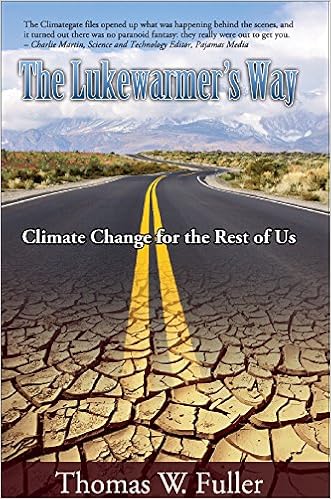
From time to time, people ask about the history of the term “lukewarmer”. As some know, David Smith coined the term. He volunteered to let me post his thoughts on the term. I’m posting his comments below. I thnk this makes a nice compliment to Tom Fuller’s recent post. discussing his book and views.
David’s email follows:
Hi, Lucia. This is David Smith, the person who used the term “lukewarmer” at Climate Audit back in 2008.Words, like people, have a life of their own and also can be seen differently by different people. What one person thought years ago doesn’t matter much today. For kicks, though, I offer below what I meant by lukewarmer back then.
First, being a “lukewarmer” reflected a belief that equilibrium climate sensitivity would most likely fall in a middle range, in the neighborhood of 2C for a doubling of CO2. My belief was based on what I saw as unpersuasive evidence of strong water-vapor feedback. To me, the likely case would be weak feedback. The effects would be mainly felt in cooler regions and not so much in the tropics, as the IPCC predicts, and moreso at night rather than in the day.
Second, it reflected my view that complex change tends to produce both benefits and drawbacks, winners and losers. And it also reflected my view that historical regional warming has, on balance, been beneficial to humanity while cooling has been detrimental. The net global impact of 2C warming, in my view, would be a wash for civilization. The biosphere would shift, mainly in flora and fauna territories and in some cases interactions, but I saw little concern for widespread extinctions or suppression.
Third, it reflected a belief that humanity is resourceful and resilient. We humans have coped with climate change for many thousands of years and will continue to do so, as our climate will change whether or not CO2 increases. We have, and can, handle it.
Fourth, it involved a belief that humanity’s slow, jerky progress in caring for each other will continue. Regions benefiting from warming (or benefiting from disproportional emissions) have an obligation to aid regions that are detrimentally affected. We have that social obligation to each other whether the problem comes from climate change, disease, earthquakes, zombies or whatever. We’re all in this together. Perhaps I’m too optimistic about society but I think we’re getting there.
Fifth, I could be wrong. So, I think it’s prudent to hedge our bets in affordable ways, as we do in other life endeavors. Pursuing energy efficiency and developing non-fossil energy sources make sense to me as both hedges and for other reasons. Phasing down the use of coal makes sense to me (though I haven’t fully vetted the idea). A world mostly energized by nuclear, renewables and natural gas, accompanied by energy efficiency and progress on new energy sources, sounds like a reasonable mid-term target to me.
Even if we don’t commercialize alternatives let’s at least have technology “on the shelf”. The bulk of our efforts to improve/cope should be on other social concerns, such as the American murder rates in the inner cities. A quarter-million young males have been murdered in the US since 1980. That’s horrific and an example of where we should place large resources. Malaria is another example.
Those were my views in 2008. Not much has changed except that I now rarely comment in the blogosphere due to its shrill nature. So many commentators behave like teenage a-holes. I admire your patience. I also am studying ocean acidifcation, a topic which was not on my radar screen in 2008.
I have one closing comment. The public is lethargic about climate change despite the overwhelming “sky is falling” negative media coverage. The reason for the lethargy is that the public intuitively knows that complex change will have both positive and negative impacts.Life teaches us that. Any topic presented as all-bad or all-good smells like a hustle and triggers our BS alarms. People sense dishonesty.
If climate science and leaders want to rally the public to action then they need to be forthcoming about climate change’s mixed impacts and uncertainties. That counter-intuitive approach would improve their credibility and gain them some public traction. Otherwise, the BS alarms in our collective heads will continue to drown their message.
So: that’s the view from the person who coined the term.
Wow. I agree with everything he says!
Julio,
He coined an apt term to describe a constellation of views that many people shared. That’s why many adopted it early on.
I’d say that when discussed at blogs like mine or others Mosher (aka ‘the instigator’ ) visited, the focus was on
But it’s clear that the David also intended to convey something about the policy side. That’s Tom Fullers current focus, and also that of others like Blair King.
Obviously, no one can “freeze” language, and no one owns the word. But I would suggest this position is distinct from both the “warmer-warmist” position and also the “cooler” or “so tepid warming can’t even be proven to have happened yet”, position.
Wow, that is so me.
Is there a term commonly used to support the views of people like Duke’s R G Brown? Which I understand to be that basically the models are so bad, the scientific modelling problem so much more difficult, and our understanding of climate so minimal that the whole notion of predicting climate is hubris of the worst kind. [would Freeman Dyson fit here?]
What to call those who say that the climate scientists are guilty of arrogance on steroids?
stan,
I don’t know a term that describes that particular view you attribute to Dukes RG Brown. You could suggest ask him to suggest one and see whether anyone wants to describe themselves using it.
Dunnos. Go ask whoever it is who says that and ask what they call themselves.
I have noticed a steady shift in the rhetoric. When David Smith first coined the term lukewarmer, 2Ëš was considered inconsequential warming and the mainstream climate warming fanatic view was closer to 5Ëš of warming.
Now the Climate fanatics are claiming climate change and severe weather events rather than any increase in temperature. They have pretty much conceded the huge ECS rate.
The evidence seems to be vindicating the lukewarmers. The only question left is whether the skeptics were correct. I don’t expect that question to be answered in my lifetime.
Ghengis,
The mainstream view has knocked out the high end– so the AR5 is close to “Lukewarm”, yes. Of course, we have relative new comer to climate blog discussions (e.g. Anders) or idiots (e.g. idiottracker) who like to mis-represent the views of Lukewarmers in some attempt to define them into being “wrong”.
Obviously, neither those like Anders or IdiotTracker get to decide what the Lukewarmer position is– nor what it has always been. It’s always been a form of “warmer”, but not in the higher end of the AR4.
Lucia, “Obviously, neither those like Anders or IdiotTracker get to decide what the Lukewarmer position is– nor what it has always been. It’s always been a form of “warmerâ€, but not in the higher end of the AR4.”
I have always seen the Lukewarmer position as being that the first order effect of increased CO2 levels is warming, but that subsequent system responses are not well understood and may as well be random.
this luke thing is really dull…if you are Dutch you build big dams and dykes; if you are Al Gore you buy a huge ocean front estate; and in between a whole load of people get to obsess about their causes, eg Neven, Tamino, Rabett.
In a sense, this is what political discourse has always been – a bunch of uninformed bystanders trying to gain political advantage
There’s lots that I think is interesting in David’s text. Focusing on one bit:
I find this interesting. It sounds like common sense to me. I’m not sure if it’s right, but I’m thinking about it. Maybe the climate communicators ought to take note. Of course, I have this odd suspicion that (many?) climate communicators have BS alarms with batteries that went dead decades ago, so possibly it wouldn’t help.
Thanks for posting this Lucia.
David, thank you. That is an excellent essay.
In the taxonomy of this imbroglio I see Lukewarmers as an important part of the spectrum loosely called “skeptics”, for the exact reasons outlined in your essay. Not to parse this out too much, but does that taxonomy seem reasonable to you?
Very nice summary, David ! I’m with you, Hans, & Julio.
As Genghis noted, there’s not so much talk about high ECS values any more. [Although I wouldn’t expect the IPCC to resile from its 4.5 K/doubling estimate as the high end of the range, any time soon.]
I think more of the discussion centers on the policy axis. There are those who view climate change as “the greatest challenge of our generation”, and consequently press for urgent, massive changes. Others who think that this isn’t an emergency, but perhaps we should devote some national research dollars to alternative energy technologies such as nuclear. Lots of variations and shades of gray as well. It’s hard to quantify “urgency”, but I think that’s a better discriminator than ECS.
Google “Lucky Luke” 😉
Interesting perspective.
It is easy to agree with most of what David says. I point out only three issues:
1) Recent empirical estimates of sensitivity, which take into account the lower aerosol estimates of AR5, indicate the most likely sensitivity lies somewhere below 2C per doubling. The ‘luke’ in lukewarmer seems to be cooling a bit. Maybe tepidwarmers is more suitable.
2) There is ample evidence that many people are working, at many levels, to improve the lives of the poorest of the poor, including the poor themselves. Global poverty has declined rapidly over the past 30 years, and we are currently on track to effectively eliminate extreme poverty withing a few decades (crazy people on the street excepted, since laws in most places restrict how much you can help the deranged). No special steps are need…. just let’s not screw it up with nutszo green restrictions on economic development.
3) For any given level of projected future warming, there are two camps: those who consider the balance of good and bad effects from future warming, and base preferred policy on that balance, and those who consider all warming (even that from ~1900 to present) utterly evil, horrible, immoral and dangerous, and base preferred policy on an ideal of return to “preindustrial” conditions. (AKA, bring on the next ice age!)
.
Lukewarmers are reasoned, calm, and deliberative. Their opposition is not. Calm and deliberative counts most at the polling booth.
In response to the paragraph on the lethargic public inured to alarmism, the public does not have to wait until the end of the century to become convinced the sky-is-falling storyline is BS.
“Back in 2007, and 2008, David Jones, then and still the Manager of Climate Monitoring and Prediction at the Bureau of Meteorology, wrote that climate change was so rampant in Australia, “We don’t need meteorological data to see it†[3], and that the drought, caused by climate change, was a sign of the “hot and dry future†that we all collectively faced [4]. Then the drought broke, as usual in Australia, with flooding rains. But the Bureau was incapable of forecasting an exceptionally wet summer, because such an event was contrary to how senior management at the Bureau perceived our climate future. So, despite warning signs evident in sea surface temperature patterns across the Pacific through 2010, Brisbane’s Wivenhoe dam, a dam originally built for flood mitigation, was allowed to fill through the spring of 2010, and kept full in advance of the torrential rains in January 2011. The resulting catastrophic flooding of Brisbane is now recognized as a “dam release floodâ€, and the subject of a class action lawsuit by Brisbane residents against the Queensland government.”
http://jennifermarohasy.com/2015/09/you-dont-know-the-half-of-it-temperature-adjustments-and-the-australian-bureau-of-meteorology/
Hmm… I believe Mosh claims he had a part in coining the term. What’s your opinion?
“Hmm… I believe Mosh claims he had a part in coining the term. What’s your opinion?”
Nope we discussed this here a long while back when Lucia thought I did and I thought it was bender and then david turned out to be coiner.
I’ve tried to impose some discipline on those who want to stray into policy.
nobody listened.