In comments on the “David Evans” post, Nick, Peter Hartley and I have been discussing arcane issues related to the use of whether the partials in the equation David Evans calls “The basic model” are “strictly hypothetical”, whether those partials are required to be so, and whether this “basic model” can be developed without resorting to these “strictly hypothetical” partials and so on.
During the conversation, I told Nick and Peter I would put up a post that does a derivation parallel to Held and Soden, 2000 (S&H) done in a way that avoids the “strictly hypothetical” (aka ‘formal’) partials. That is: I will derive formulating having dependent variables depend on sets of mutually independent variables; two of the chosen independent variables will be temperature T and $latex log_2(CO_2) $. This choice of variables means my formulation will contain partial differentials on a smaller number of parameter than S&H; my method could be called the “explicit” method. My method will be compared to that of Soden and Held 2000 (S&H) who develop similar equations using an “implicit” formulation. (Our results are physically indistinguishable. )
For convenience, I will assume people who actually read equations will be willing to tolerate my skipping some normally required prefatory material; I will simply say my equations parallel Soden and Held 2000 (S&H) . To facilitate permitting people to follow along with Soden and Held’s (S&H) notation, I will use Soden and Held’s notation as much as feasible. (The alternative is to use David Evan’s notation involving “G” which I find makes presenting this particular derivation onerous.) The equations (S&H) I will parallel start on page 448 here. Also: because (S&H) restricts “drivers” to CO_2 holding all others constant. The derivation could be expanded to consider them, but that is unimportant to the discussion of claimed problems with “hypothetical” partial derivatives.
To begin
Preliminary to the first equation on 448 of S&H, they define “S” as the absorbed solar flux and R as the out going terrestrial radiation. When the earth is at equilibrium (or pseudo-equilibrium if one is picky) S=R. (S&H) use an implicit formulation where S is a function of water vapor in the atmosphere, ice and snow cover and “clouds” $latex S(H_2O, I, C) $, R is a function of temperature, T, $latex log_2(CO_2) $ and “clouds”.
As my plan is to use only explicit variables, I will note that at equilibrium, “clouds”, “water vapor” and “ice and snow cover” are functions of Temperature, $latex (T)$ but not $latex CO_2$. It is thought absorbed radiation has no direct dependence on $latex CO_2 $; all indirect effects of $latex CO_2 $ can be captured through its effect on temperature. So with respect to $latex S $, $latex (T ,CO_2) $ are not mutually independent. In my explicit treatement, absorbed radiation at equilibrium will be a function of T only: $latex S(T) $. In contrast, outbound radiation does depend directly on $latex CO_2 $; so outgoing radiation is R(T, log_2(CO_2)) $.
My equivalent to (1.) in S&H is then:
Because I chose to avoid the using “implicit” functions but still wish to discuss “feedback”, I will now observe that the function $latex R(T, log_2(CO_2)) $ can be decomposed as the sum of two functions:
where $latex R_{pe}(T) $ is defined as the outgoing radiation that would arise on an earth whose temperature is $latex T $ and has the ice, cloud ,water vapor and $latex CO_2$ of the current earth; this does not vary with $latex log_2(CO_2)$. The subscript ‘p’ is intended to convey “Planck”, the subscript “e” intended to convey “effective”.
One of the newly introduced quantities, $latex R_{pe}(T) $, is ‘effective’ Planck radiation by which I mean the total Planck radiation at temperature T scaled by some effective emissivity of earth based on the current level of ice, cloud , water vapor and $latex CO_2$ where these two known. While there may be challenges estimating the magnitude or measuring it in the field, the quantity exists. $latex R_{pe}(T) $ can be called the outgoing radiation when there are “no feedback”. The $latex \tilde{R} $ is then just the difference between the actual outgoing radiation and R_{pe}(T). This decomposition is mathematically permissible; the “true” outward radiation remains on the left hand side.
Having decomposed R, the ‘no feedback’ portions of the physics are now captured by two terms. One, $latex R_{pe}(T) $, has already been discussed. The other, $latex \tilde{R}(T=T_o, log_2(CO_2) ) $ ,is the change in outbound radiation at the current earth temperature. It is worth noting that $latex (T log_2(CO_2) ) $ are mutually independent from the point of view of radiation, as is evident if one considers transient problems rather than steady state.
For reasons discussed in S&H
These are analogous to (3&4) in S&H. Under my formulation, no variables that depend on T are claimed to be held constnat when I vary T.
Note also: Above the subscript $latex |X $ denotes the partial is taken at constant X for arbitrary X. I am noting these to ensure those who have been reading David Evan’s material understand the partials do not required “everything” to be held constant. Only the items listed as held constant are held constant.
I can now write my equivalent of S&H’s (6):
To obtain the “feedback equation”, me must now define what we mean by the ‘no feedback’ condition. That’s easy enough to do: We simply observe that in this formulation $latex \frac{dS}{dT} $ and $latex \frac{\partial \tilde{R} }{\partial T}_{|log_2(CO_2)} $ only arise owing to the effect of temperature on features like clouds, atmospheric water vapor, ice, and snow all of which affect the magnitude of outbound and absorbed radiation but do so because the adjust to temperature. In an explicit formulation, these effects are already accounted for by including $latex T $ in the formulation. We’ll call these ‘feedbacks’; this is merely our definition.
We’ll call the “no feedback” approximation the case where we neglect the “feedback” terms; in that case we obtain:
We may then define the ‘no-feedback’ change in temperature for doubling of $latex CO_2 $ as $latex \Delta_o $:
Retaining the feedback terms in (6) we obtain
where
Those perusing (S&H) will notice Equations (8 & 9) are similar to S&H (7 & 8). In the case where the temperature dependence on radiation and absorption is assumed to depend on water vapor only (which is the one discussed in S&H), my (8&9) and their (7&8) have identical meanings. The main differences I see are:
- The “partial differentials” in my set were developed based functions that depend on a list of variables that are mutually independent. That is $latex (T, CO_2) $ can vary independently; they do under transient conditions.
- Because my equations were develop using only mutually independent variables, the physics are less readily apparent in my version. For example: my $latex \dfrac{\partial \tilde{R} }{\partial T} $ represents the “feedback” that arises because outbound radiation changes if the radiative properties of the earths’ atmosphere or surface change with temperature. It is known they do so. Identical physics are captured by H&S’s $latex \dfrac{\partial \tilde{R} }{\partial H_2O} \dfrac{\partial H_2O} {\partial T} $ though in H&S, the feedback is limited to water vapor. (I could easily modify my expression to limit my more general function to capturing water vapor by expanding $latex \tilde{R} $ into parts that represent individual components.) My $latex \dfrac{dS}{dT} $ maps into H&S $latex \dfrac{dS}{\partial H_2O} \dfrac{\partial H_2O} {\partial T} $ in a similar fashion.
- Even math averse readers will note that the S&H versions communicate the phenomenological dependence on water vapor, and as such reveal more physics. Mine contains it but it is not evident on skimming. The dependence arises through $latex T $ which affects the other variables. This is a feature of the “explicit” method which is pretty standard.
Essentially: My derivation results in the exact same meaning but communicate less phenomenology.
So why provide an alternate derivation?
The only ‘reason’ one might provide an alternate derivation is that recently, David Evans went on a tear about “partial differentials” complaining at lenght. This is a portion of his complaint.
The basic model relies heavily on partial derivatives. A partial derivative is the ratio of the changes in two variables, when everything apart from those two variables is held constant. When applied to the climate, this means everything about the climate must be held constant while we imagine how much one variable would change if the other was altered.
For example, how does changing the surface temperature affect how much heat is radiated to space (the outgoing longwave radiation, or OLR), if everything else — including humidity, clouds, gases, lapse rates, the tropopause, and absorbed sunlight — stays the same? (This particular partial derivative is the Planck sensitivity, central to the conventional model.)
Normally partial derivatives are employed when there are only a few variables, and those variables are independent of one another. […]
But in climate there are many variables and they are not independent — they form a rich web of feedbacks and indirect interconnections. As a rule of thumb, “in climate, everything depends on everythingâ€. Consequently it is not possible to hold everything constant except for only two variables, as required for partial derivatives to exist. For example, warming the surface affects nearly every climate variable, not just the OLR.
The partial derivatives of dependent variables are strictly hypothetical and not empirically verifiable –[…] Employing partial derivatives in climate therefore incurs unknown approximations – so it is unreliable.
[…]
The conventional model relies heavily on the Planck sensitivity, a partial derivative in which everything except tropospheric temperatures (which all change uniformly) and OLR are held constant. Wouldn’t a model architecture that avoided the Planck sensitivity altogether be better? (“Better†as in more reliable, because the components of the model could be empirically verified.)
It goes on. But I think that is enough to show that David makes it sound as if there is something horrifying or dubious about the feedback equation (8) with (9) here. It’s true that equation often is developed using partial differentials applied to functions where that contain many parameters chosen such that some parameters depend on the magnitudes of others. It is also true surface temperature affects the amount of outgoing long wave radiations and other features that are treated as independent in those derivations which rely on the “implicit” method of formulating equations.
S&H’s differential as written do contain partial differentials that are taken while holding dependent parameters constant. If we noted the items held constant explicitly, their $latex \dfrac{\partial \tilde{R} }{\partial H_2O} \dfrac{\partial H_2O} {\partial T} $ is :
So this “partial” is defined as describing a ‘change’ in surface temperature while cloud-cover is allowed to vary. And, it is true that that means that mathematically, one could do some odd things with this sort of partial differential. (Nick and I discussed this in a number of comments.) But in practice, this is actually not troublesome because total differences always work out right and the notation highlights phenomenology.
None of this is a problem. One can get the the same basic equation using the “explicit” formulation. (And, fwiw, “everyone” knows this.) So while some observations about the partial derivatives are true (they are taken holding dependent variables constant, and so on.) none of these observations results in any real problem in the ‘final result’.
As I’ve shown, derived using the “explicit” method above it appears we resolve many ( and likely all) the criticisms related to “differential hypothetical” that David goes on about. I think it addresses at least the following statement in the above quote:
- With respect to
A partial derivative is the ratio of the changes in two variables, when everything apart from those two variables is held constant. When applied to the climate, this means everything about the climate must be held constant while we imagine how much one variable would change if the other was altered.
In the explicit formulation, partial differential are not taken holding “everything about the climate” constant. When one parameter varies, the only things held constant are mutually independent variables which can be held constant while varying the one being varied. Note that in my formulation, I don’t hold “relative humidity” constant wile taking the partial with temperature. And. So on.
- With respect to this:
For example, how does changing the surface temperature affect how much heat is radiated to space (the outgoing longwave radiation, or OLR), if everything else — including humidity, clouds, gases, lapse rates, the tropopause, and absorbed sunlight — stays the same?
Is: my math doesn’t claim to hold all these constant while taking partial differences.
- As for this
Normally partial derivatives are employed when there are only a few variables, and those variables are independent of one another.
Evidently, my ‘explicit’ method must be the a “normal method”. Note: there are few variables in the function list. All are independent of one another. (I’m not sure how to square this with his later criticism that I suggest if someone doesn’t like derivations in which implicit variables appear in the function list should just rub them out and do the calculation the way he, here, seems to deem “normal”. His criticism of my representation of his “G” would suggest he doesn’t consider the “explicit” method the “normal” one and perhaps considers it flawed. But. whatever. )
-
The partial derivatives of dependent variables are strictly hypothetical and not empirically verifiable
The partials in mine contain no dependent variables, and so are not “hypothetical”.
-
The conventional model relies heavily on the Planck sensitivity, a partial derivative in which everything except tropospheric temperatures (which all change uniformly) and OLR are held constant.
In my formulation, my Plank sensitivity does not contain any partial derivatives holding those tings constant
So: none of those issues represent “problems” for the final equation. This is why my reaction to Evan’s posts is that it is at best confused. One might not know the precise locus of confusion, but it is certainly confused. For those wondering about my reaction to his second post which attempts to engage my criticism: it appears to be equally confused. It is sufficiently on a number of points so that it is a waste of time to try to take some of the individual “accusations” in a blog post. (Though anyone who would like me to engage individual ones in comments is welcome to raise their questions).
Meanwhile, those who were curious whether some trouble with “hypothetical partials” causes problems with the “feedback” equation: No. There may be other problems with climate models of various sorts and even the feedback equation but those problems have nothing to do with the “hypothetical” partials nor the fact that the equation was derived using an implicit representations.
I think for those who understand partials, how they are treated and what they mean this clarifies some of my comments in the previous post. Sadly, it is not possible to clarify for those who do not understand partials or functionals because the whole kerfuffle is about partials not physics. (And this is true even if David is concerned about physic elsewhere in his length N part series with $latex 10 \le N $.
Will there be a follow on post? Perhaps. There are some questions arising in comments that might need a follow on post.
Note: Let me know if you find broken equations and so on. I am proof reading lightly as I wish to post rather than spend a week proof reading latex. (Yes. This is blog.)
Also: On this post, I would like to keep discussion in comments restricted to the issue of “hypothetical partials”. Discussion of other possible issues only distracts from this narrow issue. It is true that models of various sorts have other problems. It is also likely true that David is making additional claims or points his unending series which seems to have gone to 11 at this point. That those totally different issues. If one wishes I can create a thread where others can discuss those.
Update Oct 20, 2015: Reply to David
David has posted a “reply”, which is rather hilarious. It does not warrant much of a reply as those who know math will just laugh at many of his defenses.
Lucia’s second post has no mention at all about any mistakes with differentials, which I’ll take as implicit acknowledgement that I was right — as were Held and Soden [1], and Pierrehumbert [2], whose model development I was copying. No retraction or apology from Lucia though. No one reading Lucia’s two posts would know that I was correct about differentials all along and Lucia was wrong; they’d get quite the opposite impression.
Rest assured nothing about this post is “implict acknowledgement he was right”. I’m entirely sure what he thinks my failing to criticize means he was right about. Is he joyful I didn’t criticize his application of the chain rule? I never criticized him for use of the chain rule. I said if one wants to avoid holding “everything” constant, one only needed to pitch the implicit terms out of function “G” and get rid of those terms. Partial differentials vanish. I showed this is the case. Which is to say: I showed what I said in the first place was entirely correct. But perhaps David’s claimed careful reading doesn’t extend to noticing words like “if” in statements in comments.
His response to my showing you don’t need to hold “every thing constant”, is:
Merely due to her definition of Rp , she can write the Planck feedback with straight derivative symbols instead of partial derivative symbols. This is mere notational trickery and legerdemain; Lucia is fooling herself and her readers with her multiple claims to the effect that her formulation does not contain partial derivatives that hold everything constant. “Her Planck feedback†is the just same as the conventional Planck feedback – dRp/dTS holds feedbacks constant, and since (nearly?) every climate variable is affected by feedbacks to surface warming, Lucia’s Planck feedback holds “everything about the climate†constant†too.
No. My formulation does not hold “everything about the climate” constant while taking a differential. It either holds “T” constant or “CO2” constant. Nothing else.
Subdividing effects into parts to apply partial differentials separately is not “notational trickery and legerdemain”.
That it is not so ought to be obvious to anyone including those who run small shops, or keep track of their household budget. Subdividing effects wouldn’t be “notational trickery and legerdemain” to keep track of ‘bicycle sales’ separate from “tricycle sales” in a store to gain further insights into your sales. It wouldn’t be “notational legerdemain and tricker” when used to keep track of grocery expenses and clothing expenses.
Subdividing doesn’t suddenly because “notational trickery and legerdemain” so in physics just because Evan’s doesn’t like the fact that this eliminates the “problem” of taking a derivative with “everything about the climate†constant†.
That it so happens that by separating, you can take a derivative of one of the terms without “everything” constant: That’s called convenient. But news flash: a person doing an analysis gets to organize terms to make later application of differentials convenient if they wish to. Adding and subtracting is allowed and taught to quite young children, who admittedly do it with numbers and not functions. But it’s the same math. That David Evan’s considers that “notational trickery and legerdemain” speaks volumes to his level of confusion.
It turns out you get the same feedback by using addition and subtraction to organize ones math. This eliminates any need to even seem to hold ““everything about the climate†constant†while a partial derivative is taken. If David thinks adding and subtracting is some sort of impermissible “notational trickery and legerdemain”, he is mistaken.
“None of this is a problem. One can get the the same basic equation using the “explicit†formulation. (And, fwiw, “everyone†knows this.)”
Yes, indeed. People who know about this stuff know that you can make all kinds of variable transformations, but propositions about rate of change etc remain true, possibly with appropriate mapping. So if you can prove something with one formulation, it is true in others by mapping.
In 3D space, this is formalised in the tensor calculus. A vector or a second order tensor are real entities. You describe them by coordinates in an axis system that you impose, but the axes are an artifice. And you prove things about them in that framework (as with cartesian coordinates), but it will be true about any other.
That is what is dumb about Evans stuff about climate not actually holding variables constant etc. It would of course be true about any other field where PD’s are used. Try it on Einstein. But it relates only to the process whereby you try to describe something with a particular combination of variables. It is the quantification of coefficients in that system. It isn’t the reality.
Nick
Yes. But saying that won’t clarify it it to the blog audience who can’t decide whether those here who mostly say David is confused are correct or whether David is correct. I thought paralleling Held an Soden is concrete, not to long, and shows we get the same thing both ways.
The tensor calculus is the way to come up with a general compact proof. But those who can follow that already know that both ways work.
Those at Anders are discussing stuff in “post 9”. That can also be resolved….. The issue is how to do it clearly.
For me, the discussion in comments helped think through to try to come up with a way that helps those don’t want to deal with tensor calculus!
Nearly. Thermodynamics does often do things where you keep stuff explicitly and owing to the nature of the problems you make sure you write down what is kept constant. You’d make all sorts of mistakes finding the COP of a refrigerator or the efficiency of a heat cycle if you didn’t keep track of what you were keeping constant when taking a partial when working that sort of problem.
Also: quite a few examples 1-D examples in Gas Dynamics involve working problems using ‘explicit’ formulations.
But lots of applications involve using implicit formulations. The two always map into each other. You use the one that’s “easy”.
But if someone goes into a rant about features of the implicit method with its “hypothetical” partials, they should just go to the explict method. It’s often more tedious and reveals less. But… well so?
You have put a lot of work into an alternative [explicit] description of the maths involved in forming the terms and definitions so thanks.
All those, “everyone else” apart from Nick and Carrick now know there are two ways to approach this.
You have used it to explain S and H in a an alternative way.
But why?
Because if you use S and H then David Evans criticism must be true.
Mathematically, if it was not true, then you should have used the original definition to show where he was wrong.
You could not do this.
The man is not commentating on your explicit model framework. He is commentating on the implicit framework used by S and H and Nick and others.
As you say,
“S&H’s differential as written do contain partial differentials that are taken while holding dependent parameters constant.”
When you state,
“his “partial†is defined as describing a ‘change’ in surface temperature while cloud-cover is allowed to vary. And, it is true that that means that mathematically, one could do some odd things with this sort of partial differential.”
You are agreeing with Dr Evans.
you show that his comments are right in that framework.
When you state that one agrees with the other in practice then you agree that your work is expandable to one with PDE’s that then are subject to his criticism.
You allow the terms to be variable and independent but all being determined by the temperature. This means in your example you are right but does not mean that this is right in the usual equations where such terms must lead to problems, precisely because the temperature dependence is now lost.
Nick Stokes (Comment #140056)
” One can get the the same basic equation using the “explicit†formulation. (And, fwiw, “everyone†knows this.)â€
Yes, indeed. People who know about this stuff know that you can make all kinds of variable transformations, but propositions about rate of change etc remain true, possibly with appropriate mapping.”
Possibly with appropriate mapping, meaning if the mapping is not appropriate the propositions are not true?
Or, “mathematically, one could do some odd things with this sort of partial differential.”?
Methinks your Venn diagrams are overlapping and there is a bit DE has picked up on in the usual, internal framework that still remains fishy.
Angech
In that post he was not commenting on “the framework” he was commenting on the model. Or at least he give the reader a dang good impression of this because he refers to the thing he is criticizing as “The basic model” see above. The model is the outcome of the analysis. The framework gives us a path we can follow to create the model. We get the same model either way.
There is nothing wrong with the thing he calls “The basic model”. (There isn’t anything “wrong” with either paths for developing it either.)
Angech,
I do want to be sure we note what David actually said.
To show further that he is criticizing the model this is just after the transition to “David’s” bit, so it’s his words back them.
So:in post 3 (4? whatever) he is criticizing the model and saying it contains “errors”. That particular post of his purports to elaborate on that particular “error” in the “model”. This is quite clear.
What my post shows is nothing wrong with the model. The method means the terms as expressed by Soden have features. Those features aren’t “errors”. They don’t mean the model contains an “error”.
However: if someone (say David) wants to derive the model a different way, he can. People get to do their algebra and calculus whoever they prefer.
The result will be exactly the same model. The model now clearly doesn’t have any of the supposed “errors” David complains of. Hence: The other model derived in a different way also doesn’t contain any “error”
.
And David is wrong claiming “the model” contains and “error” related to partial differential equations because:
He is not wrong to say partials contain certain “features”. They do have “features”. No one is disputing models have “features” and that you have to handle them properly. But David hasn’t brought forth one iota of evidence to suggest they have been mishandled when creating the models.
angech
No. Mappings make things “look different”. It’s sort of like looking at an object from another direction. I’m trying to think of something concrete. Have you seen “T,S” and “P,V” diagrams in thermo? They are available as “steam tables”. Depending on which you start with, you can “map” all the points form one into the other.
So: if you start with this:

with one particular ‘mapping’ you can get this

(This is dang convenient when doing thermo. )
You can use a different mapping to get a different view. So with the “appropriate” mapping you can go form one particular thing to another particular thing. With a different mapping…. you get somewhere else! So “appropriate” only means “the particular one that gets you to the desired result rather than a different one which is also right.”
The ‘odd’ things are if you haven’t stated a few things explicitly, the “partials derivatives” at “constant whatever” can seem to turn out differently with different formulations.
With respect to my equation (8), you would get the same estimate for the left hand side of (8), but the “stuff” on the right side of (8) might not have clear meaning to everyone if the derivation was implicit. (The meaning could be easily clarified by either (a) reading the derivation or (b) giving a more concrete example. But temporarily, it is “odd”).
If you want more clarity on the “odd things” I can elaborate. It’s what I’m going on about in this http://rankexploits.com/musings/2015/questions-to-david-evans-what-do-you-mean-about-partial-derivatives/#comment-139969
But these odd things actually wash out. (FWIW: In that comment I am discussing a question Nick brought up. Nick was using a fluids example, and the way we would resolve that in fluids — and mostly of physics– is we always pick u and v to be orthogonal. If someone has said they pick u and v orthogonal odd things “goes away”. BAM! Similar things are going on with climate science and their implicit formulations. But you have to read the paper in which the formulation was derived. That means the “odd thing” is resolved by reading the derivation. In contrast, the “explicit” partial derivatives are portable. No one needs to read the derivation to know the precise meaning of the “explicit” partial. )
angech,
Sorry for four!
What do you mean by the “internal framework”? What’s this framework internal to? Real questions. I realize I took you to mean “the method used to develop the model.” But now I”m not sure because I wouldn’t call that a “framework”. I would call it “a process”.
Because without my knowing that, I can’t be sure I’ve engage your comment.
Is this a simple example of what you mean? Formula for circle in different coordinate systems:
Rectangular coordinates, circle at origin:
x^2 + y^2 = (radius)^2
In polar coordinates,theta being the angle WRT to the starting point of the circle:
r(theta) = radius
Hmmm…
I think the map is if we know something as a function of (x,y) we can get it as a function of (θ, r);
So for example, if we know something like a “temperature field” in (x,y) we can re-express that as a function of (θ, r);
I’m not sure if finding θ ,r itself from (x,y) is a “mapping”. I never think of it as one but it might be.
Hmm… Yeah. I think transforming the coordinate system is a map. A transformation is a map, and that looks like a transformation.
The classic transformation of coordinates is from the Ptolemaic to the Copernican solar system, i.e. Earth centered to Sun centered. There’s nothing inherently wrong about the Ptolemaic system. As I understand, it’s a lot easier to calculate eclipses in an Earth centered frame. But the physics is obvious in the Copernican system and not in the Ptolemaic.
I think I am going around in circles. Sorry.
lucia (Comment #140085)
“You can use a different mapping to get a different view”
Yes, I understand this.
When I look at a CT scan, an MRI and an X-Ray I get three different bits of information all of which relate back to the same base.
“What do you mean by the “internal frameworkâ€?”
Probably a word slip on my part.
I think I meant to say implicit not internal.
DE did not consider or know about or ignored the explicit explanation when he was making his criticism of the implicit model. While this was obvious to you when you saw it it was not obvious to many others.
There is something not right about an artifact developing on the implicit but not the explicit explanation that suggests the mapping is not analogous.
The problem seems similar to that of solving equations where one gets imaginary numbers, Only they became useful when we entered quantum physics.
Here it just causes issues.
angech,
Well, it was obvious to many others: Nick, Carrick, Anders, lots of people discussing the issue with David in comments. The problem is explaining it in language that makes it obvious to people who forgot the flexibility one has with handling and representing differential equations. David Evans seem to fall in that category.
warning: there is likely to be broken latex initially
There’s nothing “not right”. “The artifact” always clears itself up. It’s just a matter of when one transitions from “implicit” to explicitly..
Notice in my explicit derivation above I expanded the upward radiation at “step 2“. That is: I did it immediately. Also, I wrote the second term as a function of T, not something like “H2O” That’s because I chose to use the ‘explicit method’. So I have to do the substitution then. Then, I can defer further elaboration until after I have written (9) and I want to use (9) to estimate something.
So: now I want to use my 9 to get an estimate?
Among other things, I now need to take a derivative of $latex \tilde(R(T)) $
If I believe the effects are due to water vapor and soemething else (for example ‘U’), both of which are functions of T, I could first write:
$latex \tilde(R(T)) = f(H_2O(T), U(T) ) $
At this point to get estimates the functional form would take on a concrete functional form. That is: it specified.
That is: it might look something like if I’m a stickler for “explicit” methods, I need to tell the world how I go about estimating the two functions inside (f). So now (at the risk of everyone saying: that’s a ridiculous function!) I will give easy to differentiate functions that that not the physics. It’s just to give a “what do you do” example.
For purpose of discussion, stipulate:
$latex f(H_2O, U )= H_2(T)^2 + U(T)^3 $ (example equation.)
with H_2(T) = exp(T) and U(T) = T;
substituting:
$latex \tilde{R}(T) = 5*H_2O(T)+ U(T) $
If I’m really, truly allergic to “implicit” formulations, I know write:
So: $latex \tilde{R}(T) =5* exp(T)^2 + T^3 $
I can now merrily differentiate $latex \tilde{R}(T) to my hearts content. (You can to.)
Now, for the purpose of discussion let’s further stipulate
$latex R_p(T) = A T^4 $,
Now the whole function of interest is
$latex R(T)) = (A T^4) + ( 5* exp(T)^2 + T^3) $
I (or anyone) now merrily differentiate everything I need to insert in (9) to my hearts content.
So what happens in the “implicit” method? It’s true that the partials were “temporarily” ambiguous because we can’t yet know what ‘his’
$latex \dfrac{\partial R(H2_0, U,T)}{ \partial H2_0}_{T,U} $ means when he’s obtained the equivalent of my (8). In principle, he might partition it in any number of ways. The reason he can is he didn’t substitute at step (2) but deferred it to afterward. So: in principle he (or someone else) are free to partition anyway they p. Assuming an analyst makes the same choices stipulated above in my ‘explicity’ analysis, he will get
$latex R(T) = (A T^4) + ( 5* exp(T)^2 + T^3) $
But now for the “math oddity” (that doesn’t matter): because his formulation is implicit, in principle, “for all we know” he might partition the ‘physics’ this second way:
$latex R(T)) = (A T^4 +exp(T)^2 – 0.5 T^3 ) + ( H_2O (T) + U (T) ) $
where
$latex H_2O (T) = 4* exp(T)^2 $
$latex U (T) = – 0.5 T^3 $
After that, $latex \dfrac{\partial R(H_20, U,T)}{ \partial H_20}_{|T,U} $ would be
$latex \dfrac{\partial R(H2_0, U,T)}{ \partial H2_0}_{|T,U} = 2*4* exp(T)^1 $ (**)
Call this the outcome for “equation partitioning 2”.
But because he was implicit up to the point of getting his formula, he could use the partitioning I used initially :
$latex R(T)) = (A T^4 ) + ( H_2O (T) + U (T) ) $
where
$latex H_2O (T) = 5* exp(T)^2 $
$latex U (T) = T^3 $
Notice under both choices “R(T)” is exactly the same. But now:
$latex \dfrac{ R(H2_0, U,T)}{ R(H2_0)}_{T,U}= 2*5* exp(T)^1 $
Under the original partitioning I used in my ‘explicit’ example.
Which is not the same as in (**) obtained with the second choice of partitioning.
That “seems” odd. You can’t “port around” $latex \dfrac{ R(H2_0, U,T)}{ R(H2_0)}_{|T,U}= $ to another analysis. In the implicity method, it’s functional form depends on deferred analyst choices.
In contrast ‘genuine’ differentials are in some sense ‘portable’. It is the oddity of which I speak.
But is this a ‘problem’ ? Nope.
It’s an oddity is a ‘mathy’ thing and has to do with a choice that was made when the analyst wrote “where” which tells the reader which bits the analyst attributes to “direct” effects and which he attributes to which “indirect” effect. In the “implicit’ method, he deferred all partitioning to a later point. In the ‘explicit’ method the differentials are applied with partitioning already decided.
If he later makes the same choice for partitioning, (which choice is based on understanding of physics– not math), things wash out.
So: if two analysts make different choices for partitioning or describing physical phenomena from each other, their final results will differ. That’s because they have made different claims about physics this has nothing to do with math nor with the ‘oddity’ in the partial differential equations. If two analysts share the same choices for partitioning the the effects, their final results will be identical.
The choice is a matter of “when” one decides to specify physics. That David Evans doesn’t know this. Well. . .
It actually makes no difference whether I use the “implicit” or “explicit” method. The “oddity” about partials is of no import. In both cases, if I want to get actual numbers, I have to decide how I partition my function to “better reveal phenomenology”. The question is “when”. But that’s not a “problem”. The implicit method results in ‘final result’ for the feedback equation that defers the ‘partitioning’ to a later analyst who might make different choices for partitioning the ‘physics’ — in which case– he would give his explanation what that ‘partitioning’ give greater ‘insight’.
But provided people do, at some point, describe what they thing the phenomena are and list there “wheres”, all the apparent oddities vanish. Poof.
angech
The were useful long before that. They were used in Electricity & Magnetism and Potential flow before quantum physics came along.
While the purely mathematical point made here is formally correct, there is an overlooked matter of geophysics. It centers around the stark difference between ill-understood and tenuous dependencies of other physical variables upon SURFACE temperature, as opposed to the effective planetary BLACKBODY temperature. It seems that Evans addresses the former, while Lucia concentrates on the latter.
Lucia – “As my plan is to use only explicit variables, I will note that at equilibrium, “cloudsâ€, “water vapor†and “ice and snow cover†are functions of Temperature, (T) but not CO_2.”
Could you dumb this down for me?
How can explicit variables like “cloudsâ€, “water vapor†and “ice and snow cover†be functions of Temperature? If they are in equilibrium they are constants not variables.
The same of course with CO2.
And if they aren’t in equilibrium, I also don’t see how they can be a function of Temperature?
Must be something trivial I am missing.
I believe Lucia’s point was purely mathematical. But it does sow some uncertainty WRT Dr. Evan’s understanding of multivariate calculus. Of course, that alone does not mean Dr. Evan’s simple model isn’t better than the simple IPCC version.
Ghengis
To things: first the equilibrium issue:
The equations R and S individually exist when things are not in equilibrium. So, the magnitude of each can vary with “T” etc. So can other things. The equilibrium solution can be found by setting R=S. At that point, one can solve for T given CO_2.
As what “S” is a function of: It is generally thought that the amount of the suns energy that is absorbed is either not a direct function of CO2 nor is cloud cover etc. That is to say: once we know T we can explain “S” without including any additional information about CO2. (Similarly for things like clouds etc.) If that is true, under the explict method, S is a function of (T) and adding the other features is incorrect. (If one adds them, one is using the ‘implict’ method– which is fine. But you need to know which you are using.)
As for how the amount of water vapor in the atmosphere can be a function of temperature: The vapor pressure of water is a function of temperature. That’s why boiling point of water varies with atmospheric pressure (and why pressure cookers work and so on.) Likewise, could cover varies with the amount of water vapor in the air and also with the temperature at any elevation. So that is a function of temperature. Ice coverage– like at the poles– is a function of temperature. So if the average temperature of the earth were to increase dramatically, we’d have less ice and if it dropped we’d have more. So that’s how those can be ‘functions of temperature’.
Of course, once we find the solution at steady state, those are just ‘values’. But that’s the solution– and to find it, we first express the physics as things that can vary with temperature.
Bear in mind: We know these things aren’t just constants because the world is often not at steady state. It’s in a transient. So, S(T) also applies during a transient. It’s the same S(T).
jim2,
Discussing his “simpler” model likely requires reading all the posts. Last time I looked he was up to 11. Quite a few of them contain mind numbing drivel.
Perhaps it would be possible to pull out all the drek and whatever remained would be useful. Each can have their own guestimate of whether that’s likely.
If there is anything useful there it is a shame he surrounded it with such a wad of unending drek.
To the geophysical point: since evaporation is a function of surface temperature and the–highly variable–amount of water vapor in the atmosphere decreases sharply with altitude, it cannot be simply a function of the planetary blackbody temperature.
sky,
The temperature as a function of elevation is affected by the temperature of the surface. That’s what’s meant by humidity being a function of surface temperature.
Locally at different elevations levels, water vapor is not a function of surface temperature directly. That’s the boundary condition that affects it.. For example: The adiabatic lapse rate is affected by the composition of air, which is itself a function of dry air on earth and the amount of water vapor. The value would be different if the earth’s atmosphere was made of helium. Atmospheric pressure at sea level is affected by the mass of the atmosphere. It would be lower if the atmosphere contained less air over all. But things like pressure at sea level, composition of dry air and etc. are functions of what the atmosphere is made off. In conversations about climate change, we generally assume everyone agrees that we aren’t talking about how things would change if all the Nitrogen in the atmosphere was replaced by Helium or the earth suddenly lost 1/2 its air.
Given that assumption, overall, the amount of water vapor in the atmosphere is a function of temperature.
As the “feedback” model is a ‘point”, model it’s description is limited to one temperature. That’s the nature of “simple models”. Of course it’s hardly “all” of climate science. After all, there are those AOGCM’s in use.
“Of course, that alone does not mean Dr. Evan’s simple model isn’t better than the simple IPCC version.”
There is no “IPCC version” involved here. Evans has made up a model that he calls the “basic” “conventional” model, but he gives no links to justify that usage. Some papers by Soden and Held on feedback mechanisms have been mentioned. Then he says there are flaws in his made-up model, and he has a better one.
In fact, the AR4 does have a section on simple models. It is vastly more comprehensive than anythin g in Evans. They say
All the models Evans considers are right at the primitive end of this scale. In fact, the AR4 does have a recognised “simple model”. They say:
40 layers? Upwelling? And Evans tells us that they treat all forcings the same, and at one point.
Yes, Nick, I misquoted Dr. Evans. He did mention the IPCC would not DISAGREE with the basic model he presented in the first few posts. He actually said:
“Our understanding of the effect of carbon dioxide rests on the conventional basic climate model.
That model is used to calculate the sensitivity of surface temperature to the concentration of atmospheric carbon dioxide. It dates back to 1896 with Arrhenius [1]. It was updated in the 1960s and 1970s, and described in some detail in the otherwise-rather-brief Charney Report of 1979, which is the seminal document that ushered in the current era of concern about carbon dioxide [2]. It is the cornerstone of the carbon dioxide theory of global warming. Predating computer simulations, it is often referred to as “basic physicsâ€.”
Lucia,
My basic point is that there is a stark difference between surface temperature and local temperature aloft–and neither of these are simply functions of the planetary blackbody temperature that you seemingly invoke by referring to TOA radiative balance and positing [total?] water vapor as a function of temperature.
This sort of indiscriminately vague, aphysical description may satisfy some mathematical modelers and polemicists, but fails to fly among experienced geophysicists, who recognize that all temperatures encountered in situ are DEPENDENT, extensive variables, with no straightforward functional relationship to the blackbody temperature.
Of course there large differences between surface temperature and temperature aloft. That doesn’t mean the latter can’t be a function of the former.
jim
No. The feedback equation, which Evan’s is dubbing “the basic climate model”, is a feedback equation. The “basic physics” are that
* We know CO2 has an effect– so that’s the “no feedback” element.
* feedbacks exist. For example: warmer air can hold more water vapor and water vapor itself results in warming.
* if feedbacks exist, then we can posit a “feedback” equation describing the impact of physics.
It is the elements related to the terms in the equation that are the “basic physics”. Presenting that as a “feedback” equation is “using math to show the importance of different physical phenomena.” That’s not “basic physics”. It’s “communicating ideas”.
“Of course there large differences between surface temperature and temperature aloft. That doesn’t mean the latter can’t be a function of the former.”
That strict functional relationship exists only in the theoretical derivation of dry and wet adiabatics, which are invariably different from the actual environmental lapse rate.
Until you make clear distinctions between mere conceptual constructs, such as planetary blackbody temperature, and observable physical reality, I’d rather watch football.
In fact, on Saturday evening, I’d rather do anything than prolong the fruitless discussion here!
Late here again, but what do you mean about your “no feedbacks” condition? 255 K which would not be influenced by clouds or ghg? pre-industrial? current conditions subject to perturbations?
All of this makes a difference.
Hi Lucia, I know you want this to be focused on partials, but can we just look at the system we are trying to model?
The Earth rotates and one face of the sphere is pointed at the sun and the other isn’t. Clouds can be present above the surface where the sun is at its zenith or on the opposite side of the planet. Just where clouds are will affect the surface temperature with opposing effect, blocking sunlight will cool and blocking out going IR will slow cooling. I find the near equilibrium approximation, rather than pseudo-steady state analysis to be misplaced.
Lucia. He didn’t say it WAS basic physics. He said it was often REFERRED TO as basic physics. There is a difference.
Lucia, “As for how the amount of water vapor in the atmosphere can be a function of temperature: The vapor pressure of water is a function of temperature. That’s why boiling point of water varies with atmospheric pressure (and why pressure cookers work and so on.)”
Actually the surface temperature of the ocean is relatively constant. The rate of evaporation is primarily controlled by the atmospheric pressure and wind. As the vapor content of the air increases the air pressure decreases increasing the rate of evaporation and increasing the wind.
Also as long as there is Ice in the Arctic Ocean the surface temperature is going to be very close to Freezing, again the surface temperature of the ocean surface is going to stay relatively constant and the pressure changes control evaporation.
I don’t see how water vapor is a function of Temperature, when Temperature is a (relative) constant.
Temperature, cloud coverage, wind is a function of Pressure.
” There is a difference.”
But is there any meaning left. Who refers to it? No quotes given. He says that he has strung together bits of “basic physics” he found somewhere, made a model, then found fault with it.
Despite what he says, the Charney report doesn’t set out such a model, at least not with equations. They pay more attention to GCMs, which is remarkable for the time.
jim2
Oh? Did David say who referred to it that way? And provide a reference or link? It might be useful to know.
sky,
So watch football!
Not sure I know what point you are trying to make. The Cubs are now playing the Mets. Not going to spend much time trying to read your mind.
Ghenghis
Relative? To what? This comment makes no sense.
The whole exercise is to estimate how much this “constant” changes as a function of CO2. Obviously, one doesn’t assume it’s “constant”, “relative” or otherwise for the purpose of effects on water vapor. The effect of temperature on vapor pressure is strong. This is well know, and used in engineering.
Regarding water vapor, please do consider that much of the atmosphere has a relative humidity closer to completely arid than to saturation, so that portion of the atmosphere might not be a strong candidate for water vapor feedback since it is not fulfilling its potential humidity for it’s given temperature now.
.
That wouldn’t eliminate water vapor feedback, but might reduce it somewhat.
Turbulent Eddie,
Whether water vapor feedback is large or small is irrelevant to the issue at hand which is the “partial derivative” issue and how to derive. So you are basically straying off into a different subject.
In contrast, the discussions of whether the it makes sense to give certain functional descriptions above are on topic because those have to do with the math.
Nick Stokes (Comment #140132)
In response to,
“Of course, that alone does not mean Dr. Evan’s simple model isn’t better than the simple IPCC version.â€
You said
“There is no “IPCC version†involved here”.
A paragraph later you say,
” In fact, the AR4 does have a recognized “simple modelâ€.
So which is it the IPCC [AR4] does have a primitive [sorry simple] model or not???
” Evans has made up a model that he calls the “basic†conventional model, but he gives no links to justify that usage. In fact, the AR4 does have a section on simple models. It is vastly more comprehensive than anything in Evans.”
Is this the section, Nick?
Is it not a simple IPCC version?
It is Basic Physical Science from it’s heading I believe
“Climate Change 2007: Working Group I: The Physical Science Basis
The fundamental basis on which climate models are constructed has not changed since the TAR. Climate models are derived from fundamental physical laws (such as Newton’s laws of motion), which are then subjected to physical approximations appropriate for the large-scale climate system, and then approximated through mathematical discretization. Computational constraints restrict the resolution that is possible in the discretized equations”.
” All the models Evans considers are right at the primitive [yep, that is what basic means] end of this scale. In fact, the AR4 does have a recognised “simple [yep that’s what primitive means] modelâ€. They say: As in the TAR, a simple [basic or primitive] climate model is utilised in this report to emulate the projections of future climate change”
Lucia.
“So: if two analysts make different choices for partitioning or describing physical phenomena from each other, their final results will differ. That’s because they have made different claims about physics. If two analysts share the same choices for partitioning the the effects, their final results will be identical.
The choice is a matter of “when†one decides to specify physics. That David Evans doesn’t know this. Well. . .”
That the choice of “when” is allowed to have such a drastic effect means there is something wrong with the implicit method.
There must be no doubt about the need to be specifying exactly the same choices.
When you have climate modelers who may import 40 layers [a simple climate model has land and ocean boxes in each hemisphere, and the upwelling-diffusion ocean model in each hemisphere has 40 layers with inter-hemispheric heat exchange in the mixed layer.] in one model and then change to 60 in a more complex model not to mention the hundreds of other changes possible then different climate models can never have the same choices and using the equations must lead to errors.
QED, you are right and DE is right but DE is wrong in his maths.
Lucia, “Relative? To what? This comment makes no sense.
The whole exercise is to estimate how much this “constant†changes as a function of CO2. Obviously, one doesn’t assume it’s “constantâ€, “relative†or otherwise for the purpose of effects on water vapor. The effect of temperature on vapor pressure is strong. This is well know, and used in engineering.”
Ocean surface temperature relative to land atmospheric temperature or land surface temperature. Tropical, Subtropical and Arctic ocean surface temperatures have a very narrow daily temperature range, often Zero. It is unphysical to infer that the temperature of the Arctic ocean ever gets above zero while there is any kind of ice extant.
The ocean primarily cools by evaporation not radiation and the primary control for evaporation when the temperature is constant (which it generally is) is air pressure and wind. This is a well known fact and used by meteorologists and sailors for millennia.
When the sun warms the ocean it primarily warms a band just below the surface, while the surface (skin) temperature stays remarkably constant.
Sure temperature could control the evaporation rate, but as you mentioned above pressure as in a pressure cooker has a greater influence and determines the temperature of the water in the pressure cooker to a large extent. The atmospheric pressure does the same with the ocean.
“As my plan is to use only explicit variables, I will note that at equilibrium, “cloudsâ€, “water vapor†and “ice and snow cover†are functions of Temperature, (T) but not CO_2. It is thought absorbed radiation has no direct dependence on CO_2 ; all indirect effects of CO_2 can be captured through its effect on temperature. So with respect to S , (T ,CO_2) are not mutually independent. In my explicit treatement, absorbed radiation at equilibrium will be a function of T only: S(T) . In contrast, outbound radiation does depend directly on CO_2 ; so outgoing radiation is R(T, log_2(CO_2))”
Surely incoming radiation must have some effect from increasing CO2 levels as well? There is no one way switch scientifically. If CO2 levels are higher more solar radiation will be intercepted higher up leading to increased reemission to space [equivalent in a sense to higher reflection I guess]. This effect would work all the way down to surface level.
S[T] may have a log 2 [CO2] component as well though this could remain undefined as the consideration is still what total flux is absorbed.
“So which is it the IPCC [AR4] does have a primitive [sorry simple] model or not???”
Yes, the IPCC has a simple model (not primitive). And no, what Evans described is not it.
If he really is describing an IPCC model, you’d think he could reference it (maybe you could?). The IPCC reports are online, with an elaborate numbering system. But he doesn’t.
Very elegant post clearly addressing David’s concerns. Thanks.
Lucia wrote: “As for how the amount of water vapor in the atmosphere can be a function of temperature: The vapor pressure of water is a function of temperature.”
Saturation vapor pressure is a function of temperature, vapor pressure is not. Otherwise there would be 100% relative humidity everywhere. You may be assuming a functional relationship, when at best there is a functional relationship between Ts and average humidity that is the result of the behavior of a chaotic system. Given that the earth shifts between two very different states (glacial and interglacial) with little change in forcing, I’m not sure that a functional relationship technically exists.
Nick Stokes (Comment #140156)
“If he really is describing an IPCC model, you’d think he could reference it (maybe you could?). The IPCC reports are online, with an elaborate numbering system.â€
The IPCC has a basic [simple ] model using
“Climate Change 2007: Working Group I: The Physical Science Basis The fundamental basis on which climate models are constructed has not changed since the TAR. Climate models are derived from fundamental physical laws.
Nick, he is describing the basic climate model built on the fundamental physical laws as stated by the IPCC above.
They may number their climate models A to Z but it does not change the fact that all of them are built from the fundamental physical laws.
He is not picking on one of them.
He is criticizing the way the basic model is used.
While it is good to criticize where DE may or may not have gone wrong in trying to find the error in Climate Models that has led to them diverging so much from reality it is even funnier to watch you twist your arguments like a pretzel to avoid saying “well if this argument is incorrect where is the correct argument for the model failure”.
The model failure means there are flaws in the model construct. DE has shown a willingness to try and find it mathematically, perhaps you should do the same.
A clue, the people pushing the models are doing what Lucia described. Assigning different values to reality and then running their PDE’s off these. [“[P if two analysts make different choices for partitioning or describing physical phenomena from each other, their final results will differ. “]
When the values of the inputs, Cloud cover [CC for future reference], etc are allowed to have impossible [DE] positive feedbacks due to the need for CO2 extra sensitivity [different choices Lucia called them] the models run super hot..
“Nick, he is describing the basic climate model built on the fundamental physical laws as stated by the IPCC above.”
But he built it. Not the IPCC.
“He is criticizing the way the basic model is used.”
He isn’t. He doesn’t even reference where the model comes from, let alone how it is used. How do you think it is used?
“The model failure means there are flaws in the model construct. DE has shown a willingness to try and find it mathematically”
Neither DE nor you have a clue how GCMs work.
Frank
Yes Frank. It’s saturation vapor pressure that is a function of temperature. That is why the surface temperature affect the amount of water vapor pressure in the atmosphere. The temperature at the surface of the oceans and lakes drives how much water can enter the air column. That the system is “chaotic” doesn’t matter to saying it’s a functional dependence. All systems involving turbulent flow are ‘chaotic’ in a similar sense and we can still describe certain outcomes with 1-D lumped parameter models and state functional dependencies.
Nick:
To be fair, neither do most of the modelers. 😀
Ghengis
Stating the functional dependence neither infers nor implies that.
Sure. And if temperature changes the evporation changes, making evaporation rate a function of temperature. This is sufficient to make evaporation a function of temperature.
As for the other features: They are endogenous: that is, they depend indirectly on the driver, which is the surface temperature.
None of what you write suggests we can’t say there is a functional dependence between Temperature and the amount of water vapor in the atmosphere. In fact it supports picking temperature as a sole driver.
You could, btw, pick exactly one of any number of drivers for R. But Temperature is the one you are solving for which make it the obvious choice. Otherwise you get a solution for something else (like average wind speed or something.) As you don’t want a solution for this other thing, you don’t pick it.
Following up on that, what Ghengis said:
This concept only holds for a well-mixed liquid.
Obviously much of the Arctic Ocean stays well above 0°C, even in regions where there’s an icecap on top. It’s only near the surface where you’d expect to see temperatures at the freezing point of seawater (which is of course also lower than 0°C).
Angech
Oh? Where? Real question– because for all I know h e may be criticizing the way it is used in one of the other posts in the part 13 and counting series. But in the post about partial differential equations– the one I am addressing–, he is criticizing it as containing errors. The particular post I am addressing focuses on one purported error.
See the quote of the intro to his post above. That’s not a criticism of how it’s used. There is no way to read that as a criticism of how it’s used.
What this post shows is what he actually criticizes it for in this particular post is incorrect. The thing he calls an “error” is not an “error” and does not cause any problems for the equation that should be called “the (or a) feedback equation” rather than elevated to some “basic equation”.
If his criticism is “how it’s used”, it might be useful if you show where he admits the equation is not full of errors, could be used somehow and his criticism is limited to some particular use by whoever he thinks is misusing it. Perhaps that’s buried somewhere in the 13 posts. But its certainly not what he’s saying in this particular one.
angech (Comment #140159)
This isn’t quite how I’d put it. But I think what you mean is that if the phenomenological models do not correctly capture the true phenomenology of the climate, the model projections will be wrong. If that is what you mean: you are correct. This is a garden variety observation everyone agrees with. It’s the same thing everyone has always said– and climate modelers would be in violent agreement with you. The difference of opinion would be on whether their phenomenological models are correct, close to correct, close enough to correct and so on. (You’d say likely no; they’d say likely yes.)
And if David said this no one would be criticizing him. But he’s filling the air with utter silliness about “basic math” and “partial differentials”. The things he is saying merely detract from anything useful he might say. I have no idea if he has posted anything useful yet. I’ve read a subset of the posts (perhaps 4?) They are so full of crud it’s just horrible.
Angech
The model that Evan’s is dubbing the basic modle contains none of the above. It contains
* Practically no physics. (It’s a shell set up to allow others to insert results from physics.)
* No discretization.
* No approximations.
The “model” is a “shell” which is used to clarify why increases in tempearture can be larger than one would expect based on Planck radiation. That’s all the equation David has dubbed the “basic model” does.
Yes. But note first “a” not “the”. Also: if David means one of those models: they aren’t 1D lumped parameter models. They may be simple, but they are more complicated than the one he has dubbed “the basic model”.
It would be sort of nice if at least some of the IPCC projection were based on the model David has dubbed “the basic” one. That might justify his calling it that. But I really don’t think anyone in climate science calls it “the basic model”. It would be wiser to call it what it is: “The feedback equation for response to doubling of CO2”.
FWIW:
In his “new science 13” he’s describing the model I nicknamed “Lumpy”.
http://joannenova.com.au/2015/10/new-science-12-how-do-we-model-the-thermal-inertia-of-the-earth/
Here a past post about “Lumpy”
http://rankexploits.com/musings/2008/lumpy-vs-model-e/
He’s announcing time constant on the low side of published estimates. It’s not possible to comment on how he got them because he tells us
So… we must wait.
Carrick,
Actually It is almost all near zero (-1.7Ëš- .3ËšC) and well mixed except for a small surface lens (2Ëš- 6ËšC) that is created by high pressure systems in the summer (less evaporation and wind to mix and cool the ocean). There aren’t even any fish (except for some minnows with antifreeze for blood) in the Arctic Ocean.
Genghis, granted I should have qualified what I meant by “well above 0°C” (In the context of pure water in a mixture with ice, anything above a few tenths of a degree C), but your most recent “facts” just appear made up.
In particular you claim “Actually It is almost all near zero (-1.7Ëš- .3ËšC)”
That’s not what this profile information looks like.
Nor this.
You then claim “There aren’t even any fish (except for some minnows with antifreeze for blood) in the Arctic Ocean.”
Over 240 species Fish in the Arctic including for example arctic cod. While not a huge fish by main ocean basis standards, at lengths up to 30cm, it hardly qualifies as a “minnow”. I don’t think it has antifreeze-like chemicals in its bloodstream either.
Of course it would be a mysterious of why there is such a diversity of seals in the Arctic, if there wasn’t anything bigger than a minnow for them to eat.
Lucia, [q]None of what you write suggests we can’t say there is a functional dependence between Temperature and the amount of water vapor in the atmosphere. In fact it supports picking temperature as a sole driver.[/q]
Thank you for your indulgence.
Here is my problem. I have been sailing around in the Caribbean Basin for the last three years taking temperature measurements as the spirit strikes me.
If I point the IR gun over the edge of the boat right now it is going to read ~27Ëš C and it is going to read ~27Ëš any time I care to check it for the next week, unless a front comes down or the wind changes. I am reasonably confident this is the same for the whole Basin, with just slow gradual seasonal temperature changes.
There simply isn’t the daily, weekly or monthly temperature changes for Temperature to drive anything.
On the other hand, if the wind increases or decreases the temperature will respond by decreasing or increasing respectively. The same holds true for cloud coverage or pressure changes, the temperature responds to those changes. I can predict the ocean surface temperature changes based on Barometric pressure, but I can’t predict Barometric pressure from ocean surface temperature.
What doesn’t happen is the temperature changing first, causing the other variables to change. The physical reason is that the ocean is a heat sink, a temperature buffer in other words. Temperature is not a forcing.
Ghengis
Sure. So? The feedback equation is an attempt to predict averaged quantities over the entire planet, and multi-decades.
Oh? In your view, what causes drives winds and causes them to change.
One of the main difficulties is you are discussing different issues.
Nick Stokes: “Neither DE nor you have a clue how GCMs work.
Quiz: How do models hindcast volcanic aerosol cooling?
Answer: Modelers plug in data from historical record estimations.
.
Quiz: How do models forecast volcanic cooling?
Answer: They don’t.
angech
I should have said “very small”. But you are correct it has nothing to do with direction. It has to do with the wavelengths associated with light from the sun vs radiation from the earth. The “switch” is that the opacity of CO2 to light is very wavelength dependent. The sun has a much hotter surface form the earth and the vast majority of energy from the sun is at wavelengths that that do not interact with CO2. In contrast, energy emmitted from the surface of the earth are at wavelenghts that do interact with CO2. It’s not the direction that matters: it’s the wavelength.
This hypothetical interception barely occurs because of the wavelength issue. There actually is very little doubt on this issue. We (a) understand the spectral properties of the sun’s light well (b) understand how spectral properties of emitted light vary with temperature (c) know the earth’s surface temperature is much lower than the sun’s and (d) know the spectral properties of CO2 all quite well.
That said: if I wanted to add it to the analysis above, I could. It wouldn’t change much. It would change the value of $latex \Delta_o $ — that is the no-feedback effect. That’s the only change to the final resulting equation. Otherwise, the equation would remain the same.
But we also know the change in $latex \Delta_o $ would be very small. It’s knowable.
(FWIW: AOGCM’s and radiative convective models can easily estimate the magnitude of the effect.)
Of course if intercepted it works to the ground. But with respect to the formulation of “the feedback” equation as written, the effect would be on “S”, is easily accounted for and is known to be so small as to generally not be worth discussing. But the effect is included in AOGCMs since their radiative models do “two say” radiation and partition over the spectrum.
So
1) This is not a problem with “partial differential equations” ( the subject of this post.
2) The possibility of the effect can easily be added to the “S” term. It will affect the “no feedback” term.
3) We know enough physics to estimate the effect. It’s very small.
4) AOGCM’s account for it as do simpler radiative convection models.
Ron,
“Quiz: How do models forecast volcanic cooling?
Answer: They don’t.”
GCM’s are wonderful things, but they can’t forecast volcanoes. But that doesn’t mean they have to model a volcano-free future. Hansen famously included (guessed) volcanoes in his 1988 scenario B; the big one was in 1995, which actually was pretty close to Pinatubo.
Lucia, “Oh? In your view, what causes drives winds and causes them to change.”
Evaporation. Moist air is less dense than dry air. The moist air rises and the wind is dryer air coming in to replace the moist air. The dry wind increases the evaporation rate of the ocean because of lowered pressure (Bernoulli), which becomes less dense air which rises. Rinse and repeat.
That is how low pressure areas develop, we call them things like Tropical Depressions, Storms, Hurricanes, Hadley cells, etc. etc.
The temperature of the ocean surface lowers underneath these low pressure conditions, just like releasing the pressure in a pressure cooker lowers the temperature.
This is why I made the comment above that the Ocean cools primarily via evaporation not radiation. If radiation was the primary driver then yes temperature would be a factor, but it isn’t.
Net IR radiation from the surface (temperature) and CO2 absorption rates are irrelevant to the cycle.
Ghengis
And the amount of maximum moisture in the air is dependent on the surface temperature.
That it might be the surface temperature in some region other than the one you are monitoring doesn’t change the fact that the temperature affects and overall drive it.
Nick: “But that doesn’t mean they have to model a volcano-free future.”
.
The GCMs are a volcano free future. But you don’t see that as a problem because Hansen knows about volcanoes. My question is if Hansen is the best handicapper why doesn’t he just make a forecast for the whole 21st century and let all the models use that as a common parameter?
.
Genghis: “Net IR radiation from the surface (temperature) and CO2 absorption rates are irrelevant to the cycle.”
.
That also would go for water vapor, which is the dominant GHG at the ocean surface.
Is that a valid assumption if the lapse rate is a function of CO2?
TTTM
Do you think there’s anything left to explain after T is taken into account?
Well I would have thought the lapse rate could impact the convection rate and in turn the cloud and rain production rates. You did say at “equilibrium” though so I’m not sure about that in your hypothetical example.
I guess that still comes back to being a function of T.
TTTM,
The *solution* is at equilibrium: R=S. But R itself is not “at equilibrium” and “S” isn’t either.
I just thought your concern might be that the lapse rate is a function of the composition of “dry air”. “Dry air” going from 0.03% CO2 to 0.06% CO2 does mean that strictly speaking the lapse rate is a function of CO2. We could deal with this explictly, but really, it’s ‘in the noise’.
Lucia, “And the amount of maximum moisture in the air is dependent on the surface temperature.
That it might be the surface temperature in some region other than the one you are monitoring doesn’t change the fact that the temperature affects and overall drive it.”
No, the amount of maximum moisture in the air is dependent on the air temperature, not the ocean surface temperature elsewhere.
Certainly the temperature difference affects the process, it is a heat pump after all. That just brings me back to the original question, where does the ‘change’ in temperature come from? CO2 can’t increase the radiation absorbed by the ocean and it doesn’t hinder the evaporation rate.
Here is where the change comes from http://www.climate4you.com/images/HadCRUT3%20and%20TropicalCloudCoverISCCP.gif
Which shows that the ‘Driver’ is cloud coverage and the result is the opposite of what would be expected if Temperature was the driver.
Genghis…
Yes. the surface. Which is the bottom of air. So air.
No one said the moisture in the air at (x) is a function of temperature at some location other than (x). Temperature elsewhere affect pressures elsewhere, affect wind etc.
TTTM
For now, the focus is on things he said in one particular post. he went on at some length in that post.
This is a statement about “partial derivatives”. But beyond that: what is the notion “functions are changing” supposed to mean? That’s just babble as far as I can tell. The laws governing radiation aren/t changing. Nor is conservation of mass, momentum, energy.
If he thought– for some reason– the dependence of outbound radiation depended not on Temperature varied with time, he could say so and add that:
R(T, CO2, time). But why radiative physics varies with time would require quite a bit of explanation. So if he means that it’s babble.
Regime change? Meaning what, precisely? (Real question.)
If you mean: if it turns out something one is overlooking needs to be included in the function but is missing, that’s a problem: Yes. That’s an ordinary garden variety problme and nothign to do with “partial differentials”.
So for example: Suppose outbound radiation is a function of Temperature, T, CO2 and “leprechauns” with “leprechauns” an independent factor. If — we didn’t know leprechauns the function should really be
f(T, CO2, “leprechauns’) and suddenly “leprechauns” changed, equilibrium temperature would change.
So our predictions would be wrong. But this has nothing to do with partial differental equations, and so David’s post would remain nonsense. It also would in no way clarify that his gripe is that “leprechauns” might change. (If he says that elsewhere, fine. But the post I am criticizing remains bunk.)
The ‘important’ thing here with respect to this post and Davids is we are trying to stick to the “error” he claimed to identify and went on about at some length in a particular post. That claimed error has to do with “partial differential equations”.
That he might be trying to make 10 points, and one of the 10 might– hypothetically– have some merit is no reason to pretend the other 9 gain some sort of halo of correctness. He posted this absolute tosh about “partial differentials”. It’s tosh. It deserves to be criticized. He ought not to have published that idiotic post.
This is especially true if he has good, correct points made elsewhere.
I’m struggling to clearly understand if there’s a difference between “T” changing and the lapse rate changing with CO2 but as you note, its there and ultimately is part of the driver of AGW.
I’m going to have to think on that one a whole lot more but I’m still not convinced that a change in the structure of the atmosphere (ie lapse rate change) is adequately described as a simple change to T from which all other changes are subsequently derived.
Well it could be as “dramatic” as a tipping point or as simple as increased frequency of say ENSO events or average ocean temperature changes at different latitudes ..leading to changes in average cloud cover over time scales that we care about.
But basically because clouds aren’t properly based in physics, the function that describes them is very likely to itself change over time.
Clouds aren’t the only parametrized things in models either, but make a good discussion point.
TTTM
No. The function that describes them ought not to change with time. It might seem to change if something that affects them is left out of a model, but the function itself is just a function and if it’s based on complete physics, that won’t change.
A correct function won’t change with time– not if it’s the correct function.
I think you are mistaking the feedback question in which the functions are general with a parameterization.
But we do at least know the likely existence of “leprechauns” in our representation of clouds. That’s the point.
But the function that describes cloud formation is not a “correct” function. We know that. Its a function that has been tuned to best represent clouds as seen historically up to today and iirc arbitrarily sets the condensation point when a particular combination of properties is seen (eg temperature, humidity, CCNs etc)
lucia (Comment #140177)
“This hypothetical interception barely occurs because of the wavelength issue. There actually is very little doubt on this issue”.
Thank you, your answer on both points is very clear.
Nick Stokes (Comment #140160)
“Neither DE nor you have a clue how GCMs work”.
I am sure DE has a pretty good understanding of how climate models work.
Your snide comment at me should not have included him.
Perhaps you can explain again how they currently are working so badly?
Nick Stokes (Comment #140178)
“GCM’s are wonderful things, but they can’t forecast volcanoes. But that doesn’t mean they have to model a volcano-free future”
Thats right, just chuck a volcano in there every 5 or 50 years.So Scientific. So good on initial conditions.
Forecast Climate, volcanoes and steak knifes free.
Angech,
“Your snide comment at me should not have included him.”
If you take it on yourself to tell the worlds climate modellers about their mathematical failings, you invite commentary on your own knowledge of the subject matter.
David Evans has thoroughly confused people about what models he is talking about. People think he is finding faults in GCM’s, even though he has given no detail about them. Just airy statements like:
Part 9: headed “Error 3: All Radiation Imbalances Treated the Same — The Ground is not the sky!”
“Following the conventional architecture, the GCMs apply the solar response to all radiation balances to first order, where as we argue that the actual response to increasing CO2 is very different from the solar response.”
Or Part 5: “Error 2: Model architecture means all feedbacks work through the surface temperature?”
The intro says, in bold:
“This architectural feature is inherited by the GCMs.”
The “architecture” he is talking about is of the model that he has constructed. He shows no awareness that a GCM is nothing like that. It is not based on feedbacks, partial derivatives wrt temperature, or any such. Its basis is a 3D solution of a set of transport equations of conserved quantities, energy, mass and momentum. His proclaimed Errors 1,2,3 have nothing to do with anything that climate modellers actually use. Insofar as they are errors (not very far), they are limitations of what he has built.
Nick,
“The “architecture†he is talking about is of the model that he has constructed. He shows no awareness that a GCM is nothing like that”
Actually, this is the point where I stopped reading. I didn’t understand that he was attempting to critique his own model and NOT actual climate models. In fact, like you, I’m not certain that he knew that his model architecture did not represent actual climate models. I started to reply to his ground, sky claim, and considered grabbing some online CAM code on the matter but didn’t bother. I’m not sure if I even hit send but I haven’t been back. I find that sort of confusion very hard to work with.
angech
No one needs to confidently identify the real reason to know that the reasons are not the ones David claims.
Jeff Id,
I’m not certain what David means by “architecture” in his posts. But I have to assume he mans “that which can be stuffed into a set of equations like (8) and (9)”. If he means that, then in the particular set’s ‘architechture’ I use as an example here, we can stuff in T effects into ‘S’ and both T&CO2 effects into ‘R’. We capture the leading order effects in terms of an expansion.
If that’s what he means by “architecture”, a set of equations like (8) and (9), they are pretty flexible and already contain much of what he is winging about being left out.
For example, in “http://joannenova.com.au/2015/10/new-science-7-rerouting-feedback-in-climate-models/” (episode 7) of Evan’s, he goes on about “rerouting feedback”. If I go by the part David wrote, “rerouting feedback” seems to be the notion that if a CO2 model captures a photon, some of the energy will raise the local temperature of moist air. After which, the now warmer water vapor will respond, and end up re-radiation too– with some of that going upward. There is absolutely nothing about the “architecture” of (8) and (9) that prevents an analyst from including that when developing an estimate for $latex \tilde{R}(T, log_2(CO2)) $ After all: In the “architecture” of (8) and (9) $latex \tilde{R}(T, log_2(CO2)) $ term is just whatever happens as a result of the increases in either. If “rerouting” is one of the effects that’s in there.
As for where “rerouting” would show up in the “architecture” of (8) and (9)? It’s right in there contained in these two terms:
$latex \dfrac{\partial \tilde{R}}{\partial log_2(CO_2) }_{|T} $ and
$latex \dfrac{\partial \tilde{R}}{\partial T}_{|log_2(CO_2)} $
which means it’s captured to freakin’ leading order!! That is hardly “missing”.
If the ‘rerouting’ as David describes it happens (and some must) it affects the no feedback estimate, $latex { \Delta_o } $ to leading order.
Beyond that, it’s hardly as the concept of this sort of “rerouting” isn’t considered by climate scientists. In some estimates it’s likely neglected because a particular analyst estimates it as smallish relative to other bits in the radiation path and so decides to simplify by leaving it out. How radiation is intercepted with some absorbed locally and with some converted locally to heat and the balance reradiated in moist CO2 laden air is not a poorly understood thing and it’s accounted for sometimes. (Is it sometimes neglected: sure. But people estimate orders of magnitude and estimate things that are small relative to things that are large all the time. This has nothing to do with any limitation in “model architecture”.)
(BTW: The description of “rerouting effect” by Jo and David appear to differ significantly in that post. Jo seems to describe what Angech suggested: downwelling radiation intercepted by CO2 and then going back up. It’s easy to “add” to the Held and Soden formulation. It would actually require a formal addition by adjusting S — and would, as I noted affect the estimate of the “no feedback” effect. The effect is know to be teeny-teeny-tiny but at least one could imagine that it’s left out in Held and Sodens “architecture” as I neglected it so early that I need to go back to capture the missing term in (8)& (9)).
In contrast David seems to be describing upwelling radiation being intercepted, some absorbed and then re-radiated by water either locally, or by the warming effect on the water moving it around. I addressed Angechs conception above. But the ‘rerouting’ David seems to be talking about is already IN the Soden and Held ‘architecture’. So it’s ridiculous to go on about it not being permitted by the “architecture”. That effect already fits in the “architecture”, right there to leading order. NOTHING MISSING)
It’s worth noting in the above, I explained precisely where the “rerouting” David is on about appears in the “architecture”. And yet, in comments he blathers
http://joannenova.com.au/2015/10/new-science-7-rerouting-feedback-in-climate-models/
It is such utter babble. The effect is right in there in the “architecture”, “paradigm” or whatever obscuring word you want to use.
lucia,
I see a lot of confusion over the absorption and re-emission thing. What these people don’t seem to understand is that 99.99+% of the energy of an absorbed photon is thermalized, not re-emitted. The rate of emission is controlled solely by the local temperature, not the rate of absorption. Any local temperature increase from a small increase in absorption of solar radiation is going to be very small. At low altitudes where specific humidity is high, that energy transfer is small compared to convection and the absorption of radiation from the surface and lower atmosphere.
Because the absorptivity is low, the absorption is going to be spread through the whole atmosphere and not concentrated in a particular altitude range like the absorption of short wavelength UV by oxygen and ozone in the stratosphere, which causes the temperature in the stratosphere to increase with altitude.
DeWitt,
When something is sufficiently confused, its hard pin-point the precise points that are confused. But yes climate scientists know photons are thermalized. They also know lots of energy is distributed by convection which doesn’t seem to be mentioned at all in David’s “part 7” discussing “rerouting”. Or at least I don’t find that in here: http://joannenova.com.au/2015/10/new-science-7-rerouting-feedback-in-climate-models/ . That section reads as if he thought the atmosphere was motionless- sort of like a set of resistors and capacitors
I think David’s “pipes” analogy is particularly obscuring. Or perhaps he needs to add a “convection pipe”? Who knows.
This is sort of hilarious
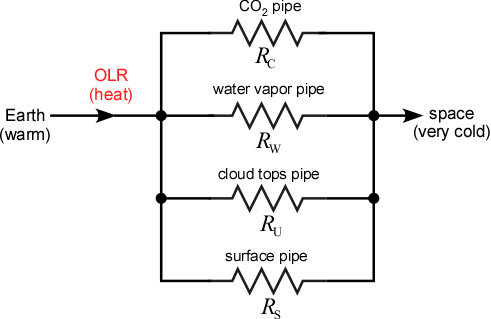
Why does lots of energy get redistributed by convection? Because air is a fluid and can move.
I see individuals and groups on all sides of the AGW issue clouding the real issues with false ones and in effect making it easier for the opposite side to point to these mistakes and for some to imply that is the main argument of their opposite side.
I have not studied the methods of the modelers in detail but I have analyzed the model results. I have little doubt that the modelers are doing their best and using methods that in principle are correct but limited by the computing power at their disposal and in some cases not having all the physics in hand and having to resort to parametrizations. We can argue about the claims implied for some for the models but that does not in my mind have bearing on the sincerity of the modelers or the correctness of their methods.
I would think that the primary issues that should be discussed are:
Why do the climate model outputs for temperature require so very different stochastic models to in turn best represent this output?
Why do many empirical studies of climate sensitivity have lower estimates than the models?
Given the noise levels in climate and the climate models how well can we really test the climate model output with regards to GHGs which have only increased into climate significant levels since the 1970s and with only 30 years of that time showing a significant trend in temperature?
Why do we take seriously climate model output for single or small numbers of runs given the expected noise levels and further why is there not more emphasis on obtaining more runs from climate models?
That modelers are sincere and doing their best and we still have these issues is a major concern. It would be a lesser concern if they were not sincere and making basic errors as that would leave open the question of being truly limited in making climate predictions and testing models versus past climate results.
Kenneth,
Those are things we ordinarily discuss here.
David Evan’s decided to try to do something else and is dribbling out scads of nonesense. We could either (a) ignore it and say nothing or (b) comment on the obviously incorrect thins he is writing.
Jo’s blog is sufficiently trafficked that (a) doesn’t make much sense. Some people are reading David’s stuff and have questions about individual claims. For example, Angech asked about the “one way switch” issue for the effect of CO2 on climate. That’s something that likely was motivated by Jo’s preface to one of David’s post. It’s easy to address that. I think it’s better to address it openly than to have a policy of “we won’t talk about that nonesense and leave people who have questions in a position where the only person to ask is David.”
Lucia,
“Jo’s blog is sufficiently trafficked that”
Not only that, but he has a hotline to the Murdoch press here. And here. And it gets around “Press ingores…:(“. Readfearn.
Kenneth Fritsch (Comment #140204)
“I see individuals and groups on all sides of the AGW issue clouding the real issues with false ones
the primary issues that should be discussed are:
Why do the climate model outputs for temperature require so very different stochastic models to in turn best represent this output?
Why do many empirical studies of climate sensitivity have lower estimates than the models?”
Lucia (Comment #140200)
“No one needs to confidently identify the real reason to know that the reasons are not the ones David claims.”
no one can confidently identify the real reason, that is precisely why DE can put up his claims.
Attacking DE’S argument rather than admitting and investigating and identifying the real causes is the real issue.
While you have shot down the messenger the message is still out there large as life.
Nick and ATTP hand wave and say nothing wrong with these models, Lucia knows and has done blogs on the variation [none recently].
Pielke and Curry at least admit the effect is there.
Most of the good mathematicians unfortunately are tied by their friends and jobs to positions that need to defend what should be indefensible.
Any objective person can see the dissonance
I would prefer to respond to those who either should know better and have a large audience for their views or Those who have published their work under peer review.
Those like Rush Limbaugh who call AGW a fraud do much damage to a thoughtful discussion that would include legitimate limitations of what we know.
On the other hand we have politicians like Obama who talk about AGW as though the science issues are all resolved and all AGW outcomes are detrimental to mankind. These people think the scientists are more certain about these issues than even the scientists think they are.
Then there are those who push crackpot conjectures who I think make an excellent case for the filtering that peer review does for publication. Once something is published it becomes fair game for rigorous analysis and crticism.
There is a case to be made for discussing ideas that might not get published but yet appear to have a reasonable theoretical and empirical basis.
Lucia says: “Not sure I know what point you are trying to make. The Cubs are now playing the Mets. Not going to spend much time trying to read your mind.”
My point is starkly simple: Temperature is an extensive property of thermalized matter. There is no one temperature of which every other climatic variable is a function. Without unequivocal specification which temperature (surface, aloft, or planetary blackbody) is being referenced–and at what time-scales (instantaneous, monthly or yearly)– it is the reader who is forced to read her mind.
With a day job to occupy me, I’ll let others seek a clarification here.
sky (Comment #140209
Without unequivocal specification which temperature (surface, aloft, or planetary blackbody) is being referenced
Lucia does unequivocally specify it in her intro.
” absorbed radiation at equilibrium will be a function of T only: S(T).
“S†as the absorbed solar flux and R as the out going terrestrial radiation. When the earth is at equilibrium (or pseudo-equilibrium if one is picky) S=R.
R_{pe}(T) , is ‘effective’ Planck radiation by which I mean the total Planck radiation at temperature T scaled by some effective emissivity of earth based on the current level of ice, cloud , water vapor and CO_2 where these are known”
Lucia is talking about the surface [planetary] temperature which is also the gray body temperature [Earth is not a blackbody due to its albedo re clouds etc] which is also the absorbed solar flux temperature.
“and at what time-scales (instantaneous, monthly or yearly)”
It is instantaneous as she states it is at equilibrium
“Temperature is an extensive property of thermalized matter. There is no one temperature of which every other climatic variable is a function.”
It may be that temperature varies at different rates at different heights and in different conditions but as an extensive property of matter it is all related by the laws of thermodynamics.If other climatic variables are present they must have an effect of temperature as temperature is dependent on climate.
Thus the one instantaneous T is related to every other T at that time, whether you are measuring temp in the bottom of the sea, in the surface layer of water in clouds or at 60,000 meters. Further if you change one of these variables to get a different temperature there will exist a function linking this change.
Of course I may be wrong.
Or at the wrong ball game.
angech
I’m not sure what you mean by “real issue”. DE published his stuff. I’m commenting. He happens to be saying silly things. I don’t see anything wrong with criticizing stuff that is obviously confused or wrong. I don’t think there is any reason why DE ought to get a pass where others would not. Presumably you aren’t suggesting that he ought to be given kid glove treatment where Gavin, Tamino, the IPCC, Anders, Eli and so on would not.
I also don’t know who you think has “shot down the messenger”. I’ve criticized his claims and statements. Obviously, he’s still alive, still has a platform. I’m not sure what “message” you attribute to him that would “remain alive”. As far as I can tell: those things he’s said that are right are not new. Those things he’s said that are new are not right. Obviously, the things we already knew and were right before he started his 13 or so part series are “still out there”.
Sky
In which case, presumably you don’t like David Evan’s new model either; it has only one temperature. In contrast the AOGCM’s have plenty of temperatures.
Many people have said for years that the problems with the consensus are not in the basics like math and physics. It lies in their applications and interpretations. I think this small drama demonstrates that.
I’m only here by accident, so I don’t have a dog in this particular fight.
I have one question. Do any of the models, regardless of the brilliance of their creators, reflect the progressive cooling of the Earth since its creation?
If the answer is “no”, then discussion of individual aspects, motivations, even initial assumptions might be moot.
I noticed an earlier post about a situation where a boy attempted to toss a bunch of flowers to a girl. Many unstated assumptions were in the framing. For example, the boy was assumed to be capable of tossing a bunch of flowers of unspecified mass and weight and aerodynamic resistance from a largely unspecified position . . . Etc. etc.
Was the boy blind?
Was he quadriplegic?
Did he suffer from a neurological disorder?
And so on.
And so it might be with “global warming”. The initial assumption seems to be that interposing CO2 between a radiative source and target will raise the temperature recorded at the target, and removing the CO2 – say, by replacing it with a vacuum – will cause the temperature to drop again.
It may be noted that nobody has ever managed to achieve this, and in fact, in physics classes around the world, precisely the opposite is shown on a regular basis.
If I am right, then this arguing about the construction of models is about as pointless as arguing about the mathematics supporting a perpetual motion machine theory.
Cheers.
“my math doesn’t claim to hold all these constant while taking partial differences.”
True.
But David Evans is clear on the thing he perceives as a problem: the need to hold things constant.
In S&H, this happens at one and only one precise point: while taking partial differences. So David Evans has naturally focused on the partial derivatives.
But that’s how the problem manifested itself, not what the problem really is.
Yes your explicit way do not need to hold all things constant while taking partial differences. You have very well demonstrated there is a way to not make such claims all at once.
You just made the hypothesis at different moments. As a consequence quite a bunch of things still need to be held constant during calculus. But not all.
The one that does not, the derivative of Rpe, has been freed because you defined it that way.
You have hold things constant for Rpe at definition time to free yourself from doing it at calculus time.
This subtle shift only changes how the problem is manifesting itself, not what it is.
I’m constantly amazed that the maths used by Evans seems to be well beyond the likes of Nick Stokes and the host of this blog. Much of the maths are basic engineering fodder, and it would serve some of the commenters here well to first acquaint themselves with the basics instead of constantly going off in a tangent. Nick Stokes is particularly guilty of this and is taking on the characteristics of a troll with his barrage of straw men.
hunter:
Not so much. It’s a much better illustration that there really are people who don’t know that they don’t know. The only thing Evans has “uncovered” is there are issues in the comparison of the models to the data (who’d thunk?!), but he’s failed to illuminate anything about why the real GCMs aren’t matching up with the data better.
John B, “the likes of Nick Stokes” and the other physical scientists and engineers on this blog are pretty secure in their knowledge of the underlying mathematics here. I’m afraid your petty attempt at insult not only falls flat on this audience, it just paints you as a total fool.
John B,
” it would serve some of the commenters here well to first acquaint themselves with the basics”
The first basic is, what does any of that maths have to do with what climate scientists actually do? Can you tell us that?
Thomas
Yes. Which means it’s quite clear his perception is wrong on two points:
(1) Needing to hold them would not be a problem. Doing the math implicitly is perfectly acceptable and done by lost of people everywhere. Those who understand math know there is no “problem”.
(2) But if he thinks that sort of partial differential is a “problem”, it just so happens that one never needs to hold them constant. One can just organize their math in a different way and get the same final outcome. He could do that, get the same final “basic model”, and stop making a fool of himself by claiming it contains an “error” because he found the “partial differences” with “everything held constant”.
So: There is no problem with the basic model. That is one of his three claimed “basic errors” gone. Poof.
John B,
Whatever Nick’s failings (and like all of us, he has them), capability in maths, basic and advanced, is not one of them. Stop making a fool of yourself by claiming otherwise.
Oh heavens. David is so confused he now writes
Oh. Lord.
Mike Flynn:
Yes.
Longer answer: On geophysical timescales, the temperature of the Earth tracks the atmospheric concentration of CO2. You don’t need a GCM to model this, but of course, they can model this.
Lucia, so the problems with partials are now mistakes with differentials?
That’s exactly the same thing, right???
>.<
Nick Stokes
I would have thought it was pretty obvious even to the most uninformed that if the climate models are not an accurate representation of reality in relation to the basic physics, then they are certainly not useful as a basis for policy making.
In fact you have just demonstrated my point by your comment. Your comment suggests you have a very limited interest in the mathematical basis which underpins the physical processes. Unfortunately that appears to be a widespread problem with climate scientists.
Carrick writes
As a matter of perspective, its probably more accurate to write
On geophysical timescales, the concentration of atmospheric CO2 tracks the temperature of the Earth.
Carrick
To claim that on geophysical timescales the temperature of the earth tracks the atmospheric concentration of CO2 is complete nonsense. It is that lack of relationship that is one of the fundamental problems with climate science today.
Carrick,
I posted an update below my main post. But.. uhmmm… yeah.
I think he now seems to be saying that there is something nasty about separating a function into two functions. So I guess adding and subtracting are now some form of ‘trickery’. That would be news to lots of people in science and math. (One wonders what’s happened to series expansions of functions? Or any number of other things?)
“the likes of Nick Stokes†and the other physical scientists and engineers on this blog are pretty secure in their knowledge of the underlying mathematics here”
Carrick,
And I’m pretty sure this quote from you is just an appeal to authority on top of an appeal to esoterica.
Andrew
Carrick,
I asked “Do any of the models, regardless of the brilliance of their creators, reflect the progressive cooling of the Earth since its creation?”
You responded “yes”.
Which model, and where are the results documented? Or did you just make it up? Merely saying something is so, does not make it true. I’m talking about the period since the creation of the Earth to now.
If, as you say, the temperature tracks the decrease in CO2 levels, the when the CO2 was, say, 7000 ppm, the temperature dropped. When the CO2 was say, 500 ppm the temperature dropped.
You appear to be saying that CO2 of say, 500 ppm, within the atmosphere caused temperature to fall in the past, but will cause it to rise in the future.
Either you or I are confused. I wonder if you could explain the apparent contradiction after providing details of the model which you say exists.
Cheers.
John B, my recommendation is to limit your comments to things you have a remote clue about. I’ll post images later if time.
Andrew_Ky you obviously are another one who gets butt hurt over the notion that people who dedicate themselves to understanding the mathematical and physical sciences would be correspondingly more knowledgeable than people who don’t.
But there was no place I appealed to authority. I merely stated my opinion.
“there was no place I appealed to authority”
“people who dedicate themselves to understanding the mathematical and physical sciences would be correspondingly more knowledgeable than people who don’t”
Whoops. You did it again.
Andrew
John B,
The issue is not the accuracy of how GCMs treat ‘basic physics’, the issue is all the sub-grid scale kludges and ‘parameterizations’ which drive the models’ sensitivities to unrealistic levels. Yes, the models are almost certainly much too sensitive, and it is relatively easy to show that many, if not most, are clearly inconsistent with measured warming. Those models ought to be ignored, and the rest viewed with considerable skepticism, since all use similar kludges and parameterizations. Yes, it would be unwise (even foolish) to base public policy on the projections of climate models…. they are clearly not capable of making projections of warming which are credible or even useful.
.
But the claims of basic errors in GCMs are both wrong and counterproductive, since such claims are easy to refute, and distract from the real problems with GCMs. Legitimate critiques of GCMs are ignored by green activists and activist climate scientists, while the nutty claims by Evans and his ilk are quickly discredited, and used to paint all critiques of GCMs with the same broad brush.
.
If you are looking for a legitimate argument against climate models, here is the simplest: the first widely publicized range for sensitivity to CO2 (Charney report, 1979) suggested a likely climate sensitivity range of 1.5C to 4.5C per doubling. More than 30 years of modeling effort (and untold billions of public dollars spent) has made zero progress in narrowing that range: AR5 states 1.5C to 4.5C, and the IPCC refuses now to even suggest a most probable sensitivity, since many empirical calculations show the likely sensitivity is quite low. GCMs can’t answer the questions the public cares about, are a waste of public funds, and so should be largely defunded. Not a single partial derivative is needed to show that.
.
Evans is wasting his time and helping green activists. He should stop. So should you.
Mike Flynn I’m saying the correlation between change in temperature and atmospheric CO2 is positive (with a slight lag between temperature and CO2 level).
I’m not claiming that CO2 is the only thing that influences atmospheric temperature. Hopefully you are knowledgeable enough to recognize that solar radiation, atmospheric and surface albedo, also influence climate and that you need to take these into account to get a good description.
Andrew_ky it isn’t appeal to authority to note that people who devote their life to a subject are more knowledgeable than people who don’t. That’s just cause and effect.
That said, I’d recommend you look up what the appeal to authority fallacy is before using that phrase again. You aren’t even using it correctly.
Carrick,
For sure albedo is a big factor. Ice core based estimates of cooling at the end of the previous interglacial show substantial cooling for 5,000+ years, with very little change in CO2, methane, and N2O, and changes in albedo, likely from more/longer lasting snow/ice clearly dominated GHG influence. Sure, falling GHGs eventually added to the cooling, but how much is an open question.
“who devote their life to a subject are more knowledgeable than people who don’t”
OK, I’ll switch my phraseology from “appeal to authority” to “useless generalization.”
If this is what one resorts to, to make their claims about climate models correct, it’s no wonder climate science sucks.
Andrew
Andrew_KY I’ll describe what you’re doing now is, having failed miserably in your initial attempt, you are now resorting to petty insults. Ciao.
SteveF I figure a few thousand years is about as short a period as we can reliably make statements about climate change without a decent mode.
One of the big factors I left out is what produces these large swings in CO2.
“you are now resorting to petty insults”
I disagree.
Andrew
Lucia, I can only imagine the horror in Evans eyes were he unfortunate enough to see a function written in terms of an even plus an odd function.
$latex f(x) = E(x) + O(x)$,
where
$latex E(x) = [f(x) + f(-x)]/2$
and
$latex O(x) = [f(x) – f(-x)]/2$
I call shenanigans!
His reaction to seeing an infinite sum (Taylor Series) would I suspect be unimaginable.
E? O? And E+O = f? I can “notational trickery and legerdemain” on you, Carrick!! Surely you and others who resort to algebra will be banned from David Evan’s kingdom of math!!
Carrick,
I’m also wondering what’s next. If decomposition is “notational trickery and legerdemain arewe going to be prohibited from this sort of decomposition
$latex f(t,x) = g(t) h(x) $
When we solve stuff like
$latex \dfrac{ \partial ^2f}{\partial x^2} = \dfrac{ \partial f}{\partial t} $
Or will the ensuing total derivatives of “g” and “h” still be “holding ‘everything’ constant? Who knows? I certainly don’t.
Oh boy. He now writes
Uhmm… It’s not holding everything constant for the climate. The quantities the vary with climate are partitioned into the other term. Duh.
But of course, he’s decreed decomponsitions “trickery”. So… whatever.
Oh… and he complains
For those wondering: I’ve replied to every single email I received from Jo and David. These include initial few by Jo (who clearly had not read comments prior to penning her emails of “clarification” and eventually ones from David. )
I am not under the impression that there is some “new rule” of blogging that requires me to get email to discuss someone’s blog post before commenting on it at my blog. Others had already commented on David’s post: Stoat, Anders etc. I happen to agree with those bloggers that David is saying silly things about partial differentials. He’s digging deeper by saying sillier things like suggesting decomposing functions is some sort of notational trickery and claiming that somehow I “must” be holding the climate constant by taking the total derivative of a term that depends only on T.
If he thinks so, he might want refresh his memory on solving partial differential equations and see these decompositions are routine. Perhaps he can check out Boundary Value Problems from the library and refresh his memory.
Carrick
I’m afraid it’s not productive to try to educate someone who simply can’t form a logical argument and who throws in unsubstantiated claims which have no basis in realty. We are therefore gong to have to agree to disagree, because I have many more productive ways to spend my time.
Hey Carrick, watch me do more legerdemain. Suppose this is a set of resistors and a rheostat that can be set by fiddling ‘x’. The resistances are all temperature dependent.
First the equivalent resistance:
$latex R_{eq}(T,x) = (1/R_1(T) + 1/R_2(T))^{-1} + R_3(T,x) $
where “x” is the setting on the rheostat and T is the temperature.
Now… here’s the ““notational trickery and legerdemain†. Watch close or you’ll miss it:
Let
$latex R_{eq}(T,x) = \tilde{R}(T,x) + R_p(T) $
with
$latex R_p(T) = (1/R_1(T) + 1/R_2(T))^{-1} $
$latex \tilde{R}(T,x) = R_3(T,x) $
Now I can take the partial of
$latex d R_p(T) /dT $ without holding ‘x’ to a constant (which, in this case, is a ordinary derivative). Fancy that! I’ve taken a derivative of something in a circuit whose resistance depends on both “x” and T” without holding “everything” in the circuit constant!
Oh.. but this must be trickery of the “notational” sort. And legerdemain. Likely not allowed. Tsk. Tsk.
I’m not disappointed John B.
If you think Evans makes sense and Nick needs school, then you’re clearly a poser.
Lucia: Speaking from authority (heh), it’s not like the derivative operator is linear or anything. Because if it were, this property of linear operators would apply:
Let
$latex C = A + B$,
then
$latex {\cal L} C = {\cal L} (A + B) = {\cal L} A + {\cal L} B,$
and then you could always freely break up a function into the sum of two pieces.
(Okay as it happens the derivative operator is linear, meaning we are free to use this property of linear operators to split a function into the sum of two pieces.)
Lucia:
If somebody’s going to require me to email them before commenting publicly on their work, I’m going to require that they email me their work to vet and not be allowed to post until I authorize it.
Otherwise, the problem for David Evans is it just sux to screw up. The cure to that is not to have people email you before exposing your errors. The cure is to make fewer errors and be a bit more open it when you do screw up.
Dang Lucia, good example, one even I get. 🙂
markbofill….
Clearly, my prestidigitation with functions has bamboozled you!
Soon you will fall under my Svengali-like sway. You’ll believe things like
” We are allowed to add and subtract bits from the whole if that’ makes doing the math more convenient or if it helps clarify how a device (or the earth’s climate) works.”
Perhaps if you fall deep enough under my influence you’ll believe things like “We can decompose vectors in to components.” or “Newton’s first law can be written as three independent equations; one in each components.” (Evil cackling!)
….yes….Lucia……I…..see…..now………what…..are…..your………..orders……?…..
:>
No actually, I suspect that equivalent resistance is a simple and well understood thing that me and countless others have brushed up against probably has more to do with it.
FWIW though, it strains credulity to imagine that David doesn’t know this. I can’t fathom what the problem is, but I still suspect some communications problem here. I don’t know. ~shrug~
Mark,
I picked an EE application because David is, evidently, an EE. But yes, stripped of the partials and temperature dependence, the resistor example is high school physics. It’s easy enough to find examples were we can decompose functions into the sum of two functions because…. well… we are allowed to decompose them. And nothing in math says we can’t decompose into something convenient that makes the math easier to do.
This particular babble by David happens to be easier to show than the others. But really, it’s all this type of claim. Sometimes it’s easier to show a clear simple example, sometimes not. This one is particularly easy to show.
BTW: We could make an example with power expressed different ways:
$latex P(V,i, R_1,R_2,R_3,T_1,T_2,T_3) $ (option A, implicit)
or
$latex P(V) $ (option B, explicit)
P(V) hasn’t “lost” the fact that the resistances emparture and current (i.e. “everything”) varies with V. Option (B) would just be an explicit formulation. Option (A) is implicit. We can “decompose” in either one. No idea how David has gotten himself so confused on this. The confusion is so deep we are stuck at “is not”/”is so” levels.
I’m with Mark on that. The example is as clear as it can get, although you may have to actually read math to parse the surrounding prose.
Mark
I also find it hard to believe David doesn’t ordinarily understand that’s it’s ok to decompose as the sum of two functions and that if one of those just happens to be the function of one independent variables, we can take the total derivative without the need of holding “everything else” constant.
But for some reason he’s writing these things and claiming things like “Lucia’s Planck feedback holds “everything about the climate†constant†too.”.
Uhmm… no. Just as my derivative of the resistance in parallel doesn’t “hold, x, the setting on the rheostat” constant. The resistance of the set in parallel is not a function of that setting x.
angech:
I, too, at first impression, thought that Lucia was referring to effective planetary blackbody (Planck) temperature. But then in a subsequent response to Genghis, she spoke of water vapor etc. being a function of temperature.
No matter how much modellers would like to have it otherwise, evaporation is a function of LOCAL surface temperature, which in situ is demonstrably not functionally related to the Planck temperature. And evaporation invariably leads to REDUCTION of local surface temperature, rather than the increase fantasized by “positive water-vapor feedback” adherents.
It’s misunderstandings of such geophysical basics that produce simplistic, static “feedback parameters,” which, when evaluated from real-world data, scatter much too widely to be credible system response characteristics. Wrong ballgame, indeed.
Carrick,
Before I depart, do I really need to point out that correlation does not imply causation?
You couldn’t or wouldn’t back your claim that a model exists which shows the cooling of the Earth since its creation. My assumption is that you fervently wish that such a model existed, but alas, it doesn’t.
As I thought.
Cheers.
Lucia,
I’m not here to embrace Evans’ conceptualizations. I’m here to point out the keen difference between what is mathematically possible and what is physically actual.
Sky,
This post is about Evan’s discussions of a 1-D model used to describe “feedback”. In such a model there is only 1 Temperature. If you are discussing something else, you are discussing another topic.
You will note my post ended with
That is, I would like people to stay on this topic and not stray. We’ll be happy to let you discuss other topics related to phenomenology and modeling elsewhere. But under the circumstances, it would be useful for this post to remain about “David Evan’s conceptions”.
If you don’t like 1-D formulations that’s fine. But the merits of these formulations are not a subject of this post.
Mike Flynn, you never addressed a thing I said, but then you announced victory and left? Thanks for the entertainment.
Ciao.
Lucia,
Had you not written “I will note that at equilibrium, “cloudsâ€, “water vapor†and “ice and snow cover†are functions of Temperature”–which makes scant geophysical sense vis a vis the planetary blackbody temperature–I would not have wasted my time on commenting here.
sky,
In a 1-D model, all of those are functions of Temperature. They are also 1-D entities. Everything is 1-D.
If someone doesn’t like 1-D models of the climate for any and all purposes, they aren’t going to like this particular use, nor that by Evan’s nor Arrhenius nor any number of things because all are 1-D. The ‘feedback equation’ is 1-D. Obviously any discussion of the feedback equation is going to involve representing things in 1-D.
So yes: if you want to discuss 3-D effects, you’ll need something more like an AOGCM. Those can be discussed on other threads. But discussing 3D issues dilutes the discussion of the current topic. Given that my math is correct and Davids is wrong, I prefer to keep these comments more focused so that the issues relevant to my post don’t get diluted.
Oh– In the above, I should say zero D, not 1-D.
Classic academic tap-dancing on a fancied stage.
Sky,
If you would like a thread to discuss 3-D issues, I can open one for you. I’ll then move the your previous comments about those to that thread and people can engage you on the 3-D issues.
Carrick (Comment #140222)
” On geophysical timescales, the temperature of the Earth tracks the atmospheric concentration of CO2.”
TimTheToolMan (Comment #140225)
“its accurate to write On geophysical timescales, the concentration of atmospheric CO2 tracks the temperature of the Earth.”
Carrick (Comment #140238)
“One of the big factors I left out is what produces these large swings in CO2.”
tracks, as in follows.
“CO2 actually lags Antarctic temperature changes by around 1,000 years. [Skeptical Science quote as very authoritative].
When the Earth comes out of an ice age, the warming is not initiated by CO2 but by changes in the Earth’s orbit.
[ie the sun gets closer to the earth and heats it up]
The warming causes the oceans to release CO2.
[ie the temperature rise causes the CO2 rise to follow].”
Tim wins, except at skeptical science where they explain that the 1000 year delayed rise in CO2 then causes higher temperatures.
[duh!].
The dimness of this argument, by people who should know better
[Carrick (Comment #140234) it isn’t appeal to authority to note that people who devote their life to a subject are more knowledgeable than people who don’t.}
Shows that knowledgeable people can easily get things wrong too, are too proud to admit their errors and dig deeper holes.
Lucia writes
How does your analysis go if you include an error “function” that isn’t symmetrical about a mean and isn’t a function of “T”?
“In comments on the “David Evans†post, Nick, Peter Hartley and I have been discussing arcane issues”
[hard to explain to the mathematically dense like angech]
-“whether the partials in the equation David Evans calls “The basic model†are “strictly hypotheticalâ€,
you later say (aka ‘formal’) and that you would avoid them.
This proves that the hypothetical partials are really hypothetical and are hypothetically real.
That hurts the brain but I think it means what I said it means.
ie partials, PDE’s or differentials do exist but they are not real because they are hypothetical.
-whether those partials are required to be so, Yes, and No.
I guess we mean “are required to be hypothetical”.
Yes They have to be hypothetical because that is what the implicit method S and H ordains. If they were meant to be “real”
[Here real means not being allowed to be hypothetical] then they would not have been constructed in a mathematical model that calls them hypothetical.
No They have to be real as you have proved by the explicit method that they are “real”, that is they have no hypothetical component done your way.
[In an implicit formalization it seems they must be, They are what S and H describe and you confirm ” and I would put up a post that avoids the “strictly hypothetical†(aka ‘formal’) partials.”]
– whether this “basic model†can be developed without resorting to these “strictly hypothetical†partials. No
You have shown by deriving a “real” solution explicitly that excludes “strictly hypothetical†partials that the basic model cannot be developed as it is a model derived from “strictly hypothetical†partials.
It cannot exist in your mathematical world.
Unfortunately it still exists, and will continue to exist forever in the S and H implicit world that everyone else is using for convenience when talking about DE’s ““basic model†.
Despite Nick’s reluctance to admit it exists, your foray on the maths involved in the “basic model” means a basic model does exist based on S and H input and DE’s chosen description, vague though it is.
Therefore my angst at your saying the two are identical. They are not mapped or identical. The Explicit way is a subset of the implicit way. “strictly hypothetical†partials only exist in the Implicit way and form a larger map. You can get to the starting point by using the explicit way or you can reduce the implicit way to the explicit way purely, but only by eliminating multiple choice entry levels on the implicit way. that is by restricting choice to an initial arbitrary range of starting points for the variables.
DE is arguing that this choice of starting points has never been specified, by Sand H by you, Nick or anyone else, particularly Climate Modelers.
Hence as said you are perfectly correcting the Explicit world and in the Limited Implicit world.
DE is right in his wider implicit world which after all is what he is arguing in.
Your making fun of his maths under your settings and view of what his settings should be is understandable but unfair.
As far as I understand it you actually agree with him in saying that if PDE’s are hypothetical and are used, then the results without those strict limits, are rubbish.
Quote from a reliable source further up page.
“That’s exactly the same thing, right???”
except when it isn’t.
Angech,
We’ve got to teach you the quote tag: <blockquotes> put quoted stuff in here</blockquotes> .
If derived using the implicit method, the partials are “hypothetical”. If derived using the explicit method I show above they are “real” and not “hypothetical”.
No. I’ve shown the equation David calls the “basic model” can be derived using no– that is zero– “hypothetical partials”.
The implicit method is the one Held uses (and which I thin
Angech
Is ‘no’ your proposed answer? That’s incorrect. Above I showed that the basic model can be developed without resorting to them by doing it.
Incorrect. I showed a derivation that entirely excluded the “hypothetical partials. So that solution can and does exist in my “mathematical world”.
I have no “angst”. The “basic model” can be derived without using any ‘hypothetical partials’. The fact that it is exactly the same as the one derived the other way shows that the claim the “hypothetical partials” are a problems is nutty. David is wrong.
TTTM
Could you clarify your question? By “include an error function” do you mean decompose R further still? With a term that doesn’t include T? (And if so, are you going to want some other specific thing in there? CO_2? Solar?)
I can answer, but I want to answer what you are actually asking. (FWIW: I haven’t assumed symmetry about a mean anywhere.)
Angech,
You have a lot of things sideway. But to be clear: the results when hypotheticals are used are not rubbish. I agree up to the underlined part. I utterly disagree with the part you put after the “then”. Totally. Completely disagree.
Moreover: It is the final bit that David goes on and on and on and on an on about. The “rubbishness” aspect is where he is wrong.
Lucia,
.
Yes. In reading over at Jo’s, it looks like they either:
.
1) Didn’t understand that this was why you derived without partials,
2) Understood but chose to misrepresent why you derived without partials.
.
I’m not impressed either way. If David honestly didn’t ‘get’ the significance, he’s obviously not as sharp as I was originally willing to assume. If he did get it and ignored it, he’s not as honest as I was originally willing to assume.
.
Whatever. The internet is full of people in those categories, it’s not interesting enough to pursue further.
In case it was unclear, I was referring to this bit over at Jo’s:
Puhleeze.
Mark,
Well… at least I’m accused of transparently shifting goals rather than doing so opaquey.
So.. now we know Evans was critiquing Held, Soden and Pierrehumbert rather than merely some vague “basic model”. Did anyone previously know the criticism about the partials was limited to those two papers rather than cutting to the core of climate science? I would suggest the tone of his post suggested the latter hugely broad claim, not the former claim that he just doesn’t like the way (2) guys and then (1) guys derived an equation in two papers. But. Whatever.
There is no such “unspoken admission”. He doesn’t seem to get that I never said he was wrong to have accused term of having used partials containing dependent variables. I am saying he is wrong to say there’s something wrong with doing so.
He either (a) doesn’t “get” what he’s being criticized for or (b) is trying to pretend he is being criticized for something entirely different in order to claim I am admitting he was right.
Anyway: this bit:
No “errors” are incurred. But David (and likely Jo) don’t seem to ‘get’ that it’s the underlined claim above the criticism is about.
This isn’t me shifting goals. It’s them seeming to be pathologically incapable of understanding what people are criticizing them for. I’m hardly the only person who has criticized them. LOTS of people have. All these people have explained the criticism in multiple different ways. But Jo and David just don’t see to get it.
I suspect they never will. That’s why I prefer to have this discussed openly. Those who want and can to understand do. That group doesn’t include Jo and David and some of their readers. In the case of some of the readers the excuse is simple: They don’t know math and want to believe David. In David’s case…. sigh….
Yeah. I’d only add that you don’t have to know the math to know that if the complaint is that something (in this case ‘hypothetical’ partials) in the math might be causing someone to get the wrong answer, yet you can get the same answer a different way which avoids the questionable thing, obviously the point is moot.
~shrug~
[Edit: ‘moot’. I don’t think I use that word properly. Maybe I should have said, ‘the complaint isn’t valid’]
Mark Bofill:
It happens that physicists and engineers often do things “wrong”, from a pure mathematical standpoint, but lead to the correct answer regardless. These are sometimes called “shortcuts”.
However, simply showing you can get the “right” answer with a “wrong” method, doesn’t demonstrate that the “wrong” method is now somehow “right”. So we need to be careful about overgeneralizing here.
But in this case, the implicit and explicit statement of partials are exactly equivalent. They represent different ways of parametrizing the same underlying mathematical structure. The different ways of writing amount to nothing more than using different sets of “book keeping” rules.
Here the structure of the solution is preserved regardless of which set of book keeping rules you use. So Evans claims are false and indeed risible to anybody with a few semesters of calculus under their belt.
Not only that, I think the counter arguments are assessable to pretty much anybody, without needing a calculus course. Which as you point out, doesn’t leave Evans in a particularly complimentary light.
Thanks Carrick. I expressed myself poorly.
This is much clearer and more precise statement of what I was trying to get at.
It’s difficult for many people to admit being mistaken, especially about something relatively simple. When someone feels ‘besieged’ it is even more difficult to admit error. I think that is what we are seeing from Jo and Evans. Unfortunate, but not difficult to understand; and especially unfortunate because this sort of thing undermines their credibility on other subjects, where they may actually have something useful to say.
SteveF,
Beyond that, this is only “Part 3” in some seemingly endless series which they seem to be promoting to the extent of getting a journalist to hype it. It appears his “final model” which will (evidently) demonstrate climate sensitivity is virtually nil will ultimately be posted in some upcoming post. At least some of the (apparently) important claims in his post have their support deferred to some future as yet unpublished blog post. I sense that Jo and David had some sort of “plan” to hype this as some sort of “breakthrough” which would appear just before ‘Paris’. Of course I could be wrong.
Part three of the seemingly endless series is supposedly describing the first of 3 “errors” in “the basic model”. And he chose to discuss this one first because it’s “easy”. But it’s not an error”. It remains to be seen if any of the other claimed “errors” are ‘errors’. Possibly they will turn out to be valid approximations, etc. One needs to go through and figure out precisely what the “error” is claimed to be first– there are lots of post that say lots of things. I’m not currently certain which are the “two” main errors.
Either “Part 3” will matter to David’s final “new model”, or it won’t. If it doesn’t, it shouldn’t have been written. They should have limited their criticism to the things “that matter”. If it does matter, his ultimate model will be flawed.
In fact: it seems more likely that “Part 3” doesn’t matter and they should not have published it. But they did. But it does remain to be seen whether the other “errors” are errors and whether his new result will be sufficiently “error free” to be useful. Based on the posts so far, things don’t look promising.
SteveF:
I guess we should look at the rest of their multipart series and see whether there’s any credibility to be salvaged here.
My impression: “isn’t.”
Lucia,
“It appears his “final model†which will (evidently) demonstrate climate sensitivity is virtually nil will ultimately be posted in some upcoming post.”
.
I hope that is not their objective; wild eyed claims…. whether sensitivity is claimed to be >6C per doubling, or claimed to be ~0C per doubling…. are going to be broadly criticized, or even laughed at. They are simply not credible. I often wonder if the people making such claims have a basic understanding of physics and if they have looked at historical temperature data and ocean heat data. My guess is ‘nope’, ‘nope’, and ‘nope’.
Steve
http://www.express.co.uk/news/science/611111/Former-government-expert-disproves-climate-change-and-says-world-will-soon-cool-down
So he’s evidently going to be claiming 1/5th to 1/10 IPCC range.
One has to wonder: How did Nick Lewis get such high empirical estimate then? 🙂
BIG NEWS VIII: New solar theory predicts imminent global cooling
i.e., notch filter + partial derivatives = explosive new theory.
RB,
So: According to Evans, cooling predicted anytime between last year and 2024.
Lucia, that seems to be the gist. Apparently many years have gone into this and the previous work plus some calls for donations. Quite unfortunate.
Lucia,
“One has to wonder: How did Nick Lewis get such high empirical estimate then?”
.
He did it the old fashioned way: plug the measured numbers into what is basically a heat balance, and see how it comes out…. answer: pretty low. He makes nice looking probability distributions as well, which helps. 😉
.
Establishing public policy based on Lewis-like sensitivity makes perfect sense. Evans and Jo should just accept the best empirical evidence and stop all the nutty rants about errors in climate model math. Could the sensitivity be a little lower than Nic’s numbers? Sure…. but it could be a bit higher too. No reason I can see to suggest a crazy-low sensitivity number. Nic’s numbers can’t justify stooopid public policy….. and that is enough for me.
Lucia,
The heading describes him as “one of planet’s top climate change experts”.
The nearest he seems to have come to professional climate change expertise was as a contract programmer for the Australian Greenhouse Office. In more humble days, after he left, he said
Well, relatively humble.
Lucia (Comment #140270)
“If derived using the implicit method, the partials are “hypotheticalâ€. If derived using the explicit method I show above they are “real†and not “hypotheticalâ€.”
Agreed.
” I’ve shown the equation David calls the “basic model†can be derived using no– that is zero– “hypothetical partialsâ€.
“Above I showed that the basic model can be developed without resorting to them by doing it.”
True
“The “basic model†can be derived without using any ‘hypothetical partials’. The fact that it is exactly the same as the one derived the other way shows that the claim the “hypothetical partials†are a problem is nutty.
Disagree
It is not exactly the same.
As you state ” I showed a derivation that entirely excluded the “hypothetical partials.
Your method has limited the derivation deliberately by assumptions that ” entirely excluded the “hypothetical partials.”
Those hypothetical partials are from S and H and are what he is talking about and are what you admit exist..
Your method entirely excludes the “hypothetical partials” which are of course what exists when one doesn’t insist on strict starting conditions.
Strict starting conditions that agree with all climate modelers do not exist. They can choose their initial conditions. What is worse some models may allow alterations to their starting conditions as they develop [comments above].
Hence a problem with using PDE’s exists unless the people using them state and stick to exactly the same initial starting conditions that S and H and you in their implicit and your explicit argument.
DE is right to state this.
You are right to state in one particular instance only the criticism does not stick. That where you have made the hypothetical partials equate exactly to the explicit partials.
angech
I’m not sure what you mean by “starting conditions”. I use an explicit formulation. This has nothing to do with “initial conditions”.
I don’t know what you mean by “allow alterations to their starting conditions as they develop [comments above]” in the context of a derivation. The [comments above] doesn’t clarify.
S&H contains no PDE’s! (PDE means “partial differential equations”. ) S&H (and I) use no “initial conditions”.
S&H, and my derivations contain “partial derivatives”.
I don’t know what you are trying to say. But DE is wrong: no problems exist because of the Partial Derivatives used in S&H.
Well, among other things, DE know seems to say S&H and PierreHumpert were the instances he was talking about. So that would mean he was wrong in the instances he was talking about.
But beyond that: can you name even one instance where these sorts of partial derivatives do cause any problem? (Real question.)
Because really, we need to find an instance were it is a problem. David hasn’t named one.
(In fact: we know that the way the math works, there is never a problem. I did this very concretely giving an instance. Nick explained it generally. The notion that this is a problem is nutty.)
Lucia:
I honestly don’t think angech knows either. You sure are awfully patient here.
So, here we have a mathematical system that has worked fine, applied extensively to a vast number of problems that intersects with our lives, and if the problems were as bad as David Evans and his parrot angech are claiming they would be, there’d be a huge number of ramifications across all of the physical sciences, not just climate science.
I’m from the school of “go take a course in calculus, then another, then another, and you’ll possibly know enough math to be comment intelligently on this.” But then he’d probably need four to six courses of physical sciences so he could see just how pervasive these concepts are, and how fundamental they are to the day-to-day operation of science.
This isn’t the sort of thing you’re going to learn reading blogs. It takes a lot of hard work, and there aren’t many short cuts for it unfortunately.
I think Lucia has done a fine job exposing the issues as well as a person can do. As I mentioned above, linearity of the derivative operator is key to being able to rewrite the expressions as Lucia has done. Never mind formal math proofs that it is linear, if the derivative operator were not linear, we’d have breakdown in the formulations all over the place in sciences, with incredibly widespread ramifications between Evans and angech’s intended target of climate science.
Kind of. It’d be a function that didn’t include anything physical necessarily. Imagine an error term that varies with things like grid cell size, step size, physics approximations, rounding and so on. Alternatively looking at the observation system, it would vary with accuracy of the instrument, spacial variability not captured by a point measurement…I’m sure you can imagine many reasons.
The point is that its going to be a term that isn’t ever going to have a mean of zero (over time) and will always constitute a positive or negative bias over timescales that matter to us. That’s my assertion.
This discussion must be kept in the context of the GCMs (as David Evans started out with) otherwise its just going to be a strawman argument about whether partial derivatives exist and are useful.
Carrick:
I think you’re probably right – it’s a requisite.
TTTM
So, in other words, you don’t want to talk about the topic of this post nor that in the David Evans post that is being criticized. His post was about “partial derivatives” and he made quite broad and bogus claims about them.
I can understand your not wanting to talk about the “partial differentials” issues. But if you want to talk about another topic entirely it’s going to have to be on another thread. This comment thread is about the whole “partial derivatives” thing that David brought up and said silly things about.
Lucia writes
No, talk about partial differentials is fine. I want the discussion to be in the context of the GCMs which include this error term and will impact on the partial derivatives.
TTTM
The “context of GCM’s” is distinctly outside the topic of David’s post. You will notice he said that post was not about GCM’s. Consequently, “the context of GCMs” is outside the topic of my criticism of David’s post.
We can discuss GCMs– but on another thread. It’s important to distinguish discussion of Davids claims about differentials from entirely unrelated issues.
If you would like to discuss GCM’s I can open another thread which will have nothing to do with David’s claims. But I do not want this thread to be diluted with discussions that have nothing to do with David’s claims.
OK, well I dont know the context of his statement so I’ll need to familiarize myself with the specific points he was making wrt partial derivatives.
I did see (in one post I saw) that he repeatedly mentioned the errors in the models and they’re obviously going to impact on the analysis which he never (appeared to) explicitly include.
TTTM,
He and Jo have very specifically said the issue about partials is not in the context GCM’s. So my post engaging their claims is specifically not in the context of GCMs. If you want to discusse GCM’s we can do so in another thread. But it will have nothing to do with Evan’s “issues” about partial derivatives. So that discussion belongs on a different thread.
FWIW: I agree that there are aspects of GCM’s that ought to be addresssed. That said: Because Evan’s claims are specifically not about GCMs it’s necessary to discuss those elsewhere to avoid confusion that the entirely different subject has something to do with his claim about “partial derivatives”.
A bit late in the game, but has anyone any justification to offer for Eq. 1? It presumes that R (and S) are functions of a parameter, T, rather than the complete thermal profile, T(x,y,z), and seems to imply that the latter is known should a value for T be known, e.g. thermal gradients are uniquely determined by the surface temperature.
Quondam,
This is a ‘0’ dimension representation which implies there is going to be averaging over time and surface of the earth.
But eq (1) doesn’t actually imply what you think. When someone does further analysis to estimate the terms, they may then go 3-D getting the explicit dependence. When done, the radiation is a function of one temperature– which is the boundary condition.
This isn’t any different from engineering problems were “pressure drop” is a function of “inlet velocity” in pipe flows or “lift” is a function of “air velocity relative to plane” in aerodynamics. There are complex 3-D patterns going on in there– but pressure drop and lift are expressed as function of only one velocity. (There are plenty of problems in heat transfer too– convective heating losses from buildings and so on.)
lucia (Comment #140291)
“angech Your method entirely excludes the “hypothetical partials†which are of course what exists when one doesn’t insist on strict starting conditions.
Strict starting conditions that agree with all climate modelers do not exist. They can choose their initial conditions. What is worse some models may allow alterations to their starting conditions as they develop [comments above].”
“I’m not sure what you mean by “starting conditionsâ€. I use an explicit formulation. This has nothing to do with “initial conditionsâ€.
Above
” my plan is to use only explicit variables, In my explicit treatment, absorbed radiation at equilibrium will be a function of T only: S(T) . In contrast, outbound radiation does depend directly on CO_2 ; so outgoing radiation is R(T, log_2(CO_2))
R_{pe}(T) is defined as the outgoing radiation that would arise on an earth whose temperature is T and has the ice, cloud ,water vapor and CO_2 of the current earth; this does not vary with log_2(CO_2).” In an explicit formulation, these effects are already accounted for by including T in the formulation.
The current earth T sounds a little like an initial starting condition for the explicit formulation? My remarks were in any case directed to the implicit formulation. This may have led to the confusion on [initial or starting] conditions
You said
” the “stuff†on the right side of (8) might not have clear meaning to everyone if the derivation was implicit.”
also
140116 “So: if two analysts make different choices for partitioning or describing physical phenomena from each other, [That is what I mean by starting conditions]
their final results will differ.”
” That because they have made different claims about physics this has nothing to do with math nor with the ‘oddity’ in the partial differential equations.”
Yet physics helps the maths?,
” If two analysts share the same choices [starting conditions] for partitioning the the effects, their final results will be identical.The choice is a matter of “when†one decides to specify physics.”
The ‘odd’ thing is, if you haven’t stated a few things explicitly, [starting conditions] the “partials derivatives†at “constant whatever†can seem to turn out differently with different formulations.
Not connected
” I don’t know what you mean by “allow alterations to their starting conditions as they develop [comments above]†in the context of a derivation. The [comments above] doesn’t clarify.”
GCM’s they are funny things, perhaps “to discuss GCM’s I [Lucia] can open another thread”?
angech
It’s not “an initial starting condition ” of any sort. It’s not one in either formulation.
Do you want me to open a GCM thread? I’m having a very difficult time understanding whatever point you are trying to make above.
I’d agree with that except that you’re looking at the wrong boundary. Its the top of the atmosphere, ie the sunlight coming in that determines everything and not the surface temperature.
What about UV turning O2 into O3, producing another GHG? What about absorbed IR at the top of the atmosphere? Do those not matter to the structure of the atmosphere and hence how it behaves?
TTTM,
I a zero-D, you get to pick one and only one. There is no “right” choice. Saying the top of the troposphere is the “right” choice is like claiming those who do thermodynamics “must” pick P and T as the “right” variables when doing thermo analyses. They don’t have to. They can pick P and density ρ Or they can pick T and entropy S. You get to pick two but one can pick any two — and the choice is dictated by convenience. And what is convenient depends on (a) what you do know and (b) what you want to know or describe.
If you want a function that describes how the surface varies with CO2,, the choice of surface temperature varies gives you that; the choice of top of the troposphere does not. So surface temperature is the appropriate choice.
If you what a feedback equation for temperature at the top of the troposphere, have at it. You can create one. But it’s not “more right”, and it’s not the quantity people want to know most.
So: to get the feedback equation, the surface temperature is “right”.
Frank wondered if we can technically consider water vapor to be a function of Ts on a chaotic planet.
Lucia wrote: “That is why the surface temperature affect the amount of water vapor pressure in the atmosphere. The temperature at the surface of the oceans and lakes drives how much water can enter the air column.”
Lucia, thanks for the reply. In reality, the rate of evaporation is actually determined by the relative unsaturation of the air over the ocean (which is temperature dependent) and the velocity of the wind blowing over the ocean. Relative unsaturation depends on the rate of mixing between the boundary layer and the free atmosphere. (I don’t know if these realities are inconsistent with a functional relationship.)
Isaac Held has an interesting post on why AOGCMs predict that relative humidity over the ocean must increase – or as he says relative unsaturation must decrease. As the surface of the ocean warms, the increase in OLR is mostly negated by an increase in DLR. However, the flux of latent heat rises 7%/degK unless relative humidity rises to suppress evaporation. (It is not clear that models get this right. Rainfall has increased by 7%/degK. not less as the models predict. Boundary layer clouds are a problem.)
http://www.gfdl.noaa.gov/blog/isaac-held/2014/06/26/47-relative-humidity-over-the-oceans/
Earlier you asked whether there were was anything left after considering “T” throughout the atmosphere and the answer is yes, there are atmosphere effects that dont depend (wholly) on T.
By considering only “T” at the surface you cant properly describe those effects and therefore cant describe the structure of the atmosphere and its feedbacks.
In other words a 1-D surface based view of the atmosphere is necessarily insufficient to describe it and so I disagree that “to get the feedback equation, the surface temperature is “right—
TTTM,
I think you don’t understand the meaning of the feedback equation. It is merely to explain the effect of feedback on amplifying the surface temperature response relative to the Planck response given knowledge of the magnitude of the partials like $latex \dfrac{ \partial \tilde{R} }{ \partial T}|_{CO_2} $ .
One does need to perform a supplemental analysis to estimate the magnitude of $latex \dfrac{ \partial \tilde{R} }{ \partial T}|_{CO_2} $ . In that analysis, the 1,2 or 3D effects are considered. In that analysis, the variations with elevation are included. But the output of that analysis can be organized to give the outbound radiation as a function of surface temperature only.
Then you are mistaken. The likely cause is you don’t understand what the feedback equation purports to do.
Lets say there were leprechauns in the atmosphere that periodically and unexpectedly stole some OLR and kept it for themselves.
Its entirely likely I dont know what the feedback equation purports to do if you’re telling me that the outbound radiation can be described in terms of surface T only.
TTTM,
In the context of a feedback equation, it can.
Well what use is it then?
It’s purpose is to explain that the total increase in temperature is greater than that predicted using Planck radiation from the surface through a “frozen” atmopsphere. That’s all. Nothing more. Climate scientists never pretended it means any more than that.
The fact that Evan’s dubbed it the “basic model” doesn’t infuse it with any greater significance than that. Certainly, climate scientists don’t ascribe any greater significance to it.
“Do you want me to open a GCM thread? ”
Yes, only more general. And only if it has purpose.
There are 4 or 5 related threads in the above discussion which would benefit from being on a different thread.
One is GCM’s and how they get it wrong [or right]
Another is the S and H paper you have quoted which suggests very strongly that Water vapor is the major GHG and that the TOA is affected by water vapor displacement in ways that models do not manage. They also raise the concept of the lapse rate not being fully explained. I expect most people have not read it.
The role of CO2 and why temperatures have not risen commensurate with the CO2 rise when they should. The risible idea that when the temps do not go up the heat has gone into the sea but when they do go up the sea plays no part in absorbing the heat.Why CO2 lags temp and lastly so De Witt and I could compare notes on the Arctic Sea Ice increase though if you allow this it will of course go into rapid decline, so, maybe not.
Finally thank you for the “I’m having a very difficult time understanding whatever point you are trying to make above.” I think I have been fairly obtuse, long winded and biased and that is probably the nicest way anyone has said that without actually saying it. This particular thread is now angech free.
angech,
I’ll probably open a thread on Monday because I’m helping Jim remodel on Saturdays and have several students to tutor on Sunday. (Weekends are popular for tutoring.)
Maybe I’ll put up remodeling pictures. . . (On the remodeling, Robert and David were helping, but Robert broke his foot and can’t stand easily. So I have to pitch in with things like “holding lamp in place while it’s screwed into the ceiling” and so on. So I’m basically just ‘on call’. They guys really enjoy it so I don’t put my oar in too much on remodeling and they don’t tell me what outfits to sew.)
TimTheToolMan:
It’s a stepping stone to understanding more complex model behavior. Generally you have to go to more complex models to do very much of a useful nature with them.
There’s a two box model that Heid uses to study differences between GCMs for example that is pretty useful.
Lucia,
🙂 Ironic but sweet of you, mechanical engineering PhD holding the light.
It would have made more sense (in my mind) to have had it as a mechanism to hide complexity rather than one that is only a partial solution.
It could be “fixed” by having another term that hides the complexity surrounding elements that dont involve feedbacks on “T” when calculating OLR from surface “T” and that would make it complete.
Lucia,
“They guys really enjoy it so I don’t put my oar in too much on remodeling and they don’t tell me what outfits to sew.”
.
And you expect equal pay? 😉
.
Actually, sewing may be a more productive use of time.
Carping,
All of you are choosing your definitions of Prediction and Projection as a means to an ends.
lucia (Comment #140334)at least gives a dictionary reference
Predict, prophesy, foresee, forecast mean to know or tell (usually correctly) beforehand what will happen. To predict is usually to foretell with precision of calculation, knowledge, or shrewd inference from facts or experience: The astronomers can predict an eclipse;it may, however, be used without the implication of underlying knowledge or expertise:
So When Gavin says
” [Carrick (Comment #140333)] This is how Gavin distinguishes them::
Prediction A much broader category of scientific statement, that might apply to undiscovered information about the past, present or future, but that implies a complete specification of the circumstances under which X would be expected. The anticipated result of a well designed lab experiment is a prediction, the prediction of general relativity concerning Mercury etc. Predictions are the mainstay of the scientific method.”
He is completely up the creek. A prediction is a forecast of the future [sorry Lucia] which may or may not be made with information, which may be made with a gut feeling, poor chickens.
It can have a varying degree of likelihood, based on the relevance of any information used and the person making it but of course does not have to have any likelihood whatsoever.
and does not have to have any basis in reality whatsoever. Hence Nick Stokes gets it right when saying a committee designs the input, sorry elephant, not modelers, after all knowing is not a prerequisite. Has Nick been on any committees in the past?
So many wrong comments to dissect here but I have a 60 K bike ride x2 today.
Will get back.
http://berkeleyearth.org/berkeley-earth-temperature-update/
Steven Mosher
Can’t really see the value of going to the bother of posting analysis of partial surface data when all we need to do is look at the RSS and UAH satellite data which gives us a more accurate picture over a much greater percentage of the globe. The surface dataset is becoming redundant in large part as a result of the molestation of the data.
JohnB
1. You prefer data (RSS) adjusted by a GCM?
2. You have two metrics
A) the tropospheric “temperature” measured since 1979
b) the SURFACE temperature measured since 1750
Question 1: Why on earth would you ignore one of these?
Question 2: why would you assume they have to tell the same
story?
According to models: Surface less than LT less than MT
.
According to observations: Surface greather than LT greater than MT
.
Why is not particularly clear.
TE.
It’s Not even clear that RSS and UAH “observations”
are done in a way that can answer the question.
1. The Surface AVERAGE is a combination of Tmin and Tmax
2. The Troposheric temps, are not tmin and tmax averaged
plus The hotspot IS there in the DIRECT observations
http://phys.org/news/2015-05-climate-scientists-elusive-tropospheric-hot.html
The question is Why does the MODELLED temperatures provided by RSS and UAH differ
John B,
Are you aware of the mathematical contortions that are required to convert the microwave emission data to temperatures? The adjustments to the surface temperature record pale by comparison. At least with the 2m temperature data you start with actual temperatures measured directly with thermometers.
Satellite atmospheric temperature measurement is also still a work in progress. Version 6 of the UAH program makes significant changes to the past data compared to version 5.6.
Observations derived from wind data aren’t what I’d call “direct”. And certainly in upper case…
Now, this , as expected, is where Evans is going with his blockbuster. I think it can safely be called a prediction.
TTTM,
The article said the database was for temperature and wind, not temperature from wind. In case you were unaware, a radiosonde is a device carried by a weather balloon that measures, among other things, temperature and humidity vs altitude. The wind speed data comes from plotting the position of the balloon vs altitude which can be determined either from direction finding antennas or, more recently, using data from an on-board GPS.
RB,
That isn’t exactly a new prediction. If the AMO index is indeed cyclical with a 60+ year period, we’re due for the negative phase real soon now. But that has nothing to do with partial derivatives. If it does happen, it would show that the models are missing the physics that determine the multidecadal cycles.
The canary in the coal mine, as it were, will be Arctic sea ice. Interestingly enough, even though a new record low summer extent was set in 2012, the Arctic sea ice area anomaly OLS trend has been flat since 1/1/2006, nearly ten years now.
Yes but it is the wind component that “finds” the warming. The radiosonde temperatures alone dont find it. In other words the warming is derived and not directly observed like Mosher forcefully asserted.
TTTM:Are you referring to Sherwood and Nishant 2015?
I don’t think the “hotspot” in that data match up with the model predictions.
HadAT somewhat equivocally shows a “hot spot”: Thorne 2009 and in particular Figure 7.
Carrick writes “Are you referring to Sherwood and Nishant 2015?”
I assumed so. The article Mosher pointed at didn’t seem to directly reference it. I’ll take a look at your other reference though…
Carrick, from Thorne 2009 we have
My understanding was that the hotspot was supposed to warm faster than the surface.
And the result isn’t exactly compelling from the satellite measurements either.
Interesting but not compelling either.
I wrote “The article Mosher pointed at didn’t seem to directly reference it.”
It does actually, down the bottom…
One more thing….and I could be wrong about this but I thought the hotspot was supposed to be most prevalent in the tropics.
Doesn’t show that.
DeWitt,
As I understand it, Evans’ prediction of cooling pre-dated the partial derivatives issue. It had to do with a theory that went something like – the sun is responsible for warming, the sun has a 11 year cycle, this 11 year cycle is not visible in the data, so there must be a filter that explains this lack of the sun’s signature, hence the sun causes global warming and because of an upcoming drop in solar radiation, there will be global cooling.
Steve you state in (Comment #140503)
That the there is direct evidence of the long elusive hotspot.
Why does the article seem so lacking in credibility?
“”We deduced from the data what natural weather and climate variations look like, then found anomalies in the data that looked more like sudden one-off shifts from these natural variations and removed them,” said Prof Sherwood.”
Read more at: http://phys.org/news/2015-05-climate-scientists-elusive-tropospheric-hot.html#jCp
phys.org seems quite hysterical and devoted to rewriting history, actually.
.
The MSU data sets have something that the surface record lacks – confirmation from an independent measurement, namely the co-located radio-sonde data.
SM, it’s telling that you gravitate toward the lone data set that confirms your opinion ( the Sherwood paper ) and ignore the multiple data sets which contradict your opinion ( four different RAOB analyses and at least four different MSU analyses ).
.
In my opinion, the Sherwood paper is out to lunch because they invoked Kriging. Kriging assumes a homogeneous spatial distribution. I believe that is invalid, particularly for the huge distances that typify some of the holes in the RAOB set.
.
Here again are multiple observations of the upper atmosphere compared to GISS model.
.
Here are the same data sets ( through 2012, which is when the Sherwood paper ended )
.
Even the ‘Kriged’ Sherwood paper doesn’t show comparable warming to what’s modeled, but again, the kriging, I believe, is invalid to begin with and certainly is the outlier data set.
.
Are you suffering confirmation bias?
Kirging can be useful if what is being kirged is based on valid assumptions.
The paper Steve refers to seems yet another circular appeal to authority designed to end discussion, not to actually address concerns about the many, many failed predictions and model projections.
“That the there is direct evidence of the long elusive hotspot.
Why does the article seem so lacking in credibility?”
i suppose because of your bias
Why haven’t you been quoting Sherwood’s earlier paper that did a similar analysis in terms of wind shear rather than wind direction?
Why does this paper make a difference over the previous one?
“The MSU data sets have something that the surface record lacks – confirmation from an independent measurement, namely the co-located radio-sonde data.”
Wrong.
the calibrations use a small sample of radiosondes.. less than 100.
The assumption of course is that if these 100 match, then the rest of the measurements are ok.
Why do they make that assumption?
Spatial homogeneity ( opps see your krigging objections )
We do the same thing with the surface.
using all the “bad stations” I can predict what will be measured
at the 200+ gold standard triple redundant, calibrated, CRN stations.
guess what?
##################################
Just so that everyone is clear.
1. You have satellite “data”
2. you have radio sond “data”
3. you have surface “data”
4. You have model “output”
Sorting out the which is LESS WRONG, is not a trivial matter,’
its not a settled matter.
for every study of no hot spot, you can find a hot spot one.
Make no mistake about this, Steve. Sherwood isn’t dispassionately looking at the data to see what it shows, he is inventing an analysis to try to find the warming he believe exists.
This paper is an example of clear bias but its not with those who question it.
Steve Mosher,
Keep in mind the danger of the single-paper fallacy. Sherwood may not be (indeed, likely will not be) the last word on balloon data. The approach to Paris has generated more than the normal number of very dubious papers…. all for the ‘good cause’ of re-enforcing alarm prior to Paris. There are lots of reasons to view such papers even more critically that usual. IMO, there is altogether too much politics substituted for climate science in the lead-up to Paris. IMO, far too much politics is being enlisted to secure a Paris agreement.
Steve M, I read a little a year ago in one of the papers purporting to find the hot spot. I found the section where they explained that wind speed was correlated with temperature and so they post processed the wind speed to come up with a temperature. As if the thermometer was less accurate.!! I was not impressed.
The theory of the tropopause requires a hot spot. But its based on some very simple assumptions. Tropical convection and rainfall could do something else like changing humidity or cloud cover.
Most of all I question people’s MIND READING ABILITIES.
so when it comes to data its all about the rigor.. is this just one paper… How did they use wind… is the data there.. code?
what about this assumption what about that assumption..
ALL about the rigor..
until its not. until its ( i dont have proof that they scrwed up) BUT Paris, but politics.
my point remains. Anyone who thinks this is a simple model / data comparison is underestimating the uncertainty
As an example lets take TE
“In my opinion, the Sherwood paper is out to lunch because they invoked Kriging. Kriging assumes a homogeneous spatial distribution. I believe that is invalid, particularly for the huge distances that typify some of the holes in the RAOB set.”
1. he believes that the spatial distribution is inhomogenous
a) Note that we have no data to CONFIRM that it is.
b) Note that this is a standard assumption you have to
make when INTERPOLATING to places where you have no
data.
2. Second, he refers to the Calibrattion of MSU
a) Note this is typically done with less than 100 ballons
across the ENTIRE PLANET
b) Note that this also assume spatial homogeniety.
Not necessarily Steve. It depends on what you’re doing. For example if you’re interested in calibrating the instruments and associated satellite model of calculating the temperature at a particular altitude then you might simultaneously look at what a radiosonde measures and what the satellite measures.
You dont need many radiosondes to do that, you simply need them to be ascending as the satellite is passing overhead.
I would trust the simpler RSS or UAH data over statistically tortured radiosonde data, radiosonde data, incidentally, which before torture agrees in general with the RSS/UAH data. Strange that …
Bias?
No.Well founded suspicion. The signal to noise ration is approaching 0 apparently as an asymptotic correlation to the proximity of the Paris Climate Synod.
The correlation between wind and temps is, as you and many others have pointed out, dubious at best.
The tone of the article is not the tone of a discussion but of ending a discussion. And why is this wind ~ temp study any more credible than prior failed wind ~ temp studies and more credible than, say temperature based studies?
jim2,
“I would trust the simpler RSS or UAH data”
Simpler? Would you care to explain how it is calculated?
Earlier this year, UAH went from V5.6, one of the most rapidly uptrending indices, to V6, one of the least. Did you trust V5.6?
jim2
“I would trust the simpler RSS or UAH data over statistically tortured radiosonde data, radiosonde data, incidentally, which before torture agrees in general with the RSS/UAH data. Strange that …”
1. see nicks comment about 5.6 and the large change with version 6.0
2. Let me give you a SMALL TASTE of the difficulties in RSS and UAH
a) you start with Multiple instruments ( I think 9 ) over a short time span of 35 years or so.
b) The data from the sensor would typically be a voltage
That data is characterized as a BRIGHTNESS at the sensor.
Next you have to work an inverse problem to figure out
the temperture at certain heights. This involves running
a raditive transfer model ( for microwave) THIS PHYSICS
this science is the same physical theory that tells you
that c02 will warm the plant. You cant just accept a
slice of radiative transfer theory you have to take it all.
This means you have to accept some of the CORE science
of AGW.
In figuring this out you use ASSUMED idealized atmospheric
profiles. And more important you have to interpolate ( OMG)
to get the TLT figures.
c) Then you have to account for differences in TOB.. say WHAT?
yes, did you think that satellites could measure the same
place and time over years.. see the phrase dirunal drift
In the case of RSS a GCM gets used for this adjustment.
You think GCMs are useless? WELL FANCY THIS… RSS uses
one to correct the data. OPPS. you trust data adjusted
by GCMs which you dont trust. Cognitive dissonance much?
d) The you have to adjust for ‘station moves” SAY WHAT?
yes.. over time the satellite changes it’s orbit.. It decays
the data have to be adjusted for the changes in orbit.
The amount of processing, the number of assumptions, the approximations, the fiddling of data with satellite series
DWARFS anything done to surface data. Here is your biggest
clue. I can write a program to do the surface in a page of code.
Nick can do in in a few dozen lines.
I can walk though his code and tell exactly what he is doing.
i started to walk through UAH code.. might take a year to decipher. That doesnt make it wrong.. it just means Nobody
but the author can tell you what is being done and why.
Hunter,
please leave the bad arguments to Eddy. At least he can pretend to have read all the papers
Nick says:”Earlier this year, UAH went from V5.6, one of the most rapidly uptrending indices, to V6, one of the least. Did you trust V5.6?”
UAH 5.6 had a trend slighty greater than RSS, but not greater than GISS or some of the other land-based temperature reconstructions.
No, I can’t personally do the math to process the sat data. But it’s based on pretty mundane physics and I have no reason to believe it’s worse than a temperature reconstruction based on measurements that probably have a +/- 5C uncertainty.
Mosher. The microwave calculations are documented in “peer reviewed” papers. So there.
Sure, it’s a bit complicated, but the sampling is continuous. And unlike the Tob correction for land based thermometers that might have been read at God-only-knows-what time, the sat reading times are known precisely.
This is a losing argument for you. The land based readings are garbage. (Not the more recent ones, I’m talking about years past.)
I’ve also read where you state the temps are mostly determined by latitude and altitude. If that were the case, climate would change only at a tectonic pace – it doesn’t.
Really jim2.. Which paper are the microwave calculations documented in? Moreover that is not the issue. Every adjustment in the land record is documented. Yes even tobs..
So answer. Do you now accept all of radiative physics?
Do you now accept that gcms are useful? I mean they get used to correct the records you love..
Answer.. Please with sugar on it.
Clarifications:
1. UAH compared to surfaced-based temperature reconstructions over the sat era; the UAH 5.6 sat trends were less than the surface-based ones.
2. Mosher says “I can walk though his code and tell exactly what he is doing. i started to walk through UAH code.. might take a year to decipher. That doesnt make it wrong.. it just means Nobody
but the author can tell you what is being done and why.”
A physical chemist or atmospheric physicist can understand the sat calcs in short order. Just because it requires a modicum of physics knowledge doesn’t make it some sort of black magic. It’s what real scientists do.
3. Mosher says:”This involves running
a raditive transfer model ( for microwave) THIS PHYSICS
this science is the same physical theory that tells you
that c02 will warm the plant. ”
This gets SO old. Sure, CO2 interacts with IR. So what? This one fact ignores every other aspect of a complex climate. Why do you keep saying that over and over? In and of itself, it means very little to solving the effect of adding CO2 to the atmosphere. As time goes on, there are more and more papers that estimate a lower sensitivity to CO2, and more and more papers pointing to the lowering of SO2 as the cause of SOME of the recent warming. Once you throw in land use changes, there isn’t much need of CO2 to explain it all.
The bottom line is that we need more time, more observations, and more (non-politically-motivated) analysis. Right now, it is premature for the Chicken Little routine.
I’ve never doubted radiative physics. I’ve used it in the lab to make measurements.
I still doubt the integrity of the land and ship-base temp records and still doubt the integrity of GCMs.
Christy, J.R., W.B. Norris, R.W. Spencer, and J.J. Hnilo, 2007: Tropospheric temperature change since 1979 from tropical radiosonde and satellite measurements. J. Geophys. Res., 112, D06102, 16 pp.
Spencer, R.W., J.R. Christy, W.D. Braswell, and W.B. Norris, 2006: Estimation of tropospheric temperature trends from MSU channels 2 and 4. J. Atmos. Ocean. Tech, 23, 417-423.
Ohring, G., B. Wielicki, R. Spencer, B. Emery, and R. Datla, 2005: Satellite instrument calibration for measuring global climate change. Bull. Amer. Meteor. Soc., 1303-1313.
Lobl, E.E., and R.W. Spencer, 2004: The Advanced Microwave Scanning Radiometer for the Earth Observing System (AMSR-E) and its products. Italian Journal of Remote Sensing, 30/31, 9-18.
Kawanishi, T., T. Sezai, Y. Ito, K. Imaoka, T. Takeshima, Y. Ishido, A. Shibata, M. Miura, H. Inahata, and R.W. Spencer, 2003: The Advanced Microwave Scanning Radiometer for the Earth Observing System (AMSR-E), NASDA’s contribution to the EOS for Global Energy and Water Cycle Studies. IEEE Trans. Geosys. Rem. Sens., 41, 184-194.
Christy, J.R., R.W. Spencer, W.B. Norris, W.D. Braswell and D.E. Parker. 2003: Error Estimates of Version 5.0 of MSU–AMSU Bulk Atmospheric Temperatures. Journal of Atmospheric and Oceanic Technology: 20, pp. 613-629.
Christy, J.R., R.W. Spencer, and W. D. Braswell, 2000: MSU tropospheric temperatures: Dataset construction and radiosonde comparisons. J. Atmos. Ocean. Tech., 17, 1153-1170.
Wentz, F.J. and R.W. Spencer, 1998: SSM/I rain retrievals within a unified all-weather ocean algorithm. J. Atmos. Sci., 55, 1613-1627.
Christy, J.R., R.W. Spencer, and E.S. Lobl, 1998: Analysis of the merging procedure for the MSU daily temperature time series. J. Climate, 11, 2016-2041.
Spencer, R.W., J.R. Christy, and N.C. Grody, 1996: Analysis of “Examination of ‘Global atmospheric temperature monitoring with satellite microwave measurementsÂ. Climatic Change, 33, 477-489.
Spencer, R.W., 1994: Oceanic rainfall monitoring with the microwave sounding units. Rem. Sens. Rev., 11, 153-162.
Spencer, R.W., 1994: Global temperature monitoring from space. Adv. Space Res., 14, (1)69-(1)75.
Spencer, R.W., 1993: Monitoring of global tropospheric and stratospheric temperature trends. Atlas of Satellite Observations Related to Global Change, Cambridge University Press.
Spencer, R.W., 1993: Global oceanic precipitation from the MSU during 1979-92 and comparisons to other climatologies. J. Climate, 6, 1301-1326.
Spencer, R.W., and J.R. Christy, 1993: Precision lower stratospheric temperature monitoring with the MSU: Technique, validation, and results 1979-91. J. Climate, 6, 1301-1326.
Spencer, R.W., and J.R. Christy, 1992a: Precision and radiosonde validation of satellite gridpoint temperature anomalies, Part I: MSU channel 2. J. Climate, 5, 847-857.
Spencer, R.W., and J.R. Christy, 1992b: Precision and radiosonde validation of satellite gridpoint temperature anomalies, Part II: A tropospheric retrieval and trends during 1979-90. J. Climate, 5, 858-866.
Spencer, R.W., J.R. Christy, and N.C. Grody, 1990: Global atmospheric temperature monitoring with satellite microwave measurements: Method and results, 1979-84. J. Climate, 3, 1111-1128.
Spencer, R.W., and J.R. Christy, 1990: Precise monitoring of global temperature trends from satellites. Science, 247, 1558-1562.
Jim is the sampling continuous? How? What do you mean? And the “reading times” explain that.. Or more precisely explain the difference between uah 5.6 and
Version 6. Go ahead. U can’t.
You are obviously out of bullets, Steven.
I don’t know enough stats to QA your claimed precision for BEST. It involves both space and time. Maybe Lucia could review your procedure for error calculations and do a nice post explaining it. Your error bars look too tight, though.
I’ve got some real work to do.
Nick Stokes:
As far as I know, the code remains unavailable, so we still have an incomplete explanation for how the temperature is calculated.
But some of details they include, like the correction for diurnal drift (section 2.3 of this) is, in my opinion (as implemented) cringe worthy.
Because V5.6 and RSS disagreed so strongly (one had the most rapidly untrending index and the other the least rapidly untrending index), that be a clue satellite remote sensing isn’t a robust measure of long duration trends. I have to view with extreme skepticism the transition to V6.0, which certainly smells of tuning of the UAH result to get it to conform with RSS.
jim2:
I have to disagree here: IMO, the radiometric and the astrometrics portions are far from as mundane as surface air temperature sensors. The process is entirely indirect, and relies on model assumptions that make GCMs look golden.
jim2,
“UAH 5.6 had a trend slighty greater than RSS, but not greater than GISS or some of the other land-based temperature reconstructions.”
A year ago, when the Pause was on its last legs, I did a plot of trends from past dates to present. The Pause showed up as a period from about 2003 to 2008, when if you drew a trend to present (2014), for various indices it would come out negative. Not UAH, though – it’s the light green one way up on top. RSS is at the bottom. UAH6 switches to being right down there with RSS.
Nick. It appears WFT is still using UAH 5.5. That’s what I was basing my observation re trends. And I just did a simple linear trend over the sat era.
Carrick (Comment #140543)-Your skepticism of version 6.0’s “improvements” seems to me to be warranted, to me. it definitely looks like a degraded product, to me.
That being said the efforts by some of the commenters here to cast doubt on the reliability of the satellite data as compared to the surface data are tellingly innumerate. Much mention is being made of a the number of processing steps without any attempt to quantify them. It’s a great way to cast doubt without actually having any basis for doing so.
Also Mosher’s habit of treating everyone who dares to question any aspect of climate alarm like an ignorant rube who doesn’t believe in physics hasn’t gotten any less obnoxious or repugnant.
Right – there’s no data to confirm homgeneity ( which is assumed by Kriging ) either.
.
And why interpolate at all if you can’t know whether that interpolation is valid, or is in-valid?
.
No, I was not referring to calibration.
.
I was referring to comparisons of MSU and co-located sonde data. We have confidence in the global scale trends in MSU because the ‘point’ comparisons with raob data agree very well.
.
But so too do most of the latitude band analyses of raob and MSU data agree very closely.
Andrew_FL,I’m happy to discuss issues with the surface record processing, as I understand it. That said, it needs to be issues with the processing, and not just somebody’s bias about which is better.
With the surface temperature products, many of us at this point have written our own code to produce global mean temperature data. We know how and have access to true raw, unadjusted and adjusted temperature GHCN records. We know that we can recover curves similar to the published curves starting with the same data. We can examine TOB, urban heating effects, etc and conclude for ourselves whether we think these effects still could yield a potential unrecognized bias.
I can say I’ve had personal experiment with satellite measurements (even published a paper) so I know a little about what goes into that. It’s a lot more complicated problem that reconstruction of surface temperature is, and representations that it’s a straightforward problem are IMO based on a lack of personal experience.
As far as I know, there’s no one place where all of the algorithms are written out. I’m pretty sure even Christy and the RSS guys start with derived products. Nobody there (AFAIK) start with the raw, or even QC raw data.
I agree Steven Mosher can go over the top sometimes. I’ve been labeled a denier by Steven for noticing what I’m sure are spatial smearing problems in his beloved BEST product. It get it, nobody likes you to pick on their children.
Still he’s no worse that the nutards who go on about the massive global warming conspiracy and the global warming hoax. (I assume you don’t think it’s a massive conspiracy or it’s all a hoax.)
I’ve seen the reproductions of land surface temperature data. They’re a convincing demonstration that overt fakery is not involved in the production of such data, if there was ever reason to think there was (I did not think there was).
What they are not is a convincing demonstration that the resulting trends are free of trend biases from various issues. To my knowledge none of them have even approached the problem from a framework that could address this question. The Berkley team believes they have. You may believe you have. You’re both wrong.
“I’m sure the satellite data are more wrong because I haven’t created satellite data replications myself” is not a numerate argument. It’s not even an argument. It’s a statement of faith.
And I don’t think I need to dignify that last question, a statement which should speak for itself.
And on top of all that, burning a lot of time on a few hundredths degree C difference here or there begs the question of the cause of the warming. None of that milli-hair splitting proves CO2 is the bugbear here.
TE
“No, I was not referring to calibration.
.
I was referring to comparisons of MSU and co-located sonde data. We have confidence in the global scale trends in MSU because the ‘point’ comparisons with raob data agree very well.
They select 68 stations in one case and something like 98 in a prior case.
for the entire planet.
And they assume, and even argue that this is justified because of homogeniety. why do they have to assume that?
because their sample is not spatially homogenous.
In short because it matches at 100 places you assume it matches every other place.
Guess what… We can do that to.
Like I said. create the field, hold out CRN, and then predict CRN from the field.
Further we can test the assumption as we get new reporting stations.. Guess what? there is ZERO evidence from new stations that the correlation structure is dramatically different.
ZERO EVIDENCE.
All you have is this.
We say:
Position X, Y Z.. should have this temperature IFF
a) the regression is correct
b) the correlation structure is correct.
You say: OMG you are assuming something that MAY NOT
be the case. You cant assert that it ISNT the case, because
you have no data.
So what do we do?
Well, we actually go out and FIND NEW DATA.
we say
Ok, we just added 2000 new locations never sampled before.
and yes
A) the regression holds together
B) the correlation holds together
And you say.. What about the rest of the unsampled places?
And we say… all our evidence points to the same assumption being valid.. And you say MAYBE LEPRECHAUNS
And I say.. Ok… proving the homogeniety assumption CORRECT
will required measuring every molecule by your standards,
That should make it easy for you to prove it WRONG in a substantial way.
.
jim2
‘And on top of all that, burning a lot of time on a few hundredths degree C difference here or there begs the question of the cause of the warming. None of that milli-hair splitting proves CO2 is the bugbear here.”
1. You accept the satellite records.
2. That FORCES YOU to accept ALL THE PHYSICS required to
produce that record.
Guess what?
Further, as you note ( the cause of the warming) is important
Good to see you accept that there is warming. Next, why do you think there has to be one cause? most folks around here admit to some portion of the warming being human caused ( cause we buy the physics used by Spencer and Christy ) and some portion of the warming to be internally forced– or natural variation.
may you and hunter both should leave the stupid argument to Eddy. he carries them off with a little more skill
“What they are not is a convincing demonstration that the resulting trends are free of trend biases from various issues. To my knowledge none of them have even approached the problem from a framework that could address this question. The Berkley team believes they have. You may believe you have. You’re both wrong.”
1. We dont think the trends are free from Bias.
2. We looked at the ISSUES SKEPTICS RAISED
2.1. BIAS DUE TO SAMPLE SELECTION
2.2. BIAS DUE TO UHI
2.3 BIAS DUE TO MICROSITE
2.4 BIAS DUE TO ADJUSTMENT METHOD.
for 2.1 we looked at many different ways
a) ALL of the data.. 40K stations
b) Random subsamples
c) GHCN data versus NO GHCN data.
what we found? trends can change in minor ways based
on your sample.. if you fail to sample in areas where the
temperature is changing quickly ( like the NP) then your
trend will be BIASED.
for 2.2 UHI
a) we split the stations into Urban and not urban.
b) we used VARIOUS definitions of urban and not urban
what did we find? no strong UHI bias.
Now, I still have issues with this. I basically joined BE after
finishing a study with zeke were we examine every definition
of urban/rural we could imagine.
We looked at defningit by population, by impervious area,
by night lights, by administraive geography, by MODIS land class,
and we varied the defintions in formal ways.
for example.. what happens if I define urban as 100 people
per sq km? 50? 40? 30? 20? 10? …
We found a smallish UHI signal
2.3 Microsite.
We took anthonys definition and found the same thing he found!
Next in July of 2012 after we published he came up with another “classification” I requested the data. I said I would sign
a licence to never publish it before he had a chance.
he and mcintyre said… wait and be patient.
that was three years ago.
So, do I think there might be micro site bias?
Sure.. working with the data provided by skeptics we found none. Now they sit on data they wont share. oh well.
2.4 ADjustment bias
What was the issue. Conspiracy minded folks though that
NOAA was cooking adjustments.
So. we developed a hands off approach. Pure statistical
adjustment.
next we tested that to make sure it moved answers TOWARDS
the truth.
It does.
Do I believe the adjustments remove all bias?
hell no. never gunna happen.
does it reduce bias?
yes.
Well, not to be too nit-picky, but I didn’t say there is only one cause. In fact, if you can take a breath and read what I’ve written here, I mention CO2, land use changes, and SO2. I’m sure there is more to it, but it’s far from definite CO2 is even a problem.
“but it’s far from definite CO2 is even a problem.”
What would be a problem?
would 1 meter of sea level rise be a problem REGARDLESS of the cause? yes or no
would an increase of temps by 3C be a problem, REGARDLESS of the cause? yes or no?
Well, Steven, write an impassioned letter to the mayor of New York. If it’s all that, he needs to call a mover.
BEST’s UHI and Microsite comparisons are conceptually wrong. You’re comparing a level variable at a set time to a change over time. You didn’t demonstrate what you think you demonstrated, because you used the wrong test. None of this “we use the test skeptics suggested” nonsense, that doesn’t work with me. Unlike some people I’m not into this tribal signalling game you try to take advantage of. Your test was constructed conceptually wrong to answer the question it was allegedly addressing. You found a null result from a poorly constructed test. Shocker.
I’m still waiting on a Berkley reanalysis of the sea surface temperature data. Have you guys even considered doing that? I say this largely disconnected from the above, since from the above you might wonder why I would care, but actually, despite the fact that I think you guys are largely self aggrandizing trolls you have at least done a pretty good job of putting together data and examining it independently. I say this with sincere respect: the world needs a Berkley SST reconstruction.
Jim 2
Answer the simple question. would 1 meter be a problem?
how about 50?
1000?
You claim that there isnt a problem from the unknown effect of c02
I am asking you what would constitute a problem… REGARDLESS of the cause..
3C? 5C? 10C?
how did you figure out what constitutes a problem?
“BEST’s UHI and Microsite comparisons are conceptually wrong. You’re comparing a level variable at a set time to a change over time. You didn’t demonstrate what you think you demonstrated, because you used the wrong test. None of this “we use the test skeptics suggested†nonsense, that doesn’t work with me. Unlike some people I’m not into this tribal signalling game you try to take advantage of. Your test was constructed conceptually wrong to answer the question it was allegedly addressing. You found a null result from a poorly constructed test. Shocker.
Actually Not. For UHI we take a set of stations that have zero to very little human development. And just so you know I do look back in time to see if the area has been “de urbanized” The answer? Nope. They end the time series with little to no development
and they start the series with little to no development.
The urban stations are different. They End the series with human
development and population…. and.. They start the series with… less human development and less population.
Crap I even did that study on my own using data from 1900 to 1940 and 1 km population data. Answer.. No discernable effect.
you can even look for yourself at CRN. At CRN you have 10 years
of pristine data. 10s of kilometers away you have stations were
populatiion has grown.. where land cover has changed.. Can you
see the difference? NOPE.
You can take some of the cities in the US where population has
dropped dramatically.. Go ahead.. See what happens.. Nothing discernable.
That said YOU WILL find cities that show higher warming trend than there surrounding rural stations. UHI is real. Its cool to watch the adjustment algorithm remove this bias.
One problem people have here is they still rely on Oke’s old work
on UHI MAX.. ( log of population) a view he abandoned.
#################################################
I’m still waiting on a Berkley reanalysis of the sea surface temperature data. Have you guys even considered doing that? I say this largely disconnected from the above, since from the above you might wonder why I would care, but actually, despite the fact that I think you guys are largely self aggrandizing trolls you have at least done a pretty good job of putting together data and examining it independently. I say this with sincere respect: the world needs a Berkley SST reconstruction.
yes we did one. We used an approach similar to the one that mcintyre suggested. The adjustments were all “hands off” data driven. There are a couple bits of information needed to improve it. Those bits are now removed from ICOAADS for security purposes. In general our recon followed the others pretty well
with some changes in local trends.. The biggest issue is deciding in certain time periods Which record is more reliable MAT or SST
basically the data itself was not sufficient to resolve that choice.
We will persue it? probably not. The answer wasnt that dramatically different and confirmation studies are really really hard to publish.
Steve writes to Jim2,
“Jim 2
Answer the simple question. would 1 meter be a problem?
how about 50?
1000?
You claim that there isnt a problem from the unknown effect of c02
I am asking you what would constitute a problem… REGARDLESS of the cause..
3C? 5C? 10C?
how did you figure out what constitutes a problem?”
This may help either or both of you find a response:
http://www.int-res.com/articles/cr/18/c018p205.pdf
Mosher, the data that would be needed to do a real test for biases to my knowledge does not exist. There is no data base on changing microsite conditions with time. Only a level variable for roughly current conditions.
You assert that Berkley has looked at the change in the degree of urbanization with time by checking for sites with relatively constant status. Urbanization is just one kind of condition at the station level which may change with time and there are many parts of the world were I’d find whether you have accurate time series data for that going back to the beginning of the data extremely difficult to believe.
Much of the better work showing little bias has been for the USHCN. This is unsurprising to me but the reason it is unsurprising to me should be very troubling to you. When “variance adjusted” the trend in UAH v5.6 over the continental US was virtually identical to the USHCN data, in fact if anything I found a very slight cooling bias in the surface data. Hell of a difficult accident for you to explain if the satellite data are as dubious compared to the surface data as you claim. This same variance adjustment method applied globally, on the other hand, implies a substantial trend bias in the global surface data. Again it is Berkley’s contention that you tested for all such potential biases and couldn’t find them.
If UAH v5.6 was substantially wrong then USHCN must also be wrong, or there must be some huge coincidence going on. But that’s what is necessary for the global surface data to be free of significant trend bias. So what’s your theory to explain this huge coincidence?
Mosher writes
Lets say a “less human development” temperature station had a ashphalt carpark built next to it so it became “human development” and impacted by UHI.
Wouldn’t BEST most likely see that as a breakpoint and remove the trend?
Jesus, Mosher. Show me where I said 50 meters of sea level rise wouldn’t be a problem. It seems you are just looking for some “climate change” reason to “do something!” Enough.
“Lets say a “less human development†temperature station had a ashphalt carpark built next to it so it became “human development†and impacted by UHI.
Wouldn’t BEST most likely see that as a breakpoint and remove the trend?”
It would depend.
First off it would depend upon which part of the country it was in.
Second it would depend on far away the sensor was from the ashphalt. next it would depend on which way the wind was blowing, and how hard..
next it would depend on how often it was cloudy
next it would depend on how much it rained.
last it would depend on what was there before.
What is the WARMEST land class? bare earth.. not urban.. but bare earth.
There is a reason why 90% of all UHI studies focus on particular days.. they are for the most part trying to measure UHI….MAXIMUM… not the average effect over a whole year, but rather they select, sunny, windless, days to measure the effect.
But yes supposing that one day you built a car park by a station and suppose it had a strong effect… Then that station would pop out like a sore thumb and we would SPLIT the station at that juncture and say “Something changed”
The bigger issue is that if you take raw data and do the same test of urban versus non urban.. you can only find a slight effect.. something on the order of .05C
Imagine you have a MAX UHI of 3C. now imagine that happens 10 days of the year?
In one set o studies since you pick the days…. you see 3C
when you look at the whole year… diffferent story
jim
“Jesus, Mosher. Show me where I said 50 meters of sea level rise wouldn’t be a problem. It seems you are just looking for some “climate change†reason to “do something!†Enough.”
You said it was not a problem.
I am ASKING YOU.. what WOULD BE a problem..
Regardless of the cause…
so 50 meters IS a problem.. ok
How about 10 meters.. would that be a problem? if not, how did you deduce that..
remember you are the one who said there was no problem.. so Its fair for me to ask an honest question… what EXACTLY would be a problem..
“Mosher, the data that would be needed to do a real test for biases to my knowledge does not exist. There is no data base on changing microsite conditions with time. Only a level variable for roughly current conditions.”
Interesting. The data doesnt exist so you assume that if it did exist it would justify your hypothesis. Stupid.
First lets start with the data that DOES exist on microsite.
The guy who did the field tests came here to this blog years
ago to explain the mistake anthony made.
CRN1-5 doesnt mean what anthony thinks it means. What he measured in the field were biases of about .1C for crn2,3 and 4.
That’s a really small bias.
Next. We can go back to at least 2001 and assess the sites for the major causes of microsite bias. You have not lived until you look at 30 meter data for thousands of sites. You look at the site today and you see that it is surrounded by impervious surface.
you then go get
http://www.mrlc.gov/nlcd2001.php
If you want to see the beginning of one study
https://stevemosher.wordpress.com/2012/10/02/city-size-and-suhi/
#######################################
You assert that Berkley has looked at the change in the degree of urbanization with time by checking for sites with relatively constant status.
Err NO. The sites were split into pristine and non pristine.
The test was performed. As people ( mainly Ross ) raised some
similar unfounded objections I started to check the sites
both he used in his study ( there were gross errors in his work)
and I check the sites we used, looking at what the sites were like at the begining of their time series ( urban area, population, land class ) and what they were like at the end.)
“Urbanization is just one kind of condition at the station level which may change with time and there are many parts of the world were I’d find whether you have accurate time series data for that going back to the beginning of the data extremely difficult to believe.”
of course urbanization is one kind of conditon. there could be UNICORNS farting on stations in the past and we have no records!!!
So we cant rule out unicorn farts as a potential Bias.. now can we?
you see the STRUCTURE of your objection? its the unicorn you are worried about.. although you have no data showing unicorns are a problem.. you just assert they MIGHT be a problem and since I cant rule out unicorns.. You conclude the series is biased by unicorns. For the most part we have good estimates of
Population, urban area and some important land classes going back to the begining of all series. you can pick a series that starts as un inhabited grassland in 1850 and changes to urban by 2010.
You can then pick sites that start as grassland and remain as uninhabited grassland. compare the two. YOUR hypothesis is that they would differ. When they DONT you refuse to give up your hypothesis.. you say… well Im talking about a different bias.. one you can never look at.. cause we dont have the data..
Ya.
“Much of the better work showing little bias has been for the USHCN. This is unsurprising to me but the reason it is unsurprising to me should be very troubling to you. When “variance adjusted†the trend in UAH v5.6 over the continental US was virtually identical to the USHCN data, in fact if anything I found a very slight cooling bias in the surface data. Hell of a difficult accident for you to explain if the satellite data are as dubious compared to the surface data as you claim. This same variance adjustment method applied globally, on the other hand, implies a substantial trend bias in the global surface data. Again it is Berkley’s contention that you tested for all such potential biases and couldn’t find them.”
1. I told you the biases we tested for. We did not
test for your unicorns.
2. USHCN.. never touch the stuff.
3. UAH.. it measures a different thing. Not a whole lot
you can learn from that.
“If UAH v5.6 was substantially wrong then USHCN must also be wrong, or there must be some huge coincidence going on. But that’s what is necessary for the global surface data to be free of significant trend bias. So what’s your theory to explain this huge coincidence?”
Last I looked version 6 matches CRN
last I looked CRN matches all the bad stations.
I suspect your processing
10 meters won’t be a problem for me. But like I said, if you are all that alarmed, you should be talking to people in the lowlands. Why aren’t you? I’m serious. You need to hop on a plane to NYC to save them from their idiotic selves. I haven’t seen any news about NYC shaking in their boots over this. Why is that? Surely, they’ve read Hansen? If anyone needs to explain anything, you need to explain why coastal cities are doing nothing of significance? Do you think George Bush put something in the water and they are clueless?
Explain all that.
The fact that people aren’t fleeing coastal cities, and said cities are doing nothing of consequence to fend off rising waters reminds me of this exchange:
Gregory (Scotland Yard detective): “Is there any other point to which you would wish to draw my attention?”
Holmes: “To the curious incident of the dog in the night-time.”
Gregory: “The dog did nothing in the night-time.”
Holmes: “That was the curious incident.”[2]
“Unicorns” There’s the condescending person whose not worth talking to.
You’re welcome to investigate the variance adjustment check for yourself. it’s not hard to do. I doesn’t require me to assume “my hypothesis is true without data.” It would be really easy for you to do for yourself, too.
But if you’re going to be condescending I’m not going to engage you.
Steven Mosher (Comment #140534)
Steve,
Since you and others make similar arguments I will scratch my head on that one.
As to tone, reading critiques are necessarily subjective, but I think my impression is reasonable.
You are a great guy but the subtle obscure stuff does not go as far as most of us wish.
As to pegging pain of change thresholds, would that not be a question better asked of the climate consensus opinion leaders?
They are completely dedicated to an apocalypse that has produced not one of the danger metrics so far predicted.
Is it not long past time to ask the profits of doom what changes they are concerned about on planet Earth, and not the ones in their minds?
Tol & Yohe 2007 found that 0.24% of habitable land would be lost to 50cm of sea level rise. As that’s mid-range of IPCC AR5 estimates, let’s go with it until incoming data shows otherwise.
Seacoast property is in most parts of the world very desirable and more expensive in the developed world. In the U.S. and Europe and the richer parts of Asia, it will be insured and protected. Parts of Tokyo have subsided several meters due to aquifer depletion, yet they’re still there and doing okay.
In the developing world, the monetary value is less but the utility is still very high. Because of high levels of poverty, much of the coastal infrastructure is fairly easy to relocate.
The environmental changes to estuaries, tidal marshes, etc. in the developed world will be significant. South of the equator things like mangrove stands tend to offer a good measure of protection.
In the rich world we seem to be pre-paying for damages due to sea level rise, due to frightening stories about extreme weather allowing insurance companies to charge higher premiums without having the damages to pay out on.
My judgement call is that if sea level rise comes in at about half a meter this century we’re in pretty good shape.
“In the rich world we seem to be pre-paying for damages due to sea level rise, due to frightening stories about extreme weather allowing insurance companies to charge higher premiums without having the damages to pay out on.”
This is partly true but it leaves out the fact that those living in less vulnerable areas have been subsidizing those living in more vulnerable areas because state insurance regulations prevent charging appropriate risk premia.
Andrew_FL:
You haven’t seen what I’ve done on this, other than the snippets I’ve shared publicly (and probably only a few of those).
That you would claim to “know” that I’m wrong without review of or full access to my work is frankly asinine on your part.
Its quite a bit of an assumption that UHI impacts are not constant and instead are periodic and infrequent.
By comparison it also seems highly unintuitive to me that an increasingly large heat source located near a temperature station would only have a 0.05C average impact on the trend whereas reading a min-max thermometer …say read mainly in the morning and then mainly in the afternoon would have about a 0.5C average impact because as I understand it the TOBs adjustment accounts for around 1/2 the observed warming.
TOBs impacts are definitely not “every day”. They either happen or they dont on a day, its clear cut. And an order of magnitude larger adjustment is a lot of adjustment.
TimTheToolMan:
Not really. It’s pretty obvious if you think about how weather would affect UHI. UHI causes heat to gradually build up in an area. Wind or rain can easily disrupt that. This is easily seen if you take some time and look at data to test your beliefs.
You should try to distinguish between UHI and microsite issues. They’re not the same thing. You can have microsite issues in rural areas, and you can have significant UHI issues without any serious microsite issues.
Brandon writes
Do you have a reference?
Further to that
FWIW This paper in Nature
http://www.nature.com/nature/journal/v511/n7508/full/nature13462.html
Would suggest that rain might have the opposite effect you think since more humid climates exhibit more UHI than drier climates. And indeed appear to have a larger effect than a max 3C effect around 10 times per year than Mosher suggested.
“If urban areas are aerodynamically smoother than surrounding rural areas, urban heat dissipation is relatively less efficient and urban warming occurs (and vice versa). This convection effect depends on the local background climate, increasing daytime ΔT by 3.0 ± 0.3 kelvin (mean and standard error) in humid climates but decreasing ΔT by 1.5 ± 0.2 kelvin in dry climates.”
From Wikipedia,
“An urban heat island (UHI) is a city or metropolitan area that is significantly warmer than its surrounding rural areas due to human activities.The phenomenon was first investigated and described by Luke Howard in the 1810s”
From Steven Mosher (Comment #140566)
“we have good estimates of Population, urban area and some important land classes going back to the begining of all series. you can pick a series that starts as un inhabited grassland in 1850 and changes to urban by 2010.You can then pick sites that start as grassland and remain as uninhabited grassland. compare the two. YOUR hypothesis is that they would differ.”
So Mosher denies the existence of UHI.
And he is right when the data is homogenized to remove the raw readings.
Wiki
“Such effects are removed by homogenization from the raw climate record by comparing urban stations with surrounding stations. While the “heat island” warming is an important local effect, there is no evidence that it biases trends in the homogenized historical temperature record. For example, urban and rural trends are very similar.”
The weird bit of this buffoonery is that the homogenization algorithms are written to preserve the overall actual temperature budget.
Thus Zeke, Mosher et al are able to talk of a cooler past with current warming of surface temperatures but glibly say that the past heat was in the oceans instead. In other words they adjust the sea temperatures up in the past by the same amount as they lower the land temperatures.
Zeke admits that the measurements “could be done one of two ways, lowering the current temperatures and preserving the past ones or lowering the past temperatures and keeping the current ones correct.
Mosher bangs on about the total value being preserved as if this is proof that homogenization is a good thing.
He does not see that this very “preservation” of the past total heat record is gold standard proof of the record adjustment.
The fact is that temperatures measured by thermometers 30,50 and 100 years ago are not suddenly 0.5, 1.0 and 2.0 degrees wrong no matter what TOB adjustments you make.
And the heat effect of built up areas is real.
And linking them with observed rural trends to homogenize them thus removing the actual temperature rise, thus being able to say you cannot observe one fools only yourself.
By achieving perfection in ersatz results you only prove that you are not dealing with real world temperatures, which must vary in ways that do not agree with the textbooks, over and over again
De Witt,
I notice that the global sea ice area is once again robustly mundane on the 2nd/11/2015, despite having hit a record high at the start of the year and a record low more recently.
Perhaps the DMI 30% Arctic Sea ice area which is at a current all time, 11 year of recordings high, is worth a mention pre Paris.
You can access it through Arctic sea ice blog , click on the 15% map and then the link that appears on this map will take you to it.
Sadly most other Arctic sea ice measurements are stalled at present including Piomas daily average thickness which is actually hidden behind the legend. Looks like Piomas may be increasing again big time.
I await Neven’s next update with interest +++.
Carrick, if the comparisons you’ve done are like what Berkley has done, then they’re conceptually wrong. To my knowledge no one has used a method that could actually identify any trend biases directly, because the data to do so does not exist. If you have some novel method, I’d love to hear about it. If your comparison is just comparing “urban” to “rural” classification, I would not, because it’s the same method everybody else uses and it’s wrong.
.
This question, and indeed concept, suffer a cognitive bias.
.
Would a 1m SLR today be a problem? Yes.
Would a 1m SLR over a century be a problem? No.
.
There areold historic buildings that are preserved ( at great expense ) but the vast majority of buildings that people live and work in ( 99% ? ) are much less than 100 years old.
.
I’m not sure if it’s correct, but let’s call this immediacy bias.
.
Well, century trends are about half that rate and decreasing, so the question is kinda irrelevant.
.
But further, there’s not a good correlation of global average temperature with circulation or indeed, climate.
.
Hyperventilating about it does further understanding.
angech,
Not only is the Antarctic sea ice at record levels, the latest NASA paper reports the ice mass has increased. Comtrary to earlier IPCC reports.
http://www.nasa.gov/feature/goddard/nasa-study-mass-gains-of-antarctic-ice-sheet-greater-than-losses/
Adrian Ashfield (Comment #140582),
If Antarctic ice mass decreases, that is as expected from climate change.
If Antarctic ice mass decreases, that is as expected from climate change.
No matter the result, the solution is that CO2 must be taxed and reduced.
Because as climate science has declared, and what climate science declares cannot be questioned, CO2 is the control knob of climate.
Adrian,
Mass gain of the land based ice during interglacials is the norm. Thickness increases nearly ten times as fast during during interglacial periods as it does during glacial periods. Lower temperature means lower specific humidity, leading to a lower precipitation rate.
hunter,
I think you meant to say increases instead of decreases in one of those sentences.
“Your snide comment at me should not have included him.â€
If you take it on yourself to tell the worlds climate modellers about their mathematical failings, you invite commentary on your own knowledge of the subject matter.
You don’t have to be a tailor to know the emperor has no clothes.
UAH October tlt v6.0beta3: 0.43°
That’s a 0.18° increase from September. It looks like the El Niño is making itself felt.
DeWitt,
Trails the Nino 3.4 temperature by about 90 days….
Thus leading to the forthcoming “pause” since 2015 in the blogosphere.
DeWitt,
“That’s a 0.18° increase from September.”
A surface reanalysis index is up by 0.2°C. But unlike UAH, it was already at a near record level.
There’s a reason the anomalies haven’t shown up as much in the MSU yet. The largest area of SST anomaly is the in the equatorial Pacific. But even with anomalous warmth, the atmosphere is still stable in the SH and no convection is occurring. As N winter and S summer advance, more convection south of the equator will occur, warming the upper atmosphere.
Test comment to see if my ISP is cooperating with this site now.
Alright, cool. Two hours ago I lost a comment because ISP assigned me an IP addressed that was blocked. TimTheToolMan, you say:
If you need references, I can provide them, but… do you really need them? What I said isn’t remotely controversial. Any time heat has built up in an area, it can be dispersed by something coming along and pushing it away. UHI causes heat to build up in an area. The heat won’t stay in that area if wind/rain comes along and pushes it away. And of course, once the wind/rain dies down, it will take a little while for the heat to build up again.
That’s how anything which causes a gradual heat build up would be expected to work.
Humidity increasing the differential caused by UHI in no way suggests rain will increase the amount of heat built up by UHI. The fact humidity and rain both involve water doesn’t suggest they’ll both automatically have the same effect in some broad, vaguely defined sense. It certainly doesn’t suggest rain falling from the sky, hitting the ground and flowing away of the area will cause heat to build up in the area.
So you’re basically saying when it rains it gets cooler. Great insight Brandon.
TimTheToolMan, that’s not what I said as I was discussing how rain affects specific types of things, such as UHI. There are other cases where rain can have the opposite effect of what you say, causing areas to get warmer rather than cooler. There are also cases where rain will neither warm nor cool areas.
If you would like to address something I actually said or comment on the topic you yourself brought up, you’re welcome to. If you’d rather just resort to gross over-simplifications and mischaracterizations… well, I think it’d be better if we just didn’t do this.
“There are other cases where rain can have the opposite effect of what you say, causing areas to get warmer rather than cooler. There are also cases where rain will neither warm nor cool areas.”
Welcome to Climate Science. Advancing knowledge exponentially, day after glorious day.
Andrew
Brandon,
what is UHI? If I recall, It is Urban Heat Island.
Andrew_KY:
What you quoted has little to do with climate science. It’s basic effects of weather.
hunter:
Correct.
“What you quoted has little to do with climate science. It’s basic effects of weather.”
So you guys are discussing weather and not climate because this is a weather blog. Please tell me if I’m correct.
Andrew
.
This is a bit of a philosophical distinction.
.
There’s no magical duration at which weather->climate.
.
The unit of action in circulation is the synoptic wave which is about 3-5 days, but it is error to dismiss shorter term variation and imagine it ‘averages out’ in the longer term. ENSOs are a reminder that the year-to-year and decade-to-decade ( and longer? ) averages fluctuate too.
“There’s no magical duration at which weather->climate.”
Another amazing feature of Climate Science and/or Weather Science, whichever it is.
Guess the Unicorns know the answer.
Andrew
Here’s a Captain Obvious moment: There’s something wrong with a science that is a different science until some undetermined time threshold is passed and then it’s transformed somehow.
Andrew
Andrew_KY,
I don’t know why I bother.
The science isn’t transformed.
“The science isn’t transformed.”
Then please explain the difference between weather science and climate science, that they would require different names.
Andrew
RB (Comment #140589)
A quick glance at the linked Ed Hawkins chart shows why we need 15 years or more to make a statement about climate change. A 10 year average around 2010 from a 10 year average around 1970 shows an approximate increase of 0.5 degrees C, while a 10 year average around 1910 to 10 year average around 1950 shows an approximate 0.4 degree C increase. An Ed Hawkins of a few decades back might have had a broken chart in the middle 1940s.
No but its application is. For example F=ma is fine until you get to “relativistic speeds” or even just need to calculate to a very high precision and then you need a different application of science to solve the problems.
Just because we can solve weather quite well doesn’t mean we can apply that to solving climate.
Kenneth,
Fair enough. I also expect many of the “pause” contrarians to now embrace that view.
I should have added in my post above that given the natural variability in climate scale temperature you need nearly all the degrees of freedom that the period of time of significant increases in GHGs will give in order to show that the CMIP5 models produce temperatures that on average run hotter than the observed temperatures. Natural variability limits our ability to validate climate models capabilities to hindcast the observed temperatures.
Perhaps I’ve missed this in the discussion, but how can S be function of water vapor/cloud, and R *not* be a function of water vapor/cloud? Water vapor/cloud certainly have strong absorption bands in the IR.
jzulauf,
Those are themselves functions of surface temperature in a 0D model. So any dependence is implicit and does not appear in an implicit formulation. That’s the way implicit/explicit formulations work.
Andrew_KY:
You are not correct. I suspect you are being intentionally obtuse. I’ll leave aside the fact this site is neither a climate not weather blog for the moment. The simple reality is discussions of climate can require looking at weather. This is particularly true when we’re interested in potential biases in our measurements, such as UHI, whose effect depends on the weather.
Properly analyzing long-term averages can require looking at short-term fluctuations. There is no reason this should be remotely surprising or confusing for anyone.
Brandon,
You said:
then
So, you’ve presented “little do with” vs “sometimes a requirement”.
As a guy who goes around the internet nitpicking (which is ok with me), you sure are a sloppy writer sometimes.
Andrew
Is this some sort of joke Andrew_KY? Things that have little to do with a topic can still be things you sometimes have to deal with for the topic. A lot of individual weather effects have little to do with climate science as a whole, but every once in a great while, you may have to look at them to figure something out.
It’s like how the difference between big-endian and little-endian has very little to do with managing a computer network, yet I have had to understand the difference to figure out why a system wasn’t working properly before.
“Is this some sort of joke Andrew_KY?”
No.
Andrew
“A lot of individual weather effects have little to do with climate science as a whole”
I will grant you that this is true in the sense that Climate Scienceâ„¢ is little more than Squiggology that has little to do with what actually happens anywhere.
Andrew
TTTM
‘Here we use a climate model to show that, for cities across North America, geographic variations in daytime ΔT are largely explained by variations in the efficiency with which urban and rural areas convect heat to the lower atmosphere.”
bwaaa
Brandon admits that sometimes one must look at the weather to study climate.
A target rich environment indeed.
bwaaa Steve?
hunter,
“Brandon admits that sometimes one must look at the weather to study climate.”
And at the same time, claims weather effects have little to do with climate science.
I guess sometimes yes, sometimes no. And only a really smart Warmer knows when that is.
Andrew
According to the Urban Dictionary, if by ‘bwaa’ what was meant was in fact ‘bwah’, Steven was expressing a snarky laugh.
If he meant ‘booyah‘, that’d be a different matter, expressing the joy of an accomplishment.
It’s also possible that he accidentally typed an expression of the relief of digestive discomfort due to an accumulation of gas in the stomach.
Mark, I expect it was “if by ‘bwaa’ what was meant was in fact ‘bwah’, Steven was expressing a snarky laugh.” …this one.
And I also expect him to point out my extreme scepticism to GCMs only a few posts back…but he probably failed to realise that the paper in question wasn’t doing climate predictions and was in fact doing weather simulations which I believe we can do reasonably well.
Having said that all model results should be taken with a large grain of salt. Its just that there’s not enough salt in the world for the long term climate predictions…
Tim – on climate vs weather modelling, this article comes to mind:
http://www.euclipse.eu/Publications/Stevens,%20Bony_What%20are%20climate%20models%20missing.pdf
It was discussed at Climate etc a while ago:
http://judithcurry.com/2013/06/16/what-are-climate-models-missing/
Apols if you’ve seen it before. More recent output from Sandrine Bony is listed here:
http://emc3.lmd.jussieu.fr/en/group-members/sbony
The abstract of this one make it sound worth a read:
“Clouds, circulation and climate sensitivity
Abstract
“Fundamental puzzles of climate science remain unsolved because of our limited understanding of how clouds, circulation and climate interact. One example is our inability to provide robust assessments of future global and regional climate changes. However, ongoing advances in our capacity to observe, simulate and conceptualize the climate system now make it possible to fill gaps in our knowledge. We argue that progress can be accelerated by focusing research on a handful of important scientific questions that have become tractable as a result of recent advances. We propose four such questions below; they involve understanding the role of cloud feedbacks and convective organization in climate, and the factors that control the position, the strength and the variability of the tropical rain belts and the extratropical storm tracks.”
http://www.nature.com/ngeo/journal/v8/n4/full/ngeo2398.html
“Fundamental puzzles of climate science remain unsolved”
Indeed. Kinda makes you wonder if there is a need to read any farther.
Andrew
OT – Keystone finally died today.
Mark,
Not surprising. He is a worm, so a wormy decision was pretty much a given. He wants more ammunition for Paris. Fortunately, the current production of tar sands crude is down, so the economic impact is a bit lower.
.
What the executive takes away, the executive can give. Support a rational candidate for president…. all the stupidity of the last 7 years can be undone pretty quickly.
Mark,
And in other breaking news: the sun rose this morning as scheduled.
Obama had made the decision many years ago. The approve-or-not charade was performed to minimize public criticism during his time in office. Berkshire Hathaway bought railway capacity to move tar-sand oil long after the pipeline was proposed. Proving (yet again) that Warren Buffet’s first priority is making money…. and that he is good at it. And that Mr Obama is a dunce.
Mark Bofill,
An important piece of North American energy independence and clean environmentally responsible transportation was killed today.
Killed by the most anti-progress, immature President we have had in a long, long time.
@ Andrew_KY (Comment #140619)
Precisely. “climate change” means whatever they need it to mean. To disagree is to be wrong. To question is to be wicked.
“Killed by the most anti-progress, immature President we have had in a long, long time.”
It’s every statist’s wet dream to control national industry. They don’t actually need a real reason to do so, other than that’s what statists want. Whatever pretense they decide to use is what we see in the media. Welcome to WarmerWorld. Thanks a lot.
Andrew
Seriously Andrew_KY, I wish you were joking with these comments. Anyone with basic reading skills can see what I said isn’t what you’ve just claimed I said.
Climate vs. weather.
All sciences overlap and are organized in separate study only by artificial boundaries for the purpose of simplification. The boundaries are undefined but for accepted consensus. It is a valid point that such compartmentalization can itself be a source of bias.
Ron,
How about giving some example of how all sciences overlap except for artificial boundaries.
I was considering the confusing state between biology and astronomy as a place for a nice explanation.
Ron,
Please tell us of the artificial boundaries between Astronomy and Biology.
Lewis Carroll could have been thinking of “climate change” when he wrote of Alice’s adventures.
“When I use a word,’ Humpty Dumpty said in rather a scornful tone, ‘it means just what I choose it to mean — neither more nor less.”
“The question is,” said Alice, “whether you can make words mean so many different things.”
“The question is,” said Humpty Dumpty, “which is to be master— that’s all.”
How about a clean definition of “climate change”?
Andrew_FL (Comment #140546)-Actually, revisiting the issue, I don’t think UAH v6 is as clearly inferior to v5.6 as I thought, at least for trend assessment over the full length of the record.
https://devoidofnulls.wordpress.com/2015/11/08/uah-version-6-may-not-be-so-bad-after-all/
Sorry about the overlapped posts- the first didn’t show up. Or perhaps I was considering Ron’s ideas on overlap….
Chemistry and Physics. Biology and Chemistry. See, for example, Physical Chemistry and Biochemistry. Meteorology and Physics. Just because all scientific disciplines don’t overlap doesn’t mean that none of them do.
Of course a mathematician would say that most of the physical sciences are subsets of Mathematics and a physicist would say that all other physical sciences are subsets of Physics.
DeWitt Payne
It’s possible to argue whether the physicist who claimed this was wrong or not.
The mathematician who claimed this would certainly be wrong. The element of “empiricisms” in science does not exist in math and is an enormous distinction. Moreover, the “science” exists even without any mathematical formulation.
That math is a tremendous aid to our ability to predict and describe the science is undisputed. But that does not make science a subset of math. (FWIW: arguments in law use logic. This does not make ‘law’ a subset of “logic”. And so on.)
“Seriously Andrew_KY, I wish you were joking with these comments”
Wish away, Warmer. lol
Andrew
SteveF:
Yup.
One of the more ironic events of my lifetime was the mistaking of a guy worth 67 billion US for somebody who is actually altruistic and cares about people besides himself or his continuous quest for wealth acquisition. IMO, virtually every word from his mouth is designed to influence the market in a favorable way towards his investments.
DeWitt:
Well I wouldn’t say that.
I’d say that physics is the fundamental science that underlies all other physical sciences (I view that as pretty much definitionally true), but chemistry is hardly a “subset” of physics.
Math is the language of physics, and physics provides the theoretical structure to chemistry, but chemistry encompasses nearly every critical aspect of human existence, from geology to biology to just about any manufacturing process.
Carrick,
Poor choice of words on my part. I should have said ‘could’ or ‘might’ rather than would.
One might argue that the Curies could have won the Nobel prize in Chemistry rather than Physics, as their isolation of radium was functionally Analytical Chemistry.
Carrick,
I think you are being a little hard on Warren. He has already pledged to give away 99% of his assets after death; heck, he has already donated something like $25 billion to the Gates Foundation and other charities. By all accounts, he lives a frugal life for someone with vast wealth… he plays bridge for entertainment, rather than jetting about the world in a private 787 (which he could easily afford). I think it is fair to say that he focuses almost 100% on making money, perhaps to the point of pathology, and that some of his investment choices, combined with considerable personal political influence, could be considered unethical, or at least contrary to the broader public good. The railway purchase to make a load of money from demonstrably more hazardous oil transport by rail probably falls in that category. The desire to win at bridge, a game of assessment of uncertainty combined with intellectual aggression, seems to me perfectly consistent with a desire to ‘win’ in business.
DeWitt,
“Just because all scientific disciplines don’t overlap doesn’t mean that none of them do.”
.
I think it is more useful to describe physical sciences as always consistent with each other, even if there are no obvious ‘overlaps’. Everything has to hold together, no matter the field. What is known about the kinetics of chemical reactions applies equally to astrobiology and free radical polymerizations. I exclude fluffy pseudosciences like sociology, economics, political ‘science’, and psychology from having any requirements for consistency with each other or with physical sciences…. they are orthogonal to physical sciences.
SteveF:
Fluffy sciences are fluffy because they stem from animal behavior, which is forced by neuro-chemistry toward optimal survival and reproduction. It is complexity heaped upon complexity, yet still somehow clear rules are resolved that even dogs and cats get.
Ron,
I disagree, they are fluffy because they are not solidly grounded in physical reality and substitute speculation (often politically tinged!) for careful analysis…. not really science at all, just the opposite. The result is the wonderful ‘work’ we get from the likes of loony leftists like Stephan Lewandowsky.
The soft or fluffy sciences are the way they are because people like Stephen Lewandowsky can produce transparent propaganda and have his peers treat as if it were a serious study. Any science can have that sort of failure. But when the failures are long term, frequent and unchallenged, it compromises the science that tolerates it.
At the time Buffett bought Burlington National (and he was a 10%+ holder much before that), it was seen as a more efficient mode of transport than trucks , as evaluated by ton-miles per gallon. It was one of those bets that probably turned out better than he expected.
RB,
Yes, especially more efficient for transporting crude oil.
Yes, he did get business from moving Bakken oil, but Buffett was for passing Keystone .
RB,
Well, I’m for taxing capital gains, adjusted for inflation, at the same rate as ordinary income. But I’d still bet that it won’t happen any time in the foreseeable future, and I would consider that in evaluating investment strategies. Warren knows a good bet when he sees one.
You better hope it doesn’t happen any time at all unless the top income tax rate is reduced to less than 20%. Capital gains are much more controllable than income and taxing them more than about 15% has been demonstrated to reduce revenue and it will tank the stock market. Your idea that it’s somehow unfair that capital gains are taxed at a lower rate than ordinary income is fundamentally Socialist. The tax code should be designed to damage the economy the least while maximizing revenue, not for some mistaken idea of fairness.
DeWitt,
I have been accused of being many things, but never a socialist. Care to back up the claims of falling tax revenue with a couple of citations? Valuation in the stock market is, in part, a result of favorable treatment of capital gains, just as real estate prices are influenced by favorable tax treatment of mortgage interests. Both seem to me to represent economic distortions which lead to less efficient use of capital. FWIW, I very much doubt top end taxes could fall to 20%, but 25% looks workable if most “tax incentives” were eliminated.
I’m not gonna go toward labels or ideology, but regarding taxation and capital gains, there is a negative feedback: the higher tax rates go, the greater the incentive for tax avoidance.
.
And we do require capital investment ( not much capitalism or subsequent economy without it ).
.
It is appealing to say, well, everything is ordinary income so there’s no incentive for capital versus labor, but maybe capital should be incentivized, since so few actually invest.
.
Do be careful with the statistics of cap gains rates and actual revenue because markets do boom and bust which may be a larger effect than tax (dis)incentives.
RB, I don’t think you get to be as successful as Buffet without a good understanding of how the companies you purchase can be made more profitable. So I don’t expect that the success of the Burlington National came as any great surprise to him.
Also a lot of what successful people do is control perception. This is how you get people to invest in your ideas so they spend their money to make you wealthier rather than you spending your own money.
Seeming to support policy that could harm your business is certainly consistent with that, even if in the long run you are going to take steps to prevent that policy from being implemented. The world he lives in is very different than ours. Things he says affects the outcome of his investments and I wouldn’t be at all surprised if public posturing is part of his long term corporate strategy.
DeWitt,
I forgot to add: The double taxation of C-corp income (as corporate profit, then at the individual rate for distributed dividends), is likewise a rather extreme economic distortion that I think should be eliminated. I don’t believe eliminating double taxation represents common socialist thinking.
Carrick,
In the Charlie Rose interview, Buffett explains how the railroad is a bet on the American economy for the next century. Elsewhere you can find many reasons for the rail revival. Oil is only a portion of BNSF shipments. And Keystone oil would be an even smaller portion of the oil shipments compared to Bakken crude. Besides, the Keystone bill would be one of the first items to be passed by the next Republican president within the next ten years. For companies Berkshire purchases as opposed to takes a stake in, the timeframe is much longer than ten years, essentially ‘forever’.
I agree with those who say that Buffett doesn’t let social concerns get in the way of his investments (e.g., PetroChina a few years ago), but I doubt that he had any personal political influence on the Keystone decision.
For reference, here’s how BNSF”s competitor UNP performed from the bottom of the broad market in 2003 to the time Buffett made his full purchase in 2009 – showing strong outperformance relative to the broad market.
As acknowledged by Buffett , he was late to the railroad investment scene.
Buffet lives modestly and makes investments that are to pay off well past his lifetime. He does it for sport, whether he realizes it or not. Humans just like other mammals love the games they are good at. Taking that human factor into account is a must for good economic policy. Changing the rules of a game can make the game better but the immediate overhead of all changes is negative, just as it would if one changed the rules of a tennis match in progress.
.
The fundamental difference between centralized government and free markets is the benefits derived from getting the common citizen to play the game, risk efforts and losses.
.
The best game rules are simple yet handle complex strategy.
.
One day it will be realized that this is the key to rehabilitation to criminals as well: motivation to compete productively by creating an environment where only such play gives rewards.
As stated by him, he seems to be driven by the idea of a ‘business masterpiece’ created over a lifetime, both his and that of the people who sell their companies to him.
From the 2000 shareholder letter
SteveF,
If capital gains are to be treated for tax purposes as ordinary income, is the government going to pay you money when you have a loss or allow you to immediately write 100% of your losses off against ordinary income? It certainly doesn’t now and that’s even more unlikely to change. Obviously then capital gains are NOT ordinary income and there is no reason to tax them at the same rate other than for some misguided illusion of fairness.
And exactly which index are you going to use to correct for inflation? None of them are very good.
As TE pointed out, decreases in the capital gains tax rate tend to be associated with improved economic performance. I don’t think that’s a coincidence, but it does make attribution of changes in tax revenue difficult.
Do you really want to punish investment? Not rhetorical.
DeWitt,
Of course, if realized capital gains are treated as normal income, then realized capital losses should count against normal income. As some might say: it’s only fair.
.
Which inflation index is used is of much less import than that there is automatic indexing for inflation; doesn’t have to be perfect, just has to be reasonable. The current situation is completely unreasonable, and both capital gains and asset depreciation are totally screwed up without any inflation adjustment. I most certainly do not want to punish investment, I only want to eliminate economic distortions…. of which there are so many that it is hard to even keep track of them all. Want to see investment in capital equipment increase? Then index the depreciation schedule to account for inflation.
RB:
While I don’t doubt there’s truth to this, this does sound like the sort of spin you would put on your motives, if you wanted people to invest in you. (In other words, regardless of true motives, you’d expect similar spin.)
My guess is his motives are much less humble—as SteveF also suggests, I think he’s driven by a personal desire to “win”, to be the absolute best at everything.
My reading of his leaving so much to not-his-children has more to do with pride than any altruistic interest on his part. If you want to be remember as “one of the greatest”, you hardly want to see your children eclipse you, based just on the fact you handed to much to them on platter.
The part about living humbly—while that’s well and good, a common characteristic of people who acquire wealth is they don’t go around piddling their fortune away on vanity items.
Carrick,
“…they don’t go around piddling their fortune away on vanity items.”
.
Maybe some, but float past Tiger’s 120 foot yacht or his $70 million house and it’s clear that is not universally true.
Carrick,
While 85% of his giving goes through the Gates Foundation, I imagine his children will have fulfilling lives being involved with giving away the considerable rest.
For what it’s worth, here’s his pledge .
People no longer have to invest in him like they did in the hedge fund days. Berkshire trades on the open market and stands on its own based on its earnings.
Of course, his reputation counts for something, which is how he was able to dictate loan shark terms to Goldman Sachs, GE and BofA at the depths of the financial crisis to give his seal of approval.
What gets me upset with Buffett is his support of Hilary Clinton who is a commodity trading thief (unconvicted). She supposedly turned $1,000 into $100,000 on her own, quite often using short sales during an up market, and then simply stopped. See https://en.wikipedia.org/wiki/Hillary_Rodham_cattle_futures_controversy Because the statute of limitations expired by the time her actions became public, she beat the system. Her actions with respect to use of a personal email account while she was Secretary of State, show a continuing sense of entitlement and incompetence. Yet Buffett supports this thoroughly dishonest person even though her actions show contempt for the honesty necessary for markets to perform their function.
JD
JD. I can only find a passing reference to “long straddle” in the Wiki article.
There is a quality of heads Hillary wins, tails Blair loses to the arrangement suspected in Hillary’s investments. I don’t think the article, though very good, got to the heart of the thing, other than to note how unlikely her success was.
I’m reminded of a quote of one of our recent presidents to the effect that leaving office did great damage both to his golf and poker prowess. It will also be interesting to see how the Clinton Foundation fares when another Clinton presidency no longer looms.
Buffett’s giving and how he wants to distribute his wealth is and should be his business only. Unfortunately this is not his political philosophy. He wants a large increase in the death tax for all wealthy people. I have wondered why wealthy liberals like Buffett and Gates would not be consistent and give their inhertitable wealth to the government.
Kenneth,
I don’t see much inconsistency. If a wealthy person gives away almost all his/her money to charitable causes, that would avoid all inheritance taxes.
.
The common thread is that Buffet, Gates and some others want to be sure there is no permanent ‘aristocratic class’ where great wealth (and influence) is passed generation to generation. The exact same principle is used to justify potentially taxing gifts over the annual federal gift maximum ($28,000 per recipient per year given by a married couple) and subjecting estates (at death) over $5.4 million to tax at up to 40%. The combination of income taxes (during life, including state taxes) and estate taxes at death could be in excess of 90%, but in practice would be normally much less because of the $5.4 million exclusion and because most very wealthy people accumulate assets via capital gains at much less than 40%…. so tax is probably more like 50-55% in total. (Warren conveniently forgets estate taxes when he talks about the need for higher taxes on wealthy people; it would diminish his “my secretary pays higher rates than me” narrative.)
jd I had /have an options account not used for 5 years since I lost several thousand and wife became cross. It is possible for a small outlay to turn into huge profits though the converse, small outlays turn into moderate losses is also true.
Good luck to her.
Your comments
“the statute of limitations expired by the time her actions became public, she beat the system. ”
are not quite correct, There is a statute of limitations. I think her actions were questioned earlier and not challenged so the statute did not have any part to play.
I doubt there is any upset with Buffet, just a dislike of Hilary here.
SteveF, the inconsistency is that contributions as charitable giving by the wealthy are aimed at non governmental organizations whereas the wealthy liberal who advocates for more government through higher taxes implies that government can better use those resources than private entities and therefore why would that wealthy liberal not want to hand his wealth over to the government.
Angech: “Your comments
“the statute of limitations expired by the time her actions became public, she beat the system. â€
are not quite correct, There is a statute of limitations. I think her actions were questioned earlier and not challenged so the statute did not have any part to play.
I doubt there is any upset with Buffet, just a dislike of Hilary here.”
…
First, I should point out that DNA evidence of paternity, for example, is only circumstantial evidence, although it is very strong circumstantial evidence. (DNA matching a father to a baby means that the chances of “Joe” not being the father are something like 1 out 2 billion. It is not absolute 100% proof)
..
The circumstantial evidence of Clinton’s criminal actions is overwhelming in this case. She had 0 experience, she traded while her husband was governor, in an account managed by someone who could use and who received significant favors (See http://www.nytimes.com/1994/03/18/us/top-arkansas-lawyer-helped-hillary-clinton-turn-big-profit.html?pagewanted=all&src=pm), the odds against anyone being able to do what she did are stratospheric, and supposedly after being this genius in commodities trading she just stopped and never did it again. The only reasonable explanation for what happened is that those executing the trades allocated the good trades to her and the bad trades to someone else. A very slick disguised bribe where others paid the price for her dishonesty.
…..
Her trading became known more than 15 years after the trades were executed. Most statutes of limitation are much shorter than this. My very quick search indicated that it may have been 5 years. (See http://www.pbs.org/wgbh/pages/frontline/business-economy-financial-crisis/untouchables/as-deadlines-loom-for-financial-crisis-cases-prosecutors-weigh-their-options/) Her trades were never investigated and by far the most logical reason was that the statute of limitations had expired. Also, I would expect that 15 years later, it would have been very difficult to find the documentary evidence of the actual trades.
….
So because her trades became public very late, she beat the system and was never investigated or charged. Unfortunately, in the public at large, there is a general incorrect sense that if someone isn’t convicted and charged that a crime didn’t occur. In this case, the overwhelming evidence is that a crime did occur, but the perpetrator beat the rap because of the passage of time. Buffett knows how disreputable her record is and ignores it.
JD
The “funny” thing about Gates is that he is trying to convince everyone global warming will be catastrophic, but only gave up 2 billion of his 72 billion to “fight climate change.” That’s chump change.
If it’s such a huge and scary problem, why didn’t he liquidate and spend all but 500 million on his “fight” of climate change? He would still have more money than the vast majority of people and could spend the rest of his life on easy street.
JD Ohio,
” Buffett knows how disreputable her record is and ignores it.”
.
Buffet is certainly not alone in that. Yes, Mrs Clinton treats the truth with considerable disrespect, and uses false statements to advance her interests, whether financial or political. Yes, she appears to have been involved in a series of unlawful activities, for which less influential people might suffer prosecution. But my perception is that those who support her simply don’t care much about these things, and focus instead on the public policies she supports. It is an ends-justify-means analysis, which IMO is a pretty standard moral calculation done by many, if not most, people on the left….. including, of course, the Clintons. The treatment of Lois Lerner by the Obama administration (not to mention the disappearance of all her emails!) is another good example of this type of calculation. Many consciously false statements? Of course. Willful destruction of evidence of unlawful activity? Almost certainly. Consequences? None.
.
I don’t count on Mrs Clinton (or her husband) ever being held accountable for their lies and misdeeds, except perhaps by history.
There, I fixed that sentence.
Kenneth,
“…charitable giving by the wealthy are aimed at non governmental organizations whereas the wealthy liberal who advocates for more government through higher taxes implies that government can better use those resources than private entities…”
.
I suspect Buffet (and others) recognize that transferring wealth to the government via estate taxes is a less efficient use of the money, and they expect, if faced with confiscatory inheritance taxes, the wealthy would, quite rationally, choose to donate more to non-government organizations. The goal is to eliminate transfer of great wealth across generations. The threat of (essentially) confiscation of wealth at death by the government is what they want…. a sort of ‘forced end-of-life generosity program’. Buffet has clearly stated that he will leave very little to his children, even though he could give them many billions if he wanted to. I think Buffet subscribes to very standard left wing views, many of which I disagree with; but at least he walks the walk instead of just talking the talk.
Buffett actually didn’t give away his money through foundations or buildings in his name either (excluding the one in his wife’s name). On why he gave the bulk to the Gates Foundation:
RB,
Sure, there are lots of people of all political persuasions who have done the same. I just see a lot more of it on the left, if only because those people place a greater value on the kind of changes (AKA ‘social progress’) they hope Mrs Clinton will help bring about; her personal failings are judged less important.
RB said: “which is how he was able to dictate loan shark terms to Goldman Sachs, GE and BofA at the depths of the financial crisis to give his seal of approval.”
.
And in the case of Goldman Sachs not only his reputation, but his friends, are how he got 100 cents on the dollar in bailouts.
Kan: You don’t need friends, you only need to bet that the government will do the right thing i.e., bailout the financial sector. Alternatively, the government doesn’t bailout the financial sector and the 5 billion you didn’t put into Goldman Sachs wouldn’t matter anyway after the whole system collapses into chaos. I understand you will have a different opinion.
I think RB shows insight into the thinking of wealthy liberals with his last two posts. Buffett is a big time backer of liberals and that backing will require looking the other way when the politician he is backing is less than honest. He would probably justify that by noting that most politicians are less than honest – and he would be correct. Buffett appears to have this unwavering faith in the US economy doing well in spite of government.
Buffett like other wealthy liberals would of course see government doing its duty by rescuing businesses from themselves. Finding and using the excuse and scare tactic of an economic meltdown was required to placate the large part of the public who naturally see this as unfair.
The thing about NGOs is that the US Federal government helps fund them. Given the Obumbles administration proclivity for leveraging government agencies such as the IRS as a political lever, it is to be expected that NGOs that he favors could be getting more money and conservative NGOs less. I think the Federal government should fund no NGO because it doesn’t have control over what the money goes to, other than the original grant in the first place.
http://www.grants.gov/web/grants/search-grants.html
Kenneth Fritsch (Comment #140682)
November 11th, 2015 at 12:44 pm
“He would probably justify that by noting that most politicians are less than honest – and he would be correct. Buffett appears to have this unwavering faith in the US economy doing well in spite of government.”
Buffett actually gets a seat at the table with Obumbles or whoever the President. He gets some inside information and puts some money where the Dimowits want. In exchange, he’s pretty bullet proof.
SteveF, in my view the true reason used by those looking to finance ever bigger government for any type of taxation is rather simple. How can taxes be raised or new ones invented to provide the most revenue for big government with least amount of resistance of the voting populace. Wealth taxes work, at least for the most wealthy, because their voting numbers are very low. Rationalizing it with preventing wealth from being passed from the generation that produced it to one that did not is simply an attempt to make it more appealing to the masses. The simple truth is that people have no inherent rights to the wealth they generated under this process. Rationalizing taxes extends to those not so wealthy by way of sin taxes. Taxes like those on corporations that can be passed onto the not so wealthy consumer is another example of simply looking for the easiest path to raise revenues for bigger government.
Kenneth,
Sure, the objective is ALWAYS to maximize public control over individual choice. This is not really in dispute; taking a large fraction of lifetime accumulated gains (as the inheritance tax essential does) is part and parcel to the current ‘liberal’ POV.
.
Nothing, short of a conservative president, and majorities in both houses of Congress, is going to change this.
Kenneth,
The weird thing here is that two thoughtful (libertarian/conservative) people argue about details, while those who reject the historical ideals of the USA (‘we hold these truths to be self evident’), like RB does, focus on maximizing public control of private activities. There seems to me a need to focus on protecting private liberties and emphatically rejecting ‘the borg’ philosophy that the left shamelessly promotes.
Steve, I must admit that I have much less confidence than you in a Republican clean sweep turning any of this around any time soon. They talk about increasing defense spending and a revenue neutral tax change. We need less government and not attempts to maintain the status quo and particularly making taxes more palatable.
RB said “You don’t need friends,”
Lehman Brothers did not have friends. Buffet does.
After some thought you will find the conclusion derived puts your next statement to the test:
“you only need to bet that the government will do the right thing”
Kan
In context, you’d then have to be referring to George Bush.
Back when he made the purchase :
RB – nice try. No, the House and the Senate were controlled by Democrats. He was reffering to them. Bush was a lame duck at this time.
Kan: OK. I’m bored with this, discussion, I guess.