The RSS anomaly for December has been posted.
- Dec 2008: 0.174
- Nov 2008: 0.216
- Dec 2007: 0.096
So it’s quite a bit warmer than Dec. 2007, but colder than last month. It’s on the low side relative to temperatures since Jan 2001 (which I use as my start date for comparing AR4 projections to observations.)
Here’s a figure showing temperatures since Jan 2001, with anomalies rebaselined to the average for the period.

Now, we’ll wait to see what happens with UAH and the surface records.
Hat Tip Fred.
The important thing is that it was below the trend line at a time when we were ENSO neutral. Having said that, it looks as though we have another La Nina on the way. Along with the PDO having switched to a cold phase and the sun showing little activity, it looks like 2009 may well be another cool year.
The zero line is the the 8 year average. So, we are low relative to that– not necessarily to any other baseline. I didn’t plot out since the beginning of RSS measurements.
Wow!… Cold in Canada: http://www.agr.gc.ca/pfra/drought/maps/nl_td08_12e.pdf
Re Fred Nieunhuis 8159
Cold? Call that cold? I’ve just driven the Midget back from the next village with the roof off in -5deg C.
Canadians! Huh!
JF
Julian… -5C. I laugh at the thought that that is cold.
Fred was showing anomalies in C. We’ll have to hunt down what those are in real temperatures. Rest assured an anomaly of -5C in the Yukon is going to be much lower than -5C!
Yes, those are the anomalies… Please read this for a discussion of the real temps: http://www.canada.com/saskatoonstarphoenix/story.html?id=e25537cf-e677-4c20-a61c-8584a406604d
😛 so there.
Normally, I can astonish those in the UK with tales of Chicago coldness. But it’s 31F right now. That’s equal to the average “high” for Jan 6. It’s nightfall, so that means its sort of warmish for January.
Lucia, you’ll likely be able to astonish them with the temps next week:
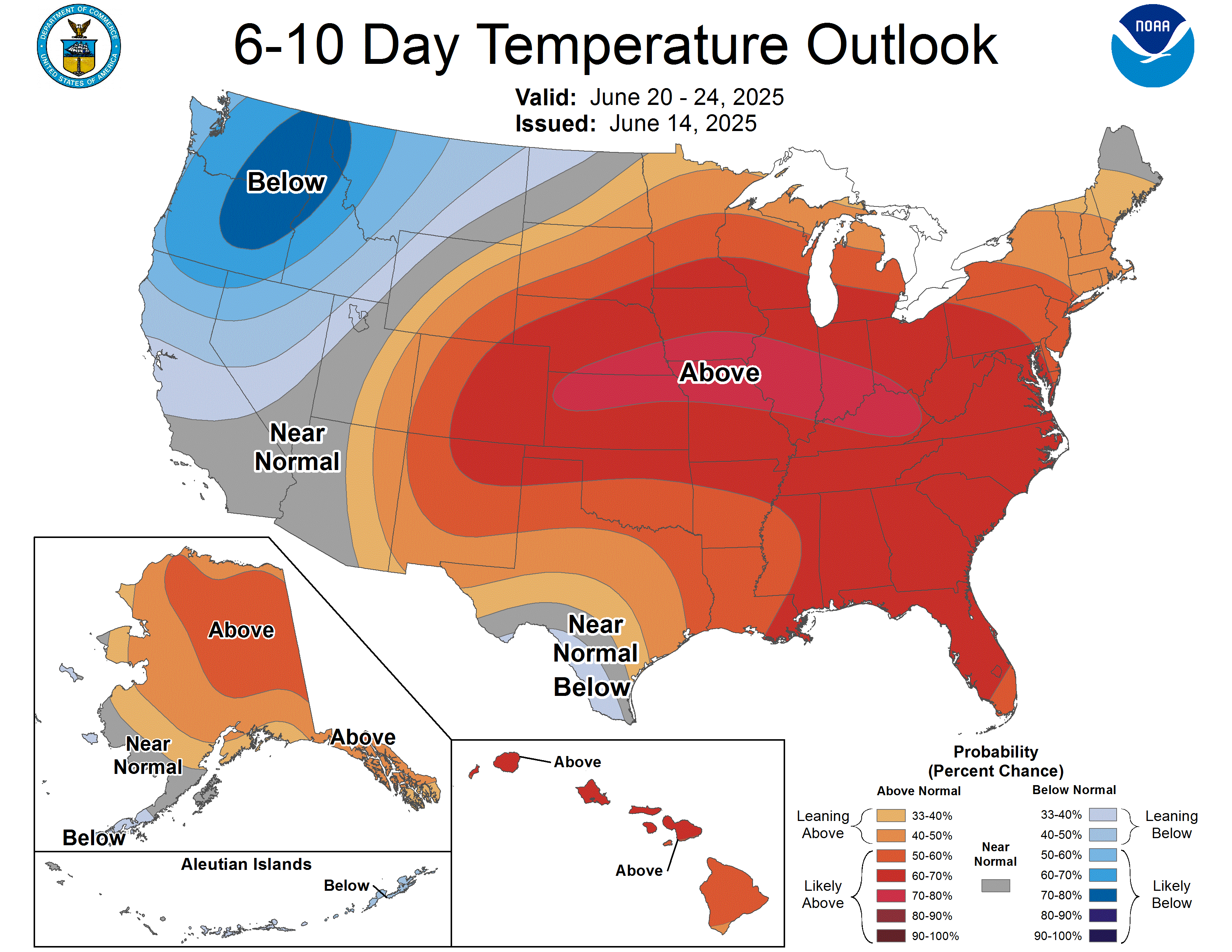
http://www.cpc.ncep.noaa.gov/products/predictions/610day/610temp.new.gif
Lucia:
“The zero line is the the 8 year average. So, we are low relative to that– not necessarily to any other baseline. I didn’t plot out since the beginning of RSS measurements.”
I know Lucia. I’m doing an 11 year average, and we are below that. If you run a trend line through the entire RSS data set, the slope will be up, but the current month will be even further below the trend line. The important thing, however, is that having ENSO neutral conditions, as we had in Aug, Sept, Oct, Nov, Dec, did not give us the kinds of temperatures that one would expect if there is really a .2C per decade rising trend going on. So the AGW pundits that were blaming the temperatures that we have been experiencing on La Nina seem to be wrong. Because even without La Nina we did not have the temperatures that they would expect. Of course there are other effects than ENSO that we have to think about, but the AGW climate community cannot point at any of them as the reason for our current flat/down trend. And this casts serious doubts upon their climate sensitivity numbers.
Fred–
I don’t see a legend. But being inside the dark blue cold spot during January has just got to be bad.
I’m in the cold spot. Right in the middle. 🙁
See text @ bottom right for explanation. Colour shades are probability forecasts for Above, Neutral, or Below normal temps. The darkest Blue in the above map is giving a greater than 50% chance of below normal mean temps for days 6-10.
The Nino 3.4 index from August to December is as follows:
2008 8 0.14C
2008 9 -0.20C
2008 10 -0.26C
2008 11 -0.22C
2008 12 -0.73C
Based on my analysis, there is a 3 month lag of the impact of the ENSO on global temperatures and a 6% impact on RSS global temperatures.
So, the change from August to September results in a -0.34C * 0.06 = -0.02C impact on RSS’ temps in December which is not too far off.
Temps will be stable for 2 months and then decline by another 0.03C in March based on the ENSO’s impact on RSS’ temps.
The way the La Nina is accelerating now, temps will continue going down afterward for a period just based on the ENSO’s impact. I haven’t seen the AMO numbers for December or the southern Atlantic’s which also have a large influence.
To complement Bill Illis’s NINO3.4 SST anomaly data, the OI.v2 SST value (NINO3.4 anomaly) for the last week in December, centered on Dec 31, 2008, is -1.09 deg C and dropping steadily. I should be posting the December SST data for the individual oceans tomorrow.
And if all the cool water below the equatorial Pacific makes it all the way to the surface, it’ll get quite chilly around those NINO areas.
http://www.cpc.ncep.noaa.gov/products/analysis_monitoring/enso_update/wkxzteq.shtml
Volcanoes Cool The Tropics, But Global Warming May Have Helped Override Some Recent Eruptions !!!
————————————————————————————————————————–
Climate researchers have shown that big volcanic eruptions over the past 450 years have temporarily cooled weather in the tropics—but suggest that such effects may have been masked in the 20th century by rising global temperatures. Their paper, which shows that higher latitudes can be even more sensitive to volcanism, appears in the current issue of Nature Geoscience.
Scientists already agree that large eruptions have lowered temperatures at higher latitudes in recent centuries, because volcanic particles reflect sunlight back into space. For instance, 1816, the year following the massive Tambora eruption in Indonesia, became known as “The Year Without a Summer,” after low temperatures caused crop failures in northern Europe and eastern North America. More extensive evidence comes in part from tree rings, which tend to grow thinner in years when temperatures go down.
This is one of the first such studies to show how the tropics have responded, said lead author Rosanne D’Arrigo, a scientist at the Tree Ring Lab at Columbia University’s Lamont-Doherty Earth Observatory. “This is significant because it gives us more information about how tropical climate responds to forces that alter the effects solar radiation,” said D’Arrigo. The other authors were Rob Wilson of Lamont and the University of St. Andrews, Scotland; and Alexander Tudhope of the University of Edinburgh, Scotland.
Along with tree rings, the researchers analyzed ice cores from alpine glaciers, and corals, taken from a wide area of the tropics. When things cool, not only do trees tend to grow less, but isotopes of oxygen in corals and glacial ice may shift. All showed that low-latitude temperatures declined for several years after major tropical eruptions. The samples, spanning 1546 to 1998, were taken from Nepal down through Indonesia and across the Indian and Pacific oceans; the ice cores came from the Peruvian Andes. The researchers used materials they collected themselves, as well as samples from the archives of other scientists.
The data show that the most sustained cooling followed two events: an 1809 eruption that probably took place in the tropics, but whose exact location remains unknown; and the 1815 Tambora eruption, one of the most powerful recorded in human history. Following Tambora, between 1815 and 1818, tropical temperatures dropped as much as 0.84 degrees C (1.5 degrees F) below the mean. A slightly bigger one-year drop came in 1731–0.90 degrees C (1.6 degrees F). The researchers say this may be connected to eruptions at the Canary Islands’ Lanzarote volcano, and Ecuador’s Sangay around this time.
D’Arrigo says that the study shows also that higher latitudes may generally be even more sensitive than the tropics. Some corresponding drops in northern regions following volcanism were up to three times greater. D’Arrigo said higher latitudes’ greater sensitivity appears to come from complex feedback mechanisms that make them vulnerable to temperature shifts. This goes along with growing evidence from other researchers that, as the globe warms, the most dramatic effects are being seen with rapid melting of glaciers, sea ice and tundra at high latitudes. The authors say that, overall, eruptions in the 20th century have exerted fewer obvious effects in the tropics. They said this could be because there were fewer major events in that century–but they noted it could also be “because of the damping effect of large-scale 20th-century warming.”
“Particularly warm decades may have partially overridden the cooling effect of some volcanic events,” said D’Arrigo. Noting that few reliable instrumental records exist from before this time, she said, “This study provides some of the first comprehensive information about how the tropical climate system responded to volcanism prior to the instrumental period.”
http://hernadi-key.blogspot.com
I was only joking — I’ve stood on the pan at Goose Bay with icicles forming in my nostrils, so I know what it’s really like in Canada.
Mind you, I ‘ve just come down to find the drainfrom the washing machines frozen. That’s not happened in twenty five years.
JF
Paris is under snow and this night the temperatures went to – 10°C under clear skies (still sunny – 6°C this morning) .
It is not (yet) record breaking in the absolute value but near record in the duration .
The temperatures plunged 1 week ago all over Benelux and France and according to the weather forecast the cold should last untill the next week-end .
There is an unusual huge cold bubble from Finland to Pyreneans .
Julian–
I wouldn’t have wanted to drive with the top down on a convertible in -5C either.
I had just read an news article at IceCap where 14F in the UK was called “Arctic”. We call that “seasonally cold”, meaning, yes, it’s cold, but it’s January, so what do you expect?
Of course, the weather readers do complain about the “seasonal cold”.
When I lived in Iowa, Iowa State University required new foreign students to attend a 1 hour “Winter in Iowa” training seminar. (Otherwise, some from warm climes might take an old jalopy out in the snow without putting on a good winter coat and boots. Bad things can happen.)
That gives a 2008 average anomaly of 0.095, putting 2008 in 13th place over the period 1979-2008.
This means that the UK met office prediction – that 2008 would be ‘another top ten year’ – is wrong again (recall that for 2007 they incorrectly predicted that it would be the warmest year ever). What chances for their latest prediction, that 2009 will be in the top 5? I’d like to place a bet against that, but I doubt I’ll find any takers.
The whole “top 10 year” thing seems, to me, to be a bit misleading. Even if temperature really is trending down (i.e. if this is not simply short-term variability), you’ll still have “top” years on both the leading and trailing edges of the peak – so the descriptive really doesn’t tell you anything. To me, anyway, the whole “top years” thing has an intrinsic alarmist feel to it.
.
Just my 2 cents on that, anyway.
UAH for Dec is out. +0.18 (but I think the graph shows down so maybe I can’t see or there is a typo)
jack– yes it’s up.
2008 10 0.166
2008 11 0.254
My husband will be home soon. I need to see if the driveway needs to be shoved. Again.
So Lucia, if global warming is masking volcanic cooling and La Nina is masking global warming, what was the great El Nino of 98 masking?
Or to put it another way:
“Who was that masked man?”
El Nino may have been masking the luke-warm-ness of AGW?
We got a bit hot 1 year pop. Unless it happens again, and fairly soon, then the data will be saying even more strongly: Not currently 2C/century.
Jack– I didn’t notice that only nov and dec were up at the web site. Looks like Anthony must have bribed “the man” with cookies or something and gotten the data early.