The thread on the TT hotspot is so long I’m experiencing server errors trying to load it. Discuss it here.
The definition of a climate fingerprint keeps coming up in comments. I have mentioned that when using the term fingerprint, I use the IPCC definition from the glossary to the AR4. This is the definition.

Lucia, check out Jeff Id’s latest post. I think he might be on to something.
http://noconsensus.wordpress.com/2009/01/06/more-fun-with-giss-temps/
Jorge, thanks! I’ll have a read of the Rind paper.
DeWitt, thanks for your response. The “rule of thumb”, which didn’t seem to jibe well with Clough’s increased CO2 -> negative tropospheric forcing for subarctic winter, is a lot of what prompted my questions. 🙂 I’ll have to do me some more reading..
JohnV–
You ended your earlier sentence with “when the only difference is scale.” suggesting that differences in scale are irrelevant to deciding whether two items are the same or different.
Scale matters. You admitted there is a difference in scale.
Now you want to suggest that somehow, if you can come up with an example where claiming to have $1million in my pocket does not conflict with having only $1 in my pocket.
Douglas was comparing observations to model projections for what happens in a specific time frame. For that time frame, the magnitude of the mid-tropospheric warming due to solar is small, and would not cause a “hot” spot, particularly relative to the amount of warming due to ghg.
Real Climate authors, in a discussion of Douglas and of our ability to detect any such spot showed an image that dramatically amplified the magnitude any warming predicted to arise due to solar forcing during the relevant period: that period would be the period Douglas (and later Santer) was using to compare models to data.
Had Douglas compared their observations to the image in RC, that would have been a humongo-normous blunder. If you are suggesting that this doesn’t matter because if Douglas has waited to accumulate 20,000 or so years of data, then the RC image would be relevant to a data comparison and so the RC image doesn’t conflict with the correct image (which has no distinct “spot”) …… huh?
RC showed an irrelevant image with effects greatly amplified in scale. It is embedded in a discussion that would make people think that was somehow relevant to what Douglas did or said.
If I write a discussion explaining 1 minute of funded labor for company “X”, and then show check from company indicating I made $1 millon and organize the information in a way that suggests the amount on the check relevant to amount of work I described, I would seem to be making a claim.
The claim would appear to be “Make $1 million dollars working a minute!” (Come to think of it, we’ve all seen make quick rich schemes use this technique.)
If a reader who delved further discovered that I earned $1 a minute and the check represented 1 million minutes of work, then the evidence would contradict the apparent claim.
Of course, the advertiser could than point out that they never specifically said that someone would make $1million in one minute.
Similar tricks are used in diet advertising. (Please read fine print on all diet ads.)
Magnitude matters. Context matters.
On to fingerprints.
Whether you like it or not the IPCC glossary provides a definition of fingerprint, and that’s the one I use. It’s been used without the sense of “unique” by climate scientists for some time. Presumably, climate scientists and climate bloggers are permitted to use this one.
If you want to the IPCC or websters to change their definitions to include “unique” contact them. Ask them to insist all peer reviewed articles and newspaper interviews of climate scientists add eratta indicating that the definition of a climate fingerprint has been revised and past usages are now depricated.
Layman Lurker–
I strongly suspect that Steve M has been downloading the specific temperature prediction for the troposphere. I don’t know if he will be addressing that in detail.
The reasons I don’t is that the IPCC AR4 did not publish specific projections about the troposphere in the AR4.
But, yes, generally we expect faster warming in the troposphere than the surface. The data also looks noisier that the surface data. (I don’t know if this is measurement noise or weather noise. But it is a bit noisier.)
lucia,
When I said “the only difference is scale”, it was implicit that “scale” referred to both forcing and result. It seems pretty obvious to me. As did the RC article — hypothetical forcing to show hypothetical result indicating same warming in the tropical troposphere.
I can’t understand why you will spend so much time arguing with me and others, but won’t spend a couple of minutes clarifying your definitions in the article. You are very concerned that somebody might come away with the wrong impression from the RC article, but have no concern that your own article is doing the same thing.
What’s the problem with clarifying your definitions at the top of the article? *If* your goal is clear communication, and it’s clear that many people mis-understood what you wrote, shouldn’t you clarify?
JohnV, Joel –
I think the confusion that comes from the RC post (and I admit that I read it this way until I went back) was the impression that a TT “hotspot” would form under an equivalent solar forcing to a doubling of CO2. I didn’t realize at the time that a 2% increase in solar is a substantially greater forcing (~27 W/m2) than the ~4 W/m2 (i think that is right) anticipated from a doubling of CO2. If RC had used an equivalent forcing, I would agree with you that the TT hotspot is not a fingerprint of GHG-induced warming. However since they appear to have used a much greater (and patently unrealistic) solar forcing of ~27 W/m2 to create the same TT hospot then I have to agree with Lucia that a TT hotspot would be a “fingerprint” of GHG warming if the models are correct.
I also agree with Lucia that not finding the hotspot or if doesn’t materialize in the future is more likely an indication that something needs to be tweaked with the models rather than an indication that the warming isn’t due to GHGs.
Bob North,
I get different numbers than you using equations from Wikipedia
http://en.wikipedia.org/wiki/Radiative_forcing
CO2 doubling: 5.35 * ln(2) = 3.7 W/m2
2% Solar Increase: (1366 / 4) * 0.7 * 0.02 = 4.8 W/m2
For equivalence, it would have been better to use a 1.5% increase in solar instead of a 2% increase.
Bob North,
I will be impressed if you follow through on your promise:
“If RC had used an equivalent forcing, I would agree with you that the TT hotspot is not a fingerprint of GHG-induced warming.”
GISS ModelE only has about 0.5 W/m2 increase built in for Solar forcing which translates into a +0.1C increase from 1880 to 2003.
3 or 4 W/m2 increase for Solar is entirely theoritical and not even within the realm of possibility.
http://data.giss.nasa.gov/modelforce/RadF_s.gif
http://img355.imageshack.us/img355/3111/modelesolarej8.png
This is faulty reasoning. You make an assumption that since Douglass did not explicitly state something in his argument (I believe he did, but let’s take your POV for a moment) that he could not have led anyone to believe that the TT hotspot was a feature of GHGs only. But as we have discussed, the common definition of “fingerprint” means “unique and identifying.” So it is obvious that someone could be misled. Then, Arthur has provided specific examples of people being misled, if not by Douglass, then by others. But it hardly matters because clarifying what is expected to be a unique feature of different forcings helps to clarify the issue. It is not a red herring.
Once again, you defend Douglass for his obviously misleading claims and you criticize RC for clarifying an issue. I don’t see how you can continue to claim an objective POV after this exchange.
JohnV
I assumed you applied it to both.
The discussion of the hypothetical prediction using hypothetical forcings is embedded this in a discussion of whether or not one could detect the feature in observations which were driven by earth forcings (smaller scale) and achieving earth outcomes (smaller scale.) There is absolutely no discussion of the absolute fact that if we used real forcings, the solar image would show no red hot spot while the ghg one would show a spot.
With respect to the comparison with real earth forcings, the magnitudes are such that the “hot spot” would appear only as a result of forcing by ghg.
Relative to the point under discussion, the authors at RC chose figures that distorted the scales of the effects expected due to ghg and solar forcings. The figures would suggest that the effects due to ghg and solar is comparable. This is embedded in a discussion of a paper comparing observaions during a period where models predict the effect of ghg’s greately swamps that of solar.
While the discussion does admit the forcings don’t match earth, the provide the reader with absolutely no information about what sorts of figures would be relevant to earth.
To sort things out, a reader has to either a) already know that the figures don’t represent real earth b) investigate further and educate themselves to discover that specifically stated forcings do not match those in the observational period being discussed and c) find out what the correct figures would be fore the period under discussion. Those appropriate figures look different.
After a reader a readers does all that extra self assigned homework, they recognize that the RC images have nothing to do with the main subject of the blog post: i.e. Douglas’s comparison of real earth observations to model predictions driven by real earth forcings.
In other words, they will find that the appropriate figures convey this: Solar forcing has an insignificant contribution during the time period being investigaed. For all practical purposes, any “hot spot” one might find would be attributed to ghgs, not solar.
What definition do you want clarified or changed in the article itself?
As far as I can tell,
* you want to first redefine the meaning of fingerprint so it does not match the IPCC definition.
* you want me to to decide that I think RC inserting those RC figures into a discussion of Douglas’s comparison of observations to models is perfectly appropriate, and not at all deceptive in context. The reason for this is that I am not allowed to use the IPCC definiton of fingerprint, but should use the one you prefer.
* you appear to want me to decide that I can’t say there is a seeming contradiction between figures. The reason you think I can say this is that, if people delve beyond the article, found the more appropriate figures in the AR4 and asked why they look different from those in RC then someone could explain that the AR4 figures show what would happen on the real earth– and what we might need to consider when doing data comparisons. (That would be the topic of Douglas paper being critiqued by RC). However, if we dug up even more data and rescaled RC figures in our heads and rethought the entire argument in RC, we could figure out how to rescale the RC figure to come up with some that look more like those in the AR4– which are the appropriate ones to think about when comparing models to data.
But you want to call this clarifying my definitions at the top of the article!
John,
.
Unless I’m misreading, Fig. 9.1, which shows the hotspot, covers how the trophosphere changes from 1890-1999. It doesn’t apply to 2xCO2. Therefore, the CO2 forcing should be about 1.7 W/m2 . . . but that’s only at present. The forcing would have been much less in the past, so the average forcing would be somewhere south of 1.7 W/m2.
.
But even using 1.7 W/m2, comparing that to your solar forcing number (which I agree with), that means RC used a solar forcing value 2.8 times greater than the present CO2 forcing – and even greater than the average CO2 forcing from 1890-1999.
.
That’s a massive difference.
New comment thread here.
As we have discussed this is not the IPCC glossary definition of the fingerprint, and the non-unique usages is widespread in climate science papers and interviews with journalists.
Who has been specifically mislead by Douglas? And about what? He may have misled them about something — and I criticized Douglas and Christy for exaggerating the meaning of their results. But you can’t the criticize them for extra sins they did not commit?
RC clarified nothing about Douglas’s claims in that article. The introduced and irrelevant subject, spent a lot of time discussing an irrelevant subject and caused people to believe that subject is relevant to Douglas’s claims.
=== I’m closing comment on this thread and opening a new one. I get server errors when I try to load the post.
New comment thread here.
JohnV –
I see the error in my numbers. Though RC should have used something closer to the 3.7 W/m2 to show the impacts of solar forcing, I agree that 3.7 and 4.8 are close enough that you cannot say that the TT hotspot predicted by the models is a “fingerprint” of GHG-induced warming. However, I do maintain that the absence of our detection of it to date and, particularly if we don’t find it in the future, is likely a reflection that something in the models need tweaking.
🙂 Lucia was moving as I was editing . . . I meant to close my last comment with the phrase “nigh unphysical”.
.
In other words, in order to make the TT hotspot be non-unique to GHG, the RC crowd used a model with unphysical forcing.
.
This is like saying that a falling object at the earth’s surface with an acceleration of 15 m/s2 is not a “fingerprint” of a non-gravitational force assisting the acceleration because you can duplicate the result by changing the value of g.
.
Patently ridiculous.
.
EDIT: @ Bob: The graphs in Fig. 9.1 aren’t for 2xCO2. They show how the models predict the troposphere should have changed between 1890 and 1999.
John V and Bob: Just to clarify what I meant, you’re using the wrong value for the reference concentration in order to arrive at the 3.7 W/m2. Because the graphs are depicting changes from 1890-1999, the reference concentration that should be used is the 1890 value, which was about 290 ppm. The present concentration is about 380 ppm. That yields a forcing of 1.44 W/m2 . . . which is slightly less than the 1.7 W/m2 that the IPCC used . . . not unexpected since the equation is just a simple first-order approximation.
.
That means RC is comparing a solar forcing of 4.8 W/m2 to a CO2 forcing of 1.7 W/m2 (1.6 W/m2 at present if you include all anthropogenic contributions). That’s not even close to the same magnitude of forcing.
Bill Illis:
I agree that 2% solar increase is entirely theoretical. That’s why solar could not have been the cause of 20th century warming.
—
Ryan O:
The images at RC compare doubling CO2 to increasing solar by 2%. The radiative forcing for doubling CO2 is about 3.7 W/m2. The IPCC image shows actual forcing for the 20th century. Different images. Different forcings.
—
Bob North:
I agree with you. As I’ve said before, if the lack of enhanced warming in the tropical troposphere is confirmed, then there is a problem with the models.
—
lucia:
I’m not asking you to re-define anything. Just provide your definitions for fingerprint and hotspot in the article, so that there is no confusion. As I understand them, your definitions are something like this:
1. Your definition of fingerprint specifically excludes the requirement that it be unique and identifying. By all means, include the exact IPCC definition that you are clinging to, but IMO it’s important to specifically state that the pattern does not need to be unique or identifying;
2. State that you do not interpret “hotspot” as meaning “enhanced warming relative to surface”, but rather as absolute warming more than some arbitrary number of your choosing;
You are obviously very fond of your definitions. You should promote them. Don’t hide them down here in the comments. Put them up front for everybody to see.
It’s obvious that the definitions you are using are not well-accepted. A good number of your long-time regular commenters disagree with them. Clarify. Make yourself understood so there can be no mis-understanding. That is your goal, right?
It’s disturbing that you can’t or won’t accept patterns over absolute magnitudes. It’s more disturbing that you’d rather argue in the comments than make a couple simple clarifications.
John V:
.
I know. That’s the whole crux of the argument. I’ve said repeatedly that the images at RC are merely an attempt to remove the context from Douglass’ claim, and, by extension, Lucia’s initial post. The models used by the IPCC predict a TT hotspot right now. Not in 2030. Not in 2050. Not when CO2 doubles to 760ppm. Right now.
.
Are you seriously arguing that time doesn’t matter when comparing observations to model predictions? Of course time matters. It provides a context for the discussion. What would the editor’s reaction have been if Douglass looked for the year 2100 hotspot in the current observational data?
.
Douglass’ paper is talking about comparing present observations to model predictions of the present. In that context – the same context as Fig. 9.1 from AR4 – the feature shown in c) and f) is unique to GHG forcings.
.
If you claim that it is not unique, then show me the results of a model run that demonstrate by replacing GHG forcing with solar forcing in the period from 1890-1999 you both reproduce c) and f) and match the observed temperature trend.
.
You guys repeatedly say that the tropospheric warming is not unique to GHG forcings, so it’s not a fingerprint. Yep – that sentence is generically true. You can indeed get tropospheric warming from all kinds of forcings. But the models predict that there should be a specific pattern and specific magnitude that is unique to GHG forcings at the present time. It’s right there in 9.1. Take a look.
.
100 years from now will it be unique? Maybe not. If the sun goes into overdrive will it be unique? RC showed probably not.
.
But given the contexts of time (now), the parameters used for the prediction (20CEN), and the models used to predict it, it DOES NOT SHOW UP FOR ANY REASON OTHER THAN GHG FORCING.
.
So you can debate the meaning of “fingerprint” all you want, but it is utterly irrelevant to the context of Douglass’ claim.
.
.
This is laughable. When comparing observations to predictions, the pattern of the response and the magnitude of the response are equally important. Neither is supreme over the other. Meeting one doesn’t mean you can ignore the fact that you didn’t meet the other. Not only that, for responses that change with time, the time also matters. Miss any one of them, and there’s something wrong with the prediction.
.
Period.
JohnV–
I am neither fond nor not fond of the IPPC definition of fingerprint. It just is what it is. Boris entered comments at CA and told people that using fingerprint a certain way didn’t make sense. That “certain way” happens to the the IPCC definition. If you read the comments, you’ll see that plenty of regular readers found examples of non-unique fingerprints, including a discussion by Hansen.
What is your issue of accepting patterns “over” absolute magnitudes. And in what context? There are contexts where one can talk about patterns, use patterns and limit oneself to unique patterns for the purpose of analysis. There are cases where abolute magnitude matter.
We have recently been discussing whether something at magnitude A can be said to contradict something at magnitude B when those magnitudes differs substantially. The simple fact is that in many contexts, one can say things contradict each other if the magnitudes are different. It’s done all the time.
You seem to want to say that either a) one can’t say those are different if the patterns are similar or b) one might be able to, but now I’m somehow accepting pattern over magnitude. This is not an either/or issue, and it is not context free. In some contexts magnitude really matters.
In the context of conversations that Boris entered, and in that of RC critiquing Douglas, the magnitude is a feature that mattered– particularly if we are going to use words like “hot spot”, “fingerprint” and discuss whether some feature that might be hotish- or spottish is expected to arise due to solar forcing in in the real world.
Ryan O:
I think we’re arguing past each other because of context. I posted radiative forcing numbers in response to Bob North’s numbers. He thought that the two RC images used vastly different forcings. I pointed out they don’t. Our little back-and-forth was about the RC images only — nothing to do with IPCC or Douglass.
.
I think we agree on the science but terminology is getting in the way. The following paragraphs are not meant to be an argument, but rather a clarification:
.
There are of course many valid ways to use model predictions and many reasons to do model studies.
.
One way is to use hypothetical forcings to determine the climate response. What would we expect given a hypothetical forcing? Is there a difference in pattern between solar forcing and GHG forcing? From this kind of study, we learn that enhanced TT warming is expected for both solar and GHG. For the purposes of determining a source of warming, enhanced warming in the TT does not distinguish between solar and GHG. The primary difference between the two is in the stratosphere. That is, stratospheric cooling distinguishes between solar- and GHG-induced warming. That is one meaning of the word fingerprint.
.
Another study would be to look at the expected temperature response to actual 20th century forcing. Since GHG forcing was dominant in the 20th century, we see that the GHG response is also dominant. Part of the GHG response is enhanced warming in the TT. Another part is stratospheric cooling. If one of these is missing, it means there is either a problem in the models or a problem in the predictions. I believe this is lucia’s meaning of the word “fingerprint”. In this meaning, enhanced TT warming doesn’t distinguish between solar and GHG, but it is a characteristic of the expected GHG-induced warming.
.
Do we agree on this much?
Sorry about the multiple posts. Forgot something.
.
Your argument is fundamentally based on removing enough specifics from the prediction that calling it a “fingerprint” becomes impossible by almost any usable definition of the word.
.
Magnitudes? Don’t need ’em. Remove from consideration.
.
Time scale? Don’t need it. Remove from consideration.
.
Latitudinal pattern? Nope. Remove from consideration.
.
What’s left? Warming in the troposphere? Why, that happens from anything! Here’s a graph showing a nonphysical solar forcing compared to an as-yet-unrealized level of CO2 from one model run. See? They look the same (sort of – just ignore the differences in scale at the bottom of the graph and don’t look at the stratosphere, please)! Not a fingerprint!
.
Bollocks.
lucia,
.
You are right that both patterns and magnitudes can be useful. I should not have said “patterns over magnitudes”. So, do you accept that the pattern of warming (the whole pattern) is a valid definition of a fingerprint?
.
I gave up on trying to convince you of anything new many posts ago. I’m now merely asking you to clarify your definitions of “fingerprint” and “hotspot” in the article. What’s so hard about that?
.
I’m sure your goal is to be as clear as possible. Right? You wouldn’t want to be ambiguous, would you?
.
Among other things, you’ve confused those of us who use dictionaries and everyday English for word definitions. Defining your terms will go a long way towards preventing more confusion.
Ryan O:
I think your last post (#8224) was written before reading mine (#8223). Let me know if #8224 was a response to #8223 or written after.
John V:
.
Sorry about the above post; we were posting at the same time.
.
AFA your latest, I agree to an extent. For the hypothetical case, I have no issues.
.
For the expected case, I do have an issue, but I have to think about how to word the response. 🙂
Damn. Posting at the same time again! Haha! 🙂
Ryan O:
Just one comment about #8224.
It is lucia who is defining just the TT hotspot as a fingerprint. I and others are arguing that the fingerprint of GHG-induced warming includes both TT warming and stratospheric cooling. I’m not sure who you’re arguing with.
I must be missing something. Why is this ‘fingerprint’ idea such a big argument? If the only way the hotspot is duplicated in the models is by using unrealistic forcings then it would seem, for any practical purposes, to be a unique signature (i.e., fingerprint) of GHG warming on earth during the modeled period…..like I said I must be missing a nuance of this argument.
As I understand the ‘hotspot’ is not observed…therefore its inconsistent with modeling results. Doesn’t this just mean that either our observations (temp measurments in troposphere and/or surface) are incorrect or the models are not capturing something in the physics of the warming process? Was RC’s discussion really as specious as Lucia makes it out to be?…somehow I think Gavin would not agree but I would love to hear what he would say to that particular criticism.
JohnV–
I did not define just the TT hotspot as “the” fingerprint. The way the glossary reads, fingerprints are
“The pattern in space and time to a specific forcing is commonly referred to as a fingerprint”.
The definition doesn’t specify the spatial extent or the length of time. So, applying the definition, the TT hotspot can be a fingerprint (though it may not be unique.) Stratospheric cooling can be a fingerprint. The two combined can be a fingerprint.
The definition doesn’t say a forcing in isolation of all others. The specified forcing may be hypothetical. It may be a real forcing. It’s just specified.
The definition permits apply the word to quite few things, and it is used this way. Note the glossary says “common”, suggesting to the reader that this word can be used conversationally.
On your suggestiong of clarifying, I am not updating to “clarify” because I think my points are already clear. I am using fingerprint as in the IPCC glossary. I don’t think there is any need for me to add footnote indicating the IPCC glossary definition of fingerprint to the base of the article and indicate that I am using it.
I don’t think there is anything unclear with what I mean by hotspot either. Or, at worse, I don’t think my use is any less conventional than the use others wish to insist on. However, if you can find a definition in the IPCC document, or some climate dictionary, then we can see if there is any strict definition.
As it stands, some people are insisiting this term applies to things that are neither “hot” nor “spot like” and insisting on some personal definition that way it is there even in the limit of zero warming which would make it an invisible spot.
Steve Geiger:
Yes. I agree. You are correct.
.
The problem is that many people (not lucia) try to go far in this argument and state that the lack of a TT hotspot disproves GHG-induced warming. It is a common argument by “skeptics” to say that the lack of a TT hotspot implies that the source of warming must be solar. For an example, see the SEPP news release that Gavin linked to at the top of the RC article. (In the context of the SEPP news release, Gavin’s article was on-topic).
.
The whole argument is about word definitions. To me and many others, a fingerprint of a particular forcing is defined by the distinguishing features of that forcing. What features could be used to distinguish between GHG-induced and solar-induced forcing? A TT hotspot does not meet this definition.
.
Lucia’s definition is different. I’m hoping she will provide us with it soon. Her definition is about the most prominent feature in the predicted warming in the 20th century. It’s not about distinguishing between solar and GHG — it’s about validating the models. There’s nothing wrong with that, but it gets mixed up with the other definition and causes all sorts of confusion.
lucia,
I can’t understand why you are so adamantly refusing to clarify your terms. Clarity is a good thing — right?
Have you ever defined “hotspot”? I know Arthur Smith asked many times, but I don’t recall an answer. Please point me to it if I missed it.
John V.:
.
I’m arguing with EVERYONE! Haha.
.
To clarify my positions:
.
1. I am referring to the whole of the feature in 9.1 c) and f). That includes the latitudinal pattern, pattern with altitude, magnitude of the response, the time frame in which the response occurs, and the parameters used to generate it. I’ve said this before, but probably not so clearly and it was a while ago. I differ from Lucia’s argument in that I think she could acquiesce to your definition of “fingerprint” and still be right as long as you don’t chop up the feature into “TT hotspot” and “strat cooling” and . . . etc.
.
2. I agree that Douglass’ statement over-reaches. First, because his statistical analysis is wrong; second, because he did not include some data he probably should have; and third, his results (if accurate in spite of the above) can not be used to say that AWG is not happening or is not significant. They can only be used to say that the models have not correctly predicted the behavior of the troposphere.
.
3. I feel that RC’s post showing the comparison between the 2XCO2 and enhanced solar forcing does not in any way, shape, or form constructively criticize Douglass’ results or statements. Instead, it confuses the issue by presenting a comparison between different models as a surrogate argument for a comparison between model predictions and observations. In my opinion, the purpose is to undercut Douglass’ credibility with an argument that has no relevance to the context of Douglass’ claims. I believe this is the spirit – if not the letter – of Lucia’s original post.
.
4. I do not agree that the concept of AWG is dead if observations cannot find 9.1 c) or f). All that would say is that something in the models is wrong; not necessarily that AWG is not happening.
.
5. By the same token, I do NOT agree that this would be a trivial problem. I do NOT agree that the effect on the long-term temperature forecasts would be minor (as many have implied). I do NOT agree that because the models “got other stuff right” that the long-term temperature predictions can still be considered “likely” responses. I believe this would be a major problem for the models because the long-term temperature response depends so heavily on water vapor feedback, and lack of a feature in 9.1 c) and f) would (on the surface) imply a water vapor feedback that is less than predicted. The feedback is cumulative; small deviations in the feedback will result in larger deviations in long-term temperature response.
.
While I understand that many denialists have used Douglass to herald the end of AWG theory, the right response is to show how Douglass’ data selection, analysis, and subsequent statements are in error – not throw up this red herring argument.
.
Now, AFA your second case from post #8223 goes (comparing actual response with forcings), the issue I have is the non-specificity. I do not agree that you can say that similar qualitative responses (surface warming, tropical tropospheric warming, stratospheric cooling) mean that a forcing does not produce a unique response.
.
Part of the response is the magnitude. I can think of no logical argument that you can exclude magnitude from that comparison, or say that magnitude can not be a distinguishing characteristic. In every other field of science and engineering, magnitude can certainly be distinguishing.
.
Now you may propose an argument by which the difference in magnitude between natural and anthropogenic contributions to the response is so small that it is within the uncertainties of the model predictions (the model ranges for natural and anthropogenic responses overlap). This is clearly not the conclusion in AR4, and it’s certainly not the direction RC took. The differences in response shown in Fig. 9.1 are statistically significant. If you have statistically significant differences, then there is no logical reason for excluding them when determining uniqueness. Even if the error in the observations is large enough to allow both cases and the observations are inconclusive (as Santer argued), that doesn’t suddenly make magnitude irrelevant when determining uniqueness. All it means is that the current data is of insufficient resolution to detect the magnitude difference.
.
For that reason alone, I side more with Lucia than with you. Magnitude matters, even if the underlying pattern is the same. It is the whole of the response that matters, and magnitude is part of it.
Mike N (Comment#8201) January 7th, 2009 at 11:14 am,
I think the Rind paper deserves its own thread.
Ryan O:
I agree with just about everything in #8234 above. I also agree with your point about magnitude being important when comparing predictions to observations. I guess I should have clarified that.
.
There is one point where I disagree. From 3), while I agree that the “2xC02 vs 2% solar” images do not speak directly to this particular Douglass paper, they are relevant for background and as a rebuttal to the types of statements made by Singer in the SEPP news release linked two paragraphs above the graph. It is logical to link to something (Singer’s news release), and then rebut it.
John V below are excerpts from IPCC AR$ of the section being discussed that indicate that Lucia is correct and your statements about fingerprint are incorrect.
from p667 of ar4-wg1-ch9 The comparison between observed changes and those that are expected is performed in a number of ways. Formal detection and attribution (Section 9.1.2) uses objective statistical tests to assess whether observations contain evidence of the expected
responses to external forcing that is distinct from variation generated within the climate system (internal variability). These methods generally do not rely on simple linear trend analysis. Instead, they attempt to identify in observations the responses to one or several forcings by exploiting the time and/or spatial pattern of the expected responses. The response to forcing does not necessarily evolve over time as a linear trend, either because the forcing itself may not evolve in that way, or because the response to forcing is not necessarily linear. The comparison between model-simulated and observed changes, for example, in detection and attribution methods (Section 9.1.2), also carefully accounts for the effects of changes over time in the availability of climate observations to ensure that a detected change is not an artefact of a changing observing system. This is usually done by evaluating climate model data only where and when observations are available, in order to mimic the observational system and avoid possible biases introduced by changing observational coverage.
and
The concepts of climate change ‘detection’ and ‘attribution’ used in this chapter remain as they were defi ned in the TAR (IPCC, 2001; Mitchell et al., 2001). ‘Detection’ is the process of demonstrating that climate has changed in some defi ned statistical sense, without providing a reason for that change (see Glossary). In this chapter, the methods used to identify change in observations are based on the expected responses to external forcing (Section 9.1.1), either from physical understanding or as simulated by climate models. An identified change is ‘detected’ in observations if its likelihood of occurrence by chance due to internal variability alone is determined to be small.
and
Many studies use climate models to predict the expected responses to external forcing, and these predictions are usually represented as patterns of variation in space, time or both (see Chapter 8 for model evaluation). Such patterns, or ‘fingerprints’, are usually derived from changes simulated by a climate model in response to forcing. Physical understanding can also be used to develop conceptual models of the anticipated pattern
of response to external forcing and the consistency between responses in different variables and different parts of the climate system…Detection does not imply attribution of the detected change to the assumed cause. ‘Attribution’ of causes of climate change is the process of establishing the most likely causes for the detected change with some defined level of confidence (see Glossary). As noted in the SAR (IPCC, 1996) and the TAR (IPCC, 2001), unequivocal attribution would require
controlled experimentation with the climate system. Since that is not possible, in practice attribution of anthropogenic climate change is understood to mean demonstration that a detected change is ‘consistent with the estimated responses to the given combination of anthropogenic and natural forcing’ and ‘not consistent with alternative, physically plausible explanations of recent climate change that exclude important elements of thegiven combination of forcings’ (IPCC, 2001).p668
Climate models are the pinnacle of climate knowledge, and they are wrong.
The argument that there is esoteric scientific knowledge of AGW that exists in science somewhere is wrong. There isn’t any. It’s belief only.
The theory of AGW is bad. That’s why there is a fight over definitions of words. It’s the natural progression of what happens to a lie after it is told over and over, over a period of time. People get confused because they can’t find any truth in any of it.
Andrew
SteveGeiger
Yep. Though there are two other alternatives, our measurements are accurate, but we don’t yet have enough signal to overcome the noise or the analysis showing we can’t detect it was incorrect or inappropriate.
The RC discussion would have been fine as a stand alone discussion given outside the framework of commenting on the meaning of the Douglas paper, their results or even whatever they might have said in their press releases.
It the figures wedged where they are, with the discussion seeming to suggest that the factoid that models predict enhanced warming in the mid-troposphere runs counter to something Douglas found and/or suggested. Douglas said nothing about the enhanced warming being unique to ghg’s particularly not in the sense that it would not appear if we looked at a planet that had been warmed by some hypothetically high level of forcing.
As far as I can tell, arguments for why it’s OK for RC to wedge the discussion in that particular aregument is the factoid is true. This, of course, ignores the fact that it was irrelevant to Douglas, but placed so as to make it appear the information was some sort of rebuttal to Douglas. The practice of changing the subject away from the main point is a red herring.
The other argument seems to be that Douglas did make some unsupported claims about the meaning of their work, and the word “such as solar” appear in the press release. But the way “solar” appears is not done in a way to suggest that the hot spot is due to the sun.
RC would have done much better if they’d said what you said instead throwing in the red herring discussion. The models predict a hotspot. We haven’t detected it. So either a) the data are inaccurate or b) the data are accurate, but noisy so we need more data c) there is a problem with the models or d) the analysis was faulty.
This year (almost a year after the 2007 team post) Santer wrote a paper in which both (a), (c) and (d) are discussed. Since the time Douglas wrote their paper and the 2007 RC paper, there have been data revisions (addressing a). Santers analysis addresses the precision issues, which Douglas did not.
The 2008 Santer paper addresses Douglas does clarify things. Notably, that paper does not include a section explaining that enhanced tropospheric warming would also be expected if warming were due to hypothetically high solar forcing. So, in fact, the discussion that I consider irrelevant in the 2007 RC post addressing Douglas was not deemed necessary to the peer reviewed paper discussing Douglas.
The reason: Whether or not hypothetical solar might cause enhanced warming in the mid troposphere, that fact is irrelevant to any comparison between models and data.
John F. Pittman:
Thanks for the excerpts.
Give me a little time to read them in context.
I don’t see anything so far that makes me wrong. Please elaborate and I will clarify my definition if necessary.
lucia:
.
Of course it isn’t. That’s the whole point.
.
Solar is suggested as an alternative explanation for the warming that is supposedly consistent with no TT hotspot. That’s why it’s important to realize that the TT hotspot is expected from solar-induced warming — to rebut the argument that solar warming is more consistent with observations.
lucia:
Your definition of TT hotspot?
Is it “enhanced TT warming relative to surface”?
Or something else?
JohnV–
Yes JohnV. I have described what I think a hotspot is.
In the context of anomalies, I consider a region “hot” only if it is “hot” relative to surrounding regions. To be hot rather than just “warm”, it must hotter than the other regions in the spatial extent under consideration. So, in the IPCC pattern maps in the previous blog post, for the observational period under consideration, only red regions are “hot”. As “yellow” describe lower temperature elevation than “red” “yellow” means “warm” not “hot”.
If, after running models, we would be able to distinguish the temperature elevation from a variability due to noise during the period of interest then the region is also not “hot” in the sense of being a stable characteristic.
I consider a “spot” to have a shape most run of the mill 7 year olds would call a “spot”. These shapes are more or less circularish, not shaped like snowmen or trucks or aeroplanes and can be picked out from their surroundings. They don’t look like big U’s or S curves.
To be a “hot spot” the region must be both “hot” and a “spot”.
During the observational period considered in Douglas, or under 20th century forcings, solar forcing does not result in any “hot spot” in the tropical troposphere. GHGs do. The reason is that when we consider the period as a whole, relative to GHG’s, solar does not create any “hot” regions.
I have described this before. I have described it to Arthur.
Arthur has describe what he thinks a hot spot is. I think his definition results in “hot spots” that a) have zero heat b) cannot be distinguishwd from noise and c) are not spot shaped.
There is no precise definition of “hot spot” in the IPCC glossary. If you find a precise definition somewhere, let me know. As far as I can tell, the term is used loosely, on blogs, talking to journalist and describing how temperature anomaly plots look.
JohnV,
Hint, try to find the term ‘unique’ anywhere in those excerpts. Fingerprint and pattern are used interchangeably . Unique is nowhere to be found.
JohnV–
Since the hotspot is not detected, it is obviously not at all important to know models also predict if in the even of hypothetically large solar forcing.
If it isn’t found, the models are wrong.
You are adding details to what Douglas or Christy say in the press release. The simply don’t say why absense of the hot spot is more consistent with models. If I were to guess their reason is not because they think the models don’t predict the spot for hypothetically large solar. It’s because a) they thing the models are wrong and b) they think the models are the main evidence for ghg warming.
So, if the models are proven wrong, then ghg (in their mind) not the cause. That leaves natural causes— like possibly something about the sun. What about the sun? Who knows? Maybe cosmic rays. Maybe some as yet undetected thing.
The rebuttal explaining that the hotspot could happen because of the sun is irrelevant.
John V, once again you confuse models with reality when you say:
What you mean is that the models predict the TT hotspot from solar-induced warming. It is not “expected” by anyone except those who blindly believe in the models in the absence of any evidence that the models are correct.
For the rest of us who still believe in evidence, no one to date (despite repeated requests) has produced a single scrap of evidence that your statement is correct. In fact, the disagreement between evidence and models (models show the TT hotspot on all timescales, evidence does not show it on either long or short timescales) certainly suggests that whatever procedures the models are using are incorrect for the GHG TT hotspot … and if so, the procedures are likely incorrect for all TT hotspots.
If you have some evidence that the hotspot arises from any warming, I’d be glad to change my ideas. However, until then, your claims would be much clearer (and also true) if you prefaced them all with something like “In the models”, so we don’t think that you are accidentally referring to the real world in any sense.
w.
Lucia,
I asked you to define your terms way back at the start of the original thread. I told you that you would need to define what you mean by fingerprint and by hotspot or else this discussion not end.
Your refusal to do so is well… stunnning. Why are you harping on about this if you aren’t even prepared to actually state your case? If you won’t define what you mean by hotspot, there is no reason to assume the diagrams in the IPCC don’t show a hotspot for solar.
“If it isn’t found, the models are wrong. ”
Yes, but so what? The models are never going to be precise.
“So, if the models are proven wrong, then ghg (in their mind) not the cause. That leaves natural causes— like possibly something about the sun. What about the sun? Who knows? Maybe cosmic rays. Maybe some as yet undetected thing.”
If that’s their argument, then it is pretty poor. Proving models wrong (however you do that) would have not demonstrate that GHG’s are not the cause.
Appealing to the unknown is a VERY weak argument.
Well, obviously. Even if you hide behind the IPCC definition of fingerprint, RC can still clarify for people who don’t know that definition. Douglass doesn’t give it in his press release.
As for someone who was misled: from the Skeptic’s [sic] Handbook:
Now I don’t know if the author of the Skeptic’s [sic] Handbook was misled by Douglass specifically, but you get the idea that such dumb statements by Douglass work in that direction.
Don’t you think misconceptions should be corrected?
Nathan– I have defined both repeatedly in this thread.
By “models would be wrong”. I mean inaccurate, not imprecise. However, either can be a problem depending on how models are used. Either way, if they are inaccurate or imprecise, that is something that we would wish to learn and admit.
On the my guess of what Christy and Douglas mean: I said it was a guess. JohnV made a guess and insists his guess is there argument.
Yep, the argument I guess the intend to make is poor. Crummy in fact. Guess what: The didn’t make it either. So, I’m not going to waste my time rebutting it.
My point is not to suggest that Douglas had a good argument to support their claim that their result show recent warming is due to natural causes. It’s that a) the didn’t provide an argument, b) we could imagine many possible arguments, c) the one John imagined is not the only possible one that might be nestled in Douglas’s braind and d) rebutting the argument John imagines John made was pointless.
RC appears to have done “d”.
Just to throw another wrinkle into this discussion about “forcings in W/m2”, what is the actual temperature response of “0.XC per 1 W/m2”.
The warmers keep telling us it is 0.75C per 1 W/m2.
But GISS ModelE is only using 0.32C per 1 W/m2.
The warmers nearly ordered a contract hit out on Christopher Moncton this summer when he dared to suggest the amount should only be 0.241C to 0.313C per 1 M/m2.
http://www.aps.org/units/fps/newsletters/200807/monckton.cfm
But GISS ModelE calculates the net increased forcing to be 1.92 W/m2 up to 2003 and a temperature impact of only 0.6C which equals 0.32C per W/m2.
http://data.giss.nasa.gov/modelforce/NetF.txt
So generally, I think you can forget about using “W/m2” for anything and just use X.XC impact instead.
Lucia,
“In the context of anomalies, I consider a region “hot†only if it is “hot†relative to surrounding regions. To be hot rather than just “warmâ€, it must hotter than the other regions in the spatial extent under consideration. So, in the IPCC pattern maps in the previous blog post, for the observational period under consideration, only red regions are “hotâ€. As “yellow†describe lower temperature elevation than “red†“yellow†means “warm†not “hotâ€.”
Ok, I see, thanks.
So instead of using colours, why not use the quantities.
Now, if for example, people discussing ‘hotspot’ s used an anomaly of say 0.3 as a hotspot, would you argue? Because that what this whole discussion amounts to. Is an anomaly of around 0.3C a hotspot?
You say no, it would appear that Boris and Arthur say yes. So that’s pretty much it really. The IPCC don’t define it, so basically this discussion is about whether a hotspot is 0.3C or over 1C…
So the answer to the original post as to who expects a tropical tropospheric hotspot, the answer would be “That depends on how we define hotspot”.
Great
Lucia,
You made a guess what their argument was, then when I point out that it was bad, you say “I was just guessing, it wasn’t their argument”
Why did you guess? What was the point? Why not find out what there argument was rather than speculate then say “Of course my speculation is wrong”
Bill Illis says:
First of all, when I look at the GISTEMP graph here, I see a difference of more like 0.8 C from 1880 to around 2003 (which is when you quote the net forcing number from).
Second of all, there is a difference between equilibrium climate sensitivity and the transient climate response. The climate system is not believed to be in equilibrium…and we’d expect roughly another half degree of warming if the forcing were held constant. Indeed, your way of calculating the equilibrium climate sensitivity is clearly quite poor…For example, if you used the value for the net forcing in 1992 relative to 1880 which was negative because of the Mt. Pinatubo eruption and the difference in temperature between those periods (whether you chose the exact year or some sort average), you’d get a negative climate sensitivity!
Nathan: you are going around in circles. The answers were there all the time. If I understand your argument: whatever output all of the models show is the range we can expect in the future and they can not be wrong. I did not need those expencive models to tell me that the climate will change and we do not know how or when. The moodels are not proven or disproven. Statements by IPCC authors are not proven or disproven. In other words we are exactly where we started in 1980 when someone said the temperature is rising and it must be us causing it. That has not been proven or disproven. Maybe it is time to face the reality of natural variability of climate that has been proven by many per reviewed articles over many more years than climate research for global warming has been going on. Hint : see ice cores.
John V.:
.
Thanks. I think I understand your position a lot better. 🙂 I do want to make a comment on this quote, though:
.
I agree entirely that RC has every right to rebut Singer . . . especially the “and can better be explained by natural factors, such as solar variability” quip. Douglass, et al (which includes Singer – so in my opinion that means Singer is intentionally trying to create the wrong impression) do not present any data anywhere in their paper supporting that claim.
.
However, how in the world does comparing hypothetical forcings (one of which is definitely not physical) in any way rebut the claim? It has nothing to do with the claim. All it says is if you jockey around the model parameters without being constrained by reality that you can make graphs that look similar. That’s not providing background. That’s providing a smokescreen.
.
If RC really wants to include model results in their rebuttal, then to stay relevant to the purpose of rebutting the Singer claim they have 2 options:
.
1. Show a model with GHG forcing that: (a) matches the observational record, (b) does not have 9.1 c) or f) as a response, and (c) predicts a similar temperature increase by 2100 as the IPCC did. Remember – we’re comparing model response to observations, so if the model response doesn’t match the historical record, it does not rebut anything Christy, Douglass, or Singer said. If the model results in significantly less warming than the IPCC prediction, then it is not a very good rebuttal because it’s at least tacit admission that Singer was partially right. So you need (a), (b), and (c) above.
.
My guess is there isn’t one of these (yet) . . . which is why it wasn’t chosen as a rebuttal option.
.
2. Show a model without GHG forcing that (a) matches the observational record, (b) has 9.1 c) and f) as a response.
.
I don’t think it’s hard to guess why, even if such a model were available, this option would not likely be chosen by RC. 😉
.
If you don’t have models showing either #1 or #2, then you don’t have any relevant models to use for a rebuttal.
.
So rather than come up with pretty and misleading graphs and attempt to deflect the argument from the real issues with the SEPP “news release”, RC should have actually discussed the real issues – which Lucia outlined above. It’s not hard to show that Douglass’ paper doesn’t support his co-author’s subsequent remarks.
.
And for the denialists who are willing to believe anything that even hints at contradicting AWG, do you think they’d be convinced by the hypothetical forcing response?
Mike D,
The models are not the theory. They are an attempt to quantify it. They will never get it right – there is no possible way of ever modelling accurately any natural physical system (though this would depend on what you mean by accurate).
So, yes the models are wrong. BUT they were always known to be wrong. What they are is an attempt to quantify, to give us an idea of what will happen. And of course, they are trying to improve them.
Lucia says:
And, RC never claimed that Douglass discussed this. RC just gave us some background on tropical tropospheric amplification and how it is expected to arise. And, given how Douglass seemed to believe that their conclusion regarding the lack of a hotspot said very strong things in regards to whether the warming observed is due to greenhouse gases, I would say that this discussion was extremely relevant.
Could you provide some examples of people saying this? I am willing to believe that it exists in the big blogosphere but my guess is that for every person who says this, I could find at least 100 who say that the lack of the hotspot is evidence that the warming is not being caused by GHGs.
The simple fact is that skeptics, including Douglass et al (at least in their press release) use the fact that the hotspot supposedly doesn’t exist to argue that the warming seen is not due to GHGs but is due to some other natural cause. Besides relying too heavily on poor data and doing the data analysis wrong, this logic also suffers from the assumption that the prediction of tropical tropospheric amplification is specific to the warming mechanism being GHGs…and it is worthwhile to point out that the models actually predict this amplification much more generally, independent of the mechanism causing the warming.
Well, they may not have technically done (1), but I see (1) as the only direct logical argument to get to (2)…and it seems to be the argument that those who point to Douglass do make when you try to pin them down. (Some of them will then back off that argument when you show them that the model prediction of the hotspot is more general and not specific to the mechanism of GHGs.)
I’d be curious what other sort of arguments you could imagine to get from (1) to (2).
Nathan–
Did you read the comments preceding my comment so as to understand the context?
It goes sort of like this:
Someone said that the RC discussion is a counter argument to an argument made by Douglas. Douglas never made that argument. Then, the person suggests that we can pretty much infer (i.e. guess) the argument Douglas made, and so the rebuttal is motivated as refuting the argument we guess Douglas made.
I pointed out that a) Douglas did not make that argument some one made a wild guess that they must have that argument somewhere in their heads and b)one could guess any the heck argument one wishes, including the one I made.
That argument which we guessed (whether mine, boris, yours, RC or whomever), whether good bad or indifferent) does not magically become an argument actually advanced by Douglas. Rebutting it is stupid. Claiming it needs to be rebutted because someone somewhere might have thought the argument was advanced is stupid.
The argument I guessed was given as an illustration of an alternate argument Douglas might have in his head. I think it’s more likely to be what he meant, but who knows? In any case, I would not bother to spend time rebutting it because no one actually made it.
Ryan O says:
No, it is providing the background and context through which a greater understanding of the issues can arise. I agree that it does not in any way rebut Douglass’s claim that there is a discrepancy between the models and the data. (That is provided in the rest of the post.) However, it does help to make us understand what a real discrepancy would mean (i.e., that there is some basic physics assumption in the models that constrains the response of the tropic atmosphere to a variety of forcings that is wrong) and what it would not mean. (It would not mean that we could say anything about whether or not the warming is due to greenhouse gases because the hotspot is not a signature unique to that warming mechanism.)
I don’t see why you need to limit this so narrowly. They are not trying to use model results to rebut Douglass et al…except to the extent that they point out that Douglass et al. have vastly underestimated the uncertainty present in the model results. Rather, they are using the model results to try to better explain why the tropical tropospheric amplification is predicted by the models and under what circumstances it is predicted. This is in fact an important piece of the puzzle in trying to understand the extent to which the models and data agree or disagree and what implications that has.
On this we agree.
Lucia
Yes I did read all the earlier comments, it’s just that your guess seemed very strange… And not particularly relevant.
“The argument I guessed was given as an illustration of an alternate argument Douglas might have in his head. I think it’s more likely to be what he meant, but who knows? In any case, I would not bother to spend time rebutting it because no one actually made it.”
So why do you make guesses like this if there is no point?
That was what I was saying was poor. If you think that is their argument, I think that is a very poor argument.
This is the key
“Yep, the argument I guess the intend to make is poor. Crummy in fact. Guess what: The didn’t make it either. So, I’m not going to waste my time rebutting it.”
So you guess at what they were arguing, then decide it’s a poor argument, then claim they never made it, so then decide not to rebutt it. It makes no sense, why make the guess if you know it’s a poor argument and one they didn’t make?
More importantly though, can you say why you think a hotspot needs to be an anomaly of 1C, rather than 0.3C?
Boris
If we follow the IPCC definitionDouglas’s usage of fingerprint was correct. I use the IPCC definition here. Your argument is that we must assume that Douglas when discussion findings in climate science was not using the IPCC definition of fingerprint. By insisting that he can’t use the formal definition, you then deem what he says is wrong?
How am I “hiding behind the IPPC definition of fingerprint”?
On the second point: Sure RC could have done the definition of fingerprint, and explained it to their audience. Had they done so, you, for example, might have learned it. Then, you would not be popping up in blog, “teaching” people alternate definitions and explaining Douglas used it incorrectly.
However, RC didn’t note the use of fingerprint by Douglas. The main blog post doesn’t even use the word “fingerprint” which is only mentioned in comments.The RC authors certainly don’t provide the IPCC glossary defintion in of fingerprints in their blogpost.
So, while I agree they had every right to clarify the term “fingerprint” they clearly chose not to do so.
Instead, RC authors link to a post where Douglas happens to mention the word fingerprint. Soon after the link they some snarky things about the paper and then launch into a discussion of about what hypothetical solar forcing might do and how the pattern for hypothetical forcings shares some characteristics with the pattern we expect with real ghg forcings on earth.
From that,some RC readers seem to have inferred that Douglas used the term incorrectly. (So, they were somehow lead to make an incorrect conclusion about that.) Some believe that the discussion of hypothetical forcing has something to do with something Douglas actually said. (Once again: they were lead to an incorrect conclusion.)
RC has a right to clarify. When the chose instead to muddy the waters, it’s fair to point that out.
Lucia says:
Yes, but that is not the point. The point is that, if the hotspot is not there, then the hypothesis that the warming is due to solar would suffer from the same problem as the hypothesis that the hotspot is due to GHGs suffers from! That is the point.
If I have a hypothesis to explain something and someone else has another hypothesis and they say, “But, this piece of data is incompatible with your hypothesis,” you seem to believe that it is a completely irrelevant argument for me to point out that the data is incompatible with their hypothesis too. In fact, I think it is quite relevant…especially since the lack of a hotspot would be, at least as far as the climate models are concerned, incompatible with just about any mechanism to explain the warming. As Santer explained it best in their 2005 paper, this means either that the models are missing a very basic piece of physics that somehow changes the “hotspot” behavior on the multidecadal timescales without altering it on the annual timescales or (more plausibly, in their view and mine) that the known issues with and uncertainties in the data for the multidecadal trends are the source of the apparent discrepancy.
Lucia
You are in disagreement with Ryan O on your interpretation of fingerprint (as defined by the IPCC).
Ryan O agrees with me that it means the whole pattern, not just bits of it. You keep claiming that you are using the IPCC definition, but really you are using your interpretation of it. Others on this blog interpret differently.
Again, it comes down to defining precisely what you mean.
Did you check with the IPCC authors what they meant by their definition of fingerprint, and how do you know Douglass was using the same definition?
Joel–
You see that discussion as relevant. I don’t see how it is. We both understand what the other is saying and are never going to agree on this.
I’m not going on a hunt for individuals– though I saw some on this very comment thread. It’s too difficult to figure out search terms to find the specific claim.
So far, no one has provided any examples of anyone deceived by Douglas’s claim. Boris’s quote from the skeptics handbook also does not make the claim that hypothetically high solar would not cause a hot spot. The examples consistently do not include the misconception people claim Douglas fostered and which required rebutting.
Sure. But that doesn’t mean that they claimed the hotspot is not predicted to appear under hypothetically large solar forcing. You are all reading in a claim that is not made. Why do you read this in? Beats me.
Let me use this cartoon to show what Douglas did:
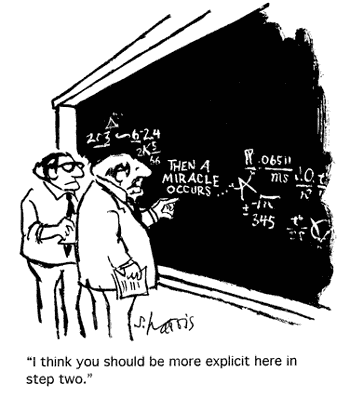
The wrote a paper. That’s the stuff to the left of “then a miracle occurred”. Then made claims about what that tells us about ghg’s. That’s the stuff to the right of “then a miracle occurs”.
You all want to believe that the part that says “then a miracle occurs” is an argument that involves the claim that the hot spot would not arise under hypothetical solar forcing. You want to say that the RC post is not irrelevant because their argument must be the one you imagine.
But they didn’t make it. (RC rebutting it does not cause them to have made it either.)
And it’s not as if there are no other arguments they might have made had they wanted to bother to make one.
Earlier in the thread, I suggested there could easily be an alternate argument– I one I think is more likely to be what some of the authors think. The argument is no better than the one RC rebutted. My posting it bothered Nathan who pointed out it’s bad. Yep.
But for all we know that’s the “and then a miracle occurred” step in their minds.
If you want to rebut what Douglas said in their press release the correct rebuttal is:
The conclusion that ghg’s did not cause surface warming does not follow from the absence of the hotspot. Even if we never find it, all it means is the models are failing to caputure some detail of the physics. This may make them inaccurate in some regard, but we are still confident that ghg’s cause surface warming. Our confidence rests on understanding of the spectral properties of ghg’s and basic radiative physics.
By rebutting an argument that was not made, RC failed to make the argument that was both correct and relevant to what Douglas actually claimed.
Nathan,
How can you say Lucia hasn’t defibned the terms:
” I asked you to define your terms way back at the start of the original thread. I told you that you would need to define what you mean by fingerprint and by hotspot or else this discussion not end.
Your refusal to do so is well… stunnning. Why are you harping on about this if you aren’t even prepared to actually state your case? If you won’t define what you mean by hotspot, there is no reason to assume the diagrams in the IPCC don’t show a hotspot for solar.” As far as I can see the main terms “fingerprint”, “hot spot” “IPCC” “diagrams” have been defined in common place English, in childish English and in technical fluid dynamical language — each time the definitions have been consistent and clear. Your refusal to accept this is … stunning
Andrew
All– I’ve been having trouble getting pages to load and some replys were munched.. I deactived all plugins and the page loaded. I’m in the process of reactivating.
If you had trouble accessing… sorry. 🙁
Andrew23
If you read further along you will see I acknowldge she defined the terms.
Willis Eschenbach:
When I say “expected” I mean “predicted by models”.
The models are the most accurate simulation available at the current time.
In most fields I trust the most accurate simulations available.
You don’t. Point taken.
—
DeWitt Payne:
We have already established that IPCC excluded the word “unique”. I would think it’s assumed based on dictionaries and everyday usage. But maybe that’s just my Canadian dialect. 🙂 Regardless, I’m only asking lucia to clearly define it in her post to prevent confusing more people and extending this argument.
.
Lucia’s definition also defines “pattern” as something like “any one or more aspect of the warming profile” rather than the complete profile. I disagree with that part as well.
lucia:
This made me laugh. I have been asking you to clarify all day and you absolutely refuse to do so. But you’re angry at RC for not clarifying? Weird.
.
Too many points have been brought up for me to respond to everything, so I will just attempt to summarize where we are:
.
Given the statement “A tropical troposphere hotspot is a fingerprint of GHG-induced warming”:
.
1) You interpret it as “A spot-shaped area in the tropical troposphere with warming that is significantly more than surrounding areas is one aspect of the warming predicted by models for 20th century forcings”;
.
2) Many others interpret it as “Enhanced warming in a spot-shaped area in the tropical troposphere is an identifying characteristic that can be used to distinguish between GHG-induced or naturally-caused warming”;
.
3) We both agree that the statement in #1 is correct and that the statement in #2 is wrong.
.
4) For some reason, you adamantly refuse to clarify that you are using interpretation #1 instead of #2. Even if interpretation #1 is obviously right, many people will make interpretation #2. As you’ve said yourself, “fingerprint” and “hotspot” are not rigorously defined — the onus is on the author to define what he/she means.
—
I just noticed that you added the IPCC definition for “fingerprint” to the top of this page. That’s a start.
Andrew23
What i think you are missing is that although Lucia defined her fingerprint according to an IPCC definition, she then used her own interpretation of that definition. One that is the source of the whole disagreement. All she needs to do is ask the IPCC authors if “pattern” meant the whole pattern or just bits.
John V articulates the same above.
Nathan,
Sorry aout the timing of my post — I think it was one of those munched so appeared later than I sent.
Andrew23
No worries.
Joel Shore:
.
No. It doesn’t provide any background information for the context of Douglass’ claim. Douglass’ claim is that the absence of the feature indicates no GHG warming under the conditions that the earth has actually experienced and using an accepted set of models. It is not made in the context of hypothetical forcings not actually experienced.
.
You then say that the feature is not a signature unique to that warming mechanism. That misconception proves my point! The RC post hasn’t clarified anything; all it’s done is confuse the issue. Given the real world constraints of the 20CEN parameter set, the feature in 9.1 c) and f) is unique to GHG warming.
.
The only way you can claim it is not unique in the real world is to use method #1 or #2 from my post.
.
Applied to the following situation, your argument runs thusly:
.
ME: A model predicts that a falling object near the earth’s surface will experience a gravitational acceleration of 9.8 m/s2. The same object, when acted upon by an additional downward force will experience an acceleration of 10.5 m/s2. I call this additional acceleration the “fingerprint” of the downward force because it is unique to the additional downward force.
.
DOUGLASS: I have measured falling objects using crappy data and analysis techniques. I did not find any fingerprint of the additional downward force, therefore it does not exist.
.
YOU: Yes, but here I have a model with the value of g adjusted to yield a gravitational acceleration of 10.5 m/s2. So therefore I conclude that a downward acceleration of 10.5 m/s2 is not a fingerprint.
.
Does that provide background information? No. Does that provide the right context? No. Does that in any way rebut Douglass’ statement? No. Does hypothetical super-gravity model world have anything to do with real world observations? No. Does using the word fingerprint like that make any sense? No.
.
Ergo: Red herring.
JohnV–
Why do you suggest I am angry with RC? I find the suggestion that I am angry weird.
I have answered your questions and clarified. You seem to believe that my saying I use the IPCC definition contained in the AR4 glossary is not “clarifying” the definition I use. You complain I don’t provide it when a) the IPCC definition contained in the AR4 glossary can be found in…. the AR4 glossary. b) I provided a link to the glossary in comments. c) I typed the definition in comments– and so did boris! (though by now hundreds back. and d) I have each of these things more than once.
In 4–Far from adamantly refusing to give my definition I have repeatedly given my definition for the hotspot. You don’t seem to like my definition , but that doesn’t translate into any refusal on my part. That you wish to try to reword the definition does not constitute my refusal.
ON the issue of “rigorous” definition: Fingerprint is rigorously defined in the IPCC glossary. (Or at least as rigorously as any word can be defined. This is not, after all a mathematical proof.) However, as is common with many words, a rigorous definitions permits many things to be called fingerprints. If you don’t believe words can be rigorously defined and also broadly applied, consider “fruit”. Fruit is rigorously defined, yet apples, oranges, bannanas, grapes and many other fruits are still fruits. Chameleons and fuzzy chicks are not. Definitions can be broad and still rigorous.
Hot spot is not defined by the IPCC and appears to be used casually at blogs, newspaper articles and press releases with no definition. You seem to think you know what all or most people mean or understand when “they” use this word. As for people who use it, who are they” (Hint: googling indicates “they” are mostly skeptics.) How can you tell what “they” mean? Do “they” provide their definition when “they” say it? Who coined the usage? (BTW when answering, it makes no sense to ask people who avoid the term and carefully use “enhanced tropospheric warming.” As they don’t use the word, we can’t figure out what they mean when they use it.)
Given how it’s used, and the fact that the IPCC does not define it, why would you think those who use this term don’t mean thing a hot spot (in anomaly space) must be a) hot relative to the surrounding anomalies and b) spot shaped?
I didn’t mean the hot spots must always be interpreted in terms of 20th century forcings. I mean that if we are discussing comparisons of observations to model predictions, then we define “hot” in context of the forcings acting during the observational period we are considering. So, in this context hot requires use to consider the relative magnitudes of warming due to solar and ghg’s during the period we are dicussing.
If we are discussing some entirely different context we can change what we mean by “hot” and “cold”. (We do the same with many applications. If I need to iron something, I might say the iron I use is on the “warm” setting or on the “hot” setting. But the temperature at the “warm” setting for my iron would be called “hot” if I was describing an indoor air temperature for my bedroom.)
As for Nathans question about color: The reason I say “red” is hot for the 20th century is that the IPCC chose that color to convey what I would call “hot” in that context.
Lucia
“As for Nathans question about color: The reason I say “red†is hot for the 20th century is that the IPCC chose that color to convey what I would call “hot†in that context.”
Yes, that’s fine. You can use the colours of the figs to define your hotspot if you like. However, the original post was about Who expects a Tropical Tropospheric hotspot from any and all sources of warming… Or whatever it was.
So, by your definition of hotspot means that the answer is “no one”.
By Boris’ and Arthurs’ definition the answer would be “everyone”
If you were to accept their definition as any anomalous warming of the TT is a hotspot (I think that’s what Arthur was saying), then you would have to concede that the IPCC fig 9 shows a TT hotspot for solar.
This whole debate is simply about definitions. It is, and always has been, semantics.
Lucia,
You might want to consider this post and paper in the overall observation issues:
http://climatesci.org/2009/01/07/sea-level-budget-over-2003–2008-a-reevaluation-from-grace-space-gravimetry-satellite-altimetry-and-argo-by-cazenave-et-al-2008/
Ryan O (#8221):
Matching the temporal fingerprint (observed temperature trend) is simply a matter of adjusting the magnitude of the forcing change (for solar forcing it’s not precisely known before the satellite era, so there’s certainly considerable “wiggle room”) to the observed temperature changes; if “something else” has caused the warming, then that “something else” must have a larger magnitude of forcing change over the 20th century than we have so far given it credit for, but whatever that forcing is, that change in magnitude will presumably roughly match the temperature curve if the GHG contribution really is “negligible”… Remember, “miracles” have no place in science, everything has a cause of some sort.
Without hard data on those 20th century forcing changes for most candidates, the spatial pattern of response would be the only clue to what this mysterious non-GHG forcing might be. Various model runs looking at spatial patterns have been done by GISS, in addition to the ones posted on RC – I posted this link before, perhaps you missed it:
http://data.giss.nasa.gov/efficacy/
If you look at table 3, you’ll note they ran the experiment with believed 1880-2000 solar forcing changes, which produced a beautiful-looking “red” hot spot – spotty even by Lucia’s definition, but apparently not “hot” enough at 0.2 C+, but still clearly hotter than surroundings. But note they also did another run with 4 x the forcing change, if one were to suppose solar forcing were the mysterious overly discounted forcing, which produced almost exactly the same picture, except the “hotness” was 0.8C+, rather than 0.2 C. Pretty much what you’d expect for a linear response to magnitude of forcing. I’m referring here to the graphs you obtain following the links in that table 3 in the bottom two rows of the right-most column.
You’ll notice every plot there shows mid-troposphere enhancement of the tropical surface warming (or cooling), but not all of them show the “spotness” that Lucia seems to care about so much – or at least it can be quite shifted around. For example the “contrails” picture (top row in the same table) has heating in the tropical troposphere, but the “spot” is actually shifted north quite a bit (presumably because that’s where most air travel occurs).
The black carbon response (table 2, 7th data row) also has a tropical troposphere hot spot, but seemingly shifted to higher altitude, and has two additional “spots” in the mid-northern latitudes and at the north pole.
The ozone response (table 1, last two rows) similarly has tropical troposphere enhancement (as does every other forcing!) but with the spot distorted on the northward side, presumably because of the differing hemispherical distribution of changes in ozone levels.
And so on.
To go back to the realclimate post Lucia was attacking from the start here, they don’t even mention “hot spot” themselves – as Lucia indicates, the term “hot spot” seems to be one that “skeptics” came up with. The precise terms Realclimate uses are identical to what some of us thought this discussion was actually about:
Enhanced warming in the troposphere – that is all that is being claimed, and that is all that Douglass’ paper was actually looking at (and Santer’s, etc). And every forcing that’s been studied produces it; for solar forcing the response looks almost identical to the one from GHG’s (except for the stratosphere, which makes stratospheric cooling a key factor in ruling out underestimation of solar forcing over the past century).
Sorry, Arthur, but the different scales used in those figures matter. If the same scale was used in the figure for solar as the one used in the figure for a doubling of C02 there would not only be no ‘hotspot’ there would be no pattern, just a sea of white.
Dover Beach, I think you should also look at the Table 1 experiments. You can see the modelled response for 2 x CO2 and a 2% increase in solar.
1.02 Solar gives a much ‘redder’ red spot. In 1.02 Solar the redspot tops out at 20C, in the 2x CO2 it tops out at 14.6C.
It seems a 2% Solar increase would give a ‘redder’ hotspot.
So for Lucia, indeed the modelled response of increasing solar would indeed give a TT hotspot.
Sorry Dover_beach
The 1.02 Solar is in Table 3
You know, Lucie, you have this huge tendancy for all of your insights to hinge on or turn into semantic debates. This shows a huge weakness in anything useful coming out of here. That plus no publications and meandering thread to thread references.
WE denialists need to do better. The RCers are not that bright and they are liberal pussies. So, why should we have to play little tendentious games. We should be able to kisck their commie asses with our Bessel functions. Without needing stick in the ass Latin from Steve McI. Or Lucia’s tendancy to not properly engage in argument since all her stuff hinges on semantic gaming of things people said…and rather than giving them bne of doubt for the real ideas at stake, she tries to say they are asserting something that they certainly aren’t when discussion joins (at a minimum, arguably they never were).
I mean the whole damn thing is persnickety. Let’s be bad ass he men. Let’s rip tits. Oh…and papers people, papers.
should not have to. Crap, girl. I thought trolls were allowed to edit posts.
Joel Shore (Comment#8257)
GISS ModelE only has 0.6C increase from 1880 to 2003.
http://img355.imageshack.us/img355/9043/modelehindcastoz1.png
john v, thanks for the response. You say:
Like you, in most fields I trust the most accurate simulations available. After all, I’ve been programming for 45 years now and have written my share of simulations and models. Some of which I trusted. I know that not all models are accurate but all models are valuable. But I don’t trust the climate simulations one bit.
The problem is too large, the size of the gridcells is too coarse, the climate is too poorly understood, the number of factors is too great, the interactions and feedbacks are too numerous, the thunderstorms are not represented at all, the albedo is parameterized, and to top it off the whole mess is tuned and tweaked to reproduce the historical record, … no, I’m afraid I’ve written far too many computer models to trust them in the slightest. You ever take a look at the code for say the GISS ModelE climate model? I have, and it’s not a pretty picture.
Now, that’s one of the top climate models. I read the code, and I found out that they forced the energy balance. At the end of every timestep, the energy has to be the same as at the start, since energy is neither created nor destroyed.
According to the ModelE code that I read (Fortran, wouldn’t you know), it said that any excess at the end of a timestep was simply spread evenly around the entire planet. I was intrigued by that, it seemed a strange practice. Why wouldn’t it balance? Why spread it out? So I wrote to Gavin Schmidt to ask him about it, he’s the programmer. I asked if my reading of the code was correct, and if so how large was the imbalance, and was there any kind of a murphy gauge on it that would stop the program if on a certain step the imbalance was too big. (A “murphy gauge” gives an alarm when Murphy’s Law causes a variable to get out of range).
He said my understanding was correct. He said it usually was small, usually positive, usually not more than one or two watts/m2. He ascribed it to frictional heating. He said there was no Murphy Gauge, and no record was kept of the size of the imbalance.
I was floored. Floored.
This is supposed to be one of the best models. This is supposed to be based on physical principles. It is build to help us understand the effects of a 2 w/m2 increase in forcing over a century.
And it has up to a 2 w/m2 error in every time step that is simply adjusted away by spreading it lightly all over the world. Based on physical principles, my patootie.
And no effort is made to discover why it’s out of balance, what’s up with that? Don’t just spread the leak around the planet, plug that sucker. If you are going to sell your model as based on physical principles, that’s the first one — the energy has to balance. Not “kinda sorta balance”. Not “forced into balance”. Balance. Yes, a two watt per square metre error is less than 1% of the total insolation plus DLR. But if you claim your model can tell what happens from a 2 w/m2 change in forcing, your model has to have that kind of accuracy. They’re claiming they can predict the effects of a 2 w/m change over a century, and they can’t even make it balance within 2 w/m for a single time step … how crazy is that?
And not having a murphy gauge to determine if on the occasional time step the imbalance might be ten times larger is inexcusable programming practice. Particularly when you are asking people to bet billions of dollars based on their results.
Bet a billion on that spaghetti-coded nightmare of a program? Not me, I wouldn’t bet a dime on it. Because unlike most people, I’ve actually looked under the hood … and understood what I saw … and had my understanding confirmed by the programmer … and really, really didn’t like what I saw. Bad programming practice allied with bad physics is a horrendous combination. Not one dime. And it’s one of the best …
w.
What arrogance. Check the CA thread and you’ll see I quoted the IPCC definition before you did. Once again, you have admitted that your reading of the IPCC definition would include the surface warming as shown in the zonal mean plot. What a useless definition that would be.
In any case, I stipulated that we could use your wrong IPCC definition. A lay person reading the article would legitimately be confused–especially given the wrong information from Monckton and the SKeptic’s [sic] Handbook.
So we should just let the morons who read the Skeptic’s [sic] Handbook and believe it wallow in their willful ignorance? What good would that do? Oh, wait, I know! That would muddy the issue and possibly cause a delay of action. Well, now I see why you find it so useful.
lucia:
I’m almost sure you won’t answer, but let me try to paraphrase your original question:
.
Given a forced surface warming from *any* given source, WHO expects the warming in the tropical troposphere to be greater than the surface warming?
.
You have repeatedly given snippets of your interpretation down here in the comments. You have repeatedly refused to clarify your interpretation in the main article. I’m with TCO on this one. You can do better, but for some reason you won’t. Have fun with your word games.
Willis Eschenbach:
Thanks for the detailed response.
I would be more inclined to not expect a TT hotspot if:
– it was not robust across all current and historical climate models;
– basic theory did not predict the same thing;
– there was some reason to reason to expect otherwise;
.
I’d like to look at the GISS Model E code for fun. I’d appreciate it if you could post a link. Thanks.
TCO–
I was having trouble with slowloading pages last night. I turned off lots of plugins, and saw that helped. I turned on only the essential ones and went to bed. The editing plugins happens to be off right now. I’ll going to be monitoring page load and turning plugins on one at a time.
While I’m responding to you, let me clarify a few things:
* I think burning fossil fuels is the cause of the recent increase in CO2.
* I think ghg’s and CO2 in particular cause warming.
* I think the ghg’s are the best explanation for the uptrend we observe in the thermometer record.
* I have no disagreement with the IPCC’s statement that climate sensitivity is likely in the range of 2 C to 4.5 C.
* Rapid sustained warming over time scales like 30 years would cause more problems than benefits. Rapid cooling would do the same– but that rapid cooling is unlikely.
The reason this particular discussion touches on semantics, is that the interjections about whether or not the hotspot is a fingerprint at CA were themselves nothing but semantics.
Unfortunately, people who believe in warming sometimes can’t seem to limit themselves to critcising skeptics (like Douglas or Christy) for what they do claim, but seem to feel the need to accuse others (like Douglas and Christy) of making additional false claims they did not make.
The way these people try to “combat” Christy and Douglas is to a) read something Douglas or Christy said b) insist C&D could not be using a word as defined in the IPCC glossary, c) insist C&D must be using it in a way that makes their claim wrong and d) then rebutting the claim C&D never made.
The alternative is to jump on a word that is ill defined like hotspot which is used loosely in the first place, insist that C&D use this is some very precise way “everyone” uses it (based on no evidence that “everyone” uses it that way) and then decree C&D said something wrong.
The process above is done in various ways. Then, when called on it, we end up with semantic debates about the meaning of “fingerprint” with some insisting it does not mean what the IPCC glossary says.
If you don’t like the fact that some arguments end up being semantic fine. If you object. Fine. It’s not going to make me fail to point out that this is going on.
The reason is that I think those who believe A is the cause of the GW we have seen and who use this tactic are fostering doubt in AGW. They are
a) failing to address the actual arguments and so never dispell them and
b) making it appear that their own position requires these semantic tricks and red herrings to seem convincing. (I think there are other things some people who believe in warming do to foster skepticism too. But, I won’t go into those things in this comment.)
Of course they are not required to agree with my views, but I’m still going to state them. If my saying these things makes you think I am in the band you refer to as “we denialists”, all I can say is: I don’t care what group you or anyone else things I fall in. But, I think the bullet points above.
Now, let me go fix the edit button. 🙂
test for get recent comments plugin installation.
John V (Comment#8298) January 8th, 2009 at 7:28 am
Info about the GISS/NASA ModelE code, including a source-code viewer, is available from this page.
I have posted comments on the ModelE coding here, here, here, and here.
“In other words we are exactly where we started in 1980 when someone said the temperature is rising and it must be us causing it. That has not been proven or disproven.”
I was thinking the same thing driving into work this morning. Does climate science know more about the climate than 20, 30, 40 years ago? Anything specific? What exactly?
Andrew ♫
john v, thanks for the response. You say:
In all fields, and most things, I say, doveryai, no proveryai. Trust does not mean never compare to data. Trust does not mean “continue to believe accurate even when the results compare poorly to data.” With regard to model output, trust does not mean, “never, ever, ever admit the possibility that model output may be only heuristic or approximate”. In some fields, that’s as far as our understanding permits models to go.
As I’ve consistently answered your questions, why do you think this?
I see you reworded your question and turned it into a different question. Climate modelers expect warming to be greater in the TT than at the surface. However, your previous questions, and boris’s quote all use “hotspot”. As I have already consistently answered your questions and Arthur’s about the meaning of “hotspot”, which is used rather casually. I had already answered your question and Arthurs on enhanced warming.
I don’t think the main article is unclear. I don’t think modifying it is better. I think others are playing the word games to make it appear that people with whom you disagree are making conceptual errors they did not make.
Dan Hughes:
Thanks.
—
lucia:
In #8306, I hope you’re not implying that I do the things you listed in quotation marks. You often suggest that I (and others) have said things that I (and others) did not. Let me clarify:
.
Define hypothesis –> Test hypothesis –> Revise hypothesis –> Repeat
.
The discussion was about whether a TT hotspot is “expected”. I defined “expected” as “predicted by models”. Testing the expectation/hypothesis by comparing models to data, and revising the expectation (if necessary) by improving the models are also important. But I was not talking about testing or revising the expectation — I was talking about defining the expectation.
—
lucia (again):
You keep insisting that your interpretation of the IPCC definition is the only correct one. Despite the large number of people who obviously think your definition is wrong, you adamantly refuse to clarify in the article. I hesitate to guess at your motives for willingly sowing confusion.
.
Let me summarize again. Do you disagree with any of my four points (quoted from above)?
.
lucia (#8308),
.
I paraphrased the question using my (and others) interpretation of the question. Then you avoided answering it. I have tried paraphrasing it to match your version. You refuse to accept or reject that paraphrase. I would not call that “consistently answering my questions”.
.
You seem to think that your definition of the concept of a TT hotspot fingerprint is the only one that is right. You won’t accept that a common definition of a fingerprint study is to determine the unique characteristics that distinguish between types of climate forcing.
.
Here are some links to others using it differently. You can see that they all use “fingerprint” to mean something like “distinguishing feature”. A quick web search on “tropical troposphere hotspot fingerprint” will turn up many more:
.
—
Ross McKitrick in Financial Post:
http://www.financialpost.com/story.html?id=d84e4100-44e4-4b96-940a-c7861a7e19ad
.
—
http://www.climateaudit.org/?p=3048
First sentence:
.
—
http://heliogenic.blogspot.com/2008/07/david-evans-on-missing-tropical.html
Complete post, which quotes from another site:
lucia:
But many others do.
You do.
I have expended a lot of effort here because I like to think your intentions are good. I don’t think you are willfully spreading misinformation. I’m starting to worry that I was too naive. Maybe I should doubt your intentions.
.
Searching on the web I have seen two ways to use the word “fingerprint”. One is the warming pattern hindcast from 20th century forcings.
Yes. This is a correct usage according to the IPCC glossary, and has existed for a long time. It is used by climate scientists. I and other commenters posted numerous examples of these in the thread. Jorge found a book chapter by Hansen discussing the various usages which includes a wide range of uses.
The other is as a unique pattern that distinguishes between hypothetical forcings.
There are instances where some wish to narrow the definition for specific reasons. English get used that way.
It is common for people to mix the two up. That is, they take the hindcast pattern and use it to distinguish between hypothetical forcings. That is the mistake made in the 3 pages I linked above. That is the mistake that you are propagating by refusing to clarify.
I reply to those below. You only see a mistakes in those examples because you refuse to permit people to use the IPCC definition of fingerprint, which is widespread among climate scientiest. You are also editing out words, and misconstruing what is being said.
JohnV–
My responses in green..
lucia,
.
Thanks for the detailed response. Wouldn’t it be useful to diffuse this whole thing by adding interpretation #1 as a little update to the start or end of your article. I’m not saying that the phrase must mean #2, only that some/many/most will interpret it as #2.
I do not see this as defusing.
.
The phrase can mean different things. Who interprets it as #2? Myself, Boris, Arthur Smith, other commenters, Ross McKitrick, Steve McIntyre, Monckton, the person at Heliogenic Climate Change, David Evans — need I go on?
Based on what you posted, I would edit your list to you, boris, and arthur. There may be a few other commenters. (Nathan?) The term is illdefined. I discussed the concepts in the post, and I discussed how people have been mislead into saying odd, definitive things about whether or not the hotspot is a “fingerprint” of any and all warming. –L
JohnV
1) I have been answering the questions you actually ask. You may think the rewording doesn’t turn it into a different question, but it does.
2) I have never said my definition of hotspot is the only one. I have said that word does not have a standard definition. However when asked what I think it means, I describe it. You, on the other hand, wish to insist that it cannot mean what I think it means and can only mean something else. If you wish to use it the other way, fine. But you can’t insist that other usages are wrong, or that one is not permitted to select from the possible usages so as to render a full sentence correct.
It is a rule in communication that if a word has several possible meanings all appearing in the dictionary and all understood by readers, and a sentence is correct with meaning A but incorrect with meaning “B”, you go with “A”. So, I am not the one saying you must interpret as “A”. I am saying that you cannot insist that the speaker could not possibly have meant “A” when “A” would make their statement correct.
3) Ross’s statement is perfectly consistent with a TT hotspot being nothing more than “a spot” that “is hot” in the TT. The IPCC does state this is a characteristic pattern created of AGW. The IPCC does state that the solar variability experienced during the observational period does not create this spot.
If you read Ross’s statements at CA you will see that my interpretation of what he means is consistent with my reading of what he says in the quote. He says that sustained solar forcing will cause a hot spot. But, since solar forcing is variable, solar variability is not expected to cause the persistent hot spot to appear in the actual earth’s atmosphere.
In contrast. RC shows graphs which do not represent the net effect of variable solar , but rather of sustained solar forcing at a high level.
4) In Steve’s statement, he also appears to be using fingerprint exactly as defined in the IPCC document. It is a fingerprint of co2 forcing and moreover, given the level of forcings on earth the appearance of a persistent spot would be a due to CO2.
5) Heliogenic, is quoting some guy named David Evans who did make the mistake. Specifically, this following sentence is either a) utterly wrong or b) so poorly written that I can find no way to translate it into anything correct:
“Each possible cause of global warming has a different pattern of where in the planet the warming occurs first and the most.”
I never said no one on the planet makes the mistake. I see no evidence of “most” making the mistake, nor do I see any evidence this mistake is based on what Douglas’s use of “fingerprint”. I don’t think RC’s article did anything to disabuse this guy of this notion. As for the issue of the definition of “fingerprint”: The streams of people who believe in AGW telling him “fingerprints” and “signatures” imply unique may have caused him to believe the IPCC uses it this way. If so, he drew the incorrect conclusion when he read the IPCC and not from Douglas.
As for this sentence by Evans:
the signature of an increased greenhouse effect is a hotspot about 10 km up in the atmosphere over the tropics.
Both enhance warming– as you define it– and the hotspot — as I define it, are part of the signature of the enhanced greenhouse effect. I can’t distinguish whether Evans would call this warming hotspot in the limit that there was no warming nor whether he thinks it ehamced warming occur if solar caused warming– but I’d guess he is probably confused.
….So based on the three examples you found, it appears to me that you believe the there is relatively few people harbor the misconception the hotspots failure to appear means that climate models driven by sustained solar forcing at high level do not manifest a “hot spot”. (Equally, few people harbor the is conception that global warming will cause the earth to explode– not withstanding the fact that I can find Tom Chalco!).
You think the misconception is despread because you are a) misinterpreting what people like Ross, Steve and Douglas actually mean and b) you can find a person who does misunderstand something. Likely, when you read other people saying what Ross, Steve and Douglas say, you think misinterpret them.
Now…. I’m going on blog silence for a bit. I have other things to do.
Yellow submarine to probe Antarctica glacier !!!
PUNTA ARENAS, Chile (Reuters) – A yellow robot submarine will dive under an ice shelf in Antarctica to seek clues to world ocean level rises in one of the most inaccessible places on earth.
The 7-meter (22 ft) submarine, to be launched from a U.S. research vessel, will probe the underside of the ice at the end of the Pine Island glacier, which is moving faster than any other in Antarctica and already brings more water to the oceans than Europe’s Rhine River.
Scientists have long observed vast icebergs breaking off Antarctica’s ice shelves — extensions of glaciers floating on the sea — but have been unable to get beneath them to see how deep currents may be driving the melt from below.
They are now stepping up monitoring of Antarctica, aware that any slight quickening of a thaw could swamp low-lying Pacific islands or incur huge costs in building defenses for coastal cities from Beijing to New York.
http://hernadi-key.blogspot.com/2009/01/yellow-submarine-to-probe-antarctica.html
My opinion – the IPCC stepped in it by publishing a falsifiable model prediction. (ie Figures 9.1(c) and 9.1(f)).
It’s curious that instead of anyone saying that “oops, we got something wrong, and have more work to do” that we’re arguing definitions and semantics.
Given chapter 9 of the IPCC report, and subsequent observations of the TT, it seems that one of the following:
The data (and/or all of its massaging)
The models
The hypothesis of a TT hotspot
…are wrong.
If this were medicine or most any other scientific discipline, I think the focus would be on finding out which is wrong. That the argument is over semantics and the use of non *physically plausible* forcings to hold on to a hypothesis and/or set of models seems incredibly um… what’s the word… nonscientific.
Given the IPCC sentence on attribution:
Since that is not possible, in practice attribution of anthropogenic climate change is understood to mean demonstration that a detected change is ‘consistent with the estimated responses to the given combination of anthropogenic and natural forcing’ and ‘not consistent with alternative, physically plausible explanations of recent climate change that exclude important elements of the given combination of forcings’ (IPCC, 2001).p668
Who here thinks a 2% increase in solar radiation is, in the timeframes referenced, physically plausible? And for those who answered yes, when was the last time solar radiation was at that level (plus or minus)? Extra credit – at current rates, when is it expected to increase (over the current level, or pick 1890 if you’d like) by 2%?
Thanks!
lucia:
.
Wrong. I have said many times that I am only asking you to clarify your meaning to prevent confusion. You refuse to do so in the article. I can’t think of any reason why without doubting your intentions.
.
Exactly.
Boris’ original statement was correct with meaning A (my interpretation) but incorrect with meaning B (your interpretation). You chose to write a whole article and thousands more words defending meaning B, while refusing to accept the correctness of meaning A.
.
Ross McKitrick says this, in the Financial Post:
How can that be interpreted any other way? He is saying that only GHG-induced warming will lead to a TT hotspot. He is saying that solar-induced warming would not. That is why he suggests basing GHG taxation on the TT hotspot. That way, according to him, the taxation will only be triggered by GHG-induced warming — not by solar or other natural factors.
.
I read his whole article a couple of times to be sure I understood. I can’t see how it has any other interpretation unless you’re really stretching. It’s plausible that is comments at CA say something different, but his article in one the main newspapers in Canada says what it says.
.
For some reason you are completely against clarifying your interpretation of “the phrase”. You would rather write thousands of words than copy-and-paste a couple dozen words.
.
Why won’t you clarify in the article?
Why is it so important to hide your definition in the comments?
.
Here’s the paraphrase that you mostly agreed with again. Just copy-and-paste as an update to the article so everyone knows exactly what you mean:
.
A spot-shaped area in the tropical troposphere with warming that is significantly more than surrounding areas is one aspect of the warming predicted by models for 20th century forcings
JohnV–
The title of the post asks a question.
Boris jumped into a conversations. If you use words the way Boris defines them, then, taken out of context his statements correct. If you read his interjection in context, using the word according the meaning he applies, his interjection it doesn’t fit the conversations. If you understand fingerprint the way it is used in the IPCC, and the way it was being used in the conversation, then Boris’s statement is incorrect.
So, the question of “who” thinks whatever it is Boris’s words might mean is valid.
With Ross– once again, you want to strip context. Ross is suggesting a tax proposal, and is discussing things in context of what can happen on the real, honest to goodness earth. On earth, solar forcing is variable, and is not expected to suddenly increase. Volcano eruptions are intermittent.
So, particulary accouting for our ability to resolve any hotspot, it is true that
Why you wish to read this to mean that Ross means that the hotspot would not occur is the sun went supernova is beyond me.
I’m not hiding my definition. If you want to argue by hypotheticals, why are you so obsessed with the idea that my blog posts should include glossaries defining commonly used words?
Readers may look back to the mostly and see two paragraphs explaining that your definition omits important ideas I have repeated in comments.
What you call mostly agreeing was this statement
Pretty much. But your wording omits this idea: that models predict ghg’s are the primary driver creating this spot, while natural causes are expected to be insufficient to cause it. But this reading is consistent with the definition of “fingerprint†in the IPCC glossary, and it makes the statement right. So, I read them to mean that, yes. Also, we can use hotspot outside the context of the 2oth century. But, if that sentence is embedded in a conversations about the 20th century then we define “hot†based on the forcings during that period.
By “pretty much” , I meant to convey that at least for the purpose of that comment, we could proceed. By adding the rest of the stuff, I thought most would recognize that I did not think your definition captures the idea. Sorry if that wasn’t clear.
Clearly, I would not copy and paste your definition, as it is missing a lot.
Also, I think most readers will see that my definition of “hot” vs. “warm” depends on context. So, I am not going to write a long discussion explaining the precise decision that results in my using “hot” vs “warm”. I already gave the “hot iron” vs. “warm iron” vs “It’s hot in this room” vs. “The oven is hot”. I think ordinary people understand this and do not need the explanation you seem to think is required to “clarify” that I understand a hot spot be be “hot” and shaped like a “spot”, that I use word “hot” is used in context and the word “spot” is something the average 7th grader would call a “spot.”
If you wish to develop the 20 page description of how “hot” vs “warm” is used in context,and use that as an exercise to understand context, go ahead. You can keep complaining about my failure to “clarify” this all you want, I’m not posting the 20 page discussion to explain that “hot spots” are both “hot” and “spots”.
Arthur:
.
You might want to read the article more carefully before making statements like these: http://pubs.giss.nasa.gov/docs/2005/2005_Hansen_etal_2.pdf
.
From the article:
.
These have nothing to do with an attempt to make up for the difference in GHG response with solar. Hansen is attempting to determine the sensitivity of the response to various changes. The 4xsolar graph has nothing to do with substituting solar for GHG.
.
Furthermore, the estimated actual solar forcing produces a tropospheric response that, when put on the same temperature scale as the IPCC graph, looks remarkably like 9.1 a) and not at all like c) or f). Even the 4x solar forcing change results in a response that goes in entirely the wrong direction in the stratosphere – so again it doesn’t look like c) or f).
.
Also, the graphs look similar because the altitude scale defaults to linear on the GISS graphs and the IPCC graphs are logarithmic. Use the logarithmic scale on the GISS ones and resize them to match up with the IPCC ones and you get:
.
http://xs435.xs.to/xs435/09024/mapgissmod1x412.jpg (1880-2000 solar forcing)
.
http://xs135.xs.to/xs135/09024/mapgissmod4x725.jpg (1880-2000 4x solar)
.
Hm. Starting to look different.
.
Add to this the difference in temperature scale and you have graphs that look nothing at all like 9.1 c) and f). “Pretty much the same picture”? Hardly.
.
Not only that, but the purpose of the GISS graphs was Hansen’s efficacy study. The parameter variations have nothing whatsoever to do with an attempt to propose alternate means of achieving the 20th century temperature rise from GHG warming.
.
They’re not the same response, Arthur. Not at all.
This is not about hot vs warm. It’s not about how “spotty” the spot is.
It’s about people making the mistake that a dominant component of hindcast 20th century warming is the same thing as an identifying characteristic that distinguishes GHG-induced warming from other sources of warming.
.
Since I read the words as Boris defines them, and since I didn’t follow the conversation at ClimateAudit, your article was anything but clear to me. I jumped in to get some clarification. I am sure at least some others would reach the same conclusion that I did but go away confused. Why would you not want to clarify? Not 20 pages. Just a paragraph describing your interpretation.
.
(It would also be appropriate to clarify that RC used a different (but valid) interpretation, and thus that the RC images do not contradict the IPCC images — but I definitely won’t hold my breath for that).
.
Although you accept that 20th century warming was primarily caused by GHGs, there are many who still believe that solar was the cause. They use the lack of an observed TT hotspot (by any definition) to argue that 20th century warming was not caused by GHG, but rather by solar changes. However, as shown by Gavin at RC using Model E results, solar changes large enough to match the surface record would also generate a TT hotspot (by any definition).
John V:
.
Are you talking about the 2% increase in solar forcing response?
.
A 2% increase in solar forcing results in a 100-year (well, actually 1880-2000) delta T of 2.07 degrees C, not the 0.6 – 0.8 degrees observed over the same time period:
.
http://pubs.giss.nasa.gov/docs/2005/2005_Hansen_etal_2.pdf (Table 3)
.
Gavin’s 2% graph has nothing to do with what caused the 20th century warming. Nothing at all.
Ryan O – if you would take care to read, you would find you are pretty much agreeing with what I said in my last comment.
How else would you “substitute solar for GHG”? If GHG’s produced a negligible amount of 20th century temperature change because we overestimate their forcing while underestimating solar forcing, then you have to run a model with some multiple of 20th century solar forcing. If not 4x, maybe it should be 5 x? Then you would have a graph that looked almost identical to the 4x graph, but with a temperature scale 5/4 as big again. Just look at the 1x and 4x graphs for solar, they’re very close aside from the temperature scale being 4x greater for the second…
Yes, indeed it does, that’s why I said:
When McKitrick, Monckton, Evans, Singer, and friends say that the lack of enhanced warming in the tropical mid-troposphere means solar forcing has to be more important than GHG forcing, they are clearly using faulty logic because the mid-troposphere warming response is common to both (and essentially all other) forcings. But they are even more clearly wrong because the stratospheric cooling which is a distinguishing feature of GHG forcing, compared with solar, is observed! This can hardly be emphasized enough – the entire logic of the (sometimes implicit, sometimes explicit) argument is completely false both on the “characteristic fingerprint” level and in comparing with actual observations.
JohnV–
By “this” do you mean my post? Or some greater more important story “out there” somewhere?
My post is about people like Boris jumping into this convesations at Climate Audit telling steve he is mis-using fingerprint in Steve’s discussion of observations of the temperatures in the real earth troposphere, trying to divert the conversation away from what we are Not seeing in the troposphere to the a discussion of senstivitity studies. He wants us to discuss the issue of what models predict would happen if we run them at artificially high sustained levels of solar forcing. Then Deepclimate jumps in to continue this issue, an points us to the old 2007 RC article where the RC did the same thing: Start out by dicussing a paper about what we do or do not see in the tropopshere, then change the conversation to what we learn from sensitivity studies, then come back.
Boris’s interjection operates by picking up the word “fingerprint” in Steve’s post, decreeing falsely that Steve’s use of fingerprints silly, and then using this proclamation as excuse for a little tutorial on the results of sensitivity studies. In otherwords, it is a cry of “look! A red herring! Lets’ forget about the cod and go after the red herring!”
Boris and Deep Climate are examples here, because I happened to see the discussion. But if “this” is my post, “this” is about “that” this other topic you seem to think it’s about.
Now on to this
Since I read the words as Boris defines them, and since I didn’t follow the conversation at ClimateAudit,
My post begins
In comments at Climate Audit Boris (#38) seems to suggest the
. This should have alerted you that the post is about a discussion at climate audit. I judge that most readers will figure this out, and if they want more clarification they can a) click the link or b) ask.
This would hardly be accurate. After all, RC does not actually use any intepretation of the word. Instead, they achieves the confusion by never using the word fingerprint or hotspot, and instead a) providing a link to a document that does use the term the and b) going off into an irrelevant discussion of results of sensitvity studies. The result was that some of their readres jumped to the conclusion that this issue of “uniqueness” is relevant to Douglas’s paper and/or press release; many jumped to the conclusion that the problem is that Douglas used “fingerprint” incorrectly.
But RC does not actually use the word the way you claim they do in their article. So, I would hardly be “clarifying” anything by saying they did and then explaining that that use was acceptable.
You and others an other keep reminding me of this. I keep aggreeing. I also keep replying more or less like this:
That there are people who are still confused about the cause of 2oth century warming is no excuse to derail conversations discussing observations of TT temperatures with lectures on sensitivity studies. Moreover, these intertuptions will do nothing whatsoever to remedy their confusion. The fact that even though sensitivity studies using artificially high sustained levels of solar forcing also show hot spots in the troposphere is it is still true that models forced with the actual solar levels do not. And finally, the fact that models forced with artifically high forcing show a hot spot does not rebutt arguments by Douglas, Christy, Ross, Steve or anyone whose stuff I read.
Do you think I’m going to say anything different the next time you remind me that there are some people out there who don’t think ghg’s caused the 20th century warming? Do you think I’m going to say “Oh! Well, then it’s fine to insist all discussion of observations of tropical tropospheric temperatures halt while we go off on tangents about what we learn from climate sensitivity studies? And Hey! As a bonus, we can make all these people believe that we violently afraid of what they might learn if we permitted anyone to discuss observations of TT temperatures. Better yet, they will come up with their one theories of why we don’t want it discussed!”
Rest assured that the process of interupting all conversations of observations of TT temperatures to discuss sensitivity studies will never cause one single person who believes ghgs do not cause warming to change their mind. Never.
Arthur
I mostly concur. And this sort of discussion is useful.
hould we never detect it, the lack of enhanced warming in the tropical mid-troposphere will not tell us solar is more important than ghs. It will tell us there is a problem with models, but we won’t know precisely what from this disagreement alone. We wil know there is a problem with the models becuase they predict this for all warming– and so if it’s not there, there is some problem.
However, it will not necessarily follow that ghg’s have less of an effect than predicted. We won’t know if they have a greater or lesser effect than currently predicted.
From my point of view, if models or anything in the process of predicting or projecting trends has deficiencies, we need to know this. For that reason, we want to figure out if the enhanced warming is there.
From the point of view of understanding the physics, would be quite a puzzle, and it would be an even bigger puzzle if we truly expect it for “any and all” forcing (whatever any and all might mean.)
Stratospheric cooling has been observed. This cooling is predicted with ghgs, and not solar, so this does tend to support ghgs. I accept Singers explanation that we can’t exclude the possiblity that a enhanced TT warming exists– but it also has not been observed. So, currently, the observations of TT warming or lack there of, tells us little.
Arthur, you continue to divide up the feature in 9.1 c) and f) such that you can make whatever claim you want and then go on to say you’re saying the same thing I am. I’ve said before and I’ll say it again: the “fingerprint” I am talking about is the whole of the response shown in the IPCC report. THE WHOLE. Not just the troposphere. Not just the trend. THE WHOLE. That includes the magnitude. It includes the stratosphere. Claiming that an increase in solar to compensate for the lack of GHG warming produces the same response is bunk. Parts of the response are the same, but the WHOLE response is not the same at all.
.
There is no scientific reason for excluding magnitude as a distinguishing characteristic when comparing predictions that are meant to be physical with actual observations. No other field of science would exclude magnitude. None. The only reason you want to do it is to draw the reader down a path whereby the reader makes an erroneous conclusion: that the magnitude of warming in the 20th century, when attributed entirely to solar forcing, produces an identical response in the atmosphere.
.
And that is not true. The response is far from identical. You keep implying that the magnitude of the response doesn’t matter, and that’s utter B.S. It DOES matter and it matters a great deal. Magnitude CAN be a distinguishing characteristic.
.
Not only that, but many of the trends in the graphs are wrong. The GHG case clearly shows a cooling response in the upper troposphere – not just the stratosphere. That is entirely missing from the other forcings. Regardless of scale, the sign is going in the wrong direction! How can you possibly call the response the same???
.
The solar models cannot duplicate the stratosphere response. It looks entirely different. Therefore, the solar models do not reflect an alternate means by which the earth could actually have warmed during the 20th century. If they do not represent a physical response, they are meaningless in terms of a discussion about real, physical responses that have actually been experienced. THEY ARE RED HERRINGS. Period.
.
I’ve already agreed that Douglass, et al, overreached in their conclusions by suggesting solar was a better explanation for the warming. That’s not at issue; it’s not what we’ve been arguing about. What we’re arguing about is the attempt at RC to cloud the issue by claiming that 9.1 c) and f) do not represent a unique characteristic of GHG with respect to the physical earth (not hypothetical model earth) by showing hypothetical model earth runs.
.
But they DO. No other physically possible forcing shows the WHOLE of the pattern in 9.1 c) and f). None. Not one. So in the context of comparing predictions to observations, that WHOLE is most certainly unique to GHG warming. The only way you are able to claim that it is not is to strip away specificity with no logical or scientific basis for doing so.
.
AFA your issue about Douglass being able to claim the fingerprint of GHG was not observed, if his data and analysis were accurate, he most certainly could make that claim.
.
Why?
.
We already know how the stratosphere is behaving. That throws the hypothetical solar forcing models in the garbage can. They cannot possibly be alternate explanations because their responses are unphysical, so comparing them to the IPCC graphs is irrelevant. We already know they CANNOT be right.
.
So what that leaves us with is a falsifiable prediction from the IPCC. If Douglass is right – (and Santer didn’t prove him wrong – he showed that Douglass’ conclusions have the wrong confidence level associated with them and that the models might still be right) – so if observations in the troposphere do not yield confirmation of 9.1 c) and f), then the models are WRONG. The unique response of GHG warming in c) and f) – the fingerprint – is MISSING. And if the models are WRONG about the behavior of GHGs in the atmosphere, then their predictions are in question.
.
Douglass overstepped his data (and Singer more so) by claiming that AWG doesn’t exist. He didn’t prove that, even if his data is right. No one here is arguing that he did. We’re arguing that the counter to Douglass at RC – that solar produces the same hotspot – is irrelevant because it uses models that are ALREADY KNOWN to result in unphysical responses. They serve only to confuse the issue.
.
For proof, just look at some of the erroneous conceptions in this thread that have come from the RC thread.
.
If Douglass’ analysis and data were correct, however, he most certainly could make the claim that the fingerprint of AWG has not been observed. He could not, however, extend that to claim that AWG is a myth.
.
You seem to think I’m arguing something I’m not.
Steve M used fingerprint in the everyday sense. He probably didn’t even know the definition of fingerprint that the IPCC used at the time he wrote the post. But onto my proof:
Steve M says:
Hmmm….what;s that “supposed to be” there for? If Steve were using the IPCC definition, he wouldn’t have said “supposed to be,” now would he? Because he would know that they were fingerprints, (that is, in your version of the IPCC definition of fingerprints). Oh, but you’ll have an excuse for this too, so I guess I’m done.
Boris– How in the world does the use of “supposed” to be fingerprints mean he is not using the IPCC definition? The IPCC defines a characteristic, it appears for a specified forcing so, then applying the definition, the characteristic is supposed to be a fingerprint.
Example: Joe says he knows what’s in my fridge. He says milk is in my fridge. So, based on Joe’s word, milk is supposed to be in my fridge. If I find it’s not there, I can exclaim “Oh my! But there was supposed to be some milk in my fridge!”
I don’t know what lingo they use in Memphis, but we use “is supposed” this way ’round here, in Chicago. Steve lives in Toronto. Maybe they use “is supposed” the same way we do.
Ryan O (#8326) – I can’t agree with the way you word everything there, but it sounds like you’re getting close to the right idea on all this.
So, the last main point:
Well, the models are right about stratospheric cooling, and they’re right about surface warming, the prediction in question is on matching a more fine-grained regional distribution of relative temperature change across the atmosphere (and perhaps the surface as well).
On this I think it really is useful to look in a reductionist fashion at the problem. Each different possible source of climate change has a characteristic “source function” – most directly the distribution of the change in physical material properties (throughout the atmosphere for GHG’s, outside the atmosphere (or at the points of solar absorption) for solar, at the surface for land-use and carbon soot, at various altitudes for cloud changes, more northern hemisphere and considerable altitude dependence for aerosols, etc.). But when you translate that change in physical material properties to its effect on energy fluxes in the system, an interesting thing happens: the well-mixed convective nature of the troposphere moves essentially all the driving radiative flux changes out to the tropopause and beyond.
The simple reason for this is that the radiative energy fluxes are more than sufficient to de-stabilize the atmosphere, driving convection and latent-heat flow, and that ensures that the troposphere temperature profile changes with altitude at not far from the standard lapse rates. That is, the fluxes for non-radiative energy adjust themselves throughout the troposphere to maintain those lapse rates from surface to tropopause.
So, once you have set up some forcing that changes energy fluxes by some amount through the tropopause (globally or with regional differences), that acts as a boundary condition on the rest of the troposphere, which should on average settle down according to the appropriate lapse rates. Then feedback terms come in, for example higher water vapor levels due to surface warming, cloud changes, etc. – but again those physical material changes have their radiative effects pushed out to the tropopause, and response follows similarly.
So any structure in troposphere response is driven by structure in the flux changes at the tropopause, but other than that is governed essentially by convective/latent heat flow considerations – things which make weather modeling extremely complex (the radiative stuff is trivial by comparison), but which are essentially internal behaviors of the atmospheric system, not specifically driven by the various different radiative forcings. For example, the thunderstorms Willis likes to talk about – they’d behave the same no matter what the source of forcing was that created a radiative imbalance at the tropopause.
The point of all this discussion being, at least as I understand it, that the distribution of temperature (and other properties) with altitude in the troposphere is a weather-modeling problem that fundamentally is essentially orthogonal to the radiative-transfer problem that creates the radiative imbalance leading to climate change. The energy imbalance is there, and proved by the changes seen at and above the tropopause; what happens below the tropopause certainly has an impact on surface temperature trends which in turn have some impact on feedback factors, but is more a secondary than a primary problem, if climate models fail to completely match changes in that region of the atmosphere.
Arthur: If the underlying physics in the models is wrong (as an absence of 9.1 c) and f) would indicate should that feature not be found), then you can make no statement about the likelihood that the predictions are correct because the correct physics may behave in an entirely different fashion. You may use your intuition to indicate that you believe the models may end up close, but you cannot put any statistical significance to that statement.
.
So while your intuition and reasoning are fundamental to solving the problem (if there ends up being a problem), they cannot be used to make any scientific or statistical statement about what the hypothetical “correct” models would predict.
.
Einstein developed general relativity from the philosophical concept of a static universe. The intuition was wrong, though it did lead him to develop the correct result (at least, the current data indicates it is correct). So your reasoning above is a good way to approach the problem (assuming it exists), but the final result may end up being far different than what you expect.
.
In short, if you can’t quantify it, then you can’t falsify it. If you can’t falsify it, you don’t have a theory – you have a guess.
.
Now as far as models being “right” on stuff, this is irrelevant. If the underlying physics is wrong, they can arrive at the right answer for all the wrong reasons and the long-term behavior may be wholly different than a model with the correct physics. So yep, the GHG forcing in the models does seem to explain the stratosphere (though there’s still considerable uncertainty in the data) . . . but it doesn’t mean that’s the right reason for the observed stratosphere if they can’t properly explain the remainder of the profile in the atmosphere.
.
When it comes to surface temperatures, this is not only irrelevant, it’s wrong. The models are tuned to match the historical surface temperature record. It’s right there in the IPCC report. I enjoy when people make statements to the contrary. They set boundary conditions on many unknown parameters not through experimentation and hypothesis testing in the real world, but by reverse-modeling. Many of these parameters have forcings on the order of (and in some cases, exceeding) the postulated GHG forcing. It’s an incestuous argument. You can’t look in the past to determine predictive power because you’ve forced agreement. You have to look in the future . . . and given the large short-term variability in the climate, you have to look a long ways in the future. The historical surface temperature record is only useful in terms of eliminating from consideration models that in hindsight are unphysical.
.
None of the above really has anything to do with the original topic, though, and you haven’t yet advanced an argument how unphysical forcings in any way clarify rather than confuse the context of Douglass’ claims. We can agree on all of the above – we can even agree on your entire last post – and it is all irrelevant to the original topic.
.
Last – and this is a small point but it still kind of annoyed me:
.
Seems a wee bit patronizing, and also implies that I’ve changed my position. I haven’t changed my position at all. It’s been the same since the beginning.
.
BTW . . . If some of my statements in the past have sounded patronizing – and I’m almost certain some of them did – I apologize. It’s much more difficult to communicate via typing than talking. I emphasized things due to their importance to my position, not due to any assumed knowledge or lack of knowledge on your part.
.
Also, I’ll try not to use “B.S.” again. 🙂 ‘Twas a bit inflammatory, methinks.
John v:
The problem is that many people (not lucia) try to go far in this argument and state that the lack of a TT hotspot disproves GHG-induced warming. It is a common argument by “skeptics†to say that the lack of a TT hotspot implies that the source of warming must be solar.
The lack of a TT hotspot does not of course disprove GHG warming, what it does do however is show the models are not robust enough to predict the consequences of GHG warming, including runaway feedback, which is the primary source of alarm about GHG warming. That is the point that I see in the debate.
Lucia
You still don’t see that this entire debate is simply over whose definition of ‘hotspot’ you use.
If you use yours the answer to your question is “no one”
If you use Arthurs or Boris’ or John V’s you get “everyone”
Why don’t you do a test. Assume for a minute that a hotspot is defined by a +0.2C anomaly. Now, do you think the IPCC figures show a hotspot for Solar?
If your answer is “yes”, then this whole debate is about semantics and is pointless.
Nathan–
I don’t know why you think I don’t see something.
If we use the IPCC definition of fingerprint — a definition that has existed in the climate literature since at least 1992, and define “hotspot” as being an anomaly that is “hot” relative to other anomlaies that arise during the observations period, and looks like a “spot”, then the “hot spot” is what appears in chapter 9, which I showed from the AR4. It is a fingerprint of warming. And the answer to the title question is “No one”. The original article reflects this, and did so before anyone commented.
If we use A,B&J’s narrowed definition of fingerprint which is not the definition in the IPCC glossary, and which would make customary use by climate scientists wrong and we and define the “hotspot” to be absolutely, precisely “enhanced warming” with the possibility of “hot” being no warming at all and “spot” taking shapes no one would call “spots” then we would agree that everyone expects the TThotspot due to any and all warming. Also, we decide the TTHotspot is not a fingerprint of warming. We retroactively decree that Tom Wigley misused the word fingerprint in a rather long discussion he wrote back in 1992.
So, yes, there is a question of semantics. There is also an issue of B jumping in and telling people using the IPCC defintion that their usages is silly, and insisting that they must use his and decreeing things about this fingerprint based on his own definitions that diasagree with the IPCC.
So, you are asking me to assume for a minute that we must use your definition, which no one else has suggested is the definition?
Of course the answer to the question depends on the definition. I think I’ve made it clear that we can’t pick a specific magnitude without a context. So, I don’t think it makes any sense to say “What if we pick +XC” without discussing how large +X is that is relative to the maximum response that occurred during that period.
In the context of discussions of forcings driving climate during the 20th century, there is no TT hotspot in the fingerprint for solar.
Lucia:
This continued exchange with JohnV (I am still reading it) continues the pattern of your essential arguments being related to semantics, Lucia. And to you putting your semantic interpretation on what your opponents say (surely neither the most charitable, interesting, or helpful pattern) rather than accepting their comments and engaging on actual issues at conflict (like the thing where you made big kerfuffle on deg/decade versus deg/century (same as before but different units and divided by 10).
“It seems a 2% Solar increase would give a ‘redder’ hotspot.”
Nathan, I’ve never said that the model’s don’t indicate that an increase of solar forcing in the order of 2% leads to a TT-hotspot, but the fact remains that a solar forcing of that magnitude is unrealistic. A doubling of CO2 is not.
And as Ryan O has indicated, for forcings we imagine to have occurred over the last century, when modeled separately and to the same scale, a TT-hotspot is unique to GHG, or when included together,we could say that the overwhelming contributor to the TT-hotspot are GHGs.
Lucia,
“If we use the IPCC definition of fingerprint — a definition that has existed in the climate literature since at least 1992, and define “hotspot†as being an anomaly that is “hot†relative to other anomlaies that arise during the observations period, and looks like a “spotâ€, then the “hot spot†is what appears in chapter 9, which I showed from the AR4. It is a fingerprint of warming. And the answer to the title question is “No oneâ€. The original article reflects this, and did so before anyone commented. ”
Not sure why you talk about fingerprints, but the IPCC does not define the word “hotspot”. If we are to engage in a sensible discussion about hotspots, you need to define it. Ok, so you defined it as the ‘red spot’. Which is fine. This is, however, not how Arthur and Boris define it.
I am not demaning you accept my definition. I wanted you to use it for a hypothetical. Can you try? It would seem not.
“If we use A,B&J’s narrowed definition of fingerprint which is not the definition in the IPCC glossary, and which would make customary use by climate scientists wrong and we and define the “hotspot†to be absolutely, precisely “enhanced warming†with the possibility of “hot†being no warming at all and “spot†taking shapes no one would call “spots†then we would agree that everyone expects the TThotspot due to any and all warming. Also, we decide the TTHotspot is not a fingerprint of warming. We retroactively decree that Tom Wigley misused the word fingerprint in a rather long discussion he wrote back in 1992.”
Why are you giving irrelevant side points about fingerprints? I simply wanted you to consider an alternative definition for HOTSPOT. Nothing to do with fingerprints.
“Of course the answer to the question depends on the definition. I think I’ve made it clear that we can’t pick a specific magnitude without a context. So, I don’t think it makes any sense to say “What if we pick +XC†without discussing how large +X is that is relative to the maximum response that occurred during that period.
In the context of discussions of forcings driving climate during the 20th century, there is no TT hotspot in the fingerprint for solar.”
So your definition of hotspot ( being the red bit which represents +1C) is the only definition you’ll accept?
Lucia this is a pointless discussion.
I think a lot of people here have attempted to try and make sense of your original post. A lot of people have tried to engage with you in a sensible and reasonable fashion. Yet you consistently show an unwillingness to discuss this or actually make an effort to consider anyone else’s POV. You claim that you used the IPCC definition of fingerprint when many other’s here using the same definition have come to different conclusions and you refuse to even contemplate an alternative view. You give a definition of hotspot that is at best arbitrary and then refuse to consider any other definition based on the fact it is arbitrary.
Lucia, where is your curiosity? Why don’t you want to explore this?
Arthur, you say:
No. Absolutely not. For starters, the solar forcing is only in the day, the GHG forcing is 24/7, and thunderstorms start mostly in the day. So an increase in solar forcing will certainly change the rate of thunderstorm production more than the equivalent change in GHG forcing.
A 1 w/m2 change in the average solar forcing increases the daytime forcing by 2 w/m2 and does not change the nighttime forcing at all. One w/m2 change in average GHG forcing, on the other hand, changes both forcings by 1 W/m2. Same change in average forcing at the tropopause, very different results in the real world.
Since both day and night forcings are important to the surface temperature for totally different reasons, and affect the surface in totally different ways, your statement that both will have the same effect is simply not true.
w.
Ryan O:
You’re absolutely right. I never said it did.
However, for those who believe that solar did cause 20th century warming (such as Fred Singer in the news release linked above Gavin’s graph), it’s important to show that *if* solar was the cause, then a TT hotspot would be expected.
lucia:
A few points before I move on…
.
You’ve spent tons of time going on about Gavin and RealClimate and red herrings and not being fair to Douglass. Now you’re retreating to this being about Boris supposedly being rude at Climate Audit. But then in the next paragraph you’re back to Real Climate and Douglass again.
.
You’ve accepted that under Boris’ definition of fingerprint, his statement was correct. I believe you’ve accepted that there are different ways to define fingerprint. You have accepted that *if* solar was a source of warming, then solar warming would cause a TT hotspot (using your definition of hotspot). Since solar was not a warming source, a hotspot (your definition) is not seen. When Boris says “A TT hotspot is expected from any source of warming”, isn’t the existence of the source of warming a pre-requisite?
.
It is interesting that you know “mostly concur” that “When McKitrick, Monckton, Evans, Singer, and friends say that the lack of enhanced warming in the tropical mid-troposphere means solar forcing has to be more important than GHG forcing, they are clearly using faulty logic because the mid-troposphere warming response is common to both (and essentially all other) forcings”. Just a few hours ago you told me that McKitrick was saying something else.
.
Oh well. Live and learn I suppose. You must have a reason for preferring to sow confusion. You must have a reason for clinging so tightly to your particular definitions and not permitting any other point of view. I’ll mentally file your site in a new category before moving on. I have to admit that I’m disappointed.
The reason is because she is afraid to admit error. Unlike me. I fuck up all the time. (See there.) I’m just so motherfucking arrogant that I don’t even care if I admit error. I still think I’m better than all you maggotz. HA! MWAHAHAHAHA!
Can’t trust those Red Heart knitters…
TCO
That was the funniest thing I have read in ages
Nathan,
If you find TCO’s humor appealing, shouldn’t you be studying for tomorrow’s Social Studies exam?
Lucia,
Being from Chicago, I’m sure you know what a Zamboni is.
John M
“If you find TCO’s humor appealing, shouldn’t you be studying for tomorrow’s Social Studies exam?”
Don’t follow your logic John… I finished with exams many years ago.
Nathan,
Presumably in 8th grade or so, when most folks take Social Studies…and when some folks might find TCO humorous.
John V., thanks for your response. You say:
Regarding your reasons:
.
1) I have not seen a single study showing that it is “robust across all current and historical models”. Cite?
.
I doubt very, very much if anyone has even surveyed “all current and historical models”, much less found that they agreed on this question. I can’t even find a single study of a single model results that shows (as my analysis showed for the data) the amplification at all time scales.
.
Now, if you cannot find such a study showing it is “robust across all current and historical models”, I would suggest that you re-examine your willingness to believe and later emphatically repeat what somebody has claimed. I have been astounded at the number of just such unsupported claims floating around in the climatosphere … one person claims something (and this happens on both sides of the AGW fence), two others repeat it, and suddenly it’s a ‘well-known fact’.
.
Or as my grandma from the Louisiana swamps used to tell us kids “You can believe an eighth of what you hear, a quarter of what you see … and half of what you say”.
.
That’s why whenever it is possible, I run the numbers myself. I don’t trust anybody on either side of the question. In this case, I found no short-term or long-term amplification. Nobody to my knowledge has ever noticed the lack of short-term amplification. Why does that happen? Is it happening in the models? How does your “basic theory” explain that? Interesting questions all, for which I have no answers … nor, as near as I can tell, does anyone else. I say again, until we understand the data, we’re wasting time arguing about theoretical hotspots and whether they are fingerprints or not.
.
I repeat here a call for anyone who can tell me where I can get the monthly tropospheric temperature data from the models. I can find the surface data at KNMI, but no tropospheric data. They say it’s there for some datasets, but just give errors when you try to access it..
.
Once we have that, we can see if the models also show no amplification at short scales. Remember that for 40% of the months of the data, one temperature goes up and the other goes down. Do the models show that as well? I’d like to know, because if that doesn’t happen in the models, that is significant in a host of ways.
.
2) I keep asking about this famous “basic theory” without getting a clear statement of what it says. People say “oh, it’s lapse rate” … but that’s just handwaving. Show me the “basic theory” that includes thunderstorms, and I’ll be very interesting. If it doesn’t include thunderstorms, it is definitely not a “basic theory” about how the tropical atmosphere should act.
.
Until then, my previous comments about “simple physics” apply, which is that simple physics applied to complex systems often yields answers that are simply wrong.
.
3) The reason to expect otherwise lies in the observations, which everyone wants to gloss over. I keep saying this, and people keep ignoring it, but the observations do not show amplification at either the long or short time scales. As a beginning assumption, we would expect the models to show the same.
.
Regarding your question about the GISSE code, please read Dan Hughes linked posts, he’s very good and clear about the problems.
.
My thanks to you,
.
w.
I have to say, I find it incredible that people here continue to accuse Lucia of engaging in ‘semantics’ when they invariably are the same people that ask her to clarify her meaning even where she has exhaustively and repeatedly done so. This is all the more incredible since this thread arose as consequence of Boris accusing Steve McIntyre of using ‘fingerprint’ inappropriately over at CA.
Dover_beach
Right at the start of thread it was pointed out that was an exercise in semantics. Lucia hasn’t acknowledged other interpretations of the definitions are valid, and has refused to even use other people’s definitions for thought experiments.
“This is all the more incredible since this thread arose as consequence of Boris accusing Steve McIntyre of using ‘fingerprint’ inappropriately over at CA.”
Yes, so regular people would just ask Boris what he meant. And if they disagreed with his interpretation then they would actually dicuss the interpretation. Lucia is the one who made the big issue about it by blogging on it.
John V:
.
Not quite. Gavin’s graph is the same as the one from the GISS sensitivity study that Arthur linked for 1.02 x solar irradiance. They’re exactly the same graph . . . and I mean exactly. It’s not a separate model run; it’s just an excerpt taken directly from GISS.
.
Given that, it’s by no means a pure comparison. Hansen did his sensitivity study by varying one parameter at a time while leaving the others at their “known” values:
.
Hansen holds everything at the 1850 (1880) – 2000 trends except for the parameter under investigation.
.
So the 1.02 x solar graph is really [all current forcings] plus an additional 2% of solar radiation. It is not a graph whereby solar forcing was substituted for GHG forcing; it is the sum of GHG forcing plus the additional solar.
.
Additionally, the 1.02 solar corresponds to an increase in solar forcing of 4.8 W/m2. The average GHG forcing over the same time period is only 1.2 W/m2. The graph is meaningless in terms of showing whether solar irradiance could have caused the observed temperature increase. It’s valuable as a sensitivity experiment, but no more.
“Right at the start of thread it was pointed out that was an exercise in semantics. Lucia hasn’t acknowledged other interpretations of the definitions are valid, and has refused to even use other people’s definitions for thought experiments.”
In an argument, what we mean specifically is important, otherwise, Boris would not have raised an objection about McIntyre’s use of ‘fingerprint’ in the first place over at CA. I’m quite happy to accept that Boris thought the point he was raising was substantive and not merely semantic. The fact that this has lead to a long comment thread over here suggests that we are engaged in something more than mere semantics. Lucia has acknowledged other interpretations and definitions; to say otherwise is misleading at best. What she has refused to do is to accept your definitions and interpretations of these terms alone. Even in respect of your thought experiment, she has simply concluded that a scale that is produced without a context is misleading and in the end irrelevant since what we’re concerned with here are forcings that we imagine pertained for the last century, not hypothetical forcings that did not.
“Yes, so regular people would just ask Boris what he meant. And if they disagreed with his interpretation then they would actually dicuss the interpretation. Lucia is the one who made the big issue about it by blogging on it.”
Nonsense. Lucia set out in the post that initiated this thread the substance of her disagreement with Boris. The problem wasn’t that she did not understand what Boris meant, but that she disagreed with what he meant and sought to set out why she did so. And in the process of this discussion there has been further clarification.
Dover_beach
“Even in respect of your thought experiment, she has simply concluded that a scale that is produced without a context is misleading and in the end irrelevant since what we’re concerned with here are forcings that we imagine pertained for the last century, not hypothetical forcings that did not. ”
It did have a context, the context was the IPCC figures. I specifically used those figures as Boris and Arthur had both been attempting to indicate that the +0.2C anomaly shown for Solar could be considered a hotspot. Lucia decided that it didn’t for entirely arbitrary reasons. This is why I say she won’t consider other people’s POV. Because when people give her a different POV she dismisses it without actually discussing it.
Another problem is that her definition did not require a scale, it simply depended on what colours the IPCC chose to use. She refused to quantify it, then criticised others for doing so. But the irony is, her definition (of it being a red spot) IS quantified in the IPCC figures.
A very telling part of this debate for me is that we (Lucia and I) discussed the IPCC definition of fingerprint. She claimed that the ‘pattern’ in the definition could be sub patterns or parts of the pattern. Even when other posters here have argued the other way (Ryan O, for example) she still sticks to her claim that the IPCC meant parts of the pattern. She even still claims that she is the one using the IPCC definition and anyone who thinks that is wrong must also think the IPCC wrong.
“And in the process of this discussion there has been further clarification.”
Well it will be interesting to see what happens with the ‘clarification’.
Willis:
.
This interested me, but I’m afraid I don’t really understand the implication. If you are talking about an energy imbalance, I would have expected it to be put in terms of “+/- Joules per step” – an excess or deficiency of energy when the step completes.
.
I’m not sure how to interpret your statement, unless it means that the uncertainty of each step results in a power imbalance of up to 2 W/m2. If this is the case, that’s freakin huge! And since it’s already in terms of W/m2, how is it possible to “spread it out”? It’s already in per-area form . . . unless they spread it out by volume through the atmosphere or oceans???
.
Sorry if these questions display my ignorance.
.
BTW . . . how long is each step?
“It did have a context, the context was the IPCC figures. I specifically used those figures as Boris and Arthur had both been attempting to indicate that the +0.2C anomaly shown for Solar could be considered a hotspot. Lucia decided that it didn’t for entirely arbitrary reasons.”
No, in the context of fig 9.1 c) the anomaly that appears in the TT of fig 9.1 a) could not reasonably be considered a ‘hotspot’. Her reasons aren’t entirely arbitrary, they’re entirely reasonable.
“A very telling part of this debate for me is that we (Lucia and I) discussed the IPCC definition of fingerprint. She claimed that the ‘pattern’ in the definition could be sub patterns or parts of the pattern. Even when other posters here have argued the other way (Ryan O, for example) she still sticks to her claim that the IPCC meant parts of the pattern. ”
Why is it telling to find Lucia disagreeing with other posters? If it is telling when they disagree, is it also telling when they agree? I, for instance, believe that both the whole pattern and sub-patterns can be used to identify particular forcings. Arthur and Boris believe that stratospheric cooling can be used to distinguish GHG-forcing from other forcings even though stratospheric cooling is a sub-pattern of what is occurring in the whole pattern. I think this is consistent with the IPCC definition of ‘fingerprint’ and it is consistent with the usage of ‘fingerprint’ in the climate literature (See previous usages that have been cited in the other thread). The whole pattern is to be preferred but this does not exclude the use of sub-patterns. In pattern recognition software, sub-patterns of the whole pattern are used to identify individual specimens.
The telling part for me of this debate have been the insistence that we should focus upon a red-herring. The pleasure of this debate has come from reading the comments of Arthur, Ryan and Lucia, and in particular Willis.
Willis (#8346) – you state:
But think about this for a minute. There is essentially no effect of these small changes in radiative forcing that is evident on a day-to-day basis. Peak day-time insolation is on the order of 1000 W/m^2 (and it’s this high for more of the time in the tropics than at high latitudes), so a 2 W/m^2 change is a mere 0.2% at peak, and 0.4% or so averaged over the day time – it would be hard to find any direct impact on any measurable property from that, other than through a high-precision radiometric observation of the incoming radiation itself.
But over a period months the energy imbalance at the tropopause results in a build-up of energy in the troposphere and therefore warming of that region – and it is that change in air and surface temperatures that will lead to changes in specific humidity and have some impact on storm formation and behavior. With the various feedbacks the resulting changes in convective, latent heat, and radiative fluxes add up to more than 4 times larger than the average 1 W/m^2 forcing at the tropopause; much of that change will be present day and night – and almost entirely independent of the original source of the radiative imbalance.
So, the effect on thunderstorm production rates, if measurable at all, will be mostly independent of the source of the forcing.
Ryan O (#8368) – where in the “efficacy” study does it state anything to indicate “the 1.02 x solar graph is really [all current forcings] plus an additional 2% of solar radiation. It is not a graph whereby solar forcing was substituted for GHG forcing; it is the sum of GHG forcing plus the additional solar.” – that was not my understanding of what they were doing at all, but I may certainly have missed something in the rather complex article. Given that some of their graphs (like “contrails”) show only tiny temperature differences, they must be subtracting out the GHG forcing somewhere along the way, if it’s really in there.
And note that 1.02 x solar wasn’t the only solar forcing change they looked at – even much smaller solar forcing changes (for example the 1x or 4x believed forcing change in the bottom 2 rows of table 3) show essentially the same pattern, with appropriately scaled temperature changes. Pick the scale that matches 1 W/m^2 forcing change (I think 5x would be about right) and you’ll see a graph that looks a lot like IPCC 9.1c in the troposphere, but of course positive through the stratosphere as well.
Dover_beach
“No, in the context of fig 9.1 c) the anomaly that appears in the TT of fig 9.1 a) could not reasonably be considered a ‘hotspot’. Her reasons aren’t entirely arbitrary, they’re entirely reasonable.”
Now this is a problem. She said it was a hotspot because it was “red” and “spotty”. That is not science. It is nothing. They are arbitrary reasons because she gave no physical reason for that definition. There is no particular reason for her definition of a hotspot other than it looks like one.
It is telling because she continues to claim that her interpretation of the IPCC definition is the correct one. Arthur and Boris’ interpretation of the definition is different. People have asked her to contact the IPCC to clear it up, yet she doesn’t. The telling part is that she won’t actually go and find out what is meant she just keeps repeating her own claims – which in turn leads to this debate going round and round in circles.
The point on this blog it seems is not to illuminate readers, not to give them substantially useful information, but rather to prevent this discussion from being resolved. If she had properly investigated the terminology from the start, and actually found out what the IPCC meant it could have been quite an interesting discussion. Instead we have Lucia making arbitrary statements and then declining to back them up with reasoned argument, or consider other lines of investigation.
“I think this is consistent with the IPCC definition of ‘fingerprint’ and it is consistent with the usage of ‘fingerprint’ in the climate literature (See previous usages that have been cited in the other thread). The whole pattern is to be preferred but this does not exclude the use of sub-patterns. In pattern recognition software, sub-patterns of the whole pattern are used to identify individual specimens. ”
Well, that’s great, but it doesn’t mean much, does it? Ryan O and myself take a different POV. Your opinion is great, but surely if you wanted to know what the IPCC meant you’d have to ask them, yes? You’d have to admit that the currect IPCC definition is ambiguous yes?
Tell you what I will see if I can email them and ask, ok. Then maybe we can agree on a definition.
“The telling part for me of this debate have been the insistence that we should focus upon a red-herring. ” What red-herring?
Arthur:
.
They didn’t explain their method well, but after looking at the graphs, I think you have to be right. Either the forcings were just run individually or the baseline response was subtracted out to produce the graphs. The wording in the article kind of indicates the latter because at the very beginning, under method, they stated that they ran their experiments using the actual estimates for 1880-2000. I’m not sure what else that would mean.
.
Regardless, I agree with you that the graphs are in some way, shape, or form a depiction of the individual forcing, not the sum of the forcings. 😉
.
For the troposphere, then, I agree with you that the models produce generally the same pattern. Using the linear thumbrule, the solar hotspot ends up being about half the GHG warming one (quick math on the 4xsolar one) . . . so closer than I had thought.
“Now this is a problem. She said it was a hotspot because it was “red†and “spottyâ€. That is not science. It is nothing. They are arbitrary reasons because she gave no physical reason for that definition. There is no particular reason for her definition of a hotspot other than it looks like one.”
I think you’re putting words in her mouth. Why don’t you quote from the passage or link to the comment in which she says what you think she has said. Considering your previous error, i.e. suggesting she had not already clarified her terms even though she had repeatedly done so, I’m not prepared simply to accept what you think she said as in any way an accurate representations.
“It is telling because she continues to claim that her interpretation of the IPCC definition is the correct one.”
It is consistent with the IPCC definition. Contacting the IPCC for clarification is superfluous.
“The point on this blog it seems is not to illuminate readers, not to give them substantially useful information, but rather to prevent this discussion from being resolved. If she had properly investigated the terminology from the start, and actually found out what the IPCC meant it could have been quite an interesting discussion.”
You repeatedly accuse Lucia of semantics while at every opportunity reducing this thread discussion to semantics. Your interventions are becoming utterly boring, sorry to say. And now you’re reduced to speculating about motives and intentions.
“Well, that’s great, but it doesn’t mean much, does it? Ryan O and myself take a different POV. Your opinion is great, but surely if you wanted to know what the IPCC meant you’d have to ask them, yes? You’d have to admit that the currect IPCC definition is ambiguous yes? ”
It doesn’t mean much? I’ve agreed that the whole pattern is consistent with the IPCC definition of ‘fingerprint’. I have agreed that whole patterns are to be preferred to sub-patterns. About this Ryan and I agree. The definition of the IPCC however does not exclude sub-patterns; this does not make the the definition the IPCC provides ambiguous.
“What red-herring?”
Oh, c’mon. Just ask our mutual friend, Ryan.
🙂 I’m sticking to my guns on the whole response thing, mostly because I fear if I attempt to assert any specific portion of the response as being unique, someone who knows more than me will find that same portion in something else. Haha.
.
But in principle there should be no reason why you couldn’t do it. I just don’t know enough personally to be able to pick out any specific portion and have any confidence that someone won’t prove me wrong.
Dover_beach
I don’t care if you think I am boring
Here is Lucia’s definition
“Yes JohnV. I have described what I think a hotspot is.
In the context of anomalies, I consider a region “hot†only if it is “hot†relative to surrounding regions. To be hot rather than just “warmâ€, it must hotter than the other regions in the spatial extent under consideration. So, in the IPCC pattern maps in the previous blog post, for the observational period under consideration, only red regions are “hotâ€. As “yellow†describe lower temperature elevation than “red†“yellow†means “warm†not “hotâ€.
If, after running models, we would be able to distinguish the temperature elevation from a variability due to noise during the period of interest then the region is also not “hot†in the sense of being a stable characteristic.
I consider a “spot†to have a shape most run of the mill 7 year olds would call a “spotâ€. These shapes are more or less circularish, not shaped like snowmen or trucks or aeroplanes and can be picked out from their surroundings. They don’t look like big U’s or S curves.
To be a “hot spot†the region must be both “hot†and a “spotâ€. ”
So for Lucia, “red” means hot. Hardly scientfic.
“It is consistent with the IPCC definition. Contacting the IPCC for clarification is superfluous.”
What? You don’t to find out what they mean? Dover, that is remarkable. When a debate is over semantics the quiclest way to clear it up is to simply ASK.
“It doesn’t mean much? I’ve agreed that the whole pattern is consistent with the IPCC definition of ‘fingerprint’. I have agreed that whole patterns are to be preferred to sub-patterns. About this Ryan and I agree. The definition of the IPCC however does not exclude sub-patterns; this does not make the the definition the IPCC provides ambiguous. ”
No you are in disagreement with Ryan
Ryan O
“Arthur, you continue to divide up the feature in 9.1 c) and f) such that you can make whatever claim you want and then go on to say you’re saying the same thing I am. I’ve said before and I’ll say it again: the “fingerprint†I am talking about is the whole of the response shown in the IPCC report. THE WHOLE. Not just the troposphere. Not just the trend. THE WHOLE. That includes the magnitude. It includes the stratosphere. Claiming that an increase in solar to compensate for the lack of GHG warming produces the same response is bunk. Parts of the response are the same, but the WHOLE response is not the same at all.”
So his fingerprint is the whole lot.
This whole debate was trivial before I entered into it and Lucia simply has her opinion on what the IPCC means.
““What red-herring?â€
Oh, c’mon. Just ask our mutual friend, Ryan.”
What am I supposed to guess now?
“So for Lucia, “red†means hot. Hardly scientfic.”
What? Did you miss: “In the context of anomalies, I consider a region “hot†only if it is “hot†relative to surrounding regions. To be hot rather than just “warmâ€, it must hotter than the other regions in the spatial extent under consideration. So, in the IPCC pattern maps in the previous blog post, for the observational period under consideration, only red regions are “hotâ€. As “yellow†describe lower temperature elevation than “red†“yellow†means “warm†not “hotâ€.” You don’t think in the context of this paragraph that Lucia was indicating that ‘red’, ‘yellow’ ,etc. signify the temperature scale at the bottom of fig. 9.1. You’ve misrepresented what she’s said for no apparent reason apart from producing a caricature.
“What? You don’t to find out what they mean? Dover, that is remarkable. When a debate is over semantics the quiclest way to clear it up is to simply ASK.”
We know what they mean since they provided a definition of ‘fingerprint’. Lucia’s usage of ‘fingerprint’ is consistent with the IPCC and the usage we find when it is employed in the climate literature. If the IPCC responded to a request for clarification to whether it was consistent with IPCC usage to regard a sub-pattern as a ‘fingerprint’ and said it was, this debate would continue nonetheless because this has never been the only matter under debate and what has been discussed is more than merely semantic, however, much you might like to characterize it as such.
“No you are in disagreement with Ryan”
How about we just ask Ryan, he seems to be more available then the IPCC. Ryan, do you agree or disagree with the following?
“I, for instance, believe that both the whole pattern and sub-patterns can be used to identify particular forcings. Arthur and Boris believe that stratospheric cooling can be used to distinguish GHG-forcing from other forcings even though stratospheric cooling is a sub-pattern of what is occurring in the whole pattern. I think this is consistent with the IPCC definition of ‘fingerprint’ and it is consistent with the usage of ‘fingerprint’ in the climate literature (See previous usages that have been cited in the other thread). The whole pattern is to be preferred but this does not exclude the use of sub-patterns. ”
“This whole debate was trivial before I entered into it”
And yet you’re contributing to it. I, as a rule, avoid discussions I think trivial; as opposed to contributing to discussions and continuously complaining about their triviality.
“What am I supposed to guess now?”
For pity’s sake, what have I, Lucia and Ryan consistently referred to as a red-herring in this discussion.
Nathan:
.
I think you were posting at the same time as I posted my response above.
.
I don’t think Lucia’s wrong in approaching it from her side, either. We know the stratosphere is cooling, so that means that anything that produces stratospheric warming can be removed from consideration when looking at the observations. That pretty much just leaves the hotspot . . . and none of the other realistic forcings produce a feature that looks like it (magnitude and shape).
.
I don’t see how pinning her down to a specific definition of “hotspot” is relevant. It’s clear she’s talking about the feature shown in 9.1 c) and f), and it’s also clear that she’s using the more colloquial form of “fingerprint” that doesn’t require uniqueness.
.
But from my read of everything, for the most part, it’s besides the point. Lucia’s main argument is that by introducing an entirely unphysical forcing into a discussion about whether an actual predicted feature has been observed – and what the implications are for the models – RC has served only to confuse the issue.
.
The physically possible forcings other than GHG simply don’t produce that feature.
.
She’s agreed that Douglass, et al, were erroneous in saying that this implies AGW is false. But, like me, she thinks that the tact RC took (to imply that Douglass was wrong in calling the hotspot a fingerprint of AGW by showing an unphysical level of solar forcing) is simply a red herring. It doesn’t clarify anything . . . it simply adds another level of potential misunderstanding.
.
From my point of view, it’s just 2 different ways of approaching the same argument. Rather than get embroiled in the semantics, I just let Boris & Co. keep their fingerprint definition and instead argued the context. Lucia went the route of arguing that Boris & Co. were incorrectly ascribing a definition of fingerprint to Douglass that he didn’t mean. Either way, you arrive at the same conclusion: unphysical levels of forcing don’t serve any purpose in a discussion about whether actual observations match model predictions other than to confuse and distract from the real issues.
.
My thoughts, anyway.
Arthur, you say:
This is kind of boring because you never provide them despite repeated requests, but I will ask exactly one more time:
.
Cite?
.
You keep making these sweeping statements, then when I ask you for a citation you ignore it. At this point, your credibility is zero with me, and sinking. Provide some citations, or you lose the game by forfeit.
.
w.
Dover_beach.
Lucia decided that red meant hot. She refused to quantify it. All that stuff about what is hot and what is warm is stuff she just made up.
“I consider a region “hot†only if it is “hot†relative to surrounding regions. To be hot rather than just “warmâ€, it must hotter than the other regions in the spatial extent under consideration.”
This is just her saying, that she thinks red is hot.
“You’ve misrepresented what she’s said for no apparent reason apart from producing a caricature.”
No, I didn’t. When I asked her to quantify it she refused. DESPITE the fact that the IPCC quantify their figure. So WHY is the red hot? What if they’d used a different colour scheme? It’s just a bad definition.
“We know what they mean since they provided a definition of ‘fingerprint’. Lucia’s usage of ‘fingerprint’ is consistent with the IPCC and the usage we find when it is employed in the climate literature.”
Here we are going round in circles again and again. We find MANY different uses of the word fingerprint. In fact in the posting many people have had great joy in showing all the different variations from the literature. Rather than attempting to find out what all the uses are and explore that as an idea, Lucia has decided that she is the custodian of the IPCC definition.
Well Ryan, wrote what I quoted, and then he’s backed away above. So I guess he changed his mind.
“And yet you’re contributing to it. I, as a rule, avoid discussions I think trivial; as opposed to contributing to discussions and continuously complaining about their triviality.”
Yes, strange isn’t it? I was hoping to enlarge the debate somewhat by encouraging agreement on terms or definitions. But this never happened.
Anyway I’ll wait to se if I get a reply from the IPCC
Ryan
“I don’t see how pinning her down to a specific definition of “hotspot†is relevant. It’s clear she’s talking about the feature shown in 9.1 c) and f), and it’s also clear that she’s using the more colloquial form of “fingerprint†that doesn’t require uniqueness.”
Because that’s what the OP was. She was wondering about who expects a hotspot. Also she keeps claiming she is using the IPCC definition, not the colloquial.
“Lucia went the route of arguing that Boris & Co. were incorrectly ascribing a definition of fingerprint to Douglass that he didn’t mean. ”
This again, is simply her opinion. When I questioned her in detail about it she made a ‘guess’, then decided her guess was ‘crummy’ then claimed that it didn’t matter becuase Douglass never made a claim like she’d ‘guessed’. It’s gone round and round and round. Simply because no one took the time and care to establish exactly what it was they were talking about.
Nathan: For the purposes of my argument, I said that I would continue to consider the WHOLE response. But there’s no reason that I MUST do it that way. I just chose to do it that way. All I said was that in principle, I don’t see why Lucia couldn’t do it her way, either.
.
.
Willis: Did you catch my question on the model?
“It’s about people making the mistake that a dominant component of hindcast 20th century warming is the same thing as an identifying characteristic that distinguishes GHG-induced warming from other sources of warming.”
John V
you are wrong. The “hot spot” is a feature of every model that “predicts” excessive warming.
“The lack of a TT hotspot does not of course disprove GHG warming, what it does do however is show the models are not robust enough to predict the consequences of GHG warming, including runaway feedback, which is the primary source of alarm about GHG warming.”
Kazinski,
the hot spot is a result of the model physics which tell us that there is a bottle neck in heat moving upwards through the atmosphere at the tropopause. The model physics says that at a certain point heat builds up faster than it can be radiated across the tropopause giving us the hot spot and dangerous warming and tipping points…
In other words, no “hot spot”, no problem (yet). Of course, as Lucia has explained, the pictures are supposed to be relatively contemporaneous.
If you know of alternative physics that explain AGW, please let us know.
Excuse me, BUT, I keep reading the suggestion that cooling is the fingerprint of AGW. Sorry, but, the models say that decreased ozone, which is another atmospheric hysteria, ALSO causes stratospheric cooling, and without the “hot spot”!!!!
So, can two people have the exact same “fingerprint”???
Again, this explanation does not match the models that show warming. If you know of alternative physics to the IPCC AR4, please share!!!
Peer Reviewed Published Papers would be good!!
HAHAHAHAHAHAHAHA
“Lucia decided that red meant hot. She refused to quantify it. All that stuff about what is hot and what is warm is stuff she just made up.”
Hogwash. Everything that she said in that paragraph related to the temperature scale provided in fig 9.1. She also said that what we deem ‘hot’, ‘warm’, etc. will depend upon the context in which those words are used. That you refuse to acknowledge this is instructive.
“Here we are going round in circles again and again. We find MANY different uses of the word fingerprint. In fact in the posting many people have had great joy in showing all the different variations from the literature. Rather than attempting to find out what all the uses are and explore that as an idea, Lucia has decided that she is the custodian of the IPCC definition.”
You’re just making things up now. If there are many different uses what does it mean to inquire into what this uses are? If you’ve fund varied usages you’ve already found out what they are or else you could judge that they were different usages. And no, Lucia’s hasn’t decided anything of the sort, all she has done is make the modest claim that her usage is consistent with the IPCC definition. Nothing more and nothing less.
“Well Ryan, wrote what I quoted, and then he’s backed away above. So I guess he changed his mind.”
You miss understood what Ryan said because you produced a quote making a different point in a different argument and failed to see that. Neither has he backed away or changed his mind. The failure is yours, not Ryan’s.
“Anyway I’ll wait to se if I get a reply from the IPCC”
What possible reply are you awaiting from an organization that produces a literature review every so often? They are unlikely to give you a definition of ‘fingerprint’ that contradicts the usages that continuously appear within the climate literature.
I see the obfuscation continues.
Douglass claims to have shown that enhanced warming in the tropical troposphere (EWTT) does not exist. If this is the case, the models are in trouble, so what can be said to defend the models – this is very very important, as they are the main evidence for linking increased GHGs to suface warming.
1) Claim that the lack of EWTT proves nothing about the effect of GHGs despite clear evidence that it is an expected feature. It is only part of the fingerprint but not the whole fingerprint so it does not matter.
2) Invoke the solar distraction. This works on two levels. It shows that the EWTT is not unique to GHGs and so the lack is somehow not so damaging and it helps to reinforce the idea that Douglass must be wrong in his claim because it shows an example of how all surface warming must be accompanied by EWTT.
3) Find some newly minted data sets that are closer to the model predictions and correctly use more rigorous statistics to show that the possibility of EWTT cannot be rejected.
4) Start to fudge the definition of what EWTT looks like so we can’t recognize it when it is not there.
So where are we now.
Some will continue to believe the EWTT is there and the models are fine. Others will say the EWTT may not be there but it has no effect on predictions of surface warming caused by GHGs.
On the skeptical side, some will say the whole GHG idea is discredited. Others will say that the credibility of the models is in doubt until the presence of EWTT is confirmed by observation.
This latter view is my position, so I cannot accept that current models have the ability to confirm that increased GHGs will cause increased surface warming.
Some of the above is a bit too black and white but I do not find it easy to cover every nuance without spending hours on a single post!!!
RyanO–
My reading of the IPCC glossary definition is that you may call the whole response a fingerprint and you may also call the subpattern a fingerprint.
Jorge also found a 1992 chapter by Wigley that introduced “fingerprint” and “efficient fingerprint”. To do attribution, the fingerprint must be “efficient”. But, initially, the fingerprint is used more generaically as just the response. (Once in the context of the sectoin labled “efficient”, he doesn’t always repeat “efficient” in every later use.)
You can read here:
http://books.google.es/books?id=BfjuQupHmQ4C&pg=PA92&lpg=PA92&dq=GHG+warming+fingerprint&source=bl&ots=RGvW9Ww83H&sig=e5YB3uGeFTT4L7iKd5b5Pir76SY&hl=en&sa=X&oi=book_result&resnum=9&ct=result#PPA85,M1
You will notice the document also discusses other features of an “efficient” fingerprint. Some, like signal to noise ratio parallel some of the things I have said about my definition of a “hot spot”. (Though I don’t expect nathan will get this.)
“Peer review is simply a cursory check on the plausibility of a study. It is not a rigorous replication and it is certainly not a stamp of correctness of results. Many studies get far more rigorous peer review on blogs after publication than in journals.”
http://www.cejournal.net/?p=607
Now, I wonder which words from this quote weren’t used correctly by the person quoted?
What makes any AGW assertion correct, in the sense that we know it is true?
Don’t worry. I don’t expect anyone can/will answer any of these questions. 😉
Andrew ♫
Lucia: Thanks. I like the “efficient” term. It would have made my magnitude explanation a lot shorter! 🙂
.
And, as before, I agree that subpatterns can be fingerprints. I don’t know enough to be able to dissect the 9.1 graphs and know that the subpattern I’m looking at is definitely a fingerprint . . . so I chose to stick with the whole response. But I honestly can’t think of how you can scientifically justify requiring a “whole response” (when “whole response” could get really tricky to define depending on the situation) in order to call something a fingerprint. So I’m cool with subpatterns . . . though I personally won’t go out on a limb and call something in that graph a subpattern because, if I’m wrong, then it deflects the argument again.
Ryan)– I’m jus saying “subpattern” in context of this discussion. After all, if we want “the whole pattern”, then strictly speaking we can start to point out that no static image is the “whole” pattern. If someone picked the spatial extent in the IPCC images, ranging up to 10 hpa, one could ask, why not go up to 1 hpa? That’s more complete? Why not include the ocean response? That’s more complete? Why not insist the print includes the rms of temperature over the that spatial domain?
Every single one of these can be called a “pattern”. The fact that one fits inside another doesn’t make it “not a pattern”. But, for this conversation, where we are debating whether a “pattern” that fits inside a bitter “pattern” is itself a pattern, I use “subpattern” and “pattern”.
If you read Wigley’s disucssion in the google books link, I thnk you’ll see that many things can be fingerprints. Some fingerprints are efficient. The TT hotspot (no matter how we define it) is not an efficient fingerprint, but it’s still a fingerprint.
Using larger spatial domains will often result in more efficient fingerprints– that’s why using the stratosphere and troposphere together is a better fingerprint from the point of view of doing an attribution study. Characteristics that stand out distinctly from the background pattern are more efficient.
But of course, this is all semantics. Since I’ve been chastised to stick to the concepts:
1) Models predict a TT hotspot should have arisen during the 20th century.
2) No matter whose definition we use, the TT hotspot, has not been observed.
3) Should we never observed the TT hotspot, this will suggest the models, and the physical understanding of the the process is lacking in some way.
4) This means we will be less confident in model predictions and the current level of physical understanding.
5) Should it be observed, we will have more confidence in model predictions and our current level of physical understanding.
6) This is true no matter what we call the TT hotspot, and it’s true whether or not solar forcing could also result in a hot spot.
7) If the hotspot is expected for any and all types of forcing capable of resulting in surface warming, and the TThotspot turns out not to exists, this will suggest our physical understanding is lacking and our lack of understanging is even worse than if the hotspot is only expected for ghgs. However, the lack of hotspot will not mean that solar is equally or more important than ghg’s.
Willis Eschenbach:
The best I can give you right now is a quote from IPCC AR4 Chapter 9 (9.2.2.1): “The major features in shown in Figure 9.1 are robust to using different climate models”.
.
IPCC AR3 Section 12.2.3.2 (http://www.ipcc.ch/ipccreports/tar/wg1/449.htm) shows the same TT hotspot.
.
I also have a spreadsheet with model results, but I can no longer find my source of original data. The TT hotspot is found in 20 of the 22 models. You are therefore correct that it is not robust against all models, but it is robust against most. I apologize for my error.
.
—
kuhnkat:
That’s what I said. That’s what Boris said. That’s what Arthur Smith said.
That’s not what she said. (She being lucia — a little “The Office reference there).
Your argument seems to be with lucia.
.
—
To everyone who insists that lucia has clarified:
Ask yourself why she refuses to add a clarification to the main article. Ask yourself why she prefers to argue in circles ad infinitum instead of adding her definition and context for the word “fingerprint”.
lucia:
I promised myself not to argue anymore today. I agree with all of your 7 points. I I wish your article had that kind of clarity and I wish you would now go back and answer your headline question.
.
Please also confirm these lines from your article, in light of the concepts:
.
As I read this, you are saying that the RC contention that a “hot spot was expected for any source of warming” is contadicted by IPCC Figure 9.1. Is that what you mean?
Willis, I think you have me confused with somebody else:
But you’ve only asked me once that I’m aware, and I responded – you asked me for a citation on the independence of response to forcing in #8129 (the previous thread), and I provided you with 3 supporting citations in #8145.
This one hardly needs a citation since it’s a simple mathematical relationship: forcing is defined at the tropopause and produces much larger flux changes (after sufficient time for response to the forcing) at the surface which can be estimated simply from the temperature response to tropopausal forcing numbers (0.75 C per W/m^2 generally is about the number, which gives a ratio of 4 for just the radiative piece (upward from the surface), and the non-radiative fluxes increase too).
As for a citation? Hmm, that’s the problem with the obvious stuff, people don’t usually even state it explicitly. Here’s one quote from Gavin on the general issue:
http://www.realclimate.org/index.php?p=154 (response to comment #23):
That surface fluxes have to be larger is also clear from the standard Kiehl-Trenberth diagram:
http://www.cgd.ucar.edu/cas/abstracts/files/kevin1997_1.html
– the total of the surface averaged fluxes is 492 W/m^2, while the non-reflected incoming flux at the top of the atmosphere is around 235 W/m^2 (and it should be pretty close to that at the tropopause too). That only gives a factor of 2 in the over-all flux numbers – the larger marginal ratio is mainly thanks to feedbacks that amplify the initial forcing at the tropopause (though for GHG’s that amplification is done by a reduction in upward flux until balance is restored, rather than an increase in downward flux – slightly complex issues).
Anyway, the point being, an instantaneous change in flux at the tropopause, say by doubling CO2 levels or increasing solar flux by 2%, if it’s only there for a few days or a week, would have essentially no noticeable effect at the surface. It’s only the cumulative impact and response over months and years that matters and has an effect on surface climate.
JohnV– You should consider keeping your promise to yourself.
As for your most recent question:
1) You have asked a quite similar question long long ago.
2) I answered it.
3) We discussed my answer.
In comments, I have consistently stated the false impression readers took away from that article was created by placing correct information in a false context. You persistently come back, insisting that we must pull specific RC claims out of contenxt and argue about whether they could be read to be correct or meaningful in the contextsome entirely different discussion– for example, a sensitivity study.
We both agree on those issues. It appears you wish I had written blog post on the issues on which we agree– well, I didn’t. We agree on those issues. They aren’t the subject of this blog post..
So, now, for your new version of the question you asked before (and which I have answered, and which answer you have read, and argued about before:
This time, when you reworded your question, and quoted, you edited out stuff from the quote, replacing with ellipses […]. I will italicize and place in bold the bit you edited out:
It turns out that back in Dec. 2007, “The Group” at Real Climate informed readers that the hot spot was expected for any source of warming. The tone of the RC blog post would suggest that this information is widely accepted and agreed on by everyone. They appear to support their contention using a single GISS model run using an increase in solar forcing not experienced by the actual earth.
As we have discussed this before, you are perfectly aware that my answer will include the issue of context, and the issue that RC dropped in irrelevant figures into a discussion of observations. They fostered the idea of “any and all” being defined only by whether the forcing was solar, volcanice etc. and failed to include the dimension of magnitude. This matter in the context of their discussion– which, even though you think it is irrelevant for me to mention was Douglas et. al.
Also, you had read the paragraphs that appears immediately after the one you quote you would read:
That’s what I mean.
lucia,
I did keep my promise to myself. I did not argue anything. I merely asked you to clarify. Thank you for doing so.
.
I had thought that your position evolved based on your post about concepts. I was wrong.
.
IMO, the issue of whether the RC solar image is appropriate in the context of Douglass is distinct from whether the image contradicts IPCC AR4 Figure 9.1.
John V:
.
I know this was to Lucia, but you and I had gone back and forth a couple of times, too. I thought I’d mention that I agree entirely with your above statement.
.
I also can’t help myself but add that I think the answer to both questions is “no”. 🙂
JohnV–
Once again, you post a comment omitting the word “seem”, which I used, and which I elaborate on in the article.
I think the issue of how a figure and narrative fits into the surrounding context is relevant to whether or not they seems to create a contradiction. So, yes, I think the placement, tone, and other features of that article misleads the reader into believing the models predict that effect in the context of what appears to be RC’s discussion of prolbems in Douglas et al.
Even in the bit you quoted, I used the word “seems”. The issue of the “seeming” is discussed in the rather long paragraph immediately following the one you quoted.
Numerous other commenters have recognized the argument I am making and various people have expressed their opinions about whether or not the insertion of the figures is relevant, whether RC readers did or did not understand the figures were at forcings that did not match observations. We’ve had theories that the figures are justifiable even though they don’t address waht Douglas said but because people somewhere might think something that might somehow be corrected by that discussion.
In future, when composing your comments, add the word “seems” (which I used) before “contradict”, remember that I draw the readers attention to the fact that I really mean seems, and then see if your comment makes any sense after inserting that word.
lucia,
If I read it with an emphasis on “seems”, I can see what you intended to write.
.
I read it like this though. Starting with a direct quote (italics added):
.
.
Replace the italiced text with the highlighted passage from the paragraph above:
.
.
The result is:
The IPCC document shows images that indicate a hotspot — or if you prefer big red spot in their solar image– is not expected as a result of solar forcing during the observational period, which is what is discussed in Douglas” — L
.
In discussing the context, you also have to include the many links and background provided immediately above the 2% solar image. The context is not just the most recent Douglass et al paper, but also the press releases and previous claims made by the same group.
We discussed the earlier in comments. See below.– L
.
As I have said before, your contention that the image is an irrelevant red herring is distinct from whether it contradicts IPCC Figure 9.1. Your article leaves the impression (intentional or not) that the GISS Model E results contradict the IPCC results.
What does this have to do with anything I wrote? You are, once again editing out the entire issue of “seems”, and the paragraph explaining it when interpreting my post. See below.– L
Lucia:
.
Hell, they’ve already worked like 200 times in this thread alone! Haha. 🙂
JohnV–
Your argument appear to be that if you edit my text to by removing a word that communicates an idea I wished to communicate, then my text says something I did not intend the reader to understand. In particular, you are editing out the word “seem” the sentence would be understood differently. After that, you forget that should someone read the sentence with the word removed, and with emphasis placed on the phrase you emphasized, they will immediately run across a long explanation of the word “seem”.
If I provide those links, it makes my argument stronger. Why?
A) Had the text making the discussion relevant been contained in the information in those numerous links, it would have been wise for RC authors to quote it and explain precisely which bit of information they were rebutting with that discussion. That would have made a less confusing article, and not forced the reader to try to guess which claim they are trying to refute with that rather long discussion
However, they couldn’t actually quote the argument they were refutting because
B) If you look through comments, you will see that we discussed the content of the numerous links. If an RC reader clicked the links and thought about it, they would see how utterly irrelevant the discussion is.
lucia,
Please read my last post again. “Seem” is right there where you wrote it.
JohnV– I shoudn’t read these in email where they contain html! (It is only in your final sentence that you one again close with a statement refuting what I did not say. You do this by leaving out the word “seem”.)
Also:
The IPCC document shows images that indicate a hotspot is not expected as a result of solar forcing during the observational period.
I have clarified this inline in your comment above.
RyanO,
Yes. The way Red Herrings work is by a) first diverting attention from the main topic being discussed then b) should anyone criticize the anything about the red herring, the person who used or likes it explains why no specific detail claimed about the herring is not true.
…and we’re right back where we stared.
.
Hypothetical forcings give hypothetical results which are different than real forcings. The two sets of results do not contradict each other. They may not be relevant to each other, but irrelevance is completely different than contradiction.
Yes. We are back to this again. Once again, you are forgetting that my post discusses a seeming contradiction, and makes it seem Douglas is wrong by inserting an irrelevant discussion into their criticism of Douglas. -L
.
But I give up. You win.
Not because you’re right, but because you’re even more stubborn than I am. 🙂
I doubt you are any less stubborn. I switched to the obnoxious, unfair tactic of replying with inline comments. Bwa ha ha. 🙂 -L
P.S. The unfairness of using my power as blogger to respond this way should be obvious to all. It is, of course, equally unfair at other blogs. Yes. I am doing it.
.
Please edit your in-line comments above where you claim I edited out “seems”. Thanks.
I did before your wrote this. (Or at leat before I read it.) Yes. Even more unfair! I can edit my own inline comments! -L)
.
I wonder if the Model E heat dissipation comments might deserve a new thread. It’s an interesting conversation that is free from semantics. It has the kind of intelligent discussion that I’ve always enjoyed about this site.
They do. The reason I haven’t bumped it is I’m trying to get figures and tables together for real (i.e. not blog) article. -L
Sheesh, Lucia. This is miserable. Remember the dacadal variability thingie where you agreed that inherent random walk nature of the system was too large to allow a decadal slowment to negate a hypothesis of a slow trend? And you know your opponents feel the same way. But you somehow fasten on some words they said and interpret them as a prediction, even when they don’t agree with your assessment?
I mean, how miserable!
Go run some Bessel functions. Do some fluid dynamics. Do some analysis. But this miserable semantic gaming makes you look like you have nothing. And makes you disengenouous. I trust JohnV way more. Be fair to your opponent. Don’t misconstrue what they say. And engage on the actual content of divided views, not your interpretation of what they said.
Content>>sematics!
TCO– Are you referring to the blog post where I did a computation of the sort we do in experiment design? That I estimated how much annual average GMST data would 50% of detecting that global warming was real if the truetrend was 2 C/century? That was
1) a computation about type 2 error and
2) I hadn’t read how to deal with autocorrelation so I couldn’t use all the data avaialble and
3) Most the test I run are for type 1 error and
Finally– why don’t you post that on the relevant thread so we can have a clue what you are talking about.
No.
And I did.
After reading every one of the posts here, and in the predecessor thread, I can only reach one conclusion: John V., Arthur, and Nathan are this website’s embodiment of the Black Knight. Lucia has patiently, painstakingly responded to every one of their attacks, defeating them at every turn, chopping off there arms, only to hear: “‘Tis but a scratch” and “its only a flesh wound.” Gentlemen, it’s way too late to preserve any sort of dignity, but for the sake of those with weak stomachs, GIVE UP. You’re not still alive. You’re dead. Please move on.
This party is definitely over.
Move along.
Nothing to see here.
And I thought the TCO show was just getting started . . . 🙂
John V.
“Hypothetical forcings give hypothetical results which are different than real forcings.”
Yes, something we can all agree on. Too bad you can not extend your understanding slightly and realise that the whole AGW mantra is included in that sentence!!!
TCO–
1) You have been using profanities, and periodically calling people brownshirts, bitches, etc. If you continue, I will ban you. It’s not much work.
2) You have posted comments referring your sexual desires at least twice. I don’t like this behavior.
3) On other points, you are simply incoherent. Someone may be able to identify a substantive point in what you write, but I can’t.
Try to behave or I will ban you. In he meantime, I am deleting in full any comments where I see viscious name-calling. I skim, and may miss some–but I will be paying special attention to you.
BK– Don’t feed the trolls. I’m going to re-activate my troll plugin which will help — but I may need to turn it off while I’m tracking down the source of some blog loading issues. But for the time being, if you see a TCO comment, only respond to substantive things TCO might be saying. As approximatly 5% of what he posts is substantive, and that is inconherent, just not responding is never a bad option.
BlackKnight– I value Arthur and JohnV’s points of view. We just disagree on some things here. Comment threads are always dominated by the disagreements rather than agreements. That means when we agree, you won’t see much posted!
Kuhnkat:
.
I think it’s pretty obvious I’m a skeptic when it comes to AGW. However, I think sometimes we skeptics approach this wrong.
.
The insulative behavior of the major greenhouse gases – CO2, water vapor, methane – is a fact. It is well-documented in laboratory experiments and it is easy to verify. Mankind is releasing these into the atmosphere in large quantities (not large compared to nature – but nature was at least approximately in balance with the addition/removal rates prior to the 20th century). Mankind’s contribution to the increase in GHGs is undeniable. People may differ on just how much we’ve increased the level of GHGs in the atmosphere, but I can’t think of any serious paper that shows a valid argument that we haven’t.
.
So taking these basic facts – the behavior of GHGs in the laboratory and the fact that mankind’s activities have resulted in an increase in GHGs in the earth’s atmosphere – it is reasonable to assume that we have some impact on the earth’s climate.
.
In fact, I would go so far as to say that anyone who claims we do not have an impact on the climate due to GHGs has the burden of proof to show that. It’s not the other way around. The basic physics of GHGs are well established; if you choose to contend that they will not result in similar behavior in the more complex system of “earth”, you must show why not.
.
The source of my skepticism with AGW is not the general principle. It’s the magnitude. It’s the uncertainties associated with the calculations.
.
If we could wave a magic wand and eliminate our GHG emissions, by all means. What are we waiting for? The problem is that it’s not that simple.
.
The actions being considered for limiting or reducing GHG emissions have one or more of the following issues (I can elaborate if you want, but that’s probably a different topic):
.
1. Only the first order effects reduce GHG emissions; when secondary and tertiary effects are considered, GHG emissions actually increase (electric cars, ethanol, etc.).
.
2. The amount of energy available to be tapped from the alternatives makes them unrealistic alternatives to fossil fuels (solar, wind, etc.).
.
3. The costs involved in any significant decrease in fossil fuel emissions by switching to alternatives is incredible. Have these been compared with the costs of simply coping with AGW? Generally no. AGW is cast as wholly bad – and there are some very bad things that come from it – but there are upsides as well (increased precipitation, more surface area of the earth available for growing food, increased CO2 available as food for plants, among others). Before we go roaring down a path as critical as this one, a cost-benefit analysis absolutely HAS to be done. That money could conceivably be spent elsewhere, with a greater net benefit.
.
4. Some of the draconian proposals – carbon taxes, corporate penalties, etc. – would be devastating to the economy. This isn’t just a game. When the economy goes into the crapper, people die. Not so much here, but in less developed countries that depend on a strong consumer base in the US and Europe to provide a market for manufactured goods, raw materials, fuel sources, etc. They also depend heavily on foreign aid and investment, and these things dwindle when the economy tanks.
.
5. The way AGW is portrayed by the IPCC, and, by extension, the media is that it’s almost a sure thing. Not only is it almost a sure thing, but even the magnitude is almost a sure thing. And frankly (as just this thread has shown) it’s much more uncertain than that.
.
So when I said earlier that AGW has ceased being a science and become a religion, the point wasn’t to imply that AGW is bunk. The point was to show that many in the scientific community have come to believe – in spite of the model deficiencies, the problems with the data, the lack of falsifiable predictions, the uncertainties associated with the physics, models, and data – that AGW is occurring on a scale that requires intervention.
.
But the information we have says that we can’t make that call, at least not on a scientific basis. It may me true, but it also may not be. And the risks associated with charging headlong into this without sufficient data are significant.
.
However, when you question this too forcefully, you are a “denialist”. When you question things like ethanol, you are an enemy of the environment (though that is changing now as people are recognizing that the naysayers had a point after all). When you question the idea of “reducing the carbon footprint” through policies that can’t significantly reduce the carbon footprint, you are in the pockets of Big Oil.
.
When a UN official says that it is “immoral” to question AGW, the subject matter is clearly no longer just a scientific one.
.
So that was the source of my comment. Not to say that AGW is wrong, but to say that some of the beliefs surrounding it – especially the ones relative to policy issues – are very similar to the not-to-be-mentioned word.
.
With all that being said, it doesn’t change the fact that if you are going to say that AGW does NOT exist at all, I strongly feel that you have the burden of proof.
.
And this is coming from a skeptic. Haha! 🙂
I’ll try to avoid the colorful language and pig tail pulling, Lucia. I don’t promise to be more understandablle because a large part of the lack of ujnderstanding is you being disengenuous or refusing to engage (and trying to sidetrack things). I’ll be the judge of appropriate behaviour in that area–I’m more honest.
Ryan O
— but but but – I thought AGW advocates were the alarmists!
My philosophy of life unfortunately includes the expectation that whatever decision you make on anything, there’s a chance people will die because of it. The butterfly effect in part, but there’s more significance to it than that as well. There’s also a chance people will be saved from early death from any given decision. Most of these deaths or rescues are things you will never know of. None of life is a game, at all – it is a test, perhaps, but certainly not a game.
But anyway, your bringing up economic costs and benefits is pretty far off topic here also – I’d suggest a discussion of the relevant materials from IPCC AR4 WG3, the McKinsey study, the recent APS study, etc. deserves to be aired separately from this whole tropical troposphere mess…
Arthur– By “I’d suggest a discussion of the relevant materials from IPCC AR4 WG3, the McKinsey study,…” do you mean specifically a discussion of the economics?
Yes, that belongs on a different thread. I’m not that familiar with that material. I have basic general thoughts– which include reducing ghg emissions. But other than that, there is not much I would write a thread on.
I’m open to guest posts (whether or not I agree with the commentary.) But, I’m unlikely to write one myself.
Arthur:
.
Yah, I know it’s off-topic. It was supposed to be about how whenever you put a magnitude on the expected warming (even if that magnitude is zero), you have the burden of proof to show you are right. Simply showing that the IPCC is wrong isn’t sufficient.
.
And then I got carried away . . . 🙂
I’m a skeptic of biblical proportions. I don’t mind at all that people want to reduce C02. That’s a reasonable thing to want by itself. The problem is AGW is everything but that! I have to believe it and I have to support it though it hasn’t been shown to be true and known liars are lying about it and trumpeting it in the media and sincere and misguided proponents argue over irrelevancies and the “solutions” are incredible?
Give me somthin’ to believe in! ANYTHING! I want to believe! 😉
Andrew
Mauna Loa data for December is out showing smallest annual gain in its recording history (since 1959). See Anthony Watts site for links. Could this be absorption into oceans due to cooler SSTs?
jack–
I think we can’t know the answer to your question yet!
Jack (comment #8513),
Anthony is making much out of what is one data point (actually 1/2 a data point since the plot strangely shows the “mean value” but not the monthly value)…and likely a data glitch in my view. Note that if you look at the rise in the mean between Nov. 2007 and Nov. 2008 (rather than Dec to Dec), you get a much different result, which should give you some indication of the robustness of the feature that Anthony is talking about!
I’m willing to believe that the cooler La Nina climate this year has resulted in a lower-than-average rise in CO2 levels but I am very skeptical of the degree to which it is shown in that plot for the reasons noted above.
Joel–
There other issues, including:
* Earlier this year there was a “low” report which turned out to be a measurement issue. I think it was related to computing the average based on the measurements actually collected when there was a big gap in the data. That specific issue is corrected, but it seems the operation is almost a 1 man operation. So, there could be other issues.
* NOAA says we shouldn’t trust those data immediately because they are subject to recalibration. I mentioned that on another thread, and someone responded that’s just a matter or retesting against the reference sample. That’s very likely true. But instruments do go out of whack, and some are subject to this more than others. So, you calibrate, take measurements, then do a post calibration. Until it’s done, we can’t really be sure it didn’t go out of whack this time.
* The economy went sour. Maybe emissions dropped and we are seeing something real, but the reason is lower emissions.
* Of course, maybe it is cooler SSTs. But I’d be pretty cautious about this until, at a minimum, we know the post calibration has been done!
It is interesting the CO2 went up such a small amount, but I can’t say I know what it means.
Well, it happened again. Here is a response to Anthony Watts from Pieter Tans at Mauna Loa. December value carried over from November .
All of your warnings to wait and see were correct.
We need some CO2 here in Chicago. A brutal week forecasted.
> Anthony,
>
> The posted December figure is an error. It will probably be fixed
> tomorrow. The error does not appear on my computer. Our web site is
> run by a separate server dedicated to communicate outside the firewall.
> At this moment I don’t know why it repeated the November value for December.
>
> Sorry about this mishap.
>
> Pieter Tans
Jack,
So, once again, it seems the issue is related to the one man operation issue. We know who that man is, and he tells us it’s wrong and he knows how the incorrect data get posted.
Your IP is confirming you live near me. So, how many times did you shovel snow since Friday?
Lucia: I live in Evanston. Only shoveled 3 times as our neighbors often share the shoveling with me. I have a cabin east of Galena with a 500 foot drive. The snow is frozen due to a thaw a while back so I cannot use a snow-thrower. Hence I must walk in. Anyway, suffering builds character…
How are you coping?
I live in Lisle. My sister lives in Highland park, my mom is in Libertyville, and the other sister is in Peotone.
I shoved 4 times; Jim shoved once. (He’s remodeling. I want him to finish. I forbade him to shovel on the weekend since it would take away time from shoveling. But he did not comply on saturday morning when I slept in late after going to see Madame Butterfly at the Lyric. He got up at 6 am and did it anyway! I can’t say I complained. )
My neighbor snuck over at the crack of dawn on Sunday and used the snowblower to clear the snow the plows had dumped in the driveway.
My brother’s in law in Wheaton say it’s worse there; they ran the snowblower twice.
My 77 year old mom hires the friendly neighbor with a snowblower. I think my sister in Peotone has someone plow her infinitely long driveway out. (It’s on acreage.) I’m not sure what my sister in Highland Park does. There driveway is short, but steeply inclined. They probably have a service since living near Ravinia, the streets are narrow and if the driveway isn’t plowed when they come home getting into the driveway would be horrific.
My 90 old father in law shoveled half his driveway. His nice neighbors came over with the snowblower. I should move these discussions of the weather to the afghan thread though.
Mauna Loa Dec is corrected: 1.58
I posted this at CA more than once until finally Steve M took notice:
Ad Nauseum
Santer (Gavin Schmidt) et al 2005
Amplification of Surface Temperature Trends and Variability in the Tropical Atmosphere
QUOTE:
Tropospheric warming is a robust feature of climate model simulations driven by historical increases in greenhouse gases (1–3). Maximum warming is predicted to occur in the middle and upper tropical troposphere.
Why is there even a question as to who expects what?
Further, a new paper states the solar forcing is grossly underestimated in climate models (H/T to Niche Modeling):
http://www.gfdl.gov/~ih/jerusalem_papers/tung-zhou-camp08.pdf
QUOTE:
[14] The TCRs of 19 coupled atmosphere-ocean GCMs
in IPCC AR4 listed in Table 1 fall within the rather low
range of 1.2–2.2 K with the exception of one, and thus fail
the lower constraint of 2.5 K determined by ERA-40, GISS
and HadCRUT3. The only exception is the Japanese
MIROC (hi-res), with a TCR of 2.6 K. All models fail the
higher constraint of 3.6 K determined by the NCEP data.
This has been acknowledged by James Hansen here:
http://www.columbia.edu/~jeh1/mailings2009/20090113_Temperature.pdf
As those following the thread know, I asked over and over what studies show that the tropical tropospheric amplification is a “robust” feature of either the models or the observations. Not getting any answer, even from those who were most vociferous in making the claim, I decided to analyze the data myself.
For those still following this thread, I have posted a paper on Climate Audit about the question. Lucia was kind enough to offer to let me post it here, but I was unable to get through the password protection to post it. Life is like that. My heartfelt thanks to Lucia for her offer.
In any case, the post is at
http://www.climateaudit.org/?p=4962&preview=true
It shows that the various claims about the amplification in both the observations and the models are not true. In both cases, the amplification varies greatly with time. However, the pattern of the temporal changes are totally different between models and observations.
I invite peoples’ comments on the post.
Best to all,
w.
W–
Thanks! I’ve been mainlining cough syrup– but I read your article. It’s very interesting.
Ditto, Willis (not the cough syrup part, though). I posted a half comment/question. 🙂