Zeke suggested the thread on You Can’t Make This Stuff Up! has gotten too long to load. That thread is not only an open thread, but odd theories on global warming are permitted.
I will be closing that thread, moving the most recent comments here, and letting this be the new thread. Yes… the topic has strayed to the “Leprechaun Theory of Global Warming”.
Who introduced this theory? I did, saying,
So, the argument that CO2 is the cause of the rise during the paleo record is entirely plausible on the basis of the radiative physics. Because the radiative physics is well accepted, that argument is more plausible than any alternatives I’ve read anywhere or can dream up. (And I love dreaming up stuff, including “Leprechauns come out of hibernation and cause the increase in temperature. After a while, they grow weary of this earth, and decide to take a nap.â€)
Moreover, most of the other theories seem to just be “something else†caused it. (After all, what self respecting person would admit their theory is Leprechauns?) Failure to specify what the other cause might be always points to a weak theory. OTOH, the possibility of “we don’t know†is always there. Maybe cosmic rays will matter. (It’s a pretty safe bet the Leprechaun theory will not pan out.)
Current status of this theory: Zeke initially skeptical, is growing more inclined to consider it. John F. Pittman has suggested a research project involving the consumption of Irish Whiskey.
Are you allowed to stray from this topic: Yes. On this thread, off topic is permitted, provided you don’t begin to imitate “He who is banned”.
Zeke’s analysis
I think Zeke’s analysis is wort highlighting, so I’ve elevated it out of comments. It is provided below.
Lucia
At first I doubted your argument there was a causal relationship between global warming and Leprechauns. After all, the very concept sounds preposterous! However, after looking into the data, I must grudgingly accept that your case has more merit than I originally believed.
Now, we all know that Leprechauns are Irish, and it’s logical that the Irish population should make a good proxy for the population of Leprechauns (as you yourself suggested), given that Leprechauns are invisible thus and we cannot count them accurately.
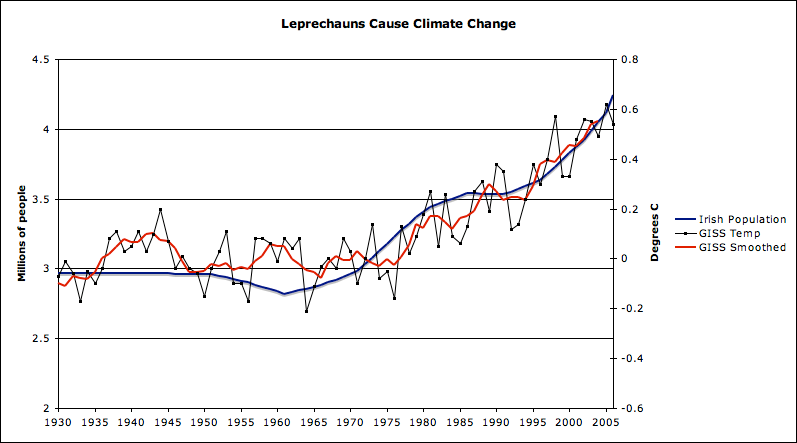
After retrieving the historic population of Ireland from Wikipedia which, despite its obvious pro-AGW bias due to the efforts of that disreputable scallywag William Connelley, has good data on other subjects. I plotted Irish population and GISS temperature data from 1930 to present, and the results were astounding!
http://i81.photobucket.com/albums/j237/hausfath/Picture5-1.png
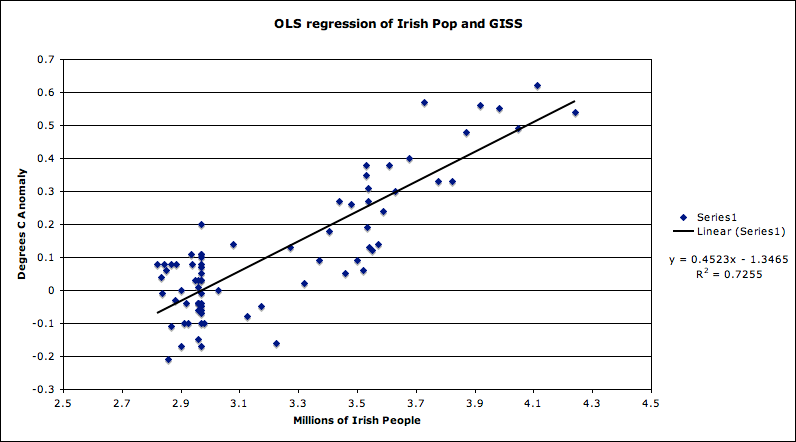
As you can clearly see, there is an amazing match between global temperature and Irish population. However, we all know that graphs can be deceptive; we need real statistics to tease this out. So I plotted the ordinary least squares regression of Irish population on GISS temperature, as shown below.
http://i81.photobucket.com/albums/j237/hausfath/Picture7.png
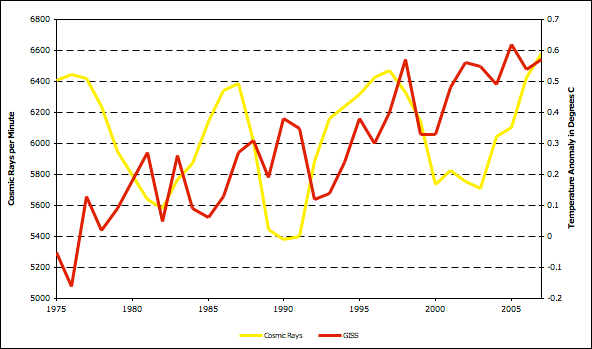
Again, the results are extraordinarily robust. The r^2 value of the correlation tells us that a full 75.5 percent of the variance in global temperature can be explained by Leprechauns. While some skeptics have argued that galactic cosmic rays, rather than Leprechauns, are responsible for the observed warming, we can clearly see that there is a much better relationship between Leprechauns and warming than GCRs and warming:
http://i81.photobucket.com/albums/j237/hausfath/Picture8-2.png
If we could only find a journal (perhaps E&E?) in which to publish this pathbreaking analysis, it may be the final nail in the coffin of anthropogenic global warming, and the beginning of the ascent of leprechagenic global warming!
.
…also, you need a new offtopic thread; this one is getting full. This analysis might be a good oppertunity 🙂
Zeke,
Agree. No contradiction CO2 could play both roles. We weren’t injecting CO2 during the early paleo record, so, of course our adding CO2 followed by warming won’t be in there.
Also no contradiction that the radiative physics tells us that all other things being equal, more CO2 must result in higher temperatures. Also, the order or magnitude estimates suggest the effect will not be tiny. (Though it could be moderated by various feedbacks.)
So, the argument that CO2 is the cause of the rise during the paleo record is entirely plausible on the basis of the radiative physics. Because the radiative physics is well accepted, that argument is more plausible than any alternatives I’ve read anywhere or can dream up. (And I love dreaming up stuff, including “Leprechauns come out of hybernation and cause the increase in temperature. After a while, they grow weary of this earth, and decide to take a nap.”)
Moreover, most of the other theories seem to just be “something else” caused it. (After all, what self respecting person would admit their theory is Leprechauns?) Failure to specify what the other cause might be always points to a weak theory. OTOH, the possibility of “we don’t know” is always there. Maybe cosmic rays will matter. (It’s a pretty safe bet the Leprechaun theory will not pan out.)
jae,
Yes. Cooling happens, even (occasionally) in periods without major volcanic eruptions. Short-term cooling has little bearing on whether or not CO2 has a positive climate forcing, just (potentially, but unlikely) on the magnitude of that forcing or (arguably more likely) the sensitivity of the climatic response to that forcing.
Lucia,
I’d suspect that the Leprechaun theory would show better correlations with temperature than cosmic rays, but that’s just my internal snark acting up.
Zeke–
We’ll just have to identify a proxy measurement for Leprechaun populations, and then infer the level from some sort of Paleodata. I think the proxie should be related to gold somehow.
Jae- There is no contradiction between some negative trends with no volcanic eruptions and warming due to CO2. The only contradiction is with some specific rate of warming. I think it’s inconsistent with 2C/century. Others might dispute this. But it would be very, very, very difficult to make a case that 8 year negative trends are inconsistent with say, 1C/century of warming.
Raven–
With regard to the Hansen prediction of the lag– we hunted for the documents. As far as I can tell, if Hansen predicted the lag, he didn’t document that prediction until after the lag was observed. (I can hunt down the thread if you like.)
On the issue of the lag making sense– yes. On the uptrend, it definitely does. After all, we know why the planet could warm, even without CO2. The Milankovich cycles exist. Other than my Leprechaun theory of global warming, we don’t know why CO2 would increase unless it warmed first.
(As Zeke thinks the Leprechaun theory is more plausible than cosmic rays, I will now write a post stating that I have won 1 adherent to the Leprechaun theory of warming. Zeke can then decide whether to issue a formal criticism of my counting him an adherent. With luck we can spin this into a major controversy!)
Now the real question is whether or not the Leprechaun theory is more or less plausible than the sheep-albedo feedback:
http://www.realclimate.org/index.php/archives/2007/04/the-sheep-albedo-feedbacki/
Zeke– The sheep are a red herring!
Both sheep and leprechauns were known to exist in Ireland. Along with the Irish diaspora, we know find descendants of the Irish in numerous countries. (I am one of those.)
In some cases, sheep were imported. I have no doubt that Leprechauns stowed away in the luggage.
Surely, given wider range, the Leprechauns have multiplied and are generating more warming than ever. Unfortunately, you can’t see the Leprechauns, but you can see the sheep.
If you doubt my theory, look at the coincidence of time: The potato famine was in the mid 1800s. Many Irish died. Have you any doubt many Leprechauns did as well? The globe cooled.
But, over the next generation, the Leprechaun population surely grew. I’m certain we are now overun by the little invisible chaps.
So, there is the explanation for the recent warming.
Regarding our earlier discussion of whether or not models predicted 50s-present warming and 70s-present cooling in Antarctica prior to the publication of Steig et al this week, I asked a variant of this question over at Realclimate:
.
Eric,
In Spencer Weart’s prior RealClimate article discussing Antarctic cooling, he mentioned a Schneider and Thompson model from 1981 and a Bryan and Manabe model from 1988 that predicted “no warming at the sea surface, and even a slight cooling over the 50-year duration of the experimentâ€. Both of these came out well before the Thompson and Solomon article on the cooling effect of stratospheric ozone depletion. Weart also stated that “computer models have improved by orders of magnitude, but they continue to show that Antarctica cannot be expected to warm up very significantly until long after the rest of the world’s climate is radically changedâ€, and implied that this was primarily due to the deep mixing in the Southern Ocean.
Was Weart only referring to East Antarctica here? If not, how do we reconcile this with your results (that Antarctica as a while is actually warming slightly faster than the southern hemispheric average)? Does this have any implications for the modeled heat transfer rate from ocean mixing in the Southern Ocean, or is that extrapolating things a tad far?
I understand that there is a lot of nuance here, given all the different forcings and sources of variability at work (GHGs, negative forcing from stratospheric ozone depletion, ENSOs, etc), but I’m genuinely curious what this study implies for past modeling efforts. Were there any models produced post-2002 that included the ozone forcing that closely matched the temperature reconstruction in your article?
.
To which Eric repied:
[Response: Zeke. Your query probably deserves a longer answer but a very short answer is that you really should look at the Connolley and Bracegirdle paper summarizing AR4 model results. Some (most?) of those models include ozone. As you’ll see, some of the models match our results rather well. Some don’t.–eric]
.
The Connolley and Bracegirdle paper is available here: http://www.agu.org/pubs/crossref/2007/2007GL031648.shtml
Comparing prior model results to revised temperatures in Antarctica would certainly make an interesting research project, if anyone has an inkling to take it up.
Lucia,
At first I doubted your argument there was a causal relationship between global warming and Leprechauns. After all, the very concept sounds preposterous! However, after looking into the data, I must grudgingly accept that your case has more merit than I originally believed.
Now, we all know that Leprechauns are Irish, and its logical that the Irish population should make a good proxy for the population of Leprechauns (as you yourself suggested), given that Leprechauns are invisible thus and we cannot count them accurately.
After retrieving the historic population of Ireland from Wikipedia which, despite its obvious pro-AGW bias due to the efforts of that disreputable scallywag William Connelley, has good data on other subjects. I plotted Irish population and GISS temperature data from 1930 to present, and the results were astounding!
http://i81.photobucket.com/albums/j237/hausfath/Picture5-1.png
As you can clearly see, there is an amazing match between global temperature and Irish population. However, we all know that graphs can be deceptive; we need real statistics to tease this out. So I plotted the ordinary least squares regression of Irish population on GISS temperature, as shown below.
http://i81.photobucket.com/albums/j237/hausfath/Picture7.png
Again, the results are extraordinarily robust. The r^2 value of the correlation tells us that a full 75.5 percent of the variance in global temperature can be explained by Leprechauns. While some skeptics have argued that galactic cosmic rays, rather than Leprechauns, are responsible for the observed warming, we can clearly see that there is a much better relationship between Leprechauns and warming than GCRs and warming:
http://i81.photobucket.com/albums/j237/hausfath/Picture8-2.png
If we could only find a journal (perhaps E&E?) in which to publish this pathbreaking analysis, it may be the final nail in the coffin of anthropogenic global warming, and the beginning of the ascent of leprechagenic global warming!
.
…also, you need a new offtopic thread; this one is getting full. This analysis might be a good oppertunity 🙂
Zeke, it looks like you cherry picked your start date. You need to go back to the great potato famines as a start date. I know the records get problematic for you at that point, but I have a great proxy for you. It is Irish Whiskey. However, you will have to take into account that people can actually see Leprecauns if they imbibe enough whiskey. You may need to do some field study on Irish Whiskey. If you need a lab assisstant to do that grunge work. I volunteer. After all, what are a few liver cells compared to the thrill of good science (and good whiskey)!
John,
Apparently “Irish cherries” is slang for carrots. And carrot picking doesn’t sound quite as fun, unless you are a Rabett.
I also have a sneaking suspicion that the first principal component of the Whiskey proxy is Scotch, such that you always get a hockey-stick shaped curve for Whiskey production when Scotch is included, especially when its aged in unusually old pine.
Leprechauns store their gold in the ground at the end of a rainbow (McNamara 1999 [1]). It follows that an increase in the number of Leprechauns (Hausfather 2009) will result in an increase in the number of rainbows. Such an increase, though, necessitates an increase in precipitation which ought to result in further cooling. However, the application of a new statistical method, “graphical inversion” (Mann 2008) will quickly demonstrate the opposite counter-intuitive result. While the science of the climatic impact of the Leprechaun population can be considered settled clarification of the mechanism is desirable and thus further research will be required..
[1] The Leprechaun Companion http://www.unicorngarden.com/bkleprec.htm#lep1
lucia:
“Also no contradiction that the radiative physics tells us that all other things being equal, more CO2 must result in higher temperatures. Also, the order or magnitude estimates suggest the effect will not be tiny. (Though it could be moderated by various feedbacks.) ”
The “all other things being equal” is a very important caveat here. There are some well-respected physicists who don’t think additional CO2 can significantly affect temperatures, since all things are not equal. Miscolczi, for one, has a very, very interesting theory that suggests that there are mechanisms on the planet that tend to keep the greenhouse effect constant and that minimizes the effect of CO2, since there is an endless supply of water vapor to keep the greenhouse effect at an optimum. And, unlike the “official” physics that nobody can seem to put down on paper in a clear manner, he has a tremendous amount of empirical and physical support for it. See various threads on David Stockwell’s blog, if you are interested.
Rich–
I think rainbows are an inefficient fingerprint for Leprechauns due to the confounding effect of Norse Gods.
Rainbows are used by Norse Gods on their way to Valhalla.[1] A decrease in Norse God’s during a period of increasing Leprechaun populations could result in fewer rainbows. This would be particularly true if the urgency of daily travel to Valhalla required a larger number of rainbows than does the storage of “The Pot O’Gold”.
Many in the US have noticed that while number of citizens claiming Irish descent is vast, those who remember their scandinavian roots is diminishing. This results in a decrease in the number of scandinavian delis in place like Andersonville, Chicago. (I can personally attest to this decline.)
So, more Leprechauns cause warming and an increase in rainbows. Fewer Norse Gods cause a decrease in rainbows. So, rainbows are not an efficient fingerprint.
[1]Bridgeman Art LIbrary link..
Jae–
Yes. I included “all other things being equal” in my sentences on purpose. 🙂
I can neither argue for or against Miscolczi’s paper because I don’t understand his argument. Because I don’t understand his theory, I also can’t say whether or not the empirical data supports it.
My lack of understanding may be due to my own deficiencies in background, or it may be due to Miscolzi’s presentation. But, I have to admit I simply can’t follow the argument at all.
“I think Zeke’s analysis is wort highlighting…”
Back to Irish Whiskey again?
http://www.scotch-whisky.org.uk/swa/93.html#Wort
🙂
lucia:
“But, I have to admit I simply can’t follow the argument at all.”
It is difficult to read M’s manuscripts, but a lot of it is fleshed out on Stockwell’s blog. Overall, he theorizes that the atmosphere tends toward a constant optical depth of 1.87 by adjustments in cloudiness. It could actually explain Lindzen’s and Spencer’s findings, IMHO.
Can you follow the “positive water vapor feedback” mechanism that is included in all the GCMs?
John M– The Leprechauns must have caused that typo! (Leaving it in. 🙂 )
Jae–
Yes. I can follow the predicted positive water vapor feedback due to water vapor, which is included in climate models. This is also discussed in text books like “A Climate Modelling Primer. That positive feedback is well understood.
The net feedback due to clouds is more difficult to estimate.
lucia:
“That positive feedback is well understood.”
You should let Steve McIntyre know about this. He asked the IPCC to include a clear exposition of the physics behind this feedback, and he’s been asking on CA for a clear exposition for several years, now.
jae– I believe SteveM has been requesting a clear exposition of a specific estimate for the climate sensitivity. This is not precisely the same as requesting a clear exposition about how increases in water vapor would result in some positive feedback. The two are not the same due to the existence of additional feedback mechanisms. One of these other feedback mechanisms is due to liquid water as clouds and solid water in the form of ice crystals in clouds or surface ice.
I may be mistaken on what SteveM is requesting. If you have a link to his request for an exposition specifically on the positive feedback of liquid water, could you provide it?
Zeke–
Though not germain to the “Leprechaun Theory”, at Roger Jr.’s blog, Eric posted this:
You can read the rest here:
http://sciencepolicy.colorado.edu/prometheus/consistent-with-chronicles-antarctic-edition-4897#comments
I think Spencer’s article was unfortunate indeed. Of course, it’s no secret I think quite a few of the articles at RC are unfortunate. In my opinion, collectively, they are the main contributor to incidents in Roger Jr.s “Consistent With Chronicles”.
lucia:
“I think Spencer’s article was unfortunate indeed. Of course, it’s no secret I think quite a few of the articles at RC are unfortunate. In my opinion, collectively, they are the main contributor to incidents in Roger Jr.s “Consistent With Chroniclesâ€.”
See the latest post at CA.
Suggest exploring the issue of natural vs anthropogenic CO2. e.g.
Increasing Atmospheric CO2: Manmade…or Natural?
January 21st, 2009 by Roy W. Spencer, Ph. D.
The Origin of Increasing Atmospheric CO2 – a Response from Ferdinand Engelbeen
“So I plotted the ordinary least squares regression of Irish population on GISS temperature, as shown below.”
But can GISS data be considered reliable for this purpose? There may be Leprechaun promoters or pro-Leprechaun Irish people at GISS who have adjusted the data to promote Leprechaun theories.
Scooter–
Retest using HadCrut. At least during the early parts of the record, the British were not thought to be pro-Leprechaun. Have the turned pro-Leprechaun recently?
Actually, as CO2 is emissive in the IR spectrum, more CO2 obviously will emit more IR. As earth is engulfed in a cosmic thermos bottle, the only practical way it cools is IR emission.
Ergo sum cogito, more CO2 will COOL the earth. I am tending toward the Leprechaun causality!!
I would point to the rather large hike in gold prices as proof that the little buggers are loose again and trying to fill their pots-o-gold!!
Kuhnkat:
“Ergo sum cogito, more CO2 will COOL the earth. I am tending toward the Leprechaun causality!!”
Yes, lad, and ye may not be so far off as some of the big folks think!
lucia:
“I may be mistaken on what SteveM is requesting. If you have a link to his request for an exposition specifically on the positive feedback of liquid water, could you provide it?”
You know as much as I do about what Steve Mc is requesting, and I’ll not waste my time searching his blog to provide stuff you can find. As you certainly know, he has MANY times asked for an “engineering-type exposition” of just how CO2 could possibly heat the Earth by 3-whatever degrees. Clouds can be included in this exposition (as they would have to be). There is no such exposition, to my knowledge. I have seen no proof, theoretically or empirically, that there is a positive water vapor feedback. Indeed, all the empirical data that I have analyzed show a negative feedback. And, as I said before, Spencer and Lindzen are showing the same thing.
And you STILL owe me an apology about how you misrepresented my position on the other thread. You promised an email. No emails, so far…
Jae–
I have sent 3 emails to the address you enter when commenting. I have no control over your spam filters, and can’t know if you may be entering a false email when commenting.
If you use the contact Lucia link, you can get in touch with me.
As for the SteveM thing: In that case, if I am not mistaken, SteveM is asking for something other than simply the argument for why water vapor results in a positive feedback.
OK, Lucia, I don’t think I have any spam filters that would preclude your simple emails. I get them from all kinds of shady folks :). Nothing is false on my end, AFAIK. But I will contact you directly so you can give me my apology :). Thanks.
Lucia : ‘Zeke– The sheep are a red herring!’
Interesting you should bring up the question of red herring, Lucia. In my 1998 paper, ‘An Inconvenient Kipper’, I of course noted the correlation between the extensive fishing of herring in the North Atlantic to provide breakfast kippers for the burgeoning population of Victorian England and the warming of the climate during the course of the 19th century. I showed that the resulting increase in the proportion of red herring to the silver variety, vastly more suitable for kippers, had caused a drop in the albedo of the area, with the catastrophic effects (warming, sea level rise, more expensive kippers etc) of which we are only now beginning to be aware.
John F Pittman: ‘Zeke, it looks like you cherry picked your start date’
Now, with regard to cherry picking… (cont p.94)
What a wonderful thread. Has anyone correlated modelling funding to temperature fluctuations? If I had access to such information I would start at 1988.
Steve UK–
Yes! I believe I read your marvelous opus which deserves to be more widely circulated.
My husband Jim likes pickled herring. I’ll encourage him to check labels to be sure he’s eating the red variety, thus sparing the high albedo white variety from extinction.
Well, well. I have by eye correlated the Dow Jones with the rise in temperature ( until this last plunge that is) and yes, human population, like all living things, thrives in warmth and diminishes in cold. I guess leprechauns too.
Unfortunately each human gives off about half a ton of CO2 a year, and there are some billions of us, if cows and other animals are included that makes for quite a lot of CO2 ( forgetting methane which is also our by product). Are Leprechauns CO2 exhaling beings? Then their number is important. I am afraid leprechauns do not take away the CO2 problem :(.
I’ve discussed this sort of thing on a number of occasions.
http://www.climateaudit.org/?p=744
I also showed that temperature reconstructions Mann-style using tech stocks outperformed MBH proxies http://www.climateaudit.org/?p=177
http://www.climateaudit.org/wp-images/spurio5.gif
The entire issue of “spurious regression” is either ignored or botched in paleoclimate reconstructions.
Maybe the Irish immigration to American cities is a better explanation for the rise in urban temperature than UHIE. So it actually is ELIE (Erie Leprechaun Island Effect).
Its actually all due to underwater volcanoes
http://www.iceagenow.com/Global_warming_may_be_caused_by_underwater_volcanoes.htm
they heat the ocean, which then warms the land. This will shortly lead to a new ice age, when what happened to the mammoths will happen to us.
You’ll see!
Steve M,
Unfortunately, the relationship breaks down prior to 1930, given that the earth was warming and the Irish population was shrinking due to blighted potatoes:
http://i81.photobucket.com/albums/j237/hausfath/Picture6.png
And while the spurious correlation in question can certainly be used as a learning exercise (and criticism of irresponsible proxy choice), the original inspiration was my remark to Lucia that there is likely a better correlation between Leprechauns and climate change than cosmic rays and climate change, given the distinct lack of a trend in the latter over the past 30 years or so. Correlation is simply a necessary (though far from sufficient!) component of causation.
Zeke-
A fact often overlooked by both those who think correlation== causation and those who cry “Correlation does not mean causation”!
Obviously, if we develop a theory on some basis other than correlation, we later look to see whether correlation exists. If we see really, really, strong correlation, we , quite frequently, seek a reason. We also continue to watch to see if the correlation continues. But, if we can think of no reason for the correlation, we aren’t to suprised that it goes away as we accumulate more data.
Shouldn’t he Irish who emigrated and their descendants also be included in the Leprechaun-proxy model? In fact, on March 17th everybody is Irish so there’s an annual spike to account for. C’mon, let’s sharpen this thing up before it’s attacked by skeptics.
lucia:
“Correlation is simply a necessary (though far from sufficient!) component of causation.”
Exactly. Now, just how long do we “put up with” the lack of correlation between CO2 and global mean temperature, before we can decide that any past “correlations” between CO2 and warming were spurious? By the alarmests views, I guess we have to wait 200 years to make the call (they are saying that the recent cooling is just a hiatus in the steady march to hell, even though their stupid models show no such possible hiatus). But the public will not wait 200 years, or even 10, so the ultimate scam artists, such as Hansen, Gore, Sierra Club, Nancy Peolosi, Friends of Earth, etc., etc., etc. will get their just deserts. By my horribly skeptic, denialist, shameful, industry-funded, non consensus, flat-earth, non-PC, Earth-raping views, the data have already shown it. It is really fun to watch the AGW-extremists starting to run for cover. What will really be funny is to watch the politicians squirm, since they will be the last to know that the emperor has no clothes. LOL.
Jae–
Both CO2 and surface temperature are correlated in the thermometer record and in the ice cores. Aside from all the labeling of people including yourself…. why do you suggest the two are uncorrelated?
Gary–
Luke over at Jennifer Marohasy already attacked it. Can you imagine? He claims Leprechaun are all male, cannot reproduce and so the populations are static!!!
lucia:
“?Jae–
Both CO2 and surface temperature are correlated in the thermometer record and in the ice cores. Aside from all the labeling of people including yourself…. why do you suggest the two are uncorrelated”
ROFLAMO. Can you tell me your definition of “spurious correlation?”
Oh, and lucia, I’m still waiting for the promised email, explaining why it was OK for you to completely dis me and misrepresent my position on “global warming.” You owe me at least an email, if not a formal blog apology. Could the problem be that you can’t admit when you are wrong? I hope not, because that is a big character flaw and greatly diminishes my opinion of you. Get it over with, now.
Well Jae,
Doing a simple linear regression of annual CO2 and temperature from 1975 to present, you get an r^2 of 0.78. Of course, CO2 is far from the only climate forcing, and the correlation gets better when you add aerosols, ENSO, volcanic activity, non-CO2 gases, and various feedbacks (e.g. lapse rate and water vapor). As for causation, see radiative physics. While climate sensitivity to GHGs is still a very open question, you are going to have a hard time convincing folks that there is no causal relationship between CO2 (and other GHGs) and the Earth’s temperature.
Jae,
1) I told you several times that I don’t think I dissed you in anyway, or misrepresented your position on AGW. I suggested you read the threads form Dec. 2007– as anyone may to read the sorts of things you said.
2) I explained I emailed you four times using the email you provide. If you feel a need to discuss this, you will need to click “contact Lucia”. I have not received the email.
Zeke
“As for causation, see radiative physics. While climate sensitivity to GHGs is still a very open question, you are going to have a hard time convincing folks that there is no causal relationship between CO2 (and other GHGs) and the Earth’s temperature.”
Zeke. “see radiative physics.” What a bland, meaningless, statement! You may be suffering from the same dementia that the majority of the “believers” do, in assuming that the incompletely explained and understood “radiative phisics” proves anything. Steve McIntyre and many others have been seeking this illusive “radiative physical explanation” for YEARS, now, and NOBODY has yet to put forth a clear engineering-quality, from first principles, explanation of just how the heck CO2 can increase temperatures. There IS CURRENTLY NO DECENT PHYSICAL EXPLANATION FOR A CO2-CAUSED WARMING, ESPECIALLY THAT PART THAT IS CAUSED BY “WATER VAPOR FEEDBACK.” Moreover, there are many reputable physicisits, like Ferenc Miskolczi (who resigned from NASA because the agency would not let him publish his findings) who disagree that CO2 has any significant effect at all. Laugh if you will, but the fact is that the science is VERY FAR from being settled, and there is no reason to enact damaging legislation at this time. The current cooling doesn’t help the doomsdayers, either. In fact it, and the financial trauma, have completely killed the hopes of the communists, for the time being. LOL.
Jae–
a) Do you doubt CO2 has spectral properties that block radiant energy at certain wavelenghts? If yes, why do you doubt this?
(b) If you don’t doubt (a), do you doubt that gases that can radiant energy at the wavelength emitted by the surface of the earth can reduce the amount of heat escaping from the earth’s surface? If yes, why do you doubt this?
lucia, 9416: OK, I just emailed you. I really find it hard to believe that you emailed me 4 times, and I did not get the email, despite that your blog accepts my email address. It has never happened to me before on any other blog.
You can just say you were wrong and it will be OK . I have admitted that I was wrong in discussions with you before. (I’m not holding my breath, LOL). I have NEVER denied that the world is warming, contrary to what you told everyone on your blog. I have just tried to show that water is a NEGATIVE feedback to any forcing from outside. You can review all my “insane” stuff here: http://www.esnips.com/HomeAction.ns;jsessionid=D32A7845E108667300BB34E141678B8E
Just show me ONE SENTENCE that says that I think there has been no warming! If you cannot, YOU ARE JUST WRONG, LUCIA! I don’t respect folks that don’t admit mistakes.
Jae–
I didn’t say you denied the world warmed. We went over this before.
My blog permitting you to enter an email has nothing to do with whether an email I send you arrives at your in box. That has to do with something on your end. I have no control over that.
I emailed you again. The email is not bouncing.
lucia:
“I didn’t say you denied the world warmed. We went over this before.”
No. You are trying to duck from your post.
Others who may be reading this:
OK, innocent bystanders, I know it’s petty and you are bored, but I get so DAMN tired of prima donnas and other folks that can’t admit a single fault. Like Lucia, who said the wrong thing and simply cannot admit it! It goes with the name, based on my experience.
Aaaaah, finally got an email from lucia.
jae (Comment#9425) January 25th, 2009 at 11:20 pm,
Pot. Kettle. Black.
or
Glass House Stones.
Atmospheric radiation physics is well understood. Try reading a college textbook. I can recommend A First Course in Atmospheric Radiation by Grant W. Petty. Water vapor feedback is a separate issue involved in determining climate sensitivity for a given forcing, not the forcing itself.
Even though I agree that ice core records certainly show a correlation between CO2 and temperature, I also would say that causation is temperature to CO2 and not the inverse, in those records. The same is true when one examines the short term differences of CO2 rise and temperature rise, http://icecap.us/index.php/go/in-the-news/qualitative_thoughts_on_co2/.
“It appears that CO2 concentrations follows temperature with approx 6-9 months. The interesting part is off course that the CO2 trends so markedly responds to temperature changes. ”
So, long term and short term, the causation arrow is from temperature to CO2. There is a window of medium term that has not been excluded which is where the water feedback model will reside.
Correlation though, there exists.
DeWitt Payne (Comment#9430)
“Atmospheric radiation physics is well understood.”
Well, all atmospheric physics radiation explanations leave me with a funny taste, not a very enlightening comment from a physicist, but we are also allowed to have intuition. The reason is that these ” models” are a pot-pourri of thermodynamics, classical statistical mechanics, quantum statistical mechanics( individual atoms absorbing and re-emitting radiation). My intuition tells me that this leads to fallacies, or at least shaky results, but I would need a lot of brushing up time on all these branches of physics to put my finger on it.
J.Peden’s editorial http://www.middlebury.net/op-ed/global-warming-01.html clears up some physics.
His oven illustrates what I mean: http://www.vermonttiger.com/content/2008/07/nasa-free-energ.html
Lucia, you asked: “Do you doubt CO2 has spectral properties that block radiant energy at certain wavelenghts? …. (b)…. do you doubt that gases that can radiant energy at the wavelength emitted by the surface of the earth can reduce the amount of heat escaping from the earth’s surface?”
I don’t doubt the spectral properties of CO2. However, I do doubt that if we take account of all the feedbacks in the functioning of the atmosphere, there is any long term net warming due to CO2 rises. Its surely a bit like arguing about a car’s mileage. Someone says, do you doubt that a given quantiity of gas has the energy to propel a car of this mass x miles?
Of course not. What I am doubting is that a car of this design, with this sort of side valve engine, and with this wind resistance in its body shape, can be driven for x miles at 70mph on this quantity of gas.
Its not the physics of CO2 that some of us are unpersuaded of, its how the physics of CO2 plays out in this particular atmosphere over periods of decades and centuries. After all, CO2 direct effects are a fairly small part of the forecast warming. The rest is supposed to come from positive feedbacks, no?
DeWitt Payne,
if atmospheric radiative physics are so well understood, why hasn’t someone already satisfied Steve Mc’s request for a decent paper on atmospheric sensitivity and why are the climate scientists continually rearranging the chairs on their version of the Titanic??
See Lucia’s question to Jae above.
“Do you doubt CO2 has spectral properties that block radiant energy at certain wavelenghts?”
Many intelligent, very well educated, people do not conceptualize the physics at all well!!!
GHG’s do not BLOCK radiant energy and your texts do not say they do (I hope), yet we have people assuming IR is BLOCKED, REFLECTED, and/or magically INCREASED… (it’s the Leprechauns)
There is quite a bit of hand, arm, and leg waving (not to mention head feints) over what actually happens in the radiative physics in the atmosphere.
For example, the cartoons always show a LOT of downward IR from GHG’s (apparently reflection). Can you explain why these gasses would mostly emit downwards instead of in relatively random directions?? That is, wouldn’t downward IR be less than 50% and the higher the molecule is in the atmosphere, the less chance it would emit earthward??
The HOT SPOT would seem to represent GHG’s absorbing and RETAINING energy. Why would CO2 keep absorbing and picking up energy and not emit? Not to mention the more absorbed the higher the velocity increasing the likelihood of collision with another molecule transferring energy. Aren’t there physical limits on how much energy a molecule can absorb before emitting or breaking down or not absorbing(deflecting??)?? Maybe this limit is only reached after the earth cooks. I don’t know, but, it is something that should be in english or french or german….
I also see interminable arguments over whether the downward IR from the GHG’s actually HEATS the ground or just slows its cooling or… Again, there does not appear to be very good data on exactly what and HOW MUCH is happening in reality.
Yes, radiative physics is alledgedly well understood. Unfortunately that understanding was apparently thrown out when communicating the AGW theory to the world. Sometimes I wonder how well what is KNOWN was translated into the models!!
I especially like the cartoon of the light bulb enclosed by a reflective material where it is suggested the heat would continue to rise till the shell melted. This totally ignores the issue of the power increase required to continue adding more energy!! (the simplest light is an electrical filament. The hotter it gets the higher the resistance, the more power is required to maintain the output. No power increase, no energy addition, equilibrium will be reached if the filament doesn’t melt first)
AGW is based on the idea that heat is being added faster than it is radiated. Since IR IS the heat and IS radiation, if the GHG’s are already saturated what happens to it?? The hot spot alledgedly happens because water vapor doesn’t cross the tropopause and the GHG’s can’t radiate enough energy to prevent a build up of heat where convection stops.
So, let’s conceptualize. We have the picture of what MAY happen when A photon intersects A GHG molecule. This doesn’t tell us whether heat is building up or not. No quantification of photons with time and emissions.
In our dayside atmosphere, how often does a photon actually interact with a molecule?? Once a day/hour/minute… My conceptualization is more like a firehose than the occasional strike. Are the GHG’s saturated because they are continuously being hit or are they occasionally getting a hit because there aren’t enough photons and/or they are being masked by water vapor in most areas of the atmosphere. Of course, since GHG’s reemit, masking shouldn’t be a big deal should it?? But, when do they emit? After they have absorbed 1/5/10E10,000,000 photons??
So, my concept of the atmosphere is of molecules continuously being struck from many directions and continuously reemitting in many directions in addition to the same with their physical movement. Of course, the higher in the atmosphere, the fewer physical or radiative interactions. Not exactly the picture we get from the cartoons and not a good fit to the theory!!!
So, tell me how those nifty radiative physics books tell us about the actual dirty details of the ACTUAL atmosphere rather than a single interaction!!! Why is my concept wrong? (what is the cross section of a photon. How many are in a volume of atmosphere, what is therefor the likelihood of a molecule being struck by a photon in what time frame and what is the odds of it being reemitted and how soon)
“Water vapor feedback is a separate issue involved in determining climate sensitivity for a given forcing, not the forcing itself.”
Yes, just like CO2 and ocean cycles (ENSO PDO NAO…)
Unfortunately AGW assumes the only primary forcing is the sun. With the number of undersea volcanoes and vents, are you SURE that the sun is the only primary forcing we need to deal with??
http://www.newscientist.com/article/dn14456
Personally I think the waste heat from our civilization has more effect than CO2!!!
a) Do you doubt CO2 has spectral properties that block radiant energy at certain wavelenghts? If yes, why do you doubt this?
It is not a doubt , it is entirely and completely a certitude .
CO2 (or any other gas for that matter) does NOT block any radiant energy at any wavelength .
CO2 and some IR active gases ABSORB and EMIT infrared energy .
How much ?
Exactly the same amount .
Why ?
Because in LTE the number of exited molecules is a constant given by the Maxwell-Boltzmann distribution .
We are even lucky that it is so because else the temperature would be undefined 🙂
.
So Jae is basically right .
Most people who say that radiative transfer is “well understood” are saying something that other people don’t understand .
What is rather well understood (well I could cite dozens of things that are not understood at all because quantum mechanics is notoriously difficult but let us not go there) is the radiative equilibrium in a gas .
But that in itself doesn’t say much (hence the question of Steve McI) about a real atmospheric system where energy transport happens through many mutually interacting ways (conduction , convection , latent heat , radiation) .
.
How long did it take untill people understood that what was happening in the atmosphere had nothing but really nothing at all to do with a greenhouse ?
Some don’t understand it even today and this stupid denomination “greenhouse effect” still sticks .
.
So no there is nothing obvious and derivable from the first principles regarding some (spatially averaged !!!) temperature when the concentration of some atmospheric component varies .
Even the sign is not sure when the time scales are large .
The only thing that is sure and rather easily derivable from first principles is that under assumption of radiative equilibrium the equilibrium local temperature at the solid/gas interface will increase .
Everything else is a matter of GCMs and faith that they get the “physics” right on all time scales .
All–
Usually, my questions are for everyone. This time was hoping Jae would answer those specific questions.
Fred– Yes. There is an issue about feedback.
Anna– I don’t go as far as Dewitt to say atmospheric radiation physics is well understood, because I think that implies more than we know. Many separate effects are well understood– and that’s what I’m trying to pin point Jae on.
KuhnKat– On the molecular level, “blocked” is not the right word. But intercepted? Whatever word. The problems with the cartoons is they actually require subsidiary cartoons. The arrows are supposed to represent net flow in a heat transfer situation. But, if you has the “set up” cartoon, you would show CO2 molecules re-radiating in all directions and you’d have lots of various details.
Tom– We use the exact same radiative physics in engineering codes. If Jae has doubts on what CO2 can do with regard to radiation of photons, I want to read what his specific issues are.
Even with the feedback, and etc. I want to figure out what it is that Jae thinks cannot happen. What does he think happens if we stick CO2 in a tube and shine light through it? Does it not have spectral properties? Etc. I’m trying to get “up” the chain and figure out where his issue is.
An old one–lack of pirates creates global warming:
http://en.wikipedia.org/wiki/File:FSM_Pirates.png
I guess now that there are lots of Somali pirates there is now global cooling? I think the chart needs to be updated!
lucia:
“Tom– We use the exact same radiative physics in engineering codes. If Jae has doubts on what CO2 can do with regard to radiation of photons, I want to read what his specific issues are.
Even with the feedback, and etc. I want to figure out what it is that Jae thinks cannot happen. What does he think happens if we stick CO2 in a tube and shine light through it? Does it not have spectral properties? Etc. I’m trying to get “up†the chain and figure out where his issue is.”
I have no problem with “radiative physics,” except that I probably don’t understand it all. I understand that any substance absorbs and radiates energy according to its temperature and absorptivity/emissivity, including gases. My “problems” relate to the continual use of the “greenhouse” term. While most of the folks that use the “greenhouse” concept SAY that the atmosphere doesn’t actually act like a greenhouse and that the term is not really appropriate, they then turn around and claim that it IS behaving exactly like not only a greenhouse, but like the old discarded idea of how a greenhouse works! That is, it is “trapping” radiation. Blankets! They are ignoring convection (and latent heat), just like the uninformed idea of how a greenhouse really works! They then go further and insist that extra heat causes evaporation (which is true), which then increases the “greenhouse effect,” totally ignoring the energy drain caused by that evaporation, as well as clouds.
And lucia, “sticking CO2 in a tube and shining light through it” hardly provides a model of the atmosphere and sunlight!
The other thing that many folks do wrong is add IR from areas with different temperatures (surface and air). If this will work, I should be able to melt iron with several propane torches. But I cannot.
DeWitt snarks again:
“Atmospheric radiation physics is well understood. Try reading a college textbook.”
I have read plenty of books, Mr. Payne. It is the meterology books that are equally important here. Air is free to move, although affected by gravity.
Jae–
The use of the word “greenhouse” is a misnomer. But you also need to understand that many physical phenomena are discussed as separate effects. So, with regard to you, the question that is difficult to tease out is: Are you concerned with some specific special effect? The whole ball of wax? Just confused? etc.
On the separate effect of CO2:
CO2 has spectral properties that cause it to absorb photons and re-emit them. Because of the specific spectra properties it does not absorb very much of the down welling solar radiation. It does absorb some of the up-welling. Then it re-emits in many directions.
One could draw a “sub-cartoon” showing the details showing CO2 molecules emitting in all direction. The product of this could be a cartoon with different details with CO2 being treated as providing a “resistance” to upwelling radiation — or a blanket.
Convection can be added to the picture and is. You can read about radiative convective models in “A climate model primer”. Depending on surface temperatures and length scales and fluid between parallel surfacea (like, say, window panes, or types of insulation above engineered objects) we create the exact same types of cartoons.
When doing full problems, no one is ignoring any energy drain caused by evaporation or clouds.
I have no idea what you think people are doing, why it’s a mistake or why you conclude that whatever they are doing would mean that one could melt iron with several propane torches.
Lucia,
I define “well understood” as the ability to calculate emission and absorption spectra that agree with observation. That is sufficient to demonstrate the fundamentals of the effect referred to as “greenhouse” and calculate first order forcings.
There are aspects that are less well understood than others. Water vapor continuum absorption is the primary example. It is most likely the result of collisional dimers, sort of a three body effect with two molecules and a photon rather than one molecule and a photon. Water vapor can interact with itself and with nitrogen and oxygen. Oxygen-oxygen, nitrogen-nitrogen and nitrogen-oxygen continuum absorption needs to be considered only in the upper atmosphere where there is very little water vapor. However, not everyone agrees that this is the case and water vapor continuum spectra are still calculated using an empirical model.
Dewitt–
If that’s how you define “well understood”, I agree with what you said. I agree with you that radiative physics is sufficiently well understood that what we know is “sufficient to demonstrate the fundamentals of the effect referred to as “greenhouse” and calculate first order forcings.”
I also agree with people when they say second order forcings matter. So, whether or not it’s “well understood” depends on how close to perfection we must get before we say “well understood”.
TomV brought up the issue of not understanding things at a quantum level. I’ve no reason to dispute what he says. There are probably tons of thing we don’t understand at a quantum level.
For example, I have no idea what is happening on a quantum level when molecules of air flow over an airfoil. I dimly remember there are electrons, protons and neutrons doing things at all times. Heck, I’m sure the odd electron, proton or neutron even does something weird from time to time. Yet, if we entirely ignore any and all quantum effects can still make decent predictions of lift on airfoils. (We even expect undergraduate students to do this and we expect that well designed aircraft will very rarely fall out of the sky because of something that happens at the quantum level.)
kuhnkat,
Jeff Id has a post ( on the waste heat thing (can’t make a link work here for some reason) at The Air Vent. The main point is that the Earth receives 120,000 TW from the sun. Human energy production is 18 TW which all ends up as heat eventually, i.e. energy efficiency is not the issue. Added heat from current energy production is insignificant to the planet as a whole but can be quite significant locally. Land use/land cover changes are far more important. Thermal energy from the Earth’s core, whether from undersea volcanoes, mid-oceanic ridges or just diffusing to the surface is also insignificant compared to total solar energy.
anna v,
I looked at the article. Not impressed. All you have to do to see that the effect of CO2 is not trivial is look at the thermal emission spectrum of the Earth observed from high altitude. The CO2 band is quite obvious and affects a significant fraction of the total energy. Also, most of the thermal energy emitted by the surface does not escape directly to space. Over 80% is absorbed at some point on average, more in the humid regions, less in the drier areas.
Lucia,
For some reason I can’t make the HTML for the first link above work and I can’t edit it either.
Lucia: If it were not for convection, the surface of the earth would be exactly the same temperature as the inside of a greenhouse during the day. Around 170 F on a sunny July day in Chicago. That is caused by a solar radiation of about 800-900 w/m^2 during the hottest part of the day. Now, convection reduces that to about 90 F, almost 50 percent. I simply refuse to believe that 4 w/m-2 additional radiation from CO2 will make a significant difference, especially since some of the effect (50%??) will be “washed away” by convection, just as it “washes away” half of the blackbody heat from teh sun.
I guess where my thoughts diverge from those of most people is that I tend to think of the IR as a property of the warm, thermalized air molecules and not some type of “driver,” except when it drives temperatures down by disappearing into space. The radiation helps thermalize the O2 and N2, so there is LTE. Air at 25 C has a certain amount of energy, and it is not somehow heating anything above that temperature by radiation.
The problem Lucia is that while you don’t need QM for air foils , you would do nothing and understand nothing in IR absorption/emission without QM .
It is a PURELY QM effect .
So yes QM matters and the relevant theoretical level to understand radiative transfer is QM and you would do no correct prediction in radiative transfer if you neglect QM .
Do you predict that N2 and O2 don’t absorb IR ? Well they do .
Actually you wouldn’t even predict the absorption/emission lines themselves without QM 🙂
.
In order to get it tractable , what many people do is to take “ready to use” formulas that have been more or less correctly derived through QM and apply them macroscopically .
Or they get equilibrium empirical data (f.ex Hitran) in standard conditions and make numerical classical approximation from the pre QM era .
Water vapour continuum (already mentionned by deWitt) is an example where this doesn’t work and yet it is significant .
There are other examples .
For instance if you ignore the hamiltonian you have no clue about the spectrum even in equilibrium .and have to use only empirical data .
Collision induced spectra are poorely understood too . Etc .
But there are cases where it works like every empirical well tuned formula when it is applied within its range of applicability .
.
All that is what people call “well understood” but I can assure you that this “well understood” is very far from what a QCD correction would do to a flow around an airfoil .
.
If you are writing yourself things like “CO2 blocks radiation” , what it definitely doesn’t , you even contribute to the confusion .
Everybody has seen a chain of workers at a yard who are throwing each other a brick to move it from the truck to the working place .
Nobody would come at the strange idea to describe this process by saying that the workers “block” the movement of the bricks .
And if you vary the number of workers in the chain , they still don’t “block” anything .
.
So again .
The CO2 blocks nothing , always emits exactly the same energy as it absorbs regardless of concentration and glass roofs or similar more or less IR blocking contraptions are wrong analogies .
Tom–
I was asking Jae a question. Of course CO2 emits the energy it absorbs.
As for blocking, since you are deciding to do the Mr. Language person, so will I. Have you never seem linemen block other players in football? Or people try to block passes? Or goal kicks in hockey or socker? In the aggregate, players do block other players, footballs and pucks, yet some players or objects get past the block. The direction of motion of the ball or other players gets changed when things are blocked. Similarly, co2 blocks photons. Neither the player, the balls nor the puck are simple absorbed so as to vanish from the universe — nor are photons.
Jae–
Please don’t say 90F is 50% of 170F. Or if you do, now convert to degrees C and see if you get the same %. Then do degrees K.
A better analogy would be a pool ball analogy. Imagine CO2 as a bunch of pool balls in the atmosphere. Imagine IR radiation as a bunch of BB’s. All collisions are completely elastic (no conversion of KE to anything else). The more pool balls you have, the more likely it is escaping BBs will be redirected back where they came from. Physical size of the balls/BBs is analogous to absorption cross section; mass of the BBs is analogous to the photon energy; mass of the pool balls is just that – mass of the CO2.
.
The addition of more pool balls changes the odds that a BB will escape.
“The addition of more pool balls changes the odds that a BB will escape.”
Yes. So what? The optical depth increases by 0.0000000000000000000001?
lucia:
“Please don’t say 90F is 50% of 170F. Or if you do, now convert to degrees C and see if you get the same %. Then do degrees K.”
OK, but you get the idea….
DeWitt Payne (Comment#9462)
“I looked at the article. Not impressed. All you have to do to see that the effect of CO2 is not trivial is look at the thermal emission spectrum of the Earth observed from high altitude. The CO2 band is quite obvious and affects a significant fraction of the total energy”
I looked at the emission spectrum you provided, and it corroborates that a very small part of the infrared is in the CO2 lines.(2.7, 4.3 and 15 micrometers) There is little width, CO2 absorbs in lines, not a continuum, and the spectra you show are mostly a continuum.
I have no doubt that thermal energy is jostled around in the atmosphere and will eventually appear as infrared . The question is the role of CO2 and the role of anthropogenic CO2 that is exagerated.
Jae–
So, baby steps here: Do you believe this extra 4 W/m^2 does arise as a result of CO2?
No. If the heat input remains the same, then at equilibrium, the same number of BBs need to escape. This results in more BBs bouncing around below the pool balls (i.e., it gets warmer below the pool balls) in order to achieve the same number escaping at the new, lower rate of escape.
.
Let’s say you start with 1 million BB’s per second hitting the pool balls with an initial chance of escaping of 99.99%. This means, on average, 100 BB’s per second are rejected (999,900 escape).
.
Now change the odds to a 99.9% chance to escape. In order to get the same 999,900 escaping, you need to reject 1,001 BB’s per second.
.
If you change the odds to 99%, you now need to reject 10,100 BB’s per second to keep the escape rate the same.
.
Small changes in the escape rate can result in a significant increase in the insulative properties of the pool balls.
🙂 I had a chuckle ^
Wrong thread, lucia, but the answer is that I don’t know. All else being equal, that is probably close. But all else isn’t equal. Like convection and clouds. Maybe this model has the same problems as the GCMs. http://motls.blogspot.com/2008/01/why-is-greenhouse-effect-logarithmic.html
Of interest: Roger Pielke Sr. references this article, which suggests there probably has been NO warming in the USA. http://hallofrecord.blogspot.com/2009/01/decadal-occurrences-of-statewide.html
anna v,
CO2 absorbs in fairly narrow lines at low pressure where Doppler broadening dominates. In the troposphere, though, pressure broadening dominates and the lines have a Lorentz profile and are about 15 times broader than the Doppler width at sea level. And there are lots of lines with very high line strength. The result is that over distances ranging from a few meters or less at sea level to kilometers at high altitude, the lines overlap a lot and transmittance is effectively zero. This then gives the appearance of band rather than line absorption when plotted as percent absorption or transmittance rather than absorbance. The Spectracalc site lets you play with different molecules and conditions for free with some limits (transmittance only and frequency range for any single calculation of 100 cm-1 or less).
So what would the path length of the CO2 in the atmosphere be at STP? If I did my sums right it’s 30 m or 3,000 cm. Plug that number into the Spectral Calculator for CO2 and you get effectively zero transmittance over the 100 cm-1 central part of the band. The 50% transmittance frequencies are at about 580 and 760 cm-1, very similar to the CO2 emission feature in the spectrum observed at 20 km looking down. That trough in the emission spectrum, btw, has to be made up by emission elsewhere in the spectrum which can only be obtained by an increased surface temperature. And that is why CO2 is an important greenhouse gas even at its relatively low concentration in the atmosphere.
Ryan O,
I like the Pachinko model better. Add more pins and the balls stay up longer. Introduce balls at a constant rate and more pins means more balls in play at any given time. Then there’s the football model where you’re allowed to catch a ball (inelastic collision), but have to run faster when you do.
jae,
The optical depth at the center of a saturated band or line doesn’t change, but the wings of the band aren’t saturated and absorption there can increase (the band gets broader). The band model of absorption uses the concept of equivalent width. That is the width of a rectangular absorption peak (100% absorption over the width and zero everywhere else) that absorbs the same amount of radiation as the actual spectrum in a band that includes the entire line or band of interest. The effective width increases linearly with concentration at low peak optical depth and transitions to square root of concentration as the center of the line reaches effectively 100 % absorption. And the effetive width doesn’t stop increasing until the width of the line or band exceeds the width of the measurement range. Here’s another figure from Petty’s book that illustrates the concept using percent transmittance rather than percent absorption.
My book suggestion was not intended as snark. This is snark: You may have read a lot of books, but you clearly didn’t understand much. And it’s Dr. Payne to you.
OOOh, ugly snark, Doktor DeWitt, but I’m not too concerned, because I don’t think you know your stethoscope from your proctoscope. So it will be DeWitt to me, not Dr. Payne. 🙂
Boys (Jae & Dewitt): Behave.
Jae– The climate modeling primer above is a college text book. It discusses the radiative convective model which includes both radiation and convection. If I recall correctly, DeWitt’s Ph.D. is chemistry.
lucia,
Sorry, my inner bender demanded to be let out to play. He feels much better now and promises to be good.
LOL. ” If I recall correctly, DeWitt’s Ph.D. is chemistry.”
Funny, that, because my PhD is also in chemistry!. And the arrogant DeWitt can address me as Dr., also, if I have to address him such. Petty punks!
lucia: your arrogance is growning, too, big time.
By the way: all the hand-waving about pressure-broadening, effective width, etc., etc., etc explained by DeWitt has a solid basis in science, no doubt (although he is probably trying to impress and “lose” the majority of the readers in this little exercise in proving he is all-knowledgable about all things). But all that hand-waving probably doesn’t mean a damn thing in the REAL WORLD atmosphere, where there are so many OTHER important physical things going on that don’t allow the complete fulfillment of Dr. DeWitts’ precise, absolute, in-laboratory, infallible radiative dictums. Like convection and thunder storms. That’s the trouble with the narrow-minded AGW types; they bloviate forever about what they know and never mention what they DON’T know (PLEASE tell us FOR ONCE, Docktor DeWitt what you DON’T KNOW SOMETHING! Have you got the cloud/water vapor dilmena figured out for the modelers? If so, have you explained it to the modelers?)
This may be the essence of Tom Vonk’s comments (Tom ??). The bottom-line fault of “climate science” in general, is that there is total UNSCIENTIFIC arrogance, no humility, never a possibility of mistake, no admission of mistakes, games of press-releases/media events. And, folks, that AIN’T WHAT I VIEW AS SCIENCE, even if Docktor DeWitt, Docktor Mann, Docktor Hansen, etc., etc, etc., say otherwise!
OK, Lucia, kill this if you want, since I am enjoying a wonderful pinot noir! 🙂
DeWitt: The football one’s probably the most apt, but I figured elastic balls was an easier analogy even though it ignores the absorption part. Not really sure if either would have worked in this case, though. Haha.
The BBC can make anything up. Species endangered by something that isn’t happening.
http://news.bbc.co.uk/2/hi/science/nature/7851276.stm
Really Martin?
The Caswell et al paper looks quite interesting to me. Perhaps you will fill us in on why its “made up”, as that’s a pretty serous charge to make against the authors.
Zeke Hausfather (Comment#9513) January 27th, 2009 at 1:29 pm ,
I wouldn’t say made up, but it does read more like hard (based only on currently accepted science, no ftl travel for example) science fiction rather than science. It is a rather extreme extrapolation involving not only climate models, which have not been validated as to forecast skill, but also (probably over fit) population models that have been extrapolated by more than a factor of two beyond their calibration range. I question the confidence they claim for their prediction. Not to mention that penguins as a distinct species have been around for millions of years. Mitochondrial DNA suggest that the split into a distinct species occured about 40 Mya. The Vostok ice core record also shows a temperature of 1 C higher than the twentieth century average about 5,000 ya and about 3 C higher than recent average during the previous interglacial.
What would be interesting would be a backward extrapolation of their model to glacial conditions. Bet that predicts extinction too.
DeWitt Payne (Comment#9489)
” anna v,
CO2 absorbs in fairly narrow lines at low pressure where Doppler broadening dominates. In the troposphere, though, pressure broadening dominates and the lines have a Lorentz profile and are about 15 times broader than the Doppler width at sea level. And there are lots of lines with very high line strength. The result is that over distances ranging from a few meters or less at sea level to kilometers at high altitude, the lines overlap a lot and transmittance is effectively zero. ”
Why do I have the distinct impression that broadening changes shape but not area ?
The CO2 spectra I am sure are measured in the lab at room temperatures and pressures, the ones that show lines with little width.
There are very few lines where CO2 absorbs, if one looks at the spectra in the link I gave.
This is too much hand waving for me. CO2 as heavier will be closer to the ground anyway
I’m going to try to model CO2 as a forcing and a feedback as I’m tired of reading that it can’t be both. Model conditions:
Start with constant energy input and output to the system, fixed albedo and a fixed greenhouse forcing. I’ll use MODTRAN to calculate the forcing for a starting CO2 concentration of 185 ppmv CO2 under 1976 standard atmosphere conditions. Let convective heat transfer from the surface be a constant proportion of the total energy flux at the surface. I’ll use something like the Kiehl and Trenberth energy balance numbers.
Apply an external forcing function to the energy input. To start let it increase linearly with time starting at t=0.
Let the CO2 concentration increase linearly with surface temperature.
Add a forcing from CO2 that’s a logarithmic function of CO2 concentration of the form used in TAR4, forcing = constant times the log of the ratio of CO2(t) to CO2(t=0). Or, calculate with MODTRAN and fit an empirical function.
If necessary, put in a time constant on the CO2 concentration as a function of temperature so it lags the temperature. Say let the reservoir for CO2 have a higher heat capacity so it warms at a slower rate.
Make plots of temperature vs. time for different values of the CO2 forcing constant and possibly the time constant as well.
I’m going to try to do this in Excel to start, but I suspect I’ll have to learn R.
Suggestions or comments appreciated.
anna v,
Yes the area remains constant but overall transmttance decreases with increasing line width for a strong line. For example, a line with zero width absorbs no radiation at all. Of course no line has zero width even at absolute zero temperature where there is no doppler broadening because of the uncertainty principle. The line parameters have not just been measured in a lab. Many of the lines were measured in the atmosphere because the information was needed by the Air Force for IR imaging, missile guidance, etc.
There are many thousands of lines for CO2 in the HITRAN database. Using the line browser function at spectracalc.com, here is a plot of just the lines from 660 to 674 cm-1. The Lorentz line shape parameters for each line are also included in the database .
DeWitt-
I’d advise trying to find information in the literature that describes the release rate of CO2. It might be better to use a function of the level of some level of CO2 dissolved in the ocean, some level of CO2 in the atmosphere and temperature. That might be required to avoid funny things like CO2 release rate never going to zero if you could artificially impose a step function in temperature (or if you ran out of CO2 in the oceans etc.)
Zeke Hausfather (Comment#9513) January 27th, 2009 at 1:29 pm
“The Caswell et al paper looks quite interesting to me. Perhaps you will fill us in on why its “made upâ€, as that’s a pretty serous charge to make against the authors.”
Fluctuations in sea ice during the 1970s, and the effect that it has on the penguin population, were used as a model of what could happen on a larger scale during the next 100 years or so of climate change.
Model=made up.
lucia,
Maybe I could use the Vostok or some other ice core CO2 data and scale it up or down rather than using an explicit function of temperature. Or would that violate the terms of the test?
MartinGAtkins,
Model does not necessarily equal made up. That attitude is exactly the point of some posts I made at Climate Audit starting here. Extrapolating an empirical model far beyond its calibration range is fraught with peril though.
Lucia I certainly wouldn’t do Mr “Language” , that is your specialty .
Especially then not when the language in question is not my mother language .
My point in this issue is only physics and specifically QM .
When you suggest with the “airfoil” example that using QM for radiative transfer is an infinitesimaly small correction with which nobody should bother , it is simply wrong because the whole phenomenon IS quantum mechanical .
So it is not even a correction , it is the process itself .
I notice that you didn’t come back on that issue so you probably realised how irrelevant this example was .
.
Similarily whatever word one uses , the radiation flux in gases is transferred and conserved by the gas molecules . I have never seen the word blocking used to mean transferring but perhaps it is a special use of english that I am not aware of . It might be that Jae is also not familiar with this use .
.
deWitt
I see what your model would do .
But I am not sure that it would advance anything .
Like every correct toy model it is selfconsistent but the question is how far it is relevant (quantitatively) to the climate behaviour and more particularly to the local temperature dynamics .
.
If the purpose is to show qualitatively what is the relationship between gas concentrations and temperature in a radiative equilibrium case then it is rather easy even without a model .
1) The energy quantum levels of the molecules in equilibrium are distributed according to the Maxwell-Boltzmann distribution . This distribution is realised by the interaction matter-radiation .
2) Per definition in equilibrium absorbed energy = emitted energy and the energy of the photons will be also given by the MB distribution scaled by the Einstein’s coefficients for every frequency . When the matter has neither absorption nor emission bands , this gives the Planck’s law .
3) The absorbed energy is proportionnal to the energy density of the field therefore the emitted energy is also proportionnal to the energy density of the field .
4) The absorbed energy is also proportionnal to the number of absorbing molecules .
.
So .
When you increase the number of absorbing molecules -> you increase the absorbed power -> you increase the emitted power -> you increase the energy density of the field (at equilibrium) -> you increase the MB factor -> you increase the temperature (at equilibrium) .
The sign is sure and at the interface solid/gas it is even more trivial .
Now as the atmosphere is not a black body and the Einstein’s coefficients are different for every frequency , the above calculation can only be done numerically and take the line shapes in account (Hitran) .
That’s what your model would do but as the atmosphere is neither in equilibrium nor is it true that everything else is being equal (humidty , cloudiness , velocity fields etc) , you are not able to say how good (if at all) it is an approximation of the dynamics of the real system .
So it wouldn’t convince anybody beyond the , I think , generally admitted qualitative fact about radiative equilibriums .
Dewitt–
It’s just that to be totally convincing, you need to show the parameters aren’t tuned to match the Vostok core which you are trying to explain. I’m not sure it matters whether you tune first, and then see if the parameters match something in the literature or if you find something in the literature first, then create the model. But, for the little test to have any power to convince, you’ll eventually need this.
Otherwise, people will say, “We understand that CO2 could be botha feedback and forcing in principle, but what about the magnitude?
It may be that who-si-whats-it who wrote the RC article on the lag would know the literature explaining some model for CO2 uptake or release. You might find some empirical relation with a rule that is at least the correct order of magnitude. That would be useful.
TomV–
The reason I didn’t come back to your QM issue is that the point of the airfoil example is that we can make continuum assumptions about processes even if we don’t understand what every single detail of what happens at the microscopic or subatomic level. We can do this with conservation of mass, momentum and energy; we can do it with QM. We can parameterize things like viscosity– even when it’s nonNewtonian– without knowing what happens at the molecular level. We can do all sorts of things. The point was not to suggest that QM has nothing to do with radiation.
If you think there is something about our lack of knowledge of what happens at the quantum level that prevents us from being able to predict what happens at the macroscopic level, you need to be specific and show evidence that this quantum issue has every prevented anyone from using a continuum description for the spectral properties of CO2 to predict radiation heat transfer of CO2 mixed with normal atmospheric gases at in those regions of the earths atmosphere where this is done.
After explaining you do not play Mr. Language person, you return to your complaint about the use of the word “block”. So, yes, you are playing “Mr Language person. ”
If you don’t like my use of “block” you could read the dictionary. I used it as a transitive verb.
http://www.yourdictionary.com/block
transitive verb
1. to impede the passage or progress of; obstruct
2. to blockade
3. to create difficulties for; stand in the way of; hinder
4.
1. to shape or mold on or as on a block
2. to stamp with a block
5. to form into blocks
6. to strengthen or support with blocks
7. to restrict or prohibit the use, conversion, or flow of (currency, assets, etc.)
8. to sketch or outline with little or no detail: often with out
9. Games, Sports to hinder (an opponent or his play), whether legally or as a foul
10. Med. to prevent the transmission of impulses in (a nerve), esp. by anesthetizing
11. Theater to plan or direct (the movements on stage of actors)
When looking at radiative heat transfer from a continuum point of view, it is perfectly reasonable to say CO2, “hinders, blocks, impedes or stands in the way of” photons from traveling through the atmosphere. While it is true that this description does not describe the microphysics of the process, it does describe the effective outcome.
Hmmm, we all know that IR is “blocked” (attenuated, absorbed, whatever) by the glass in a glass greenhouse (at least half of it for ordinary glass). However, a glass greenhouse gets no warmer than one made of an IR-transparent material, such as NaCl (both have to be covered by a sheet of glass to eliminate the effects of near IR from the sun, or else the NaCl one would actually get even hotter than the glass one). Why, if this “blocking” is so important?
Jae–
Do you think the amount of radiant energy blocked by the window makes 0.000000000C difference to under all circumstance? Or did you just read that the difference is small as a practical matter for real, honest to goodness, greenhouses? There could be an effect, but it could be small in a particular application. That doesn’t mean the effect must be small for entirely other problems. As we all agree: Greenhouse effect is a misnomer. For that reason, you can’t use what happens in an actual glass-covered greenhouse to evaluate the greenhouse effect on earth.
Generally, with heat transfer problems it’s a matter of checking the order of magnitude of different effects. For example: You can compare the temperature in two identical greenhouses with the only difference being one small 2W light bulb turned on in one greenhouse. Will the one with the light bulb be warmer than the other one? Etc.
LOL.
“As we all agree: Greenhouse effect is a misnomer. For that reason, you can’t use what happens in an actual glass-covered greenhouse to evaluate the greenhouse effect on earth.”
But it is considered a misnomer by the physicists (with agreement by most of the climate science “community”) precisely because a greenhouse does NOT heat up by “blocking” radiation; rather, it blocks CONVECTION!. Then the climate scientists (and many physicists) turn right around and substitute the atmosphere in the place of the glass and claim that the atmosphere “blocks” radiation and causes heating. They talk about “blankets,” which also function almost entirely by blocking convection (unless they are IR-reflective metals, as observed by a wise-a– rodent somewhere). What is the functional difference between the glass and the atmosphere here, relative to the idea of a “greenhouse?” How can the atmosphere do this but not the glass? (btw, I don’t claim to know the answer 🙂 ).
Jae–
People do use metaphors, but those are inexact. Obviously, the atmosphere is not precisely like a blanket or a piece of glass.
If you want a first order explanation of the effect that CO2 or any ghg gas is thought to have in the in the atmosphere, I recommend you get the book shown to the right from the library. The section on the radiative-convective model discusses the issues that concern you. You’ll have to understand the earlier chapters first.
“I recommend you get the book shown to the right from the library. The section on the radiative-convective model discusses the issues that concern you. You’ll have to understand the earlier chapters first.”
LOL. I can always tell when someone is “in over their head,” when they start recommending that I read a textbook. And especially when I get some extremely arrogant snark, like “You’ll have to understand the earlier chapters first.” Are you related to DeWitt? That kind of bullshit does not engender further discussion, Lucia. Shame on you.
Jae–
It’s not an issue of being in over my head. I don’t plan to organize several posts starting with conservation of energy, discussing constitutive relations for heat transfer and creating slick graphics because it would consume quite a bit of time, and I think the only person who wants this is you. The material appears in books.
Given the sorts of questions you ask, explaining radiative convective models takes some time and effort to explain. The answers to the specific questions you ask are discussed on chapters 4&5 of that text book. If you already understand chapter 3 or 1, you can skip them. But what I said is the simple truth: If you don’t already understand the material in chapter 3 &1 you will need to go over that first.
I don’t know why the idea suggestion that the answers to your questions are in this specific book bothers you. They are there.
Otherwise, what I’m reading in your comments appears to be that you doubt something because someone, somewhere used an incomplete metaphor to explain one of the separate effects in the full model. Well… metaphors are useful. They are also often incomplete. That someone used an incomplete metaphor does not negate the general idea or theory encompassed in radiative convective models.
Lucia: Just to note that you failed to address my concern/question in any way. IMHO, you are, indeed, getting more and more arrogant (as I said earlier) and you seem to be very far in over your head. Otherwise, you would simply explain to me the “error of my ways.” Referring to “Chapters 3 and 4 of some textbook is a completely lame copout and is a very familiar tactic used by someone on a debate team that doesn’t have a clue. I have been on that trail many times, and have yet to be convinced that the author knows much more about the subject than I do, despite many baffling partial differential equations. My question was very easy, and should be answerable to anyone who spends so much time defining “block.” It was, after all a question, not a statement of fact!
Back at you, I suggest you read, Miskolczi’s papers and then refute them or point to some textbook that does so. So, I guess I’ll just move back to other forums, where such matters matter.
Jae-
I have read the Miskolcki paper. I told you that I don’t understand it and can neither endorse nor refute it.
I didn’t pretend to directly address your question about the blanket or glass etc. I’ve been addressing your various questions to no avail, and I thought maybe a book would do a better job than I have been able to do in comments. You can either read the book or not. If you wish to seek answers to your questions another forum, I have no objection.
At the risk of being called arrogant or worse by Jae, my diagnosis is that he’s an old dog that, when learning one new trick, forgets all the others he’s just been taught. Not much hope for him, I’m afraid. I’ve been back and forth with him on essentially all these matters for close to a year now, and I see no progress. Sisyphus would probably prefer going back to pushing his boulder up-hill, to trying to persuade Jae of anything 🙂
No, Arthur, that’s not arrogant, just your opinion (except the old dog part, which is factual). But your comment, of course, amounts to wasted bandwidth, since it adds absolutely nothing to the discussion. To remind you in case your young-dog mind forgot, the question here is how “blocking” of long-wavelength IR by the atmosphere causes any more warming than “blocking” of IR by the glass of a greenhouse. IOW, how can the climate scientists say that the true greenhouse mechanism is really not appropriate for the “greenhouse gas theory,” but then turn around and use the same mechanism to explain it (instead of glass, they point to “blankets” or down-radiation)? Interestingly, David Stockwell put up some data from a little greenhouse gas experiment he ran that show that adding even 5 layers of glass to “block” the radiation doesn’t increase temperature inside. http://landshape.org/enm/global-warming-effect-experiment-3/#more-1268
Jae–
Had David posted a synopsis to summarize his findings? Based on the levels/layers etc. information, I can’t quickly figure out how to deconvolute the effect of various different parameters. (It looks like there is one test rig, and we get measurements that differ in location, time, level, with little held constant. But maybe my impression is the result of just reading a preliminary post.)
lucia: I don’t think David has drawn many conclusions (if any) from these experiments, yet. Maybe he will when he gets enough data. He says he will present more data soon.
Yeah, he couldn’t hold every variable except one constant, as should be done to evaluate the effect of an individual variable; measurements were taken sequentially at different times on same day. But if you look at the way he did it, the variation should have biased the results in the opposite way that you would expect (it should have gotten hotter with the addition of panes of glass, since the outside temperature was getting warmer and the sunlight was more intense). And he has done several of these little experiments, all of which point in the same direction.
I think there is a lot still to be learned from simple greenhouse experiments. What gets really intriguing to me is that many of Miskolczi’s equations also seem to apply to the greenhouse situation, if certain rather “weird” assumptions are made, such as the blackbody temperature inside represents surface radiation (Su), the glass represents the atmosphere (lapse rate being the difference between the inside surface and the otuside the surface), the ambient temperature represents outgoing longwave radiation (OLR), etc. Maybe nothing to it except coincidence, but it’s absolutely spooky how close the numbers are. Miskolczi’s basic relationships such as Su = 3/2 OLR seem to fit almost perfectly.
Jae–
Glass has finite reflectivity at the surface. Adding extra panes of glass can reduce the amount of incoming solar. You can verify this by taking a photo through a window using the flash.
Because glass panes do reflect some incoming sunlight. So, whether or not the glass absorbs in the infrared, the effect of adding panes could easily be net cooling.
Ideally, these things should be done with two identical test rigs side by side. All physical properties of the glass, black mat etc. should be known. That’s the only way people can begin to suggest what we might expect to happen to the air, mat or glass temperature based on theory as we add or subtract more panes of glass.
lucia:
“That’s the only way people can begin to suggest what we might expect to happen to the air, mat or glass temperature based on theory as we add or subtract more panes of glass.”
I don’t know about the “begin to suggest” part, but in general, quite so. HOWEVER, doesn’t this also apply to this popular theory that involves effects from the addition or subtraction of more CO2 to the atmosphere? Where are the controlled tests?
Glass is also not completely transparent in the IR portion of the solar spectrum. IIRC, that’s why Wood put glass plates above both his NaCL and glass covered test boxes. So not only will you get more reflection, but you will also get less transmission with more sheets of glass in the way. Unless there were measurements of total incident energy inside the test greenhouse with a pyrheliometer, then the validity of the conclusion is in doubt. Here’s another though experiment: What would happen if you replaced the glass windows in a home oven with NaCl windows?
Jae:
I was referring to this suggestion, which you made above:
I was being kind in calling it a suggestion rather than full blown claim.
As far as I can see, there is insufficient information to permit anyone to begin to suggest that the temperature inside that greenhouse should get hotter with the addition of the panes of glass. Given the properties of glass, it’s entirely plausible that we should expect more panes to result in a cooler greenhouse.
Lucia:
“As far as I can see, there is insufficient information to permit anyone to begin to suggest that the temperature inside that greenhouse should get hotter with the addition of the panes of glass. Given the properties of glass, it’s entirely plausible that we should expect more panes to result in a cooler greenhouse.”
Not worth debating, because it doesn’t matter. Straw man. Greenhouses don’t work because the glass “traps,” “blocks,” or “absorbs” (select your favorite word) IR energy. They work only because they PREVENT CONVECTION. I’m asking that someone demonstrate that the atmospheric “greenhouse effect” doesn’t amount to the same thing. I would like it demonstrated that the atmospheric greenhouse effect works because the atmosphere “traps,” “blocks,” or “absorbs” energy. There’s no big blanket in the sky.
A.S.:
“What would happen if you replaced the glass windows in a home oven with NaCl windows?”
Now, that would be interesting! I wonder if the results would relate directly to the greenhouse, where both the input and output of the energy is affected by the properties of the glass.
If the previous thread is too long to load, that implies that you’re not making the data of your previous study available! For shame!
“Also no contradiction that the radiative physics tells us that all other things being equal, more CO2 must result in higher temperatures.”
So there is experimental evidence that a parcel of oxygen with 12 parts per thousand (by volume) of carbon dioxide has a higher temperature than one with 11 or 10 per thousand? Or 800 per million more than one with 600 per million? 30 per trillion versus 10 per trillion? In any size container equally per some base unit.
So I don’t agree that “more CO2 must result in higher temperatures” even with the caveat of “all other things being equal”. Under what exact conditions? For how long? Where?
I think it would be more correct to say there is no doubt that carbon dioxide reacts to outgoing long wave IR, so more CO2 would probably result in more reaction to thermal energy by that CO2. Depending upon circumstances. But you’ve forgotten two things, perhaps.
First, there is the logarithmic nature of such gases, coupled with the probably more important fact that the gases don’t exist on their own. So some physics formula really tells us nothing about how an extra x% will behave, certainly not in the entire weather system itself, much less just the atmospheric portion of it.
Second, not all else is equal nor can it be.
A simple example of both of the above is also physics-based; warmer air can hold more water vapor than colder air, et al. So if indeed increased concentrations of the long lived gases results in some direct net warming due to those gases, this also would increase the amount of water vapor at that given location. Now you’ve got other things to worry about; partial pressure, vapor density, kinetic energy associated with phase changes, cloud types and numbers, ocean temperatures, surface ice and snow albedo, and any other number of things related to water just in and of itself. What about percentages of the gases that don’t react to IR, and their kinetic and other behaviors?
How about just Land Change and Land Use as a factor?
For example:
http://www.sciencedaily.com/releases/2008/04/080407132120.htm
Industry, transportation, and biomass burning in North America, Europe, and Asia are emitting trace gases and tiny airborne particles that are polluting the polar region, forming an “Arctic Haze†every winter and spring.
Are we really only concerned about theoretical radiative behaviors of LWMLWIRAEGD? No.
(Like, Well Mixed Long Wave Infra Red Absorbing and Emitting Gases, Dude)
None of that is important though, because I have proven two things.
First, the reason the anomaly trend has risen is due to wheat prices, which are caused by stock prices, which themselves react to the population in a county in Arizona. The only way to reduce the rise in the trend is to make people move from this area, it seems.
http://www.climateaudit.org/phpBB3/download/file.php?id=213
Second, the reason there is ~35% more atmospheric carbon dioxide since the industrial era began is due to the number of cars, which number is “driven” by the level of world population. So we can either reduce population levels or limit the number of personal automobiles that can be owned.
http://www.climateaudit.org/phpBB3/download/file.php?id=220
Although I must admit I’m intrigued by the “Leprechaun Theory of Global Warmingâ€, it clearly can not stand up to the empirical observations of world population or Maricopa county population.
Sam,
When I said “all other things being equal”, I meant “all other things being equal”.
Of course if you increase CO2 but then change something else, the other factor you change may be more important. That would fall under “other things not equal”.
The logarithmic issue doesn’t affect what I said. Log(x) increases monotonically with x.
I’m still harboring the Leprechaun theory though. It seems worth. . . 🙂
Lucia: Equal where? In a lab? In an atmosphere? According to the spectral bands? Compressed in a tank buried under a desert? As dry ice at the top of a mountain? Given the Quantum Mechanics of photons? 🙂
This isn’t as simple as the fact that according to the physics increased levels of carbon dioxide should thermalize more outgoing IR in and of itself. Which I don’t disagree with. But again, I’d have to ask at what levels before and after, and where? Need the scenario. Increased temperatures? Ah, now we have to show a net increase in thermalization. Are you speaking purely hypothetically? If so, what bearing does that have on the actual constituents in the actual system?
You speak of changing other factors. This isn’t an experiment or a model. I’m saying that any additional levels of long lived well mixed gases in the atmosphere will change other factors. In unqualifiable and unquantifiable ways. Ratio of gases with no dipole moment, energy levels, amount of water vapor, things like that.
If you’re talking about a 30x30x30 meter box, well now there’s other considerations; the length of the column being unlike the atmosphere, the lack of effects from changing altitudes (pressure, temperature, chemical composition). Is the box closed? Great system control theory experiment in feedback loops, but then we’ve got the blocking of convection to consider. How about a .5 meter cube on a table in a room with no sunlight? That doesn’t work. A 1000 meter cube open to the air might be somewhat similar, but then how do you keep that additional level of methane from getting back out?
The main problem here is that if you postulate increased net temperatures due to increased radiative forcing, we have to consider water vapor. Not just as a short-lived not well-mixed greenhouse gas, but also unlike the others, one that undergoes phase changes. I suppose the simple way to say it is that it’s not just a greenhouse gas, it’s part of the water cycle. Which means we have to consider the rest of the water cycle in determining what it’s doing. What would be happening if the Earth’s surface water wasn’t providing evaporative cooling? I’d hazard a guess that the behavior of chlorofluorocarbons would be moot at that time!
Maybe the IPCC can help me explain it better, using the state of models then and now. From AR 4 WG 1 Chapter 1
1970s http://www.climateaudit.org/phpBB3/download/file.php?id=236
AR 4 http://www.climateaudit.org/phpBB3/download/file.php?id=237
Sam:
“All otherthings being equal” is an idiom in English.
Do this:
Pick any scenario on earth you like. That’s scenario A.
Now, take the exact same scenario but increase the amount of CO2 in the atmosphere. Make no other changes. Hold everything the same. That’s scenario B.
Which will have a warmer surface?
That’s what “all other things being equal” means.
Okay, you’re talking scenarios with a single variable. So when you say “radiative physics” I take it you mean the radiative physics in the model ensembles?
But to your question. Which will have a warmer surface?
How about these three:
Scenario A: 100,000 ppmv
Scenario B: 200,000 ppmv
Scenario A: 50 ppmv
Scenario B: 100 ppmv
Scenario A: 500 ppmv
Scenario B: 1,000 ppmv
I suppose the answer would be that according to a model output using the assumption that a doubling of carbon dioxide results in a net temperature increase of 3 C, Scenario B would all be warmer. By 3 C. 🙂
I don’t think we’re having the same conversation. I’m not talking about models or scenarios or single variables.
In the Earth’s actual weather system, what would happen? Other things would change. Especially since the planet wouldn’t be the same as it is now if there were 100,000 ppmv of carbon dioxide in the air.
I’m not trying to argue with you. I’m simply saying the physics of radiative transfer are not the only issue in the physical world, and carbon dioxide is not the only variable of interest.
My opinion on the rest is that the most simple answer is that any increased energy levels on the planet are probably due to the number of people and their infrastructure and outputs and side effects.
Then again there’s the multi scenario avenue. In fact, I think it rather shows that there is a limit in even the non-physical world as far as these sure fire obvious most likely plausible avenues of consideration.
Since doubling 0 ppmv is still 0 ppmv ( hey, I already found a case where doubling has no impact! 😀 ) I’ll start at 1
A: 1 ppmv -19
B: 2 ppmv -15
C: 4 ppmv -11
…..
T: 524,288 ppmv 57
U: 1,000,000 ppmv 61
So let’s ignore how an actual biosphere and/or atmosphere and/or hydrosphere (et al. – “the spheres”) such as our current one is even possible without carbon dioxide in the air, and also ignore all the other greenhouse gases including water vapor. And so forth.
If we postulate a mean surface temperature of -19 C with 1 ppmv (essentially no) carbon dioxide, and if each doubling is 4 C, at scenario I we have 256 ppmv and 13 C. This is close to the current atmospheric 380ish ppmv and a mean global temperature of around 14 C as reflected in the model ensemble referenced by the GISTEMP folks.
When we get to scenario J at 512K ppmv, we have 17 C. Continuing to U, we hit an atmosphere of 100% carbon dioxide (still ignoring our actual spheres and the other GHG) and a temp of 61 C. Interestingly enough, that’s almost the same temperature as is estimated if the oceans vanished right now and no longer provided any evaporative cooling.
So in the end, there’s certainly a logical line of progression showing that an atmosphere only considering carbon dioxide would experience about 4 C for each doubling of carbon dioxide. Nice, simple, totally unphysical. But it all fits. Quite plausible, under those metrics. The single variable scenario one might say. But….
http://eesc.columbia.edu/courses/ees/climate/lectures/radiation/
http://www.realclimate.org/index.php?p=142
Totally implausible in reality. Not least of which is the fact that water vapor is between 1/3 and 3/4 of the greenhouse effect according to Model E. (More like 3/4, the amount of the effect lost if water vapor is removed, versus 1/3 if it’s the only thing.)
But hey.
In any case, the last 110 ppmv additional has resulted in an anomaly trend of about .8 C, which is around the 512/17 for scenario J. At least at our current levels (around 1 C average per 100 ppmv) make sense, if we equate the anomaly to energy levels.
But out of the interesting thought experiment.
What you said, Lucia.
So, the argument that CO2 is the cause of the rise during the paleo record is entirely plausible on the basis of the radiative physics.
I certainly agree. But perhaps you could be more clear by specifying the exact “the rise” in what exactly by percentage, during what exact period of “the paleo record”.
http://www.globalwarmingart.com/wiki/Image:Global_Carbon_Emission_by_Type_png
http://www.globalwarmingart.com/wiki/Image:Carbon_History_and_Flux_Rev_png
http://www.globalwarmingart.com/wiki/Image:Carbon_Dioxide_400kyr_Rev_png
http://www.globalwarmingart.com/wiki/Image:Phanerozoic_Carbon_Dioxide_png
Because the radiative physics is well accepted, that argument is more plausible than any alternatives I’ve read anywhere or can dream up.
I don’t quite get that. It seems rather illogical; radiative physics is well accepted, therefore CO2 is the cause of “the rise” during “the paleo record”. Although I don’t disagree such is plausible (if I understand, that more CO2 equates to overall higher temperatures in net due to the behavior of radiative physics), I don’t know if it rises to “more plausible than any alternatives”. Although you did qualify it with “I’ve read anywhere or can dream up.”
But then we have to ask; we know the global carbon emissions by type graph is true, showing a rise in emissions per year since 1850, and the other graphs support it. Cause of that? You got it.
http://en.wikipedia.org/wiki/File:Population_curve.svg
http://en.wikipedia.org/wiki/File:World_population_history.svg
So is the cause of any warming the gas, or is the ultimate overall cause the number of people, cities, cars, farms, boats, ships, factories, power plants, industrial run off, waste heat, etc etc etc?
Well, even the IPCC’s opinion is that only most of “the warming” is due to GHG emissions. And that LULC is an important factor.
Those things just don’t happen on their own.